Chapter 8

POLYMERS
PHY351
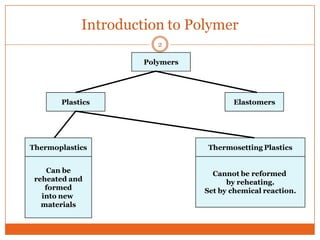
Introduction to Polymer
2
Polymers

Plastics

Elastomers

Thermoplastics

Thermosetting Plastics

Can be
reheated and
formed
into new
materials

Cannot be reformed
by reheating.
Set by chemical reaction.
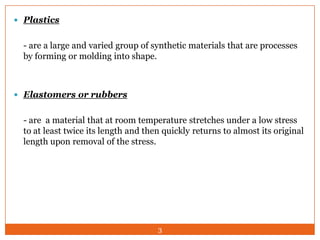
 Plastics

- are a large and varied group of synthetic materials that are processes
by forming or molding into shape.

 Elastomers or rubbers

- are a material that at room temperature stretches under a low stress
to at least twice its length and then quickly returns to almost its original
length upon removal of the stress.

3
 Thermoplastics

- Linear or branched polymers which chains of molecules are NOT
INTERCONNECTED to one another.
- Low density, low tensile strength, high insulation, good corrosion
resistance.
- Are considered to fracture primarily in a brittle mode.

 Thermosetting plastics

- Thermosetting or thermoset plastic are formed with a NETWORK
molecular structure of primary covalent bonds.
- High thermal and dimensional stability, rigidity, resistance to creep,
light weight.
- Are considered to fracture primarily by the brittle and ductile manner.

4
Question 1
5

a.

Define and differentiate polymers, plastics and elastomers.

b.

Give 3 example of thermoplastic and thermosetting plastic.

c.

Give 2 example application of thermoplastic and thermosetting
plastic.
Advantages of Polymer
6

 Wide range of properties.
 Minimum finishing.
 Minimum lubrication.
 Good insulation.
 Light weight.
 Noise Reduction.

c)

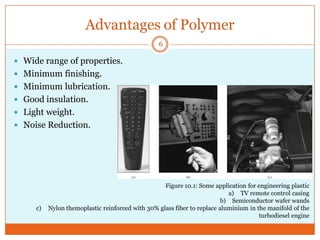
Figure 10.1: Some application for engineering plastic
a) TV remote control casing
b) Semiconductor wafer wands
Nylon themoplastic reinforced with 30% glass fiber to replace aluminium in the manifold of the
turbodiesel engine
Polymerization
7
 Polymerization:

- is the process by a small molecules consisting of one (monomer) or few
(oligomers) units are chemically joined to create a giant molecules.
 Chain growth polymerization:

- Small molecules covalently bond to form long chains (monomers) which in
turn bond to form polymers.
 Stepwise polymerization:

- Monomers chemically react with each other to produce linear polymers
and a small molecule of byproduct.
 Network polymerization:

- Chemical reaction takes place in more than two reaction sites (3D
network).
Chain Polymerization Steps
8
1.

Initiation:
 A radical is needed.
 Example: Ethylene
- One of free radicals react with ethylene molecule to form new longer
chain free radical.

2.

Propagation:

Process of extending polymer chain by addition of monomers.

Energy of system is lowered by polymerization.

3.

Termination: By addition of termination free radical.
 Or by combining of two chains
 Impurities.
Structural Feature of Polymers
9

 The simple molecules that are covalently bonded into long chains are

called monomers.

 The long chain molecule formed from the monomer units is called a

polymer.

 The number of active bonds in a monomer has is called

functionality.

 Homopolymers are polymeric materials that consist of polymer

chain made up of single repeating units.

 Copolymers consist of polymer chains made up of two or more

chemically different repeating units that can be in different sequences.
Mechanical Properties of Polymers
10

 Flexural and dynamic moduli

 Viscoelestic deformation
 Elastomeric deformation
 Creep deformation

 Stress relaxation
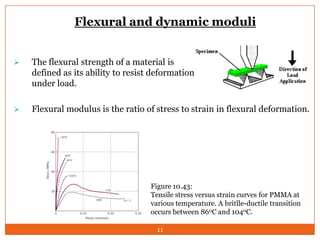
Flexural and dynamic moduli


The flexural strength of a material is
defined as its ability to resist deformation
under load.



Flexural modulus is the ratio of stress to strain in flexural deformation.

Figure 10.43:
Tensile stress versus strain curves for PMMA at
various temperature. A britlle-ductile transition
occurs between 860C and 1040C.
11
Viscoelestic deformation



Viscosity occur when temperature is above the glass transition
temperature.



Viscoelastic deformation of a material is the deformation by elastic
deformation and viscous flow of the material when stress is applied.

12
Elastomeric deformation


The strength of thermoplastics cam be considerably increased by
addition of reinforcements.



Thermosetting plastic without reinforcements are strengthened by
the creation of a network of covalent bonding throughout the
structure of the material.



During the elastic deformation, covalent bond of the molecular
chains are stretch and distort, allowing the chain to elongate
elastically.

13
Creep deformation
 Polymeric materials subjected to a load may creep.
Creep is a time dependent permanent deformation with constant stress
or load.
 Creep is low below Tg (above Tg, the behavior is viscoelastic). Glass fiber
reinforcements decreases creep.

14
Stress relaxation
 Stress relaxation is a reduction of the stress acting on a material over a
period of time at a constant strain due to viscoelastic deformation.
 Stress relaxation is due to breaking and formation of secondary bonds.
 Stress relaxation allow the material to attain a lower energy states
spontaneously if there is sufficient activation energy for the process to
occur.

15
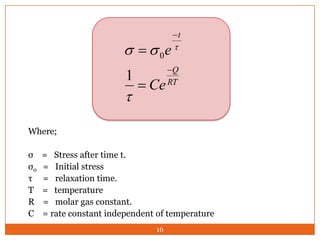
t

   0e 
1



 Ce

Q
RT

Where;
σ
σo
τ
T
R
C

= Stress after time t.
= Initial stress
= relaxation time.
= temperature
= molar gas constant.
= rate constant independent of temperature
16
Question 2
17

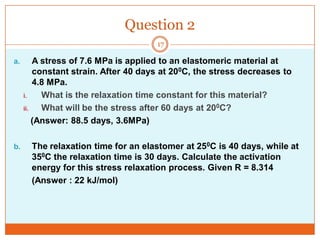
a.

b.

A stress of 7.6 MPa is applied to an elastomeric material at
constant strain. After 40 days at 200C, the stress decreases to
4.8 MPa.
i.
What is the relaxation time constant for this material?
ii.
What will be the stress after 60 days at 200C?
(Answer: 88.5 days, 3.6MPa)
The relaxation time for an elastomer at 250C is 40 days, while at
350C the relaxation time is 30 days. Calculate the activation
energy for this stress relaxation process. Given R = 8.314
(Answer : 22 kJ/mol)
Optical Properties of Polymers
18

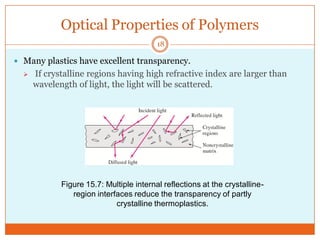
 Many plastics have excellent transparency.


If crystalline regions having high refractive index are larger than
wavelength of light, the light will be scattered.

Figure 15.7: Multiple internal reflections at the crystallineregion interfaces reduce the transparency of partly
crystalline thermoplastics.
Luminescence
19

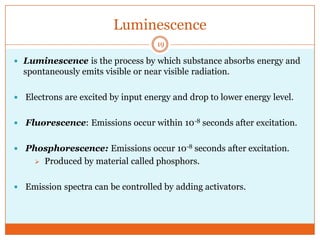
 Luminescence is the process by which substance absorbs energy and

spontaneously emits visible or near visible radiation.
 Electrons are excited by input energy and drop to lower energy level.
 Fluorescence: Emissions occur within 10-8 seconds after excitation.
 Phosphorescence: Emissions occur 10-8 seconds after excitation.


Produced by material called phosphors.

 Emission spectra can be controlled by adding activators.
Photoluminescence
20

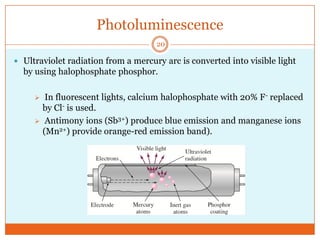
 Ultraviolet radiation from a mercury arc is converted into visible light

by using halophosphate phosphor.



In fluorescent lights, calcium halophosphate with 20% F - replaced
by Cl- is used.
Antimony ions (Sb3+) produce blue emission and manganese ions
(Mn2+) provide orange-red emission band).
Cathodoluminescence
21

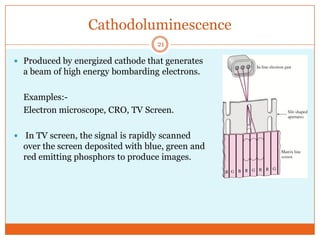
 Produced by energized cathode that generates

a beam of high energy bombarding electrons.
Examples:Electron microscope, CRO, TV Screen.
 In TV screen, the signal is rapidly scanned

over the screen deposited with blue, green and
red emitting phosphors to produce images.
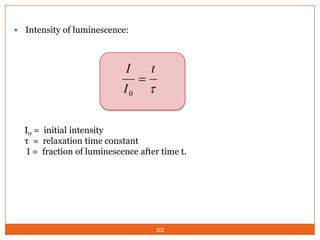
 Intensity of luminescence:

I
I0



t



I0 = initial intensity
τ = relaxation time constant
I = fraction of luminescence after time t.

22
Question 3
23

a.

A colour TV phosphor has a relaxation time of 3.9 x 10⁻³ s. How long
will it take for the intensity of this phosphor material to decrease to
10% of its original intensity?
(Answer : 9 x 10⁻³s)
References
24

 A.G. Guy (1972) Introduction to Material Science, McGraw Hill.
 J.F. Shackelford (2000). Introduction to Material Science for

Engineers, (5th Edition), Prentice Hall.
 W.F. Smith (1996). Principle to Material Science and Engineering, (3 rd
Edition), McGraw Hill.
 W.D. Callister Jr. (1997) Material Science and Engineering: An
Introduction, (4th Edition) John Wiley.

Phy351 ch 8

  • 1.
  • 2.
    Introduction to Polymer 2 Polymers Plastics Elastomers Thermoplastics ThermosettingPlastics Can be reheated and formed into new materials Cannot be reformed by reheating. Set by chemical reaction.
  • 3.
     Plastics - area large and varied group of synthetic materials that are processes by forming or molding into shape.  Elastomers or rubbers - are a material that at room temperature stretches under a low stress to at least twice its length and then quickly returns to almost its original length upon removal of the stress. 3
  • 4.
     Thermoplastics - Linearor branched polymers which chains of molecules are NOT INTERCONNECTED to one another. - Low density, low tensile strength, high insulation, good corrosion resistance. - Are considered to fracture primarily in a brittle mode.  Thermosetting plastics - Thermosetting or thermoset plastic are formed with a NETWORK molecular structure of primary covalent bonds. - High thermal and dimensional stability, rigidity, resistance to creep, light weight. - Are considered to fracture primarily by the brittle and ductile manner. 4
  • 5.
    Question 1 5 a. Define anddifferentiate polymers, plastics and elastomers. b. Give 3 example of thermoplastic and thermosetting plastic. c. Give 2 example application of thermoplastic and thermosetting plastic.
  • 6.
    Advantages of Polymer 6 Wide range of properties.  Minimum finishing.  Minimum lubrication.  Good insulation.  Light weight.  Noise Reduction. c) Figure 10.1: Some application for engineering plastic a) TV remote control casing b) Semiconductor wafer wands Nylon themoplastic reinforced with 30% glass fiber to replace aluminium in the manifold of the turbodiesel engine
  • 7.
    Polymerization 7  Polymerization: - isthe process by a small molecules consisting of one (monomer) or few (oligomers) units are chemically joined to create a giant molecules.  Chain growth polymerization: - Small molecules covalently bond to form long chains (monomers) which in turn bond to form polymers.  Stepwise polymerization: - Monomers chemically react with each other to produce linear polymers and a small molecule of byproduct.  Network polymerization: - Chemical reaction takes place in more than two reaction sites (3D network).
  • 8.
    Chain Polymerization Steps 8 1. Initiation: A radical is needed.  Example: Ethylene - One of free radicals react with ethylene molecule to form new longer chain free radical. 2. Propagation:  Process of extending polymer chain by addition of monomers.  Energy of system is lowered by polymerization. 3. Termination: By addition of termination free radical.  Or by combining of two chains  Impurities.
  • 9.
    Structural Feature ofPolymers 9  The simple molecules that are covalently bonded into long chains are called monomers.  The long chain molecule formed from the monomer units is called a polymer.  The number of active bonds in a monomer has is called functionality.  Homopolymers are polymeric materials that consist of polymer chain made up of single repeating units.  Copolymers consist of polymer chains made up of two or more chemically different repeating units that can be in different sequences.
  • 10.
    Mechanical Properties ofPolymers 10  Flexural and dynamic moduli  Viscoelestic deformation  Elastomeric deformation  Creep deformation  Stress relaxation
  • 11.
    Flexural and dynamicmoduli  The flexural strength of a material is defined as its ability to resist deformation under load.  Flexural modulus is the ratio of stress to strain in flexural deformation. Figure 10.43: Tensile stress versus strain curves for PMMA at various temperature. A britlle-ductile transition occurs between 860C and 1040C. 11
  • 12.
    Viscoelestic deformation  Viscosity occurwhen temperature is above the glass transition temperature.  Viscoelastic deformation of a material is the deformation by elastic deformation and viscous flow of the material when stress is applied. 12
  • 13.
    Elastomeric deformation  The strengthof thermoplastics cam be considerably increased by addition of reinforcements.  Thermosetting plastic without reinforcements are strengthened by the creation of a network of covalent bonding throughout the structure of the material.  During the elastic deformation, covalent bond of the molecular chains are stretch and distort, allowing the chain to elongate elastically. 13
  • 14.
    Creep deformation  Polymericmaterials subjected to a load may creep. Creep is a time dependent permanent deformation with constant stress or load.  Creep is low below Tg (above Tg, the behavior is viscoelastic). Glass fiber reinforcements decreases creep. 14
  • 15.
    Stress relaxation  Stressrelaxation is a reduction of the stress acting on a material over a period of time at a constant strain due to viscoelastic deformation.  Stress relaxation is due to breaking and formation of secondary bonds.  Stress relaxation allow the material to attain a lower energy states spontaneously if there is sufficient activation energy for the process to occur. 15
  • 16.
    t   0e  1   Ce Q RT Where; σ σo τ T R C = Stress after time t. = Initial stress = relaxation time. = temperature = molar gas constant. = rate constant independent of temperature 16
  • 17.
    Question 2 17 a. b. A stressof 7.6 MPa is applied to an elastomeric material at constant strain. After 40 days at 200C, the stress decreases to 4.8 MPa. i. What is the relaxation time constant for this material? ii. What will be the stress after 60 days at 200C? (Answer: 88.5 days, 3.6MPa) The relaxation time for an elastomer at 250C is 40 days, while at 350C the relaxation time is 30 days. Calculate the activation energy for this stress relaxation process. Given R = 8.314 (Answer : 22 kJ/mol)
  • 18.
    Optical Properties ofPolymers 18  Many plastics have excellent transparency.  If crystalline regions having high refractive index are larger than wavelength of light, the light will be scattered. Figure 15.7: Multiple internal reflections at the crystallineregion interfaces reduce the transparency of partly crystalline thermoplastics.
  • 19.
    Luminescence 19  Luminescence isthe process by which substance absorbs energy and spontaneously emits visible or near visible radiation.  Electrons are excited by input energy and drop to lower energy level.  Fluorescence: Emissions occur within 10-8 seconds after excitation.  Phosphorescence: Emissions occur 10-8 seconds after excitation.  Produced by material called phosphors.  Emission spectra can be controlled by adding activators.
  • 20.
    Photoluminescence 20  Ultraviolet radiationfrom a mercury arc is converted into visible light by using halophosphate phosphor.   In fluorescent lights, calcium halophosphate with 20% F - replaced by Cl- is used. Antimony ions (Sb3+) produce blue emission and manganese ions (Mn2+) provide orange-red emission band).
  • 21.
    Cathodoluminescence 21  Produced byenergized cathode that generates a beam of high energy bombarding electrons. Examples:Electron microscope, CRO, TV Screen.  In TV screen, the signal is rapidly scanned over the screen deposited with blue, green and red emitting phosphors to produce images.
  • 22.
     Intensity ofluminescence: I I0  t  I0 = initial intensity τ = relaxation time constant I = fraction of luminescence after time t. 22
  • 23.
    Question 3 23 a. A colourTV phosphor has a relaxation time of 3.9 x 10⁻³ s. How long will it take for the intensity of this phosphor material to decrease to 10% of its original intensity? (Answer : 9 x 10⁻³s)
  • 24.
    References 24  A.G. Guy(1972) Introduction to Material Science, McGraw Hill.  J.F. Shackelford (2000). Introduction to Material Science for Engineers, (5th Edition), Prentice Hall.  W.F. Smith (1996). Principle to Material Science and Engineering, (3 rd Edition), McGraw Hill.  W.D. Callister Jr. (1997) Material Science and Engineering: An Introduction, (4th Edition) John Wiley.