Chapter 18
Copyright © 2010 Pearson Education, Inc.
Organic Chemistry, 7th
Edition
L. G. Wade, Jr.
Ketones and Aldehydes
Chapter 18 2
Carbonyl Compounds
Chapter 18 3
Carbonyl Structure
 Carbon is sp2
hybridized.
 C═O bond is shorter, stronger, and more
polar than C═C bond in alkenes.
Chapter 18 4
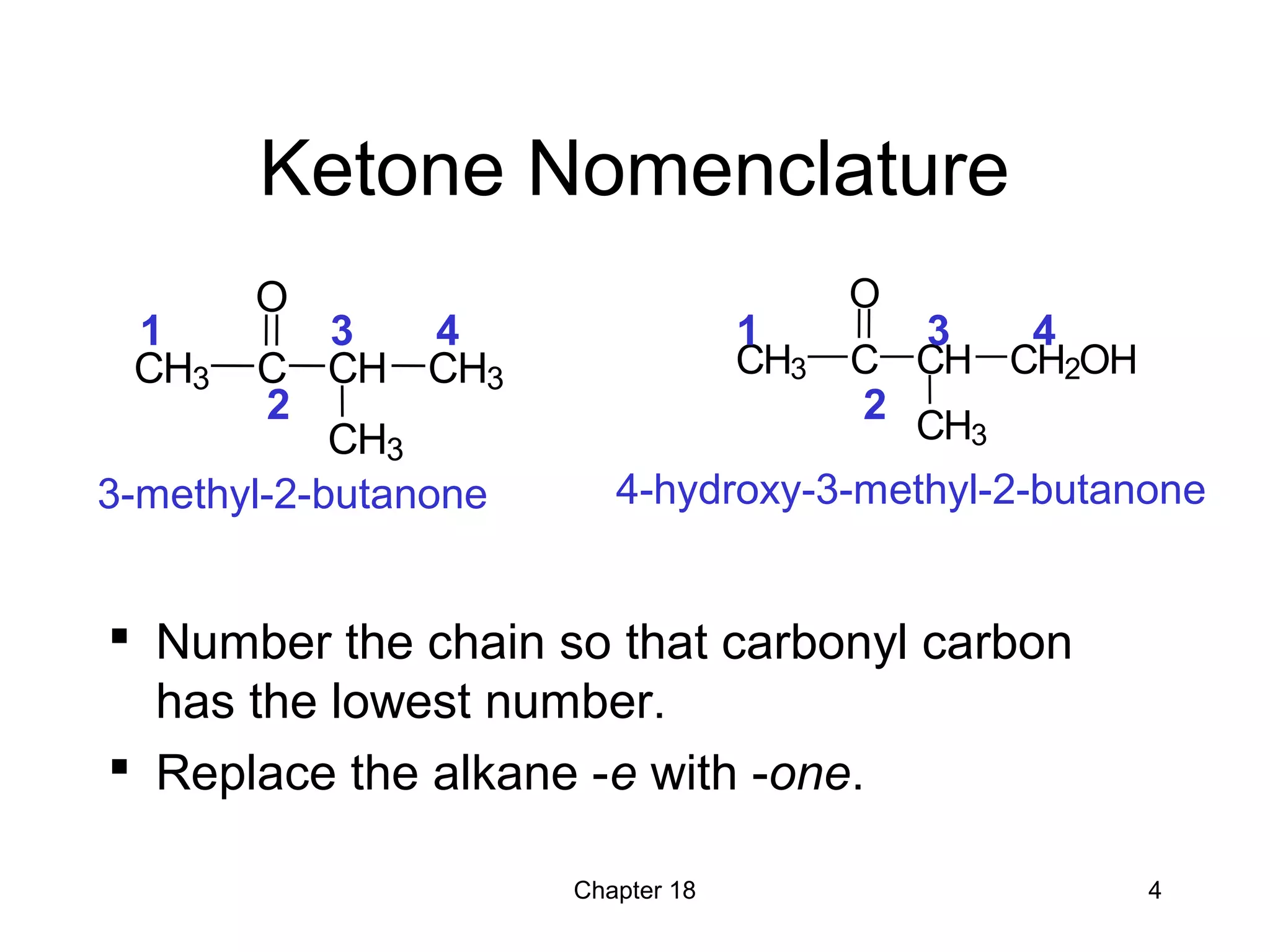
Ketone Nomenclature
 Number the chain so that carbonyl carbon
has the lowest number.
 Replace the alkane -e with -one.
3-methyl-2-butanone 4-hydroxy-3-methyl-2-butanone
CH3 C
O
CH
CH3
CH3 CH3 C
O
CH
CH3
CH2OH
1
2
3 4 1
2
3 4
Chapter 18 5
Ketone Nomenclature
(Continued)
 For cyclic ketones, the carbonyl carbon is
assigned the number 1.
3-bromocyclohexanone
O
Br
1
3
Chapter 18 6
CH3 CH2 CH
CH3
CH2 C H
O
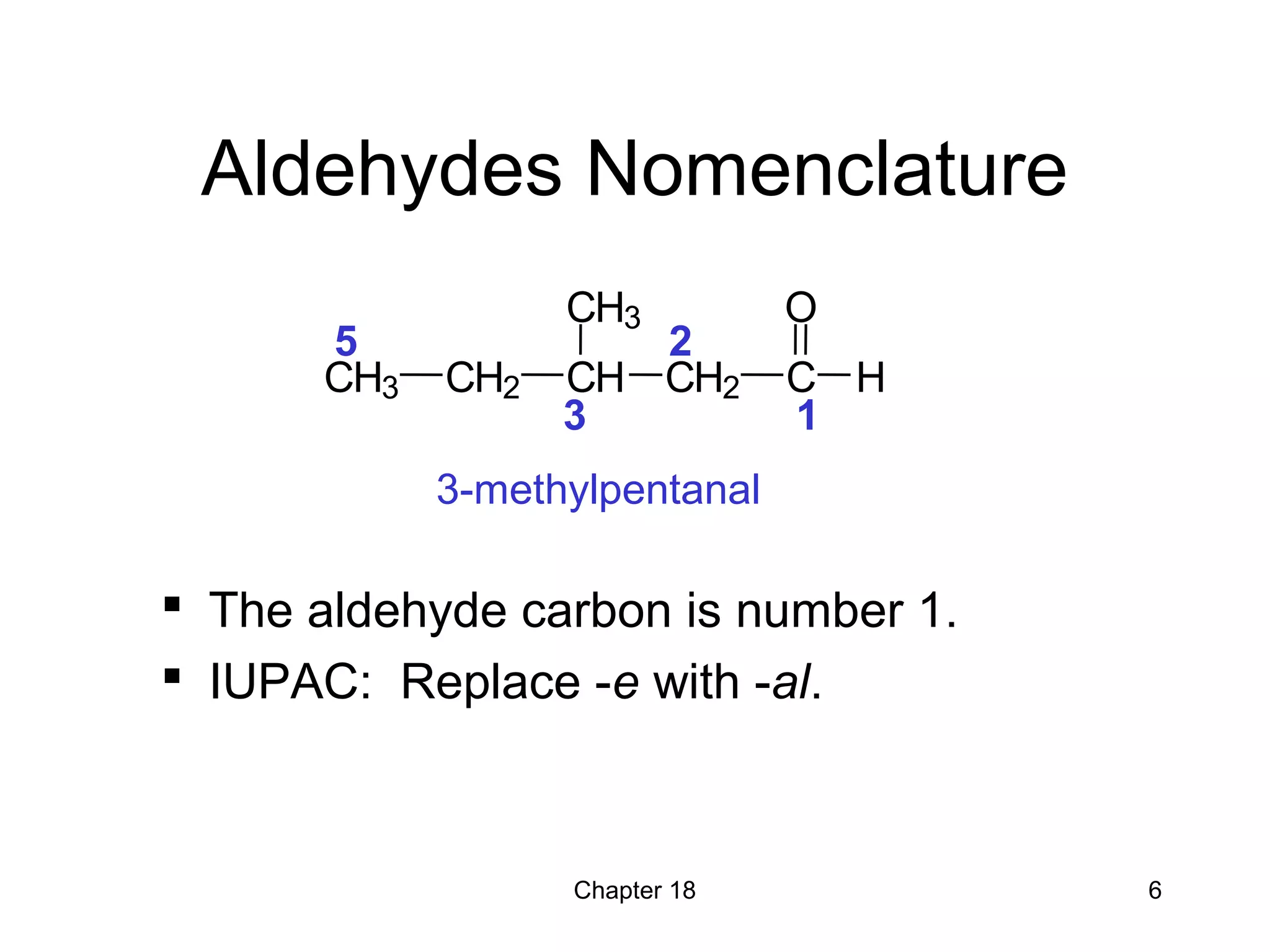
Aldehydes Nomenclature
 The aldehyde carbon is number 1.
 IUPAC: Replace -e with -al.
3-methylpentanal
1
2
3
5
Chapter 18 7
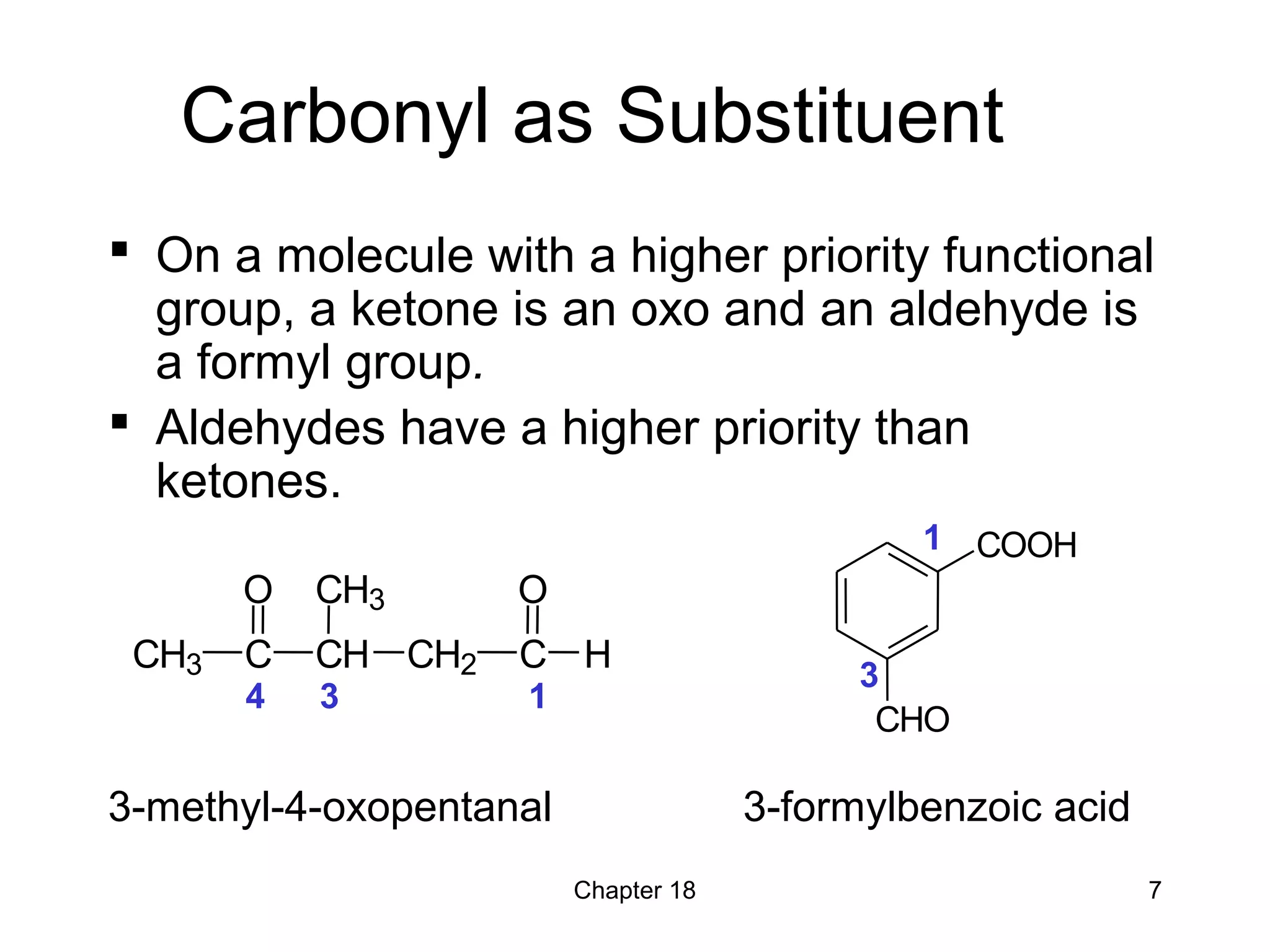
Carbonyl as Substituent
 On a molecule with a higher priority functional
group, a ketone is an oxo and an aldehyde is
a formyl group.
 Aldehydes have a higher priority than
ketones.
3-methyl-4-oxopentanal 3-formylbenzoic acid
134
1
3
CH3 C CH
CH3
CH2 C H
OO
COOH
CHO
Chapter 18 8
Common Names for Ketones
 Named as alkyl attachments to —C═O.
 Use Greek letters instead of numbers.
methyl isopropyl ketone α−bromoethyl isopropyl ketone
CH3 C
O
CH
CH3
CH3 CH3CH C
O
CH
CH3
CH3
Br
Chapter 18 9
Historical Common Names
CH3 C
O
CH3
C
CH3
O
C
O
acetone acetophenone
benzophenone
Chapter 18 10
Boiling Points
 Ketones and aldehydes are more polar, so they have
a higher boiling point than comparable alkanes or
ethers.
 They cannot hydrogen-bond to each other, so their
boiling point is lower than comparable alcohol.
Chapter 18 11
Solubility of Ketones and
Aldehydes
 Good solvent for
alcohols.
 Lone pair of electrons
on oxygen of carbonyl
can accept a hydrogen
bond from O—H or
N—H.
 Acetone and
acetaldehyde are
miscible in water.
Chapter 18 12
Formaldehyde
 Gas at room temperature.
 Formalin is a 40% aqueous solution.
trioxane, m.p. 62°C
formaldehyde,
b.p. -21°C
formalin
O
C
O
C
O
C
H H
H
H
H
H
heat
H C
O
H
H2O
H C
H
OH
HO
Chapter 18 13
Infrared (IR) Spectroscopy
 Very strong C═O stretch around 1710 cm-1
.
 Additional C—H stretches for aldehyde: Two
absorptions at 2710 cm-1
and 2810 cm-1
.
Chapter 18 14
IR Spectra
 Conjugation lowers the carbonyl stretching
frequencies to about 1685 cm-1
.
 Rings that have ring strain have higher C═O
frequencies.
Chapter 18 15
Proton NMR Spectra
 Aldehyde protons normally absorb between
δ9 and δ 10.
 Protons of the α-carbon usually absorb
between δ 2.1 and δ 2.4 if there are no other
electron-withdrawing groups nearby.
Chapter 18 16
1
H NMR Spectroscopy
 Protons closer to the carbonyl group are
more deshielded.
Chapter 18 17
Carbon NMR Spectra of Ketones
 The spin-decoupled carbon NMR spectrum of 2-
heptanone shows the carbonyl carbon at 208 ppm
and the α carbon at 30 ppm (methyl) and 44 ppm
(methylene).
Chapter 18 18
Mass Spectrometry (MS)
Chapter 18 19
MS for Butyraldehyde
Chapter 18 20
McLafferty Rearrangement
 The net result of this rearrangement is the breaking
of the α, β bond, and the transfer of a proton from the
γ carbon to the oxygen.
 An alkene is formed as a product of this
rearrangement through the tautomerization of the
enol.
Chapter 18 21
Ultraviolet Spectra of Conjugated
Carbonyl Compounds
 Conjugated carbonyl compounds have characteristic
π -π* absorption in the UV spectrum.
 An additional conjugated C═C increases λmax about 30
nm; an additional alkyl group increases it about 10
nm.
Chapter 18 22
Electronic Transitions of the C═O
 Small molar absorptivity.
 “Forbidden” transition occurs less frequently.
Chapter 18 23
Industrial Importance
 Acetone and methyl ethyl ketone are
important solvents.
 Formaldehyde is used in polymers like
Bakelite®
.
 Flavorings and additives like vanilla,
cinnamon, and artificial butter.
Chapter 18 24
Chapter 18 25
Oxidation of Secondary Alcohols
to Ketones
 Secondary alcohols are readily oxidized to
ketones with sodium dichromate (Na2Cr2O7) in
sulfuric acid or by potassium permanganate
(KMnO4).
Chapter 18 26
Oxidation of Primary Alcohols to
Aldehydes
 Pyridinium chlorochromate (PCC) is
selectively used to oxidize primary alcohols to
aldehydes.
Chapter 18 27
Ozonolysis of Alkenes
 The double bond is oxidatively cleaved by
ozone followed by reduction.
 Ketones and aldehydes can be isolated as
products.
Chapter 18 28
Friedel–Crafts Reaction
 Reaction between an acyl halide and an
aromatic ring will produce a ketone.
Chapter 18 29
Hydration of Alkynes
 The initial product of Markovnikov hydration is an enol,
which quickly tautomerizes to its keto form.
 Internal alkynes can be hydrated, but mixtures of
ketones often result.
Chapter 18 30
Hydroboration–Oxidation of
Alkynes
 Hydroboration–oxidation of an alkyne gives
anti-Markovnikov addition of water across the
triple bond.
Chapter 18 31
Show how you would synthesize each compound from starting materials containing no more than six
carbon atoms.
(a) (b)
(a) This compound is a ketone with 12 carbon atoms. The carbon skeleton might be assembled from
two six-carbon fragments using a Grignard reaction, which gives an alcohol that is easily oxidized
to the target compound.
Solved Problem 1
Solution
Chapter 18 32
An alternative route to the target compound involves Friedel–Crafts acylation.
(b) This compound is an aldehyde with eight carbon atoms. An aldehyde might come from oxidation
of an alcohol (possibly a Grignard product) or hydroboration of an alkyne. If we use a Grignard,
the restriction to six-carbon starting materials means we need to add two carbons to a
methylcyclopentyl fragment, ending in a primary alcohol. Grignard addition to an epoxide does
this.
Solved Problem 1 (Continued)
Solution (Continued)
Chapter 18 33
Alternatively, we could construct the carbon skeleton using acetylene as the two-carbon fragment.
The resulting terminal alkyne undergoes hydroboration to the correct aldehyde.
Solved Problem 1 (Continued)
Solution (Continued)
Chapter 18 34
Synthesis of Ketones and
Aldehydes Using 1,3-Dithianes
 1,3-Dithiane can be deprotonated by strong
bases such as n-butyllithium.
 The resulting carbanion is stabilized by the
electron-withdrawing effects of two
polarizable sulfur atoms.
Chapter 18 35
Alkylation of 1,3-Dithiane
 Alkylation of the dithiane anion by a primary
alkyl halide or a tosylate gives a thioacetal
that can be hydrolyzed into the aldehyde by
using an acidic solution of mercuric chloride.
Chapter 18 36
Ketones from 1,3-Dithiane
 The thioacetal can be isolated and deprotonated.
 Alkylation and hydrolysis will produce a ketone.
Chapter 18 37
Synthesis of Ketones from
Carboxylic Acids
 Organolithiums will attack the lithium salts of
carboxylate anions to give dianions.
 Protonation of the dianion forms the hydrate
of a ketone, which quickly loses water to give
the ketone.
Chapter 18 38
Ketones from Nitriles
 A Grignard or organolithium reagent can
attack the carbon of the nitrile.
 The imine is then hydrolyzed to form a
ketone.
Chapter 18 39
Aldehydes from Acid
Chlorides
 Lithium aluminum tri(t-butoxy)hydride is a
milder reducing agent that reacts faster with
acid chlorides than with aldehydes.
Chapter 18 40
Lithium Dialkyl Cuprate
Reagents
 A lithium dialkylcuprate (Gilman reagent) will
transfer one of its alkyl groups to the acid
chloride.
Chapter 18 41
Nucleophilic Addition
 A strong nucleophile attacks the carbonyl
carbon, forming an alkoxide ion that is then
protonated.
 Aldehydes are more reactive than ketones.
Chapter 18 42
The Wittig Reaction
 The Wittig reaction converts the carbonyl
group into a new C═C double bond where no
bond existed before.
 A phosphorus ylide is used as the nucleophile
in the reaction.
Chapter 18 43
Preparation of Phosphorus Ylides
 Prepared from triphenylphosphine and an
unhindered alkyl halide.
 Butyllithium then abstracts a hydrogen from
the carbon attached to phosphorus.
Chapter 18 44
Mechanism of the Wittig Reaction
Betaine formation
Oxaphosphetane formation
Chapter 18 45
Mechanism for Wittig
 The oxaphosphetane will collapse, forming
carbonyl (ketone or aldehyde) and a molecule
of triphenyl phosphine oxide.
Chapter 18 46
Show how you would use a Wittig reaction to synthesize 1-phenyl-1,3-butadiene.
Solved Problem 2
Chapter 18 47
This molecule has two double bonds that might be formed by Wittig reactions. The central double bond
could be formed in either of two ways. Both of these syntheses will probably work, and both will
produce a mixture of cis and trans isomers.
You should complete this solution by drawing out the syntheses indicated by this analysis (Problem 18-
16).
Solved Problem 2 (Continued)
Solution (Continued)
Chapter 18 48
Hydration of Ketones and
Aldehydes
 In an aqueous solution, a ketone or an
aldehyde is in equilibrium with its hydrate, a
geminal diol.
 With ketones, the equilibrium favors the
unhydrated keto form (carbonyl).
Chapter 18 49
Mechanism of Hydration of
Ketones and Aldehydes
 Hydration occurs through the nucleophilic addition
mechanism, with water (in acid) or hydroxide (in
base) serving as the nucleophile.
Chapter 18 50
Cyanohydrin Formation
 The mechanism is a base-catalyzed nucleophilic
addition: Attack by cyanide ion on the carbonyl group,
followed by protonation of the intermediate.
 HCN is highly toxic.
Chapter 18 51
Formation of Imines
 Ammonia or a primary amine reacts with a ketone or
an aldehyde to form an imine.
 Imines are nitrogen analogues of ketones and
aldehydes with a C═N bond in place of the carbonyl
group.
 Optimum pH is around 4.5
Chapter 18 52
Mechanism of Imine Formation
Acid-catalyzed addition of the amine to the carbonyl
compound group.
Acid-catalyzed dehydration.
Chapter 18 53
Other Condensations with Amines
Chapter 18 54
Formation of Acetals
Chapter 18 55
Mechanism for Hemiacetal
Formation
 Must be acid-catalyzed.
 Adding H+
to carbonyl makes it more reactive
with weak nucleophile, ROH.
Chapter 18 56
Acetal Formation
Chapter 18 57
Cyclic Acetals
 Addition of a diol produces a cyclic acetal.
 The reaction is reversible.
 This reaction is used in synthesis to protect
carbonyls from reaction
Chapter 18 58
Acetals as Protecting Groups
O
H
O
HO
OH
H+
H
O
OO
 Hydrolyze easily in acid; stable in base.
 Aldehydes are more reactive than ketones.
Chapter 18 59
Reaction and Deprotection
H
O
OO
1) NaBH4
2) H3O+
O
H
OH
 The acetal will not react with NaBH4, so only
the ketone will get reduced.
 Hydrolysis conditions will protonate the
alcohol and remove the acetal to restore the
aldehyde.
Chapter 18 60
Oxidation of Aldehydes
Aldehydes are easily oxidized to carboxylic acids.
Chapter 18 61
Reduction Reagents
 Sodium borohydride, NaBH4, can reduce
ketones to secondary alcohols and aldehydes
to primary alcohols.
 Lithium aluminum hydride, LiAlH4, is a
powerful reducing agent, so it can also
reduce carboxylic acids and their derivatives.
 Hydrogenation with a catalyst can reduce the
carbonyl, but it will also reduce any double or
triple bonds present in the molecule.
Chapter 18 62
Sodium Borohydride
aldehyde or ketone
R R(H)
O
NaBH4
CH3OH R R(H)
OH
H
• NaBH4 can reduce ketones and aldehydes, but not
esters, carboxylic acids, acyl chlorides, or amides.
Chapter 18 63
Lithium Aluminum Hydride
R R(H)
OH
H
R R(H)
O
LiAlH4
ether
aldehyde or ketone
 LiAlH4 can reduce any carbonyl because it is
a very strong reducing agent.
 Difficult to handle.
Chapter 18 64
Catalytic Hydrogenation
 Widely used in industry.
 Raney nickel is finely divided Ni powder
saturated with hydrogen gas.
 It will attack the alkene first, then the carbonyl.
O
H2
Raney Ni
OH
Chapter 18 65
Deoxygenation of Ketones and
Aldehydes
 The Clemmensen reduction or the Wolff–
Kishner reduction can be used to
deoxygenate ketones and aldehydes.
Chapter 18 66
Clemmensen Reduction
C
O
CH2CH3 Zn(Hg)
HCl, H2O
CH2CH2CH3
CH2 C
O
H HCl, H2O
Zn(Hg)
CH2 CH3
Chapter 18 67
Wolff–Kishner Reduction
 Forms hydrazone, then heat with strong base
like KOH or potassium tert-butoxide.
 Use a high-boiling solvent: ethylene glycol,
diethylene glycol, or DMSO.
 A molecule of nitrogen is lost in the last steps
of the reaction.

18 - Ketones and Aldehydes - Wade 7th

  • 1.
    Chapter 18 Copyright ©2010 Pearson Education, Inc. Organic Chemistry, 7th Edition L. G. Wade, Jr. Ketones and Aldehydes
  • 2.
  • 3.
    Chapter 18 3 CarbonylStructure  Carbon is sp2 hybridized.  C═O bond is shorter, stronger, and more polar than C═C bond in alkenes.
  • 4.
    Chapter 18 4 KetoneNomenclature  Number the chain so that carbonyl carbon has the lowest number.  Replace the alkane -e with -one. 3-methyl-2-butanone 4-hydroxy-3-methyl-2-butanone CH3 C O CH CH3 CH3 CH3 C O CH CH3 CH2OH 1 2 3 4 1 2 3 4
  • 5.
    Chapter 18 5 KetoneNomenclature (Continued)  For cyclic ketones, the carbonyl carbon is assigned the number 1. 3-bromocyclohexanone O Br 1 3
  • 6.
    Chapter 18 6 CH3CH2 CH CH3 CH2 C H O Aldehydes Nomenclature  The aldehyde carbon is number 1.  IUPAC: Replace -e with -al. 3-methylpentanal 1 2 3 5
  • 7.
    Chapter 18 7 Carbonylas Substituent  On a molecule with a higher priority functional group, a ketone is an oxo and an aldehyde is a formyl group.  Aldehydes have a higher priority than ketones. 3-methyl-4-oxopentanal 3-formylbenzoic acid 134 1 3 CH3 C CH CH3 CH2 C H OO COOH CHO
  • 8.
    Chapter 18 8 CommonNames for Ketones  Named as alkyl attachments to —C═O.  Use Greek letters instead of numbers. methyl isopropyl ketone α−bromoethyl isopropyl ketone CH3 C O CH CH3 CH3 CH3CH C O CH CH3 CH3 Br
  • 9.
    Chapter 18 9 HistoricalCommon Names CH3 C O CH3 C CH3 O C O acetone acetophenone benzophenone
  • 10.
    Chapter 18 10 BoilingPoints  Ketones and aldehydes are more polar, so they have a higher boiling point than comparable alkanes or ethers.  They cannot hydrogen-bond to each other, so their boiling point is lower than comparable alcohol.
  • 11.
    Chapter 18 11 Solubilityof Ketones and Aldehydes  Good solvent for alcohols.  Lone pair of electrons on oxygen of carbonyl can accept a hydrogen bond from O—H or N—H.  Acetone and acetaldehyde are miscible in water.
  • 12.
    Chapter 18 12 Formaldehyde Gas at room temperature.  Formalin is a 40% aqueous solution. trioxane, m.p. 62°C formaldehyde, b.p. -21°C formalin O C O C O C H H H H H H heat H C O H H2O H C H OH HO
  • 13.
    Chapter 18 13 Infrared(IR) Spectroscopy  Very strong C═O stretch around 1710 cm-1 .  Additional C—H stretches for aldehyde: Two absorptions at 2710 cm-1 and 2810 cm-1 .
  • 14.
    Chapter 18 14 IRSpectra  Conjugation lowers the carbonyl stretching frequencies to about 1685 cm-1 .  Rings that have ring strain have higher C═O frequencies.
  • 15.
    Chapter 18 15 ProtonNMR Spectra  Aldehyde protons normally absorb between δ9 and δ 10.  Protons of the α-carbon usually absorb between δ 2.1 and δ 2.4 if there are no other electron-withdrawing groups nearby.
  • 16.
    Chapter 18 16 1 HNMR Spectroscopy  Protons closer to the carbonyl group are more deshielded.
  • 17.
    Chapter 18 17 CarbonNMR Spectra of Ketones  The spin-decoupled carbon NMR spectrum of 2- heptanone shows the carbonyl carbon at 208 ppm and the α carbon at 30 ppm (methyl) and 44 ppm (methylene).
  • 18.
    Chapter 18 18 MassSpectrometry (MS)
  • 19.
    Chapter 18 19 MSfor Butyraldehyde
  • 20.
    Chapter 18 20 McLaffertyRearrangement  The net result of this rearrangement is the breaking of the α, β bond, and the transfer of a proton from the γ carbon to the oxygen.  An alkene is formed as a product of this rearrangement through the tautomerization of the enol.
  • 21.
    Chapter 18 21 UltravioletSpectra of Conjugated Carbonyl Compounds  Conjugated carbonyl compounds have characteristic π -π* absorption in the UV spectrum.  An additional conjugated C═C increases λmax about 30 nm; an additional alkyl group increases it about 10 nm.
  • 22.
    Chapter 18 22 ElectronicTransitions of the C═O  Small molar absorptivity.  “Forbidden” transition occurs less frequently.
  • 23.
    Chapter 18 23 IndustrialImportance  Acetone and methyl ethyl ketone are important solvents.  Formaldehyde is used in polymers like Bakelite® .  Flavorings and additives like vanilla, cinnamon, and artificial butter.
  • 24.
  • 25.
    Chapter 18 25 Oxidationof Secondary Alcohols to Ketones  Secondary alcohols are readily oxidized to ketones with sodium dichromate (Na2Cr2O7) in sulfuric acid or by potassium permanganate (KMnO4).
  • 26.
    Chapter 18 26 Oxidationof Primary Alcohols to Aldehydes  Pyridinium chlorochromate (PCC) is selectively used to oxidize primary alcohols to aldehydes.
  • 27.
    Chapter 18 27 Ozonolysisof Alkenes  The double bond is oxidatively cleaved by ozone followed by reduction.  Ketones and aldehydes can be isolated as products.
  • 28.
    Chapter 18 28 Friedel–CraftsReaction  Reaction between an acyl halide and an aromatic ring will produce a ketone.
  • 29.
    Chapter 18 29 Hydrationof Alkynes  The initial product of Markovnikov hydration is an enol, which quickly tautomerizes to its keto form.  Internal alkynes can be hydrated, but mixtures of ketones often result.
  • 30.
    Chapter 18 30 Hydroboration–Oxidationof Alkynes  Hydroboration–oxidation of an alkyne gives anti-Markovnikov addition of water across the triple bond.
  • 31.
    Chapter 18 31 Showhow you would synthesize each compound from starting materials containing no more than six carbon atoms. (a) (b) (a) This compound is a ketone with 12 carbon atoms. The carbon skeleton might be assembled from two six-carbon fragments using a Grignard reaction, which gives an alcohol that is easily oxidized to the target compound. Solved Problem 1 Solution
  • 32.
    Chapter 18 32 Analternative route to the target compound involves Friedel–Crafts acylation. (b) This compound is an aldehyde with eight carbon atoms. An aldehyde might come from oxidation of an alcohol (possibly a Grignard product) or hydroboration of an alkyne. If we use a Grignard, the restriction to six-carbon starting materials means we need to add two carbons to a methylcyclopentyl fragment, ending in a primary alcohol. Grignard addition to an epoxide does this. Solved Problem 1 (Continued) Solution (Continued)
  • 33.
    Chapter 18 33 Alternatively,we could construct the carbon skeleton using acetylene as the two-carbon fragment. The resulting terminal alkyne undergoes hydroboration to the correct aldehyde. Solved Problem 1 (Continued) Solution (Continued)
  • 34.
    Chapter 18 34 Synthesisof Ketones and Aldehydes Using 1,3-Dithianes  1,3-Dithiane can be deprotonated by strong bases such as n-butyllithium.  The resulting carbanion is stabilized by the electron-withdrawing effects of two polarizable sulfur atoms.
  • 35.
    Chapter 18 35 Alkylationof 1,3-Dithiane  Alkylation of the dithiane anion by a primary alkyl halide or a tosylate gives a thioacetal that can be hydrolyzed into the aldehyde by using an acidic solution of mercuric chloride.
  • 36.
    Chapter 18 36 Ketonesfrom 1,3-Dithiane  The thioacetal can be isolated and deprotonated.  Alkylation and hydrolysis will produce a ketone.
  • 37.
    Chapter 18 37 Synthesisof Ketones from Carboxylic Acids  Organolithiums will attack the lithium salts of carboxylate anions to give dianions.  Protonation of the dianion forms the hydrate of a ketone, which quickly loses water to give the ketone.
  • 38.
    Chapter 18 38 Ketonesfrom Nitriles  A Grignard or organolithium reagent can attack the carbon of the nitrile.  The imine is then hydrolyzed to form a ketone.
  • 39.
    Chapter 18 39 Aldehydesfrom Acid Chlorides  Lithium aluminum tri(t-butoxy)hydride is a milder reducing agent that reacts faster with acid chlorides than with aldehydes.
  • 40.
    Chapter 18 40 LithiumDialkyl Cuprate Reagents  A lithium dialkylcuprate (Gilman reagent) will transfer one of its alkyl groups to the acid chloride.
  • 41.
    Chapter 18 41 NucleophilicAddition  A strong nucleophile attacks the carbonyl carbon, forming an alkoxide ion that is then protonated.  Aldehydes are more reactive than ketones.
  • 42.
    Chapter 18 42 TheWittig Reaction  The Wittig reaction converts the carbonyl group into a new C═C double bond where no bond existed before.  A phosphorus ylide is used as the nucleophile in the reaction.
  • 43.
    Chapter 18 43 Preparationof Phosphorus Ylides  Prepared from triphenylphosphine and an unhindered alkyl halide.  Butyllithium then abstracts a hydrogen from the carbon attached to phosphorus.
  • 44.
    Chapter 18 44 Mechanismof the Wittig Reaction Betaine formation Oxaphosphetane formation
  • 45.
    Chapter 18 45 Mechanismfor Wittig  The oxaphosphetane will collapse, forming carbonyl (ketone or aldehyde) and a molecule of triphenyl phosphine oxide.
  • 46.
    Chapter 18 46 Showhow you would use a Wittig reaction to synthesize 1-phenyl-1,3-butadiene. Solved Problem 2
  • 47.
    Chapter 18 47 Thismolecule has two double bonds that might be formed by Wittig reactions. The central double bond could be formed in either of two ways. Both of these syntheses will probably work, and both will produce a mixture of cis and trans isomers. You should complete this solution by drawing out the syntheses indicated by this analysis (Problem 18- 16). Solved Problem 2 (Continued) Solution (Continued)
  • 48.
    Chapter 18 48 Hydrationof Ketones and Aldehydes  In an aqueous solution, a ketone or an aldehyde is in equilibrium with its hydrate, a geminal diol.  With ketones, the equilibrium favors the unhydrated keto form (carbonyl).
  • 49.
    Chapter 18 49 Mechanismof Hydration of Ketones and Aldehydes  Hydration occurs through the nucleophilic addition mechanism, with water (in acid) or hydroxide (in base) serving as the nucleophile.
  • 50.
    Chapter 18 50 CyanohydrinFormation  The mechanism is a base-catalyzed nucleophilic addition: Attack by cyanide ion on the carbonyl group, followed by protonation of the intermediate.  HCN is highly toxic.
  • 51.
    Chapter 18 51 Formationof Imines  Ammonia or a primary amine reacts with a ketone or an aldehyde to form an imine.  Imines are nitrogen analogues of ketones and aldehydes with a C═N bond in place of the carbonyl group.  Optimum pH is around 4.5
  • 52.
    Chapter 18 52 Mechanismof Imine Formation Acid-catalyzed addition of the amine to the carbonyl compound group. Acid-catalyzed dehydration.
  • 53.
    Chapter 18 53 OtherCondensations with Amines
  • 54.
  • 55.
    Chapter 18 55 Mechanismfor Hemiacetal Formation  Must be acid-catalyzed.  Adding H+ to carbonyl makes it more reactive with weak nucleophile, ROH.
  • 56.
  • 57.
    Chapter 18 57 CyclicAcetals  Addition of a diol produces a cyclic acetal.  The reaction is reversible.  This reaction is used in synthesis to protect carbonyls from reaction
  • 58.
    Chapter 18 58 Acetalsas Protecting Groups O H O HO OH H+ H O OO  Hydrolyze easily in acid; stable in base.  Aldehydes are more reactive than ketones.
  • 59.
    Chapter 18 59 Reactionand Deprotection H O OO 1) NaBH4 2) H3O+ O H OH  The acetal will not react with NaBH4, so only the ketone will get reduced.  Hydrolysis conditions will protonate the alcohol and remove the acetal to restore the aldehyde.
  • 60.
    Chapter 18 60 Oxidationof Aldehydes Aldehydes are easily oxidized to carboxylic acids.
  • 61.
    Chapter 18 61 ReductionReagents  Sodium borohydride, NaBH4, can reduce ketones to secondary alcohols and aldehydes to primary alcohols.  Lithium aluminum hydride, LiAlH4, is a powerful reducing agent, so it can also reduce carboxylic acids and their derivatives.  Hydrogenation with a catalyst can reduce the carbonyl, but it will also reduce any double or triple bonds present in the molecule.
  • 62.
    Chapter 18 62 SodiumBorohydride aldehyde or ketone R R(H) O NaBH4 CH3OH R R(H) OH H • NaBH4 can reduce ketones and aldehydes, but not esters, carboxylic acids, acyl chlorides, or amides.
  • 63.
    Chapter 18 63 LithiumAluminum Hydride R R(H) OH H R R(H) O LiAlH4 ether aldehyde or ketone  LiAlH4 can reduce any carbonyl because it is a very strong reducing agent.  Difficult to handle.
  • 64.
    Chapter 18 64 CatalyticHydrogenation  Widely used in industry.  Raney nickel is finely divided Ni powder saturated with hydrogen gas.  It will attack the alkene first, then the carbonyl. O H2 Raney Ni OH
  • 65.
    Chapter 18 65 Deoxygenationof Ketones and Aldehydes  The Clemmensen reduction or the Wolff– Kishner reduction can be used to deoxygenate ketones and aldehydes.
  • 66.
    Chapter 18 66 ClemmensenReduction C O CH2CH3 Zn(Hg) HCl, H2O CH2CH2CH3 CH2 C O H HCl, H2O Zn(Hg) CH2 CH3
  • 67.
    Chapter 18 67 Wolff–KishnerReduction  Forms hydrazone, then heat with strong base like KOH or potassium tert-butoxide.  Use a high-boiling solvent: ethylene glycol, diethylene glycol, or DMSO.  A molecule of nitrogen is lost in the last steps of the reaction.

Editor's Notes

  • #32 Copyright © 2006 Pearson Prentice Hall, Inc.
  • #33 Copyright © 2006 Pearson Prentice Hall, Inc.
  • #34 Copyright © 2006 Pearson Prentice Hall, Inc.
  • #47 Copyright © 2006 Pearson Prentice Hall, Inc.
  • #48 Copyright © 2006 Pearson Prentice Hall, Inc.