Seminar
On

“Brain Computer Interface: Next Generation of Human Computer
Interaction”
By

Suraj S.Kasture
(Final Year A-Section)
Under the guidance of
Prof. A. P. Jadhao

Department Of Computer Science and Engineering
Jawaharlal Darda Institute of Engineering & Technology,
Yavatmal, (M.S), India-445001

Session 2013-14
Contents
 Introduction
 Literature Review
 Mechanism Of BCI
 Significance And Relevance Of BCI Technology
 BCI Application
 Challenges For BCI
 The Future Of BCI Technologies
 Conclusion
Introduction
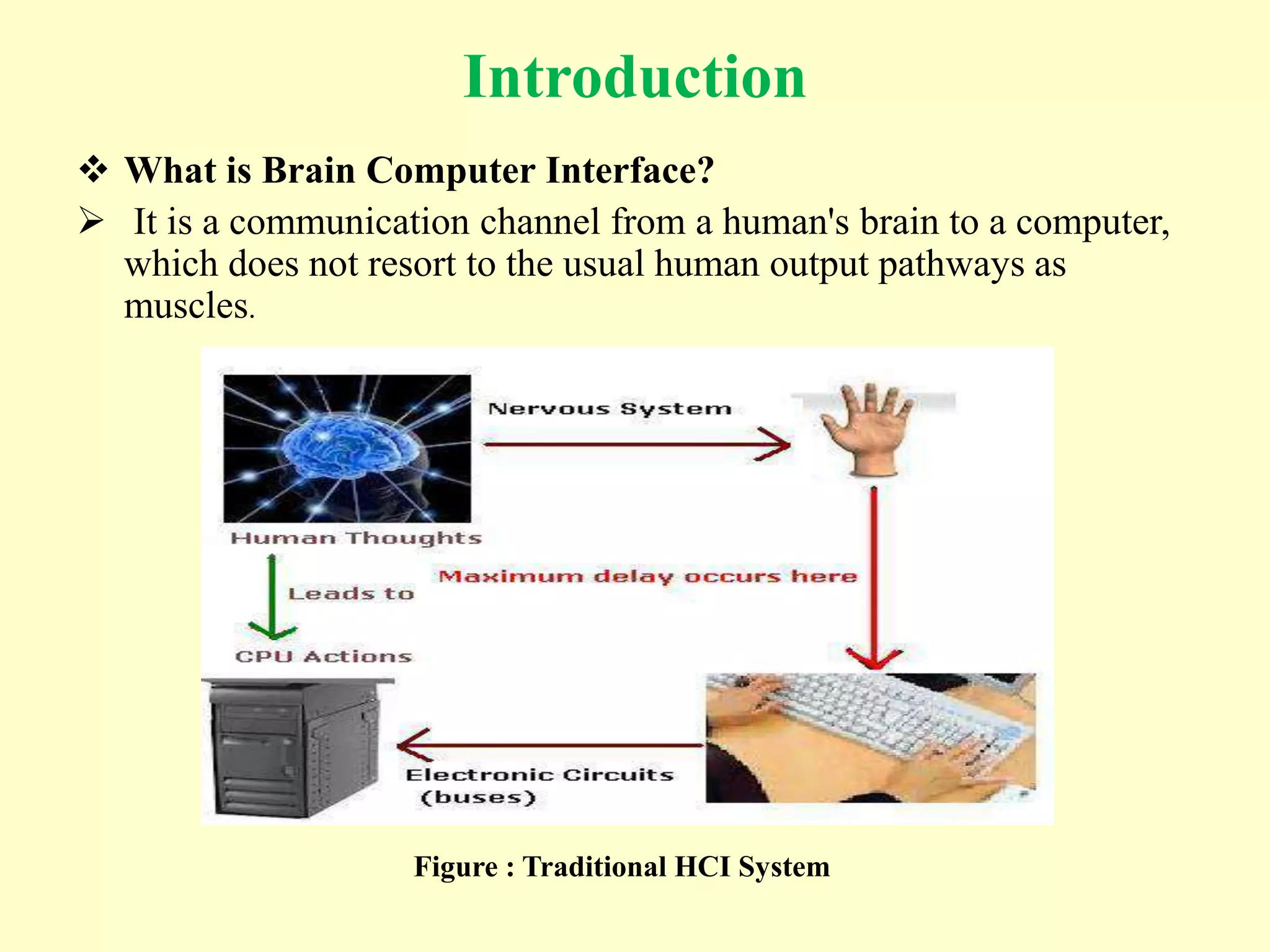
 What is Brain Computer Interface?
 It is a communication channel from a human's brain to a computer,
which does not resort to the usual human output pathways as
muscles.

Figure : Traditional HCI System
History Of BCI
 Hans Berger in 1929 on a device that later came to
be known as electroencephalogram (EEG), which
could record electrical potentials generated by brain
activity.
The Human Brain
 The brain is undoubtedly the most complex organ
found among the carbon-based life forms.
 The average human brain weights around 1400
grams. The most relevant part of brain concerning
BMI„s is the cerebral cortex.

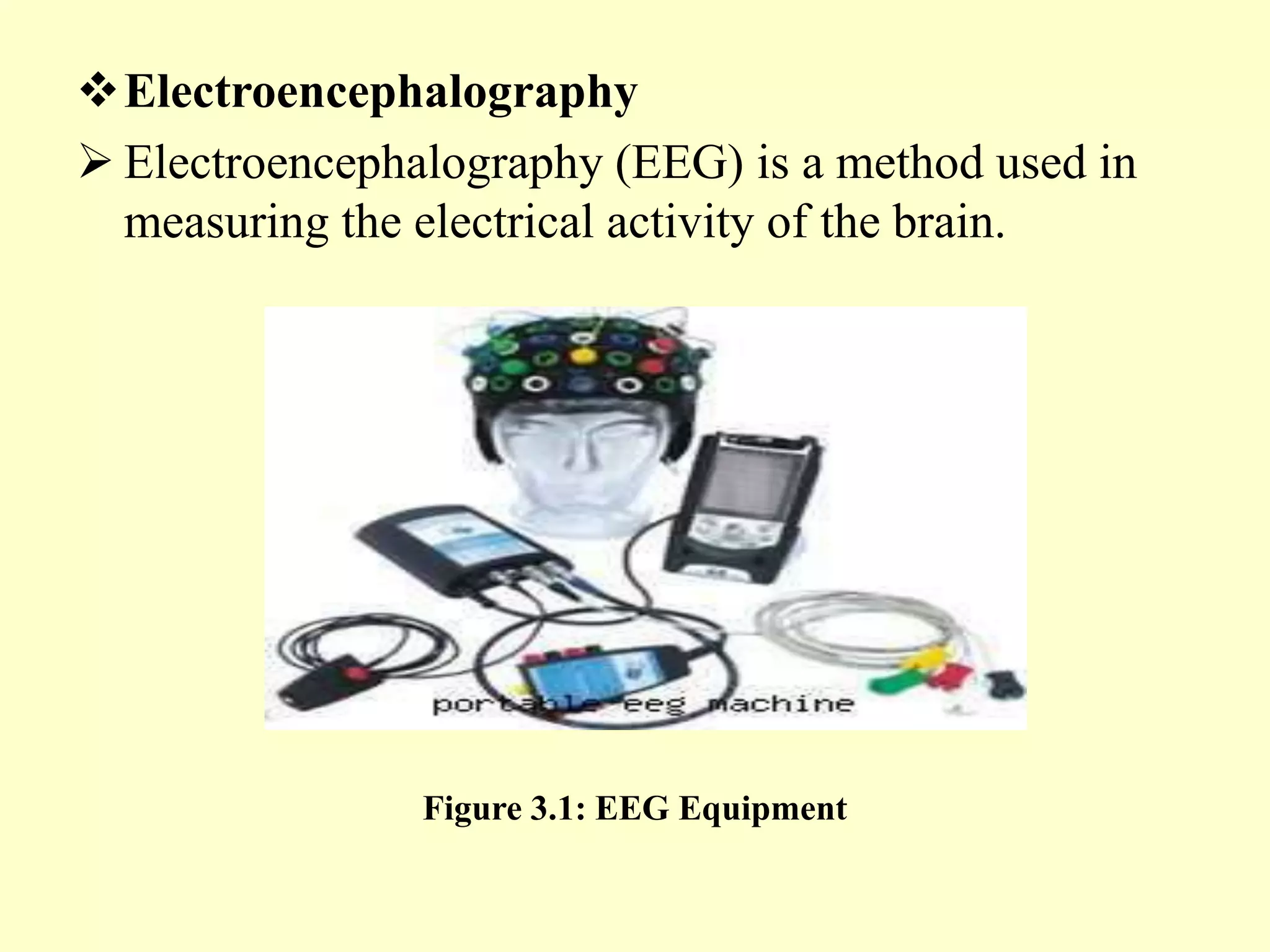
Electroencephalography
 Electroencephalography (EEG) is a method used in
measuring the electrical activity of the brain.

Figure 3.1: EEG Equipment
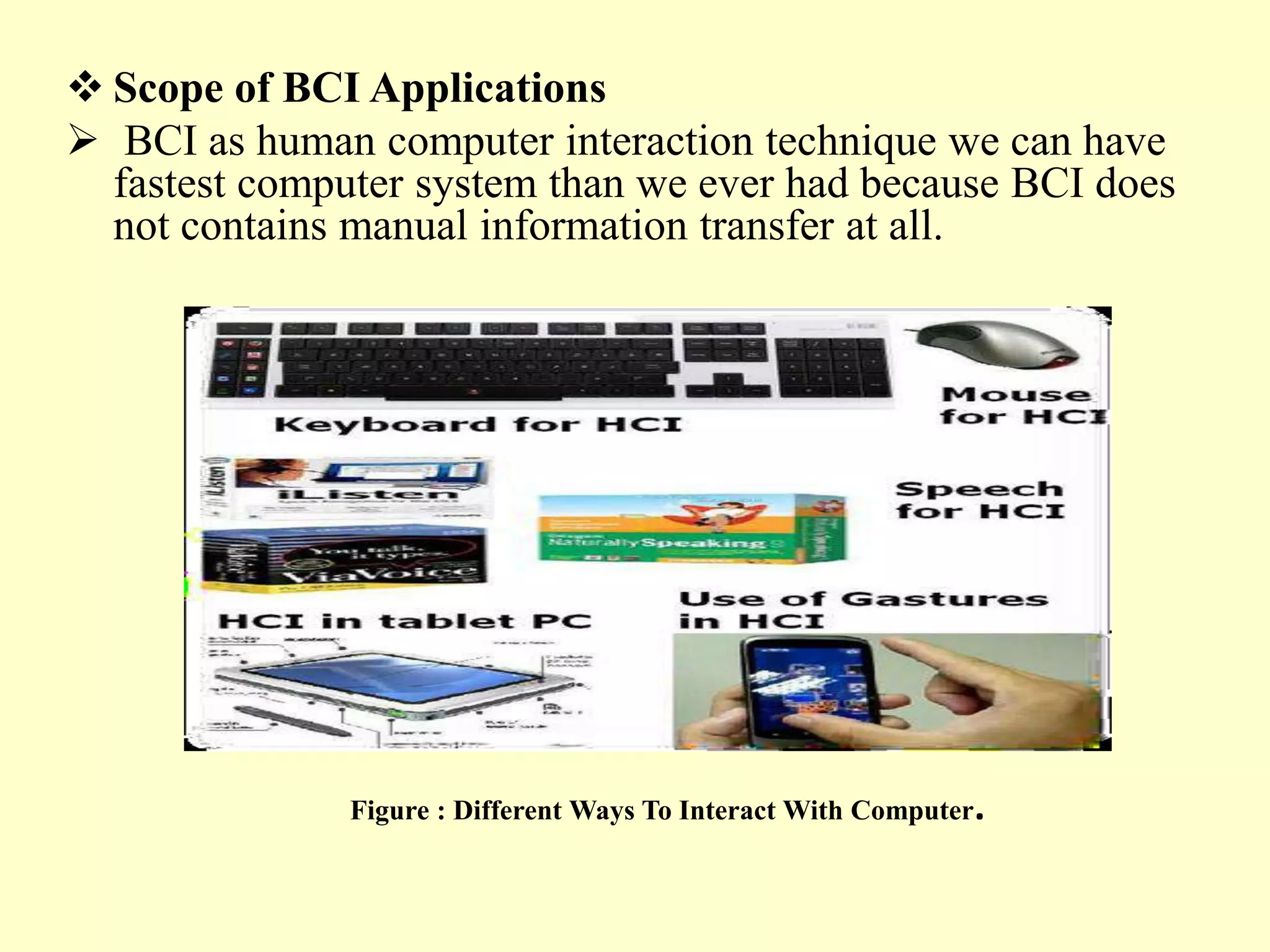
 Scope of BCI Applications
 BCI as human computer interaction technique we can have
fastest computer system than we ever had because BCI does
not contains manual information transfer at all.

Figure : Different Ways To Interact With Computer.
Literature Review
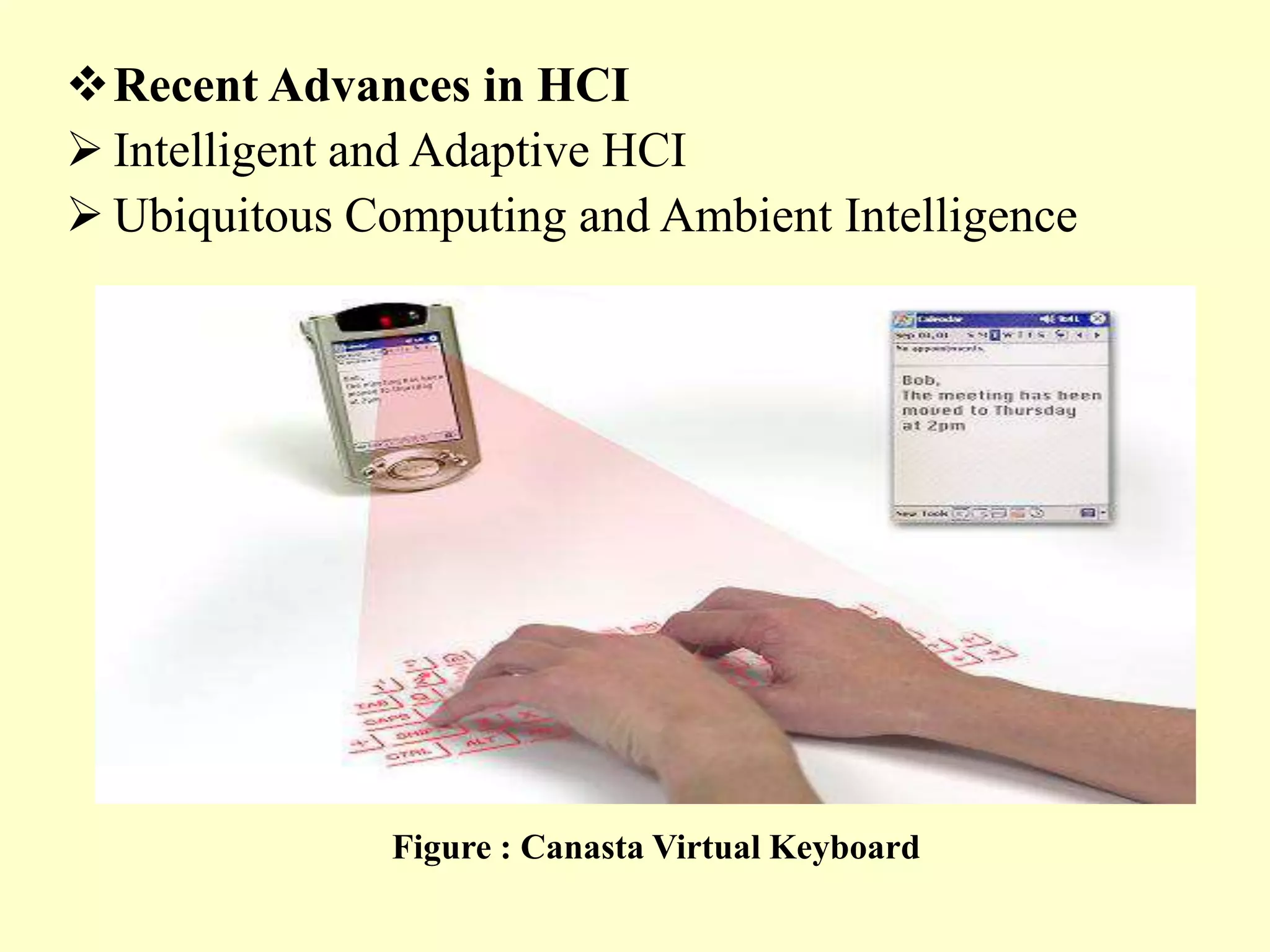
Existing HCI Technologies
 Human brain and the EEG in order to design a BMI.
 pattern recognition approach is based on cognitive
mental tasks.
 operant conditioning approach is based on the selfregulation of the EEG response
 The user activity has three different levels: physical,
cognitive and affective.
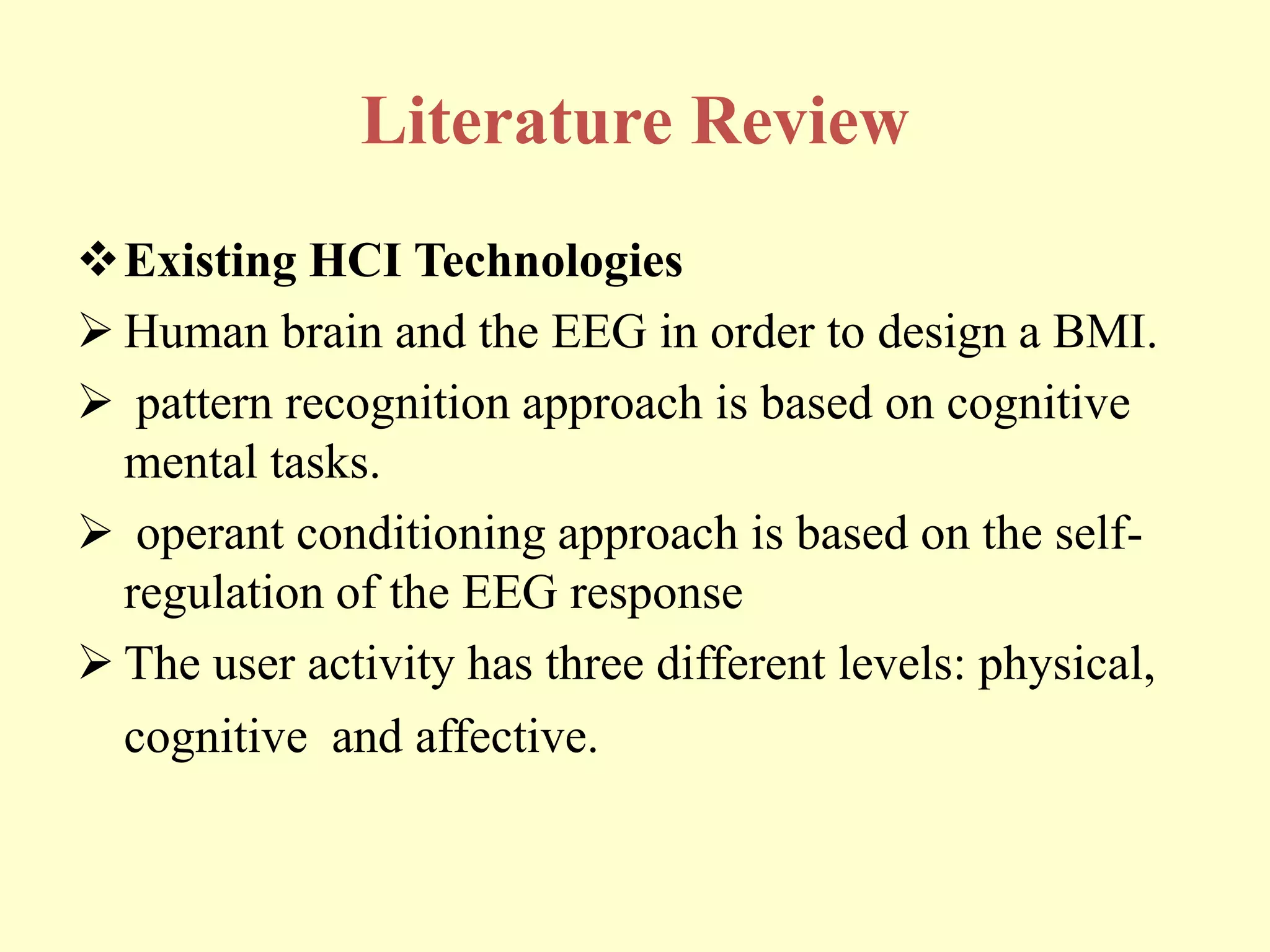
Recent Advances in HCI
 Intelligent and Adaptive HCI
 Ubiquitous Computing and Ambient Intelligence

Figure : Canasta Virtual Keyboard
Mechanism Of BCI
Architecture of Brain
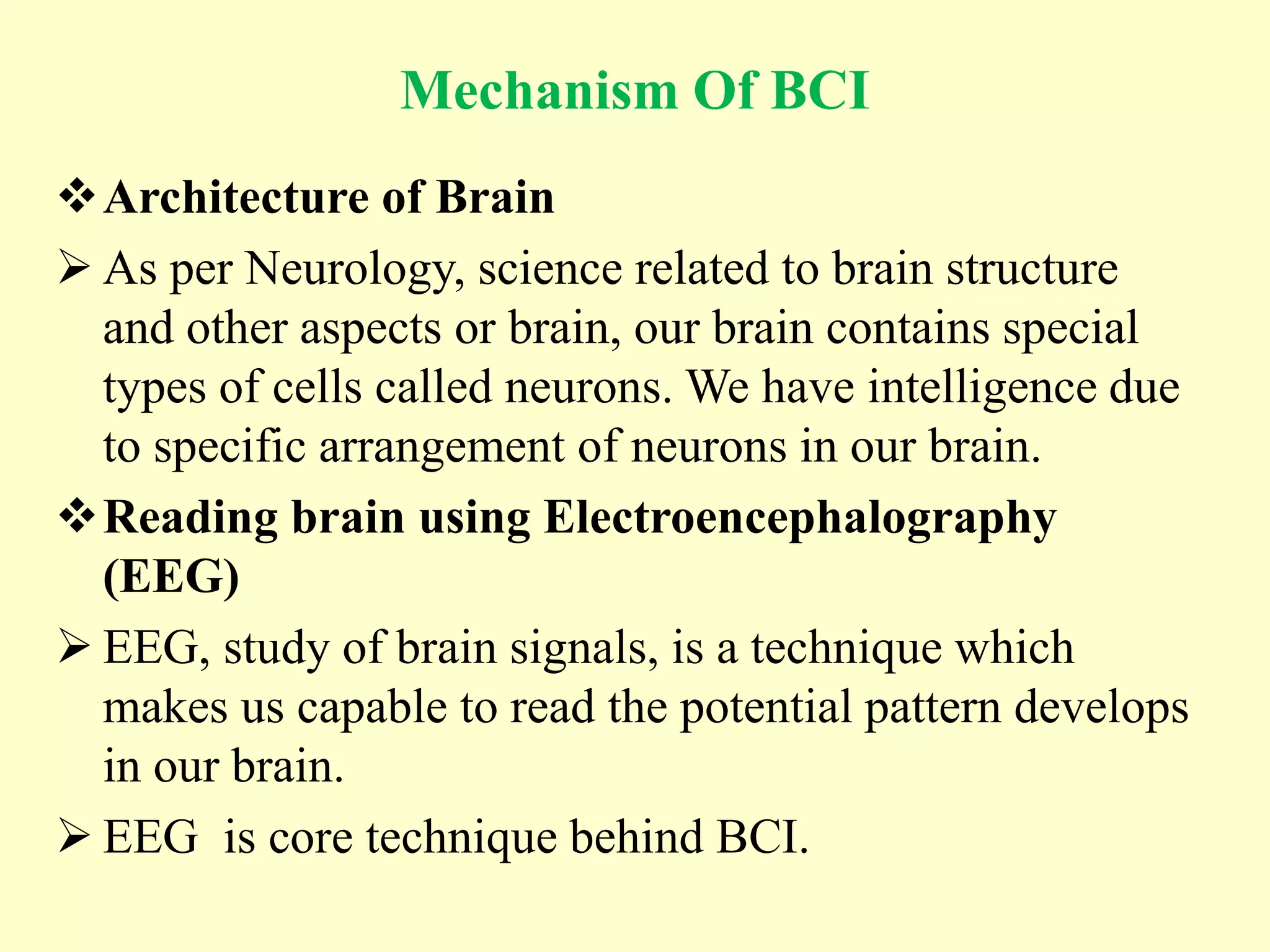
 As per Neurology, science related to brain structure
and other aspects or brain, our brain contains special
types of cells called neurons. We have intelligence due
to specific arrangement of neurons in our brain.
Reading brain using Electroencephalography
(EEG)
 EEG, study of brain signals, is a technique which
makes us capable to read the potential pattern develops
in our brain.
 EEG is core technique behind BCI.
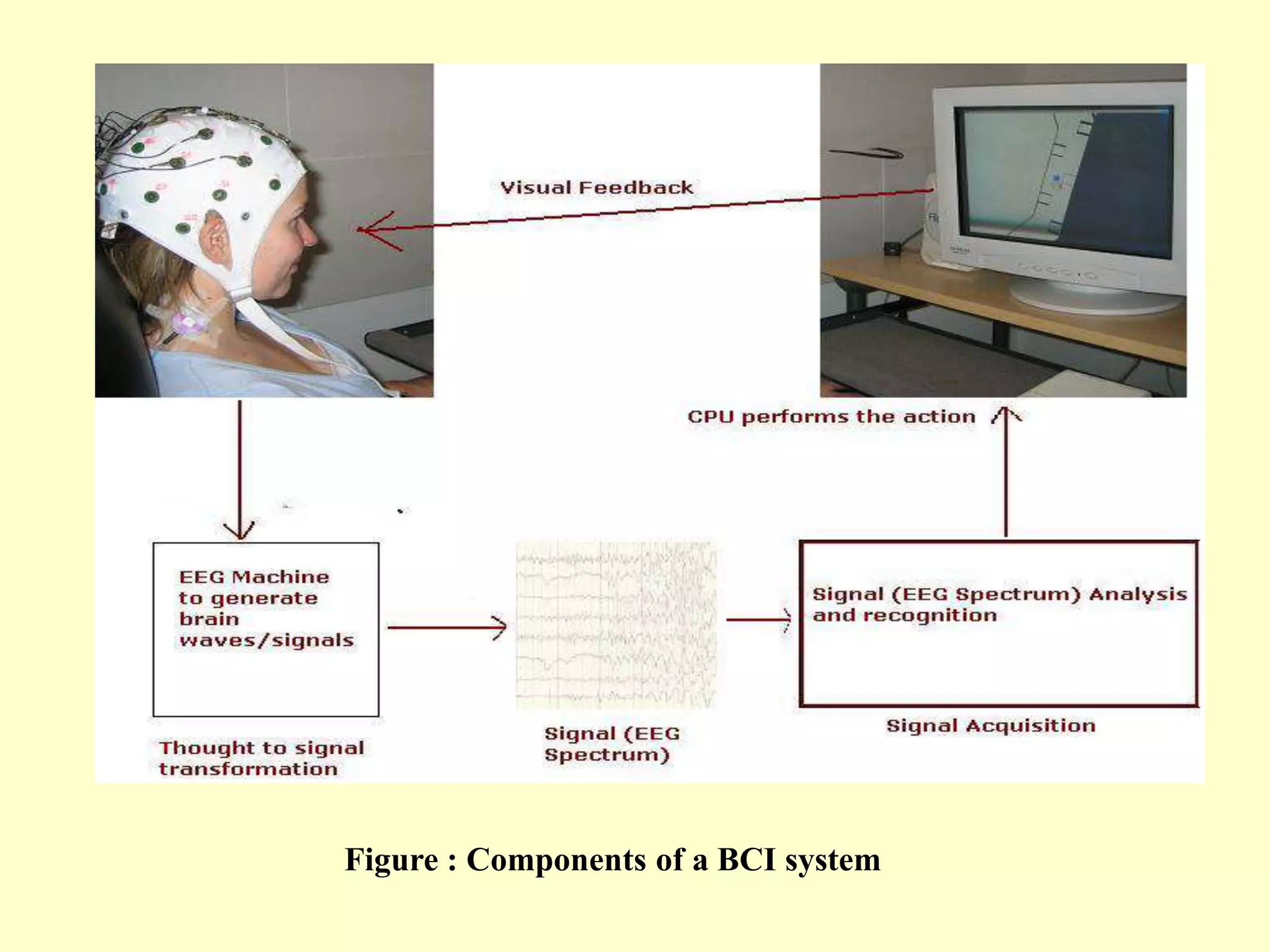
Abstract view of BCI system
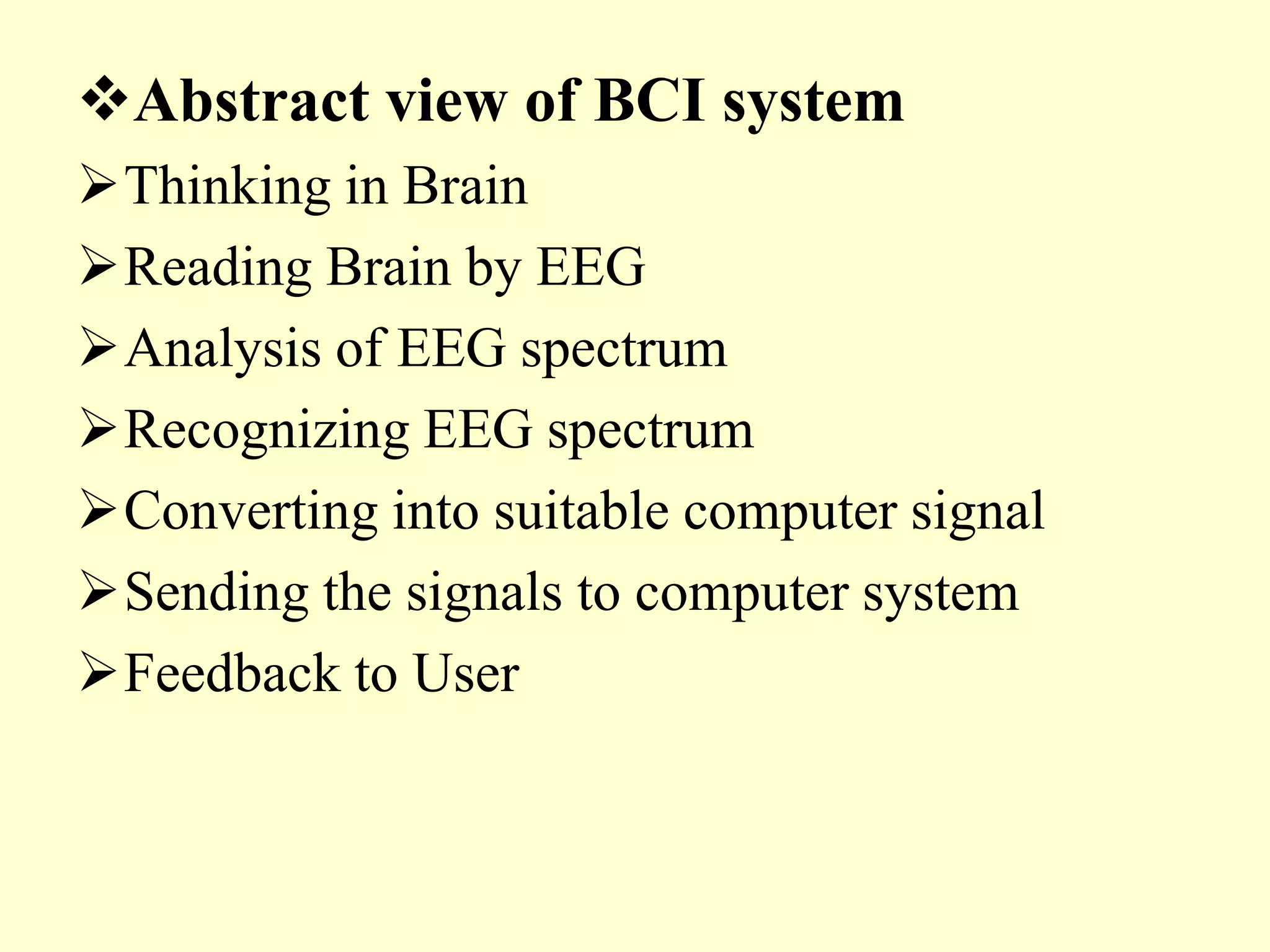
Thinking in Brain
Reading Brain by EEG
Analysis of EEG spectrum
Recognizing EEG spectrum
Converting into suitable computer signal
Sending the signals to computer system
Feedback to User
Figure : Components of a BCI system
Significance And Relevance Of BCI
Technology
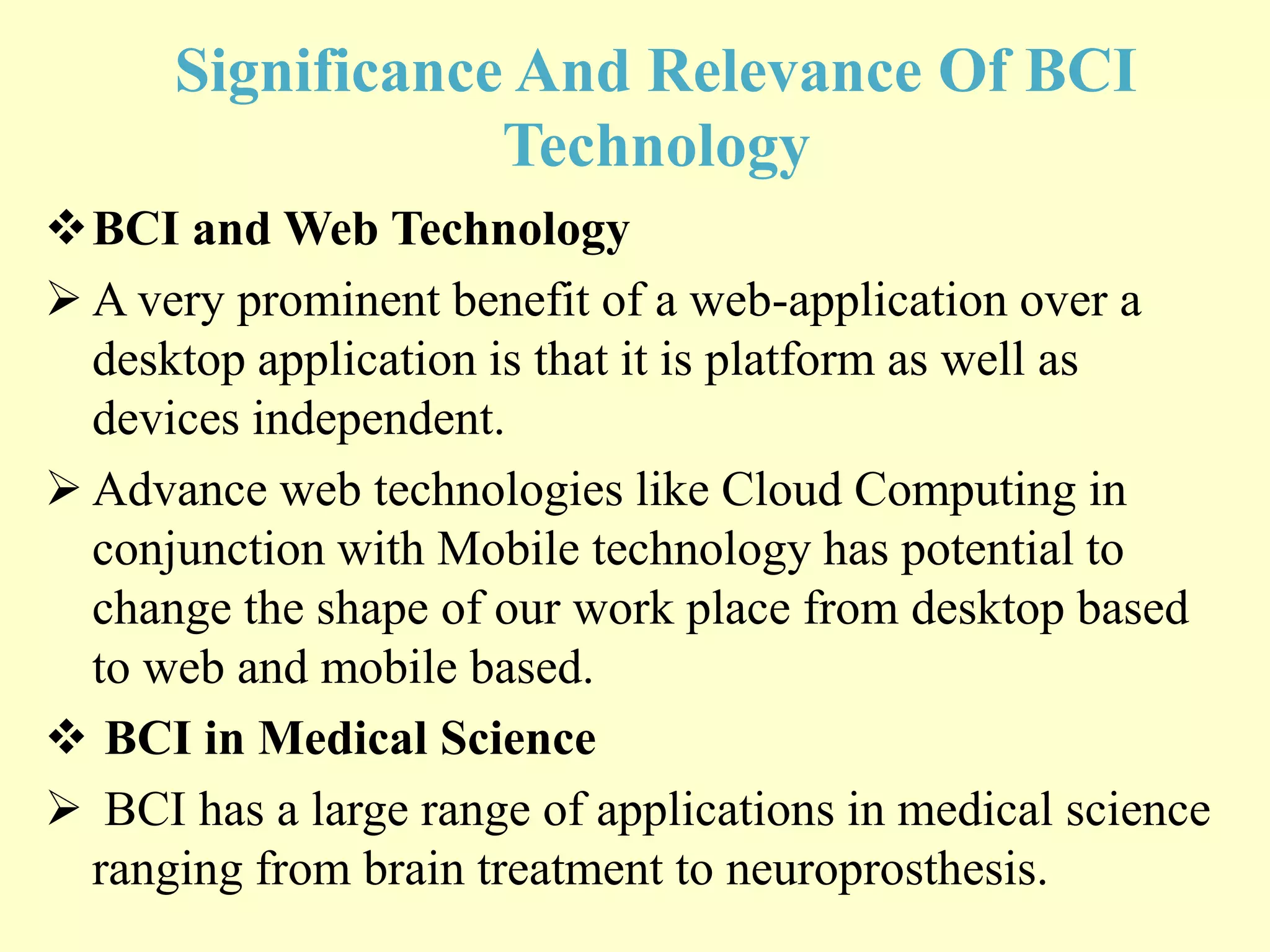
BCI and Web Technology
 A very prominent benefit of a web-application over a
desktop application is that it is platform as well as
devices independent.
 Advance web technologies like Cloud Computing in
conjunction with Mobile technology has potential to
change the shape of our work place from desktop based
to web and mobile based.
 BCI in Medical Science
 BCI has a large range of applications in medical science
ranging from brain treatment to neuroprosthesis.
BCI vs. Eco friendly IT
BCI system facilitates operating of a computer
system without having a large number of
accessories it makes a computer system very
highly Eco-friendly.
 BCI and Society
BCI has a very promising future for those who
cannot use computer system due to their physical
limitation or they are not able to understand the
terminology. Since BCI does not require any
physical connection.
BCI Applications
The Mental Typewriter
BCI offers paralyzed patients improved
quality of life
Military Applications
Challenges For BCI
Noise Filtering
Clustering of Neuron
Signal Acquisition
User Interface Design
The Future Of BCI Technologies
 Future task-oriented BCIs, based on advances in sensor
technologies, analysis algorithms, artificial intelligence,
multi-aspect sensing of the brain, behavior, and
environment through pervasive technologies, and
computing algorithms, will be capable of collecting and
analyzing brain data for extended time periods and are
expected to become prevalent in many aspects of daily
life. If and when brain-sensing technologies are worn
during portions of people‟s daily lives, the possibility of
using the BCI infrastructure for “opportunistic”
applications arises.
Conclusion
 In this seminar I presents various aspects of BCI system
inclusion its structure, applications and promises to IT world.
Various challenges which need to address for making BCI a
successful and consumable technology. The main motivation of
the seminar is to bring this new emerging technology to the
front BCI development depends on close interdisciplinary
cooperation between neuroscientists, engineers, psychologists,
computer scientists, and rehabilitation specialists. BMI„s will
have the ability to give people back their vision and hearing.
They will also change the way a person looks at the world.
References
[1] FakhreddineKarray et.al”Human-Computer Interaction: Overview on State
of the Art” International journal on smart sensing and intelligent systems,
VOL. 1, NO. 1, MARCH 2008, University of Waterloo, Waterloo, Canada
[2] Sandeepkumar And MedhaSharma,”BCI: Next Generation for HCI”,
International Journal of Advanced Research in Computer Science and
Software Engineering,Volume 2, Issue 3, March 2012
[3] Ros T, Munneke MA et.al”Endogenous control of waking brain rhythms
induces neuroplasticity in humans”, European Journal of Neuroscience
Volume 31, Issue 4, pages 770–778, February 2010
[4] C Neuper,G.R Müller et.al”Clinical application of an EEG-based brain–
computer interface: a case study in a patient with severe motor
impairment”, Clinical Neurophysiology Volume 114, Issue 3 , Pages 399409, March 2003
[5] Honda, ATR and Shimadzu Jointly Develop Brain-Machine Interface
Technology Enabling Control of a Robot by Human Thought Alone, Honda
News Release, March 31, 2009
[6] Azevedo, Frederico; Carvalho,et. al. (2009). "Equal numbers of neuronal
and nonneuronal cells make the human brain an isometrically scaled-up
primate brain". The Journal of Comparative Neurology
[7] The human brain in numbers: a linearly scaled-up primate brain, Frontiers
In Human NeuroscienceRetrieved May 11, 2011.
[8] M. Teplan, Fundamentals of EEG measurement‖, institute of measurement
science, slovak academy of sciences, slovakia, measurement science
review, volume 2, section 2, 2002
[9] D. B. Ryan; G. E. Frye; G. Townsend; D. R. Berry; S. Mesa-G; N. A.
Gates; E. W. Sellers, Predictive Spelling With a P300-Based BrainComputer Interface: Increasing the Rate of Communication, IJHCI 201012-30 Volume 27 Issue 1
[10] Doron Friedman; Robert Leeb; GertPfurtscheller; Mel Slater,
Human-Computer Interface Issues in Controlling Virtual Reality
With Brain-Computer Interface, HCI 2010 Volume 25 Issue 1
[11] Andrew T. Campbell, TanzeemChoudhury et.al NeuroPhone:
Brain-Mobile Phone Interface using a Wireless EEG Headset,
MobiHeld 2010, August 30, 2010, New Delhi, India.
[12] Molina, G.G.; Tsoneva, T.; Nijholt, A.; Philips Res. Eur.,
Eindhoven, Netherlands, Emotional brain-computer interfaces, 3rd
International Conference on Affective Computing and Intelligent
Interaction and Workshops, 2009. ACII 2009
Brain Computer Interface Next Generation of Human Computer Interaction

Brain Computer Interface Next Generation of Human Computer Interaction

  • 1.
    Seminar On “Brain Computer Interface:Next Generation of Human Computer Interaction” By Suraj S.Kasture (Final Year A-Section) Under the guidance of Prof. A. P. Jadhao Department Of Computer Science and Engineering Jawaharlal Darda Institute of Engineering & Technology, Yavatmal, (M.S), India-445001 Session 2013-14
  • 2.
    Contents  Introduction  LiteratureReview  Mechanism Of BCI  Significance And Relevance Of BCI Technology  BCI Application  Challenges For BCI  The Future Of BCI Technologies  Conclusion
  • 3.
    Introduction  What isBrain Computer Interface?  It is a communication channel from a human's brain to a computer, which does not resort to the usual human output pathways as muscles. Figure : Traditional HCI System
  • 4.
    History Of BCI Hans Berger in 1929 on a device that later came to be known as electroencephalogram (EEG), which could record electrical potentials generated by brain activity. The Human Brain  The brain is undoubtedly the most complex organ found among the carbon-based life forms.  The average human brain weights around 1400 grams. The most relevant part of brain concerning BMI„s is the cerebral cortex. 
  • 5.
    Electroencephalography  Electroencephalography (EEG)is a method used in measuring the electrical activity of the brain. Figure 3.1: EEG Equipment
  • 6.
     Scope ofBCI Applications  BCI as human computer interaction technique we can have fastest computer system than we ever had because BCI does not contains manual information transfer at all. Figure : Different Ways To Interact With Computer.
  • 7.
    Literature Review Existing HCITechnologies  Human brain and the EEG in order to design a BMI.  pattern recognition approach is based on cognitive mental tasks.  operant conditioning approach is based on the selfregulation of the EEG response  The user activity has three different levels: physical, cognitive and affective.
  • 8.
    Recent Advances inHCI  Intelligent and Adaptive HCI  Ubiquitous Computing and Ambient Intelligence Figure : Canasta Virtual Keyboard
  • 9.
    Mechanism Of BCI Architectureof Brain  As per Neurology, science related to brain structure and other aspects or brain, our brain contains special types of cells called neurons. We have intelligence due to specific arrangement of neurons in our brain. Reading brain using Electroencephalography (EEG)  EEG, study of brain signals, is a technique which makes us capable to read the potential pattern develops in our brain.  EEG is core technique behind BCI.
  • 10.
    Abstract view ofBCI system Thinking in Brain Reading Brain by EEG Analysis of EEG spectrum Recognizing EEG spectrum Converting into suitable computer signal Sending the signals to computer system Feedback to User
  • 11.
    Figure : Componentsof a BCI system
  • 12.
    Significance And RelevanceOf BCI Technology BCI and Web Technology  A very prominent benefit of a web-application over a desktop application is that it is platform as well as devices independent.  Advance web technologies like Cloud Computing in conjunction with Mobile technology has potential to change the shape of our work place from desktop based to web and mobile based.  BCI in Medical Science  BCI has a large range of applications in medical science ranging from brain treatment to neuroprosthesis.
  • 13.
    BCI vs. Ecofriendly IT BCI system facilitates operating of a computer system without having a large number of accessories it makes a computer system very highly Eco-friendly.  BCI and Society BCI has a very promising future for those who cannot use computer system due to their physical limitation or they are not able to understand the terminology. Since BCI does not require any physical connection.
  • 14.
    BCI Applications The MentalTypewriter BCI offers paralyzed patients improved quality of life Military Applications
  • 15.
    Challenges For BCI NoiseFiltering Clustering of Neuron Signal Acquisition User Interface Design
  • 16.
    The Future OfBCI Technologies  Future task-oriented BCIs, based on advances in sensor technologies, analysis algorithms, artificial intelligence, multi-aspect sensing of the brain, behavior, and environment through pervasive technologies, and computing algorithms, will be capable of collecting and analyzing brain data for extended time periods and are expected to become prevalent in many aspects of daily life. If and when brain-sensing technologies are worn during portions of people‟s daily lives, the possibility of using the BCI infrastructure for “opportunistic” applications arises.
  • 17.
    Conclusion  In thisseminar I presents various aspects of BCI system inclusion its structure, applications and promises to IT world. Various challenges which need to address for making BCI a successful and consumable technology. The main motivation of the seminar is to bring this new emerging technology to the front BCI development depends on close interdisciplinary cooperation between neuroscientists, engineers, psychologists, computer scientists, and rehabilitation specialists. BMI„s will have the ability to give people back their vision and hearing. They will also change the way a person looks at the world.
  • 18.
    References [1] FakhreddineKarray et.al”Human-ComputerInteraction: Overview on State of the Art” International journal on smart sensing and intelligent systems, VOL. 1, NO. 1, MARCH 2008, University of Waterloo, Waterloo, Canada [2] Sandeepkumar And MedhaSharma,”BCI: Next Generation for HCI”, International Journal of Advanced Research in Computer Science and Software Engineering,Volume 2, Issue 3, March 2012 [3] Ros T, Munneke MA et.al”Endogenous control of waking brain rhythms induces neuroplasticity in humans”, European Journal of Neuroscience Volume 31, Issue 4, pages 770–778, February 2010 [4] C Neuper,G.R Müller et.al”Clinical application of an EEG-based brain– computer interface: a case study in a patient with severe motor impairment”, Clinical Neurophysiology Volume 114, Issue 3 , Pages 399409, March 2003
  • 19.
    [5] Honda, ATRand Shimadzu Jointly Develop Brain-Machine Interface Technology Enabling Control of a Robot by Human Thought Alone, Honda News Release, March 31, 2009 [6] Azevedo, Frederico; Carvalho,et. al. (2009). "Equal numbers of neuronal and nonneuronal cells make the human brain an isometrically scaled-up primate brain". The Journal of Comparative Neurology [7] The human brain in numbers: a linearly scaled-up primate brain, Frontiers In Human NeuroscienceRetrieved May 11, 2011. [8] M. Teplan, Fundamentals of EEG measurement‖, institute of measurement science, slovak academy of sciences, slovakia, measurement science review, volume 2, section 2, 2002 [9] D. B. Ryan; G. E. Frye; G. Townsend; D. R. Berry; S. Mesa-G; N. A. Gates; E. W. Sellers, Predictive Spelling With a P300-Based BrainComputer Interface: Increasing the Rate of Communication, IJHCI 201012-30 Volume 27 Issue 1
  • 20.
    [10] Doron Friedman;Robert Leeb; GertPfurtscheller; Mel Slater, Human-Computer Interface Issues in Controlling Virtual Reality With Brain-Computer Interface, HCI 2010 Volume 25 Issue 1 [11] Andrew T. Campbell, TanzeemChoudhury et.al NeuroPhone: Brain-Mobile Phone Interface using a Wireless EEG Headset, MobiHeld 2010, August 30, 2010, New Delhi, India. [12] Molina, G.G.; Tsoneva, T.; Nijholt, A.; Philips Res. Eur., Eindhoven, Netherlands, Emotional brain-computer interfaces, 3rd International Conference on Affective Computing and Intelligent Interaction and Workshops, 2009. ACII 2009