PRESENTATION ON 
BRAIN-COMPUTER 
INTERFACE (BCI) 
BY- DEVENDRA SINGH TOMAR 
(0904EC111038)
CONTENTS 
INTRODUCTION 
WHAT IS BCI 
HISTORY OF BCI 
BASIC COMPONENTS OF BCI 
TECHNIQUES- (a)INVASIVE TECHNIQUE 
(b)NON-INVASIVE TECHNIQUE 
BCI APPLICATION-(a)NON-MEDICAL APPLICATION 
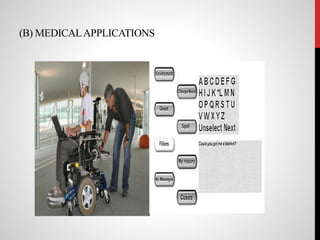
(b) MEIDCAL APPLICATIONS 
DRAWBACKS & INNOVATORS 
CONCLUSION 
REFERENCES
INTRODUCTION 
• For generations, humans have fantasized about the ability to 
communicate and interact with machines. 
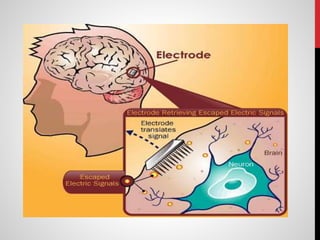
• The ability to communicate with the human brain is made possible 
through the use of sensors that can monitor some of the physical 
processes that occur within the brain that correspond with certain 
forms of thought. 
• Brain-Computer Interfaces (BCI) is a developing field that has been 
adding this new dimension of functionality to HCI (Human Computer 
Interaction).
WHAT IS BCI 
A Brain–Computer Interface (BCI), often called a Mind-Machine 
Interface (MMI), is a direct communication pathway between the brain 
and an external device.
 HISTORY OF BCI
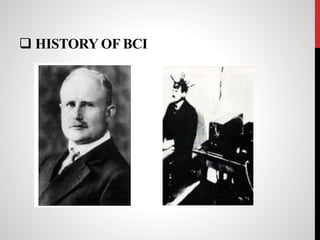
• Wolpaw and colleagues, 40 years later, in the 1970s, researchers were 
able to develop primitive control systems based on electrical activity 
recorded from the head. 
• The Pentagon's Defence Advanced Research Projects Agency‘s 
(DARPA) research conducted by George Lawrence and coworkers, 
focused on developing techniques to improve the performance of 
soldiers in tasks that had high mental loads, expanded its focus 
toward a more general field of biocybemetics, whose goal was to 
explore the possibility of controlling devices through the real-time 
computerized processing of any biological signal. 
• American scientist Peter Brunner composed a message simply by 
concentrating on a display At the European Research and Innovation 
Exhibition in Paris in June 2006.
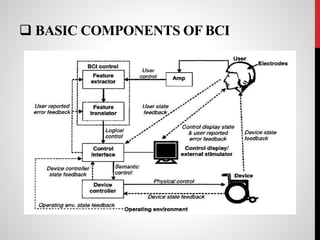
 BASIC COMPONENTS OF BCI
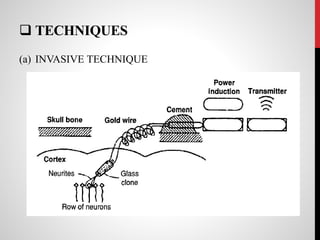
 TECHNIQUES 
(a) INVASIVE TECHNIQUE
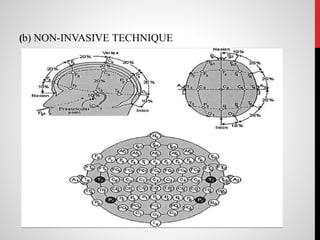
(b) NON-INVASIVE TECHNIQUE
 BCI APPLICATION 
(a) NON-MEDICAL APPLICATION: 
(i) DEVICE CONTROL 
(ii) USER STATE MODELLING 
(iii) EVALUATION 
(iv) TRAINING 
(v) GAMING AND ENTERTAINMENT 
(vi) COGNITIVE IMPROVEMENT 
(vii) SAFETY & SECURITY
(B) MEDICAL APPLICATIONS
 DRAWBACKS & INNOVATORS 
(a) DRAWBACKS: 
• Brain neuron’s signals are not always in electrical form, they involved 
chemical processes as well, which EEG can’t pick up on. 
• The signal is weak and prone to interference. 
• The equipment is less portable. 
(b) INNOVATORS: 
• Neural Signals is developing technology to restore speech to disabled people. 
• NASA has researched a similar system, although it reads electric signals from 
the nerves in the mouth and throat area, rather than directly from the brain. 
• Cyberkinetics Neurotechnology Systems is marketing the BrainGate. 
• Japanese researchers have developed a preliminary BCI that allows the user to 
control their avatar in the online world Second Life.
 CONCLUSION 
Continuation and acceleration of recent progress in BCI research and 
development requires increased focus on the production of peer-reviewed 
research articles in high quality journals, identification and 
widespread presentations and from media attention. For the near future, 
research funding will depend primarily on public agencies and private 
foundations that fund research directed at the needs of those with severe 
motor disabilities. With further increases in speed, accuracy, and range 
of applications, BCI technology could become applicable to larger 
populations and could thereby engage the interest and resources of 
private industry.
 REFERENCES 
1. Niels Birbaumer, P. Hunter Backham, “Brain Computer Interface 
Technology: A Review of First International Meeting”, IEEE 
Transactions on Rehabilitation Engineering, Vol.8, No.2, June 2000. 
2. Anirudh Vallabhaneni, Tao Wang, “Brain Computer Interface”, 
University of Illinois, Chicago, 2005. 
3. Haider Hussein Alwaiti, Ishak Aris, “Brain Computer Interface Design 
& Applications: Challenges & Future”, World Applied Journal 11, 2010. 
4. Jan B. F. Vanerp, Fabien Lotte, “Brain-Computer Interfaces for Non- 
Medical Applications: How to Move Forward”, Computer-IEEE 
Computer Society-45, April 2012. 
5. http://computer.howstuffworks.com/brain-computer-interface.htm 
6. en.wikipedia.org/wiki/Brain–computer_interface 
7. www.braincomputerinterface.com/
Brain Computer Interface PPT

Brain Computer Interface PPT

  • 1.
    PRESENTATION ON BRAIN-COMPUTER INTERFACE (BCI) BY- DEVENDRA SINGH TOMAR (0904EC111038)
  • 2.
    CONTENTS INTRODUCTION WHATIS BCI HISTORY OF BCI BASIC COMPONENTS OF BCI TECHNIQUES- (a)INVASIVE TECHNIQUE (b)NON-INVASIVE TECHNIQUE BCI APPLICATION-(a)NON-MEDICAL APPLICATION (b) MEIDCAL APPLICATIONS DRAWBACKS & INNOVATORS CONCLUSION REFERENCES
  • 3.
    INTRODUCTION • Forgenerations, humans have fantasized about the ability to communicate and interact with machines. • The ability to communicate with the human brain is made possible through the use of sensors that can monitor some of the physical processes that occur within the brain that correspond with certain forms of thought. • Brain-Computer Interfaces (BCI) is a developing field that has been adding this new dimension of functionality to HCI (Human Computer Interaction).
  • 4.
    WHAT IS BCI A Brain–Computer Interface (BCI), often called a Mind-Machine Interface (MMI), is a direct communication pathway between the brain and an external device.
  • 6.
  • 7.
    • Wolpaw andcolleagues, 40 years later, in the 1970s, researchers were able to develop primitive control systems based on electrical activity recorded from the head. • The Pentagon's Defence Advanced Research Projects Agency‘s (DARPA) research conducted by George Lawrence and coworkers, focused on developing techniques to improve the performance of soldiers in tasks that had high mental loads, expanded its focus toward a more general field of biocybemetics, whose goal was to explore the possibility of controlling devices through the real-time computerized processing of any biological signal. • American scientist Peter Brunner composed a message simply by concentrating on a display At the European Research and Innovation Exhibition in Paris in June 2006.
  • 8.
  • 10.
     TECHNIQUES (a)INVASIVE TECHNIQUE
  • 11.
  • 12.
     BCI APPLICATION (a) NON-MEDICAL APPLICATION: (i) DEVICE CONTROL (ii) USER STATE MODELLING (iii) EVALUATION (iv) TRAINING (v) GAMING AND ENTERTAINMENT (vi) COGNITIVE IMPROVEMENT (vii) SAFETY & SECURITY
  • 13.
  • 14.
     DRAWBACKS &INNOVATORS (a) DRAWBACKS: • Brain neuron’s signals are not always in electrical form, they involved chemical processes as well, which EEG can’t pick up on. • The signal is weak and prone to interference. • The equipment is less portable. (b) INNOVATORS: • Neural Signals is developing technology to restore speech to disabled people. • NASA has researched a similar system, although it reads electric signals from the nerves in the mouth and throat area, rather than directly from the brain. • Cyberkinetics Neurotechnology Systems is marketing the BrainGate. • Japanese researchers have developed a preliminary BCI that allows the user to control their avatar in the online world Second Life.
  • 15.
     CONCLUSION Continuationand acceleration of recent progress in BCI research and development requires increased focus on the production of peer-reviewed research articles in high quality journals, identification and widespread presentations and from media attention. For the near future, research funding will depend primarily on public agencies and private foundations that fund research directed at the needs of those with severe motor disabilities. With further increases in speed, accuracy, and range of applications, BCI technology could become applicable to larger populations and could thereby engage the interest and resources of private industry.
  • 16.
     REFERENCES 1.Niels Birbaumer, P. Hunter Backham, “Brain Computer Interface Technology: A Review of First International Meeting”, IEEE Transactions on Rehabilitation Engineering, Vol.8, No.2, June 2000. 2. Anirudh Vallabhaneni, Tao Wang, “Brain Computer Interface”, University of Illinois, Chicago, 2005. 3. Haider Hussein Alwaiti, Ishak Aris, “Brain Computer Interface Design & Applications: Challenges & Future”, World Applied Journal 11, 2010. 4. Jan B. F. Vanerp, Fabien Lotte, “Brain-Computer Interfaces for Non- Medical Applications: How to Move Forward”, Computer-IEEE Computer Society-45, April 2012. 5. http://computer.howstuffworks.com/brain-computer-interface.htm 6. en.wikipedia.org/wiki/Brain–computer_interface 7. www.braincomputerinterface.com/