By : Ayush Sharma, Ayush
kelkar
Vth SEM ‘EC’
INTRODUCTION
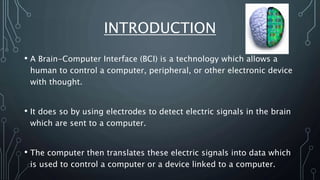
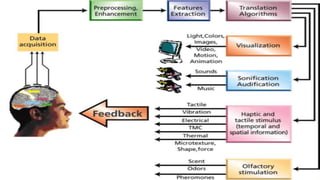
• A Brain-Computer Interface (BCI) is a technology which allows a
human to control a computer, peripheral, or other electronic device
with thought.
• It does so by using electrodes to detect electric signals in the brain
which are sent to a computer.
• The computer then translates these electric signals into data which
is used to control a computer or a device linked to a computer.
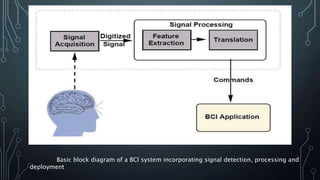
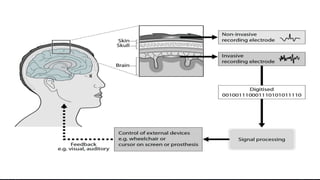
Basic block diagram of a BCI system incorporating signal detection, processing and
deployment
MAJOR HISTORICAL EVENTS
• 1924 ,Hans Berger, a German neurologist was the first to record human brain activity by
means of EEG.
• 1970, Research on BCIs began at the University of California Los Angeles (UCLA).
• 1978, A prototype was implanted into a man blinded in adulthood.
• Following years of animal experimentation, the first neuroprosthetic devices implanted in
humans appeared in the mid-1990s.
• 2005. Matthew Nagle was one of the first persons to use a BCI to restore functionality lost due
to paralysis.
• 2013 Duke University researchers successfully connected the brains of two rats with electronic
interfaces that allowed them to directly share information, in the first-ever direct brain-to-
HOW THE BRAIN TURNS THOUGHTS INTO
ACTION ?
• The brain is full of neurons; these neurons are connected to each
other by axons and dendrites.
• Your neurons - as you think about anything or do anything - are at
work.
• Your neurons connect with each other to form a super highway for
nerve impulses to travel from neuron to neuron to produce thought,
hearing, speech, or movement.
• If you have an itch and you reach to scratch it; you received a
stimulus (an itch) and reacted in response to the stimulus by
scratching.
BCI
Working
BCI MODEL
INTERFACE
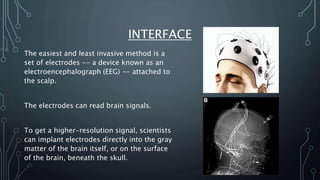
The easiest and least invasive method is a
set of electrodes -- a device known as an
electroencephalograph (EEG) -- attached to
the scalp.
The electrodes can read brain signals.
To get a higher-resolution signal, scientists
can implant electrodes directly into the gray
matter of the brain itself, or on the surface
of the brain, beneath the skull.
BASIC MECHANISM
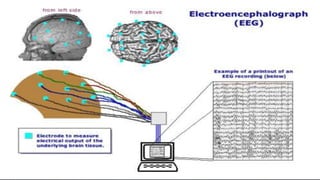
• Wires from each electrode transmit
their measurements to a
computer.
• The electrodes measure minute
differences in the voltage between
neurons.
• The signal is then amplified and
filtered.
• The computer produces a graph
showing the readings from each
electrode.
Digital EEG
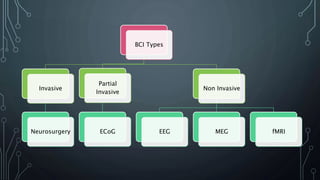
BCI Types
Invasive
Neurosurgery
Partial
Invasive
ECoG
Non Invasive
EEG MEG fMRI
INVASIVE BCIS
• Invasive BCIs are implanted directly into
the grey matter of the brain by
neurosurgery.
• As they rest in the grey matter, invasive
devices produce the highest quality
signals of BCI devices.
• But are prone to scar tissue build-up,
causing the signal to become weaker or
even lost as the body reacts to a foreign
BrainGate Neural Interface System
PARTIALLY INVASIVE
• It is another brain signal reading process
which is applied to the inside the skull
but outside the grey matter.
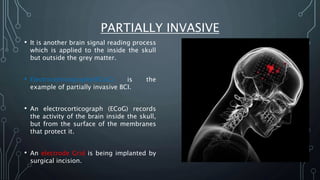
• Electrocorticography(ECoG) is the
example of partially invasive BCI.
• An electrocorticograph (ECoG) records
the activity of the brain inside the skull,
but from the surface of the membranes
that protect it.
• An electrode Grid is being implanted by
surgical incision.
NON-INVASIVE
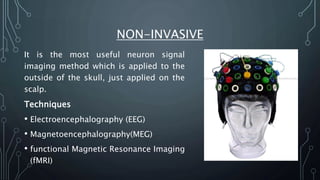
It is the most useful neuron signal
imaging method which is applied to the
outside of the skull, just applied on the
scalp.
Techniques
• Electroencephalography (EEG)
• Magnetoencephalography(MEG)
• functional Magnetic Resonance Imaging
(fMRI)
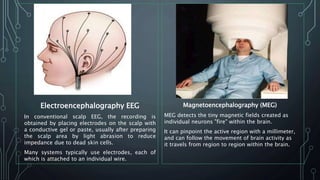
Electroencephalography EEG
In conventional scalp EEG, the recording is
obtained by placing electrodes on the scalp with
a conductive gel or paste, usually after preparing
the scalp area by light abrasion to reduce
impedance due to dead skin cells.
Many systems typically use electrodes, each of
which is attached to an individual wire.
Magnetoencephalography (MEG)
MEG detects the tiny magnetic fields created as
individual neurons "fire" within the brain.
It can pinpoint the active region with a millimeter,
and can follow the movement of brain activity as
it travels from region to region within the brain.
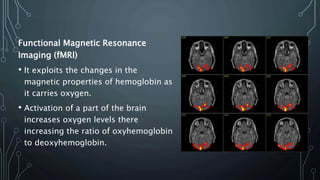
Functional Magnetic Resonance
Imaging (fMRI)
• It exploits the changes in the
magnetic properties of hemoglobin as
it carries oxygen.
• Activation of a part of the brain
increases oxygen levels there
increasing the ratio of oxyhemoglobin
to deoxyhemoglobin.
APPLICATIONS
• Provide disabled people with communication, environment control, and movement
restoration.
• Provide enhanced control of devices such as wheelchairs, vehicles, or assistance robots for
people with disabilities.
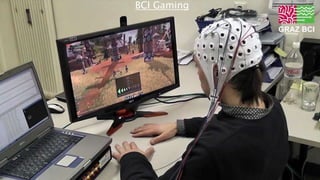
• Provide additional channel of control in computer games.
• Monitor attention in long-distance drivers or aircraft pilots, send out alert and warning for
aircraft pilots.
• Develop intelligent relaxation devices.
• Control robots that function in dangerous or inhospitable situations
(e.g., underwater or in extreme heat or cold).
• Create a feedback loop to enhance the benefits of certain therapeutic
methods.
• Develop passive devices for monitoring function, such as monitoring
long-term drug effects, evaluating psychological state, etc.
• Monitor stages of sleep,Bionics/Cybernetics, Memory Upload/Download,
Dream Capture etc.
• Brain as a Computer
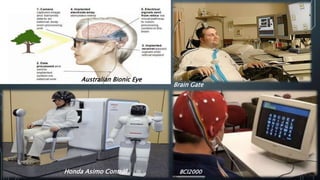
Brain Gate
Australian Bionic Eye
Honda Asimo Control BCI2000
BCI Gaming
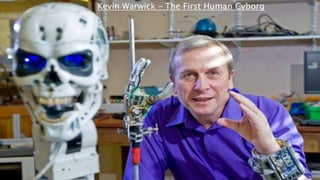
Kevin Warwick – The First Human Cyborg
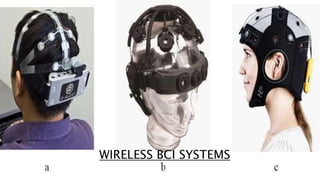
WIRELESS BCI SYSTEMS
ADVANTAGES OF BCI
Eventually, this technology could:
• Allow paralyzed people to control prosthetic limbs with their
mind.
• Transmit visual images to the mind of a blind person, allowing
them to see.
• Transmit auditory data to the mind of a deaf person, allowing
them to hear.
• Allow gamers to control video games with their minds.
• Allow a mute person to have their thoughts displayed and
DISADVANTAGES OF BCI
• Research is still in beginning stages.
• The current technology is crude.
• Ethical issues may prevent its development.
• Electrodes outside of the skull can detect very few electric
signals from the brain.
• Electrodes placed inside the skull create scar tissue in the brain.
CONCLUSION
As BCI technology further advances, brain tissue may one day
give way to implanted silicon chips thereby creating a completely
computerized simulation of the human brain that can be
augmented at will.
Futurists predict that from there, superhuman artificial
intelligence won't be far behind.
Thank You
PLEASE FEEL FREE TO ASK
ANYTHING

BRAIN COMPUTER INTERFACE (BCI)

  • 1.
    By : AyushSharma, Ayush kelkar Vth SEM ‘EC’
  • 2.
    INTRODUCTION • A Brain-ComputerInterface (BCI) is a technology which allows a human to control a computer, peripheral, or other electronic device with thought. • It does so by using electrodes to detect electric signals in the brain which are sent to a computer. • The computer then translates these electric signals into data which is used to control a computer or a device linked to a computer.
  • 3.
    Basic block diagramof a BCI system incorporating signal detection, processing and deployment
  • 4.
    MAJOR HISTORICAL EVENTS •1924 ,Hans Berger, a German neurologist was the first to record human brain activity by means of EEG. • 1970, Research on BCIs began at the University of California Los Angeles (UCLA). • 1978, A prototype was implanted into a man blinded in adulthood. • Following years of animal experimentation, the first neuroprosthetic devices implanted in humans appeared in the mid-1990s. • 2005. Matthew Nagle was one of the first persons to use a BCI to restore functionality lost due to paralysis. • 2013 Duke University researchers successfully connected the brains of two rats with electronic interfaces that allowed them to directly share information, in the first-ever direct brain-to-
  • 5.
    HOW THE BRAINTURNS THOUGHTS INTO ACTION ? • The brain is full of neurons; these neurons are connected to each other by axons and dendrites. • Your neurons - as you think about anything or do anything - are at work. • Your neurons connect with each other to form a super highway for nerve impulses to travel from neuron to neuron to produce thought, hearing, speech, or movement. • If you have an itch and you reach to scratch it; you received a stimulus (an itch) and reacted in response to the stimulus by scratching.
  • 6.
  • 8.
  • 9.
    INTERFACE The easiest andleast invasive method is a set of electrodes -- a device known as an electroencephalograph (EEG) -- attached to the scalp. The electrodes can read brain signals. To get a higher-resolution signal, scientists can implant electrodes directly into the gray matter of the brain itself, or on the surface of the brain, beneath the skull.
  • 10.
    BASIC MECHANISM • Wiresfrom each electrode transmit their measurements to a computer. • The electrodes measure minute differences in the voltage between neurons. • The signal is then amplified and filtered. • The computer produces a graph showing the readings from each electrode. Digital EEG
  • 12.
  • 13.
    INVASIVE BCIS • InvasiveBCIs are implanted directly into the grey matter of the brain by neurosurgery. • As they rest in the grey matter, invasive devices produce the highest quality signals of BCI devices. • But are prone to scar tissue build-up, causing the signal to become weaker or even lost as the body reacts to a foreign BrainGate Neural Interface System
  • 15.
    PARTIALLY INVASIVE • Itis another brain signal reading process which is applied to the inside the skull but outside the grey matter. • Electrocorticography(ECoG) is the example of partially invasive BCI. • An electrocorticograph (ECoG) records the activity of the brain inside the skull, but from the surface of the membranes that protect it. • An electrode Grid is being implanted by surgical incision.
  • 16.
    NON-INVASIVE It is themost useful neuron signal imaging method which is applied to the outside of the skull, just applied on the scalp. Techniques • Electroencephalography (EEG) • Magnetoencephalography(MEG) • functional Magnetic Resonance Imaging (fMRI)
  • 17.
    Electroencephalography EEG In conventionalscalp EEG, the recording is obtained by placing electrodes on the scalp with a conductive gel or paste, usually after preparing the scalp area by light abrasion to reduce impedance due to dead skin cells. Many systems typically use electrodes, each of which is attached to an individual wire. Magnetoencephalography (MEG) MEG detects the tiny magnetic fields created as individual neurons "fire" within the brain. It can pinpoint the active region with a millimeter, and can follow the movement of brain activity as it travels from region to region within the brain.
  • 18.
    Functional Magnetic Resonance Imaging(fMRI) • It exploits the changes in the magnetic properties of hemoglobin as it carries oxygen. • Activation of a part of the brain increases oxygen levels there increasing the ratio of oxyhemoglobin to deoxyhemoglobin.
  • 19.
    APPLICATIONS • Provide disabledpeople with communication, environment control, and movement restoration. • Provide enhanced control of devices such as wheelchairs, vehicles, or assistance robots for people with disabilities. • Provide additional channel of control in computer games. • Monitor attention in long-distance drivers or aircraft pilots, send out alert and warning for aircraft pilots. • Develop intelligent relaxation devices.
  • 20.
    • Control robotsthat function in dangerous or inhospitable situations (e.g., underwater or in extreme heat or cold). • Create a feedback loop to enhance the benefits of certain therapeutic methods. • Develop passive devices for monitoring function, such as monitoring long-term drug effects, evaluating psychological state, etc. • Monitor stages of sleep,Bionics/Cybernetics, Memory Upload/Download, Dream Capture etc. • Brain as a Computer
  • 21.
    Brain Gate Australian BionicEye Honda Asimo Control BCI2000
  • 22.
  • 23.
    Kevin Warwick –The First Human Cyborg
  • 24.
  • 25.
    ADVANTAGES OF BCI Eventually,this technology could: • Allow paralyzed people to control prosthetic limbs with their mind. • Transmit visual images to the mind of a blind person, allowing them to see. • Transmit auditory data to the mind of a deaf person, allowing them to hear. • Allow gamers to control video games with their minds. • Allow a mute person to have their thoughts displayed and
  • 26.
    DISADVANTAGES OF BCI •Research is still in beginning stages. • The current technology is crude. • Ethical issues may prevent its development. • Electrodes outside of the skull can detect very few electric signals from the brain. • Electrodes placed inside the skull create scar tissue in the brain.
  • 27.
    CONCLUSION As BCI technologyfurther advances, brain tissue may one day give way to implanted silicon chips thereby creating a completely computerized simulation of the human brain that can be augmented at will. Futurists predict that from there, superhuman artificial intelligence won't be far behind.
  • 28.
  • 29.
    PLEASE FEEL FREETO ASK ANYTHING