Brain Computer
Interface
Fathima Mubashira K
S5, EC
AKNM Polytechnic
Thirurangadi
26-09-2016
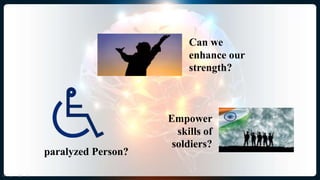
paralyzed Person?
Can we
enhance our
strength?
Empower
skills of
soldiers?
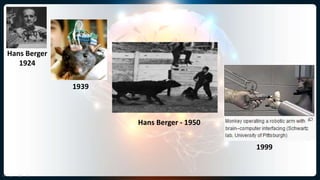
Hans Berger
1924
1939
Hans Berger - 1950
1999
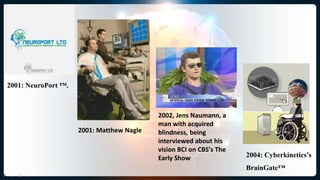
2002, Jens Naumann, a
man with acquired
blindness, being
interviewed about his
vision BCI on CBS's The
Early Show
2001: NeuroPort ™.
2004: Cyberkinetics’s
BrainGate™
2001: Matthew Nagle
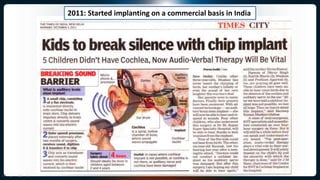
2011: Started implanting on a commercial basis in India
How this works?
Know your BRAIN !!
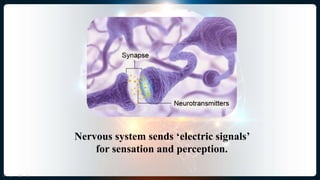
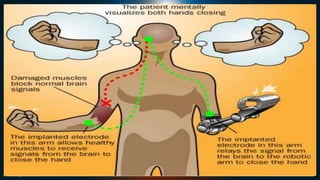
Nervous system sends ‘electric signals’
for sensation and perception.
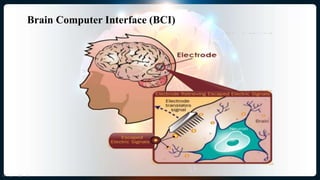
Brain Computer Interface (BCI)
Direct communication pathway between an
enhanced or wired brain and an external device.
They offers an alternative to natural
communication and control
Principle:
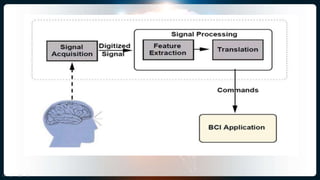
The generated brain signals are interpreted using a
computer software which converts and transmits the
information to the implanted artificial organs.
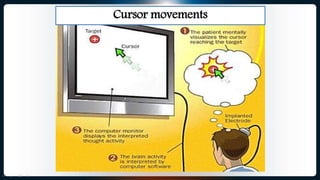
Cursor movements
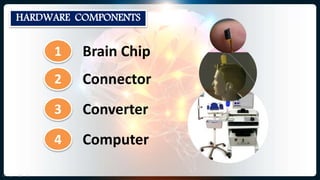
HARDWARE COMPONENTS
1 Brain Chip
2 Connector
3 Converter
4 Computer
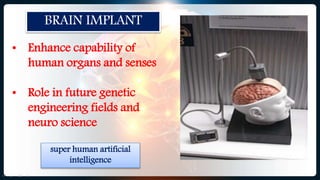
BRAIN IMPLANT
• Enhance capability of
human organs and senses
• Role in future genetic
engineering fields and
neuro science
super human artificial
intelligence
Interface
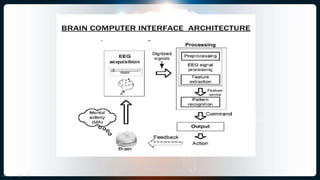
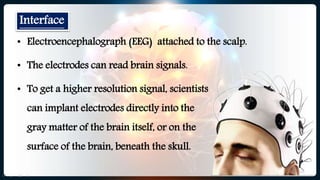
• Electroencephalograph (EEG) attached to the scalp.
• The electrodes can read brain signals.
• To get a higher resolution signal, scientists
can implant electrodes directly into the
gray matter of the brain itself, or on the
surface of the brain, beneath the skull.
 Navigate Internet.
 Play Computer Games.
 Turn Lights On and Off.
 Control Television.
 Control Robotic Arm.
Applications:
1. Allow paralyzed people to control prosthetic limbs with
their mind.
2. Allow gamers to control video games with their minds.
3. Allow a mute person to have their thoughts displayed and
spoken by a computer.
Uses
4. It acts as sensors that may soon assist failing memory,
but even provide fluency in a new language
5. For lie detecting test
6. Mental Typewriter.
Benefits of Brain Chips
 It will increase the dynamic ranging of senses.
 It will give light to blind and give paralyzed patients
full mental control of limbs.
 No genetic modifications in the next generation.
 Rescue missions (remote controlled rat).
Disadvantages:
 Research is still in the beginning stages.
 The current technology is crude.
 Ethical issues may prevent its development.
 Electrodes outside of the skull can detect very few electric signals
from the brain.
 Electrodes placed inside the skull create scar tissue in the brain
Future of brain chips
 It will enhance memory.
 It might enable “cyberthink”- invisible communication.
 Enable consistent and constant access to information where and
when needed.
 It will increase the dynamic range of senses, enabling, for
example, seeing IR, UV, and chemical spectra.
Conclusion
 Helps the patients who cannot perform even simple actions
without the help of another person.
 Such paitents are able to do things like checking
e-mails, turn the TV on or off, and control a prosthetic
arm with just their thoughts.
 Future of genetic and nuero-engineering
• http://biomed.brown.edu/Courses/BI108/BI108_2005_Groups/03/hist.htm
• http://www.slideshare.net/komal_maloo/brain-computer-interface-11822630
• http://www.oxfordscholarship.com/view/10.1093/acprof:oso/9780195388855.001
.0001/acprof-9780195388855
• http://news.discovery.com/autos/tags/brain-computer-interface.htm
• http://en.wikipedia.org/wiki/Brain%E2%80%93computer_interface
References

Brain Computer Interface (BCI) - seminar PPT

  • 1.
    Brain Computer Interface Fathima MubashiraK S5, EC AKNM Polytechnic Thirurangadi 26-09-2016
  • 2.
    paralyzed Person? Can we enhanceour strength? Empower skills of soldiers?
  • 3.
  • 4.
    2002, Jens Naumann,a man with acquired blindness, being interviewed about his vision BCI on CBS's The Early Show 2001: NeuroPort ™. 2004: Cyberkinetics’s BrainGate™ 2001: Matthew Nagle
  • 5.
    2011: Started implantingon a commercial basis in India
  • 6.
  • 7.
  • 8.
    Nervous system sends‘electric signals’ for sensation and perception.
  • 9.
  • 10.
    Direct communication pathwaybetween an enhanced or wired brain and an external device. They offers an alternative to natural communication and control
  • 11.
    Principle: The generated brainsignals are interpreted using a computer software which converts and transmits the information to the implanted artificial organs.
  • 15.
  • 16.
    HARDWARE COMPONENTS 1 BrainChip 2 Connector 3 Converter 4 Computer
  • 17.
    BRAIN IMPLANT • Enhancecapability of human organs and senses • Role in future genetic engineering fields and neuro science super human artificial intelligence
  • 18.
    Interface • Electroencephalograph (EEG)attached to the scalp. • The electrodes can read brain signals. • To get a higher resolution signal, scientists can implant electrodes directly into the gray matter of the brain itself, or on the surface of the brain, beneath the skull.
  • 19.
     Navigate Internet. Play Computer Games.  Turn Lights On and Off.  Control Television.  Control Robotic Arm. Applications:
  • 20.
    1. Allow paralyzedpeople to control prosthetic limbs with their mind. 2. Allow gamers to control video games with their minds. 3. Allow a mute person to have their thoughts displayed and spoken by a computer. Uses
  • 21.
    4. It actsas sensors that may soon assist failing memory, but even provide fluency in a new language 5. For lie detecting test 6. Mental Typewriter.
  • 22.
    Benefits of BrainChips  It will increase the dynamic ranging of senses.  It will give light to blind and give paralyzed patients full mental control of limbs.  No genetic modifications in the next generation.  Rescue missions (remote controlled rat).
  • 23.
    Disadvantages:  Research isstill in the beginning stages.  The current technology is crude.  Ethical issues may prevent its development.  Electrodes outside of the skull can detect very few electric signals from the brain.  Electrodes placed inside the skull create scar tissue in the brain
  • 24.
    Future of brainchips  It will enhance memory.  It might enable “cyberthink”- invisible communication.  Enable consistent and constant access to information where and when needed.  It will increase the dynamic range of senses, enabling, for example, seeing IR, UV, and chemical spectra.
  • 25.
    Conclusion  Helps thepatients who cannot perform even simple actions without the help of another person.  Such paitents are able to do things like checking e-mails, turn the TV on or off, and control a prosthetic arm with just their thoughts.  Future of genetic and nuero-engineering
  • 28.
    • http://biomed.brown.edu/Courses/BI108/BI108_2005_Groups/03/hist.htm • http://www.slideshare.net/komal_maloo/brain-computer-interface-11822630 •http://www.oxfordscholarship.com/view/10.1093/acprof:oso/9780195388855.001 .0001/acprof-9780195388855 • http://news.discovery.com/autos/tags/brain-computer-interface.htm • http://en.wikipedia.org/wiki/Brain%E2%80%93computer_interface References

Editor's Notes

  • #3 If a man get paralyzed, is there any way to bring him back? Is there any methods to enhance ones strengths? How to empower skills of soldiers? How artificial organs can work together with our brain signals and sensations?
  • #12  With intact brain function, brain signals are generated even though they are not sent to the arms, hands and legs. The signals are interpreted and transmitted into cursor movements.
  • #17 1. Brain chip A Four millimeter square silicon chip studded with 100 hair-thin, micro electrodes is embedded in brain’s primary motor cortex. The sensors detects tiny electrical signals generated when a user imagines. 2. The Connector The signal from the brain is transmitted through the pedestal plug attached to the skull. 3. The Converter The signal travels to an amplifier where it is converted to optical data and bounced by fibre-optic cable to a computer. 4. The Computer A brain-computer interface uses electrophysiological signals to control remote devices. The Brain Computer Interface which are invasive is prerefrable. The electrodes pick up the brain’s electrical activity (at the microvolt level) and carry it into amplifiers. These amplifiers amplify the signal approximately ten thousand times and then pass the signal via an analog to digital converter to a computer for processing. The computer processes the EEG signal and uses it in order to accomplish tasks such as communication and environmental control.