A Report on Seminar mid-term evaluation
GAUTAM BUDDHA UNIVERSITY
Integrated Dual Degree(B.tech+M.tech (CSE) ) , Semester- VII
TOPIC - BRAIN COMPUTER INTERFACE
Submitted by:
Ms. Deepti Singh : 14/ICS/018
Mr. Kshitij Saini : 14/ICS/024
Ms. Shalini Singh : 14/ICS/047
Ms. Shikha Dwivedi: 14/ICS/048
Supervised to: Dr.Vidushi Sharma
HOD, CSE
School of ICT
Acknowledgment
We would like to take this opportunity to express our humble gratitude to Dr. Vidushi
Sharma, under whom we are executing this project. Her constant guidance and willingness to
share her vast knowledge made us understand this project and its manifestations in great
depths and helped us to complete the assigned tasks timely.
We would also like to thank all the faculty members and staff of the department of Computer
Science and Engineering, SoICT, Gautam Buddha University for their contribution in the
development of this project.
Certificate
This is to certify that the work in the Seminar Report based on Technology Brain Computer
Interface(BCIs) by Deepti Singh, kshitiz Saini , Shalini Singh and Shikha Dwivedi is an
authentic work carried out under my supervision and guidance in fulfillment of the
requirements for the purpose of the Minor Project in Bachelor of Technology in Computer
Science and Engineering
Dr. Vidushi Sharma
HoD,CSE SoICT
CONTENTS
1. Introduction
2. History of BCI
3. Component Of BCI
4. Application Of BCI
5. Working Of BCI
6. Types Of BCIs
7. Advantages and Disadvantages Of BCI
8. Conclusion
ABSTRACT
Brain Computer Interface (BCI) aims at providing an alternate means of communication and
control to people with severe cognitive or sensory-motor disabilities. These systems are based
on the single trial recognition of different mental states or tasks from the brain activity. This
paper discusses the major components involved in developing a Brain Computer Interface
system which includes the modality to obtain brain signals and its related processing
methods.
INTRODUCTION
Brain-computer interface is a method of communication based on neural activity generated
by the brain and is independent of its normal output pathways of peripheral nerves and
muscles. The neural activity used in BCI can be recorded using invasive or noninvasive
techniques. The goal of BCI is not to determine a person's intent by eavesdropping on brain
activity, but rather to provide a new channel of output for the brain that requires voluntary
adaptive control by the user (Wolpaw et ai, 2000b).
Brain Computer Interface (BCIs) is a technology which allow a human to control a computer,
peripheral, or other electronic device with thoughts.
The computer then interpret these electric signals into data which is used to control a
computer or a device linked to a computer.
It is also known as Direct Neural Interface(DNI) and Brain Machine Interface(BMI).
Brain-computer interface is an electrode chip which can be implemented in the brain through
surgical procedure.
When it is implemented in brain the electrical signal exchanged by neurons within the brain
are sent to the computer and then the computer is controlled by person.
What Is BCI
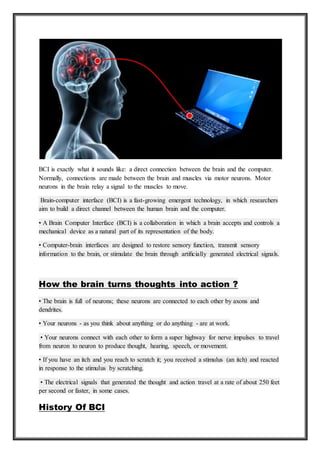
BCI is exactly what it sounds like: a direct connection between the brain and the computer.
Normally, connections are made between the brain and muscles via motor neurons. Motor
neurons in the brain relay a signal to the muscles to move.
Brain-computer interface (BCI) is a fast-growing emergent technology, in which researchers
aim to build a direct channel between the human brain and the computer.
• A Brain Computer Interface (BCI) is a collaboration in which a brain accepts and controls a
mechanical device as a natural part of its representation of the body.
• Computer-brain interfaces are designed to restore sensory function, transmit sensory
information to the brain, or stimulate the brain through artificially generated electrical signals.
How the brain turns thoughts into action ?
• The brain is full of neurons; these neurons are connected to each other by axons and
dendrites.
• Your neurons - as you think about anything or do anything - are at work.
• Your neurons connect with each other to form a super highway for nerve impulses to travel
from neuron to neuron to produce thought, hearing, speech, or movement.
• If you have an itch and you reach to scratch it; you received a stimulus (an itch) and reacted
in response to the stimulus by scratching.
• The electrical signals that generated the thought and action travel at a rate of about 250 feet
per second or faster, in some cases.
History Of BCI
Following the work of Hans Berger in 1929 on a device that later came to be known as
electroencephalogram (EEG), which could record electrical potentials generated by brain
activity, there was speculation that perhaps devices could be controlled by using these
signals. For a long time, however, this remained a speculation. As reviewed by Wolpaw and
colleagues (2000b), 40 years later, in the 1970s, researchers were able to develop primitive
control systems based on electrical activity recorded from the head. The Pentagon's
Advanced Research Projects Agency (DARPA), the same agency involved in developing the
first versions of the Internet, funded research focused on developing bionic devices that
would aid soldiers. Early research, conducted by George Lawrence and coworkers, focused
on developing techniques to improve the performance of soldiers in tasks that had high
mental loads. His research produced a lot of insight on methods of autoregulation and
cognitive biofeedback, but did not produce any usable devices. DARPA expanded its focus
toward a more general field of biocybemetics. The goal was to explore the possibility of
controlling devices through the real-time computerized processing of any biological signal.
Jacques Vidal from UCLA's Brain-Computer Interface Laboratory provided evidence that
single-trial visual-evoked potentials could be used as a communication channel effective
enough to control a cursor through a two-dimensional maze (Vidal, 1977). Work by Vidal
and other groups proved that signals from brain activity could be used to effectively
communicate a user's intent. It also created a clear-cut separation between those systems
utilizing EEG activity and those that used EMG (electromyogram) activity generated from
scalp or facial muscular movements. Future work expanded BCI systems to use neural
activity signals recorded not only by EEG but also by other imaging techniques. Current BCI-
based tools can aid users in communication, daily living activities, environmental control,
movement, and exercise, with limited success and mostly in research settings. A more
detailed evolution of BCI systems is detailed later in this chapter. The primary users of BCI
systems are individuals with mild to severe muscular handicaps. BCI systems have also been
developed for users with certain mental handicaps such as autism. Basic and applied research
is being conducted with humans and animals for using BCIs in numerous clinical and other
applications for handicapped and nonhandicapped users.
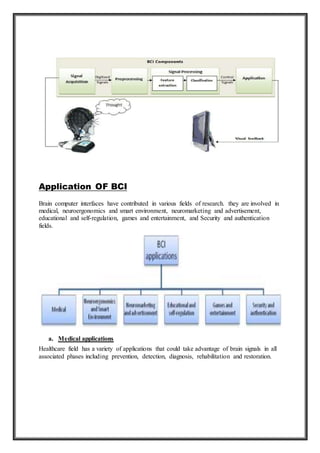
COMPONENTS OF A BCI SYSTEM
It isimportantto put itin the contextof the entire BCIsystem.The recentworkof Mason and Birch
(2003), whichisadaptedinthissection,presentedageneral functional model forBCIsystemsupon
whicha universal vocabularycouldbe developedanddifferentBCIsystemscouldbe comparedina
unifiedframework.
The goal of a BCI systemistoallowthe userto interactwiththe device.Thisinteractionisenabled
througha varietyof intermediaryfunctionalcomponents,control signals,andfeedbackloops.
Intermediaryfunctionalcomponentsperformspecificfunctionsinconvertingintentintoaction.By
definition,thismeansthatthe userand the device are alsointegral partsof a BCI system.Interaction
isalso made possible throughfeedbackloopsthatserve toinformeachcomponentinthe systemof
the state of one or more components.
Application OF BCI
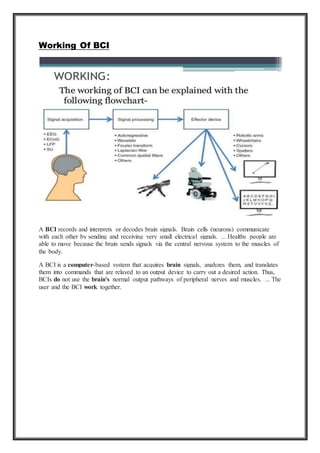
Brain computer interfaces have contributed in various fields of research. they are involved in
medical, neuroergonomics and smart environment, neuromarketing and advertisement,
educational and self-regulation, games and entertainment, and Security and authentication
fields.
a. Medical applications
Healthcare field has a variety of applications that could take advantage of brain signals in all
associated phases including prevention, detection, diagnosis, rehabilitation and restoration.
b. Neuroergonomics and smart environment
As previously mentioned, deploying brain signals is not exclusive to the medical field. Smart
environments such as smart houses, workplaces or transportations could also exploit brain
computer interfaces in offering further safety, luxury and physiological control to humans’
daily life. They are also expected to witness cooperation between Internet Of Things (IOT)
and BCI technologies.
c. Neuromarketing and advertisement
Marketing field has also been an interest for BCI researches. The research in has explained
the benefits of using EEG evaluation for TV advertisements related to both commercial and
political fields. BCI based assessment measures the generated attention accompanying
watching activity . On the other hand, the researchers of have considered the impact of
another cognitive function in neuromarketing field. They have been interested in estimating
the memorization of TV advertisements thus providing another method for advertising
evaluation.
d. Educational and self-regulation
Neurofeedback is a promising approach for enhancing brain performance via targeting human
brain activity modulation. It invades the educational systems, which utilizes brain electrical
signals to determine the degree of clearness of studied information. Personalized interaction
to each learner is established according to the resultant response experienced.
e. Games and entertainment
Entertainment and gaming applications have opened the market for nonmedical brain
computer interfaces. Various games are presented like in [81] where helicopters are made to
fly to any point in either a 2D or 3D virtual world.
f. Security and authentication
Security systems involve knowledge based, object based and/or biometrics based
authentication. They have shown to be vulnerable to several drawbacks such as simple
insecure password, shoulder surfing, theft crime, and cancelable biometrics .
Working Of BCI
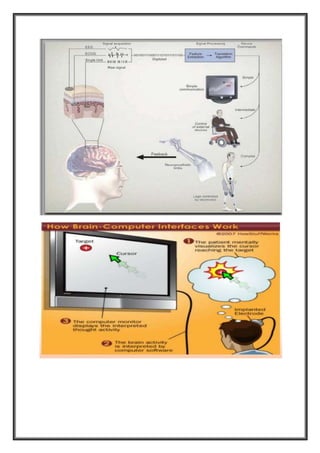
A BCI records and interprets or decodes brain signals. Brain cells (neurons) communicate
with each other by sending and receiving very small electrical signals. ... Healthy people are
able to move because the brain sends signals via the central nervous system to the muscles of
the body.
A BCI is a computer-based system that acquires brain signals, analyzes them, and translates
them into commands that are relayed to an output device to carry out a desired action. Thus,
BCIs do not use the brain's normal output pathways of peripheral nerves and muscles. ... The
user and the BCI work together.
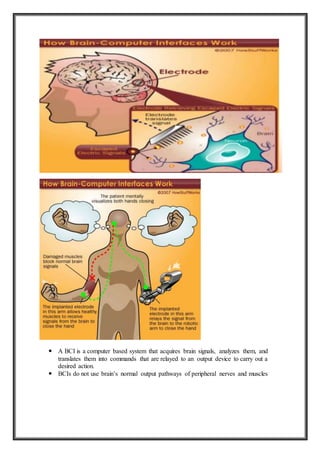
 A BCI is a computer based system that acquires brain signals, analyzes them, and
translates them into commands that are relayed to an output device to carry out a
desired action.
 BCIs do not use brain’s normal output pathways of peripheral nerves and muscles
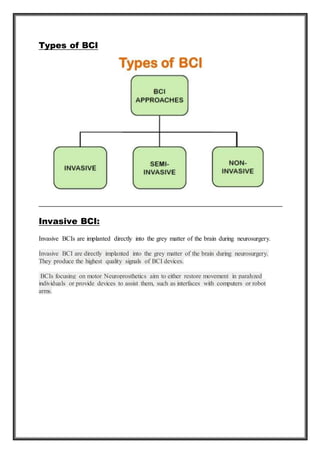
Types of BCI
Invasive BCI:
Invasive BCIs are implanted directly into the grey matter of the brain during neurosurgery.
Invasive BCI are directly implanted into the grey matter of the brain during neurosurgery.
They produce the highest quality signals of BCI devices.
BCIs focusing on motor Neuroprosthetics aim to either restore movement in paralyzed
individuals or provide devices to assist them, such as interfaces with computers or robot
arms.
Semi Invasive BCI :
Partially invasive BCI devices are implanted inside the skull but rest outside the brain rather
than within the grey matter.
Partially invasive BCI devices are implanted inside the skull but rest outside the brain rather
than amidst the grey matter.
Electrocorticography(ECoG) uses the same technology as non-invasive
electroencephalography, but the electrodes are embedded in a thin plastic pad that is placed
above the cortex, beneath the duramater.
Light Reactive Imaging BCI devices are still in the realm of theory. These would involve
implanting laser inside the skull
Non Invasive BCI :
Non-Invasive BCIs do not involve neurosurgery. They are just like wearable virtual reality
devices.
The signals which are used in non invasive BCI have been used to power muscle implants
and restore partial movement in an experimental volunteer.
Easy to wear but it produces poor signals.
Another substantial barrier used in BCI:  Electroencephalography (EEG) 
Magnetoencephalography (MEG)
Advantage of BCI
 Allow paralyzed people to control prosthetic limbs with their mind.
 Transmit visual images to mind of blind person.
 Transmit auditory data to mind of deaf person.
 Allow gamers to control video games with their mind
 Advantages BCI system Mind balance Graz BCI BSLEACS EEG signal P300 wave
Motor imagery Alpha and theta Channels 2 3 1 Transmission Cable Cable Bluetooth
Power supply power line power line Li-ion battery Back end signal processing unit
Personal computer Personal computer Embedded signal processing unit Control mode
Active mental command Active mental command Adaptation 2
Disadvantage Of BCI
 The brain is incredibly complex.
 Signal is weak and prone to interference.
 The equipment is less than portable
 The current technology is crude.
 Ethical issues may prevent its development.
 Electrodes outside of the skull can detect very few electric signals from the brain.
 Electrodes placed inside the skull create scar tissue in the brain
Conclusion
 BCI is a high potential idea with high impact on the society .
 Future developments enable ,complex performance .
 Researchers hope that every thing will be mind controlled in future.
References:
abstract
Published in: Recent and Emergingtrendsin Computer and Computational Sciences(RETCOMP), 2015
Application
http://www.sciencedirect.com/science/article/pii/S1110866515000237
component & history
https://www.researchgate.net/profile/Bin_He32/publication/227160438_Brain-
Computer_Interface/links/55def34908ae45e825d3bcef.pdf
.
Brain Computer Interface

Brain Computer Interface

  • 1.
    A Report onSeminar mid-term evaluation GAUTAM BUDDHA UNIVERSITY Integrated Dual Degree(B.tech+M.tech (CSE) ) , Semester- VII TOPIC - BRAIN COMPUTER INTERFACE Submitted by: Ms. Deepti Singh : 14/ICS/018 Mr. Kshitij Saini : 14/ICS/024 Ms. Shalini Singh : 14/ICS/047 Ms. Shikha Dwivedi: 14/ICS/048 Supervised to: Dr.Vidushi Sharma HOD, CSE School of ICT Acknowledgment
  • 2.
    We would liketo take this opportunity to express our humble gratitude to Dr. Vidushi Sharma, under whom we are executing this project. Her constant guidance and willingness to share her vast knowledge made us understand this project and its manifestations in great depths and helped us to complete the assigned tasks timely. We would also like to thank all the faculty members and staff of the department of Computer Science and Engineering, SoICT, Gautam Buddha University for their contribution in the development of this project. Certificate
  • 3.
    This is tocertify that the work in the Seminar Report based on Technology Brain Computer Interface(BCIs) by Deepti Singh, kshitiz Saini , Shalini Singh and Shikha Dwivedi is an authentic work carried out under my supervision and guidance in fulfillment of the requirements for the purpose of the Minor Project in Bachelor of Technology in Computer Science and Engineering Dr. Vidushi Sharma HoD,CSE SoICT CONTENTS 1. Introduction
  • 4.
    2. History ofBCI 3. Component Of BCI 4. Application Of BCI 5. Working Of BCI 6. Types Of BCIs 7. Advantages and Disadvantages Of BCI 8. Conclusion ABSTRACT
  • 5.
    Brain Computer Interface(BCI) aims at providing an alternate means of communication and control to people with severe cognitive or sensory-motor disabilities. These systems are based on the single trial recognition of different mental states or tasks from the brain activity. This paper discusses the major components involved in developing a Brain Computer Interface system which includes the modality to obtain brain signals and its related processing methods. INTRODUCTION Brain-computer interface is a method of communication based on neural activity generated by the brain and is independent of its normal output pathways of peripheral nerves and muscles. The neural activity used in BCI can be recorded using invasive or noninvasive techniques. The goal of BCI is not to determine a person's intent by eavesdropping on brain activity, but rather to provide a new channel of output for the brain that requires voluntary adaptive control by the user (Wolpaw et ai, 2000b). Brain Computer Interface (BCIs) is a technology which allow a human to control a computer, peripheral, or other electronic device with thoughts. The computer then interpret these electric signals into data which is used to control a computer or a device linked to a computer. It is also known as Direct Neural Interface(DNI) and Brain Machine Interface(BMI). Brain-computer interface is an electrode chip which can be implemented in the brain through surgical procedure. When it is implemented in brain the electrical signal exchanged by neurons within the brain are sent to the computer and then the computer is controlled by person. What Is BCI
  • 6.
    BCI is exactlywhat it sounds like: a direct connection between the brain and the computer. Normally, connections are made between the brain and muscles via motor neurons. Motor neurons in the brain relay a signal to the muscles to move. Brain-computer interface (BCI) is a fast-growing emergent technology, in which researchers aim to build a direct channel between the human brain and the computer. • A Brain Computer Interface (BCI) is a collaboration in which a brain accepts and controls a mechanical device as a natural part of its representation of the body. • Computer-brain interfaces are designed to restore sensory function, transmit sensory information to the brain, or stimulate the brain through artificially generated electrical signals. How the brain turns thoughts into action ? • The brain is full of neurons; these neurons are connected to each other by axons and dendrites. • Your neurons - as you think about anything or do anything - are at work. • Your neurons connect with each other to form a super highway for nerve impulses to travel from neuron to neuron to produce thought, hearing, speech, or movement. • If you have an itch and you reach to scratch it; you received a stimulus (an itch) and reacted in response to the stimulus by scratching. • The electrical signals that generated the thought and action travel at a rate of about 250 feet per second or faster, in some cases. History Of BCI
  • 7.
    Following the workof Hans Berger in 1929 on a device that later came to be known as electroencephalogram (EEG), which could record electrical potentials generated by brain activity, there was speculation that perhaps devices could be controlled by using these signals. For a long time, however, this remained a speculation. As reviewed by Wolpaw and colleagues (2000b), 40 years later, in the 1970s, researchers were able to develop primitive control systems based on electrical activity recorded from the head. The Pentagon's Advanced Research Projects Agency (DARPA), the same agency involved in developing the first versions of the Internet, funded research focused on developing bionic devices that would aid soldiers. Early research, conducted by George Lawrence and coworkers, focused on developing techniques to improve the performance of soldiers in tasks that had high mental loads. His research produced a lot of insight on methods of autoregulation and cognitive biofeedback, but did not produce any usable devices. DARPA expanded its focus toward a more general field of biocybemetics. The goal was to explore the possibility of controlling devices through the real-time computerized processing of any biological signal. Jacques Vidal from UCLA's Brain-Computer Interface Laboratory provided evidence that single-trial visual-evoked potentials could be used as a communication channel effective enough to control a cursor through a two-dimensional maze (Vidal, 1977). Work by Vidal and other groups proved that signals from brain activity could be used to effectively communicate a user's intent. It also created a clear-cut separation between those systems utilizing EEG activity and those that used EMG (electromyogram) activity generated from scalp or facial muscular movements. Future work expanded BCI systems to use neural activity signals recorded not only by EEG but also by other imaging techniques. Current BCI- based tools can aid users in communication, daily living activities, environmental control, movement, and exercise, with limited success and mostly in research settings. A more detailed evolution of BCI systems is detailed later in this chapter. The primary users of BCI systems are individuals with mild to severe muscular handicaps. BCI systems have also been developed for users with certain mental handicaps such as autism. Basic and applied research is being conducted with humans and animals for using BCIs in numerous clinical and other applications for handicapped and nonhandicapped users. COMPONENTS OF A BCI SYSTEM It isimportantto put itin the contextof the entire BCIsystem.The recentworkof Mason and Birch (2003), whichisadaptedinthissection,presentedageneral functional model forBCIsystemsupon whicha universal vocabularycouldbe developedanddifferentBCIsystemscouldbe comparedina unifiedframework. The goal of a BCI systemistoallowthe userto interactwiththe device.Thisinteractionisenabled througha varietyof intermediaryfunctionalcomponents,control signals,andfeedbackloops. Intermediaryfunctionalcomponentsperformspecificfunctionsinconvertingintentintoaction.By definition,thismeansthatthe userand the device are alsointegral partsof a BCI system.Interaction isalso made possible throughfeedbackloopsthatserve toinformeachcomponentinthe systemof the state of one or more components.
  • 8.
    Application OF BCI Braincomputer interfaces have contributed in various fields of research. they are involved in medical, neuroergonomics and smart environment, neuromarketing and advertisement, educational and self-regulation, games and entertainment, and Security and authentication fields. a. Medical applications Healthcare field has a variety of applications that could take advantage of brain signals in all associated phases including prevention, detection, diagnosis, rehabilitation and restoration.
  • 9.
    b. Neuroergonomics andsmart environment As previously mentioned, deploying brain signals is not exclusive to the medical field. Smart environments such as smart houses, workplaces or transportations could also exploit brain computer interfaces in offering further safety, luxury and physiological control to humans’ daily life. They are also expected to witness cooperation between Internet Of Things (IOT) and BCI technologies. c. Neuromarketing and advertisement Marketing field has also been an interest for BCI researches. The research in has explained the benefits of using EEG evaluation for TV advertisements related to both commercial and political fields. BCI based assessment measures the generated attention accompanying watching activity . On the other hand, the researchers of have considered the impact of another cognitive function in neuromarketing field. They have been interested in estimating the memorization of TV advertisements thus providing another method for advertising evaluation. d. Educational and self-regulation Neurofeedback is a promising approach for enhancing brain performance via targeting human brain activity modulation. It invades the educational systems, which utilizes brain electrical signals to determine the degree of clearness of studied information. Personalized interaction to each learner is established according to the resultant response experienced. e. Games and entertainment Entertainment and gaming applications have opened the market for nonmedical brain computer interfaces. Various games are presented like in [81] where helicopters are made to fly to any point in either a 2D or 3D virtual world. f. Security and authentication Security systems involve knowledge based, object based and/or biometrics based authentication. They have shown to be vulnerable to several drawbacks such as simple insecure password, shoulder surfing, theft crime, and cancelable biometrics .
  • 10.
    Working Of BCI ABCI records and interprets or decodes brain signals. Brain cells (neurons) communicate with each other by sending and receiving very small electrical signals. ... Healthy people are able to move because the brain sends signals via the central nervous system to the muscles of the body. A BCI is a computer-based system that acquires brain signals, analyzes them, and translates them into commands that are relayed to an output device to carry out a desired action. Thus, BCIs do not use the brain's normal output pathways of peripheral nerves and muscles. ... The user and the BCI work together.
  • 12.
     A BCIis a computer based system that acquires brain signals, analyzes them, and translates them into commands that are relayed to an output device to carry out a desired action.  BCIs do not use brain’s normal output pathways of peripheral nerves and muscles
  • 13.
    Types of BCI InvasiveBCI: Invasive BCIs are implanted directly into the grey matter of the brain during neurosurgery. Invasive BCI are directly implanted into the grey matter of the brain during neurosurgery. They produce the highest quality signals of BCI devices. BCIs focusing on motor Neuroprosthetics aim to either restore movement in paralyzed individuals or provide devices to assist them, such as interfaces with computers or robot arms.
  • 14.
    Semi Invasive BCI: Partially invasive BCI devices are implanted inside the skull but rest outside the brain rather than within the grey matter. Partially invasive BCI devices are implanted inside the skull but rest outside the brain rather than amidst the grey matter. Electrocorticography(ECoG) uses the same technology as non-invasive electroencephalography, but the electrodes are embedded in a thin plastic pad that is placed above the cortex, beneath the duramater. Light Reactive Imaging BCI devices are still in the realm of theory. These would involve implanting laser inside the skull
  • 15.
    Non Invasive BCI: Non-Invasive BCIs do not involve neurosurgery. They are just like wearable virtual reality devices. The signals which are used in non invasive BCI have been used to power muscle implants and restore partial movement in an experimental volunteer. Easy to wear but it produces poor signals. Another substantial barrier used in BCI:  Electroencephalography (EEG)  Magnetoencephalography (MEG)
  • 16.
    Advantage of BCI Allow paralyzed people to control prosthetic limbs with their mind.  Transmit visual images to mind of blind person.  Transmit auditory data to mind of deaf person.  Allow gamers to control video games with their mind  Advantages BCI system Mind balance Graz BCI BSLEACS EEG signal P300 wave Motor imagery Alpha and theta Channels 2 3 1 Transmission Cable Cable Bluetooth Power supply power line power line Li-ion battery Back end signal processing unit Personal computer Personal computer Embedded signal processing unit Control mode Active mental command Active mental command Adaptation 2 Disadvantage Of BCI  The brain is incredibly complex.  Signal is weak and prone to interference.  The equipment is less than portable  The current technology is crude.  Ethical issues may prevent its development.  Electrodes outside of the skull can detect very few electric signals from the brain.  Electrodes placed inside the skull create scar tissue in the brain
  • 17.
    Conclusion  BCI isa high potential idea with high impact on the society .  Future developments enable ,complex performance .  Researchers hope that every thing will be mind controlled in future. References: abstract Published in: Recent and Emergingtrendsin Computer and Computational Sciences(RETCOMP), 2015 Application http://www.sciencedirect.com/science/article/pii/S1110866515000237 component & history https://www.researchgate.net/profile/Bin_He32/publication/227160438_Brain- Computer_Interface/links/55def34908ae45e825d3bcef.pdf .