BRAIN CHIPS
-A Study
AUTHOR:
S.MOHAMMED RIZWAN
SRI DURGADEVI POLYTECHNIC COLLEGE
1
B RAI N C H I P
Author:
S.MOHAMMED RIZWAN
mohammedrizwan@outlook.in
Sri Durgadevi Polytechnic College
Kavarapettai, Tiruvallur district.
Computer Engineering 2nd
Year.
ABSTRACT:
Thousands of people around the world
suffer from paralysis, they are dependent on
others to perform even the most basic tasks.
But that could change, because of the latest
achievements in the Brain-Computer
Interface (BCI), which could help them
regain a portion of their lost independence.
Even normal humans may also be able to
utilize Brain Chip Technology to enhance
their relationship with the digital world-
provided they are willing to receive the
implant.
The term ‘Brain Computer interface’ refers
to the direct interaction between a healthy
brain and a computer. Intense efforts and
research in this BCI field over the past
decade have recently resulted in a human
BCI implantation, which is a great news for
all of us, especially for those who have been
resigned to spending their lives in wheel
chairs. This Brain Chip Technology is a
platform for the development of a wide
range of other assisting devices.
Brain Chip Technology helps quadriplegic
people to do things like checking e-mail,
turning the TV, lights on or off with just their
thoughts. Also the definition of Brain-
Computer Interface,the primary goal of
designing Brain gate, the basic elements of
BrainGate, the research work conducted on
it at different Universities and some short
comings of BrainGate were also presented.
1.INTRODUCTION
The brain is "hardwired" with
connections, which are made by billions of
neurons that make electricity whenever they
are stimulated. The electrical patterns are
called brain waves. Neurons act like the
wires and gates in a computer, gathering and
transmitting electrochemical signals over
distances as far as several feet. The brain
encodes information not by relying on single
neurons, but by spreading it across large
2
populations of neurons, and by rapidly
adapting to new circumstances.
Motor neurons carry signals from the
central nervous system to the muscles, skin
and glands of the body, while sensory
neurons carry signals from those outer parts
of the body to the central nervous system.
Receptors sense things like chemicals, light,
and sound and encode this information into
electrochemical signals transmitted by the
sensory neurons. And interneurons tie
everything together by connecting the
various neurons within the brain and spinal
cord. The part of the brain that controls
motor skills is located at the ear of the
frontal lobe. Muscles in the body's limbs
contain embedded sensors called muscle
spindles that measure the length and speed
of the muscles as they stretch and contract as
you move. Other sensors in the skin respond
to stretching and pressure. Even if paralysis
or disease damages the part of the brain that
processes movement, the brain still makes
neural signals. They're just not being sent to
the arms, hands and legs. A technique called
neurofeedback uses connecting sensors on
the scalp to translate brain waves into
information a person can learn from. The
sensors register different frequencies of the
signals produced in the brain. These changes
in brain wave patterns indicate whether
someone is concentrating or suppressing his
impulses, or whether he is relaxed or tense.
1.1.BRAIN GATE
Brain Gate was developed by the bio-tech
company Cyberkinetics in 2003 in
Conjunction with the department of
Neuroscience Brown University.
he device was designed to help those who
have lost control of their limbs or other body
function. The computer chip which is
implanted into the brain, monitors brain
activity in the patient and convert the
intension of the user into computer hands.
Currently the chip used 100 hair-thin
electrodes that hear neurons firing in
specific area of the brain. For e.g.: the area
that control the arm movement. the activity
is translated into eclectically charged signals
and are then set and decoded using a
program thus moving the arm. According to
the Cyberkinetics website, 2 patients have
been implanted with the Brain Gate.
The Brain Gate System is based on Cyber
kinetics" platform technologies to sense,
transmit, analyze and apply the language of
neurons. The System consists of a sensor
that is implanted on the motor cortex of the
brain and a device that analyzes brain
signals. The principle of operation behind
the Brain Gate System is that with intact
brain function, brain signals are generated
even though they are not sent to the arms,
hands and legs. The signals are interpreted
and translated into cursor movements,
3
offering the user an alternate "Brain Gate
pathway" to control a computer with
thought, just as individuals who have the
ability to move their hands use a mouse.
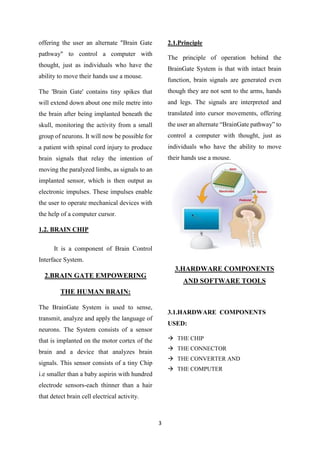
The 'Brain Gate' contains tiny spikes that
will extend down about one mile metre into
the brain after being implanted beneath the
skull, monitoring the activity from a small
group of neurons. It will now be possible for
a patient with spinal cord injury to produce
brain signals that relay the intention of
moving the paralyzed limbs, as signals to an
implanted sensor, which is then output as
electronic impulses. These impulses enable
the user to operate mechanical devices with
the help of a computer cursor.
1.2. BRAIN CHIP
It is a component of Brain Control
Interface System.
2.BRAIN GATE EMPOWERING
THE HUMAN BRAIN:
The BrainGate System is used to sense,
transmit, analyze and apply the language of
neurons. The System consists of a sensor
that is implanted on the motor cortex of the
brain and a device that analyzes brain
signals. This sensor consists of a tiny Chip
i.e smaller than a baby aspirin with hundred
electrode sensors-each thinner than a hair
that detect brain cell electrical activity.
2.1.Principle
The principle of operation behind the
BrainGate System is that with intact brain
function, brain signals are generated even
though they are not sent to the arms, hands
and legs. The signals are interpreted and
translated into cursor movements, offering
the user an alternate “BrainGate pathway” to
control a computer with thought, just as
individuals who have the ability to move
their hands use a mouse.
3.HARDWARE COMPONENTS
AND SOFTWARE TOOLS
3.1.HARDWARE COMPONENTS
USED:
 THE CHIP
 THE CONNECTOR
 THE CONVERTER AND
 THE COMPUTER
4
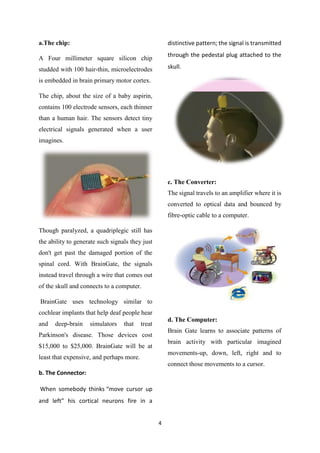
a.The chip:
A Four millimeter square silicon chip
studded with 100 hair-thin, microelectrodes
is embedded in brain primary motor cortex.
The chip, about the size of a baby aspirin,
contains 100 electrode sensors, each thinner
than a human hair. The sensors detect tiny
electrical signals generated when a user
imagines.
Though paralyzed, a quadriplegic still has
the ability to generate such signals they just
don't get past the damaged portion of the
spinal cord. With BrainGate, the signals
instead travel through a wire that comes out
of the skull and connects to a computer.
BrainGate uses technology similar to
cochlear implants that help deaf people hear
and deep-brain simulators that treat
Parkinson's disease. Those devices cost
$15,000 to $25,000. BrainGate will be at
least that expensive, and perhaps more.
b. The Connector:
When somebody thinks “move cursor up
and left” his cortical neurons fire in a
distinctive pattern; the signal is transmitted
through the pedestal plug attached to the
skull.
c. The Converter:
The signal travels to an amplifier where it is
converted to optical data and bounced by
fibre-optic cable to a computer.
d. The Computer:
Brain Gate learns to associate patterns of
brain activity with particular imagined
movements-up, down, left, right and to
connect those movements to a cursor.
5
A brain-computer interface uses
electrophysiological signals to control
remote devices. Most current BCIs are not
invasive. They consist of electrodes applied
to the scalp of an individual or worn in an
electrode cap. These electrodes pick up the
brain’s electrical activity (at the microvolt
level) and carry it into amplifiers. These
amplifiers amplify the signal approximately
ten thousand times and then pass the signal
via an analog to digital converter to a
computer for processing. The computer
processes the EEG signal and uses it in order
to accomplish tasks such as communication
and environmental control. BCIs are slow in
comparison with normal human actions,
because of the complexity and noisiness of
the signals used, as well as the time
necessary to complete recognition and
signal processing.The phrase brain-
computer interface (BCI) when taken
literally means to interface an individuals
electrophysiological signals with a
computer. A true BCI only uses signals from
the brain and as such must treat eye and
muscle movements as artifacts or noise. On
the other hand, a system that uses eye,
muscle, or other body potentials mixed with
EEG signals, is a brain-body actuated
system.
3.2. SOFTWARE BEHIND
BRAINGATE:
Software Behind BrainGate System uses
algorithms and pattern matching techniques
to facilitate communication. The algorithms
are written in C, JAVA and MATLAB.
signal processing software algorithms
analyze the electrical activity of neurons and
translate it into control signals for use in
various computer-based applications.
4.Working of the System:
WORKING:
Embedded down into the cortex
are hundred thin platinum tipped electrodes
each a millimeter long and only 90 microns
at the base. These pick up the brain’s
electrical signals which are then transmitted
to EEG through wires connected to each
individual electrode.
PREPROCESSING:
The raw EEG signal requires
some pre-processing before the feature
extraction. This pre-processing includes
removing unnecessary frequency bands,
averaging the current brain activity level,
6
transforming the measured scalp potentials
to cortex potentials and de-noising.
DETECTION:
The detection of the input from the
user and them translating it into an action
could be considered as key part of any BCI
system. This detection means to try to find
out these mental tasks from the EEG signal.
It can be done in time domain, e.g. by
comparing amplitudes of the EEG and in
frequency-domain. This involves usually
digital signal processing for sampling and
band pass filtering the signal, then
calculating these time -or frequency domain
features and then classifying them. These
classification algorithms include simple
comparison of amplitudes linear and non-
linear equations and artificial neural
networks. By constant feedback from user to
the system and vice versa, both partners
gradually learn more from each other and
improve the overall performance.
CONTROL:
The final part consists of applying
the will of the user to the used application.
The user chooses an action by controlling
his brain activity, which is then detected and
classified to corresponding action. Feedback
is provided to user by audio-visual means
e.g. when typing with virtual keyboard,
letter appears to the message box etc.
Frequency bands of the EEG
Band Frequency [Hz] Amplitude [V] Location
Alpha (_) 8-12 10 -150 Occipital/
Parietal regions
µ-rhythm 9-11 varies Precentral/
Postcentral regions
Beta (_) 14 -30 25 typically
frontal
regions
Theta (_) 4-7 varies varies
Delta (_) <3 varies varies
7
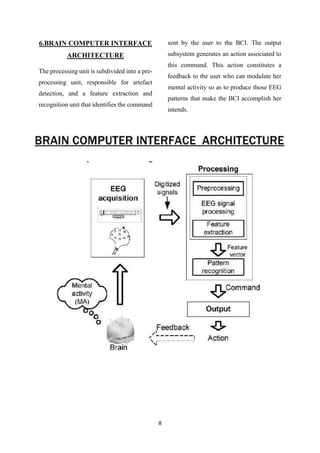
5.STRUCTURE OF BRAIN-COMPUTER INTERFACE
The common structure of a Brain-Computer Interface is given below:
1.Signal Acquisition: the EEG signals are obtained from the brain through invasive or non-
invasive methods (for example, electrodes).
2. Signal Pre-Processing: once the signals are acquired, it is necessary to clean them.
3.Signal Classification: once the signals are cleaned, they will be processed and classified to
find out which kind of mental task the subject is performing.
4.Computer Interaction: once the signals are classified, they will be used by an appropriate
algorithm for the development of a certain application.
8
6.BRAIN COMPUTER INTERFACE
ARCHITECTURE
The processing unit is subdivided into a pre-
processing unit, responsible for artefact
detection, and a feature extraction and
recognition unit that identifies the command
sent by the user to the BCI. The output
subsystem generates an action associated to
this command. This action constitutes a
feedback to the user who can modulate her
mental activity so as to produce those EEG
patterns that make the BCI accomplish her
intends.
9
7.CONNECTING BRAINS TO COMPUTERS:
A WAY TO HELP QUADRIPLEGICS:
Cyberkinetics, a company commercializing technology developed at Brown University, just
reported the results of its first attempt to implant sensors into the brain of a quadriplegic.
Signals from the sensor allow him to control a computer.
JUST LIKE A CELL PHONE
Many people might wonder how an
external device like an artificial arm gets
signals from the brain. Well, in a healthy
person the message from the brain first
moves down to the spinal cord and from
there, to the muscles of the limbs that need
to be moved. But in those with serious spinal
cord injuries, the path for the signals is
broken. Professor Donoghue explains this
state as being similar to cutting a telephone
cable-the receivers are fine but the
connections broken.
The brain chip can listen to the
electrical impulses produced by the neurons.
Placed into the brain itself, the electrode
arrays of these chips come into direct
contact with live neurons, and so can sense
the signal neuron impulses. Current methods
of direct neuron sensing being tested in
humans use arrays of as many as hundred
micro-electrodes, recording the electrical
activities of up to 96 different neurons are
small groups of neurons at a time.
7.1.A BOON TO THE
PARALYZED BRAINGATE
NEURAL INTERFACE SYSTEM
The first patient, Matthew Nagle, a 25 year
old Massachusetts man with a severe spinal
cord injury, has been paralyzed from the
10
neck down since 2001. Nagle is unable to
move his arms and legs after he was stabbed
in the neck. During 57 sessions, at New
England Sinai Hospital and Rehabilitation
Center, Nagle learned to open simulated
email, draw circular shapes using a paint
program on the computer and play a simple
videogame, "neural Pong," using only his
thoughts. He could change the channel and
adjust the volume on a television, even while
conversing. He was ultimately able to open
and close the fingers of a prosthetic hand and
use a robotic limb to grasp and move
objects. to open and close the fingers of a
prosthetic hand and use a robotic limb to
grasp and move objects. Despite a decline in
neural signals after few months, Nagle
remained an active participant in the trial
and continued to aid the clinical team in
producing valuable feedback concerning the
BrainGate technology.
Applications:
• Navigate Internet.
• Play Computer Games.
• Turn Lights On and Off.
• Control Television.
• Control Robotic Arm.
This technology is well supported by the
latest fields of
• Biomedical Instrumentation,
• Microelectronics, signal processing,
• Artificial Neural Networks and Robotics
which has overwhelming developments.
• Hope these systems will be effectively
implemented for many Biomedical
applications.
Advantages:
Potential advantages of the Brain Gate
System over other muscle driven:
• It is potential to interface with a compute
weeks or months of training.
• Its potential to be used in an interactive
environment users ability to operate the
device is not affected by their speech.
• Eye movement noise.
• The ability to provide significantly more
usefulness and utility than other approaches
by connecting directly to the part of the brain
that controls hand gestures.
11
Disadvantages:
• Dangerous and Experimental:
Neural Interfacing is extremely
dangerous and highly experimental. It
has only truly been spoken about in
science fiction text.
• Considered Unethnical:
Many people resist neural interfacing as
they consider it unethical and a harmful
advancement to the human body.
• Death and Permanent Brain Damage:
It may lead to death or permanent brain
damage as it is controlled by man induced
electrical impulses that are suppose to
meet our brain natural impulses to send
signals to response.
8.Conclusion:
The idea of moving robots or prosthetic
devices not by manual control, but by
thinking i.e. the brain activity of human
subjects has been a fascinated approach.
Medical cures are unavailable for many
forms of neural and muscular paralysis. The
enormity of the deficits caused by paralysis
is a strong motivation to pursue BMI
solutions. So this idea helps many patients to
control the prosthetic devices of their own
by simply thinking about the task.Here by,
we conclude that Neural interfaces have
emerged as effective interventions to reduce
the burden associated with some
neurological diseases, injuries and
disabilities. The BrainGate helps the
quadriplegic patients who cannot perform
even simple actions without the help of
another person are able to do things like
checking e-mails, turn the TV on or off, and
control a prosthetic arm with just their
thoughts. BrainChip technology does not
promise miracles it does not, for instance,
say that a paralysed man will one day walk
using an artificial leg by his thoughts alone.
REFERNCES:
1.The Brain Gate: The Little-Known
Doorway-J. Robert Hatherill (Author).
2.Implant Memory Chips in our Brain-
Dr. Gary Marcus(Author).
3.The Demise of the Brain Chip-Megan
Walsh(Author).
4. Brain-Computer Interfacing: An
Introduction-Rajesh P. N. R(Author).
5. Brain-Computer Interfaces: Principles-
Jonathan Wolpaw(Author).

Brain chips

  • 1.
    BRAIN CHIPS -A Study AUTHOR: S.MOHAMMEDRIZWAN SRI DURGADEVI POLYTECHNIC COLLEGE
  • 2.
    1 B RAI NC H I P Author: S.MOHAMMED RIZWAN mohammedrizwan@outlook.in Sri Durgadevi Polytechnic College Kavarapettai, Tiruvallur district. Computer Engineering 2nd Year. ABSTRACT: Thousands of people around the world suffer from paralysis, they are dependent on others to perform even the most basic tasks. But that could change, because of the latest achievements in the Brain-Computer Interface (BCI), which could help them regain a portion of their lost independence. Even normal humans may also be able to utilize Brain Chip Technology to enhance their relationship with the digital world- provided they are willing to receive the implant. The term ‘Brain Computer interface’ refers to the direct interaction between a healthy brain and a computer. Intense efforts and research in this BCI field over the past decade have recently resulted in a human BCI implantation, which is a great news for all of us, especially for those who have been resigned to spending their lives in wheel chairs. This Brain Chip Technology is a platform for the development of a wide range of other assisting devices. Brain Chip Technology helps quadriplegic people to do things like checking e-mail, turning the TV, lights on or off with just their thoughts. Also the definition of Brain- Computer Interface,the primary goal of designing Brain gate, the basic elements of BrainGate, the research work conducted on it at different Universities and some short comings of BrainGate were also presented. 1.INTRODUCTION The brain is "hardwired" with connections, which are made by billions of neurons that make electricity whenever they are stimulated. The electrical patterns are called brain waves. Neurons act like the wires and gates in a computer, gathering and transmitting electrochemical signals over distances as far as several feet. The brain encodes information not by relying on single neurons, but by spreading it across large
  • 3.
    2 populations of neurons,and by rapidly adapting to new circumstances. Motor neurons carry signals from the central nervous system to the muscles, skin and glands of the body, while sensory neurons carry signals from those outer parts of the body to the central nervous system. Receptors sense things like chemicals, light, and sound and encode this information into electrochemical signals transmitted by the sensory neurons. And interneurons tie everything together by connecting the various neurons within the brain and spinal cord. The part of the brain that controls motor skills is located at the ear of the frontal lobe. Muscles in the body's limbs contain embedded sensors called muscle spindles that measure the length and speed of the muscles as they stretch and contract as you move. Other sensors in the skin respond to stretching and pressure. Even if paralysis or disease damages the part of the brain that processes movement, the brain still makes neural signals. They're just not being sent to the arms, hands and legs. A technique called neurofeedback uses connecting sensors on the scalp to translate brain waves into information a person can learn from. The sensors register different frequencies of the signals produced in the brain. These changes in brain wave patterns indicate whether someone is concentrating or suppressing his impulses, or whether he is relaxed or tense. 1.1.BRAIN GATE Brain Gate was developed by the bio-tech company Cyberkinetics in 2003 in Conjunction with the department of Neuroscience Brown University. he device was designed to help those who have lost control of their limbs or other body function. The computer chip which is implanted into the brain, monitors brain activity in the patient and convert the intension of the user into computer hands. Currently the chip used 100 hair-thin electrodes that hear neurons firing in specific area of the brain. For e.g.: the area that control the arm movement. the activity is translated into eclectically charged signals and are then set and decoded using a program thus moving the arm. According to the Cyberkinetics website, 2 patients have been implanted with the Brain Gate. The Brain Gate System is based on Cyber kinetics" platform technologies to sense, transmit, analyze and apply the language of neurons. The System consists of a sensor that is implanted on the motor cortex of the brain and a device that analyzes brain signals. The principle of operation behind the Brain Gate System is that with intact brain function, brain signals are generated even though they are not sent to the arms, hands and legs. The signals are interpreted and translated into cursor movements,
  • 4.
    3 offering the useran alternate "Brain Gate pathway" to control a computer with thought, just as individuals who have the ability to move their hands use a mouse. The 'Brain Gate' contains tiny spikes that will extend down about one mile metre into the brain after being implanted beneath the skull, monitoring the activity from a small group of neurons. It will now be possible for a patient with spinal cord injury to produce brain signals that relay the intention of moving the paralyzed limbs, as signals to an implanted sensor, which is then output as electronic impulses. These impulses enable the user to operate mechanical devices with the help of a computer cursor. 1.2. BRAIN CHIP It is a component of Brain Control Interface System. 2.BRAIN GATE EMPOWERING THE HUMAN BRAIN: The BrainGate System is used to sense, transmit, analyze and apply the language of neurons. The System consists of a sensor that is implanted on the motor cortex of the brain and a device that analyzes brain signals. This sensor consists of a tiny Chip i.e smaller than a baby aspirin with hundred electrode sensors-each thinner than a hair that detect brain cell electrical activity. 2.1.Principle The principle of operation behind the BrainGate System is that with intact brain function, brain signals are generated even though they are not sent to the arms, hands and legs. The signals are interpreted and translated into cursor movements, offering the user an alternate “BrainGate pathway” to control a computer with thought, just as individuals who have the ability to move their hands use a mouse. 3.HARDWARE COMPONENTS AND SOFTWARE TOOLS 3.1.HARDWARE COMPONENTS USED:  THE CHIP  THE CONNECTOR  THE CONVERTER AND  THE COMPUTER
  • 5.
    4 a.The chip: A Fourmillimeter square silicon chip studded with 100 hair-thin, microelectrodes is embedded in brain primary motor cortex. The chip, about the size of a baby aspirin, contains 100 electrode sensors, each thinner than a human hair. The sensors detect tiny electrical signals generated when a user imagines. Though paralyzed, a quadriplegic still has the ability to generate such signals they just don't get past the damaged portion of the spinal cord. With BrainGate, the signals instead travel through a wire that comes out of the skull and connects to a computer. BrainGate uses technology similar to cochlear implants that help deaf people hear and deep-brain simulators that treat Parkinson's disease. Those devices cost $15,000 to $25,000. BrainGate will be at least that expensive, and perhaps more. b. The Connector: When somebody thinks “move cursor up and left” his cortical neurons fire in a distinctive pattern; the signal is transmitted through the pedestal plug attached to the skull. c. The Converter: The signal travels to an amplifier where it is converted to optical data and bounced by fibre-optic cable to a computer. d. The Computer: Brain Gate learns to associate patterns of brain activity with particular imagined movements-up, down, left, right and to connect those movements to a cursor.
  • 6.
    5 A brain-computer interfaceuses electrophysiological signals to control remote devices. Most current BCIs are not invasive. They consist of electrodes applied to the scalp of an individual or worn in an electrode cap. These electrodes pick up the brain’s electrical activity (at the microvolt level) and carry it into amplifiers. These amplifiers amplify the signal approximately ten thousand times and then pass the signal via an analog to digital converter to a computer for processing. The computer processes the EEG signal and uses it in order to accomplish tasks such as communication and environmental control. BCIs are slow in comparison with normal human actions, because of the complexity and noisiness of the signals used, as well as the time necessary to complete recognition and signal processing.The phrase brain- computer interface (BCI) when taken literally means to interface an individuals electrophysiological signals with a computer. A true BCI only uses signals from the brain and as such must treat eye and muscle movements as artifacts or noise. On the other hand, a system that uses eye, muscle, or other body potentials mixed with EEG signals, is a brain-body actuated system. 3.2. SOFTWARE BEHIND BRAINGATE: Software Behind BrainGate System uses algorithms and pattern matching techniques to facilitate communication. The algorithms are written in C, JAVA and MATLAB. signal processing software algorithms analyze the electrical activity of neurons and translate it into control signals for use in various computer-based applications. 4.Working of the System: WORKING: Embedded down into the cortex are hundred thin platinum tipped electrodes each a millimeter long and only 90 microns at the base. These pick up the brain’s electrical signals which are then transmitted to EEG through wires connected to each individual electrode. PREPROCESSING: The raw EEG signal requires some pre-processing before the feature extraction. This pre-processing includes removing unnecessary frequency bands, averaging the current brain activity level,
  • 7.
    6 transforming the measuredscalp potentials to cortex potentials and de-noising. DETECTION: The detection of the input from the user and them translating it into an action could be considered as key part of any BCI system. This detection means to try to find out these mental tasks from the EEG signal. It can be done in time domain, e.g. by comparing amplitudes of the EEG and in frequency-domain. This involves usually digital signal processing for sampling and band pass filtering the signal, then calculating these time -or frequency domain features and then classifying them. These classification algorithms include simple comparison of amplitudes linear and non- linear equations and artificial neural networks. By constant feedback from user to the system and vice versa, both partners gradually learn more from each other and improve the overall performance. CONTROL: The final part consists of applying the will of the user to the used application. The user chooses an action by controlling his brain activity, which is then detected and classified to corresponding action. Feedback is provided to user by audio-visual means e.g. when typing with virtual keyboard, letter appears to the message box etc. Frequency bands of the EEG Band Frequency [Hz] Amplitude [V] Location Alpha (_) 8-12 10 -150 Occipital/ Parietal regions µ-rhythm 9-11 varies Precentral/ Postcentral regions Beta (_) 14 -30 25 typically frontal regions Theta (_) 4-7 varies varies Delta (_) <3 varies varies
  • 8.
    7 5.STRUCTURE OF BRAIN-COMPUTERINTERFACE The common structure of a Brain-Computer Interface is given below: 1.Signal Acquisition: the EEG signals are obtained from the brain through invasive or non- invasive methods (for example, electrodes). 2. Signal Pre-Processing: once the signals are acquired, it is necessary to clean them. 3.Signal Classification: once the signals are cleaned, they will be processed and classified to find out which kind of mental task the subject is performing. 4.Computer Interaction: once the signals are classified, they will be used by an appropriate algorithm for the development of a certain application.
  • 9.
    8 6.BRAIN COMPUTER INTERFACE ARCHITECTURE Theprocessing unit is subdivided into a pre- processing unit, responsible for artefact detection, and a feature extraction and recognition unit that identifies the command sent by the user to the BCI. The output subsystem generates an action associated to this command. This action constitutes a feedback to the user who can modulate her mental activity so as to produce those EEG patterns that make the BCI accomplish her intends.
  • 10.
    9 7.CONNECTING BRAINS TOCOMPUTERS: A WAY TO HELP QUADRIPLEGICS: Cyberkinetics, a company commercializing technology developed at Brown University, just reported the results of its first attempt to implant sensors into the brain of a quadriplegic. Signals from the sensor allow him to control a computer. JUST LIKE A CELL PHONE Many people might wonder how an external device like an artificial arm gets signals from the brain. Well, in a healthy person the message from the brain first moves down to the spinal cord and from there, to the muscles of the limbs that need to be moved. But in those with serious spinal cord injuries, the path for the signals is broken. Professor Donoghue explains this state as being similar to cutting a telephone cable-the receivers are fine but the connections broken. The brain chip can listen to the electrical impulses produced by the neurons. Placed into the brain itself, the electrode arrays of these chips come into direct contact with live neurons, and so can sense the signal neuron impulses. Current methods of direct neuron sensing being tested in humans use arrays of as many as hundred micro-electrodes, recording the electrical activities of up to 96 different neurons are small groups of neurons at a time. 7.1.A BOON TO THE PARALYZED BRAINGATE NEURAL INTERFACE SYSTEM The first patient, Matthew Nagle, a 25 year old Massachusetts man with a severe spinal cord injury, has been paralyzed from the
  • 11.
    10 neck down since2001. Nagle is unable to move his arms and legs after he was stabbed in the neck. During 57 sessions, at New England Sinai Hospital and Rehabilitation Center, Nagle learned to open simulated email, draw circular shapes using a paint program on the computer and play a simple videogame, "neural Pong," using only his thoughts. He could change the channel and adjust the volume on a television, even while conversing. He was ultimately able to open and close the fingers of a prosthetic hand and use a robotic limb to grasp and move objects. to open and close the fingers of a prosthetic hand and use a robotic limb to grasp and move objects. Despite a decline in neural signals after few months, Nagle remained an active participant in the trial and continued to aid the clinical team in producing valuable feedback concerning the BrainGate technology. Applications: • Navigate Internet. • Play Computer Games. • Turn Lights On and Off. • Control Television. • Control Robotic Arm. This technology is well supported by the latest fields of • Biomedical Instrumentation, • Microelectronics, signal processing, • Artificial Neural Networks and Robotics which has overwhelming developments. • Hope these systems will be effectively implemented for many Biomedical applications. Advantages: Potential advantages of the Brain Gate System over other muscle driven: • It is potential to interface with a compute weeks or months of training. • Its potential to be used in an interactive environment users ability to operate the device is not affected by their speech. • Eye movement noise. • The ability to provide significantly more usefulness and utility than other approaches by connecting directly to the part of the brain that controls hand gestures.
  • 12.
    11 Disadvantages: • Dangerous andExperimental: Neural Interfacing is extremely dangerous and highly experimental. It has only truly been spoken about in science fiction text. • Considered Unethnical: Many people resist neural interfacing as they consider it unethical and a harmful advancement to the human body. • Death and Permanent Brain Damage: It may lead to death or permanent brain damage as it is controlled by man induced electrical impulses that are suppose to meet our brain natural impulses to send signals to response. 8.Conclusion: The idea of moving robots or prosthetic devices not by manual control, but by thinking i.e. the brain activity of human subjects has been a fascinated approach. Medical cures are unavailable for many forms of neural and muscular paralysis. The enormity of the deficits caused by paralysis is a strong motivation to pursue BMI solutions. So this idea helps many patients to control the prosthetic devices of their own by simply thinking about the task.Here by, we conclude that Neural interfaces have emerged as effective interventions to reduce the burden associated with some neurological diseases, injuries and disabilities. The BrainGate helps the quadriplegic patients who cannot perform even simple actions without the help of another person are able to do things like checking e-mails, turn the TV on or off, and control a prosthetic arm with just their thoughts. BrainChip technology does not promise miracles it does not, for instance, say that a paralysed man will one day walk using an artificial leg by his thoughts alone. REFERNCES: 1.The Brain Gate: The Little-Known Doorway-J. Robert Hatherill (Author). 2.Implant Memory Chips in our Brain- Dr. Gary Marcus(Author). 3.The Demise of the Brain Chip-Megan Walsh(Author). 4. Brain-Computer Interfacing: An Introduction-Rajesh P. N. R(Author). 5. Brain-Computer Interfaces: Principles- Jonathan Wolpaw(Author).