BRAINGATE TECHNOLOGY
Presented by:-
Praneeth Inampudi
Contents:-
• Introduction
• History
• NeuroChip
• Principle
• Working
• Neuromotor Devices
• Applications
• Conclusion
Introduction
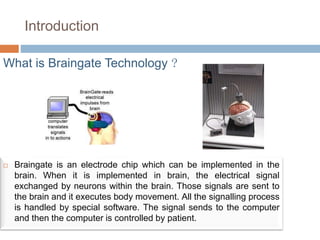
 Braingate is an electrode chip which can be implemented in the
brain. When it is implemented in brain, the electrical signal
exchanged by neurons within the brain. Those signals are sent to
the brain and it executes body movement. All the signalling process
is handled by special software. The signal sends to the computer
and then the computer is controlled by patient.
What is Braingate Technology ?
History
 After 10 years of study and research,
Cyberkinetics, a biotech company in
Foxboro, Massachusetts, has developed
Braingate in 2
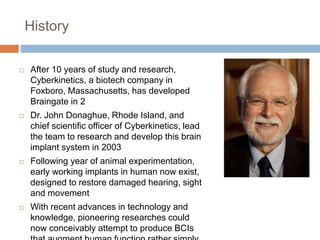
 Dr. John Donaghue, Rhode Island, and
chief scientific officer of Cyberkinetics, lead
the team to research and develop this brain
implant system in 2003
 Following year of animal experimentation,
early working implants in human now exist,
designed to restore damaged hearing, sight
and movement
 With recent advances in technology and
knowledge, pioneering researches could
now conceivably attempt to produce BCIs
NeuroChip
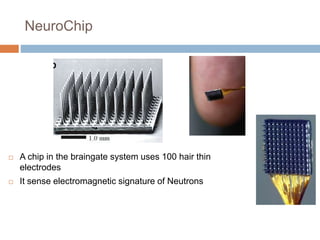
 A chip in the braingate system uses 100 hair thin
electrodes
 It sense electromagnetic signature of Neutrons
Principle
 With intact brain function, brain signals are
generated even through they are not sent to the
arms, hands and legs
 The signals are interpreted and transmitted into
cursor movements
Working
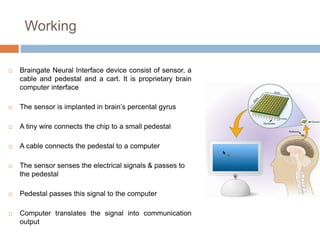
 Braingate Neural Interface device consist of sensor, a
cable and pedestal and a cart. It is proprietary brain
computer interface
 The sensor is implanted in brain’s percental gyrus
 A tiny wire connects the chip to a small pedestal
 A cable connects the pedestal to a computer
 The sensor senses the electrical signals & passes to
the pedestal
 Pedestal passes this signal to the computer
 Computer translates the signal into communication
output
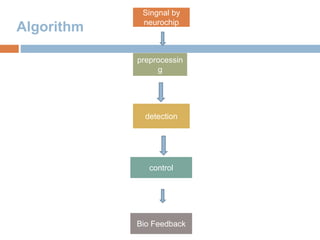
Singnal by
neurochip
preprocessin
g
detection
control
Bio Feedback
Algorithm
Chip Implimentation in Brain
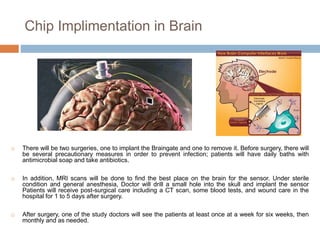
 There will be two surgeries, one to implant the Braingate and one to remove it. Before surgery, there will
be several precautionary measures in order to prevent infection; patients will have daily baths with
antimicrobial soap and take antibiotics.
 In addition, MRI scans will be done to find the best place on the brain for the sensor. Under sterile
condition and general anesthesia, Doctor will drill a small hole into the skull and implant the sensor
Patients will receive post-surgical care including a CT scan, some blood tests, and wound care in the
hospital for 1 to 5 days after surgery.
 After surgery, one of the study doctors will see the patients at least once at a week for six weeks, then
monthly and as needed.
Advantages
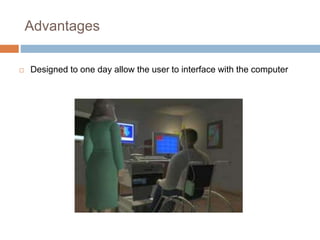
 Designed to one day allow the user to interface with the computer
Advantages
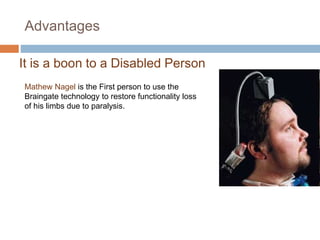
It is a boon to a Disabled Person
Mathew Nagel is the First person to use the
Braingate technology to restore functionality loss
of his limbs due to paralysis.
Advantages
 Faster than what is possible with the hands of a non- disabled
person
Disadvantages
 Has not been approved by FDA
 Has been approved for pre-market clinical
trials
 No estimate on cost
Applications
 Multi device patient ambulation system
 Biological interface system with patient training
apparatus
 Biological interface system with surrogate controlled
device
 Limb and digit movement system
 Mental typewriter
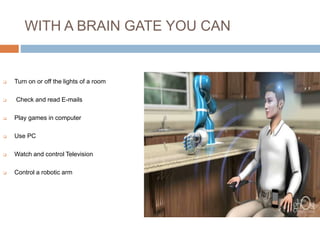
WITH A BRAIN GATE YOU CAN
 Turn on or off the lights of a room
 Check and read E-mails
 Play games in computer
 Use PC
 Watch and control Television
 Control a robotic arm
Conclusion
The invention of Braingate is such a
Revolution in medical field. The
remarkable breakthrough offers hope
that people who are paralyzed will
one day be able to independently
operate artificial limbs, computers or
wheelchairs
References
http://www.braingate.com/technology.html
http://en.wikipedia.org/wiki/BrainGate
http://www.howstuffworks.com/braincomputerinterface
.htm
Braingate technology

Braingate technology

  • 1.
  • 2.
    Contents:- • Introduction • History •NeuroChip • Principle • Working • Neuromotor Devices • Applications • Conclusion
  • 3.
    Introduction  Braingate isan electrode chip which can be implemented in the brain. When it is implemented in brain, the electrical signal exchanged by neurons within the brain. Those signals are sent to the brain and it executes body movement. All the signalling process is handled by special software. The signal sends to the computer and then the computer is controlled by patient. What is Braingate Technology ?
  • 4.
    History  After 10years of study and research, Cyberkinetics, a biotech company in Foxboro, Massachusetts, has developed Braingate in 2  Dr. John Donaghue, Rhode Island, and chief scientific officer of Cyberkinetics, lead the team to research and develop this brain implant system in 2003  Following year of animal experimentation, early working implants in human now exist, designed to restore damaged hearing, sight and movement  With recent advances in technology and knowledge, pioneering researches could now conceivably attempt to produce BCIs
  • 5.
    NeuroChip  A chipin the braingate system uses 100 hair thin electrodes  It sense electromagnetic signature of Neutrons
  • 6.
    Principle  With intactbrain function, brain signals are generated even through they are not sent to the arms, hands and legs  The signals are interpreted and transmitted into cursor movements
  • 7.
    Working  Braingate NeuralInterface device consist of sensor, a cable and pedestal and a cart. It is proprietary brain computer interface  The sensor is implanted in brain’s percental gyrus  A tiny wire connects the chip to a small pedestal  A cable connects the pedestal to a computer  The sensor senses the electrical signals & passes to the pedestal  Pedestal passes this signal to the computer  Computer translates the signal into communication output
  • 8.
  • 9.
    Chip Implimentation inBrain  There will be two surgeries, one to implant the Braingate and one to remove it. Before surgery, there will be several precautionary measures in order to prevent infection; patients will have daily baths with antimicrobial soap and take antibiotics.  In addition, MRI scans will be done to find the best place on the brain for the sensor. Under sterile condition and general anesthesia, Doctor will drill a small hole into the skull and implant the sensor Patients will receive post-surgical care including a CT scan, some blood tests, and wound care in the hospital for 1 to 5 days after surgery.  After surgery, one of the study doctors will see the patients at least once at a week for six weeks, then monthly and as needed.
  • 10.
    Advantages  Designed toone day allow the user to interface with the computer
  • 11.
    Advantages It is aboon to a Disabled Person Mathew Nagel is the First person to use the Braingate technology to restore functionality loss of his limbs due to paralysis.
  • 12.
    Advantages  Faster thanwhat is possible with the hands of a non- disabled person
  • 13.
    Disadvantages  Has notbeen approved by FDA  Has been approved for pre-market clinical trials  No estimate on cost
  • 14.
    Applications  Multi devicepatient ambulation system  Biological interface system with patient training apparatus  Biological interface system with surrogate controlled device  Limb and digit movement system  Mental typewriter
  • 15.
    WITH A BRAINGATE YOU CAN  Turn on or off the lights of a room  Check and read E-mails  Play games in computer  Use PC  Watch and control Television  Control a robotic arm
  • 16.
    Conclusion The invention ofBraingate is such a Revolution in medical field. The remarkable breakthrough offers hope that people who are paralyzed will one day be able to independently operate artificial limbs, computers or wheelchairs
  • 17.