BRAIN COMPUTER INTERFACE
BY SACHIN AND CHAITANYA
What is Brain–computer interface?
A brain–computer interface (BCI), sometimes called a
mind-machine interface (MMI), direct neural interface
(DNI), synthetic telepathy interface (STI) or brain–machine
interface (BMI), is a direct communication pathway
between the brain and an external device. BCIs are often
directed at assisting, augmenting, or repairing human
cognitive or sensory-motor functions.
“Brain computer interface is the technology to interact with
human brain to the computer or any communicating
device.”
Introduction
For generations, humans have fantasized about the ability to
communicate and interact with machines through thought alone or to
create devices that can peer into person’s mind and thoughts. These
ideas have captured the imagination of humankind in the form of
ancient myths and modern science fiction stories. However, it is only
recently that advances in cognitive neuroscience and brain imaging
technologies have started to provide us with the ability to interface
directly with the human brain. This ability is made possible through
the use of sensors that can monitor some of the physical processes
that occur within the brain that correspond with certain forms of
thought.
History
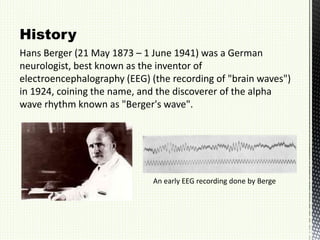
Hans Berger (21 May 1873 – 1 June 1941) was a German
neurologist, best known as the inventor of
electroencephalography (EEG) (the recording of "brain waves")
in 1924, coining the name, and the discoverer of the alpha
wave rhythm known as "Berger's wave".
An early EEG recording done by Berge
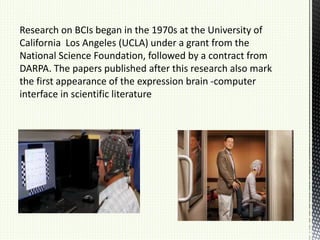
Research on BCIs began in the 1970s at the University of
California Los Angeles (UCLA) under a grant from the
National Science Foundation, followed by a contract from
DARPA. The papers published after this research also mark
the first appearance of the expression brain -computer
interface in scientific literature
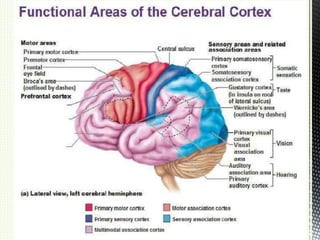
 Architecture of Brain
The brain can be roughly divided into two main parts:
• Cerebral Cortex,
• Sub-cortical regions.
1 Cerebral Cortex System
The cerebral cortex is evolutionarily much newer. Since this is the largest and most
complex part of the brain in the human, this is usually the part of the brain people notice
in pictures. The cortex supports most sensory and motor processing as well as ―higher‖
level functions including reasoning,
planning, language processing, and pattern recognition. This is the region that current BCI
work has largely focused on.
2 Sub-cortical Regions
Sub-cortical regions are phylogenetically older and include a areas associated with
controlling basic functions including vital functions such as respiration, heart rate, and
temperature regulation, basic emotional and instinctive responses such as fear and
reward, reflexes, as well as learning and memory
How Brain-computer Interfaces Work
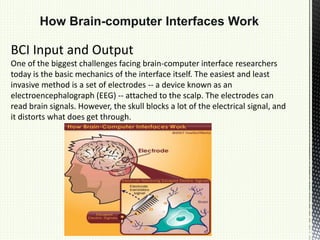
BCI Input and Output
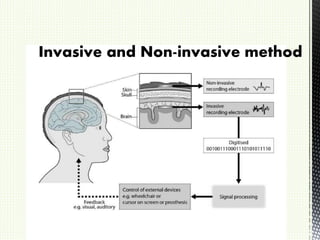
One of the biggest challenges facing brain-computer interface researchers
today is the basic mechanics of the interface itself. The easiest and least
invasive method is a set of electrodes -- a device known as an
electroencephalograph (EEG) -- attached to the scalp. The electrodes can
read brain signals. However, the skull blocks a lot of the electrical signal, and
it distorts what does get through.
To get a higher-resolution signal, scientists can implant electrodes directly
into the gray matter of the brain itself, or on the surface of the brain,
beneath the skull. This allows for much more direct reception of electric
signals and allows electrode placement in the specific area of the brain
where the appropriate signals are generated. This approach has many
problems, however. It requires invasive surgery to implant the electrodes,
and devices left in the brain long-term tend to cause the formation of scar
tissue in the gray matter. This scar tissue ultimately blocks signals.
Another way to measure brain activity is with a Magnetic Resonance Image (MRI). An
MRI machine is a massive, complicated device. It produces very high-resolution images
of brain activity, but it can't be used as part of a permanent or semipermanent BCI.
Researchers use it to get benchmarks for certain brain functions or to map where in
the brain electrodes should be placed to measure a specific function. For example, if
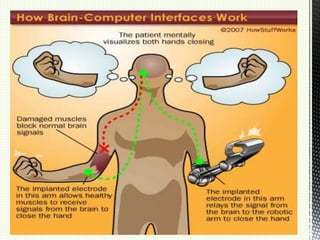
researchers are attempting to implant electrodes that will allow someone to control a
robotic arm with their thoughts, they might first put the subject into an MRI and ask
him or her to think about moving their actual arm. The MRI will show which area of
the brain is active during arm movement, giving them a clearer target for electrode
placement.
Invasive and Non-invasive method
Experiments and Researches
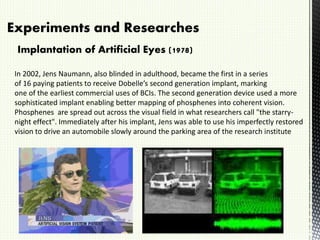
In 2002, Jens Naumann, also blinded in adulthood, became the first in a series
of 16 paying patients to receive Dobelle’s second generation implant, marking
one of the earliest commercial uses of BCIs. The second generation device used a more
sophisticated implant enabling better mapping of phosphenes into coherent vision.
Phosphenes are spread out across the visual field in what researchers call "the starry-
night effect". Immediately after his implant, Jens was able to use his imperfectly restored
vision to drive an automobile slowly around the parking area of the research institute
Implantation of Artificial Eyes (1978)
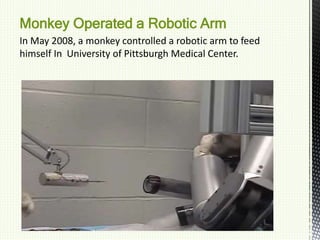
Monkey Operated a Robotic Arm
In May 2008, a monkey controlled a robotic arm to feed
himself In University of Pittsburgh Medical Center.
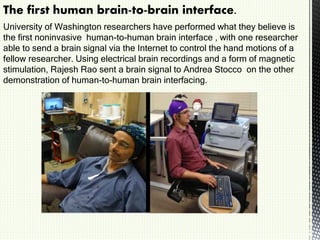
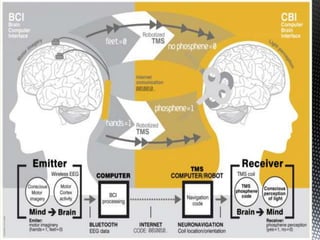
The first human brain-to-brain interface.
University of Washington researchers have performed what they believe is
the first noninvasive human-to-human brain interface , with one researcher
able to send a brain signal via the Internet to control the hand motions of a
fellow researcher. Using electrical brain recordings and a form of magnetic
stimulation, Rajesh Rao sent a brain signal to Andrea Stocco on the other
demonstration of human-to-human brain interfacing.
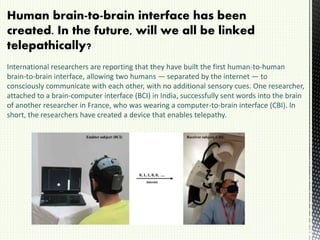
Human brain-to-brain interface has been
created. In the future, will we all be linked
telepathically?
International researchers are reporting that they have built the first human-to-human
brain-to-brain interface, allowing two humans — separated by the internet — to
consciously communicate with each other, with no additional sensory cues. One researcher,
attached to a brain-computer interface (BCI) in India, successfully sent words into the brain
of another researcher in France, who was wearing a computer-to-brain interface (CBI). In
short, the researchers have created a device that enables telepathy.
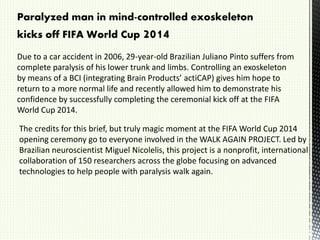
Paralyzed man in mind-controlled exoskeleton
kicks off FIFA World Cup 2014
Due to a car accident in 2006, 29-year-old Brazilian Juliano Pinto suffers from
complete paralysis of his lower trunk and limbs. Controlling an exoskeleton
by means of a BCI (integrating Brain Products’ actiCAP) gives him hope to
return to a more normal life and recently allowed him to demonstrate his
confidence by successfully completing the ceremonial kick off at the FIFA
World Cup 2014.
The credits for this brief, but truly magic moment at the FIFA World Cup 2014
opening ceremony go to everyone involved in the WALK AGAIN PROJECT. Led by
Brazilian neuroscientist Miguel Nicolelis, this project is a nonprofit, international
collaboration of 150 researchers across the globe focusing on advanced
technologies to help people with paralysis walk again.
FIFA World Cup (2014) WALK AGAIN PROJECT
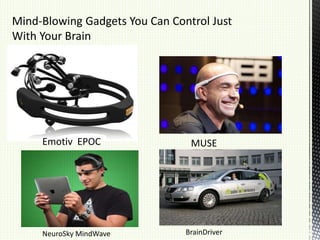
Mind-Blowing Gadgets You Can Control Just
With Your Brain
Emotiv EPOC MUSE
NeuroSky MindWave BrainDriver
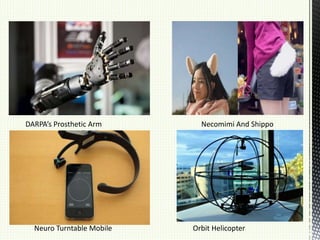
DARPA’s Prosthetic Arm Necomimi And Shippo
Neuro Turntable Mobile Orbit Helicopter
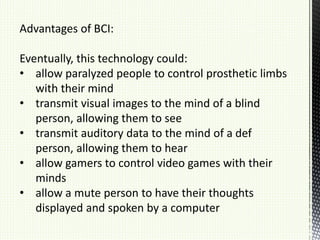
Advantages of BCI:
Eventually, this technology could:
• allow paralyzed people to control prosthetic limbs
with their mind
• transmit visual images to the mind of a blind
person, allowing them to see
• transmit auditory data to the mind of a def
person, allowing them to hear
• allow gamers to control video games with their
minds
• allow a mute person to have their thoughts
displayed and spoken by a computer
One Giant Bite: Woman with Quadriplegia Feeds Herself
Chocolate Using Mind-Controlled Robot Arm
Man Controls Robotic Hand with Mind
Man sees with
'bionic eye'
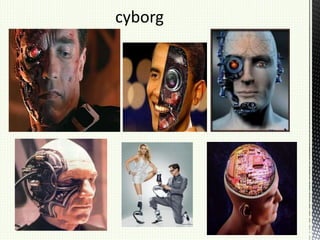
cyborg
Disadvantages of BCI:
 Research is still in beginning stages
 The current technology is crude
 Ethical issues may prevent its development
 Electrodes outside of the skull can detect very
few electric signals from the brain
 Electrodes placed inside the skull create scar
tissue in the brain
Brain computer Interface

Brain computer Interface

  • 1.
    BRAIN COMPUTER INTERFACE BYSACHIN AND CHAITANYA
  • 2.
    What is Brain–computerinterface? A brain–computer interface (BCI), sometimes called a mind-machine interface (MMI), direct neural interface (DNI), synthetic telepathy interface (STI) or brain–machine interface (BMI), is a direct communication pathway between the brain and an external device. BCIs are often directed at assisting, augmenting, or repairing human cognitive or sensory-motor functions. “Brain computer interface is the technology to interact with human brain to the computer or any communicating device.”
  • 3.
    Introduction For generations, humanshave fantasized about the ability to communicate and interact with machines through thought alone or to create devices that can peer into person’s mind and thoughts. These ideas have captured the imagination of humankind in the form of ancient myths and modern science fiction stories. However, it is only recently that advances in cognitive neuroscience and brain imaging technologies have started to provide us with the ability to interface directly with the human brain. This ability is made possible through the use of sensors that can monitor some of the physical processes that occur within the brain that correspond with certain forms of thought.
  • 4.
    History Hans Berger (21May 1873 – 1 June 1941) was a German neurologist, best known as the inventor of electroencephalography (EEG) (the recording of "brain waves") in 1924, coining the name, and the discoverer of the alpha wave rhythm known as "Berger's wave". An early EEG recording done by Berge
  • 5.
    Research on BCIsbegan in the 1970s at the University of California Los Angeles (UCLA) under a grant from the National Science Foundation, followed by a contract from DARPA. The papers published after this research also mark the first appearance of the expression brain -computer interface in scientific literature
  • 6.
     Architecture ofBrain The brain can be roughly divided into two main parts: • Cerebral Cortex, • Sub-cortical regions. 1 Cerebral Cortex System The cerebral cortex is evolutionarily much newer. Since this is the largest and most complex part of the brain in the human, this is usually the part of the brain people notice in pictures. The cortex supports most sensory and motor processing as well as ―higher‖ level functions including reasoning, planning, language processing, and pattern recognition. This is the region that current BCI work has largely focused on. 2 Sub-cortical Regions Sub-cortical regions are phylogenetically older and include a areas associated with controlling basic functions including vital functions such as respiration, heart rate, and temperature regulation, basic emotional and instinctive responses such as fear and reward, reflexes, as well as learning and memory
  • 8.
    How Brain-computer InterfacesWork BCI Input and Output One of the biggest challenges facing brain-computer interface researchers today is the basic mechanics of the interface itself. The easiest and least invasive method is a set of electrodes -- a device known as an electroencephalograph (EEG) -- attached to the scalp. The electrodes can read brain signals. However, the skull blocks a lot of the electrical signal, and it distorts what does get through.
  • 9.
    To get ahigher-resolution signal, scientists can implant electrodes directly into the gray matter of the brain itself, or on the surface of the brain, beneath the skull. This allows for much more direct reception of electric signals and allows electrode placement in the specific area of the brain where the appropriate signals are generated. This approach has many problems, however. It requires invasive surgery to implant the electrodes, and devices left in the brain long-term tend to cause the formation of scar tissue in the gray matter. This scar tissue ultimately blocks signals. Another way to measure brain activity is with a Magnetic Resonance Image (MRI). An MRI machine is a massive, complicated device. It produces very high-resolution images of brain activity, but it can't be used as part of a permanent or semipermanent BCI. Researchers use it to get benchmarks for certain brain functions or to map where in the brain electrodes should be placed to measure a specific function. For example, if researchers are attempting to implant electrodes that will allow someone to control a robotic arm with their thoughts, they might first put the subject into an MRI and ask him or her to think about moving their actual arm. The MRI will show which area of the brain is active during arm movement, giving them a clearer target for electrode placement.
  • 12.
  • 13.
    Experiments and Researches In2002, Jens Naumann, also blinded in adulthood, became the first in a series of 16 paying patients to receive Dobelle’s second generation implant, marking one of the earliest commercial uses of BCIs. The second generation device used a more sophisticated implant enabling better mapping of phosphenes into coherent vision. Phosphenes are spread out across the visual field in what researchers call "the starry- night effect". Immediately after his implant, Jens was able to use his imperfectly restored vision to drive an automobile slowly around the parking area of the research institute Implantation of Artificial Eyes (1978)
  • 14.
    Monkey Operated aRobotic Arm In May 2008, a monkey controlled a robotic arm to feed himself In University of Pittsburgh Medical Center.
  • 15.
    The first humanbrain-to-brain interface. University of Washington researchers have performed what they believe is the first noninvasive human-to-human brain interface , with one researcher able to send a brain signal via the Internet to control the hand motions of a fellow researcher. Using electrical brain recordings and a form of magnetic stimulation, Rajesh Rao sent a brain signal to Andrea Stocco on the other demonstration of human-to-human brain interfacing.
  • 16.
    Human brain-to-brain interfacehas been created. In the future, will we all be linked telepathically? International researchers are reporting that they have built the first human-to-human brain-to-brain interface, allowing two humans — separated by the internet — to consciously communicate with each other, with no additional sensory cues. One researcher, attached to a brain-computer interface (BCI) in India, successfully sent words into the brain of another researcher in France, who was wearing a computer-to-brain interface (CBI). In short, the researchers have created a device that enables telepathy.
  • 18.
    Paralyzed man inmind-controlled exoskeleton kicks off FIFA World Cup 2014 Due to a car accident in 2006, 29-year-old Brazilian Juliano Pinto suffers from complete paralysis of his lower trunk and limbs. Controlling an exoskeleton by means of a BCI (integrating Brain Products’ actiCAP) gives him hope to return to a more normal life and recently allowed him to demonstrate his confidence by successfully completing the ceremonial kick off at the FIFA World Cup 2014. The credits for this brief, but truly magic moment at the FIFA World Cup 2014 opening ceremony go to everyone involved in the WALK AGAIN PROJECT. Led by Brazilian neuroscientist Miguel Nicolelis, this project is a nonprofit, international collaboration of 150 researchers across the globe focusing on advanced technologies to help people with paralysis walk again.
  • 19.
    FIFA World Cup(2014) WALK AGAIN PROJECT
  • 20.
    Mind-Blowing Gadgets YouCan Control Just With Your Brain Emotiv EPOC MUSE NeuroSky MindWave BrainDriver
  • 21.
    DARPA’s Prosthetic ArmNecomimi And Shippo Neuro Turntable Mobile Orbit Helicopter
  • 22.
    Advantages of BCI: Eventually,this technology could: • allow paralyzed people to control prosthetic limbs with their mind • transmit visual images to the mind of a blind person, allowing them to see • transmit auditory data to the mind of a def person, allowing them to hear • allow gamers to control video games with their minds • allow a mute person to have their thoughts displayed and spoken by a computer
  • 23.
    One Giant Bite:Woman with Quadriplegia Feeds Herself Chocolate Using Mind-Controlled Robot Arm
  • 24.
    Man Controls RoboticHand with Mind
  • 25.
  • 26.
  • 27.
    Disadvantages of BCI: Research is still in beginning stages  The current technology is crude  Ethical issues may prevent its development  Electrodes outside of the skull can detect very few electric signals from the brain  Electrodes placed inside the skull create scar tissue in the brain