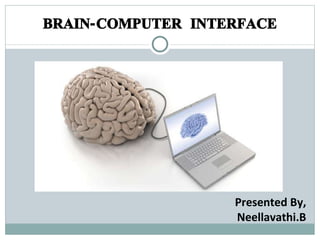
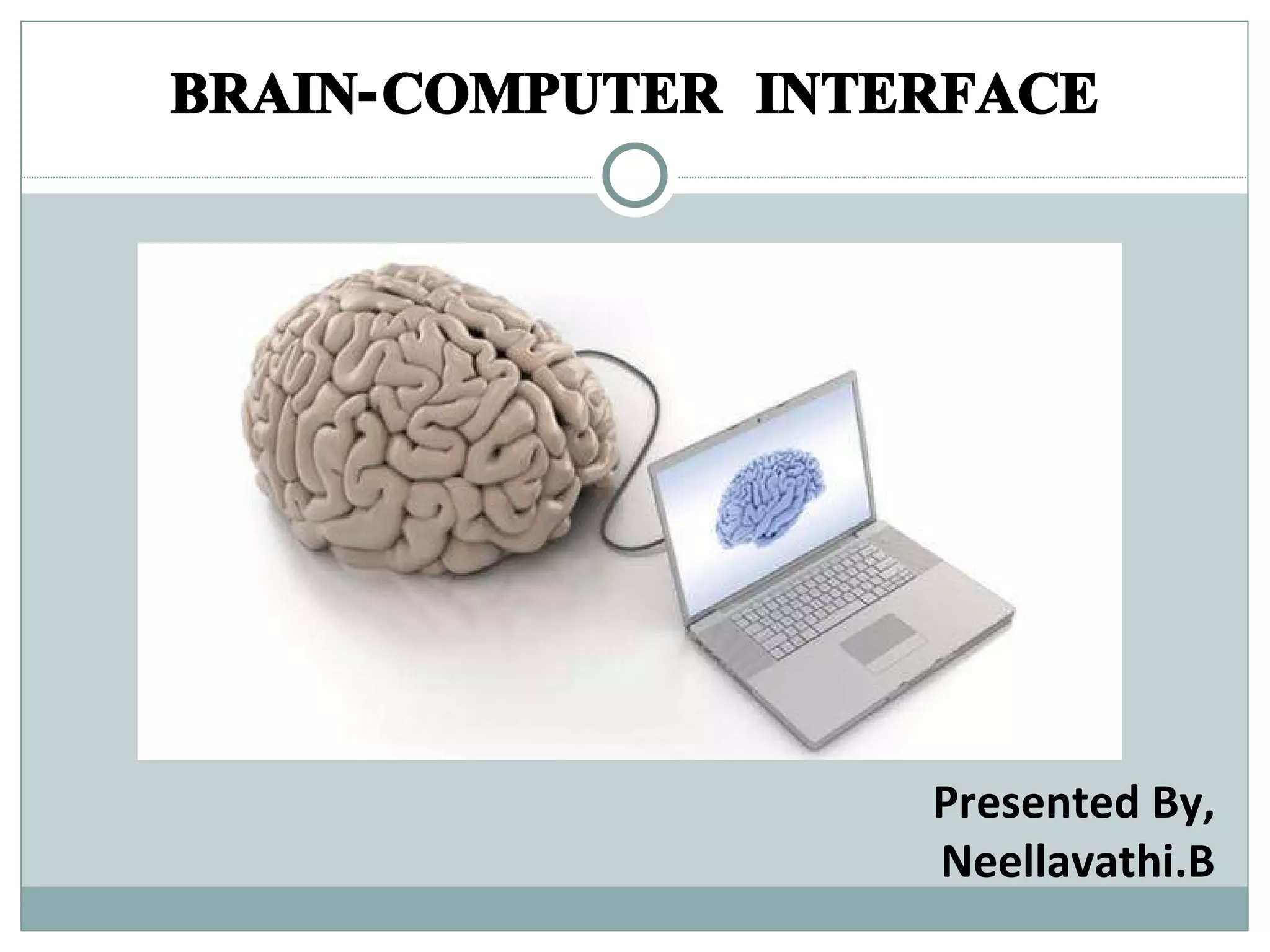
BRAIN-COMPUTER INTERFACE Presented By, Neellavathi.B
DEFINITION A brain–computer interface (BCI), sometimes called a direct neural interface or a brain–machine interface, is a direct communication pathway between a brain and an external device.
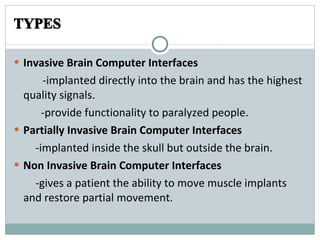
TYPES Invasive Brain Computer Interfaces -implanted directly into the brain and has the highest quality signals. -provide functionality to paralyzed people.  Partially Invasive Brain Computer Interfaces -implanted inside the skull but outside the brain.  Non Invasive Brain Computer Interfaces -gives a patient the ability to move muscle implants and restore partial movement.
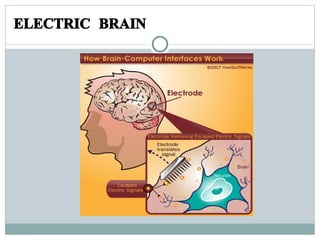
ELECTRIC BRAIN Our brains are filled with  neurons. Every time we think, move, feel or remember something, our neurons are at work.  That work is carried out by small  electric signals  that zip from neuron to neuron as fast as 250 mph.
ELECTRIC BRAIN
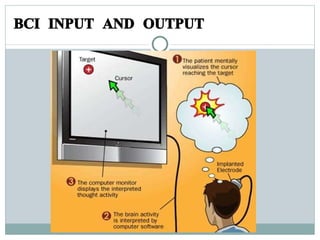
BCI INPUT AND OUTPUT The easiest and least invasive method is a set of electrodes -- a device known as an  electroencephalograph  (EEG) -- attached to the scalp.  The electrodes can read brain signals. The electrodes measure minute differences in the voltage between neurons. The signal is then amplified and filtered.  In current BCI systems, it is then interpreted by a computer program
BCI INPUT AND OUTPUT
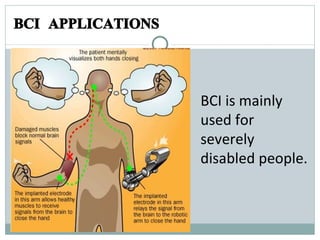
BCI APPLICATIONS BCI is mainly used for severely disabled people.
NEUROPROSTHETICS  Neuroprosthetics is an area of neuroscience concerned with neural prostheses—using artificial devices to replace the function of impaired nervous systems or sensory organs. The most widely used neuroprosthetic device is the cochlear implant. There are also several neuroprosthetic devices that aim to restore vision, including retinal implants.
BCI VERSUS NEUROPROSTHETICS   Neuroprosthetics typically connect the nervous system to a device. BCIs usually connect the brain (or nervous system) with a computer system.
APPLICATIONS OF BCI Medicine Military Manufacturing Gaming Social Potential
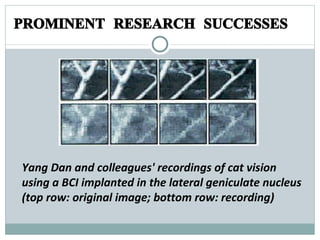
PROMINENT RESEARCH SUCCESSES Yang Dan and colleagues' recordings of cat vision using a BCI implanted in the lateral geniculate nucleus (top row: original image; bottom row: recording)
ANIMAL BCI RESEARCH
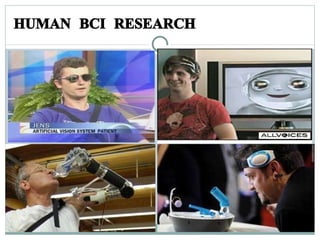
HUMAN BCI RESEARCH
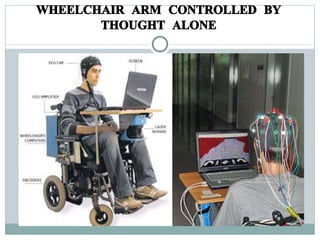
WHEELCHAIR ARM CONTROLLED BY THOUGHT ALONE
BCI IN AVATAR
BCI IN AVATAR
CURRENT DEVELOPMENTS AND FUTURE ‘ Braingate’ brain computer interface takes shape ATR and honda develops new brain computer interface Hitachi: commercial mind-machine interface by 2011 Hat allows computer control by thought Dream machine
BCI ADVANTAGES BCIs will help creating a Direct communication pathway between a human or animal brain and any external devices like computers.  BCI has increased the possibility of treatment of disabilities related to nervous system along with the old technique of Neuroprosthetics.  Techniques like EEG, MEG and neurochips have come into discussions since the BCI application have started developing.  This has provided a new work area for scientists and researchers around the world.
BCI DRAWBACKS The brain is incredibly complex. The signal is weak and prone to interference. The equipment is less than portable.
CONCLUSION Newly purchased computers will one day arrive with biological signal sensors and thought-recognition software built in, just as keyboard and mouse are commonly found on today's units.
 

Brain-computer interface

  • 1.
  • 2.
    DEFINITION A brain–computerinterface (BCI), sometimes called a direct neural interface or a brain–machine interface, is a direct communication pathway between a brain and an external device.
  • 3.
    TYPES Invasive BrainComputer Interfaces -implanted directly into the brain and has the highest quality signals. -provide functionality to paralyzed people. Partially Invasive Brain Computer Interfaces -implanted inside the skull but outside the brain. Non Invasive Brain Computer Interfaces -gives a patient the ability to move muscle implants and restore partial movement.
  • 4.
    ELECTRIC BRAIN Ourbrains are filled with neurons. Every time we think, move, feel or remember something, our neurons are at work. That work is carried out by small electric signals that zip from neuron to neuron as fast as 250 mph.
  • 5.
  • 6.
    BCI INPUT ANDOUTPUT The easiest and least invasive method is a set of electrodes -- a device known as an electroencephalograph (EEG) -- attached to the scalp. The electrodes can read brain signals. The electrodes measure minute differences in the voltage between neurons. The signal is then amplified and filtered. In current BCI systems, it is then interpreted by a computer program
  • 7.
  • 8.
    BCI APPLICATIONS BCIis mainly used for severely disabled people.
  • 9.
    NEUROPROSTHETICS  Neuroprosthetics isan area of neuroscience concerned with neural prostheses—using artificial devices to replace the function of impaired nervous systems or sensory organs. The most widely used neuroprosthetic device is the cochlear implant. There are also several neuroprosthetic devices that aim to restore vision, including retinal implants.
  • 10.
    BCI VERSUS NEUROPROSTHETICS  Neuroprosthetics typically connect the nervous system to a device. BCIs usually connect the brain (or nervous system) with a computer system.
  • 11.
    APPLICATIONS OF BCIMedicine Military Manufacturing Gaming Social Potential
  • 12.
    PROMINENT RESEARCH SUCCESSESYang Dan and colleagues' recordings of cat vision using a BCI implanted in the lateral geniculate nucleus (top row: original image; bottom row: recording)
  • 13.
  • 14.
  • 15.
    WHEELCHAIR ARM CONTROLLEDBY THOUGHT ALONE
  • 16.
  • 17.
  • 18.
    CURRENT DEVELOPMENTS ANDFUTURE ‘ Braingate’ brain computer interface takes shape ATR and honda develops new brain computer interface Hitachi: commercial mind-machine interface by 2011 Hat allows computer control by thought Dream machine
  • 19.
    BCI ADVANTAGES BCIswill help creating a Direct communication pathway between a human or animal brain and any external devices like computers. BCI has increased the possibility of treatment of disabilities related to nervous system along with the old technique of Neuroprosthetics. Techniques like EEG, MEG and neurochips have come into discussions since the BCI application have started developing. This has provided a new work area for scientists and researchers around the world.
  • 20.
    BCI DRAWBACKS Thebrain is incredibly complex. The signal is weak and prone to interference. The equipment is less than portable.
  • 21.
    CONCLUSION Newly purchasedcomputers will one day arrive with biological signal sensors and thought-recognition software built in, just as keyboard and mouse are commonly found on today's units.
  • 22.