Presented By
Sri Uday Saikia












Introduction
What is BCI
History
Structure and signals
Architecture/Logical structure
Brain waves
Functionality
Future Work
Conclusion
References







It is the study of brain functions.
A collaboration in which a brain accepts and
controls a mechanical device.
Direct communication pathway between a brain
and an external device.
Thus BCI extracts electro-physical signals from
suitable components of the brain and process
them to generate control signals for computers,
robotic machines or communication devices.
“ A Brain-Computer Interface is a communication
system that do not depend on peripheral nerves
and muscles “

[J. R. Wolpaw et al. “Brain-computer interface
technology: A review of the first international
meeting,” IEEE Trans. Rehab. Eng., vol. 8, no.
2, pp. 164–173, 2000]


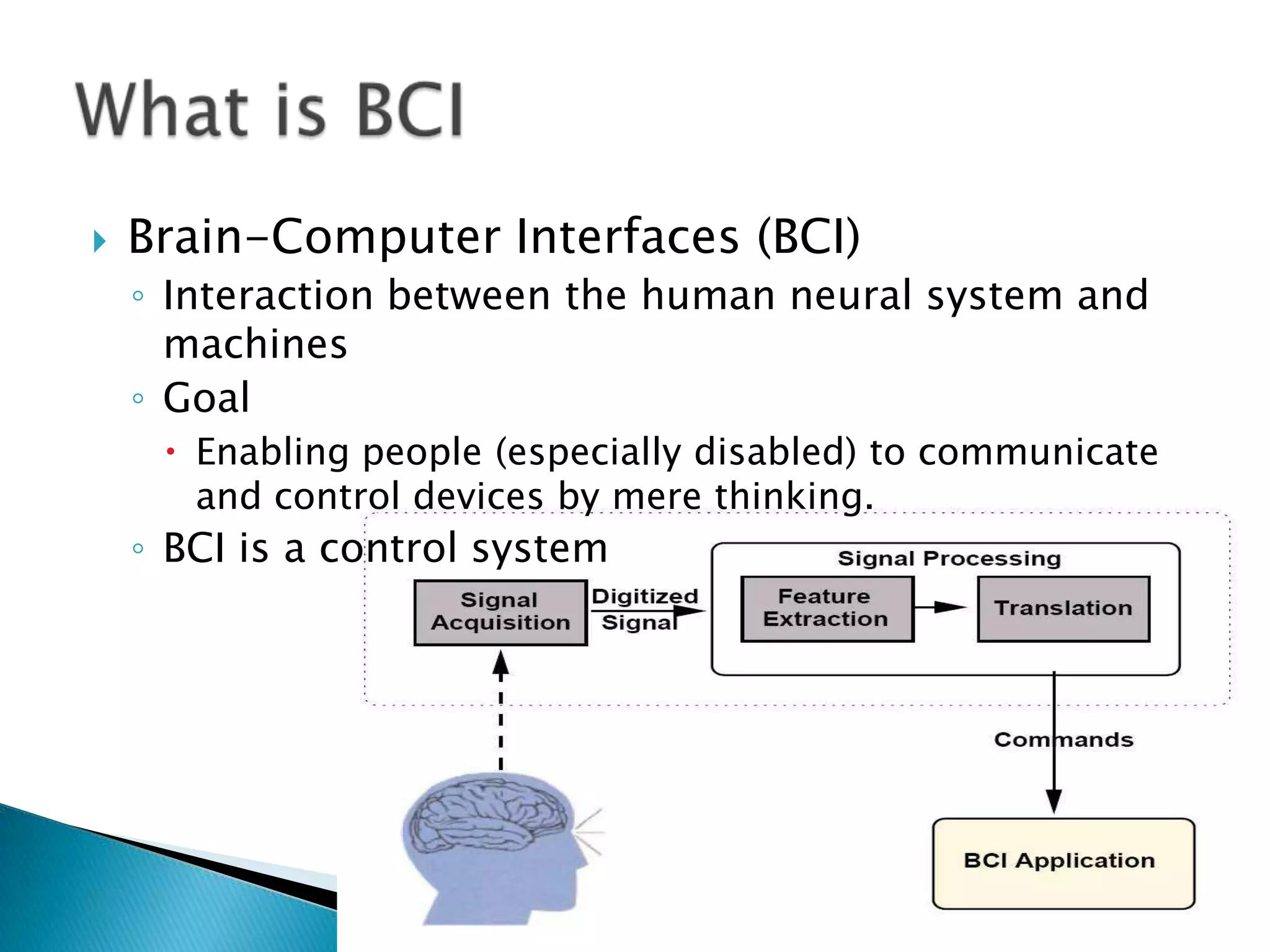
Brain-Computer Interfaces (BCI)
◦ Interaction between the human neural system and
machines
◦ Goal
 Enabling people (especially disabled) to communicate
and control devices by mere thinking.

◦ BCI is a control system






1924: Hans Berger discovers the EEG
Analyses the interrelation of EEG and brain
diseases.
1970: First developments to use brain waves
as input
ARPA has vision of enhanced human
First step in the right direction








1990: First successful experiments with
monkeys
Implanting electrode arrays into monkey
brains
Recording of monkeys„ brain waves
2000: Monkeys control robots by thoughts




More non-invasive than invasive approaches
Brain reading by eg. EEG, MEG or fMRI
2004: First human benefits from research
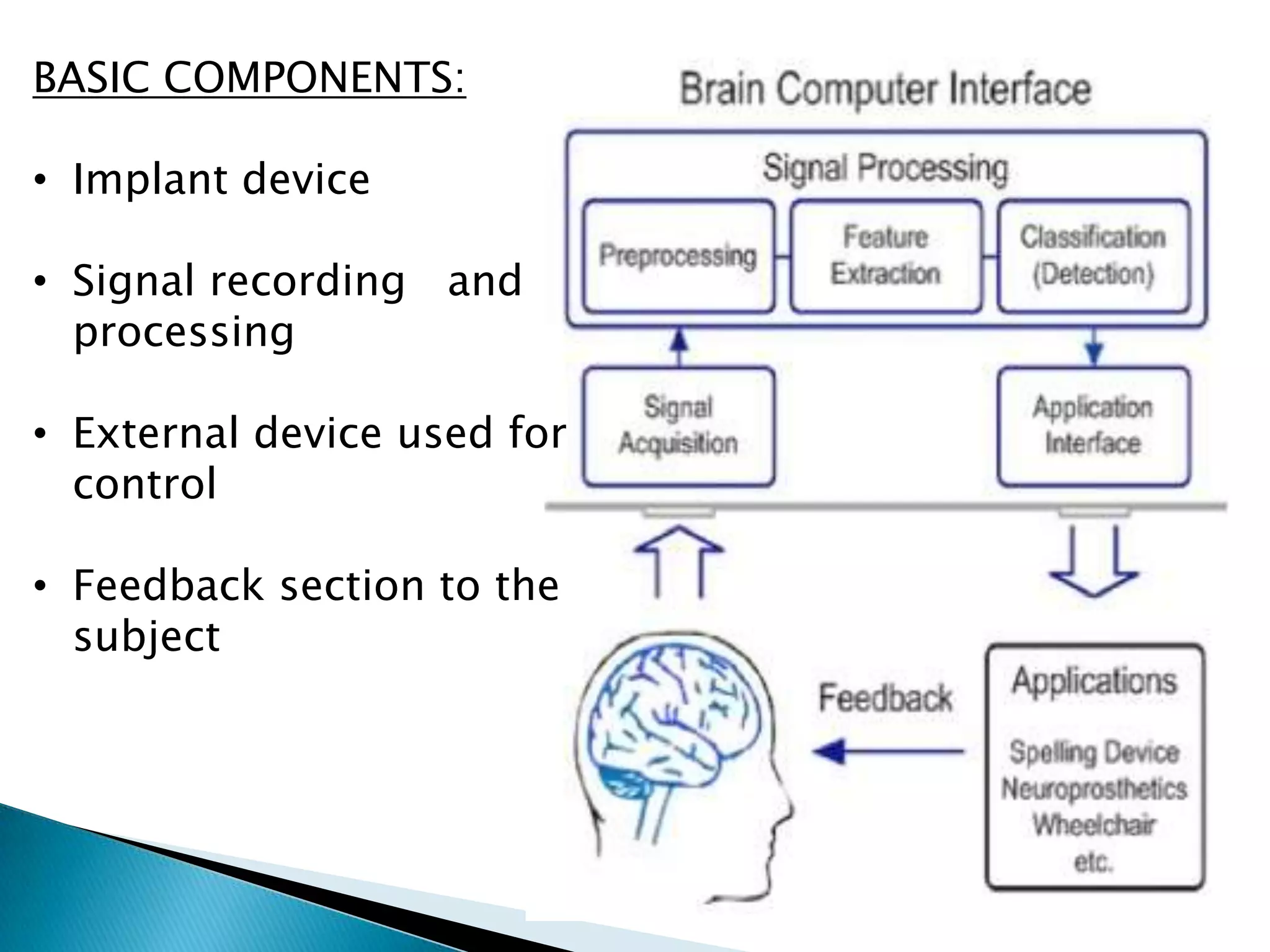
BASIC COMPONENTS:
• Implant device
• Signal recording and
processing
• External device used for
control

• Feedback section to the
subject
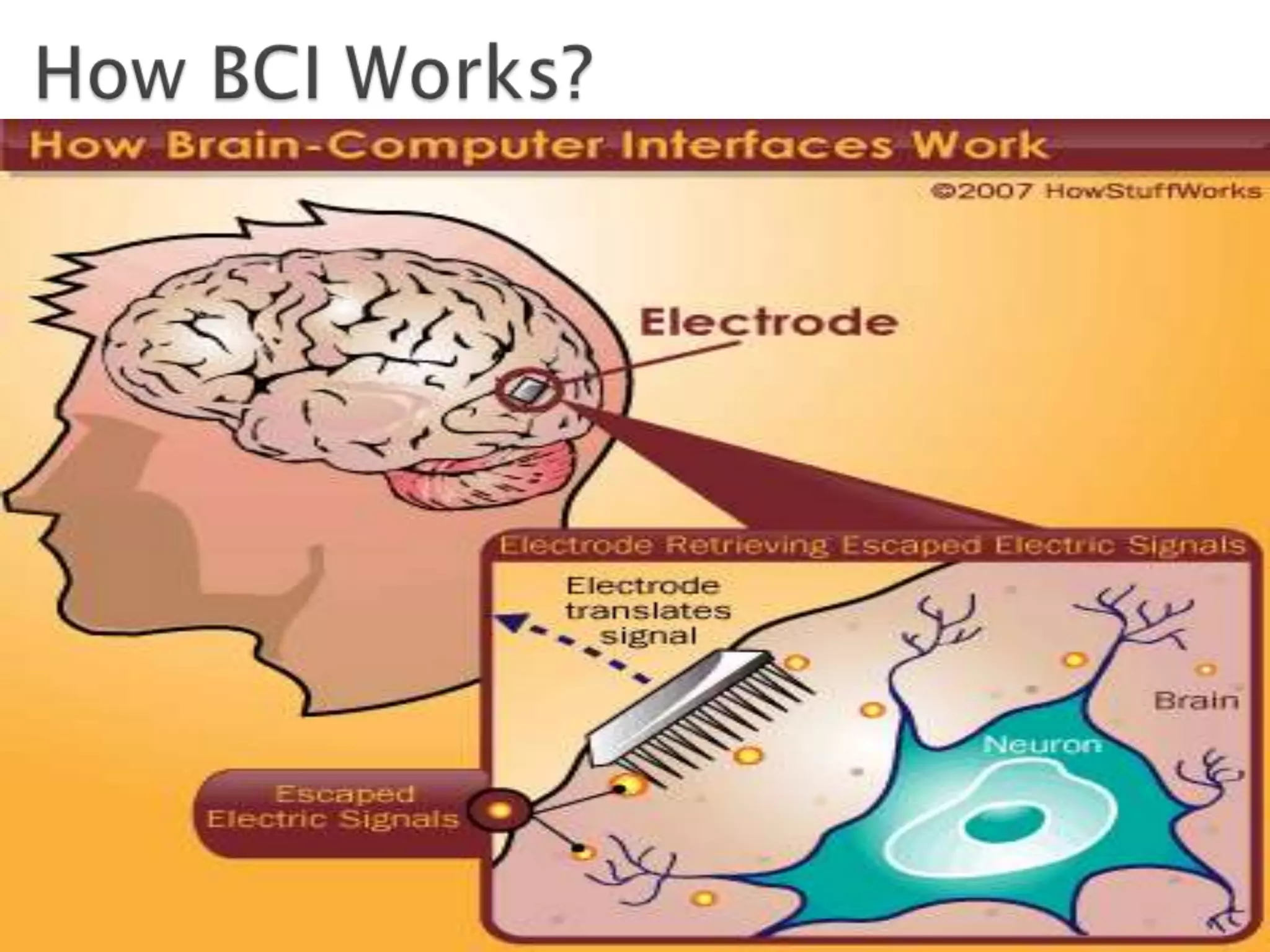
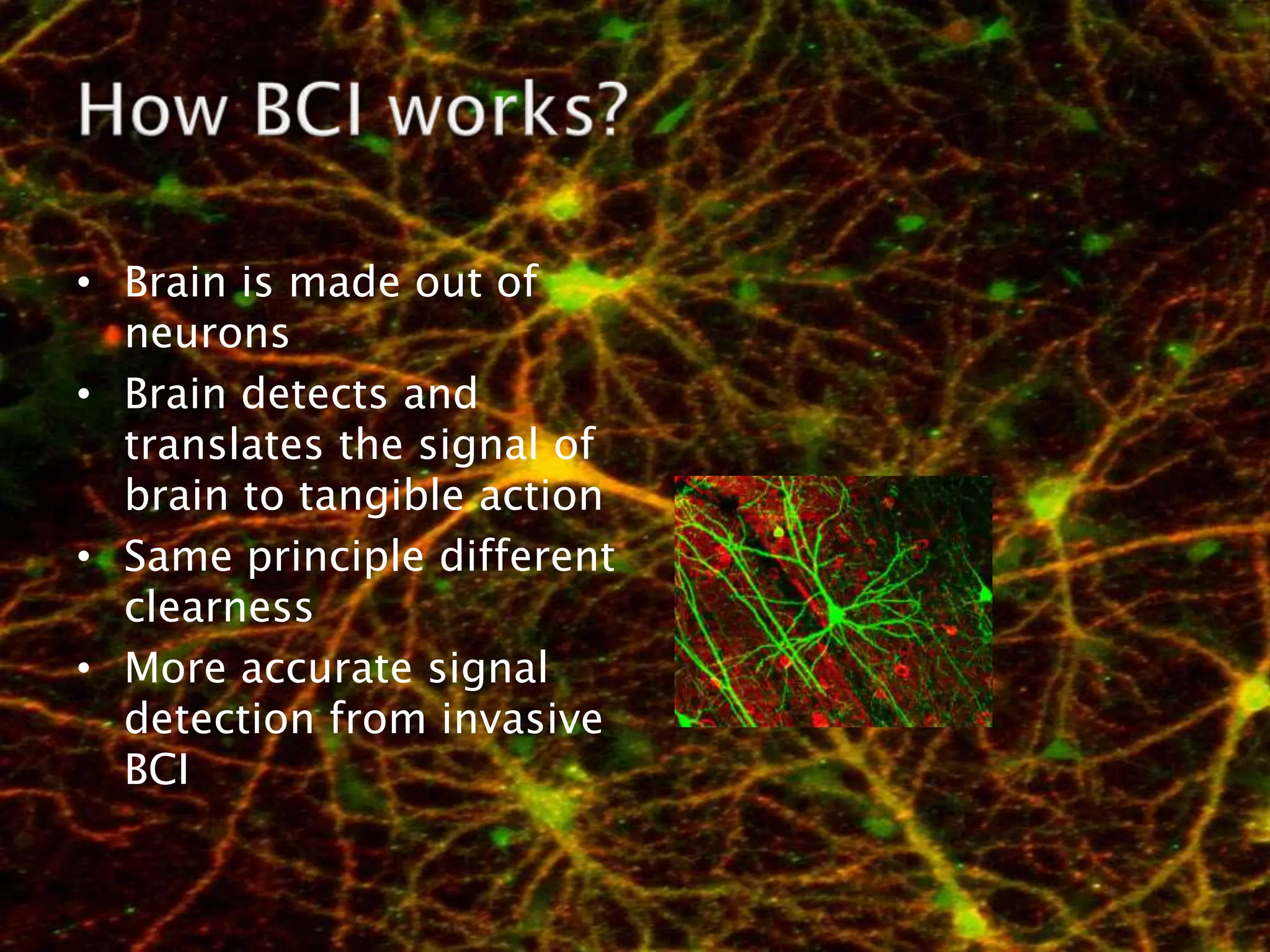
• Brain is made out of
neurons
• Brain detects and
translates the signal of
brain to tangible action
• Same principle different
clearness
• More accurate signal
detection from invasive
BCI
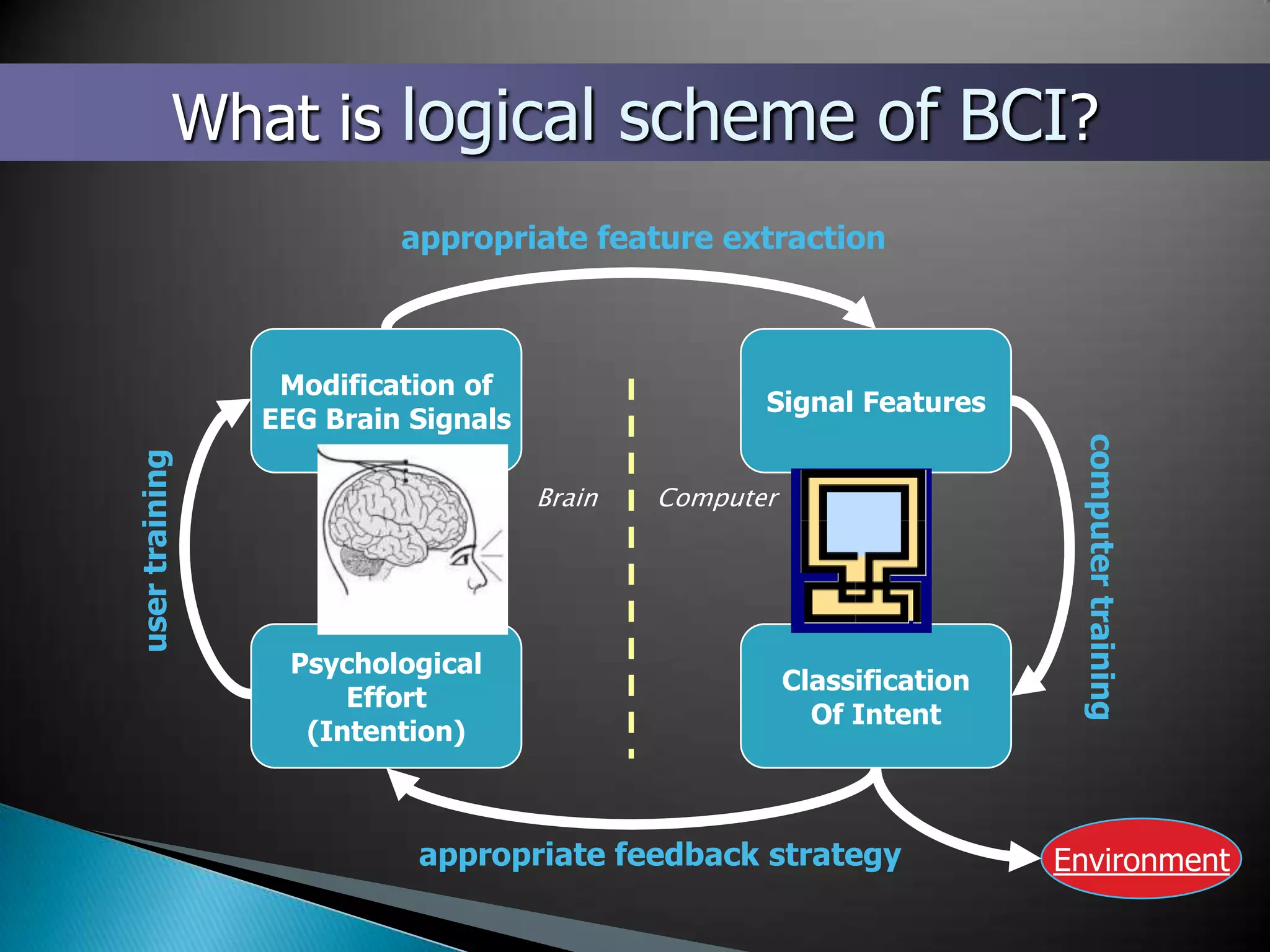
What is logical scheme of BCI?
appropriate feature extraction

Signal Features
Brain

Psychological
Effort
(Intention)

Computer

Classification
Of Intent

appropriate feedback strategy

computer training

user training

Modification of
EEG Brain Signals

Environment
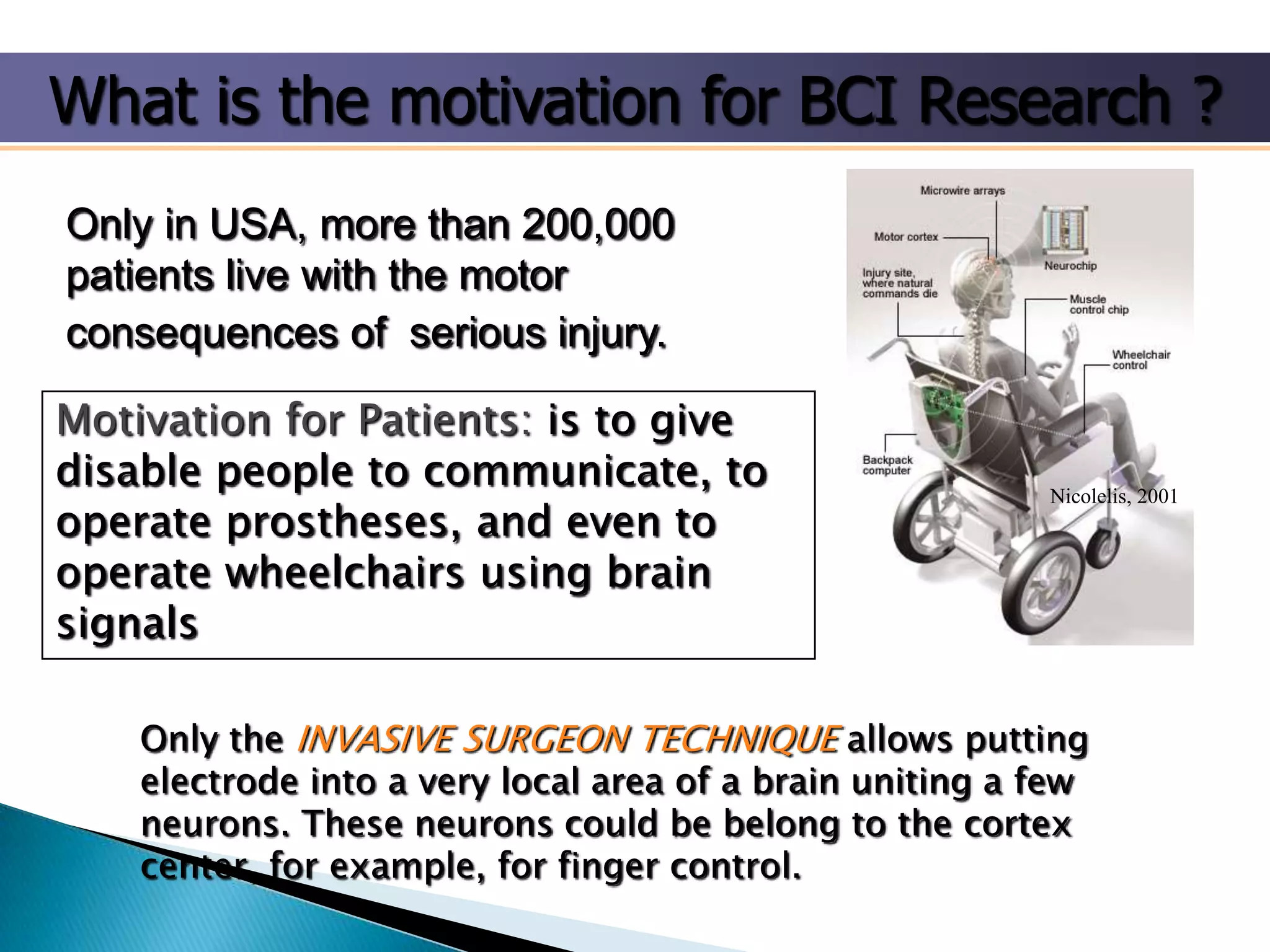
What is the motivation for BCI Research ?
Only in USA, more than 200,000
patients live with the motor
consequences of serious injury.
Motivation for Patients: is to give
disable people to communicate, to
operate prostheses, and even to
operate wheelchairs using brain
signals

Nicolelis, 2001

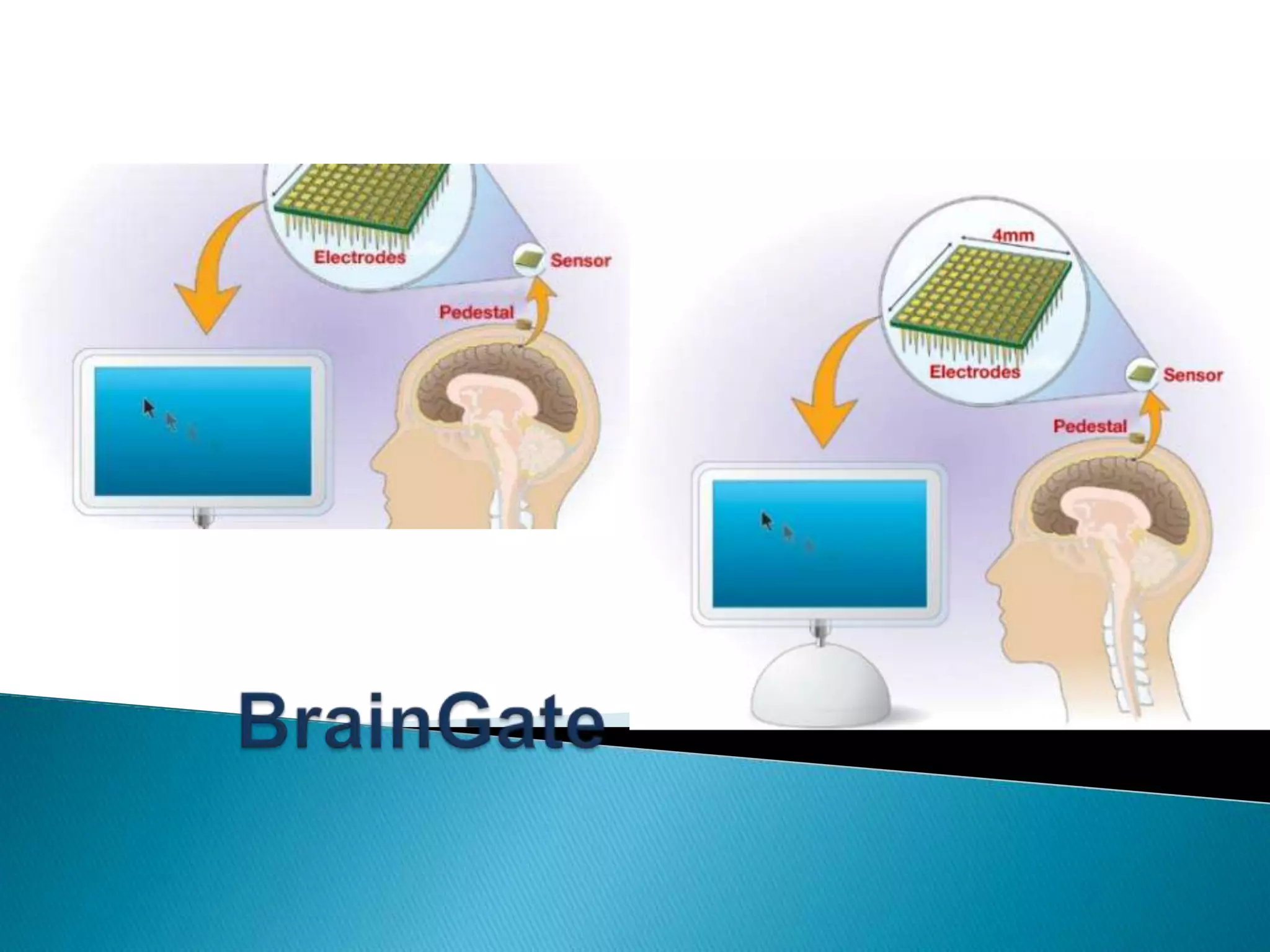
Only the INVASIVE SURGEON TECHNIQUE allows putting
electrode into a very local area of a brain uniting a few
neurons. These neurons could be belong to the cortex
center, for example, for finger control.
BCI Types

Invasive BCI:
implant electrodes directly onto a patient’s
brain.

Non-Invasive:
implant medical scanning devices to read
brain signals.
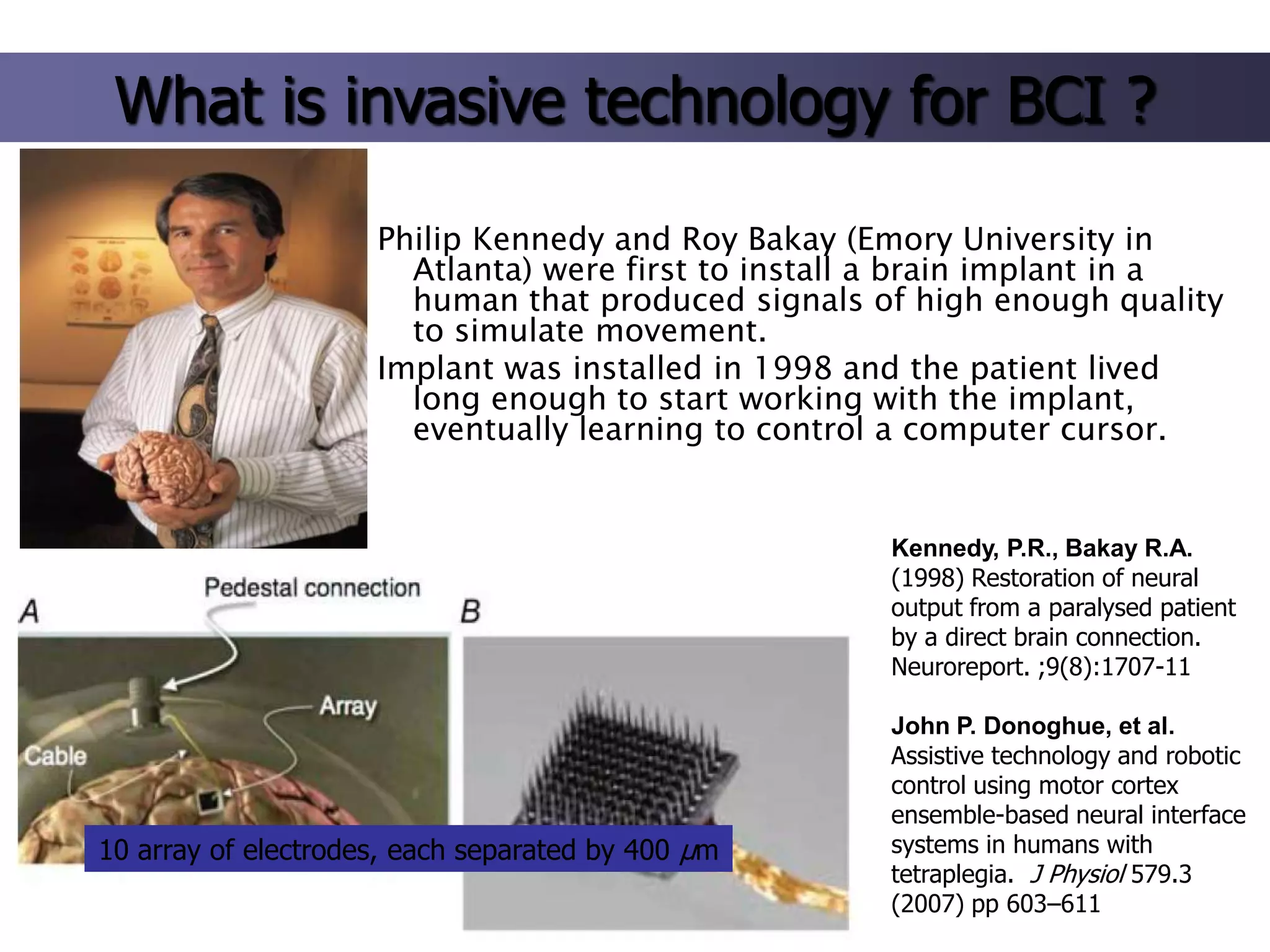
What is invasive technology for BCI ?
Philip Kennedy and Roy Bakay (Emory University in
Atlanta) were first to install a brain implant in a
human that produced signals of high enough quality
to simulate movement.
Implant was installed in 1998 and the patient lived
long enough to start working with the implant,
eventually learning to control a computer cursor.

Kennedy, P.R., Bakay R.A.
(1998) Restoration of neural
output from a paralysed patient
by a direct brain connection.
Neuroreport. ;9(8):1707-11

10 array of electrodes, each separated by 400 μm

John P. Donoghue, et al.
Assistive technology and robotic
control using motor cortex
ensemble-based neural interface
systems in humans with
tetraplegia. J Physiol 579.3
(2007) pp 603–611
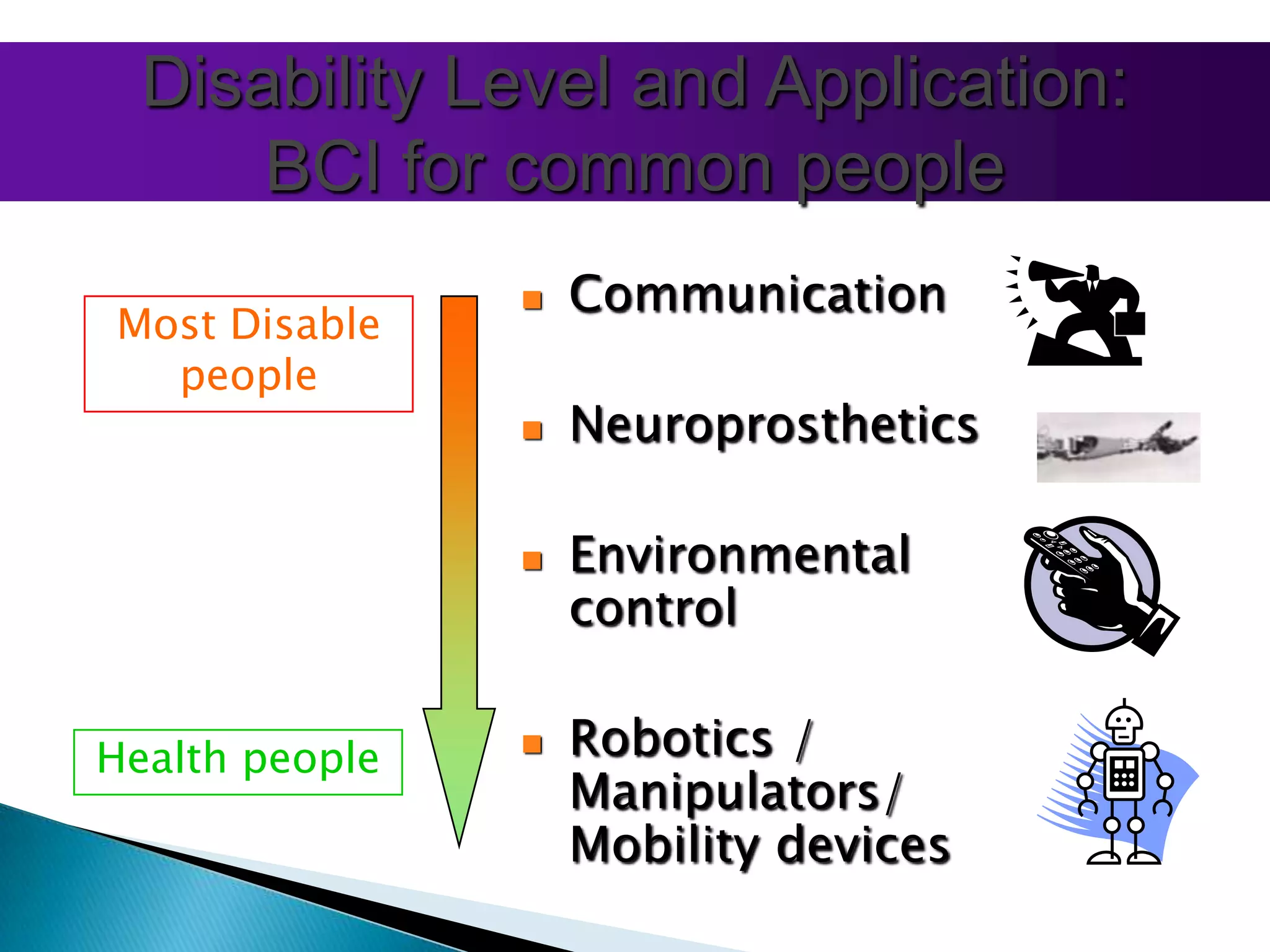
Disability Level and Application:
BCI for common people
Communication



Most Disable
people



Neuroprosthetics



Health people



Environmental
control
Robotics /
Manipulators/
Mobility devices
Honda Asimo Controll
And an artificial eye can see a
lot…



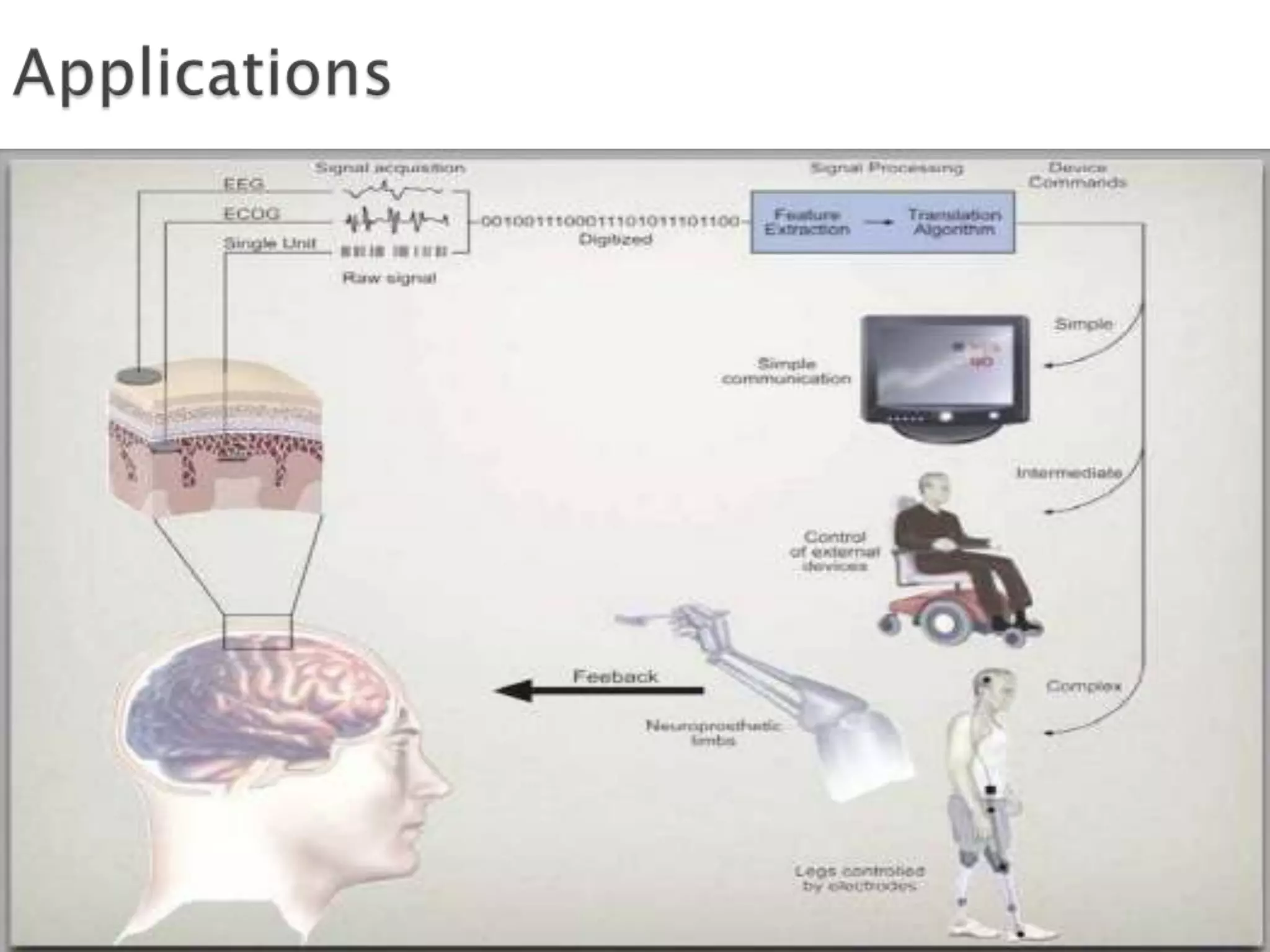
Feature Extraction
The Translation Algorithm


Any controllable machines
◦
◦
◦
◦



For answering yes/no questions
For word processing
Wheelchair
Virtual Reality

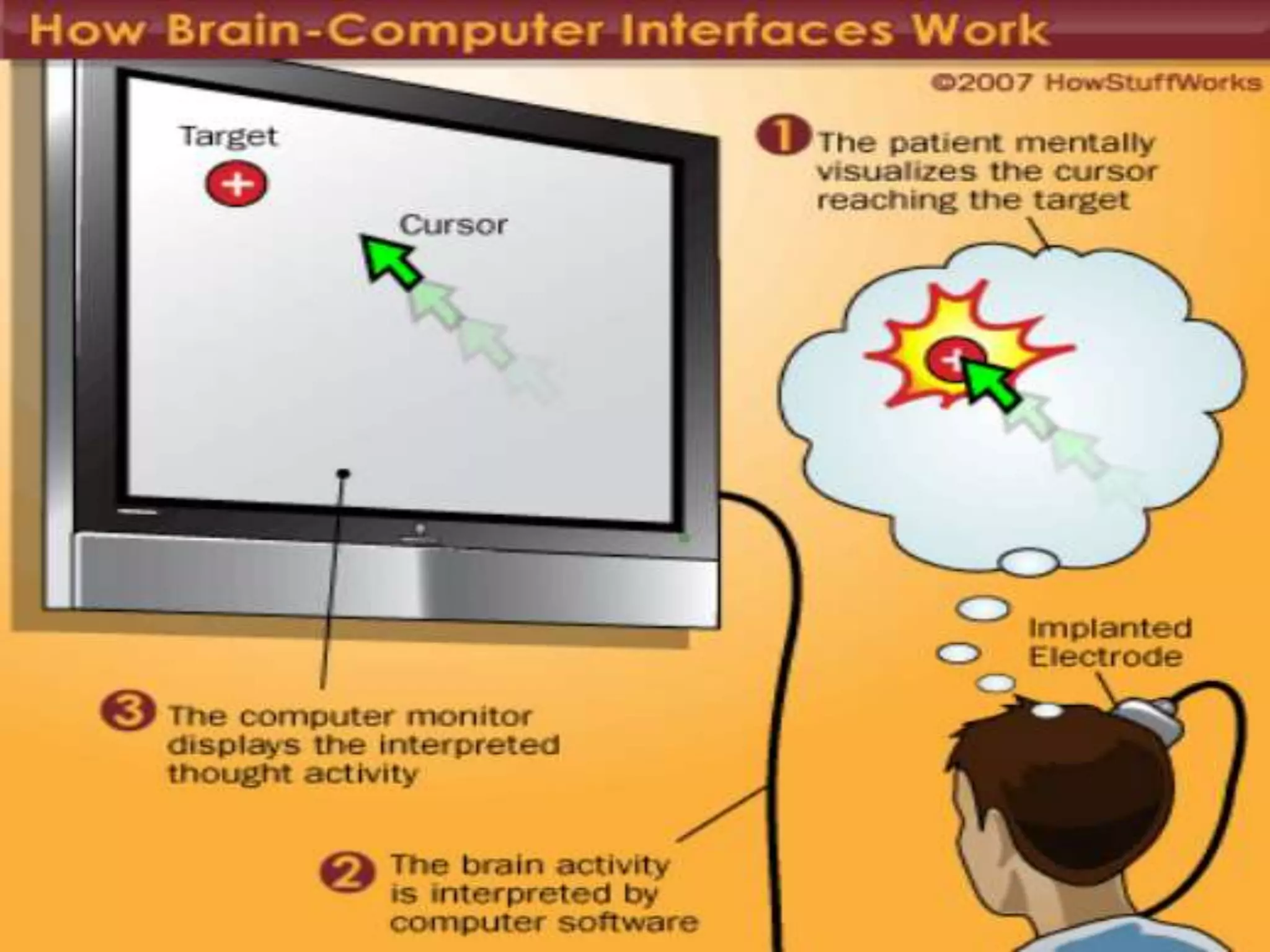
Usually, Computer screen and the output is
the selection of targets or cursor movement


Successful Story, Wearable BCI



BCI2000

◦ A successful transition of the whole BCI system to the
portable device
◦ No machine learning
◦ Limited computational power (limited signal processing)

◦ A general-purpose system for (BCI) research

 Source Module (new device new driver)
 Signal Processing Module (reusable, No Machine Learning)
 User Application Module (UDP/IP support to be running in any
machine)

◦ Platform

 Microsoft Windows™ 2000/XP
 C++ language


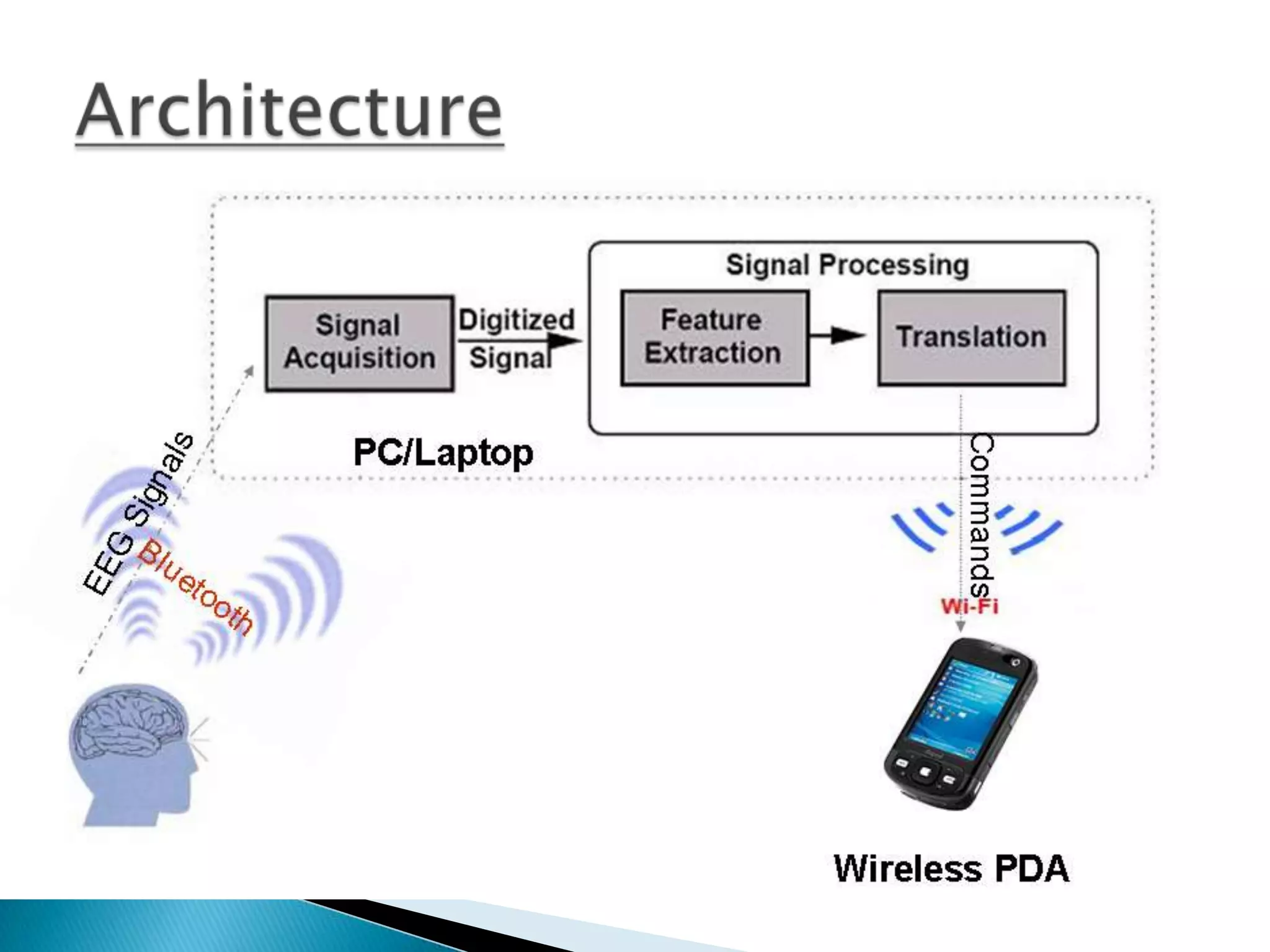
Mobility
◦ Communication technologies
 Bluetooth
 802.11(wire less –WLAN)
 GSM/GPRS

◦ PDA instead of stationary computer




Dry Electrode instead of wet (reducing
montage time)
Making the BCI transparent
◦ No need to change electrodes for a reasonable long
time
Theta

waves [4, 7.5] associated with reverie,
daydreaming, meditation, creative ideas

Delta waves [0,4] Hz associated with deep sleep and in
the awake state were thought to indicates physical defects
in the brain.
Alpha

wave(8-13hz)-its indicates both a relaxed
and attention mode of the brain.
Beta

wave(13-30 hz)-it is the brain wave usually
associated with activity thinking, active attention.
CHARACTERISTICS OF BRAIN WAVES
Gamma

waves-within 35Hz-it reflect the mechanism of
consciousness.
Mu

wave(8-12)hz –associated with Motor activity,


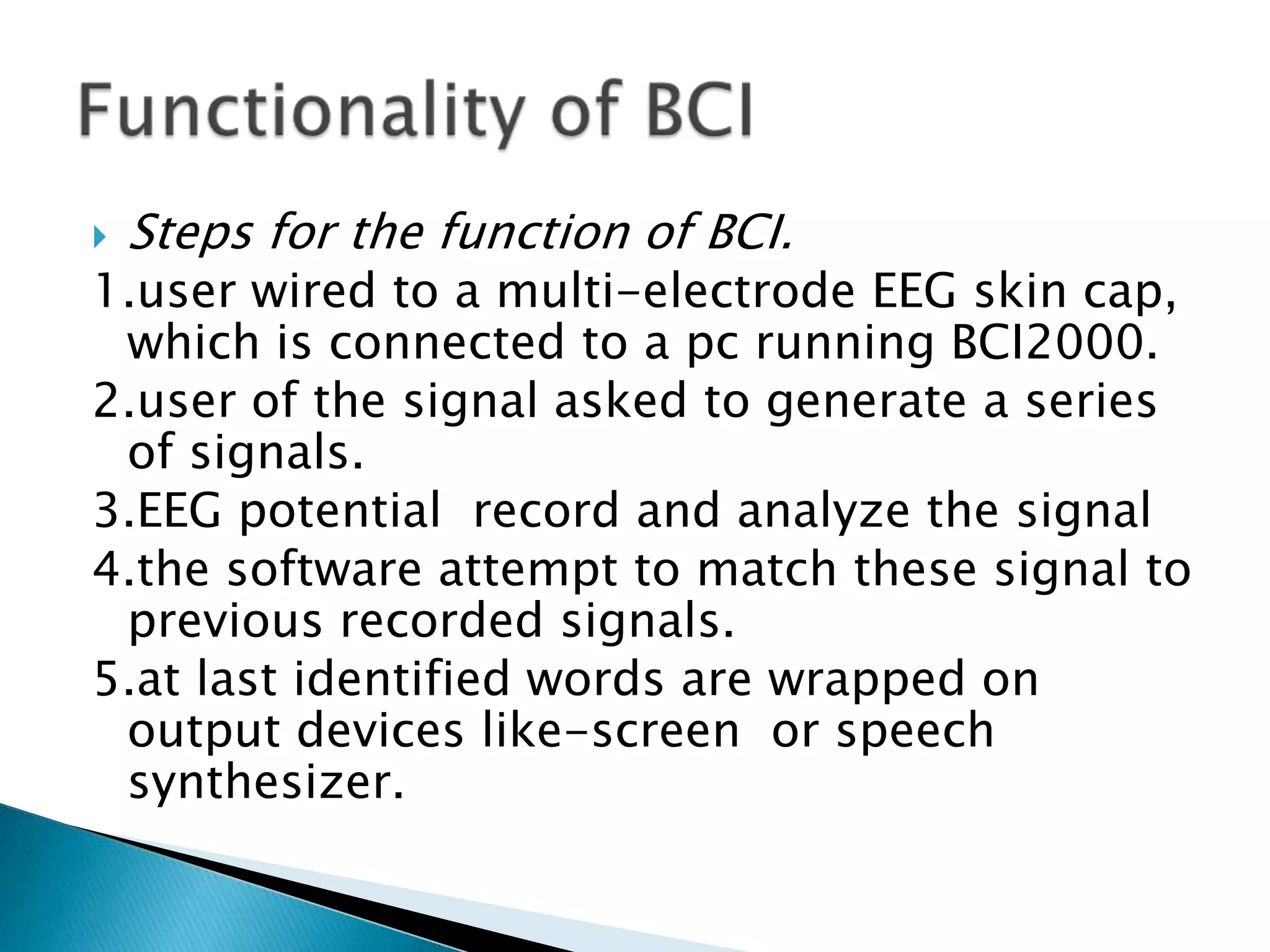
Steps for the function of BCI.

1.user wired to a multi-electrode EEG skin cap,
which is connected to a pc running BCI2000.
2.user of the signal asked to generate a series
of signals.
3.EEG potential record and analyze the signal
4.the software attempt to match these signal to
previous recorded signals.
5.at last identified words are wrapped on
output devices like-screen or speech
synthesizer.
 Undergone

through
hurdle brain
surgery.
 New surgery for
each up gradation
 Risky and
complicated eyes
surgery.

 Use

wearable
computing devices.
 External device is
good option.
 Glasses and Lasik
operation is best
options.
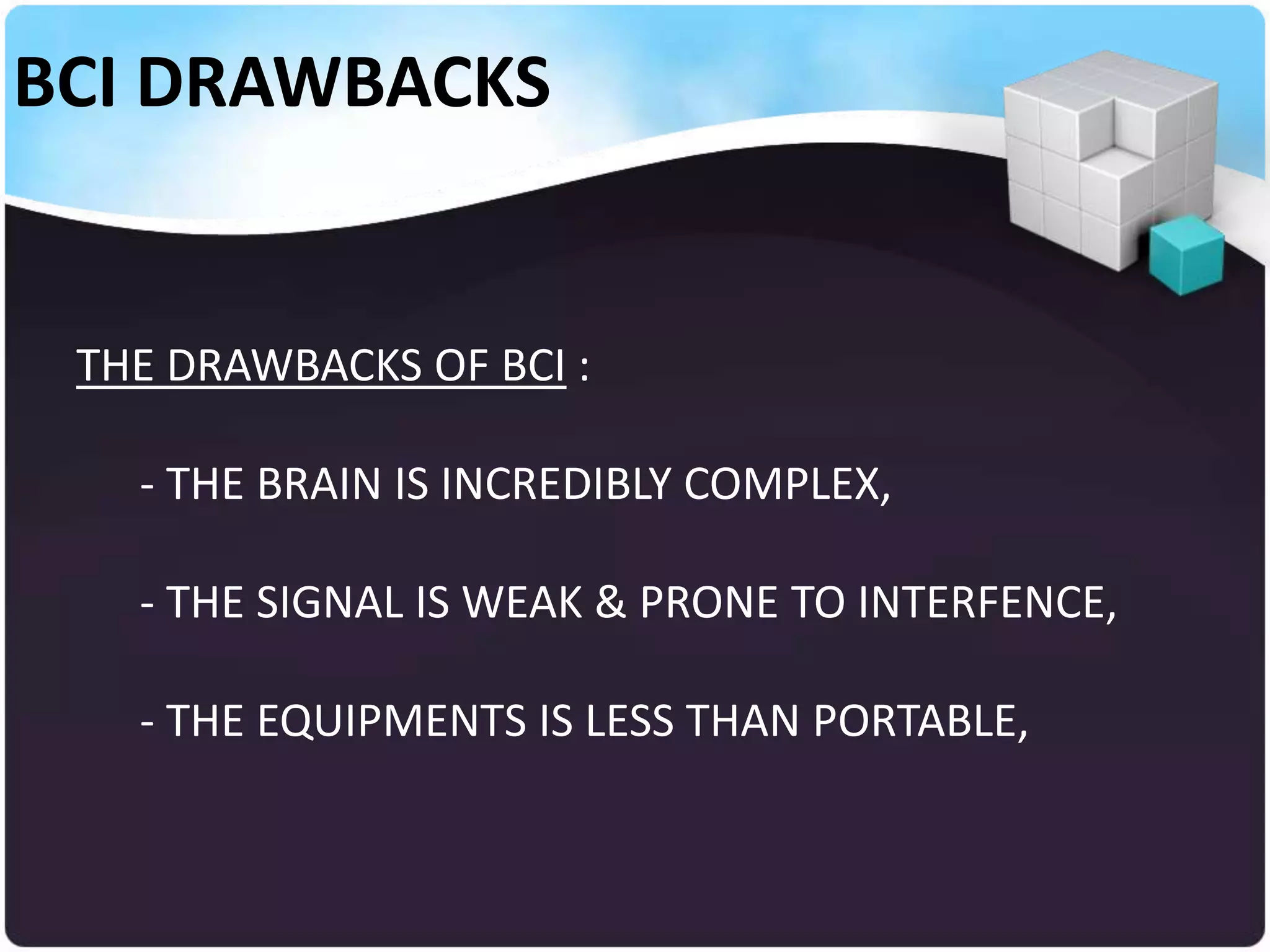
BCI DRAWBACKS

THE DRAWBACKS OF BCI :
- THE BRAIN IS INCREDIBLY COMPLEX,
- THE SIGNAL IS WEAK & PRONE TO INTERFENCE,
- THE EQUIPMENTS IS LESS THAN PORTABLE,


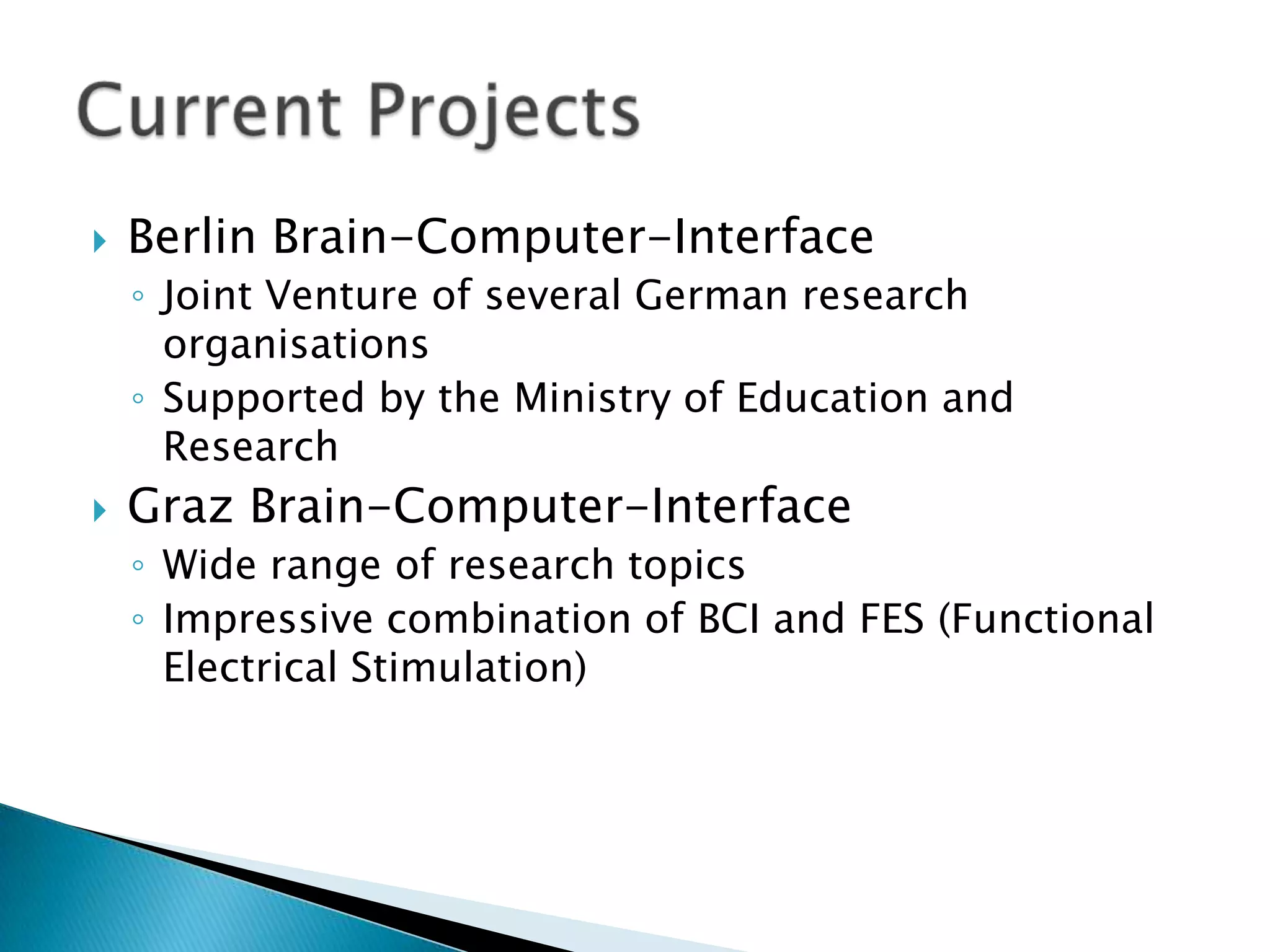
Berlin Brain-Computer-Interface
◦ Joint Venture of several German research
organisations
◦ Supported by the Ministry of Education and
Research



Graz Brain-Computer-Interface
◦ Wide range of research topics
◦ Impressive combination of BCI and FES (Functional
Electrical Stimulation)




Virtual Reality
Bluesense,Sniff mode
Bluesense, Security
• A potential therapeutic tool.
• BCI is an advancing technology promising paradigm shift in
areas like Machine Control, Human Enhancement, Virtual
reality and etc. So, it’s potentially high impact technology.
• Several potential applications of BCI hold promise for
rehabilitation and improving performance, such as treating
emotional disorders (for example, depression or anxiety),
easing chronic pain, and overcoming movement disabilities due
to stroke.
• Will enable us to achieve singularity very soon.

• Intense R&D in future to attain intuitive efficiency.
Star wars
Humans dive into a
virtual world by
connecting their
brains directly to a
computer.

Harder concentration
to the fan to blow for
simulating the ball to
float




[1] IEEE Xplorer Digital Library website(Through
SJCE Server)
http://ieeexplore.ieee.org/Xplore

[2] Wikipedia - internet encyclopedia
http://en.wikipedia.org/wiki/Braincomputer_interface
• Sixto Ortiz Jr., "Brain-Computer Interfaces: Where Human and
Machine Meet," Computer, vol. 40, no. 1, pp. 17-21, Jan., 2007
• F. Babiloni, A. Cichocki, and S. Gao, eds., special issue, “BrainComputer Interfaces: Towards Practical Implementations and Potential
Applications,” ComputationalIntelligence and Neuroscience, 2007
• P. Sajda, K-R. Mueller, and K.V. Shenoy, eds., special issue, “Brain
Computer Interfaces,” IEEE Signal Processing Magazine,Jan. 2008
• The MIT Press – “Toward Brain-Computer Interfacing”
• Wikipedia, HowStuffWorks and various other website sources…
Brain Computer Interfaces(BCI)

Brain Computer Interfaces(BCI)

  • 1.
  • 2.
              Introduction What is BCI History Structureand signals Architecture/Logical structure Brain waves Functionality Future Work Conclusion References
  • 3.
        It is thestudy of brain functions. A collaboration in which a brain accepts and controls a mechanical device. Direct communication pathway between a brain and an external device. Thus BCI extracts electro-physical signals from suitable components of the brain and process them to generate control signals for computers, robotic machines or communication devices.
  • 4.
    “ A Brain-ComputerInterface is a communication system that do not depend on peripheral nerves and muscles “ [J. R. Wolpaw et al. “Brain-computer interface technology: A review of the first international meeting,” IEEE Trans. Rehab. Eng., vol. 8, no. 2, pp. 164–173, 2000]
  • 5.
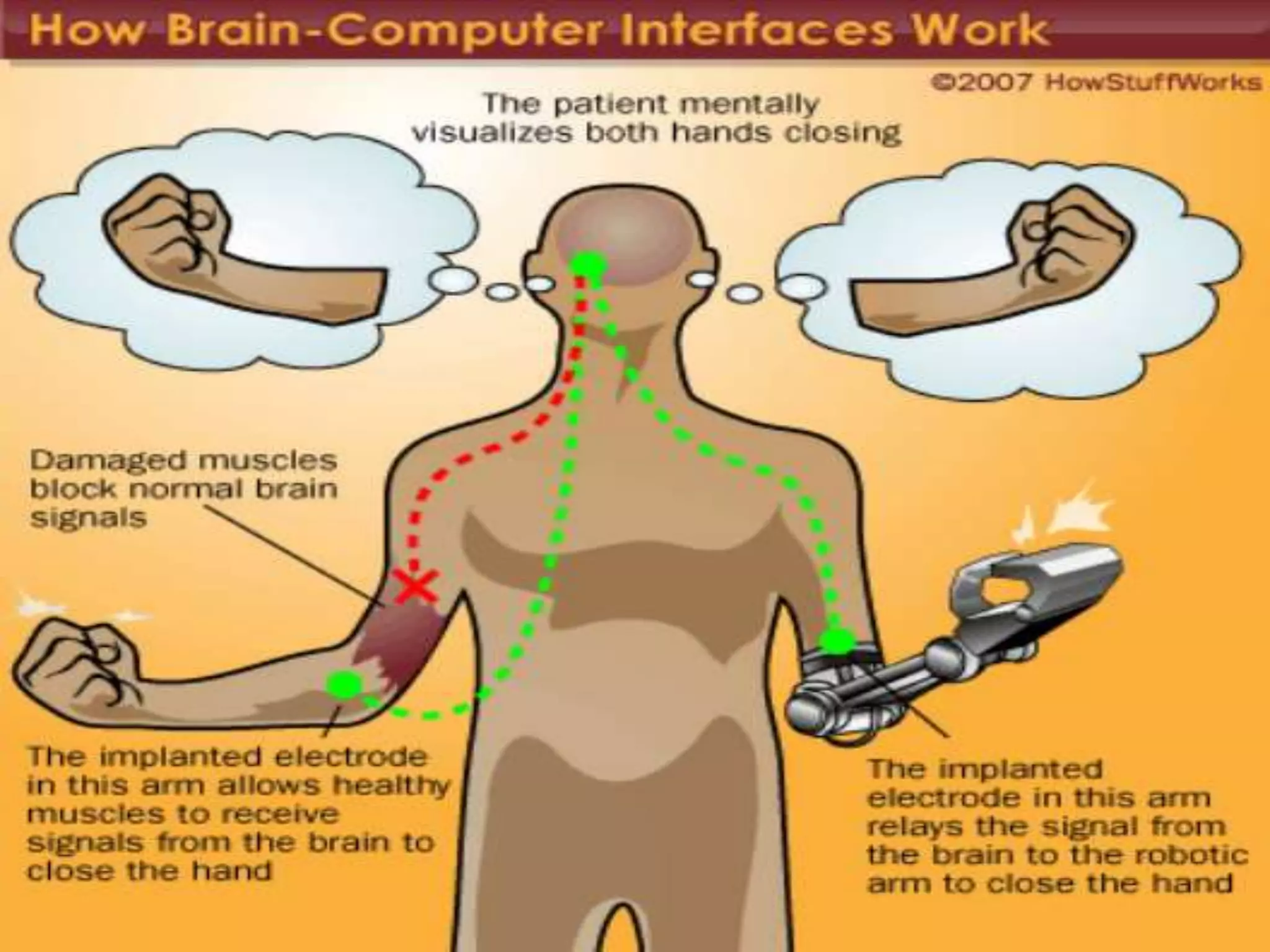
     Brain-Computer Interfaces (BCI) ◦Interaction between the human neural system and machines ◦ Goal  Enabling people (especially disabled) to communicate and control devices by mere thinking. ◦ BCI is a control system
  • 6.
       1924: Hans Bergerdiscovers the EEG Analyses the interrelation of EEG and brain diseases. 1970: First developments to use brain waves as input ARPA has vision of enhanced human First step in the right direction
  • 7.
        1990: First successfulexperiments with monkeys Implanting electrode arrays into monkey brains Recording of monkeys„ brain waves 2000: Monkeys control robots by thoughts
  • 8.
       More non-invasive thaninvasive approaches Brain reading by eg. EEG, MEG or fMRI 2004: First human benefits from research
  • 10.
    BASIC COMPONENTS: • Implantdevice • Signal recording and processing • External device used for control • Feedback section to the subject
  • 12.
    • Brain ismade out of neurons • Brain detects and translates the signal of brain to tangible action • Same principle different clearness • More accurate signal detection from invasive BCI
  • 14.
    What is logicalscheme of BCI? appropriate feature extraction Signal Features Brain Psychological Effort (Intention) Computer Classification Of Intent appropriate feedback strategy computer training user training Modification of EEG Brain Signals Environment
  • 15.
    What is themotivation for BCI Research ? Only in USA, more than 200,000 patients live with the motor consequences of serious injury. Motivation for Patients: is to give disable people to communicate, to operate prostheses, and even to operate wheelchairs using brain signals Nicolelis, 2001 Only the INVASIVE SURGEON TECHNIQUE allows putting electrode into a very local area of a brain uniting a few neurons. These neurons could be belong to the cortex center, for example, for finger control.
  • 17.
    BCI Types Invasive BCI: implantelectrodes directly onto a patient’s brain. Non-Invasive: implant medical scanning devices to read brain signals.
  • 18.
    What is invasivetechnology for BCI ? Philip Kennedy and Roy Bakay (Emory University in Atlanta) were first to install a brain implant in a human that produced signals of high enough quality to simulate movement. Implant was installed in 1998 and the patient lived long enough to start working with the implant, eventually learning to control a computer cursor. Kennedy, P.R., Bakay R.A. (1998) Restoration of neural output from a paralysed patient by a direct brain connection. Neuroreport. ;9(8):1707-11 10 array of electrodes, each separated by 400 μm John P. Donoghue, et al. Assistive technology and robotic control using motor cortex ensemble-based neural interface systems in humans with tetraplegia. J Physiol 579.3 (2007) pp 603–611
  • 19.
    Disability Level andApplication: BCI for common people Communication  Most Disable people  Neuroprosthetics  Health people  Environmental control Robotics / Manipulators/ Mobility devices
  • 21.
  • 22.
    And an artificialeye can see a lot…
  • 23.
  • 24.
     Any controllable machines ◦ ◦ ◦ ◦  Foranswering yes/no questions For word processing Wheelchair Virtual Reality Usually, Computer screen and the output is the selection of targets or cursor movement
  • 25.
     Successful Story, WearableBCI  BCI2000 ◦ A successful transition of the whole BCI system to the portable device ◦ No machine learning ◦ Limited computational power (limited signal processing) ◦ A general-purpose system for (BCI) research  Source Module (new device new driver)  Signal Processing Module (reusable, No Machine Learning)  User Application Module (UDP/IP support to be running in any machine) ◦ Platform  Microsoft Windows™ 2000/XP  C++ language
  • 26.
     Mobility ◦ Communication technologies Bluetooth  802.11(wire less –WLAN)  GSM/GPRS ◦ PDA instead of stationary computer   Dry Electrode instead of wet (reducing montage time) Making the BCI transparent ◦ No need to change electrodes for a reasonable long time
  • 28.
    Theta waves [4, 7.5]associated with reverie, daydreaming, meditation, creative ideas Delta waves [0,4] Hz associated with deep sleep and in the awake state were thought to indicates physical defects in the brain.
  • 29.
    Alpha wave(8-13hz)-its indicates botha relaxed and attention mode of the brain. Beta wave(13-30 hz)-it is the brain wave usually associated with activity thinking, active attention.
  • 30.
    CHARACTERISTICS OF BRAINWAVES Gamma waves-within 35Hz-it reflect the mechanism of consciousness. Mu wave(8-12)hz –associated with Motor activity,
  • 31.
     Steps for thefunction of BCI. 1.user wired to a multi-electrode EEG skin cap, which is connected to a pc running BCI2000. 2.user of the signal asked to generate a series of signals. 3.EEG potential record and analyze the signal 4.the software attempt to match these signal to previous recorded signals. 5.at last identified words are wrapped on output devices like-screen or speech synthesizer.
  • 32.
     Undergone through hurdle brain surgery. New surgery for each up gradation  Risky and complicated eyes surgery.  Use wearable computing devices.  External device is good option.  Glasses and Lasik operation is best options.
  • 33.
    BCI DRAWBACKS THE DRAWBACKSOF BCI : - THE BRAIN IS INCREDIBLY COMPLEX, - THE SIGNAL IS WEAK & PRONE TO INTERFENCE, - THE EQUIPMENTS IS LESS THAN PORTABLE,
  • 34.
     Berlin Brain-Computer-Interface ◦ JointVenture of several German research organisations ◦ Supported by the Ministry of Education and Research  Graz Brain-Computer-Interface ◦ Wide range of research topics ◦ Impressive combination of BCI and FES (Functional Electrical Stimulation)
  • 35.
  • 36.
    • A potentialtherapeutic tool. • BCI is an advancing technology promising paradigm shift in areas like Machine Control, Human Enhancement, Virtual reality and etc. So, it’s potentially high impact technology. • Several potential applications of BCI hold promise for rehabilitation and improving performance, such as treating emotional disorders (for example, depression or anxiety), easing chronic pain, and overcoming movement disabilities due to stroke. • Will enable us to achieve singularity very soon. • Intense R&D in future to attain intuitive efficiency.
  • 37.
    Star wars Humans diveinto a virtual world by connecting their brains directly to a computer. Harder concentration to the fan to blow for simulating the ball to float
  • 39.
      [1] IEEE XplorerDigital Library website(Through SJCE Server) http://ieeexplore.ieee.org/Xplore [2] Wikipedia - internet encyclopedia http://en.wikipedia.org/wiki/Braincomputer_interface
  • 40.
    • Sixto OrtizJr., "Brain-Computer Interfaces: Where Human and Machine Meet," Computer, vol. 40, no. 1, pp. 17-21, Jan., 2007 • F. Babiloni, A. Cichocki, and S. Gao, eds., special issue, “BrainComputer Interfaces: Towards Practical Implementations and Potential Applications,” ComputationalIntelligence and Neuroscience, 2007 • P. Sajda, K-R. Mueller, and K.V. Shenoy, eds., special issue, “Brain Computer Interfaces,” IEEE Signal Processing Magazine,Jan. 2008 • The MIT Press – “Toward Brain-Computer Interfacing” • Wikipedia, HowStuffWorks and various other website sources…