Brain Computer Interfaceby-       MANEESH RANJAN      MCA 4th Sem.        SJCE,MYSORE
OverviewIntroductionApplicationHistoryWhat is BCIStructure and signalsArchitecture/Logical structureBrain wavesFunctionalityFuture WorkConclusionReferences
IntroductionIt is the study of brain functionsBCI are system that provide translation of the electrical activity of the human brain into command which can control device in real time.An Electroencephalogram based Brain-Computer-Interface (BCI) provides a new communication channel between the human brain and a computer.
Applications		Bioengineering applications: assist devices for disabled people.Human subject monitoring: sleep disorders, neurological diseases, attention monitoring, and/or overall "mental state".Neuroscience research: real-time methods for correlating observable behavior with recorded neural signals.Man – Machine Interaction: Interface devices between human and computers, machines.
History- Discovering the Basics1924: Hans Berger discovers the EEG     Analyses the interrelation of EEG and brain      diseases.1970: First developments to use brain waves as inputARPA has vision of enhanced human       First step in the right direction
History-Monkey first1990: First successful experiments with monkeysImplanting electrode arrays into monkey brainsRecording of monkeys‘ brain waves2000: Monkeys control robots by thoughts
History - … Humans followMore non-invasive than invasive approachesBrain reading by eg. EEG, MEG or fMRI2004: First human benefits from research
KEY ISSUES IN BCI RESEARCH AND USERSRESEARCH  DISCIPLINESEngineeringClinical ...PsychologicalNeuroscience
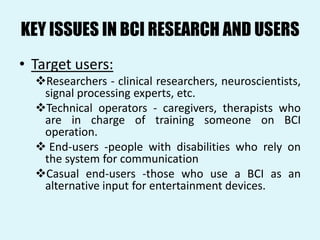
KEY ISSUES IN BCI RESEARCH AND USERSTarget users:Researchers - clinical researchers, neuroscientists, signal processing experts, etc.
Technical operators - caregivers, therapists who are in charge of training someone on BCI  operation.
 End-users -people with disabilities who rely on the system for communication
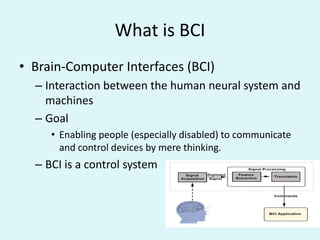
Casual end-users -those who use a BCI as an alternative input for entertainment devices.What is BCIBrain-Computer Interfaces (BCI) Interaction between the human neural system and machinesGoalEnabling people (especially disabled) to communicate and control devices by mere thinking.BCI is a control system
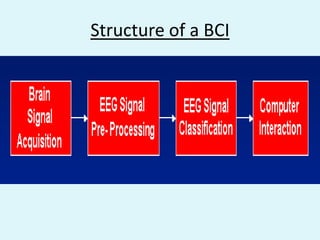
Structure of a BCI
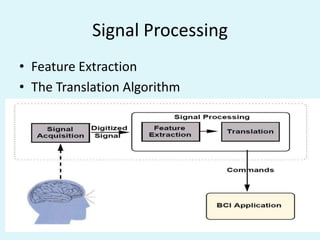
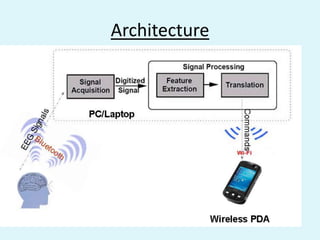
Structure of a BCI1) Signal Acquisition: the EEG signals are obtained from      the brain through invasive or non-invasive methods (for example, electrodes). After, the signal is amplified and sampled.2) Signal Pre-Processing: once the signals are acquired, it is necessary to clean them.3) Signal Classification: once the signals are cleaned, they will be processed and classified to find out which kind of mental task the subject is performing.4) Computer Interaction: once the signals are classified, they will be used by an appropriate algorithm for the development of a certain application.
Signal ProcessingFeature ExtractionThe Translation Algorithm
Output DeviceAny controllable machinesFor answering yes/no questionsFor word processing WheelchairVirtual RealityUsually, Computer screen and the output is the selection of targets or cursor movement
Existing SolutionSuccessful Story, Wearable BCI
A successful transition of the whole BCI system to the portable device
No machine learning
 Limited computational power (limited signal processing)
BCI2000
A general-purpose system for (BCI) research
Source Module (new device new driver)
Signal Processing Module (reusable, No Machine Learning)
User Application Module (UDP/IP support to be running in any machine)
Platform
Microsoft Windows™ 2000/XP
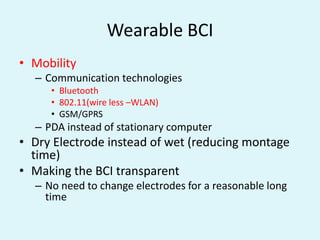
C++ languageWearable BCIMobilityCommunication technologiesBluetooth802.11(wire less –WLAN)GSM/GPRSPDA instead of stationary computerDry Electrode instead of wet (reducing montage time)Making the BCI transparentNo need to change electrodes for a reasonable long time
Architecture

Brain Computer Interface

  • 1.
    Brain Computer Interfaceby- MANEESH RANJAN MCA 4th Sem. SJCE,MYSORE
  • 2.
    OverviewIntroductionApplicationHistoryWhat is BCIStructureand signalsArchitecture/Logical structureBrain wavesFunctionalityFuture WorkConclusionReferences
  • 3.
    IntroductionIt is thestudy of brain functionsBCI are system that provide translation of the electrical activity of the human brain into command which can control device in real time.An Electroencephalogram based Brain-Computer-Interface (BCI) provides a new communication channel between the human brain and a computer.
  • 4.
    Applications Bioengineering applications: assistdevices for disabled people.Human subject monitoring: sleep disorders, neurological diseases, attention monitoring, and/or overall "mental state".Neuroscience research: real-time methods for correlating observable behavior with recorded neural signals.Man – Machine Interaction: Interface devices between human and computers, machines.
  • 5.
    History- Discovering theBasics1924: Hans Berger discovers the EEG Analyses the interrelation of EEG and brain diseases.1970: First developments to use brain waves as inputARPA has vision of enhanced human First step in the right direction
  • 6.
    History-Monkey first1990: Firstsuccessful experiments with monkeysImplanting electrode arrays into monkey brainsRecording of monkeys‘ brain waves2000: Monkeys control robots by thoughts
  • 7.
    History - …Humans followMore non-invasive than invasive approachesBrain reading by eg. EEG, MEG or fMRI2004: First human benefits from research
  • 8.
    KEY ISSUES INBCI RESEARCH AND USERSRESEARCH DISCIPLINESEngineeringClinical ...PsychologicalNeuroscience
  • 9.
    KEY ISSUES INBCI RESEARCH AND USERSTarget users:Researchers - clinical researchers, neuroscientists, signal processing experts, etc.
  • 10.
    Technical operators -caregivers, therapists who are in charge of training someone on BCI operation.
  • 11.
    End-users -peoplewith disabilities who rely on the system for communication
  • 12.
    Casual end-users -thosewho use a BCI as an alternative input for entertainment devices.What is BCIBrain-Computer Interfaces (BCI) Interaction between the human neural system and machinesGoalEnabling people (especially disabled) to communicate and control devices by mere thinking.BCI is a control system
  • 13.
  • 14.
    Structure of aBCI1) Signal Acquisition: the EEG signals are obtained from the brain through invasive or non-invasive methods (for example, electrodes). After, the signal is amplified and sampled.2) Signal Pre-Processing: once the signals are acquired, it is necessary to clean them.3) Signal Classification: once the signals are cleaned, they will be processed and classified to find out which kind of mental task the subject is performing.4) Computer Interaction: once the signals are classified, they will be used by an appropriate algorithm for the development of a certain application.
  • 15.
  • 16.
    Output DeviceAny controllablemachinesFor answering yes/no questionsFor word processing WheelchairVirtual RealityUsually, Computer screen and the output is the selection of targets or cursor movement
  • 17.
  • 18.
    A successful transitionof the whole BCI system to the portable device
  • 19.
  • 20.
    Limited computationalpower (limited signal processing)
  • 21.
  • 22.
    A general-purpose systemfor (BCI) research
  • 23.
    Source Module (newdevice new driver)
  • 24.
    Signal Processing Module(reusable, No Machine Learning)
  • 25.
    User Application Module(UDP/IP support to be running in any machine)
  • 26.
  • 27.
  • 28.
    C++ languageWearable BCIMobilityCommunicationtechnologiesBluetooth802.11(wire less –WLAN)GSM/GPRSPDA instead of stationary computerDry Electrode instead of wet (reducing montage time)Making the BCI transparentNo need to change electrodes for a reasonable long time
  • 29.
  • 30.
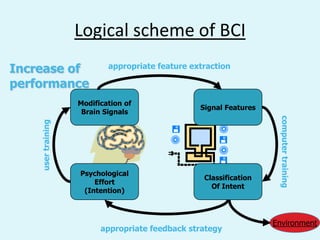
    Logical scheme ofBCIIncrease of performanceappropriate feature extractionModification ofBrain SignalsSignal Featurescomputer traininguser trainingPsychologicalEffort(Intention)ClassificationOf IntentEnvironmentappropriate feedback strategy
  • 31.
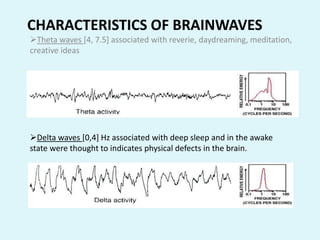
    Characteristics of BrainwavesThetawaves [4, 7.5] associated with reverie, daydreaming, meditation, creative ideas
  • 32.
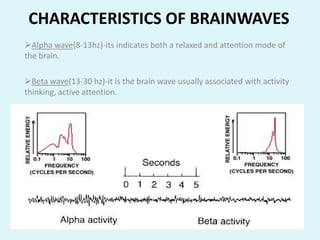
    Delta waves [0,4]Hz associated with deep sleep and in the awake state were thought to indicates physical defects in the brain.Characteristics of BrainwavesAlpha wave(8-13hz)-its indicates both a relaxed and attention mode of the brain.
  • 33.
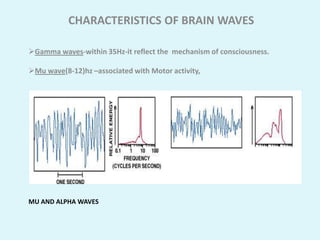
    Beta wave(13-30 hz)-itis the brain wave usually associated with activity thinking, active attention.CHARACTERISTICS OF BRAIN WAVESGamma waves-within 35Hz-it reflect the mechanism of consciousness.
  • 34.
    Mu wave(8-12)hz –associatedwith Motor activity,Mu and alpha waves
  • 35.
    Functionality of BCIStepsfor the function of BCI.1.user wired to a multi-electrode EEG skin cap, which is connected to a pc running BCI2000.2.user of the signal asked to generate a series of signals.3.EEG potential record and analyze the signal4.the software attempt to match these signal to previous recorded signals.5.at last identified words are wrapped on output devices like-screen or speech synthesizer.
  • 36.
    Risk factors andalternate solutionUndergone through hurdle brain surgery.
  • 37.
    New surgery foreach up gradation
  • 38.
    Risky and complicatedeyes surgery.
  • 39.
  • 40.
    External device isgood option.
  • 41.
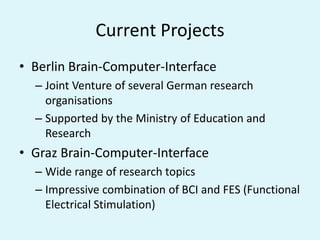
    Glasses and Lasikoperation is best options.Current ProjectsBerlin Brain-Computer-InterfaceJoint Venture of several German research organisationsSupported by the Ministry of Education and ResearchGraz Brain-Computer-InterfaceWide range of research topicsImpressive combination of BCI and FES (Functional Electrical Stimulation)
  • 42.
    Future WorkVirtual RealityBluesense,Sniff modeBluesense, Security
  • 43.
  • 44.
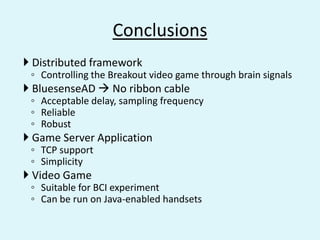
    Controlling the Breakoutvideo game through brain signals
  • 45.
    BluesenseAD  Noribbon cable
  • 46.
  • 47.
  • 48.
  • 49.
  • 50.
  • 51.
  • 52.
  • 53.
  • 54.
    Can be runon Java-enabled handsetsREFERENCES [1] IEEE Xplorer Digital Library website(Through SJCE Server) http://ieeexplore.ieee.org/Xplore [2] Wikipedia - internet encyclopediahttp://en.wikipedia.org/wiki/Brain-computer_interface
  • 55.
  • 56.