A Presentation on Brain Computer Interface
By Group 10
Agenda
1.Introduction
2.BCI Model
3.Early Work
4.BCI Approaches
5.How does it work
6.Applications
7.Current Projects
8.Cautions
9.Conclutions
Introduction
Brain computer interaction is a fast growing eminent technology, in which researchers aim to build a direct channel between
the human brain and the computer.
A Brain Computer Interface is a collaboration in which a brain accepts and controls a mechanical device as a part of its
representation of the body.
Computer Brain Interfaces are designed to restore sensory function and transmit sensory information to the brain or stimulate
the brain through artificially generated electrical signals.
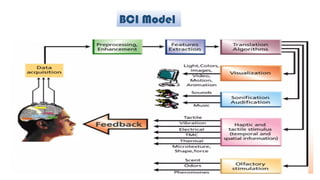
BCI Model
Early Works
The history of brain-computer interfaces (BCIs) dates back to the early 20th century when Hans Berger discovered the
electrical activity of the human brain and developed electroencephalography (EEG) in 19241. Berger’s pioneering work
enabled the recording of human brain activity, including oscillatory patterns like the alpha wave1.
One of the earliest examples of a working BCI is the piece Music for Solo Performer composed by Alvin Lucier in 19651.
The composition employed EEG and analog signal processing hardware to stimulate acoustic percussion instruments1.
Research on BCIs began in the 1970s by Jacques Vidal at the University of California, Los Angeles (UCLA) under a grant
from the National Science Foundation1. Vidal’s 1973 paper marked the first appearance of the term “brain-computer
interface” in scientific literature1. Since then, BCIs have evolved significantly, with the first neuroprosthetic devices
implanted in humans appearing in the mid-1990s1.
BCIs are often conceptualized as a human-machine interface that bypasses the need for physical movement, allowing
direct communication between the brain and an external device1. They can be non-invasive (using methods like EEG,
MEG, and MRI), partially invasive (using ECoG and endovascular techniques), or invasive (using microelectrode arrays)1.
BCIs have shown promise in classifying mental states, emotional states, and thalamocortical dysrhythmia
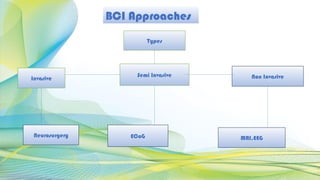
BCI Approaches
Types
Invasive Non Invasive
Semi Invasive
Neurosurgery ECoG MRI,EEG
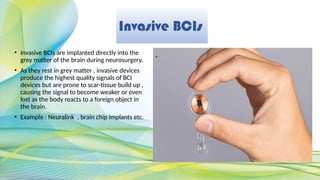
Invasive BCIs
• Invasive BCIs are implanted directly into the
grey matter of the brain during neurosurgery.
• As they rest in grey matter , invasive devices
produce the highest quality signals of BCI
devices but are prone to scar-tissue build up ,
causing the signal to become weaker or even
lost as the body reacts to a foreign object in
the brain.
• Example : Neuralink , brain chip implants etc.
.
Semi and Non-Invasive BCIs
• Electrocorticography(EC0G) measures the electrical activity of the brain taken from beneath the skull in a similar way to
non-invasive electroencephalography but the electrodes are embedded in a thin plastic pad that is placed above the
cortex,beneath the dura-matter.
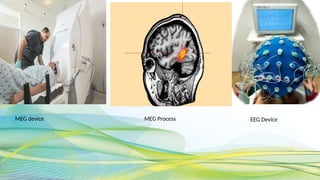
• Electroencephalography: In conventional scalp EEG, the recording is obtained by placing the electrodes on the scalp with
a conductive gel or paste,usually after preparing the scalp area by light abrasion to reduce impedance due to dead skin
cells. Many systems typically use electrodes,each of which is attached to an individual wire.
• fMRI=Functional Magnetic Resonance Imaging: fMRI exploites the changes in the magnetic properties of hemoglobin as
it carries oxygen. Activation of a part of the brain increases oxygen levels there increasing the ratio of oxyhemoglobin to
deoxyhemoglobin.
• Magnetoencephalography(MEG):MEG detects the tiny magnetic fields created as individual neurons “fire” within the
brain. It can pinpoint the active region with a millimeter,and can follow the movement of brain activity as it travels from
region to region within the brain.
MEG device MEG Process EEG Device
How do BCIs Work
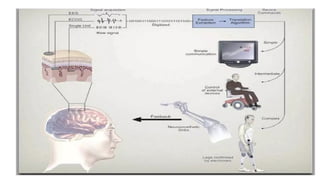
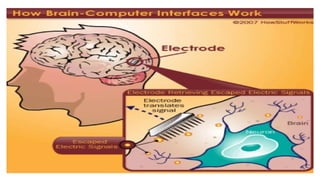
1. Brain signals detection: BCIs detect and record electrical signals generated by neurons in the brain using various methods
such as electrocephalography(EEG),Electrocortiography(ECoG), and microelectrode arrays.
2. Signal Processing: The recorded brains are processed to extract meaningful information using algorithm and machine
learning techniques.
3. Feature Extraction: Relevant features,patterns, or characteristics are extracted.
Applications
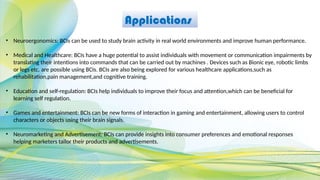
• Neuroergonomics: BCIs can be used to study brain activity in real world environments and improve human performance.
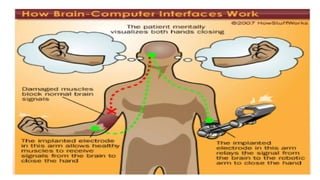
• Medical and Healthcare: BCIs have a huge potential to assist individuals with movement or communication impairments by
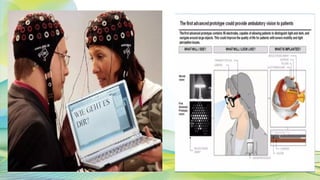
translating their intentions into commands that can be carried out by machines . Devices such as Bionic eye, robotic limbs
or legs etc. are possible using BCIs. BCIs are also being explored for various healthcare applications,such as
rehabilitation,pain management,and cognitive training.
• Education and self-regulation: BCIs help individuals to improve their focus and attention,which can be beneficial for
learning self regulation.
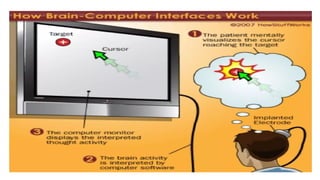
• Games and entertainment: BCIs can be new forms of interaction in gaming and entertainment, allowing users to control
characters or objects using their brain signals.
• Neuromarketing and Advertisement: BCIs can provide insights into consumer preferences and emotional responses
helping marketers tailor their products and advertisements.
Projects
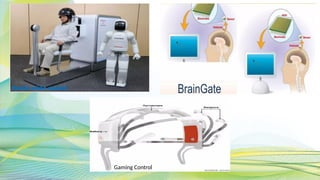
• Brain Gate
• BCI 2000
• Australian Bionic Eye
• Honda Asimo Control
• Kevin Warwick – The First Human Crybrog
• Gaming Control
• Neuralink
Honda asimo control
Gaming Control
Cautions
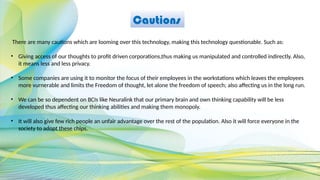
There are many cautions which are looming over this technology, making this technology questionable. Such as:
• Giving access of our thoughts to profit driven corporations,thus making us manipulated and controlled indirectly. Also,
it means less and less privacy.
• Some companies are using it to monitor the focus of their employees in the workstations which leaves the employees
more vurnerable and limits the Freedom of thought, let alone the freedom of speech; also affecting us in the long run.
• We can be so dependent on BCIs like Neuralink that our primary brain and own thinking capability will be less
developed thus affecting our thinking abilities and making them monopoly.
• It will also give few rich people an unfair advantage over the rest of the population. Also it will force everyone in the
society to adopt these chips.
Conclusion
• A potential therapeutic tool.
• BCI is an advancing technology promising paradigm shift in areas like machine control,human enhancement,virtual
reality etc. So it is potentially high impact technology.
• Several potential applications of BCIs hold promise for rehabilitation and improving performance,such as treating
emotional disorders (for example, depression or anxiety), easing chronic pain, and overcoming movement disabilities
due to stroke.
• Will enable us to achieve singularity soon.
• Requires intense R&D in future to attain intuitive efficiency.
References
• Sixto Ortiz Jr. , “Brain Computer Interfaces : Where Human and Machine Meet,” Computer , vol. 40,no. 1,
pp. 17-21, Jan., 2007
• F. Babiloni, A. Cichoki, and S. Gao, eds., special issue, “ Brain Computer Interfaces : Towards Practical
Implimentations and potential Applications,” Computational Intelligence and Neuroscience, 2007
• P. Sajda, K.R. Muller and K.V. Sheroy, eds., special issue, “ Brain Computer Interfaces,” IEEE Signal Processing
Magazine, Jan. 2008
• The MIT Press- “Toward Brain-Computer Interfacing”
• Wikipedia,HowStuffWorks and Various other website sources…
Thank
You!
Thank You!

Brain Computer Interface (BCI) Presentation

  • 1.
    A Presentation onBrain Computer Interface By Group 10
  • 2.
    Agenda 1.Introduction 2.BCI Model 3.Early Work 4.BCIApproaches 5.How does it work 6.Applications 7.Current Projects 8.Cautions 9.Conclutions
  • 3.
    Introduction Brain computer interactionis a fast growing eminent technology, in which researchers aim to build a direct channel between the human brain and the computer. A Brain Computer Interface is a collaboration in which a brain accepts and controls a mechanical device as a part of its representation of the body. Computer Brain Interfaces are designed to restore sensory function and transmit sensory information to the brain or stimulate the brain through artificially generated electrical signals.
  • 4.
  • 6.
    Early Works The historyof brain-computer interfaces (BCIs) dates back to the early 20th century when Hans Berger discovered the electrical activity of the human brain and developed electroencephalography (EEG) in 19241. Berger’s pioneering work enabled the recording of human brain activity, including oscillatory patterns like the alpha wave1. One of the earliest examples of a working BCI is the piece Music for Solo Performer composed by Alvin Lucier in 19651. The composition employed EEG and analog signal processing hardware to stimulate acoustic percussion instruments1. Research on BCIs began in the 1970s by Jacques Vidal at the University of California, Los Angeles (UCLA) under a grant from the National Science Foundation1. Vidal’s 1973 paper marked the first appearance of the term “brain-computer interface” in scientific literature1. Since then, BCIs have evolved significantly, with the first neuroprosthetic devices implanted in humans appearing in the mid-1990s1. BCIs are often conceptualized as a human-machine interface that bypasses the need for physical movement, allowing direct communication between the brain and an external device1. They can be non-invasive (using methods like EEG, MEG, and MRI), partially invasive (using ECoG and endovascular techniques), or invasive (using microelectrode arrays)1. BCIs have shown promise in classifying mental states, emotional states, and thalamocortical dysrhythmia
  • 7.
    BCI Approaches Types Invasive NonInvasive Semi Invasive Neurosurgery ECoG MRI,EEG
  • 8.
    Invasive BCIs • InvasiveBCIs are implanted directly into the grey matter of the brain during neurosurgery. • As they rest in grey matter , invasive devices produce the highest quality signals of BCI devices but are prone to scar-tissue build up , causing the signal to become weaker or even lost as the body reacts to a foreign object in the brain. • Example : Neuralink , brain chip implants etc. .
  • 9.
    Semi and Non-InvasiveBCIs • Electrocorticography(EC0G) measures the electrical activity of the brain taken from beneath the skull in a similar way to non-invasive electroencephalography but the electrodes are embedded in a thin plastic pad that is placed above the cortex,beneath the dura-matter. • Electroencephalography: In conventional scalp EEG, the recording is obtained by placing the electrodes on the scalp with a conductive gel or paste,usually after preparing the scalp area by light abrasion to reduce impedance due to dead skin cells. Many systems typically use electrodes,each of which is attached to an individual wire. • fMRI=Functional Magnetic Resonance Imaging: fMRI exploites the changes in the magnetic properties of hemoglobin as it carries oxygen. Activation of a part of the brain increases oxygen levels there increasing the ratio of oxyhemoglobin to deoxyhemoglobin. • Magnetoencephalography(MEG):MEG detects the tiny magnetic fields created as individual neurons “fire” within the brain. It can pinpoint the active region with a millimeter,and can follow the movement of brain activity as it travels from region to region within the brain.
  • 10.
    MEG device MEGProcess EEG Device
  • 11.
    How do BCIsWork 1. Brain signals detection: BCIs detect and record electrical signals generated by neurons in the brain using various methods such as electrocephalography(EEG),Electrocortiography(ECoG), and microelectrode arrays. 2. Signal Processing: The recorded brains are processed to extract meaningful information using algorithm and machine learning techniques. 3. Feature Extraction: Relevant features,patterns, or characteristics are extracted.
  • 15.
    Applications • Neuroergonomics: BCIscan be used to study brain activity in real world environments and improve human performance. • Medical and Healthcare: BCIs have a huge potential to assist individuals with movement or communication impairments by translating their intentions into commands that can be carried out by machines . Devices such as Bionic eye, robotic limbs or legs etc. are possible using BCIs. BCIs are also being explored for various healthcare applications,such as rehabilitation,pain management,and cognitive training. • Education and self-regulation: BCIs help individuals to improve their focus and attention,which can be beneficial for learning self regulation. • Games and entertainment: BCIs can be new forms of interaction in gaming and entertainment, allowing users to control characters or objects using their brain signals. • Neuromarketing and Advertisement: BCIs can provide insights into consumer preferences and emotional responses helping marketers tailor their products and advertisements.
  • 16.
    Projects • Brain Gate •BCI 2000 • Australian Bionic Eye • Honda Asimo Control • Kevin Warwick – The First Human Crybrog • Gaming Control • Neuralink
  • 17.
  • 19.
    Cautions There are manycautions which are looming over this technology, making this technology questionable. Such as: • Giving access of our thoughts to profit driven corporations,thus making us manipulated and controlled indirectly. Also, it means less and less privacy. • Some companies are using it to monitor the focus of their employees in the workstations which leaves the employees more vurnerable and limits the Freedom of thought, let alone the freedom of speech; also affecting us in the long run. • We can be so dependent on BCIs like Neuralink that our primary brain and own thinking capability will be less developed thus affecting our thinking abilities and making them monopoly. • It will also give few rich people an unfair advantage over the rest of the population. Also it will force everyone in the society to adopt these chips.
  • 20.
    Conclusion • A potentialtherapeutic tool. • BCI is an advancing technology promising paradigm shift in areas like machine control,human enhancement,virtual reality etc. So it is potentially high impact technology. • Several potential applications of BCIs hold promise for rehabilitation and improving performance,such as treating emotional disorders (for example, depression or anxiety), easing chronic pain, and overcoming movement disabilities due to stroke. • Will enable us to achieve singularity soon. • Requires intense R&D in future to attain intuitive efficiency.
  • 21.
    References • Sixto OrtizJr. , “Brain Computer Interfaces : Where Human and Machine Meet,” Computer , vol. 40,no. 1, pp. 17-21, Jan., 2007 • F. Babiloni, A. Cichoki, and S. Gao, eds., special issue, “ Brain Computer Interfaces : Towards Practical Implimentations and potential Applications,” Computational Intelligence and Neuroscience, 2007 • P. Sajda, K.R. Muller and K.V. Sheroy, eds., special issue, “ Brain Computer Interfaces,” IEEE Signal Processing Magazine, Jan. 2008 • The MIT Press- “Toward Brain-Computer Interfacing” • Wikipedia,HowStuffWorks and Various other website sources…
  • 22.