This document discusses neural interfacing systems, including their objective to link the nervous system to the outside world by stimulating or recording neural tissue. It describes types of invasive and non-invasive neural interfaces and their workings. Applications mentioned include assisting those with disabilities, gaming, manufacturing, and communication. Methods covered are P300 detection, EEG rhythms, and conclusion discusses advantages like helping disabled individuals and disadvantages like risk factors and noise sensitivity.
OVER VIEW
Objective
Scope
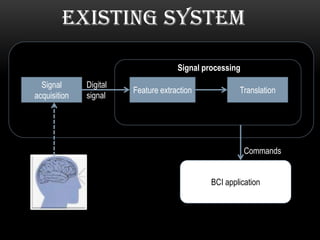
Existing system
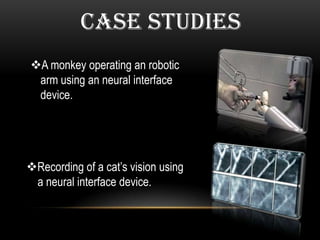
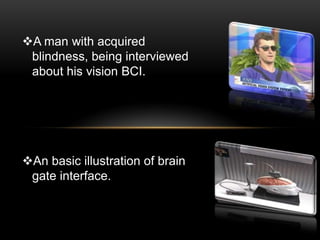
Case studies
Types of neural interfacing
Working of the types
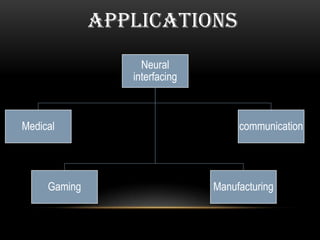
Applications
NIS methods
Conclusion
References
3.
OBJECTIVE
The goalof neural interface research is to create links between
the nervous system and the outside world.
This can be done either by stimulating or by recording from
neural tissue.
It’s ultimate purpose is to assist people with disabilities of
neural function
4.
SCOPE
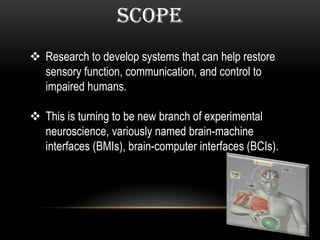
Research todevelop systems that can help restore
sensory function, communication, and control to
impaired humans.
This is turning to be new branch of experimental
neuroscience, variously named brain-machine
interfaces (BMIs), brain-computer interfaces (BCIs).
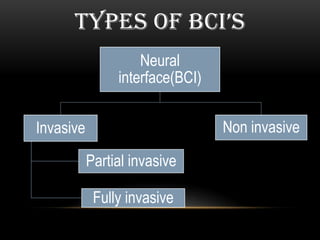
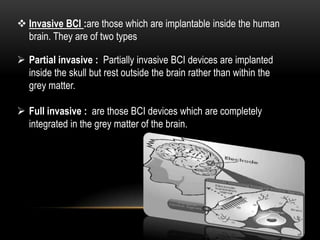
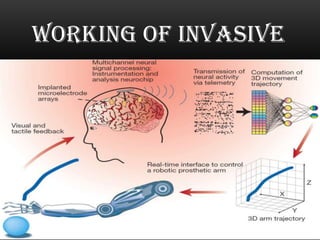
Invasive BCI:are those which are implantable inside the human
brain. They are of two types
Partial invasive : Partially invasive BCI devices are implanted
inside the skull but rest outside the brain rather than within the
grey matter.
Full invasive : are those BCI devices which are completely
integrated in the grey matter of the brain.
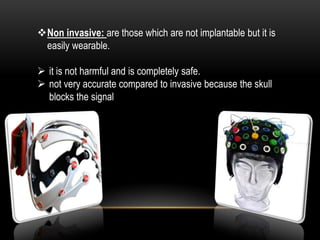
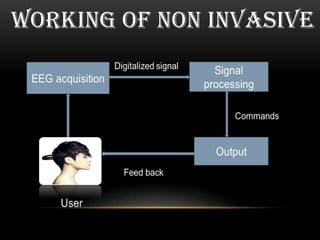
Non invasive: arethose which are not implantable but it is
easily wearable.
it is not harmful and is completely safe.
not very accurate compared to invasive because the skull
blocks the signal
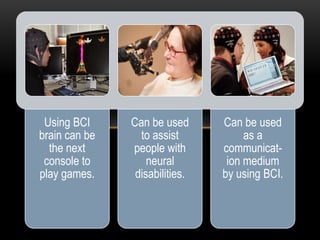
Using BCI
brain canbe
the next
console to
play games.
Can be used
to assist
people with
neural
disabilities.
Can be used
as a
communicat-
ion medium
by using BCI.
15.
NIS METHODS
Thereare basically three methods for implementing neural interfacing
systems.
They are as follows:
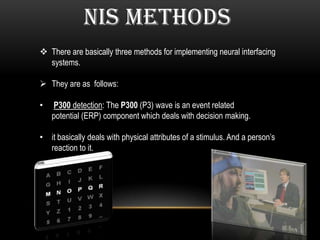
• P300 detection: The P300 (P3) wave is an event related
potential (ERP) component which deals with decision making.
• it basically deals with physical attributes of a stimulus. And a person’s
reaction to it.
16.
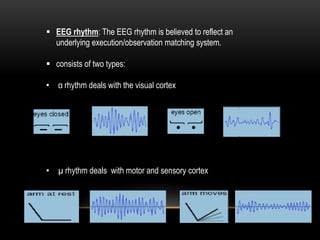
EEG rhythm:The EEG rhythm is believed to reflect an
underlying execution/observation matching system.
consists of two types:
• α rhythm deals with the visual cortex
• µ rhythm deals with motor and sensory cortex
17.
CONCLUSION
Certainly theapplications for BCI devices discussed here are long reach
and BCI device are not yet powerful enough to perform various tasks.
Various researches are been deployed under this technology. If it’s
successful it can be a revolutionized technology.
Advantages:
How its used in various applications.
Helpful for physically disabled people.
Disadvantages
Invasive devices may have risk factor to deal with.
Non invasive are easily affected by various noises.
Patients should be trained how to think and should go through physical
therapy.
18.
REFERENCES
The NeuralInterface Program by Dr.Kip Ludwig,
university of neurology.
The Science Of Neural Interface Systems by Nicholas
G, university of Chicago.
Multi – Command Brain-Computer Interface Based
On Silicon Chips by Shang kai G.
Full Data Rate Direct Neural Interface by Boris
Murmann and Teressa H. Meng, Fellow IEEE