10/31/2016 Brain Computer Interface 1
Department of Physical Science and Technology
Faculty of Applied Sciences
Sabaragamuwa University of Sri Lanka
BRAIN COMPUTER INTERFACE
Content
 Introduction
 Challenges in BCI
 BCI System
 How BCI works
 BCI Types
 Invasive BCI Acquisition Techniques
 Partially Invasive BCI Acquisition Techniques
 Non Invasive BCI Acquisition Techniques
 BCI Signal Types
 Classification of BCI Signals
 Applications of BCI
 Advantages of BCI
 Disadvantages of BCI
10/31/2016 Brain Computer Interface 2
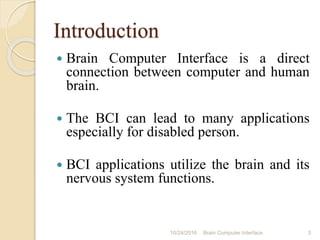
Introduction
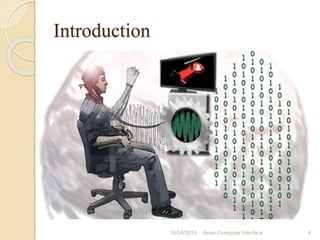
 Brain Computer Interface is a direct
connection between computer and human
brain.
 The BCI can lead to many applications
especially for disabled person.
 BCI applications utilize the brain and its
nervous system functions.
10/31/2016 3Brain Computer Interface
Introduction
10/31/2016 Brain Computer Interface 4
Challenges in BCI
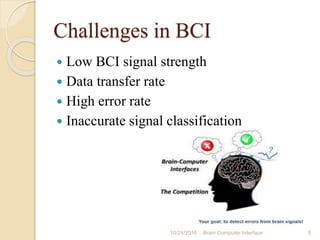
 Low BCI signal strength
 Data transfer rate
 High error rate
 Inaccurate signal classification
10/31/2016 5Brain Computer Interface
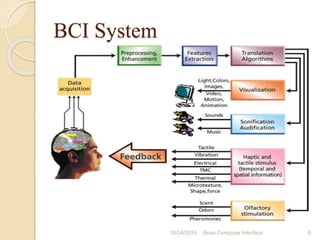
BCI System
10/31/2016 6Brain Computer Interface
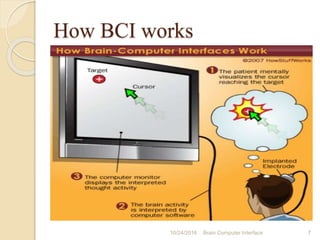
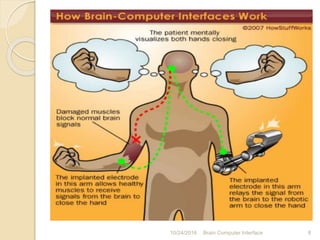
How BCI works
10/31/2016 7Brain Computer Interface
10/31/2016 Brain Computer Interface 8
BCI Types
 Invasive BCI acquisition techniques
 Partially Invasive BCI acquisition
techniques
 Non Invasive BCI acquisition
techniques
10/31/2016 9Brain Computer Interface
Invasive BCI Acquisition
Techniques
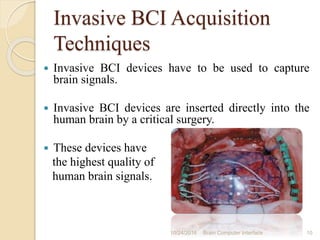
 Invasive BCI devices have to be used to capture
brain signals.
 Invasive BCI devices are inserted directly into the
human brain by a critical surgery.
 These devices have
the highest quality of
human brain signals.
10/31/2016 10Brain Computer Interface
Partially Invasive BCI
Acquisition Techniques
 Partially Invasive BCI devices are implanted
inside the skull but rest outside the brain.
 Signal strength using this type of BCI is bit
weaker.
 Partially Invasive BCIs
have less risk of scar
tissue formation.
10/31/2016 11Brain Computer Interface
Non Invasive BCI
Acquisition Techniques
 Non Invasive BCI has the least signal clarity
when it comes to communicating with the
brain.
 It has less risk than
the above two
methods.
10/31/2016 12Brain Computer Interface
BCI Signal Types
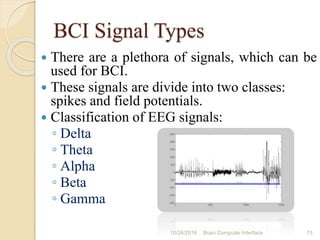
 There are a plethora of signals, which can be
used for BCI.
 These signals are divide into two classes:
spikes and field potentials.
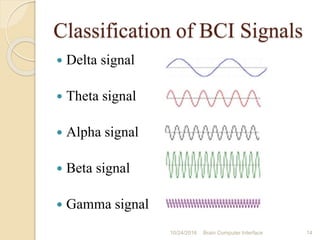
 Classification of EEG signals:
◦ Delta
◦ Theta
◦ Alpha
◦ Beta
◦ Gamma
10/31/2016 13Brain Computer Interface
Classification of BCI Signals
 Delta signal
 Theta signal
 Alpha signal
 Beta signal
 Gamma signal
10/31/2016 14Brain Computer Interface
Applications of BCI
 Provide disabled people with
communication, environment control, and
movement restoration.
 Provide enhanced control of devices such
as wheelchairs, vehicles, or assistance
robots for people with disabilities.
 Provide additional channel of control in
computer games.
10/31/2016 15Brain Computer Interface
Applications of BCI
 Monitor attention in long-distance drivers
or aircraft pilots, send out alert and
warning for aircraft pilots.
 Develop intelligent relaxation devices.
 Control robots that function in dangerous
or inhospitable situations.
 “Google Search” through brain.
10/31/2016 16Brain Computer Interface
Projects
• Brain Gate
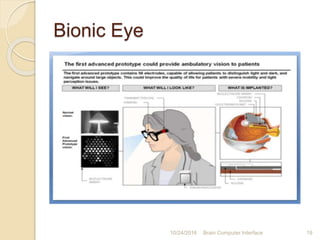
• Australian Bionic Eye
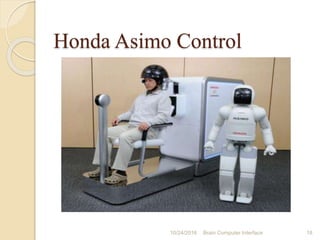
• Honda Asimo Control
• Gaming Control
10/31/2016 Brain Computer Interface 17
Honda Asimo Control
10/31/2016 Brain Computer Interface 18
Bionic Eye
10/31/2016 Brain Computer Interface 19
10/31/2016 Brain Computer Interface 20
Advantages of BCI
 Allow paralyzed people to control
prosthetic limbs with their mind.
 Transmit visual images to mind of blind
person.
 Transmit auditory data to mind of deaf
person.
 Allow gamers to control video games with
their mind.
10/31/2016 21Brain Computer Interface
Disadvantages of BCI
 The brain is incredibly complex.
 Signal is weak and prone to interference.
 The equipment is less than portable.
10/31/2016 22Brain Computer Interface
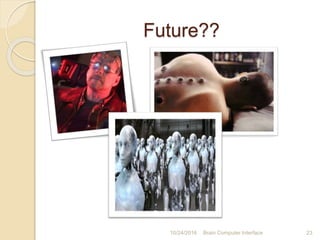
Future??
10/31/2016 Brain Computer Interface 23
Conclusion
 BCI is an advancing technology promising paradigm
shift in areas like Machine Control, Human reality and
etc. So, it’s potentially high impact technology.
10/31/2016 Brain Computer Interface 24
References
 Melody, M.: Real-world applications for brain-computer
interface technology. IEEE Trans. Neural Syst. Rehabil.
Eng. 11(2), 162–165 (2003)
 Pei, X., Barbour, D., Leuthardt, E., Schalk, G.: Decoding
vowels and consonants in spoken and imagined words
using electrocorticographic signals in humans. J.
Neural. Eng. 8(4), 1–11 (2011)
 Azar, A.T., Balas, V.E., Olariu, T.: Classification of EEG-
based brain-computer interfaces. advanced intelligent
computational technologies and decision support
systems. Stud. Comput. Intell. 486, 97 –106 (2014)
 Buckner, R., Andrews-Hanna, J., Schacter, D.: The
brain’s default network: anatomy, function, and
relevance to disease. Ann. N. Y. Acad. Sci. 1124,1 –38
(2008)
10/31/2016 Brain Computer Interface 25
Questions ??
10/31/2016 Brain Computer Interface 26
10/31/2016 Brain Computer Interface 27

Brain computer interface

  • 1.
    10/31/2016 Brain ComputerInterface 1 Department of Physical Science and Technology Faculty of Applied Sciences Sabaragamuwa University of Sri Lanka BRAIN COMPUTER INTERFACE
  • 2.
    Content  Introduction  Challengesin BCI  BCI System  How BCI works  BCI Types  Invasive BCI Acquisition Techniques  Partially Invasive BCI Acquisition Techniques  Non Invasive BCI Acquisition Techniques  BCI Signal Types  Classification of BCI Signals  Applications of BCI  Advantages of BCI  Disadvantages of BCI 10/31/2016 Brain Computer Interface 2
  • 3.
    Introduction  Brain ComputerInterface is a direct connection between computer and human brain.  The BCI can lead to many applications especially for disabled person.  BCI applications utilize the brain and its nervous system functions. 10/31/2016 3Brain Computer Interface
  • 4.
  • 5.
    Challenges in BCI Low BCI signal strength  Data transfer rate  High error rate  Inaccurate signal classification 10/31/2016 5Brain Computer Interface
  • 6.
    BCI System 10/31/2016 6BrainComputer Interface
  • 7.
    How BCI works 10/31/20167Brain Computer Interface
  • 8.
  • 9.
    BCI Types  InvasiveBCI acquisition techniques  Partially Invasive BCI acquisition techniques  Non Invasive BCI acquisition techniques 10/31/2016 9Brain Computer Interface
  • 10.
    Invasive BCI Acquisition Techniques Invasive BCI devices have to be used to capture brain signals.  Invasive BCI devices are inserted directly into the human brain by a critical surgery.  These devices have the highest quality of human brain signals. 10/31/2016 10Brain Computer Interface
  • 11.
    Partially Invasive BCI AcquisitionTechniques  Partially Invasive BCI devices are implanted inside the skull but rest outside the brain.  Signal strength using this type of BCI is bit weaker.  Partially Invasive BCIs have less risk of scar tissue formation. 10/31/2016 11Brain Computer Interface
  • 12.
    Non Invasive BCI AcquisitionTechniques  Non Invasive BCI has the least signal clarity when it comes to communicating with the brain.  It has less risk than the above two methods. 10/31/2016 12Brain Computer Interface
  • 13.
    BCI Signal Types There are a plethora of signals, which can be used for BCI.  These signals are divide into two classes: spikes and field potentials.  Classification of EEG signals: ◦ Delta ◦ Theta ◦ Alpha ◦ Beta ◦ Gamma 10/31/2016 13Brain Computer Interface
  • 14.
    Classification of BCISignals  Delta signal  Theta signal  Alpha signal  Beta signal  Gamma signal 10/31/2016 14Brain Computer Interface
  • 15.
    Applications of BCI Provide disabled people with communication, environment control, and movement restoration.  Provide enhanced control of devices such as wheelchairs, vehicles, or assistance robots for people with disabilities.  Provide additional channel of control in computer games. 10/31/2016 15Brain Computer Interface
  • 16.
    Applications of BCI Monitor attention in long-distance drivers or aircraft pilots, send out alert and warning for aircraft pilots.  Develop intelligent relaxation devices.  Control robots that function in dangerous or inhospitable situations.  “Google Search” through brain. 10/31/2016 16Brain Computer Interface
  • 17.
    Projects • Brain Gate •Australian Bionic Eye • Honda Asimo Control • Gaming Control 10/31/2016 Brain Computer Interface 17
  • 18.
    Honda Asimo Control 10/31/2016Brain Computer Interface 18
  • 19.
    Bionic Eye 10/31/2016 BrainComputer Interface 19
  • 20.
  • 21.
    Advantages of BCI Allow paralyzed people to control prosthetic limbs with their mind.  Transmit visual images to mind of blind person.  Transmit auditory data to mind of deaf person.  Allow gamers to control video games with their mind. 10/31/2016 21Brain Computer Interface
  • 22.
    Disadvantages of BCI The brain is incredibly complex.  Signal is weak and prone to interference.  The equipment is less than portable. 10/31/2016 22Brain Computer Interface
  • 23.
  • 24.
    Conclusion  BCI isan advancing technology promising paradigm shift in areas like Machine Control, Human reality and etc. So, it’s potentially high impact technology. 10/31/2016 Brain Computer Interface 24
  • 25.
    References  Melody, M.:Real-world applications for brain-computer interface technology. IEEE Trans. Neural Syst. Rehabil. Eng. 11(2), 162–165 (2003)  Pei, X., Barbour, D., Leuthardt, E., Schalk, G.: Decoding vowels and consonants in spoken and imagined words using electrocorticographic signals in humans. J. Neural. Eng. 8(4), 1–11 (2011)  Azar, A.T., Balas, V.E., Olariu, T.: Classification of EEG- based brain-computer interfaces. advanced intelligent computational technologies and decision support systems. Stud. Comput. Intell. 486, 97 –106 (2014)  Buckner, R., Andrews-Hanna, J., Schacter, D.: The brain’s default network: anatomy, function, and relevance to disease. Ann. N. Y. Acad. Sci. 1124,1 –38 (2008) 10/31/2016 Brain Computer Interface 25
  • 26.
    Questions ?? 10/31/2016 BrainComputer Interface 26
  • 27.