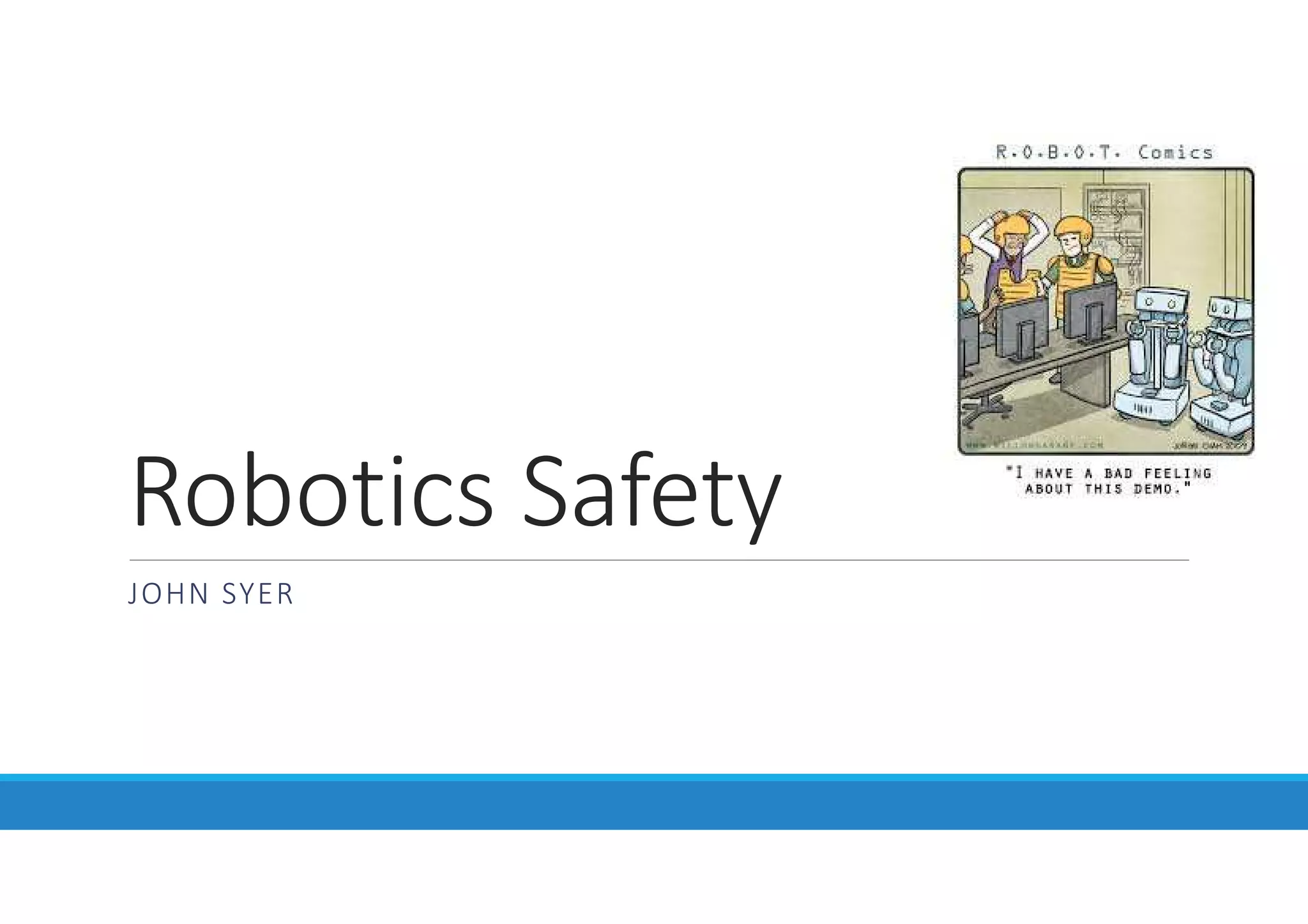
Robotics Safety
JOHN SYER
Historical
Rapid growth in industrial robots and robot systems in the 1980’s.
Recent strong growth in orders (North American robotics market sets records from 2014 to
2016)
Automotive OEMs dominated purchase and use of industrial use in the past
Cost of robotics are declining and more industries are implementing into operation
Robotics now growing in food and beverage, plastics, medical devices, and manufacturing
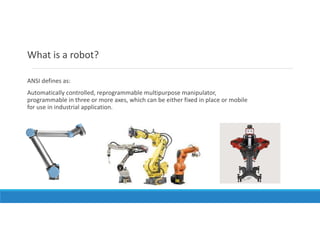
What is a robot?
ANSI defines as:
Automatically controlled, reprogrammable multipurpose manipulator,
programmable in three or more axes, which can be either fixed in place or mobile
for use in industrial application.
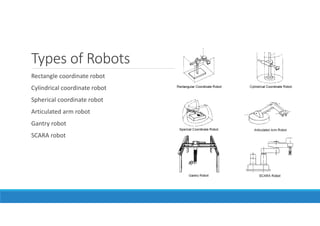
Types of Robots
Rectangle coordinate robot
Cylindrical coordinate robot
Spherical coordinate robot
Articulated arm robot
Gantry robot
SCARA robot
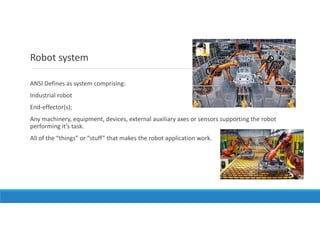
Robot system
ANSI Defines as system comprising:
Industrial robot
End-effector(s);
Any machinery, equipment, devices, external auxiliary axes or sensors supporting the robot
performing it’s task.
All of the “things” or “stuff” that makes the robot application work.
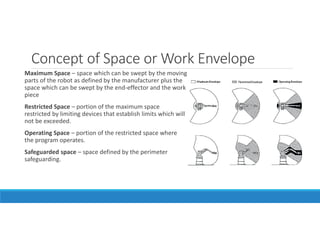
Concept of Space or Work Envelope
Maximum Space – space which can be swept by the moving
parts of the robot as defined by the manufacturer plus the
space which can be swept by the end-effector and the work
piece
Restricted Space – portion of the maximum space
restricted by limiting devices that establish limits which will
not be exceeded.
Operating Space – portion of the restricted space where
the program operates.
Safeguarded space – space defined by the perimeter
safeguarding.
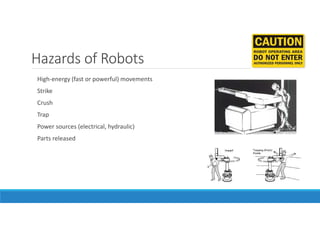
Hazards of Robots
High-energy (fast or powerful) movements
Strike
Crush
Trap
Power sources (electrical, hydraulic)
Parts released
Past studies and incidents
Studies in Sweden and Japan suggest the following – From OSHA
The majority of Robot accidents do not occur under normal operation.
Accidents have occurred during programming (teach), program touch-up or refinement,
maintenance , repair, testing, setup and adjustment
Typical accidents – From OSHA guidelines of incidents occurring in US, Japan, and Sweden
A operator entered a robot’s work space during operations and was pinned between the back end of
the robot and a safety pole.
A coworker accidentally turned on power to robot while maintenance worker was servicing a robot.
A robot’s arm functioned erratically during a teaching phase and struck the operator.
A welding robot went functionally awry and its arm pushed a worker against another machine.
Controls
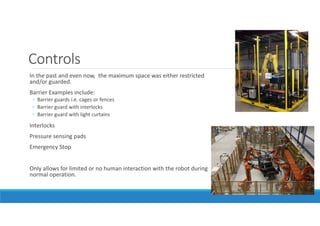
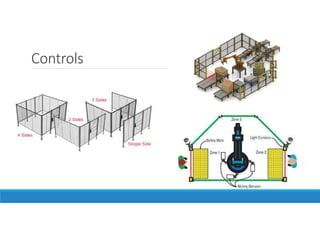
In the past and even now, the maximum space was either restricted
and/or guarded.
Barrier Examples include:
◦ Barrier guards i.e. cages or fences
◦ Barrier guard with interlocks
◦ Barrier guard with light curtains
Interlocks
Pressure sensing pads
Emergency Stop
Only allows for limited or no human interaction with the robot during
normal operation.
Controls
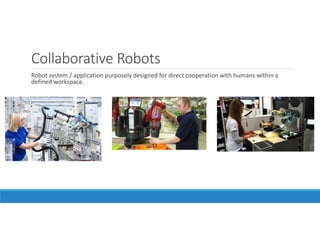
Collaborative Robots
Robot system / application purposely designed for direct cooperation with humans within a
defined workspace.
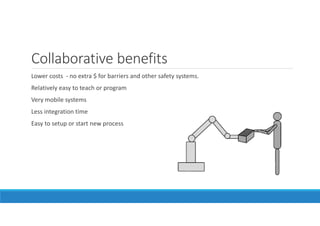
Collaborative benefits
Lower costs - no extra $ for barriers and other safety systems.
Relatively easy to teach or program
Very mobile systems
Less integration time
Easy to setup or start new process
What is a robot?
ANSI defines as:
Automatically controlled, reprogrammable multipurpose manipulator,
programmable in three or more axes, which can be either fixed in place or mobile
for use in industrial application.
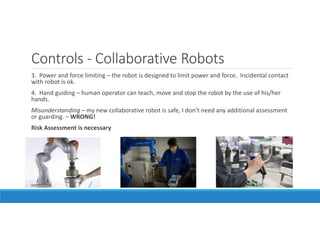
Controls - Collaborative Robots
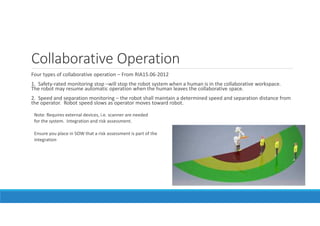
3. Power and force limiting – the robot is designed to limit power and force. Incidental contact
with robot is ok.
4. Hand guiding – human operator can teach, move and stop the robot by the use of his/her
hands.
Misunderstanding – my new collaborative robot is safe, I don’t need any additional assessment
or guarding. – WRONG!
Risk Assessment is necessary
Safety Standards
No specific standards for robotics
OSHA refers to:
General industry – 29 CFR 1910
◦ Subpart J – general environmental controls
◦ 1910.147 – LOTO
◦ Subpart O – Machinery and machine guarding
Depending on the material being process, other standards will apply
OSHA – Guidelines for Robotics Safety STD 01-12-002 1987
OSHA Technical Manual TED 01-00-015
Consensus Standards
ANSI/RIA TR R15.106-2012 – for Industrial Robots and Robot
System – Safety Requirements
ANSI/RIA/ISO 10218 – 2011 – Robots and robotic devices –
Safety requirements for industrial robots
◦ Part 1 – Robot Safety
◦ Part 2 – Integration Safety
ISO 12100 – Safety of Machinery – Risk assessment and risk
reduction
ISO Technical Specification 15066:2016 – Collaborative Robots
◦ Provide safety requirements for collaborative robots
RIA TR R15 306-2016 : Task-Based Risk Assessment
Consensus standards are voluntary; however can be
referenced by OSHA.
ANSI/RIA R15.06-2012– for Industrial Robots
and Robot System – Safety Requirements
U.S. industrial robot safety standard
Adoption of ISO 12018 Robots and Robotic Devices - Parts 1 and 2
◦ It’s guidance is the same as the international standards
◦ Note - ANSI/RIA R15.06-1999 was used as the basis for ISO 10218
Includes Collaborative robot operation
Risk assessment is now required
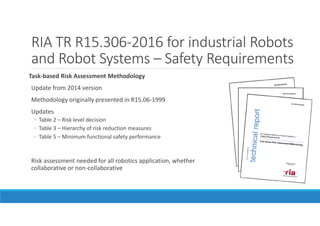
RIA TR R15.306-2016 for industrial Robots
and Robot Systems – Safety Requirements
Task-based Risk Assessment Methodology
Update from 2014 version
Methodology originally presented in R15.06-1999
Updates
◦ Table 2 – Risk level decision
◦ Table 3 – Hierarchy of risk reduction measures
◦ Table 5 – Minimum functional safety performance
Risk assessment needed for all robotics application, whether
collaborative or non-collaborative
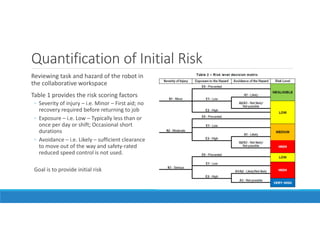
Quantification of Initial Risk
Reviewing task and hazard of the robot in
the collaborative workspace
Table 1 provides the risk scoring factors
◦ Severity of injury – i.e. Minor – First aid; no
recovery required before returning to job
◦ Exposure – i.e. Low – Typically less than or
once per day or shift; Occasional short
durations
◦ Avoidance – i.e. Likely – sufficient clearance
to move out of the way and safety-rated
reduced speed control is not used.
Goal is to provide initial risk
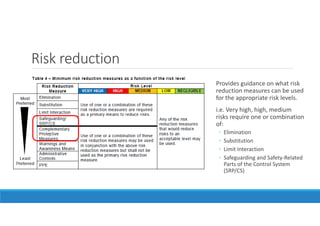
Risk reduction
Provides guidance on what risk
reduction measures can be used
for the appropriate risk levels.
i.e. Very high, high, medium
risks require one or combination
of:
◦ Elimination
◦ Substitution
◦ Limit Interaction
◦ Safeguarding and Safety-Related
Parts of the Control System
(SRP/CS)
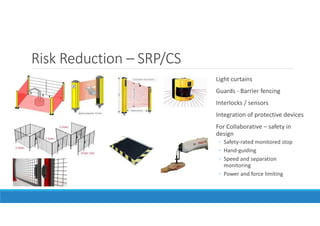
Risk Reduction – SRP/CS
Light curtains
Guards - Barrier fencing
Interlocks / sensors
Integration of protective devices
For Collaborative – safety in
design
◦ Safety-rated monitored stop
◦ Hand-guiding
◦ Speed and separation
monitoring
◦ Power and force limiting
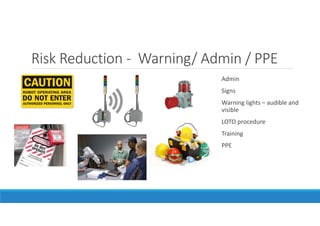
Risk Reduction - Warning/ Admin / PPE
Admin
Signs
Warning lights – audible and
visible
LOTO procedure
Training
PPE
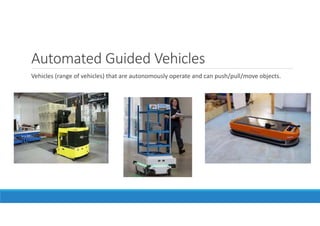
Automated Guided Vehicles
Vehicles (range of vehicles) that are autonomously operate and can push/pull/move objects.
Types of Robots
Rectangle coordinate robot
Cylindrical coordinate robot
Spherical coordinate robot
Articulated arm robot
Gantry robot
SCARA robot
ANSI/ITSDF B56.5-2012
Defines the safety requirements
◦ Elements of design
◦ Operation
◦ Maintenance
There are requirements for the system supplier and manufacturers and the end user.
Some of the requirements do not account for the recent trends in technology
◦ Standard requires a minimum path clearance and establishing hazard zones if minimum clearance
is not provided
◦ AGV with 3 Imaging can plot a unique path to maintain clearance.
Consensus standards are barely keeping up with the improvements and upgrades to robot
capabilities
References
Robotic Industries Association (RIA) – Robotics.org
http://www.robotics.org/content-detail.cfm/Industrial-Robotics-Editorials/Industrial-Robots-and-
Manufacturing-Jobs-A-Catalyst-for-Loss-or-Growth/content_id/6179
◦ Archived webinars
◦ http://www.robotics.org/events.cfm?type=3
OSHA - Industrial Robots and Robot System Safety
◦ Guidelines for Robotics Safety
https://www.osha.gov/dts/osta/otm/otm_iv/otm_iv_4.html
◦ OSHA Technical Manual TED 01-00-015
https://www.osha.gov/pls/oshaweb/owadisp.show_document?p_table=DIRECTIVES&p_id=1703
Universal Robots -
https://www.universal-robots.com/blog/demystifying-cobot-safety-the-four-types-of-collaborative-
operation/
References – Cont.
Rockwell automation -
https://www.rockwellautomation.com/resources/downloads/rockwellautomation/pdf/events/r
aotm/sessions/tech/T97NewANSIRIAR1506RobotandRobotSystemSafety.pdf
ISA Publication
https://www.isa.org/intech/20160803/
Industrial Truck Standards Development Foundation
http://www.itsdf.org/pB56.asp

Robotics Safety

  • 1.
  • 2.
    Historical Rapid growth inindustrial robots and robot systems in the 1980’s. Recent strong growth in orders (North American robotics market sets records from 2014 to 2016) Automotive OEMs dominated purchase and use of industrial use in the past Cost of robotics are declining and more industries are implementing into operation Robotics now growing in food and beverage, plastics, medical devices, and manufacturing
  • 3.
    What is arobot? ANSI defines as: Automatically controlled, reprogrammable multipurpose manipulator, programmable in three or more axes, which can be either fixed in place or mobile for use in industrial application.
  • 4.
    Types of Robots Rectanglecoordinate robot Cylindrical coordinate robot Spherical coordinate robot Articulated arm robot Gantry robot SCARA robot
  • 5.
    Robot system ANSI Definesas system comprising: Industrial robot End-effector(s); Any machinery, equipment, devices, external auxiliary axes or sensors supporting the robot performing it’s task. All of the “things” or “stuff” that makes the robot application work.
  • 6.
    Concept of Spaceor Work Envelope Maximum Space – space which can be swept by the moving parts of the robot as defined by the manufacturer plus the space which can be swept by the end-effector and the work piece Restricted Space – portion of the maximum space restricted by limiting devices that establish limits which will not be exceeded. Operating Space – portion of the restricted space where the program operates. Safeguarded space – space defined by the perimeter safeguarding.
  • 7.
    Hazards of Robots High-energy(fast or powerful) movements Strike Crush Trap Power sources (electrical, hydraulic) Parts released
  • 8.
    Past studies andincidents Studies in Sweden and Japan suggest the following – From OSHA The majority of Robot accidents do not occur under normal operation. Accidents have occurred during programming (teach), program touch-up or refinement, maintenance , repair, testing, setup and adjustment Typical accidents – From OSHA guidelines of incidents occurring in US, Japan, and Sweden A operator entered a robot’s work space during operations and was pinned between the back end of the robot and a safety pole. A coworker accidentally turned on power to robot while maintenance worker was servicing a robot. A robot’s arm functioned erratically during a teaching phase and struck the operator. A welding robot went functionally awry and its arm pushed a worker against another machine.
  • 9.
    Controls In the pastand even now, the maximum space was either restricted and/or guarded. Barrier Examples include: ◦ Barrier guards i.e. cages or fences ◦ Barrier guard with interlocks ◦ Barrier guard with light curtains Interlocks Pressure sensing pads Emergency Stop Only allows for limited or no human interaction with the robot during normal operation.
  • 10.
  • 11.
    Collaborative Robots Robot system/ application purposely designed for direct cooperation with humans within a defined workspace.
  • 12.
    Collaborative benefits Lower costs- no extra $ for barriers and other safety systems. Relatively easy to teach or program Very mobile systems Less integration time Easy to setup or start new process
  • 13.
    What is arobot? ANSI defines as: Automatically controlled, reprogrammable multipurpose manipulator, programmable in three or more axes, which can be either fixed in place or mobile for use in industrial application.
  • 14.
    Controls - CollaborativeRobots 3. Power and force limiting – the robot is designed to limit power and force. Incidental contact with robot is ok. 4. Hand guiding – human operator can teach, move and stop the robot by the use of his/her hands. Misunderstanding – my new collaborative robot is safe, I don’t need any additional assessment or guarding. – WRONG! Risk Assessment is necessary
  • 15.
    Safety Standards No specificstandards for robotics OSHA refers to: General industry – 29 CFR 1910 ◦ Subpart J – general environmental controls ◦ 1910.147 – LOTO ◦ Subpart O – Machinery and machine guarding Depending on the material being process, other standards will apply OSHA – Guidelines for Robotics Safety STD 01-12-002 1987 OSHA Technical Manual TED 01-00-015
  • 16.
    Consensus Standards ANSI/RIA TRR15.106-2012 – for Industrial Robots and Robot System – Safety Requirements ANSI/RIA/ISO 10218 – 2011 – Robots and robotic devices – Safety requirements for industrial robots ◦ Part 1 – Robot Safety ◦ Part 2 – Integration Safety ISO 12100 – Safety of Machinery – Risk assessment and risk reduction ISO Technical Specification 15066:2016 – Collaborative Robots ◦ Provide safety requirements for collaborative robots RIA TR R15 306-2016 : Task-Based Risk Assessment Consensus standards are voluntary; however can be referenced by OSHA.
  • 17.
    ANSI/RIA R15.06-2012– forIndustrial Robots and Robot System – Safety Requirements U.S. industrial robot safety standard Adoption of ISO 12018 Robots and Robotic Devices - Parts 1 and 2 ◦ It’s guidance is the same as the international standards ◦ Note - ANSI/RIA R15.06-1999 was used as the basis for ISO 10218 Includes Collaborative robot operation Risk assessment is now required
  • 18.
    RIA TR R15.306-2016for industrial Robots and Robot Systems – Safety Requirements Task-based Risk Assessment Methodology Update from 2014 version Methodology originally presented in R15.06-1999 Updates ◦ Table 2 – Risk level decision ◦ Table 3 – Hierarchy of risk reduction measures ◦ Table 5 – Minimum functional safety performance Risk assessment needed for all robotics application, whether collaborative or non-collaborative
  • 19.
    Quantification of InitialRisk Reviewing task and hazard of the robot in the collaborative workspace Table 1 provides the risk scoring factors ◦ Severity of injury – i.e. Minor – First aid; no recovery required before returning to job ◦ Exposure – i.e. Low – Typically less than or once per day or shift; Occasional short durations ◦ Avoidance – i.e. Likely – sufficient clearance to move out of the way and safety-rated reduced speed control is not used. Goal is to provide initial risk
  • 20.
    Risk reduction Provides guidanceon what risk reduction measures can be used for the appropriate risk levels. i.e. Very high, high, medium risks require one or combination of: ◦ Elimination ◦ Substitution ◦ Limit Interaction ◦ Safeguarding and Safety-Related Parts of the Control System (SRP/CS)
  • 21.
    Risk Reduction –SRP/CS Light curtains Guards - Barrier fencing Interlocks / sensors Integration of protective devices For Collaborative – safety in design ◦ Safety-rated monitored stop ◦ Hand-guiding ◦ Speed and separation monitoring ◦ Power and force limiting
  • 22.
    Risk Reduction -Warning/ Admin / PPE Admin Signs Warning lights – audible and visible LOTO procedure Training PPE
  • 23.
    Automated Guided Vehicles Vehicles(range of vehicles) that are autonomously operate and can push/pull/move objects.
  • 24.
    Types of Robots Rectanglecoordinate robot Cylindrical coordinate robot Spherical coordinate robot Articulated arm robot Gantry robot SCARA robot
  • 25.
    ANSI/ITSDF B56.5-2012 Defines thesafety requirements ◦ Elements of design ◦ Operation ◦ Maintenance There are requirements for the system supplier and manufacturers and the end user. Some of the requirements do not account for the recent trends in technology ◦ Standard requires a minimum path clearance and establishing hazard zones if minimum clearance is not provided ◦ AGV with 3 Imaging can plot a unique path to maintain clearance. Consensus standards are barely keeping up with the improvements and upgrades to robot capabilities
  • 26.
    References Robotic Industries Association(RIA) – Robotics.org http://www.robotics.org/content-detail.cfm/Industrial-Robotics-Editorials/Industrial-Robots-and- Manufacturing-Jobs-A-Catalyst-for-Loss-or-Growth/content_id/6179 ◦ Archived webinars ◦ http://www.robotics.org/events.cfm?type=3 OSHA - Industrial Robots and Robot System Safety ◦ Guidelines for Robotics Safety https://www.osha.gov/dts/osta/otm/otm_iv/otm_iv_4.html ◦ OSHA Technical Manual TED 01-00-015 https://www.osha.gov/pls/oshaweb/owadisp.show_document?p_table=DIRECTIVES&p_id=1703 Universal Robots - https://www.universal-robots.com/blog/demystifying-cobot-safety-the-four-types-of-collaborative- operation/
  • 27.
    References – Cont. Rockwellautomation - https://www.rockwellautomation.com/resources/downloads/rockwellautomation/pdf/events/r aotm/sessions/tech/T97NewANSIRIAR1506RobotandRobotSystemSafety.pdf ISA Publication https://www.isa.org/intech/20160803/ Industrial Truck Standards Development Foundation http://www.itsdf.org/pB56.asp