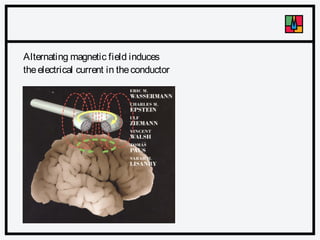
Alternating magnetic field induces
the electrical current in the conductor
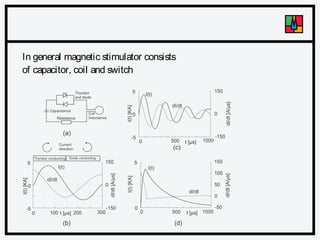
In general magnetic stimulator consists
of capacitor, coil and switch
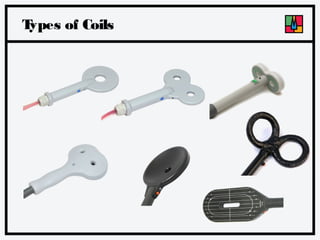
T
ypes of Coils
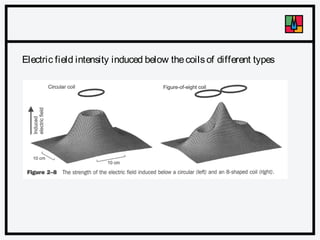
Electric field intensity induced below the coils of different types
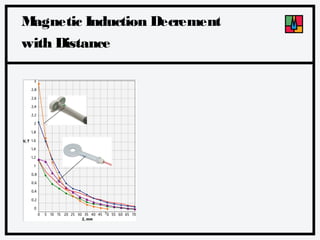
M
agnetic Induction Decrement
with Distance
General Rules for Selecting
the Appropriate Coil for Certain Application
– Small coils have stronger field on the surface but field decreases
dramatically with distance. Therefore small coils are suitable for
peripheral stimulation in which magnetic field does not need to
pass through skull bones
– B coils have lower decrease of field with distance.
ig
Therefore they are used for transcranial stimulation
– Ring coils are less focused. Therefore they are used
for stimulation of wide areas (for diagnostics)
– F
igure-of-eight coils are more focused, therefore they are widely
used for treatment
H T SW
ow M
orks
M
otor E
voked P
otential (M P
E)
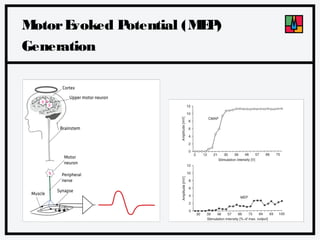
Generation
General P
eculiarities of M P
E:
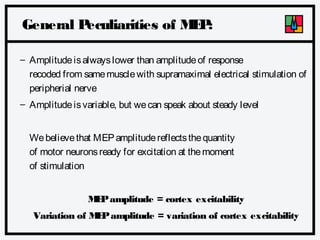
– Amplitude is always lower than amplitude of response
recoded from same muscle with supramaximal electrical stimulation of
peripherial nerve
– Amplitude is variable, but we can speak about steady level
We believe that MEP amplitude reflects the quantity
of motor neurons ready for excitation at the moment
of stimulation
M P amplitude = cortex excitability
E
Variation of M P amplitude = variation of cortex excitability
E
F
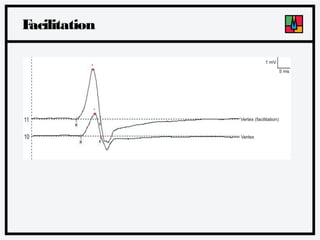
acilitation
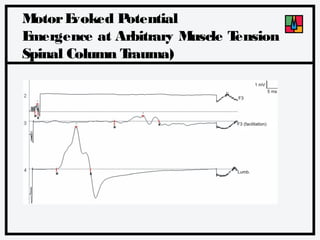
M
otor E
voked P
otential
E
mergence at Arbitrary M
uscle T
ension
Spinal Column T
rauma)
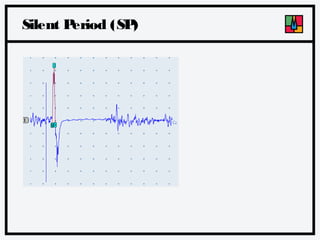
Silent P
eriod (SP
)
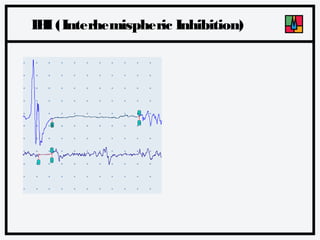
IH (Interhemispheric Inhibition)
I
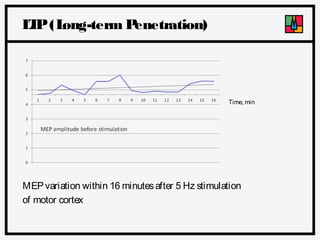
L P (L
T
ong-term P
enetration)

Time, min

MEP variation within 16 minutes after 5 Hz stimulation
of motor cortex
H W Can Use T S for B
ow e
M
rain Activity
M
odulation
– We can excite activity (facilitation)
– We can inhibit activity (silent period)
– We can stimulate one site but get inhibition at another
site (interhemispheric inhibition)
– We can have long-term post-stimulation effect
(long-term penetration)
Daily P
ractical Use: Diagnostics
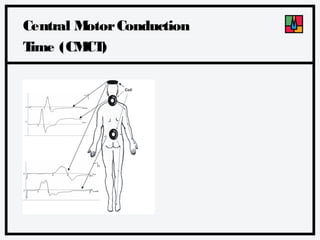
Central M
otor Conduction
T
ime (CM )
CT
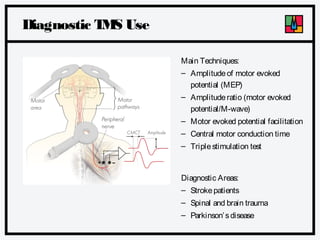
Diagnostic T S Use
M
Main Techniques:
– Amplitude of motor evoked
potential (MEP)
– Amplitude ratio (motor evoked
potential/M-wave)
– Motor evoked potential facilitation
– Central motor conduction time
– Triple stimulation test

Diagnostic Areas:
– Stroke patients
– Spinal and brain trauma
– Parkinson’ s disease
Daily P
ractical Use: T
herapeutic
T
herapeutic T S Use
M
Amblyopia[11][12]
Amyotrophic lateral sclerosis
Auditory hallucinations associated with schizoaffective disorders
Chronic pain
Dysphasia
Dystonia
Epilepsy
Fibromyalgia
Hemispatial neglect
Major depression
Migraine[13]
Obsessive-compulsive disorder
Parkinson’s disease
Phantom limb
Stroke
Nonfluent aphasia [14]
Tinnitus[15]
T S Use to T
M
reat Depressions
Is T S Safe?
M
When user follows Internationally recognized safety guidelines,
TMS is safe
TMS is not recommended for children, pregnant women, patients with
implants and patients with epilepsy

“Risk and safety of repetitive transcranial magnetic stimulation: report and
suggested guidelines from the International Workshop on the safety of repetitive
magnetic stimulation, June 5-7. 1996”
by Eric M. Wassermann (accepted for publication: 23 May 1997)
M
otor T
hreshold (M )
T
Minimum intensity required to elicit a small motor evoked potential in
at least half of the trials
It may be expected that motor threshold depends on
the excitability of those elements which are activated by TMS
For treatment purposes MT level means intensity of stimulation just
enough to excite cortex
Stimulation with lower intensities might not be effective and
stimulation with higher intensities can be uncomfortable
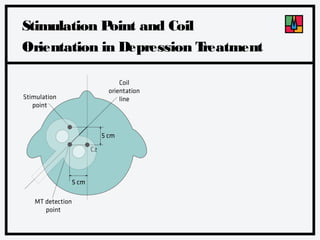
Stimulation P
oint and Coil
Orientation in Depression T
reatment
T
reatment W
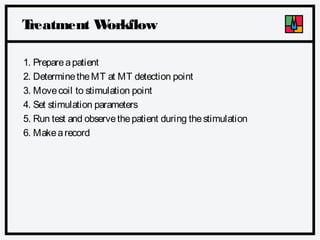
orkflow
1. Prepare a patient
2. Determine the MT at MT detection point
3. Move coil to stimulation point
4. Set stimulation parameters
5. Run test and observe the patient during the stimulation
6. Make a record
P
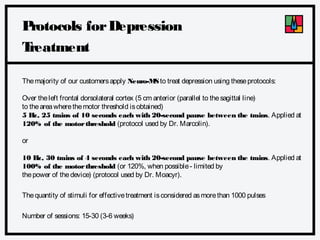
rotocols for Depression
T
reatment
The majority of our customers apply Neuro-M to treat depression using these protocols:
S
Over the left frontal dorsolateral cortex (5 cm anterior (parallel to the sagittal line)
to the area where the motor threshold is obtained)
5 H 25 trains of 10 seconds each with 20-second pause between the trains. Applied at
z,
120% of the motor threshold (protocol used by Dr. Marcolin).
or
10 H 30 trains of 4 seconds each with 20-second pause between the trains. Applied at
z,
100% of the motor threshold (or 120%, when possible - limited by
the power of the device) (protocol used by Dr. Moacyr).
The quantity of stimuli for effective treatment is considered as more than 1000 pulses
Number of sessions: 15-30 (3-6 weeks)
Video 2
W
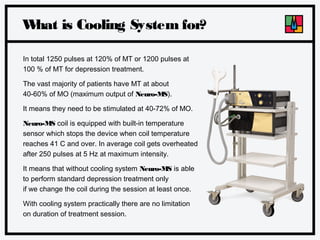
hat is Cooling System for?
In total 1250 pulses at 120% of MT or 1200 pulses at
100 % of MT for depression treatment.
The vast majority of patients have MT at about
40-60% of MO (maximum output of Neuro-MS).
It means they need to be stimulated at 40-72% of MO.
Neuro-MS coil is equipped with built-in temperature
sensor which stops the device when coil temperature
reaches 41 C and over. In average coil gets overheated
after 250 pulses at 5 Hz at maximum intensity.
It means that without cooling system Neuro-MS is able
to perform standard depression treatment only
if we change the coil during the session at least once.
With cooling system practically there are no limitation
on duration of treatment session.
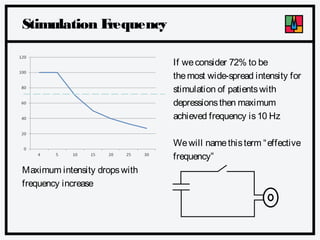
Stimulation F
requency
If we consider 72% to be
the most wide-spread intensity for
stimulation of patients with
depressions then maximum
achieved frequency is 10 Hz
We will name this term “ effective
frequency”
Maximum intensity drops with
frequency increase
W
hat is P
lacebo-coil for?
Placebo coil should:
– Look like normal one
– Produce click like normal one
– But generate low-intensity stimulus
Available at blurb for $52,95
http://www.blurb.com/bookstore/detail/3442787

TMS for beginners

  • 2.
    Alternating magnetic fieldinduces the electrical current in the conductor
  • 3.
    In general magneticstimulator consists of capacitor, coil and switch
  • 4.
  • 5.
    Electric field intensityinduced below the coils of different types
  • 6.
  • 7.
    General Rules forSelecting the Appropriate Coil for Certain Application – Small coils have stronger field on the surface but field decreases dramatically with distance. Therefore small coils are suitable for peripheral stimulation in which magnetic field does not need to pass through skull bones – B coils have lower decrease of field with distance. ig Therefore they are used for transcranial stimulation – Ring coils are less focused. Therefore they are used for stimulation of wide areas (for diagnostics) – F igure-of-eight coils are more focused, therefore they are widely used for treatment
  • 8.
    H T SW owM orks
  • 9.
    M otor E voked P otential(M P E) Generation
  • 10.
    General P eculiarities ofM P E: – Amplitude is always lower than amplitude of response recoded from same muscle with supramaximal electrical stimulation of peripherial nerve – Amplitude is variable, but we can speak about steady level We believe that MEP amplitude reflects the quantity of motor neurons ready for excitation at the moment of stimulation M P amplitude = cortex excitability E Variation of M P amplitude = variation of cortex excitability E
  • 11.
  • 12.
    M otor E voked P otential E mergenceat Arbitrary M uscle T ension Spinal Column T rauma)
  • 13.
  • 14.
  • 15.
    L P (L T ong-termP enetration) Time, min MEP variation within 16 minutes after 5 Hz stimulation of motor cortex
  • 16.
    H W CanUse T S for B ow e M rain Activity M odulation – We can excite activity (facilitation) – We can inhibit activity (silent period) – We can stimulate one site but get inhibition at another site (interhemispheric inhibition) – We can have long-term post-stimulation effect (long-term penetration)
  • 17.
  • 18.
  • 19.
    Diagnostic T SUse M Main Techniques: – Amplitude of motor evoked potential (MEP) – Amplitude ratio (motor evoked potential/M-wave) – Motor evoked potential facilitation – Central motor conduction time – Triple stimulation test Diagnostic Areas: – Stroke patients – Spinal and brain trauma – Parkinson’ s disease
  • 20.
  • 21.
    T herapeutic T SUse M Amblyopia[11][12] Amyotrophic lateral sclerosis Auditory hallucinations associated with schizoaffective disorders Chronic pain Dysphasia Dystonia Epilepsy Fibromyalgia Hemispatial neglect Major depression Migraine[13] Obsessive-compulsive disorder Parkinson’s disease Phantom limb Stroke Nonfluent aphasia [14] Tinnitus[15]
  • 22.
    T S Useto T M reat Depressions
  • 23.
    Is T SSafe? M When user follows Internationally recognized safety guidelines, TMS is safe TMS is not recommended for children, pregnant women, patients with implants and patients with epilepsy “Risk and safety of repetitive transcranial magnetic stimulation: report and suggested guidelines from the International Workshop on the safety of repetitive magnetic stimulation, June 5-7. 1996” by Eric M. Wassermann (accepted for publication: 23 May 1997)
  • 24.
    M otor T hreshold (M) T Minimum intensity required to elicit a small motor evoked potential in at least half of the trials It may be expected that motor threshold depends on the excitability of those elements which are activated by TMS For treatment purposes MT level means intensity of stimulation just enough to excite cortex Stimulation with lower intensities might not be effective and stimulation with higher intensities can be uncomfortable
  • 25.
    Stimulation P oint andCoil Orientation in Depression T reatment
  • 26.
    T reatment W orkflow 1. Preparea patient 2. Determine the MT at MT detection point 3. Move coil to stimulation point 4. Set stimulation parameters 5. Run test and observe the patient during the stimulation 6. Make a record
  • 27.
    P rotocols for Depression T reatment Themajority of our customers apply Neuro-M to treat depression using these protocols: S Over the left frontal dorsolateral cortex (5 cm anterior (parallel to the sagittal line) to the area where the motor threshold is obtained) 5 H 25 trains of 10 seconds each with 20-second pause between the trains. Applied at z, 120% of the motor threshold (protocol used by Dr. Marcolin). or 10 H 30 trains of 4 seconds each with 20-second pause between the trains. Applied at z, 100% of the motor threshold (or 120%, when possible - limited by the power of the device) (protocol used by Dr. Moacyr). The quantity of stimuli for effective treatment is considered as more than 1000 pulses Number of sessions: 15-30 (3-6 weeks)
  • 28.
  • 29.
    W hat is CoolingSystem for? In total 1250 pulses at 120% of MT or 1200 pulses at 100 % of MT for depression treatment. The vast majority of patients have MT at about 40-60% of MO (maximum output of Neuro-MS). It means they need to be stimulated at 40-72% of MO. Neuro-MS coil is equipped with built-in temperature sensor which stops the device when coil temperature reaches 41 C and over. In average coil gets overheated after 250 pulses at 5 Hz at maximum intensity. It means that without cooling system Neuro-MS is able to perform standard depression treatment only if we change the coil during the session at least once. With cooling system practically there are no limitation on duration of treatment session.
  • 30.
    Stimulation F requency If weconsider 72% to be the most wide-spread intensity for stimulation of patients with depressions then maximum achieved frequency is 10 Hz We will name this term “ effective frequency” Maximum intensity drops with frequency increase
  • 31.
    W hat is P lacebo-coilfor? Placebo coil should: – Look like normal one – Produce click like normal one – But generate low-intensity stimulus
  • 33.
    Available at blurbfor $52,95 http://www.blurb.com/bookstore/detail/3442787