PRESENTED BY
JEETESH PRADHAN
MCA 4TH SEMSETER
REGD NO -1851020002
GUIDED BY
MR. MANAS KUMAR NANDA
ASSISTANT PROFESSOR
DEPT. OF COMPUTER
APPLICATION
OVERVIEW
Introduction
 History
 How brain computer interface works?
 BCI control system
 Types of BCI
 Application
 Advantages
 Disadvantages
 Conclusion
 References
INTRODUCTION
 It is the study of brain functions.
 A collaboration in which a brain accepts and controls a mechanical device.
 Direct communication pathway between a brain and an external device.
 Thus BCI extracts electro-physical signals from suitable components of the
brain and process them to generate control signals for computers, robotic
machines or communication devices.
 “ A Brain-Computer Interface is a communication system that do not depend
on peripheral nerves and muscles “
HISTORY
1924: Hans Berger discovers the EEG Analyses the interrelation of
EEG and brain diseases.
 1970: First developments to use brain waves as input.
 ARPA has vision of enhanced human First step in the right direction.
 1990: First successful experiments with monkeys.
 Implanting electrode arrays into monkey brains , recording of
monkeys, brain waves.
 2000: Monkeys control robots by thoughts.
 More non-invasive than invasive approaches Brain reading by eg.
EEG, MEG or fMRI .
 2004: First human benefits from research.
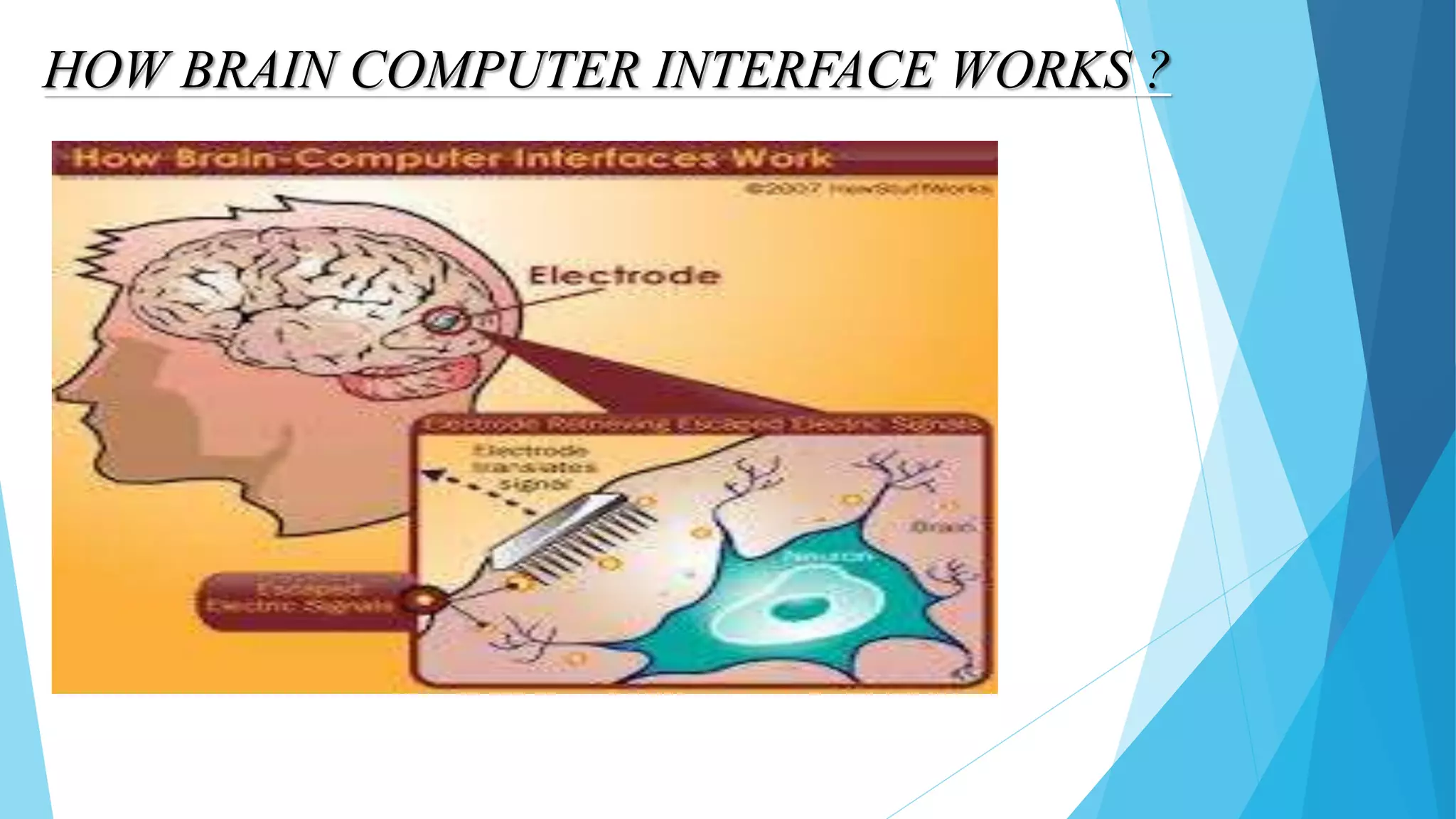
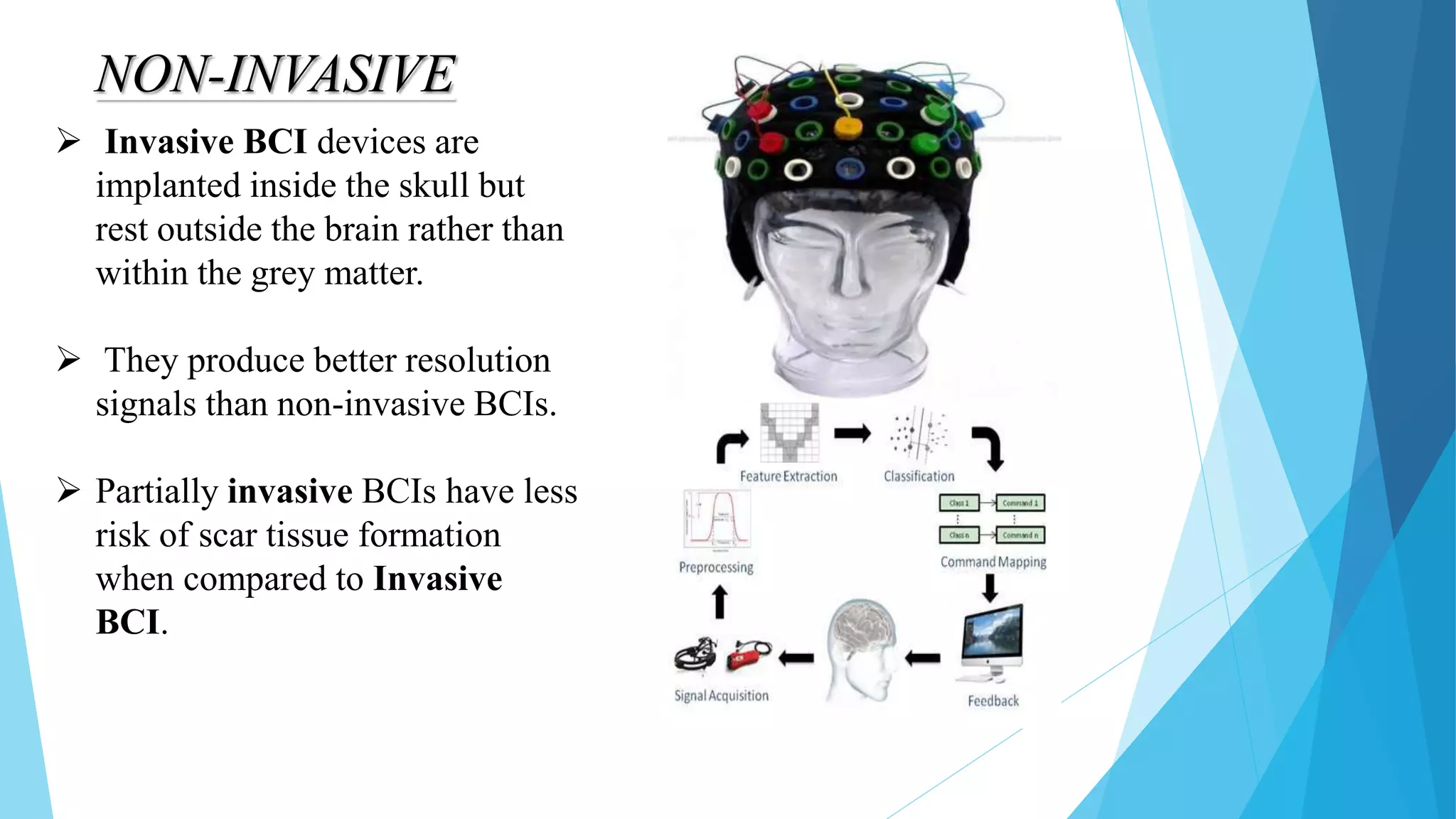
HOW BRAIN COMPUTER INTERFACE WORKS ?
BCI Control SystemBasic components of BCI:
Signal acquisition
 Signal pre-processing
 Feature extraction
Classification
BLOCK DIAGRAM OF A BCI
SYSTEM
TYPES OF BCI
Invasive BCI: implant electrodes directly onto a patient’s brain.
Non-Invasive: implant medical scanning devices to read brain signals.
INVASIVE BCI
 Brain is made out of
neurons .
 Brain detects and translates
the signal of brain to
tangible action .
 Same principle different
clearness .
 More accurate signal
detection from invasive
BCI.
NON-INVASIVE
 Invasive BCI devices are
implanted inside the skull but
rest outside the brain rather than
within the grey matter.
 They produce better resolution
signals than non-invasive BCIs.
 Partially invasive BCIs have less
risk of scar tissue formation
when compared to Invasive
BCI.
APPLICATION
 Brain computer interface have contributed in various fields of
research.
 As briefed in they are involved in such as:
 Medical.
 Neuroergonomics and smart environment .
Neuromarketing and advertisement.
 Educational and self-regulation.
 Games and entertainment .
Security and authentication fields.
ADVANTAGES
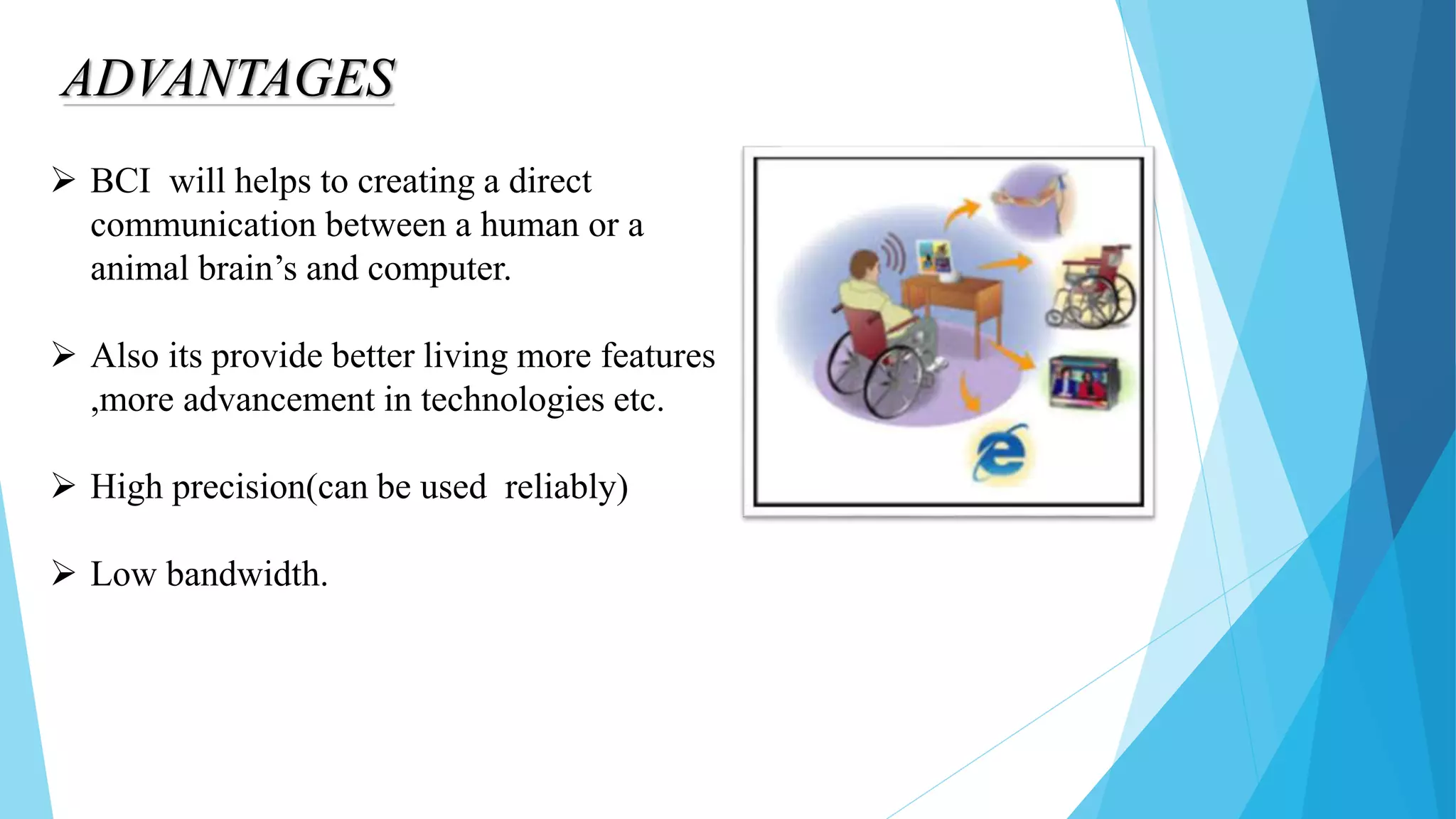
 BCI will helps to creating a direct
communication between a human or a
animal brain’s and computer.
 Also its provide better living more features
,more advancement in technologies etc.
 High precision(can be used reliably)
 Low bandwidth.
DISADVANTAGES
Research in to BCIs at the moment is at a fairly basic level
considering the complexity of the problem.
BCIs are currently fairly inaccurate in terms of classifying neural
activity.
BCIs placed outside of the skull have a limited ability to read brain
signals.
They can be placed under the skull, but this requires pretty drastic
surgery.
Reading people's inner thoughts comes with a massive amount of
ethical issues.
CONCLUSION
 BCI is an advancing technology promising paradigm shift in areas like
Machine Control, Human Enhancement, Virtual reality and etc. So, it’s
potentially high impact technology.
 Several potential applications of BCI hold promise for rehabilitation and
improving performance, such as treating emotional disorders (for example,
depression or anxiety), easing chronic pain, and overcoming movement
disabilities due to stroke.
Will enable us to achieve singularity very soon.
REFERENCES
• www.google.com
• www.Wikipedia.org
ANY QUERIES
Bci updated

Bci updated

  • 1.
    PRESENTED BY JEETESH PRADHAN MCA4TH SEMSETER REGD NO -1851020002 GUIDED BY MR. MANAS KUMAR NANDA ASSISTANT PROFESSOR DEPT. OF COMPUTER APPLICATION
  • 2.
    OVERVIEW Introduction  History  Howbrain computer interface works?  BCI control system  Types of BCI  Application  Advantages  Disadvantages  Conclusion  References
  • 3.
    INTRODUCTION  It isthe study of brain functions.  A collaboration in which a brain accepts and controls a mechanical device.  Direct communication pathway between a brain and an external device.  Thus BCI extracts electro-physical signals from suitable components of the brain and process them to generate control signals for computers, robotic machines or communication devices.  “ A Brain-Computer Interface is a communication system that do not depend on peripheral nerves and muscles “
  • 4.
    HISTORY 1924: Hans Bergerdiscovers the EEG Analyses the interrelation of EEG and brain diseases.  1970: First developments to use brain waves as input.  ARPA has vision of enhanced human First step in the right direction.  1990: First successful experiments with monkeys.  Implanting electrode arrays into monkey brains , recording of monkeys, brain waves.  2000: Monkeys control robots by thoughts.  More non-invasive than invasive approaches Brain reading by eg. EEG, MEG or fMRI .  2004: First human benefits from research.
  • 5.
    HOW BRAIN COMPUTERINTERFACE WORKS ?
  • 7.
    BCI Control SystemBasiccomponents of BCI: Signal acquisition  Signal pre-processing  Feature extraction Classification BLOCK DIAGRAM OF A BCI SYSTEM
  • 8.
    TYPES OF BCI InvasiveBCI: implant electrodes directly onto a patient’s brain. Non-Invasive: implant medical scanning devices to read brain signals.
  • 9.
    INVASIVE BCI  Brainis made out of neurons .  Brain detects and translates the signal of brain to tangible action .  Same principle different clearness .  More accurate signal detection from invasive BCI.
  • 10.
    NON-INVASIVE  Invasive BCIdevices are implanted inside the skull but rest outside the brain rather than within the grey matter.  They produce better resolution signals than non-invasive BCIs.  Partially invasive BCIs have less risk of scar tissue formation when compared to Invasive BCI.
  • 11.
    APPLICATION  Brain computerinterface have contributed in various fields of research.  As briefed in they are involved in such as:  Medical.  Neuroergonomics and smart environment . Neuromarketing and advertisement.  Educational and self-regulation.  Games and entertainment . Security and authentication fields.
  • 12.
    ADVANTAGES  BCI willhelps to creating a direct communication between a human or a animal brain’s and computer.  Also its provide better living more features ,more advancement in technologies etc.  High precision(can be used reliably)  Low bandwidth.
  • 13.
    DISADVANTAGES Research in toBCIs at the moment is at a fairly basic level considering the complexity of the problem. BCIs are currently fairly inaccurate in terms of classifying neural activity. BCIs placed outside of the skull have a limited ability to read brain signals. They can be placed under the skull, but this requires pretty drastic surgery. Reading people's inner thoughts comes with a massive amount of ethical issues.
  • 14.
    CONCLUSION  BCI isan advancing technology promising paradigm shift in areas like Machine Control, Human Enhancement, Virtual reality and etc. So, it’s potentially high impact technology.  Several potential applications of BCI hold promise for rehabilitation and improving performance, such as treating emotional disorders (for example, depression or anxiety), easing chronic pain, and overcoming movement disabilities due to stroke. Will enable us to achieve singularity very soon.
  • 15.
  • 16.