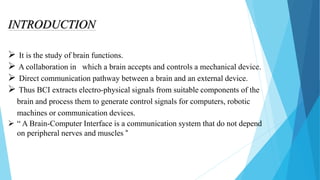
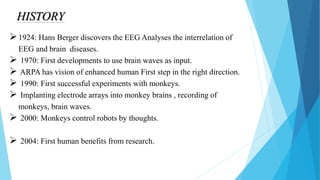
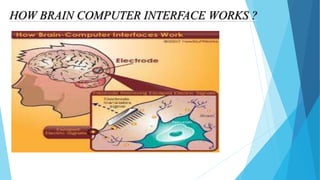
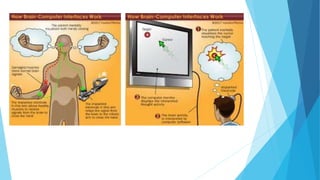
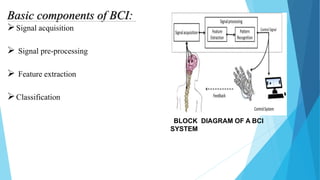
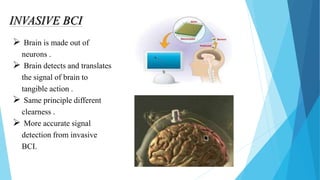
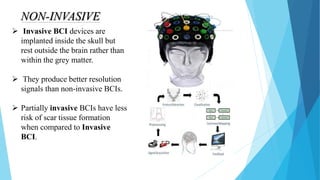
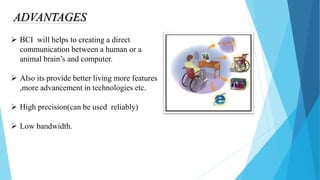
This document provides an overview of brain-computer interfaces (BCI). It begins with an introduction defining BCI as a direct communication pathway between the brain and an external device. It then discusses the history of BCI research from the 1920s to present day. The document outlines how a typical BCI system works, including signal acquisition, preprocessing, feature extraction, and classification. It describes the two main types of BCI as invasive and non-invasive. Applications of BCI technology are discussed in several fields like medicine, education, and gaming. Both advantages like high precision and disadvantages like current accuracy limitations are noted.