

BRAIN COMPUTER INTERFACE
ABSTRACT
A Brain Computer Interface (BCI) provides a communication path between human
brain and the computer system. With the advancement in the areas of information technology
and neurosciences, there has been a surge of interest in turning fiction into reality. The major
goal of BCI research is to develop a system that allows disabled people to communicate with
other persons and helps to interact with the external environments. This area includes
components like, comparison of invasive and noninvasive technologies to measure brain
activity, evaluation of control signals (i.e. patterns of brain activity that can be used for
communication), development of algorithms for translation of brain signals into computer
commands, and the development of new BCI applications. This Paper provides an insight
into the aspects of BCI, its applications, recent developments and open problems in this area
of research.
INTRODUCTION
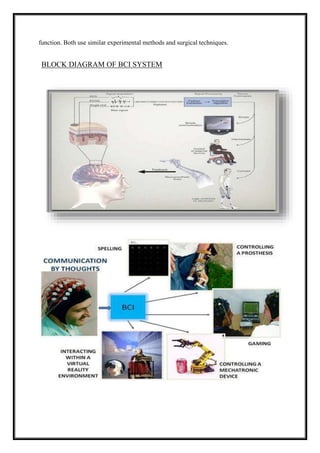
BCI provides a new communication channel between the human brain and the
computer. Mental activity leads to changes of electrophysiological signals like the EEG. The
BCI system detects such changes and transforms it into a control signal which can be used in
various applications like video game, motion of a wheel chair etc. One of the main goal is to
enable completely paralyzed patient to communicate with their environment. The machine
should be able to learn to discriminate between different patterns of brain activity as accurate
as possible and the user of the BCI should learn to perform different mental tasks in order to
produce distinct brain signals, a BCI establishes a real-time interaction between the user and
the outside world.
OVERVIEW OF BRAIN COMPUTER INTERFACE (BCI)
A Brain–Computer Interface (BCI), often called a Mind-Machine Interface (MMI), or
sometimes called a direct neural interface or a Brain–Machine Interface (BMI), is a direct
communication channel between the brain and an external device. Brain-computer interface
(BCI) is an upcoming technology which aims to convey people's intentions to the outside
world directly from their thoughts, enhancing cognitive capability. BCIs are often directed at
assisting, augmenting, or repairing human cognitive or sensory-motor functions. The BCI can
be used for people who are unable to express through speech. Normally these people are
"locked in" meaning they can't move their face or any of their appendages. The field of BCI
research and development has been focused on neuroprosthetics applications. This aims at
restoring damaged hearing, sight and movement.
Neuroprosthetics is an area of neuroscience concerned with neural prostheses. We can
use artificial devices to replace the function of nervous system which is not proper and brain
related problems as well as sensory organs. The most widely used neuroprosthetics device is
the cochlear implant which, as of 2006, had been implanted in approximately 100,000 people
worldwide. However, neuroprosthetics and BCIs are mainly focusing on to achieve the same
goal such as restoring sight, hearing, movement, ability to communicate, and even cognitive
function. Both use similar experimental methods and surgical techniques.
BLOCK DIAGRAM OF BCI SYSTEM
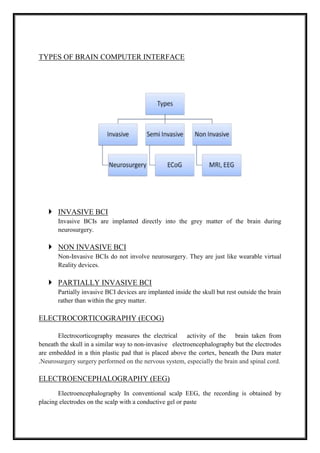
TYPES OF BRAIN COMPUTER INTERFACE
 INVASIVE BCI
Invasive BCIs are implanted directly into the grey matter of the brain during
neurosurgery.
 NON INVASIVE BCI
Non-Invasive BCIs do not involve neurosurgery. They are just like wearable virtual
Reality devices.
 PARTIALLY INVASIVE BCI
Partially invasive BCI devices are implanted inside the skull but rest outside the brain
rather than within the grey matter.
ELECTROCORTICOGRAPHY (ECOG)
Electrocorticography measures the electrical activity of the brain taken from
beneath the skull in a similar way to non-invasive electroencephalography but the electrodes
are embedded in a thin plastic pad that is placed above the cortex, beneath the Dura mater
.Neurosurgery surgery performed on the nervous system, especially the brain and spinal cord.
ELECTROENCEPHALOGRAPHY (EEG)
Electroencephalography In conventional scalp EEG, the recording is obtained by
placing electrodes on the scalp with a conductive gel or paste
MAGNETIC RESONANCE IMAGING (MRI)
Magnetic resonance imaging is a medical imaging technique used in radiology to
investigate the anatomy and function of the body in both health and disease. MRI scanners
use strong magnetic fields and radio waves to form images of the body
ELECTROENCEPHALOGRAPHY (EEG)
Electroencephalography is the recording of electrical activity along the scalp. EEG
measures voltage fluctuations resulting from ionic current flows within the neurons of
the brain.
BCI CHALLENGES
 The brain is incredibly complex.
 There are chemical processes involved as well.
 The signal is weak and prone to interference i.e. reading brain signals is like listening
to a bad phone connection. There's lots of static.
 The equipment is less than portable.
ADVANTAGES
 Bci will help creating a direct communication pathway between a human or animal
brain to any external devices like computers or devices allow paralyzed people to
control prosthetic limbs with their mind
 transmit visual images to the mind of a blind person, allowing them to see
 transmit auditory data to the mind of a def person, allowing them to hear
 allow gamers to control video games with their minds
 allow a mute person to have their thoughts displayed and spoken by a computer
DISADVANTAGES
 Research is still in beginning stages
 In case of invasive BCI there is a risk of information of scar tissue
 BCI techniques are costly.
 The current technology is crude
 Ethical issues may prevent its development
 Electrodes outside of the skull can detect very few electric signals from the brain
 Electrodes placed inside the skull create scar tissue in the brain
FUTURE SCOPES
 Direct control over the activities of all individual neurons by means of nanorobots.
 Arbitrary read/write access to the whole brain.
 The line between the mind and the computer is blurred. Partial or full uploading is
possible and inevitable.
 More direct links into the brain with the ability to read certain thoughts and copy a
wide range of data and information into various parts of the brain.
CONCLUSION
The results of BCI are spectacular and almost unbelievable. BCI’s will definitely have
the ability to change the way a person looks at the world by giving people back their vision
and hearing. Bci research is an interdisciplinary endeavor involving neuroscience,
engineering, signal processing, and clinical rehabilitation and lies at the intersection of
several emerging technologies such as machine learning and artificial intelligence among
others. Bci is considered as a be frontier in science technology
REFERENCES
www.ieeexplore.com
www.wikipedia.com
www.braincomputerinterface.com
www.whatis.com
www.slideshare.com
www.yahooanswers.com
www.howstuffworks.com
www.sciencedaily.com
www.extremetech.com

Bci report

  • 1.
    BRAIN COMPUTER INTERFACE ABSTRACT ABrain Computer Interface (BCI) provides a communication path between human brain and the computer system. With the advancement in the areas of information technology and neurosciences, there has been a surge of interest in turning fiction into reality. The major goal of BCI research is to develop a system that allows disabled people to communicate with other persons and helps to interact with the external environments. This area includes components like, comparison of invasive and noninvasive technologies to measure brain activity, evaluation of control signals (i.e. patterns of brain activity that can be used for communication), development of algorithms for translation of brain signals into computer commands, and the development of new BCI applications. This Paper provides an insight into the aspects of BCI, its applications, recent developments and open problems in this area of research. INTRODUCTION BCI provides a new communication channel between the human brain and the computer. Mental activity leads to changes of electrophysiological signals like the EEG. The BCI system detects such changes and transforms it into a control signal which can be used in various applications like video game, motion of a wheel chair etc. One of the main goal is to enable completely paralyzed patient to communicate with their environment. The machine should be able to learn to discriminate between different patterns of brain activity as accurate as possible and the user of the BCI should learn to perform different mental tasks in order to produce distinct brain signals, a BCI establishes a real-time interaction between the user and the outside world. OVERVIEW OF BRAIN COMPUTER INTERFACE (BCI) A Brain–Computer Interface (BCI), often called a Mind-Machine Interface (MMI), or sometimes called a direct neural interface or a Brain–Machine Interface (BMI), is a direct communication channel between the brain and an external device. Brain-computer interface (BCI) is an upcoming technology which aims to convey people's intentions to the outside world directly from their thoughts, enhancing cognitive capability. BCIs are often directed at assisting, augmenting, or repairing human cognitive or sensory-motor functions. The BCI can be used for people who are unable to express through speech. Normally these people are "locked in" meaning they can't move their face or any of their appendages. The field of BCI research and development has been focused on neuroprosthetics applications. This aims at restoring damaged hearing, sight and movement. Neuroprosthetics is an area of neuroscience concerned with neural prostheses. We can use artificial devices to replace the function of nervous system which is not proper and brain related problems as well as sensory organs. The most widely used neuroprosthetics device is the cochlear implant which, as of 2006, had been implanted in approximately 100,000 people worldwide. However, neuroprosthetics and BCIs are mainly focusing on to achieve the same goal such as restoring sight, hearing, movement, ability to communicate, and even cognitive
  • 2.
    function. Both usesimilar experimental methods and surgical techniques. BLOCK DIAGRAM OF BCI SYSTEM
  • 3.
    TYPES OF BRAINCOMPUTER INTERFACE  INVASIVE BCI Invasive BCIs are implanted directly into the grey matter of the brain during neurosurgery.  NON INVASIVE BCI Non-Invasive BCIs do not involve neurosurgery. They are just like wearable virtual Reality devices.  PARTIALLY INVASIVE BCI Partially invasive BCI devices are implanted inside the skull but rest outside the brain rather than within the grey matter. ELECTROCORTICOGRAPHY (ECOG) Electrocorticography measures the electrical activity of the brain taken from beneath the skull in a similar way to non-invasive electroencephalography but the electrodes are embedded in a thin plastic pad that is placed above the cortex, beneath the Dura mater .Neurosurgery surgery performed on the nervous system, especially the brain and spinal cord. ELECTROENCEPHALOGRAPHY (EEG) Electroencephalography In conventional scalp EEG, the recording is obtained by placing electrodes on the scalp with a conductive gel or paste
  • 4.
    MAGNETIC RESONANCE IMAGING(MRI) Magnetic resonance imaging is a medical imaging technique used in radiology to investigate the anatomy and function of the body in both health and disease. MRI scanners use strong magnetic fields and radio waves to form images of the body ELECTROENCEPHALOGRAPHY (EEG) Electroencephalography is the recording of electrical activity along the scalp. EEG measures voltage fluctuations resulting from ionic current flows within the neurons of the brain. BCI CHALLENGES  The brain is incredibly complex.  There are chemical processes involved as well.  The signal is weak and prone to interference i.e. reading brain signals is like listening to a bad phone connection. There's lots of static.  The equipment is less than portable. ADVANTAGES  Bci will help creating a direct communication pathway between a human or animal brain to any external devices like computers or devices allow paralyzed people to control prosthetic limbs with their mind  transmit visual images to the mind of a blind person, allowing them to see  transmit auditory data to the mind of a def person, allowing them to hear  allow gamers to control video games with their minds  allow a mute person to have their thoughts displayed and spoken by a computer DISADVANTAGES  Research is still in beginning stages  In case of invasive BCI there is a risk of information of scar tissue  BCI techniques are costly.  The current technology is crude  Ethical issues may prevent its development  Electrodes outside of the skull can detect very few electric signals from the brain  Electrodes placed inside the skull create scar tissue in the brain
  • 5.
    FUTURE SCOPES  Directcontrol over the activities of all individual neurons by means of nanorobots.  Arbitrary read/write access to the whole brain.  The line between the mind and the computer is blurred. Partial or full uploading is possible and inevitable.  More direct links into the brain with the ability to read certain thoughts and copy a wide range of data and information into various parts of the brain. CONCLUSION The results of BCI are spectacular and almost unbelievable. BCI’s will definitely have the ability to change the way a person looks at the world by giving people back their vision and hearing. Bci research is an interdisciplinary endeavor involving neuroscience, engineering, signal processing, and clinical rehabilitation and lies at the intersection of several emerging technologies such as machine learning and artificial intelligence among others. Bci is considered as a be frontier in science technology REFERENCES www.ieeexplore.com www.wikipedia.com www.braincomputerinterface.com www.whatis.com www.slideshare.com www.yahooanswers.com www.howstuffworks.com www.sciencedaily.com www.extremetech.com