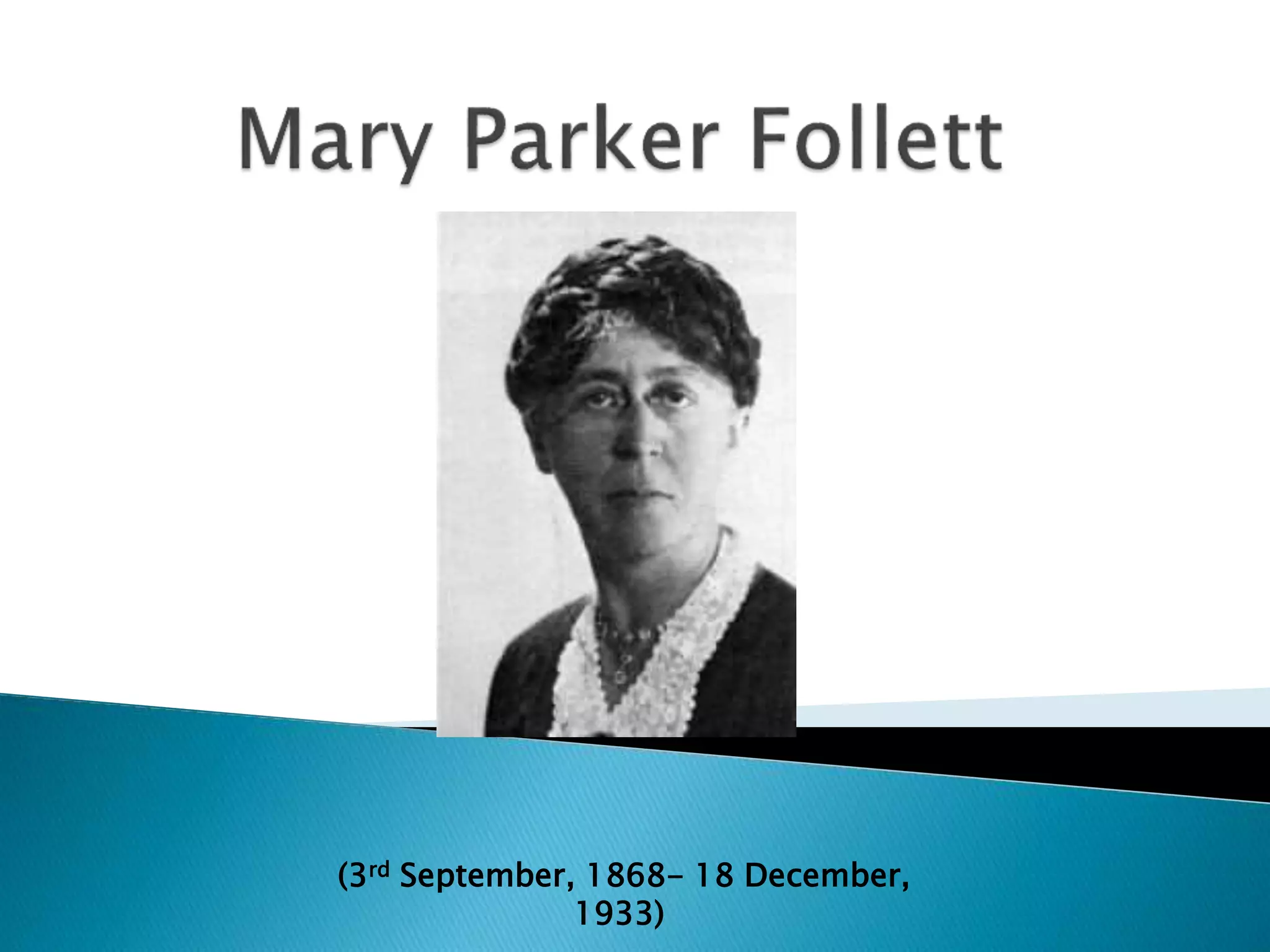
(3rd September, 1868- 18 December,
1933)
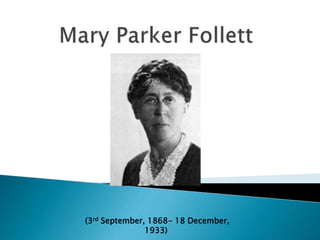
Mary Parker Follett was an American social
worker and a management consultant.
She was a pioneer in the fields of
Organizational theory and Organizational
behavior.
Follett was born in Boston and spent much of
her early life there.
She was one of the great women
management gurus.
Mary Parker Follett defined
management as “the art of
getting things through
others.”
Mary Parker Follett is regarded as the mother
of scientific management.
Her ideas on negotiation, power,
and employee participation were highly
influential in the development of the fields
of organizational studies.
She was a social worker turned management
theorist and consultant and writer.
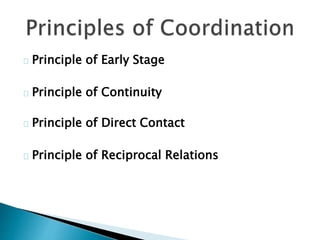
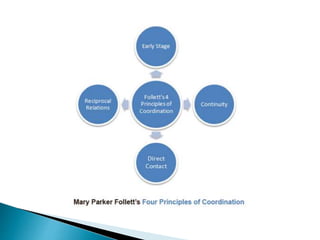
Principle of Early Stage
Principle of Continuity
Principle of Direct Contact
Principle of Reciprocal Relations
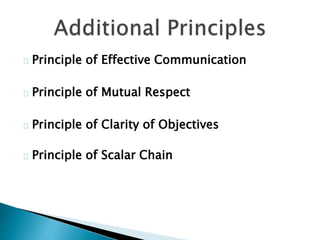
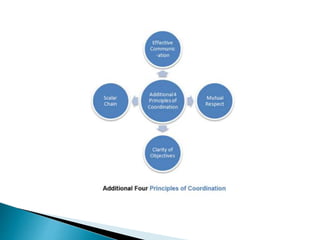
Principle of Effective Communication
Principle of Mutual Respect
Principle of Clarity of Objectives
Principle of Scalar Chain
The Mary Parker Follett Theory of Management is
marked by such principles as the following:
1. Conflict resolution through Integration (i.e.,
identifying and meeting each party's underlying and
often compatible need, as opposed to attempting to
meet the frequently-incompatible expressed desire
of each) often results in a win-win situation.
2. In Mary Parker Follett leadership theory, genuine
power is not "coercive" ("power over") but "coactive"
("power with").
3. True leaders, according to Follett's theory, "create
group power, rather than expressing personal
power."
Theory Of Management
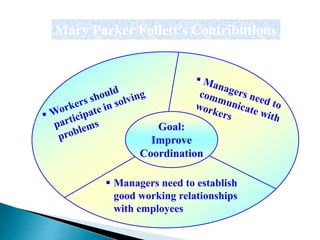
Mary Parker Follett’s Contributions
 Managers need to establish
good working relationships
with employees
Goal:
Improve
Coordination
New State: The New State was written during
1918, and argues for group-based
democracy as a process of government.
The Creative Experience: The Creative
Experience was also written during 1918, and
again focused on democratic governance,
using examples from business to illustrate
ideas.
She also authored a number of books and
numerous essays, articles and speeches on
democracy, human relations, political
philosophy, psychology, organizational
behavior and conflict resolution.
Few other publications by her are The
Speaker of the House of Representatives
(1896), The Giving of Orders (1926) and
Dynamic Administration (1942).
Mary Parker Follett was a pioneer of
community organizing. Her advocacy of
schools as community centers helped open
numerous such centers throughout Boston,
establishing them as important educational
and social forums.
Her argument of the need of community
organizing as the school of democracy led to
better understanding of the dynamics of
democracy in general.
Regarding her work on management, after her
death in 1933, she became practically
forgotten.
Her ideas vanished from the mainstream of
American management and organizational
thinking in the 1930s and 1940s. She
however continued to draw followers in Great
Britain.
Gradually her work re-emerged, especially in
1960s Japan, and several management
thinkers started to re-apply her theories.
Himani
Saurabh
Komal
Mary parker follett

Mary parker follett

  • 1.
    (3rd September, 1868-18 December, 1933)
  • 2.
    Mary Parker Follettwas an American social worker and a management consultant. She was a pioneer in the fields of Organizational theory and Organizational behavior. Follett was born in Boston and spent much of her early life there. She was one of the great women management gurus.
  • 3.
    Mary Parker Follettdefined management as “the art of getting things through others.”
  • 4.
    Mary Parker Follettis regarded as the mother of scientific management. Her ideas on negotiation, power, and employee participation were highly influential in the development of the fields of organizational studies. She was a social worker turned management theorist and consultant and writer.
  • 5.
    Principle of EarlyStage Principle of Continuity Principle of Direct Contact Principle of Reciprocal Relations
  • 7.
    Principle of EffectiveCommunication Principle of Mutual Respect Principle of Clarity of Objectives Principle of Scalar Chain
  • 9.
    The Mary ParkerFollett Theory of Management is marked by such principles as the following: 1. Conflict resolution through Integration (i.e., identifying and meeting each party's underlying and often compatible need, as opposed to attempting to meet the frequently-incompatible expressed desire of each) often results in a win-win situation. 2. In Mary Parker Follett leadership theory, genuine power is not "coercive" ("power over") but "coactive" ("power with"). 3. True leaders, according to Follett's theory, "create group power, rather than expressing personal power." Theory Of Management
  • 10.
    Mary Parker Follett’sContributions  Managers need to establish good working relationships with employees Goal: Improve Coordination
  • 11.
    New State: TheNew State was written during 1918, and argues for group-based democracy as a process of government. The Creative Experience: The Creative Experience was also written during 1918, and again focused on democratic governance, using examples from business to illustrate ideas.
  • 12.
    She also authoreda number of books and numerous essays, articles and speeches on democracy, human relations, political philosophy, psychology, organizational behavior and conflict resolution. Few other publications by her are The Speaker of the House of Representatives (1896), The Giving of Orders (1926) and Dynamic Administration (1942).
  • 13.
    Mary Parker Follettwas a pioneer of community organizing. Her advocacy of schools as community centers helped open numerous such centers throughout Boston, establishing them as important educational and social forums. Her argument of the need of community organizing as the school of democracy led to better understanding of the dynamics of democracy in general.
  • 14.
    Regarding her workon management, after her death in 1933, she became practically forgotten. Her ideas vanished from the mainstream of American management and organizational thinking in the 1930s and 1940s. She however continued to draw followers in Great Britain. Gradually her work re-emerged, especially in 1960s Japan, and several management thinkers started to re-apply her theories.
  • 15.