Robotics
Robotic
Technology
Types of
Robots
What is a Robot…?
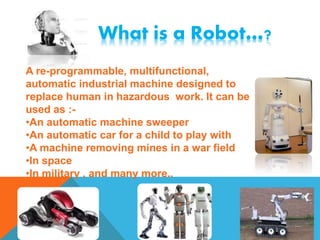
A re-programmable, multifunctional,
automatic industrial machine designed to
replace human in hazardous work. It can be
used as :-
•An automatic machine sweeper
•An automatic car for a child to play with
•A machine removing mines in a war field
•In space
•In military , and many more..
Robotics is science of designing or building an application
of robots. Simply ,Robotics may be defines as “The Study
of Robots”. The aim of robotics is to design an efficient
robot.
Robotics is needed because:-
•Speed
• Can work in hazardous/dangerous temperature
• Can do repetitive tasks
• Can do work with accuracy
Sensors
Effectors
Actuators
Controllers
Arms
Most industrial robots have at least the
following five parts:
SENSORS
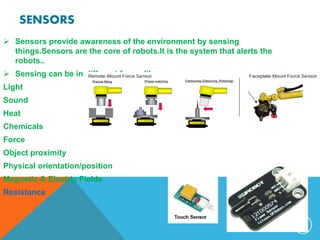
 Sensors provide awareness of the environment by sensing
things.Sensors are the core of robots.It is the system that alerts the
robots..
 Sensing can be in different forms like-
Light
Sound
Heat
Chemicals
Force
Object proximity
Physical orientation/position
Magnetic & Electric Fields
Resistance
6
ACTUATORS
 Locomotion
 Manipulation
7
ACTUATORS…
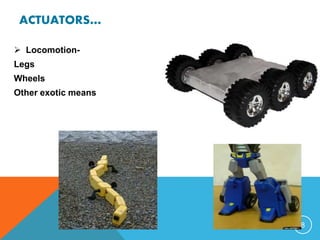
 Locomotion-
Legs
Wheels
Other exotic means
8
ACTUATORS…
 Manipulations-
Degrees of freedom
 independently controllable components of motion
Arms
 more often used in fixed robots due to power & weight
Grippers
 may be very simple (two rigid arms) to pick up objects
 may be complex device with fingers on end of an arm
9
The most common types of Robots are..
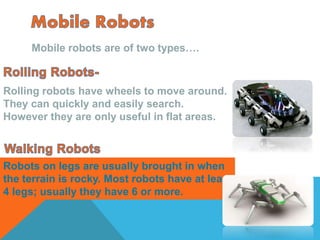
Mobile robots are of two types….
Rolling robots have wheels to move around.
They can quickly and easily search.
However they are only useful in flat areas.
Robots on legs are usually brought in when
the terrain is rocky. Most robots have at least
4 legs; usually they have 6 or more.
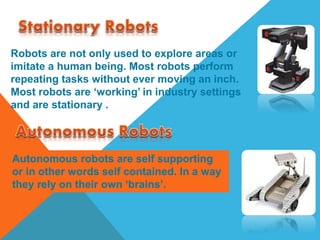
Robots are not only used to explore areas or
imitate a human being. Most robots perform
repeating tasks without ever moving an inch.
Most robots are ‘working’ in industry settings
and are stationary .
Autonomous robots are self supporting
or in other words self contained. In a way
they rely on their own ‘brains’.
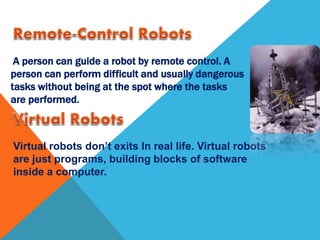
A person can guide a robot by remote control. A
person can perform difficult and usually dangerous
tasks without being at the spot where the tasks
are performed.
Virtual robots don’t exits In real life. Virtual robots
are just programs, building blocks of software
inside a computer.
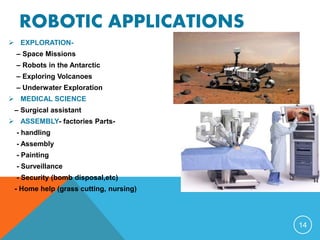
ROBOTIC APPLICATIONS
 EXPLORATION-
– Space Missions
– Robots in the Antarctic
– Exploring Volcanoes
– Underwater Exploration
 MEDICAL SCIENCE
– Surgical assistant
 ASSEMBLY- factories Parts-
- handling
- Assembly
- Painting
- Surveillance
- Security (bomb disposal,etc)
- Home help (grass cutting, nursing)
14
Going to far away planets.
Going far down into the unknown waters and mines where humans would be
crushed
Giving us information that humans can't get
Working at places 24/7 without any salary and food. Plus they don't get bored
They can perform tasks faster than humans and much more consistently and
accurately
Most of them are automatic so they can go around by themselves without any
human interference.
 People can lose jobs in factories
 It needs a supply of power
It needs maintenance to keep it running .
It costs money to make or buy a robot

Robotics project ppt

  • 2.
  • 3.
    What is aRobot…? A re-programmable, multifunctional, automatic industrial machine designed to replace human in hazardous work. It can be used as :- •An automatic machine sweeper •An automatic car for a child to play with •A machine removing mines in a war field •In space •In military , and many more..
  • 4.
    Robotics is scienceof designing or building an application of robots. Simply ,Robotics may be defines as “The Study of Robots”. The aim of robotics is to design an efficient robot. Robotics is needed because:- •Speed • Can work in hazardous/dangerous temperature • Can do repetitive tasks • Can do work with accuracy
  • 5.
  • 6.
    SENSORS  Sensors provideawareness of the environment by sensing things.Sensors are the core of robots.It is the system that alerts the robots..  Sensing can be in different forms like- Light Sound Heat Chemicals Force Object proximity Physical orientation/position Magnetic & Electric Fields Resistance 6
  • 7.
  • 8.
  • 9.
    ACTUATORS…  Manipulations- Degrees offreedom  independently controllable components of motion Arms  more often used in fixed robots due to power & weight Grippers  may be very simple (two rigid arms) to pick up objects  may be complex device with fingers on end of an arm 9
  • 10.
    The most commontypes of Robots are..
  • 11.
    Mobile robots areof two types…. Rolling robots have wheels to move around. They can quickly and easily search. However they are only useful in flat areas. Robots on legs are usually brought in when the terrain is rocky. Most robots have at least 4 legs; usually they have 6 or more.
  • 12.
    Robots are notonly used to explore areas or imitate a human being. Most robots perform repeating tasks without ever moving an inch. Most robots are ‘working’ in industry settings and are stationary . Autonomous robots are self supporting or in other words self contained. In a way they rely on their own ‘brains’.
  • 13.
    A person canguide a robot by remote control. A person can perform difficult and usually dangerous tasks without being at the spot where the tasks are performed. Virtual robots don’t exits In real life. Virtual robots are just programs, building blocks of software inside a computer.
  • 14.
    ROBOTIC APPLICATIONS  EXPLORATION- –Space Missions – Robots in the Antarctic – Exploring Volcanoes – Underwater Exploration  MEDICAL SCIENCE – Surgical assistant  ASSEMBLY- factories Parts- - handling - Assembly - Painting - Surveillance - Security (bomb disposal,etc) - Home help (grass cutting, nursing) 14
  • 15.
    Going to faraway planets. Going far down into the unknown waters and mines where humans would be crushed Giving us information that humans can't get Working at places 24/7 without any salary and food. Plus they don't get bored They can perform tasks faster than humans and much more consistently and accurately Most of them are automatic so they can go around by themselves without any human interference.  People can lose jobs in factories  It needs a supply of power It needs maintenance to keep it running . It costs money to make or buy a robot