Adventures in pH Control

Greg McMillan CDI Process & Industrial
Dave Joseph Rosemount Analytical
Photography & Video Recording Policy


  Photography and audio/video recording is not permitted in any
  sessions or in the exhibition areas without press credentials
  or written permission from the Emerson Exchange Board of
  Directors. Inquiries should be directed to:

  EmersonExchange@Emerson.com

  Thank you.
Presenters

   Greg McMillan
Principal Consultant
Email: Greg.McMillan@Emerson.com
33 years Monsanto-Solutia Fellow
2 years WU Adjunct Professor
10 years DeltaV R&D Contractor
BS Engineering Physics
MS Control Theory


   Dave Joseph
Sr. Industry Manager
Email: Dave.joseph@emerson.com
24 years with Rosemount Analytical
BS and MS in Chemical Engineering
Member AIChE
Key Benefits of Course

    Recognize the opportunity/challenges of pH control
    Learn about modeling and control options
    Optimize hardware implementation
    Understand the root causes of poor performance
    Prioritize improvements based on cost, time, and goal
    Gather insights for applications and solutions


                                                             4
Section 1: Measuring pH

    Brief theory of pH
    Inside a pH sensor
    The Smart pH sensor
    Diagnostics


                           5
Top Ten Signs of a Rough pH Startup

     Food is burning in the operators’ kitchen
     Only loop mode configured is manual
     Operator puts his fist through the screen
     You trip over a pile of used pH electrodes
     Technicians ask: “what is a positioner?”
     Technicians stick electrodes up your nose
     Environmental engineer is wearing a mask
     Plant manager leaves the country
     Lawyers pull the plugs on the consoles
     President is on the phone holding for you


                                                   6
The definition of pH

   pH is the unit of measurement for determining
    the acidity or alkalinity of a solution.
   The mathematical definition of pH is the
    negative logarithm of the molar hydrogen ion
    concentration, pH = - log([H+])
   pH is measured by various different sensors,      H2O

    most common and economical is the glass         H+      OH-
                                                    OH-     H+
    electrode/silver reference system.
   pH measurement requires periodic
    maintenance to maintain accuracy.
pH Scale vs Moles/Liter Ion
Concentration

     pH          Hydrogen Ion [H+]   Hydroxyl Ion [OH-]

     0 Acidic    1.0                 0.00000000000001
     1           0.1                 0.0000000000001
     2           0.01                0.000000000001
     3           0.001               0.00000000001
     4           0.0001              0.0000000001
     5           0.00001             0.000000001
     6           0.000001            0.00000001
     7 Neutral   0.0000001           0.0000001
     8           0.00000001          0.000001
     9           0.000000001         0.00001
     10          0.0000000001        0.0001
     11          0.00000000001       0.001
     12          0.000000000001      0.01
     13          0.0000000000001     0.1
     14 Basic    0.00000000000001    1.0
pH Values of Acids and Bases

     14                  4.0 % Sodium Hydroxide


     12                  0.04% Sodium Hydroxide

     10                       Milk of Magnesia


     8            0.84% Sodium Bicarbonate
pH                                                                   Water @ 25ºC
     6
                                                                     0.00001% Sulfuric Acid

     4                                                               0.0001% Hydrochloric Acid

                                                                     0.01% Sulfuric Acid
     2                                                               0.1% Hydrochloric Acid
                                                                     4.9% Sulfuric Acid
     0    1E00 1E-01 1E-02 1E-03 1E-04 1E-05 1E-06 1E-07 1E-08 1E-09 1E-10 1E-11 1E-12 1E-13 1E-14


               Hydrogen Ion Concentration (Mole/Liter)
What is pH? – technical stuff

    pH = - log([H+])
    Kw = [H+]*[OH-] = 1.0x10⁻¹⁴ at 25ºC
    pH + pOH = pKw
    pH is measured using the Nernst equation
         E(mV) = Ex + 2.3(RT/F)*log aH+
         ~ Ex – (S)*pH in simple form

    Where Ex = calibration constant
    2.3(RT/F) ~ slope (S) in mV/pH units
    aH+ = activity of hydrogen ion ~ [H+]
Theoretical Response of a
pH Sensor (25ºC)

 500
 400
 300                                      Slope of 59.16
                                          mV/pH Unit
 200
 100
  0
           mV
-100
-200           Zero mV
               at 7 pH
-300
-400                                 pH
-500
       0   1    2   3    4   5   6   7    8   9   10 11    12 13   14
pH Sensor Basics
•The pH electrode
produces a potential
(in mV’s)                           • The reference
proportional to the                 electrode potential
pH of the solution.                 must remain stable
                                    regardless of process
                                    or time effects
                       Glass
                       Body

         Ag/AgCl                     • Internal element- AgAgCl
         Internal       Shield
         Wire                        • Electrolyte fill - KCl/AgCl

                                     • Liquid Junctions


  pH Sensitive         Fill
  Glass                Solution


                               12
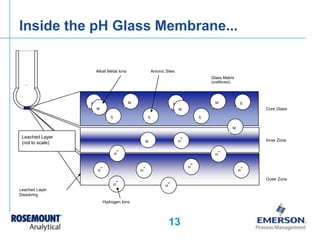
Inside the pH Glass Membrane...

                      Alkali Metal Ions                Anionic Sites
                                                                                     Glass Matrix
                                                                                     (unaffected)


                  M                       M                        M                   M                S
                      M                                                M                                     Core Glass

                               S                   S                             S

                                                                                                    M

 Leached Layer                                                          +
                                                   M                   H                                     Inner Zone
 (not to scale)
                                    +                                                   +
                                   H                                                   H

                                                                             +
                        +                      +                            H                            +
                       H                      H                                                         H

                                                                                                             Outer Zone
                                    +                          +
                                   H                          H
Leached Layer
Dissolving
                            Hydrogen Ions


                                                                13
The reference electrode


                                    The Reference Cell maintains
                                    a stable potential regardless
                                    of the process pH or changes
                                    in the activities of other ions in
                    AgCl/KCl        solution.
  Ag/AgCl           Fill
  Internal          Solution
  Wire                              The Liquid Junction completes
                                    the electrical circuit between
                                    the pH measuring electrode
                                    and the reference cell via the
                                    process solution.
                Liquid
                Junction

                               14
pH17
The sum of all potentials…

 Assuming a preamp with low leakage current, the pH sensor
 Ex =
   Eoutside of glass (in process solution)
 - Einside of glass (in glass fill solution)
 - Emeasurement wire (in glass fill solution)
 + Ereference wire (in reference Ag/KCL solution)
 + Ejunction potential (sum of all interface potentials)
    Glass fill solution typically formulated to cancel out effects
     so that 7 pH is 0 mV at any temperature.
Double Junction Combination pH
 Electrode - Circuit Diagram
                                                                                                                  Em


                                                                                                             W
                                                                                                                 R3

                                                                                                        Er


                                                                                                   W
                                                                                                       R4


                                                                                                              solution ground


                                                                                                             silver-silver chloride
Dehydration, loss of active sites,                                                                             internal electrode
chemical attack, and premature
                                                                                              E4
 aging reduces efficiency and
                                                                                                                  second
makes sensor dramatically slow


                                                                                    W
                                                                                        R5
                                                                                                                 junction

                                                                                                                 potassium chloride (KCl) electrolyte
        Gel layer is used as a term
                                                                                                                   in salt bridge between junctions
        for the glass surface that
          has water molecules                                                                                    primary
                                                                                        R6


                                                                                    W
                                                                                                                 junction

                                      inner                                              E5
                                      gel                                                                    silver-silver chloride
                                      layer                                                                    internal electrode
                                                                         E3
                                      outer
                                                                    W


                                                                        R2
                                      gel                                                                    pH fill solution
                                      layer                              E2
                                                                                                                                   Process ions may
            Measurement                                                 R1
                                                                    W


                                                                                                                                  migrate into porous
           becomes slow                                                        Ii                                                  reference junction
        if glass gets coated                                             E1                                                       while electrolyte ions
                                       Process Fluid                                                                                   migrate out
                                                                              W
                                                                                                   W


                                                                                                       R10
                                                                                    W
                                                                    W


                                                               R9                       R7
                                                                              R8


                               High acid or base concentrations can affect glass gel layer and reference junction potential
                               Increase in noise or decrease in span or efficiency is indicative of glass electrode problem
                                Shift or drift in pH measurement is normally associated with reference electrode problem
                                                                                                                                                           16
Life Depends On Process Conditions

  Months

                                          >100% increase in life
                                          from new glass designs
                                          for high temperatures


            25ºC           50ºC          75ºC                      100ºC
                         Process Temperature

      High pH conditions decrease glass life at any temperature
      Degraded accuracy and response time is also common
      Leads to unreliable feedforward control

                                                                           17
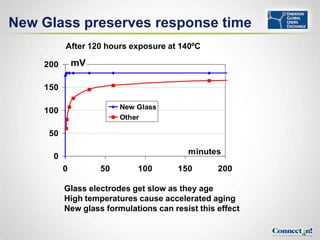
New Glass preserves response time
          After 120 hours exposure at 140ºC

    200       mV

    150

                        New Glass
    100
                        Other

     50

                                         minutes
      0
          0        50       100        150       200

          Glass electrodes get slow as they age
          High temperatures cause accelerated aging
          New glass formulations can resist this effect

                                                          18
Review: pH Measurement loop
                                      Analyzer
                               (not part of the sensor)
 4. Solution
   ground
                                  2. Reference
                                    electrode


                                    Liquid
                                   junction
  1. Glass
 electrode     3.Temperature
                  element
What is a SMART sensor?

    SMART sensors store calibration data on an embedded chip.
    SMART sensors record the initial calibration data of the sensor
     and all data from the last 5 calibrations
    They allow trending the performance variables of the sensor to
     determine how healthy the sensor is and what work is needed
     on it before venturing out into the field.
    Trended diagnostics enable Plantweb users to take action
     before the reading is compromised without any intimate
     knowledge of how a sensor works or what conditions the sensor
     may have been exposed to.
    Results are reduced maintenance and increased measurement
     uptime.
SMART loop: instrument-cable-sensor
                  4-wire Models
                 56 and 1056 are
                  smart-enabled


   2-wire, FF
 Model 1066 is
 smart-enabled                                             Smart pH sensorused
                                                                    sensor used
                   OR                                        in “Smart” mode

                                          VP8 (or cable)


                               Model 6081pH
                               Smart-enabled
                             Wireless Transmitter
SMART pH Sensors


     Plug and Play
  -   Factory pre-calibrated
  -   Calibrate in lab instead of in field
  -   Can restore to factory values

     SMART technology
  -   Automatically trend diagnostics
  -   Capture intermittent sensor problems
  -   SMART signal superimposed on mV signal (like HART)

     Simple Migration path
  -   Compatible with previous analyzers
  -   Compatible with previous sensors
Calibration history


   Advanced diagnostics
    Last 5 calibration data
     sets for troubleshooting
Calibration data set – diagnostics

                    Current readings!
                   Calibration Data
                   Time stamp between calibrations
                   Calibration method
                   Slope


                   Offset
                   Temperature at the time of calibration
                   Glass impedance
                   Reference impedance
Calibration History
Plug & Play Convenience
  Conventional approach: Field calibration with buffers
 SMART approach: Cal in the lab, Plug & Play in the field

Conventional sensor Field Equipment   Smart Sensor Field Equipment
Siemens Water Technologies, WI

 • Application: spent caustic, pH ~10-12
 • pH sensor: 3500HTVP and 396PVP
 • User comment:
 “The SMART is somewhat fool proof. I do like
 the backward compatibility with it, because
 initially we had the wrong probes hooked to the
 wrong boards, and everything still worked. The
 SMART features obviously didn't, but the
 probes themselves all functioned fine. “
Key Indicators of Sensor Performance
Plantweb pH measurements
provide a complete view of
the operational parameters:
 pH reading
 raw sensor output
 temperature
 reference impedance
 Glass impedance
 RTD resistance
Diagnostics - Broken Glass
                            3K      150 M
                                     0-5
                                      
                                                          Broken
                                                           Glass!


       Reference
       Electrode                                      Glass
                                     Solution         Electrode
                                     Ground


Broken Glass Fault
    pH Glass electrode normally has high impedance of 50-500 Megohm
    Recommended setting of 10 Megohm will detect even hairline cracks
    Glass can be cracked at the tip or further back inside the sensor (and
     not easily visible)


                                   29
Diagnostics - Coated Sensor
                          3K
                        40k             150 M
                                         
   Coated
   Sensor!


           Reference
           Electrode                                   Glass
                                       Solution        Electrode
                                       Ground


Coated Sensor Fault (Ref Z Too High)
    pH Reference electrode normally has low impedance of 1-10 KilOhm
    Reference coating slowly builds up around the junction
    Setting of 20 KilOhm should not generally cause false alarms


                                30
Diagnostics - Non-Immersed Sensor
                          60K         1500 M
                                     
                                                           Dry
                                                          Sensor!

      Reference
      Electrode                                     Glass
                                   Solution         Electrode
                                   Ground


 Dry Sensor Fault (Glass Z Too High)
     pH Glass electrode normally has impedance of 50-500 Megohm
     When sensor is dry there is no continuity between the electrode(s) and
      the solution ground so impedance reading is very high
     Recommended setting of 1000 Megohm will not cause false alarms


                                 31
More Advanced Diagnostics

      pH parameters slope, reference offset, glass, and reference
       impedances change little over bulk of operational life.
      When parameters start to change, they indicate that more
       frequent calibrations will be necessary.
      Diagnostics are at their most powerful when they can be
       compared to the original properties of the sensor.
      Example: a pH slope of 54 may not indicate a problem, but
       a sudden drop in slope from 58 to 54 may indicate a 9
       month old sensor will not last much longer.
      Trending the electrode slope, reference offset, and
       reference impedance will show the first sign of problems.
SMART and Trending Diagnostics

SMART pH sensors
automatically record their          ^mV/ pH
                                     59     58.9        58.8
                                                                Max pH error per calibration cycle
                                                       Change in Slope
                                                                 58.7         58.6        58.5        58.4        58.3        58.2        58.1         58         57.9        57.8        57.7        57.6         57.5         57.4         57.3


initial conditions and the
                              ^pH            0.1         0.2      0.3          0.4         0.5         0.6         0.7         0.8         0.9          1          1.1         1.2         1.3         1.4          1.5          1.6          1.7
                              0.1        # 0.02%   #   0.03% # 0.05%     #   0.07%   #   0.09%   #   0.10%   #   0.12%   #   0.14%   #   0.15%   #   0.17%   #   0.19%   #   0.21%   #   0.23%   #   0.24%   #    0.26%   #    0.28%   #    0.30%
                              0.2        # 0.03%   #   0.07% # 0.10%     #   0.14%   #   0.17%   #   0.21%   #   0.24%   #   0.27%   #   0.31%   #   0.34%   #   0.38%   #   0.42%   #   0.45%   #   0.49%   #    0.52%   #    0.56%   #    0.59%
                              0.3        # 0.05%   #   0.10% # 0.15%     #   0.20%   #   0.26%   #   0.31%   #   0.36%   #   0.41%   #   0.46%   #   0.52%   #   0.57%   #   0.62%   #   0.68%   #   0.73%   #    0.78%   #    0.84%   #    0.89%
                              0.4        # 0.07%   #   0.14% # 0.20%     #   0.27%   #   0.34%   #   0.41%   #   0.48%   #   0.55%   #   0.62%   #   0.69%   #   0.76%   #   0.83%   #   0.90%   #   0.97%   #    1.04%   #    1.11%   #    1.19%
                              0.5        # 0.08%   #   0.17% # 0.26%     #   0.34%   #   0.43%   #   0.51%   #   0.60%   #   0.69%   #   0.77%   #   0.86%   #   0.95%   #   1.04%   #   1.13%   #   1.22%   #    1.30%   #    1.39%   #    1.48%


last 5 calibrations to make
                              0.6        # 0.10%   #   0.20% # 0.31%     #   0.41%   #   0.51%   #   0.62%   #   0.72%   #   0.82%   #   0.93%   #   1.03%   #   1.14%   #   1.25%   #   1.35%   #   1.46%   #    1.57%   #    1.67%   #    1.78%
                              0.7        # 0.12%   #   0.24% # 0.36%     #   0.48%   #   0.60%   #   0.72%   #   0.84%   #   0.96%   #   1.08%   #   1.21%   #   1.33%   #   1.45%   #   1.58%   #   1.70%   #    1.83%   #    1.95%   #    2.08%
                              0.8        # 0.14%   #   0.27% # 0.41%     #   0.55%   #   0.68%   #   0.82%   #   0.96%   #   1.10%   #   1.24%   #   1.38%   #   1.52%   #   1.66%   #   1.80%   #   1.94%   #    2.09%   #    2.23%   #    2.37%
                              0.9        # 0.15%   #   0.31% # 0.46%     #   0.61%   #   0.77%   #   0.92%   #   1.08%   #   1.24%   #   1.39%   #   1.55%   #   1.71%   #   1.87%   #   2.03%   #   2.19%   #    2.35%   #    2.51%   #    2.67%
                               1         # 0.17%   #   0.34% # 0.51%     #   0.68%   #   0.85%   #   1.03%   #   1.20%   #   1.37%   #   1.55%   #   1.72%   #   1.90%   #   2.08%   #   2.25%   #   2.43%   #    2.61%   #    2.79%   #    2.97%
                              1.1        # 0.19%   #   0.37% # 0.56%     #   0.75%   #   0.94%   #   1.13%   #   1.32%   #   1.51%   #   1.70%   #   1.90%   #   2.09%   #   2.28%   #   2.48%   #   2.67%   #    2.87%   #    3.07%   #    3.26%


trending easier.              1.2
                              1.3
                              1.4
                              1.5
                              1.6
                                         # 0.20%
                                         # 0.22%
                                         # 0.24%
                                         # 0.25%
                                         # 0.27%
                                                   #
                                                   #
                                                   #
                                                   #
                                                   #
                                                       0.41% # 0.61%
                                                       0.44% # 0.66%
                                                       0.48% # 0.72%
                                                       0.51% # 0.77%
                                                       0.54% # 0.82%
                                                                         #
                                                                         #
                                                                         #
                                                                         #
                                                                         #
                                                                             0.82%
                                                                             0.89%
                                                                             0.96%
                                                                             1.02%
                                                                             1.09%
                                                                                     #
                                                                                     #
                                                                                     #
                                                                                     #
                                                                                     #
                                                                                         1.03%
                                                                                         1.11%
                                                                                         1.20%
                                                                                         1.28%
                                                                                         1.37%
                                                                                                 #
                                                                                                 #
                                                                                                 #
                                                                                                 #
                                                                                                 #
                                                                                                     1.23%
                                                                                                     1.34%
                                                                                                     1.44%
                                                                                                     1.54%
                                                                                                     1.64%
                                                                                                             #
                                                                                                             #
                                                                                                             #
                                                                                                             #
                                                                                                             #
                                                                                                                 1.44%
                                                                                                                 1.56%
                                                                                                                 1.68%
                                                                                                                 1.80%
                                                                                                                 1.92%
                                                                                                                         #
                                                                                                                         #
                                                                                                                         #
                                                                                                                         #
                                                                                                                         #
                                                                                                                             1.65%
                                                                                                                             1.79%
                                                                                                                             1.92%
                                                                                                                             2.06%
                                                                                                                             2.20%
                                                                                                                                     #
                                                                                                                                     #
                                                                                                                                     #
                                                                                                                                     #
                                                                                                                                     #
                                                                                                                                         1.86%
                                                                                                                                         2.01%
                                                                                                                                         2.17%
                                                                                                                                         2.32%
                                                                                                                                         2.48%
                                                                                                                                                 #
                                                                                                                                                 #
                                                                                                                                                 #
                                                                                                                                                 #
                                                                                                                                                 #
                                                                                                                                                     Beginning Slope - Ending Slope =
                                                                                                                                                     2.07%
                                                                                                                                                     2.24%
                                                                                                                                                     2.41%
                                                                                                                                                     2.59%
                                                                                                                                                             #
                                                                                                                                                             #
                                                                                                                                                             #
                                                                                                                                                             #
                                                                                                                                                                 2.28%
                                                                                                                                                                 2.47%
                                                                                                                                                             Slope Change
                                                                                                                                                                 2.66%
                                                                                                                                                                 2.85%
                                                                                                                                                                         #
                                                                                                                                                                         #
                                                                                                                                                                         #
                                                                                                                                                                         #
                                                                                                                                                                             2.49%
                                                                                                                                                                             2.70%
                                                                                                                                                                             2.91%
                                                                                                                                                                             3.11%
                                                                                                                                                                                     #
                                                                                                                                                                                     #
                                                                                                                                                                                     #
                                                                                                                                                                                     #

                                                                                                                                                     Slope change * Max change in pH =
                                                                                                                                                     2.76%   #   3.04%   #   3.32%   #
                                                                                                                                                                                         2.70%
                                                                                                                                                                                         2.93%
                                                                                                                                                                                         3.15%
                                                                                                                                                                                         3.38%
                                                                                                                                                                                         3.60%
                                                                                                                                                                                                 #
                                                                                                                                                                                                 #
                                                                                                                                                                                                 #
                                                                                                                                                                                                 #
                                                                                                                                                                                                 #
                                                                                                                                                                                                     2.92%
                                                                                                                                                                                                     3.16%
                                                                                                                                                                                                     3.40%
                                                                                                                                                                                                     3.65%
                                                                                                                                                                                                     3.89%
                                                                                                                                                                                                             #
                                                                                                                                                                                                             #
                                                                                                                                                                                                             #
                                                                                                                                                                                                             #
                                                                                                                                                                                                             #
                                                                                                                                                                                                                  3.13%
                                                                                                                                                                                                                  3.39%
                                                                                                                                                                                                                  3.65%
                                                                                                                                                                                                                  3.91%
                                                                                                                                                                                                                  4.17%
                                                                                                                                                                                                                          #
                                                                                                                                                                                                                          #
                                                                                                                                                                                                                          #
                                                                                                                                                                                                                          #
                                                                                                                                                                                                                          #
                                                                                                                                                                                                                               3.34%
                                                                                                                                                                                                                               3.62%
                                                                                                                                                                                                                               3.90%
                                                                                                                                                                                                                               4.18%
                                                                                                                                                                                                                               4.46%
                                                                                                                                                                                                                                       #
                                                                                                                                                                                                                                       #
                                                                                                                                                                                                                                       #
                                                                                                                                                                                                                                       #
                                                                                                                                                                                                                                       #
                                                                                                                                                                                                                                            3.56%
                                                                                                                                                                                                                                            3.86%
                                                                                                                                                                                                                                            4.15%
                                                                                                                                                                                                                                            4.45%
                                                                                                                                                                                                                                            4.75%


• Predictive maintenance
                              1.7        # 0.29%   #   0.58% # 0.87%     #   1.16%   #   1.45%   #   1.75%   #   2.04%   #   2.34%   #   2.63%   #   2.93%   #   3.23%   #   3.53%   #   3.83%   #   4.13%   #    4.43%   #    4.74%   #    5.04%
                              1.8        # 0.31%   #   0.61% # 0.92%     #   1.23%   #   1.54%   #   1.85%   #   2.16%   #   2.47%   #   2.79%   #   3.10%   #   3.42%   #   3.74%   #   4.06%   #   4.38%   #    4.70%   #    5.02%   #    5.34%
                              1.9        # 0.32%   #   0.65% # 0.97%     #   1.30%   #   1.62%   #   1.95%   #   2.28%   #   2.61%   #   2.94%   #   3.28%   Max mV deviation per
                                                                                                                                                             #   3.61%   #   3.94%   #   4.28%   #   4.62%   #    4.96%   #    5.30%   #    5.64%
                               2         # 0.34%   #   0.68% # 1.02%     #   1.37%   #   1.71%   #   2.05%   #   2.40%   #   2.75%   #   3.10%   #   3.45%   #   3.80%   #   4.15%   #   4.51%   #   4.86%   #    5.22%   #    5.57%   #    5.93%
                              2.1        # 0.36%   #   0.71% # 1.07%     #   1.43%   #   1.79%   #   2.16%   #   2.52%   #   2.89%   #   3.25%   #   3.62%   calibration cycle
                                                                                                                                                             #   3.99%   #   4.36%   #   4.73%   #   5.10%   #    5.48%   #    5.85%   #    6.23%
                              2.2        # 0.37%   #   0.75% # 1.12%     #   1.50%   #   1.88%   #   2.26%   #   2.64%   #   3.02%   #   3.41%   #   3.79%   #   4.18%   #   4.57%   #   4.96%   #   5.35%   #    5.74%   #    6.13%   #    6.53%
                              2.3        # 0.39%   #   0.78% # 1.18%     #   1.57%   #   1.97%   #   2.36%   #   2.76%   #   3.16%   #   3.56%   #   (Max mV deviation / Beginning
                                                                                                                                                     3.97%   #   4.37%   #   4.78%   #   5.18%   #   5.59%   #    6.00%   #    6.41%   #    6.82%


with reference Impedance      2.4
                              2.5
                              2.6
                              2.7
                              2.8
                                         # 0.41%
                                         # 0.42%
                                         # 0.44%
                                         # 0.46%
                                         # 0.48%
                                                   #
                                                   #
                                                   #
                                                   #
                                                   #
                                                       0.82% # 1.23%
                                                       0.85% # 1.28%
                                                       0.88% # 1.33%
                                                       0.92% # 1.38%
                                                       0.95% # 1.43%
                                                                         #
                                                                         #
                                                                         #
                                                                         #
                                                                         #
                                                                             1.64%
                                                                             1.71%
                                                                             1.77%
                                                                             1.84%
                                                                             1.91%
                                                                                     #
                                                                                     #
                                                                                     #
                                                                                     #
                                                                                     #
                                                                                         2.05%
                                                                                         2.14%
                                                                                         2.22%
                                                                                         2.31%
                                                                                         2.39%
                                                                                                 #
                                                                                                 #
                                                                                                 #
                                                                                                 #
                                                                                                 #
                                                                                                     2.47%
                                                                                                     2.57%
                                                                                                     2.67%
                                                                                                     2.77%
                                                                                                     2.88%
                                                                                                             #
                                                                                                             #
                                                                                                             #
                                                                                                             #
                                                                                                             #
                                                                                                                 2.88%
                                                                                                                 3.00%
                                                                                                                 3.12%
                                                                                                                 3.24%
                                                                                                                 3.36%
                                                                                                                         #
                                                                                                                         #
                                                                                                                         #
                                                                                                                         #
                                                                                                                         #
                                                                                                                             3.30%
                                                                                                                             3.44%
                                                                                                                             3.57%
                                                                                                                             3.71%
                                                                                                                             3.85%
                                                                                                                                     #
                                                                                                                                     #
                                                                                                                                     #
                                                                                                                                     #
                                                                                                                                     #
                                                                                                                                         3.72%
                                                                                                                                         3.87%
                                                                                                                                         4.03%
                                                                                                                                         4.18%
                                                                                                                                         4.34%
                                                                                                                                                 #
                                                                                                                                                 #
                                                                                                                                                 #
                                                                                                                                                 #
                                                                                                                                                 #
                                                                                                                                                     4.14%
                                                                                                                                                     4.31%
                                                                                                                                                     4.48%
                                                                                                                                                     4.66%
                                                                                                                                                     4.83%
                                                                                                                                                             #
                                                                                                                                                             #
                                                                                                                                                             #
                                                                                                                                                             #
                                                                                                                                                             #
                                                                                                                                                                 4.56%
                                                                                                                                                                 4.75%
                                                                                                                                                                 4.94%
                                                                                                                                                                 5.13%
                                                                                                                                                                 5.32%
                                                                                                                                                                         #
                                                                                                                                                                         #
                                                                                                                                                                         #
                                                                                                                                                                         #
                                                                                                                                                                         #
                                                                                                                                                                             4.98%
                                                                                                                                                             Slope) = Max pH error
                                                                                                                                                                             5.19%
                                                                                                                                                                             5.40%
                                                                                                                                                                             5.61%
                                                                                                                                                                             5.81%
                                                                                                                                                                                     #
                                                                                                                                                                                     #
                                                                                                                                                                                     #
                                                                                                                                                                                     #
                                                                                                                                                                                     #
                                                                                                                                                                                         5.41%
                                                                                                                                                                                         5.63%
                                                                                                                                                                                         5.86%
                                                                                                                                                                                         6.08%
                                                                                                                                                                                         6.31%
                                                                                                                                                                                                 #
                                                                                                                                                                                                 #
                                                                                                                                                                                                 #
                                                                                                                                                                                                 #
                                                                                                                                                                                                 #
                                                                                                                                                                                                     5.83%
                                                                                                                                                                                                     6.08%
                                                                                                                                                                                                     6.32%
                                                                                                                                                                                                     6.56%
                                                                                                                                                                                                     6.81%
                                                                                                                                                                                                             #
                                                                                                                                                                                                             #
                                                                                                                                                                                                             #
                                                                                                                                                                                                             #
                                                                                                                                                                                                             #
                                                                                                                                                                                                                  6.26%
                                                                                                                                                                                                                  6.52%
                                                                                                                                                                                                                  6.78%
                                                                                                                                                                                                                  7.04%
                                                                                                                                                                                                                  7.30%
                                                                                                                                                                                                                          #
                                                                                                                                                                                                                          #
                                                                                                                                                                                                                          #
                                                                                                                                                                                                                          #
                                                                                                                                                                                                                          #
                                                                                                                                                                                                                               6.69%
                                                                                                                                                                                                                               6.97%
                                                                                                                                                                                                                               7.25%
                                                                                                                                                                                                                               7.53%
                                                                                                                                                                                                                               7.80%
                                                                                                                                                                                                                                       #
                                                                                                                                                                                                                                       #
                                                                                                                                                                                                                                       #
                                                                                                                                                                                                                                       #
                                                                                                                                                                                                                                       #
                                                                                                                                                                                                                                            7.12%
                                                                                                                                                                                                                                            7.42%
                                                                                                                                                                                                                                            7.71%
                                                                                                                                                                                                                                            8.01%
                                                                                                                                                                                                                                            8.31%


trending
                              2.9        # 0.49%   #   0.99% # 1.48%     #   1.98%   #   2.48%   #   2.98%   #   3.48%   #   3.99%   #   4.49%   #   5.00%   #   5.51%   #   6.02%   #   6.53%   #   7.05%   #    7.57%   #    8.08%   #    8.60%
                               3         # 0.51%   #   1.02% # 1.53%     #   2.05%   #   2.56%   #   3.08%   #   3.60%   #   4.12%   #   4.65%   #   5.17%   #   5.70%   #   6.23%   #   6.76%   #   7.29%   #    7.83%   #    8.36%   #    8.90%
                              3.1        # 0.53%   #   1.05% # 1.58%     #   2.12%   #   2.65%   #   3.18%   #   3.72%   #   4.26%   #   4.80%   #   5.34%   #   5.89%   #   6.44%   #   6.98%   #   7.53%   #    8.09%   #    8.64%   #    9.20%
                              3.2        # 0.54%   #   1.09% # 1.64%     #   2.18%   #   2.74%   #   3.29%   #   3.84%   #   4.40%   #   4.96%   #   5.52%   #   6.08%   #   6.64%   #   7.21%   #   7.78%   #    8.35%   #    8.92%   #    9.49%
                              3.3        # 0.56%   #   1.12% # 1.69%     #   2.25%   #   2.82%   #   3.39%   #   3.96%   #   4.54%   #   5.11%   #   5.69%   #   6.27%   #   6.85%   #   7.44%   #   8.02%   #    8.61%   #    9.20%   #    9.79%


• Determine optimum
                              3.4        # 0.58%   #   1.16% # 1.74%     #   2.32%   #   2.91%   #   3.49%   #   4.08%   #   4.67%   #   5.27%   #   5.86%   #   6.46%   #   7.06%   #   7.66%   #   8.26%   #    8.87%   #    9.48%   #   10.09%
                              3.5        # 0.59%   #   1.19% # 1.79%     #   2.39%   #   2.99%   #   3.60%   #   4.20%   #   4.81%   #   5.42%   #     59mV/pH - 55mV/pH = 4mV/pH * 6pH =
                                                                                                                                                     6.03%   #   6.65%   #   7.27%   #   7.89%   #   8.51%   #    9.13%   #    9.76%   #   10.38%
                              3.6        # 0.61%   #   1.22% # 1.84%     #   2.46%   #   3.08%   #   3.70%   #   4.32%   #   4.95%   #   5.58%   #   6.21%   #   6.84%   #   7.47%   #   8.11%   #   8.75%   #    9.39%   #   10.03%   #   10.68%
                              3.7        # 0.63%   #   1.26% # 1.89%     #   2.53%   #   3.16%   #   3.80%   #   4.44%   #   5.09%   #   5.73%   #   6.38%  24mV / 59mV/pH = 0.41pH
                                                                                                                                                             #   7.03%   #   7.68%   #   8.34%   #   8.99%   #    9.65%   #   10.31%   #   10.98%
                              3.8        # 0.65%   #   1.29% # 1.94%     #   2.59%   #   3.25%   #   3.90%   #   4.56%   #   5.22%   #   5.89%   #   6.55%   #   7.22%   #   7.89%   #   8.56%   #   9.24%   #    9.91%   #   10.59%   #   11.27%
                              3.9        # 0.66%   #   1.33% # 1.99%     #   2.66%   #   3.33%   #   4.01%   #   4.68%   #   5.36%   #   6.04%   #   6.72%   #   7.41%   #   8.10%   #   8.79%   #   9.48%   #   10.17%   #   10.87%   #   11.57%
                               4         # 0.68%   #   1.36% # 2.04%     #   2.73%   #   3.42%   #   4.11%   #   4.80%   #   5.50%   #   6.20%   #   6.90%   #   7.60%   #   8.30%   #   9.01%   #   9.72%   #   10.43%   #   11.15%   #   11.87%


calibration frequency and     Change in Process
                                                             = 1%                    = 2%                    = 3%


                                                                             Beginning Slope - Ending Slope = Slope Change
                                                                                                                                     = 4%                    = 5%


predict probe life with pH                                                   Slope Change * Maximum Change in Process pH = Maximum pH Deviation


                                                                                                 For a typical application ranging from 4 to

slope trending                                                                                    10 pH the error from assuming 59 slope
                                                                                                    instead of 55 could be 0.41 pH units
                                                                                                           >>> need to recalibrate
Using Diagnostics
   Instruments ship with the
    diagnostics turned off
   When enabled, default setpoints
    will generally be ok
   Few false alarms when
    correctly configured
   Some problems may not be
    detectable with online
    diagnostics
   When in doubt, check with
    buffers
Section 2: Modeling and Control

    Virtual plant and embedded process models
    Online identification of titration curve
    Minimization of project capital cost
    Cascade pH control
    Batch pH control
    Linear reagent demand control
    Elimination of split range control
    Model predictive control


                                                 35
Embedded Process Model for pH


                                36
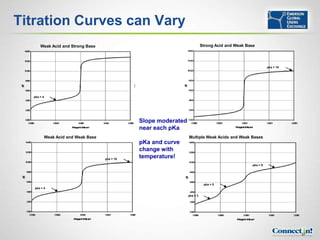
Titration Curves can Vary
      Weak Acid and Strong Base                                              Strong Acid and Weak Base


                                                                                                              pka = 10


  pka = 4


                                                 Slope moderated
                                                 near each pKa
            Weak Acid and Weak Base                                Multiple Weak Acids and Weak Bases
                                                 pKa and curve
                                                 change with
                                      pka = 10
                                                 temperature!
                                                                                                    pka = 9


                                                                              pka = 5
   pka = 4

                                                                   pka = 3


                                                                                                                         37
Nonlinearity can cost big money

pH measurement error may look smaller on the flatter portion of a titration
curve but the associated reagent delivery error is larger
                                  10


                                pH


                                     4
                                                                                             Reagent to Feed
                                                           Reagent                             Flow Ratio
                                         Optimum           Savings
                                                                                 Original
                                         set point
                                                                                 set point


       Oscillations could be due to non-ideal mixing, control valve stick-slip. or pressure fluctuations


                                                                                                               38
Titration Curve Matched to Plant


              pH


            Slope


                                   39
Modeled pH Control System

                                                                                   AY              signal
                                                       pH set point                             characterizer
                                                                                   1-3


    Signal characterizers linearize loop
        via reagent demand control
                                                                                   AC
                                                                                   1-1
   LC                              LT
   1-5                             1-5
                                                            signal                         splitter
                                                         characterizer
                                                                                   AY                 Feed
                                                                                   1-4
                                                 AY
                                                 1-2
                                                                           NaOH          Acid                   To other Tank
                                                            middle
                                                            signal
                                                           selector          FT           FT
                  Tank                                                       1-1          1-2
                                                 AY
                                                 1-1


                                           AT    AT          AT
                 Eductors                  1-1   1-2         1-3

                                                                         Static Mixer                           From other Tank


                                                                                                                To other Tank

     Downstream system


                                                                                                                                  40
Conventional vs. Reagent Demand


                            One of many spikes of recirculation pH
                             spikes from stick-slip of water valve


    Influent pH

                       Tank 1 pH for Reagent Demand Control


                        Tank 1 pH for Conventional pH Control


                                               Start of Step 4
                                               (Slow Rinses)
                  Start of Step 2
                  (Regeneration)


                                                                     41
Traditional System for
 Minimum Variability
The period of oscillation (4 x process dead time) and filter time
(process residence time) is proportional to volume. To prevent                                 Reagent
resonance of oscillations, different vessel volumes are used.


                                         Major overlooked           Reagent

                   Reagent              problem is reagent
                                        Deliver delay from
                                          dip tube design


            Feed


Small first tank provides a faster response
and oscillation that is more effectively filtered                             Big footprint
by the larger tanks downstream                                                and high cost!

                                                                                                         42
Traditional System for
Minimum Reagent Use
                    Reagent
                              The period of oscillation (total loop dead time) must differ by more
                              than factor of 5 to prevent resonance (amplification of oscillations)

             Feed                                         Reagent

                                                                                                  Reagent


 Big footprint
 and high cost!


                                  The large first tank offers more cross neutralization of influents


                                                                                                            43
Tight pH Control with
Minimum Capital


 IL#1 – Interlock that prevents back fill of
 reagent piping when control valve closes

 IL#2 – Interlock that shuts off effluent flow until
 vessel pH is projected to be within control band


                                                                                     Eductor
                                                                                                         High Recirculation Flow


                                                                                               Reagent
                                                                      Any Old Tank
                                                                                                                     Signal
                                                                                                                  Characterizer
                                                  LC          LT
                                                  1-3         1-3


                                                              *IL#2                                                                            f(x)
                                                                                               FT
                                                                                               1-1
Effluent
                                                                                                                         AC
                                                                                                                         1-1
                                                        FC
                                                        1-2
                                                                                                                                               AT
                                                                                                                                               1-1

                                                                                                                 *IL#1

                                   Influent             FT
                                                        1-2
                                                                                                                                    10 to 20
                                                                                                                                      pipe
                                                                                                                                   diameters


                                                                                                                                                      44
Linear Reagent Demand Control
   Signal characterizer converts PV and SP from pH to % Reagent Demand
     –   PV is abscissa of the titration curve scaled 0 to 100% reagent demand
     –   Piecewise segment fit normally used to go from ordinate to abscissa of curve
     –   Fieldbus block offers 21 custom space X,Y pairs (X is pH and Y is % demand)
     –   Closer spacing of X,Y pairs in control region provides most needed compensation
     –   If neural network or polynomial fit used, beware of bumps and wild extrapolation
   Special configuration is needed to provide operations with interface to:
     – See loop PV in pH and signal to final element
     – Enter loop SP in pH
     – Change mode to manual and change manual output
   Set point on steep part of curve shows biggest improvements from:
     –   Reduction in limit cycle amplitude seen from pH nonlinearity
     –   Decrease in limit cycle frequency from final element resolution (e.g. stick-slip)
     –   Decrease in crossing of split range point
     –   Reduced reaction to measurement noise
     –   Shorter startup time (loop sees real distance to set point and is not detuned)
     –   Simplified tuning (process gain no longer depends upon titration curve slope)
     –   Restored process time constant (slower pH excursion from disturbance)

                                                                                             45
Cascade Control to Reduce
Downstream Offset
                                                                                                                               Linear Reagent
                                                                                                                              Demand Controller
                                                                        Flow Feedforward
                           FT
                           1-1

                                                                                                                            RSP
                                                FC                                                                  AC                      Trim of Inline
                                                1-1               Sum                                                                         Set Point
                                                                                                                    1-1

                 Reagent


                                                                  AT                                                 f(x)
                                                                                           Filter                                     f(x)
                                                                  1-1

      FT
                                 Static Mixer                                                         PV signal
      1-2                                                                                                                                         SP signal
                                                                                                    Characterizer                               characterizer
                  Feed
 Coriolis Mass
                                                       10 to 20
  Flow Meter
                                                         pipe
                                                      diameters


                                                                                     M


                                                                                                                                      AC
                                                                                                                                      1-2
                                                        Any Old Tank

                                                                                                                                                         Enhanced PID
                                                                                                                                                           Controller
                                                                                                                                      AT
                                                                                                                                      1-2


                                                                                                                                                                        46
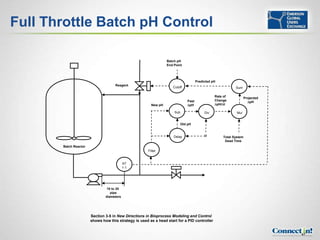
Full Throttle Batch pH Control

                                                                  Batch pH
                                                                  End Point


                                                                                     Predicted pH
                                    Reagent
                                                                     Cutoff                                 Sum

                                                                                                Rate of
                                                                                                                   Projected
                                                                              Past              Change               DpH
                                                         New pH               DpH               DpH/Dt

                                                                      Sub                 Div                Mul


                                                                          Old pH


                                                                      Delay               Dt         Total System
                                                                                                      Dead Time
       Batch Reactor
                                                       Filter


                                           AT
                                           1-1


                                10 to 20
                                  pipe
                               diameters


                       Section 3-5 in New Directions in Bioprocess Modeling and Control
                       shows how this strategy is used as a head start for a PID controller


                                                                                                                               47
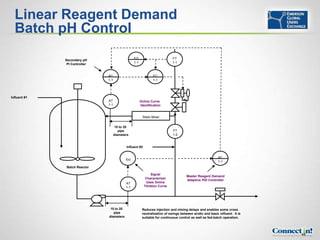
Linear Reagent Demand
  Batch pH Control
                                                   FQ                         FT
              Secondary pH
                                                   1-1                        1-1
               PI Controller


                               AC                                FC
                               1-1                               1-1


Influent #1
                               AT                        Online Curve
                               1-1                       Identification


                                                          Static Mixer


                                      10 to 20
                                        pipe                                  FT
                                     diameters                                1-2


                                            Influent #2


                                                                                                            AC
                                            f(x)
                                                                                                            1-1
               Batch Reactor

                                                                Signal
                                                                                       Master Reagent Demand
                                                            Characterizer
                                                                                       Adaptive PID Controller
                                            AT              Uses Online
                                            1-1            Titration Curve


                                10 to 20                  Reduces injection and mixing delays and enables some cross
                                  pipe                    neutralization of swings between acidic and basic influent. It is
                               diameters                  suitable for continuous control as well as fed-batch operation.


                                                                                                                              48
Conventional Fine and
Coarse Valve Control


                                            Large                   Small
                                           (Coarse)                 (Fine)


                                     ZC        CV
                                     1-1


              Integral only Controller
                (CV is Implied Fine
              Control Valve Position)


                                                      Neutralizer

                                                                             AC
   ZC speed of response must
                                                                             1-1
   be slow and tuning is difficult
   Must add feedforward for fast
   and large influent disturbance                                                  PID Controller

                                                                             AT
                                                                             1-1


                                                                                                    49
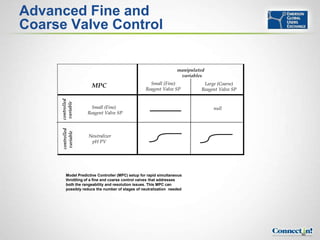
Advanced Fine and
Coarse Valve Control

                                                                   manipulated
                                                                    variables
                                                    Small (Fine)             Large (Coarse)
                     MPC                          Reagent Valve SP          Reagent Valve SP
     controlled
      variable


                     Small (Fine)                                                null
                   Reagent Valve SP
     controlled
      variable


                    Neutralizer
                     pH PV


        Model Predictive Controller (MPC) setup for rapid simultaneous
        throttling of a fine and coarse control valves that addresses
        both the rangeability and resolution issues. This MPC can
        possibly reduce the number of stages of neutralization needed


                                                                                               50
Key Points
   More so than for any other loop, it is important to reduce dead time for pH control
    because it reduces the effect of the nonlinearity
   Filter the feedforward signal to remove noise and make sure the corrective action
    does not arrive too soon and cause inverse response
   The effectiveness of feedforward control greatly depends upon the ability to
    eliminate reagent delivery delays
   If there is a reproducible influent flow measurement use flow feedforward,
    otherwise use a head start to initialize the reagent flow for startup
   The reliability and error of a pH feedforward is unacceptable if the influent or feed
    pH measurement is on the extremities of the titration curve
   Use a Coriolis or magnetic flow meter for reagent flow control
   Every reagent valve must have a digital valve controller (digital positioner)
   Except for fast inline buffered systems, use cascade control of pH to reagent flow
    to compensate for pressure upsets and enable flow feedforward
   Linear reagent demand can restore the time constant and capture the investment
    in well mixed vessels, provide a unity gain for the process variable, simply and
    improve controller tuning, suppress oscillations and noise on the steep part of the
    curve, and speed up startup and recovery from the flat part of the curve


                                                                                        51
Key Points
   Changes in the process dynamics identified online can be used to predict and
    analyze changes in the influent, reagent, valve, and sensor
   New adaptive controllers will remember changes in the process model as a function
    of operating point and preemptively schedule controller tuning
   Use inline pH control, mass flow meters, linear control valves, and dynamic
    compensation to automatically identify the titration curve online
   Use gain scheduling or signal characterization based on the titration curve to free
    up an adaptive controller to find the changes in the curve
   Batch samples should be taken only after all the reagent in the pipeline and dip tube
    has drained into the batch and been thoroughly mixed
   Use a wide open reagent valve that is shut or turned over to pH loop based on a
    predicted pH from ramp rate and dead time to provide the fastest pH batch/startup
   Use online titration curve identification and linear reagent demand pH control for
    extremely variable and sharp or steep titration curve
   Use an online dynamic pH estimator to provide a much faster, smoother, and more
    reliable pH value, if the open loop dead time and time constant are known and there
    are feed and reagent Coriolis mass flow meters
   Use linear reagent demand model predictive control for interacting systems and
    constraint or valve position control
                                                                                      52
Section 3: Practical Considerations

    Causes and Effects of Drift
    Common Problems with Titration Curves
    Effect of Measurement Selection and Installation
    Options to improve accuracy and maintenance
    Effect of piping design, vessel type, and mixing pattern
    Implications of oversized and split ranged valves
    Online Troubleshooting


                                                                53
Drift

    Reference Liquid Junction is a Porous “Membrane”
      – Diffusion Rate Must Remain Constant to Eliminate Drift
      – Coating, Pressure (flow) changes, chemical reactions interfere

                                       Concentration Gradient Through
                                       Reference Junction (Membrane)
                                                                                            H2O in
           KCl out


                                                                                          Other Process
                                                                                          Constituents in


              Inside Sensor                                                 Process
              Reference
                                                                 Gradient Through Reference When Coated
        Gradient Through Reference When Clean


Difference in the Gradient between Clean and Coated Causes Offset
High Today may be Low Tomorrow
       Calibration adjustments chase short term effects such as:
         – Imperfect mixing
         – Ion migration into reference junction
         – Temperature shifts
         – Different glass surface conditions
         – Fluid streaming potentials…


                   A                               B
                                                                    A
                   B
                                                   A

   pH                                                               B


                                            time


With just two electrodes, sometimes there are more questions than answers.

                                                                             55
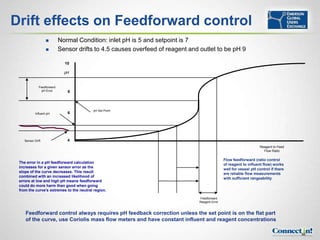
Drift effects on Feedforward control
                           Normal Condition: inlet pH is 5 and setpoint is 7
                           Sensor drifts to 4.5 causes overfeed of reagent and outlet to be pH 9

                              10

                              pH


              Feedforward
                pH Error       8


                                         pH Set Point
            Influent pH        6


    Sensor Drift               4
                                                                                                                    Reagent to Feed
                                                                                                                      Flow Ratio

                                                                                               Flow feedforward (ratio control
 The error in a pH feedforward calculation
                                                                                               of reagent to influent flow) works
 increases for a given sensor error as the
                                                                                               well for vessel pH control if there
 slope of the curve decreases. This result
                                                                                               are reliable flow measurements
 combined with an increased likelihood of
                                                                                               with sufficient rangeability
 errors at low and high pH means feedforward
 could do more harm than good when going
 from the curve’s extremes to the neutral region.

                                                                               Feedforward
                                                                               Reagent Error


    Feedforward control always requires pH feedback correction unless the set point is on the flat part
    of the curve, use Coriolis mass flow meters and have constant influent and reagent concentrations

                                                                                                                                      56
Common Problems with
Titration Curves
   Insufficient number of data points were generated near the equivalence point
   Starting pH (influent pH) data were not plotted for all operating conditions
   Curve doesn’t cover the whole operating range and control system overshoot
   No separate curve that zooms in to show the curvature in the control region
   No separate curve for each different split ranged reagent
   Sequence of the different split ranged reagents was not analyzed
   Back mixing of different split ranged reagents was not considered
   Overshoot and oscillation at the split ranged point was not included
   Sample or reagent solids dissolution time effect was not quantified
   Sample or reagent gaseous dissolution time and escape was not quantified
   Sample volume was not specified
   Sample time was not specified
   Reagent concentration was not specified
   Sample temperature during titration was different than the process temperature
   Sample was contaminated by absorption of carbon dioxide from the air
   Sample was contaminated by absorption of ions from the glass beaker
   Sample composition was altered by evaporation, reaction, or dissolution
   Laboratory and field measurement electrodes had different types of electrodes
   Composite sample instead of individual samples was titrated
   Laboratory and field used different reagents

                                                                                     57
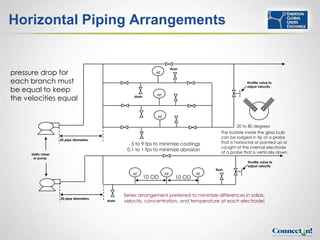
Horizontal Piping Arrangements


                                                                           flush
pressure drop for                                                AE

each branch must                                                                                           throttle valve to
                                                                                                           adjust velocity
be equal to keep
                                                                 AE
the velocities equal                                 drain


                                                                 AE

                                                                                                       20 to 80 degrees
                                                                                              The bubble inside the glass bulb
                                                                                              can be lodged in tip of a probe
                     20 pipe diameters
                                                    5 to 9 fps to minimize coatings           that is horizontal or pointed up or
                                                                                              caught at the internal electrode
                                                  0.1 to 1 fps to minimize abrasion
      static mixer
                                                                                              of a probe that is vertically down
       or pump
                                                                                                            throttle valve to
                                                                                                            adjust velocity
                                                                                           flush
                                                    AE                AE              AE
                                                             10 OD            10 OD


                                                 Series arrangement preferred to minimize differences in solids,
                     20 pipe diameters
                                         drain   velocity, concentration, and temperature at each electrode!


                                                                                                                                    58
Vertical Piping Arrangements

             throttle valve to                       throttle valve to
             adjust velocity                         adjust velocity     Orientation of slot in shroud

                                                                            coating          abrasion
                                                                            5 to 9 fps      0.1 to 1 fps


                                                                                         hole


                                     AE
                                                                                          or


                                    10 OD AE 10 OD
                                                                                         slot
                AE
        AE
   AE


                                     AE


                                 Series arrangement preferred to minimize differences in solids,
                                 velocity, concentration, and temperature at each electrode!
                                                                                                           59
Options for Maximum Accuracy
   Select best glass and reference electrolyte for process
   A hemi-spherical glass electrode and flowing junction reference offers
    maximum accuracy, but in practice maintenance prefers:
    –   A refillable double junction reference to reduce the complexity of installation –
        often the best compromise between accuracy and maintainability.
    –   A solid reference to resist penetration and contamination by the process and
        eliminate the need to refill or replace reference particularly for high and nasty
        concentrations and pressure fluctuations – takes the longest time to equilibrate
        and is more prone to junction effects.
   Use smart digital transmitters with built-in diagnostics
   Use middle signal selection of three pH measurements
    –   Inherent auto protection against a failure, drift, coating, loss in efficiency, and noise
        (see February 5, 2010 entry on http://www.modelingandcontrol.com/ )
   Allocate time for equilibration of the reference electrode
   Use “in place” standardization on a sample with the same temperature and
    composition as the process. If this is not practical, the middle value of three
    measurements can be used as a reference. The fraction and frequency of the
    correction should be chosen to avoid chasing previous calibrations
   Keep process fluid velocity constant at the highest practical value for
    clean and responsive electrodes


                                                                                                    60
Wireless pH Lab Setup


Wireless pH measurements offer
   • Best sensor technology for a wide range of process conditions
   • Reduced electrical noise from ground issues
   • Predictive diagnostics using smart pH sensors
   • Convenient platform to establish specific solution temperature compensation,
     develop inferential measurements of process concentrations, and relocate the sensor
   for best results considering velocity, mixing, delay, & bubbles
                                                                                       61
Wireless pH Eliminate Ground Spikes


                 Incredibly tight pH control via 0.001 pH wireless resolution
                 setting still reduced the number of communications by 60%


         Temperature compensated wireless pH controlling at 6.9 pH set point


                     Wired pH ground noise spike


                                                                                62
Wireless Bioreactor
Adaptive pH Loop Test


                        63
Mistakes in pH System Design

                                Mistake 1: Missing, inaccurate, or erroneous titration curve
                                Mistake 2: Absence of a plan to handle failures, startups, or shutdowns
    reagent
   feed tank
                                                        Mistake 3 (single stage
                 Mistake 7 (gravity flow)                for set point at 7 pH)


                 Mistake 8 (valve                     Mistake 4 (horizontal tank)
                 too far away)
                                                                                        AT      Mistake 12 (electrode
                                                                                        1-3
     Mistake 9 (ball valve                  Mistake 10 (electrode                               too far downstream)
     with no positioner)                    submerged in vessel)
                                                AT
      Influent (1 pH)                           1-1
                                                               M


                                                    Mistakes 5 and 6
                                                 (backfilled dip tube &           AT
                                                                                  1-2
                                                 injection short circuit)

                                                                        Mistake 11 (electrode
                                                                         in pump suction)


                                                                                                                        64
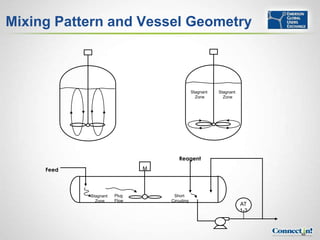
Mixing Pattern and Vessel Geometry


                                               Stagnant   Stagnant
                                                 Zone       Zone


                                      Reagent

     Feed                     M


            Stagnant   Plug        Short
              Zone     Flow       Circuiting
                                                                     AT
                                                                     1-3


                                                                           65
Oversized Reagent Valves

                  Limit cycle amplitude is operating point dependent and can be estimated as:
      stick-slip (%) multiplied by valve characteristic slope (pph/%) and by titration curve slope (pH/pph)


                                                     Dead band is 5% - 50%
                                                     without a positioner !
                                                            Dead band


         Pneumatic positioner
         requires a negative %      Stroke
         signal to close valve       (%)                                Digital positioner
                                                                         will force valve
                                                                        shut at 0% signal

                                                           Stick-Slip is worse near closed position

                                             0                 Signal
                                      dead band                  (%)


         The dead band and stick-slip is greatest near the closed position so valves that
         ride the seat from over sizing or split ranged operation create a large limit cycle


                                                                                                              66
Control Valve Rangeability
and Resolution
                                              pH


                                                  8
       Set point                                         Control Band
                                                  6


                     B
Er = 100% * Fimax * ----            Influent pH
                     Frmax                                                  B
                                                                                Reagent Flow
                                                                        A
                                                                                Influent Flow
Frmax = A * Fimax

      B
Er = ----
      A

Ss = 0.5 * Er

Where:
A = distance to center of reagent error band on abscissa from influent pH
B = width of allowable reagent error band on abscissa for control band
Er = allowable reagent error (%)
Frmax = maximum reagent valve capacity (kg per minute)
Fimax = maximum influent flow (kg per minute)
Ss = allowable stick-slip (resolution limit) (%)                                                67
Key Points
   The pH measurement error may look smaller on the flatter portion of a
    titration curve but the associated reagent delivery error is larger
   The control system should schedule automated maintenance based
    on the severity of the problem and production and process
    requirements
   pH measurements can fail anywhere on or off the pH scale but middle
    signal selection will inherently ride out a single electrode failure of any
    type
   Equipment and piping should have the connections for three probes
    but a plant should not go to the expense of installing three
    measurements until the life expectancy has been proven to be
    acceptable for the process conditions
   A series installation of multiple probes insures the electrodes will see
    the same velocity and mixture that is important for consistent
    performance

                                                                                  68
Section 4: Summary

    Extraordinary Sensitivity and Rangeability
    Deceptive and Severe Nonlinearity
    Extraneous Effects on Measurement
    Difficult Control Valve Requirements


                                                  69
Look at the titration curve
 14
 13
 12                                                     1.10000
 11                  Equivalence                    1.01000
 10                                                1.00100
  9                  Point                         1.00010
  8                                                1.00001
pH7                                                1.00000
  6                                                0.99999
  5                                                0.99990
  4                                                0.99900
  3                                                0.99000
  2                                            0.90000
  1
  0
                                                                                                   Not a
         0.0 0.1 0.2 0.3 0.4 0.5 0.6 0.7 0.8 0.9 1.0 1.1 1.2 1.3 1.4 1.5 1.6 1.7 1.8 1.9 2.0 2.1
                                                                                                   pipette!
                                      ml of base added
          pH Control is difficult because of nonlinearity:
             – Large Amounts of chemical cause little change initially.
             – Small Amounts cause huge changes near equivalence point.
          Titration Curves are essential for pH system modeling
Rules of thumb: multiple stages

When the process pH must
be changed by more than 2          pH          Hydrogen Ion [H+]   Hydroxyl Ion [OH-]
units:                             0 Acidic    1.0                 0.00000000000001
                                   1           0.1                 0.0000000000001
                                   2           0.01                0.000000000001
Use Multiple Stages!               3
                                   4
                                               0.001
                                               0.0001
                                                                   0.00000000001
                                                                   0.0000000001
                                   5           0.00001             0.000000001
                                   6           0.000001            0.00000001
Remember that 2 pH units           7 Neutral   0.0000001           0.0000001
                                   8           0.00000001          0.000001
is a factor of 100 in              9           0.000000001         0.00001
concentration.                     10          0.0000000001        0.0001
                                   11          0.00000000001       0.001
                                   12          0.000000000001      0.01
                                   13          0.0000000000001     0.1
Can you accurately dilute a        14 Basic    0.00000000000001    1.0
concentrated acid by a factor of
500 in one step?
Rules: Mixing

   If the sensor does not see a representative
    sample of the process, it won’t measure
    correctly.
   Don’t try to do all the neutralizing in a pipe!
   pH reagents can be more viscous than water
    and require time to mix and react.
   Static mixers are good for first stage
    treatment, especially in feedforward mode.
   Achieving a good setpoint will usually require
    a downstream stabilization tank.
Mixing II
   A system normally considered to be well mixed may be
    poorly mixed for pH control
   To be “well mixed” for pH control, the deviation in the
    reagent to influent flow from non ideal mixing multiplied by
    the process gain must be well within the control band
   Back mixing (axial mixing) creates a beneficial process
    time constant and plug flow or radial mixing creates a
    detrimental process dead time for pH control
   The agitation in a vessel should be vertical axial pattern
    without rotation and be intense enough to break the
    surface but not cause froth


                                                                   73
Rules: Holdup time
1.    Use sufficient holdup time to balance
      throughput and efficiency.
2.    Prevent short-circuiting by using
      baffles.
3.    Locate tank exit lines to give the
      reagent the maximum time to react
      (tanks using heavy pH solutions should
      overflow, not exit the bottom).
    improve performance
    provide a better location for a feedback
     pH loop
    help prevent overshoot and oscillation
Holdup time II
   Horizontal tanks are notorious for short circuiting,
    stagnation, and plug flow that cause excessive dead time
    and an erratic pH response
   To provide isolation, use a separate on-off valve and avoid
    the specification of tight shutoff and high performance
    valves for throttling reagent


                                                                  75
Rules: Minimize deadtime

   Deadtime is the killer of all good
    control loops.
   The response time of a pH sensor
    depends most on how clean the glass
    surface is.
   Install the sensor in a flowing stream
    at about 5 feet per second velocity for
    a self-cleaning action.
   Try to minimize extractive sampling
    since that is another delay and may
    not provide a representative sample.
Deadtime II
   The actual equipment dead time is often larger than the
    turnover time because of non ideal mixing patterns and
    fluid entry and exit locations
   The dead time from back filled reagent dip tubes or
    injection piping is huge


                                                              77
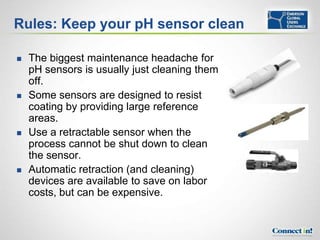
Rules: Keep your pH sensor clean

   The biggest maintenance headache for
    pH sensors is usually just cleaning them
    off.
   Some sensors are designed to resist
    coating by providing large reference
    areas.
   Use a retractable sensor when the
    process cannot be shut down to clean
    the sensor.
   Automatic retraction (and cleaning)
    devices are available to save on labor
    costs, but can be expensive.
Rules: Valve selection

    Good control valves have a
     turndown ratio of about 10:1.
    Don’t oversize pH control valves!
    Allow for some hysteresis and
     stiction in your valves to prevent
     overshoot problems.
    Don’t try to control too close to the
     desired setpoint.
    pH control obeys the Uncertainty
     Principle
Valve Selection II
   Set points on the steep portion of a titration curve require a reagent
    control valve precision that goes well beyond the norm and offers the
    best test to determine a valve’s actual stick-slip in installed conditions
   Reagent valve stick-slip may determine the number of stages of
    neutralization required, which has a huge impact on a project’s capital
    cost


                                                                                 80
Extreme pH values

   pH is a very sensitive measure of acid
    or base.
   When there is a lot of acid or base (i.e.
    pH over 13 or under 1), there may be
    more appropriate methods.
   Methods based on bulk measurements               H2O

    like electrical conductivity, near infrared,   H+      OH-
                                                   OH-     H+
    or refractive index may be more
    accurate since they are linear in
    concentration.
Key Points - Measurement
   The time that glass electrodes are left dry or exposed to high pH
    solutions must be minimized for the best performance from the
    hydrated gel layer
   Most accuracy statements and tests are for short term exposure
    before changes in the glass gel layer or reference junction potential
    are significant
   The cost of pH sensor maintenance can typically be reduced by a
    factor of ten with realistic expectations and calibration policies
   The first sign of coating on the glass measurement electrode is a large
    increase in its time constant and response time
   The first sign of a non conductive coating on the reference electrode is
    usually a large increase in its electrical resistance
   Non-aqueous and pure water streams require extra attention to
    shielding, process path length, and velocity to minimize pH
    measurement noise


                                                                           82
Key Points - Measurement II
   Slow references may be more stable for short term fluctuations from
    imperfect mixing and short exposure times from automated retraction
   The fastest and most accurate reference has a flowing junction but
    requires regulated pressurization to maintain a small positive flow
   The best choice might not be the best technical match to the
    application but the electrode that gets the best support from
    maintenance, operations, and vendor
   For non abrasive solids, installation in a recirculation line with a
    velocity of 5 to 9 fps downstream of a strainer and pump may delay
    onset of coatings
   For abrasive solids and viscous fluids, a thicker glass or flat electrode
    can minimize coatings, stagnant areas, and glass breakage
   For high process temperatures, high ion concentrations, and severe
    fouling, use automatic retractable assemblies to reduce exposure
   When the fluid velocity is insufficient to sweep electrodes clean, use
    an integral jet washer or a cleaning cycle in a retractable assembly
                                                                                83
Conclusion

    pH is a versatile and powerful analytical
     technique for characterizing your process
    Understanding the nonlinear aspect of pH
     is key to successful implementation
    There’s more to pH control than selecting
     the “best” pH sensor and tuning a PID
     loop
    Rewards for proper pH management far
     outweigh the small cost of the installed
     field equipment
Where To Get More Information

    “What’s the Real pH of that Stream?”
     –   http://www2.emersonprocess.com/siteadmincenter/PM%20Ro
         semount%20Analytical%20Documents/Liq_Article_61-
         2111_200503.pdf

    Greg’s excellent book
     –   http://www.amazon.com/Advanced-Measurement-Control-3rd-
         Edition/dp/1934394432

    Emerson Application data sheets
     –   http://www2.emersonprocess.com/en-
         US/brands/rosemountanalytical/Liquid/Documentation/ADS/Pa
         ges/index.aspx

Adventures in pH Control

  • 1.
    Adventures in pHControl Greg McMillan CDI Process & Industrial Dave Joseph Rosemount Analytical
  • 2.
    Photography & VideoRecording Policy Photography and audio/video recording is not permitted in any sessions or in the exhibition areas without press credentials or written permission from the Emerson Exchange Board of Directors. Inquiries should be directed to: EmersonExchange@Emerson.com Thank you.
  • 3.
    Presenters  Greg McMillan Principal Consultant Email: Greg.McMillan@Emerson.com 33 years Monsanto-Solutia Fellow 2 years WU Adjunct Professor 10 years DeltaV R&D Contractor BS Engineering Physics MS Control Theory  Dave Joseph Sr. Industry Manager Email: Dave.joseph@emerson.com 24 years with Rosemount Analytical BS and MS in Chemical Engineering Member AIChE
  • 4.
    Key Benefits ofCourse  Recognize the opportunity/challenges of pH control  Learn about modeling and control options  Optimize hardware implementation  Understand the root causes of poor performance  Prioritize improvements based on cost, time, and goal  Gather insights for applications and solutions 4
  • 5.
    Section 1: MeasuringpH  Brief theory of pH  Inside a pH sensor  The Smart pH sensor  Diagnostics 5
  • 6.
    Top Ten Signsof a Rough pH Startup  Food is burning in the operators’ kitchen  Only loop mode configured is manual  Operator puts his fist through the screen  You trip over a pile of used pH electrodes  Technicians ask: “what is a positioner?”  Technicians stick electrodes up your nose  Environmental engineer is wearing a mask  Plant manager leaves the country  Lawyers pull the plugs on the consoles  President is on the phone holding for you 6
  • 7.
    The definition ofpH  pH is the unit of measurement for determining the acidity or alkalinity of a solution.  The mathematical definition of pH is the negative logarithm of the molar hydrogen ion concentration, pH = - log([H+])  pH is measured by various different sensors, H2O most common and economical is the glass H+ OH- OH- H+ electrode/silver reference system.  pH measurement requires periodic maintenance to maintain accuracy.
  • 8.
    pH Scale vsMoles/Liter Ion Concentration pH Hydrogen Ion [H+] Hydroxyl Ion [OH-] 0 Acidic 1.0 0.00000000000001 1 0.1 0.0000000000001 2 0.01 0.000000000001 3 0.001 0.00000000001 4 0.0001 0.0000000001 5 0.00001 0.000000001 6 0.000001 0.00000001 7 Neutral 0.0000001 0.0000001 8 0.00000001 0.000001 9 0.000000001 0.00001 10 0.0000000001 0.0001 11 0.00000000001 0.001 12 0.000000000001 0.01 13 0.0000000000001 0.1 14 Basic 0.00000000000001 1.0
  • 9.
    pH Values ofAcids and Bases 14 4.0 % Sodium Hydroxide 12 0.04% Sodium Hydroxide 10 Milk of Magnesia 8 0.84% Sodium Bicarbonate pH Water @ 25ºC 6 0.00001% Sulfuric Acid 4 0.0001% Hydrochloric Acid 0.01% Sulfuric Acid 2 0.1% Hydrochloric Acid 4.9% Sulfuric Acid 0 1E00 1E-01 1E-02 1E-03 1E-04 1E-05 1E-06 1E-07 1E-08 1E-09 1E-10 1E-11 1E-12 1E-13 1E-14 Hydrogen Ion Concentration (Mole/Liter)
  • 10.
    What is pH?– technical stuff  pH = - log([H+])  Kw = [H+]*[OH-] = 1.0x10⁻¹⁴ at 25ºC  pH + pOH = pKw  pH is measured using the Nernst equation  E(mV) = Ex + 2.3(RT/F)*log aH+  ~ Ex – (S)*pH in simple form  Where Ex = calibration constant  2.3(RT/F) ~ slope (S) in mV/pH units  aH+ = activity of hydrogen ion ~ [H+]
  • 11.
    Theoretical Response ofa pH Sensor (25ºC) 500 400 300 Slope of 59.16 mV/pH Unit 200 100 0 mV -100 -200 Zero mV at 7 pH -300 -400 pH -500 0 1 2 3 4 5 6 7 8 9 10 11 12 13 14
  • 12.
    pH Sensor Basics •ThepH electrode produces a potential (in mV’s) • The reference proportional to the electrode potential pH of the solution. must remain stable regardless of process or time effects Glass Body Ag/AgCl • Internal element- AgAgCl Internal Shield Wire • Electrolyte fill - KCl/AgCl • Liquid Junctions pH Sensitive Fill Glass Solution 12
  • 13.
    Inside the pHGlass Membrane... Alkali Metal Ions Anionic Sites Glass Matrix (unaffected) M M M M S M M Core Glass S S S M Leached Layer + M H Inner Zone (not to scale) + + H H + + + H + H H H Outer Zone + + H H Leached Layer Dissolving Hydrogen Ions 13
  • 14.
    The reference electrode The Reference Cell maintains a stable potential regardless of the process pH or changes in the activities of other ions in AgCl/KCl solution. Ag/AgCl Fill Internal Solution Wire The Liquid Junction completes the electrical circuit between the pH measuring electrode and the reference cell via the process solution. Liquid Junction 14 pH17
  • 15.
    The sum ofall potentials… Assuming a preamp with low leakage current, the pH sensor Ex = Eoutside of glass (in process solution) - Einside of glass (in glass fill solution) - Emeasurement wire (in glass fill solution) + Ereference wire (in reference Ag/KCL solution) + Ejunction potential (sum of all interface potentials)  Glass fill solution typically formulated to cancel out effects so that 7 pH is 0 mV at any temperature.
  • 16.
    Double Junction CombinationpH Electrode - Circuit Diagram Em W R3 Er W R4 solution ground silver-silver chloride Dehydration, loss of active sites, internal electrode chemical attack, and premature E4 aging reduces efficiency and second makes sensor dramatically slow W R5 junction potassium chloride (KCl) electrolyte Gel layer is used as a term in salt bridge between junctions for the glass surface that has water molecules primary R6 W junction inner E5 gel silver-silver chloride layer internal electrode E3 outer W R2 gel pH fill solution layer E2 Process ions may Measurement R1 W migrate into porous becomes slow Ii reference junction if glass gets coated E1 while electrolyte ions Process Fluid migrate out W W R10 W W R9 R7 R8 High acid or base concentrations can affect glass gel layer and reference junction potential Increase in noise or decrease in span or efficiency is indicative of glass electrode problem Shift or drift in pH measurement is normally associated with reference electrode problem 16
  • 17.
    Life Depends OnProcess Conditions Months >100% increase in life from new glass designs for high temperatures 25ºC 50ºC 75ºC 100ºC Process Temperature  High pH conditions decrease glass life at any temperature  Degraded accuracy and response time is also common  Leads to unreliable feedforward control 17
  • 18.
    New Glass preservesresponse time After 120 hours exposure at 140ºC 200 mV 150 New Glass 100 Other 50 minutes 0 0 50 100 150 200 Glass electrodes get slow as they age High temperatures cause accelerated aging New glass formulations can resist this effect 18
  • 19.
    Review: pH Measurementloop Analyzer (not part of the sensor) 4. Solution ground 2. Reference electrode Liquid junction 1. Glass electrode 3.Temperature element
  • 20.
    What is aSMART sensor?  SMART sensors store calibration data on an embedded chip.  SMART sensors record the initial calibration data of the sensor and all data from the last 5 calibrations  They allow trending the performance variables of the sensor to determine how healthy the sensor is and what work is needed on it before venturing out into the field.  Trended diagnostics enable Plantweb users to take action before the reading is compromised without any intimate knowledge of how a sensor works or what conditions the sensor may have been exposed to.  Results are reduced maintenance and increased measurement uptime.
  • 21.
    SMART loop: instrument-cable-sensor 4-wire Models 56 and 1056 are smart-enabled 2-wire, FF Model 1066 is smart-enabled Smart pH sensorused sensor used OR in “Smart” mode VP8 (or cable) Model 6081pH Smart-enabled Wireless Transmitter
  • 22.
    SMART pH Sensors  Plug and Play - Factory pre-calibrated - Calibrate in lab instead of in field - Can restore to factory values  SMART technology - Automatically trend diagnostics - Capture intermittent sensor problems - SMART signal superimposed on mV signal (like HART)  Simple Migration path - Compatible with previous analyzers - Compatible with previous sensors
  • 23.
    Calibration history Advanced diagnostics  Last 5 calibration data sets for troubleshooting
  • 24.
    Calibration data set– diagnostics Current readings! Calibration Data Time stamp between calibrations Calibration method Slope Offset Temperature at the time of calibration Glass impedance Reference impedance
  • 25.
  • 26.
    Plug & PlayConvenience Conventional approach: Field calibration with buffers  SMART approach: Cal in the lab, Plug & Play in the field Conventional sensor Field Equipment Smart Sensor Field Equipment
  • 27.
    Siemens Water Technologies,WI • Application: spent caustic, pH ~10-12 • pH sensor: 3500HTVP and 396PVP • User comment: “The SMART is somewhat fool proof. I do like the backward compatibility with it, because initially we had the wrong probes hooked to the wrong boards, and everything still worked. The SMART features obviously didn't, but the probes themselves all functioned fine. “
  • 28.
    Key Indicators ofSensor Performance Plantweb pH measurements provide a complete view of the operational parameters:  pH reading  raw sensor output  temperature  reference impedance  Glass impedance  RTD resistance
  • 29.
    Diagnostics - BrokenGlass 3K 150 M 0-5   Broken Glass! Reference Electrode Glass Solution Electrode Ground Broken Glass Fault  pH Glass electrode normally has high impedance of 50-500 Megohm  Recommended setting of 10 Megohm will detect even hairline cracks  Glass can be cracked at the tip or further back inside the sensor (and not easily visible) 29
  • 30.
    Diagnostics - CoatedSensor 3K 40k 150 M   Coated Sensor! Reference Electrode Glass Solution Electrode Ground Coated Sensor Fault (Ref Z Too High)  pH Reference electrode normally has low impedance of 1-10 KilOhm  Reference coating slowly builds up around the junction  Setting of 20 KilOhm should not generally cause false alarms 30
  • 31.
    Diagnostics - Non-ImmersedSensor 60K 1500 M   Dry Sensor! Reference Electrode Glass Solution Electrode Ground Dry Sensor Fault (Glass Z Too High)  pH Glass electrode normally has impedance of 50-500 Megohm  When sensor is dry there is no continuity between the electrode(s) and the solution ground so impedance reading is very high  Recommended setting of 1000 Megohm will not cause false alarms 31
  • 32.
    More Advanced Diagnostics  pH parameters slope, reference offset, glass, and reference impedances change little over bulk of operational life.  When parameters start to change, they indicate that more frequent calibrations will be necessary.  Diagnostics are at their most powerful when they can be compared to the original properties of the sensor.  Example: a pH slope of 54 may not indicate a problem, but a sudden drop in slope from 58 to 54 may indicate a 9 month old sensor will not last much longer.  Trending the electrode slope, reference offset, and reference impedance will show the first sign of problems.
  • 33.
    SMART and TrendingDiagnostics SMART pH sensors automatically record their ^mV/ pH 59 58.9 58.8 Max pH error per calibration cycle Change in Slope 58.7 58.6 58.5 58.4 58.3 58.2 58.1 58 57.9 57.8 57.7 57.6 57.5 57.4 57.3 initial conditions and the ^pH 0.1 0.2 0.3 0.4 0.5 0.6 0.7 0.8 0.9 1 1.1 1.2 1.3 1.4 1.5 1.6 1.7 0.1 # 0.02% # 0.03% # 0.05% # 0.07% # 0.09% # 0.10% # 0.12% # 0.14% # 0.15% # 0.17% # 0.19% # 0.21% # 0.23% # 0.24% # 0.26% # 0.28% # 0.30% 0.2 # 0.03% # 0.07% # 0.10% # 0.14% # 0.17% # 0.21% # 0.24% # 0.27% # 0.31% # 0.34% # 0.38% # 0.42% # 0.45% # 0.49% # 0.52% # 0.56% # 0.59% 0.3 # 0.05% # 0.10% # 0.15% # 0.20% # 0.26% # 0.31% # 0.36% # 0.41% # 0.46% # 0.52% # 0.57% # 0.62% # 0.68% # 0.73% # 0.78% # 0.84% # 0.89% 0.4 # 0.07% # 0.14% # 0.20% # 0.27% # 0.34% # 0.41% # 0.48% # 0.55% # 0.62% # 0.69% # 0.76% # 0.83% # 0.90% # 0.97% # 1.04% # 1.11% # 1.19% 0.5 # 0.08% # 0.17% # 0.26% # 0.34% # 0.43% # 0.51% # 0.60% # 0.69% # 0.77% # 0.86% # 0.95% # 1.04% # 1.13% # 1.22% # 1.30% # 1.39% # 1.48% last 5 calibrations to make 0.6 # 0.10% # 0.20% # 0.31% # 0.41% # 0.51% # 0.62% # 0.72% # 0.82% # 0.93% # 1.03% # 1.14% # 1.25% # 1.35% # 1.46% # 1.57% # 1.67% # 1.78% 0.7 # 0.12% # 0.24% # 0.36% # 0.48% # 0.60% # 0.72% # 0.84% # 0.96% # 1.08% # 1.21% # 1.33% # 1.45% # 1.58% # 1.70% # 1.83% # 1.95% # 2.08% 0.8 # 0.14% # 0.27% # 0.41% # 0.55% # 0.68% # 0.82% # 0.96% # 1.10% # 1.24% # 1.38% # 1.52% # 1.66% # 1.80% # 1.94% # 2.09% # 2.23% # 2.37% 0.9 # 0.15% # 0.31% # 0.46% # 0.61% # 0.77% # 0.92% # 1.08% # 1.24% # 1.39% # 1.55% # 1.71% # 1.87% # 2.03% # 2.19% # 2.35% # 2.51% # 2.67% 1 # 0.17% # 0.34% # 0.51% # 0.68% # 0.85% # 1.03% # 1.20% # 1.37% # 1.55% # 1.72% # 1.90% # 2.08% # 2.25% # 2.43% # 2.61% # 2.79% # 2.97% 1.1 # 0.19% # 0.37% # 0.56% # 0.75% # 0.94% # 1.13% # 1.32% # 1.51% # 1.70% # 1.90% # 2.09% # 2.28% # 2.48% # 2.67% # 2.87% # 3.07% # 3.26% trending easier. 1.2 1.3 1.4 1.5 1.6 # 0.20% # 0.22% # 0.24% # 0.25% # 0.27% # # # # # 0.41% # 0.61% 0.44% # 0.66% 0.48% # 0.72% 0.51% # 0.77% 0.54% # 0.82% # # # # # 0.82% 0.89% 0.96% 1.02% 1.09% # # # # # 1.03% 1.11% 1.20% 1.28% 1.37% # # # # # 1.23% 1.34% 1.44% 1.54% 1.64% # # # # # 1.44% 1.56% 1.68% 1.80% 1.92% # # # # # 1.65% 1.79% 1.92% 2.06% 2.20% # # # # # 1.86% 2.01% 2.17% 2.32% 2.48% # # # # # Beginning Slope - Ending Slope = 2.07% 2.24% 2.41% 2.59% # # # # 2.28% 2.47% Slope Change 2.66% 2.85% # # # # 2.49% 2.70% 2.91% 3.11% # # # # Slope change * Max change in pH = 2.76% # 3.04% # 3.32% # 2.70% 2.93% 3.15% 3.38% 3.60% # # # # # 2.92% 3.16% 3.40% 3.65% 3.89% # # # # # 3.13% 3.39% 3.65% 3.91% 4.17% # # # # # 3.34% 3.62% 3.90% 4.18% 4.46% # # # # # 3.56% 3.86% 4.15% 4.45% 4.75% • Predictive maintenance 1.7 # 0.29% # 0.58% # 0.87% # 1.16% # 1.45% # 1.75% # 2.04% # 2.34% # 2.63% # 2.93% # 3.23% # 3.53% # 3.83% # 4.13% # 4.43% # 4.74% # 5.04% 1.8 # 0.31% # 0.61% # 0.92% # 1.23% # 1.54% # 1.85% # 2.16% # 2.47% # 2.79% # 3.10% # 3.42% # 3.74% # 4.06% # 4.38% # 4.70% # 5.02% # 5.34% 1.9 # 0.32% # 0.65% # 0.97% # 1.30% # 1.62% # 1.95% # 2.28% # 2.61% # 2.94% # 3.28% Max mV deviation per # 3.61% # 3.94% # 4.28% # 4.62% # 4.96% # 5.30% # 5.64% 2 # 0.34% # 0.68% # 1.02% # 1.37% # 1.71% # 2.05% # 2.40% # 2.75% # 3.10% # 3.45% # 3.80% # 4.15% # 4.51% # 4.86% # 5.22% # 5.57% # 5.93% 2.1 # 0.36% # 0.71% # 1.07% # 1.43% # 1.79% # 2.16% # 2.52% # 2.89% # 3.25% # 3.62% calibration cycle # 3.99% # 4.36% # 4.73% # 5.10% # 5.48% # 5.85% # 6.23% 2.2 # 0.37% # 0.75% # 1.12% # 1.50% # 1.88% # 2.26% # 2.64% # 3.02% # 3.41% # 3.79% # 4.18% # 4.57% # 4.96% # 5.35% # 5.74% # 6.13% # 6.53% 2.3 # 0.39% # 0.78% # 1.18% # 1.57% # 1.97% # 2.36% # 2.76% # 3.16% # 3.56% # (Max mV deviation / Beginning 3.97% # 4.37% # 4.78% # 5.18% # 5.59% # 6.00% # 6.41% # 6.82% with reference Impedance 2.4 2.5 2.6 2.7 2.8 # 0.41% # 0.42% # 0.44% # 0.46% # 0.48% # # # # # 0.82% # 1.23% 0.85% # 1.28% 0.88% # 1.33% 0.92% # 1.38% 0.95% # 1.43% # # # # # 1.64% 1.71% 1.77% 1.84% 1.91% # # # # # 2.05% 2.14% 2.22% 2.31% 2.39% # # # # # 2.47% 2.57% 2.67% 2.77% 2.88% # # # # # 2.88% 3.00% 3.12% 3.24% 3.36% # # # # # 3.30% 3.44% 3.57% 3.71% 3.85% # # # # # 3.72% 3.87% 4.03% 4.18% 4.34% # # # # # 4.14% 4.31% 4.48% 4.66% 4.83% # # # # # 4.56% 4.75% 4.94% 5.13% 5.32% # # # # # 4.98% Slope) = Max pH error 5.19% 5.40% 5.61% 5.81% # # # # # 5.41% 5.63% 5.86% 6.08% 6.31% # # # # # 5.83% 6.08% 6.32% 6.56% 6.81% # # # # # 6.26% 6.52% 6.78% 7.04% 7.30% # # # # # 6.69% 6.97% 7.25% 7.53% 7.80% # # # # # 7.12% 7.42% 7.71% 8.01% 8.31% trending 2.9 # 0.49% # 0.99% # 1.48% # 1.98% # 2.48% # 2.98% # 3.48% # 3.99% # 4.49% # 5.00% # 5.51% # 6.02% # 6.53% # 7.05% # 7.57% # 8.08% # 8.60% 3 # 0.51% # 1.02% # 1.53% # 2.05% # 2.56% # 3.08% # 3.60% # 4.12% # 4.65% # 5.17% # 5.70% # 6.23% # 6.76% # 7.29% # 7.83% # 8.36% # 8.90% 3.1 # 0.53% # 1.05% # 1.58% # 2.12% # 2.65% # 3.18% # 3.72% # 4.26% # 4.80% # 5.34% # 5.89% # 6.44% # 6.98% # 7.53% # 8.09% # 8.64% # 9.20% 3.2 # 0.54% # 1.09% # 1.64% # 2.18% # 2.74% # 3.29% # 3.84% # 4.40% # 4.96% # 5.52% # 6.08% # 6.64% # 7.21% # 7.78% # 8.35% # 8.92% # 9.49% 3.3 # 0.56% # 1.12% # 1.69% # 2.25% # 2.82% # 3.39% # 3.96% # 4.54% # 5.11% # 5.69% # 6.27% # 6.85% # 7.44% # 8.02% # 8.61% # 9.20% # 9.79% • Determine optimum 3.4 # 0.58% # 1.16% # 1.74% # 2.32% # 2.91% # 3.49% # 4.08% # 4.67% # 5.27% # 5.86% # 6.46% # 7.06% # 7.66% # 8.26% # 8.87% # 9.48% # 10.09% 3.5 # 0.59% # 1.19% # 1.79% # 2.39% # 2.99% # 3.60% # 4.20% # 4.81% # 5.42% # 59mV/pH - 55mV/pH = 4mV/pH * 6pH = 6.03% # 6.65% # 7.27% # 7.89% # 8.51% # 9.13% # 9.76% # 10.38% 3.6 # 0.61% # 1.22% # 1.84% # 2.46% # 3.08% # 3.70% # 4.32% # 4.95% # 5.58% # 6.21% # 6.84% # 7.47% # 8.11% # 8.75% # 9.39% # 10.03% # 10.68% 3.7 # 0.63% # 1.26% # 1.89% # 2.53% # 3.16% # 3.80% # 4.44% # 5.09% # 5.73% # 6.38% 24mV / 59mV/pH = 0.41pH # 7.03% # 7.68% # 8.34% # 8.99% # 9.65% # 10.31% # 10.98% 3.8 # 0.65% # 1.29% # 1.94% # 2.59% # 3.25% # 3.90% # 4.56% # 5.22% # 5.89% # 6.55% # 7.22% # 7.89% # 8.56% # 9.24% # 9.91% # 10.59% # 11.27% 3.9 # 0.66% # 1.33% # 1.99% # 2.66% # 3.33% # 4.01% # 4.68% # 5.36% # 6.04% # 6.72% # 7.41% # 8.10% # 8.79% # 9.48% # 10.17% # 10.87% # 11.57% 4 # 0.68% # 1.36% # 2.04% # 2.73% # 3.42% # 4.11% # 4.80% # 5.50% # 6.20% # 6.90% # 7.60% # 8.30% # 9.01% # 9.72% # 10.43% # 11.15% # 11.87% calibration frequency and Change in Process = 1% = 2% = 3% Beginning Slope - Ending Slope = Slope Change = 4% = 5% predict probe life with pH Slope Change * Maximum Change in Process pH = Maximum pH Deviation For a typical application ranging from 4 to slope trending 10 pH the error from assuming 59 slope instead of 55 could be 0.41 pH units >>> need to recalibrate
  • 34.
    Using Diagnostics  Instruments ship with the diagnostics turned off  When enabled, default setpoints will generally be ok  Few false alarms when correctly configured  Some problems may not be detectable with online diagnostics  When in doubt, check with buffers
  • 35.
    Section 2: Modelingand Control  Virtual plant and embedded process models  Online identification of titration curve  Minimization of project capital cost  Cascade pH control  Batch pH control  Linear reagent demand control  Elimination of split range control  Model predictive control 35
  • 36.
  • 37.
    Titration Curves canVary Weak Acid and Strong Base Strong Acid and Weak Base pka = 10 pka = 4 Slope moderated near each pKa Weak Acid and Weak Base Multiple Weak Acids and Weak Bases pKa and curve change with pka = 10 temperature! pka = 9 pka = 5 pka = 4 pka = 3 37
  • 38.
    Nonlinearity can costbig money pH measurement error may look smaller on the flatter portion of a titration curve but the associated reagent delivery error is larger 10 pH 4 Reagent to Feed Reagent Flow Ratio Optimum Savings Original set point set point Oscillations could be due to non-ideal mixing, control valve stick-slip. or pressure fluctuations 38
  • 39.
    Titration Curve Matchedto Plant pH Slope 39
  • 40.
    Modeled pH ControlSystem AY signal pH set point characterizer 1-3 Signal characterizers linearize loop via reagent demand control AC 1-1 LC LT 1-5 1-5 signal splitter characterizer AY Feed 1-4 AY 1-2 NaOH Acid To other Tank middle signal selector FT FT Tank 1-1 1-2 AY 1-1 AT AT AT Eductors 1-1 1-2 1-3 Static Mixer From other Tank To other Tank Downstream system 40
  • 41.
    Conventional vs. ReagentDemand One of many spikes of recirculation pH spikes from stick-slip of water valve Influent pH Tank 1 pH for Reagent Demand Control Tank 1 pH for Conventional pH Control Start of Step 4 (Slow Rinses) Start of Step 2 (Regeneration) 41
  • 42.
    Traditional System for Minimum Variability The period of oscillation (4 x process dead time) and filter time (process residence time) is proportional to volume. To prevent Reagent resonance of oscillations, different vessel volumes are used. Major overlooked Reagent Reagent problem is reagent Deliver delay from dip tube design Feed Small first tank provides a faster response and oscillation that is more effectively filtered Big footprint by the larger tanks downstream and high cost! 42
  • 43.
    Traditional System for MinimumReagent Use Reagent The period of oscillation (total loop dead time) must differ by more than factor of 5 to prevent resonance (amplification of oscillations) Feed Reagent Reagent Big footprint and high cost! The large first tank offers more cross neutralization of influents 43
  • 44.
    Tight pH Controlwith Minimum Capital IL#1 – Interlock that prevents back fill of reagent piping when control valve closes IL#2 – Interlock that shuts off effluent flow until vessel pH is projected to be within control band Eductor High Recirculation Flow Reagent Any Old Tank Signal Characterizer LC LT 1-3 1-3 *IL#2 f(x) FT 1-1 Effluent AC 1-1 FC 1-2 AT 1-1 *IL#1 Influent FT 1-2 10 to 20 pipe diameters 44
  • 45.
    Linear Reagent DemandControl  Signal characterizer converts PV and SP from pH to % Reagent Demand – PV is abscissa of the titration curve scaled 0 to 100% reagent demand – Piecewise segment fit normally used to go from ordinate to abscissa of curve – Fieldbus block offers 21 custom space X,Y pairs (X is pH and Y is % demand) – Closer spacing of X,Y pairs in control region provides most needed compensation – If neural network or polynomial fit used, beware of bumps and wild extrapolation  Special configuration is needed to provide operations with interface to: – See loop PV in pH and signal to final element – Enter loop SP in pH – Change mode to manual and change manual output  Set point on steep part of curve shows biggest improvements from: – Reduction in limit cycle amplitude seen from pH nonlinearity – Decrease in limit cycle frequency from final element resolution (e.g. stick-slip) – Decrease in crossing of split range point – Reduced reaction to measurement noise – Shorter startup time (loop sees real distance to set point and is not detuned) – Simplified tuning (process gain no longer depends upon titration curve slope) – Restored process time constant (slower pH excursion from disturbance) 45
  • 46.
    Cascade Control toReduce Downstream Offset Linear Reagent Demand Controller Flow Feedforward FT 1-1 RSP FC AC Trim of Inline 1-1 Sum Set Point 1-1 Reagent AT f(x) Filter f(x) 1-1 FT Static Mixer PV signal 1-2 SP signal Characterizer characterizer Feed Coriolis Mass 10 to 20 Flow Meter pipe diameters M AC 1-2 Any Old Tank Enhanced PID Controller AT 1-2 46
  • 47.
    Full Throttle BatchpH Control Batch pH End Point Predicted pH Reagent Cutoff Sum Rate of Projected Past Change DpH New pH DpH DpH/Dt Sub Div Mul Old pH Delay Dt Total System Dead Time Batch Reactor Filter AT 1-1 10 to 20 pipe diameters Section 3-5 in New Directions in Bioprocess Modeling and Control shows how this strategy is used as a head start for a PID controller 47
  • 48.
    Linear Reagent Demand Batch pH Control FQ FT Secondary pH 1-1 1-1 PI Controller AC FC 1-1 1-1 Influent #1 AT Online Curve 1-1 Identification Static Mixer 10 to 20 pipe FT diameters 1-2 Influent #2 AC f(x) 1-1 Batch Reactor Signal Master Reagent Demand Characterizer Adaptive PID Controller AT Uses Online 1-1 Titration Curve 10 to 20 Reduces injection and mixing delays and enables some cross pipe neutralization of swings between acidic and basic influent. It is diameters suitable for continuous control as well as fed-batch operation. 48
  • 49.
    Conventional Fine and CoarseValve Control Large Small (Coarse) (Fine) ZC CV 1-1 Integral only Controller (CV is Implied Fine Control Valve Position) Neutralizer AC ZC speed of response must 1-1 be slow and tuning is difficult Must add feedforward for fast and large influent disturbance PID Controller AT 1-1 49
  • 50.
    Advanced Fine and CoarseValve Control manipulated variables Small (Fine) Large (Coarse) MPC Reagent Valve SP Reagent Valve SP controlled variable Small (Fine) null Reagent Valve SP controlled variable Neutralizer pH PV Model Predictive Controller (MPC) setup for rapid simultaneous throttling of a fine and coarse control valves that addresses both the rangeability and resolution issues. This MPC can possibly reduce the number of stages of neutralization needed 50
  • 51.
    Key Points  More so than for any other loop, it is important to reduce dead time for pH control because it reduces the effect of the nonlinearity  Filter the feedforward signal to remove noise and make sure the corrective action does not arrive too soon and cause inverse response  The effectiveness of feedforward control greatly depends upon the ability to eliminate reagent delivery delays  If there is a reproducible influent flow measurement use flow feedforward, otherwise use a head start to initialize the reagent flow for startup  The reliability and error of a pH feedforward is unacceptable if the influent or feed pH measurement is on the extremities of the titration curve  Use a Coriolis or magnetic flow meter for reagent flow control  Every reagent valve must have a digital valve controller (digital positioner)  Except for fast inline buffered systems, use cascade control of pH to reagent flow to compensate for pressure upsets and enable flow feedforward  Linear reagent demand can restore the time constant and capture the investment in well mixed vessels, provide a unity gain for the process variable, simply and improve controller tuning, suppress oscillations and noise on the steep part of the curve, and speed up startup and recovery from the flat part of the curve 51
  • 52.
    Key Points  Changes in the process dynamics identified online can be used to predict and analyze changes in the influent, reagent, valve, and sensor  New adaptive controllers will remember changes in the process model as a function of operating point and preemptively schedule controller tuning  Use inline pH control, mass flow meters, linear control valves, and dynamic compensation to automatically identify the titration curve online  Use gain scheduling or signal characterization based on the titration curve to free up an adaptive controller to find the changes in the curve  Batch samples should be taken only after all the reagent in the pipeline and dip tube has drained into the batch and been thoroughly mixed  Use a wide open reagent valve that is shut or turned over to pH loop based on a predicted pH from ramp rate and dead time to provide the fastest pH batch/startup  Use online titration curve identification and linear reagent demand pH control for extremely variable and sharp or steep titration curve  Use an online dynamic pH estimator to provide a much faster, smoother, and more reliable pH value, if the open loop dead time and time constant are known and there are feed and reagent Coriolis mass flow meters  Use linear reagent demand model predictive control for interacting systems and constraint or valve position control 52
  • 53.
    Section 3: PracticalConsiderations  Causes and Effects of Drift  Common Problems with Titration Curves  Effect of Measurement Selection and Installation  Options to improve accuracy and maintenance  Effect of piping design, vessel type, and mixing pattern  Implications of oversized and split ranged valves  Online Troubleshooting 53
  • 54.
    Drift  Reference Liquid Junction is a Porous “Membrane” – Diffusion Rate Must Remain Constant to Eliminate Drift – Coating, Pressure (flow) changes, chemical reactions interfere Concentration Gradient Through Reference Junction (Membrane) H2O in KCl out Other Process Constituents in Inside Sensor Process Reference Gradient Through Reference When Coated Gradient Through Reference When Clean Difference in the Gradient between Clean and Coated Causes Offset
  • 55.
    High Today maybe Low Tomorrow  Calibration adjustments chase short term effects such as: – Imperfect mixing – Ion migration into reference junction – Temperature shifts – Different glass surface conditions – Fluid streaming potentials… A B A B A pH B time With just two electrodes, sometimes there are more questions than answers. 55
  • 56.
    Drift effects onFeedforward control  Normal Condition: inlet pH is 5 and setpoint is 7  Sensor drifts to 4.5 causes overfeed of reagent and outlet to be pH 9 10 pH Feedforward pH Error 8 pH Set Point Influent pH 6 Sensor Drift 4 Reagent to Feed Flow Ratio Flow feedforward (ratio control The error in a pH feedforward calculation of reagent to influent flow) works increases for a given sensor error as the well for vessel pH control if there slope of the curve decreases. This result are reliable flow measurements combined with an increased likelihood of with sufficient rangeability errors at low and high pH means feedforward could do more harm than good when going from the curve’s extremes to the neutral region. Feedforward Reagent Error Feedforward control always requires pH feedback correction unless the set point is on the flat part of the curve, use Coriolis mass flow meters and have constant influent and reagent concentrations 56
  • 57.
    Common Problems with TitrationCurves  Insufficient number of data points were generated near the equivalence point  Starting pH (influent pH) data were not plotted for all operating conditions  Curve doesn’t cover the whole operating range and control system overshoot  No separate curve that zooms in to show the curvature in the control region  No separate curve for each different split ranged reagent  Sequence of the different split ranged reagents was not analyzed  Back mixing of different split ranged reagents was not considered  Overshoot and oscillation at the split ranged point was not included  Sample or reagent solids dissolution time effect was not quantified  Sample or reagent gaseous dissolution time and escape was not quantified  Sample volume was not specified  Sample time was not specified  Reagent concentration was not specified  Sample temperature during titration was different than the process temperature  Sample was contaminated by absorption of carbon dioxide from the air  Sample was contaminated by absorption of ions from the glass beaker  Sample composition was altered by evaporation, reaction, or dissolution  Laboratory and field measurement electrodes had different types of electrodes  Composite sample instead of individual samples was titrated  Laboratory and field used different reagents 57
  • 58.
    Horizontal Piping Arrangements flush pressure drop for AE each branch must throttle valve to adjust velocity be equal to keep AE the velocities equal drain AE 20 to 80 degrees The bubble inside the glass bulb can be lodged in tip of a probe 20 pipe diameters 5 to 9 fps to minimize coatings that is horizontal or pointed up or caught at the internal electrode 0.1 to 1 fps to minimize abrasion static mixer of a probe that is vertically down or pump throttle valve to adjust velocity flush AE AE AE 10 OD 10 OD Series arrangement preferred to minimize differences in solids, 20 pipe diameters drain velocity, concentration, and temperature at each electrode! 58
  • 59.
    Vertical Piping Arrangements throttle valve to throttle valve to adjust velocity adjust velocity Orientation of slot in shroud coating abrasion 5 to 9 fps 0.1 to 1 fps hole AE or 10 OD AE 10 OD slot AE AE AE AE Series arrangement preferred to minimize differences in solids, velocity, concentration, and temperature at each electrode! 59
  • 60.
    Options for MaximumAccuracy  Select best glass and reference electrolyte for process  A hemi-spherical glass electrode and flowing junction reference offers maximum accuracy, but in practice maintenance prefers: – A refillable double junction reference to reduce the complexity of installation – often the best compromise between accuracy and maintainability. – A solid reference to resist penetration and contamination by the process and eliminate the need to refill or replace reference particularly for high and nasty concentrations and pressure fluctuations – takes the longest time to equilibrate and is more prone to junction effects.  Use smart digital transmitters with built-in diagnostics  Use middle signal selection of three pH measurements – Inherent auto protection against a failure, drift, coating, loss in efficiency, and noise (see February 5, 2010 entry on http://www.modelingandcontrol.com/ )  Allocate time for equilibration of the reference electrode  Use “in place” standardization on a sample with the same temperature and composition as the process. If this is not practical, the middle value of three measurements can be used as a reference. The fraction and frequency of the correction should be chosen to avoid chasing previous calibrations  Keep process fluid velocity constant at the highest practical value for clean and responsive electrodes 60
  • 61.
    Wireless pH LabSetup Wireless pH measurements offer • Best sensor technology for a wide range of process conditions • Reduced electrical noise from ground issues • Predictive diagnostics using smart pH sensors • Convenient platform to establish specific solution temperature compensation, develop inferential measurements of process concentrations, and relocate the sensor for best results considering velocity, mixing, delay, & bubbles 61
  • 62.
    Wireless pH EliminateGround Spikes Incredibly tight pH control via 0.001 pH wireless resolution setting still reduced the number of communications by 60% Temperature compensated wireless pH controlling at 6.9 pH set point Wired pH ground noise spike 62
  • 63.
  • 64.
    Mistakes in pHSystem Design Mistake 1: Missing, inaccurate, or erroneous titration curve Mistake 2: Absence of a plan to handle failures, startups, or shutdowns reagent feed tank Mistake 3 (single stage Mistake 7 (gravity flow) for set point at 7 pH) Mistake 8 (valve Mistake 4 (horizontal tank) too far away) AT Mistake 12 (electrode 1-3 Mistake 9 (ball valve Mistake 10 (electrode too far downstream) with no positioner) submerged in vessel) AT Influent (1 pH) 1-1 M Mistakes 5 and 6 (backfilled dip tube & AT 1-2 injection short circuit) Mistake 11 (electrode in pump suction) 64
  • 65.
    Mixing Pattern andVessel Geometry Stagnant Stagnant Zone Zone Reagent Feed M Stagnant Plug Short Zone Flow Circuiting AT 1-3 65
  • 66.
    Oversized Reagent Valves Limit cycle amplitude is operating point dependent and can be estimated as: stick-slip (%) multiplied by valve characteristic slope (pph/%) and by titration curve slope (pH/pph) Dead band is 5% - 50% without a positioner ! Dead band Pneumatic positioner requires a negative % Stroke signal to close valve (%) Digital positioner will force valve shut at 0% signal Stick-Slip is worse near closed position 0 Signal dead band (%) The dead band and stick-slip is greatest near the closed position so valves that ride the seat from over sizing or split ranged operation create a large limit cycle 66
  • 67.
    Control Valve Rangeability andResolution pH 8 Set point Control Band 6 B Er = 100% * Fimax * ---- Influent pH Frmax B Reagent Flow A Influent Flow Frmax = A * Fimax B Er = ---- A Ss = 0.5 * Er Where: A = distance to center of reagent error band on abscissa from influent pH B = width of allowable reagent error band on abscissa for control band Er = allowable reagent error (%) Frmax = maximum reagent valve capacity (kg per minute) Fimax = maximum influent flow (kg per minute) Ss = allowable stick-slip (resolution limit) (%) 67
  • 68.
    Key Points  The pH measurement error may look smaller on the flatter portion of a titration curve but the associated reagent delivery error is larger  The control system should schedule automated maintenance based on the severity of the problem and production and process requirements  pH measurements can fail anywhere on or off the pH scale but middle signal selection will inherently ride out a single electrode failure of any type  Equipment and piping should have the connections for three probes but a plant should not go to the expense of installing three measurements until the life expectancy has been proven to be acceptable for the process conditions  A series installation of multiple probes insures the electrodes will see the same velocity and mixture that is important for consistent performance 68
  • 69.
    Section 4: Summary  Extraordinary Sensitivity and Rangeability  Deceptive and Severe Nonlinearity  Extraneous Effects on Measurement  Difficult Control Valve Requirements 69
  • 70.
    Look at thetitration curve 14 13 12 1.10000 11 Equivalence 1.01000 10 1.00100 9 Point 1.00010 8 1.00001 pH7 1.00000 6 0.99999 5 0.99990 4 0.99900 3 0.99000 2 0.90000 1 0 Not a 0.0 0.1 0.2 0.3 0.4 0.5 0.6 0.7 0.8 0.9 1.0 1.1 1.2 1.3 1.4 1.5 1.6 1.7 1.8 1.9 2.0 2.1 pipette! ml of base added  pH Control is difficult because of nonlinearity: – Large Amounts of chemical cause little change initially. – Small Amounts cause huge changes near equivalence point.  Titration Curves are essential for pH system modeling
  • 71.
    Rules of thumb:multiple stages When the process pH must be changed by more than 2 pH Hydrogen Ion [H+] Hydroxyl Ion [OH-] units: 0 Acidic 1.0 0.00000000000001 1 0.1 0.0000000000001 2 0.01 0.000000000001 Use Multiple Stages! 3 4 0.001 0.0001 0.00000000001 0.0000000001 5 0.00001 0.000000001 6 0.000001 0.00000001 Remember that 2 pH units 7 Neutral 0.0000001 0.0000001 8 0.00000001 0.000001 is a factor of 100 in 9 0.000000001 0.00001 concentration. 10 0.0000000001 0.0001 11 0.00000000001 0.001 12 0.000000000001 0.01 13 0.0000000000001 0.1 Can you accurately dilute a 14 Basic 0.00000000000001 1.0 concentrated acid by a factor of 500 in one step?
  • 72.
    Rules: Mixing  If the sensor does not see a representative sample of the process, it won’t measure correctly.  Don’t try to do all the neutralizing in a pipe!  pH reagents can be more viscous than water and require time to mix and react.  Static mixers are good for first stage treatment, especially in feedforward mode.  Achieving a good setpoint will usually require a downstream stabilization tank.
  • 73.
    Mixing II  A system normally considered to be well mixed may be poorly mixed for pH control  To be “well mixed” for pH control, the deviation in the reagent to influent flow from non ideal mixing multiplied by the process gain must be well within the control band  Back mixing (axial mixing) creates a beneficial process time constant and plug flow or radial mixing creates a detrimental process dead time for pH control  The agitation in a vessel should be vertical axial pattern without rotation and be intense enough to break the surface but not cause froth 73
  • 74.
    Rules: Holdup time 1. Use sufficient holdup time to balance throughput and efficiency. 2. Prevent short-circuiting by using baffles. 3. Locate tank exit lines to give the reagent the maximum time to react (tanks using heavy pH solutions should overflow, not exit the bottom).  improve performance  provide a better location for a feedback pH loop  help prevent overshoot and oscillation
  • 75.
    Holdup time II  Horizontal tanks are notorious for short circuiting, stagnation, and plug flow that cause excessive dead time and an erratic pH response  To provide isolation, use a separate on-off valve and avoid the specification of tight shutoff and high performance valves for throttling reagent 75
  • 76.
    Rules: Minimize deadtime  Deadtime is the killer of all good control loops.  The response time of a pH sensor depends most on how clean the glass surface is.  Install the sensor in a flowing stream at about 5 feet per second velocity for a self-cleaning action.  Try to minimize extractive sampling since that is another delay and may not provide a representative sample.
  • 77.
    Deadtime II  The actual equipment dead time is often larger than the turnover time because of non ideal mixing patterns and fluid entry and exit locations  The dead time from back filled reagent dip tubes or injection piping is huge 77
  • 78.
    Rules: Keep yourpH sensor clean  The biggest maintenance headache for pH sensors is usually just cleaning them off.  Some sensors are designed to resist coating by providing large reference areas.  Use a retractable sensor when the process cannot be shut down to clean the sensor.  Automatic retraction (and cleaning) devices are available to save on labor costs, but can be expensive.
  • 79.
    Rules: Valve selection  Good control valves have a turndown ratio of about 10:1.  Don’t oversize pH control valves!  Allow for some hysteresis and stiction in your valves to prevent overshoot problems.  Don’t try to control too close to the desired setpoint.  pH control obeys the Uncertainty Principle
  • 80.
    Valve Selection II  Set points on the steep portion of a titration curve require a reagent control valve precision that goes well beyond the norm and offers the best test to determine a valve’s actual stick-slip in installed conditions  Reagent valve stick-slip may determine the number of stages of neutralization required, which has a huge impact on a project’s capital cost 80
  • 81.
    Extreme pH values  pH is a very sensitive measure of acid or base.  When there is a lot of acid or base (i.e. pH over 13 or under 1), there may be more appropriate methods.  Methods based on bulk measurements H2O like electrical conductivity, near infrared, H+ OH- OH- H+ or refractive index may be more accurate since they are linear in concentration.
  • 82.
    Key Points -Measurement  The time that glass electrodes are left dry or exposed to high pH solutions must be minimized for the best performance from the hydrated gel layer  Most accuracy statements and tests are for short term exposure before changes in the glass gel layer or reference junction potential are significant  The cost of pH sensor maintenance can typically be reduced by a factor of ten with realistic expectations and calibration policies  The first sign of coating on the glass measurement electrode is a large increase in its time constant and response time  The first sign of a non conductive coating on the reference electrode is usually a large increase in its electrical resistance  Non-aqueous and pure water streams require extra attention to shielding, process path length, and velocity to minimize pH measurement noise 82
  • 83.
    Key Points -Measurement II  Slow references may be more stable for short term fluctuations from imperfect mixing and short exposure times from automated retraction  The fastest and most accurate reference has a flowing junction but requires regulated pressurization to maintain a small positive flow  The best choice might not be the best technical match to the application but the electrode that gets the best support from maintenance, operations, and vendor  For non abrasive solids, installation in a recirculation line with a velocity of 5 to 9 fps downstream of a strainer and pump may delay onset of coatings  For abrasive solids and viscous fluids, a thicker glass or flat electrode can minimize coatings, stagnant areas, and glass breakage  For high process temperatures, high ion concentrations, and severe fouling, use automatic retractable assemblies to reduce exposure  When the fluid velocity is insufficient to sweep electrodes clean, use an integral jet washer or a cleaning cycle in a retractable assembly 83
  • 84.
    Conclusion  pH is a versatile and powerful analytical technique for characterizing your process  Understanding the nonlinear aspect of pH is key to successful implementation  There’s more to pH control than selecting the “best” pH sensor and tuning a PID loop  Rewards for proper pH management far outweigh the small cost of the installed field equipment
  • 85.
    Where To GetMore Information  “What’s the Real pH of that Stream?” – http://www2.emersonprocess.com/siteadmincenter/PM%20Ro semount%20Analytical%20Documents/Liq_Article_61- 2111_200503.pdf  Greg’s excellent book – http://www.amazon.com/Advanced-Measurement-Control-3rd- Edition/dp/1934394432  Emerson Application data sheets – http://www2.emersonprocess.com/en- US/brands/rosemountanalytical/Liquid/Documentation/ADS/Pa ges/index.aspx