Chapter 10
Measurement of hydrogen ion concentration (pH)
1. General
pH is a way of expressing the hydrogen ion concentration in water. It is related to the
acidic or alkaline nature of water. Consideration of hydrogen ion concentration is important
in almost all uses of water. In particular, pH balance is important in maintaining desirable
aquatic ecological conditions in natural waters. pH is also maintained at various levels for
efficient operation of water and wastewater treatment systems such as coagulation,
disinfecting, softening, anaerobic decomposition of wastes, etc. The pH of most natural
waters lies between 6.5 and 8.
2. The pH scale
Pure water dissociates to yield 10"7
moles/L of H+
at 25 °C:
H 2 0 ~ H +
+ 0 H " (1)
Since water dissociates to produce one OH" ion for each H+
ion, it is obvious that 10"7
OH"
ions are produced simultaneously.
The product of [H+
] and [OH"] always remains constant. When the value for one of the
species changes the other also changes accordingly.
[H+
] x [OH] = 10"14
(2)
The large bracket sign, [ ], indicates molar concentration.
The concentration of H+
ions can be increased when compounds are added which release
H+
ions such as H2SO4:
H2SO4—• 2H+
+ S04
2
" (3)
Or preferentially combine with OH" ions when added to water, such as FeCl3.
FeCI3 + 3H2 0 —• Fe(OH)3 + 3H+
+ 3CI" (4)
Note that in either case the product of /H+
7and [OH"] ions remains constant at 10"14
Likewise the concentration of H+
ions can be decreased when compounds are added
which release OH" ions, such as NaOH, or preferentially combine with H+
ions, such as
Na2C03.
Expression of the molar concentration of hydrogen ions is rather cumbersome because of
the extremely small values and large variations. To overcome this difficulty, the
concentration is expressed in terms of pH value, which is negative logarithm of the
concentration in moles/L.
pH = - log [H+
] (5)
or [H+
] = 10pH
(6)
Thus the pH value of a sample of water containing 10"7 5
moles/L H+
is 7.5.
Since the product of [H+
] and [OH"] is always a constant, Eq. (2) becomes
log[H+
] +log[OH"]= -14
Or -log[H+
] - log [OH1 = +14
The pH scale is usually represented as ranging from 0 to 14, with pH 7 at 25 °C
representing neutrality. Acid conditions increase as pH values decrease and alkaline
conditions increase as pH values increase.
Acid range Neutral Alkaline range
1 2 3 4 5 6 7 8 9 10 11 12 13 14
3. Calculating pH
Example calculation
Calculate the pH value for the following cases:
A: [H+
]= a.0.0001
b.0.00005 and
B: [OH"] a 10"8
b. 0.00005 and
c.0.00001
A: [H+
} a. 0.0001
A. 0.00005
pH= -log 10"3
=3
pH= -log 0.00005= -log (5 x10"5
)= - 0.7 +5=4.3
B:[OH"] a. 10"8
b. 0.00005
c. 0.00001
[H+
] x 10"8
= 10"14
, or [H+
] =10"6
Therefore pH=6
—log[H+
]—log [OH"] =14
Therefore pH=14-4.3 =9.7
pH=14 + Iog10"5
=14- 5 =9
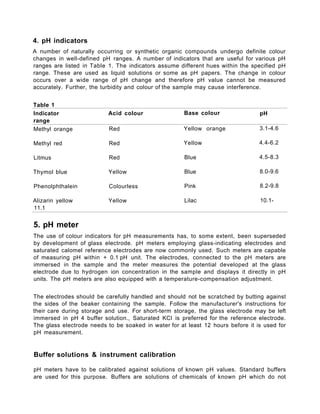
4. pH indicators
A number of naturally occurring or synthetic organic compounds undergo definite colour
changes in well-defined pH ranges. A number of indicators that are useful for various pH
ranges are listed in Table 1. The indicators assume different hues within the specified pH
range. These are used as liquid solutions or some as pH papers. The change in colour
occurs over a wide range of pH change and therefore pH value cannot be measured
accurately. Further, the turbidity and colour of the sample may cause interference.
Table 1
Indicator Acid colour Base colour pH
range
Methyl orange Red Yellow orange 3.1-4.6
Methyl red Red Yellow 4.4-6.2
Litmus Red Blue 4.5-8.3
Thymol blue Yellow Blue 8.0-9.6
Phenolphthalein Colourless Pink 8.2-9.8
Alizarin yellow Yellow Lilac 10.1-
11.1
5. pH meter
The use of colour indicators for pH measurements has, to some extent, been superseded
by development of glass electrode. pH meters employing glass-indicating electrodes and
saturated calomel reference electrodes are now commonly used. Such meters are capable
of measuring pH within + 0.1 pH unit. The electrodes, connected to the pH meters are
immersed in the sample and the meter measures the potential developed at the glass
electrode due to hydrogen ion concentration in the sample and displays it directly in pH
units. The pH meters are also equipped with a temperature-compensation adjustment.
The electrodes should be carefully handled and should not be scratched by butting against
the sides of the beaker containing the sample. Follow the manufacturer's instructions for
their care during storage and use. For short-term storage, the glass electrode may be left
immersed in pH 4 buffer solution., Saturated KCI is preferred for the reference electrode.
The glass electrode needs to be soaked in water for at least 12 hours before it is used for
pH measurement.
Buffer solutions & instrument calibration
pH meters have to be calibrated against solutions of known pH values. Standard buffers
are used for this purpose. Buffers are solutions of chemicals of known pH which do not
change their pH value upon dilution and resist change of pH when small amounts of acid
or alkali are added to them. Buffer solutions usually contain mixtures of weak acids and
their salts (conjugate bases) or weak bases and their salts (conjugate acids). Buffer has
importance for life forms that usually can survive only within a narrow pH range. Table 2
gives the composition of some commonly used buffers. Buffers of different pH values are
also available commercially.
Table 2 Buffer solutions of known pH
S. No Buffer solution pH at
25°C
Amount of salt to be dissolved in
1000 ml freshly boiled and cooled
and cooled distilled water
1. 0.05 M potassium hydrogen phthalate 4.00 10.12 g KHC8H404
2. 0.025 M potassium dihydrogen
phosphate + 0.025 M disodium
hydrogen phosphate
6.86 3.387 g KH2P04 and 3.533 g Na2HP04
3. 0.01 M sodium borate decahydrate 9.18 3.80 g Na2B407.10 H2 0
It is a good practice to calibrate the pH meter using two buffers. After calibrating with an
initial buffer, use a second buffer within 2 pH units of the sample pH.
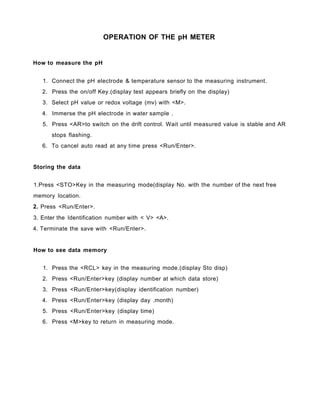
OPERATION OF THE pH METER
How to measure the pH
1. Connect the pH electrode & temperature sensor to the measuring instrument.
2. Press the on/off Key.(display test appears briefly on the display)
3. Select pH value or redox voltage (mv) with <M>.
4. Immerse the pH electrode in water sample .
5. Press <AR>to switch on the drift control. Wait until measured value is stable and AR
stops flashing.
6. To cancel auto read at any time press <Run/Enter>.
Storing the data
1.Press <STO>Key in the measuring mode(display No. with the number of the next free
memory location.
2. Press <Run/Enter>.
3. Enter the Identification number with < V> <A>.
4. Terminate the save with <Run/Enter>.
How to see data memory
1. Press the <RCL> key in the measuring mode.(display Sto disp)
2. Press <Run/Enter>key (display number at which data store)
3. Press <Run/Enter>key(display identification number)
4. Press <Run/Enter>key (display day .month)
5. Press <Run/Enter>key (display time)
6. Press <M>key to return in measuring mode.
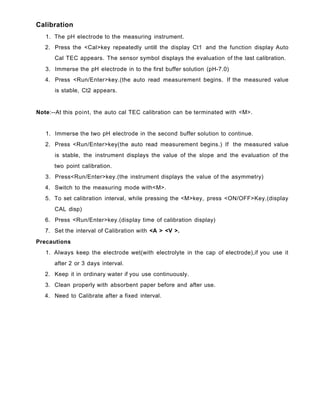
Calibration
1. The pH electrode to the measuring instrument.
2. Press the <Cal>key repeatedly untill the display Ct1 and the function display Auto
Cal TEC appears. The sensor symbol displays the evaluation of the last calibration.
3. Immerse the pH electrode in to the first buffer solution (pH-7.0)
4. Press <Run/Enter>key.(the auto read measurement begins. If the measured value
is stable, Ct2 appears.
Note:--At this point, the auto cal TEC calibration can be terminated with <M>.
1. Immerse the two pH electrode in the second buffer solution to continue.
2. Press <Run/Enter>key(the auto read measurement begins.) If the measured value
is stable, the instrument displays the value of the slope and the evaluation of the
two point calibration.
3. Press<Run/Enter>key.(the instrument displays the value of the asymmetry)
4. Switch to the measuring mode with<M>.
5. To set calibration interval, while pressing the <M>key, press <ON/OFF>Key.(display
CAL disp)
6. Press <Run/Enter>key.(display time of calibration display)
7. Set the interval of Calibration with <A > <V >.
Precautions
1. Always keep the electrode wet(with electrolyte in the cap of electrode),if you use it
after 2 or 3 days interval.
2. Keep it in ordinary water if you use continuously.
3. Clean properly with absorbent paper before and after use.
4. Need to Calibrate after a fixed interval.

Chapter 10

  • 1.
    Chapter 10 Measurement ofhydrogen ion concentration (pH) 1. General pH is a way of expressing the hydrogen ion concentration in water. It is related to the acidic or alkaline nature of water. Consideration of hydrogen ion concentration is important in almost all uses of water. In particular, pH balance is important in maintaining desirable aquatic ecological conditions in natural waters. pH is also maintained at various levels for efficient operation of water and wastewater treatment systems such as coagulation, disinfecting, softening, anaerobic decomposition of wastes, etc. The pH of most natural waters lies between 6.5 and 8. 2. The pH scale Pure water dissociates to yield 10"7 moles/L of H+ at 25 °C: H 2 0 ~ H + + 0 H " (1) Since water dissociates to produce one OH" ion for each H+ ion, it is obvious that 10"7 OH" ions are produced simultaneously. The product of [H+ ] and [OH"] always remains constant. When the value for one of the species changes the other also changes accordingly. [H+ ] x [OH] = 10"14 (2) The large bracket sign, [ ], indicates molar concentration. The concentration of H+ ions can be increased when compounds are added which release H+ ions such as H2SO4: H2SO4—• 2H+ + S04 2 " (3) Or preferentially combine with OH" ions when added to water, such as FeCl3. FeCI3 + 3H2 0 —• Fe(OH)3 + 3H+ + 3CI" (4) Note that in either case the product of /H+ 7and [OH"] ions remains constant at 10"14 Likewise the concentration of H+ ions can be decreased when compounds are added which release OH" ions, such as NaOH, or preferentially combine with H+ ions, such as Na2C03. Expression of the molar concentration of hydrogen ions is rather cumbersome because of
  • 2.
    the extremely smallvalues and large variations. To overcome this difficulty, the concentration is expressed in terms of pH value, which is negative logarithm of the concentration in moles/L. pH = - log [H+ ] (5) or [H+ ] = 10pH (6) Thus the pH value of a sample of water containing 10"7 5 moles/L H+ is 7.5. Since the product of [H+ ] and [OH"] is always a constant, Eq. (2) becomes log[H+ ] +log[OH"]= -14 Or -log[H+ ] - log [OH1 = +14 The pH scale is usually represented as ranging from 0 to 14, with pH 7 at 25 °C representing neutrality. Acid conditions increase as pH values decrease and alkaline conditions increase as pH values increase. Acid range Neutral Alkaline range 1 2 3 4 5 6 7 8 9 10 11 12 13 14 3. Calculating pH Example calculation Calculate the pH value for the following cases: A: [H+ ]= a.0.0001 b.0.00005 and B: [OH"] a 10"8 b. 0.00005 and c.0.00001 A: [H+ } a. 0.0001 A. 0.00005 pH= -log 10"3 =3 pH= -log 0.00005= -log (5 x10"5 )= - 0.7 +5=4.3 B:[OH"] a. 10"8 b. 0.00005 c. 0.00001 [H+ ] x 10"8 = 10"14 , or [H+ ] =10"6 Therefore pH=6 —log[H+ ]—log [OH"] =14 Therefore pH=14-4.3 =9.7 pH=14 + Iog10"5 =14- 5 =9
  • 3.
    4. pH indicators Anumber of naturally occurring or synthetic organic compounds undergo definite colour changes in well-defined pH ranges. A number of indicators that are useful for various pH ranges are listed in Table 1. The indicators assume different hues within the specified pH range. These are used as liquid solutions or some as pH papers. The change in colour occurs over a wide range of pH change and therefore pH value cannot be measured accurately. Further, the turbidity and colour of the sample may cause interference. Table 1 Indicator Acid colour Base colour pH range Methyl orange Red Yellow orange 3.1-4.6 Methyl red Red Yellow 4.4-6.2 Litmus Red Blue 4.5-8.3 Thymol blue Yellow Blue 8.0-9.6 Phenolphthalein Colourless Pink 8.2-9.8 Alizarin yellow Yellow Lilac 10.1- 11.1 5. pH meter The use of colour indicators for pH measurements has, to some extent, been superseded by development of glass electrode. pH meters employing glass-indicating electrodes and saturated calomel reference electrodes are now commonly used. Such meters are capable of measuring pH within + 0.1 pH unit. The electrodes, connected to the pH meters are immersed in the sample and the meter measures the potential developed at the glass electrode due to hydrogen ion concentration in the sample and displays it directly in pH units. The pH meters are also equipped with a temperature-compensation adjustment. The electrodes should be carefully handled and should not be scratched by butting against the sides of the beaker containing the sample. Follow the manufacturer's instructions for their care during storage and use. For short-term storage, the glass electrode may be left immersed in pH 4 buffer solution., Saturated KCI is preferred for the reference electrode. The glass electrode needs to be soaked in water for at least 12 hours before it is used for pH measurement. Buffer solutions & instrument calibration pH meters have to be calibrated against solutions of known pH values. Standard buffers are used for this purpose. Buffers are solutions of chemicals of known pH which do not
  • 4.
    change their pHvalue upon dilution and resist change of pH when small amounts of acid or alkali are added to them. Buffer solutions usually contain mixtures of weak acids and their salts (conjugate bases) or weak bases and their salts (conjugate acids). Buffer has importance for life forms that usually can survive only within a narrow pH range. Table 2 gives the composition of some commonly used buffers. Buffers of different pH values are also available commercially. Table 2 Buffer solutions of known pH S. No Buffer solution pH at 25°C Amount of salt to be dissolved in 1000 ml freshly boiled and cooled and cooled distilled water 1. 0.05 M potassium hydrogen phthalate 4.00 10.12 g KHC8H404 2. 0.025 M potassium dihydrogen phosphate + 0.025 M disodium hydrogen phosphate 6.86 3.387 g KH2P04 and 3.533 g Na2HP04 3. 0.01 M sodium borate decahydrate 9.18 3.80 g Na2B407.10 H2 0 It is a good practice to calibrate the pH meter using two buffers. After calibrating with an initial buffer, use a second buffer within 2 pH units of the sample pH.
  • 5.
    OPERATION OF THEpH METER How to measure the pH 1. Connect the pH electrode & temperature sensor to the measuring instrument. 2. Press the on/off Key.(display test appears briefly on the display) 3. Select pH value or redox voltage (mv) with <M>. 4. Immerse the pH electrode in water sample . 5. Press <AR>to switch on the drift control. Wait until measured value is stable and AR stops flashing. 6. To cancel auto read at any time press <Run/Enter>. Storing the data 1.Press <STO>Key in the measuring mode(display No. with the number of the next free memory location. 2. Press <Run/Enter>. 3. Enter the Identification number with < V> <A>. 4. Terminate the save with <Run/Enter>. How to see data memory 1. Press the <RCL> key in the measuring mode.(display Sto disp) 2. Press <Run/Enter>key (display number at which data store) 3. Press <Run/Enter>key(display identification number) 4. Press <Run/Enter>key (display day .month) 5. Press <Run/Enter>key (display time) 6. Press <M>key to return in measuring mode.
  • 6.
    Calibration 1. The pHelectrode to the measuring instrument. 2. Press the <Cal>key repeatedly untill the display Ct1 and the function display Auto Cal TEC appears. The sensor symbol displays the evaluation of the last calibration. 3. Immerse the pH electrode in to the first buffer solution (pH-7.0) 4. Press <Run/Enter>key.(the auto read measurement begins. If the measured value is stable, Ct2 appears. Note:--At this point, the auto cal TEC calibration can be terminated with <M>. 1. Immerse the two pH electrode in the second buffer solution to continue. 2. Press <Run/Enter>key(the auto read measurement begins.) If the measured value is stable, the instrument displays the value of the slope and the evaluation of the two point calibration. 3. Press<Run/Enter>key.(the instrument displays the value of the asymmetry) 4. Switch to the measuring mode with<M>. 5. To set calibration interval, while pressing the <M>key, press <ON/OFF>Key.(display CAL disp) 6. Press <Run/Enter>key.(display time of calibration display) 7. Set the interval of Calibration with <A > <V >. Precautions 1. Always keep the electrode wet(with electrolyte in the cap of electrode),if you use it after 2 or 3 days interval. 2. Keep it in ordinary water if you use continuously. 3. Clean properly with absorbent paper before and after use. 4. Need to Calibrate after a fixed interval.