Maximizing the Return on Your Control Investment Part 2 of 2 Meet the Experts Sessions
Presenters James Beall Terry Blevins
Agenda Justifying the installation of multi-loop control techniques Recognizing when advanced control techniques are needed to achieve best control performance.
When is Reduced Variability Important The objectives of a process control system generally fall into one of three categories: Economic Incentive Safety and Environmental Compliance Equipment Protection The degree to which a control loop must reduce variability depends in many cases on the objective of the control loop.
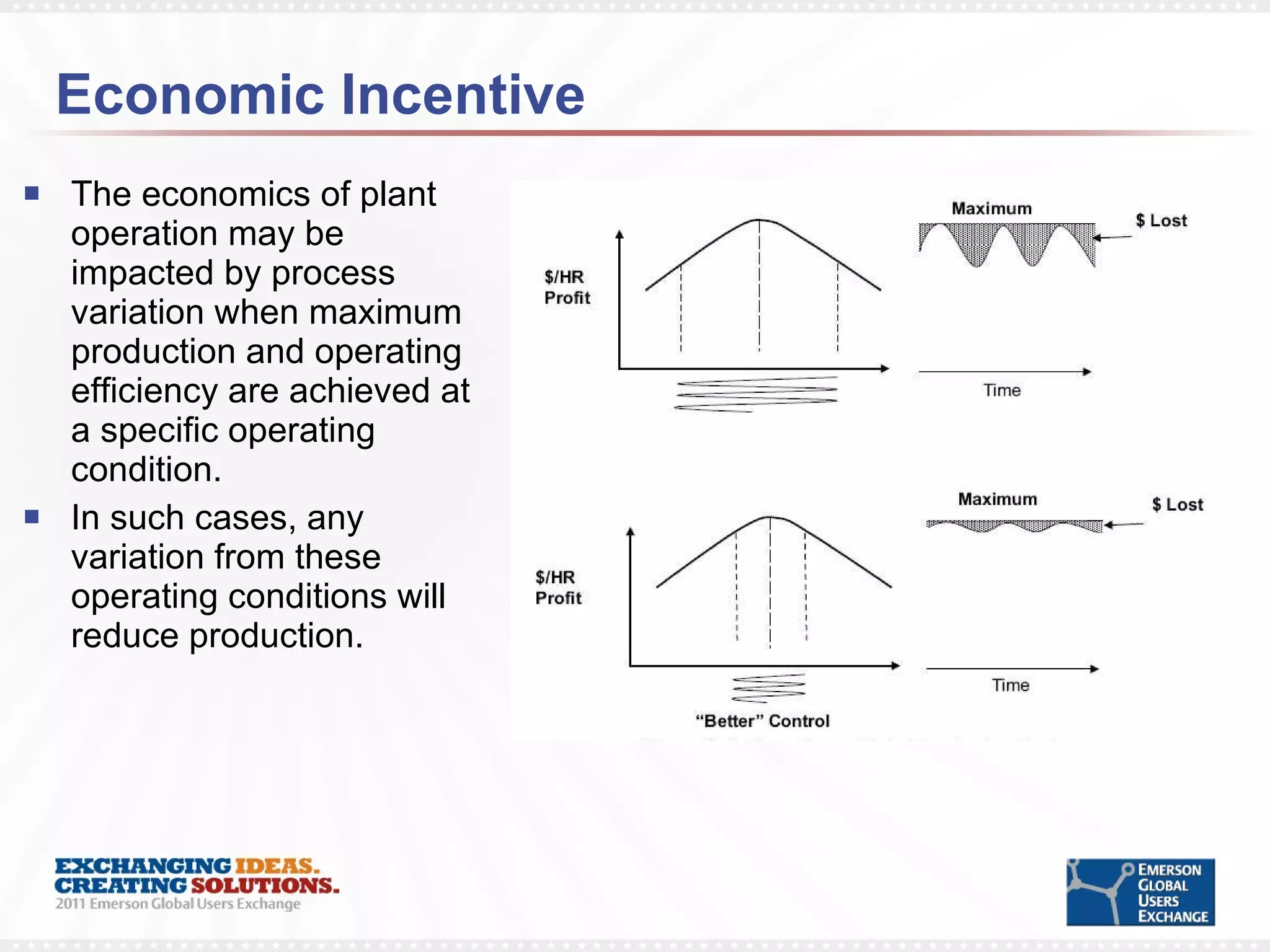
Economic Incentive The economics of plant operation may be impacted by process variation when maximum production and operating efficiency are achieved at a specific operating condition. In such cases, any variation from these operating conditions will reduce production.
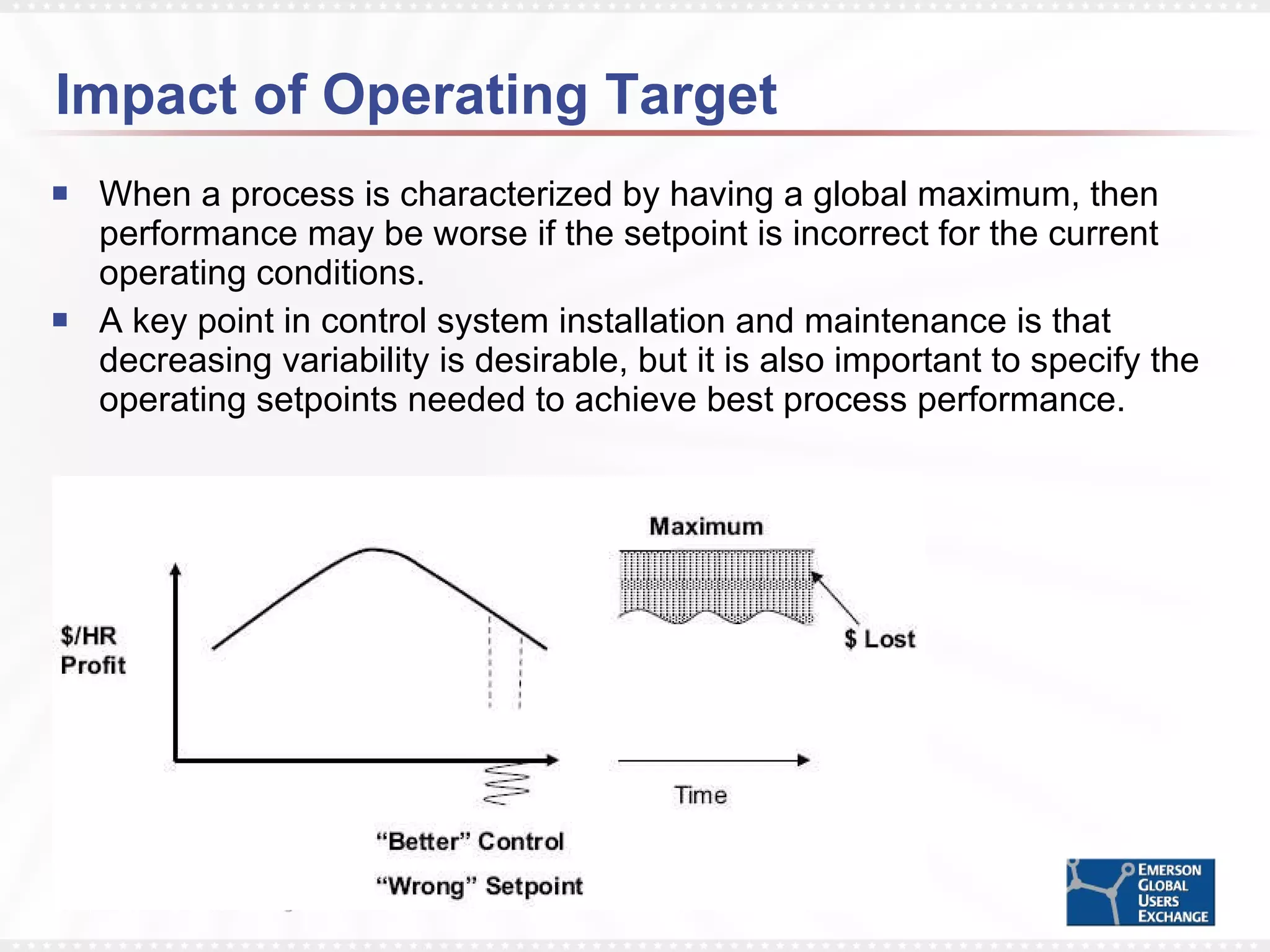
Impact of Operating Target  When a process is characterized by having a global maximum, then performance may be worse if the setpoint is incorrect for the current operating conditions. A key point in control system installation and maintenance is that decreasing variability is desirable, but it is also important to specify the operating setpoints needed to achieve best process performance.
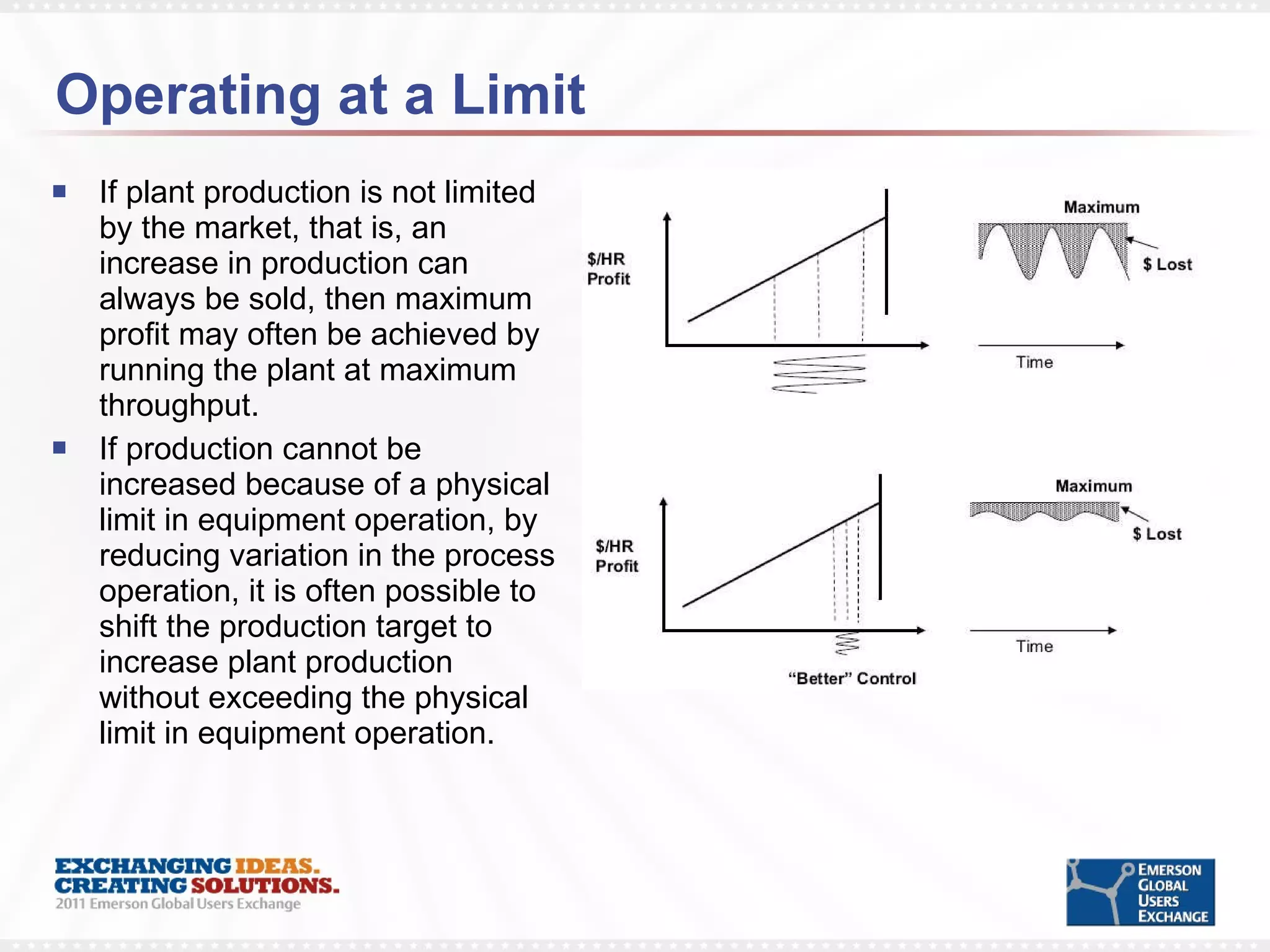
Operating at a Limit If plant production is not limited by the market, that is, an increase in production can always be sold, then maximum profit may often be achieved by running the plant at maximum throughput.  If production cannot be increased because of a physical limit in equipment operation, by reducing variation in the process operation, it is often possible to shift the production target to increase plant production without exceeding the physical limit in equipment operation.
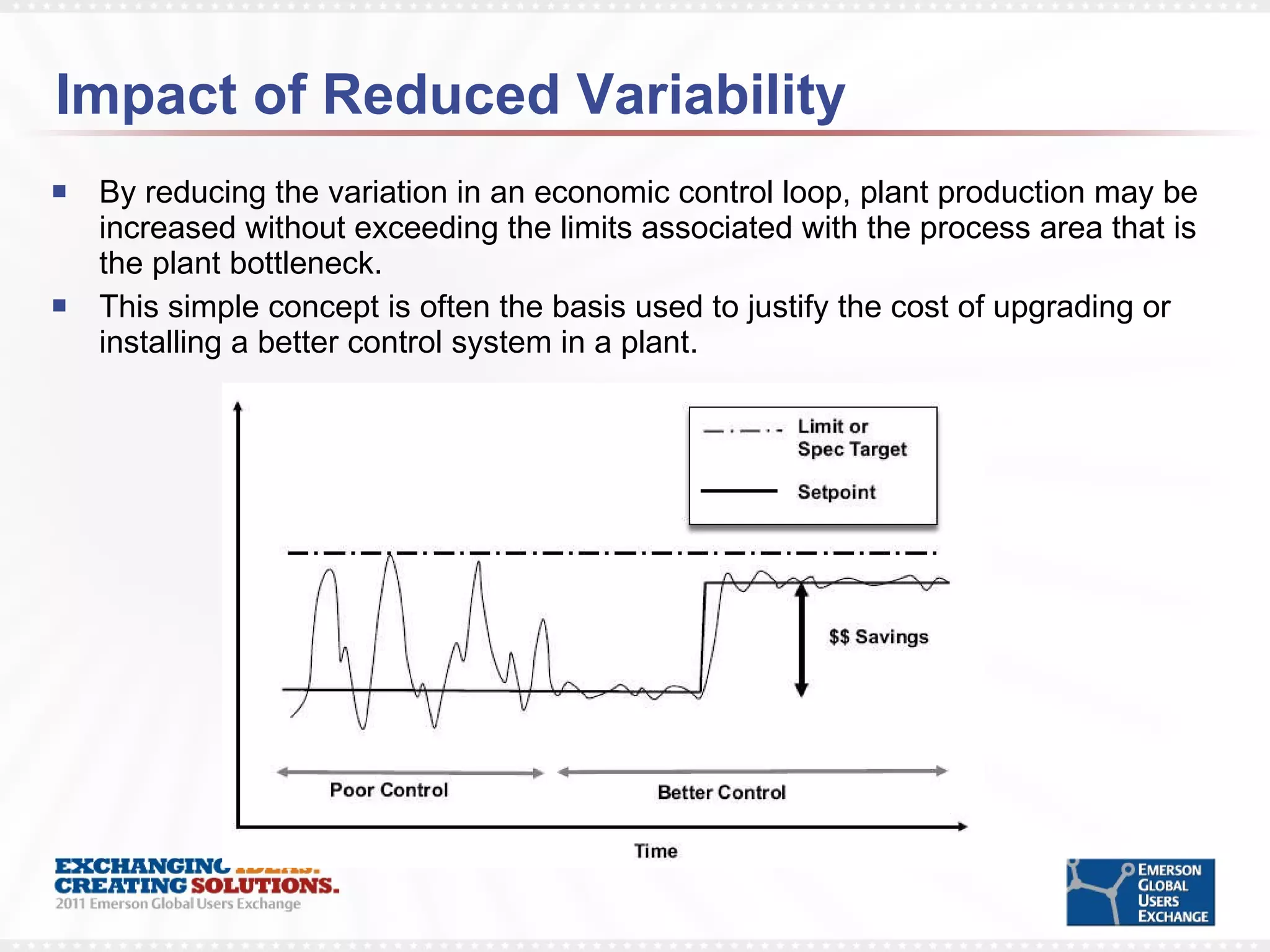
Impact of Reduced Variability By reducing the variation in an economic control loop, plant production may be increased without exceeding the limits associated with the process area that is the plant bottleneck.  This simple concept is often the basis used to justify the cost of upgrading or installing a better control system in a plant.
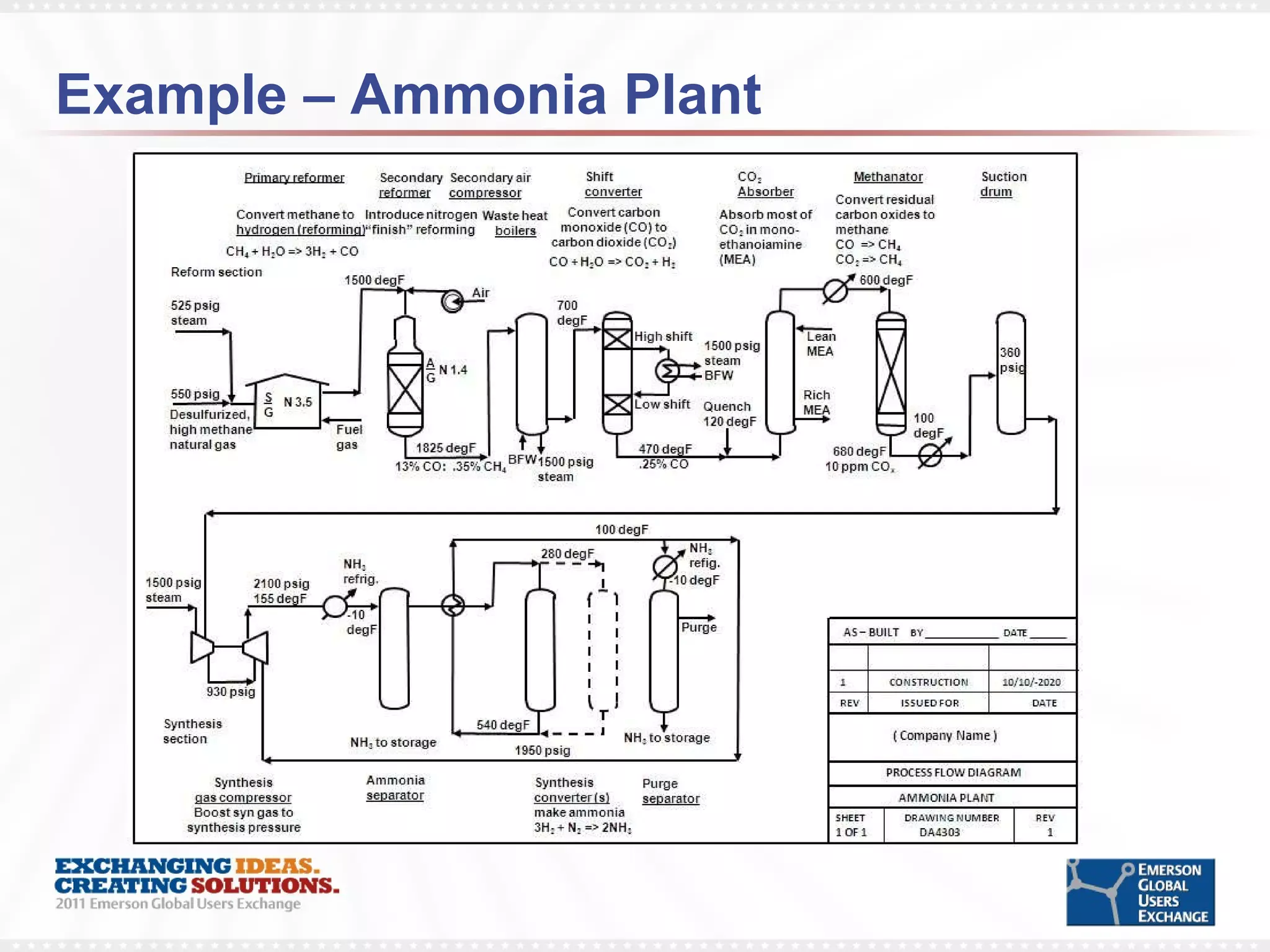
Example – Ammonia Plant
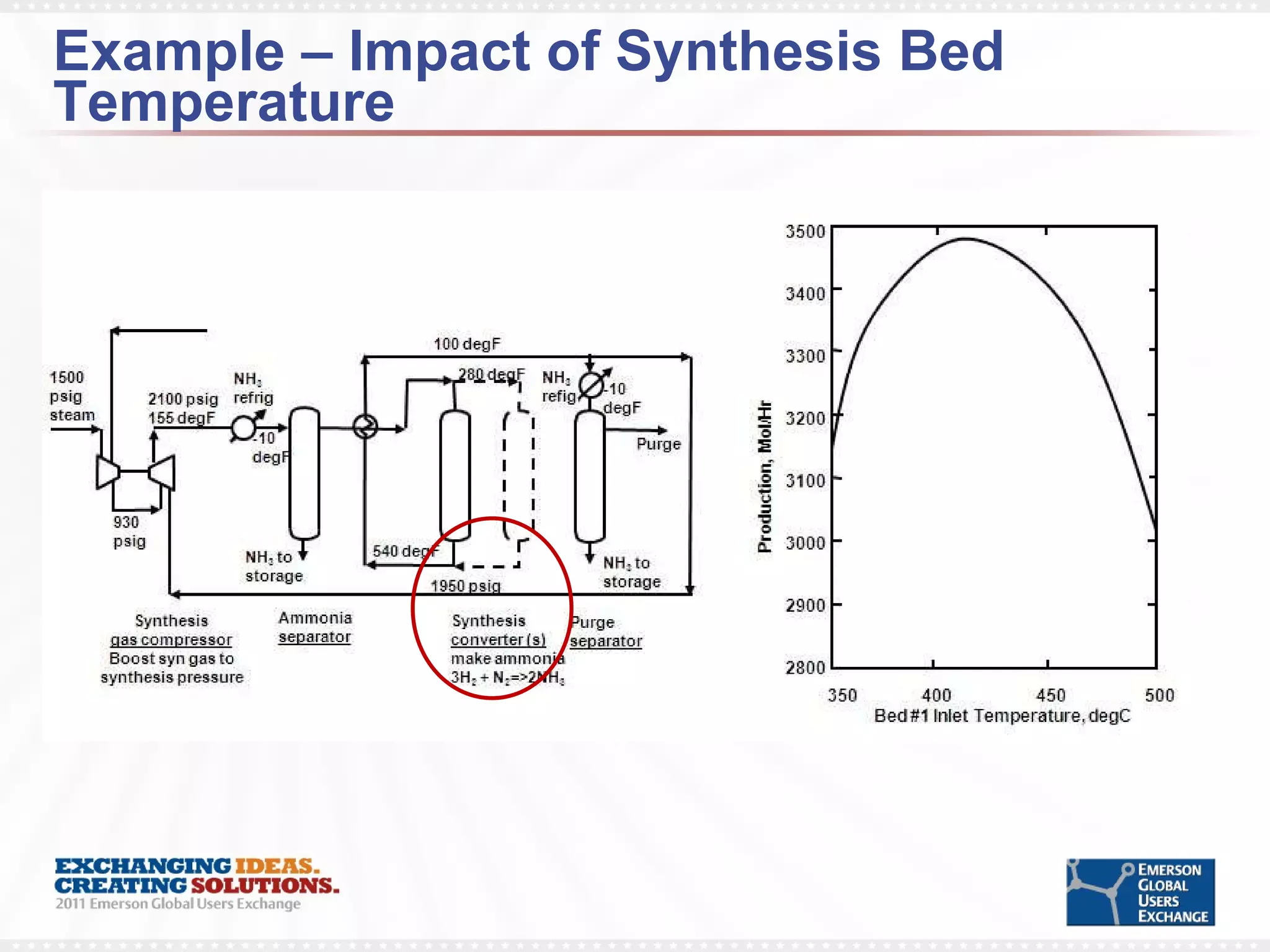
Example – Impact of Synthesis Bed Temperature
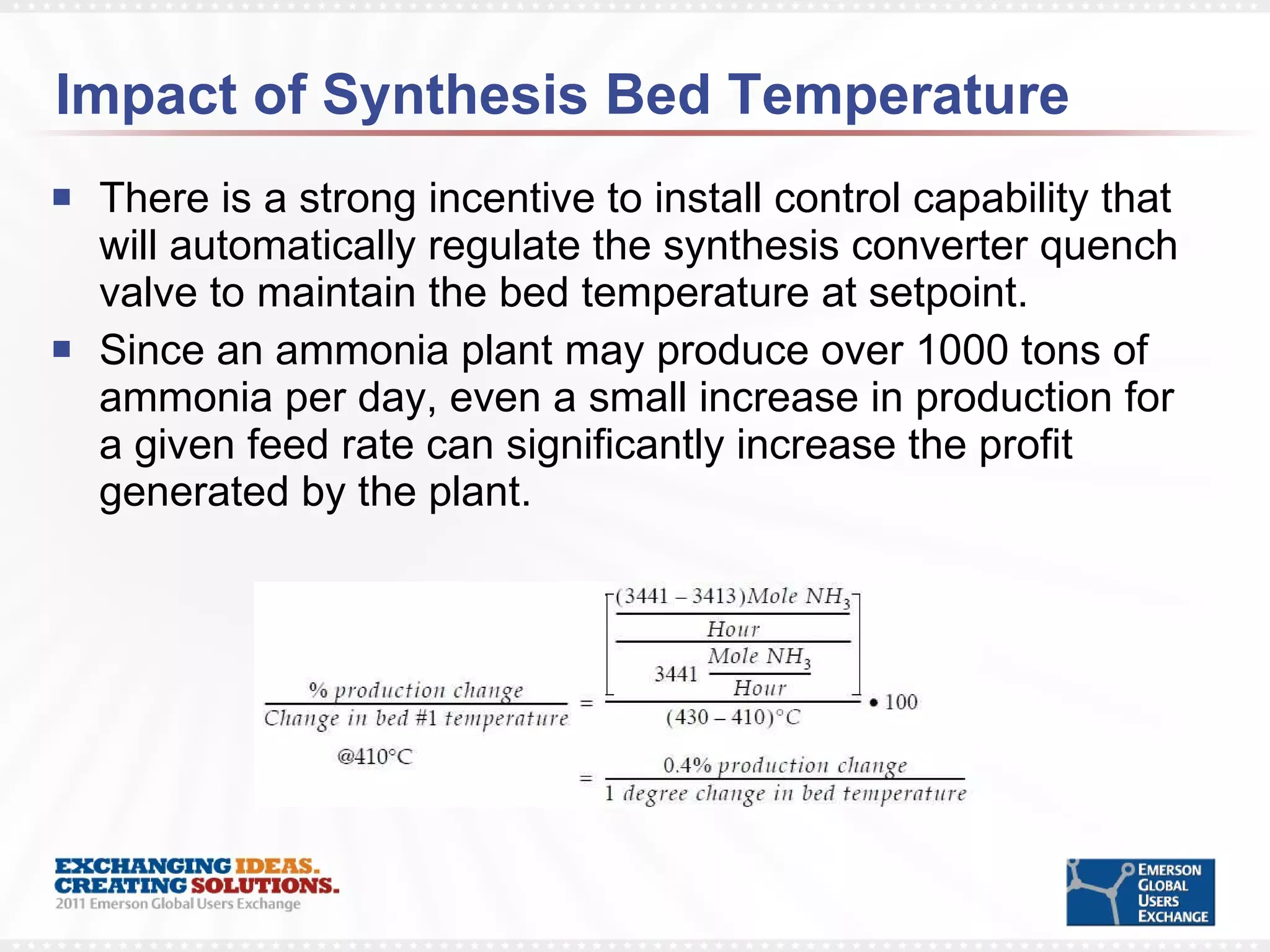
Impact of Synthesis Bed Temperature There is a strong incentive to install control capability that will automatically regulate the synthesis converter quench valve to maintain the bed temperature at setpoint. Since an ammonia plant may produce over 1000 tons of ammonia per day, even a small increase in production for a given feed rate can significantly increase the profit generated by the plant.
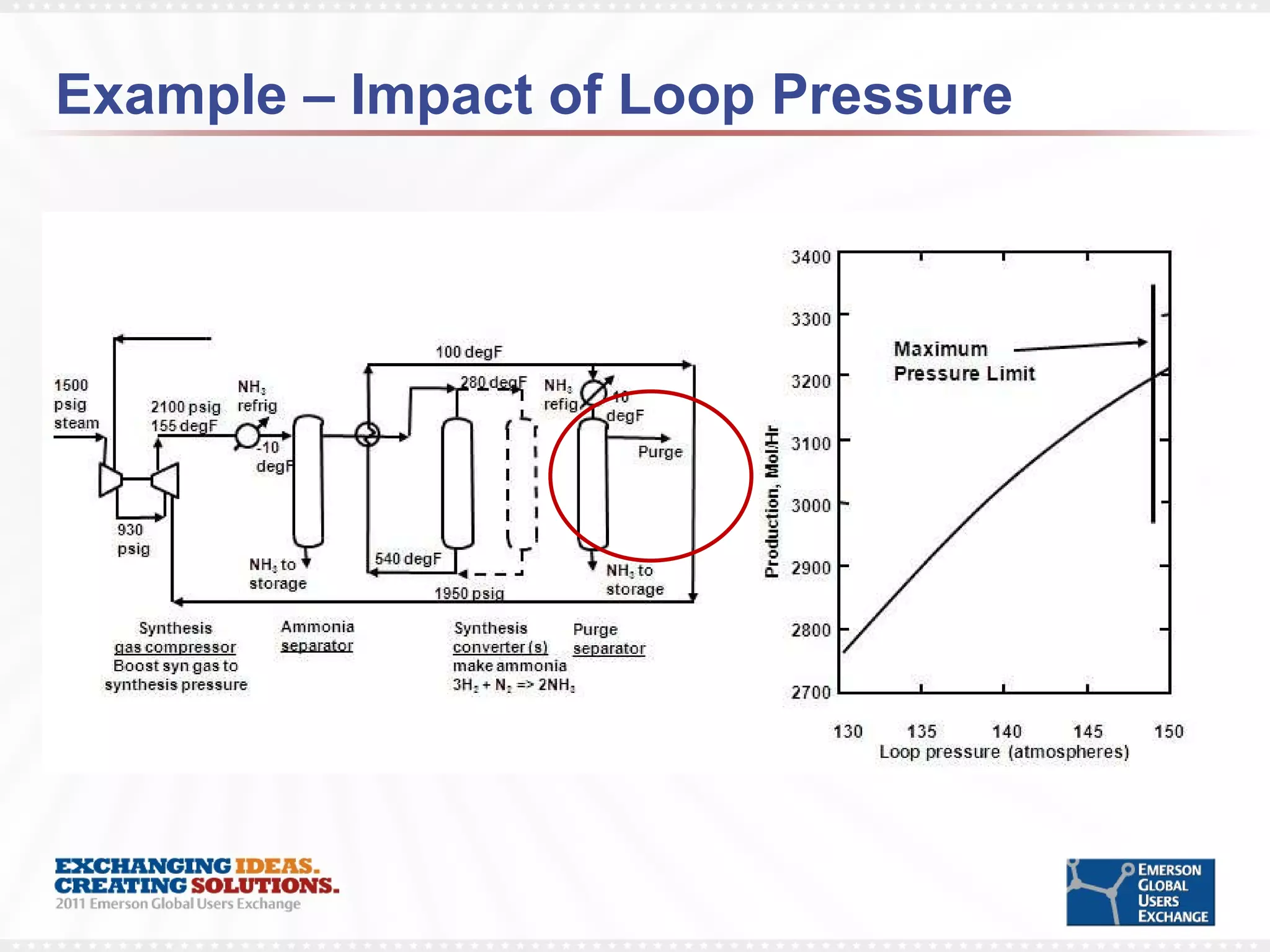
Example – Impact of Loop Pressure
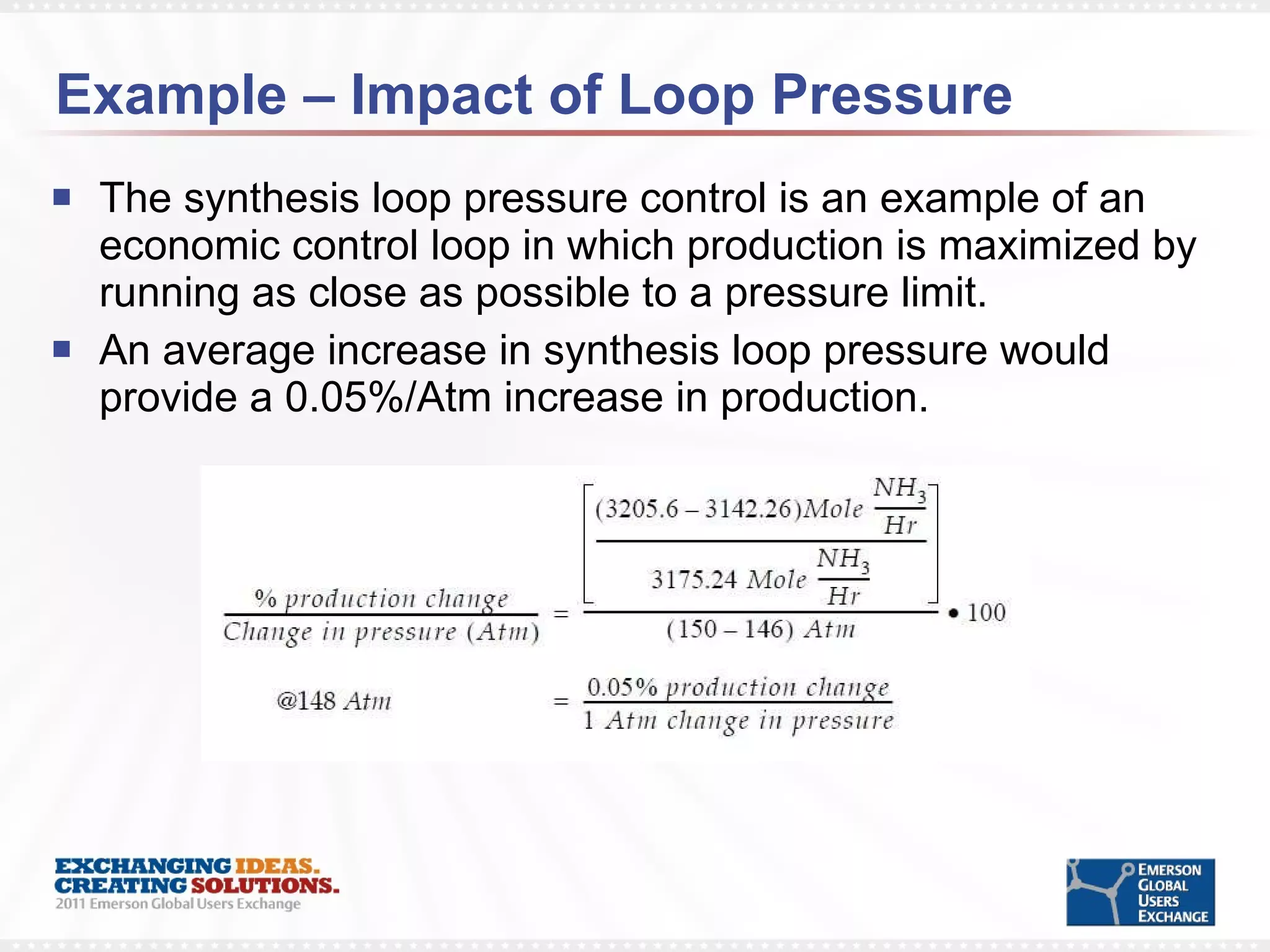
Example – Impact of Loop Pressure The synthesis loop pressure control is an example of an economic control loop in which production is maximized by running as close as possible to a pressure limit. An average increase in synthesis loop pressure would provide a 0.05%/Atm increase in production.
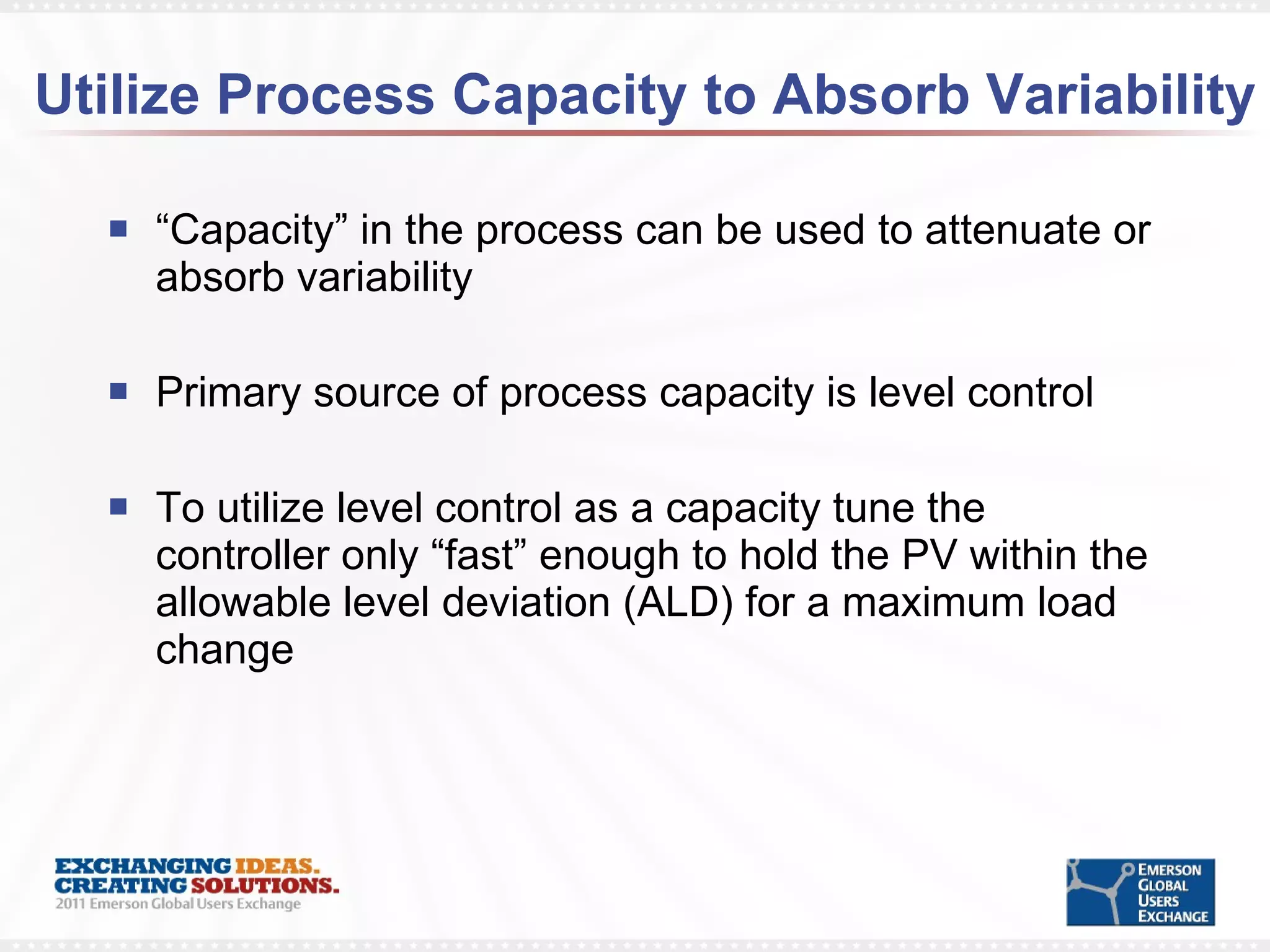
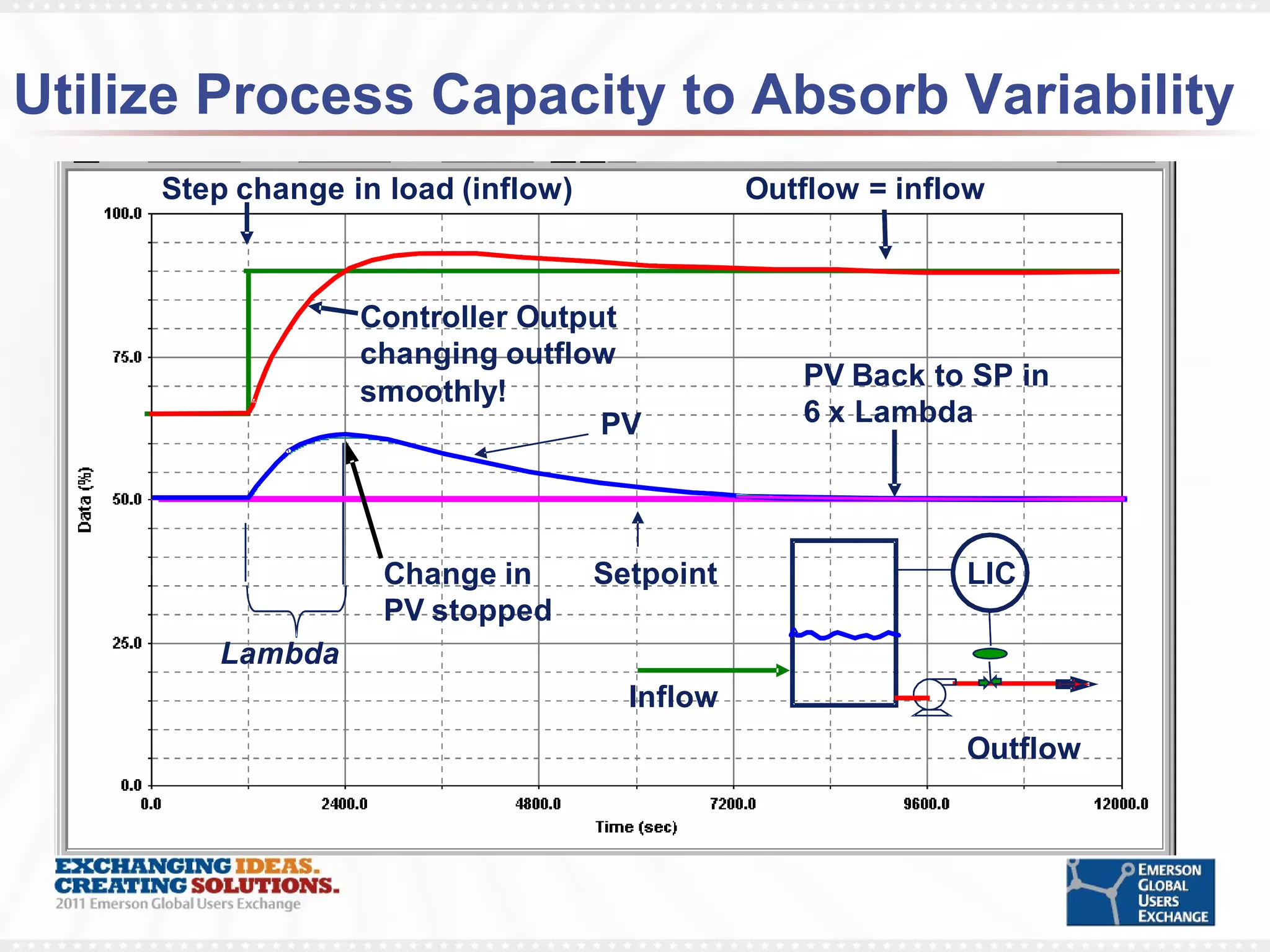
Utilize Process Capacity to Absorb Variability “ Capacity” in the process can be used to attenuate or absorb variability Primary source of process capacity is level control To utilize level control as a capacity tune the controller only “fast” enough to hold the PV within the allowable level deviation (ALD) for a maximum load change
Utilize Process Capacity to Absorb Variability
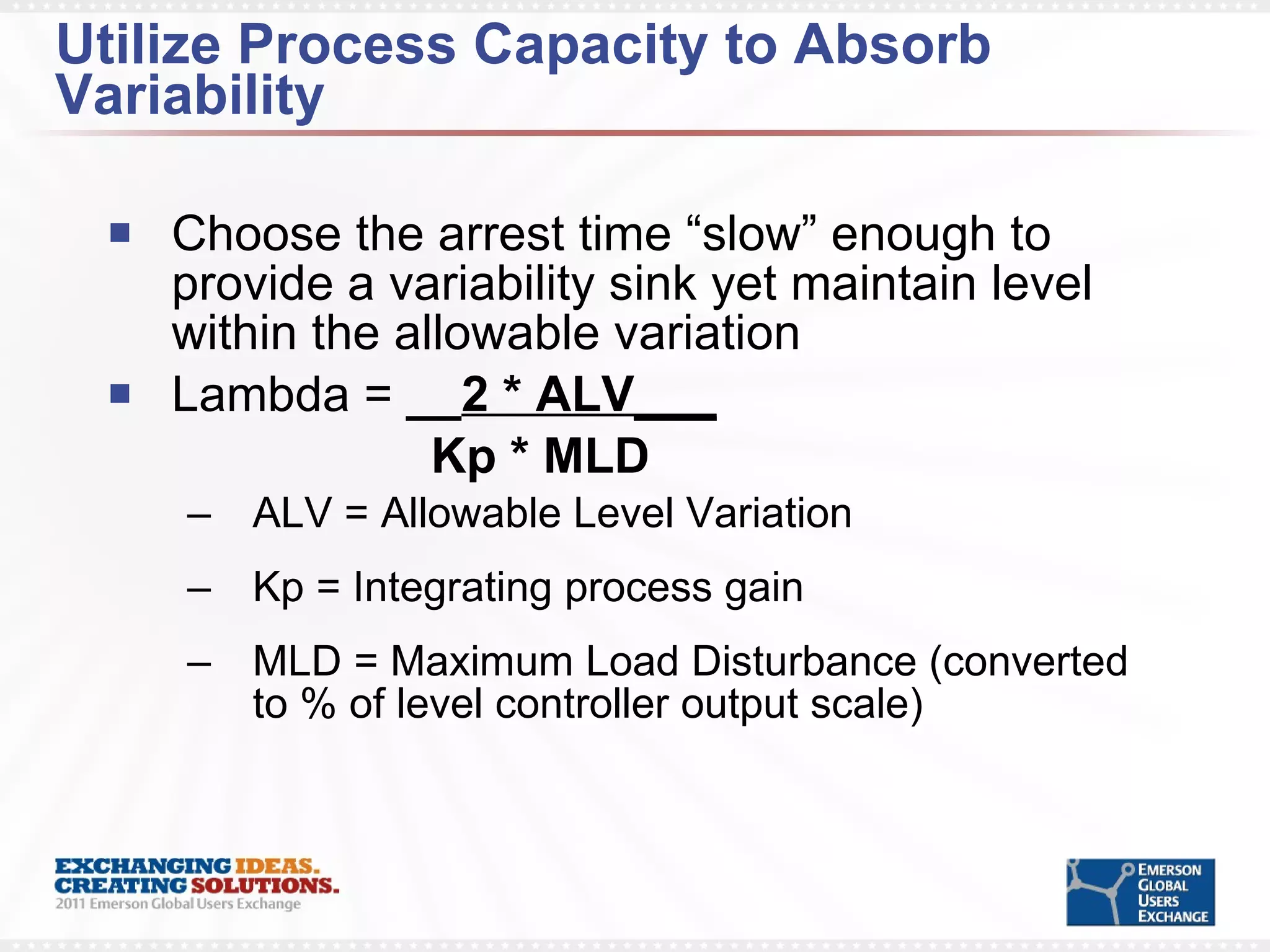
Utilize Process Capacity to Absorb Variability Choose the arrest time “slow” enough to provide a variability sink yet maintain level within the allowable variation Lambda =  __ 2 * ALV___   Kp * MLD ALV = Allowable Level Variation Kp = Integrating process gain MLD = Maximum Load Disturbance (converted to % of level controller output scale)
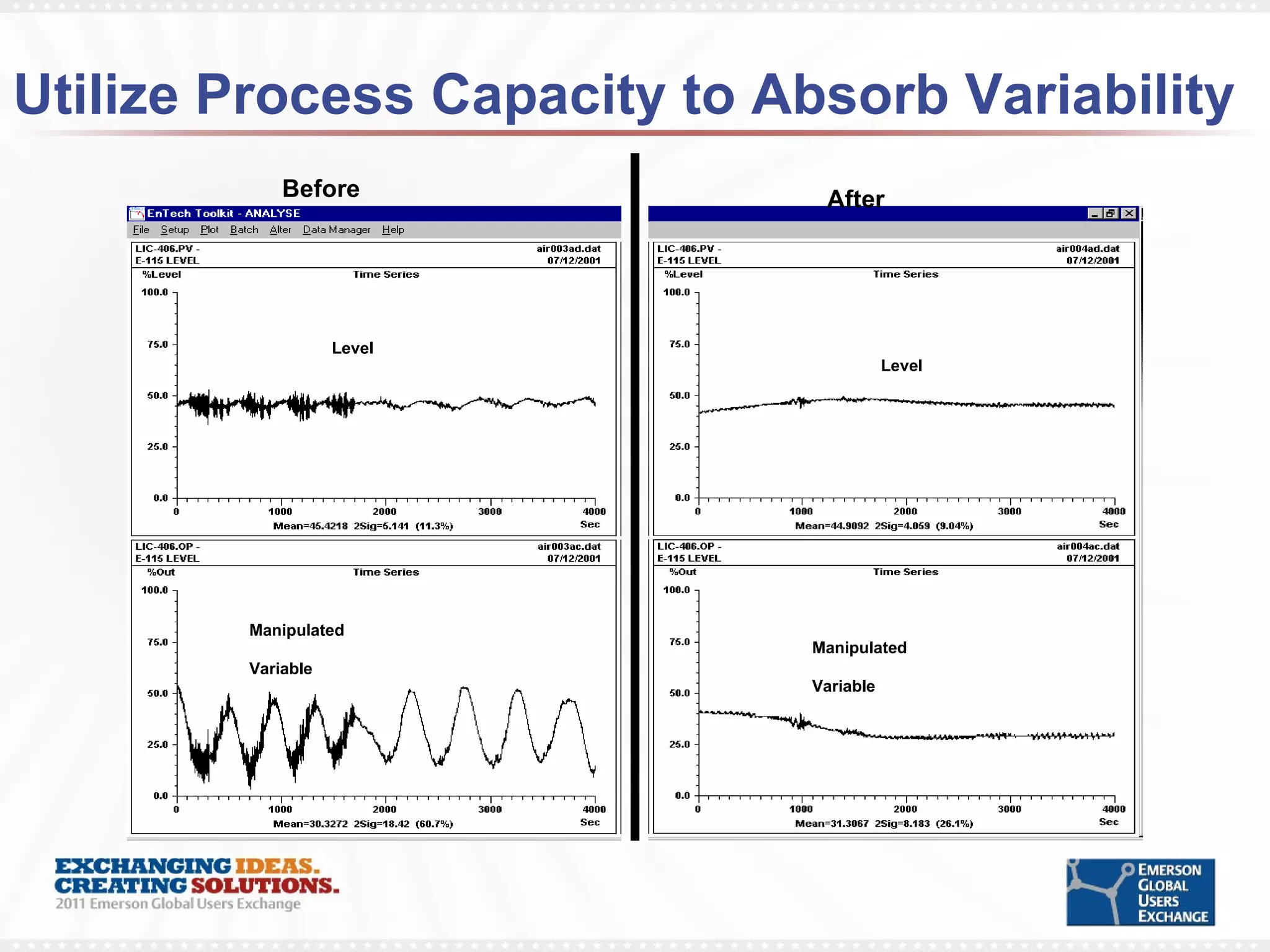
Utilize Process Capacity to Absorb Variability Level Manipulated Variable Before Level Manipulated Variable After
Reducing Control Variation When tuning is not sufficient to achieved the desired level of variation in critical control parameter or to maintain it at an operating limit, then multi-loop techniques may sometimes be applied to improve control.  Three common multi-loop techniques are: Feedforward Control Cascade Control Override Control
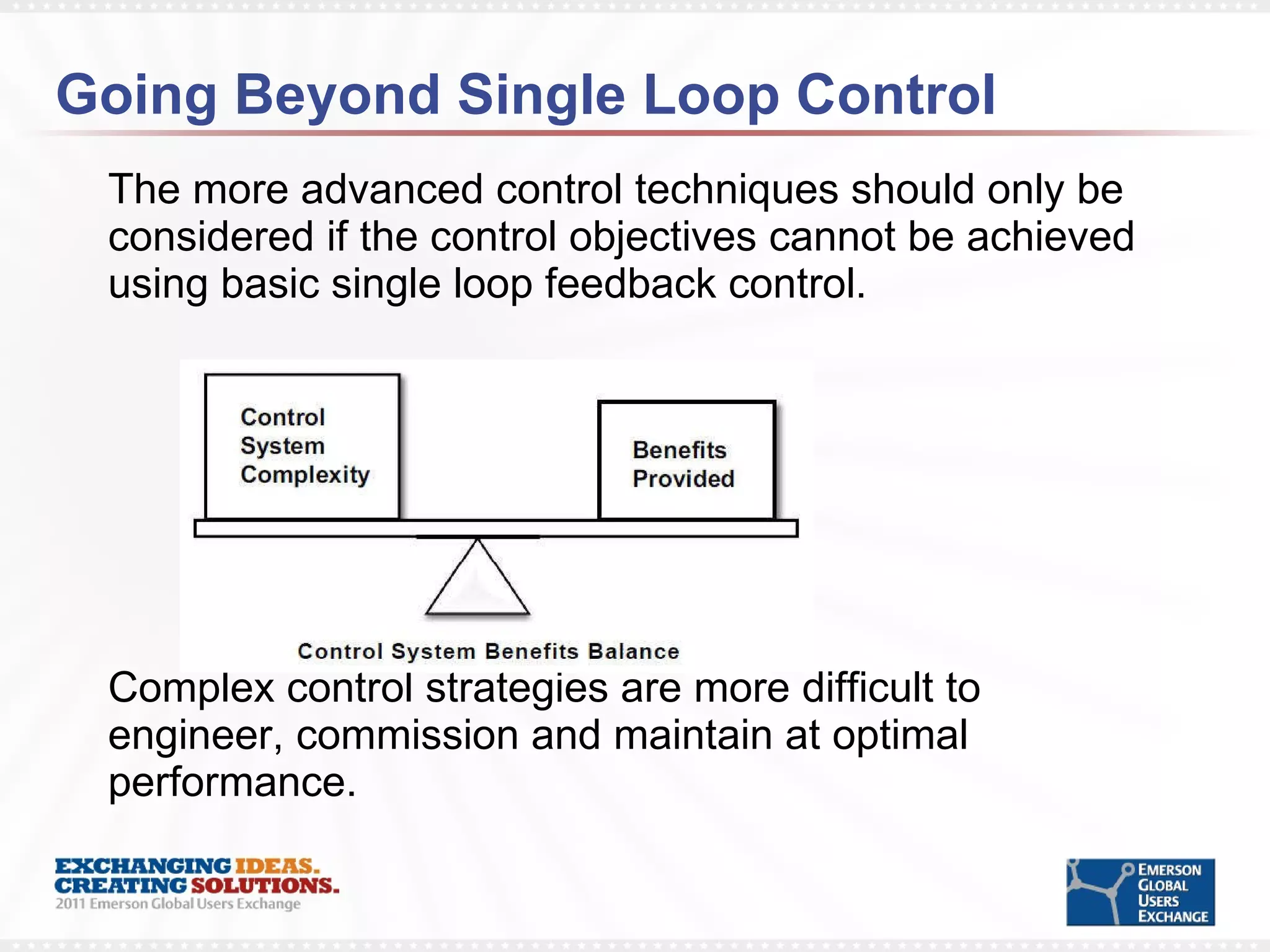
Going Beyond Single Loop Control The more advanced control techniques should only be considered if the control objectives cannot be achieved using basic single loop feedback control.  Complex control strategies are more difficult to engineer, commission and maintain at optimal performance.
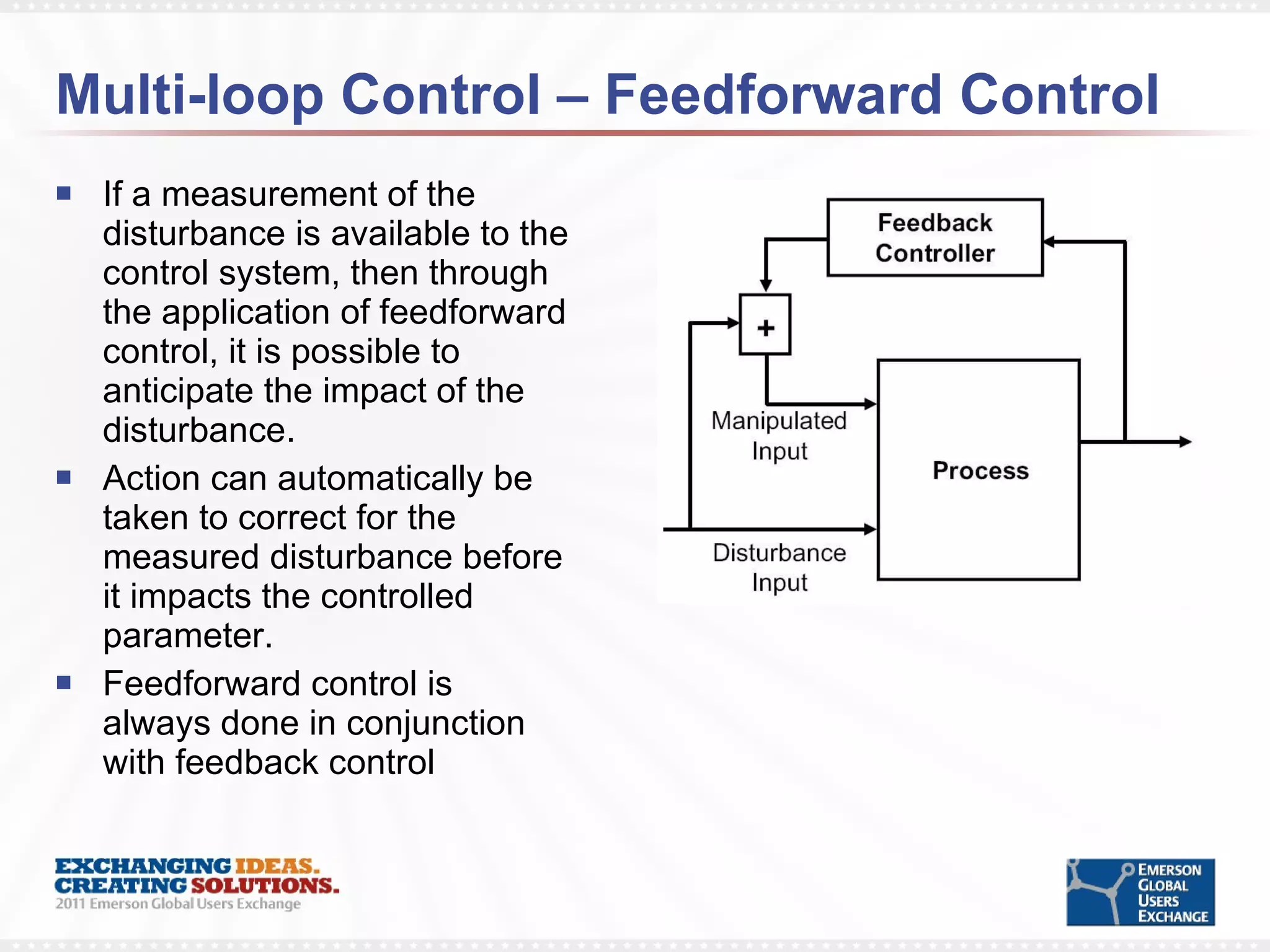
Multi-loop Control – Feedforward Control If a measurement of the disturbance is available to the control system, then through the application of feedforward control, it is possible to anticipate the impact of the disturbance.  Action can automatically be taken to correct for the measured disturbance before it impacts the controlled parameter. Feedforward control is always done in conjunction with feedback control
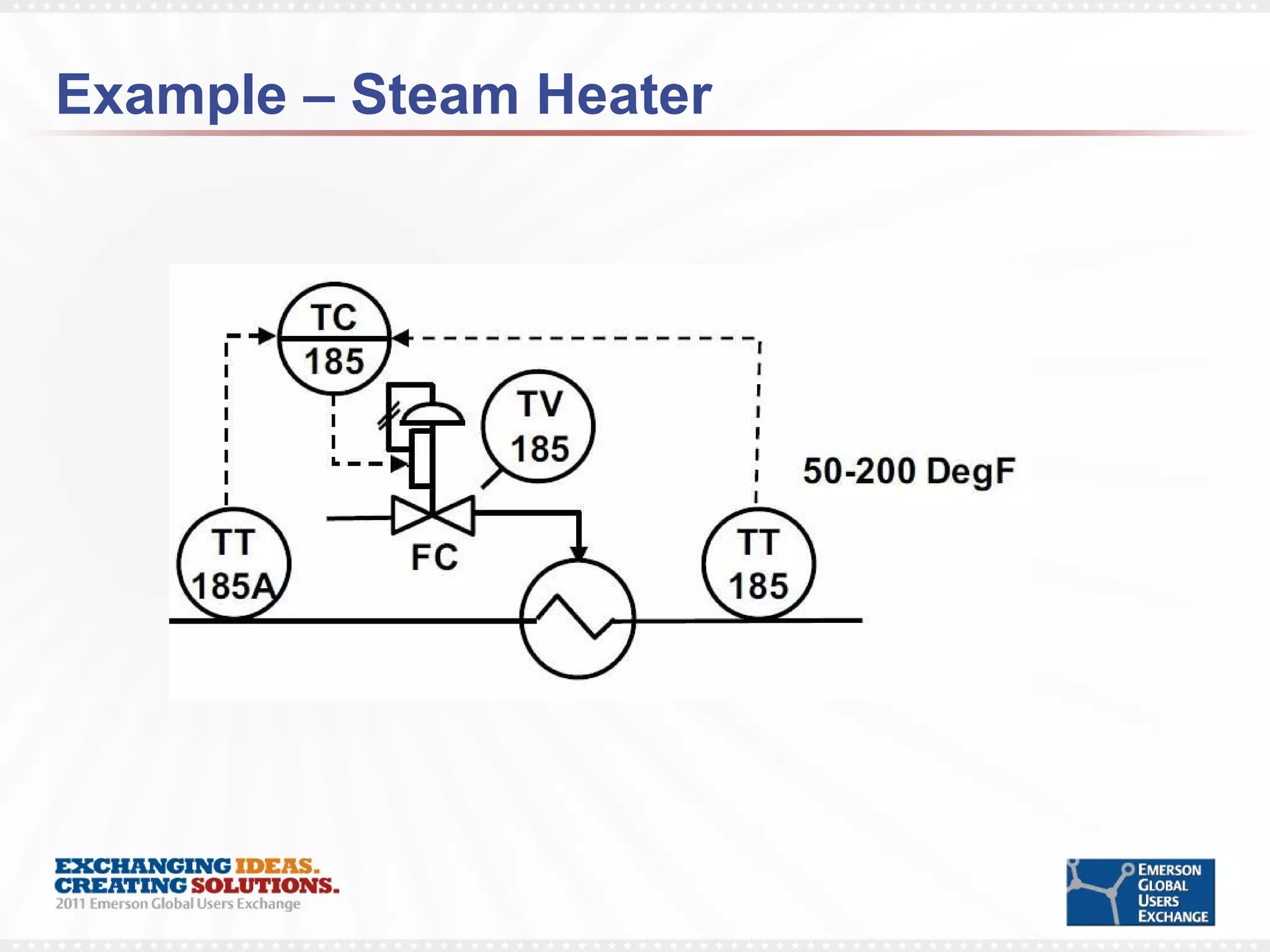
Example – Steam Heater
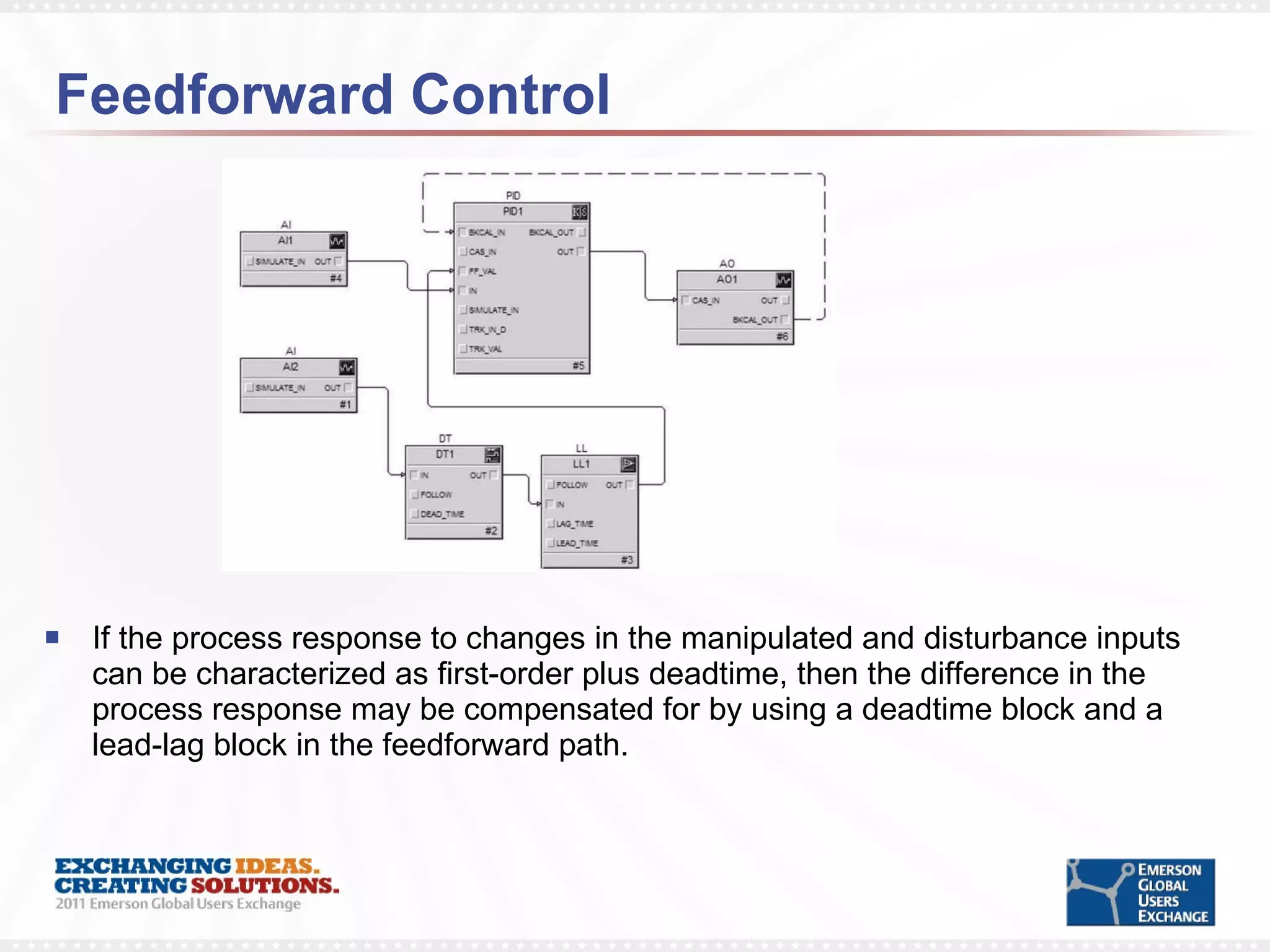
Feedforward Control If the process response to changes in the manipulated and disturbance inputs can be characterized as first-order plus deadtime, then the difference in the process response may be compensated for by using a deadtime block and a lead-lag block in the feedforward path.
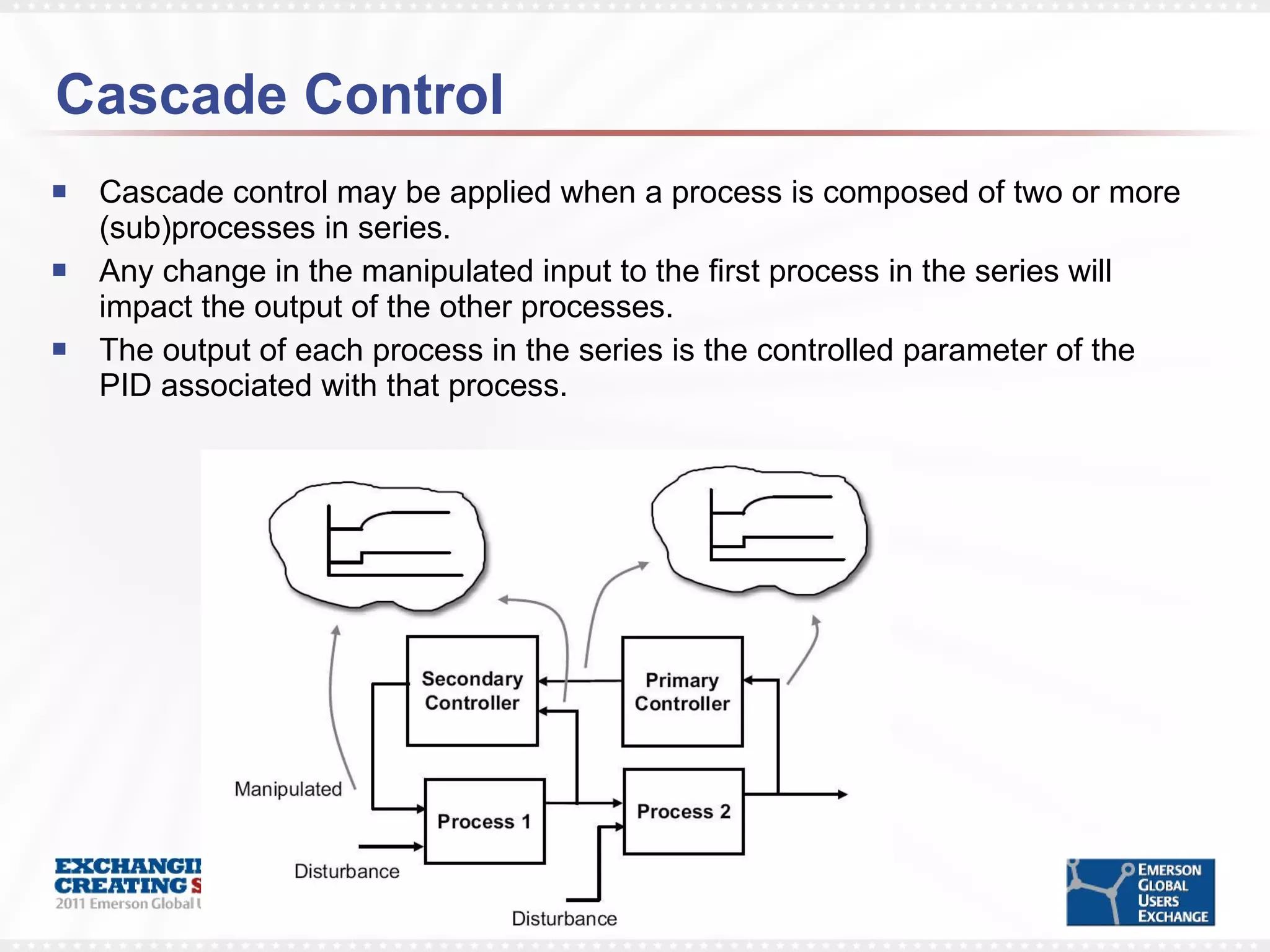
Cascade Control Cascade control may be applied when a process is composed of two or more (sub)processes in series.  Any change in the manipulated input to the first process in the series will impact the output of the other processes.  The output of each process in the series is the controlled parameter of the PID associated with that process.
Cascade Control – Benefits The primary benefits of cascade control are: The PID at each point in the cascade can react quickly to disturbance inputs to its associated process. If the PID responds quickly enough, changes introduced by disturbance inputs will have little or no impact on the downstream processes. Cascade control may be implemented to compensate for the non-linear installed characteristic of a regulating valve. The slave loop could be tuned to quickly adjust the valve to achieve its setpoint requested by the master loop. Thus, the non-linear installed characteristic of the valve would have no impact on the tuning or response of the master loop.
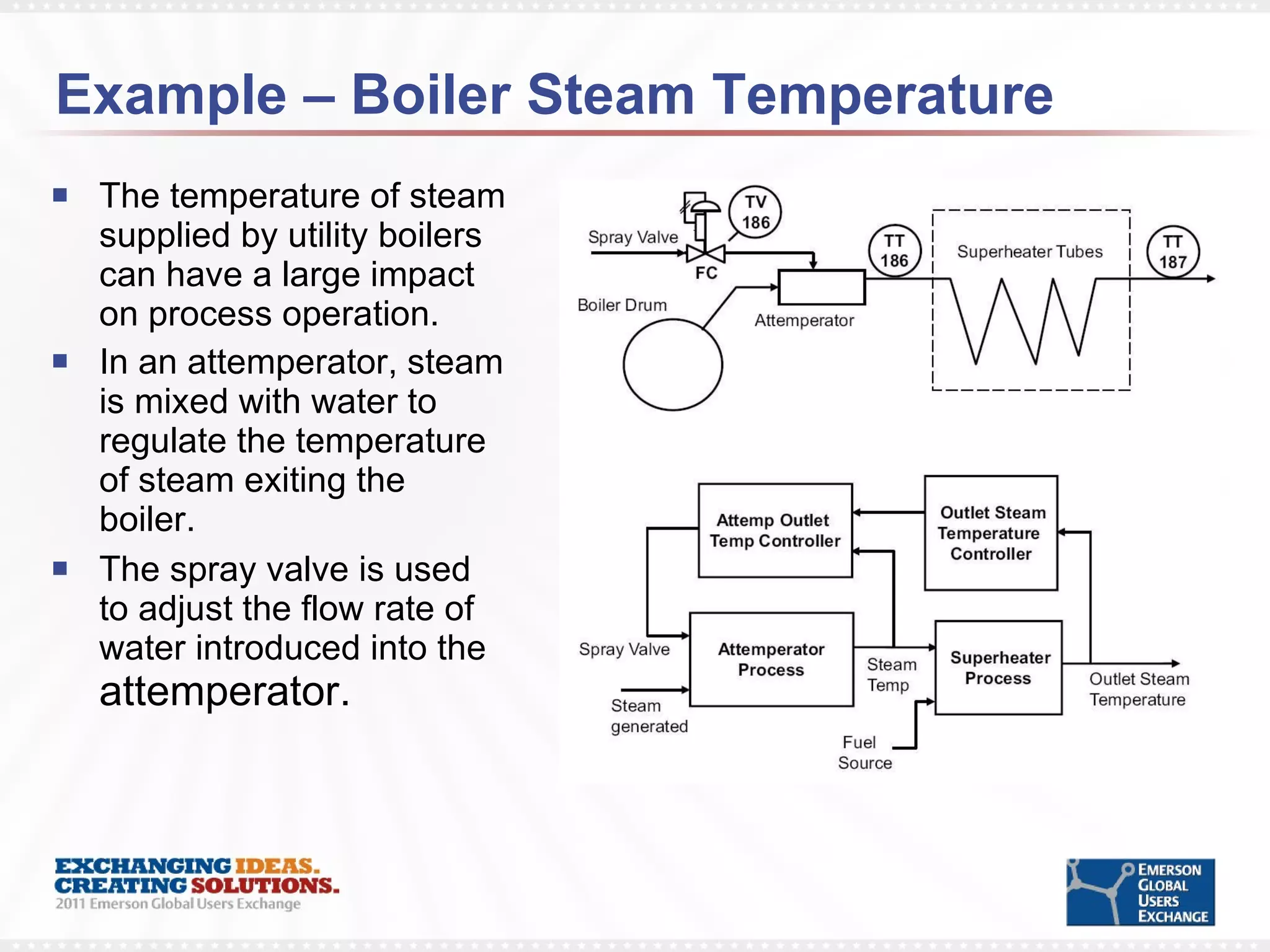
Example – Boiler Steam Temperature The temperature of steam supplied by utility boilers can have a large impact on process operation. In an attemperator, steam is mixed with water to regulate the temperature of steam exiting the boiler. The spray valve is used to adjust the flow rate of water introduced into the  attemperator.
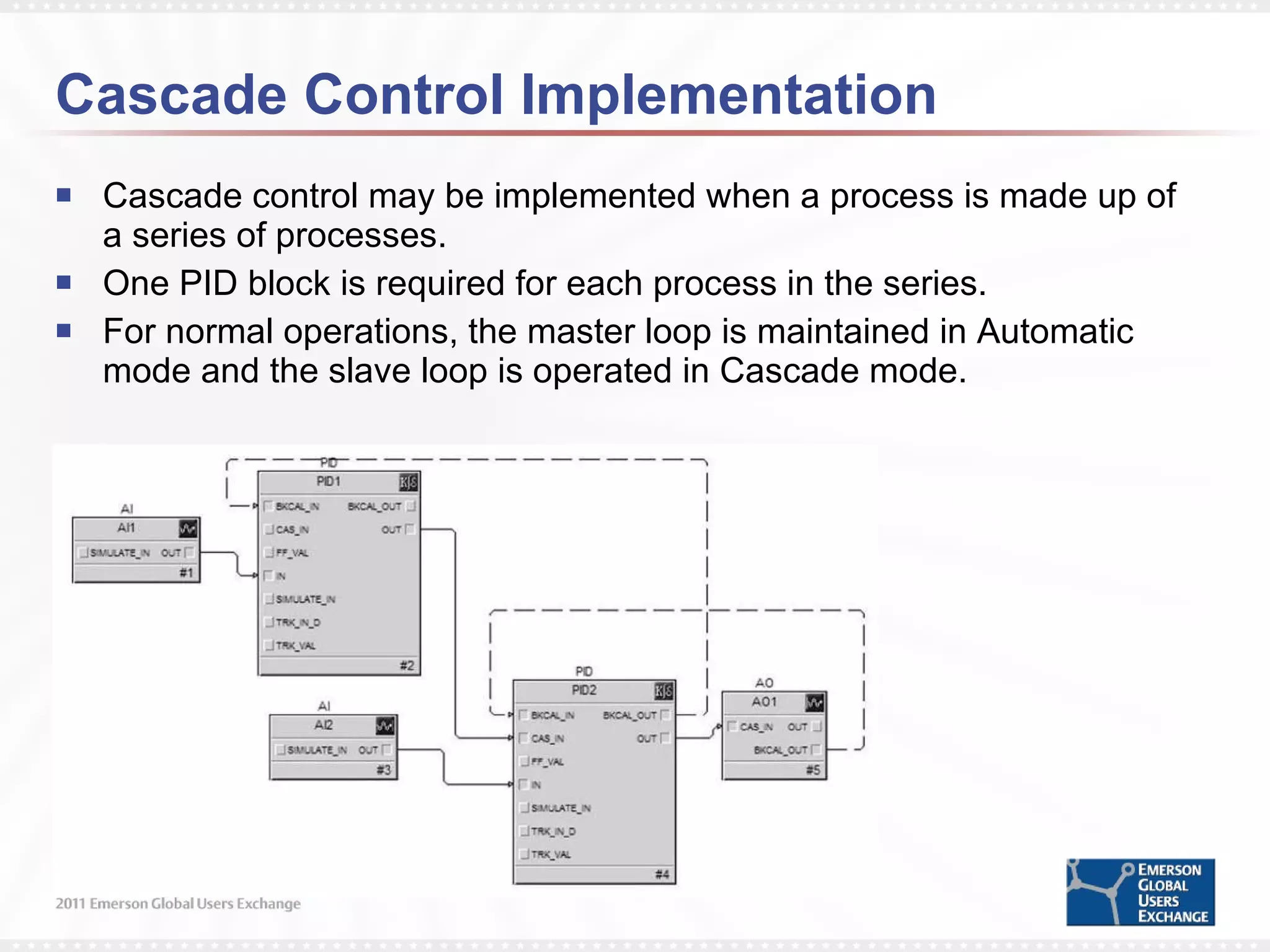
Cascade Control Implementation Cascade control may be implemented when a process is made up of a series of processes.  One PID block is required for each process in the series.  For normal operations, the master loop is maintained in Automatic mode and the slave loop is operated in Cascade mode.
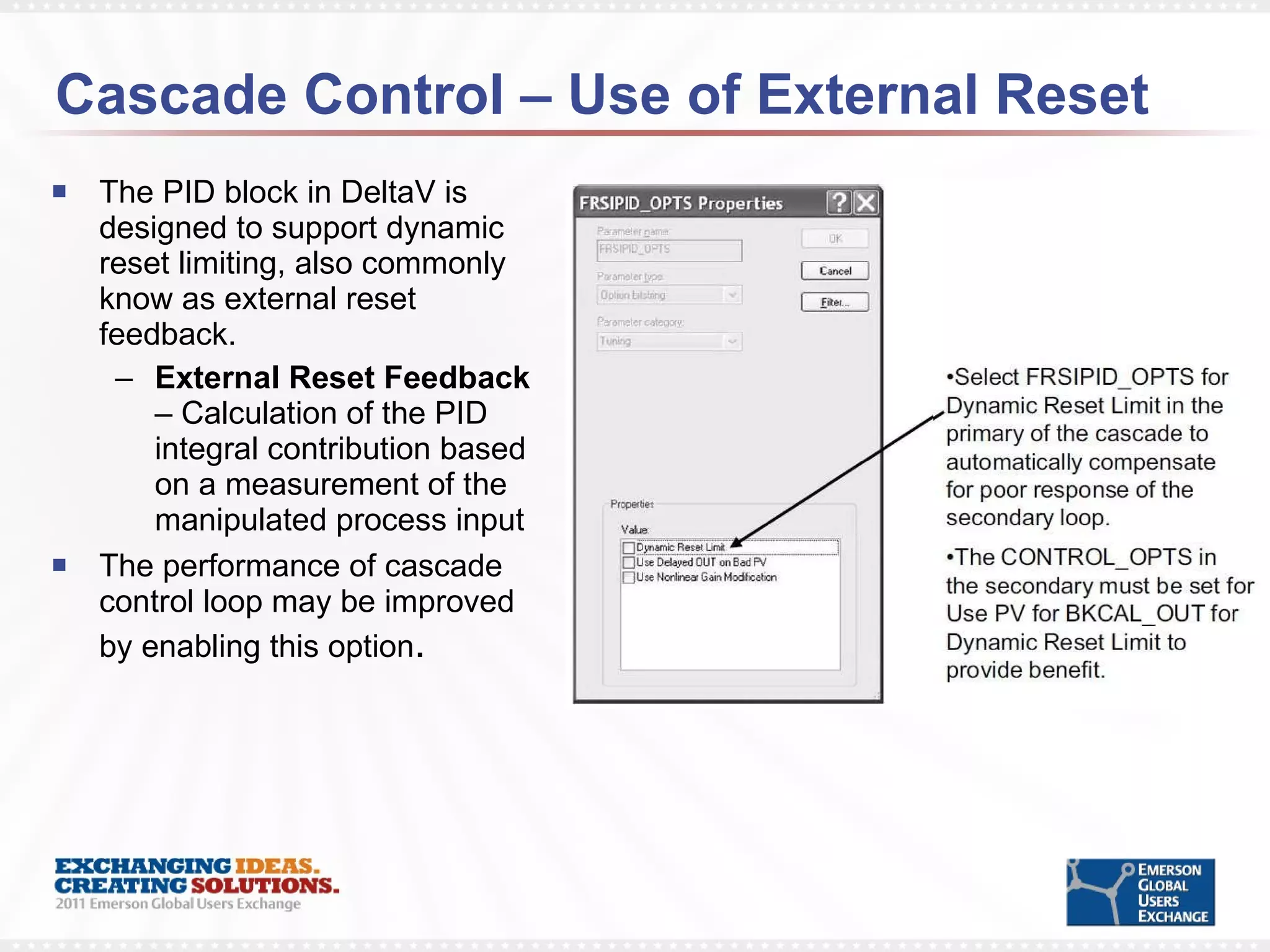
Cascade Control – Use of External Reset The PID block in DeltaV is designed to support dynamic reset limiting, also commonly know as external reset feedback. External Reset Feedback  –   Calculation of the PID integral contribution based on a measurement of the manipulated process input The performance of cascade control loop may be improved by enabling this option .
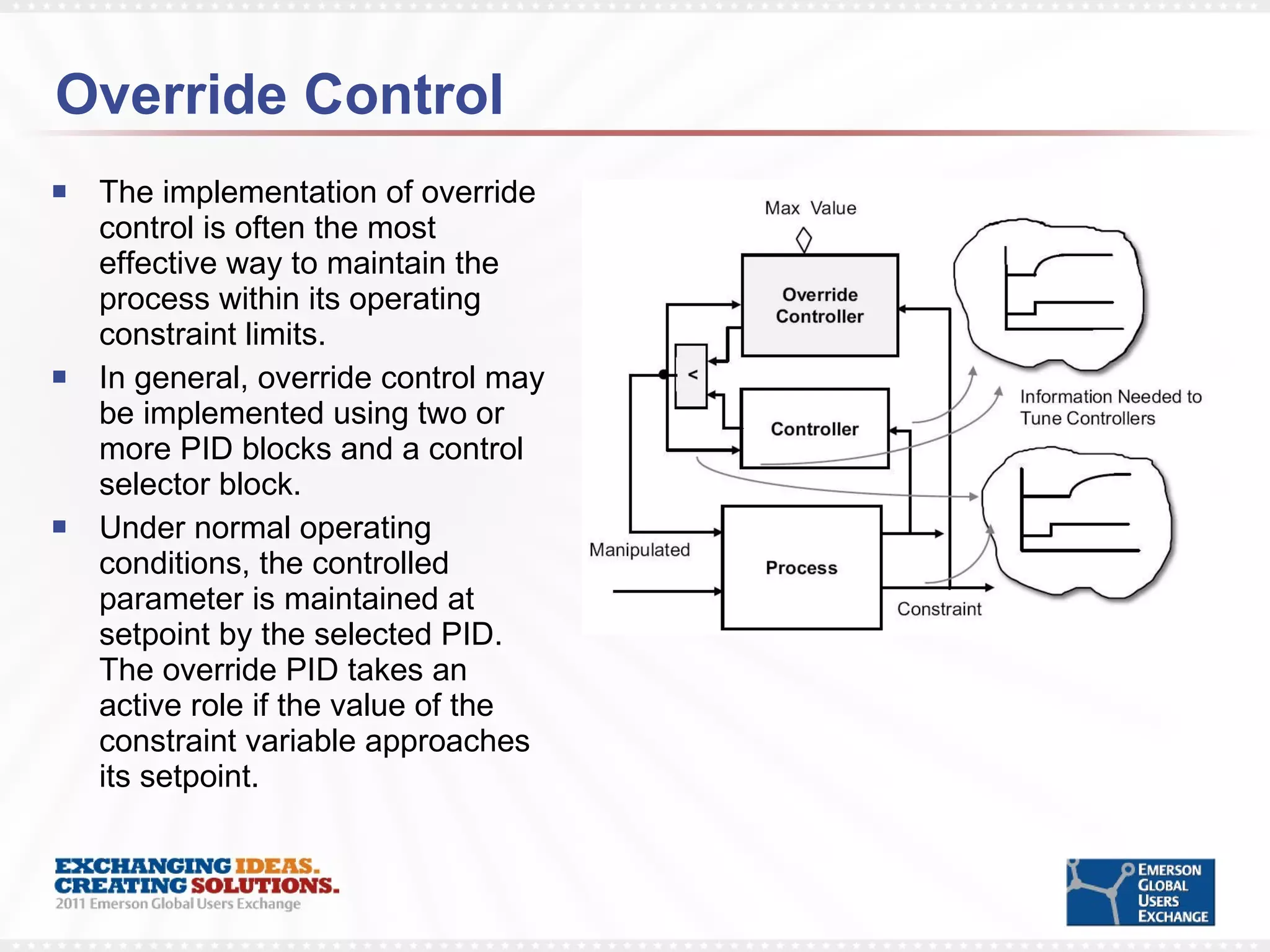
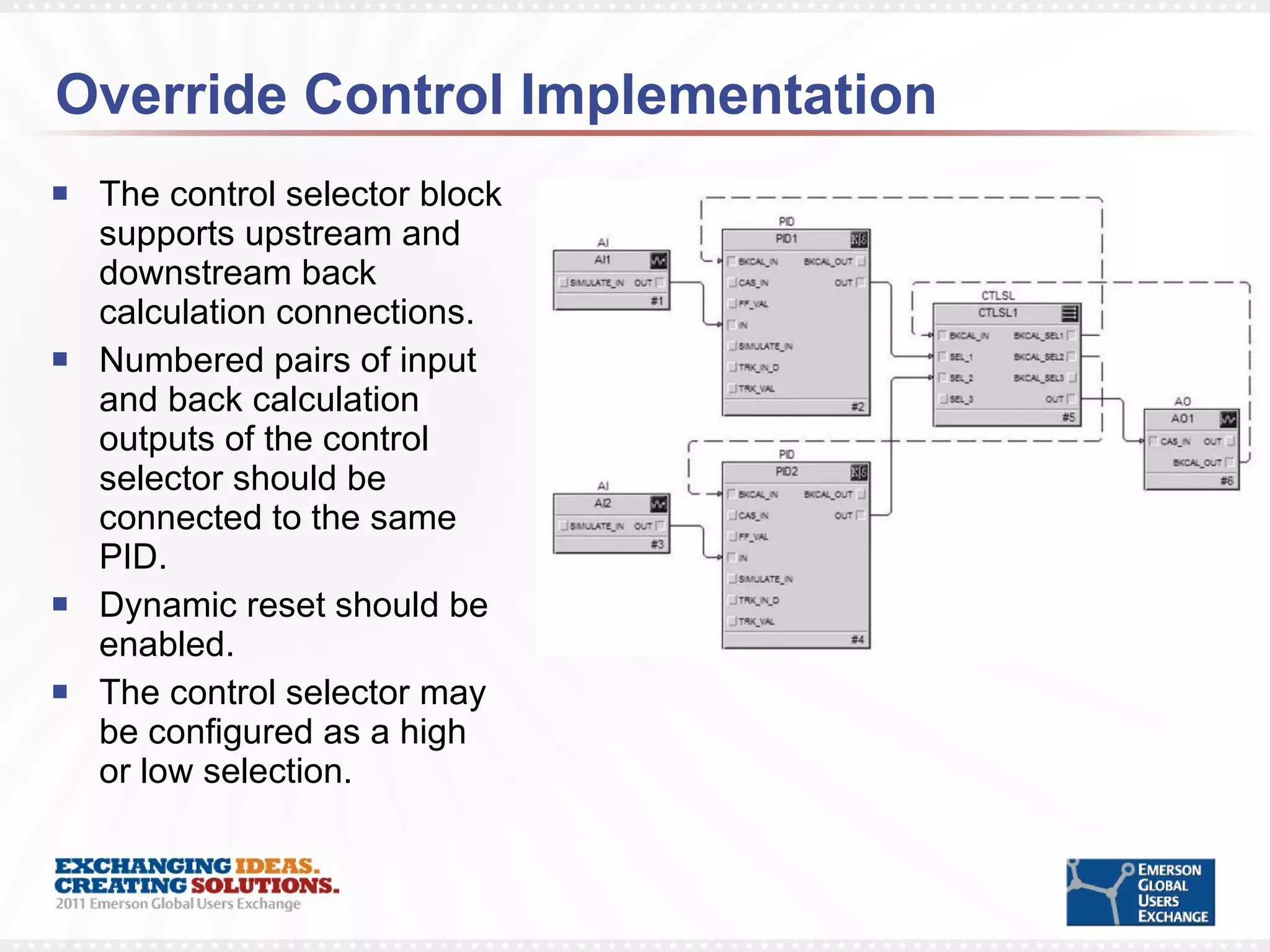
Override Control The implementation of override control is often the most effective way to maintain the process within its operating constraint limits.  In general, override control may be implemented using two or more PID blocks and a control selector block. Under normal operating conditions, the controlled parameter is maintained at setpoint by the selected PID. The override PID takes an active role if the value of the constraint variable approaches its setpoint.
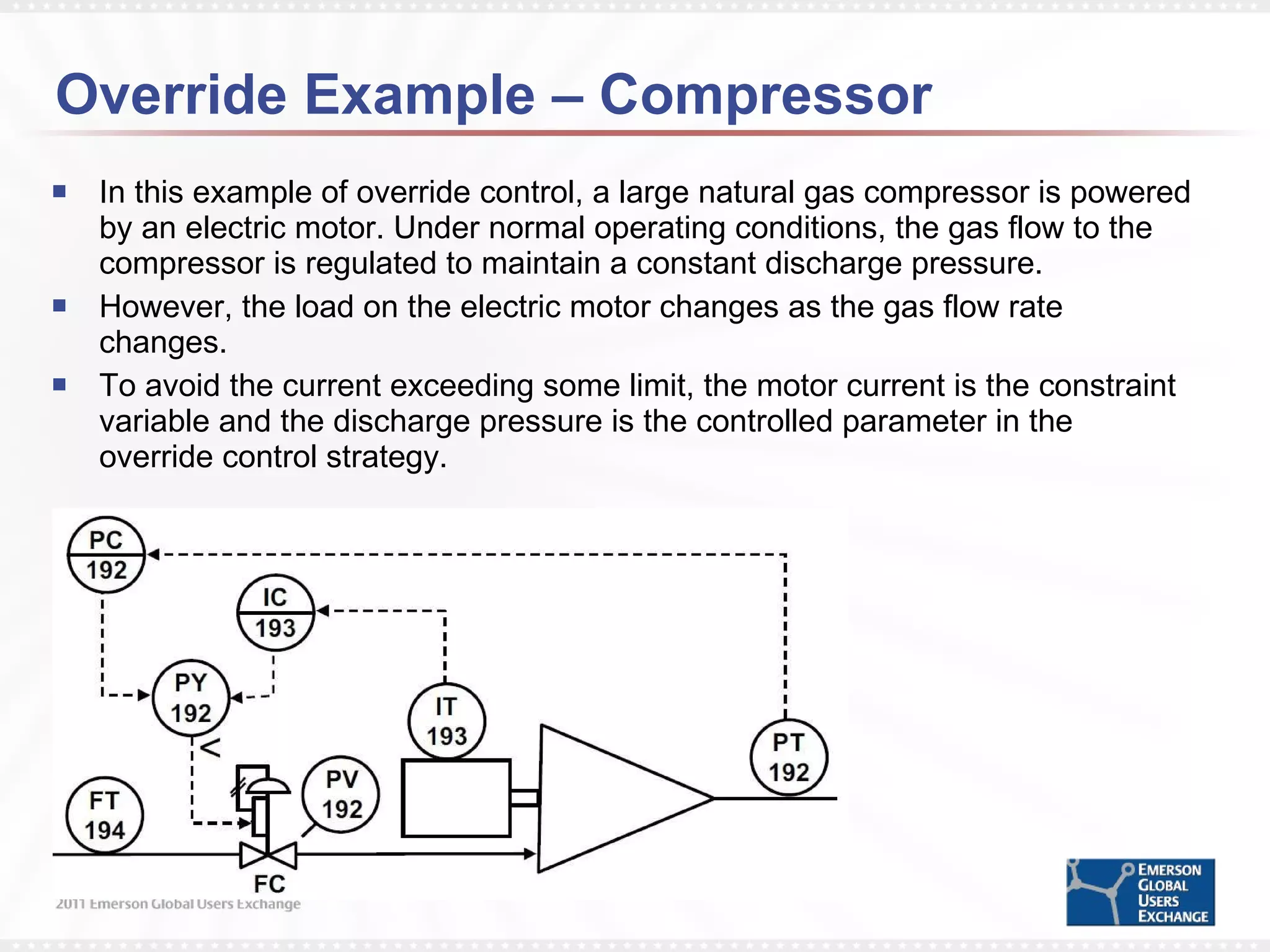
Override Example – Compressor In this example of override control, a large natural gas compressor is powered by an electric motor. Under normal operating conditions, the gas flow to the compressor is regulated to maintain a constant discharge pressure. However, the load on the electric motor changes as the gas flow rate changes.  To avoid the current exceeding some limit, the motor current is the constraint variable and the discharge pressure is the controlled parameter in the override control strategy.
Override Control Implementation The control selector block supports upstream and downstream back calculation connections.  Numbered pairs of input and back calculation outputs of the control selector should be connected to the same PID.  Dynamic reset should be enabled.  The control selector may be configured as a high or low selection.
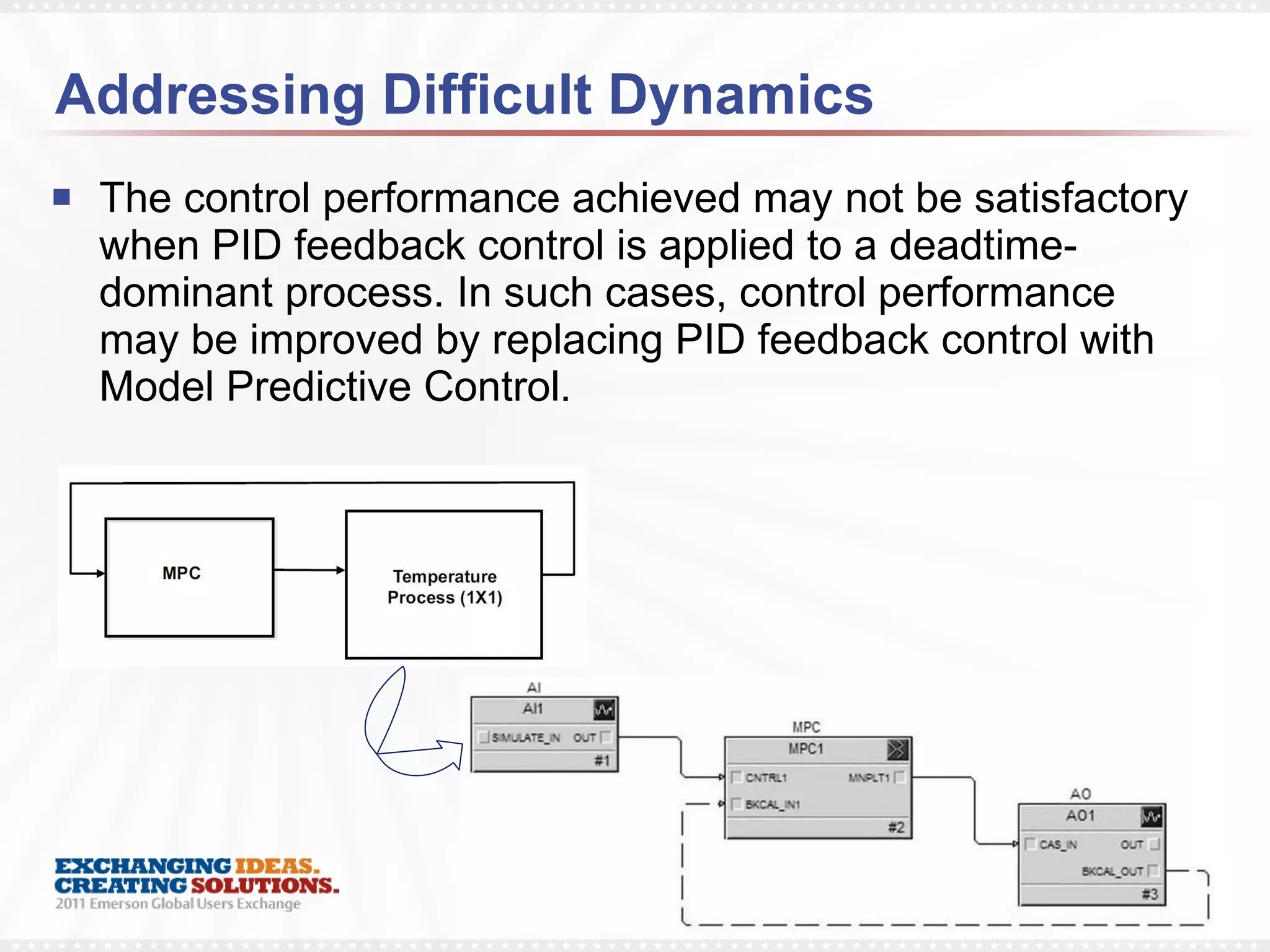
Addressing Difficult Dynamics The control performance achieved may not be satisfactory when PID feedback control is applied to a deadtime-dominant process. In such cases, control performance may be improved by replacing PID feedback control with Model Predictive Control.
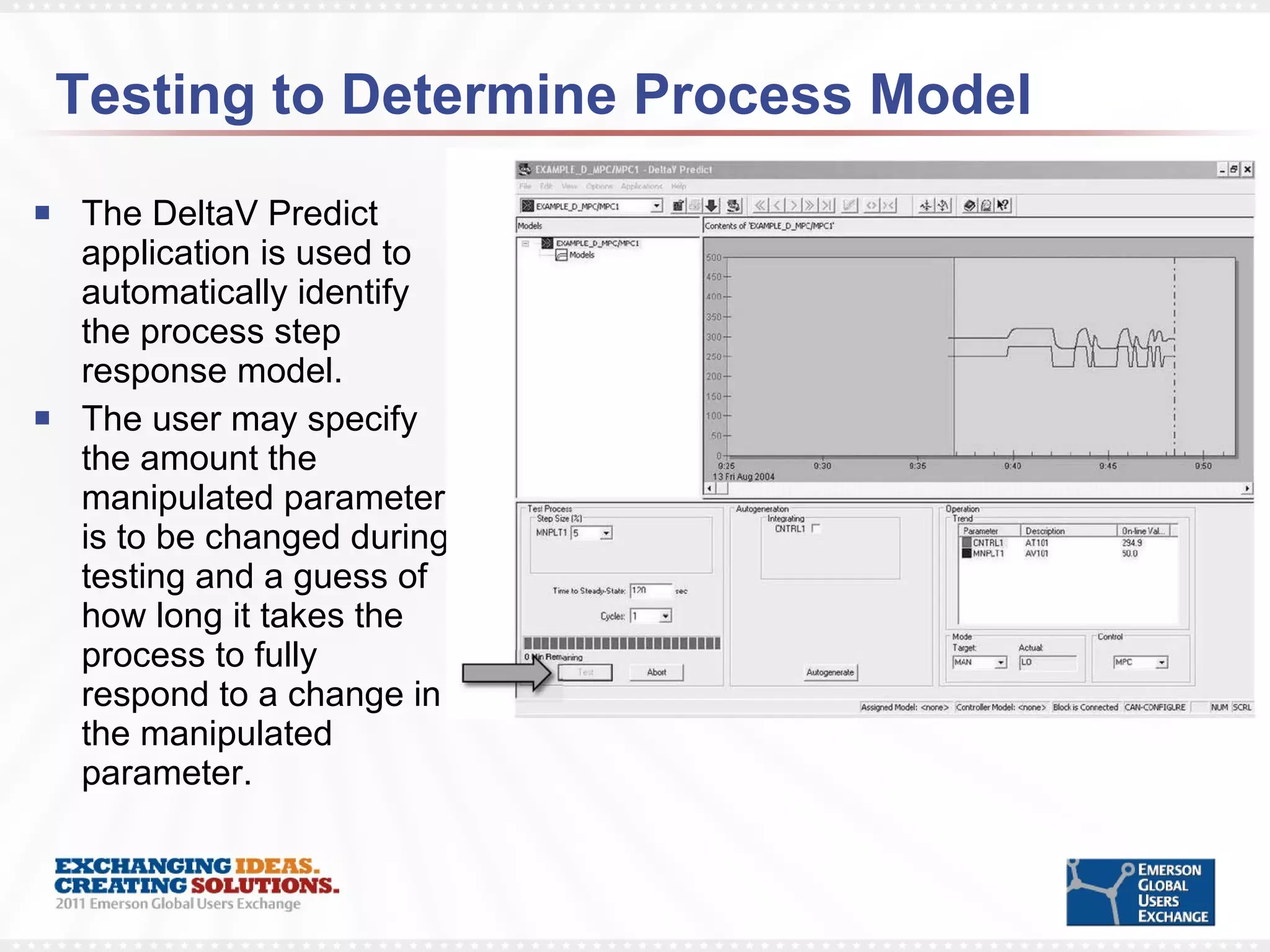
Testing to Determine Process Model The DeltaV Predict application is used to automatically identify the process step response model.  The user may specify the amount the manipulated parameter is to be changed during testing and a guess of how long it takes the process to fully respond to a change in the manipulated parameter.
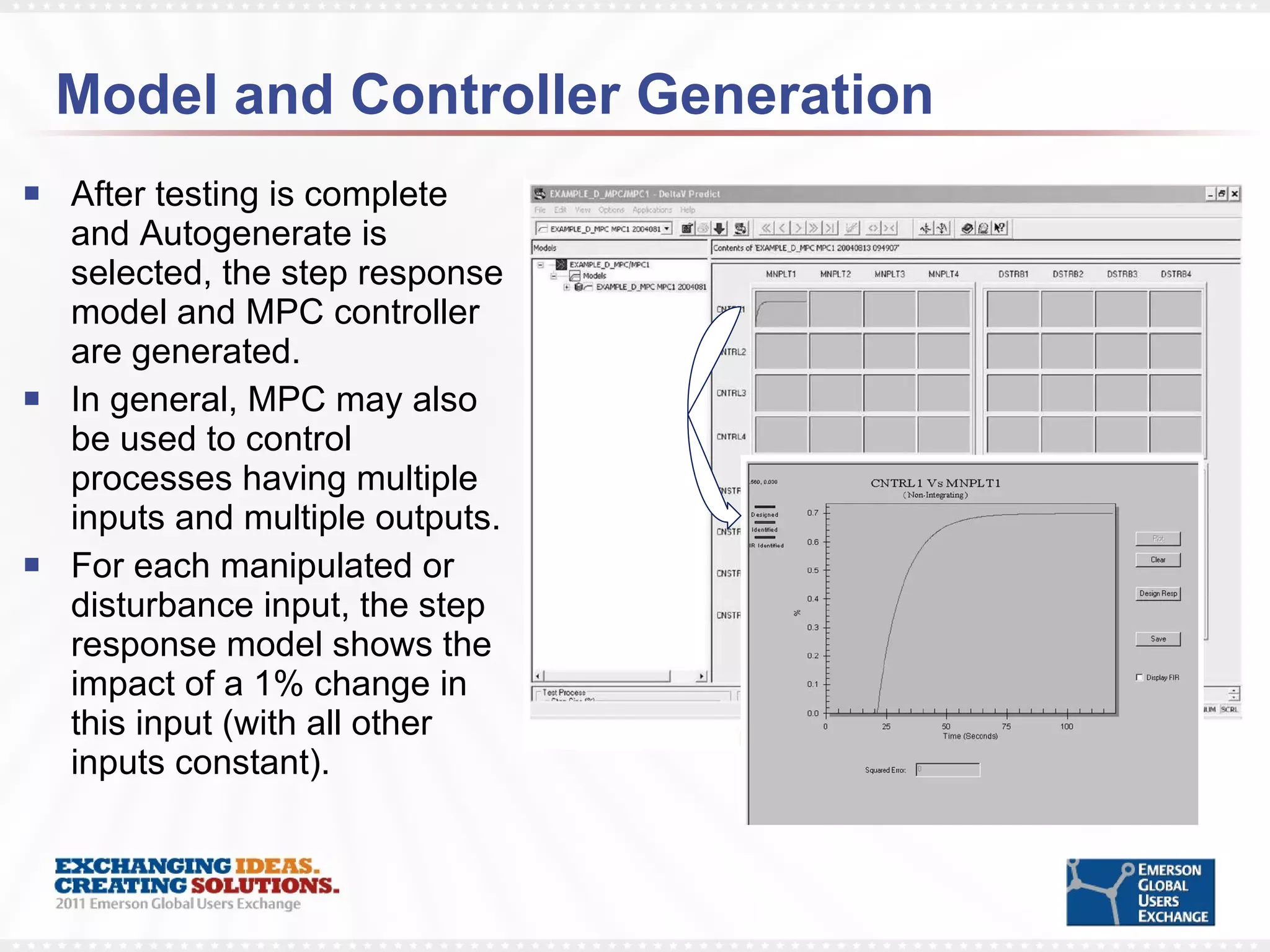
Model and Controller Generation After testing is complete and Autogenerate is selected, the step response model and MPC controller are generated. In general, MPC may also be used to control processes having multiple inputs and multiple outputs. For each manipulated or disturbance input, the step response model shows the impact of a 1% change in this input (with all other inputs constant).
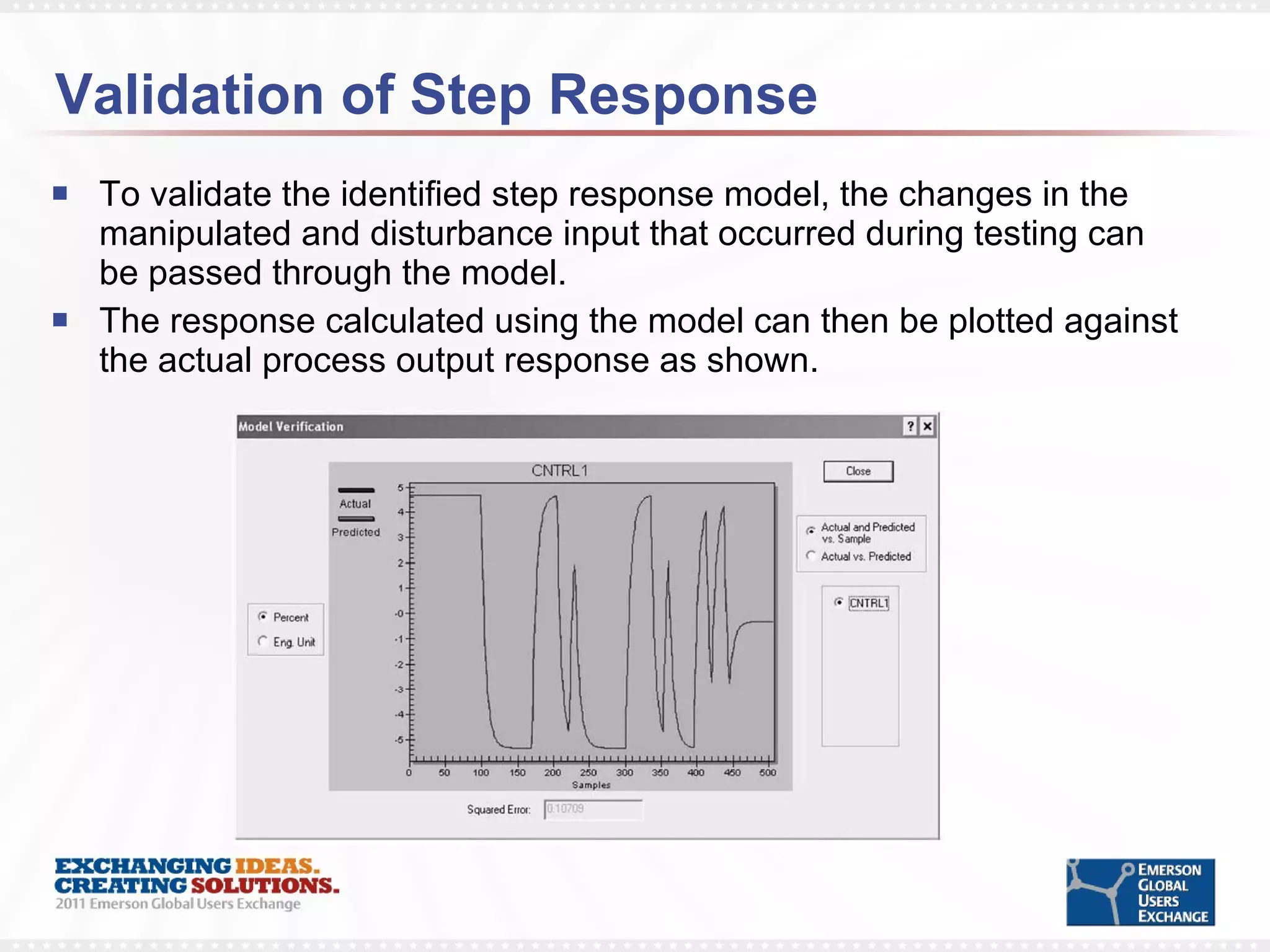
Validation of Step Response To validate the identified step response model, the changes in the manipulated and disturbance input that occurred during testing can be passed through the model.  The response calculated using the model can then be plotted against the actual process output response as shown.
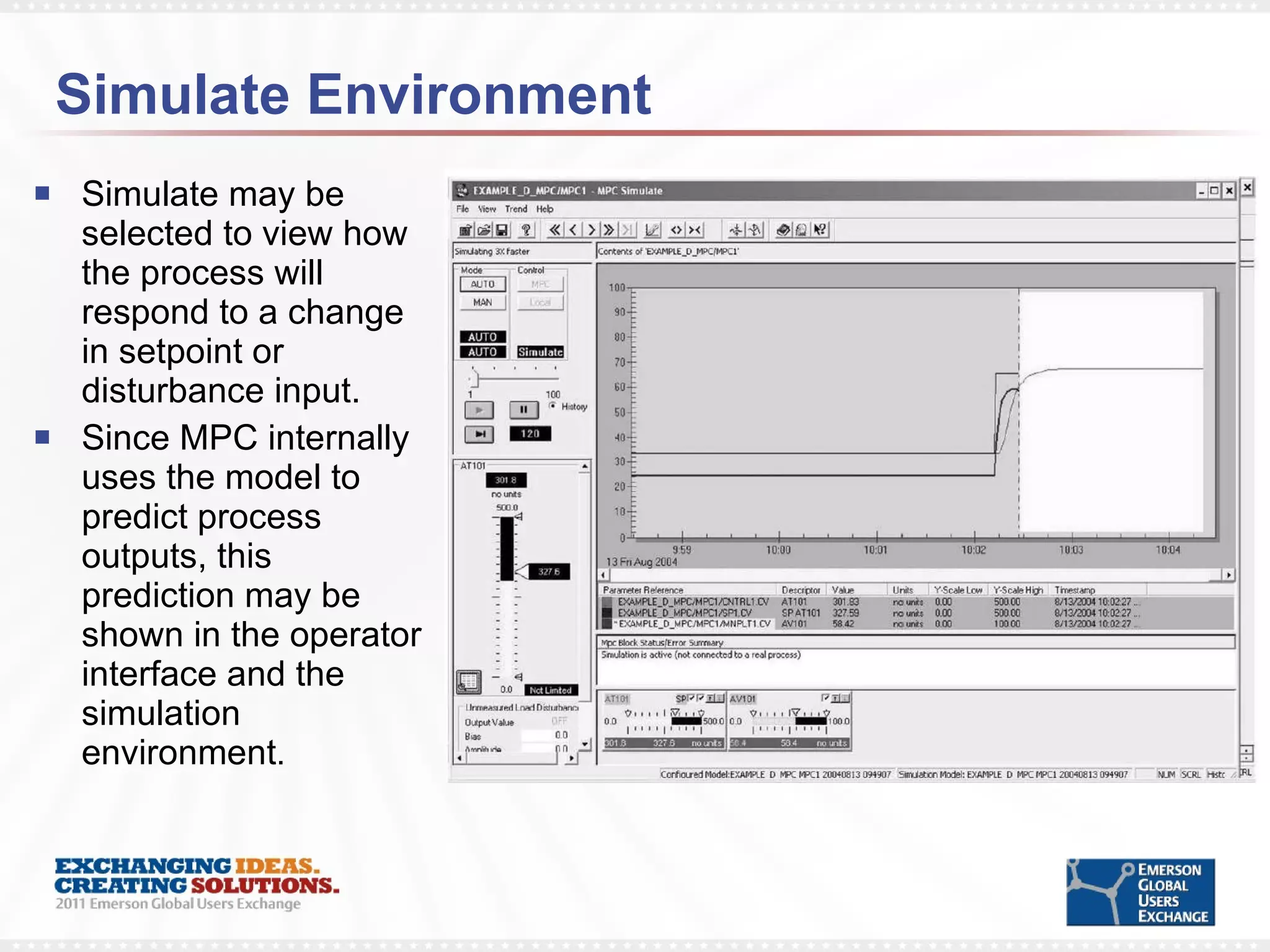
Simulate Environment Simulate may be selected to view how the process will respond to a change in setpoint or disturbance input.  Since MPC internally uses the model to predict process outputs, this prediction may be shown in the operator interface and the simulation environment .
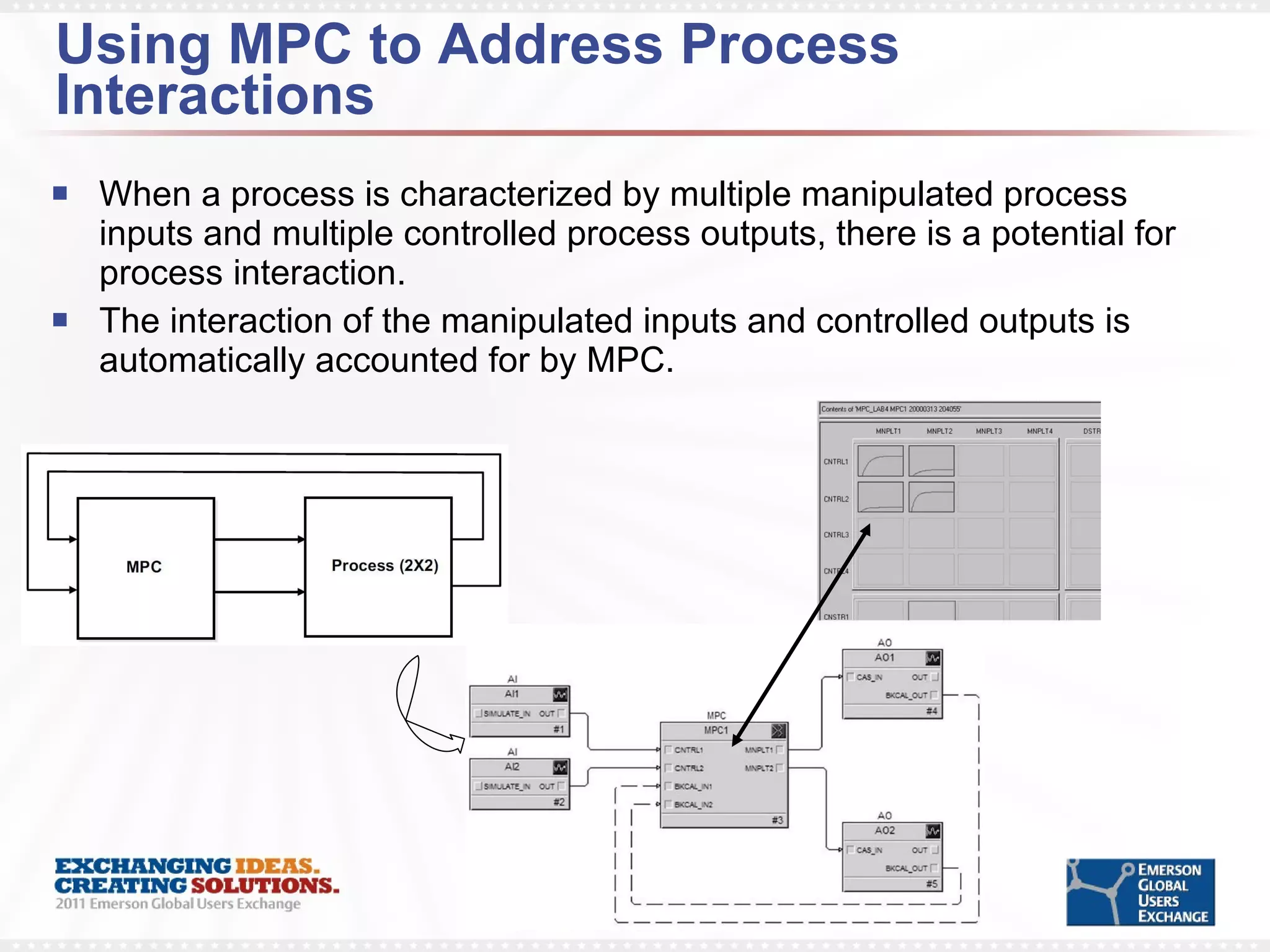
Using MPC to Address Process Interactions When a process is characterized by multiple manipulated process inputs and multiple controlled process outputs, there is a potential for process interaction.  The interaction of the manipulated inputs and controlled outputs is automatically accounted for by MPC.
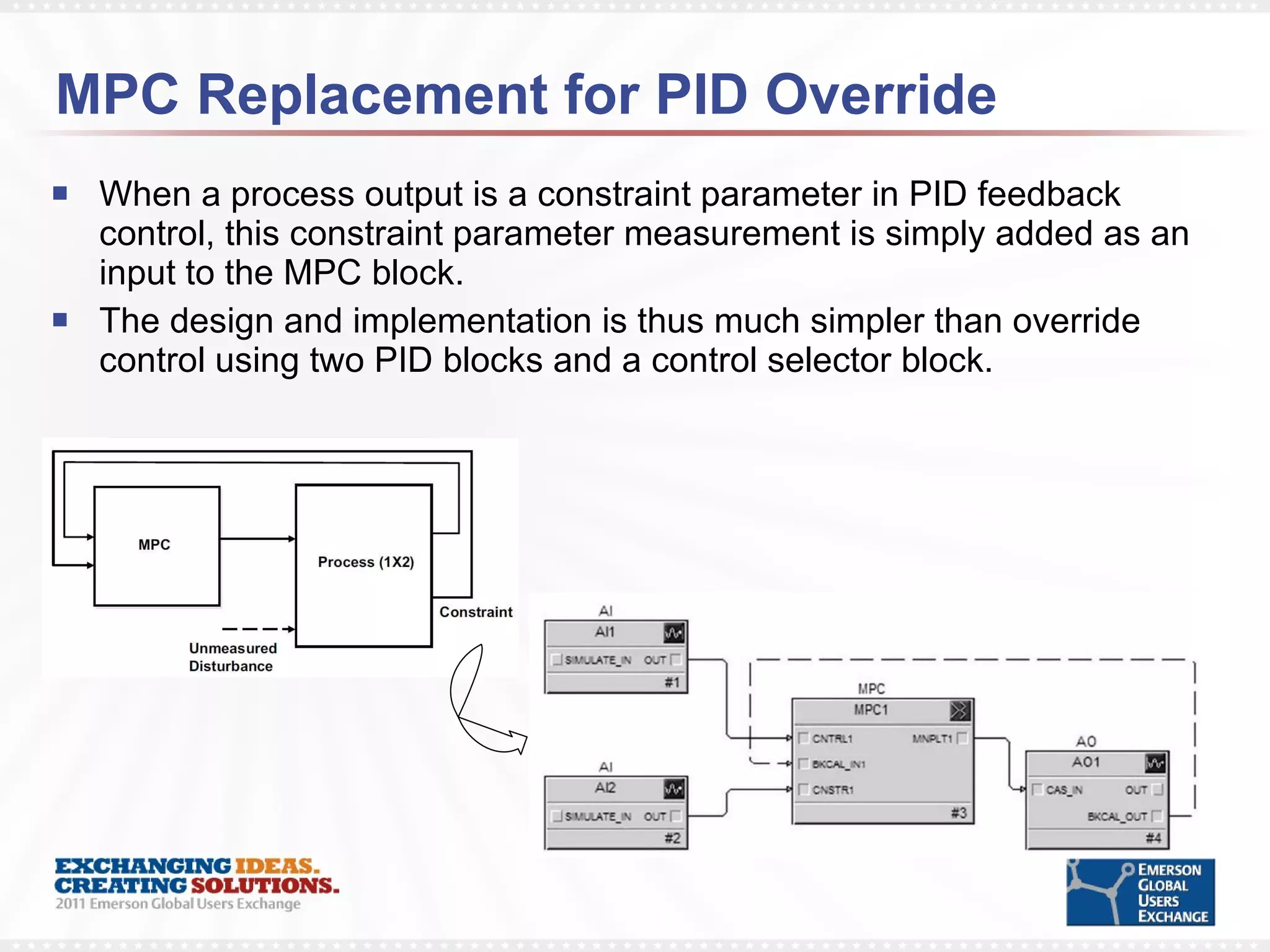
MPC Replacement for PID Override When a process output is a constraint parameter in PID feedback control, this constraint parameter measurement is simply added as an input to the MPC block.  The design and implementation is thus much simpler than override control using two PID blocks and a control selector block.
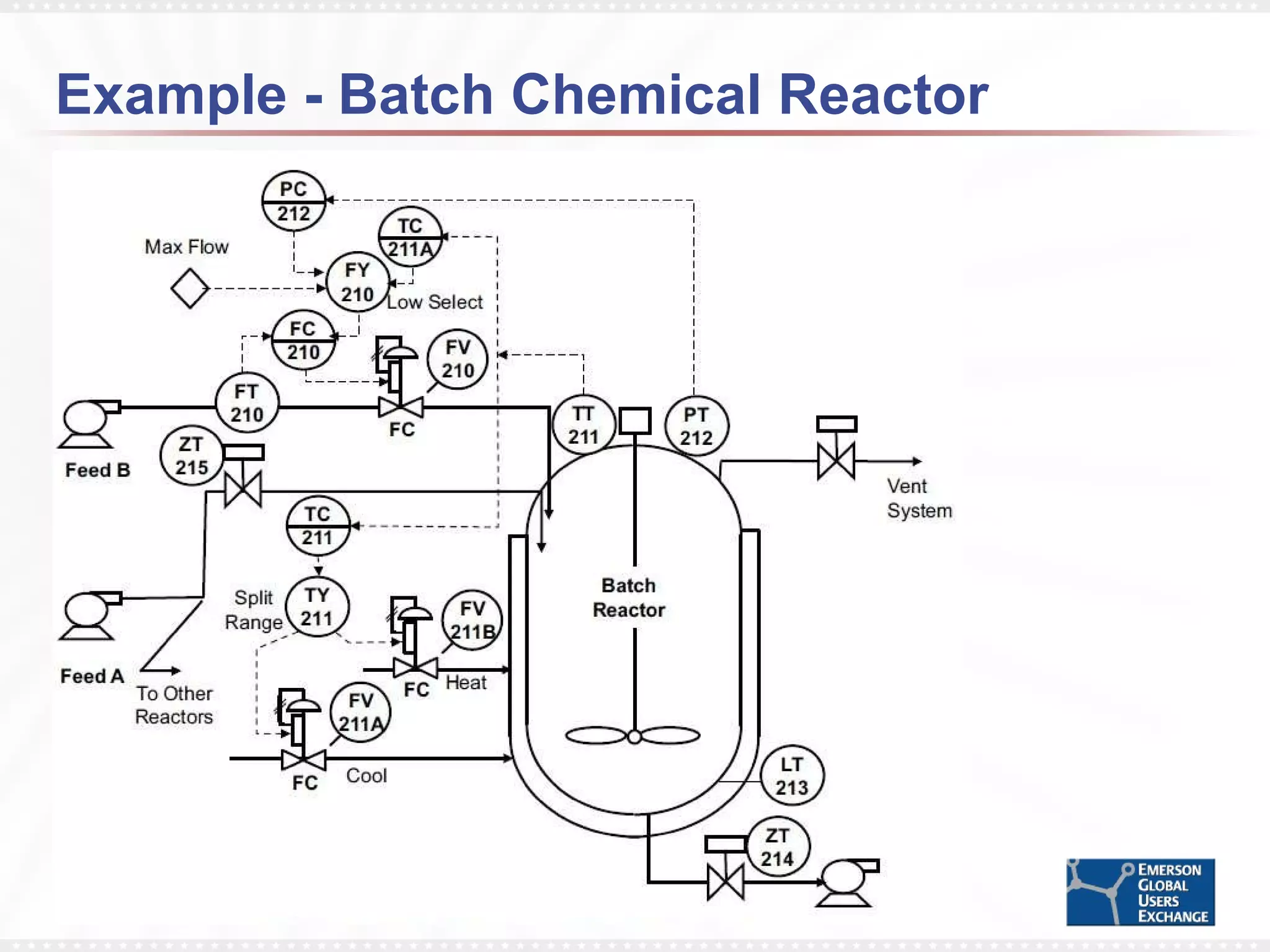
Example - Batch Chemical Reactor
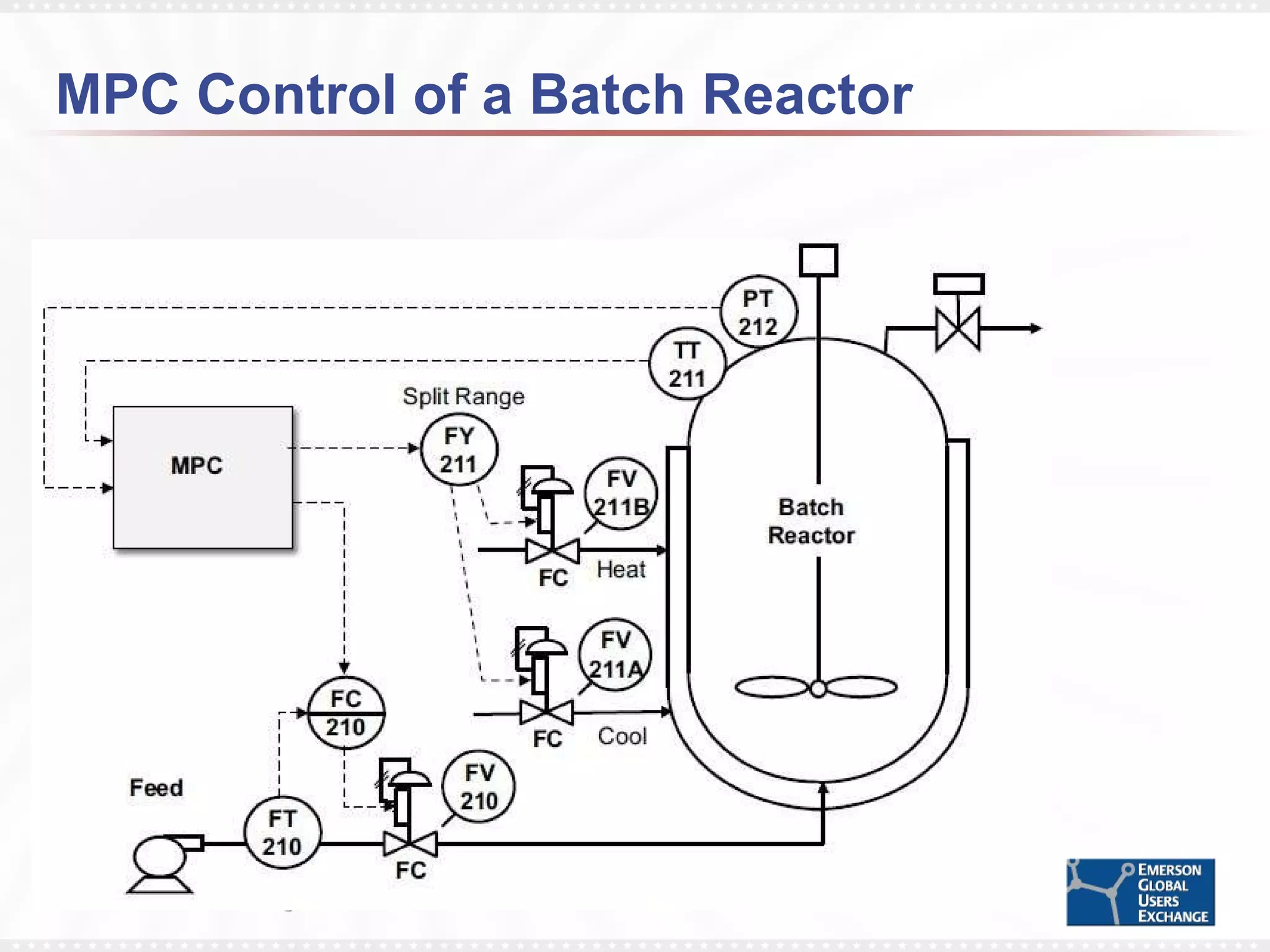
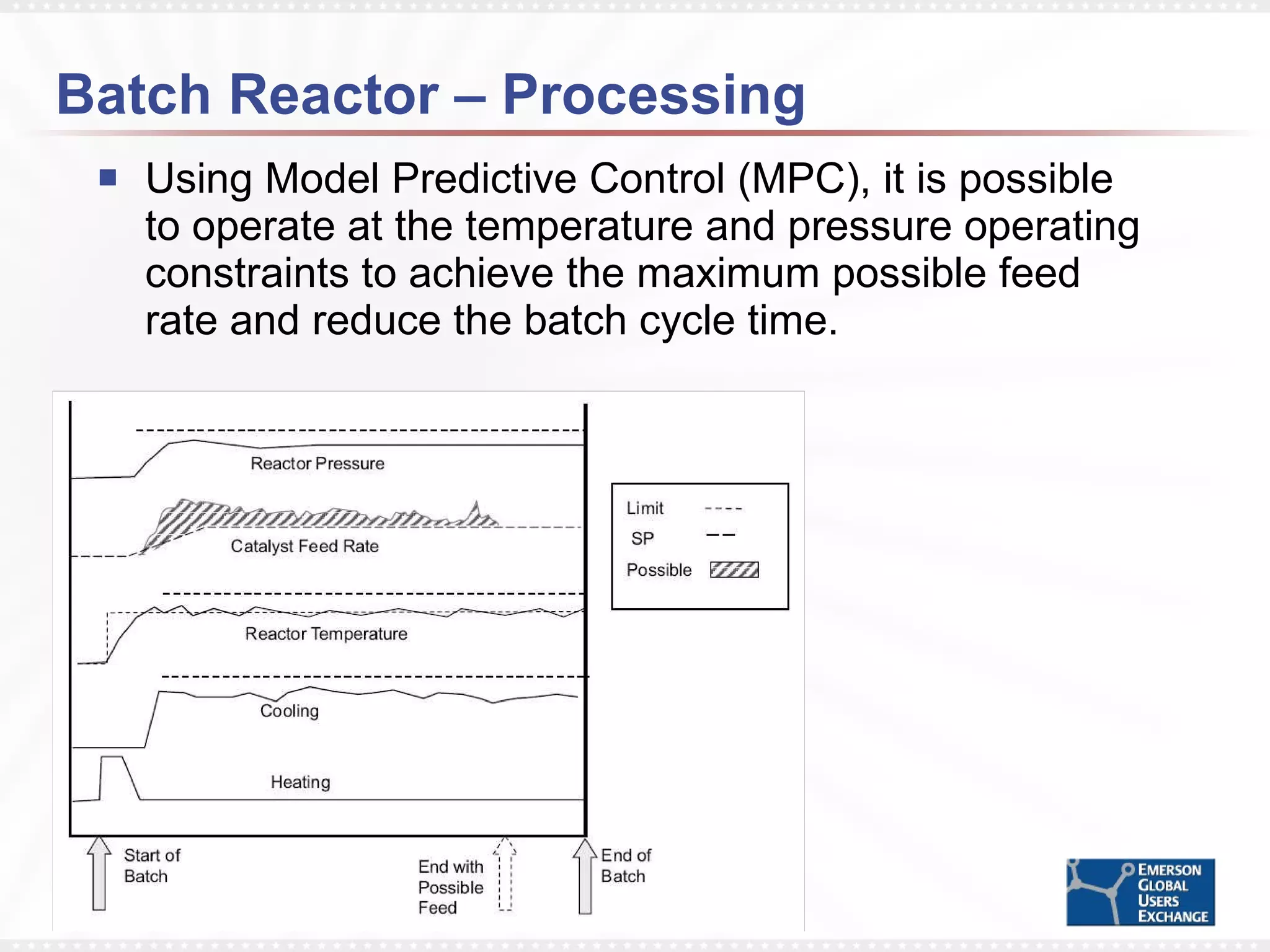
Batch Reactor – Processing Using Model Predictive Control (MPC), it is possible to operate at the temperature and pressure operating constraints to achieve the maximum possible feed rate and reduce the batch cycle time.
MPC Control of a Batch Reactor
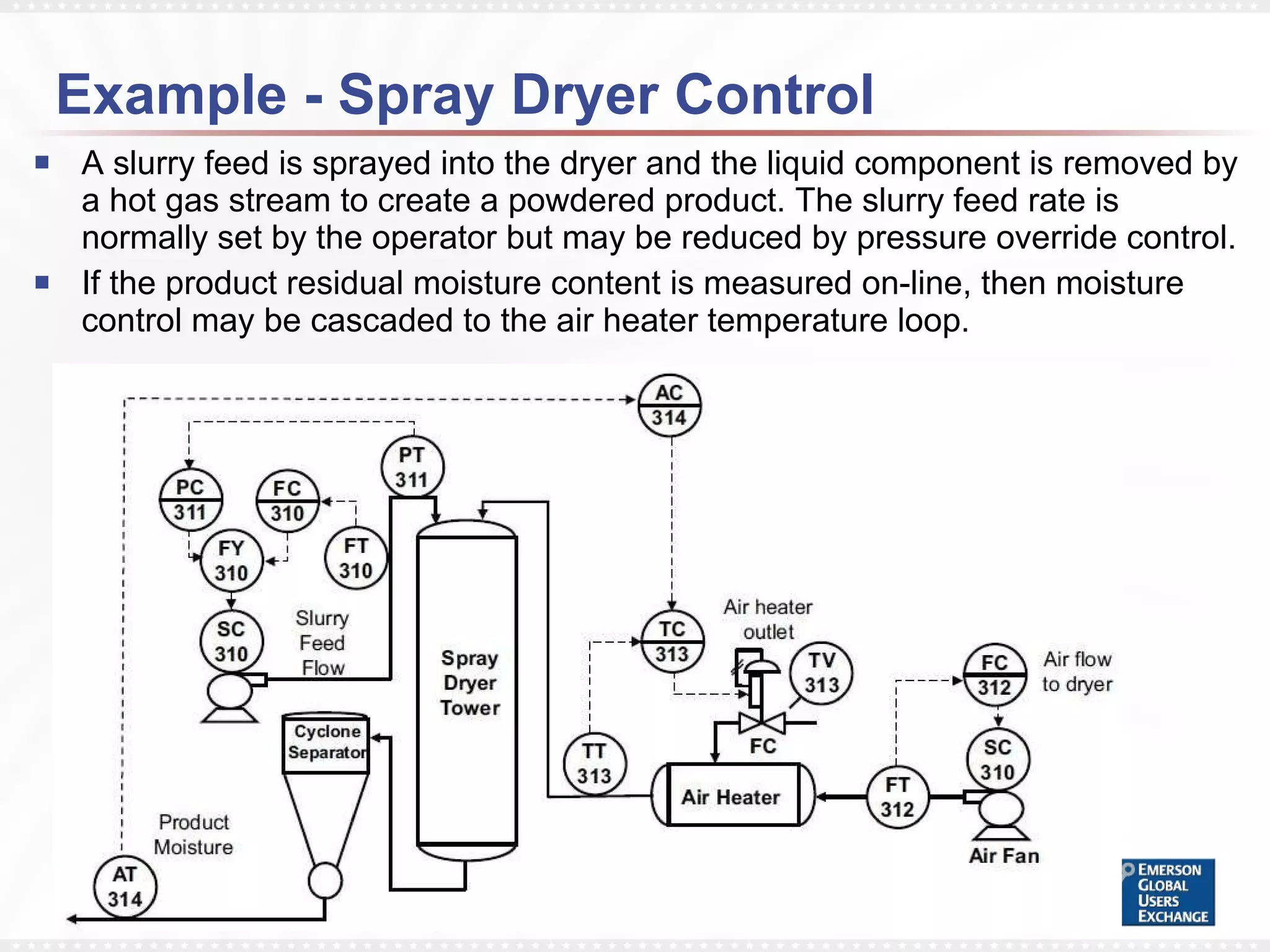
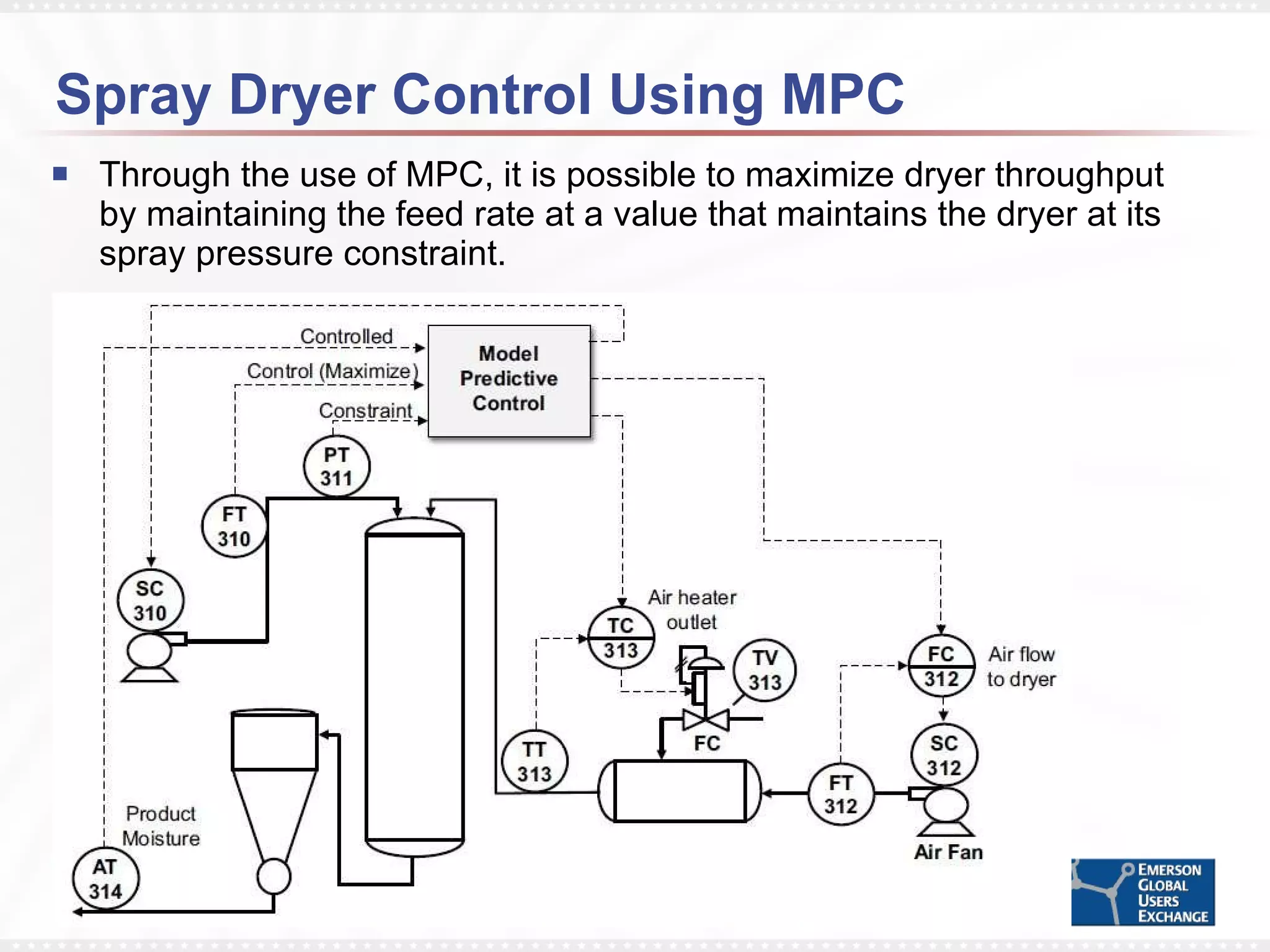
Example - Spray Dryer Control A slurry feed is sprayed into the dryer and the liquid component is removed by a hot gas stream to create a powdered product. The slurry feed rate is normally set by the operator but may be reduced by pressure override control.  If the product residual moisture content is measured on-line, then moisture control may be cascaded to the air heater temperature loop.
Spray Dryer Control Using MPC Through the use of MPC, it is possible to maximize dryer throughput by maintaining the feed rate at a value that maintains the dryer at its spray pressure constraint.
Summary An on-line measurement of control utilization and variability is provided by DeltaV Insight. Exploring the causes of poor utilization is the first step in resolving measurement, actuator or control issues. When single loop control is not sufficient to achieve the desired level of control the multi-loops solutions should be explored. MPC may be used to address difficult dynamic or process interactions that are difficult address using PID.
Where To Get More Information Many of the ideas discussed in this session are addressed “Control Loop Foundation – Batch and Continuous Processes”.  Information on this book may be found at the book’s web site: http://controlloopfoundation.com/   Also, by going to this web site you can use your web  browser to perform the 19 workshops that go with this book.

Maximizing the return on your control investment meet the experts sessions part2

  • 1.
    Maximizing the Returnon Your Control Investment Part 2 of 2 Meet the Experts Sessions
  • 2.
  • 3.
    Agenda Justifying theinstallation of multi-loop control techniques Recognizing when advanced control techniques are needed to achieve best control performance.
  • 4.
    When is ReducedVariability Important The objectives of a process control system generally fall into one of three categories: Economic Incentive Safety and Environmental Compliance Equipment Protection The degree to which a control loop must reduce variability depends in many cases on the objective of the control loop.
  • 5.
    Economic Incentive Theeconomics of plant operation may be impacted by process variation when maximum production and operating efficiency are achieved at a specific operating condition. In such cases, any variation from these operating conditions will reduce production.
  • 6.
    Impact of OperatingTarget When a process is characterized by having a global maximum, then performance may be worse if the setpoint is incorrect for the current operating conditions. A key point in control system installation and maintenance is that decreasing variability is desirable, but it is also important to specify the operating setpoints needed to achieve best process performance.
  • 7.
    Operating at aLimit If plant production is not limited by the market, that is, an increase in production can always be sold, then maximum profit may often be achieved by running the plant at maximum throughput. If production cannot be increased because of a physical limit in equipment operation, by reducing variation in the process operation, it is often possible to shift the production target to increase plant production without exceeding the physical limit in equipment operation.
  • 8.
    Impact of ReducedVariability By reducing the variation in an economic control loop, plant production may be increased without exceeding the limits associated with the process area that is the plant bottleneck. This simple concept is often the basis used to justify the cost of upgrading or installing a better control system in a plant.
  • 9.
  • 10.
    Example – Impactof Synthesis Bed Temperature
  • 11.
    Impact of SynthesisBed Temperature There is a strong incentive to install control capability that will automatically regulate the synthesis converter quench valve to maintain the bed temperature at setpoint. Since an ammonia plant may produce over 1000 tons of ammonia per day, even a small increase in production for a given feed rate can significantly increase the profit generated by the plant.
  • 12.
    Example – Impactof Loop Pressure
  • 13.
    Example – Impactof Loop Pressure The synthesis loop pressure control is an example of an economic control loop in which production is maximized by running as close as possible to a pressure limit. An average increase in synthesis loop pressure would provide a 0.05%/Atm increase in production.
  • 14.
    Utilize Process Capacityto Absorb Variability “ Capacity” in the process can be used to attenuate or absorb variability Primary source of process capacity is level control To utilize level control as a capacity tune the controller only “fast” enough to hold the PV within the allowable level deviation (ALD) for a maximum load change
  • 15.
    Utilize Process Capacityto Absorb Variability
  • 16.
    Utilize Process Capacityto Absorb Variability Choose the arrest time “slow” enough to provide a variability sink yet maintain level within the allowable variation Lambda = __ 2 * ALV___ Kp * MLD ALV = Allowable Level Variation Kp = Integrating process gain MLD = Maximum Load Disturbance (converted to % of level controller output scale)
  • 17.
    Utilize Process Capacityto Absorb Variability Level Manipulated Variable Before Level Manipulated Variable After
  • 18.
    Reducing Control VariationWhen tuning is not sufficient to achieved the desired level of variation in critical control parameter or to maintain it at an operating limit, then multi-loop techniques may sometimes be applied to improve control. Three common multi-loop techniques are: Feedforward Control Cascade Control Override Control
  • 19.
    Going Beyond SingleLoop Control The more advanced control techniques should only be considered if the control objectives cannot be achieved using basic single loop feedback control. Complex control strategies are more difficult to engineer, commission and maintain at optimal performance.
  • 20.
    Multi-loop Control –Feedforward Control If a measurement of the disturbance is available to the control system, then through the application of feedforward control, it is possible to anticipate the impact of the disturbance. Action can automatically be taken to correct for the measured disturbance before it impacts the controlled parameter. Feedforward control is always done in conjunction with feedback control
  • 21.
  • 22.
    Feedforward Control Ifthe process response to changes in the manipulated and disturbance inputs can be characterized as first-order plus deadtime, then the difference in the process response may be compensated for by using a deadtime block and a lead-lag block in the feedforward path.
  • 23.
    Cascade Control Cascadecontrol may be applied when a process is composed of two or more (sub)processes in series. Any change in the manipulated input to the first process in the series will impact the output of the other processes. The output of each process in the series is the controlled parameter of the PID associated with that process.
  • 24.
    Cascade Control –Benefits The primary benefits of cascade control are: The PID at each point in the cascade can react quickly to disturbance inputs to its associated process. If the PID responds quickly enough, changes introduced by disturbance inputs will have little or no impact on the downstream processes. Cascade control may be implemented to compensate for the non-linear installed characteristic of a regulating valve. The slave loop could be tuned to quickly adjust the valve to achieve its setpoint requested by the master loop. Thus, the non-linear installed characteristic of the valve would have no impact on the tuning or response of the master loop.
  • 25.
    Example – BoilerSteam Temperature The temperature of steam supplied by utility boilers can have a large impact on process operation. In an attemperator, steam is mixed with water to regulate the temperature of steam exiting the boiler. The spray valve is used to adjust the flow rate of water introduced into the attemperator.
  • 26.
    Cascade Control ImplementationCascade control may be implemented when a process is made up of a series of processes. One PID block is required for each process in the series. For normal operations, the master loop is maintained in Automatic mode and the slave loop is operated in Cascade mode.
  • 27.
    Cascade Control –Use of External Reset The PID block in DeltaV is designed to support dynamic reset limiting, also commonly know as external reset feedback. External Reset Feedback – Calculation of the PID integral contribution based on a measurement of the manipulated process input The performance of cascade control loop may be improved by enabling this option .
  • 28.
    Override Control Theimplementation of override control is often the most effective way to maintain the process within its operating constraint limits. In general, override control may be implemented using two or more PID blocks and a control selector block. Under normal operating conditions, the controlled parameter is maintained at setpoint by the selected PID. The override PID takes an active role if the value of the constraint variable approaches its setpoint.
  • 29.
    Override Example –Compressor In this example of override control, a large natural gas compressor is powered by an electric motor. Under normal operating conditions, the gas flow to the compressor is regulated to maintain a constant discharge pressure. However, the load on the electric motor changes as the gas flow rate changes. To avoid the current exceeding some limit, the motor current is the constraint variable and the discharge pressure is the controlled parameter in the override control strategy.
  • 30.
    Override Control ImplementationThe control selector block supports upstream and downstream back calculation connections. Numbered pairs of input and back calculation outputs of the control selector should be connected to the same PID. Dynamic reset should be enabled. The control selector may be configured as a high or low selection.
  • 31.
    Addressing Difficult DynamicsThe control performance achieved may not be satisfactory when PID feedback control is applied to a deadtime-dominant process. In such cases, control performance may be improved by replacing PID feedback control with Model Predictive Control.
  • 32.
    Testing to DetermineProcess Model The DeltaV Predict application is used to automatically identify the process step response model. The user may specify the amount the manipulated parameter is to be changed during testing and a guess of how long it takes the process to fully respond to a change in the manipulated parameter.
  • 33.
    Model and ControllerGeneration After testing is complete and Autogenerate is selected, the step response model and MPC controller are generated. In general, MPC may also be used to control processes having multiple inputs and multiple outputs. For each manipulated or disturbance input, the step response model shows the impact of a 1% change in this input (with all other inputs constant).
  • 34.
    Validation of StepResponse To validate the identified step response model, the changes in the manipulated and disturbance input that occurred during testing can be passed through the model. The response calculated using the model can then be plotted against the actual process output response as shown.
  • 35.
    Simulate Environment Simulatemay be selected to view how the process will respond to a change in setpoint or disturbance input. Since MPC internally uses the model to predict process outputs, this prediction may be shown in the operator interface and the simulation environment .
  • 36.
    Using MPC toAddress Process Interactions When a process is characterized by multiple manipulated process inputs and multiple controlled process outputs, there is a potential for process interaction. The interaction of the manipulated inputs and controlled outputs is automatically accounted for by MPC.
  • 37.
    MPC Replacement forPID Override When a process output is a constraint parameter in PID feedback control, this constraint parameter measurement is simply added as an input to the MPC block. The design and implementation is thus much simpler than override control using two PID blocks and a control selector block.
  • 38.
    Example - BatchChemical Reactor
  • 39.
    Batch Reactor –Processing Using Model Predictive Control (MPC), it is possible to operate at the temperature and pressure operating constraints to achieve the maximum possible feed rate and reduce the batch cycle time.
  • 40.
    MPC Control ofa Batch Reactor
  • 41.
    Example - SprayDryer Control A slurry feed is sprayed into the dryer and the liquid component is removed by a hot gas stream to create a powdered product. The slurry feed rate is normally set by the operator but may be reduced by pressure override control. If the product residual moisture content is measured on-line, then moisture control may be cascaded to the air heater temperature loop.
  • 42.
    Spray Dryer ControlUsing MPC Through the use of MPC, it is possible to maximize dryer throughput by maintaining the feed rate at a value that maintains the dryer at its spray pressure constraint.
  • 43.
    Summary An on-linemeasurement of control utilization and variability is provided by DeltaV Insight. Exploring the causes of poor utilization is the first step in resolving measurement, actuator or control issues. When single loop control is not sufficient to achieve the desired level of control the multi-loops solutions should be explored. MPC may be used to address difficult dynamic or process interactions that are difficult address using PID.
  • 44.
    Where To GetMore Information Many of the ideas discussed in this session are addressed “Control Loop Foundation – Batch and Continuous Processes”. Information on this book may be found at the book’s web site: http://controlloopfoundation.com/ Also, by going to this web site you can use your web browser to perform the 19 workshops that go with this book.