Dr AshwiniWadegaonkar
pH Meter
Content
 pH meter Introduction
 Glass pH electrode
 Combination of pH electrode
 Complete Cell
 Standard Buffer –reference for pH measurement
 Accuracy of pH measurement
 Using pH meter –How does it work?
 Applications of pH meter
pH
 The hydrogen ion concentration or pH is a measure of the
acidity or alkalinity of a solution.
 pH = 1 log 10 (H+)
 (H+) is the hydrogen ion concentration of the solution in
moles per liter.
 In an aqueous solution, the product of hydrogen ion
concentration and hydroxyl ion concentration is constant.
 At a temperature of 22, this product conveniently happens to
be exactly 10-14 (expressed in gramme-molecules per liter).
 The pH of solution is defined as the negative logarithm of the
hydrogen ion concentration, in an aqueous solution.
 Scale of pH meter: 0 to 14 pH
 An acid sol. : Less than 7.0
 A basic sol. : greater than 7.0
 A neutral sol. : 7
 A change of one pH unit corresponds to a 10 fold change of
hydrogen-ion conc. of the soln.
 A pH meter is a scientific instrument that measures
the hydrogen-ion activity in water-based solutions,
indicating its acidity or alkalinity expressed as pH
 pH is the unit of measure that describes the degree of acidity
or alkalinity. It is measured on a scale of 0 to 14
 The pH value of substance is directly related to the ratio of
hydrogen ion [H+] and the hydroxyl ion [OH-]
Introduction
 The material is acidic if [H+] concentration is greater than [OH-].
The pH value is less than 7
 The material is neutral if [H+] concentration is equal to [OH-].
The pH value is 7
 The material is basic if [H+] concentration is less than [OH-].The
pH value is greater than 7
 Acids and bases have free [H+] and [OH-] ions respectively.
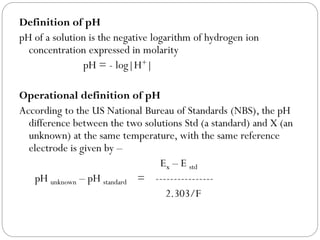
Definition of pH
pH of a solution is the negative logarithm of hydrogen ion
concentration expressed in molarity
pH = - log|H+|
Operational definition of pH
According to the US National Bureau of Standards (NBS), the pH
difference between the two solutions Std (a standard) and X (an
unknown) at the same temperature, with the same reference
electrode is given by –
Ex – E std
pH unknown – pH standard = ----------------
2.303/F
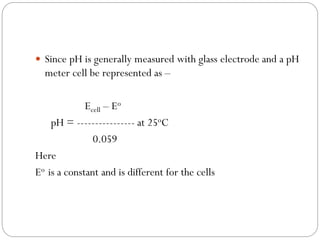
 Since pH is generally measured with glass electrode and a pH
meter cell be represented as –
Ecell – Eo
pH = ---------------- at 25oC
0.059
Here
Eo is a constant and is different for the cells
Principle
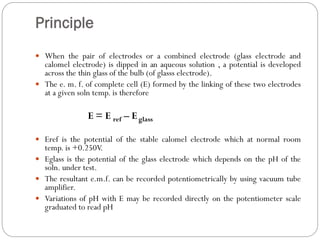
 When the pair of electrodes or a combined electrode (glass electrode and
calomel electrode) is dipped in an aqueous solution , a potential is developed
across the thin glass of the bulb (of glasss electrode).
 The e. m. f. of complete cell (E) formed by the linking of these two electrodes
at a given soln temp. is therefore
E = E ref – E glass
 Eref is the potential of the stable calomel electrode which at normal room
temp. is +0.250V.
 Eglass is the potential of the glass electrode which depends on the pH of the
soln. under test.
 The resultant e.m.f. can be recorded potentiometrically by using vacuum tube
amplifier.
 Variations of pH with E may be recorded directly on the potentiometer scale
graduated to read pH
Electrodes in pH determination
 For finding the pH of the solution one should use an
electrode reversible to H+ ions.
 The glass electrode which is reversible to H+ ions, is the
most commonly used as indicator electrode.
 Generally calomel electrode is used as reference electrode.
 The most widely used ion-selective electrode is the glass pH
electrode, which utilizes a thin glass membrane that is
responsive to changes in H+ activity
Important Components of pH Meter
 1. Glass electrode 2. Calomel electrode 3. Electrometer
 1.Glass Electrode:
It consists of a very thin bulb about 0.1 mm thick blown on
to a hard glass tube of high resistance.
The bulb contains 0.1 mol/litre HCL connected to a
platinum wire via a silver-silver chloride combination.
2.Calomel electrode:
It consists of a glass tube containing saturated KCl connected
to a platinum wires through mercury-mercurous chloride
paste.
3.Electrometer:
Which is a device capable of measuring very small
differences in electrical potentials in a circuit of extremely
high resistance.
Working Mechanism
 An acidic solution has far more positively charged hydrogen
ions than an alkaline one, so it has greater potential to
produce an electric current in a certain situation.
 In other words, it is a bit like a battery that can produce a
greater voltage.
 A pH meter takes advantage of this and works like a
voltmeter: it measures the voltage (electrical potential)
produced by the solution.
 When two electrodes (or one probe containing the two
electrodes) are dipped into solution, some of the hydrogen
ions in the solution move toward the glass electrode and
replace some of the metal ions in its special glass coating.
 This creates a tiny voltage across the glass the silver electrode
picks up and passes to the voltmeter.
 Reference electrode acts as a baseline or reference for the
measurement.
 A voltmeter measures the voltage generated by the solution
and displays it as a pH-measurement.
 An increase in voltage means more hydrogen ions and an
increase in acidity, so the meter shows it as a decrease in pH;
in the same way, a decrease in voltage means fewer hydrogen
ions, more hydroxide ions, a decrease in acidity, an increase
in alkalinity, and an increase in pH.
 ↑ voltage = more H+ /less OH - = ↑ acidity = ↓pH
 ↓ voltage = less H+ /more OH - = ↓ acidity = ↑pH
Glass pH electrode
 The most widely used - For pH measurements (selective ion
is H+ ) - Response is fast, stable, and has broad range - pH
changes by 1 when [H+ ] changes by a factor of 10 - Potential
difference is 0.05196V when [H+ ] changes by a factor of 10
For a change in pH from 3.00 to 6.00 (3.00 units) Potential
difference = 3.00 x 0.05196V = 0.177
 pH GLASS ELECTRODE - Thin glass membrane (bulb)
consists of SiO4 - Most common composition is SiO2,
Na2O, and CaO Glass membrane contains - dilute HCl
solution - inbuilt reference electrode (Ag wire coated with
AgCl)
 Equilibrium establishes across the glass membrane with
respect to H+ in inner and outer solutions –
 This produces the potential, E - Linearity between pH and
potential - Calibration plot yields slope = 59 mV/pH units -
Electrode is prevented from drying out by storing in aqueous
solution when not in use
Advantages of glass electrode
 Used in solutions with pH values ranging from 1 to 12
 Lithium glass electrode can be used to measure upto 14
 Well suited for continuous automatic recording and control
of industrial and commercial processes
 Permits rapid measurements
 Simple to operate
 Used for both oxidising and reducing solutions
 Does not affect solution under examination
 Can be used in coloured, turbid and colloidal solutions.
Disadvantages of using glass electrode
 Due to high resistance ordinary potentiometer cannot be used.
 In solutions of proteins and other colloids that tend to adhere to
the sensitive membrane, the glass electrode may yield erroneous
results.
 Cannot be used in acid fluoride solutions
 Cannot be used in strongly alkaline solutions
 Cannot be used at high temperatures (about 100o C) for prolonged
period
 Due to partial dehydration of glass electrode when used in non-
aqueous media, it cannot be employed to measure pH in that
media.
2 types of pH meters
 1. Potentiometric / slide wire type
 2. Direct reading type
Combination of pH electrode
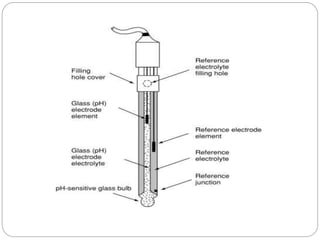
 Majority of pH electrodes available commercially are combination
electrodes that have both glass H+ ion sensitive electrode and
additional reference electrode.
 The glass electrode and calomel electrode can be constructed
together in a single probe called as combined or combination
electrode.
 The combination or pH electrode measures the difference in
potentials between the two sides in the glass electrode. To measure
the potentials it must be a closed circuit. The circuit is closed
through the internal solutions of the electrode and the external
solution that is being measured and the pH meter.
 As the electrode is immersed in the test solution the glass bulb
senses the hydrogen ions as a millivolts (mV) due to the positive
charge of the hydrogen ions.
 The electrolyte or internal solution picks up the mV signal from
the glass bulb.That signal is then passed to the internal electrode.
 The Ag/AgCl wire then passes that signal to the electrode cable
that leads to the meter.
 The reference electrode containing electrolyte or filling solution
generates a constant mV, which is transferred to the Ag/AgCl
wire.
 The wire then passes the signal, which can be considered a
"control" being measured to the electrode's cable.
 The circuit is closed by a minute amount of internal solution
from the reference electrode flowing through a porous
membrane made of a ceramic wick. This membrane or
junction as it is called is located the electrode body.
 The pH meter measures the difference between the internal
electrode and the reference electrode in millivolts DC. This
mV reading is then read by the meter and is displayed in pH
units.
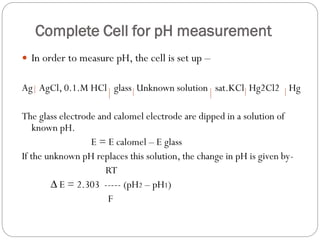
Complete Cell for pH measurement
 In order to measure pH, the cell is set up –
Ag AgCl, 0.1.M HCl glass Unknown solution sat.KCl Hg2Cl2 Hg
The glass electrode and calomel electrode are dipped in a solution of
known pH.
E = E calomel – E glass
If the unknown pH replaces this solution, the change in pH is given by-
RT
∆ E = 2.303 ----- (pH2 – pH1)
F
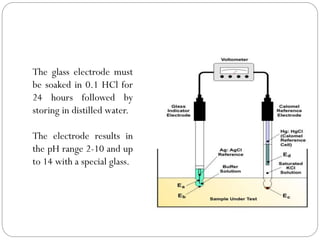
The glass electrode must
be soaked in 0.1 HCl for
24 hours followed by
storing in distilled water.
The electrode results in
the pH range 2-10 and up
to 14 with a special glass.
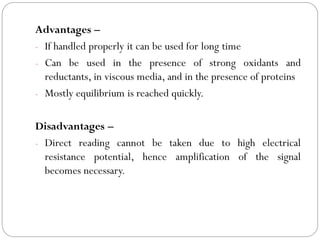
Advantages –
- If handled properly it can be used for long time
- Can be used in the presence of strong oxidants and
reductants, in viscous media, and in the presence of proteins
- Mostly equilibrium is reached quickly.
Disadvantages –
- Direct reading cannot be taken due to high electrical
resistance potential, hence amplification of the signal
becomes necessary.
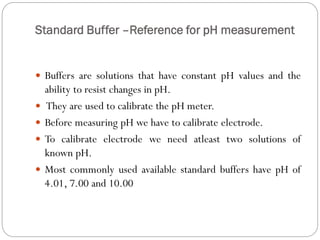
Standard Buffer –Reference for pH measurement
 Buffers are solutions that have constant pH values and the
ability to resist changes in pH.
 They are used to calibrate the pH meter.
 Before measuring pH we have to calibrate electrode.
 To calibrate electrode we need atleast two solutions of
known pH.
 Most commonly used available standard buffers have pH of
4.01, 7.00 and 10.00
 Next step is to put the electrode into pH 7.00 buffer.
 Rinse the electrode with distilled water from a wash bottle
into an empty beaker before immersing it into new solution.
 You should do it every time electrode is moved from one
solution to other to minimise contamination.
 Check if the working part of the electrode is completely
immersed in the buffer.
 Take care to not hit bottom of the baker with the electrode.
 Wait for the reading to stabilize (it takes seconds usually, up
to a minute sometimes).
 Next steps will depend on the solution you want to measure pH
of.
 If you plan to measure pH in acidic solutions, use pH=4.01 buffer.
 If you plan to measure high pH use pH=10.00 buffer.
 If you want to be able to measure pH in the wider range, you may
want to proceed with three point calibration and you will need
both buffers.
 Remember that high pH buffers tend to absorb atmospheric
CO2 thus they should be used as fresh as possible - don't left the
bottle open and do the calibration immediately after filling the
beaker with the buffer.
Accuracy of pH measurement
The accuracy of pH measurement by using pH meter depends
upon –
 External factors –Temperature, Pressure, flow etc.
 If the electrodes are not calibrated, we can not have accurate
value.
Applications of pH meter
 To measure the pH of biological fluids such as blood, urine, gastric acid etc.
to ascertain type of biological conditions
 Useful in determination of concentration of substances by pH measurement
 To know pH of buffer solutions
 To maintain the pH of reaction conditions
 To measure the pH of soil, which will be helpful in maximizing the yields
and returns from the soil
 To measure the pH of rainwater
 Maintaining perfect and accurate pH levels in several daily activities like
keeping the milk from turning sour
 pH meters employed in chemical industries, neutralization of effluent in
steel, pulp and paper, pharmaceutical manufacturing , biotechnology and
petrochemical industries.
 Helps in analyzing the exact pH value of chemical substances and food
grade products, thus ensuring high levels of safety and quality.