
Metrosensor electrodes


Precision is not accidental, but brought about by
design!
2
Table of contents

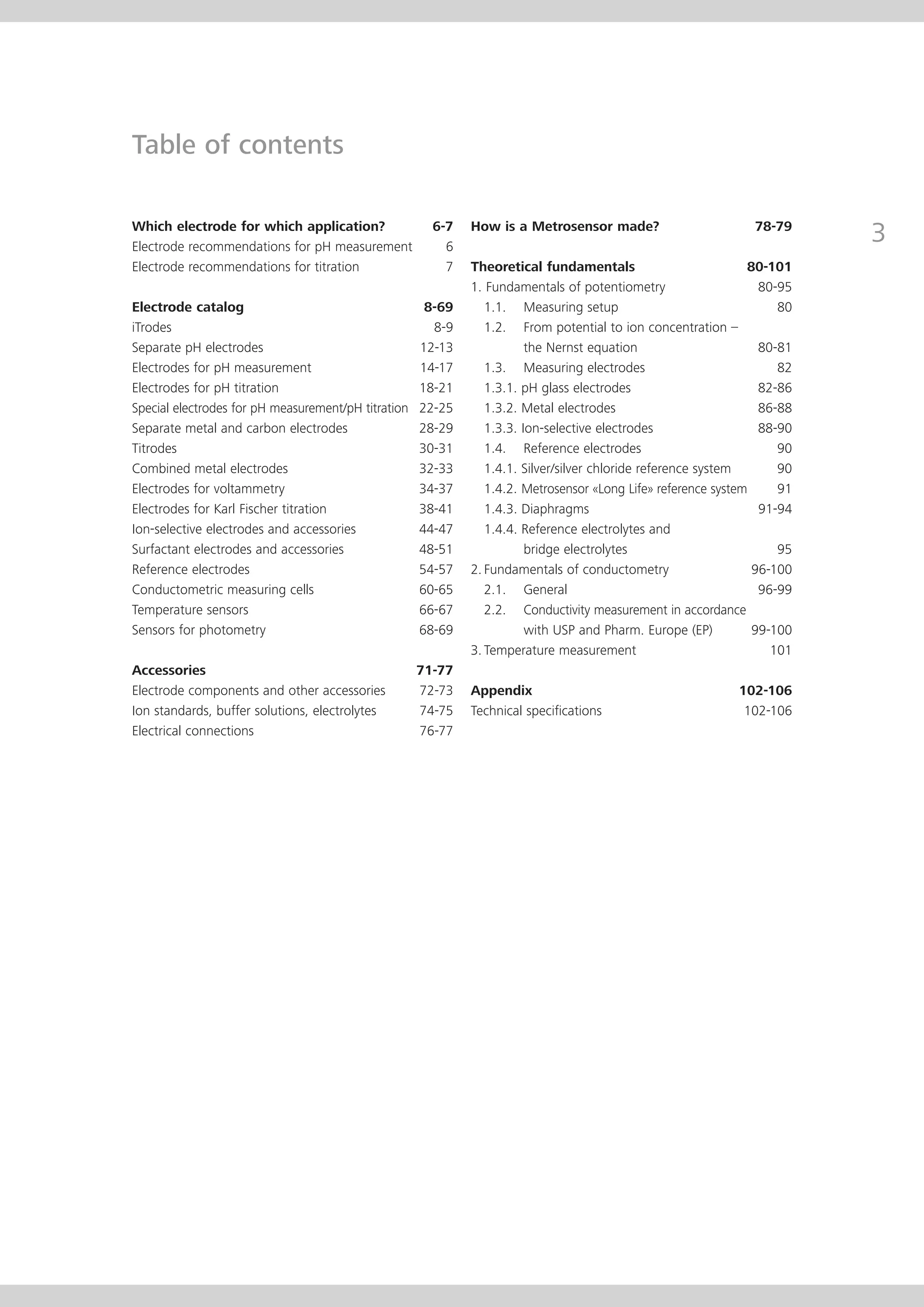
Which electrode for which application?
Electrode recommendations for pH measurement
                                                       6-7
                                                         6
                                                             How is a Metrosensor made?                        78-79
                                                                                                                         3
Electrode recommendations for titration                  7   Theoretical fundamentals                          80-101
                                                             1. Fundamentals of potentiometry                    80-
Electrode catalog                                     8-69      1.1. Measuring setup                                80
iTrodes                                                8-9      1.2. From potential to ion concentration –
Separate pH electrodes                               12-13              the Nernst equation                      80-81
Electrodes for pH measurement                        14-17      1.3. Measuring electrodes                           82
Electrodes for pH titration                          18-21      1.3.1. pH glass electrodes                       82-86
Special electrodes for pH measurement/pH titration   22-25      1.3.2. Metal electrodes                          86-88
Separate metal and carbon electrodes                 28-29      1.3.3. Ion-selective electrodes                  88-90
Titrodes                                             30-31      1.4. Reference electrodes                           90
Combined metal electrodes                            32-33      1.4.1. Silver/silver chloride reference system      90
Electrodes for voltammetry                           34-37      1.4.2. Metrosensor «Long Life» reference system     91
Electrodes for Karl Fischer titration                38-41      1.4.3. Diaphragms                                91-94
Ion-selective electrodes and accessories             44-47      1.4.4. Reference electrolytes and
Surfactant electrodes and accessories                48-51              bridge electrolytes                         95
Reference electrodes                                 54-57   2. Fundamentals of conductometry                   96-100
Conductometric measuring cells                       60-65      2.1. General                                     96-99
Temperature sensors                                  66-67      2.2. Conductivity measurement in accordance
Sensors for photometry                               68-69              with USP and Pharm. Europe (EP)         99-100
                                                             3. Temperature measurement                            101
Accessories                                          71-77
Electrode components and other accessories           72-73   Appendix                                       102-106
Ion standards, buffer solutions, electrolytes        74-75   Technical specifications                        102-106
Electrical connections                               76-77
4   Metrohm stands for 65 year’s experience in ion analysis
    – why should you wrack your brains, when we've already
    done the thinking for you?

    Metrohm Application Bulletins – instructions that
    are guaranteed to work.
                                                               Pharm PAC – the most important methods for the
    Metrohm PACs (Potentiometric Analysis Collections)         determination of pharmaceutical ingredients in
    contain ready-to-use methods, which are right up to        accordance with European and US pharmacopeias.
    date and always in compliance with the respective stand-
    ards and regulations.                                      Wine PAC – the most important methods in wine
                                                               analysis.
      Surf PAC – the most important methods in sur-
      factant analysis.                                        Plate PAC – the most important methods for the
                                                               analysis of galvanic baths.
      Oil PAC – the most important methods for the
      analysis of petroleum products.                          Food PAC – the most important methods in food
                                                               analysis.


    Get your know-how from the market leader!
    www.metrohm.com
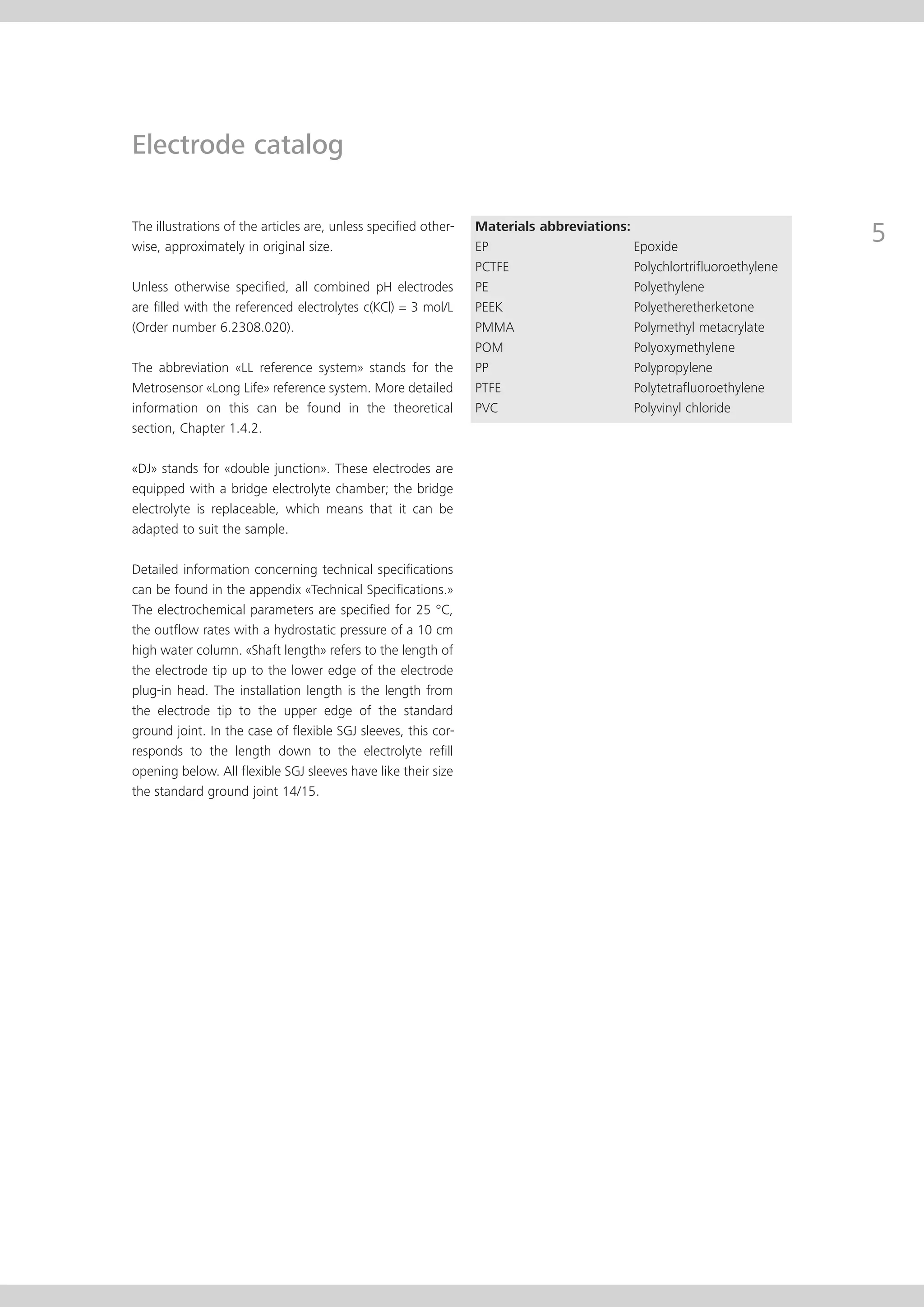
Electrode catalog

The illustrations of the articles are, unless specified other-
wise, approximately in original size.
                                                                 Materials abbreviations:
                                                                 EP                       Epoxide
                                                                                                                       5
                                                                 PCTFE                    Polychlortrifluoroethylene
Unless otherwise specified, all combined pH electrodes           PE                       Polyethylene
are filled with the referenced electrolytes c(KCl) = 3 mol/L     PEEK                     Polyetheretherketone
(Order number 6.2308.020).                                       PMMA                     Polymethyl metacrylate
                                                                 POM                      Polyoxymethylene
The abbreviation «LL reference system» stands for the            PP                       Polypropylene
Metrosensor «Long Life» reference system. More detailed          PTFE                     Polytetrafluoroethylene
information on this can be found in the theoretical              PVC                      Polyvinyl chloride
section, Chapter 1.4.2.

«DJ» stands for «double junction». These electrodes are
equipped with a bridge electrolyte chamber; the bridge
electrolyte is replaceable, which means that it can be
adapted to suit the sample.

Detailed information concerning technical specifications
can be found in the appendix «Technical Specifications.»
The electrochemical parameters are specified for 25 °C,
the outflow rates with a hydrostatic pressure of a 10 cm
high water column. «Shaft length» refers to the length of
the electrode tip up to the lower edge of the electrode
plug-in head. The installation length is the length from
the electrode tip to the upper edge of the standard
ground joint. In the case of flexible SGJ sleeves, this cor-
responds to the length down to the electrolyte refill
opening below. All flexible SGJ sleeves have like their size
the standard ground joint 14/15.
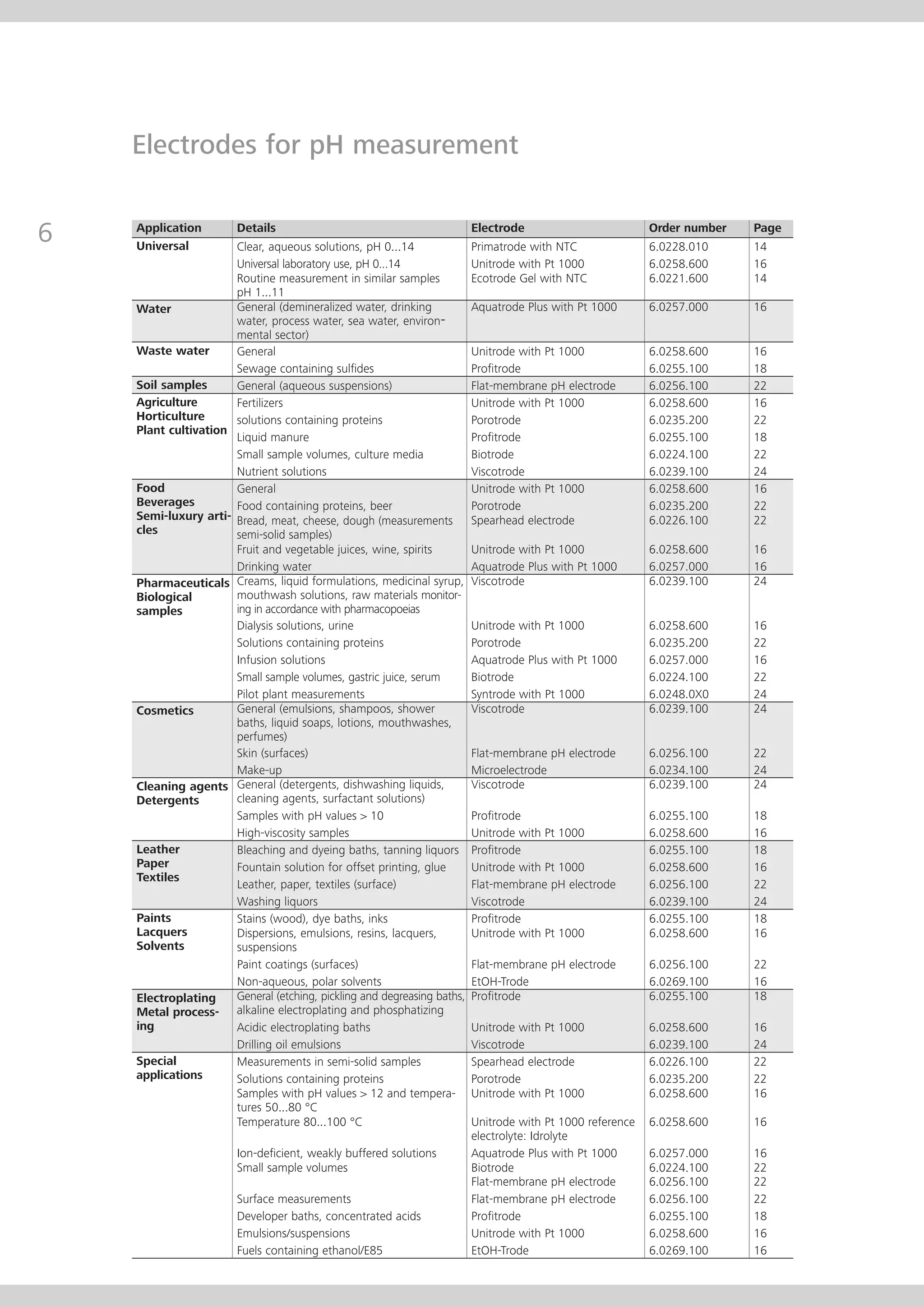
Electrodes for pH measurement


6   Application
    Universal
                        Details
                        Clear, aqueous solutions, pH 0...14
                                                                           Electrode
                                                                           Primatrode with NTC
                                                                                                             Order number
                                                                                                             6.0228.010
                                                                                                                            Page
                                                                                                                            14
                        Universal laboratory use, pH 0...14                Unitrode with Pt 1000             6.0258.600     16
                        Routine measurement in similar samples             Ecotrode Gel with NTC             6.0221.600     14
                        pH 1...11
    Water               General (demineralized water, drinking             Aquatrode Plus with Pt 1000       6.0257.000     16
                        water, process water, sea water, environ-
                        mental sector)
    Waste water         General                                            Unitrode with Pt 1000             6.0258.600     16
                        Sewage containing sulfides                         Profitrode                        6.0255.100     18
    Soil samples        General (aqueous suspensions)                      Flat-membrane pH electrode        6.0256.100     22
    Agriculture         Fertilizers                                        Unitrode with Pt 1000             6.0258.600     16
    Horticulture        solutions containing proteins                      Porotrode                         6.0235.200     22
    Plant cultivation
                        Liquid manure                                      Profitrode                        6.0255.100     18
                        Small sample volumes, culture media                Biotrode                          6.0224.100     22
                        Nutrient solutions                                 Viscotrode                        6.0239.100     24
    Food                General                                            Unitrode with Pt 1000             6.0258.600     16
    Beverages           Food containing proteins, beer                     Porotrode                         6.0235.200     22
    Semi-luxury arti-   Bread, meat, cheese, dough (measurements           Spearhead electrode               6.0226.100     22
    cles                semi-solid samples)
                        Fruit and vegetable juices, wine, spirits          Unitrode with Pt 1000             6.0258.600     16
                        Drinking water                                     Aquatrode Plus with Pt 1000       6.0257.000     16
    Pharmaceuticals     Creams, liquid formulations, medicinal syrup,      Viscotrode                        6.0239.100     24
    Biological          mouthwash solutions, raw materials monitor-
    samples             ing in accordance with pharmacopoeias
                        Dialysis solutions, urine                          Unitrode with Pt 1000             6.0258.600     16
                        Solutions containing proteins                      Porotrode                         6.0235.200     22
                        Infusion solutions                                 Aquatrode Plus with Pt 1000       6.0257.000     16
                        Small sample volumes, gastric juice, serum         Biotrode                          6.0224.100     22
                        Pilot plant measurements                           Syntrode with Pt 1000             6.0248.0X0     24
    Cosmetics           General (emulsions, shampoos, shower               Viscotrode                        6.0239.100     24
                        baths, liquid soaps, lotions, mouthwashes,
                        perfumes)
                        Skin (surfaces)                                    Flat-membrane pH electrode        6.0256.100     22
                        Make-up                                            Microelectrode                    6.0234.100     24
    Cleaning agents     General (detergents, dishwashing liquids,          Viscotrode                        6.0239.100     24
    Detergents          cleaning agents, surfactant solutions)
                        Samples with pH values  10                        Profitrode                        6.0255.100     18
                        High-viscosity samples                             Unitrode with Pt 1000             6.0258.600     16
    Leather             Bleaching and dyeing baths, tanning liquors        Profitrode                        6.0255.100     18
    Paper               Fountain solution for offset printing, glue        Unitrode with Pt 1000             6.0258.600     16
    Textiles
                        Leather, paper, textiles (surface)                 Flat-membrane pH electrode        6.0256.100     22
                        Washing liquors                                    Viscotrode                        6.0239.100     24
    Paints              Stains (wood), dye baths, inks                     Profitrode                        6.0255.100     18
    Lacquers            Dispersions, emulsions, resins, lacquers,          Unitrode with Pt 1000             6.0258.600     16
    Solvents            suspensions
                        Paint coatings (surfaces)                          Flat-membrane pH electrode        6.0256.100     22
                        Non-aqueous, polar solvents                        EtOH-Trode                        6.0269.100     16
    Electroplating      General (etching, pickling and degreasing baths,   Profitrode                        6.0255.100     18
    Metal process-      alkaline electroplating and phosphatizing
    ing                 Acidic electroplating baths                        Unitrode with Pt 1000             6.0258.600     16
                        Drilling oil emulsions                             Viscotrode                        6.0239.100     24
    Special             Measurements in semi-solid samples                 Spearhead electrode               6.0226.100     22
    applications        Solutions containing proteins                      Porotrode                         6.0235.200     22
                        Samples with pH values  12 and tempera-           Unitrode with Pt 1000             6.0258.600     16
                        tures 50...80 °C
                        Temperature 80...100 °C                            Unitrode with Pt 1000 reference   6.0258.600     16
                                                                           electrolyte: Idrolyte
                        Ion-deficient, weakly buffered solutions           Aquatrode Plus with Pt 1000       6.0257.000     16
                        Small sample volumes                               Biotrode                          6.0224.100     22
                                                                           Flat-membrane pH electrode        6.0256.100     22
                        Surface measurements                               Flat-membrane pH electrode        6.0256.100     22
                        Developer baths, concentrated acids                Profitrode                        6.0255.100     18
                        Emulsions/suspensions                              Unitrode with Pt 1000             6.0258.600     16
                        Fuels containing ethanol/E85                       EtOH-Trode                        6.0269.100     16
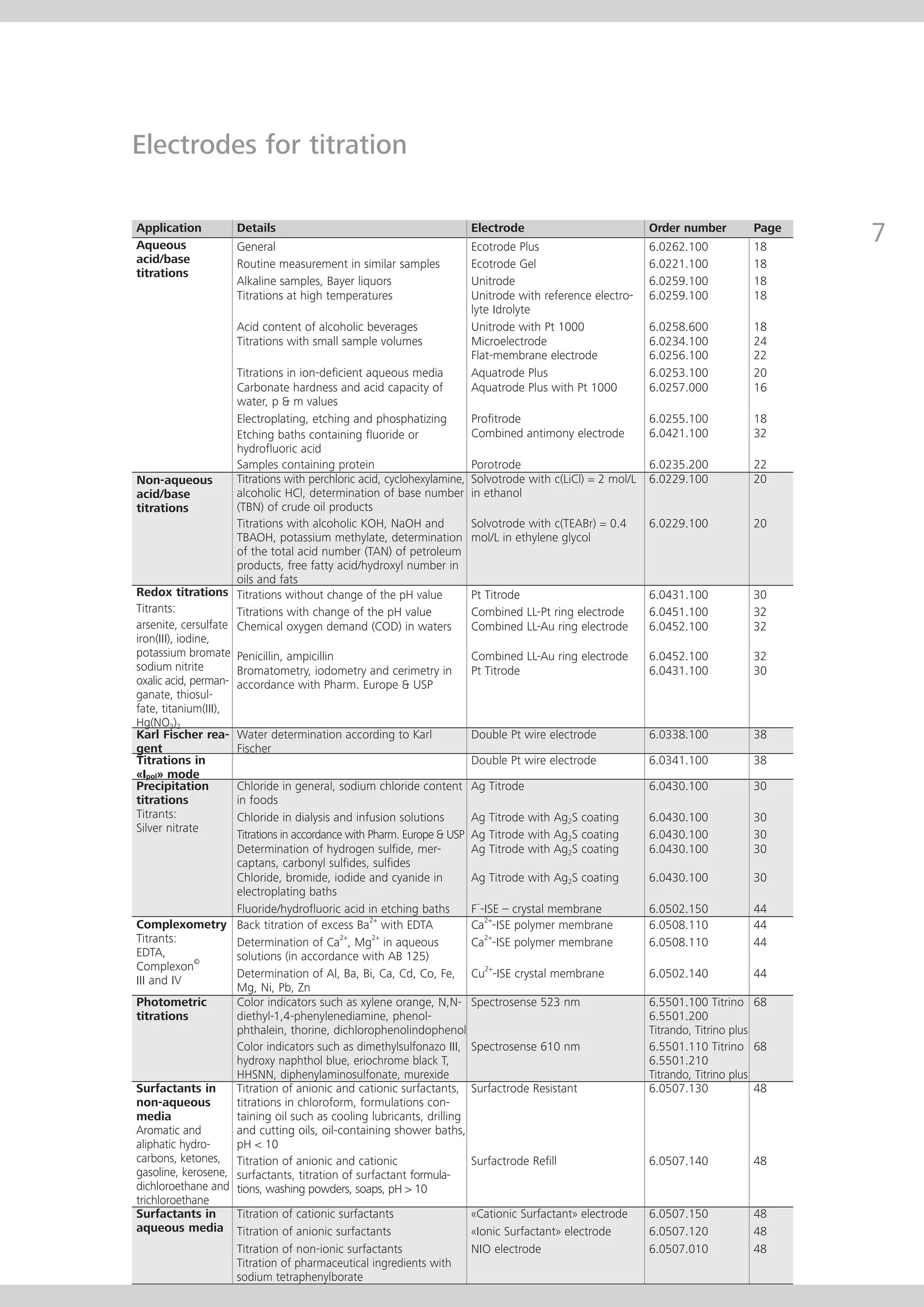
Electrodes for titration

Application
Aqueous
                     Details
                     General
                                                                         Electrode
                                                                         Ecotrode Plus
                                                                                                             Order number
                                                                                                             6.0262.100
                                                                                                                                   Page
                                                                                                                                   18
                                                                                                                                          7
acid/base            Routine measurement in similar samples              Ecotrode Gel                        6.0221.100            18
titrations
                     Alkaline samples, Bayer liquors                     Unitrode                            6.0259.100            18
                     Titrations at high temperatures                     Unitrode with reference electro-    6.0259.100            18
                                                                         lyte Idrolyte
                     Acid content of alcoholic beverages                 Unitrode with Pt 1000               6.0258.600            18
                     Titrations with small sample volumes                Microelectrode                      6.0234.100            24
                                                                         Flat-membrane electrode             6.0256.100            22
                     Titrations in ion-deficient aqueous media           Aquatrode Plus                      6.0253.100            20
                     Carbonate hardness and acid capacity of             Aquatrode Plus with Pt 1000         6.0257.000            16
                     water, p  m values
                     Electroplating, etching and phosphatizing           Profitrode                          6.0255.100            18
                     Etching baths containing fluoride or                Combined antimony electrode         6.0421.100            32
                     hydrofluoric acid
                     Samples containing protein                          Porotrode                           6.0235.200            22
Non-aqueous          Titrations with perchloric acid, cyclohexylamine,   Solvotrode with c(LiCl) = 2 mol/L   6.0229.100            20
acid/base            alcoholic HCl, determination of base number         in ethanol
titrations           (TBN) of crude oil products
                     Titrations with alcoholic KOH, NaOH and             Solvotrode with c(TEABr) = 0.4      6.0229.100            20
                     TBAOH, potassium methylate, determination           mol/L in ethylene glycol
                     of the total acid number (TAN) of petroleum
                     products, free fatty acid/hydroxyl number in
                     oils and fats
Redox titrations Titrations without change of the pH value               Pt Titrode                          6.0431.100            30
Titrants:            Titrations with change of the pH value              Combined LL-Pt ring electrode       6.0451.100            32
arsenite, cersulfate Chemical oxygen demand (COD) in waters              Combined LL-Au ring electrode       6.0452.100            32
iron(III), iodine,
potassium bromate Penicillin, ampicillin                                 Combined LL-Au ring electrode       6.0452.100            32
sodium nitrite       Bromatometry, iodometry and cerimetry in            Pt Titrode                          6.0431.100            30
oxalic acid, perman- accordance with Pharm. Europe  USP
ganate, thiosul-
fate, titanium(III),
Hg(NO3)2
Karl Fischer rea- Water determination according to Karl                  Double Pt wire electrode            6.0338.100            38
gent                 Fischer
Titrations in                                                            Double Pt wire electrode            6.0341.100            38
«Ipol» mode
Precipitation        Chloride in general, sodium chloride content        Ag Titrode                          6.0430.100            30
titrations           in foods
Titrants:            Chloride in dialysis and infusion solutions         Ag Titrode with Ag2S coating        6.0430.100            30
Silver nitrate
                     Titrations in accordance with Pharm. Europe  USP   Ag Titrode with Ag2S coating        6.0430.100            30
                     Determination of hydrogen sulfide, mer-             Ag Titrode with Ag2S coating        6.0430.100            30
                     captans, carbonyl sulfides, sulfides
                     Chloride, bromide, iodide and cyanide in            Ag Titrode with Ag2S coating        6.0430.100            30
                     electroplating baths
                                                                          –
                     Fluoride/hydrofluoric acid in etching baths         F -ISE – crystal membrane           6.0502.150            44
Complexometry Back titration of excess Ba2+ with EDTA                       2+
                                                                         Ca -ISE polymer membrane            6.0508.110            44
Titrants:                                    2+     2+
                     Determination of Ca , Mg in aqueous                 Ca2+-ISE polymer membrane           6.0508.110            44
EDTA,                solutions (in accordance with AB 125)
               ©
Complexon                                                                  2+
                     Determination of Al, Ba, Bi, Ca, Cd, Co, Fe,        Cu -ISE crystal membrane            6.0502.140            44
III and IV
                     Mg, Ni, Pb, Zn
Photometric          Color indicators such as xylene orange, N,N-        Spectrosense 523 nm                 6.5501.100 Titrino 68
titrations           diethyl-1,4-phenylenediamine, phenol-                                                   6.5501.200
                     phthalein, thorine, dichlorophenolindophenol                                            Titrando, Titrino plus
                     Color indicators such as dimethylsulfonazo III,     Spectrosense 610 nm                 6.5501.110 Titrino 68
                     hydroxy naphthol blue, eriochrome black T,                                              6.5501.210
                     HHSNN, diphenylaminosulfonate, murexide                                                 Titrando, Titrino plus
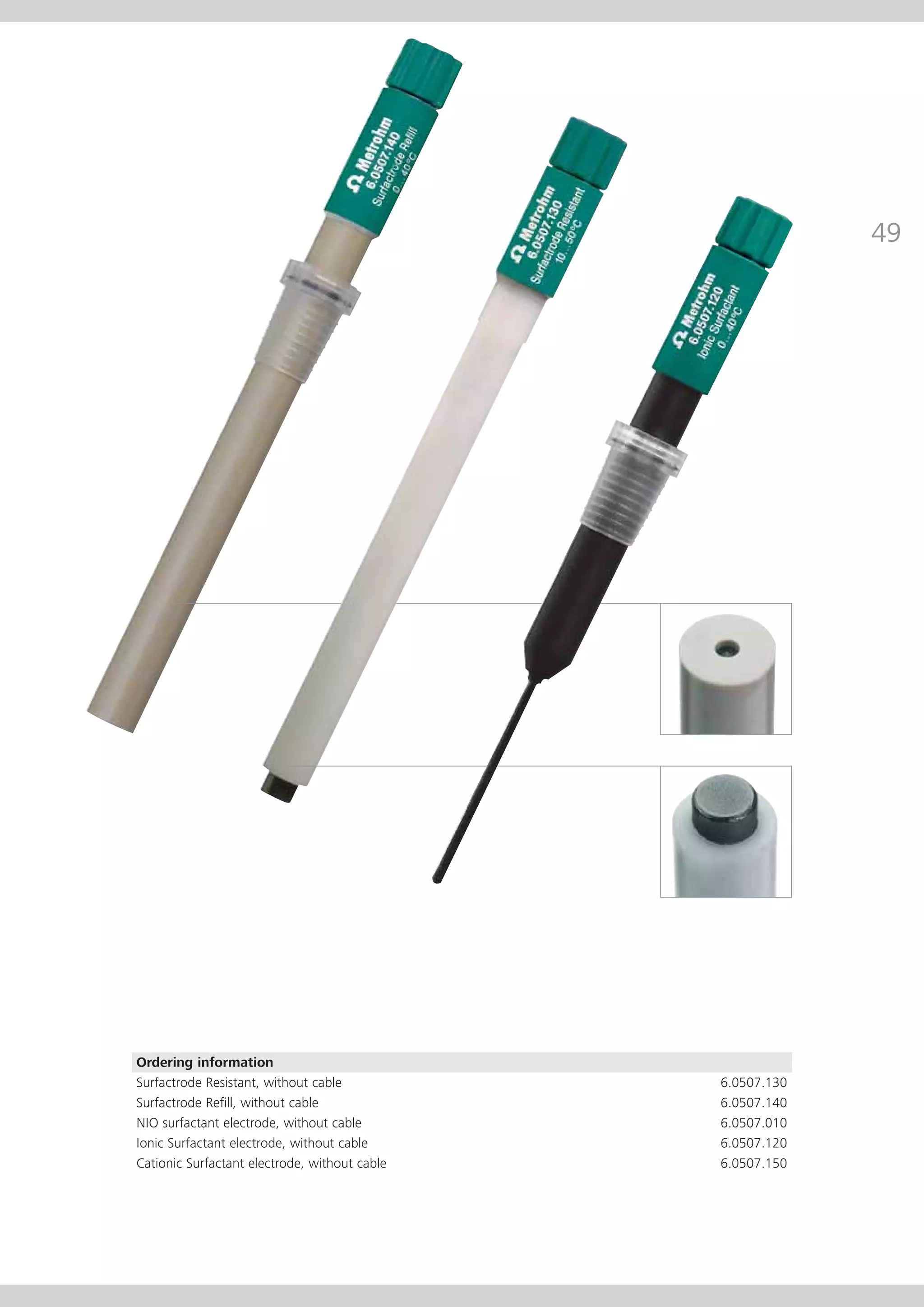
Surfactants in       Titration of anionic and cationic surfactants,      Surfactrode Resistant               6.0507.130             48
non-aqueous          titrations in chloroform, formulations con-
media                taining oil such as cooling lubricants, drilling
Aromatic and         and cutting oils, oil-containing shower baths,
aliphatic hydro-     pH  10
carbons, ketones, Titration of anionic and cationic                      Surfactrode Refill                  6.0507.140            48
gasoline, kerosene, surfactants, titration of surfactant formula-
dichloroethane and tions, washing powders, soaps, pH  10
trichloroethane
Surfactants in       Titration of cationic surfactants                   «Cationic Surfactant» electrode     6.0507.150            48
aqueous media Titration of anionic surfactants                           «Ionic Surfactant» electrode        6.0507.120            48
                     Titration of non-ionic surfactants                  NIO electrode                       6.0507.010            48
                     Titration of pharmaceutical ingredients with
                     sodium tetraphenylborate
iTrodes – The intelligent electrodes


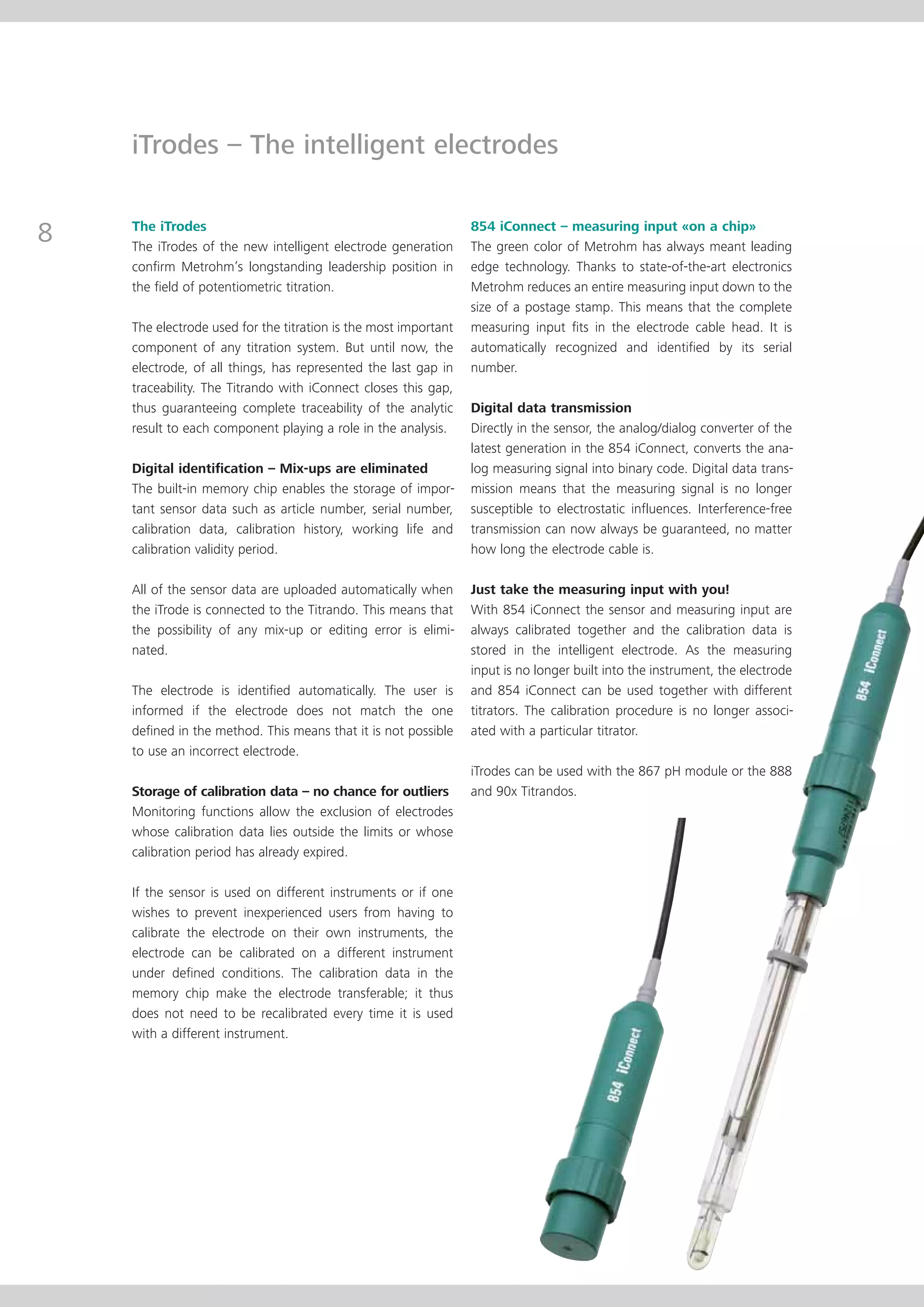
8   The iTrodes
    The iTrodes of the new intelligent electrode generation
                                                                 854 iConnect – measuring input «on a chip»
                                                                 The green color of Metrohm has always meant leading
    confirm Metrohm’s longstanding leadership position in        edge technology. Thanks to state-of-the-art electronics
    the field of potentiometric titration.                       Metrohm reduces an entire measuring input down to the
                                                                 size of a postage stamp. This means that the complete
    The electrode used for the titration is the most important   measuring input fits in the electrode cable head. It is
    component of any titration system. But until now, the        automatically recognized and identified by its serial
    electrode, of all things, has represented the last gap in    number.
    traceability. The Titrando with iConnect closes this gap,
    thus guaranteeing complete traceability of the analytic      Digital data transmission
    result to each component playing a role in the analysis.     Directly in the sensor, the analog/dialog converter of the
                                                                 latest generation in the 854 iConnect, converts the ana-
    Digital identification – Mix-ups are eliminated              log measuring signal into binary code. Digital data trans-
    The built-in memory chip enables the storage of impor-       mission means that the measuring signal is no longer
    tant sensor data such as article number, serial number,      susceptible to electrostatic influences. Interference-free
    calibration data, calibration history, working life and      transmission can now always be guaranteed, no matter
    calibration validity period.                                 how long the electrode cable is.

    All of the sensor data are uploaded automatically when       Just take the measuring input with you!
    the iTrode is connected to the Titrando. This means that     With 854 iConnect the sensor and measuring input are
    the possibility of any mix-up or editing error is elimi-     always calibrated together and the calibration data is
    nated.                                                       stored in the intelligent electrode. As the measuring
                                                                 input is no longer built into the instrument, the electrode
    The electrode is identified automatically. The user is       and 854 iConnect can be used together with different
    informed if the electrode does not match the one             titrators. The calibration procedure is no longer associ-
    defined in the method. This means that it is not possible    ated with a particular titrator.
    to use an incorrect electrode.
                                                                 iTrodes can be used with the 867 pH module or the 888
    Storage of calibration data – no chance for outliers         and 90x Titrandos.
    Monitoring functions allow the exclusion of electrodes
    whose calibration data lies outside the limits or whose
    calibration period has already expired.

    If the sensor is used on different instruments or if one
    wishes to prevent inexperienced users from having to
    calibrate the electrode on their own instruments, the
    electrode can be calibrated on a different instrument
    under defined conditions. The calibration data in the
    memory chip make the electrode transferable; it thus
    does not need to be recalibrated every time it is used
    with a different instrument.
9


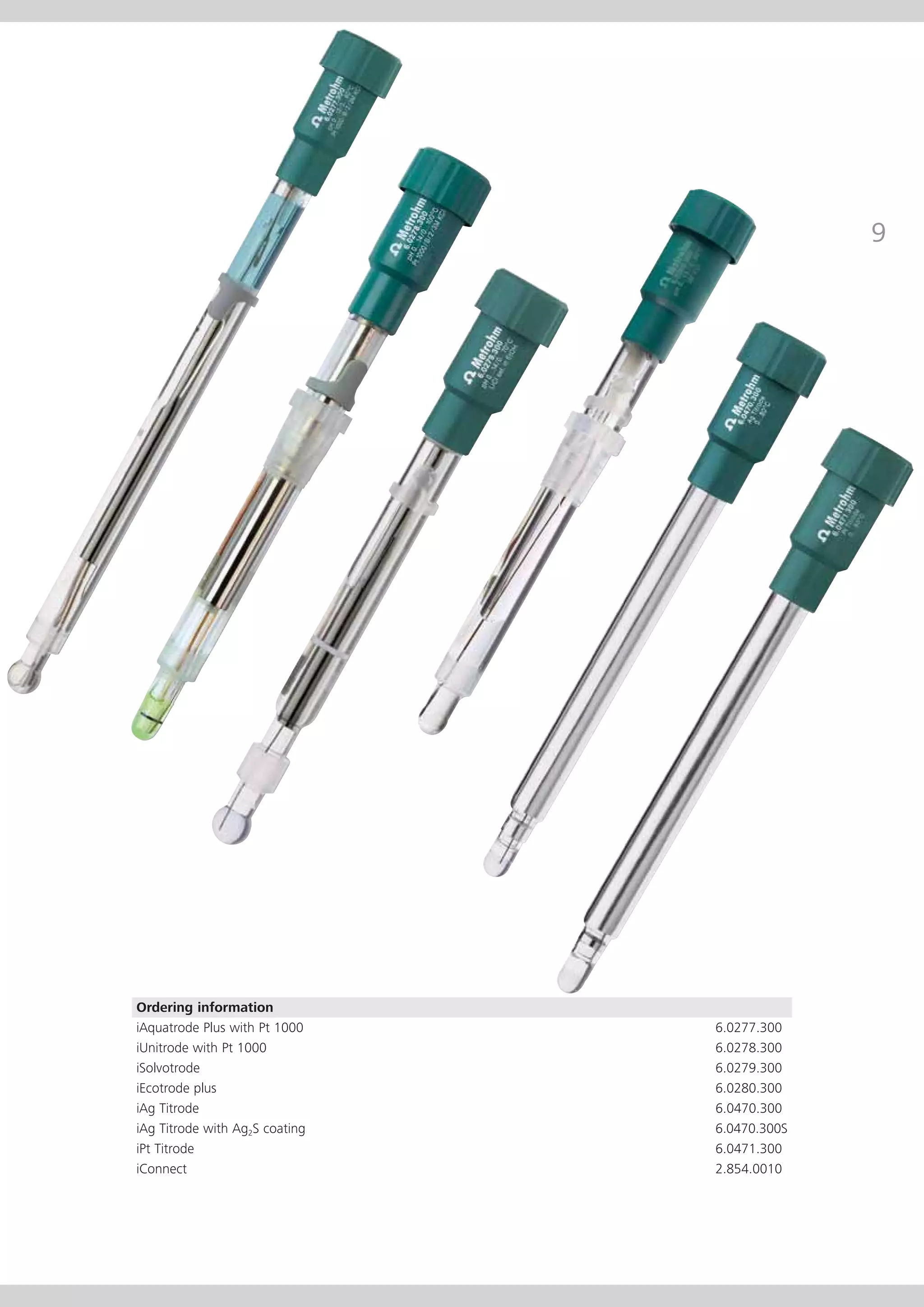
Ordering information
iAquatrode Plus with Pt 1000    6.0277.300
iUnitrode with Pt 1000          6.0278.300
iSolvotrode                     6.0279.300
iEcotrode plus                  6.0280.300
iAg Titrode                     6.0470.300
iAg Titrode with Ag2S coating   6.0470.300S
iPt Titrode                     6.0471.300
iConnect                        2.854.0010
10
Electrodes for pH measurement/pH titration                                                                             11


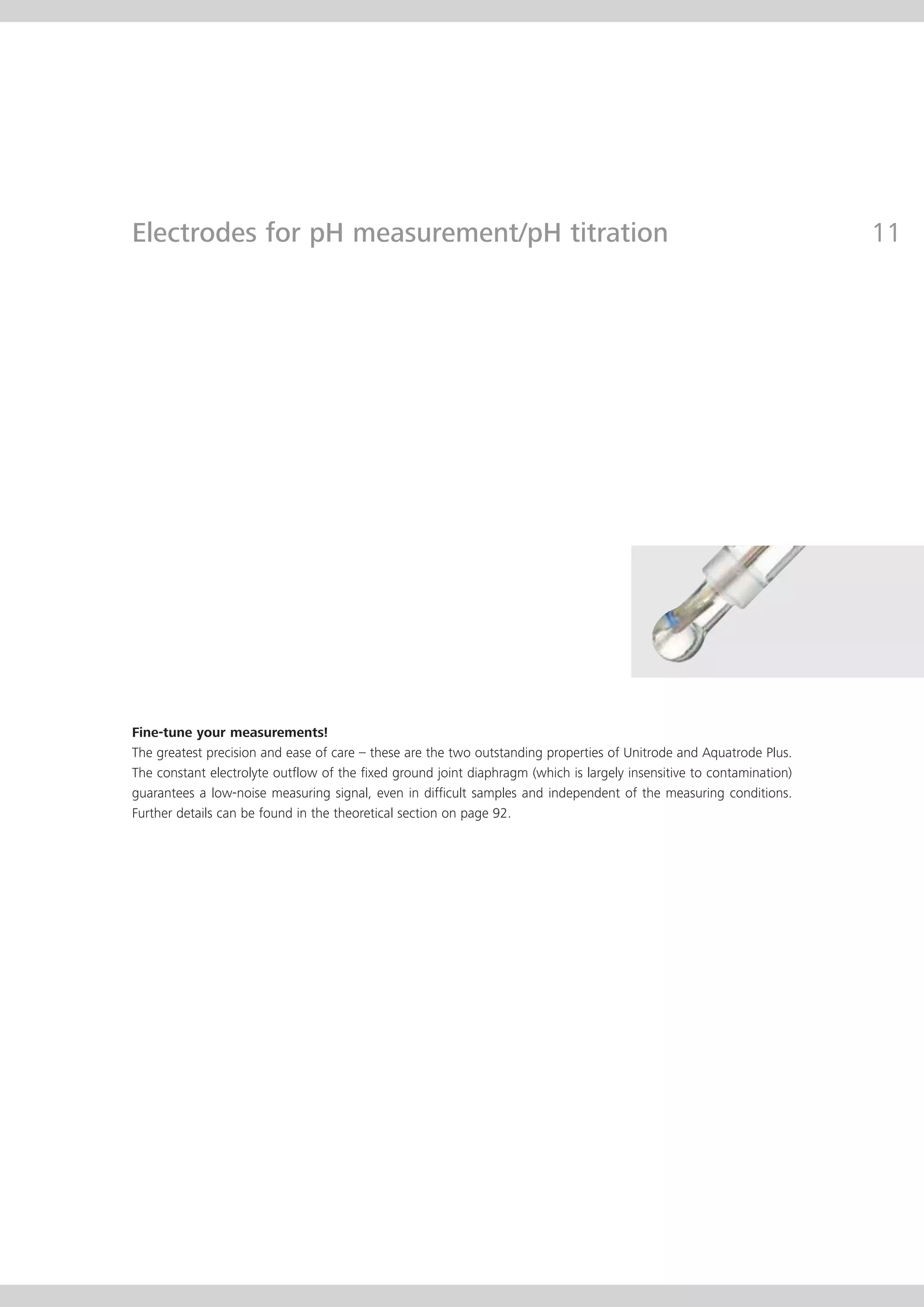
Fine-tune your measurements!
The greatest precision and ease of care – these are the two outstanding properties of Unitrode and Aquatrode Plus.
The constant electrolyte outflow of the fixed ground joint diaphragm (which is largely insensitive to contamination)
guarantees a low-noise measuring signal, even in difficult samples and independent of the measuring conditions.
Further details can be found in the theoretical section on page 92.
Separate pH glass electrodes


12   Separate pH glass electrode
       Electrically shielded
                                                                  Technical specifications
                                                                  pH range                 0...14
       Blue T glass for reliable results, e.g. in differential    Temperature range        0...80 °C
       potentiometry in non-aqueous media                         Installation length      142 mm
       Optimal length for sample changer applications             Shaft diameter           12 mm
                                                                  Minimum immersion depth 15 mm
                                                                  Electrode plug-in head   Metrohm plug-in head G


     Differential potentiometry
     In addition to the measuring electrode, a reference electrode and an auxiliary electrode are required for differential
     potentiometry. The shielding of the reference electrode must be identical to that of the measuring electrode.

     Reference electrodes for differential potentiometry (see «Reference electrodes» section)

       Ag/AgCl DJ reference electrode, length 125 mm, Metrohm plug-in head G
       Without electrolyte filling, without cable           6.0729.100
       Filled with LiClsat in ethanol, without cable        6.0729.108

       Ag/AgCl DJ reference electrode, length 162 mm, Metrohm plug-in head G
       Without electrolyte filling, without cable           6.0729.110

     Auxiliary electrodes for differential potentiometry, Metrohm plug-in head B (see «Separate metal electrodes»
     section)

     Separate Pt wire electrode                                  6.0301.100
     Separate Pt pin electrode                                   6.1241.040 + 6.1248.000
     Separate Pt ring electrode                                  6.0351.100
13


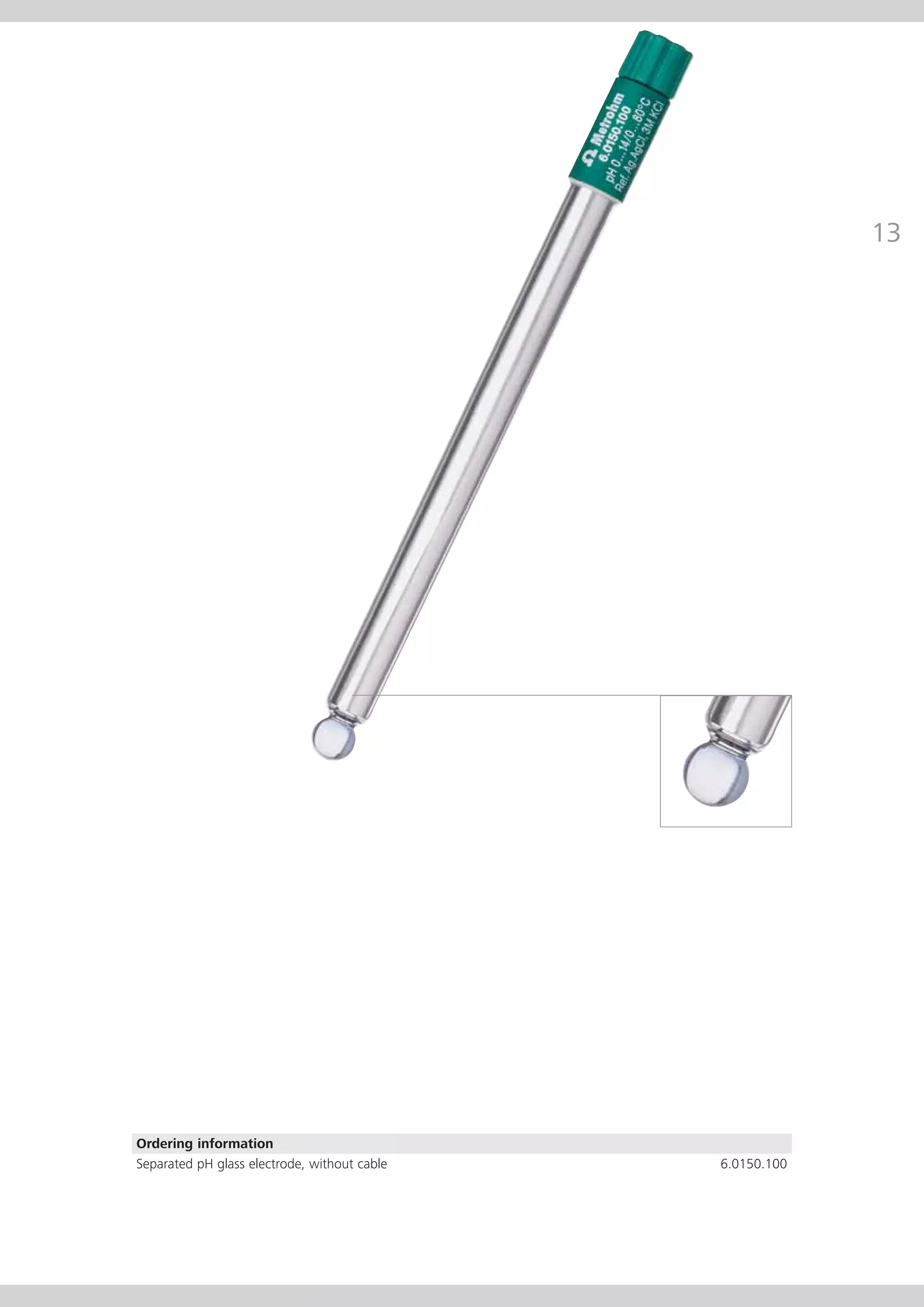
Ordering information
Separated pH glass electrode, without cable   6.0150.100
Electrodes for pH measurement


14   Primatrode with NTC – the economical entry to
     GLP-compliant pH measurement
                                                                  Technical specifications
                                                                  Primatrode
       For solutions that do not contain precipitates, pro-       Shaft material           PP
       teins or sulfides                                          pH range                 0...14
       Long-lasting standard electrode                            Temperature range        0...80 °C
       Unbreakable plastic shaft                                  Temperature sensor       NTC
       Impact protection for the glass membrane                   Diaphragm                Ceramic pin
       Fixed cable (length 1.2 m)                                 Installation length      113 mm
       LL reference system with long-term stability               Shaft diameter           12 mm
       Variant 6.0228.020 with waterproof plug I for use          Minimum immersion depth 15 mm
       with the 826 pH mobile (IP67)

     The Solitrode with Pt 1000 – robust and reliable,            Technical specifications
     ideal for routine laboratory use                             Solitrode
       For solutions that do not contain precipitates, proteins   Shaft material           PP
       or sulfides                                                pH range                 0...14
       Long-lasting standard electrode                            Temperature range        0...80 °C
       Unbrekable plastic shaft                                   Temperature sensor       Pt 1000
       Impact protection for the glass membrane                   Diaphragm                Ceramic pin
       Fixed cable (length 1.2 m)                                 Installation length      113 mm
       LL reference system with long-term stability               Shaft diameter           12 mm
                                                                  Minimum immersion depth 15 mm


     Ecotrode Gel – the maintenance-free solution                 Technical specifications
       Ideal for routine measurements in similar samples          Ecotrode Gel
       Maintenance-free                                           Shaft material           Glass
       Life-time indicator                                        pH range                 1...11
       LL reference system with long-term stability               Temperature range        0...60 °C
                                                                  Temperature sensor       NTC
                                                                  Diaphragm                Twin pore
                                                                  Installation length      125 mm
                                                                  Shaft diameter           12 mm
                                                                  Minimum immersion depth 20 mm
                                                                  Electrode plug-in head   Metrohm plug-in head U


     How to store your electrodes correctly:
     Rapid response is not a matter of magic, but rather a question of storage! Metrohm recommends the patented
     6.2323.000 storage solution for all combined pH glass electrodes which use c(KCl) = 3 mol/L as the reference
     electrolyte. This prevents the aging of the glass membrane and, as a result, guarantees response times short as they
     were on the first day. More information on this can be found in the theoretical section in Chapter 1.3.1. «pH glass
     electrodes.»
15


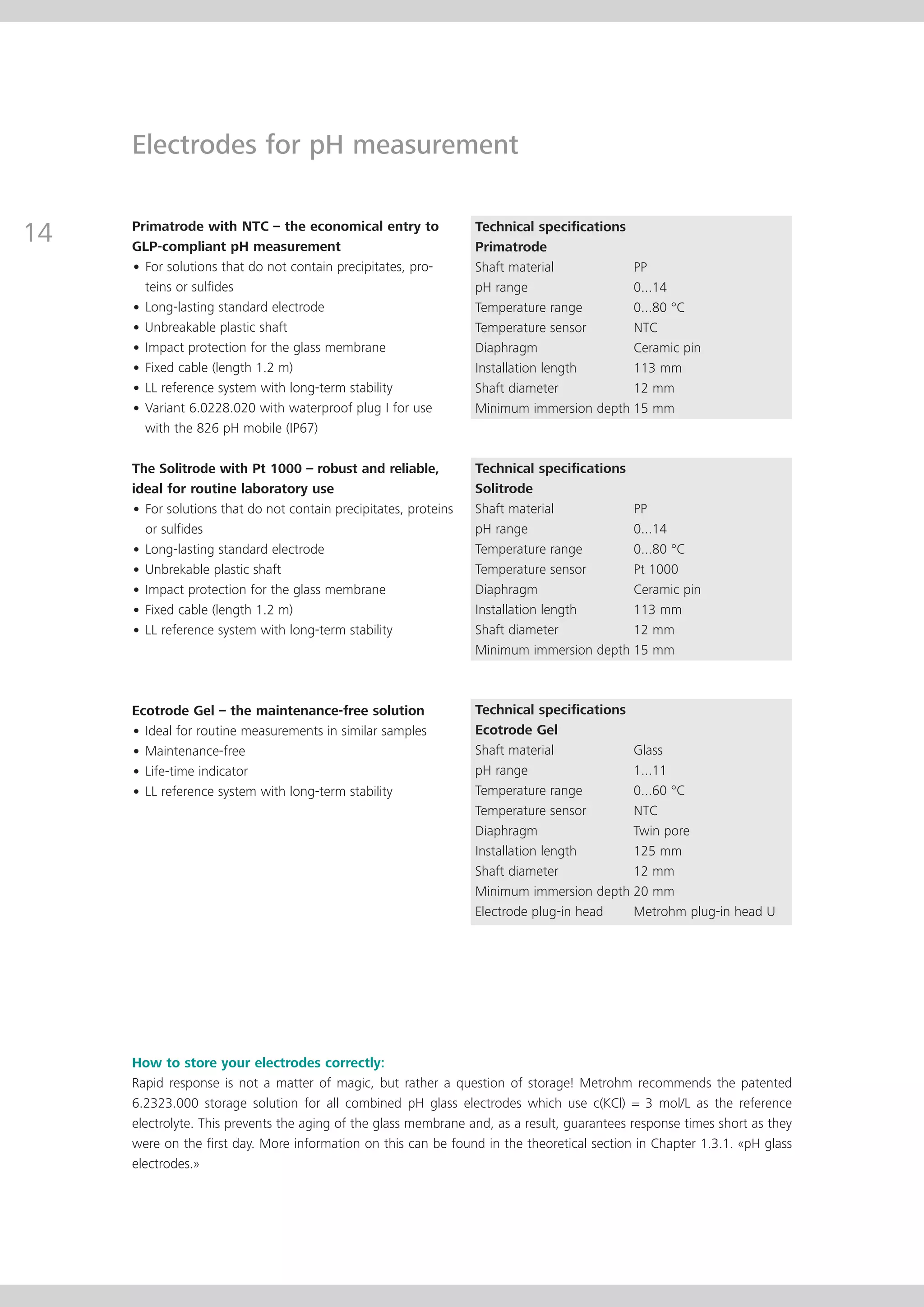
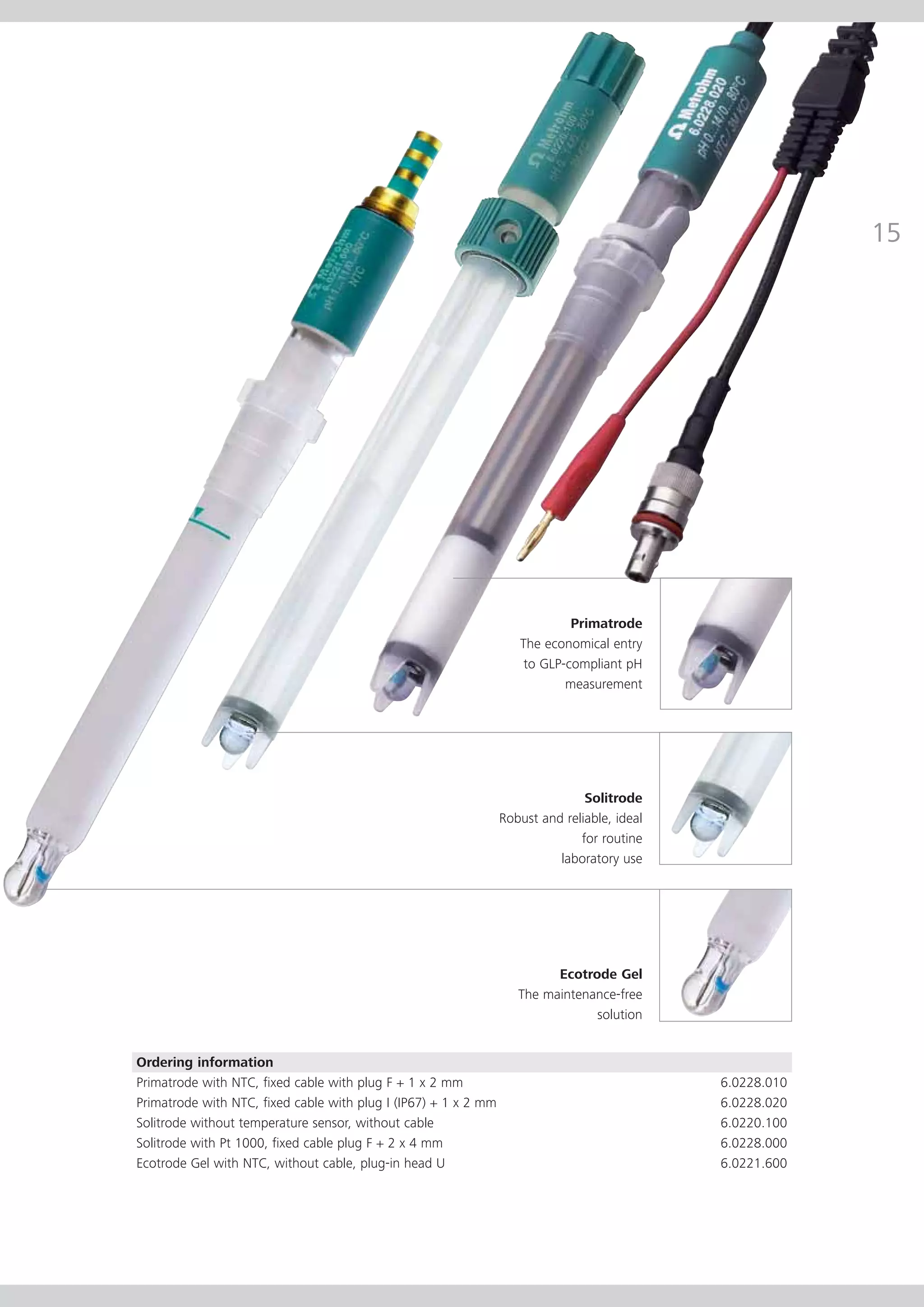
                                                                             Primatrode
                                                                    The economical entry
                                                                     to GLP-compliant pH
                                                                            measurement


                                                                                Solitrode
                                                                 Robust and reliable, ideal
                                                                               for routine
                                                                           laboratory use


                                                                          Ecotrode Gel
                                                                    The maintenance-free
                                                                                solution


Ordering information
Primatrode with NTC, fixed cable with plug F + 1 x 2 mm                                       6.0228.010
Primatrode with NTC, fixed cable with plug I (IP67) + 1 x 2 mm                                6.0228.020
Solitrode without temperature sensor, without cable                                           6.0220.100
Solitrode with Pt 1000, fixed cable plug F + 2 x 4 mm                                         6.0228.000
Ecotrode Gel with NTC, without cable, plug-in head U                                          6.0221.600
Electrodes for pH measurement


16   Unitrode with Pt 1000 – high performance in
     difficult samples and at high pH values
                                                                   Technical specifications
                                                                   Unitrode
       For universal use, even in dyes, pigments, inks, suspen-    Shaft material           Glass
       sions, resins and polymers                                  pH range                 0...14
       Fixed ground-joint diaphragm insensitive to contamination   Temperature range        0...100 °C
       High temperature resistance and very low alkali error       Temperature sensor       Pt 1000
       Rapid response to temperature changes                       Diaphragm                Fixed ground joint
       Outer electrolyte Idrolyte for temperatures of              Installation length      113 mm
       80...100 °C                                                 Shaft diameter           12 mm
       Fixed cable (length 1.2 m) or with plug-in head U and       Minimum immersion depth 25 mm
       removable cable
       LL reference system with long-term stability

     Aquatrode Plus with Pt 1000 – ideal for weekly                Technical specifications
     buffered aqueous solutions                                    Aquatrode Plus
       Special electrode membrane glass: precise measuring         Shaft material           Glass
       values and very rapid response times, even in weekly        pH range                 0...13
       buffered solutions such as drinking water, surface          Temperature range        0...60 °C
       water and rain water and other poorly conducting            Temperature sensor       Pt 1000
       solutions                                                   Diaphragm                Fixed ground joint
       Maintenance-free inner reference electrolyte (gel)          Installation length      125/260 mm
       Variable bridge electrolyte for special applications        Shaft diameter           12 mm
       Fixed ground joint diaphragm insensitive to contamination   Minimum immersion depth 20 mm
       Optimized length for sample changer applications
       Fixed cable (length 2 m)
       LL reference system with long-term stability
                                                                   Technical specifications
     EtOH-Trode – the specialist for ethanol                       EtOH-Trode
       Developed for pHe measurement in ethanol                    Shaft material           Glass
       Special membrane glass                                      pH range                 0...12
       Very precise ground joint diaphragm                         Temperature range        0...80 °C
       Double-junction system for free choice of electrolytes      Diaphragm                Fixed ground joint
       (e.g. 3 M KCI in ASTM D 6423, 1 M LiCI in EN                Installation length      145 mm
       15490).                                                     Shaft diameter           12 mm
       LL reference system with long-term stability                Minimum immersion depth 20 mm
                                                                   Electrode plug-in head   Metrohm plug-in head G


     Wellness for the electrode
     Reliable measuring results over long periods of time can only be guaranteed if the glass membrane and the dia-
     phragm receive preventative and regular care. Cleaning by means of etching with toxic chemicals or a mechanical
     treatment of the diaphragm is not only complicated and expensive, it also accelerates the aging of the pH glass
     electrode as well. The 6.2325.000 care kit was developed for simple, gentle cleaning of pH glass electrodes with a
     liquid electrolyte. Regular application can considerably prolong its lifetime.
17


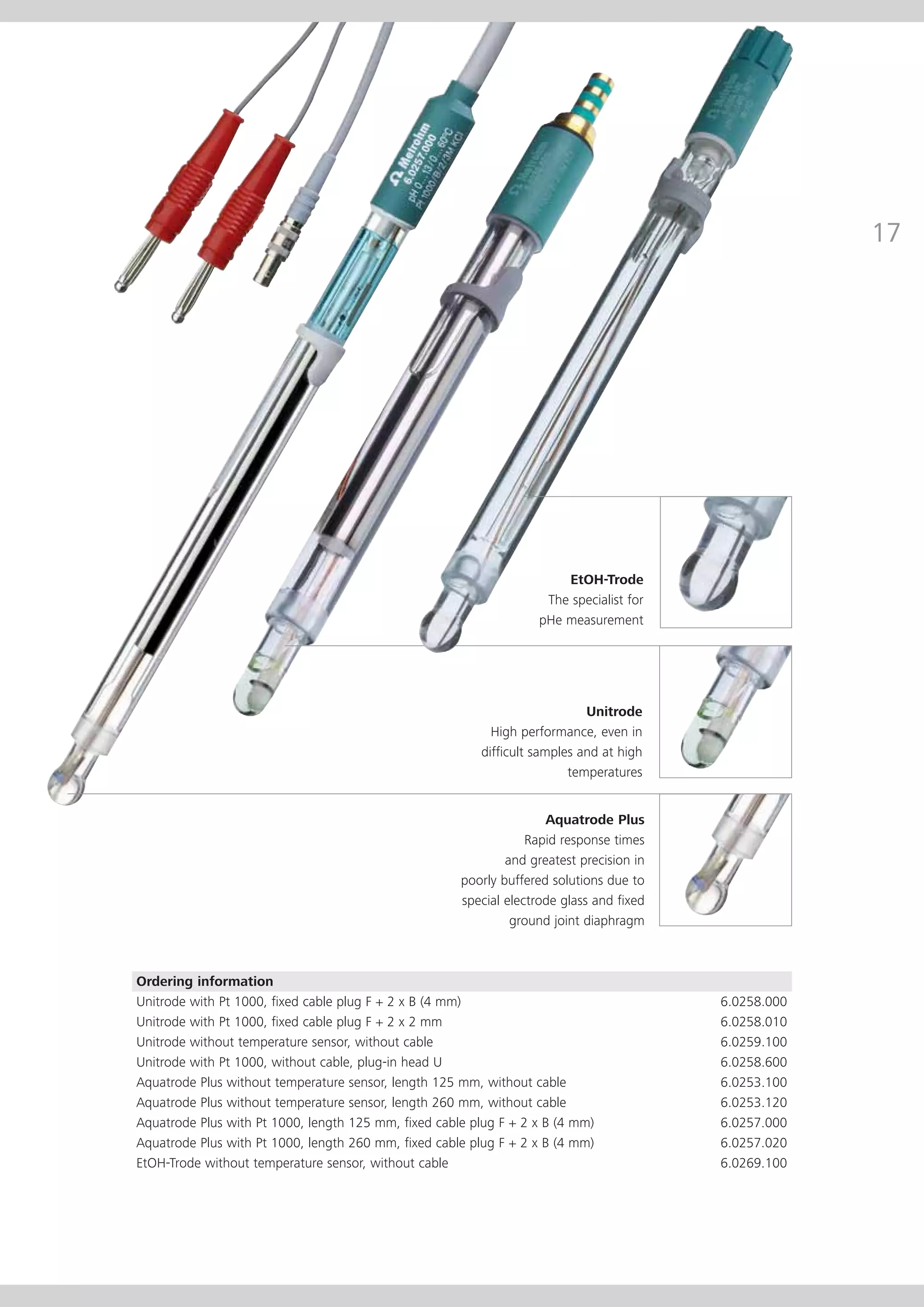
                                                                        EtOH-Trode
                                                                     The specialist for
                                                                    pHe measurement


                                                                             Unitrode
                                                            High performance, even in
                                                          difficult samples and at high
                                                                          temperatures


                                                                     Aquatrode Plus
                                                                  Rapid response times
                                                              and greatest precision in
                                                      poorly buffered solutions due to
                                                      special electrode glass and fixed
                                                               ground joint diaphragm


Ordering information
Unitrode with Pt 1000, fixed cable plug F + 2 x B (4 mm)                                  6.0258.000
Unitrode with Pt 1000, fixed cable plug F + 2 x 2 mm                                      6.0258.010
Unitrode without temperature sensor, without cable                                        6.0259.100
Unitrode with Pt 1000, without cable, plug-in head U                                      6.0258.600
Aquatrode Plus without temperature sensor, length 125 mm, without cable                   6.0253.100
Aquatrode Plus without temperature sensor, length 260 mm, without cable                   6.0253.120
Aquatrode Plus with Pt 1000, length 125 mm, fixed cable plug F + 2 x B (4 mm)             6.0257.000
Aquatrode Plus with Pt 1000, length 260 mm, fixed cable plug F + 2 x B (4 mm)             6.0257.020
EtOH-Trode without temperature sensor, without cable                                      6.0269.100
Electrodes for pH titration


18   Ecotrode Gel – the maintenance-free solution
       Ideal for routine measurements in similar samples
                                                                   Technical specifications
                                                                   Ecotrode Gel
       Maintenance-free                                            Shaft material           Glass
       Lifetime indicator                                          pH range                 1...11
       LL reference system with long-term stability                Temperature range        0...60 °C
                                                                   Diaphragm                Twin pore
                                                                   Installation length      125 mm
                                                                   Shaft diameter           12 mm
                                                                   Minimum immersion depth 20 mm
                                                                   Electrode plug-in head   Metrohm plug-in head G


     Ecotrode Plus – high durability in routine use at a           Technical specifications
     fair price                                                    Ecotrode Plus
       For acid/base titrations in various kinds of solutions      Shaft material           Glass
       Fixed ground joint diaphragm insensitive to contamination   pH range                 0...13
       Ideal for routine laboratory use                            Temperature range        0...80 °C
       LL reference system with long-term stability                Diaphragm                Fixed ground joint
                                                                   Installation length      113 mm
                                                                   Shaft diameter           12 mm
                                                                   Minimum immersion depth 20 mm
                                                                   Electrode plug-in head   Metrohm plug-in head G


     Profitrode – professional working in the most                 Technical specifications
     difficult of matrices                                         Profitrode
       For difficult matrices (galvanic baths, precipitates,       Shaft material           Glass
       samples containing sulfides, etc.)                          pH range                 0...14
       Flexible ground joint diaphragm, particularly easy to       Temperature range        0...80 °C
       clean                                                       Diaphragm                Flexible ground joint
       Double-junction construction                                Installation length      113/170/310 mm
       Available in various lengths                                Shaft diameter           12 mm
       (113/170/310 mm)                                            Minimum immersion depth 30 mm
       LL reference system with long-term stability                Electrode plug-in head   Metrohm plug-in head G


     Unitrode – high performance in difficult samples              Technical specifications
     and at high pH values                                         Unitrode
       For universal use, even in dyes, pigments, inks, sus-       Shaft material           Glass
       pensions, resins and polymers                               pH range                 0...14
       Fixed ground joint diaphragm insensitive to contamination   Temperature range        0...100 °C
       High temperature resistance and very low alkali error       Diaphragm                Fixed ground joint
       Rapid response to temperature changes                       Installation length      113 mm
       Outer electrolyte Idrolyte for temperatures of              Shaft diameter           12 mm
       80...100 °C                                                 Minimum immersion depth 25 mm
       LL reference system with long-term stability
19


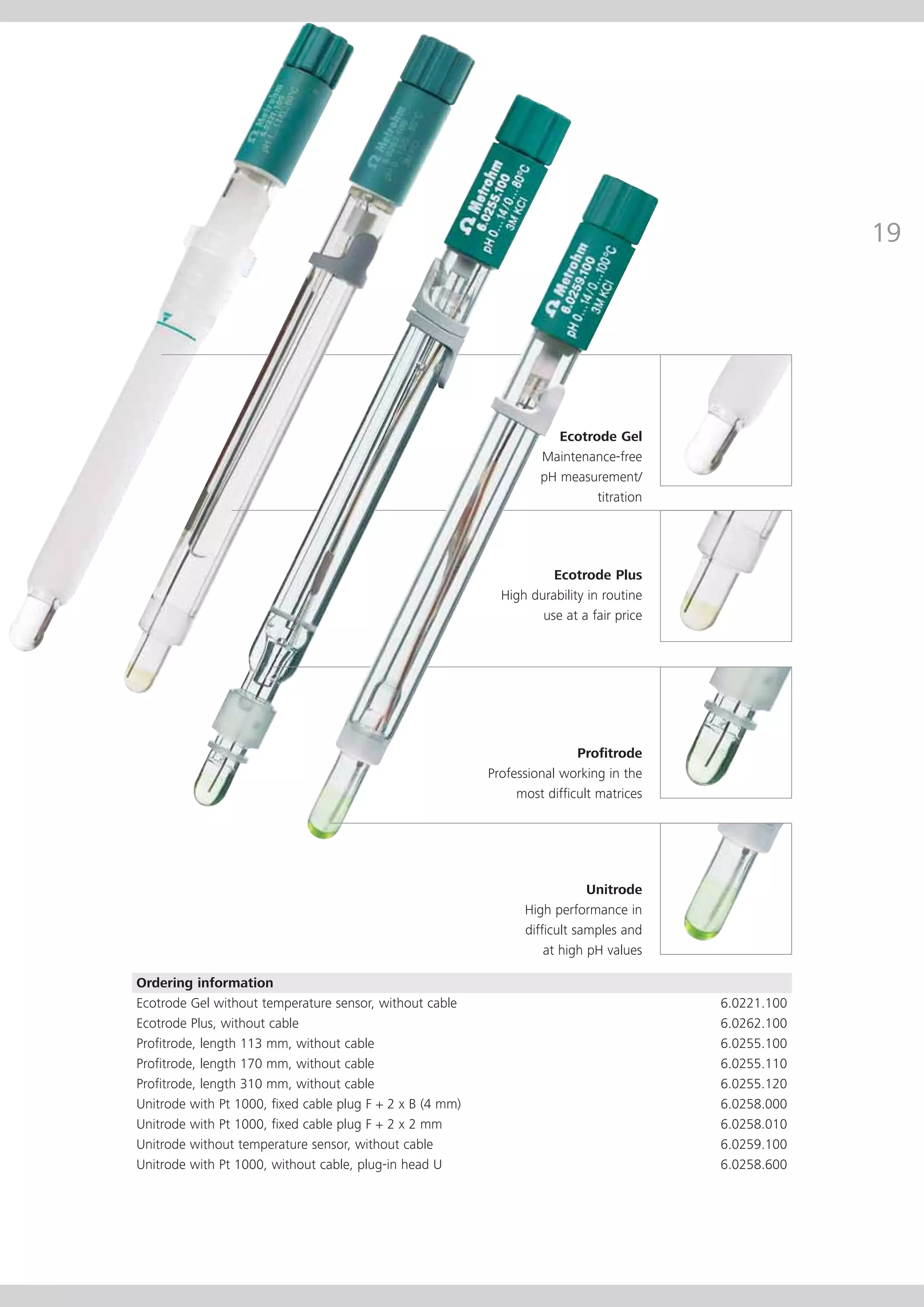
                                                                       Ecotrode Gel
                                                                    Maintenance-free
                                                                    pH measurement/
                                                                             titration


                                                                      Ecotrode Plus
                                                             High durability in routine
                                                                    use at a fair price


                                                                           Profitrode
                                                           Professional working in the
                                                                most difficult matrices


                                                                             Unitrode
                                                                 High performance in
                                                                 difficult samples and
                                                                     at high pH values

Ordering information
Ecotrode Gel without temperature sensor, without cable                                    6.0221.100
Ecotrode Plus, without cable                                                              6.0262.100
Profitrode, length 113 mm, without cable                                                  6.0255.100
Profitrode, length 170 mm, without cable                                                  6.0255.110
Profitrode, length 310 mm, without cable                                                  6.0255.120
Unitrode with Pt 1000, fixed cable plug F + 2 x B (4 mm)                                  6.0258.000
Unitrode with Pt 1000, fixed cable plug F + 2 x 2 mm                                      6.0258.010
Unitrode without temperature sensor, without cable                                        6.0259.100
Unitrode with Pt 1000, without cable, plug-in head U                                      6.0258.600
Electrodes for pH titration


20   Aquatrode Plus – ideal for aqueous, weekly
     buffered solutions
                                                                   Technical specifications
                                                                   Aquatrode Plus
       Precise measuring values and very rapid response            Shaft material           Glass
       times in ion-deficient or weekly buffered solutions –       pH range                 0...13
       such as drinking water, surface water and rain water        Temperature range        0...60 °C
       – thanks to special membrane glass and optimized,           Diaphragm                Fixed ground joint
       fixed ground joint diaphragm insensitive to contamination   Installation length      125/260 mm
       Maintenance-free inner reference electrolyte (gel)          Shaft diameter           12 mm
       Variable bridge electrolyte for special applications        Minimum immersion depth 20 mm
       Optimized length for sample changer applications            Electrode plug-in head   Metrohm plug-in head G
       LL reference system with long-term stability

     Solvotrode – space-saving alternative for titration           Technical specifications
     in non-aqueous media                                          Solvotrode
       For non-aqueous titrations in the pharmaceutical sector     Shaft material           Glass
       For determination of TAN/TBN in compliance with             pH range                 0...14
       ASTM D4739, D2896 and D664 and DIN ISO 3771                 Temperature range        0...70 °C
       and DIN EN 12634                                            Diaphragm                Flexible ground joint
       Reference electrolyte: LiCl(sat) in ethanol                 Installation length      113 mm
       Rapid response and stable measuring values in               Shaft diameter           12 mm
       organic solvents                                            Minimum immersion depth 20 mm
       Shielding against electrostatic effects                     Electrode plug-in head   Metrohm plug-in head G
       Flexible ground joint diaphragm, particularly easy to
       clean
       LL reference system with long-term stability


     Drinking water analysis – Does it matter at which stirring rate titration is performed?
     When stirring in ion-deficient solutions, streaming potentials occur at pH electrodes with ceramic pin diaphragms
     which falsify measuring values. In the case of a SET titration, e.g. to a defined pH value, a considerable error can be
     produced if an incorrect value is measured at the start or at the endpoint of the titration. See page 93 to find out
     why you can forget about this problem when using the Aquatrode Plus.
21


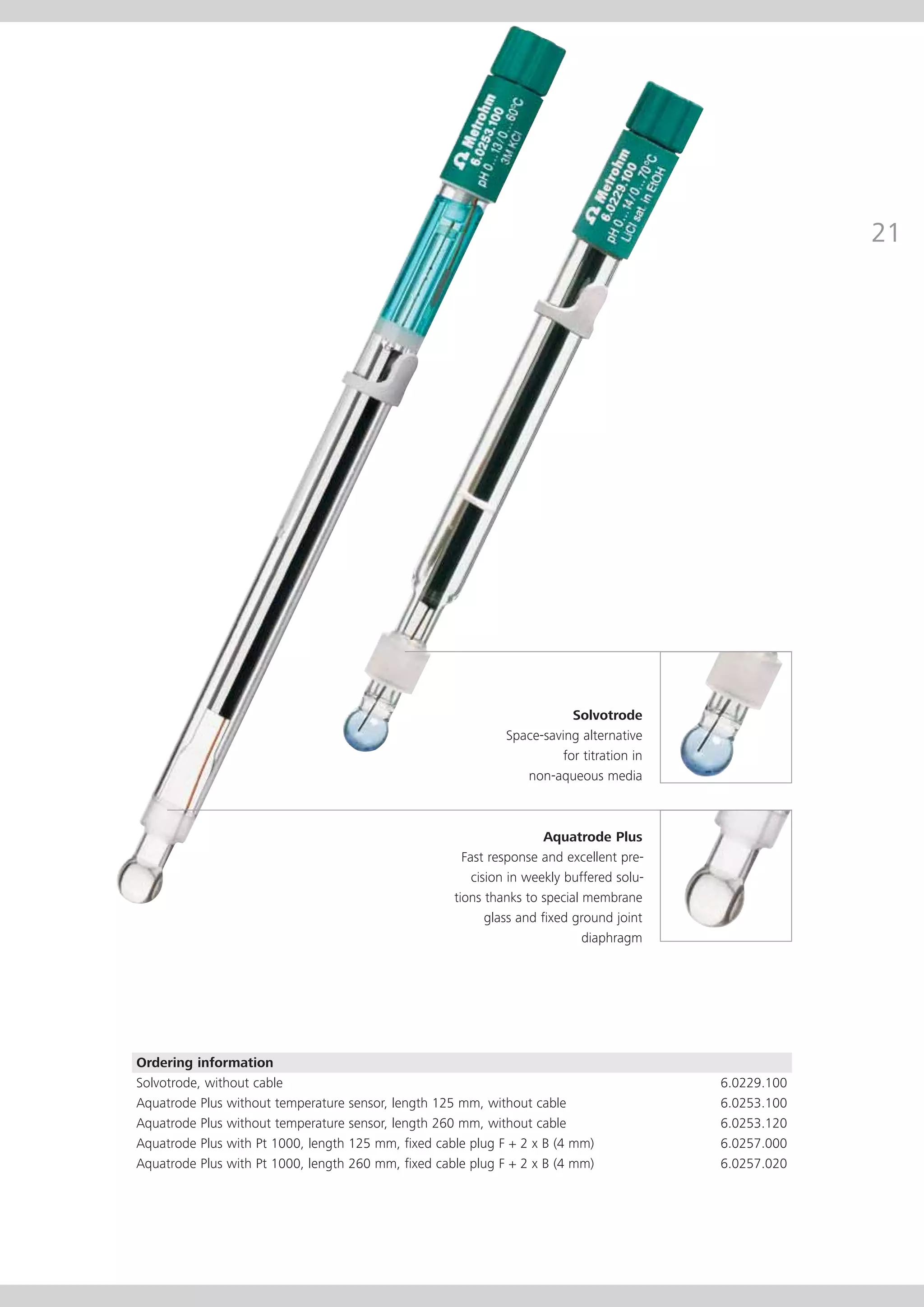
                                                                         Solvotrode
                                                              Space-saving alternative
                                                                       for titration in
                                                                 non-aqueous media


                                                                       Aquatrode Plus
                                                       Fast response and excellent pre-
                                                         cision in weekly buffered solu-
                                                     tions thanks to special membrane
                                                            glass and fixed ground joint
                                                                             diaphragm


Ordering information
Solvotrode, without cable                                                                  6.0229.100
Aquatrode Plus without temperature sensor, length 125 mm, without cable                    6.0253.100
Aquatrode Plus without temperature sensor, length 260 mm, without cable                    6.0253.120
Aquatrode Plus with Pt 1000, length 125 mm, fixed cable plug F + 2 x B (4 mm)              6.0257.000
Aquatrode Plus with Pt 1000, length 260 mm, fixed cable plug F + 2 x B (4 mm)              6.0257.020
Special electrodes for pH measurement/pH titration


22   Biotrode – pH measurement in small volumes
       Very low immersion depth and very small diameter of
                                                                 Technical specifications
                                                                 Biotrode
       the electrode tip (3 mm), exceptionally suited to small   Shaft material           Glass
       measuring vessels                                         pH range                 1...11
       For protein-containing samples and solutions with         Temperature range        0...60 °C
       organic components                                        Diaphragm                Platinum wire
       Very low electrolyte outflow (Idrolyte)                   Installation length      113 mm
       LL reference system with long-term stability              Shaft diameter           12 mm
                                                                 Shaft diameter bottom    3 mm
                                                                 Minimum immersion depth 7 mm
                                                                 Electrode plug-in head   Metrohm plug-in head G


     Spearhead electrode – pH measurement in                     Technical specifications
     semi-solid samples                                          Spearhead electrode
       Robust electrode tip for measurements in semi-solid       Shaft material           Glass
       samples such as cheese, meat, fruits, etc.                pH range                 1...11
       Maintenance-free reference electrolyte (gel)              Temperature range        0...40 °C
       Easy-to-clean diaphragm                                   Diaphragm                Twin pore
       LL reference system with long-term stability              Installation length      98 mm
                                                                 Shaft diameter           12 mm
                                                                 Shaft diameter bottom    6 mm
                                                                 Minimum immersion depth 10 mm
                                                                 Electrode plug-in head   Metrohm plug-in head G


     Flat-membrane electrode – pH measurement on                 Technical specifications
     surfaces and in small sample volumes                        Flat-membrane electrode
       For pH measurement on surfaces such as paper, textiles,   Shaft material           Glass
       leather or soil samples (aqueous suspensions)             pH range                 0...14
       Measurement/titration in small sample volumes             Temperature range        0...80 °C
       Completely made of glass with extremely fine-             Diaphragm                Fixed ground joint
       grounded surface                                          Installation length      125 mm
       LL reference system with long-term stability              Shaft diameter           12 mm
                                                                 Minimum immersion depth 1 mm
                                                                 Electrode plug-in head   Metrohm plug-in head G


     Porotrode – pH measurement in protein contain-              Technical specifications
     ing samples                                                 Porotrode
       For pH measurement in very contaminated, protein-         Shaft material           Glass
       containing or viscous samples                             pH range                 0...14
       Low-maintenance capillary diaphragm                       Temperature range        0...80 °C
       Polymer electrolyte Porolyte for uniform electrolyte      Diaphragm                Ceramic capillaries
       outflow                                                   Installation length      125 mm
       LL reference system with long-term stability              Shaft diameter           12 mm
                                                                 Minimum immersion depth 20 mm
                                                                 Electrode plug-in head   Metrohm plug-in head G
23


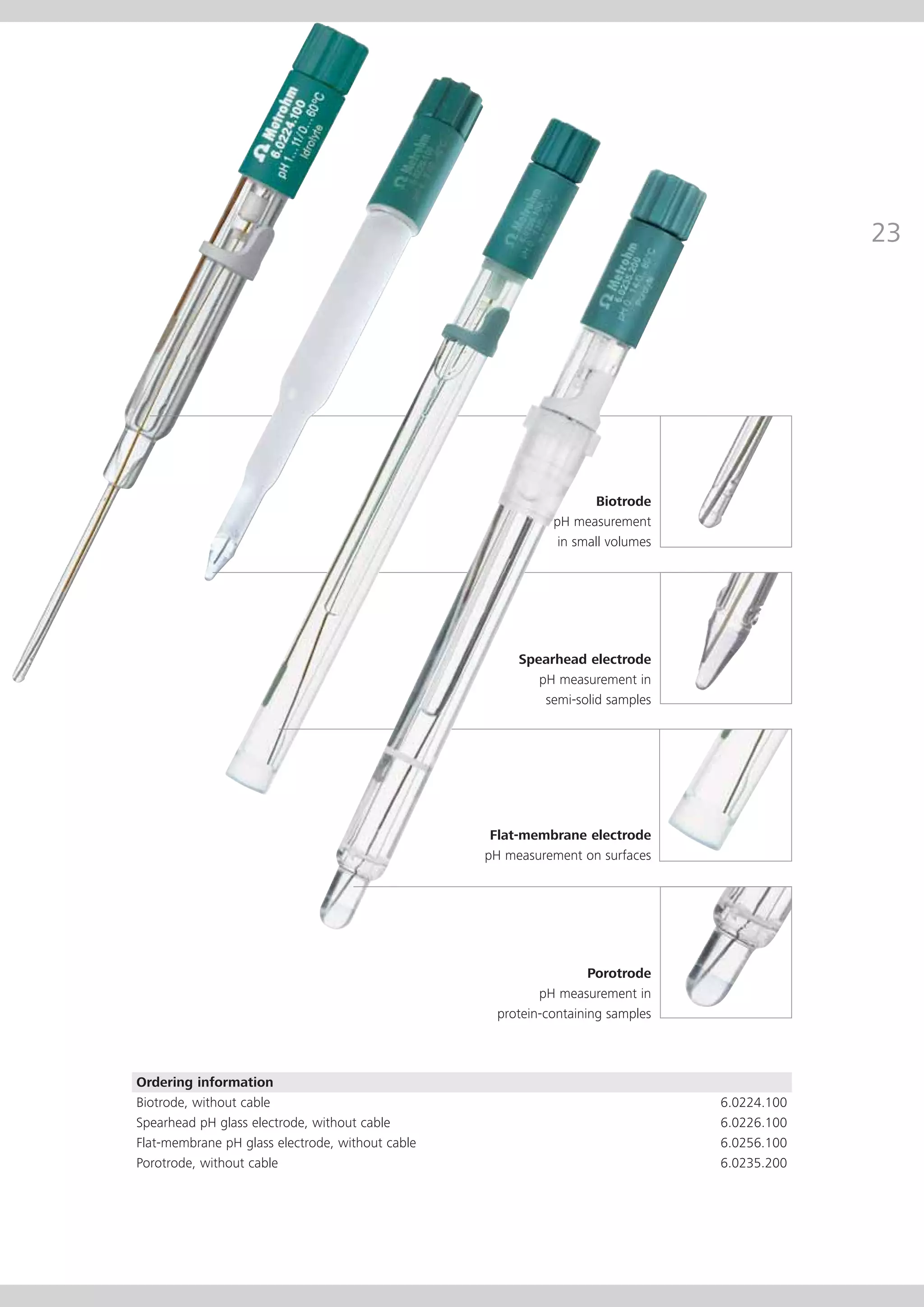
                                                                   Biotrode
                                                            pH measurement
                                                             in small volumes


                                                       Spearhead electrode
                                                          pH measurement in
                                                           semi-solid samples


                                                   Flat-membrane electrode
                                                  pH measurement on surfaces


                                                                   Porotrode
                                                          pH measurement in
                                                   protein-containing samples


Ordering information
Biotrode, without cable                                                         6.0224.100
Spearhead pH glass electrode, without cable                                     6.0226.100
Flat-membrane pH glass electrode, without cable                                 6.0256.100
Porotrode, without cable                                                        6.0235.200
Special electrodes for pH measurement/pH titration


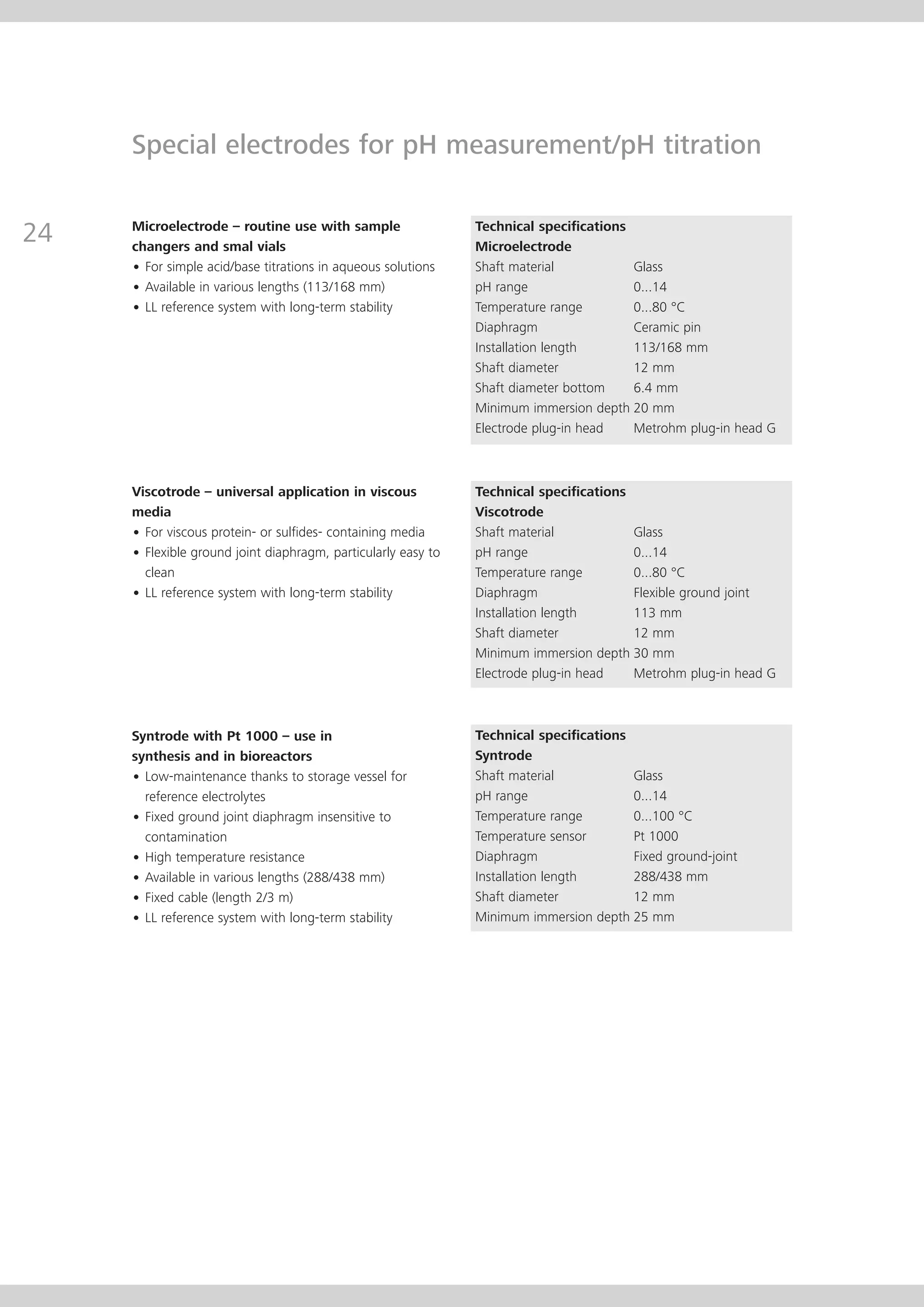
24   Microelectrode – routine use with sample
     changers and smal vials
                                                               Technical specifications
                                                               Microelectrode
       For simple acid/base titrations in aqueous solutions    Shaft material           Glass
       Available in various lengths (113/168 mm)               pH range                 0...14
       LL reference system with long-term stability            Temperature range        0...80 °C
                                                               Diaphragm                Ceramic pin
                                                               Installation length      113/168 mm
                                                               Shaft diameter           12 mm
                                                               Shaft diameter bottom    6.4 mm
                                                               Minimum immersion depth 20 mm
                                                               Electrode plug-in head   Metrohm plug-in head G


     Viscotrode – universal application in viscous             Technical specifications
     media                                                     Viscotrode
       For viscous protein- or sulfides- containing media      Shaft material           Glass
       Flexible ground joint diaphragm, particularly easy to   pH range                 0...14
       clean                                                   Temperature range        0...80 °C
       LL reference system with long-term stability            Diaphragm                Flexible ground joint
                                                               Installation length      113 mm
                                                               Shaft diameter           12 mm
                                                               Minimum immersion depth 30 mm
                                                               Electrode plug-in head   Metrohm plug-in head G


     Syntrode with Pt 1000 – use in                            Technical specifications
     synthesis and in bioreactors                              Syntrode
       Low-maintenance thanks to storage vessel for            Shaft material           Glass
       reference electrolytes                                  pH range                 0...14
       Fixed ground joint diaphragm insensitive to             Temperature range        0...100 °C
       contamination                                           Temperature sensor       Pt 1000
       High temperature resistance                             Diaphragm                Fixed ground-joint
       Available in various lengths (288/438 mm)               Installation length      288/438 mm
       Fixed cable (length 2/3 m)                              Shaft diameter           12 mm
       LL reference system with long-term stability            Minimum immersion depth 25 mm
25


                                                                                                          size
                                                                                                         d in
                                                                                                      uce
                                                                                                  red
                                                                                              ion
                                                                                            trat
                                                                                          Illus
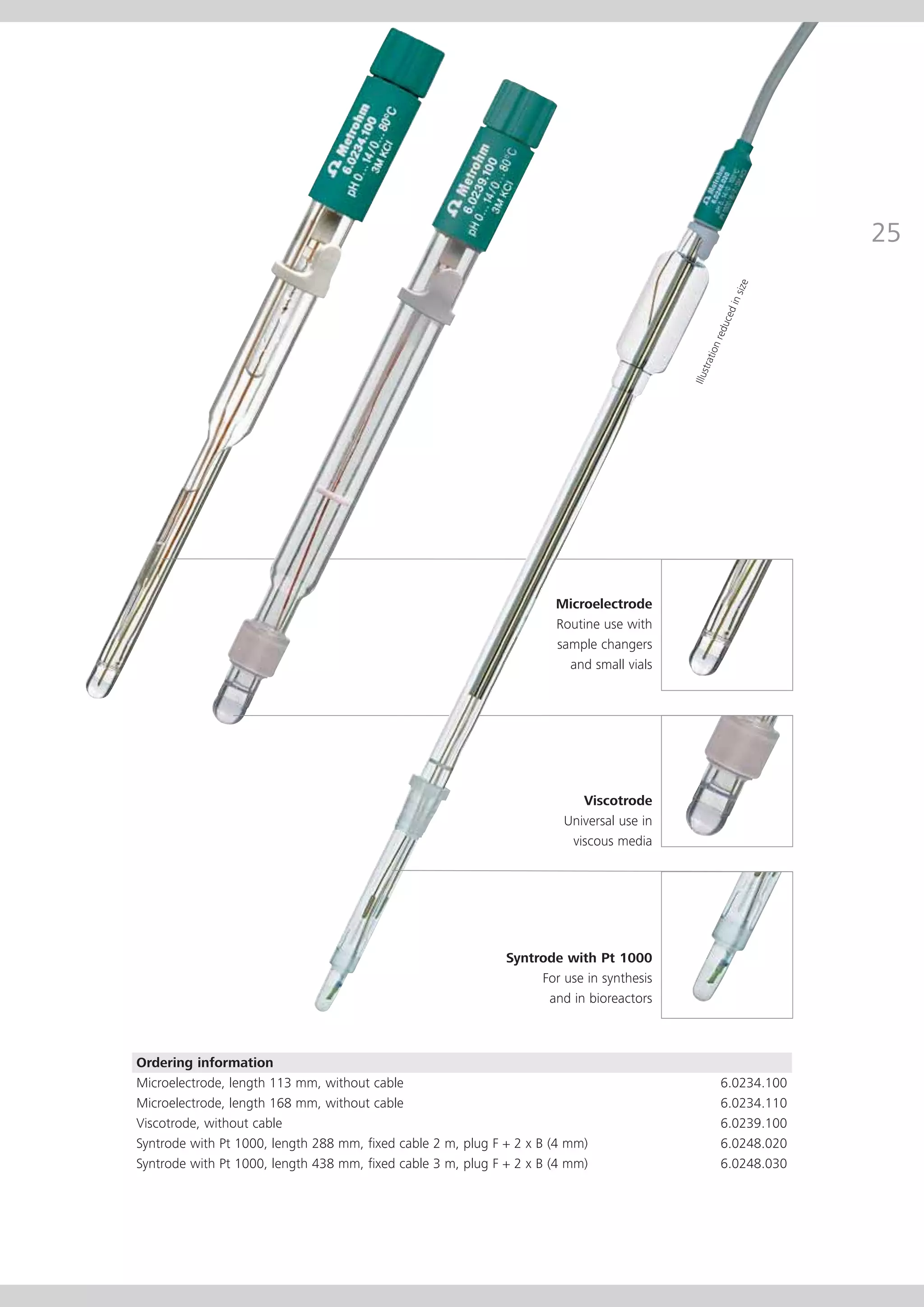
                                                                      Microelectrode
                                                                      Routine use with
                                                                      sample changers
                                                                        and small vials


                                                                          Viscotrode
                                                                       Universal use in
                                                                        viscous media


                                                              Syntrode with Pt 1000
                                                                   For use in synthesis
                                                                    and in bioreactors


Ordering information
Microelectrode, length 113 mm, without cable                                                        6.0234.100
Microelectrode, length 168 mm, without cable                                                        6.0234.110
Viscotrode, without cable                                                                           6.0239.100
Syntrode with Pt 1000, length 288 mm, fixed cable 2 m, plug F + 2 x B (4 mm)                        6.0248.020
Syntrode with Pt 1000, length 438 mm, fixed cable 3 m, plug F + 2 x B (4 mm)                        6.0248.030
26
Metal electrodes                                                                                               27


High-performance metal electrodes for redox and precipitation titration, voltammetry and water determination
according to Karl Fischer.
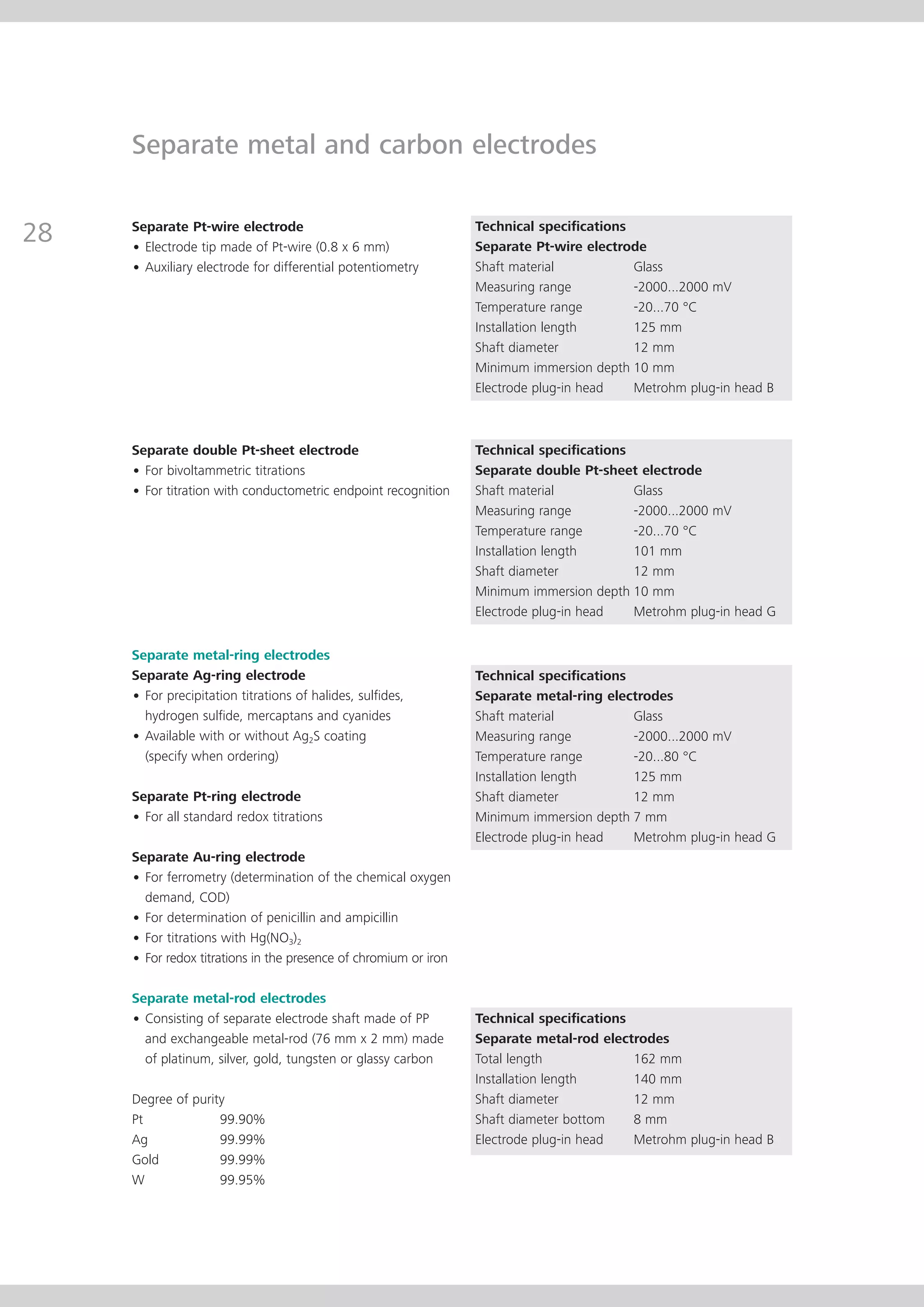
Separate metal and carbon electrodes


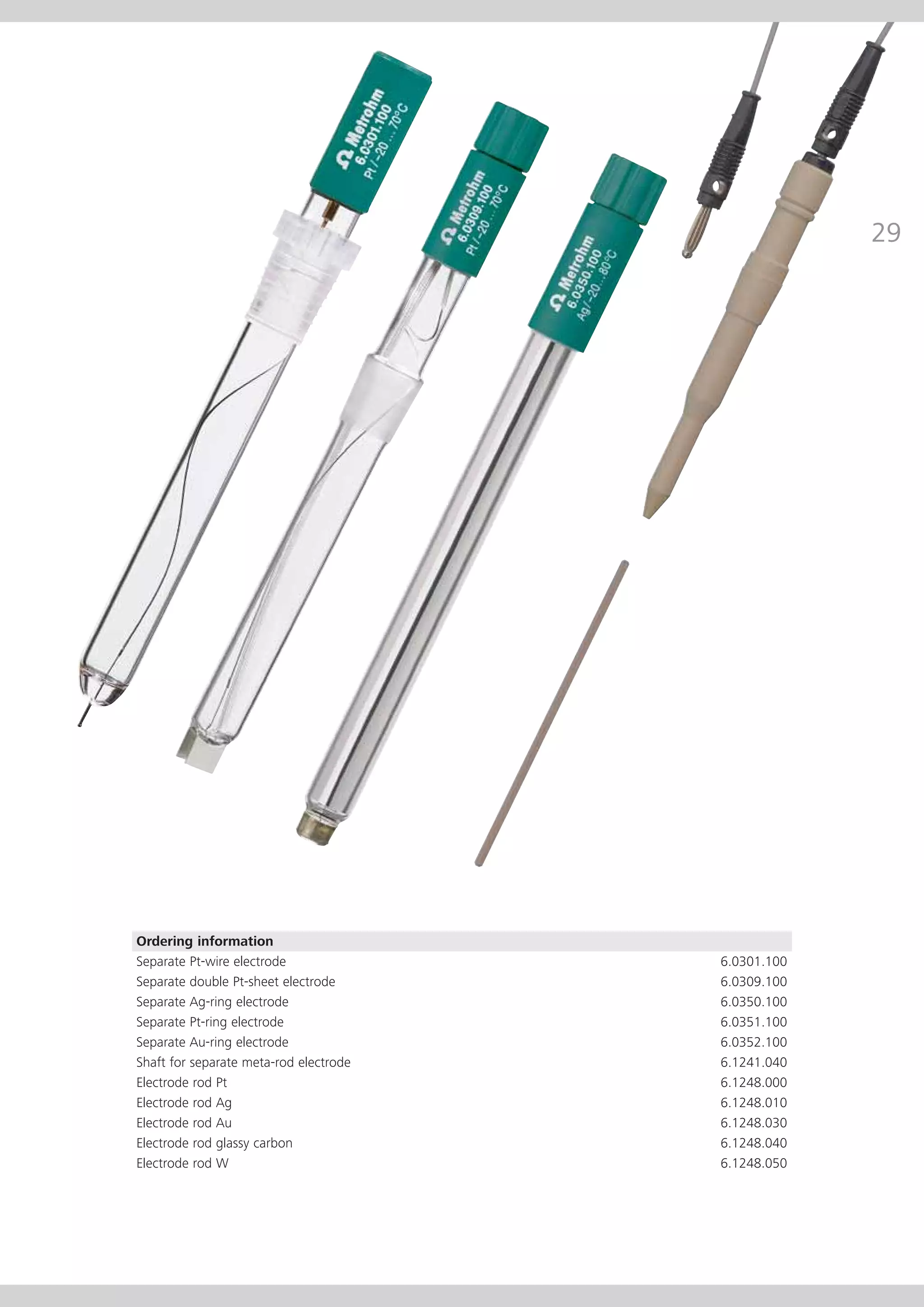
28   Separate Pt-wire electrode
       Electrode tip made of Pt-wire (0.8 x 6 mm)
                                                                  Technical specifications
                                                                  Separate Pt-wire electrode
       Auxiliary electrode for differential potentiometry         Shaft material           Glass
                                                                  Measuring range          -2000...2000 mV
                                                                  Temperature range        -20...70 °C
                                                                  Installation length      125 mm
                                                                  Shaft diameter           12 mm
                                                                  Minimum immersion depth 10 mm
                                                                  Electrode plug-in head   Metrohm plug-in head B


     Separate double Pt-sheet electrode                           Technical specifications
       For bivoltammetric titrations                              Separate double Pt-sheet electrode
       For titration with conductometric endpoint recognition     Shaft material           Glass
                                                                  Measuring range          -2000...2000 mV
                                                                  Temperature range        -20...70 °C
                                                                  Installation length      101 mm
                                                                  Shaft diameter           12 mm
                                                                  Minimum immersion depth 10 mm
                                                                  Electrode plug-in head   Metrohm plug-in head G


     Separate metal-ring electrodes
     Separate Ag-ring electrode                                   Technical specifications
       For precipitation titrations of halides, sulfides,         Separate metal-ring electrodes
       hydrogen sulfide, mercaptans and cyanides                  Shaft material           Glass
       Available with or without Ag2S coating                     Measuring range          -2000...2000 mV
       (specify when ordering)                                    Temperature range        -20...80 °C
                                                                  Installation length      125 mm
     Separate Pt-ring electrode                                   Shaft diameter           12 mm
       For all standard redox titrations                          Minimum immersion depth 7 mm
                                                                  Electrode plug-in head   Metrohm plug-in head G
     Separate Au-ring electrode
       For ferrometry (determination of the chemical oxygen
       demand, COD)
       For determination of penicillin and ampicillin
       For titrations with Hg(NO3)2
       For redox titrations in the presence of chromium or iron

     Separate metal-rod electrodes
       Consisting of separate electrode shaft made of PP          Technical specifications
       and exchangeable metal-rod (76 mm x 2 mm) made             Separate metal-rod electrodes
       of platinum, silver, gold, tungsten or glassy carbon       Total length             162 mm
                                                                  Installation length      140 mm
     Degree of purity                                             Shaft diameter           12 mm
     Pt             99.90%                                        Shaft diameter bottom    8 mm
     Ag             99.99%                                        Electrode plug-in head   Metrohm plug-in head B
     Gold           99.99%
     W              99.95%
29


Ordering information
Separate Pt-wire electrode              6.0301.100
Separate double Pt-sheet electrode      6.0309.100
Separate Ag-ring electrode              6.0350.100
Separate Pt-ring electrode              6.0351.100
Separate Au-ring electrode              6.0352.100
Shaft for separate meta-rod electrode   6.1241.040
Electrode rod Pt                        6.1248.000
Electrode rod Ag                        6.1248.010
Electrode rod Au                        6.1248.030
Electrode rod glassy carbon             6.1248.040
Electrode rod W                         6.1248.050
Titrodes – the maintenance-free metal electrodes


30   Pt Titrode / Pt Micro Titrode
       For redox titrations without alteration of the pH value
                                                                 Technical specifications
                                                                 Titrodes
       For bromatometry, iodometry and cerimetry in com-         Shaft material           Glass
       pliance with Pharm. Europe  USP                          Measuring range          -2000...2000 mV
       Maintenance-free reference system (pH glass               pH range                 0...14
       membrane)                                                 Temperature range        0...80 °C
                                                                 Reference system         pH glass electrode
     Ag Titrode / Ag Micro Titrode                               Installation length      125 mm
      For precipitation titrations without alteration of the     Shaft diameter           12 mm
      pH value                                                   Minimum immersion depth 20 mm
      For precipitation titrations of halides, sulfides,         Electrode plug-in head   Metrohm plug-in head G
      hydrogen sulfide, mercaptans and cyanides
      For titrations in compliance with Pharm. Europe  USP      Micro Titrodes
      Available with or without Ag2S coating                     Shaft material          Glass
      (specify when ordering)                                    Measuring range         -2000...2000 mV
      Maintenance-free reference system (pH glass                pH range                0...14
      membrane)                                                  Temperature range       0...80 °C
                                                                 Reference system        pH glass electrode
     Au Micro Titrode                                            Installation length     178 mm
      For ferrometry (determination of the chemical oxygen       Shaft diameter          12 mm
      demand, COD)                                               Shaft diameter bottom   6.4 mm
      For the determination of penicillin and ampicillin         Minimum immersion depth 20 mm
      For titrations with Hg(NO3)2                               Electrode plug-in head  Metrohm plug-in head G
      For redox titrations in the presence of chromium or iron
      Maintenance-free reference system (pH glass
      membrane)


     Ag Titrodes: available with or without coating
     Depending on the application (see application lists), the use of an Ag Titrode with or without Ag2S or AgBr coating
     is recommended. We would be happy to supply you with your Ag Titrode with the respective coating at an addi-
     tional charge; please specify when ordering.
31


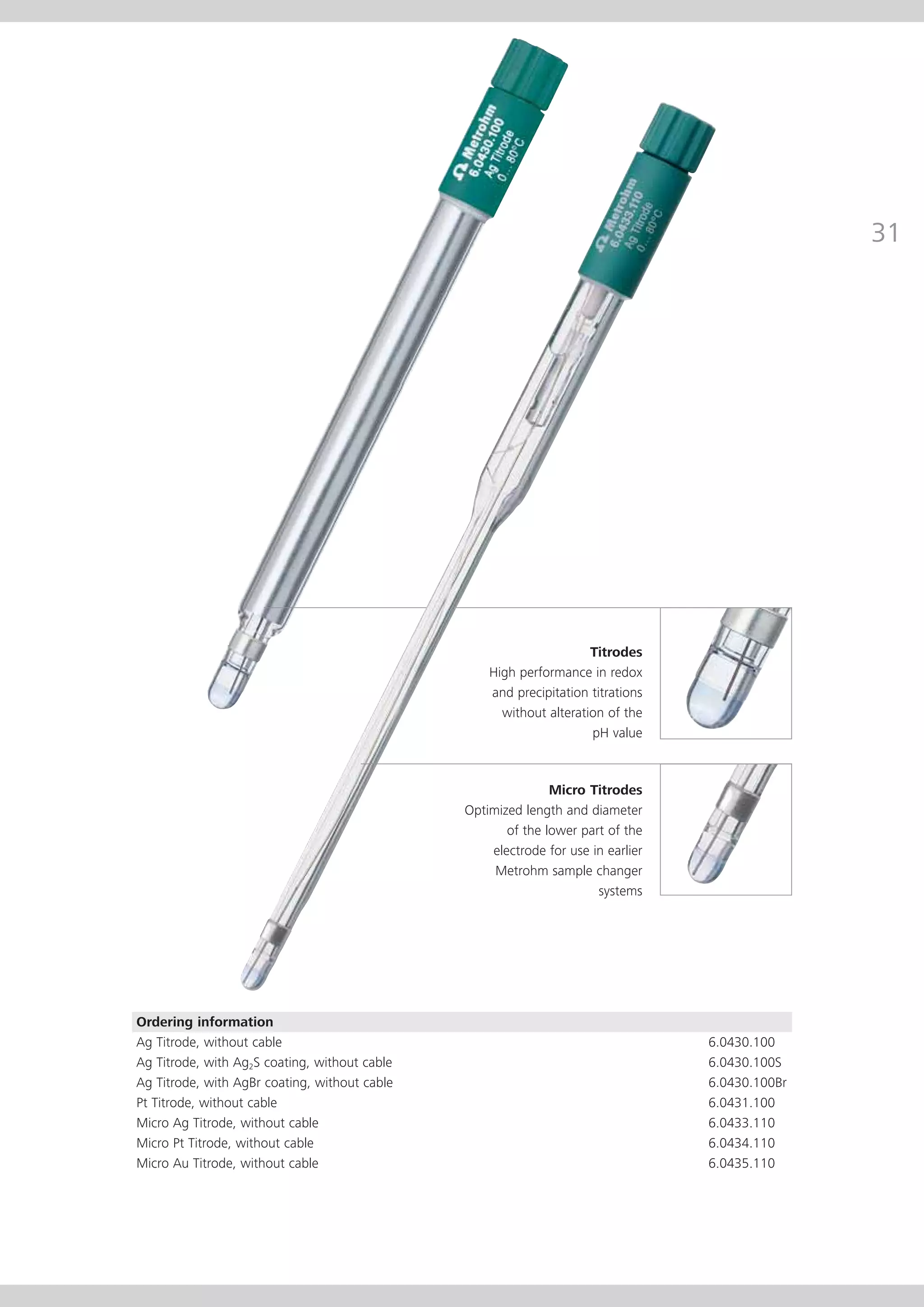
                                                                     Titrodes
                                                   High performance in redox
                                                   and precipitation titrations
                                                     without alteration of the
                                                                     pH value


                                                              Micro Titrodes
                                               Optimized length and diameter
                                                      of the lower part of the
                                                   electrode for use in earlier
                                                    Metrohm sample changer
                                                                      systems


Ordering information
Ag Titrode, without cable                                                         6.0430.100
Ag Titrode, with Ag2S coating, without cable                                      6.0430.100S
Ag Titrode, with AgBr coating, without cable                                      6.0430.100Br
Pt Titrode, without cable                                                         6.0431.100
Micro Ag Titrode, without cable                                                   6.0433.110
Micro Pt Titrode, without cable                                                   6.0434.110
Micro Au Titrode, without cable                                                   6.0435.110
Combined metal electrodes


32   Combined Ag-ring electrode
       For precipitation titrations of halides, sulfides,
                                                              Technical specifications
                                                              Combined Ag-ring electrode
       hydrogen sulfide, mercaptans and cyanides with         Shaft material           Glass
       alteration of the pH value                             Measuring range          -2000...2000 mV
       Available with or without Ag2S coating                 Temperature range        -5...80 °C
       (specify when ordering)                                Reference system         Ag wire + AgCl
                                                              Reference electrolyte    c(KNO3) = 1 mol/L
     Combined Pt-ring electrode                               Diaphragm                Ceramic pin
       For redox titrations with alteration of the pH value   Installation length      113 mm
                                                              Shaft diameter           12 mm
     Combined Au-ring electrode                               Minimum immersion depth 15 mm
       For ferrometry (determination of the chemical oxygen   Electrode plug-in head   Metrohm plug-in head G
       demand COD)
       For determination of penicillin and ampicillin         Combined Pt-ring electrode / Au-ring electrode
                                                              Shaft material          Glass
                                                              Measuring range         -2000...2000 mV
                                                              Temperature range       -5...80 °C
                                                              Reference system        LL system
                                                              Reference electrolyte   c(KCl) = 3 mol/L
                                                              Diaphragm               Ceramic pin
                                                              Installation length     113 mm
                                                              Shaft diameter          12 mm
                                                              Minimum immersion depth 15 mm
                                                              Electrode plug-in head  Metrohm plug-in head G


     Combined Sb electrode                                    Technical specifications
       For pH titration in very hygroscopic matrices or in    Combined Sb electrode
       matrices containing hydrofluoric acid                  Shaft material           PP
       Unbreakable plastic shaft                              pH range                 2...11
                                                              Temperature range        0...70 °C
                                                              Reference system         LL system
                                                              Reference electrolyte    c(KCl) = 3 mol/L
                                                              Diaphragm                Ceramic pin
                                                              Installation length      113 mm
                                                              Shaft diameter           12 mm
                                                              Minimum immersion depth 15 mm
                                                              Electrode plug-in head   Metrohm plug-in head G
33


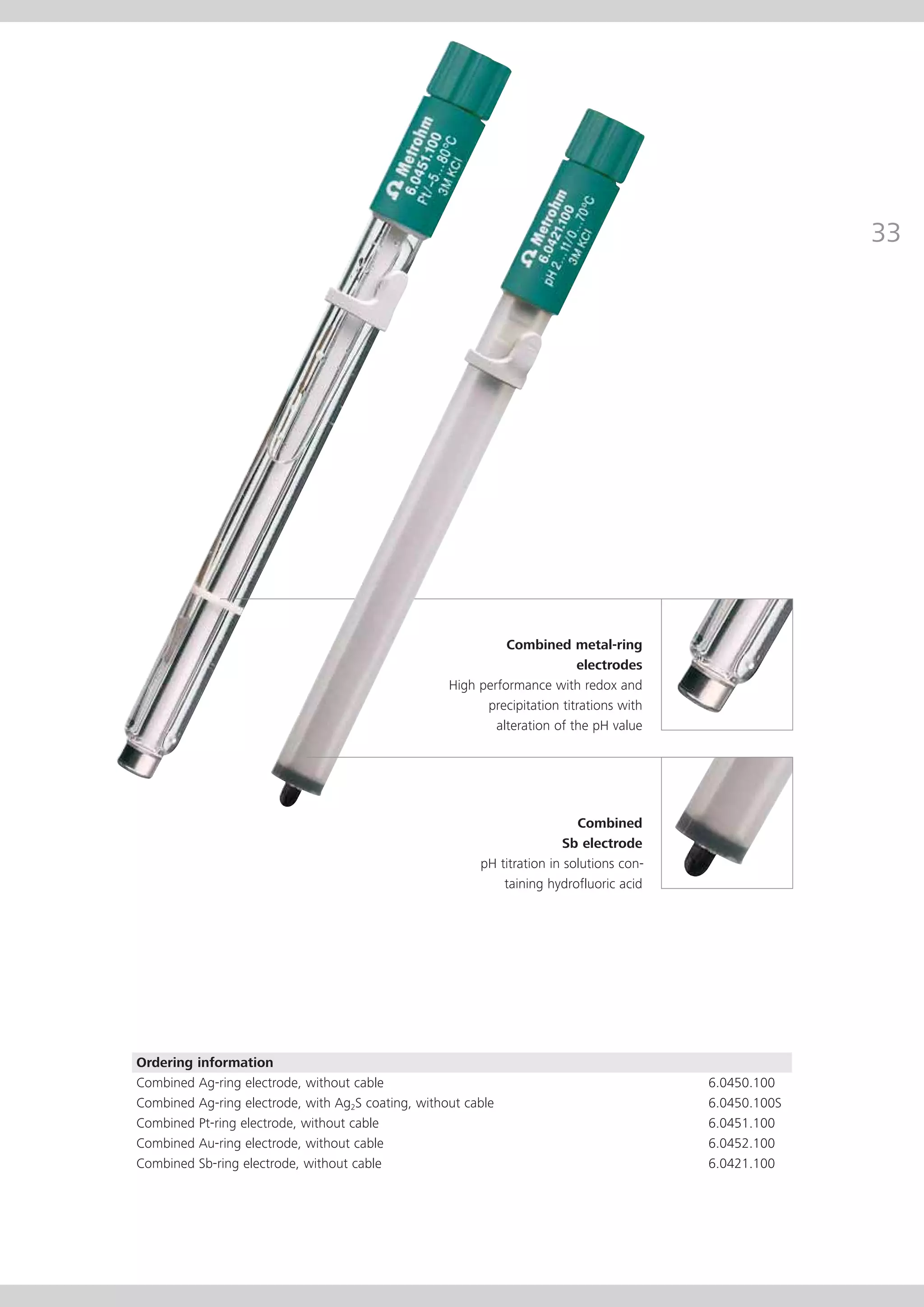
                                                              Combined metal-ring
                                                                           electrodes
                                                    High performance with redox and
                                                          precipitation titrations with
                                                            alteration of the pH value


                                                                           Combined
                                                                         Sb electrode
                                                         pH titration in solutions con-
                                                             taining hydrofluoric acid


Ordering information
Combined Ag-ring electrode, without cable                                                 6.0450.100
Combined Ag-ring electrode, with Ag2S coating, without cable                              6.0450.100S
Combined Pt-ring electrode, without cable                                                 6.0451.100
Combined Au-ring electrode, without cable                                                 6.0452.100
Combined Sb-ring electrode, without cable                                                 6.0421.100
Electrodes for voltammetry


34   The electrodes described in the following can be used in
     various Metrohm voltammetry instruments: 663 VA
     Stand, 694 VA Stand, 747 VA Stand, 757 VA Computrace
     and 797 VA Computrace.

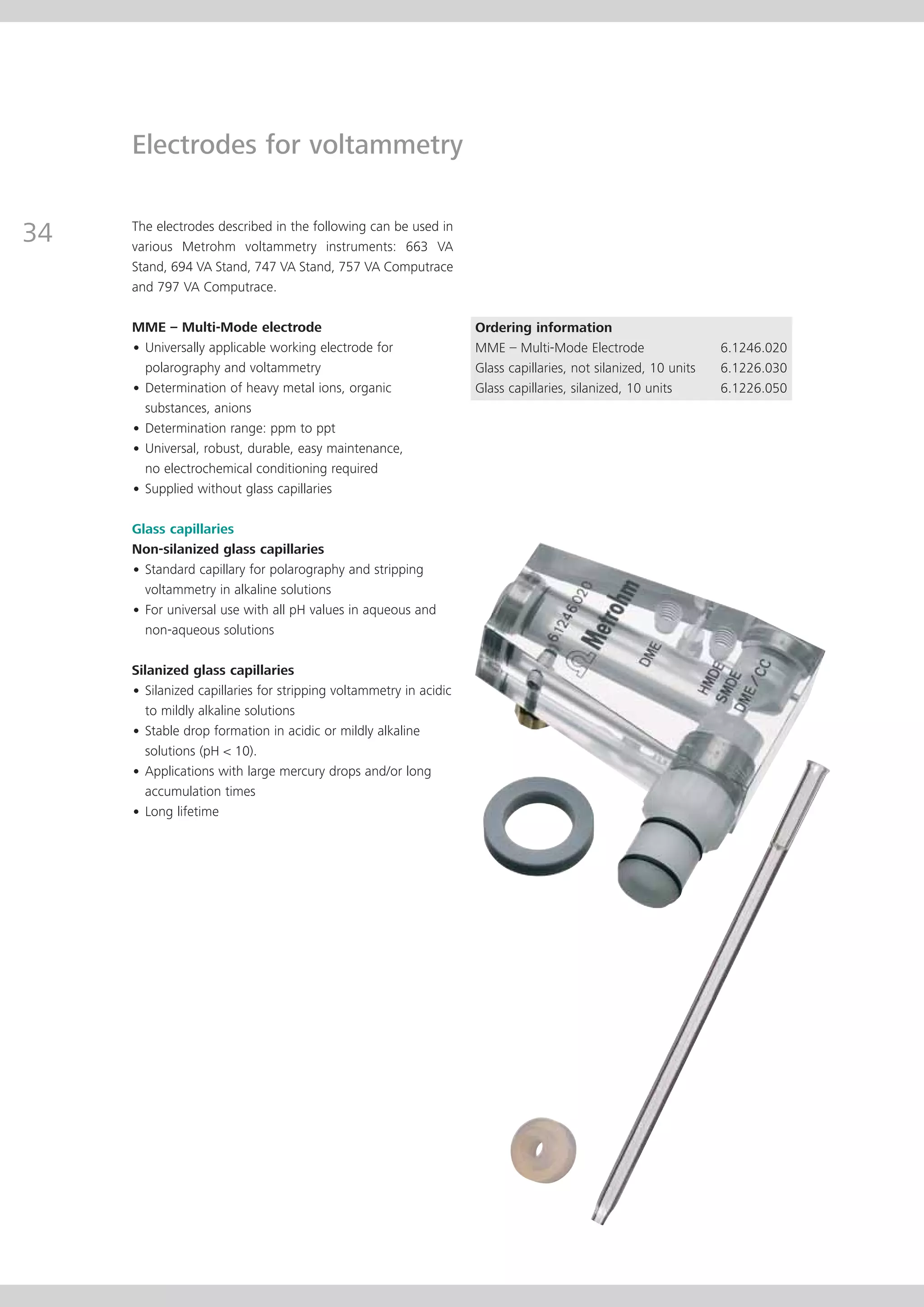
     MME – Multi-Mode electrode                                    Ordering information
      Universally applicable working electrode for                 MME – Multi-Mode Electrode                   6.1246.020
      polarography and voltammetry                                 Glass capillaries, not silanized, 10 units   6.1226.030
      Determination of heavy metal ions, organic                   Glass capillaries, silanized, 10 units       6.1226.050
      substances, anions
      Determination range: ppm to ppt
      Universal, robust, durable, easy maintenance,
      no electrochemical conditioning required
      Supplied without glass capillaries

     Glass capillaries
     Non-silanized glass capillaries
       Standard capillary for polarography and stripping
       voltammetry in alkaline solutions
       For universal use with all pH values in aqueous and
       non-aqueous solutions

     Silanized glass capillaries
       Silanized capillaries for stripping voltammetry in acidic
       to mildly alkaline solutions
       Stable drop formation in acidic or mildly alkaline
       solutions (pH  10).
       Applications with large mercury drops and/or long
       accumulation times
       Long lifetime
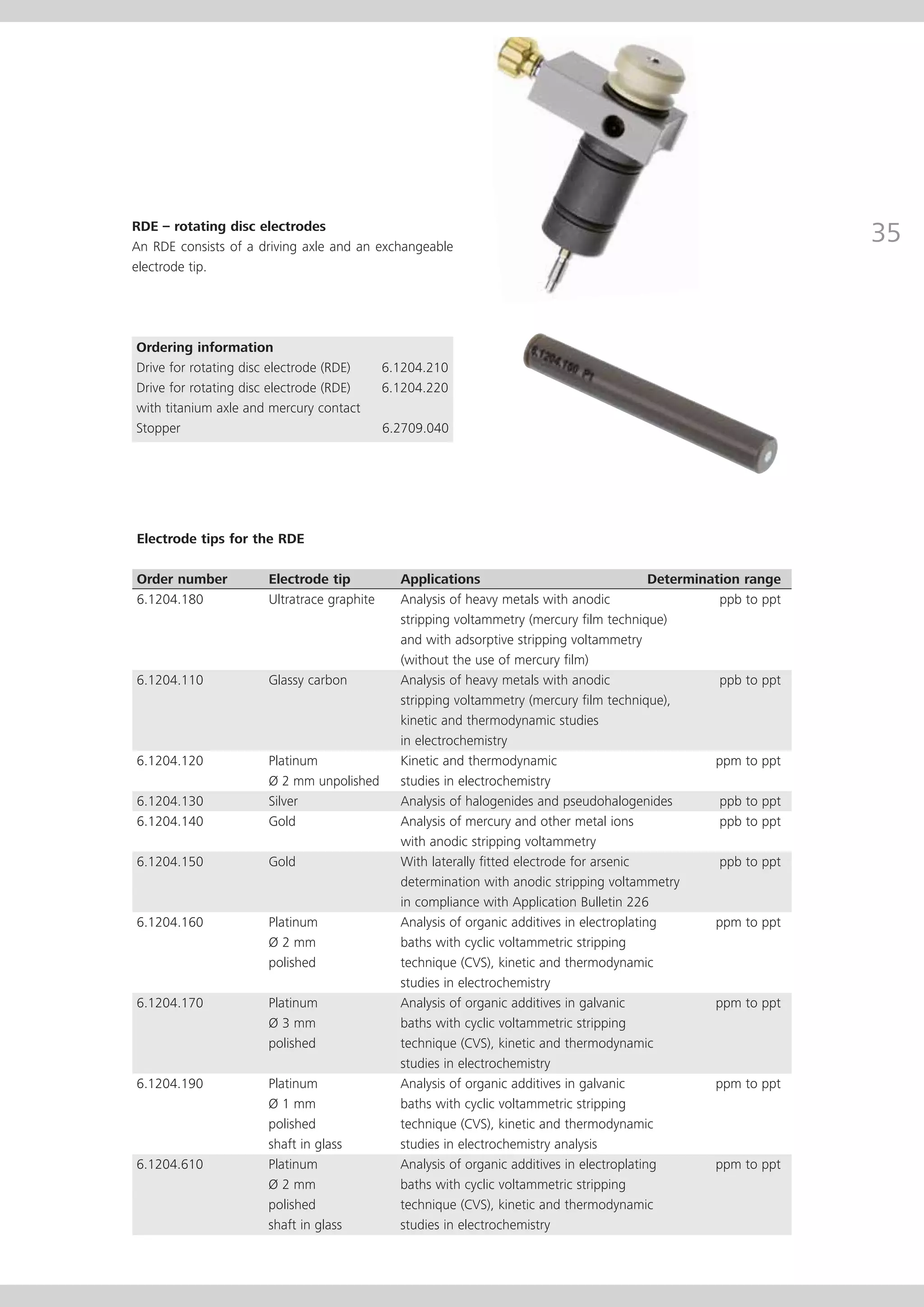
RDE – rotating disc electrodes
An RDE consists of a driving axle and an exchangeable
                                                                                                                    35
electrode tip.


Ordering information
Drive for rotating disc electrode (RDE)      6.1204.210
Drive for rotating disc electrode (RDE)      6.1204.220
with titanium axle and mercury contact
Stopper                                      6.2709.040


Electrode tips for the RDE

Order number           Electrode tip           Applications                                  Determination range
6.1204.180             Ultratrace graphite     Analysis of heavy metals with anodic                    ppb to ppt
                                               stripping voltammetry (mercury film technique)
                                               and with adsorptive stripping voltammetry
                                               (without the use of mercury film)
6.1204.110             Glassy carbon           Analysis of heavy metals with anodic                    ppb to ppt
                                               stripping voltammetry (mercury film technique),
                                               kinetic and thermodynamic studies
                                               in electrochemistry
6.1204.120             Platinum                Kinetic and thermodynamic                              ppm to ppt
                       Ø 2 mm unpolished       studies in electrochemistry
6.1204.130             Silver                  Analysis of halogenides and pseudohalogenides           ppb to ppt
6.1204.140             Gold                    Analysis of mercury and other metal ions                ppb to ppt
                                               with anodic stripping voltammetry
6.1204.150             Gold                    With laterally fitted electrode for arsenic             ppb to ppt
                                               determination with anodic stripping voltammetry
                                               in compliance with Application Bulletin 226
6.1204.160             Platinum                Analysis of organic additives in electroplating        ppm to ppt
                       Ø 2 mm                  baths with cyclic voltammetric stripping
                       polished                technique (CVS), kinetic and thermodynamic
                                               studies in electrochemistry
6.1204.170             Platinum                Analysis of organic additives in galvanic              ppm to ppt
                       Ø 3 mm                  baths with cyclic voltammetric stripping
                       polished                technique (CVS), kinetic and thermodynamic
                                               studies in electrochemistry
6.1204.190            Platinum                 Analysis of organic additives in galvanic              ppm to ppt
                      Ø 1 mm                   baths with cyclic voltammetric stripping
                      polished                 technique (CVS), kinetic and thermodynamic
                      shaft in glass           studies in electrochemistry analysis
6.1204.610            Platinum                 Analysis of organic additives in electroplating        ppm to ppt
                      Ø 2 mm                   baths with cyclic voltammetric stripping
                      polished                 technique (CVS), kinetic and thermodynamic
                      shaft in glass           studies in electrochemistry
Electrodes for voltammetry


36   Reference electrode for Metrohm VA stands
     Reference electrode made of plastic with ceramic              Ordering information
     diaphragm, filled
       Universal double-junction reference electrode for           Ag / AgCl reference electrode              6.0728.020
       voltammetry                                                 Electrolyte vessel for Reference electrode 6.1245.010
       Inner system filled with c(KCl) = 3 mol/L
       Aqueous solutions, trace and ultra trace ranges, CVS
       Low carry-over effects, low blank values

     Reference electrode made of plastic with ceramic
     diaphragm, dry
       Double-junction reference electrode. Reference system dry   Ag / AgCl reference electrode (dry)          6.0728.010
       Studies in organic solvents with any electrolyte solution   Electrolyte vessel for reference electrode   6.1245.010
       Low carry-over effects, low blank values

     LL reference electrode made of plastic with
     ceramic diaphragm, filled
       Double-junction reference electrode for the analysis        LL-Ag/AgCl reference electrode               6.0728.030
       of electroplating baths with cyclic voltammetric            Electrolyte vessel for reference electrode   6.1245.010
       stripping (CVS)
                                                                   LL-Ag/AgCl (Gel) reference electrode         6.0728.040
       Inner system filled with c(KCl) = 3 mol/L
                                                                   Electrolyte vessel for reference electrode   6.1245.010
       Very stable reference potential

     LL reference electrode made of glass, filled
       Double-junction reference electrode for the studies         LL-Ag/AgCl (Gel) reference electrode         6.0730.000
       of electroplating baths with cyclic voltammetric
       stripping (CVS)
       Very stable reference potential
       Maintenance-free

     Reference electrode made of glass with ground
     joint diaphragm
       Double-junction reference electrode with dry                LL-Ag/AgCl(Gel) reference electrode glass 6.0728.000
       reference system                                            Electrolyte vessel for reference electrode 6.1245.010
       For aqueous as well as non-aqueous solutions
       Simple electrolyte replacement, low outflow rate

     Auxiliary electrodes for Metrohm VA stands
     Platinum auxiliary electrode
       Universal auxiliary electrode for voltammetry               Platinum auxiliary electrode                 6.0343.000
       For all applications with the MME as well as with the
       rotating platinum disc electrode
       Robust, easy maintenance

     Glassy carbon auxiliary electrode
       For all applications with rotating disc electrodes as       Auxiliary electrode holder                   6.1241.020
       well as with the MME                                        Glassy carbon rod                            6.1247.000
       Inert surface, no contamination of the measuring
       cell by platinum
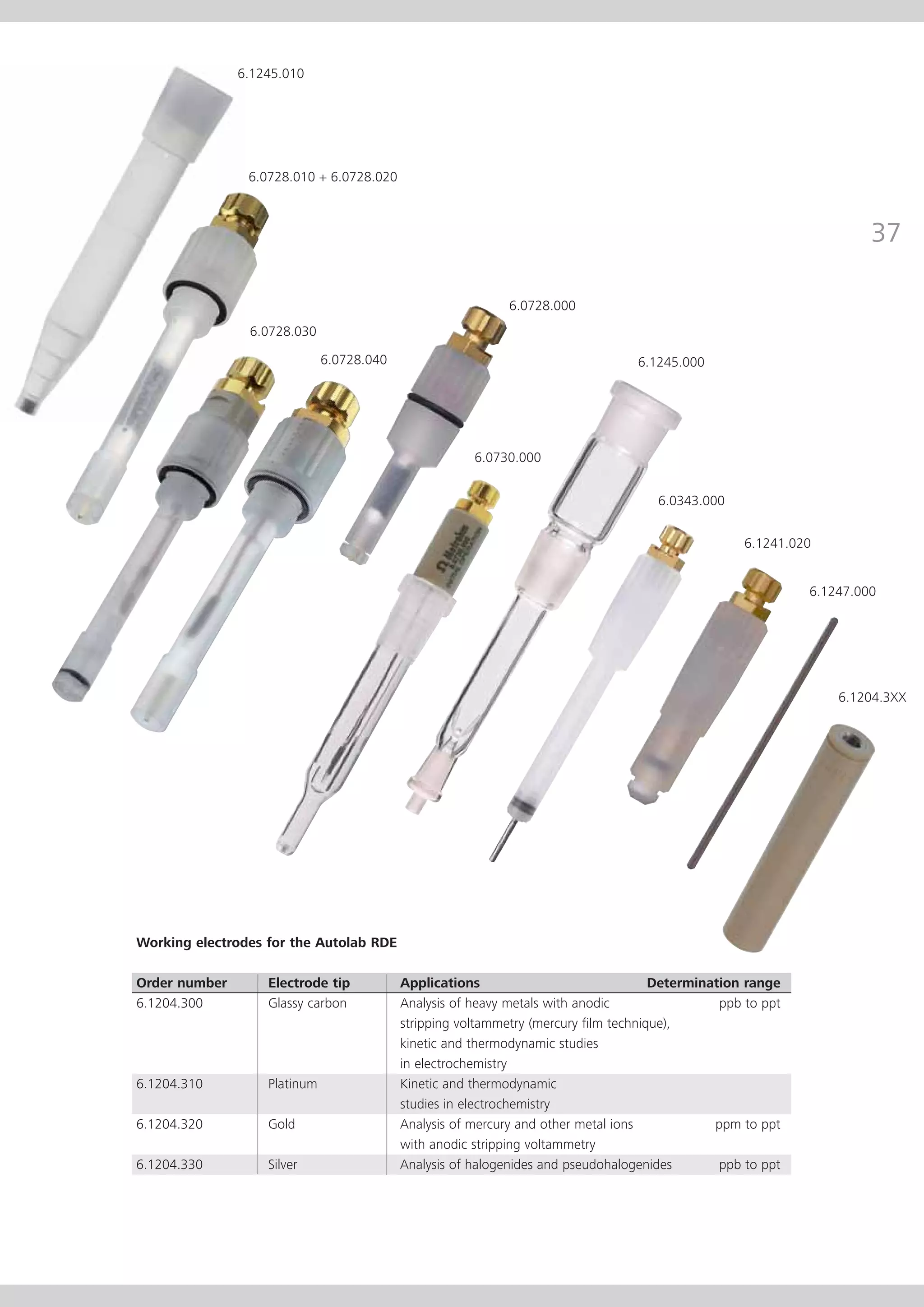
6.1245.010


                6.0728.010 + 6.0728.020


                                                                                                                      37

                                                             6.0728.000
                6.0728.030

                              6.0728.040                                          6.1245.000


                                                       6.0730.000


                                                                                     6.0343.000


                                                                                                   6.1241.020


                                                                                                             6.1247.000


                                                                                                                 6.1204.3XX


Working electrodes for the Autolab RDE

Order number       Electrode tip           Applications                               Determination range
6.1204.300         Glassy carbon           Analysis of heavy metals with anodic                 ppb to ppt
                                           stripping voltammetry (mercury film technique),
                                           kinetic and thermodynamic studies
                                           in electrochemistry
6.1204.310         Platinum                Kinetic and thermodynamic
                                           studies in electrochemistry
6.1204.320         Gold                    Analysis of mercury and other metal ions            ppm to ppt
                                           with anodic stripping voltammetry
6.1204.330         Silver                  Analysis of halogenides and pseudohalogenides        ppb to ppt
Electrodes for Karl Fischer titration


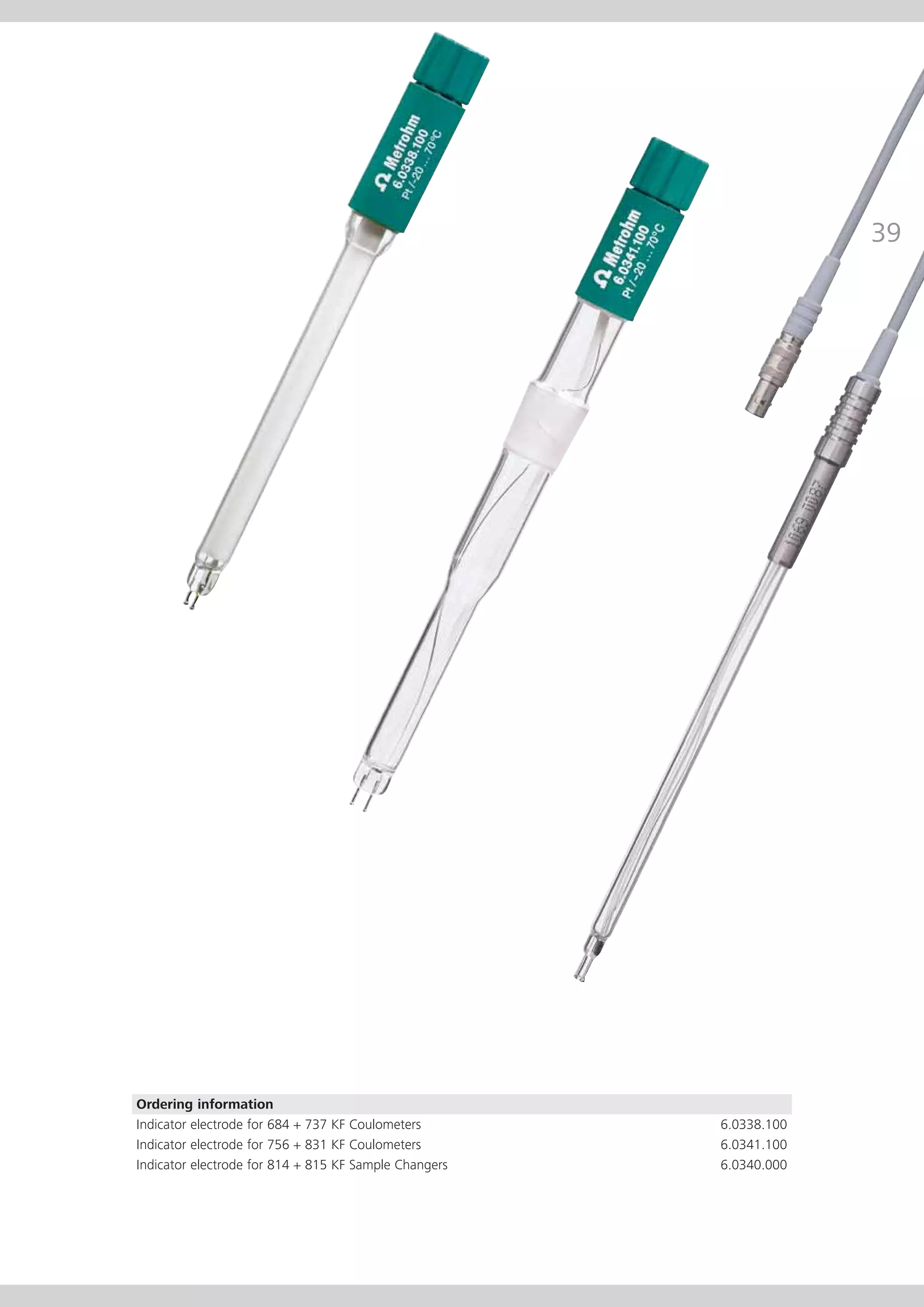
38   Double platinum-wire indicator electrodes
     Indicator electrode for volumetric KF determination      Technical specifications
       For KFT equipment in the Titrino line, Titrandos and   Measuring range          -2000...2000 mV
       Titro processors                                       Temperature range        -20...70 °C
       For «Ipol»-mode titrations                             Installation length      96 mm
       Also for 685 and 737 KF Coulometer                     Shaft diameter           8 mm
                                                              Minimum immersion depth 5 mm
                                                              Electrode plug-in head   Metrohm plug-in head G


     Indicator electrode for 756 and 831 KF                   Technical specifications
     coulometer and 851 and 852 Titrandos                     Measuring range          -2000...2000 mV
       With standard ground joint 14/15                       Temperature range        -20...70 °C
                                                              Installation length      101 mm
                                                              Shaft diameter           12 mm
                                                              Shaft diameter bottom    8.75 mm
                                                              Minimum immersion depth 10 mm
                                                              Electrode plug-in head   Metrohm plug-in head G


     Indicator electrode for KF Sample Changers               Technical specifications
       Fixed cable (length 2 m with plug F)                   Measuring range          -2000...2000 mV
                                                              Temperature range        -20...70 °C
                                                              Installation length      103 mm
                                                              Shaft diameter           5.3 mm
                                                              Minimum immersion depth 10 mm
39


Ordering information
Indicator electrode for 684 + 737 KF Coulometers       6.0338.100
Indicator electrode for 756 + 831 KF Coulometers       6.0341.100
Indicator electrode for 814 + 815 KF Sample Changers   6.0340.000
Electrodes for Karl Fischer titration


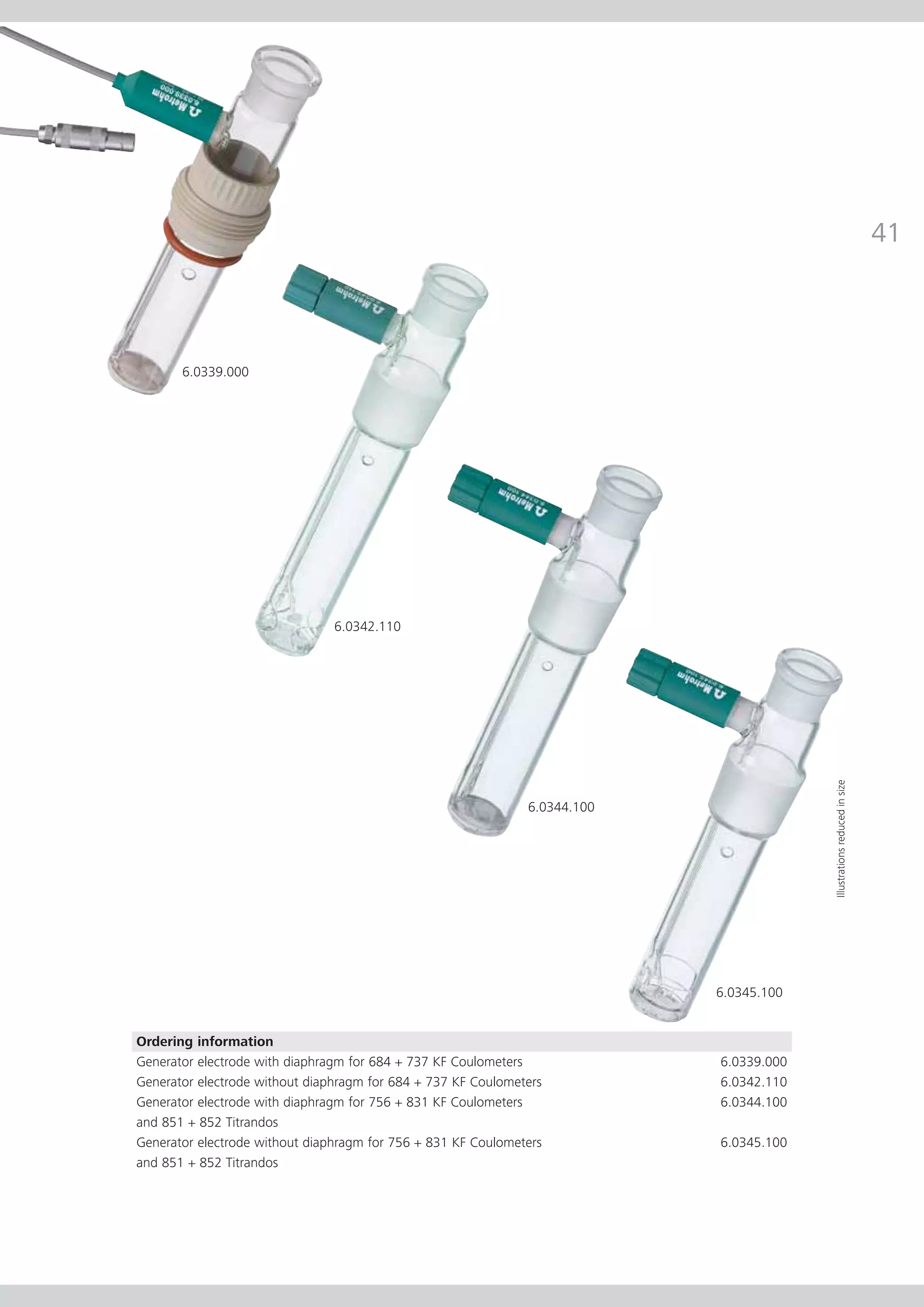
40   Generator electrodes
     Generator electrode with diaphragm                   Technical specifications
     for 684 + 737 KF Coulometers                         Temperature range        -20...70 °C
       Fixed cable (length 1 m, plug H)                   Installation length      65 mm
                                                          Shaft diameter           24 mm
                                                          Minimum immersion depth 15 mm


     Generator electrode without diaphragm                Technical specifications
     for 684 + 737 KF Coulometers                         Temperature range        -20...70 °C
       Standard ground joint 29/22 and Metrohm plug-in    Installation length      110 mm
       head G                                             Shaft diameter           24 mm
       Requires cable 6.2104.120 for connection with KF   Minimum immersion depth 15 mm
       Coulometers


     Generator electrode with diaphragm for 756 +         Technical specifications
     831 KF Coulometers and 851 + 852 Titrandos           Temperature range        -20...70 °C
       Standard ground joint 29/22 and Metrohm plug-in    Installation length      100 mm
       head G                                             Shaft diameter           24 mm
       Requires cable 6.2104.120 for connection with KF   Minimum immersion depth 15 mm
       Coulometers


     Generator electrode without diaphragm for 756 +      Technical specifications
     831 KF Coulometers and 851 + 852 Titrandos           Temperature range        -20...70 °C
       Standard ground joint 29/22 and Metrohm plug-in    Installation length      100 mm
       head G                                             Shaft diameter           24 mm
       Requires cable 6.2104.120 for connection with KF   Minimum immersion depth 15 mm
       Coulometers
41


       6.0339.000


                                6.0342.110


                                                                                         Illustrations reduced in size
                                                               6.0344.100


                                                                            6.0345.100


Ordering information
Generator electrode with diaphragm for 684 + 737 KF Coulometers             6.0339.000
Generator electrode without diaphragm for 684 + 737 KF Coulometers          6.0342.110
Generator electrode with diaphragm for 756 + 831 KF Coulometers             6.0344.100
and 851 + 852 Titrandos
Generator electrode without diaphragm for 756 + 831 KF Coulometers          6.0345.100
and 851 + 852 Titrandos
42
43


Electrodes for ion and surfactant analysis
Ion-selective electrodes


44   Polymer-membrane electrodes with replaceable
     electrode tip for K+ and NO3–
       Robust construction
       High selectivity due to ionophores immobilized in the
       membrane
       Short preparation time after conditioning in a
       standard solution
       For aqueous solutions

     Crystal-membrane electrodes
       Robust construction
       Can also be used for brief periods in organic solvents
       Simple cleaning and renewal of electrode surface
       with polishing set

     Sodium-selective glass membrane electrode
       For sodium determination in simple aqueous media

     Polymer-membrane electrodes for Na+ and Ca2+
       Robust construction
       High selectivity due to ionophores immobilized in the
       membrane
       Short preparation time after conditioning in a
       standard solution
       For aqueous solutions

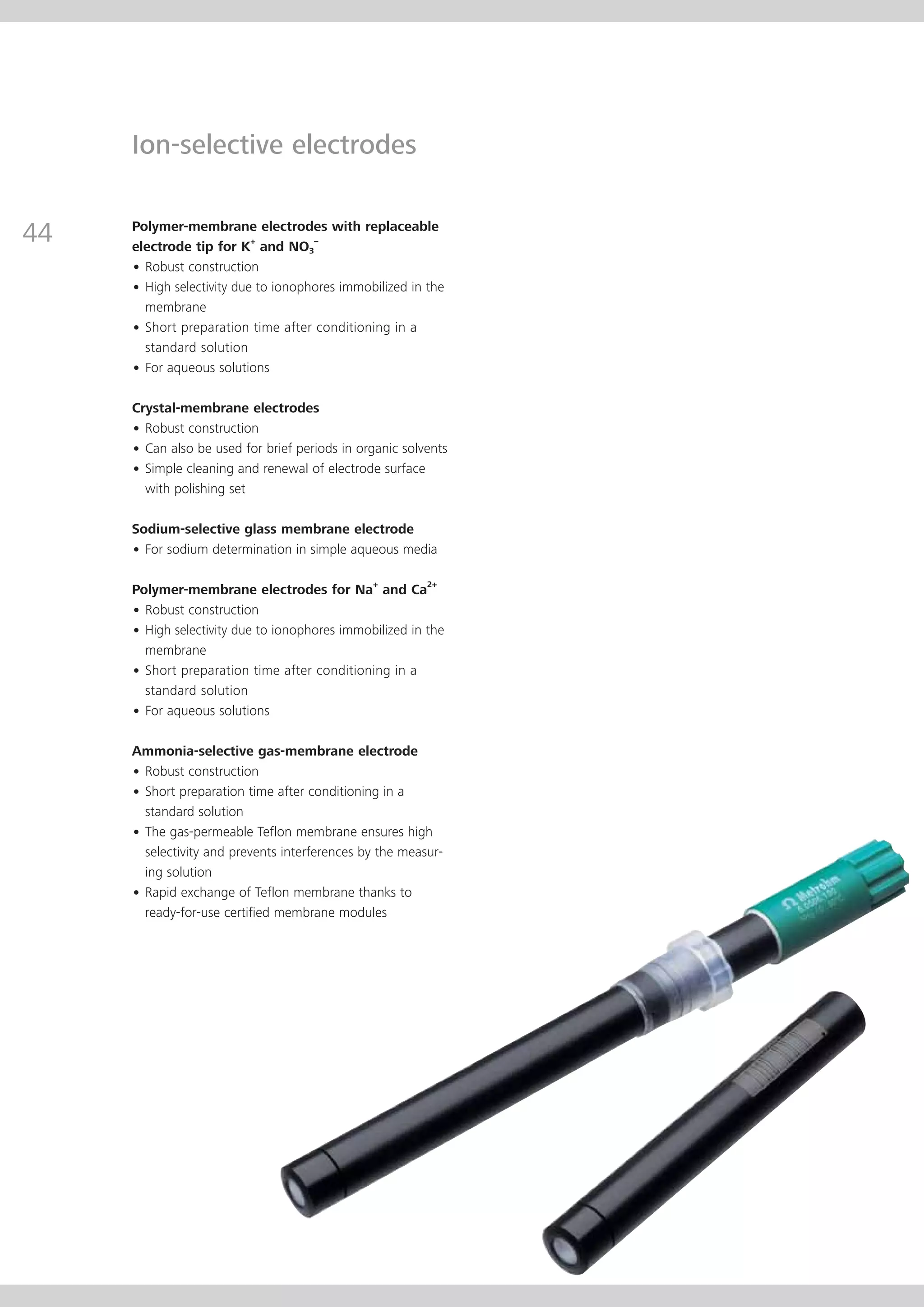
     Ammonia-selective gas-membrane electrode
      Robust construction
      Short preparation time after conditioning in a
      standard solution
      The gas-permeable Teflon membrane ensures high
      selectivity and prevents interferences by the measur-
      ing solution
      Rapid exchange of Teflon membrane thanks to
      ready-for-use certified membrane modules
45


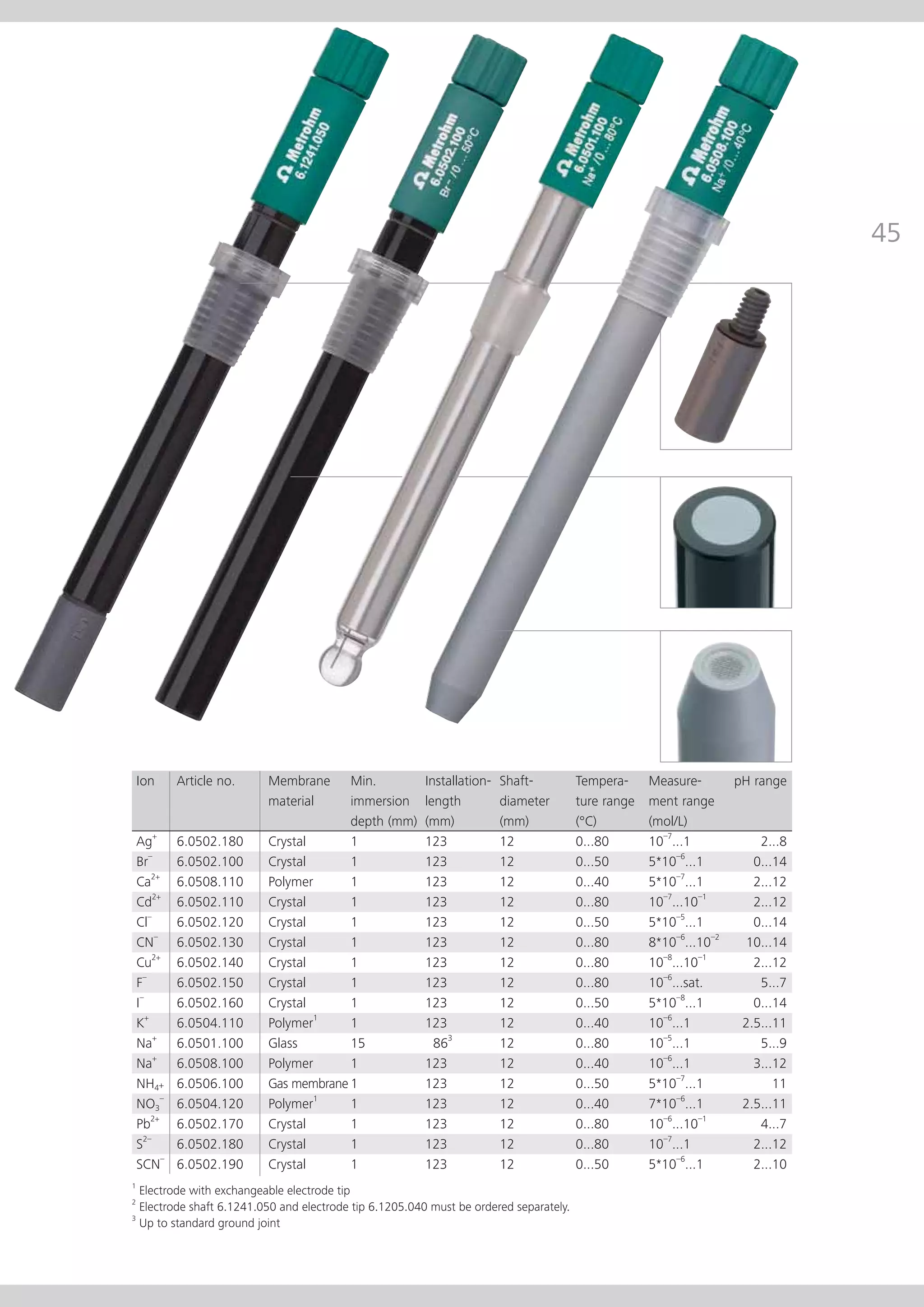
    Ion    Article no.    Membrane     Min.             Installation-   Shaft-          Tempera-     Measure-        pH range
                          material     immersion        length          diameter        ture range   ment range
                                       depth (mm)       (mm)            (mm)            (°C)         (mol/L)
    Ag+    6.0502.180     Crystal      1                123             12              0...80       10–7...1            2...8
    Br–    6.0502.100     Crystal      1                123             12              0...50       5*10–6...1         0...14
    Ca2+   6.0508.110     Polymer      1                123             12              0...40       5*10–7...1         2...12
    Cd2+   6.0502.110     Crystal      1                123             12              0...80       10–7...10–1        2...12
    Cl–    6.0502.120     Crystal      1                123             12              0...50       5*10–5...1         0...14
    CN–    6.0502.130     Crystal      1                123             12              0...80       8*10–6...10–2    10...14
    Cu2+   6.0502.140     Crystal      1                123             12              0...80       10–8...10–1        2...12
    F–     6.0502.150     Crystal      1                123             12              0...80       10–6...sat.         5...7
    I–     6.0502.160     Crystal      1                123             12              0...50       5*10–8...1         0...14
    K+     6.0504.110     Polymer1     1                123             12              0...40       10–6...1         2.5...11
    Na+    6.0501.100     Glass        15                 863           12              0...80       10–5...1            5...9
    Na+    6.0508.100     Polymer      1                123             12              0...40       10–6...1           3...12
    NH4+   6.0506.100     Gas membrane 1                123             12              0...50       5*10–7...1             11
    NO3–   6.0504.120     Polymer1     1                123             12              0...40       7*10–6...1       2.5...11
    Pb2+   6.0502.170     Crystal      1                123             12              0...80       10–6...10–1         4...7
    S2–    6.0502.180     Crystal      1                123             12              0...80       10–7...1           2...12
    SCN–   6.0502.190     Crystal      1                123             12              0...50       5*10–6...1         2...10
1
  Electrode with exchangeable electrode tip
2
  Electrode shaft 6.1241.050 and electrode tip 6.1205.040 must be ordered separately.
3
  Up to standard ground joint
Accessories for ion-selective electrodes


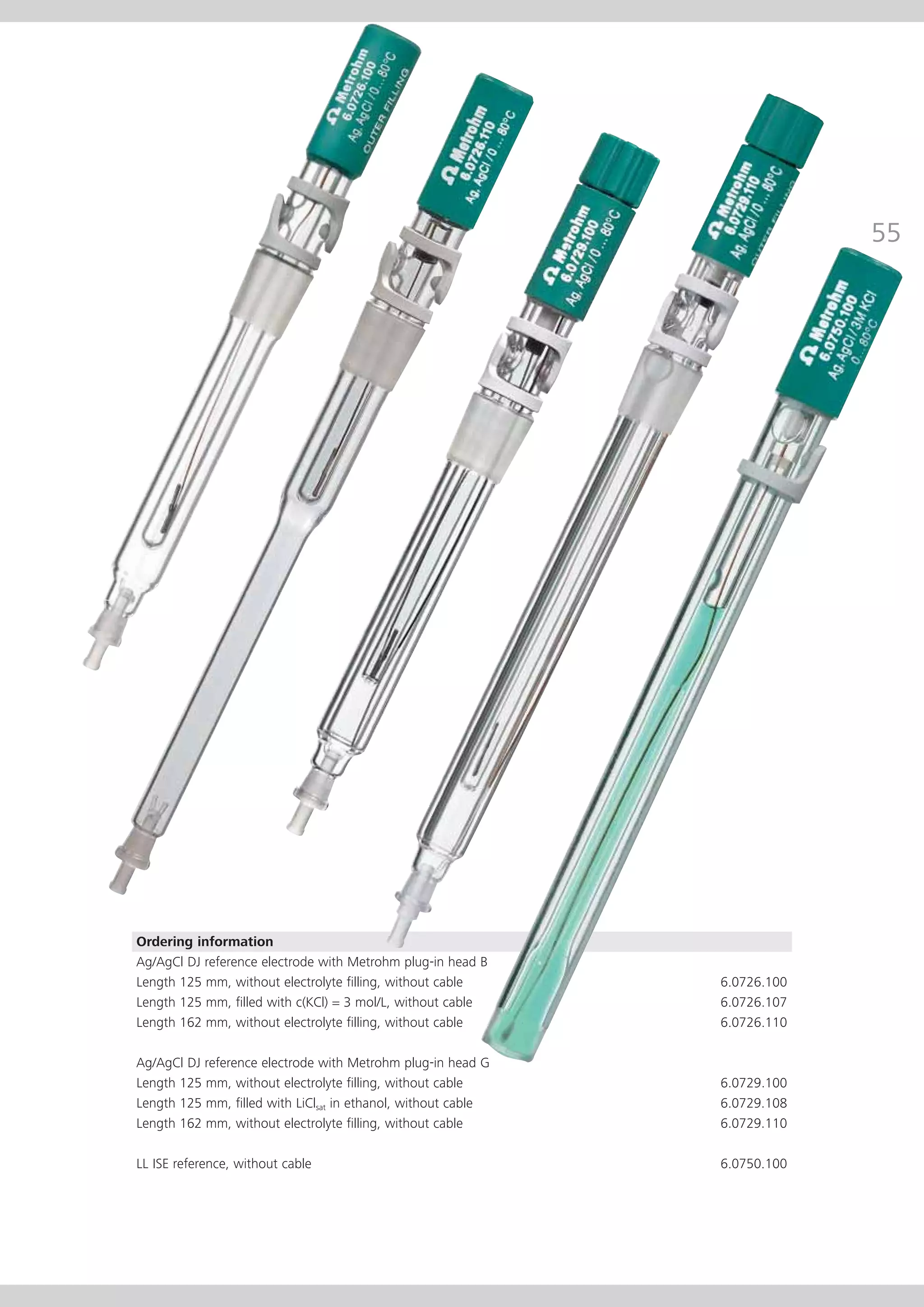
46   LL ISE reference, without cable 6.0750.100
     Double-junction Ag/AgCl reference electrode with fixed
                                                              LL ISE Reference
                                                              A stable, reproducible reference potential is very impor-
     ground-joint diaphragm and optimized length for sample   tant at low ion concentrations, low ionic strengths and
     changer applications. Standard bridge electrolyte:       especially with repeated determinations using sample
     c(KCl) = 3 mol/L.                                        changer systems. For this reason Metrohm recom-
                                                              mends reference electrodes with a fixed ground-joint
                                                              diaphragm for working with ion-selective electrodes. In
                                                              addition to a constant electrolyte outflow of approx.
                                                              5...30 μL/h, these electrodes are also considerably less
                                                              influenced by either the ionic strength of the sample
                                                              solution or the stirring speed than other types of refer-
                                                              ence electrodes.


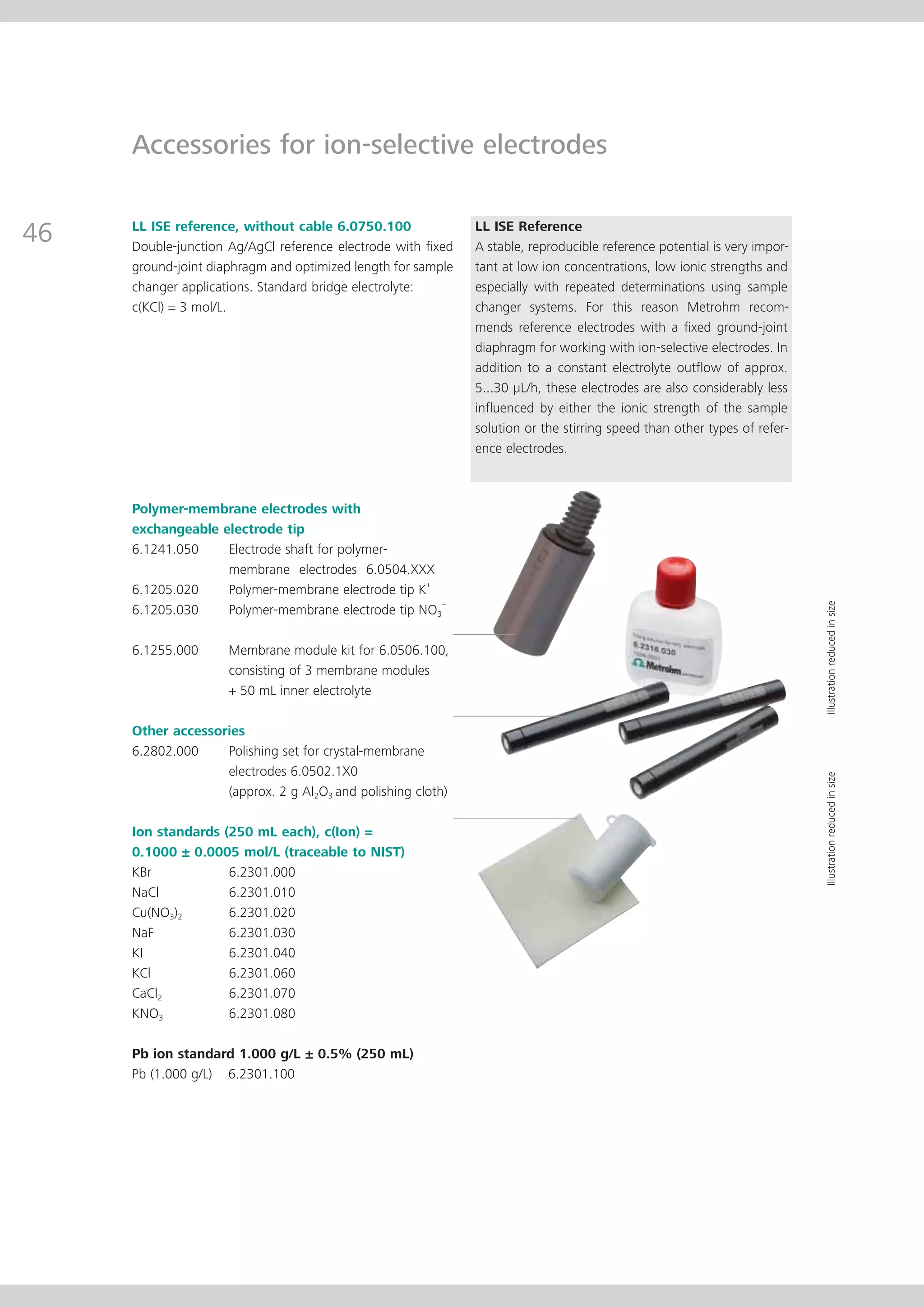
     Polymer-membrane electrodes with
     exchangeable electrode tip
     6.1241.050    Electrode shaft for polymer-
                   membrane electrodes 6.0504.XXX
     6.1205.020    Polymer-membrane electrode tip K+


                                                                                                                          Illustration reduced in size
     6.1205.030    Polymer-membrane electrode tip NO3–

     6.1255.000      Membrane module kit for 6.0506.100,
                     consisting of 3 membrane modules
                     + 50 mL inner electrolyte

     Other accessories
     6.2802.000    Polishing set for crystal-membrane
                   electrodes 6.0502.1X0


                                                                                                                          Illustration reduced in size
                   (approx. 2 g AI2O3 and polishing cloth)

     Ion standards (250 mL each), c(Ion) =
     0.1000 ± 0.0005 mol/L (traceable to NIST)
     KBr            6.2301.000
     NaCl           6.2301.010
     Cu(NO3)2       6.2301.020
     NaF            6.2301.030
     KI             6.2301.040
     KCl            6.2301.060
     CaCl2          6.2301.070
     KNO3           6.2301.080

     Pb ion standard 1.000 g/L ± 0.5% (250 mL)
     Pb (1.000 g/L) 6.2301.100
47


Spoilt for choice!
To what must I pay particular attention in an ion determination? Precision? Time needed? Costs?

Which method is the most suitable for my application? Titration? Direct measurement? Standard addition?

ISA? TISAB? When is their use advisable? Which solution do I need for my application? You will find the answers to
these questions along with many other useful tips for ion determination with ion-selective electrodes from Metrohm
in the theoretical part in section 1.3.3. «Ion-selective electrodes.»
Electrodes for surfactant titration


48   Surfactant electrodes for two-phase titration
     Surfactrode Refill                                                 Technical specifications
       Refillable surfactant electrode for the titration of ionic       Shaft material           PEEK
       surfactants in non-aqueous solvents                              pH range                 0...13
       Renewable electrode surface, therefore practically               Temperature range        0...40 °C
       unlimited working life                                           Installation length      125 mm
       Resistant to virtually all conventional solvents used in         Shaft diameter           12 mm
       surfactant analysis (not to chloroform)                          Minimum immersion depth 1 mm
       Particularly suitable for titration of detergents and soap       Electrode plug-in head   Metrohm plug-in head G


     Surfactrode Resistant                                              Technical specifications
       Durable surfactant electrode for the two-phase                   Shaft material           POM
       titration of anionic and cationic surfactants in                 pH range                 0...10
       non-aqueous solvents                                             Temperature range        10...50 °C
       Easy to clean and low-maintenance, therefore particularly        Installation length      108 mm
       suitable for use in sample changer systems                       Shaft diameter           12 mm
       Resistant to chloroform and all solvents used in sur-            Minimum immersion depth 5 mm
       factant analysis                                                 Electrode plug-in head   Metrohm plug-in head G
       Particularly suitable for samples containing oil such as
       drilling and cutting oils or cooling lubricants

     Polymer-membrane surfactant electrodes for
     environmentally-friendly surfactant titration
     Cationic Surfactant electrode                                      Technical specifications
       For the titration of cationic and anionic surfactants in         Shaft material              PVC
       aqueous matrices                                                 pH range                    0...12
       Optimized for cationic surfactants                               Temperature range           0...40 °C
       Excellent response due to ionophores immobilized in              Installation length         125 mm
       the membrane                                                     Shaft diameter              12 mm
       Long working life with normal use                                Shaft diameter bottom       2.5 mm
                                                                        Length of the active part   50 mm
                                                                        Electrode plug-in head      Metrohm plug-in head G

     Ionic Surfactant electrode                                         Technical specifications
       For the titration of anionic and cationic surfactants in         Shaft material              PVC
       aqueous matrices                                                 pH range                    0...12
       Excellent response due to ionophores immobilized in              Temperature range           0...40 °C
       the membrane                                                     Installation length         125 mm
       Long working life with normal use                                Shaft diameter              12 mm
                                                                        Shaft diameter bottom       2.5 mm
                                                                        Length of the active part   50 mm
                                                                        Electrode plug-in head      Metrohm plug-in head G

     NIO surfactant electrode                                           Technical specifications
       For the titration of non-ionic surfactants in aqueous matrices   Shaft material              PVC
       For the titration of surfactants based on polyoxy-               pH range                    0...12
       ethylene adducts                                                 Temperature range           0...40 °C
       For the titration of pharmaceutical ingredients                  Installation length         125 mm
       Long working life with normal use                                Shaft diameter              12 mm
                                                                        Shaft diameter bottom       2.5 mm
                                                                        Length of the active part   50 mm
                                                                        Electrode plug-in head      Metrohm plug-in head G
49


Ordering information
Surfactrode Resistant, without cable           6.0507.130
Surfactrode Refill, without cable              6.0507.140
NIO surfactant electrode, without cable        6.0507.010
Ionic Surfactant electrode, without cable      6.0507.120
Cationic Surfactant electrode, without cable   6.0507.150
Accessories for surfactant electrodes


50   Refill set for Surfactrode Refill
     Paste for Surfactrode Refill, 3.5 g       6.2319.000
     Filling tool                              6.2826.010

     Reagents for surfactant titration
     TEGO trant A100, titrant for anionic surfactants

     6g                                        6.2317.000
     60 g                                      6.2317.010
     500 g                                     6.2317.020

     TEGO add, additive for two-phase titration

     50 mL                                     6.2317.100
     500 mL                                    6.2317.110
51
52
53


Reference electrodes – our best references
Reference electrodes


54   Double-junction reference electrodes
     Ag/AgCl reference electrode with Metrohm                      Technical specifications
     plug-in head B                                                Shaft material           Glass
       Easy to change reference and bridge electrolytes            Temperature range        0...80 °C
       Variable electrolyte outflow at the flexible ground         Diaphragm                Flexible ground joint
       joint diaphragm                                             Installation length      97/140 mm
       Available with 125 mm or 162 mm shaft length                Shaft diameter           12 mm
       With standard ground joint 14/15                            Minimum immersion depth 10 mm
       Can also be supplied filled with electrolyte upon request   Reference system         Ag wire + AgCl
                                                                   Electrode plug-in head   Metrohm plug-in head B


     Ag/AgCl reference electrode with Metrohm                      Technical specifications
     plug-in head G                                                Shaft material           Glass
       For differential potentiometry with Metrohm titrators       Temperature range        0...80 °C
       Easy to change reference and bridge electrolytes            Diaphragm                Flexible ground joint
       Variable electrolyte outflow at the flexible ground         Installation length      97/140 mm
       joint diaphragm                                             Shaft diameter           12 mm
       Available with 125 mm or 162 mm shaft length                Minimum immersion depth 10 mm
       With standard ground joint 14/15                            Reference system         Ag wire + AgCl
                                                                   Electrode plug-in head   Metrohm plug-in head G


     LL ISE Reference                                              Technical specifications
       Double-junction Ag/AgCl reference electrode                 Shaft material           Glass
       High signal stability thanks to constant, reproducible      Temperature range        0...80 °C
       electrolyte outflow, therefore particularly suitable for    Diaphragm                Fixed ground joint
       sample changer applications                                 Installation length      125 mm
       Fixed ground joint diaphragm insensitive to                 Shaft diameter           12 mm
       contamination                                               Minimum immersion depth 1 mm
       Minimum immersion depth of 1 mm                             Reference system         Ag wire + AgCl
                                                                   Electrode plug-in head   Metrohm plug-in head B
55


Ordering information
Ag/AgCl DJ reference electrode with Metrohm plug-in head B
Length 125 mm, without electrolyte filling, without cable      6.0726.100
Length 125 mm, filled with c(KCl) = 3 mol/L, without cable     6.0726.107
Length 162 mm, without electrolyte filling, without cable      6.0726.110

Ag/AgCl DJ reference electrode with Metrohm plug-in head G
Length 125 mm, without electrolyte filling, without cable      6.0729.100
Length 125 mm, filled with LiClsat in ethanol, without cable   6.0729.108
Length 162 mm, without electrolyte filling, without cable      6.0729.110

LL ISE reference, without cable                                6.0750.100
Reference electrodes


56   Modular reference system
      Consisting of Ag/AgCl reference system with standard
                                                               Technical specifications
                                                               Ag/AgCl reference system
      ground joint 14/15 and exchangeable electrolyte vessel   Shaft material           Glass
                                                               Temperature range        0...80 °C
       Electrolyte vessel made of glass with storage vessel    Shaft length             50 mm
       (approx. 5 mL) and glass fritt                          Length to the upper edge
                                                               Standard ground joint    43 mm
       Electrolyte vessels without storage vessels, with       Shaft diameter top       12 mm
       ceramic diaphragm, various diaphragm diameters          Shaft diameter bottom    8 mm
                                                               Minimum immersion depth 20 mm
                                                               Reference system         Ag wire + AgCl
                                                               Electrode plug-in head   Metrohm plug-in head B

                                                               Electrolyte vessel with storage container
                                                               Length to the upper edge
                                                               Standard ground joint     101 mm
                                                               Shaft diameter            6 mm
                                                               Shaft material            Glass
                                                               Diaphragm                 Fritted glass P4

                                                               Electrolyte vessels without storage container
                                                               Length to the upper edge
                                                               Standard ground joint    101 mm
                                                               Shaft material           PTFE/glass
                                                               Diaphragm                Ceramic pin
                                                               Shaft diameter           3/5.5 mm
                                                               Diaphragm diameter       3 mm (PTFE)/1 mm (glass)
57


Ordering information
Ag/AgCl reference system, without cable                                            6.0724.140
Electrolyte vessel made of glass with storage vessel                               6.1225.010
Electrolyte vessel made of PTFE without storage vessel, diaphragm diameter 3 mm    6.1240.000
Electrolyte vessel made of glass without storage vessel, diaphragm diameter 1 mm   6.1240.020
58
59


Conductivity measuring cells and temperature sensors
Conductivity measuring cells


60   Five-ring conductivity measuring cells
     Modern five-ring conductivity measuring cells have
                                                                   Technical specifications
                                                                   6.0915.100
     linearity ranges that are wider than those of classic con-    Shaft material             PEEK
     ductivity measuring cells and require no additional plati-    Ideal measuring range      5...2 x 104 μS/cm
     nization. The current applied to the inner electrode gen-     Temperature range          0...70 °C
     erates a current flow to the outer, grounded electrodes,      Temperature sensor         Pt 1000
     so that external influences and measuring errors are          Installation length        125 mm
     minimized.                                                    Shaft diameter             12 mm
                                                                   Minimum immersion depth    34 mm
     Five-ring conductivity measuring cells supply precise         Cell constant              0.7 cm-1
     measuring values, independent of immersion depth or
     positioning in the beaker (wall effect). Interferences with   Technical specifications
     the potentiometric measurements are now a thing of the        6.0915.130
     past; conductivity and pH value can now be measured           Shaft material             PEEK
     simultaneously in the same beaker.                            Ideal measuring range      5...105 μS/cm
                                                                   Temperature range          0...70 °C
     The measuring cells are equipped with plug N for direct       Temperature sensor         Pt 1000
     connection to the 856 Conductivity Module.                    Installation length        142 mm
                                                                   Shaft diameter             12 mm
                                                                   Minimum immersion depth    50 mm
                                                                   Cell constant              1 cm-1
61


Ordering information
Five-ring conductivity measuring cell c = 0.7 cm-1 with integrated Pt 1000   6.0915.100
Five-ring conductivity measuring cell c = 1.0 cm-1 with integrated Pt 1000   6.0915.130
Conductivity measuring cells


62   Conductivity measuring cells without
     temperature sensors
     Conductivity measuring cell, c = 0.1 cm–1     Technical specifications
       Platinized                                  Shaft material             Glass
       Fixed cable (1 m) with 2 x plug B           Measuring range            10-1...104 μS/cm
                                                   Temperature range          5...70 °C
                                                   Installation length        108 mm
                                                   Shaft diameter             12 mm
                                                   Shaft diameter bottom      20 mm
                                                   Minimum immersion depth    50 mm


     Conductivity measuring cell, c = 10 cm–1      Technical specifications
       Platinized                                  Shaft material             Glass
       Fixed cable (1 m) with 2 x plug B           Measuring range            10...106 μS/cm
                                                   Temperature range          5...70 °C
                                                   Installation length        125 mm
                                                   Shaft diameter             12 mm
                                                   Shaft diameter bottom      20 mm
                                                   Minimum immersion depth    80 mm


     Conductivity measuring cell, c = 0.9 cm–1     Technical specifications
       Platinized                                  Shaft material             Glass
       With standard ground joint 14/15            Measuring range            1...105 μS/cm
       Metrohm plug-in head G                      Temperature range          5...70 °C
       Optimum length for sample changer systems   Installation length        120 mm
                                                   Shaft diameter             12 mm
                                                   Minimum immersion depth    16 mm
63


Ordering information
Conductivity measuring cell, c = 0.1 cm–1                                     6.0901.040
Conductivity measuring cell, c = 10 cm–1                                      6.0901.260
Conductivity measuring cell for sample changer, c = 0.9 cm–1, without cable   6.0910.120
Conductivity measuring cells


64   Conductivity measuring cells with temperature sensor
     Conductivity measuring cell
                                                                Technical specifications
                                                                Shaft material             Glass
     with Pt 100, c = 0.8 cm–1                                  Measuring range            1...105 μS/cm
       Platinized                                               Temperature range          5...70 °C
       Fixed cable (1.2 m) with 4 x plug B                      Installation length        123 mm
                                                                Shaft diameter             12 mm
                                                                Minimum immersion depth    40 mm


     Conductivity measuring cell                                Technical specifications
     with Pt 1000, c = 0.8 cm–1                                 Shaft material             PP
       Platinized                                               Measuring range            1...105 μS/cm
       Fixed cable (1.2 m) with 4 x plug B                      Temperature range          5...70 °C
                                                                Installation length        125 mm
                                                                Shaft diameter             12 mm
                                                                Minimum immersion depth    40 mm


     Conductivity measuring cell made of stainless              Technical specifications
     steel with Pt 1000, c = 0.1 cm–1                           Shaft material             Stainless steel
       Stainless-steel measuring cell for the measurement of    Measuring range            0...300 μS/cm
       very low conductivities                                  Temperature range          0...70 °C
       Ideal for applications in accordance with USP 645        Installation length        125 mm
       and EP 2.2.38                                            Shaft diameter             12 mm
       Fixed cable (1.2 m) with 4 x plug B or 1 x plug N (for   Minimum immersion depth    40 mm
       856 Conductivity Module)


     Conductivity measuring cells for stability measur-         Technical specifications
     ing devices 679, 743, 763 and 873                          Shaft material           PP
     Conductivity measuring cell for 679 Rancimat               Measuring range          1...105 μS/cm
       Cell constant c = 0.9 cm–1                               Temperature range        -20...70 °C
       With fixed cable (0.4 m) and special connection for      Installation length      125 mm
       679 Rancimat                                             Shaft diameter           12 mm
                                                                Minimum immersion depth 30 mm


     Conductivity measuring cell for 743 Rancimat,              Technical specifications
     873 Biodiesel Rancimat and 763 PVC Thermomat               Shaft material           PP
       Cell constant c = 1 cm–1                                 Measuring range          1...105 μS/cm


     Accessories for conductivity measuring cells:
     Conductivity standard = 12.87 mS/cm (25° C), 250 ml                                                     6.2301.060
     Conductivity standard = 100 μS/cm (25 °C), 250 ml with DKD certificate                                  6.2324.010
     Conductivity standard = 100 μS/cm (25 °C), 5 x 30 ml with DKD certificate                               6.2324.110
65


                                                                                                   Illustration reduced in size


Ordering information
Conductivity measuring cell with Pt 100, c = 0.8 cm–1                                        6.0908.110
Conductivity measuring cell with Pt 1000, c = 0.8 cm–1                                       6.0912.110
Conductivity measuring cell made of stainless steel with Pt 1000, c = 0.1 cm–1, 4 x plug B   6.0914.040
Conductivity measuring cell made of stainless steel with Pt 1000, c = 0.1 cm–1, plug N       6.0916.040
for 856 Conductivity Module
Conductivity measuring cell for 679 Rancimat                                                 6.0911.120
Conductivity measuring cell for 743, 763 and 873                                             6.0913.130
Temperature sensor


66   Temperature sensor Pt 1000
       Rapid, precise temperature setting
                                                             Technical specifications
                                                             Shaft material             Glass
       Available in various lengths (125/178 mm)             Temperature range          -50...180 °C
                                                             Installation length        125/178 mm
                                                             Shaft diameter             12 mm
                                                             Shaft diameter bottom      5/6.4 mm
                                                             Minimum immersion depth    20 mm
                                                             Electrode plug-in head     Metrohm plug-in head G


     Temperature sensor Pt 1000 steel                        Technical specifications
       The glass-free alternative                            Shaft material             PEEK
       Shaft made of PEEK                                    Temperature range          -50...100 °C
       For use in non-oxidizing media pH 1 - 13              Installation length        140 mm
       For temperature measurement in semi-solid materials   Shaft diameter             12 mm
       such as cheese, not in frozen meat or similar         Shaft diameter bottom      (75 mm) 3 mm
       Fixed cable 1.2 m with plug 2 x 2 mm                  Minimum immersion depth    10 mm


     Temperature sensor Pt 100 for 711 Liquino,              Technical specifications
     743 Rancimat or 763 PVC Thermomat                       Shaft material             Stainless steel
       Shaft made of stainless steel                         Temperature range          -200...300 °C
       Fixed cable with Mini DIN plug                        Installation length        178 mm
                                                             Shaft diameter             2 mm
                                                             Minimum immersion depth    20 mm


     Temperature sensor Pt 100 for                           Technical specifications
     873 Biodiesel Rancimat                                  Temperature range          -200...300 °C
       Shaft made of stainless steel                         Installation length        300 mm
       Fixed cable with Mini DIN plug                        Shaft diameter             2 mm
                                                             Minimum immersion depth    20 mm
67


Ordering information
Temperature sensor Pt 1000, length 125 mm, without cable          6.1110.100
Temperature sensor Pt 1000, length 178 mm, without cable          6.1110.110
Temperature sensor Pt 1000, steel, length 140 mm, plug 2 x 2 mm   6.1114.010
Temperature sensor Pt 100 for 711/743/763, length 175 mm          6.1111.010
Temperature sensor Pt 100 for 873, length 300 mm                  6.1111.020
Sensors for photometry


68   Titration with photometric endpoint detection is an
     integral part of many titration methods. The Spectrosense
                                                                     Technical specifications
                                                                     Width (housing)
                                                                                                Spectrosense
                                                                                                50.3 mm
     is a handy sensor that can be used like any other               Height (housing)           63 mm
     Metrosensor. Modern light diodes (LEDs) are used as the         Depth (housing)            20.3 mm
     light-source. The average working life is 50’000 hours.         Weight                     120 g
     Even after long use they will still provide high light inten-   Material (housing)         Aluminum
     sity. The power supply to the Spectrosense is provided          Shaft diameter             12 mm
     through the stirrer connection for the titrator; no sepa-       Material (optical fiber)   PMMA
     rate power supply is required. Two wavelengths are avail-       Length without mirror      129 mm
     able (523 and 610 nm) enabling a wide range of applica-         Length with mirror         145 mm
     tions.                                                          Shaft material             PEEK
                                                                     Optical path               22 mm
                                                                     Material mirror holder     Stainless steel
                                                                     Measuring range            50...1000 mV
                                                                     Temperature range          0...45 °C
                                                                     (housing)
                                                                     Temperature range          0...80 °C
                                                                     (mirror)
                                                                     Relative humidity           80%
                                                                     pH range                   0...14


     Photometric titrations with the Spectrosense: typical applications

     Determination              Matrix                           Color indicator                            Wavelength
     Al                         Sodium borate                    Xylenol orange                             523 nm
     Free chlorine              Water                            N,N-Diethyl-1,4-phenylenediamine           523 nm
     Acid value                 Plastic                          Phenolphthalein                            523 nm
     Sulfate                    Fertilizer                       Thorine                                    523 nm
     Vitamin C                  Tablets                          Dichlorphenol indophenol                   523 nm
     Ba/Y/Cu                    Superconductor                   Dimethylsulfonazo III                      610 nm
     Ca traces                  Brine                            Hydroxynaphthol blue                       610 nm
     Ca/Mg                      Dolomite, drinking water         Eriochrome black T                         610 nm
     Fe                         Mn ores                          Diphenylaminosulfonate                     610 nm
     Zn                         Ni baths                         Murexide                                   610 nm


     Accessories
     Spectrosense 523 nm measuring module                                                                         6.1109.100
     Spectrosense 610 nm measuring module                                                                         6.1109.110
     Mirror for Spectrosense (light path 22 mm)                                                                   6.1250.010
     Power supply cable Titrino – Spectrosense                                                                    6.2108.130
     Power supply cable Titrando/Titrino plus – Spectrosense                                                      6.2151.070
     Cable for measuring input, plug F/angled plug F, length 1 m                                                  6.2116.020
69


Ordering information
Spectrosense 523 nm for Titrino, complete, with mirror (light path 22 mm)                 6.5501.100
and all required cables
Spectrosense 610 nm for Titrino, complete, with mirror (light path 22 mm)                 6.5501.110
and all required cables
Spectrosense 523 nm for Titrando/Titrino plus, complete, with mirror (light path 22 mm)   6.5501.200
and all required cables
Spectrosense 610 nm for Titrando/Titrino plus, complete, with mirror (light path 22 mm)   6.5501.210
and all required cables
70
71


Accessories for Metrosensors


72   SGJ sleeves for Metrohm electrodes
     6.1236.020     SGJ sleeve made of PP, standard
                    ground joint 14/15 with O-ring

     6.1236.030     SGJ sleeve made of PP, standard
                    ground joint 14/15 with O-ring,
                    for sample changer

     6.1236.040     SGJ sleeve made of silicone rubber,
                    standard ground joint 14/15

     6.1236.050     SGJ sleeve made of PE, standard
                    ground joint 14/15


     Other accessories
     6.2008.040    Storage vessel made of PE
                   Length          130 mm
                   Diameter        16 mm
                   Ground joint    taper or standard
                                   ground joint 14/15


     6.1243.020     Spare ground joint diaphragm
                    for Profitrode 6.0255.1XX
                    (glass sleeve and plastic ring)

     6.1243.030     Spare ground joint for reference
                    electrodes 6.0726.1XX and
                    6.0729.1XX

     6.2615.050     Electrode holder for 11 electrodes
                    and 3 x 50 ml buffer bottles
                                                          Illustrations reduced in size
73


6.1236.020   6.1236.030   6.1236.040   6.1236.050
Ion standards, buffer solutions, electrolytes


74   Ion standards (traceable to NIST)

     Ion standard                                                                                  Order number
     KBr ion standard (250 mL, c(Ion) = 0.1000 ± 0.0005 mol/L)                                        6.2301.000
     NaCl ion standard (250 mL, c(Ion) = 0.1000 ± 0.0005 mol/L)                                       6.2301.010
     Cu(NO3)2 ion standard (250 mL, c(Ion) = 0.1000 ± 0.0005 mol/L)                                   6.2301.020
     NaF ion standard (250 mL, c(Ion) = 0.1000 ± 0.0005 mol/L)                                        6.2301.030
     KI ion standard (250 mL, c(Ion) = 0.1000 ± 0.0005 mol/L)                                         6.2301.040
     KCl ion standard (250 mL, c(Ion) = 0.1000 ± 0.0005 mol/L)                                        6.2301.060
     CaCl2 ion standard (250 mL, c(Ion) = 0.1000 ± 0.0005 mol/L)                                      6.2301.070
     KNO3 ion standard (250 mL, c(Ion) = 0.1000 ± 0.0005 mol/L)                                       6.2301.080
     Pb ion standard (50 mL, c(Ion) = 1.000 g/L)                                                      6.2301.100
     Conductivity standard = 100 μS/cm (25 °C), for USP 645 and EP 2.2.38 (250 ml)                  6.2324.010
     with DKD certificate
     Conductivity standard = 100 μS/cm (25 °C), for USP 645 and EP 2.2.38 (5 x 30 ml in sachets)    6.2324.110
     with DKD certificate
     Conductivity standard = 12.87 mS/cm (25 °C) (250 ml)                                             6.2301.060


     Buffer and calibration solutions (traceable to NIST)

     Article                                                                                     Order number
     Buffer set (50 mL each of concentrate pH = 4.00, pH = 7.00, KCl solution 3 mol/L)              6.2302.010
     Buffer set (50 mL each of concentrate pH = 4.00, 7.00, 9.00)                                   6.2304.000
     Buffer set pH = 4.00 (3 x 50 mL of concentrate)                                                6.2305.010
     Buffer set pH = 7.00 (3 x 50 mL of concentrate)                                                6.2305.020
     Buffer set pH = 9.00 (3 x 50 mL of concentrate)                                                6.2305.030
     Redox standard (250 mL, yields with reference electrode Ag/AgCl/c(KCl) = 3 mol/L               6.2306.020
     U = + 250 ± 5 mV (20 °C); can also be used as buffer pH = 7)
     Ready-to-use buffer solution pH = 4.00 (500 mL), colored, with paper seal                       6.2307.100
     Ready-to-use buffer solution pH = 7.00 (500 mL), colored, with paper seal                       6.2307.110
     Ready-to-use buffer solution pH = 9.00 (500 mL), colorless, with paper seal                     6.2307.120
     Ready-to-use buffer solution pH = 4.00 (30 x 30 mL, in sachets), with DKD certificate           6.2307.200
     Ready-to-use buffer solution pH = 7.00 (30 x 30 mL, in sachets), with DKD certificate           6.2307.210
     Ready-to-use buffer solution pH = 9.00 (30 x 30 mL, in sachets), with DKD certificate           6.2307.220
     Ready-to-use buffer solutions pH = 4.00, 7.00, 9.00 (each 10 x 30 mL, in sachets),              6.2307.230
     with DKD certificate
Electrolytes, storage solution, pHit kit                                                                                                               75
Article                                                                                             Order number
Electrolyte solution c(KCl) = sat., 250 mL (storage of gel electrodes)                                  6.2308.000
Electrolyte solution c(KCl) = 3 mol/L, 250 mL (for Ag/AgCl reference systems)                           6.2308.020
KCI solution saturated, thickened, 250 mL                                                               6.2308.030
Idrolyte, 250 mL (for 6.0224.100 Biotrode or for pH measurement  80 °C with Unitrode)                  6.2308.040
Electrolyte solution c(KNO3 ) = 1 mol/L , 250 mL (reference electrolyte for combined Ag electrode       6.2310.010
and bridge electrolyte for Ag/AgCl reference systems)
Electrolyte solution (non-aqueous), LiClsat in ethanol, 250 mL (bridge electrolyte for                 Contact your
titrations in non-aqueous solutions and reference electrolyte for Solvotrode 6.0229.100)      Metrohm representative
Electrolyte solution (non-aqueous), c(LiCl) = 2 mol/L in ethanol, 250 mL (bridge electrolyte           Contact your
for titrations in non-aqueous solutions and reference electrolyte for Solvotrode 6.0229.100) Metrohm representative
Electrolyte solution c(KCl) = 3 mol/L, 1000 mL (for Ag/AgCl reference systems)                          6.2313.000
Electrolyte for NH3 electrodes, 50 mL (internal electrolyte for electrode 6.0506.100)                   6.2316.030
Porolyte, 50 mL (for 6.0235.200 Porotrode)                                                              6.2318.000
Electrolyte solution (non-aqueous), c(tetraethylammonium bromide) = 0.4 mol/L in ethylene glycol,       6.2320.000
250 mL (bridge electrolyte for titrations in non-aqueous solutions and reference electrolyte
for 6.0229.100 Solvotrode)
Storage solution for combined pH glass electrodes with reference electrolyte c(KCl) = 3 mol/L           6.2323.000
pHit Kit – Care kit for electrodes, containing 50 mL each of cleaning solution, KCl solution            6.2325.000
c(KCl) = 3 mol/L, Storage solution and 2 storage vessels
Electrolyte KCL Gel c(KCl) = 3 mol/L, 50 ml (only as external electrolyte VA reference electrodes,      6.2308.060
e.g. 6.0728.040)


                                                                                                                       Illustrations reduced in size
Electrical connections


76   Connection of pH electrodes, ion-selective electrodes (ISE) and metal electrodes with Metrohm plug-
     in head G on Metrohm instruments

     Electrode             Cable                                         Order number Measuring device
     plug-in head

                           Plug-in head G – plug F, 1 m                   6.2104.020   For pH/ISE and Ind measuring
                                                                                       inputs of Titroprocessors,
     Plug-in head G        Plug-in head G – plug F, 2 m                   6.2104.030   Titrinos and Titrandos, pH-/
                                                                                       ion meter ≥ 691
                           Plug-in head G – plug F, 3 m                   6.2104.040


                           Plug-in head G – plug E (DIN 19262), 1 m       6.2104.050   For Metrohm pH Meter  691
                           Plug-in head G – plug E (DIN 19262), 2 m       6.2104.060
                           Plug-in head G – plug E (DIN 19262), 3 m       6.2104.070
                           Electrode cables for generator electrodes      6.2104.120   KF Coulometer
                           6.0342.110, 6.0344.100 and 6.0345.100


     pH electrodes with    Adapter plug B (2 mm)/4 mm                     6.2103.150   Titrinos (Pt 1000 only)
     fixed cable, plug B                                                               pH Meter ≤ 744
     (2 mm)                                                                            (Pt 1000 only)

     pH electrodes with    Adapter plug B (4 mm)/2 mm (red)               6.2103.130   780/781/Titrandos
     fixed cable plug B    Adapter plug B (4 mm)/2 mm (black)             6.2103.140   Pt 1000
     (4 mm)                                                                            (2 mm)


     Plug-in head U        Plug-in head U – plug F + 2 x B (2 mm), 1 m    6.2104.600

                           Plug-in head U – plug F + 2 x B (2 mm), 2 m    6.2104.610


     Connection of conductivity measuring cells and temperature sensors with plug-in head G to
     Metrohm instruments

     Electrode             Cable                                         Order number Measuring device
     plug-in head

                           Plug-in head G – plug 2 x B (4 mm), 1 m        6.2104.080   712 Conductometer,
                                                                                       measuring inputs Pt 100/
     Plug-in head G                                                                    Pt 1000
                                                                                       (4 mm)
                           Plug-in head G – plug 2 x B (4 mm), 2 m        6.2104.110


                           Plug-in head G – plug 2 x 2 mm, 1 m            6.2104.140   780/781/Titrandos
                                                                                       Pt 1000
                           Plug-in head G – plug 2 x 2 mm, 2 m            6.2104.150   (2 mm)
Connection of reference electrodes and separate metal electrodes on Metrohm devices
                                                                                                                                               77
Electrode           Cable                                      Order number Measuring device
plug-in head

                    Plug-in head G – plug F, 1 m                6.2104.020   For «Ind II» measuring inputs
Plug-in head G                                                               of Titroprocessors and Titrinos
(6.0729.XXX)        Plug-in head G – plug F, 2 m                6.2104.030   and for connection
                                                                             to a Metrohm differential
                    Plug-in head G – plug F, 3 m                6.2104.040   amplifier


Plug-in head B      Plug-in head B (4 mm) – plug B              6.2106.020   For measuring input «Ref.»
                    (4 mm), 1 m
                    Plug-in head B (4 mm) – plug B              6.2106.060
                    (4 mm), 2 m
                    Plug-in head B (4 mm) – plug B              6.2106.050
                    (4 mm), 3 m


Connection of Metrohm electrodes with plug-in head G to devices made by other manufacturers

Electrode           Cable                                      Order number Measuring device
plug-in head

                    Plug-in head G – BNC plug, 1 m              6.2104.090   Orion, Beckman, Corning,
Plug-in head G                                                               EDT, Fisher, Hanna, Mettler-
                                                                             Toledo, Jenway, Philips

                    Plug-in head G – LEMO                       6.2104.160   Mettler


                    Plug-in head G – plug E (DIN 19262), 1 m    6.2104.050   Older Metrohm devices,
                                                                             WTW, Knick, Schott
                                                                                                               Illustrations reduced in size


                    Plug-in head G – Radiometer plug, 1 m       6.2104.130   Radiometer, Crison


                    Plug-in head G – US plug, 1 m               6.2104.010   Older Orion, Beckman and
                                                                             Fisher devices
How is a Metrosensor made?


78   Our accuracy is not accidental ...
     Always keep cool!
     Many years of experience and a steady hand with raw
     materials guarantee that our chemistry is always correct.
     The right composition of the glass mixture and the great-
     est possible care during the melting process ensure the
     perfect quality of the membrane glass.


     We know how to do it!
     Our employees need the right feeling when fusing the
     membrane glass with the electrode body. That this is not
     just a matter of luck can be seen from our electrodes at
     the first glance..
Our employees are only human!
In some manufacturing processes, such as grinding our
                                                            79
fixed ground-joint diaphragms, even a practiced eye no
longer stands a chance. Such tasks are carried out with
unrivalled accuracy by the most modern machines.


Tried and tested electrodes!
Before our electrodes leave our premises they are sub-
jected to a further wet-chemistry computer-supported
check. At its conclusion we provide a written confirma-
tion so that you can have complete confidence in our
electrodes: each electrode is supplied with its own test
certificate.


Certificate of origin:
Precision and guaranteed reliability – Metrohm stands for
the highest quality in ion analysis. Just convince your-
self!
1. Basics of potentiometry


80   1.1. Electrode construction
     In potentiometry the measuring setup always consists of
                                                                    Redox electrode

     two electrodes: the measuring electrode, also known as
     the indicator electrode, and the reference electrode.
     Both electrodes are half-cells. When placed in a solution
     together they produce a certain potential. Depending on
     the construction of the half-cells, the potential produced
     is the sum of several individual potentials. Potential-
     determining transitions always occur at the phase bound-
     aries, e.g. between the solution and the electrode
     surface.                                                       Figure 2: Schematic diagram of a redox electrode


     pH electrode                                                   Measuring electrode – metal electrode (left)
                                                                    U1 = redox potential between measuring solution
                                                                         and metal surface

                                                                    Reference electrode – silver/silver chloride (right)
                                                                    U4 = Galvani potential of reference electrode
                                                                    U5 = Diaphragm potential (diffusion potential)
                                                                    aM = Activity of measured ion in sample solution

                                                                    For metal electrodes the potential forming transitions U2
     Figure 1: Schematic diagram of a pH electrode                  and U3 of the pH electrodes do not exist. Depending on
                                                                    the particular application, it may be possible to use a pH
     Measuring electrode – glass electrode (left)                   glass electrode as the reference electrode instead of the
     U1 = Galvani potential between measuring solution              silver/silver chloride reference electrode. In the combined
          and glass membrane                                        redox electrodes and Titrodes from Metrohm the half-
     U2 = Galvani potential between glass membrane                  cells are also contained in a single electrode.
          and inner electrolyte
     U3 = Galvani potential between inner electrolyte               1.2.    From the measured potential to
          and inner reference electrode                                     the ion concentration
                                                                    As each ion is surrounded by ions with the opposite
     Reference electrode – silver/silver chloride (right)           charge, it is – to put it simply – no longer as effective as
     U4 = Galvani potential of reference electrode                  a free ion (see Debye-Hückel law). This affects both the
     U5 = Diaphragm potential (diffusion potential)                 reactivity and the size of the potentials at the measuring
     aM = Activity of measured ion in sample solution               electrode. The activity of the measuring ion aM, which is
                                                                    also used in the Nernst equation, is linked to the normally
     The potentials U2, U3 and U4 can be kept constant by a         interesting analytical concentration cM via the activity
     suitable electrode construction. Constructive measures         coefficient :
     and the selection of a suitable reference electrolyte
     ensure that U5 is also kept as constant as possible. Ideally
                                                                                      aM = * cM
     the measured potential should depend only on the
     potential between the glass membrane and the solution.         (1)
     For practical reasons the half-cells of the measuring elec-
     trode and the reference electrode are normally contained
     in a single electrode; this is then known as a combined
     pH electrode.
For dilute solutions with concentration cM ≤0.001 mol/L
the activity coefficient tends towards 1 and the activity
                                                             the temperature (see Equation 3). This is why it is abso-
                                                             lutely necessary to take the temperature into account in
                                                                                                                              81
of the ion corresponds to its concentration as a first       all direct potentiometric measurements, as otherwise no
approximation. is a function of the total electrolyte        correct results will be obtained.
content.
                                                             pH value
The mathematical relationship between the activity aM of     In practice – particularly when measuring the acid/ base
a measuring ion in solution ions and the potential meas-     equilibrium – the term pH, introduced by Sörensen in
ured between the reference electrode and the measuring       1909, is frequently used instead of the activity of the
electrode is described by the Nernst equation. This          measuring ion aM:
applies only for the (ideal) case in which an electrode
only responds to a single type of ion. Potentials U2 to U5                       pH = -log aH+
for pH electrodes and U4 and U5 for redox electrodes,
which are normally constant, appear as potential U0 in       (Definition of the pH value) (4)
the Nernst equation.
                                                             The pH value is the negative common logarithm of the
           2.303 * R * T
  U = U0 +               * log aM                            hydrogen ion activity of a solution. The term p is fre-
               z*F                                           quently used for the simplified presentation of very large
(Nernst equation) (2)                                        or small values. In a similar way pNa+ can be used for the
                                                             activity of sodium ion, or pKA as acid constant or pKB as
U = measured potential                                       base constant for reaction constants. In each of these
U0 = temperature-dependent standard potential                cases what is meant is the negative common logarithm
     of electrode                                            of the particular value. If this definition is inserted in the
R = general gas constant 8.315 J mol-1 K-1                   Nernst equation then we obtain for the measured
T = temperature in Kelvin                                    potential U:
z = ionic charge including sign
F = Faraday constant 96485.3 C mol-1                               U = U0 – 2.303 * R * T * pH
                                                                                z*F
The term in the Nernst equation in front of the logarithm    (pH value and potential) (5)
is known as the Nernst potential UN (also Nernst slope).
                                                             Redox potentials (metal electrodes)
            UN = 2.303 * R * T                               In a similar way to the Nernst equation (Equation 2) the
                     z*F                                     equation for the activity-dependent potential is obtained
(Nernst potential) (3)                                       as follows:

Under standard conditions (T = 298.15 K and z = +1) its                        2.303 * R * T log aox * aH+
                                                             U = U0 +                       *         ared
value is 0.059 V. As a factor in the Nernst equation it                            z*F
represents the theoretical electrode slope. UN corre-        (6)
sponds exactly to the alteration in potential caused by
increasing the activity aM by a factor of ten. From the      Equation 6 usually allows the potential generated by a
equation it can be seen that the electrode slope for         redox pair at the measuring electrode to be calculated.
electrodes that respond to ions with a double charge (z      As protons are involved in most redox reactions, the
= 2) is only half the size of that for electrodes for ions   measured potential depends on the pH. If proton react-
with a single charge (z = 1). In addition, the sign for      ions cannot be excluded then the pH should also be
cation- and anion-sensitive measuring electrodes is          determined or adjusted to a defined value.
different, as z also takes the charge on the ion into
account. The Nernst potential is directly dependent on
82   1.3. Measuring electrodes
     1.3.1. pH glass electrodes
                                                                     why conditioning the electrode in a suitable electrolyte is
                                                                     absolutely necessary to ensure an initial solvated layer
     How does a pH glass electrode work?                             condition that is as stationary as possible so that results
     The glass membrane of a pH glass electrode consists of          can be obtained that are as reproducible as possible.
     a silicate framework containing lithium ions. When a
     glass surface is immersed in an aqueous solution then a
     thin solvated layer (gel layer) is formed on the glass sur-
     face in which the glass structure is softer. This applies to
     both the outside and inside of the glass membrane. As
     the proton concentration in the inner buffer of the
     electrode is constant (pH = 7), a stationary condition is
     established on the inner surface of the glass membrane.
     In contrast, if the proton concentration in the measuring
     solution changes then ion exchange will occur in the
     outer solvated layer and cause an alteration in the poten-
     tial at the glass membrane. Only when this ion exchange
     has achieved a stable condition will the potential of the
                                                                     Figure 3: The silicate skeleton of the glass membrane contains
     glass electrode also be constant. This means that the           lithium ions, among other things. During the formation of the
     response time of a glass electrode always depends on            solvated layer at the glass surface these are partly replaced by
     the thickness of the solvated layer. Continuous contact         protons. If the concentration of the protons in the solution
                                                                     changes then a new stationary condition must again be
     with aqueous solutions causes the thickness of the sol-
                                                                     achieved in the solvated layer; this results in a change in
     vated layer to increase continuously – even if only very        potential at the glass membrane.
     slowly – which results in longer response times. This is


     Table 1: Overview of the different electrode membrane glasses used by Metrohm Ltd

     Application       U glass                 T glass              M glass               Aquatrode glass E glass
                       (green)                 (blue)               (colorless)           (colorless)     (yellow)
     pH range          0...14                  0...14               0...14                0...13          0...13
     Temperature range 0...80 °C               0...80 °C            0...60 °C             0...80 °C       0...80 °C
     continuous        0...100 °C
     short-term
     Membrane          Electrodes with        Electrodes with       Electrodes with       Large surfaces         Electrodes with
     surface           large membrane         medium to large       small membrane                               medium to large
                       surface                membrane              surface (micro-                              membrane
                                              surface (mini-        electrodes)                                  surface
                                              electrodes)
     Special features     For strongly        Measurements in       Measurements in Responds very                Quick response,
                          alkaline solutions, non-aqueous           small-volume    quickly, so                  excellent stability
                          long-term meas- sample solutions          samples         particularly suitable        in continuous use
                          urements and                                              for measurements
                          measurements at                                           in ion-deficient or
                          high temperatures                                         weakly buffered
                                                                                    solutions
     Membrane resist-  500                     150                 120            250                         250
     ance (MΩ)
     With reference to
     sphere membrane
     10.5 mm diameter
Why are there different types of glass for
pH electrodes?
                                                                                                                               83
Different demands are placed on a pH glass electrode
depending on the particular application. Various proper-
ties such as response time, thermal resistance, chemical
stability, shape, size and electrical properties must all be
taken into account in order to have an optimal electrode
available to solve each problem. In order to be able to do
justice to the numerous applications, different glasses are
available with different properties (see table 1).

Why must a pH glass electrode be calibrated?                   Figure 5: In the second calibration step with another buffer
                                                               solution the electrode slope is determined and expressed as a
The potential of a measuring electrode can always only
                                                               percentage of the theoretical value of 0.059 V (at 25 °C).
be given relative to that of a reference electrode. To be
able to compare systems, the electrode zero point is
defined as being 0 mV for pH = 7 and 298.15 K or 25 °C.        The electrode zero point is set first (pH = 7 corresponding
The electrode slope, i.e. the alteration in the measured       to 0 mV for Metrosensor pH electrodes). The second and
value with the pH, is given by the Nernst equation and at      further buffer solutions are used to determine the slope
25 °C is 0.059 V per DpH = 1. These are ideal values from      of the pH electrode. This slope is expressed as a percent-
which Metrosensor electrodes only differ slightly. The         age of the theoretical value (100% = 0.059 V per DpH =
electrode zero point is ±0.015 V. The electrode zero point     1 at 25 °C). In order to minimize subsequent measuring
and the electrode slope may change as a result of the          errors, care should be taken that the expected measured
aging of the glass membrane or changes, (e.g contami-          value of the sample solution always lies within the pH
nation) on the diaphragm. For this reason the pH meter         range covered by the buffer solutions. Modern pH and
must be adapted to the characteristics of the electrode,       ion meters such as the 780 pH Meter and the 781 and
i.e. calibrated, at regular intervals by using buffer solu-    867 pH/Ion Meter do not require any manual settings to
tions.                                                         be made. The buffer solutions are recognized automati-
                                                               cally and can be presented in any sequence.

                                                               Calibration always includes a check of the measuring
                                                               electrode. The calibration buffers have a medium acid-
                                                               base concentration and their ionic strength is approxi-
                                                               mately that of the most common sample solutions. The
                                                               dependency of the electrode slope on the temperature
                                                               means that the calibration and measuring temperatures
                                                               must be known. Information about the electrode condi-
                                                               tion is provided by the electrode slope, electrode zero
                                                               point, response time of the signal and its streaming
                                                               dependency. With the Metrohm 781 and 867 pH/Ion
                                                               Meter and 780 pH Meter an automatic electrode test can
                                                               be carried out; this provides an exact statement of the
                                                               electrode condition and often allows a source of error to
                                                               be localized.
Figure 4: In the first calibration step with buffer pH = 7
the variation from the electrode zero point (= asymmetry
potential) is determined and corrected.
84   pH and temperature – an inseparable couple!
     The temperature has a considerable influence on the pH
     value and the pH measurement. If an electrode is cali-
     brated at 25 °C then it should be capable of linear meas-
     urement throughout the whole pH range and provide
     correct results. However, if the electrode is then used at
     a different temperature the electrode slope will change
     – in accordance with the Nernst equation – and possibly
     the electrode zero point as well. The point at which the
     two calibration curves (without correction) for different
     temperatures intersect is known as the isothermal inter-       Figure 6: Isothermal intersection point
     section point. Thanks to the optimized inner buffer and
     «Long Life» reference system precise measurements can          pH compensation will be incorrect as the temperature
     be made with Metrosensor pH electrodes at different            and pH are not measured at the same location. In
     temperatures. This means that, although calibration is         modern pH electrodes the temperature sensor should be
     only carried out at a single temperature, measurements         located within the electrode in the immediate vicinity of
     can then be made throughout the whole temperature              the glass membrane. This is the only way in which an
     range. The real behavior of Metrosensor pH electrodes          accurate pH measurement is possible. If the sensor is
     varies from the ideal behavior by maximum ±15 mV.              located outside the membrane then problems when
     Nevertheless it is still true that the accuracy of the meas-   cleaning the electrode could easily occur.
     urement is increased when the electrode is calibrated at
     the temperature to be used for the subsequent measure-
     ments. Under standard conditions (z = 1, T = 298.15 K)         Table 2: Dependency of the Nernst potential UN on the
     the Nernst potential UN is equal to 59.16 mV. For other        temperature
     temperatures it can be corrected in the Nernst equation        Temperature      Slope UN        Temperature   Slope UN
     by using Table 2. Modern pH meters automatically take          T (°C)           (mV)            T (°C)        (mV)
     the temperature dependency of the Nernst potential into        0                54.20           50            64.12
     account if a temperature sensor is connected. In princi-       5                55.19           55            65.11
     ple, within the context of GLP/ISO recording and docu-         10               56.18           60            66.10
     mentation of the temperature is required for all measure-      15               57.17           65            67.09
                                                                    20               58.16           70            68.08
     ments.
                                                                    25               59.16           75            69.07
                                                                    30               60.15           80            70.07
     However, it must be remembered that a pH meter can             35               61.14           85            71.06
     only correct the temperature behavior of the electrode         37               61.54           90            72.05
     and never that of the solution to be measured. For cor-        40               62.13           95            73.04
     rect pH measurements it is essential that the pH is meas-      45               63.12           100           74.03
     ured at the temperature at which the sample was taken.
     For example, sodium hydroxide c(NaOH) = 0.001 mol/L
     at 0 °C has a pH of 11.94, at 50 °C it is pH = 10.26 and       How to store a pH glass electrode?
     only at 25 °C is it pH = 11.00. This change in pH is caused    The swelling of the glass surface is indispensable for the
     by the dependency of the ionic product of water on the         use of glass as membrane for pH glass electrodes; with-
     temperature.                                                   out this solvated layer, no pH measurement would be
                                                                    possible. Glasses for pH glass electrodes are optimized in
     In some conventional electrodes the temperature sensor         such a way that only protons can penetrate into the glass
     is not located in the immediate vicinity of the membrane,      membrane. However, because of the very slow but
     i.e. in the electrode foot. This means that it cannot meas-    steady swelling of the glass, it is unavoidable that also
     ure the temperature of the solution correctly and that the     other ions penetrate into the glass, e.g. sodium and
potassium ions. At higher concentrations, these lead to
the so-called alkali error of the glass electrode. This
                                                                                                                                    85
means that the measured value is falsified at compara-
tively low proton concentrations. If the glass electrode is
stored for a very long time in a strong solution of potas-
sium or sodium, this leads to prolonged response times
of the glass membrane since the protons must expulse
the «added ions» from the solvated layer.

One of the most used electrolytes for pH measurement is            Figure 8: pH measurement in c(NaHCO3) = 0.05 mmol/L. A
c(KCl) = 3 mol/L, since the aequitransferent KCl causes            glass of the Aquatrode stored in the storage solution shows a
only a very small diffusion potential at the diaphragm             substantially shorter response time than an electrode glass of
                                                                   the same type stored during the same period in KCl.
and is also economical. Normally a combined pH glass
electrode is stored in c(KCl) = 3 mol/L only for this reason,
as one wants to have it ready for immediate use without            the glass membrane remains unchanged regarding
conditioning the diaphragm. However, on a long-term                response time and alkali error. Moreover, if one uses
basis the storage in KCl affects the glass, since it leads to      c(KCl) = 3 mol/L as the reference electrolyte, the opti-
ever longer response times. For the membrane glass,                mized composition of the storage solution keeps the pH
storage in distilled water would be optimal, but then the          glass electrode ready for measurement. Conditioning
diaphragm would have to be conditioned for several                 before the measurement is not necessary, no matter for
hours. The patented storage solution for combined pH               how long the electrode has been stored.
glass electrodes (6.2323.000) solves exactly this problem.
If a combined pH glass electrode is kept in this solution,


Table 3: The correct storage of pH glass electrodes

 Electrode resp. reference electrolyte                             Storage
 Separate pH glass electrode                                       Distilled water
 Combined pH glass electrode with c(KCl) = 3 mol/L,                6.2323.000 Storage solution
 Porolyte
 Combined pH glass electrode with another                          In the respective reference electrolyte
 reference electrolyte (Idrolyte, non aqueous)
 Gel (spearhead electrode), Ecotrode Gel                           6.2308.000 Electrolyte solution c(KCl) = sat.


                                                                   Troubleshooting
                                                                   The cause of most problems is not to be found in the
                                                                   measuring electrode and its glass membrane, but rather
                                                                   in the reference electrode, as much more critical dia-
                                                                   phragm problems can occur there. To avoid incorrect
                                                                   measurements and to increase the working life, attention
                                                                   must still be paid to the following possible sources of
                                                                   error:


Figure 7: Cross-section of a pH glass membrane. If several kinds
of cations are present in the measuring solution, these compete
for the free spaces in the solvated layer. Especially potassium
and sodium can penetrate into the glass membrane and pro-
long the response time.
86   Table 4: Possible sources of error and their remedies for pH glass electrodes

      Source of error                  Effects                            Action                        Alternatives
      HF-containing solutions          Etching and dissolution                                          Use of the Sb electrode
                                       of the glass membrane g
                                       corrosion potential during
                                       the measurement/short
                                       working life
      High pH value and high           Increased alkali error g                                         Use of electrodes with U
      alkali content                   pH too low                                                       glass
      High temperatures                Rapid rise in membrane                                           Use of electrodes with U
                                       resistance by aging g                                            glass
                                       increased polarizability
                                       and drift
      Measurements at                  High membrane resistance                                         Use of electrodes with
      low temperature                  g polarization effects                                           T glass and Idrolyte
                                                                                                        as reference electrolyte
      Dry storage                      Zero point drift                   Store in water overnight      Store in storage solution
                                                                                                        6.2323.000 or reference
                                                                                                        electrolyte
      Reaction of a solution           Slow response, zero point                                        Try other glass types
      component with the glass         shift, slope reduction
      Non-aqueous media                Reduced sensitivity                Store in water                T glass/non-aqueous
                                                                                                        electrolyte solution
      Deposition of solids on          Slow response, zero point          Solvent or strong acids
      membrane surface                 shift, slope reduction
      Electrostatic charging           Slow response                      No dab-drying of the          Grounding of measuring
                                                                          electrode                     instrument
      Deposition of proteins on        Slow response, zero point          5% pepsin in 0.1 mol/L
      membrane surface                 shift, slope reduction             HCl

     Possible sources of error and care information for diaphragm problems are given in Section 1.4. for reference electrodes.


     1.3.2. Metal electrodes
     How does a metal electrode work?
     Metal electrodes have an exposed metal surface. If ions             This concentration-dependent equilibrium is character-
     of this metal are contained in the sample solution then             ized by a corresponding potential E0 (Galvani potential),
     an equilibrium is formed at the metal surface that                  e.g. the Ag/Ag+ equilibrium at a silver surface has a value
     depends on the concentration of the metal ions in the               of E0 = 0.7999 V (25°C). If the sample solution does not
     solution (see «Theory of the electrical double layer» in            contain any ions of the corresponding metal then metal
     electrochemistry textbooks). Metal ions are accepted by             electrodes can still form a Galvani potential if a redox
     the metal surface and simultaneously released into the              reaction occurs in the sample solution.
     solution.

                              n+             –             0                          Sox + n * e–                   Sred
           Me           Me +n * e                       E =...
                                                                         (9)
     (8)
The electrode surface is inert to the redox reaction. No
metal ions are released from the metal; in this case the
                                                                  In the literature the so-called standard redox potentials E0
                                                                  can usually be found.
                                                                                                                                 87
metal surface only acts as a catalyst for the electrons. As
gold and platinum electrodes are to a large extent                Cl2 (g) + 2e– → 2 Cl–           E0 = + 1.359 V
chemically inert, they are used for the measurement of            Fe3+ + e– → Fe2+                E0 = + 0.771 V
redox potentials. Silver electrodes are only used as indi-        Cd2+ + 2e– → Cd2–               E0 = – 0.403 V
cator electrodes for titrations.
                                                                  The zero point of these systems is defined (arbitrarily)
Calibrating a metal electrode                                     with the standard hydrogen electrode (SHE) which is
Redox-buffer solutions (6.2306.020) are used for quickly          assigned a standard potential of 0 mV. If electrons are
checking metal or redox electrodes. As the potential              released by a redox system to the SHE then this is
measured in a redox buffer solution is insensitive to the         reduced and the redox pair receives a negative sign; if
electrode’s surface condition, contamination of the               electrons are accepted then the SHE is oxidized and the
metal electrode is often not recognized. For this reason          result is a redox potential with a positive sign. The stand-
redox-buffer solutions are rather more suitable for check-        ard hydrogen reference electrode is difficult to handle.
ing the reference electrode. If the potential is displaced        The specifications of the SHE stipulate that a platinized
then the metal electrode is contaminated, the redox               platinum wire must be used; this is located in a stream of
buffer partly oxidized or the functioning of the reference        hydrogen gas at a partial hydrogen pressure of 1.0 bar,
electrode is affected. Under no circumstances should the          and that the activity of the hydrogen ions in the solution
indicated potential be set to the theoretical value.              in which the platinized platinum wire is immersed is to be
                                                                  exactly 1.00 mol/L. The normal alternative is the Ag/
If measurements are made in weakly redox-buffered                 AgCl/KCl reference electrode, which has a potential E0 =
solutions then a suitable pretreatment of the metal               +207.6 mV at c(KCl) = 3 mol/L and T = 25 °C. The
electrode is recommended to adapt the surface condi-              Metrohm redox standard (6.2306.020) can be used for
tion as much as possible to the measurement conditions            checking separate and combined metal electrodes.
(abrasive pretreatment: carefully clean the electrode with        Platinum and gold electrodes together with the Ag/AgCl/
abrasive paste). The reference electrode can either be            KCl reference electrode (c(KCl) = 3 mol/L and T = 20 °C)
checked against a second reference electrode that has             produce a potential of +250 ± 5 mV.
already been checked in buffer solutions 4 and 7
(response behavior and reference potential) or by using
the redox buffer.


Table 5: Measuring data for 6.2306.020 redox standard as a function of the temperature

Temp. (°C)      10            20            25            30            40               50        60            70
mV ± 5          + 265         + 250         + 243         + 236         + 221            + 207     + 183         + 178
pH ± 0.05       7.06          7.02          7.00          6.99           6.98             6.97      6.97         6.98


If instead of an Ag/AgCl/KCl reference electrode c(KCl) =         from Metrohm, the correction to be applied is -37 mV.
3 mol/L an Ag/AgCl/KCl reference electrode c(KCl) = sat.          The Titrodes are checked by a standard titration as no
is used for the measurement then at 25 °C a correction            suitable calibration or buffer solutions are available. For
of +10 mV must be applied; if the measurement is made             example, the certified ion standard c(NaCl) = 0.1 mol/L
using an Hg/Hg2Cl2/KCl calomel reference electrode,               (6.2301.010) can be titrated with a silver nitrate standard
which for toxicological reasons is no longer available            solution.
88   Troubleshooting

     Table 6: Problems encountered when measuring with metal electrodes

     Electrode      Source of error         Effects                         Cleaning                      Alternatives
     Ag             Electrode poisons       Passivation of Ag layer g       Cleaning with abrasives
                    such as S2–, I–, Br–    slow response
     Pt/Au          Fats or oils            Isolating layer g slow          Cleaning with solvent
                                            response, incorrect potential
                    Weakly redox-           Adsorbed ions on the            Abrasive, oxidative (for     Use of Au or Pt
                    buffered solution       surface (e.g. oxides) g         oxidizing solutions) or
                                            slow response                   reducing (for reducing solu-
                                                                            tions) pretreatment
                    COD determination Deactivation of Pt                                                 Use of Au


     1.3.3. Ion-selective electrodes                                best-known examples of such a cross-sensitivity is the
     How does an ion-selective electrode work?                      so-called alkali error of pH glass electrodes. With some
     An ion-selective electrode (ISE) can selectively recognize     types of glass the linear range does not extend through-
     an ion in a mixture of ions in a solution. There are various   out the whole pH range from 0 to 14 and at high pH
     types of ion-selective electrodes, the most commonly           values a departure from linear behavior can be observed.
     used ones are:                                                 The reason for this is that at very low H+-concentrations
                                                                    any alkali ions present in the solution (possibly released
     Glass membrane         framework of silicate glass             from the walls of the vessel) will falsify the measured
     with                   interstitial sites for H+ and Na+       value. Unfortunately there are only a very few ion-selec-
                                                                    tive electrodes that have a linear range similar to that of
     Crystal membrane       crystal lattice containing defined      pH glass electrodes. The use of an ISE is normally restrict-
                            gaps for the ion to be measured         ed to a concentration range of 6 to 8 powers of ten. If
                                                                    an ISE is used for a measurement right at the limit of the
     Polymer membrane polymer membrane containing a                 linear range then the Nernst equation (Eq. (5), Section
                      molecule (= ionophore) that only              1.2.) must be extended by the contribution made by the
                      binds the ion to be measured                  particular interfering ion for the evaluation of the meas-
                                                                    ured potential:
     In contrast to metal electrodes, an ISE does not measure
                                                                                     2.303 * R * T log (a +K a )
     a redox potential. If the ion to be measured is contained      U = U0 +                      *      M  S* S
     in the sample solution then this ion can penetrate the                               z*F
     membrane. This alters the electrochemical properties of        (Nikolsky equation) (10)
     the membrane and causes a change in potential. One
     hundred percent selectivity for exactly one type of ion is     KS is the so-called selectivity coefficient of the ion-selec-
     only possible on rare occasions. Most ion-selective elec-      tive electrode for interfering ion S. This is a factor that
     trodes have «only» a particular sensitivity for a special      describes the influence of the interfering ion in relation-
     type of ion, but also often react with ions with similar       ship to the ion to be measured. These selectivity coeffi-
     chemical properties or a similar structure (see Table 7).      cients are known for the most important interfering ions
     This is why the cross-sensitivity to other ions that may be    for an ISE and therefore a simple estimation can be made
     contained in the sample solution must always be taken          as to whether an interfering ion contained in the sample
     into consideration when selecting an ISE. One of the           solution will influence the measured value or not.
Direct measurement or standard addition?
The question often arises as to which determination
                                                                  Sample addition
                                                                  Similar to standard addition, with the difference that
                                                                                                                                     89
method is most suitable for a particular sample. In prin-         defined volumes of the sample solution are added to a
ciple there are three different ways of carrying out an ion       defined amount of an ion standard.
measurement with ion-selective electrodes:
                                                                  Modern ion meters such as the 781 pH/Ion Meter from
Direct measurement                                                Metrohm can carry out these addition methods auto-
Direct measurement is chiefly of benefit with high sam-           matically. The addition of the standard or sample solution
ple throughputs or with a known sample solution of a              is automatically controlled from the ion meter – by press-
simple composition. The ion-selective electrode is cali-          ing a single key – and evaluated by using the Nikolsky
brated with special standard solutions of the ion to be           equation.
measured before the measurement itself in a similar way
to the calibration of a pH glass electrode and can then be        ISA and TISAB – when and why?
used for several determinations in series.                        The activity coefficient of an ion (Section 1.2.) is a func-
                                                                  tion of the total electrolyte content. For this reason care
Standard addition                                                 must be taken that ion-selective measurements are
Standard addition is recommended whenever a determi-              always carried out in solutions with approximately the
nation only needs to be carried out occasionally or when          same ionic strength. In order to achieve this, the so-
the composition of the sample is unknown. Defined vol-            called ISA solutions (Ionic Strength Adjustor) or TISAB
umes of a standard solution of the ion to be measured             solutions (Total Ionic Strength Adjustment Buffer) should
are added to the sample solution in several steps. The            be added to the sample solution (see Table 7). These are
concentration in the original solution can then be calcu-         chemically inert and have such a high ionic strength that
lated from the initial potential and the individual poten-        the ionic strength of the sample solution can be
tial steps after the addition of the standard. The advan-         neglected after their addition.
tage of standard addition is that the ISE is calibrated
directly in the sample solution, which eliminates all
matrix effects.


Table 7: Interfering ions and recommended ISA and TISAB solutions for ion-selective electrodes

Ion      Membrane         pH range1        ISA                          Most important                Remarks
                                                    2                                    3
         material                          or TISAB                     interfering ions
Ag
   +
         Crystal          2...8            c(KNO3) = 1 mol/L         Hg2+, Proteins                   1) The given pH range only
Br
  –
         Crystal          0...14           c(KNO3) = 1 mol/L         Hg2+, Cl–, I–, S2–, CN–          applies to ion-selective
                          2...12                                                                      electrodes from Metrohm
Ca2+     Polymer                           c(KCl) = 1 mol/L          Pb2+, Fe2+, Zn2+, Cu2+, Mg2+
                                                                                                      Ltd.
Cd2+     Crystal          2...12           c(KNO3) = 1 mol/L         Ag+, Hg2+, Cu2+
Cl–      Crystal          0...14           c(KNO3) = 1 mol/L         Hg2+, Br–, I–, S2–, S2O32–,      2) Alternatives or more de-
                                                                         –
                                                                     CN                               tailed compositions can be
CN–      Crystal          10...14          c(NaOH) = 0.1 mol/L       Cl , Br–, I–,
                                                                       –
                                                                                                      found in the manual «Ion
Cu2+     Crystal          2...12           c(KNO3) = 1 mol/L         Ag+, Hg2+, S2–                   Selective Electrodes (ISE)»,
                          5...7                                                                       order number 8.109.1476
F–       Crystal                           NaCl/glacial acetic acid/ OH–
                                           CDTA
                                                                                                      3) More detailed informa-
I–       Crystal          0...14           c(KNO3) = 1 mol/L         Hg2+, S2–, S2O32–,               tion about interfering ions
K
   +
         Polymer          2.5...11         c(NaCl) = 0.1…1 mol/L TRIS+, NH4+, Cs+, H+                 and other interferences
Na+      Glass            5...9            C(TRIS) = 1 mol/L         H+, Li+, K+, Ag+                 can be found in
Na+      Polymer          3...12           c(CaCl2) = 1 mol/L        SCN–, K+, lipophilic ions        the manual «Ion Selective
                          11                                                                          Electrodes (ISE)», order
NH4+     Gas membrane                      –                         –
                                                                                                      number 8.109.1476
NO3–     Polymer          2.5...11         c((NH4)2SO4) = 1 mol/L Cl–, Br–, NO2–, OAC–
Pb2+     Crystal          4...7            c(NaClO4·H2O) = 1 mol/L Ag+, Hg2+, Cu2+
S2–      Crystal          2...12           c(NaOH) = 2 mol/L         Hg2+, Proteins
SCN
     –
         Crystal          2...10           c(KNO3) = 1 mol/L         Cl–, Br–, I–, S2–, S2O32–, CN–
90   Troubleshooting
     Table 8: Possible sources of interference and remedies for ion-selective electrodes

      Electrode                  Source of inter-           Effects                                         Action
                                 ference
      Ion-selective crystal      Dissolution processes,Rough surface g slow response,                       Polish with polishing cloth
      membrane                   oxidation processes   poor detection limits
                                 Electrode poisons     Formation of more sparingly soluble                  Polish with polishing cloth,
                                                       salts on the electrode surface than with             mask interfering ion
                                                       the ion to be measured g zero point
                                                       shift, reduced linearity range
      Ion-selective              Dissolution processes Diffusion into the membrane or                       Elimination of interfering
      polymer membrane                                 dissolution of membrane component                    components
      NH3 sensor                 Volatile bases        Electrolyte becomes contaminated g                   Change electrolyte
                                 (amines)              displacement of calibration line, limited
                                                       linearity
                                 Surfactants           Membrane becomes wetted g                            Replace membrane
                                                       slow response


     1.4. Reference electrodes
     Reference electrodes are usually electrodes of the second            bration purposes. Some titrations offer the possibility of
     kind. In this type of electrode a metal electrode is in              using pH glass electrodes as reference electrodes. Even if
     contact with a sparingly soluble salt of the same metal.             protons are transferred during the titration it is usually
     The potential depends only on the solubility of the salt.            still possible to make an accurate determination of the
     As a first approximation, electrodes of the second kind              endpoint.
     do not themselves react with the solution and therefore
     supply a constant potential.                                         1.4.1. Silver/silver chloride reference electrode
                                                                          The reference element of the silver/silver chloride refer-
     The most frequently used reference electrode is the sil-             ence electrode is the silver/silver chloride/potassium
     ver/silver chloride reference electrode (Ag/AgCl/ KCl). The          chloride solution system: Ag/AgCl/KCl. The reference
     calomel electrode (Hg/Hg2Cl2/KCl), which was formerly                electrode is usually filled with c(KCl) = 3 mol/L or satu-
     widely used, is hardly used at all today as mercury and its          rated KCl solution. Tables 9 and 10 show the potentials
     salts are extremely toxic and all the applications can also          of the reference electrode as a function of the reference
     be carried out with the silver/ silver chloride reference            electrolyte and temperature. Each of these values has
     electrode. The standard hydrogen electrode SHE is also               been measured against the standard hydrogen electrode
     an electrode of the second kind. It is only used for cali-           under isothermal conditions.


     Table 9: Standard redox potentials of the silver/silver chloride reference electrode as a function of the temperature and concentration

      Temp. (°C)       0      +10    +20    +25    +30    +40    +50    +60    +70    +80    +90    +95
      E0 (mV) with     +224.2 +217.4 +210.5 +207.0 +203.4 +196.1 +188.4 +180.3 +172.1 +163.1 +153.3 +148.1
      c(KCl) = 3 mol/L
      E0 (mV) with     +220.5 +211.5 +201.9 +197.0 +191.9 +181.4 +170.7 +159.8 +148.8 +137.8 +126.9 +121.5
      c(KCl) = sat.

     Table 10: Standard redox potentials of the silver/silver chloride reference electrode as a function of the concentration

      c(KCl) / mol/L (25 °C)       0.1    1.0    3.0    3.5    sat.
       0
      E (mV)                       +291.6 +236.3 +207.0 +203.7 +197.0
1.4.2. The Metrosensor «Long Life» reference system
Most electrodes are equipped with the silver/silver chlo-
                                                                year the concentration of silver chloride in the outer
                                                                electrolyte has only reached 5% of the saturation value.
                                                                                                                               91
ride reference system. The solubility product of silver
chloride in water is very small (10-10 mol/L). In the con-      The advantages of the «Long Life» reference systems at a
centrated, chloride-containing solution of the reference        glance:
electrolyte soluble complexes of the series (AgCl2)-,
(AgCl3)2-, (AgCl4)3- are formed. This means that the refer-       Long working life of the electrode
ence system poses several problems. Outside the elec-             Rapid response to changes in pH
trode the chloride concentration is frequently lower and          Rapid response to temperature changes
the complexed silver chloride precipitates in the region          Less sensitive to electrode poissons, e.g. S2-
surrounding the diaphragm («liquid junction»). The result:
precipitated silver chloride blocks the diaphragm, the          Blocking the diaphragm by crystallized AgCl also affects
response time of the pH electrode increases and with            the electrolyte flow. If the «Long Life» reference system is
time the electrode becomes inactive. A further problem          used then the flow of the KCl solution through the dia-
is presented by the dependency of the solubility product        phragm into deionized water only decreases slightly.
of AgCl on the temperature. If the electrode is used at a
different temperature then the equilibrium that deter-          As in the «Long Life» reference system the silver chloride
mines the potential of the reference electrode must be          is present in a smaller volume of potassium chloride
reestablished. The larger the surface with solid AgCl in        solution, the thermodynamic equilibrium between silver,
relationship to the electrolyte volume, the shorter the         silver chloride (solid) and silver chloride (dissolved) is
time required. The «Long Life» reference system prevents        established very quickly and the potential of the refer-
high concentrations of complexed AgCl from occurring            ence electrode becomes stable after a very short time.
in the outer electrolyte, as the silver chloride reservoir is
connected with the outer electrolyte by a highly effective     1.4.3. Diaphragms
diffusion barrier. The concentration of the silver complex     Faulty measurements, unstable measured values and very
in the reference electrolyte remains low. Even after one       long response times usually have their source in the
                                                               «liquid junction» between the sample solution and the
                                                               reference electrode. The diffusion, streaming and Donnan
                                                               potentials that occur there – which are normally known
                                      Figure 9:
                                                               together as the diaphragm potential – have various
                                      Conventional Ag/AgCl/
                                      KCl system. The chloride causes and can result in a very incorrect measured value.
                                      concentration outside    The measuring error may assume vast proportions if
                                      the electrode is usu-    measurements are made under the following condi-
                                      ally lower than in the
                                                               tions:
                                      electrolyte chamber. The
                                      soluble silver chloride     with a blocked, virtually impermeable diaphragm,
                                      complexes precipitate       in ion-deficient solutions with an unsuitable
                                      out in the region sur-      diaphragm,
                                      rounding the                in strong acids and bases with an unsuitable
                                      diaphragm and may
                                      block it.
                                                                  diaphragm,
                                                                  in colloidal solutions.


                                      Figure 10:
                                      The Metrohm «Long
                                      Life» reference system.
                                      The dissolved AgCl is
                                      retained in the AgCl
                                      cartridge and can no
                                      longer block the dia-
                                      phragm.
92   In all such cases errors may occur that cannot be toler-
     ated. This is why the following questions must be in the
                                                                    phragms tend to become blocked and therefore should
                                                                    not be used in solutions containing precipitates. An
     foreground whenever an electrode and therefore the             important advance with regard to the prevention of dia-
     optimal type of diaphragm are to be selected:                  phragm blockages by silver chloride and silver sulfide has
        Does the reference electrolyte react with the sample        been achieved by the introduction of the «Long Life»
        solution to form a precipitate in the diaphragm?            reference system (see Section «The Metrosensor «Long
        Does the electrolyte flow alter the composition of the      Life» reference system»).
        sample solution in an unacceptable way?
        Is there a risk of depositing sample solution compo-        Ground-joint diaphragms with fixed or separable
        nents on the diaphragm?                                     ground joint
        Is the chemical resistance assured?                         Ground-joint diaphragms with fixed or separable ground
        Can physical parameters such as flow, pressure or           joint are used in ion-deficient media, among others, as
        temperature cause measuring errors?                         they produce a steady signal that is almost independent
        Does the process allow cleaning/maintenance of the          of sample flow conditions. The risk of blockage by silver
        electrode at certain intervals?                             chloride or by precipitates formed in the sample solution
        Is a short response time and/or high reproducibility        is relatively low because of the large surface area.
        necessary?                                                  Streaming potentials, which may occur in measurements
                                                                    in flowing or stirred solutions, remain negligibly small.
     The time required for cleaning and maintenance can             These properties are particularly important for a SET titra-
     usually be considerably reduced if the correct choice of       tion to a defined pH or potential value. For example: the
     electrode is made. The most frequent cause of measuring        determination of the carbonate alkalinity by a SET titra-
     problems is contamination of the diaphragm. This is why        tion to pH = 5.4 according to ISO 9963-2 is a widely used
     with pH electrodes the chief attention is paid to the          method in the routine analysis of drinking water. During
     diaphragm during maintenance with the pH membrane              a titration it is not possible to dispense with stirring, i.e.
     being of secondary importance. If existing means cannot        with an incorrectly measured pH or potential at the start
     be used to determine whether the indicator electrode or        of the titration an incorrect endpoint is the inevitable
     the reference electrode requires cleaning/regeneration,        result. Figures 11 and 12 clearly show the difference
     then it is usually best to treat the reference electrode.      between the Aquatrode Plus (6.0253.100), which was
     Various types of diaphragm are available to satisfy the        specially developed for this application, and a conven-
     diverse requirements. These requirements have already          tional pH glass electrode with ceramic pin diaphragm.
     been taken into consideration for the electrode recom-
     mendations in the application lists on pages 6 and 7.

     Ceramic pin diaphragms
     Ceramic pin diaphragms are frequently used diaphragms.
     They are primarily suitable for clear, aqueous sample
     solutions. They normally have pore diameters of up to
     1 μm with a length and diameter each of about 1 mm.
     This results in an electrolyte flow rate of up to 25 μL/h,
     depending on the condition of the diaphragm. This
     means that the reference electrolyte only requires refilling
     at long intervals; this is why electrodes with ceramic pin
     diaphragms are particularly suitable for long-term meas-
     urements. On the other hand, because of their small
     pores and large polar surface (500 mm2), ceramic dia-
The ring-shaped geometry and the small polar surface of
                                                                    the ground joint diaphragm have a favorable effect on
                                                                                                                                 93
                                                                    the measurement. The increased electrolyte flow influ-
                                                                    ences the sample solution more than if a ceramic pin
                                                                    diaphragm was to be used, the reference electrolyte
                                                                    normally needs refilling on a daily basis during long-term
                                                                    measurements.

                                                                    Capillary diaphragms
                                                                    In pH measurements in critical samples the very small
Figure 11: Measured pH of a solution with c(Na2CO3) =               pores of conventional ceramic diaphragms are easily
0.14 mmol/L. Even under vigorous stirring the Aquatrode Plus        blocked. The concept that has been realized in the
deviates by only approx. 0.05 pH units (corresponding to ap-        Porotrode (6.0235.100), with two capillaries and a flow
prox. 3 mV) from the unstirred value, in contrast the pH glass
                                                                    rate of 15...25 μL/h ensures unhindered contact between
electrode with ceramic pin diaphragm deviates by approx. 0.2
pH units.                                                           the reference electrolyte and the sample solution (liquid/
                                                                    liquid phase boundary), while the two capillaries of the
                                                                    Porotrode are practically insensitive to contamination.
                                                                    The reference electrode is filled with Porolyte, which has
                                                                    been specially developed for this electrode. The constant
                                                                    flow of Porolyte ensures that the potential is established
                                                                    quickly and reproducibly. The flow rate and therefore the
                                                                    refilling intervals are comparable to those of conven-
                                                                    tional electrodes. Extra maintenance work is not neces-
                                                                    sary. Measurements in problematic samples can be
                                                                    carried out easily and reproducibly thanks to the concept
                                                                    that has been realized in the Porotrode. The pH of sam-
                                                                    ples containing protein, such as milk and beer, can now
Figure 12: Endpoint volumes of a SET titration of a solution        be determined without any diaphragm problems. In
with c(Na2CO3) = 0.14 mmol/L with the titrant c(H2SO4) = 0.035
mol/L to pH 5.4. The endpoints of the Aquatrode Plus are virtu-
                                                                    contrast to traditional pH electrodes the Porotrode meas-
ally independent of the stirring speed. At higher stirring speeds   ures correctly even at high surfactant concentrations.
the deviation from the theoretical value of the pH electrode
with ceramic diaphragm amounts to approx. 5%.


Fixed ground-joint diaphragms have a uniform and
reproducible electrolyte flow and are therefore particu-
larly suitable for use with sample changers.

Separable ground-joint diaphragms are easy to clean and
therefore particularly suitable for applications where con-
tamination of the diaphragm cannot be prevented. The
electrolyte flow may reach up to 100 μL/h and is nor-
mally considerably higher than the amount of electrolyte
flowing from a ceramic or fixed ground joint diaphragm.
94   Twin pore
     Measuring the pH in semi-solid samples such as cheese,
                                                                   long-term behavior: even when used in difficult media
                                                                   the electrode zero point retains its long-term stability.
     meat and fruit places special demands on an electrode.        The use of polymer electrolytes means that refilling a
     Proteins, fats and carbohydrates and other semi-solid         liquid reference electrolyte is no longer necessary.
     substances in foodstuffs tend to block the fine pores of
     the ceramic diaphragms used in most pH electrodes, as         The new Ecotrode Gel electrodes (6.0221.x00) are
     such substances adhere extremely well to the fine-pore        equipped with this diaphragm which keeps maintenance
     ceramic surface. With the development of the spearhead        effort low.
     electrode (6.0226.100) and the polymer electrolytes this
     problem has been elegantly eliminated: two pinhole            Plied platinum wire
     diaphragms take over the function of the «liquid junc-        In combination with the reference electrolyte Idrolyte,
     tion» between the sample and the reference electrode.         which contains glycerol, the plied-platinum-wire dia-
     The polymer electrolyte adjacent to the openings, which       phragm is outstandingly suitable for applications in bio-
     is spiked with potassium chloride and thickened, is to a      logical media. The precipitation of proteins is suppressed
     large extent insensitive to contamination by media con-       by using an electrolyte with a low KCl content. The
     taining proteins and fats. This insensitivity to contamina-   multi-capillary system (channels between the platinum
     tion, the efficient protection of the reference electrode     wires) reduces contamination effects and the electrically
     against the penetration of electrode poisons and the          conductive platinum reduces the response time and the
     optimized inner buffer of the measuring electrode ensure      diaphragm resistance. However, cross-sensitivity may
     that the new spearhead electrode has an outstanding           occur in strongly redox-buffered solutions.


     Cleaning and care of diaphragms
     Table 11: Recommended ways of cleaning diaphragms


     Type of diaphragm         Type of contamination                 Cleaning
     General                   Preventiv and regular care            6.2325.000 pHit Kit according to instructions

                               Precipitates of silver halides        Immerse diaphragm for several hours in
                               and silver sulfides                   a solution of 7% thiourea in 0.1 mol/L HCl.
                               Proteins, polypeptides                Immerse diaphragm for several hours in
                                                                     a solution of 5% pepsin in 0.1 mol/L HCl.
                               Suspensions, solids, resins,          Clean electrode with suitable solvent
                               glues, oils, fats
     Fixed ground joint        All types of contamination            Aspirate off reference electrolyte and
                                                                     immerse electrode in
                                                                     the corresponding cleaning solution.
     Separable ground joint All types of contamination               Loosen the ground-joint sleeve (using hot water if
                                                                     necessary) and clean according to the type of
                                                                     contamination.
     Capillary                 Electrolyte flow interrupted          Apply slight counterpressure to electrolyte refilling
                                                                     opening
1.4.4. Reference electrolytes and bridge electrolytes
The reference or bridge electrolyte is in galvanic contact
                                                                        extent achieved by the use of c(KCl) = 3 mol/L. On the
                                                                        one hand the ionic mobilities of K+ and Cl– are practically
                                                                                                                                              95
with the sample solution via the diaphragm. The sample                  the same, on the other hand the ionic concentration in
solution and electrolyte form a phase boundary with                     the sample solution is normally negligibly low in com-
different ion concentrations on each side. This difference              parison to c(KCl) = 3 mol/L. This is why the equal-trans-
in concentration causes diffusion of the ions to the other              ference KCl electrolyte is used as standard in all com-
side and, because of the different ion mobilities, a                    bined Metrohm electrodes and reference electrodes.
so-called diffusion potential occurs. In order to achieve a             However, certain media require the use of other electro-
high degree of measuring accuracy the electrolyte com-                  lyte compositions in order to suppress effects that occur
position must be selected so that any diffusion potentials              in addition to the diffusion potential.
formed are as negligible as possible; this is to a large


Table 12: Alternatives to the standard reference electrolyte c(KCl) = 3 mol/L

Medium                         Problems with standard electrolytes                             Alternative electrolyte
                               c(KCl) = 3 mol/L
                               Reaction with Cl with precipitation of AgCl g slow
                                                 –
Silver ions                                                                                    1 mol/L KNO3 (or Titrode for more
                               response                                                        or less constant pH value)
Non-aqueous                    Precipitation of KCl, solutions and electrolyte                 2 mol/L LiCl in ethanol or LiCl
                               immiscible g unsteady signal                                    saturated in ethanol
Ion-deficient water            Contamination of the medium by salt g drift                     KCl solution of lower concentration
Proteins/polypeptides          Precipitation of the proteins with KCl and AgCl g               Idrolyte1
                               zero point shift/reduced slope
Semi-solid substances          Contamination of diaphragm g zero point shift/slow              Solid electrolyte in combination
                               response                                                        with pinhole diaphragm
Surfactants (proteins)         Adsorption on diaphragm g zero point shift/                     Porolyte2
                               reduced slope
1
    IIdrolyte is a glycerol-based electrolyte whose chloride ion activity corresponds to that of a KCl solution with c(KCl) = 3 mol/L. This
    means that the latter can also be readily replaced by Idrolyte. Idrolyte is excellent for use with solutions containing proteins and
    aqueous solutions with an organic fraction.
2
    Porolyte is a KCl solution that has been gelled by polymerization and is used in electrodes with a capillary diaphragm (Porotrode).


Table 13: Electrolyte flow rates and viscosities

 Electrolyte Viscosity              Flow rate μL/h (10 cm water column)
             (25 °C)                Ceramic pin          Flexible ground                  Fixed           Ceramic          Plied Pt
             (mPas)                                      joint                            ground          capillary        wire
                                                                                          joint

 c(KCl) =          ~1               Standard electrode           Ø 10 mm: 20...100        5...30          –                –
 3 mol/L                            5...25
                                    Microelectrode 5...15        Ø 5 mm: 5...30
 c(KNO3) =         ~1               10...25                      Ø 10 mm: 20...100        –               –                –
 1 mol/L                                                         Ø 5 mm: 5...30
 Idrolyte          8...10      –                                 –                        –               –                3...25
 Porolyte          1200...1500 –                                 –                        –               5...30           –
2. Basics of conductometry


96   2.1. General
     Conductometry means measuring the conductivity – a
                                                                    c = distance between Pt sheets [cm–1]
     conductometer measures the electrical conductivity of               electrode surface area
     ionic solutions. This is done by applying an electric field
     between two electrodes. The ions wander in this field.        Cell constant (11)
     The anions migrate to the anode and the cations to the
     cathode. In order to avoid substance conversions and the      must be known. The result of the measurement is there-
     formation of diffusion layers at the electrodes (polariza-    fore always given as the specific conductivity with the
     tion), work is carried out with alternating voltage. The      unit Siemens per cm (S·cm–1).
     rule of thumb is that the frequency of the alternating
     voltage must be increased as the ion concentration                                   L * c [S cm–1]
     increases. Modern conductometers automatically adapt
     the measuring frequency to the particular measuring           Specific conductivity (12)
     conditions.
                                                                   This means that the conductometer must be calibrated
     Ion migration in an electric field depends on many fac-       before each measurement by determining the cell con-
     tors. The temperature has a decisive influence on the         stant in a solution of known specific conductivity. The
     viscosity of the solution and therefore on the mobility of    specific conductivity for various concentrations of many
     the ions. As the temperature increases the viscosity          salts is given in tables. The specific conductivity        is
     decreases and the conductivity increases. Dissociation        linked with the concentration ci of the individual ion i via
     constants are also temperature-dependent quantities.          the concentration-dependent equivalent conductivity i.
     This is why it is important to make measurements at a         The equivalent conductivity i is similar to the activity
     constant temperature or to compensate for changes of          coefficient (see Section 1.2.) and is also a quantity that
     temperature by using the so-called temperature coeffi-        depends on the concentration.
     cient. The temperature coefficient of most salt solutions
                                                                                         ∑(
     is approx. 2%/°C, but depends on the temperature in                                 i     i   * zi * ci)
     very dilute solutions.
                                                                   Specific conductivity and concentration (13)

     The measuring unit used in conductivity measurements is
                                                                   At great dilutions, i.e. ci ≤0.001 mol/L, the equivalent
     the electrical resistance of the solution. This means that
                                                                   conductivity i can be equated with the equivalent con-
     the conductivity is a sum parameter which includes all
                                                                   ductivity shown in the tables for an infinite dilution.
     dissolved ions. Conductivity cannot be used for the
     determination of a single type of ion, unless the sample
     is a solution of a single salt or the concentrations of the
     other ions are known. The reciprocal value of the meas-
     ured resistance of the solution, the so-called conduct-
     ance L with the unit Siemens (S = Ω-1) is by itself less
     meaningful, as the shape of the measuring cell must be
     taken into account. The cell constant c of a conducto-
     metric measuring cell
Table 14: Conductivity   of various substances and solutions
                                                                                                                      –1
                                                                                                                           97
Conductor                 T( )     Conductivity due to                                         Conductivity (μS cm )
Metallic copper           273      Electron conduction                                         645,000,000,000
Potassium hydroxide       291      Ionic conduction resulting from the complete                184,000
solution (c = 1 mol/L)             dissociation of KOH
KCl solution              293      Ionic conduction resulting from the complete                11,660
(c = 0.1 mol/L)                    dissociation of KCl
Brackish water            273      Ionic conduction resulting from the dissociation of salts   20,000 to 1,000,000
                                   and carbonic acid
Acetic acid               291      Ionic conduction resulting from the partial dissociation    1300
(c = 1 mol/L)                      of CH3CH2COOH
Drinking water            298      Ionic conduction resulting from the dissociation of salts   10 to 2000
                                   and carbonic acid
Graphite                  273      Electronic conduction                                       1200
Distilled water           273      Ionic conduction resulting from contamination               0.06...10
                                   by salts, dissociation of water and carbonic acid
Ultrapure water           273      Ionic conduction resulting from low self-dissociation       0.056
Pure benzene              273      Ionic conduction resulting from the dissociation of         0.00000005
                                   traces of water


Conductometry is used for direct measurements and in           Conductivity measurements
titration. The theory is identical for both methods.           Whereas the instruments used for potentiometry have
Whereas in direct measurements it is the absolute value        been standardized (input impedance 1012 Ω, zero
that is of interest, in titrations it is the change in the     point at pH 7), this is not the case with conductometers.
measured value. Direct measurement is often used for           The influence of the cable capacity, the measuring fre-
monitoring surface waters, waterworks, water desalina-         quency level, the conductivity range and the adjustable
tion plants and in the preparation of ultrapure water,         cell constant, the method used for conductivity measure-
where particular limits must not be exceeded. Conductivity     ments (phase-sensitive, frequency-dependent, bipolar
detection is mostly used for precipitation titrations,         pulse, etc.) vary and depend on the type of instrument.
where the equivalent point is recognized by the conduc-        This means that the instrument must be taken into
tivity reaching a minimum value. The absolute value is of      account for solving application problems. Important
secondary importance.                                          parameters are:

                                                                 Platinizing quality (platinum black) g high series
                                                                 capacity CS
                                                                 Electrode area A g high series capacity CS
                                                                 Cell constant c
                                                                 Measuring frequency f
                                                                 Cable capacity CP
                                                                 Cable resistance RC
                                                                 Instrument measuring range (resistance range)
98   Selecting the right cell constant
     The cell constant c is defined for conductometric meas-
                                                                        Interferences, care
                                                                        Conductivity measuring cells with Pt sheets
     uring cells. A measuring cell with two parallel electrodes         Conductivity cells have a very porous black platinum
     at a distance of 1 cm and each with an area of 1 cm2               coating in order to avoid polarization effects in media
     theoretically has a cell constant c = l · A-1 = 1 cm-1. The        with a high conductivity. However, the properties of this
     cell constant is never exactly l · A-1, as the electric field is   coating may change in time (contamination, abrasion of
     not strictly homogeneous. The rules of thumb given in              the platinum coating, etc.); this could alter the cell con-
     Table 15 are used for selecting the correct measuring              stant. This is why it is absolutely necessary to calibrate
     cell:                                                              the conductometric measuring cell before making a
                                                                        measurement in order to avoid measuring errors. For the
                                                                        exact determination of cells with a cell constant of
                                                                        1 cm-1 a solution with a conductivity of about 100 mS/
                                                                        cm is recommended. If measurements are made in well
                                                                        conducting media then a check of the activity of the
                                                                        platinum layer is additionally recommended, e.g. in a
                                                                        0.1 mol/L KCl solution. If a lower specific conductivity is
                                                                        shown then cleaning with a suitable oxidizing agent or
                                                                        solvent is indicated.

                                                                        If measurements are made in ion-deficient water then
                                                                        frequent calibration is unnecessary, as in this case the
                                                                        activity (series capacity) of the platinum layer is not very
                                                                        important and the deposition of highly isolating sub-
     Figure 13: Cell constants and recommended conductivity
     intervals.
                                                                        stances is not to be expected. The measuring cell must
                                                                        be thoroughly cleaned after calibration in order to avoid
                                                                        incorrect measuring results caused by adherent KCl solu-
                                                                        tion.


     Table 15: Recommended cell constants

      Cell constant                 Sample
                   –1
      c = 0.1 cm                    For very poorly conducting solutions such as distilled water, deionized or partly
                                    deionized water, etc. For applications according to USP 645 and EP 2.2.38
      c = 1 cm–1                    For moderately conducting solutions such as drinking water, surface water,
                                    wastewater, etc.
      c = 10 cm–1                   For solutions with good conductivity such as seawater, rinsing water, physiological
                                    solutions, etc.
      c = 100 cm–1                  For solutions with very good conductivity such as electroplating baths, salt solutions, etc.
Conductivity measuring cells made of
stainless steel
                                                               cells should be calibrated before the measurements in
                                                               order to achieve the highest possible measuring accuracy.
                                                                                                                             99
These are usually substantially more insensitive to con-       For cleaning, water and/or ethanol alone should be
tamination or corrosion. However, also these measuring         used.


Table 16: Conductivity measurement – interferences

Source of                Effects                                      Measures
interference
Low conductivity         Values too high, drift                       Drive off atmospheric CO2 with inert gas
with open vessel                                                      (Ar, N2) or use flow-through cell, avoid carryover
                                                                      of salt solutions (e.g. too frequent calibration,
                                                                      inadequate rinsing)
Oils, precipitation      Isolating layer on electrode g               Clean with solvent or oxidizing agent
products                 cell constant increases, measuring range
                         limited to higher values
Unstable                 Unstable values                                 Temperature compensation, if temperature
temperature                                                              coefficient is known, or thermostatting
                                                                         (temperature coefficient generally approx. 2%/°C)
Conductance              Stray fields outside electrode shaft            Watch distance from vessel during
depends on               (particularly for cells with constants 1 cm-1) calibration and measurement or select
electrode position       g measured value displaced                      cell constant 1 cm–1
                                                                         Use of 5-ring conductivity measuring cells
Foreign salts            Carryover of residual salts when changing Thorough previous rinsing of electrode
                         to solutions with low conductivity g drift
                         to higher values
Air bubbles              Air bubble located between                      Remove air bubble by tapping
                         electrode plates g unsteady signal


2.2.    Conductivity measurement in water for                  bled, a conductivity measuring cell and a conductivity
        pharmaceutical use according to USP and                standard are to be used that allow to determine the cell
        Pharm. Europe (EP)                                     constant with a maximum measuring error of 2%. To
There are special requirements for the conductivity meas-      prevent the uptake of carbon dioxide, the measurement
urement in water for pharmaceutical use («water for            should be carried under exclusion of air and/or in a flow
injections») according to USP 645, EP 2.2.38 resp. the         cell. The sample fulfills the specification if one of the
latest EP -4.8-07/2004:0169. Besides a precision conduc-       following three conditions is met:
tometer whose temperature compensation can be disa-
100   Stage 1:
      The sample is measured directly without further pretreat-
                                                                      Stage 3:
                                                                      However, if the sample does not fulfill the specification
      ment and without temperature compensation. If the               of stage 2, a sample of exactly 100 mL is mixed with 0.3
      water fulfills the specification indicated in table 17, the     mL saturated KCl solution. Then the pH value of this solu-
      test is considered as passed.                                   tion is measured exactly to 0.1 pH units. Only if the
                                                                      conductivity fulfills the conditions specified in table 18
      Stage 2:                                                        the test is considered as passed. Otherwise the water
      If the conditions are not fulfilled by stage 1, continue as     cannot be used for pharmaceutical purposes.
      follows: The conductivity of at least 100 mL sample is
      measured under strong agitation at 25 °C ±1 °C as soon
      as the drift caused by the uptake of carbon dioxide is
      smaller than 0.1 μS/cm per five minutes. If the measured
      value is smaller than 2.1 μS/cm, the test is considered as
      passed.


      Table 17: First step of the conductivity measurement according to USP 645 and EP -4.8-07/2004:0169

      Temperature                      Conductivity                   Temperature                    Conductivity
                                       not larger than (μS/cm)                                       not larger than (μS/cm)
                     0                             0.6                             55                            2.1
                     5                             0.8                             60                            2.2
                     10                            0.9                              65                           2.4
                     15                            1.0                              70                           2.5
                     20                            1.1                              75                           2.7
                     25                            1.3                              80                           2.7
                     30                            1.4                              85                           2.7
                     35                            1.5                              90                           2.7
                     40                            1.7                              95                           2.9
                     45                            1.8                             100                           3.1
                     50                            1.9


      Table 18: pH and conductivity criteria for stage 3

      pH                               Conductivity                   pH                             Conductivity
                                       not larger than (μS/cm)                                       not larger than (μS/cm)
                    5.0                            4.7                              6.1                          2.4
                    5.1                            4.1                              6.2                          2.5
                    5.2                            3.6                              6.3                          2.4
                    5.3                            3.3                              6.4                          2.3
                    5.4                            3.0                              6.5                          2.2
                    5.5                            2.8                              6.6                          2.1
                    5.6                            2.6                              6.7                          2.6
                    5.7                            2.5                              6.8                          3.1
                    5.8                            2.4                              6.9                          3.8
                    5.9                            2.4                              7.0                          4.6
                    6.0                            2.4
3. Temperature measurement

Only a few of the electrodes offered are fitted with a
built-in temperature sensor. The decision whether tem-
                                                               pensation. Under such circumstances it is possible to
                                                               dispense with the use of a temperature sensor.
                                                                                                                           101
perature measurement/compensation is necessary de-
pends on the required accuracy. Differing diffusion            However, if a high degree of reproducibility of the meas-
potentials, e.g. in highly concentrated or very dilute solu-   ured values is demanded or if GLP requirements have to
tions, or changes to the diaphragm or the membrane             be met then temperature measurement/compensation is
glass can result in measuring errors that are far in excess    absolutely necessary.
of the errors caused by the absence of temperature com-


Table 19: Temperature measurement or temperature compensation: yes or no?

Measurement requirements                                       Temperature compensation or measurement
Are GLP requirements to be met?                                Yes: temperature measurement
Is high measuring accuracy required?                           Yes: temperature compensation (see Nernst potential)
Direct measurement?                                            Yes: temperature compensation (see Nernst potential)
Titration?                                                     No: relative measurement
Is the pH of the sample about 7?                               Yes: temperature compensation not absolutely necessary
                                                               (low influence, as electrode zero point is at pH = 7),
                                                               possibly temperature measurement
Does the pH value differ greatly from pH 7?                    Yes: temperature compensation (see Nernst potential)
Are measurements made at different temperatures?               Yes: temperature compensation/measurement
                                                               (see Nernst potential)
Is the pH of the sample solution very temperature-             Yes: temperature measurement (measurement
dependent?                                                     temperature must be mentioned)
Does the application require a different type of               Yes: separate temperature sensor (electrodes with
diaphragm than a ceramic pin?                                  built-in temperature sensors are only available with
                                                               ceramic pin and fixed ground joint)
Is the working life of the electrode very short?               Yes: for cost reduction use separate temperature sensor
Technical specifications


102
      6.01 - 6.02 pH glass electrodes


                                                                                                                                                                                                                       Temperature range short-term (°C)


                                                                                                                                                                                                                                                           Temperature range long-term (°C)
                                        Max. installation length (mm)


                                                                                              Shaft diameter bottom (mm)


                                                                                                                           Min. immersion depth (mm)
                                                                        Shaft diameter (mm)


                                                                                                                                                                                                  Temperature sensor
                                                                                                                                                       Shaft material


                                                                                                                                                                        Plug-in head


                                                                                                                                                                                                                                                                                                              pH range
                                                                                                                                                                                                                                                                                              Shape
      6.0150.100                        142                             12                    12                           15                          Glass            G                                              0...80                              0...80                             Sphere          0...14
      6.0220.100                        113                             12                    12                           15                          PP               G                                              0...80                              0...80                             Hemisphere      0...14
      6.0221.100                        125                             12                    12                           20                          Glass            G                                              0...60                              0...60                             Hemisphere      1...11
      6.0221.600                        125                             12                    12                           20                          Glass            U                         NTC                  0...60                              0...60                             Hemisphere      1...11
      6.0224.100                        113                             12                    3                            7                           Glass            G                                              0...60                              0...60                             Hemisphere      1...11
      6.0226.100                        98                              12                    6                            10                          Glass            G                                              0...60                              0...40                             Needle          1...11
      6.0228.000                        113                             12                    12                           15                          PP               Fixed cable with plug F   Pt1000 (4 mm)        0...80                              0...80                             Hemisphere      0...14
      6.0228.010                        113                             12                    12                           15                          PP               Fixed cable with plug F   NTC (2 mm)           0...80                              0...80                             Hemisphere      0...14
      6.0228.020                        113                             12                    12                           15                          PP               Fixed cable with plug I   NTC (2 mm)           0...80                              0...80                             Hemisphere      0...14
                                                                                                                                                                        (IP67)
      6.0229.100                        113                             12                    12                           30                          Glass            G                                              0...70                              0...70                             Sphere          0...14
      6.0233.100                        113                             12                    12                           20                          Glass            G                                              0...80                              0...80                             Hemisphere      0...14
      6.0234.100                        113                             12                    6.4                          20                          Glass            G                                              0...80                              0...80                             Hemisphere      0...14
      6.0234.110                        168                             12                    6.4                          20                          Glass            G                                              0...80                              0...80                             Hemisphere      0...14
      6.0235.200                        125                             12                    12                           20                          Glass            G                                              0...80                              0...80                             Hemisphere      0...14

      6.0239.100                        113                             12                    12                           30                          Glass            G                                              0...80                              0...80                             Hemisphere      0...14
      6.0248.020                        288                             12                    12                           25                          Glass            Fixed cable with plug F   Pt1000 (4 mm)        0...100                             0...80                             Cylinder        0...14
      6.0248.030                        438                             12                    12                           25                          Glass            Fixed cable with plug F   Pt1000 (4 mm)        0...100                             0...80                             Cylinder        0...14
      6.0253.100                        125                             12                    12                           20                          Glass            G                                              0...60                              0...60                             Sphere          0...13
      6.0255.100                        113                             12                    12                           30                          Glass            G                                              0...100                             0...70                             Cylinder        0...14
      6.0255.110                        170                             12                    12                           30                          Glass            G                                              0...100                             0...70                             Cylinder        0...14
      6.0255.120                        310                             12                    12                           30                          Glass            G                                              0...100                             0...70                             Cylinder        0...14
      6.0256.100                        125                             12                    12                           1                           Glass            G                                              0...70                              0...60                             Flat membrane   0...13
      6.0257.000                        125                             12                    12                           20                          Glass            Fixed cable with plug F   Pt1000 (4 mm)        0...60                              0...60                             Sphere          0...13
      6.0257.020                        260                             12                    12                           20                          Glass            Fixed cable with plug F   Pt1000 (4 mm)        0...60                              0...60                             Sphere          0...13
      6.0258.000                        113                             12                    12                           25                          Glass            Fixed cable with plug F   Pt1000 (4 mm)        0...100                             0...80                             Cylinder        0...14
      6.0258.010                        113                             12                    12                           25                          Glass            Fixed cable with plug F   Pt1000 (2 mm)        0...100                             0...80                             Cylinder        0...14
      6.0258.600                        113                             12                    12                           30                          Glass            U                         Pt1000               0...100                             0...80                             Cylinder        0...14
      6.0259.100                        113                             12                    12                           25                          Glass            G                                              0...100                             0...80                             Cylinder        0...14
      6.0262.100                        113                             12                    12                           20                          Glass            G                                              0...80                              0...80                             Hemisphere      0...13
      6.0269.100                        125                             12                    12                           20                          Glass            G                                              0...80                              0...80                             Sphere          0...13
      6.0277.300                        125                             12                    12                           20                          Glass            K                         Pt1000               0...60                              0...60                             Sphere          0...13
      6.0278.300                        113                             12                    12                           30                          Glass            K                         Pt1000               0...100                             0...80                             Cylinder        0...14
      6.0279.300                        113                             12                    12                           30                          Glass            K                                              0...70                              0...70                             Sphere          0...14
      6.0280.300                        113                             12                    12                           20                          Glass            K                                              0...80                              0...80                             Hemisphere      0...13
103
                 Membrane resistance (MΩ)


                                                                                          Asymmetry potential (mV)
                                            Electrode zero point (mV)


                                                                                                                                                                                                                   Reference resistance (kΩ)
                                                                                                                                                                   Electrolyte outflow (μL/h)
                                                                                                                                          Reference electrolyte


                                                                                                                                                                                                Reference system
Membrane glass


                                                                        Electrode slope


                                                                                                                     Diaphragm


T                40...150                   0...±15                      0.97            0...±15                    -                    c(KCl) = 3 mol/L         -                            -                  -
T                200...400                  0...±15                      0.97            0...±15                    Ceramic              c(KCl) = 3 mol/L         3...10                       LL system          5
E                 400                      0...±15                      0.97            0...±15                    Twin pore            Gel                      0                            LL system           20
M                300...600                  0...±15                      0.97            0...±15                    Platinum wire        Idrolyte                 3...30                       LL system          30
T                200...500                  0...±15                      0.97            0...±15                    Twin pore            Gel                      0                            LL system          20
T                200...400                  0...±15                      0.97            0...±15                    Ceramic              c(KCl) = 3 mol/L         3...10                       LL system          5

T                40...150                   10...60                      0.90            0...±15                    Ground joint         LiCl/EtOH                0.4...1.2                    LL system           100
T                150...400                  0...±15                      0.97            0...±15                    Ceramic              c(KCl) = 3 mol/L         10...25                      LL system          5
T                200...500                  0...±15                      0.97            0...±15                    Ceramic              c(KCl) = 3 mol/L         5...15                       LL system          5
T                200...400                  0...±15                      0.97            0...±15                    Double capillary     Porolyte                 5...30                       LL system           15
                                                                                                                     (ceramic)
T                150...400                  0...±15                      0.97            0...±15                    Ground joint         c(KCl) = 3 mol/L         20...100                     LL system          5
U                150...500                  0...±15                      0.97            0...±15                    Fixed ground joint   c(KCl) = 3 mol/L         3...30                       LL system          5
A                80...200                   0...±15                      0.97            0...±15                    Fixed ground joint   c(KCl) = 3 mol/L (gel)   5...20                       LL system          50
U                150...500                  0...±15                      0.97            0...±15                    Ground joint         c(KCl) = 3 mol/L         20...100                     LL system          5
spec.             2000                     0...±15                      0.97            0...±15                    Fixed ground joint   c(KCl) = 3 mol/L         2                           LL system          5
A                80...200                   0...±15                      0.97            0...±15                    Fixed ground joint   c(KCl) = 3 mol/L (gel)   5...20                       LL system          50
U                150...500                  0...±15                      0.97            0...±15                    Fixed ground joint   c(KCl) = 3 mol/L         3...30                       LL system          5
E                150...400                  0...±15                      0.97            0...±15                    Fixed ground joint   c(KCl) = 3 mol/L         5...30                       LL system          5
E                80...200                   0...±15                      0.97            0...±15                    Fixed ground joint   c(KCl) = 3 mol/L         5...30                       LL system          10
A                80...200                   0...±15                      0.97            0...±15                    Fixed ground joint   Gel                      5...20                       LL system          50
U                150...500                  0...±15                      0.97            0...±15                    Fixed ground joint   c(KCl) = 3 mol/L         3...30                       LL system          5
T                40...500                   10...60                      0.90            0...±15                    Ground joint         LiCl/EtOH                0.4...1.2                    LL system           100
E                 400                      0...±15                      0.97            0...±15                    Fixed ground joint   c(KCl) = 3 mol/L         5...30                       LL system          5
Technical specifications


104


                                                                                                                                                                                                                                                                                                                                                                                                               Temperature range long-term (°C)
      6.03 Separate metal electro-


                                                                                                                                                                                                                                                                                                                                                       Temperature range short-term
                                     Max. installation length (mm)


                                                                                                                     Shaft diameter bottom (mm)

                                                                                                                                                                              Min. immersion depth (mm)
                                                                           Shaft diameter (mm)


                                                                                                                                                                                                                                                                                                                                                                                                                                                                                 Measuring range
                                                                                                                                                                                                                    Shaft material


                                                                                                                                                                                                                                                           Plug-in head


                                                                                                                                                                                                                                                                                                                                                                                                                                                                                                                                               pH range
                                                                                                                                                                                                                                                                                                                                                                                                                                                             Shape
                                                                                                                                                                                                                                                                                                                                            Type
      des


                                                                                                                                                                                                                                                                                                                                                                                      (°C)
      6.0301.100 125                                                      12                                       12                                                         10                                    Glass                                  G                                                                                Pt        -20...70                                                 -20...70                                      Wire                -2000...2000 mV                                             0...14
      6.0309.100 101                                                      12                                       12                                                         10                                    Glass                                  G                                                                                Pt        -20...70                                                 -20...70                                      Sheet               -2000...2000 mV                                             0...14
      6.0338.100 96                                                       8                                        8                                                          5                                     Glass                                  G                                                                                Pt        -20...70                                                 -20...70                                      Wire                -2000...2000 mV                                             0...14
      6.0340.000 103                                                      5.3                                      5.3                                                        10                                    Glass                                  Fixed cable/                                                                     Pt        -20...70                                                 -20...70                                      Wire                -2000...2000 mV                                             0...14
                                                                                                                                                                                                                                                           Plug F
      6.0341.100 101                                                      12                                       8.75 10                                                                                          Glass                                  G                                                                                Pt        -20...70                                                 -20...70                                      Wire                -2000...2000 mV                                             0...14
      6.0343.000 86                                                       8                                        8                                                          10                                    Plastic                                Clamp con-                                                                       Pt        0...80                                                   0...80                                        Rod                 -2000...2000 mV                                             0...14
                                                                                                                                                                                                                                                           nection VA
      6.0344.100 147                                                      24                                       24                                                         15                                    Glass                                  G                                                                                Pt        -20...70                                                 -20...70                                      Grid/Sheet                                                                      0...14
      6.0345.100 147                                                      24                                       24                                                         15                                    Glass                                  G                                                                                Pt        -20...70                                                 -20...70                                      Grid/Sheet                                                                      0...14
      6.0350.100 125                                                      12                                       12                                                         7                                     Glass                                  G                                                                                Ag        -20...80                                                 -20...80                                      Ring                -2000...2000 mV                                             0...14
      6.0351.100 125                                                      12                                       12                                                         7                                     Glass                                  G                                                                                Pt        -20...80                                                 -20...80                                      Ring                -2000...2000 mV                                             0...14
      6.0352.100 125                                                      12                                       12                                                         7                                     Glass                                  G                                                                                Au        -20...80                                                 -20...80                                      Ring                -2000...2000 mV                                             0...14
                                                                                                                                                                                                                                                                                                         Temperature range long-term (°C)
      6.04 Combined metal electro-


                                                                                                                                                                                                                                                                          Temperature range short-term
                                     Max. installation length (mm)


                                                                                                 Shaft diameter bottom (mm)
                                                                                                                                                  Min. immersion depth (mm)


                                                                                                                                                                                                                                                                                                                                                                                                                                                                                                                                      Diaphragm resistance (kΩ)


                                                                                                                                                                                                                                                                                                                                                                                                                                                                                                                                                                                     Reference resistance (kΩ)
                                                                                                                                                                                                                                                                                                                                                                                                                                                                                                         Electrolyte outflow (μL/h)
                                                                                                                                                                                                                                                                                                                                                                                                                                                                                 Reference electrolyte
                                                                     Shaft diameter (mm)


                                                                                                                                                                                                                                                                                                                                                                                                                                                                                                                                                                  Reference system
                                                                                                                                                                                                                                                                                                                                                                                             Measuring range
                                                                                                                                                                                                   Shaft material

                                                                                                                                                                                                                                     Plug-in head


                                                                                                                                                                                                                                                                                                                                                                                                                                                                     Diaphragm
                                                                                                                                                                                                                                                                                                                                                                                                                                                  pH range
                                                                                                                                                                                                                                                                                                                                                   Shape
                                                                                                                                                                                                                                                    Type
      des


                                                                                                                                                                                                                                                                                                         (°C)


      6.0421.100 113 12                                                                          12                                               10                                             Noryl/ G                                           Sb rod 0...70 0...70                                                                                                                                                                          2...11 Ceramic c(KCl)= 3...10                                                       1.2...1.8                   LL system 5
                                                                                                                                                                                                 PP                                                                                                                                                                                                                                                              3 mol/L
      6.0430.100 125 12                                                                          12                                               20                                             Glass                               G              Ag/pH 0...80 0...80 Ring/hemi- -2000...2000 0...14                                                                                                                                                                                                                                                            pH                 150...400
                                                                                                                                                                                                                                                                        sphere     mV
      6.0431.100 125 12                                                                          12                                               20                                             Glass                               G              Pt/pH 0...80 0...80 Ring/hemi- -2000...2000 0...14                                                                                                                                                                                                                                                            pH                 150...400
                                                                                                                                                                                                                                                                        sphere     mV
      6.0433.110 178 12                                                                          6.4 15                                                                                          Glass                               G              Ag/pH 0...80 0...80 Ring/hemi- -2000...2000 0...14                                                                                                                                                                                                                                                            pH                 200...500
                                                                                                                                                                                                                                                                        sphere     mV
      6.0434.110 178 12                                                                          6.4 15                                                                                          Glass                               G              Pt/pH 0...80 0...80 Ring/hemi- -2000...2000 0...14                                                                                                                                                                                                                                                            pH                 200...500
                                                                                                                                                                                                                                                                        sphere     mV
      6.0435.110 178 12                                                                          6.4 15                                                                                          Glass                               G              Au/pH 0...80 0...80 Ring/hemi- -2000...2000 0...14                                                                                                                                                                                                                                                            pH                 200...500
                                                                                                                                                                                                                                                                        sphere     mV
      6.0450.100 113 12                                                                          12                                               15                                             Glass                               G              Ag                    -5...80 -5...80 Ring                                                                                               -2000...2000 0...14 Ceramic c(KNO3= 10...25                                                                                              0.4...0.9                   LL system 5
                                                                                                                                                                                                                                                                                                                                                                                             mV                          1 mol/L
      6.0451.100 113 12                                                                          12                                               15                                             Glass                               G              Pt                    -5...80 -5...80 Ring                                                                                               -2000...2000 0...14 Ceramic c(KCl)= 10...25                                                                                              0.4...0.9                   LL system 5
                                                                                                                                                                                                                                                                                                                                                                                             mV                          3 mol/L
      6.0452.100 113 12                                                                          12                                               15                                             Glass                               G              Au                    -5...80 -5...80 Ring                                                                                               -2000...2000 0...14 Ceramic c(KCl)= 10...25                                                                                              0.4...0.9                   LL system 5
                                                                                                                                                                                                                                                                                                                                                                                             mV                          3 mol/L
      6.0470.300 125 12                                                                          12                                               20                                             Glass                               K              Ag/pH 0...80 0...80 Ring/hemi- -2000...2000 0...14                                                                                                                                                                                                                                                            pH                 150...400
                                                                                                                                                                                                                                                                        sphere     mV
      6.0471.300 125 12                                                                          12                                               20                                             Glass                               K              Pt/pH 0...80 0...80 Ring/hemi- -2000...2000 0...14                                                                                                                                                                                                                                                            pH                 200...500
                                                                                                                                                                                                                                                                        sphere     mV
105


                                                                                                                                                                                                                                Temperature range long-term (°C)
                                                                                                                                                                                          Temperature range short-term
                     Max. installation length (mm)


                                                                           Shaft diameter bottom (mm)

                                                                                                        Min. immersion depth (mm)
                                                     Shaft diameter (mm)
6.05 Ion-selective


                                                                                                                                                                                                                                                                           Measuring range
                                                                                                                                    Shaft material


                                                                                                                                                     Plug-in head
electrodes


                                                                                                                                                                                                                                                                                                  pH range
                                                                                                                                                                                                                                                                   Shape
                                                                                                                                                                    Type


                                                                                                                                                                                                                         (°C)
 6.0501.100          86                              12                    12                           20                          Glass            G              Glass (Na)            0...80                                0...80                             Sphere 1x10⁻⁵...1 mol/L        5...9
                                                                                                                                                                                                                                                                               -6
 6.0502.100          123                             12                    12                           1                           EP               G              Crystal (Br)          0...50                                0...50                             Flat    5x10 ...1 mol/L        0...14
                                                                                                                                                                                                                                                                               -7
 6.0502.110          123                             12                    12                           1                           EP               G              Crystal (Cd)          0...80                                0...80                             Flat    1x10 ...0.1 mol/L      2...12
                                                                                                                                                                                                                                                                               -6
 6.0502.120          123                             12                    12                           1                           EP               G              Crystal (Cl)          0...50                                0...50                             Flat    5x10 ...1 mol/L        0...14
                                                                                                                                                                                                                                                                               -6    -2
 6.0502.130          123                             12                    12                           1                           EP               G              Crystal (CN)          0...80                                0...80                             Flat    8x10 ...10 mol/L 10...14
                                                                                                                                                                                                                                                                               -8
 6.0502.140          123                             12                    12                           1                           EP               G              Crystal (Cu)          0...80                                0...80                             Flat    1x10 ...0.1 mol/L      2...12
                                                                                                                                                                                                                                                                               -6
 6.0502.150          123                             12                    12                           1                           EP               G              Crystal (F)           0...80                                0...80                             Flat    1x10 ...sat. mol/L     5...7
                                                                                                                                                                                                                                                                               -8
 6.0502.160          123                             12                    12                           1                           EP               G              Crystal (I)           0...50                                0...50                             Flat    5x10 ...1 mol/L        0...14
                                                                                                                                                                                                                                                                               -6
 6.0502.170          123                             12                    12                           1                           EP               G              Crystal (Pb)          0...80                                0...80                             Flat    1x10 ...0.1 mol/L      4...7
                                                                                                                                                                                                                                                                               -7
 6.0502.180          123                             12                    12                           1                           EP               G              Crystal (Ag/S)        0...80                                0...80                             Flat    1x10 ...1 mol/L        2...12
                                                                                                                                                                                                                                                                               -6
 6.0502.190          123                             12                    12                           1                           EP               G              Crystal (SCN)         0...50                                0...50                             Flat    5x10 ...1 mol/L        2...10
                                                                                                                                                                                                                                                                               -7
 6.0504.100          123                             12                    12                           1                           EP/PVC           G              Polymer (Ca)          0...40                                0...40                             Flat    5x10 ...1 mol/L        2.5...11
                                                                                                                                                                                                                                                                               -6
 6.0504.110          123                             12                    12                           1                           EP/PVC           G              Polymer (K)           0...40                                0...40                             Flat    1x10 ...1 mol/L        2.5...11
                                                                                                                                                                                                                                                                               -6
 6.0504.120          123                             12                    12                           1                           EP/PVC           G              Polymer (NO3)         0...40                                0...40                             Flat    7x10 ...1 mol/L        2.5...11
                                                                                                                                                                                                                                                                               -6
 6.0506.100          123                             12                    12                           5                           PEEK/POM G                      NH3-permeable         0...40                                0...40                             Flat    5x10 ...1 mol/L        11
                                                                                                                                                                    membrane
 6.0507.010          123                             12                    2.5                          20                          PPO              G              Non-ionic surfactants 0...40                                0...40                             Pin     surfactant-            0...12
                                                                                                                                                                                                                                                                           dependent
 6.0507.120          123                             12                    2.5                          20                          PPO              G              Non-ionic surfactants 0...40                                0...40                             Pin     surfactant-            0...12
                                                                                                                                                                                                                                                                           dependent
 6.0507.130          108                             12                    12                           1                           POM              G              Ionic surfactants     10...50                               10...50                            Flat    surfactant-            0...10
                                                                                                                                                                                                                                                                           dependent
 6.0507.140          123                             12                    12                           1                           PEEK             G              Ionic surfactants     0...40                                0...40                             Flat    surfactant-            0...13
                                                                                                                                                                                                                                                                           dependent
 6.0507.150          123                             12                    2.5                          20                          PPO              G              Ionic surfactants     0...40                                0...40                             Pin     surfactant-            0...12
                                                                                                                                                                                                                                                                           dependent
                                                                                                                                                                                                                                                                               -7
 6.0508.100          123                             12                    12                           1                           PVC              G              Polymer (Na)          0...40                                0...40                             Flat    5x10 ...1 mol/L        3...12
                                                                                                                                                                                                                                                                                             -7
 6.0508.110          123                             12                    12                           1                           PVC              G              Polymer (Ca)          0...40                                0...40                             Flat    5x10 ...1 mol/L        2...12
Technical specifications


106


                                                                                                                                                                                                                                                                                   Temperature range long-term (°C)
                                                                                                                                                                                                                                               Temperature range short-term (°C)
      6.07 Reference electrodes


                                     Max. installation length (mm)


                                                                                           Shaft diameter bottom (mm)

                                                                                                                                 Min. immersion depth (mm)


                                                                                                                                                                                                                                                                                                                                                                                                                                            Diaphragm resistance (kΩ)


                                                                                                                                                                                                                                                                                                                                                                                                                                                                                                             Reference resistance (kΩ)
                                                                                                                                                                                                                                                                                                                                       Reference electrolyte
                                                                     Shaft diameter (mm)


                                                                                                                                                                                                                                                                                                                                                                                                                                                                                          Reference system
                                                                                                                                                                               Shaft material

                                                                                                                                                                                                                 Plug-in head


                                                                                                                                                                                                                                                                                                                      Diaphragm


                                                                                                                                                                                                                                                                                                                                                                                                     pH range
      6.0724.140 43                                                  12                    8                                     20                                            Glass                             B                             0...80                              0...80
      6.0726.100 97                                                  12                    12                                    10                                            Glass                             B                             0...80                              0...80                             Ground joint variable                                                          variable variable Ag wire/AgCl variable
      6.0726.107 97                                                  12                    12                                    10                                            Glass                             B                             0...80                              0...80                             Ground joint c(KCl) = 3 mol/L                                                  5...30                                 1                                            Ag wire/AgCl  1
      6.0726.108 97                                                  12                    12                                    10                                            Glass                             B                             0...80                              0...80                             Ground joint LiCl(sat) in ethanol 0.1...0.8  200                                                                                                                   Ag wire/AgCl  200
      6.0726.110 108                                                 12                    8                                     10                                            Glass                             B                             0...80                              0...80                             Ground joint variable                                                          variable variable Ag wire/AgCl variable
      6.0727.000 83                                                  18                    18                                                                                  PTCFE Plug pin                                                                                                                         Ceramic          c(KCl) = 3 mol/L                                                                                     0.4...0.9
                                                                                                                                                                                     2 mm
      6.0728.000 65                                                  12                    7                                     10                                            PTCFE Clamping screw 0...60                                                                         0...60                             Ceramic          variable                                                                                                                                           Ag wire/AgCl
      6.0728.010 78                                                  15                    12                                    10                                            PTCFE Clamping screw 0...60                                                                         0...60                             Ceramic          variable                                                                                                                                           Ag wire/AgCl
      6.0728.020 78                                                  15                    12                                    10                                            PTCFE Clamping screw 0...60                                                                         0...60                             Ceramic          c(KCl) = 3 mol/L                                                                                                                                   Ag wire/AgCl
      6.0728.030 78                                                  15                    12                                    10                                            PTCFE Clamping screw 0...60                                                                         0...60                             Ceramic          c(KCl) = 3 mol/L                                                                                                                                   LL system
      6.0729.100 97                                                  12                    12                                    10                                            Glass                             G                             0...80                              0...80                             Ground joint variable                                                          variable variable Ag wire/AgCl variable
      6.0729.108 97                                                  12                    12                                    10                                            Glass                             G                             0...80                              0...80                             Ground joint LiCl(sat) in ethanol 0.1...0.8  200                                                                                                                   Ag wire/AgCl  200
      6.0729.110 140                                                 12                    12                                    10                                            Glass                             G                             0...80                              0...80                             Ground joint variable                                                          variable variable Ag wire/AgCl variable
      6.0733.100 125                                                 12                    12                                    10                                            Glass                             B                             0...80                              0...80                             Ceramic          c(KCl) = 3 mol/L                                              5...15                                 0.4...0.9 LL system                                              3
      6.0736.110 178                                                 12                    6.4                                   10                                            Glass                             B                             0...80                              0...80                             Ground joint variable                                                          variable variable Ag wire/AgCl variable
      6.0750.100 125                                                 12                    12                                    1                                             Glass                             B                             0...80                              0...80                             Fixed ground variable                                                          5...30                                 variable Ag wire/AgCl variable
                                                                                                                                                                                                                                                                                                                      joint
                                                                                                                                                                                                                                                                                                                                                                                                         Temperature range long-term (°C)
      6.08-6.11 carbon electrodes,


                                                                                                                                                                                                                                                                                                                                                               Temperature range short-term
                                                                                                    Shaft diameter bottom (mm)

                                                                                                                                                   Min. immersion depth (mm)
                                     Installation length (mm)
      temperature sensors


                                                                     Shaft diameter (mm)
      Conductivity cells,


                                                                                                                                                                                                                                                                                                                                                                                                                                                                                                             Temperature sensor
                                                                                                                                                                                                                                                                                                                                                                                                                                                                        Measuring range
                                                                                                                                                                                                Shaft material


                                                                                                                                                                                                                                Plug-in head


                                                                                                                                                                                                                                                                                                                       Type


                                                                                                                                                                                                                                                                                                                                                                                              (°C)


      6.0901.040 108                                                 12                            20                                             50                                            Glass                           Fixed cable 2xB (4 mm)                                                                 Pt platinized                           5...70                                    5...70                                                         0.1...10000 μS/cm
      6.0901.260 125                                                 12                            20                                             80                                            Glass                           Fixed cable 2xB (4 mm)                                                                 Pt platinized                           5...70                                    5...70                                                         10...1000000 μS/cm
      6.0908.110 123                                                 12                            12                                             40                                            Glass                           Fixed cable 4xB (4 mm)                                                                 Pt platinized                           5...70                                    5...70                                                         1...100000 μS/cm                     Pt100
      6.0910.120 120                                                 12                            12                                             16                                            Glass                           G                                                                                      Pt platinized                           5...70                                    5...70                                                         1...100000 μS/cm
      6.0912.110 125                                                 12                            12                                             30                                            PP                              Fixed cable 4xB (4 mm)                                                                 Pt platinized                           5...70                                    5...70                                                         1...100000 μS/cm                     Pt1000
      6.0914.040 125                                                 12                            12                                             35                                            Steel, stainless Fixed cable 4xB (4 mm)                                                                                Steel, stainless                        -20...150                                 -20...150                                                      0...300 μS/cm                        Pt1000
      6.0915.100 125                                                 12                            12                                            34                                             PEEK                            Fixed cable, plug N                                                                    5-ring, Pt                              0...70                                    0...70                                                         5...20000 μS/cm                      Pt1000
                                                                                                                                                                                                                                                                                                                                                                                                                                                                        (ideal)
      6.0915.130 142                                                 12                            12                                            50                                             PEEK                            Fixed cable, plug N                                                                    5-ring, Pt                              0...70                                    0...70                                                         5...100000 μS/cm                     Pt1000
                                                                                                                                                                                                                                                                                                                                                                                                                                                                        (ideal)
      6.0916.100 133                                                 12                            12                                            35                                             Steel, stainless Fixed cable, plug N                                                                                   Steel, stainless                        -20...150                                 -20...150                                                      0...300 μS/cm                        Pt1000
      6.1103.000 121                                                 12                            5                                             20                                             Glass                           Fixed cable 2xB (4 mm)                                                                                                         -50...100                                 -50...100                                                      -50...100 °C                         Pt100
      6.1110.100 125                                                 12                            5                                              20                                            Glass                           G                                                                                                                              -50...180                                 -50...180                                                      -50...180 °C                         Pt1000
      6.1110.110 178                                                 12                            6.4                                            20                                            Glass                           G                                                                                                                              -50...180                                 -50...180                                                      -50...180 °C                         Pt1000
      6.1114.010 140                                                 12                            3                                              10                                            PEEK                            Fixed cable, plug 2x2 B                                                                Stainless steel                         -50...100                                 -50...100                                                      -50...100                            Pt1000
107
Subject to change without notice.
Design Ecknauer+Schoch ASW, Printing Metrohm AG, CH-9101 Herisau
8.000.5037EN – 2010-7


                                                                   www.metrohm.com

Metrosensor: electrodes from Metrohm

  • 1.
    Metrosensor electrodes Precision isnot accidental, but brought about by design!
  • 2.
  • 3.
    Table of contents Whichelectrode for which application? Electrode recommendations for pH measurement 6-7 6 How is a Metrosensor made? 78-79 3 Electrode recommendations for titration 7 Theoretical fundamentals 80-101 1. Fundamentals of potentiometry 80- Electrode catalog 8-69 1.1. Measuring setup 80 iTrodes 8-9 1.2. From potential to ion concentration – Separate pH electrodes 12-13 the Nernst equation 80-81 Electrodes for pH measurement 14-17 1.3. Measuring electrodes 82 Electrodes for pH titration 18-21 1.3.1. pH glass electrodes 82-86 Special electrodes for pH measurement/pH titration 22-25 1.3.2. Metal electrodes 86-88 Separate metal and carbon electrodes 28-29 1.3.3. Ion-selective electrodes 88-90 Titrodes 30-31 1.4. Reference electrodes 90 Combined metal electrodes 32-33 1.4.1. Silver/silver chloride reference system 90 Electrodes for voltammetry 34-37 1.4.2. Metrosensor «Long Life» reference system 91 Electrodes for Karl Fischer titration 38-41 1.4.3. Diaphragms 91-94 Ion-selective electrodes and accessories 44-47 1.4.4. Reference electrolytes and Surfactant electrodes and accessories 48-51 bridge electrolytes 95 Reference electrodes 54-57 2. Fundamentals of conductometry 96-100 Conductometric measuring cells 60-65 2.1. General 96-99 Temperature sensors 66-67 2.2. Conductivity measurement in accordance Sensors for photometry 68-69 with USP and Pharm. Europe (EP) 99-100 3. Temperature measurement 101 Accessories 71-77 Electrode components and other accessories 72-73 Appendix 102-106 Ion standards, buffer solutions, electrolytes 74-75 Technical specifications 102-106 Electrical connections 76-77
  • 4.
    4 Metrohm stands for 65 year’s experience in ion analysis – why should you wrack your brains, when we've already done the thinking for you? Metrohm Application Bulletins – instructions that are guaranteed to work. Pharm PAC – the most important methods for the Metrohm PACs (Potentiometric Analysis Collections) determination of pharmaceutical ingredients in contain ready-to-use methods, which are right up to accordance with European and US pharmacopeias. date and always in compliance with the respective stand- ards and regulations. Wine PAC – the most important methods in wine analysis. Surf PAC – the most important methods in sur- factant analysis. Plate PAC – the most important methods for the analysis of galvanic baths. Oil PAC – the most important methods for the analysis of petroleum products. Food PAC – the most important methods in food analysis. Get your know-how from the market leader! www.metrohm.com
  • 5.
    Electrode catalog The illustrationsof the articles are, unless specified other- wise, approximately in original size. Materials abbreviations: EP Epoxide 5 PCTFE Polychlortrifluoroethylene Unless otherwise specified, all combined pH electrodes PE Polyethylene are filled with the referenced electrolytes c(KCl) = 3 mol/L PEEK Polyetheretherketone (Order number 6.2308.020). PMMA Polymethyl metacrylate POM Polyoxymethylene The abbreviation «LL reference system» stands for the PP Polypropylene Metrosensor «Long Life» reference system. More detailed PTFE Polytetrafluoroethylene information on this can be found in the theoretical PVC Polyvinyl chloride section, Chapter 1.4.2. «DJ» stands for «double junction». These electrodes are equipped with a bridge electrolyte chamber; the bridge electrolyte is replaceable, which means that it can be adapted to suit the sample. Detailed information concerning technical specifications can be found in the appendix «Technical Specifications.» The electrochemical parameters are specified for 25 °C, the outflow rates with a hydrostatic pressure of a 10 cm high water column. «Shaft length» refers to the length of the electrode tip up to the lower edge of the electrode plug-in head. The installation length is the length from the electrode tip to the upper edge of the standard ground joint. In the case of flexible SGJ sleeves, this cor- responds to the length down to the electrolyte refill opening below. All flexible SGJ sleeves have like their size the standard ground joint 14/15.
  • 6.
    Electrodes for pHmeasurement 6 Application Universal Details Clear, aqueous solutions, pH 0...14 Electrode Primatrode with NTC Order number 6.0228.010 Page 14 Universal laboratory use, pH 0...14 Unitrode with Pt 1000 6.0258.600 16 Routine measurement in similar samples Ecotrode Gel with NTC 6.0221.600 14 pH 1...11 Water General (demineralized water, drinking Aquatrode Plus with Pt 1000 6.0257.000 16 water, process water, sea water, environ- mental sector) Waste water General Unitrode with Pt 1000 6.0258.600 16 Sewage containing sulfides Profitrode 6.0255.100 18 Soil samples General (aqueous suspensions) Flat-membrane pH electrode 6.0256.100 22 Agriculture Fertilizers Unitrode with Pt 1000 6.0258.600 16 Horticulture solutions containing proteins Porotrode 6.0235.200 22 Plant cultivation Liquid manure Profitrode 6.0255.100 18 Small sample volumes, culture media Biotrode 6.0224.100 22 Nutrient solutions Viscotrode 6.0239.100 24 Food General Unitrode with Pt 1000 6.0258.600 16 Beverages Food containing proteins, beer Porotrode 6.0235.200 22 Semi-luxury arti- Bread, meat, cheese, dough (measurements Spearhead electrode 6.0226.100 22 cles semi-solid samples) Fruit and vegetable juices, wine, spirits Unitrode with Pt 1000 6.0258.600 16 Drinking water Aquatrode Plus with Pt 1000 6.0257.000 16 Pharmaceuticals Creams, liquid formulations, medicinal syrup, Viscotrode 6.0239.100 24 Biological mouthwash solutions, raw materials monitor- samples ing in accordance with pharmacopoeias Dialysis solutions, urine Unitrode with Pt 1000 6.0258.600 16 Solutions containing proteins Porotrode 6.0235.200 22 Infusion solutions Aquatrode Plus with Pt 1000 6.0257.000 16 Small sample volumes, gastric juice, serum Biotrode 6.0224.100 22 Pilot plant measurements Syntrode with Pt 1000 6.0248.0X0 24 Cosmetics General (emulsions, shampoos, shower Viscotrode 6.0239.100 24 baths, liquid soaps, lotions, mouthwashes, perfumes) Skin (surfaces) Flat-membrane pH electrode 6.0256.100 22 Make-up Microelectrode 6.0234.100 24 Cleaning agents General (detergents, dishwashing liquids, Viscotrode 6.0239.100 24 Detergents cleaning agents, surfactant solutions) Samples with pH values 10 Profitrode 6.0255.100 18 High-viscosity samples Unitrode with Pt 1000 6.0258.600 16 Leather Bleaching and dyeing baths, tanning liquors Profitrode 6.0255.100 18 Paper Fountain solution for offset printing, glue Unitrode with Pt 1000 6.0258.600 16 Textiles Leather, paper, textiles (surface) Flat-membrane pH electrode 6.0256.100 22 Washing liquors Viscotrode 6.0239.100 24 Paints Stains (wood), dye baths, inks Profitrode 6.0255.100 18 Lacquers Dispersions, emulsions, resins, lacquers, Unitrode with Pt 1000 6.0258.600 16 Solvents suspensions Paint coatings (surfaces) Flat-membrane pH electrode 6.0256.100 22 Non-aqueous, polar solvents EtOH-Trode 6.0269.100 16 Electroplating General (etching, pickling and degreasing baths, Profitrode 6.0255.100 18 Metal process- alkaline electroplating and phosphatizing ing Acidic electroplating baths Unitrode with Pt 1000 6.0258.600 16 Drilling oil emulsions Viscotrode 6.0239.100 24 Special Measurements in semi-solid samples Spearhead electrode 6.0226.100 22 applications Solutions containing proteins Porotrode 6.0235.200 22 Samples with pH values 12 and tempera- Unitrode with Pt 1000 6.0258.600 16 tures 50...80 °C Temperature 80...100 °C Unitrode with Pt 1000 reference 6.0258.600 16 electrolyte: Idrolyte Ion-deficient, weakly buffered solutions Aquatrode Plus with Pt 1000 6.0257.000 16 Small sample volumes Biotrode 6.0224.100 22 Flat-membrane pH electrode 6.0256.100 22 Surface measurements Flat-membrane pH electrode 6.0256.100 22 Developer baths, concentrated acids Profitrode 6.0255.100 18 Emulsions/suspensions Unitrode with Pt 1000 6.0258.600 16 Fuels containing ethanol/E85 EtOH-Trode 6.0269.100 16
  • 7.
    Electrodes for titration Application Aqueous Details General Electrode Ecotrode Plus Order number 6.0262.100 Page 18 7 acid/base Routine measurement in similar samples Ecotrode Gel 6.0221.100 18 titrations Alkaline samples, Bayer liquors Unitrode 6.0259.100 18 Titrations at high temperatures Unitrode with reference electro- 6.0259.100 18 lyte Idrolyte Acid content of alcoholic beverages Unitrode with Pt 1000 6.0258.600 18 Titrations with small sample volumes Microelectrode 6.0234.100 24 Flat-membrane electrode 6.0256.100 22 Titrations in ion-deficient aqueous media Aquatrode Plus 6.0253.100 20 Carbonate hardness and acid capacity of Aquatrode Plus with Pt 1000 6.0257.000 16 water, p m values Electroplating, etching and phosphatizing Profitrode 6.0255.100 18 Etching baths containing fluoride or Combined antimony electrode 6.0421.100 32 hydrofluoric acid Samples containing protein Porotrode 6.0235.200 22 Non-aqueous Titrations with perchloric acid, cyclohexylamine, Solvotrode with c(LiCl) = 2 mol/L 6.0229.100 20 acid/base alcoholic HCl, determination of base number in ethanol titrations (TBN) of crude oil products Titrations with alcoholic KOH, NaOH and Solvotrode with c(TEABr) = 0.4 6.0229.100 20 TBAOH, potassium methylate, determination mol/L in ethylene glycol of the total acid number (TAN) of petroleum products, free fatty acid/hydroxyl number in oils and fats Redox titrations Titrations without change of the pH value Pt Titrode 6.0431.100 30 Titrants: Titrations with change of the pH value Combined LL-Pt ring electrode 6.0451.100 32 arsenite, cersulfate Chemical oxygen demand (COD) in waters Combined LL-Au ring electrode 6.0452.100 32 iron(III), iodine, potassium bromate Penicillin, ampicillin Combined LL-Au ring electrode 6.0452.100 32 sodium nitrite Bromatometry, iodometry and cerimetry in Pt Titrode 6.0431.100 30 oxalic acid, perman- accordance with Pharm. Europe USP ganate, thiosul- fate, titanium(III), Hg(NO3)2 Karl Fischer rea- Water determination according to Karl Double Pt wire electrode 6.0338.100 38 gent Fischer Titrations in Double Pt wire electrode 6.0341.100 38 «Ipol» mode Precipitation Chloride in general, sodium chloride content Ag Titrode 6.0430.100 30 titrations in foods Titrants: Chloride in dialysis and infusion solutions Ag Titrode with Ag2S coating 6.0430.100 30 Silver nitrate Titrations in accordance with Pharm. Europe USP Ag Titrode with Ag2S coating 6.0430.100 30 Determination of hydrogen sulfide, mer- Ag Titrode with Ag2S coating 6.0430.100 30 captans, carbonyl sulfides, sulfides Chloride, bromide, iodide and cyanide in Ag Titrode with Ag2S coating 6.0430.100 30 electroplating baths – Fluoride/hydrofluoric acid in etching baths F -ISE – crystal membrane 6.0502.150 44 Complexometry Back titration of excess Ba2+ with EDTA 2+ Ca -ISE polymer membrane 6.0508.110 44 Titrants: 2+ 2+ Determination of Ca , Mg in aqueous Ca2+-ISE polymer membrane 6.0508.110 44 EDTA, solutions (in accordance with AB 125) © Complexon 2+ Determination of Al, Ba, Bi, Ca, Cd, Co, Fe, Cu -ISE crystal membrane 6.0502.140 44 III and IV Mg, Ni, Pb, Zn Photometric Color indicators such as xylene orange, N,N- Spectrosense 523 nm 6.5501.100 Titrino 68 titrations diethyl-1,4-phenylenediamine, phenol- 6.5501.200 phthalein, thorine, dichlorophenolindophenol Titrando, Titrino plus Color indicators such as dimethylsulfonazo III, Spectrosense 610 nm 6.5501.110 Titrino 68 hydroxy naphthol blue, eriochrome black T, 6.5501.210 HHSNN, diphenylaminosulfonate, murexide Titrando, Titrino plus Surfactants in Titration of anionic and cationic surfactants, Surfactrode Resistant 6.0507.130 48 non-aqueous titrations in chloroform, formulations con- media taining oil such as cooling lubricants, drilling Aromatic and and cutting oils, oil-containing shower baths, aliphatic hydro- pH 10 carbons, ketones, Titration of anionic and cationic Surfactrode Refill 6.0507.140 48 gasoline, kerosene, surfactants, titration of surfactant formula- dichloroethane and tions, washing powders, soaps, pH 10 trichloroethane Surfactants in Titration of cationic surfactants «Cationic Surfactant» electrode 6.0507.150 48 aqueous media Titration of anionic surfactants «Ionic Surfactant» electrode 6.0507.120 48 Titration of non-ionic surfactants NIO electrode 6.0507.010 48 Titration of pharmaceutical ingredients with sodium tetraphenylborate
  • 8.
    iTrodes – Theintelligent electrodes 8 The iTrodes The iTrodes of the new intelligent electrode generation 854 iConnect – measuring input «on a chip» The green color of Metrohm has always meant leading confirm Metrohm’s longstanding leadership position in edge technology. Thanks to state-of-the-art electronics the field of potentiometric titration. Metrohm reduces an entire measuring input down to the size of a postage stamp. This means that the complete The electrode used for the titration is the most important measuring input fits in the electrode cable head. It is component of any titration system. But until now, the automatically recognized and identified by its serial electrode, of all things, has represented the last gap in number. traceability. The Titrando with iConnect closes this gap, thus guaranteeing complete traceability of the analytic Digital data transmission result to each component playing a role in the analysis. Directly in the sensor, the analog/dialog converter of the latest generation in the 854 iConnect, converts the ana- Digital identification – Mix-ups are eliminated log measuring signal into binary code. Digital data trans- The built-in memory chip enables the storage of impor- mission means that the measuring signal is no longer tant sensor data such as article number, serial number, susceptible to electrostatic influences. Interference-free calibration data, calibration history, working life and transmission can now always be guaranteed, no matter calibration validity period. how long the electrode cable is. All of the sensor data are uploaded automatically when Just take the measuring input with you! the iTrode is connected to the Titrando. This means that With 854 iConnect the sensor and measuring input are the possibility of any mix-up or editing error is elimi- always calibrated together and the calibration data is nated. stored in the intelligent electrode. As the measuring input is no longer built into the instrument, the electrode The electrode is identified automatically. The user is and 854 iConnect can be used together with different informed if the electrode does not match the one titrators. The calibration procedure is no longer associ- defined in the method. This means that it is not possible ated with a particular titrator. to use an incorrect electrode. iTrodes can be used with the 867 pH module or the 888 Storage of calibration data – no chance for outliers and 90x Titrandos. Monitoring functions allow the exclusion of electrodes whose calibration data lies outside the limits or whose calibration period has already expired. If the sensor is used on different instruments or if one wishes to prevent inexperienced users from having to calibrate the electrode on their own instruments, the electrode can be calibrated on a different instrument under defined conditions. The calibration data in the memory chip make the electrode transferable; it thus does not need to be recalibrated every time it is used with a different instrument.
  • 9.
    9 Ordering information iAquatrode Pluswith Pt 1000 6.0277.300 iUnitrode with Pt 1000 6.0278.300 iSolvotrode 6.0279.300 iEcotrode plus 6.0280.300 iAg Titrode 6.0470.300 iAg Titrode with Ag2S coating 6.0470.300S iPt Titrode 6.0471.300 iConnect 2.854.0010
  • 10.
  • 11.
    Electrodes for pHmeasurement/pH titration 11 Fine-tune your measurements! The greatest precision and ease of care – these are the two outstanding properties of Unitrode and Aquatrode Plus. The constant electrolyte outflow of the fixed ground joint diaphragm (which is largely insensitive to contamination) guarantees a low-noise measuring signal, even in difficult samples and independent of the measuring conditions. Further details can be found in the theoretical section on page 92.
  • 12.
    Separate pH glasselectrodes 12 Separate pH glass electrode Electrically shielded Technical specifications pH range 0...14 Blue T glass for reliable results, e.g. in differential Temperature range 0...80 °C potentiometry in non-aqueous media Installation length 142 mm Optimal length for sample changer applications Shaft diameter 12 mm Minimum immersion depth 15 mm Electrode plug-in head Metrohm plug-in head G Differential potentiometry In addition to the measuring electrode, a reference electrode and an auxiliary electrode are required for differential potentiometry. The shielding of the reference electrode must be identical to that of the measuring electrode. Reference electrodes for differential potentiometry (see «Reference electrodes» section) Ag/AgCl DJ reference electrode, length 125 mm, Metrohm plug-in head G Without electrolyte filling, without cable 6.0729.100 Filled with LiClsat in ethanol, without cable 6.0729.108 Ag/AgCl DJ reference electrode, length 162 mm, Metrohm plug-in head G Without electrolyte filling, without cable 6.0729.110 Auxiliary electrodes for differential potentiometry, Metrohm plug-in head B (see «Separate metal electrodes» section) Separate Pt wire electrode 6.0301.100 Separate Pt pin electrode 6.1241.040 + 6.1248.000 Separate Pt ring electrode 6.0351.100
  • 13.
    13 Ordering information Separated pHglass electrode, without cable 6.0150.100
  • 14.
    Electrodes for pHmeasurement 14 Primatrode with NTC – the economical entry to GLP-compliant pH measurement Technical specifications Primatrode For solutions that do not contain precipitates, pro- Shaft material PP teins or sulfides pH range 0...14 Long-lasting standard electrode Temperature range 0...80 °C Unbreakable plastic shaft Temperature sensor NTC Impact protection for the glass membrane Diaphragm Ceramic pin Fixed cable (length 1.2 m) Installation length 113 mm LL reference system with long-term stability Shaft diameter 12 mm Variant 6.0228.020 with waterproof plug I for use Minimum immersion depth 15 mm with the 826 pH mobile (IP67) The Solitrode with Pt 1000 – robust and reliable, Technical specifications ideal for routine laboratory use Solitrode For solutions that do not contain precipitates, proteins Shaft material PP or sulfides pH range 0...14 Long-lasting standard electrode Temperature range 0...80 °C Unbrekable plastic shaft Temperature sensor Pt 1000 Impact protection for the glass membrane Diaphragm Ceramic pin Fixed cable (length 1.2 m) Installation length 113 mm LL reference system with long-term stability Shaft diameter 12 mm Minimum immersion depth 15 mm Ecotrode Gel – the maintenance-free solution Technical specifications Ideal for routine measurements in similar samples Ecotrode Gel Maintenance-free Shaft material Glass Life-time indicator pH range 1...11 LL reference system with long-term stability Temperature range 0...60 °C Temperature sensor NTC Diaphragm Twin pore Installation length 125 mm Shaft diameter 12 mm Minimum immersion depth 20 mm Electrode plug-in head Metrohm plug-in head U How to store your electrodes correctly: Rapid response is not a matter of magic, but rather a question of storage! Metrohm recommends the patented 6.2323.000 storage solution for all combined pH glass electrodes which use c(KCl) = 3 mol/L as the reference electrolyte. This prevents the aging of the glass membrane and, as a result, guarantees response times short as they were on the first day. More information on this can be found in the theoretical section in Chapter 1.3.1. «pH glass electrodes.»
  • 15.
    15 Primatrode The economical entry to GLP-compliant pH measurement Solitrode Robust and reliable, ideal for routine laboratory use Ecotrode Gel The maintenance-free solution Ordering information Primatrode with NTC, fixed cable with plug F + 1 x 2 mm 6.0228.010 Primatrode with NTC, fixed cable with plug I (IP67) + 1 x 2 mm 6.0228.020 Solitrode without temperature sensor, without cable 6.0220.100 Solitrode with Pt 1000, fixed cable plug F + 2 x 4 mm 6.0228.000 Ecotrode Gel with NTC, without cable, plug-in head U 6.0221.600
  • 16.
    Electrodes for pHmeasurement 16 Unitrode with Pt 1000 – high performance in difficult samples and at high pH values Technical specifications Unitrode For universal use, even in dyes, pigments, inks, suspen- Shaft material Glass sions, resins and polymers pH range 0...14 Fixed ground-joint diaphragm insensitive to contamination Temperature range 0...100 °C High temperature resistance and very low alkali error Temperature sensor Pt 1000 Rapid response to temperature changes Diaphragm Fixed ground joint Outer electrolyte Idrolyte for temperatures of Installation length 113 mm 80...100 °C Shaft diameter 12 mm Fixed cable (length 1.2 m) or with plug-in head U and Minimum immersion depth 25 mm removable cable LL reference system with long-term stability Aquatrode Plus with Pt 1000 – ideal for weekly Technical specifications buffered aqueous solutions Aquatrode Plus Special electrode membrane glass: precise measuring Shaft material Glass values and very rapid response times, even in weekly pH range 0...13 buffered solutions such as drinking water, surface Temperature range 0...60 °C water and rain water and other poorly conducting Temperature sensor Pt 1000 solutions Diaphragm Fixed ground joint Maintenance-free inner reference electrolyte (gel) Installation length 125/260 mm Variable bridge electrolyte for special applications Shaft diameter 12 mm Fixed ground joint diaphragm insensitive to contamination Minimum immersion depth 20 mm Optimized length for sample changer applications Fixed cable (length 2 m) LL reference system with long-term stability Technical specifications EtOH-Trode – the specialist for ethanol EtOH-Trode Developed for pHe measurement in ethanol Shaft material Glass Special membrane glass pH range 0...12 Very precise ground joint diaphragm Temperature range 0...80 °C Double-junction system for free choice of electrolytes Diaphragm Fixed ground joint (e.g. 3 M KCI in ASTM D 6423, 1 M LiCI in EN Installation length 145 mm 15490). Shaft diameter 12 mm LL reference system with long-term stability Minimum immersion depth 20 mm Electrode plug-in head Metrohm plug-in head G Wellness for the electrode Reliable measuring results over long periods of time can only be guaranteed if the glass membrane and the dia- phragm receive preventative and regular care. Cleaning by means of etching with toxic chemicals or a mechanical treatment of the diaphragm is not only complicated and expensive, it also accelerates the aging of the pH glass electrode as well. The 6.2325.000 care kit was developed for simple, gentle cleaning of pH glass electrodes with a liquid electrolyte. Regular application can considerably prolong its lifetime.
  • 17.
    17 EtOH-Trode The specialist for pHe measurement Unitrode High performance, even in difficult samples and at high temperatures Aquatrode Plus Rapid response times and greatest precision in poorly buffered solutions due to special electrode glass and fixed ground joint diaphragm Ordering information Unitrode with Pt 1000, fixed cable plug F + 2 x B (4 mm) 6.0258.000 Unitrode with Pt 1000, fixed cable plug F + 2 x 2 mm 6.0258.010 Unitrode without temperature sensor, without cable 6.0259.100 Unitrode with Pt 1000, without cable, plug-in head U 6.0258.600 Aquatrode Plus without temperature sensor, length 125 mm, without cable 6.0253.100 Aquatrode Plus without temperature sensor, length 260 mm, without cable 6.0253.120 Aquatrode Plus with Pt 1000, length 125 mm, fixed cable plug F + 2 x B (4 mm) 6.0257.000 Aquatrode Plus with Pt 1000, length 260 mm, fixed cable plug F + 2 x B (4 mm) 6.0257.020 EtOH-Trode without temperature sensor, without cable 6.0269.100
  • 18.
    Electrodes for pHtitration 18 Ecotrode Gel – the maintenance-free solution Ideal for routine measurements in similar samples Technical specifications Ecotrode Gel Maintenance-free Shaft material Glass Lifetime indicator pH range 1...11 LL reference system with long-term stability Temperature range 0...60 °C Diaphragm Twin pore Installation length 125 mm Shaft diameter 12 mm Minimum immersion depth 20 mm Electrode plug-in head Metrohm plug-in head G Ecotrode Plus – high durability in routine use at a Technical specifications fair price Ecotrode Plus For acid/base titrations in various kinds of solutions Shaft material Glass Fixed ground joint diaphragm insensitive to contamination pH range 0...13 Ideal for routine laboratory use Temperature range 0...80 °C LL reference system with long-term stability Diaphragm Fixed ground joint Installation length 113 mm Shaft diameter 12 mm Minimum immersion depth 20 mm Electrode plug-in head Metrohm plug-in head G Profitrode – professional working in the most Technical specifications difficult of matrices Profitrode For difficult matrices (galvanic baths, precipitates, Shaft material Glass samples containing sulfides, etc.) pH range 0...14 Flexible ground joint diaphragm, particularly easy to Temperature range 0...80 °C clean Diaphragm Flexible ground joint Double-junction construction Installation length 113/170/310 mm Available in various lengths Shaft diameter 12 mm (113/170/310 mm) Minimum immersion depth 30 mm LL reference system with long-term stability Electrode plug-in head Metrohm plug-in head G Unitrode – high performance in difficult samples Technical specifications and at high pH values Unitrode For universal use, even in dyes, pigments, inks, sus- Shaft material Glass pensions, resins and polymers pH range 0...14 Fixed ground joint diaphragm insensitive to contamination Temperature range 0...100 °C High temperature resistance and very low alkali error Diaphragm Fixed ground joint Rapid response to temperature changes Installation length 113 mm Outer electrolyte Idrolyte for temperatures of Shaft diameter 12 mm 80...100 °C Minimum immersion depth 25 mm LL reference system with long-term stability
  • 19.
    19 Ecotrode Gel Maintenance-free pH measurement/ titration Ecotrode Plus High durability in routine use at a fair price Profitrode Professional working in the most difficult matrices Unitrode High performance in difficult samples and at high pH values Ordering information Ecotrode Gel without temperature sensor, without cable 6.0221.100 Ecotrode Plus, without cable 6.0262.100 Profitrode, length 113 mm, without cable 6.0255.100 Profitrode, length 170 mm, without cable 6.0255.110 Profitrode, length 310 mm, without cable 6.0255.120 Unitrode with Pt 1000, fixed cable plug F + 2 x B (4 mm) 6.0258.000 Unitrode with Pt 1000, fixed cable plug F + 2 x 2 mm 6.0258.010 Unitrode without temperature sensor, without cable 6.0259.100 Unitrode with Pt 1000, without cable, plug-in head U 6.0258.600
  • 20.
    Electrodes for pHtitration 20 Aquatrode Plus – ideal for aqueous, weekly buffered solutions Technical specifications Aquatrode Plus Precise measuring values and very rapid response Shaft material Glass times in ion-deficient or weekly buffered solutions – pH range 0...13 such as drinking water, surface water and rain water Temperature range 0...60 °C – thanks to special membrane glass and optimized, Diaphragm Fixed ground joint fixed ground joint diaphragm insensitive to contamination Installation length 125/260 mm Maintenance-free inner reference electrolyte (gel) Shaft diameter 12 mm Variable bridge electrolyte for special applications Minimum immersion depth 20 mm Optimized length for sample changer applications Electrode plug-in head Metrohm plug-in head G LL reference system with long-term stability Solvotrode – space-saving alternative for titration Technical specifications in non-aqueous media Solvotrode For non-aqueous titrations in the pharmaceutical sector Shaft material Glass For determination of TAN/TBN in compliance with pH range 0...14 ASTM D4739, D2896 and D664 and DIN ISO 3771 Temperature range 0...70 °C and DIN EN 12634 Diaphragm Flexible ground joint Reference electrolyte: LiCl(sat) in ethanol Installation length 113 mm Rapid response and stable measuring values in Shaft diameter 12 mm organic solvents Minimum immersion depth 20 mm Shielding against electrostatic effects Electrode plug-in head Metrohm plug-in head G Flexible ground joint diaphragm, particularly easy to clean LL reference system with long-term stability Drinking water analysis – Does it matter at which stirring rate titration is performed? When stirring in ion-deficient solutions, streaming potentials occur at pH electrodes with ceramic pin diaphragms which falsify measuring values. In the case of a SET titration, e.g. to a defined pH value, a considerable error can be produced if an incorrect value is measured at the start or at the endpoint of the titration. See page 93 to find out why you can forget about this problem when using the Aquatrode Plus.
  • 21.
    21 Solvotrode Space-saving alternative for titration in non-aqueous media Aquatrode Plus Fast response and excellent pre- cision in weekly buffered solu- tions thanks to special membrane glass and fixed ground joint diaphragm Ordering information Solvotrode, without cable 6.0229.100 Aquatrode Plus without temperature sensor, length 125 mm, without cable 6.0253.100 Aquatrode Plus without temperature sensor, length 260 mm, without cable 6.0253.120 Aquatrode Plus with Pt 1000, length 125 mm, fixed cable plug F + 2 x B (4 mm) 6.0257.000 Aquatrode Plus with Pt 1000, length 260 mm, fixed cable plug F + 2 x B (4 mm) 6.0257.020
  • 22.
    Special electrodes forpH measurement/pH titration 22 Biotrode – pH measurement in small volumes Very low immersion depth and very small diameter of Technical specifications Biotrode the electrode tip (3 mm), exceptionally suited to small Shaft material Glass measuring vessels pH range 1...11 For protein-containing samples and solutions with Temperature range 0...60 °C organic components Diaphragm Platinum wire Very low electrolyte outflow (Idrolyte) Installation length 113 mm LL reference system with long-term stability Shaft diameter 12 mm Shaft diameter bottom 3 mm Minimum immersion depth 7 mm Electrode plug-in head Metrohm plug-in head G Spearhead electrode – pH measurement in Technical specifications semi-solid samples Spearhead electrode Robust electrode tip for measurements in semi-solid Shaft material Glass samples such as cheese, meat, fruits, etc. pH range 1...11 Maintenance-free reference electrolyte (gel) Temperature range 0...40 °C Easy-to-clean diaphragm Diaphragm Twin pore LL reference system with long-term stability Installation length 98 mm Shaft diameter 12 mm Shaft diameter bottom 6 mm Minimum immersion depth 10 mm Electrode plug-in head Metrohm plug-in head G Flat-membrane electrode – pH measurement on Technical specifications surfaces and in small sample volumes Flat-membrane electrode For pH measurement on surfaces such as paper, textiles, Shaft material Glass leather or soil samples (aqueous suspensions) pH range 0...14 Measurement/titration in small sample volumes Temperature range 0...80 °C Completely made of glass with extremely fine- Diaphragm Fixed ground joint grounded surface Installation length 125 mm LL reference system with long-term stability Shaft diameter 12 mm Minimum immersion depth 1 mm Electrode plug-in head Metrohm plug-in head G Porotrode – pH measurement in protein contain- Technical specifications ing samples Porotrode For pH measurement in very contaminated, protein- Shaft material Glass containing or viscous samples pH range 0...14 Low-maintenance capillary diaphragm Temperature range 0...80 °C Polymer electrolyte Porolyte for uniform electrolyte Diaphragm Ceramic capillaries outflow Installation length 125 mm LL reference system with long-term stability Shaft diameter 12 mm Minimum immersion depth 20 mm Electrode plug-in head Metrohm plug-in head G
  • 23.
    23 Biotrode pH measurement in small volumes Spearhead electrode pH measurement in semi-solid samples Flat-membrane electrode pH measurement on surfaces Porotrode pH measurement in protein-containing samples Ordering information Biotrode, without cable 6.0224.100 Spearhead pH glass electrode, without cable 6.0226.100 Flat-membrane pH glass electrode, without cable 6.0256.100 Porotrode, without cable 6.0235.200
  • 24.
    Special electrodes forpH measurement/pH titration 24 Microelectrode – routine use with sample changers and smal vials Technical specifications Microelectrode For simple acid/base titrations in aqueous solutions Shaft material Glass Available in various lengths (113/168 mm) pH range 0...14 LL reference system with long-term stability Temperature range 0...80 °C Diaphragm Ceramic pin Installation length 113/168 mm Shaft diameter 12 mm Shaft diameter bottom 6.4 mm Minimum immersion depth 20 mm Electrode plug-in head Metrohm plug-in head G Viscotrode – universal application in viscous Technical specifications media Viscotrode For viscous protein- or sulfides- containing media Shaft material Glass Flexible ground joint diaphragm, particularly easy to pH range 0...14 clean Temperature range 0...80 °C LL reference system with long-term stability Diaphragm Flexible ground joint Installation length 113 mm Shaft diameter 12 mm Minimum immersion depth 30 mm Electrode plug-in head Metrohm plug-in head G Syntrode with Pt 1000 – use in Technical specifications synthesis and in bioreactors Syntrode Low-maintenance thanks to storage vessel for Shaft material Glass reference electrolytes pH range 0...14 Fixed ground joint diaphragm insensitive to Temperature range 0...100 °C contamination Temperature sensor Pt 1000 High temperature resistance Diaphragm Fixed ground-joint Available in various lengths (288/438 mm) Installation length 288/438 mm Fixed cable (length 2/3 m) Shaft diameter 12 mm LL reference system with long-term stability Minimum immersion depth 25 mm
  • 25.
    25 size d in uce red ion trat Illus Microelectrode Routine use with sample changers and small vials Viscotrode Universal use in viscous media Syntrode with Pt 1000 For use in synthesis and in bioreactors Ordering information Microelectrode, length 113 mm, without cable 6.0234.100 Microelectrode, length 168 mm, without cable 6.0234.110 Viscotrode, without cable 6.0239.100 Syntrode with Pt 1000, length 288 mm, fixed cable 2 m, plug F + 2 x B (4 mm) 6.0248.020 Syntrode with Pt 1000, length 438 mm, fixed cable 3 m, plug F + 2 x B (4 mm) 6.0248.030
  • 26.
  • 27.
    Metal electrodes 27 High-performance metal electrodes for redox and precipitation titration, voltammetry and water determination according to Karl Fischer.
  • 28.
    Separate metal andcarbon electrodes 28 Separate Pt-wire electrode Electrode tip made of Pt-wire (0.8 x 6 mm) Technical specifications Separate Pt-wire electrode Auxiliary electrode for differential potentiometry Shaft material Glass Measuring range -2000...2000 mV Temperature range -20...70 °C Installation length 125 mm Shaft diameter 12 mm Minimum immersion depth 10 mm Electrode plug-in head Metrohm plug-in head B Separate double Pt-sheet electrode Technical specifications For bivoltammetric titrations Separate double Pt-sheet electrode For titration with conductometric endpoint recognition Shaft material Glass Measuring range -2000...2000 mV Temperature range -20...70 °C Installation length 101 mm Shaft diameter 12 mm Minimum immersion depth 10 mm Electrode plug-in head Metrohm plug-in head G Separate metal-ring electrodes Separate Ag-ring electrode Technical specifications For precipitation titrations of halides, sulfides, Separate metal-ring electrodes hydrogen sulfide, mercaptans and cyanides Shaft material Glass Available with or without Ag2S coating Measuring range -2000...2000 mV (specify when ordering) Temperature range -20...80 °C Installation length 125 mm Separate Pt-ring electrode Shaft diameter 12 mm For all standard redox titrations Minimum immersion depth 7 mm Electrode plug-in head Metrohm plug-in head G Separate Au-ring electrode For ferrometry (determination of the chemical oxygen demand, COD) For determination of penicillin and ampicillin For titrations with Hg(NO3)2 For redox titrations in the presence of chromium or iron Separate metal-rod electrodes Consisting of separate electrode shaft made of PP Technical specifications and exchangeable metal-rod (76 mm x 2 mm) made Separate metal-rod electrodes of platinum, silver, gold, tungsten or glassy carbon Total length 162 mm Installation length 140 mm Degree of purity Shaft diameter 12 mm Pt 99.90% Shaft diameter bottom 8 mm Ag 99.99% Electrode plug-in head Metrohm plug-in head B Gold 99.99% W 99.95%
  • 29.
    29 Ordering information Separate Pt-wireelectrode 6.0301.100 Separate double Pt-sheet electrode 6.0309.100 Separate Ag-ring electrode 6.0350.100 Separate Pt-ring electrode 6.0351.100 Separate Au-ring electrode 6.0352.100 Shaft for separate meta-rod electrode 6.1241.040 Electrode rod Pt 6.1248.000 Electrode rod Ag 6.1248.010 Electrode rod Au 6.1248.030 Electrode rod glassy carbon 6.1248.040 Electrode rod W 6.1248.050
  • 30.
    Titrodes – themaintenance-free metal electrodes 30 Pt Titrode / Pt Micro Titrode For redox titrations without alteration of the pH value Technical specifications Titrodes For bromatometry, iodometry and cerimetry in com- Shaft material Glass pliance with Pharm. Europe USP Measuring range -2000...2000 mV Maintenance-free reference system (pH glass pH range 0...14 membrane) Temperature range 0...80 °C Reference system pH glass electrode Ag Titrode / Ag Micro Titrode Installation length 125 mm For precipitation titrations without alteration of the Shaft diameter 12 mm pH value Minimum immersion depth 20 mm For precipitation titrations of halides, sulfides, Electrode plug-in head Metrohm plug-in head G hydrogen sulfide, mercaptans and cyanides For titrations in compliance with Pharm. Europe USP Micro Titrodes Available with or without Ag2S coating Shaft material Glass (specify when ordering) Measuring range -2000...2000 mV Maintenance-free reference system (pH glass pH range 0...14 membrane) Temperature range 0...80 °C Reference system pH glass electrode Au Micro Titrode Installation length 178 mm For ferrometry (determination of the chemical oxygen Shaft diameter 12 mm demand, COD) Shaft diameter bottom 6.4 mm For the determination of penicillin and ampicillin Minimum immersion depth 20 mm For titrations with Hg(NO3)2 Electrode plug-in head Metrohm plug-in head G For redox titrations in the presence of chromium or iron Maintenance-free reference system (pH glass membrane) Ag Titrodes: available with or without coating Depending on the application (see application lists), the use of an Ag Titrode with or without Ag2S or AgBr coating is recommended. We would be happy to supply you with your Ag Titrode with the respective coating at an addi- tional charge; please specify when ordering.
  • 31.
    31 Titrodes High performance in redox and precipitation titrations without alteration of the pH value Micro Titrodes Optimized length and diameter of the lower part of the electrode for use in earlier Metrohm sample changer systems Ordering information Ag Titrode, without cable 6.0430.100 Ag Titrode, with Ag2S coating, without cable 6.0430.100S Ag Titrode, with AgBr coating, without cable 6.0430.100Br Pt Titrode, without cable 6.0431.100 Micro Ag Titrode, without cable 6.0433.110 Micro Pt Titrode, without cable 6.0434.110 Micro Au Titrode, without cable 6.0435.110
  • 32.
    Combined metal electrodes 32 Combined Ag-ring electrode For precipitation titrations of halides, sulfides, Technical specifications Combined Ag-ring electrode hydrogen sulfide, mercaptans and cyanides with Shaft material Glass alteration of the pH value Measuring range -2000...2000 mV Available with or without Ag2S coating Temperature range -5...80 °C (specify when ordering) Reference system Ag wire + AgCl Reference electrolyte c(KNO3) = 1 mol/L Combined Pt-ring electrode Diaphragm Ceramic pin For redox titrations with alteration of the pH value Installation length 113 mm Shaft diameter 12 mm Combined Au-ring electrode Minimum immersion depth 15 mm For ferrometry (determination of the chemical oxygen Electrode plug-in head Metrohm plug-in head G demand COD) For determination of penicillin and ampicillin Combined Pt-ring electrode / Au-ring electrode Shaft material Glass Measuring range -2000...2000 mV Temperature range -5...80 °C Reference system LL system Reference electrolyte c(KCl) = 3 mol/L Diaphragm Ceramic pin Installation length 113 mm Shaft diameter 12 mm Minimum immersion depth 15 mm Electrode plug-in head Metrohm plug-in head G Combined Sb electrode Technical specifications For pH titration in very hygroscopic matrices or in Combined Sb electrode matrices containing hydrofluoric acid Shaft material PP Unbreakable plastic shaft pH range 2...11 Temperature range 0...70 °C Reference system LL system Reference electrolyte c(KCl) = 3 mol/L Diaphragm Ceramic pin Installation length 113 mm Shaft diameter 12 mm Minimum immersion depth 15 mm Electrode plug-in head Metrohm plug-in head G
  • 33.
    33 Combined metal-ring electrodes High performance with redox and precipitation titrations with alteration of the pH value Combined Sb electrode pH titration in solutions con- taining hydrofluoric acid Ordering information Combined Ag-ring electrode, without cable 6.0450.100 Combined Ag-ring electrode, with Ag2S coating, without cable 6.0450.100S Combined Pt-ring electrode, without cable 6.0451.100 Combined Au-ring electrode, without cable 6.0452.100 Combined Sb-ring electrode, without cable 6.0421.100
  • 34.
    Electrodes for voltammetry 34 The electrodes described in the following can be used in various Metrohm voltammetry instruments: 663 VA Stand, 694 VA Stand, 747 VA Stand, 757 VA Computrace and 797 VA Computrace. MME – Multi-Mode electrode Ordering information Universally applicable working electrode for MME – Multi-Mode Electrode 6.1246.020 polarography and voltammetry Glass capillaries, not silanized, 10 units 6.1226.030 Determination of heavy metal ions, organic Glass capillaries, silanized, 10 units 6.1226.050 substances, anions Determination range: ppm to ppt Universal, robust, durable, easy maintenance, no electrochemical conditioning required Supplied without glass capillaries Glass capillaries Non-silanized glass capillaries Standard capillary for polarography and stripping voltammetry in alkaline solutions For universal use with all pH values in aqueous and non-aqueous solutions Silanized glass capillaries Silanized capillaries for stripping voltammetry in acidic to mildly alkaline solutions Stable drop formation in acidic or mildly alkaline solutions (pH 10). Applications with large mercury drops and/or long accumulation times Long lifetime
  • 35.
    RDE – rotatingdisc electrodes An RDE consists of a driving axle and an exchangeable 35 electrode tip. Ordering information Drive for rotating disc electrode (RDE) 6.1204.210 Drive for rotating disc electrode (RDE) 6.1204.220 with titanium axle and mercury contact Stopper 6.2709.040 Electrode tips for the RDE Order number Electrode tip Applications Determination range 6.1204.180 Ultratrace graphite Analysis of heavy metals with anodic ppb to ppt stripping voltammetry (mercury film technique) and with adsorptive stripping voltammetry (without the use of mercury film) 6.1204.110 Glassy carbon Analysis of heavy metals with anodic ppb to ppt stripping voltammetry (mercury film technique), kinetic and thermodynamic studies in electrochemistry 6.1204.120 Platinum Kinetic and thermodynamic ppm to ppt Ø 2 mm unpolished studies in electrochemistry 6.1204.130 Silver Analysis of halogenides and pseudohalogenides ppb to ppt 6.1204.140 Gold Analysis of mercury and other metal ions ppb to ppt with anodic stripping voltammetry 6.1204.150 Gold With laterally fitted electrode for arsenic ppb to ppt determination with anodic stripping voltammetry in compliance with Application Bulletin 226 6.1204.160 Platinum Analysis of organic additives in electroplating ppm to ppt Ø 2 mm baths with cyclic voltammetric stripping polished technique (CVS), kinetic and thermodynamic studies in electrochemistry 6.1204.170 Platinum Analysis of organic additives in galvanic ppm to ppt Ø 3 mm baths with cyclic voltammetric stripping polished technique (CVS), kinetic and thermodynamic studies in electrochemistry 6.1204.190 Platinum Analysis of organic additives in galvanic ppm to ppt Ø 1 mm baths with cyclic voltammetric stripping polished technique (CVS), kinetic and thermodynamic shaft in glass studies in electrochemistry analysis 6.1204.610 Platinum Analysis of organic additives in electroplating ppm to ppt Ø 2 mm baths with cyclic voltammetric stripping polished technique (CVS), kinetic and thermodynamic shaft in glass studies in electrochemistry
  • 36.
    Electrodes for voltammetry 36 Reference electrode for Metrohm VA stands Reference electrode made of plastic with ceramic Ordering information diaphragm, filled Universal double-junction reference electrode for Ag / AgCl reference electrode 6.0728.020 voltammetry Electrolyte vessel for Reference electrode 6.1245.010 Inner system filled with c(KCl) = 3 mol/L Aqueous solutions, trace and ultra trace ranges, CVS Low carry-over effects, low blank values Reference electrode made of plastic with ceramic diaphragm, dry Double-junction reference electrode. Reference system dry Ag / AgCl reference electrode (dry) 6.0728.010 Studies in organic solvents with any electrolyte solution Electrolyte vessel for reference electrode 6.1245.010 Low carry-over effects, low blank values LL reference electrode made of plastic with ceramic diaphragm, filled Double-junction reference electrode for the analysis LL-Ag/AgCl reference electrode 6.0728.030 of electroplating baths with cyclic voltammetric Electrolyte vessel for reference electrode 6.1245.010 stripping (CVS) LL-Ag/AgCl (Gel) reference electrode 6.0728.040 Inner system filled with c(KCl) = 3 mol/L Electrolyte vessel for reference electrode 6.1245.010 Very stable reference potential LL reference electrode made of glass, filled Double-junction reference electrode for the studies LL-Ag/AgCl (Gel) reference electrode 6.0730.000 of electroplating baths with cyclic voltammetric stripping (CVS) Very stable reference potential Maintenance-free Reference electrode made of glass with ground joint diaphragm Double-junction reference electrode with dry LL-Ag/AgCl(Gel) reference electrode glass 6.0728.000 reference system Electrolyte vessel for reference electrode 6.1245.010 For aqueous as well as non-aqueous solutions Simple electrolyte replacement, low outflow rate Auxiliary electrodes for Metrohm VA stands Platinum auxiliary electrode Universal auxiliary electrode for voltammetry Platinum auxiliary electrode 6.0343.000 For all applications with the MME as well as with the rotating platinum disc electrode Robust, easy maintenance Glassy carbon auxiliary electrode For all applications with rotating disc electrodes as Auxiliary electrode holder 6.1241.020 well as with the MME Glassy carbon rod 6.1247.000 Inert surface, no contamination of the measuring cell by platinum
  • 37.
    6.1245.010 6.0728.010 + 6.0728.020 37 6.0728.000 6.0728.030 6.0728.040 6.1245.000 6.0730.000 6.0343.000 6.1241.020 6.1247.000 6.1204.3XX Working electrodes for the Autolab RDE Order number Electrode tip Applications Determination range 6.1204.300 Glassy carbon Analysis of heavy metals with anodic ppb to ppt stripping voltammetry (mercury film technique), kinetic and thermodynamic studies in electrochemistry 6.1204.310 Platinum Kinetic and thermodynamic studies in electrochemistry 6.1204.320 Gold Analysis of mercury and other metal ions ppm to ppt with anodic stripping voltammetry 6.1204.330 Silver Analysis of halogenides and pseudohalogenides ppb to ppt
  • 38.
    Electrodes for KarlFischer titration 38 Double platinum-wire indicator electrodes Indicator electrode for volumetric KF determination Technical specifications For KFT equipment in the Titrino line, Titrandos and Measuring range -2000...2000 mV Titro processors Temperature range -20...70 °C For «Ipol»-mode titrations Installation length 96 mm Also for 685 and 737 KF Coulometer Shaft diameter 8 mm Minimum immersion depth 5 mm Electrode plug-in head Metrohm plug-in head G Indicator electrode for 756 and 831 KF Technical specifications coulometer and 851 and 852 Titrandos Measuring range -2000...2000 mV With standard ground joint 14/15 Temperature range -20...70 °C Installation length 101 mm Shaft diameter 12 mm Shaft diameter bottom 8.75 mm Minimum immersion depth 10 mm Electrode plug-in head Metrohm plug-in head G Indicator electrode for KF Sample Changers Technical specifications Fixed cable (length 2 m with plug F) Measuring range -2000...2000 mV Temperature range -20...70 °C Installation length 103 mm Shaft diameter 5.3 mm Minimum immersion depth 10 mm
  • 39.
    39 Ordering information Indicator electrodefor 684 + 737 KF Coulometers 6.0338.100 Indicator electrode for 756 + 831 KF Coulometers 6.0341.100 Indicator electrode for 814 + 815 KF Sample Changers 6.0340.000
  • 40.
    Electrodes for KarlFischer titration 40 Generator electrodes Generator electrode with diaphragm Technical specifications for 684 + 737 KF Coulometers Temperature range -20...70 °C Fixed cable (length 1 m, plug H) Installation length 65 mm Shaft diameter 24 mm Minimum immersion depth 15 mm Generator electrode without diaphragm Technical specifications for 684 + 737 KF Coulometers Temperature range -20...70 °C Standard ground joint 29/22 and Metrohm plug-in Installation length 110 mm head G Shaft diameter 24 mm Requires cable 6.2104.120 for connection with KF Minimum immersion depth 15 mm Coulometers Generator electrode with diaphragm for 756 + Technical specifications 831 KF Coulometers and 851 + 852 Titrandos Temperature range -20...70 °C Standard ground joint 29/22 and Metrohm plug-in Installation length 100 mm head G Shaft diameter 24 mm Requires cable 6.2104.120 for connection with KF Minimum immersion depth 15 mm Coulometers Generator electrode without diaphragm for 756 + Technical specifications 831 KF Coulometers and 851 + 852 Titrandos Temperature range -20...70 °C Standard ground joint 29/22 and Metrohm plug-in Installation length 100 mm head G Shaft diameter 24 mm Requires cable 6.2104.120 for connection with KF Minimum immersion depth 15 mm Coulometers
  • 41.
    41 6.0339.000 6.0342.110 Illustrations reduced in size 6.0344.100 6.0345.100 Ordering information Generator electrode with diaphragm for 684 + 737 KF Coulometers 6.0339.000 Generator electrode without diaphragm for 684 + 737 KF Coulometers 6.0342.110 Generator electrode with diaphragm for 756 + 831 KF Coulometers 6.0344.100 and 851 + 852 Titrandos Generator electrode without diaphragm for 756 + 831 KF Coulometers 6.0345.100 and 851 + 852 Titrandos
  • 42.
  • 43.
    43 Electrodes for ionand surfactant analysis
  • 44.
    Ion-selective electrodes 44 Polymer-membrane electrodes with replaceable electrode tip for K+ and NO3– Robust construction High selectivity due to ionophores immobilized in the membrane Short preparation time after conditioning in a standard solution For aqueous solutions Crystal-membrane electrodes Robust construction Can also be used for brief periods in organic solvents Simple cleaning and renewal of electrode surface with polishing set Sodium-selective glass membrane electrode For sodium determination in simple aqueous media Polymer-membrane electrodes for Na+ and Ca2+ Robust construction High selectivity due to ionophores immobilized in the membrane Short preparation time after conditioning in a standard solution For aqueous solutions Ammonia-selective gas-membrane electrode Robust construction Short preparation time after conditioning in a standard solution The gas-permeable Teflon membrane ensures high selectivity and prevents interferences by the measur- ing solution Rapid exchange of Teflon membrane thanks to ready-for-use certified membrane modules
  • 45.
    45 Ion Article no. Membrane Min. Installation- Shaft- Tempera- Measure- pH range material immersion length diameter ture range ment range depth (mm) (mm) (mm) (°C) (mol/L) Ag+ 6.0502.180 Crystal 1 123 12 0...80 10–7...1 2...8 Br– 6.0502.100 Crystal 1 123 12 0...50 5*10–6...1 0...14 Ca2+ 6.0508.110 Polymer 1 123 12 0...40 5*10–7...1 2...12 Cd2+ 6.0502.110 Crystal 1 123 12 0...80 10–7...10–1 2...12 Cl– 6.0502.120 Crystal 1 123 12 0...50 5*10–5...1 0...14 CN– 6.0502.130 Crystal 1 123 12 0...80 8*10–6...10–2 10...14 Cu2+ 6.0502.140 Crystal 1 123 12 0...80 10–8...10–1 2...12 F– 6.0502.150 Crystal 1 123 12 0...80 10–6...sat. 5...7 I– 6.0502.160 Crystal 1 123 12 0...50 5*10–8...1 0...14 K+ 6.0504.110 Polymer1 1 123 12 0...40 10–6...1 2.5...11 Na+ 6.0501.100 Glass 15 863 12 0...80 10–5...1 5...9 Na+ 6.0508.100 Polymer 1 123 12 0...40 10–6...1 3...12 NH4+ 6.0506.100 Gas membrane 1 123 12 0...50 5*10–7...1 11 NO3– 6.0504.120 Polymer1 1 123 12 0...40 7*10–6...1 2.5...11 Pb2+ 6.0502.170 Crystal 1 123 12 0...80 10–6...10–1 4...7 S2– 6.0502.180 Crystal 1 123 12 0...80 10–7...1 2...12 SCN– 6.0502.190 Crystal 1 123 12 0...50 5*10–6...1 2...10 1 Electrode with exchangeable electrode tip 2 Electrode shaft 6.1241.050 and electrode tip 6.1205.040 must be ordered separately. 3 Up to standard ground joint
  • 46.
    Accessories for ion-selectiveelectrodes 46 LL ISE reference, without cable 6.0750.100 Double-junction Ag/AgCl reference electrode with fixed LL ISE Reference A stable, reproducible reference potential is very impor- ground-joint diaphragm and optimized length for sample tant at low ion concentrations, low ionic strengths and changer applications. Standard bridge electrolyte: especially with repeated determinations using sample c(KCl) = 3 mol/L. changer systems. For this reason Metrohm recom- mends reference electrodes with a fixed ground-joint diaphragm for working with ion-selective electrodes. In addition to a constant electrolyte outflow of approx. 5...30 μL/h, these electrodes are also considerably less influenced by either the ionic strength of the sample solution or the stirring speed than other types of refer- ence electrodes. Polymer-membrane electrodes with exchangeable electrode tip 6.1241.050 Electrode shaft for polymer- membrane electrodes 6.0504.XXX 6.1205.020 Polymer-membrane electrode tip K+ Illustration reduced in size 6.1205.030 Polymer-membrane electrode tip NO3– 6.1255.000 Membrane module kit for 6.0506.100, consisting of 3 membrane modules + 50 mL inner electrolyte Other accessories 6.2802.000 Polishing set for crystal-membrane electrodes 6.0502.1X0 Illustration reduced in size (approx. 2 g AI2O3 and polishing cloth) Ion standards (250 mL each), c(Ion) = 0.1000 ± 0.0005 mol/L (traceable to NIST) KBr 6.2301.000 NaCl 6.2301.010 Cu(NO3)2 6.2301.020 NaF 6.2301.030 KI 6.2301.040 KCl 6.2301.060 CaCl2 6.2301.070 KNO3 6.2301.080 Pb ion standard 1.000 g/L ± 0.5% (250 mL) Pb (1.000 g/L) 6.2301.100
  • 47.
    47 Spoilt for choice! Towhat must I pay particular attention in an ion determination? Precision? Time needed? Costs? Which method is the most suitable for my application? Titration? Direct measurement? Standard addition? ISA? TISAB? When is their use advisable? Which solution do I need for my application? You will find the answers to these questions along with many other useful tips for ion determination with ion-selective electrodes from Metrohm in the theoretical part in section 1.3.3. «Ion-selective electrodes.»
  • 48.
    Electrodes for surfactanttitration 48 Surfactant electrodes for two-phase titration Surfactrode Refill Technical specifications Refillable surfactant electrode for the titration of ionic Shaft material PEEK surfactants in non-aqueous solvents pH range 0...13 Renewable electrode surface, therefore practically Temperature range 0...40 °C unlimited working life Installation length 125 mm Resistant to virtually all conventional solvents used in Shaft diameter 12 mm surfactant analysis (not to chloroform) Minimum immersion depth 1 mm Particularly suitable for titration of detergents and soap Electrode plug-in head Metrohm plug-in head G Surfactrode Resistant Technical specifications Durable surfactant electrode for the two-phase Shaft material POM titration of anionic and cationic surfactants in pH range 0...10 non-aqueous solvents Temperature range 10...50 °C Easy to clean and low-maintenance, therefore particularly Installation length 108 mm suitable for use in sample changer systems Shaft diameter 12 mm Resistant to chloroform and all solvents used in sur- Minimum immersion depth 5 mm factant analysis Electrode plug-in head Metrohm plug-in head G Particularly suitable for samples containing oil such as drilling and cutting oils or cooling lubricants Polymer-membrane surfactant electrodes for environmentally-friendly surfactant titration Cationic Surfactant electrode Technical specifications For the titration of cationic and anionic surfactants in Shaft material PVC aqueous matrices pH range 0...12 Optimized for cationic surfactants Temperature range 0...40 °C Excellent response due to ionophores immobilized in Installation length 125 mm the membrane Shaft diameter 12 mm Long working life with normal use Shaft diameter bottom 2.5 mm Length of the active part 50 mm Electrode plug-in head Metrohm plug-in head G Ionic Surfactant electrode Technical specifications For the titration of anionic and cationic surfactants in Shaft material PVC aqueous matrices pH range 0...12 Excellent response due to ionophores immobilized in Temperature range 0...40 °C the membrane Installation length 125 mm Long working life with normal use Shaft diameter 12 mm Shaft diameter bottom 2.5 mm Length of the active part 50 mm Electrode plug-in head Metrohm plug-in head G NIO surfactant electrode Technical specifications For the titration of non-ionic surfactants in aqueous matrices Shaft material PVC For the titration of surfactants based on polyoxy- pH range 0...12 ethylene adducts Temperature range 0...40 °C For the titration of pharmaceutical ingredients Installation length 125 mm Long working life with normal use Shaft diameter 12 mm Shaft diameter bottom 2.5 mm Length of the active part 50 mm Electrode plug-in head Metrohm plug-in head G
  • 49.
    49 Ordering information Surfactrode Resistant,without cable 6.0507.130 Surfactrode Refill, without cable 6.0507.140 NIO surfactant electrode, without cable 6.0507.010 Ionic Surfactant electrode, without cable 6.0507.120 Cationic Surfactant electrode, without cable 6.0507.150
  • 50.
    Accessories for surfactantelectrodes 50 Refill set for Surfactrode Refill Paste for Surfactrode Refill, 3.5 g 6.2319.000 Filling tool 6.2826.010 Reagents for surfactant titration TEGO trant A100, titrant for anionic surfactants 6g 6.2317.000 60 g 6.2317.010 500 g 6.2317.020 TEGO add, additive for two-phase titration 50 mL 6.2317.100 500 mL 6.2317.110
  • 51.
  • 52.
  • 53.
    53 Reference electrodes –our best references
  • 54.
    Reference electrodes 54 Double-junction reference electrodes Ag/AgCl reference electrode with Metrohm Technical specifications plug-in head B Shaft material Glass Easy to change reference and bridge electrolytes Temperature range 0...80 °C Variable electrolyte outflow at the flexible ground Diaphragm Flexible ground joint joint diaphragm Installation length 97/140 mm Available with 125 mm or 162 mm shaft length Shaft diameter 12 mm With standard ground joint 14/15 Minimum immersion depth 10 mm Can also be supplied filled with electrolyte upon request Reference system Ag wire + AgCl Electrode plug-in head Metrohm plug-in head B Ag/AgCl reference electrode with Metrohm Technical specifications plug-in head G Shaft material Glass For differential potentiometry with Metrohm titrators Temperature range 0...80 °C Easy to change reference and bridge electrolytes Diaphragm Flexible ground joint Variable electrolyte outflow at the flexible ground Installation length 97/140 mm joint diaphragm Shaft diameter 12 mm Available with 125 mm or 162 mm shaft length Minimum immersion depth 10 mm With standard ground joint 14/15 Reference system Ag wire + AgCl Electrode plug-in head Metrohm plug-in head G LL ISE Reference Technical specifications Double-junction Ag/AgCl reference electrode Shaft material Glass High signal stability thanks to constant, reproducible Temperature range 0...80 °C electrolyte outflow, therefore particularly suitable for Diaphragm Fixed ground joint sample changer applications Installation length 125 mm Fixed ground joint diaphragm insensitive to Shaft diameter 12 mm contamination Minimum immersion depth 1 mm Minimum immersion depth of 1 mm Reference system Ag wire + AgCl Electrode plug-in head Metrohm plug-in head B
  • 55.
    55 Ordering information Ag/AgCl DJreference electrode with Metrohm plug-in head B Length 125 mm, without electrolyte filling, without cable 6.0726.100 Length 125 mm, filled with c(KCl) = 3 mol/L, without cable 6.0726.107 Length 162 mm, without electrolyte filling, without cable 6.0726.110 Ag/AgCl DJ reference electrode with Metrohm plug-in head G Length 125 mm, without electrolyte filling, without cable 6.0729.100 Length 125 mm, filled with LiClsat in ethanol, without cable 6.0729.108 Length 162 mm, without electrolyte filling, without cable 6.0729.110 LL ISE reference, without cable 6.0750.100
  • 56.
    Reference electrodes 56 Modular reference system Consisting of Ag/AgCl reference system with standard Technical specifications Ag/AgCl reference system ground joint 14/15 and exchangeable electrolyte vessel Shaft material Glass Temperature range 0...80 °C Electrolyte vessel made of glass with storage vessel Shaft length 50 mm (approx. 5 mL) and glass fritt Length to the upper edge Standard ground joint 43 mm Electrolyte vessels without storage vessels, with Shaft diameter top 12 mm ceramic diaphragm, various diaphragm diameters Shaft diameter bottom 8 mm Minimum immersion depth 20 mm Reference system Ag wire + AgCl Electrode plug-in head Metrohm plug-in head B Electrolyte vessel with storage container Length to the upper edge Standard ground joint 101 mm Shaft diameter 6 mm Shaft material Glass Diaphragm Fritted glass P4 Electrolyte vessels without storage container Length to the upper edge Standard ground joint 101 mm Shaft material PTFE/glass Diaphragm Ceramic pin Shaft diameter 3/5.5 mm Diaphragm diameter 3 mm (PTFE)/1 mm (glass)
  • 57.
    57 Ordering information Ag/AgCl referencesystem, without cable 6.0724.140 Electrolyte vessel made of glass with storage vessel 6.1225.010 Electrolyte vessel made of PTFE without storage vessel, diaphragm diameter 3 mm 6.1240.000 Electrolyte vessel made of glass without storage vessel, diaphragm diameter 1 mm 6.1240.020
  • 58.
  • 59.
    59 Conductivity measuring cellsand temperature sensors
  • 60.
    Conductivity measuring cells 60 Five-ring conductivity measuring cells Modern five-ring conductivity measuring cells have Technical specifications 6.0915.100 linearity ranges that are wider than those of classic con- Shaft material PEEK ductivity measuring cells and require no additional plati- Ideal measuring range 5...2 x 104 μS/cm nization. The current applied to the inner electrode gen- Temperature range 0...70 °C erates a current flow to the outer, grounded electrodes, Temperature sensor Pt 1000 so that external influences and measuring errors are Installation length 125 mm minimized. Shaft diameter 12 mm Minimum immersion depth 34 mm Five-ring conductivity measuring cells supply precise Cell constant 0.7 cm-1 measuring values, independent of immersion depth or positioning in the beaker (wall effect). Interferences with Technical specifications the potentiometric measurements are now a thing of the 6.0915.130 past; conductivity and pH value can now be measured Shaft material PEEK simultaneously in the same beaker. Ideal measuring range 5...105 μS/cm Temperature range 0...70 °C The measuring cells are equipped with plug N for direct Temperature sensor Pt 1000 connection to the 856 Conductivity Module. Installation length 142 mm Shaft diameter 12 mm Minimum immersion depth 50 mm Cell constant 1 cm-1
  • 61.
    61 Ordering information Five-ring conductivitymeasuring cell c = 0.7 cm-1 with integrated Pt 1000 6.0915.100 Five-ring conductivity measuring cell c = 1.0 cm-1 with integrated Pt 1000 6.0915.130
  • 62.
    Conductivity measuring cells 62 Conductivity measuring cells without temperature sensors Conductivity measuring cell, c = 0.1 cm–1 Technical specifications Platinized Shaft material Glass Fixed cable (1 m) with 2 x plug B Measuring range 10-1...104 μS/cm Temperature range 5...70 °C Installation length 108 mm Shaft diameter 12 mm Shaft diameter bottom 20 mm Minimum immersion depth 50 mm Conductivity measuring cell, c = 10 cm–1 Technical specifications Platinized Shaft material Glass Fixed cable (1 m) with 2 x plug B Measuring range 10...106 μS/cm Temperature range 5...70 °C Installation length 125 mm Shaft diameter 12 mm Shaft diameter bottom 20 mm Minimum immersion depth 80 mm Conductivity measuring cell, c = 0.9 cm–1 Technical specifications Platinized Shaft material Glass With standard ground joint 14/15 Measuring range 1...105 μS/cm Metrohm plug-in head G Temperature range 5...70 °C Optimum length for sample changer systems Installation length 120 mm Shaft diameter 12 mm Minimum immersion depth 16 mm
  • 63.
    63 Ordering information Conductivity measuringcell, c = 0.1 cm–1 6.0901.040 Conductivity measuring cell, c = 10 cm–1 6.0901.260 Conductivity measuring cell for sample changer, c = 0.9 cm–1, without cable 6.0910.120
  • 64.
    Conductivity measuring cells 64 Conductivity measuring cells with temperature sensor Conductivity measuring cell Technical specifications Shaft material Glass with Pt 100, c = 0.8 cm–1 Measuring range 1...105 μS/cm Platinized Temperature range 5...70 °C Fixed cable (1.2 m) with 4 x plug B Installation length 123 mm Shaft diameter 12 mm Minimum immersion depth 40 mm Conductivity measuring cell Technical specifications with Pt 1000, c = 0.8 cm–1 Shaft material PP Platinized Measuring range 1...105 μS/cm Fixed cable (1.2 m) with 4 x plug B Temperature range 5...70 °C Installation length 125 mm Shaft diameter 12 mm Minimum immersion depth 40 mm Conductivity measuring cell made of stainless Technical specifications steel with Pt 1000, c = 0.1 cm–1 Shaft material Stainless steel Stainless-steel measuring cell for the measurement of Measuring range 0...300 μS/cm very low conductivities Temperature range 0...70 °C Ideal for applications in accordance with USP 645 Installation length 125 mm and EP 2.2.38 Shaft diameter 12 mm Fixed cable (1.2 m) with 4 x plug B or 1 x plug N (for Minimum immersion depth 40 mm 856 Conductivity Module) Conductivity measuring cells for stability measur- Technical specifications ing devices 679, 743, 763 and 873 Shaft material PP Conductivity measuring cell for 679 Rancimat Measuring range 1...105 μS/cm Cell constant c = 0.9 cm–1 Temperature range -20...70 °C With fixed cable (0.4 m) and special connection for Installation length 125 mm 679 Rancimat Shaft diameter 12 mm Minimum immersion depth 30 mm Conductivity measuring cell for 743 Rancimat, Technical specifications 873 Biodiesel Rancimat and 763 PVC Thermomat Shaft material PP Cell constant c = 1 cm–1 Measuring range 1...105 μS/cm Accessories for conductivity measuring cells: Conductivity standard = 12.87 mS/cm (25° C), 250 ml 6.2301.060 Conductivity standard = 100 μS/cm (25 °C), 250 ml with DKD certificate 6.2324.010 Conductivity standard = 100 μS/cm (25 °C), 5 x 30 ml with DKD certificate 6.2324.110
  • 65.
    65 Illustration reduced in size Ordering information Conductivity measuring cell with Pt 100, c = 0.8 cm–1 6.0908.110 Conductivity measuring cell with Pt 1000, c = 0.8 cm–1 6.0912.110 Conductivity measuring cell made of stainless steel with Pt 1000, c = 0.1 cm–1, 4 x plug B 6.0914.040 Conductivity measuring cell made of stainless steel with Pt 1000, c = 0.1 cm–1, plug N 6.0916.040 for 856 Conductivity Module Conductivity measuring cell for 679 Rancimat 6.0911.120 Conductivity measuring cell for 743, 763 and 873 6.0913.130
  • 66.
    Temperature sensor 66 Temperature sensor Pt 1000 Rapid, precise temperature setting Technical specifications Shaft material Glass Available in various lengths (125/178 mm) Temperature range -50...180 °C Installation length 125/178 mm Shaft diameter 12 mm Shaft diameter bottom 5/6.4 mm Minimum immersion depth 20 mm Electrode plug-in head Metrohm plug-in head G Temperature sensor Pt 1000 steel Technical specifications The glass-free alternative Shaft material PEEK Shaft made of PEEK Temperature range -50...100 °C For use in non-oxidizing media pH 1 - 13 Installation length 140 mm For temperature measurement in semi-solid materials Shaft diameter 12 mm such as cheese, not in frozen meat or similar Shaft diameter bottom (75 mm) 3 mm Fixed cable 1.2 m with plug 2 x 2 mm Minimum immersion depth 10 mm Temperature sensor Pt 100 for 711 Liquino, Technical specifications 743 Rancimat or 763 PVC Thermomat Shaft material Stainless steel Shaft made of stainless steel Temperature range -200...300 °C Fixed cable with Mini DIN plug Installation length 178 mm Shaft diameter 2 mm Minimum immersion depth 20 mm Temperature sensor Pt 100 for Technical specifications 873 Biodiesel Rancimat Temperature range -200...300 °C Shaft made of stainless steel Installation length 300 mm Fixed cable with Mini DIN plug Shaft diameter 2 mm Minimum immersion depth 20 mm
  • 67.
    67 Ordering information Temperature sensorPt 1000, length 125 mm, without cable 6.1110.100 Temperature sensor Pt 1000, length 178 mm, without cable 6.1110.110 Temperature sensor Pt 1000, steel, length 140 mm, plug 2 x 2 mm 6.1114.010 Temperature sensor Pt 100 for 711/743/763, length 175 mm 6.1111.010 Temperature sensor Pt 100 for 873, length 300 mm 6.1111.020
  • 68.
    Sensors for photometry 68 Titration with photometric endpoint detection is an integral part of many titration methods. The Spectrosense Technical specifications Width (housing) Spectrosense 50.3 mm is a handy sensor that can be used like any other Height (housing) 63 mm Metrosensor. Modern light diodes (LEDs) are used as the Depth (housing) 20.3 mm light-source. The average working life is 50’000 hours. Weight 120 g Even after long use they will still provide high light inten- Material (housing) Aluminum sity. The power supply to the Spectrosense is provided Shaft diameter 12 mm through the stirrer connection for the titrator; no sepa- Material (optical fiber) PMMA rate power supply is required. Two wavelengths are avail- Length without mirror 129 mm able (523 and 610 nm) enabling a wide range of applica- Length with mirror 145 mm tions. Shaft material PEEK Optical path 22 mm Material mirror holder Stainless steel Measuring range 50...1000 mV Temperature range 0...45 °C (housing) Temperature range 0...80 °C (mirror) Relative humidity 80% pH range 0...14 Photometric titrations with the Spectrosense: typical applications Determination Matrix Color indicator Wavelength Al Sodium borate Xylenol orange 523 nm Free chlorine Water N,N-Diethyl-1,4-phenylenediamine 523 nm Acid value Plastic Phenolphthalein 523 nm Sulfate Fertilizer Thorine 523 nm Vitamin C Tablets Dichlorphenol indophenol 523 nm Ba/Y/Cu Superconductor Dimethylsulfonazo III 610 nm Ca traces Brine Hydroxynaphthol blue 610 nm Ca/Mg Dolomite, drinking water Eriochrome black T 610 nm Fe Mn ores Diphenylaminosulfonate 610 nm Zn Ni baths Murexide 610 nm Accessories Spectrosense 523 nm measuring module 6.1109.100 Spectrosense 610 nm measuring module 6.1109.110 Mirror for Spectrosense (light path 22 mm) 6.1250.010 Power supply cable Titrino – Spectrosense 6.2108.130 Power supply cable Titrando/Titrino plus – Spectrosense 6.2151.070 Cable for measuring input, plug F/angled plug F, length 1 m 6.2116.020
  • 69.
    69 Ordering information Spectrosense 523nm for Titrino, complete, with mirror (light path 22 mm) 6.5501.100 and all required cables Spectrosense 610 nm for Titrino, complete, with mirror (light path 22 mm) 6.5501.110 and all required cables Spectrosense 523 nm for Titrando/Titrino plus, complete, with mirror (light path 22 mm) 6.5501.200 and all required cables Spectrosense 610 nm for Titrando/Titrino plus, complete, with mirror (light path 22 mm) 6.5501.210 and all required cables
  • 70.
  • 71.
  • 72.
    Accessories for Metrosensors 72 SGJ sleeves for Metrohm electrodes 6.1236.020 SGJ sleeve made of PP, standard ground joint 14/15 with O-ring 6.1236.030 SGJ sleeve made of PP, standard ground joint 14/15 with O-ring, for sample changer 6.1236.040 SGJ sleeve made of silicone rubber, standard ground joint 14/15 6.1236.050 SGJ sleeve made of PE, standard ground joint 14/15 Other accessories 6.2008.040 Storage vessel made of PE Length 130 mm Diameter 16 mm Ground joint taper or standard ground joint 14/15 6.1243.020 Spare ground joint diaphragm for Profitrode 6.0255.1XX (glass sleeve and plastic ring) 6.1243.030 Spare ground joint for reference electrodes 6.0726.1XX and 6.0729.1XX 6.2615.050 Electrode holder for 11 electrodes and 3 x 50 ml buffer bottles Illustrations reduced in size
  • 73.
    73 6.1236.020 6.1236.030 6.1236.040 6.1236.050
  • 74.
    Ion standards, buffersolutions, electrolytes 74 Ion standards (traceable to NIST) Ion standard Order number KBr ion standard (250 mL, c(Ion) = 0.1000 ± 0.0005 mol/L) 6.2301.000 NaCl ion standard (250 mL, c(Ion) = 0.1000 ± 0.0005 mol/L) 6.2301.010 Cu(NO3)2 ion standard (250 mL, c(Ion) = 0.1000 ± 0.0005 mol/L) 6.2301.020 NaF ion standard (250 mL, c(Ion) = 0.1000 ± 0.0005 mol/L) 6.2301.030 KI ion standard (250 mL, c(Ion) = 0.1000 ± 0.0005 mol/L) 6.2301.040 KCl ion standard (250 mL, c(Ion) = 0.1000 ± 0.0005 mol/L) 6.2301.060 CaCl2 ion standard (250 mL, c(Ion) = 0.1000 ± 0.0005 mol/L) 6.2301.070 KNO3 ion standard (250 mL, c(Ion) = 0.1000 ± 0.0005 mol/L) 6.2301.080 Pb ion standard (50 mL, c(Ion) = 1.000 g/L) 6.2301.100 Conductivity standard = 100 μS/cm (25 °C), for USP 645 and EP 2.2.38 (250 ml) 6.2324.010 with DKD certificate Conductivity standard = 100 μS/cm (25 °C), for USP 645 and EP 2.2.38 (5 x 30 ml in sachets) 6.2324.110 with DKD certificate Conductivity standard = 12.87 mS/cm (25 °C) (250 ml) 6.2301.060 Buffer and calibration solutions (traceable to NIST) Article Order number Buffer set (50 mL each of concentrate pH = 4.00, pH = 7.00, KCl solution 3 mol/L) 6.2302.010 Buffer set (50 mL each of concentrate pH = 4.00, 7.00, 9.00) 6.2304.000 Buffer set pH = 4.00 (3 x 50 mL of concentrate) 6.2305.010 Buffer set pH = 7.00 (3 x 50 mL of concentrate) 6.2305.020 Buffer set pH = 9.00 (3 x 50 mL of concentrate) 6.2305.030 Redox standard (250 mL, yields with reference electrode Ag/AgCl/c(KCl) = 3 mol/L 6.2306.020 U = + 250 ± 5 mV (20 °C); can also be used as buffer pH = 7) Ready-to-use buffer solution pH = 4.00 (500 mL), colored, with paper seal 6.2307.100 Ready-to-use buffer solution pH = 7.00 (500 mL), colored, with paper seal 6.2307.110 Ready-to-use buffer solution pH = 9.00 (500 mL), colorless, with paper seal 6.2307.120 Ready-to-use buffer solution pH = 4.00 (30 x 30 mL, in sachets), with DKD certificate 6.2307.200 Ready-to-use buffer solution pH = 7.00 (30 x 30 mL, in sachets), with DKD certificate 6.2307.210 Ready-to-use buffer solution pH = 9.00 (30 x 30 mL, in sachets), with DKD certificate 6.2307.220 Ready-to-use buffer solutions pH = 4.00, 7.00, 9.00 (each 10 x 30 mL, in sachets), 6.2307.230 with DKD certificate
  • 75.
    Electrolytes, storage solution,pHit kit 75 Article Order number Electrolyte solution c(KCl) = sat., 250 mL (storage of gel electrodes) 6.2308.000 Electrolyte solution c(KCl) = 3 mol/L, 250 mL (for Ag/AgCl reference systems) 6.2308.020 KCI solution saturated, thickened, 250 mL 6.2308.030 Idrolyte, 250 mL (for 6.0224.100 Biotrode or for pH measurement 80 °C with Unitrode) 6.2308.040 Electrolyte solution c(KNO3 ) = 1 mol/L , 250 mL (reference electrolyte for combined Ag electrode 6.2310.010 and bridge electrolyte for Ag/AgCl reference systems) Electrolyte solution (non-aqueous), LiClsat in ethanol, 250 mL (bridge electrolyte for Contact your titrations in non-aqueous solutions and reference electrolyte for Solvotrode 6.0229.100) Metrohm representative Electrolyte solution (non-aqueous), c(LiCl) = 2 mol/L in ethanol, 250 mL (bridge electrolyte Contact your for titrations in non-aqueous solutions and reference electrolyte for Solvotrode 6.0229.100) Metrohm representative Electrolyte solution c(KCl) = 3 mol/L, 1000 mL (for Ag/AgCl reference systems) 6.2313.000 Electrolyte for NH3 electrodes, 50 mL (internal electrolyte for electrode 6.0506.100) 6.2316.030 Porolyte, 50 mL (for 6.0235.200 Porotrode) 6.2318.000 Electrolyte solution (non-aqueous), c(tetraethylammonium bromide) = 0.4 mol/L in ethylene glycol, 6.2320.000 250 mL (bridge electrolyte for titrations in non-aqueous solutions and reference electrolyte for 6.0229.100 Solvotrode) Storage solution for combined pH glass electrodes with reference electrolyte c(KCl) = 3 mol/L 6.2323.000 pHit Kit – Care kit for electrodes, containing 50 mL each of cleaning solution, KCl solution 6.2325.000 c(KCl) = 3 mol/L, Storage solution and 2 storage vessels Electrolyte KCL Gel c(KCl) = 3 mol/L, 50 ml (only as external electrolyte VA reference electrodes, 6.2308.060 e.g. 6.0728.040) Illustrations reduced in size
  • 76.
    Electrical connections 76 Connection of pH electrodes, ion-selective electrodes (ISE) and metal electrodes with Metrohm plug- in head G on Metrohm instruments Electrode Cable Order number Measuring device plug-in head Plug-in head G – plug F, 1 m 6.2104.020 For pH/ISE and Ind measuring inputs of Titroprocessors, Plug-in head G Plug-in head G – plug F, 2 m 6.2104.030 Titrinos and Titrandos, pH-/ ion meter ≥ 691 Plug-in head G – plug F, 3 m 6.2104.040 Plug-in head G – plug E (DIN 19262), 1 m 6.2104.050 For Metrohm pH Meter 691 Plug-in head G – plug E (DIN 19262), 2 m 6.2104.060 Plug-in head G – plug E (DIN 19262), 3 m 6.2104.070 Electrode cables for generator electrodes 6.2104.120 KF Coulometer 6.0342.110, 6.0344.100 and 6.0345.100 pH electrodes with Adapter plug B (2 mm)/4 mm 6.2103.150 Titrinos (Pt 1000 only) fixed cable, plug B pH Meter ≤ 744 (2 mm) (Pt 1000 only) pH electrodes with Adapter plug B (4 mm)/2 mm (red) 6.2103.130 780/781/Titrandos fixed cable plug B Adapter plug B (4 mm)/2 mm (black) 6.2103.140 Pt 1000 (4 mm) (2 mm) Plug-in head U Plug-in head U – plug F + 2 x B (2 mm), 1 m 6.2104.600 Plug-in head U – plug F + 2 x B (2 mm), 2 m 6.2104.610 Connection of conductivity measuring cells and temperature sensors with plug-in head G to Metrohm instruments Electrode Cable Order number Measuring device plug-in head Plug-in head G – plug 2 x B (4 mm), 1 m 6.2104.080 712 Conductometer, measuring inputs Pt 100/ Plug-in head G Pt 1000 (4 mm) Plug-in head G – plug 2 x B (4 mm), 2 m 6.2104.110 Plug-in head G – plug 2 x 2 mm, 1 m 6.2104.140 780/781/Titrandos Pt 1000 Plug-in head G – plug 2 x 2 mm, 2 m 6.2104.150 (2 mm)
  • 77.
    Connection of referenceelectrodes and separate metal electrodes on Metrohm devices 77 Electrode Cable Order number Measuring device plug-in head Plug-in head G – plug F, 1 m 6.2104.020 For «Ind II» measuring inputs Plug-in head G of Titroprocessors and Titrinos (6.0729.XXX) Plug-in head G – plug F, 2 m 6.2104.030 and for connection to a Metrohm differential Plug-in head G – plug F, 3 m 6.2104.040 amplifier Plug-in head B Plug-in head B (4 mm) – plug B 6.2106.020 For measuring input «Ref.» (4 mm), 1 m Plug-in head B (4 mm) – plug B 6.2106.060 (4 mm), 2 m Plug-in head B (4 mm) – plug B 6.2106.050 (4 mm), 3 m Connection of Metrohm electrodes with plug-in head G to devices made by other manufacturers Electrode Cable Order number Measuring device plug-in head Plug-in head G – BNC plug, 1 m 6.2104.090 Orion, Beckman, Corning, Plug-in head G EDT, Fisher, Hanna, Mettler- Toledo, Jenway, Philips Plug-in head G – LEMO 6.2104.160 Mettler Plug-in head G – plug E (DIN 19262), 1 m 6.2104.050 Older Metrohm devices, WTW, Knick, Schott Illustrations reduced in size Plug-in head G – Radiometer plug, 1 m 6.2104.130 Radiometer, Crison Plug-in head G – US plug, 1 m 6.2104.010 Older Orion, Beckman and Fisher devices
  • 78.
    How is aMetrosensor made? 78 Our accuracy is not accidental ... Always keep cool! Many years of experience and a steady hand with raw materials guarantee that our chemistry is always correct. The right composition of the glass mixture and the great- est possible care during the melting process ensure the perfect quality of the membrane glass. We know how to do it! Our employees need the right feeling when fusing the membrane glass with the electrode body. That this is not just a matter of luck can be seen from our electrodes at the first glance..
  • 79.
    Our employees areonly human! In some manufacturing processes, such as grinding our 79 fixed ground-joint diaphragms, even a practiced eye no longer stands a chance. Such tasks are carried out with unrivalled accuracy by the most modern machines. Tried and tested electrodes! Before our electrodes leave our premises they are sub- jected to a further wet-chemistry computer-supported check. At its conclusion we provide a written confirma- tion so that you can have complete confidence in our electrodes: each electrode is supplied with its own test certificate. Certificate of origin: Precision and guaranteed reliability – Metrohm stands for the highest quality in ion analysis. Just convince your- self!
  • 80.
    1. Basics ofpotentiometry 80 1.1. Electrode construction In potentiometry the measuring setup always consists of Redox electrode two electrodes: the measuring electrode, also known as the indicator electrode, and the reference electrode. Both electrodes are half-cells. When placed in a solution together they produce a certain potential. Depending on the construction of the half-cells, the potential produced is the sum of several individual potentials. Potential- determining transitions always occur at the phase bound- aries, e.g. between the solution and the electrode surface. Figure 2: Schematic diagram of a redox electrode pH electrode Measuring electrode – metal electrode (left) U1 = redox potential between measuring solution and metal surface Reference electrode – silver/silver chloride (right) U4 = Galvani potential of reference electrode U5 = Diaphragm potential (diffusion potential) aM = Activity of measured ion in sample solution For metal electrodes the potential forming transitions U2 Figure 1: Schematic diagram of a pH electrode and U3 of the pH electrodes do not exist. Depending on the particular application, it may be possible to use a pH Measuring electrode – glass electrode (left) glass electrode as the reference electrode instead of the U1 = Galvani potential between measuring solution silver/silver chloride reference electrode. In the combined and glass membrane redox electrodes and Titrodes from Metrohm the half- U2 = Galvani potential between glass membrane cells are also contained in a single electrode. and inner electrolyte U3 = Galvani potential between inner electrolyte 1.2. From the measured potential to and inner reference electrode the ion concentration As each ion is surrounded by ions with the opposite Reference electrode – silver/silver chloride (right) charge, it is – to put it simply – no longer as effective as U4 = Galvani potential of reference electrode a free ion (see Debye-Hückel law). This affects both the U5 = Diaphragm potential (diffusion potential) reactivity and the size of the potentials at the measuring aM = Activity of measured ion in sample solution electrode. The activity of the measuring ion aM, which is also used in the Nernst equation, is linked to the normally The potentials U2, U3 and U4 can be kept constant by a interesting analytical concentration cM via the activity suitable electrode construction. Constructive measures coefficient : and the selection of a suitable reference electrolyte ensure that U5 is also kept as constant as possible. Ideally aM = * cM the measured potential should depend only on the potential between the glass membrane and the solution. (1) For practical reasons the half-cells of the measuring elec- trode and the reference electrode are normally contained in a single electrode; this is then known as a combined pH electrode.
  • 81.
    For dilute solutionswith concentration cM ≤0.001 mol/L the activity coefficient tends towards 1 and the activity the temperature (see Equation 3). This is why it is abso- lutely necessary to take the temperature into account in 81 of the ion corresponds to its concentration as a first all direct potentiometric measurements, as otherwise no approximation. is a function of the total electrolyte correct results will be obtained. content. pH value The mathematical relationship between the activity aM of In practice – particularly when measuring the acid/ base a measuring ion in solution ions and the potential meas- equilibrium – the term pH, introduced by Sörensen in ured between the reference electrode and the measuring 1909, is frequently used instead of the activity of the electrode is described by the Nernst equation. This measuring ion aM: applies only for the (ideal) case in which an electrode only responds to a single type of ion. Potentials U2 to U5 pH = -log aH+ for pH electrodes and U4 and U5 for redox electrodes, which are normally constant, appear as potential U0 in (Definition of the pH value) (4) the Nernst equation. The pH value is the negative common logarithm of the 2.303 * R * T U = U0 + * log aM hydrogen ion activity of a solution. The term p is fre- z*F quently used for the simplified presentation of very large (Nernst equation) (2) or small values. In a similar way pNa+ can be used for the activity of sodium ion, or pKA as acid constant or pKB as U = measured potential base constant for reaction constants. In each of these U0 = temperature-dependent standard potential cases what is meant is the negative common logarithm of electrode of the particular value. If this definition is inserted in the R = general gas constant 8.315 J mol-1 K-1 Nernst equation then we obtain for the measured T = temperature in Kelvin potential U: z = ionic charge including sign F = Faraday constant 96485.3 C mol-1 U = U0 – 2.303 * R * T * pH z*F The term in the Nernst equation in front of the logarithm (pH value and potential) (5) is known as the Nernst potential UN (also Nernst slope). Redox potentials (metal electrodes) UN = 2.303 * R * T In a similar way to the Nernst equation (Equation 2) the z*F equation for the activity-dependent potential is obtained (Nernst potential) (3) as follows: Under standard conditions (T = 298.15 K and z = +1) its 2.303 * R * T log aox * aH+ U = U0 + * ared value is 0.059 V. As a factor in the Nernst equation it z*F represents the theoretical electrode slope. UN corre- (6) sponds exactly to the alteration in potential caused by increasing the activity aM by a factor of ten. From the Equation 6 usually allows the potential generated by a equation it can be seen that the electrode slope for redox pair at the measuring electrode to be calculated. electrodes that respond to ions with a double charge (z As protons are involved in most redox reactions, the = 2) is only half the size of that for electrodes for ions measured potential depends on the pH. If proton react- with a single charge (z = 1). In addition, the sign for ions cannot be excluded then the pH should also be cation- and anion-sensitive measuring electrodes is determined or adjusted to a defined value. different, as z also takes the charge on the ion into account. The Nernst potential is directly dependent on
  • 82.
    82 1.3. Measuring electrodes 1.3.1. pH glass electrodes why conditioning the electrode in a suitable electrolyte is absolutely necessary to ensure an initial solvated layer How does a pH glass electrode work? condition that is as stationary as possible so that results The glass membrane of a pH glass electrode consists of can be obtained that are as reproducible as possible. a silicate framework containing lithium ions. When a glass surface is immersed in an aqueous solution then a thin solvated layer (gel layer) is formed on the glass sur- face in which the glass structure is softer. This applies to both the outside and inside of the glass membrane. As the proton concentration in the inner buffer of the electrode is constant (pH = 7), a stationary condition is established on the inner surface of the glass membrane. In contrast, if the proton concentration in the measuring solution changes then ion exchange will occur in the outer solvated layer and cause an alteration in the poten- tial at the glass membrane. Only when this ion exchange has achieved a stable condition will the potential of the Figure 3: The silicate skeleton of the glass membrane contains glass electrode also be constant. This means that the lithium ions, among other things. During the formation of the response time of a glass electrode always depends on solvated layer at the glass surface these are partly replaced by the thickness of the solvated layer. Continuous contact protons. If the concentration of the protons in the solution changes then a new stationary condition must again be with aqueous solutions causes the thickness of the sol- achieved in the solvated layer; this results in a change in vated layer to increase continuously – even if only very potential at the glass membrane. slowly – which results in longer response times. This is Table 1: Overview of the different electrode membrane glasses used by Metrohm Ltd Application U glass T glass M glass Aquatrode glass E glass (green) (blue) (colorless) (colorless) (yellow) pH range 0...14 0...14 0...14 0...13 0...13 Temperature range 0...80 °C 0...80 °C 0...60 °C 0...80 °C 0...80 °C continuous 0...100 °C short-term Membrane Electrodes with Electrodes with Electrodes with Large surfaces Electrodes with surface large membrane medium to large small membrane medium to large surface membrane surface (micro- membrane surface (mini- electrodes) surface electrodes) Special features For strongly Measurements in Measurements in Responds very Quick response, alkaline solutions, non-aqueous small-volume quickly, so excellent stability long-term meas- sample solutions samples particularly suitable in continuous use urements and for measurements measurements at in ion-deficient or high temperatures weakly buffered solutions Membrane resist- 500 150 120 250 250 ance (MΩ) With reference to sphere membrane 10.5 mm diameter
  • 83.
    Why are theredifferent types of glass for pH electrodes? 83 Different demands are placed on a pH glass electrode depending on the particular application. Various proper- ties such as response time, thermal resistance, chemical stability, shape, size and electrical properties must all be taken into account in order to have an optimal electrode available to solve each problem. In order to be able to do justice to the numerous applications, different glasses are available with different properties (see table 1). Why must a pH glass electrode be calibrated? Figure 5: In the second calibration step with another buffer solution the electrode slope is determined and expressed as a The potential of a measuring electrode can always only percentage of the theoretical value of 0.059 V (at 25 °C). be given relative to that of a reference electrode. To be able to compare systems, the electrode zero point is defined as being 0 mV for pH = 7 and 298.15 K or 25 °C. The electrode zero point is set first (pH = 7 corresponding The electrode slope, i.e. the alteration in the measured to 0 mV for Metrosensor pH electrodes). The second and value with the pH, is given by the Nernst equation and at further buffer solutions are used to determine the slope 25 °C is 0.059 V per DpH = 1. These are ideal values from of the pH electrode. This slope is expressed as a percent- which Metrosensor electrodes only differ slightly. The age of the theoretical value (100% = 0.059 V per DpH = electrode zero point is ±0.015 V. The electrode zero point 1 at 25 °C). In order to minimize subsequent measuring and the electrode slope may change as a result of the errors, care should be taken that the expected measured aging of the glass membrane or changes, (e.g contami- value of the sample solution always lies within the pH nation) on the diaphragm. For this reason the pH meter range covered by the buffer solutions. Modern pH and must be adapted to the characteristics of the electrode, ion meters such as the 780 pH Meter and the 781 and i.e. calibrated, at regular intervals by using buffer solu- 867 pH/Ion Meter do not require any manual settings to tions. be made. The buffer solutions are recognized automati- cally and can be presented in any sequence. Calibration always includes a check of the measuring electrode. The calibration buffers have a medium acid- base concentration and their ionic strength is approxi- mately that of the most common sample solutions. The dependency of the electrode slope on the temperature means that the calibration and measuring temperatures must be known. Information about the electrode condi- tion is provided by the electrode slope, electrode zero point, response time of the signal and its streaming dependency. With the Metrohm 781 and 867 pH/Ion Meter and 780 pH Meter an automatic electrode test can be carried out; this provides an exact statement of the electrode condition and often allows a source of error to be localized. Figure 4: In the first calibration step with buffer pH = 7 the variation from the electrode zero point (= asymmetry potential) is determined and corrected.
  • 84.
    84 pH and temperature – an inseparable couple! The temperature has a considerable influence on the pH value and the pH measurement. If an electrode is cali- brated at 25 °C then it should be capable of linear meas- urement throughout the whole pH range and provide correct results. However, if the electrode is then used at a different temperature the electrode slope will change – in accordance with the Nernst equation – and possibly the electrode zero point as well. The point at which the two calibration curves (without correction) for different temperatures intersect is known as the isothermal inter- Figure 6: Isothermal intersection point section point. Thanks to the optimized inner buffer and «Long Life» reference system precise measurements can pH compensation will be incorrect as the temperature be made with Metrosensor pH electrodes at different and pH are not measured at the same location. In temperatures. This means that, although calibration is modern pH electrodes the temperature sensor should be only carried out at a single temperature, measurements located within the electrode in the immediate vicinity of can then be made throughout the whole temperature the glass membrane. This is the only way in which an range. The real behavior of Metrosensor pH electrodes accurate pH measurement is possible. If the sensor is varies from the ideal behavior by maximum ±15 mV. located outside the membrane then problems when Nevertheless it is still true that the accuracy of the meas- cleaning the electrode could easily occur. urement is increased when the electrode is calibrated at the temperature to be used for the subsequent measure- ments. Under standard conditions (z = 1, T = 298.15 K) Table 2: Dependency of the Nernst potential UN on the the Nernst potential UN is equal to 59.16 mV. For other temperature temperatures it can be corrected in the Nernst equation Temperature Slope UN Temperature Slope UN by using Table 2. Modern pH meters automatically take T (°C) (mV) T (°C) (mV) the temperature dependency of the Nernst potential into 0 54.20 50 64.12 account if a temperature sensor is connected. In princi- 5 55.19 55 65.11 ple, within the context of GLP/ISO recording and docu- 10 56.18 60 66.10 mentation of the temperature is required for all measure- 15 57.17 65 67.09 20 58.16 70 68.08 ments. 25 59.16 75 69.07 30 60.15 80 70.07 However, it must be remembered that a pH meter can 35 61.14 85 71.06 only correct the temperature behavior of the electrode 37 61.54 90 72.05 and never that of the solution to be measured. For cor- 40 62.13 95 73.04 rect pH measurements it is essential that the pH is meas- 45 63.12 100 74.03 ured at the temperature at which the sample was taken. For example, sodium hydroxide c(NaOH) = 0.001 mol/L at 0 °C has a pH of 11.94, at 50 °C it is pH = 10.26 and How to store a pH glass electrode? only at 25 °C is it pH = 11.00. This change in pH is caused The swelling of the glass surface is indispensable for the by the dependency of the ionic product of water on the use of glass as membrane for pH glass electrodes; with- temperature. out this solvated layer, no pH measurement would be possible. Glasses for pH glass electrodes are optimized in In some conventional electrodes the temperature sensor such a way that only protons can penetrate into the glass is not located in the immediate vicinity of the membrane, membrane. However, because of the very slow but i.e. in the electrode foot. This means that it cannot meas- steady swelling of the glass, it is unavoidable that also ure the temperature of the solution correctly and that the other ions penetrate into the glass, e.g. sodium and
  • 85.
    potassium ions. Athigher concentrations, these lead to the so-called alkali error of the glass electrode. This 85 means that the measured value is falsified at compara- tively low proton concentrations. If the glass electrode is stored for a very long time in a strong solution of potas- sium or sodium, this leads to prolonged response times of the glass membrane since the protons must expulse the «added ions» from the solvated layer. One of the most used electrolytes for pH measurement is Figure 8: pH measurement in c(NaHCO3) = 0.05 mmol/L. A c(KCl) = 3 mol/L, since the aequitransferent KCl causes glass of the Aquatrode stored in the storage solution shows a only a very small diffusion potential at the diaphragm substantially shorter response time than an electrode glass of the same type stored during the same period in KCl. and is also economical. Normally a combined pH glass electrode is stored in c(KCl) = 3 mol/L only for this reason, as one wants to have it ready for immediate use without the glass membrane remains unchanged regarding conditioning the diaphragm. However, on a long-term response time and alkali error. Moreover, if one uses basis the storage in KCl affects the glass, since it leads to c(KCl) = 3 mol/L as the reference electrolyte, the opti- ever longer response times. For the membrane glass, mized composition of the storage solution keeps the pH storage in distilled water would be optimal, but then the glass electrode ready for measurement. Conditioning diaphragm would have to be conditioned for several before the measurement is not necessary, no matter for hours. The patented storage solution for combined pH how long the electrode has been stored. glass electrodes (6.2323.000) solves exactly this problem. If a combined pH glass electrode is kept in this solution, Table 3: The correct storage of pH glass electrodes Electrode resp. reference electrolyte Storage Separate pH glass electrode Distilled water Combined pH glass electrode with c(KCl) = 3 mol/L, 6.2323.000 Storage solution Porolyte Combined pH glass electrode with another In the respective reference electrolyte reference electrolyte (Idrolyte, non aqueous) Gel (spearhead electrode), Ecotrode Gel 6.2308.000 Electrolyte solution c(KCl) = sat. Troubleshooting The cause of most problems is not to be found in the measuring electrode and its glass membrane, but rather in the reference electrode, as much more critical dia- phragm problems can occur there. To avoid incorrect measurements and to increase the working life, attention must still be paid to the following possible sources of error: Figure 7: Cross-section of a pH glass membrane. If several kinds of cations are present in the measuring solution, these compete for the free spaces in the solvated layer. Especially potassium and sodium can penetrate into the glass membrane and pro- long the response time.
  • 86.
    86 Table 4: Possible sources of error and their remedies for pH glass electrodes Source of error Effects Action Alternatives HF-containing solutions Etching and dissolution Use of the Sb electrode of the glass membrane g corrosion potential during the measurement/short working life High pH value and high Increased alkali error g Use of electrodes with U alkali content pH too low glass High temperatures Rapid rise in membrane Use of electrodes with U resistance by aging g glass increased polarizability and drift Measurements at High membrane resistance Use of electrodes with low temperature g polarization effects T glass and Idrolyte as reference electrolyte Dry storage Zero point drift Store in water overnight Store in storage solution 6.2323.000 or reference electrolyte Reaction of a solution Slow response, zero point Try other glass types component with the glass shift, slope reduction Non-aqueous media Reduced sensitivity Store in water T glass/non-aqueous electrolyte solution Deposition of solids on Slow response, zero point Solvent or strong acids membrane surface shift, slope reduction Electrostatic charging Slow response No dab-drying of the Grounding of measuring electrode instrument Deposition of proteins on Slow response, zero point 5% pepsin in 0.1 mol/L membrane surface shift, slope reduction HCl Possible sources of error and care information for diaphragm problems are given in Section 1.4. for reference electrodes. 1.3.2. Metal electrodes How does a metal electrode work? Metal electrodes have an exposed metal surface. If ions This concentration-dependent equilibrium is character- of this metal are contained in the sample solution then ized by a corresponding potential E0 (Galvani potential), an equilibrium is formed at the metal surface that e.g. the Ag/Ag+ equilibrium at a silver surface has a value depends on the concentration of the metal ions in the of E0 = 0.7999 V (25°C). If the sample solution does not solution (see «Theory of the electrical double layer» in contain any ions of the corresponding metal then metal electrochemistry textbooks). Metal ions are accepted by electrodes can still form a Galvani potential if a redox the metal surface and simultaneously released into the reaction occurs in the sample solution. solution. n+ – 0 Sox + n * e– Sred Me Me +n * e E =... (9) (8)
  • 87.
    The electrode surfaceis inert to the redox reaction. No metal ions are released from the metal; in this case the In the literature the so-called standard redox potentials E0 can usually be found. 87 metal surface only acts as a catalyst for the electrons. As gold and platinum electrodes are to a large extent Cl2 (g) + 2e– → 2 Cl– E0 = + 1.359 V chemically inert, they are used for the measurement of Fe3+ + e– → Fe2+ E0 = + 0.771 V redox potentials. Silver electrodes are only used as indi- Cd2+ + 2e– → Cd2– E0 = – 0.403 V cator electrodes for titrations. The zero point of these systems is defined (arbitrarily) Calibrating a metal electrode with the standard hydrogen electrode (SHE) which is Redox-buffer solutions (6.2306.020) are used for quickly assigned a standard potential of 0 mV. If electrons are checking metal or redox electrodes. As the potential released by a redox system to the SHE then this is measured in a redox buffer solution is insensitive to the reduced and the redox pair receives a negative sign; if electrode’s surface condition, contamination of the electrons are accepted then the SHE is oxidized and the metal electrode is often not recognized. For this reason result is a redox potential with a positive sign. The stand- redox-buffer solutions are rather more suitable for check- ard hydrogen reference electrode is difficult to handle. ing the reference electrode. If the potential is displaced The specifications of the SHE stipulate that a platinized then the metal electrode is contaminated, the redox platinum wire must be used; this is located in a stream of buffer partly oxidized or the functioning of the reference hydrogen gas at a partial hydrogen pressure of 1.0 bar, electrode is affected. Under no circumstances should the and that the activity of the hydrogen ions in the solution indicated potential be set to the theoretical value. in which the platinized platinum wire is immersed is to be exactly 1.00 mol/L. The normal alternative is the Ag/ If measurements are made in weakly redox-buffered AgCl/KCl reference electrode, which has a potential E0 = solutions then a suitable pretreatment of the metal +207.6 mV at c(KCl) = 3 mol/L and T = 25 °C. The electrode is recommended to adapt the surface condi- Metrohm redox standard (6.2306.020) can be used for tion as much as possible to the measurement conditions checking separate and combined metal electrodes. (abrasive pretreatment: carefully clean the electrode with Platinum and gold electrodes together with the Ag/AgCl/ abrasive paste). The reference electrode can either be KCl reference electrode (c(KCl) = 3 mol/L and T = 20 °C) checked against a second reference electrode that has produce a potential of +250 ± 5 mV. already been checked in buffer solutions 4 and 7 (response behavior and reference potential) or by using the redox buffer. Table 5: Measuring data for 6.2306.020 redox standard as a function of the temperature Temp. (°C) 10 20 25 30 40 50 60 70 mV ± 5 + 265 + 250 + 243 + 236 + 221 + 207 + 183 + 178 pH ± 0.05 7.06 7.02 7.00 6.99 6.98 6.97 6.97 6.98 If instead of an Ag/AgCl/KCl reference electrode c(KCl) = from Metrohm, the correction to be applied is -37 mV. 3 mol/L an Ag/AgCl/KCl reference electrode c(KCl) = sat. The Titrodes are checked by a standard titration as no is used for the measurement then at 25 °C a correction suitable calibration or buffer solutions are available. For of +10 mV must be applied; if the measurement is made example, the certified ion standard c(NaCl) = 0.1 mol/L using an Hg/Hg2Cl2/KCl calomel reference electrode, (6.2301.010) can be titrated with a silver nitrate standard which for toxicological reasons is no longer available solution.
  • 88.
    88 Troubleshooting Table 6: Problems encountered when measuring with metal electrodes Electrode Source of error Effects Cleaning Alternatives Ag Electrode poisons Passivation of Ag layer g Cleaning with abrasives such as S2–, I–, Br– slow response Pt/Au Fats or oils Isolating layer g slow Cleaning with solvent response, incorrect potential Weakly redox- Adsorbed ions on the Abrasive, oxidative (for Use of Au or Pt buffered solution surface (e.g. oxides) g oxidizing solutions) or slow response reducing (for reducing solu- tions) pretreatment COD determination Deactivation of Pt Use of Au 1.3.3. Ion-selective electrodes best-known examples of such a cross-sensitivity is the How does an ion-selective electrode work? so-called alkali error of pH glass electrodes. With some An ion-selective electrode (ISE) can selectively recognize types of glass the linear range does not extend through- an ion in a mixture of ions in a solution. There are various out the whole pH range from 0 to 14 and at high pH types of ion-selective electrodes, the most commonly values a departure from linear behavior can be observed. used ones are: The reason for this is that at very low H+-concentrations any alkali ions present in the solution (possibly released Glass membrane framework of silicate glass from the walls of the vessel) will falsify the measured with interstitial sites for H+ and Na+ value. Unfortunately there are only a very few ion-selec- tive electrodes that have a linear range similar to that of Crystal membrane crystal lattice containing defined pH glass electrodes. The use of an ISE is normally restrict- gaps for the ion to be measured ed to a concentration range of 6 to 8 powers of ten. If an ISE is used for a measurement right at the limit of the Polymer membrane polymer membrane containing a linear range then the Nernst equation (Eq. (5), Section molecule (= ionophore) that only 1.2.) must be extended by the contribution made by the binds the ion to be measured particular interfering ion for the evaluation of the meas- ured potential: In contrast to metal electrodes, an ISE does not measure 2.303 * R * T log (a +K a ) a redox potential. If the ion to be measured is contained U = U0 + * M S* S in the sample solution then this ion can penetrate the z*F membrane. This alters the electrochemical properties of (Nikolsky equation) (10) the membrane and causes a change in potential. One hundred percent selectivity for exactly one type of ion is KS is the so-called selectivity coefficient of the ion-selec- only possible on rare occasions. Most ion-selective elec- tive electrode for interfering ion S. This is a factor that trodes have «only» a particular sensitivity for a special describes the influence of the interfering ion in relation- type of ion, but also often react with ions with similar ship to the ion to be measured. These selectivity coeffi- chemical properties or a similar structure (see Table 7). cients are known for the most important interfering ions This is why the cross-sensitivity to other ions that may be for an ISE and therefore a simple estimation can be made contained in the sample solution must always be taken as to whether an interfering ion contained in the sample into consideration when selecting an ISE. One of the solution will influence the measured value or not.
  • 89.
    Direct measurement orstandard addition? The question often arises as to which determination Sample addition Similar to standard addition, with the difference that 89 method is most suitable for a particular sample. In prin- defined volumes of the sample solution are added to a ciple there are three different ways of carrying out an ion defined amount of an ion standard. measurement with ion-selective electrodes: Modern ion meters such as the 781 pH/Ion Meter from Direct measurement Metrohm can carry out these addition methods auto- Direct measurement is chiefly of benefit with high sam- matically. The addition of the standard or sample solution ple throughputs or with a known sample solution of a is automatically controlled from the ion meter – by press- simple composition. The ion-selective electrode is cali- ing a single key – and evaluated by using the Nikolsky brated with special standard solutions of the ion to be equation. measured before the measurement itself in a similar way to the calibration of a pH glass electrode and can then be ISA and TISAB – when and why? used for several determinations in series. The activity coefficient of an ion (Section 1.2.) is a func- tion of the total electrolyte content. For this reason care Standard addition must be taken that ion-selective measurements are Standard addition is recommended whenever a determi- always carried out in solutions with approximately the nation only needs to be carried out occasionally or when same ionic strength. In order to achieve this, the so- the composition of the sample is unknown. Defined vol- called ISA solutions (Ionic Strength Adjustor) or TISAB umes of a standard solution of the ion to be measured solutions (Total Ionic Strength Adjustment Buffer) should are added to the sample solution in several steps. The be added to the sample solution (see Table 7). These are concentration in the original solution can then be calcu- chemically inert and have such a high ionic strength that lated from the initial potential and the individual poten- the ionic strength of the sample solution can be tial steps after the addition of the standard. The advan- neglected after their addition. tage of standard addition is that the ISE is calibrated directly in the sample solution, which eliminates all matrix effects. Table 7: Interfering ions and recommended ISA and TISAB solutions for ion-selective electrodes Ion Membrane pH range1 ISA Most important Remarks 2 3 material or TISAB interfering ions Ag + Crystal 2...8 c(KNO3) = 1 mol/L Hg2+, Proteins 1) The given pH range only Br – Crystal 0...14 c(KNO3) = 1 mol/L Hg2+, Cl–, I–, S2–, CN– applies to ion-selective 2...12 electrodes from Metrohm Ca2+ Polymer c(KCl) = 1 mol/L Pb2+, Fe2+, Zn2+, Cu2+, Mg2+ Ltd. Cd2+ Crystal 2...12 c(KNO3) = 1 mol/L Ag+, Hg2+, Cu2+ Cl– Crystal 0...14 c(KNO3) = 1 mol/L Hg2+, Br–, I–, S2–, S2O32–, 2) Alternatives or more de- – CN tailed compositions can be CN– Crystal 10...14 c(NaOH) = 0.1 mol/L Cl , Br–, I–, – found in the manual «Ion Cu2+ Crystal 2...12 c(KNO3) = 1 mol/L Ag+, Hg2+, S2– Selective Electrodes (ISE)», 5...7 order number 8.109.1476 F– Crystal NaCl/glacial acetic acid/ OH– CDTA 3) More detailed informa- I– Crystal 0...14 c(KNO3) = 1 mol/L Hg2+, S2–, S2O32–, tion about interfering ions K + Polymer 2.5...11 c(NaCl) = 0.1…1 mol/L TRIS+, NH4+, Cs+, H+ and other interferences Na+ Glass 5...9 C(TRIS) = 1 mol/L H+, Li+, K+, Ag+ can be found in Na+ Polymer 3...12 c(CaCl2) = 1 mol/L SCN–, K+, lipophilic ions the manual «Ion Selective 11 Electrodes (ISE)», order NH4+ Gas membrane – – number 8.109.1476 NO3– Polymer 2.5...11 c((NH4)2SO4) = 1 mol/L Cl–, Br–, NO2–, OAC– Pb2+ Crystal 4...7 c(NaClO4·H2O) = 1 mol/L Ag+, Hg2+, Cu2+ S2– Crystal 2...12 c(NaOH) = 2 mol/L Hg2+, Proteins SCN – Crystal 2...10 c(KNO3) = 1 mol/L Cl–, Br–, I–, S2–, S2O32–, CN–
  • 90.
    90 Troubleshooting Table 8: Possible sources of interference and remedies for ion-selective electrodes Electrode Source of inter- Effects Action ference Ion-selective crystal Dissolution processes,Rough surface g slow response, Polish with polishing cloth membrane oxidation processes poor detection limits Electrode poisons Formation of more sparingly soluble Polish with polishing cloth, salts on the electrode surface than with mask interfering ion the ion to be measured g zero point shift, reduced linearity range Ion-selective Dissolution processes Diffusion into the membrane or Elimination of interfering polymer membrane dissolution of membrane component components NH3 sensor Volatile bases Electrolyte becomes contaminated g Change electrolyte (amines) displacement of calibration line, limited linearity Surfactants Membrane becomes wetted g Replace membrane slow response 1.4. Reference electrodes Reference electrodes are usually electrodes of the second bration purposes. Some titrations offer the possibility of kind. In this type of electrode a metal electrode is in using pH glass electrodes as reference electrodes. Even if contact with a sparingly soluble salt of the same metal. protons are transferred during the titration it is usually The potential depends only on the solubility of the salt. still possible to make an accurate determination of the As a first approximation, electrodes of the second kind endpoint. do not themselves react with the solution and therefore supply a constant potential. 1.4.1. Silver/silver chloride reference electrode The reference element of the silver/silver chloride refer- The most frequently used reference electrode is the sil- ence electrode is the silver/silver chloride/potassium ver/silver chloride reference electrode (Ag/AgCl/ KCl). The chloride solution system: Ag/AgCl/KCl. The reference calomel electrode (Hg/Hg2Cl2/KCl), which was formerly electrode is usually filled with c(KCl) = 3 mol/L or satu- widely used, is hardly used at all today as mercury and its rated KCl solution. Tables 9 and 10 show the potentials salts are extremely toxic and all the applications can also of the reference electrode as a function of the reference be carried out with the silver/ silver chloride reference electrolyte and temperature. Each of these values has electrode. The standard hydrogen electrode SHE is also been measured against the standard hydrogen electrode an electrode of the second kind. It is only used for cali- under isothermal conditions. Table 9: Standard redox potentials of the silver/silver chloride reference electrode as a function of the temperature and concentration Temp. (°C) 0 +10 +20 +25 +30 +40 +50 +60 +70 +80 +90 +95 E0 (mV) with +224.2 +217.4 +210.5 +207.0 +203.4 +196.1 +188.4 +180.3 +172.1 +163.1 +153.3 +148.1 c(KCl) = 3 mol/L E0 (mV) with +220.5 +211.5 +201.9 +197.0 +191.9 +181.4 +170.7 +159.8 +148.8 +137.8 +126.9 +121.5 c(KCl) = sat. Table 10: Standard redox potentials of the silver/silver chloride reference electrode as a function of the concentration c(KCl) / mol/L (25 °C) 0.1 1.0 3.0 3.5 sat. 0 E (mV) +291.6 +236.3 +207.0 +203.7 +197.0
  • 91.
    1.4.2. The Metrosensor«Long Life» reference system Most electrodes are equipped with the silver/silver chlo- year the concentration of silver chloride in the outer electrolyte has only reached 5% of the saturation value. 91 ride reference system. The solubility product of silver chloride in water is very small (10-10 mol/L). In the con- The advantages of the «Long Life» reference systems at a centrated, chloride-containing solution of the reference glance: electrolyte soluble complexes of the series (AgCl2)-, (AgCl3)2-, (AgCl4)3- are formed. This means that the refer- Long working life of the electrode ence system poses several problems. Outside the elec- Rapid response to changes in pH trode the chloride concentration is frequently lower and Rapid response to temperature changes the complexed silver chloride precipitates in the region Less sensitive to electrode poissons, e.g. S2- surrounding the diaphragm («liquid junction»). The result: precipitated silver chloride blocks the diaphragm, the Blocking the diaphragm by crystallized AgCl also affects response time of the pH electrode increases and with the electrolyte flow. If the «Long Life» reference system is time the electrode becomes inactive. A further problem used then the flow of the KCl solution through the dia- is presented by the dependency of the solubility product phragm into deionized water only decreases slightly. of AgCl on the temperature. If the electrode is used at a different temperature then the equilibrium that deter- As in the «Long Life» reference system the silver chloride mines the potential of the reference electrode must be is present in a smaller volume of potassium chloride reestablished. The larger the surface with solid AgCl in solution, the thermodynamic equilibrium between silver, relationship to the electrolyte volume, the shorter the silver chloride (solid) and silver chloride (dissolved) is time required. The «Long Life» reference system prevents established very quickly and the potential of the refer- high concentrations of complexed AgCl from occurring ence electrode becomes stable after a very short time. in the outer electrolyte, as the silver chloride reservoir is connected with the outer electrolyte by a highly effective 1.4.3. Diaphragms diffusion barrier. The concentration of the silver complex Faulty measurements, unstable measured values and very in the reference electrolyte remains low. Even after one long response times usually have their source in the «liquid junction» between the sample solution and the reference electrode. The diffusion, streaming and Donnan potentials that occur there – which are normally known Figure 9: together as the diaphragm potential – have various Conventional Ag/AgCl/ KCl system. The chloride causes and can result in a very incorrect measured value. concentration outside The measuring error may assume vast proportions if the electrode is usu- measurements are made under the following condi- ally lower than in the tions: electrolyte chamber. The soluble silver chloride with a blocked, virtually impermeable diaphragm, complexes precipitate in ion-deficient solutions with an unsuitable out in the region sur- diaphragm, rounding the in strong acids and bases with an unsuitable diaphragm and may block it. diaphragm, in colloidal solutions. Figure 10: The Metrohm «Long Life» reference system. The dissolved AgCl is retained in the AgCl cartridge and can no longer block the dia- phragm.
  • 92.
    92 In all such cases errors may occur that cannot be toler- ated. This is why the following questions must be in the phragms tend to become blocked and therefore should not be used in solutions containing precipitates. An foreground whenever an electrode and therefore the important advance with regard to the prevention of dia- optimal type of diaphragm are to be selected: phragm blockages by silver chloride and silver sulfide has Does the reference electrolyte react with the sample been achieved by the introduction of the «Long Life» solution to form a precipitate in the diaphragm? reference system (see Section «The Metrosensor «Long Does the electrolyte flow alter the composition of the Life» reference system»). sample solution in an unacceptable way? Is there a risk of depositing sample solution compo- Ground-joint diaphragms with fixed or separable nents on the diaphragm? ground joint Is the chemical resistance assured? Ground-joint diaphragms with fixed or separable ground Can physical parameters such as flow, pressure or joint are used in ion-deficient media, among others, as temperature cause measuring errors? they produce a steady signal that is almost independent Does the process allow cleaning/maintenance of the of sample flow conditions. The risk of blockage by silver electrode at certain intervals? chloride or by precipitates formed in the sample solution Is a short response time and/or high reproducibility is relatively low because of the large surface area. necessary? Streaming potentials, which may occur in measurements in flowing or stirred solutions, remain negligibly small. The time required for cleaning and maintenance can These properties are particularly important for a SET titra- usually be considerably reduced if the correct choice of tion to a defined pH or potential value. For example: the electrode is made. The most frequent cause of measuring determination of the carbonate alkalinity by a SET titra- problems is contamination of the diaphragm. This is why tion to pH = 5.4 according to ISO 9963-2 is a widely used with pH electrodes the chief attention is paid to the method in the routine analysis of drinking water. During diaphragm during maintenance with the pH membrane a titration it is not possible to dispense with stirring, i.e. being of secondary importance. If existing means cannot with an incorrectly measured pH or potential at the start be used to determine whether the indicator electrode or of the titration an incorrect endpoint is the inevitable the reference electrode requires cleaning/regeneration, result. Figures 11 and 12 clearly show the difference then it is usually best to treat the reference electrode. between the Aquatrode Plus (6.0253.100), which was Various types of diaphragm are available to satisfy the specially developed for this application, and a conven- diverse requirements. These requirements have already tional pH glass electrode with ceramic pin diaphragm. been taken into consideration for the electrode recom- mendations in the application lists on pages 6 and 7. Ceramic pin diaphragms Ceramic pin diaphragms are frequently used diaphragms. They are primarily suitable for clear, aqueous sample solutions. They normally have pore diameters of up to 1 μm with a length and diameter each of about 1 mm. This results in an electrolyte flow rate of up to 25 μL/h, depending on the condition of the diaphragm. This means that the reference electrolyte only requires refilling at long intervals; this is why electrodes with ceramic pin diaphragms are particularly suitable for long-term meas- urements. On the other hand, because of their small pores and large polar surface (500 mm2), ceramic dia-
  • 93.
    The ring-shaped geometryand the small polar surface of the ground joint diaphragm have a favorable effect on 93 the measurement. The increased electrolyte flow influ- ences the sample solution more than if a ceramic pin diaphragm was to be used, the reference electrolyte normally needs refilling on a daily basis during long-term measurements. Capillary diaphragms In pH measurements in critical samples the very small Figure 11: Measured pH of a solution with c(Na2CO3) = pores of conventional ceramic diaphragms are easily 0.14 mmol/L. Even under vigorous stirring the Aquatrode Plus blocked. The concept that has been realized in the deviates by only approx. 0.05 pH units (corresponding to ap- Porotrode (6.0235.100), with two capillaries and a flow prox. 3 mV) from the unstirred value, in contrast the pH glass rate of 15...25 μL/h ensures unhindered contact between electrode with ceramic pin diaphragm deviates by approx. 0.2 pH units. the reference electrolyte and the sample solution (liquid/ liquid phase boundary), while the two capillaries of the Porotrode are practically insensitive to contamination. The reference electrode is filled with Porolyte, which has been specially developed for this electrode. The constant flow of Porolyte ensures that the potential is established quickly and reproducibly. The flow rate and therefore the refilling intervals are comparable to those of conven- tional electrodes. Extra maintenance work is not neces- sary. Measurements in problematic samples can be carried out easily and reproducibly thanks to the concept that has been realized in the Porotrode. The pH of sam- ples containing protein, such as milk and beer, can now Figure 12: Endpoint volumes of a SET titration of a solution be determined without any diaphragm problems. In with c(Na2CO3) = 0.14 mmol/L with the titrant c(H2SO4) = 0.035 mol/L to pH 5.4. The endpoints of the Aquatrode Plus are virtu- contrast to traditional pH electrodes the Porotrode meas- ally independent of the stirring speed. At higher stirring speeds ures correctly even at high surfactant concentrations. the deviation from the theoretical value of the pH electrode with ceramic diaphragm amounts to approx. 5%. Fixed ground-joint diaphragms have a uniform and reproducible electrolyte flow and are therefore particu- larly suitable for use with sample changers. Separable ground-joint diaphragms are easy to clean and therefore particularly suitable for applications where con- tamination of the diaphragm cannot be prevented. The electrolyte flow may reach up to 100 μL/h and is nor- mally considerably higher than the amount of electrolyte flowing from a ceramic or fixed ground joint diaphragm.
  • 94.
    94 Twin pore Measuring the pH in semi-solid samples such as cheese, long-term behavior: even when used in difficult media the electrode zero point retains its long-term stability. meat and fruit places special demands on an electrode. The use of polymer electrolytes means that refilling a Proteins, fats and carbohydrates and other semi-solid liquid reference electrolyte is no longer necessary. substances in foodstuffs tend to block the fine pores of the ceramic diaphragms used in most pH electrodes, as The new Ecotrode Gel electrodes (6.0221.x00) are such substances adhere extremely well to the fine-pore equipped with this diaphragm which keeps maintenance ceramic surface. With the development of the spearhead effort low. electrode (6.0226.100) and the polymer electrolytes this problem has been elegantly eliminated: two pinhole Plied platinum wire diaphragms take over the function of the «liquid junc- In combination with the reference electrolyte Idrolyte, tion» between the sample and the reference electrode. which contains glycerol, the plied-platinum-wire dia- The polymer electrolyte adjacent to the openings, which phragm is outstandingly suitable for applications in bio- is spiked with potassium chloride and thickened, is to a logical media. The precipitation of proteins is suppressed large extent insensitive to contamination by media con- by using an electrolyte with a low KCl content. The taining proteins and fats. This insensitivity to contamina- multi-capillary system (channels between the platinum tion, the efficient protection of the reference electrode wires) reduces contamination effects and the electrically against the penetration of electrode poisons and the conductive platinum reduces the response time and the optimized inner buffer of the measuring electrode ensure diaphragm resistance. However, cross-sensitivity may that the new spearhead electrode has an outstanding occur in strongly redox-buffered solutions. Cleaning and care of diaphragms Table 11: Recommended ways of cleaning diaphragms Type of diaphragm Type of contamination Cleaning General Preventiv and regular care 6.2325.000 pHit Kit according to instructions Precipitates of silver halides Immerse diaphragm for several hours in and silver sulfides a solution of 7% thiourea in 0.1 mol/L HCl. Proteins, polypeptides Immerse diaphragm for several hours in a solution of 5% pepsin in 0.1 mol/L HCl. Suspensions, solids, resins, Clean electrode with suitable solvent glues, oils, fats Fixed ground joint All types of contamination Aspirate off reference electrolyte and immerse electrode in the corresponding cleaning solution. Separable ground joint All types of contamination Loosen the ground-joint sleeve (using hot water if necessary) and clean according to the type of contamination. Capillary Electrolyte flow interrupted Apply slight counterpressure to electrolyte refilling opening
  • 95.
    1.4.4. Reference electrolytesand bridge electrolytes The reference or bridge electrolyte is in galvanic contact extent achieved by the use of c(KCl) = 3 mol/L. On the one hand the ionic mobilities of K+ and Cl– are practically 95 with the sample solution via the diaphragm. The sample the same, on the other hand the ionic concentration in solution and electrolyte form a phase boundary with the sample solution is normally negligibly low in com- different ion concentrations on each side. This difference parison to c(KCl) = 3 mol/L. This is why the equal-trans- in concentration causes diffusion of the ions to the other ference KCl electrolyte is used as standard in all com- side and, because of the different ion mobilities, a bined Metrohm electrodes and reference electrodes. so-called diffusion potential occurs. In order to achieve a However, certain media require the use of other electro- high degree of measuring accuracy the electrolyte com- lyte compositions in order to suppress effects that occur position must be selected so that any diffusion potentials in addition to the diffusion potential. formed are as negligible as possible; this is to a large Table 12: Alternatives to the standard reference electrolyte c(KCl) = 3 mol/L Medium Problems with standard electrolytes Alternative electrolyte c(KCl) = 3 mol/L Reaction with Cl with precipitation of AgCl g slow – Silver ions 1 mol/L KNO3 (or Titrode for more response or less constant pH value) Non-aqueous Precipitation of KCl, solutions and electrolyte 2 mol/L LiCl in ethanol or LiCl immiscible g unsteady signal saturated in ethanol Ion-deficient water Contamination of the medium by salt g drift KCl solution of lower concentration Proteins/polypeptides Precipitation of the proteins with KCl and AgCl g Idrolyte1 zero point shift/reduced slope Semi-solid substances Contamination of diaphragm g zero point shift/slow Solid electrolyte in combination response with pinhole diaphragm Surfactants (proteins) Adsorption on diaphragm g zero point shift/ Porolyte2 reduced slope 1 IIdrolyte is a glycerol-based electrolyte whose chloride ion activity corresponds to that of a KCl solution with c(KCl) = 3 mol/L. This means that the latter can also be readily replaced by Idrolyte. Idrolyte is excellent for use with solutions containing proteins and aqueous solutions with an organic fraction. 2 Porolyte is a KCl solution that has been gelled by polymerization and is used in electrodes with a capillary diaphragm (Porotrode). Table 13: Electrolyte flow rates and viscosities Electrolyte Viscosity Flow rate μL/h (10 cm water column) (25 °C) Ceramic pin Flexible ground Fixed Ceramic Plied Pt (mPas) joint ground capillary wire joint c(KCl) = ~1 Standard electrode Ø 10 mm: 20...100 5...30 – – 3 mol/L 5...25 Microelectrode 5...15 Ø 5 mm: 5...30 c(KNO3) = ~1 10...25 Ø 10 mm: 20...100 – – – 1 mol/L Ø 5 mm: 5...30 Idrolyte 8...10 – – – – 3...25 Porolyte 1200...1500 – – – 5...30 –
  • 96.
    2. Basics ofconductometry 96 2.1. General Conductometry means measuring the conductivity – a c = distance between Pt sheets [cm–1] conductometer measures the electrical conductivity of electrode surface area ionic solutions. This is done by applying an electric field between two electrodes. The ions wander in this field. Cell constant (11) The anions migrate to the anode and the cations to the cathode. In order to avoid substance conversions and the must be known. The result of the measurement is there- formation of diffusion layers at the electrodes (polariza- fore always given as the specific conductivity with the tion), work is carried out with alternating voltage. The unit Siemens per cm (S·cm–1). rule of thumb is that the frequency of the alternating voltage must be increased as the ion concentration L * c [S cm–1] increases. Modern conductometers automatically adapt the measuring frequency to the particular measuring Specific conductivity (12) conditions. This means that the conductometer must be calibrated Ion migration in an electric field depends on many fac- before each measurement by determining the cell con- tors. The temperature has a decisive influence on the stant in a solution of known specific conductivity. The viscosity of the solution and therefore on the mobility of specific conductivity for various concentrations of many the ions. As the temperature increases the viscosity salts is given in tables. The specific conductivity is decreases and the conductivity increases. Dissociation linked with the concentration ci of the individual ion i via constants are also temperature-dependent quantities. the concentration-dependent equivalent conductivity i. This is why it is important to make measurements at a The equivalent conductivity i is similar to the activity constant temperature or to compensate for changes of coefficient (see Section 1.2.) and is also a quantity that temperature by using the so-called temperature coeffi- depends on the concentration. cient. The temperature coefficient of most salt solutions ∑( is approx. 2%/°C, but depends on the temperature in i i * zi * ci) very dilute solutions. Specific conductivity and concentration (13) The measuring unit used in conductivity measurements is At great dilutions, i.e. ci ≤0.001 mol/L, the equivalent the electrical resistance of the solution. This means that conductivity i can be equated with the equivalent con- the conductivity is a sum parameter which includes all ductivity shown in the tables for an infinite dilution. dissolved ions. Conductivity cannot be used for the determination of a single type of ion, unless the sample is a solution of a single salt or the concentrations of the other ions are known. The reciprocal value of the meas- ured resistance of the solution, the so-called conduct- ance L with the unit Siemens (S = Ω-1) is by itself less meaningful, as the shape of the measuring cell must be taken into account. The cell constant c of a conducto- metric measuring cell
  • 97.
    Table 14: Conductivity of various substances and solutions –1 97 Conductor T( ) Conductivity due to Conductivity (μS cm ) Metallic copper 273 Electron conduction 645,000,000,000 Potassium hydroxide 291 Ionic conduction resulting from the complete 184,000 solution (c = 1 mol/L) dissociation of KOH KCl solution 293 Ionic conduction resulting from the complete 11,660 (c = 0.1 mol/L) dissociation of KCl Brackish water 273 Ionic conduction resulting from the dissociation of salts 20,000 to 1,000,000 and carbonic acid Acetic acid 291 Ionic conduction resulting from the partial dissociation 1300 (c = 1 mol/L) of CH3CH2COOH Drinking water 298 Ionic conduction resulting from the dissociation of salts 10 to 2000 and carbonic acid Graphite 273 Electronic conduction 1200 Distilled water 273 Ionic conduction resulting from contamination 0.06...10 by salts, dissociation of water and carbonic acid Ultrapure water 273 Ionic conduction resulting from low self-dissociation 0.056 Pure benzene 273 Ionic conduction resulting from the dissociation of 0.00000005 traces of water Conductometry is used for direct measurements and in Conductivity measurements titration. The theory is identical for both methods. Whereas the instruments used for potentiometry have Whereas in direct measurements it is the absolute value been standardized (input impedance 1012 Ω, zero that is of interest, in titrations it is the change in the point at pH 7), this is not the case with conductometers. measured value. Direct measurement is often used for The influence of the cable capacity, the measuring fre- monitoring surface waters, waterworks, water desalina- quency level, the conductivity range and the adjustable tion plants and in the preparation of ultrapure water, cell constant, the method used for conductivity measure- where particular limits must not be exceeded. Conductivity ments (phase-sensitive, frequency-dependent, bipolar detection is mostly used for precipitation titrations, pulse, etc.) vary and depend on the type of instrument. where the equivalent point is recognized by the conduc- This means that the instrument must be taken into tivity reaching a minimum value. The absolute value is of account for solving application problems. Important secondary importance. parameters are: Platinizing quality (platinum black) g high series capacity CS Electrode area A g high series capacity CS Cell constant c Measuring frequency f Cable capacity CP Cable resistance RC Instrument measuring range (resistance range)
  • 98.
    98 Selecting the right cell constant The cell constant c is defined for conductometric meas- Interferences, care Conductivity measuring cells with Pt sheets uring cells. A measuring cell with two parallel electrodes Conductivity cells have a very porous black platinum at a distance of 1 cm and each with an area of 1 cm2 coating in order to avoid polarization effects in media theoretically has a cell constant c = l · A-1 = 1 cm-1. The with a high conductivity. However, the properties of this cell constant is never exactly l · A-1, as the electric field is coating may change in time (contamination, abrasion of not strictly homogeneous. The rules of thumb given in the platinum coating, etc.); this could alter the cell con- Table 15 are used for selecting the correct measuring stant. This is why it is absolutely necessary to calibrate cell: the conductometric measuring cell before making a measurement in order to avoid measuring errors. For the exact determination of cells with a cell constant of 1 cm-1 a solution with a conductivity of about 100 mS/ cm is recommended. If measurements are made in well conducting media then a check of the activity of the platinum layer is additionally recommended, e.g. in a 0.1 mol/L KCl solution. If a lower specific conductivity is shown then cleaning with a suitable oxidizing agent or solvent is indicated. If measurements are made in ion-deficient water then frequent calibration is unnecessary, as in this case the activity (series capacity) of the platinum layer is not very important and the deposition of highly isolating sub- Figure 13: Cell constants and recommended conductivity intervals. stances is not to be expected. The measuring cell must be thoroughly cleaned after calibration in order to avoid incorrect measuring results caused by adherent KCl solu- tion. Table 15: Recommended cell constants Cell constant Sample –1 c = 0.1 cm For very poorly conducting solutions such as distilled water, deionized or partly deionized water, etc. For applications according to USP 645 and EP 2.2.38 c = 1 cm–1 For moderately conducting solutions such as drinking water, surface water, wastewater, etc. c = 10 cm–1 For solutions with good conductivity such as seawater, rinsing water, physiological solutions, etc. c = 100 cm–1 For solutions with very good conductivity such as electroplating baths, salt solutions, etc.
  • 99.
    Conductivity measuring cellsmade of stainless steel cells should be calibrated before the measurements in order to achieve the highest possible measuring accuracy. 99 These are usually substantially more insensitive to con- For cleaning, water and/or ethanol alone should be tamination or corrosion. However, also these measuring used. Table 16: Conductivity measurement – interferences Source of Effects Measures interference Low conductivity Values too high, drift Drive off atmospheric CO2 with inert gas with open vessel (Ar, N2) or use flow-through cell, avoid carryover of salt solutions (e.g. too frequent calibration, inadequate rinsing) Oils, precipitation Isolating layer on electrode g Clean with solvent or oxidizing agent products cell constant increases, measuring range limited to higher values Unstable Unstable values Temperature compensation, if temperature temperature coefficient is known, or thermostatting (temperature coefficient generally approx. 2%/°C) Conductance Stray fields outside electrode shaft Watch distance from vessel during depends on (particularly for cells with constants 1 cm-1) calibration and measurement or select electrode position g measured value displaced cell constant 1 cm–1 Use of 5-ring conductivity measuring cells Foreign salts Carryover of residual salts when changing Thorough previous rinsing of electrode to solutions with low conductivity g drift to higher values Air bubbles Air bubble located between Remove air bubble by tapping electrode plates g unsteady signal 2.2. Conductivity measurement in water for bled, a conductivity measuring cell and a conductivity pharmaceutical use according to USP and standard are to be used that allow to determine the cell Pharm. Europe (EP) constant with a maximum measuring error of 2%. To There are special requirements for the conductivity meas- prevent the uptake of carbon dioxide, the measurement urement in water for pharmaceutical use («water for should be carried under exclusion of air and/or in a flow injections») according to USP 645, EP 2.2.38 resp. the cell. The sample fulfills the specification if one of the latest EP -4.8-07/2004:0169. Besides a precision conduc- following three conditions is met: tometer whose temperature compensation can be disa-
  • 100.
    100 Stage 1: The sample is measured directly without further pretreat- Stage 3: However, if the sample does not fulfill the specification ment and without temperature compensation. If the of stage 2, a sample of exactly 100 mL is mixed with 0.3 water fulfills the specification indicated in table 17, the mL saturated KCl solution. Then the pH value of this solu- test is considered as passed. tion is measured exactly to 0.1 pH units. Only if the conductivity fulfills the conditions specified in table 18 Stage 2: the test is considered as passed. Otherwise the water If the conditions are not fulfilled by stage 1, continue as cannot be used for pharmaceutical purposes. follows: The conductivity of at least 100 mL sample is measured under strong agitation at 25 °C ±1 °C as soon as the drift caused by the uptake of carbon dioxide is smaller than 0.1 μS/cm per five minutes. If the measured value is smaller than 2.1 μS/cm, the test is considered as passed. Table 17: First step of the conductivity measurement according to USP 645 and EP -4.8-07/2004:0169 Temperature Conductivity Temperature Conductivity not larger than (μS/cm) not larger than (μS/cm) 0 0.6 55 2.1 5 0.8 60 2.2 10 0.9 65 2.4 15 1.0 70 2.5 20 1.1 75 2.7 25 1.3 80 2.7 30 1.4 85 2.7 35 1.5 90 2.7 40 1.7 95 2.9 45 1.8 100 3.1 50 1.9 Table 18: pH and conductivity criteria for stage 3 pH Conductivity pH Conductivity not larger than (μS/cm) not larger than (μS/cm) 5.0 4.7 6.1 2.4 5.1 4.1 6.2 2.5 5.2 3.6 6.3 2.4 5.3 3.3 6.4 2.3 5.4 3.0 6.5 2.2 5.5 2.8 6.6 2.1 5.6 2.6 6.7 2.6 5.7 2.5 6.8 3.1 5.8 2.4 6.9 3.8 5.9 2.4 7.0 4.6 6.0 2.4
  • 101.
    3. Temperature measurement Onlya few of the electrodes offered are fitted with a built-in temperature sensor. The decision whether tem- pensation. Under such circumstances it is possible to dispense with the use of a temperature sensor. 101 perature measurement/compensation is necessary de- pends on the required accuracy. Differing diffusion However, if a high degree of reproducibility of the meas- potentials, e.g. in highly concentrated or very dilute solu- ured values is demanded or if GLP requirements have to tions, or changes to the diaphragm or the membrane be met then temperature measurement/compensation is glass can result in measuring errors that are far in excess absolutely necessary. of the errors caused by the absence of temperature com- Table 19: Temperature measurement or temperature compensation: yes or no? Measurement requirements Temperature compensation or measurement Are GLP requirements to be met? Yes: temperature measurement Is high measuring accuracy required? Yes: temperature compensation (see Nernst potential) Direct measurement? Yes: temperature compensation (see Nernst potential) Titration? No: relative measurement Is the pH of the sample about 7? Yes: temperature compensation not absolutely necessary (low influence, as electrode zero point is at pH = 7), possibly temperature measurement Does the pH value differ greatly from pH 7? Yes: temperature compensation (see Nernst potential) Are measurements made at different temperatures? Yes: temperature compensation/measurement (see Nernst potential) Is the pH of the sample solution very temperature- Yes: temperature measurement (measurement dependent? temperature must be mentioned) Does the application require a different type of Yes: separate temperature sensor (electrodes with diaphragm than a ceramic pin? built-in temperature sensors are only available with ceramic pin and fixed ground joint) Is the working life of the electrode very short? Yes: for cost reduction use separate temperature sensor
  • 102.
    Technical specifications 102 6.01 - 6.02 pH glass electrodes Temperature range short-term (°C) Temperature range long-term (°C) Max. installation length (mm) Shaft diameter bottom (mm) Min. immersion depth (mm) Shaft diameter (mm) Temperature sensor Shaft material Plug-in head pH range Shape 6.0150.100 142 12 12 15 Glass G 0...80 0...80 Sphere 0...14 6.0220.100 113 12 12 15 PP G 0...80 0...80 Hemisphere 0...14 6.0221.100 125 12 12 20 Glass G 0...60 0...60 Hemisphere 1...11 6.0221.600 125 12 12 20 Glass U NTC 0...60 0...60 Hemisphere 1...11 6.0224.100 113 12 3 7 Glass G 0...60 0...60 Hemisphere 1...11 6.0226.100 98 12 6 10 Glass G 0...60 0...40 Needle 1...11 6.0228.000 113 12 12 15 PP Fixed cable with plug F Pt1000 (4 mm) 0...80 0...80 Hemisphere 0...14 6.0228.010 113 12 12 15 PP Fixed cable with plug F NTC (2 mm) 0...80 0...80 Hemisphere 0...14 6.0228.020 113 12 12 15 PP Fixed cable with plug I NTC (2 mm) 0...80 0...80 Hemisphere 0...14 (IP67) 6.0229.100 113 12 12 30 Glass G 0...70 0...70 Sphere 0...14 6.0233.100 113 12 12 20 Glass G 0...80 0...80 Hemisphere 0...14 6.0234.100 113 12 6.4 20 Glass G 0...80 0...80 Hemisphere 0...14 6.0234.110 168 12 6.4 20 Glass G 0...80 0...80 Hemisphere 0...14 6.0235.200 125 12 12 20 Glass G 0...80 0...80 Hemisphere 0...14 6.0239.100 113 12 12 30 Glass G 0...80 0...80 Hemisphere 0...14 6.0248.020 288 12 12 25 Glass Fixed cable with plug F Pt1000 (4 mm) 0...100 0...80 Cylinder 0...14 6.0248.030 438 12 12 25 Glass Fixed cable with plug F Pt1000 (4 mm) 0...100 0...80 Cylinder 0...14 6.0253.100 125 12 12 20 Glass G 0...60 0...60 Sphere 0...13 6.0255.100 113 12 12 30 Glass G 0...100 0...70 Cylinder 0...14 6.0255.110 170 12 12 30 Glass G 0...100 0...70 Cylinder 0...14 6.0255.120 310 12 12 30 Glass G 0...100 0...70 Cylinder 0...14 6.0256.100 125 12 12 1 Glass G 0...70 0...60 Flat membrane 0...13 6.0257.000 125 12 12 20 Glass Fixed cable with plug F Pt1000 (4 mm) 0...60 0...60 Sphere 0...13 6.0257.020 260 12 12 20 Glass Fixed cable with plug F Pt1000 (4 mm) 0...60 0...60 Sphere 0...13 6.0258.000 113 12 12 25 Glass Fixed cable with plug F Pt1000 (4 mm) 0...100 0...80 Cylinder 0...14 6.0258.010 113 12 12 25 Glass Fixed cable with plug F Pt1000 (2 mm) 0...100 0...80 Cylinder 0...14 6.0258.600 113 12 12 30 Glass U Pt1000 0...100 0...80 Cylinder 0...14 6.0259.100 113 12 12 25 Glass G 0...100 0...80 Cylinder 0...14 6.0262.100 113 12 12 20 Glass G 0...80 0...80 Hemisphere 0...13 6.0269.100 125 12 12 20 Glass G 0...80 0...80 Sphere 0...13 6.0277.300 125 12 12 20 Glass K Pt1000 0...60 0...60 Sphere 0...13 6.0278.300 113 12 12 30 Glass K Pt1000 0...100 0...80 Cylinder 0...14 6.0279.300 113 12 12 30 Glass K 0...70 0...70 Sphere 0...14 6.0280.300 113 12 12 20 Glass K 0...80 0...80 Hemisphere 0...13
  • 103.
    103 Membrane resistance (MΩ) Asymmetry potential (mV) Electrode zero point (mV) Reference resistance (kΩ) Electrolyte outflow (μL/h) Reference electrolyte Reference system Membrane glass Electrode slope Diaphragm T 40...150 0...±15 0.97 0...±15 - c(KCl) = 3 mol/L - - - T 200...400 0...±15 0.97 0...±15 Ceramic c(KCl) = 3 mol/L 3...10 LL system 5 E 400 0...±15 0.97 0...±15 Twin pore Gel 0 LL system 20 E 400 0...±15 0.97 0...±15 Twin pore Gel 0 LL system 20 M 300...600 0...±15 0.97 0...±15 Platinum wire Idrolyte 3...30 LL system 30 T 200...500 0...±15 0.97 0...±15 Twin pore Gel 0 LL system 20 T 200...400 0...±15 0.97 0...±15 Ceramic c(KCl) = 3 mol/L 3...10 LL system 5 T 200...400 0...±15 0.97 0...±15 Ceramic c(KCl) = 3 mol/L 3...10 LL system 5 T 200...400 0...±15 0.97 0...±15 Ceramic c(KCl) = 3 mol/L 3...10 LL system 5 T 40...150 10...60 0.90 0...±15 Ground joint LiCl/EtOH 0.4...1.2 LL system 100 T 150...400 0...±15 0.97 0...±15 Ceramic c(KCl) = 3 mol/L 10...25 LL system 5 T 200...500 0...±15 0.97 0...±15 Ceramic c(KCl) = 3 mol/L 5...15 LL system 5 T 200...500 0...±15 0.97 0...±15 Ceramic c(KCl) = 3 mol/L 5...15 LL system 5 T 200...400 0...±15 0.97 0...±15 Double capillary Porolyte 5...30 LL system 15 (ceramic) T 150...400 0...±15 0.97 0...±15 Ground joint c(KCl) = 3 mol/L 20...100 LL system 5 U 150...500 0...±15 0.97 0...±15 Fixed ground joint c(KCl) = 3 mol/L 3...30 LL system 5 U 150...500 0...±15 0.97 0...±15 Fixed ground joint c(KCl) = 3 mol/L 3...30 LL system 5 A 80...200 0...±15 0.97 0...±15 Fixed ground joint c(KCl) = 3 mol/L (gel) 5...20 LL system 50 U 150...500 0...±15 0.97 0...±15 Ground joint c(KCl) = 3 mol/L 20...100 LL system 5 U 150...500 0...±15 0.97 0...±15 Ground joint c(KCl) = 3 mol/L 20...100 LL system 5 U 150...500 0...±15 0.97 0...±15 Ground joint c(KCl) = 3 mol/L 20...100 LL system 5 spec. 2000 0...±15 0.97 0...±15 Fixed ground joint c(KCl) = 3 mol/L 2 LL system 5 A 80...200 0...±15 0.97 0...±15 Fixed ground joint c(KCl) = 3 mol/L (gel) 5...20 LL system 50 A 80...200 0...±15 0.97 0...±15 Fixed ground joint c(KCl) = 3 mol/L (gel) 5...20 LL system 50 U 150...500 0...±15 0.97 0...±15 Fixed ground joint c(KCl) = 3 mol/L 3...30 LL system 5 U 150...500 0...±15 0.97 0...±15 Fixed ground joint c(KCl) = 3 mol/L 3...30 LL system 5 U 150...500 0...±15 0.97 0...±15 Fixed ground joint c(KCl) = 3 mol/L 3...30 LL system 5 U 150...500 0...±15 0.97 0...±15 Fixed ground joint c(KCl) = 3 mol/L 3...30 LL system 5 E 150...400 0...±15 0.97 0...±15 Fixed ground joint c(KCl) = 3 mol/L 5...30 LL system 5 E 80...200 0...±15 0.97 0...±15 Fixed ground joint c(KCl) = 3 mol/L 5...30 LL system 10 A 80...200 0...±15 0.97 0...±15 Fixed ground joint Gel 5...20 LL system 50 U 150...500 0...±15 0.97 0...±15 Fixed ground joint c(KCl) = 3 mol/L 3...30 LL system 5 T 40...500 10...60 0.90 0...±15 Ground joint LiCl/EtOH 0.4...1.2 LL system 100 E 400 0...±15 0.97 0...±15 Fixed ground joint c(KCl) = 3 mol/L 5...30 LL system 5
  • 104.
    Technical specifications 104 Temperature range long-term (°C) 6.03 Separate metal electro- Temperature range short-term Max. installation length (mm) Shaft diameter bottom (mm) Min. immersion depth (mm) Shaft diameter (mm) Measuring range Shaft material Plug-in head pH range Shape Type des (°C) 6.0301.100 125 12 12 10 Glass G Pt -20...70 -20...70 Wire -2000...2000 mV 0...14 6.0309.100 101 12 12 10 Glass G Pt -20...70 -20...70 Sheet -2000...2000 mV 0...14 6.0338.100 96 8 8 5 Glass G Pt -20...70 -20...70 Wire -2000...2000 mV 0...14 6.0340.000 103 5.3 5.3 10 Glass Fixed cable/ Pt -20...70 -20...70 Wire -2000...2000 mV 0...14 Plug F 6.0341.100 101 12 8.75 10 Glass G Pt -20...70 -20...70 Wire -2000...2000 mV 0...14 6.0343.000 86 8 8 10 Plastic Clamp con- Pt 0...80 0...80 Rod -2000...2000 mV 0...14 nection VA 6.0344.100 147 24 24 15 Glass G Pt -20...70 -20...70 Grid/Sheet 0...14 6.0345.100 147 24 24 15 Glass G Pt -20...70 -20...70 Grid/Sheet 0...14 6.0350.100 125 12 12 7 Glass G Ag -20...80 -20...80 Ring -2000...2000 mV 0...14 6.0351.100 125 12 12 7 Glass G Pt -20...80 -20...80 Ring -2000...2000 mV 0...14 6.0352.100 125 12 12 7 Glass G Au -20...80 -20...80 Ring -2000...2000 mV 0...14 Temperature range long-term (°C) 6.04 Combined metal electro- Temperature range short-term Max. installation length (mm) Shaft diameter bottom (mm) Min. immersion depth (mm) Diaphragm resistance (kΩ) Reference resistance (kΩ) Electrolyte outflow (μL/h) Reference electrolyte Shaft diameter (mm) Reference system Measuring range Shaft material Plug-in head Diaphragm pH range Shape Type des (°C) 6.0421.100 113 12 12 10 Noryl/ G Sb rod 0...70 0...70 2...11 Ceramic c(KCl)= 3...10 1.2...1.8 LL system 5 PP 3 mol/L 6.0430.100 125 12 12 20 Glass G Ag/pH 0...80 0...80 Ring/hemi- -2000...2000 0...14 pH 150...400 sphere mV 6.0431.100 125 12 12 20 Glass G Pt/pH 0...80 0...80 Ring/hemi- -2000...2000 0...14 pH 150...400 sphere mV 6.0433.110 178 12 6.4 15 Glass G Ag/pH 0...80 0...80 Ring/hemi- -2000...2000 0...14 pH 200...500 sphere mV 6.0434.110 178 12 6.4 15 Glass G Pt/pH 0...80 0...80 Ring/hemi- -2000...2000 0...14 pH 200...500 sphere mV 6.0435.110 178 12 6.4 15 Glass G Au/pH 0...80 0...80 Ring/hemi- -2000...2000 0...14 pH 200...500 sphere mV 6.0450.100 113 12 12 15 Glass G Ag -5...80 -5...80 Ring -2000...2000 0...14 Ceramic c(KNO3= 10...25 0.4...0.9 LL system 5 mV 1 mol/L 6.0451.100 113 12 12 15 Glass G Pt -5...80 -5...80 Ring -2000...2000 0...14 Ceramic c(KCl)= 10...25 0.4...0.9 LL system 5 mV 3 mol/L 6.0452.100 113 12 12 15 Glass G Au -5...80 -5...80 Ring -2000...2000 0...14 Ceramic c(KCl)= 10...25 0.4...0.9 LL system 5 mV 3 mol/L 6.0470.300 125 12 12 20 Glass K Ag/pH 0...80 0...80 Ring/hemi- -2000...2000 0...14 pH 150...400 sphere mV 6.0471.300 125 12 12 20 Glass K Pt/pH 0...80 0...80 Ring/hemi- -2000...2000 0...14 pH 200...500 sphere mV
  • 105.
    105 Temperature range long-term (°C) Temperature range short-term Max. installation length (mm) Shaft diameter bottom (mm) Min. immersion depth (mm) Shaft diameter (mm) 6.05 Ion-selective Measuring range Shaft material Plug-in head electrodes pH range Shape Type (°C) 6.0501.100 86 12 12 20 Glass G Glass (Na) 0...80 0...80 Sphere 1x10⁻⁵...1 mol/L 5...9 -6 6.0502.100 123 12 12 1 EP G Crystal (Br) 0...50 0...50 Flat 5x10 ...1 mol/L 0...14 -7 6.0502.110 123 12 12 1 EP G Crystal (Cd) 0...80 0...80 Flat 1x10 ...0.1 mol/L 2...12 -6 6.0502.120 123 12 12 1 EP G Crystal (Cl) 0...50 0...50 Flat 5x10 ...1 mol/L 0...14 -6 -2 6.0502.130 123 12 12 1 EP G Crystal (CN) 0...80 0...80 Flat 8x10 ...10 mol/L 10...14 -8 6.0502.140 123 12 12 1 EP G Crystal (Cu) 0...80 0...80 Flat 1x10 ...0.1 mol/L 2...12 -6 6.0502.150 123 12 12 1 EP G Crystal (F) 0...80 0...80 Flat 1x10 ...sat. mol/L 5...7 -8 6.0502.160 123 12 12 1 EP G Crystal (I) 0...50 0...50 Flat 5x10 ...1 mol/L 0...14 -6 6.0502.170 123 12 12 1 EP G Crystal (Pb) 0...80 0...80 Flat 1x10 ...0.1 mol/L 4...7 -7 6.0502.180 123 12 12 1 EP G Crystal (Ag/S) 0...80 0...80 Flat 1x10 ...1 mol/L 2...12 -6 6.0502.190 123 12 12 1 EP G Crystal (SCN) 0...50 0...50 Flat 5x10 ...1 mol/L 2...10 -7 6.0504.100 123 12 12 1 EP/PVC G Polymer (Ca) 0...40 0...40 Flat 5x10 ...1 mol/L 2.5...11 -6 6.0504.110 123 12 12 1 EP/PVC G Polymer (K) 0...40 0...40 Flat 1x10 ...1 mol/L 2.5...11 -6 6.0504.120 123 12 12 1 EP/PVC G Polymer (NO3) 0...40 0...40 Flat 7x10 ...1 mol/L 2.5...11 -6 6.0506.100 123 12 12 5 PEEK/POM G NH3-permeable 0...40 0...40 Flat 5x10 ...1 mol/L 11 membrane 6.0507.010 123 12 2.5 20 PPO G Non-ionic surfactants 0...40 0...40 Pin surfactant- 0...12 dependent 6.0507.120 123 12 2.5 20 PPO G Non-ionic surfactants 0...40 0...40 Pin surfactant- 0...12 dependent 6.0507.130 108 12 12 1 POM G Ionic surfactants 10...50 10...50 Flat surfactant- 0...10 dependent 6.0507.140 123 12 12 1 PEEK G Ionic surfactants 0...40 0...40 Flat surfactant- 0...13 dependent 6.0507.150 123 12 2.5 20 PPO G Ionic surfactants 0...40 0...40 Pin surfactant- 0...12 dependent -7 6.0508.100 123 12 12 1 PVC G Polymer (Na) 0...40 0...40 Flat 5x10 ...1 mol/L 3...12 -7 6.0508.110 123 12 12 1 PVC G Polymer (Ca) 0...40 0...40 Flat 5x10 ...1 mol/L 2...12
  • 106.
    Technical specifications 106 Temperature range long-term (°C) Temperature range short-term (°C) 6.07 Reference electrodes Max. installation length (mm) Shaft diameter bottom (mm) Min. immersion depth (mm) Diaphragm resistance (kΩ) Reference resistance (kΩ) Reference electrolyte Shaft diameter (mm) Reference system Shaft material Plug-in head Diaphragm pH range 6.0724.140 43 12 8 20 Glass B 0...80 0...80 6.0726.100 97 12 12 10 Glass B 0...80 0...80 Ground joint variable variable variable Ag wire/AgCl variable 6.0726.107 97 12 12 10 Glass B 0...80 0...80 Ground joint c(KCl) = 3 mol/L 5...30 1 Ag wire/AgCl 1 6.0726.108 97 12 12 10 Glass B 0...80 0...80 Ground joint LiCl(sat) in ethanol 0.1...0.8 200 Ag wire/AgCl 200 6.0726.110 108 12 8 10 Glass B 0...80 0...80 Ground joint variable variable variable Ag wire/AgCl variable 6.0727.000 83 18 18 PTCFE Plug pin Ceramic c(KCl) = 3 mol/L 0.4...0.9 2 mm 6.0728.000 65 12 7 10 PTCFE Clamping screw 0...60 0...60 Ceramic variable Ag wire/AgCl 6.0728.010 78 15 12 10 PTCFE Clamping screw 0...60 0...60 Ceramic variable Ag wire/AgCl 6.0728.020 78 15 12 10 PTCFE Clamping screw 0...60 0...60 Ceramic c(KCl) = 3 mol/L Ag wire/AgCl 6.0728.030 78 15 12 10 PTCFE Clamping screw 0...60 0...60 Ceramic c(KCl) = 3 mol/L LL system 6.0729.100 97 12 12 10 Glass G 0...80 0...80 Ground joint variable variable variable Ag wire/AgCl variable 6.0729.108 97 12 12 10 Glass G 0...80 0...80 Ground joint LiCl(sat) in ethanol 0.1...0.8 200 Ag wire/AgCl 200 6.0729.110 140 12 12 10 Glass G 0...80 0...80 Ground joint variable variable variable Ag wire/AgCl variable 6.0733.100 125 12 12 10 Glass B 0...80 0...80 Ceramic c(KCl) = 3 mol/L 5...15 0.4...0.9 LL system 3 6.0736.110 178 12 6.4 10 Glass B 0...80 0...80 Ground joint variable variable variable Ag wire/AgCl variable 6.0750.100 125 12 12 1 Glass B 0...80 0...80 Fixed ground variable 5...30 variable Ag wire/AgCl variable joint Temperature range long-term (°C) 6.08-6.11 carbon electrodes, Temperature range short-term Shaft diameter bottom (mm) Min. immersion depth (mm) Installation length (mm) temperature sensors Shaft diameter (mm) Conductivity cells, Temperature sensor Measuring range Shaft material Plug-in head Type (°C) 6.0901.040 108 12 20 50 Glass Fixed cable 2xB (4 mm) Pt platinized 5...70 5...70 0.1...10000 μS/cm 6.0901.260 125 12 20 80 Glass Fixed cable 2xB (4 mm) Pt platinized 5...70 5...70 10...1000000 μS/cm 6.0908.110 123 12 12 40 Glass Fixed cable 4xB (4 mm) Pt platinized 5...70 5...70 1...100000 μS/cm Pt100 6.0910.120 120 12 12 16 Glass G Pt platinized 5...70 5...70 1...100000 μS/cm 6.0912.110 125 12 12 30 PP Fixed cable 4xB (4 mm) Pt platinized 5...70 5...70 1...100000 μS/cm Pt1000 6.0914.040 125 12 12 35 Steel, stainless Fixed cable 4xB (4 mm) Steel, stainless -20...150 -20...150 0...300 μS/cm Pt1000 6.0915.100 125 12 12 34 PEEK Fixed cable, plug N 5-ring, Pt 0...70 0...70 5...20000 μS/cm Pt1000 (ideal) 6.0915.130 142 12 12 50 PEEK Fixed cable, plug N 5-ring, Pt 0...70 0...70 5...100000 μS/cm Pt1000 (ideal) 6.0916.100 133 12 12 35 Steel, stainless Fixed cable, plug N Steel, stainless -20...150 -20...150 0...300 μS/cm Pt1000 6.1103.000 121 12 5 20 Glass Fixed cable 2xB (4 mm) -50...100 -50...100 -50...100 °C Pt100 6.1110.100 125 12 5 20 Glass G -50...180 -50...180 -50...180 °C Pt1000 6.1110.110 178 12 6.4 20 Glass G -50...180 -50...180 -50...180 °C Pt1000 6.1114.010 140 12 3 10 PEEK Fixed cable, plug 2x2 B Stainless steel -50...100 -50...100 -50...100 Pt1000
  • 107.
  • 108.
    Subject to changewithout notice. Design Ecknauer+Schoch ASW, Printing Metrohm AG, CH-9101 Herisau 8.000.5037EN – 2010-7 www.metrohm.com