Intelligent PID Product Design

            IFAC Conference on Advances in PID Control
                   Brescia, 28-30 March 2012


                                                         Willy Wojsznis
                                                         Terry Blevins
                                                         John Caldwell
                                                         Peter Wojsznis
                                                         Mark Nixon


Slide 1                  IFAC - PID’12 – Brescia Italy
What is Intelligent PID?

          An intelligent control system has the ability to
              Improve control performance automatically or
                direct user to make changes that improve
                performance
              Detect and diagnose faults and impaired loop
                operation
               Learn about process, disturbances and operating
                conditions
          Collection of simple features improves product
          functionality and makes it easy to use


Slide 2
                         IFAC - PID’12 – Brescia Italy
PID controller options selection


Slide 3
                     IFAC - PID’12 – Brescia Italy
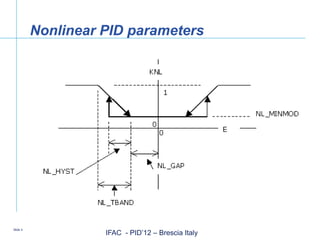
Nonlinear PID parameters


Slide 4
                    IFAC - PID’12 – Brescia Italy
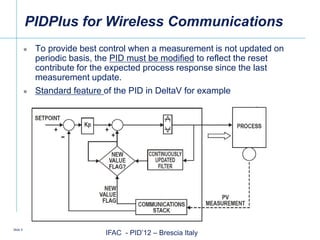
PIDPlus for Wireless Communications
             To provide best control when a measurement is not updated on
              periodic basis, the PID must be modified to reflect the reset
              contribute for the expected process response since the last
              measurement update.
             Standard feature of the PID in DeltaV for example


                                       PIDPlus Design

Slide 5
                               IFAC - PID’12 – Brescia Italy
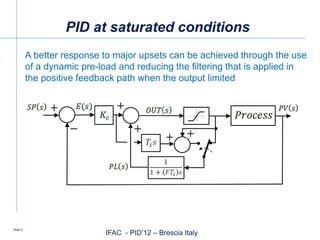
PID at saturated conditions
          A better response to major upsets can be achieved through the use
          of a dynamic pre-load and reducing the filtering that is applied in
          the positive feedback path when the output limited


Slide 6
                             IFAC - PID’12 – Brescia Italy
Performance Monitoring- Overview


Slide 7
                    IFAC - PID’12 – Brescia Italy
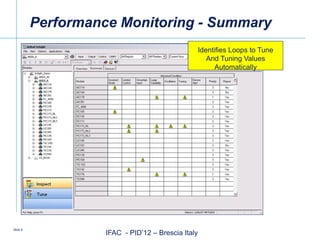
Performance Monitoring - Summary
                                                    Identifies Loops to Tune
                                                       And Tuning Values
                                                          Automatically


Slide 8
                    IFAC - PID’12 – Brescia Italy
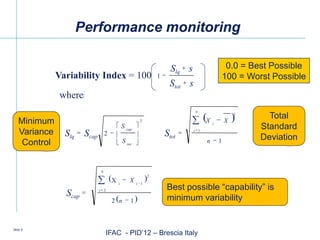
Performance monitoring

                                                             Slq + s                   0.0 = Best Possible
              Variability Index = 100                   1-                            100 = Worst Possible
                                                             Stot + s
               where:
                                                                         n

                                                                     (X                  )      Total
                                                                                          2

   Minimum                                        2                                 - X
                                       S cap                                  i
                                                                                               Standard
   Variance     Slq = Scap        2 -                  Stot =         i =1

                                                                               n -1            Deviation
    Control                            S tot 


                              n

                              (X i     - X
                                              i -1
                                                   )2
                             i= 2                            Best possible “capability” is
                Scap   =                                     s - Sensitivity Factor
                                                             minimum variability
                                    2 (n - 1 )


Slide 9
                                  IFAC - PID’12 – Brescia Italy
Valve Diagnostics
       • The approach uses the process model gain and is the best suited for
       the adaptive control loops or automatically tuned loops where process
       gain is known

       • Valve stem position availability improves the diagnostics

       • After calculating oscillation amplitudes on the controller input and
       output, valve HYSTERESIS is defined directly as:


            h = 2 A(out )                 2 Ampl ( PV ) = Kr


           r = 2 Ampl ( PV )                  b = h-r
                               K

Slide 10
                             IFAC - PID’12 – Brescia Italy
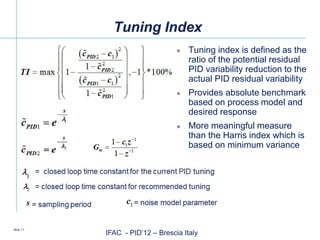
Tuning Index
                                    Tuning index is defined as the
                                     ratio of the potential residual
                                     PID variability reduction to the
                                     actual PID residual variability
                                    Provides absolute benchmark
                                     based on process model and
                                     desired response
                                    More meaningful measure
                                     than the Harris index which is
                                     based on minimum variance


Slide 11
           IFAC - PID’12 – Brescia Italy
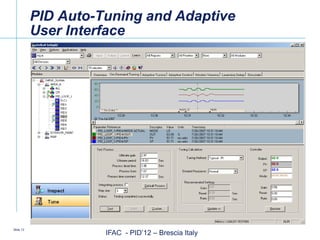
PID Auto-Tuning and Adaptive
           User Interface


Slide 12
                     IFAC - PID’12 – Brescia Italy
PID Graphical Gain-Phase Margin Tuning


Slide 13
                     IFAC - PID’12 – Brescia Italy
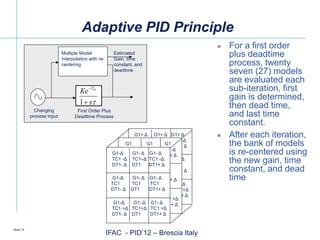
Adaptive PID Principle
                                                                                          For a first order
                           Multiple Model
                           Interpolation with re-
                                                      Estimated
                                                      Gain, time
                                                                                           plus deadtime
                           centering                  constant, and                        process, twenty
                                                      deadtime                             seven (27) models
                                                                                           are evaluated each
                                    Ke -TD                                                 sub-iteration, first
                                                                                           gain is determined,
                                    1 + s                                                 then dead time,
             Changing             First Order Plus
           process input         Deadtime Process                                          and last time
                                                                                           constant.
                                                               G1+ Δ G1+ Δ G1+ Δ          After each iteration,
                                                               TC1 -Δ TC1–Δ TC1 -Δ
                                                           G1       G1
                                                               DT1- Δ DT1
                                                                           G1
                                                                              DT1+ Δ       the bank of models
                                                          TC1 -Δ TC1–Δ TC1 -Δ
                                                     G1-Δ DT1- Δ ΔDT1 Δ
                                                              G1-    G1- DT1+ Δ            is re-centered using
                                                     TC1 -Δ TC1–Δ TC1 -ΔΔ G1+ Δ
                                                     DT1- Δ DT1
                                                               G1+ Δ G1+
                                                              TC1 DT1+ Δ
                                                                       TC1    TC1
                                                                                           the new gain, time
                                                          G1 DT1- Δ DT1 G1DT1+ Δ
                                                          TC1
                                                                    G1
                                                                   TC1    TC1
                                                                                           constant, and dead
                                                     G1-ΔDT1-G1- Δ G1- ΔDT1+ Δ
                                                               Δ DT1                       time
                                                     TC1      TC1 Δ TC1 Δ G1+ Δ
                                                               G1+     G1+
                                                     DT1- Δ DT1 +Δ TC1+Δ TC1 +Δ
                                                               TC1 DT1+ Δ
                                                           G1 DT1- Δ DT1 G1 DT1+ Δ
                                                                    G1
                                                          TC1 +Δ TC1+Δ TC1 +Δ
                                                      G1-ΔDT1-G1- Δ G1- ΔDT1+ Δ
                                                                Δ DT1
                                                     TC1 +Δ TC1+Δ TC1 +Δ
                                                     DT1- Δ DT1      DT1+ Δ


Slide 14
                                                    IFAC - PID’12 – Brescia Italy
Adaptive modeling with parameter
                     interpolation
      •Every parameter value of the model is evaluated
      independently

      •The weight assigned to the parameter value is inverse of
      the squared error

      •Adapted parameter value is weighted average of all
      evaluated values – decrease the number of models
      dramatically

      •Interpolation delivers improved accuracy, compared to
      selection from the limited number of models

Slide 15
                          IFAC - PID’12 – Brescia Italy
Sequential Parameter Interpolation
    •Sequential parameter adaptation – less models:
           Model with 3 parameters (Gain, Lag, Dead Time) and 3 values for every
                           3
           parameter has 3 model variations for model switching adaptation
           or 3x3 model variations for sequential parameter adaptation


     •Using the original data and                             Gain


     performing adaptation iteratively                                               Dead time
                                                                 Initial
                                                                 model


     •
                                                                               3
                                                                     1
                                                                                    Final
           The procedure on-line practically                               2        model


     feasible with sequential adaptation
                                                                                   Lag


Slide 16
                              IFAC - PID’12 – Brescia Italy
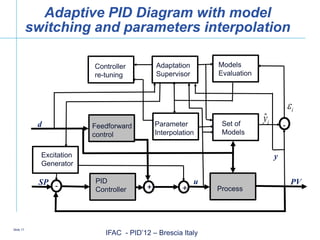
Adaptive PID Diagram with model
           switching and parameters interpolation

                          Controller          Adaptation       Models
                          re-tuning           Supervisor       Evaluation


                                                                                         i
                                                                            ˆ
                                                                            yi
            d             Feedforward         Parameter         Set of               -
                          control             Interpolation     Models


             Excitation                                                          y
             Generator

            SP -          PID                              u                              PV
                          Controller      +            +       Process


Slide 17
                             IFAC - PID’12 – Brescia Italy
Adaptive modeling and control


Slide 18
                  IFAC - PID’12 – Brescia Italy
Adaptive model scheduling


Slide 19
                IFAC - PID’12 – Brescia Italy
Conclusions
          The PID intelligence is commonly accepted by users with
           various level of control expertise
          The main factor that contributed to the intelligent PID
           acceptance is robust process model identification
           A significant factor is friendly user interface that provides
           full insight into control loop operation, control
           performance, loop faults and tuning recommendations
          Evolution of PID design will continue. PID will be facing
           more challenges and deliver more successes.


Slide 20
                           IFAC - PID’12 – Brescia Italy
Acknowledgments
       •Our communication with professors Karl Åstrӧm, Dale
       Seborg and Thomas Edgar greatly improved the product
       concepts and design.

       •The final shape of the product and its quality is the result of
       contributions from many control software developers –just to
       name the core of the group:
       Dennis Stevenson, John Gudaz, Peter Wojsznis, Mike Ott,
       Yan Zhang and Ron Ottenbacher.


Slide 21
                         IFAC - PID’12 – Brescia Italy

Intelligent PID Product Design

  • 1.
    Intelligent PID ProductDesign IFAC Conference on Advances in PID Control Brescia, 28-30 March 2012 Willy Wojsznis Terry Blevins John Caldwell Peter Wojsznis Mark Nixon Slide 1 IFAC - PID’12 – Brescia Italy
  • 2.
    What is IntelligentPID? An intelligent control system has the ability to  Improve control performance automatically or direct user to make changes that improve performance  Detect and diagnose faults and impaired loop operation  Learn about process, disturbances and operating conditions Collection of simple features improves product functionality and makes it easy to use Slide 2 IFAC - PID’12 – Brescia Italy
  • 3.
    PID controller optionsselection Slide 3 IFAC - PID’12 – Brescia Italy
  • 4.
    Nonlinear PID parameters Slide4 IFAC - PID’12 – Brescia Italy
  • 5.
    PIDPlus for WirelessCommunications  To provide best control when a measurement is not updated on periodic basis, the PID must be modified to reflect the reset contribute for the expected process response since the last measurement update.  Standard feature of the PID in DeltaV for example PIDPlus Design Slide 5 IFAC - PID’12 – Brescia Italy
  • 6.
    PID at saturatedconditions A better response to major upsets can be achieved through the use of a dynamic pre-load and reducing the filtering that is applied in the positive feedback path when the output limited Slide 6 IFAC - PID’12 – Brescia Italy
  • 7.
    Performance Monitoring- Overview Slide7 IFAC - PID’12 – Brescia Italy
  • 8.
    Performance Monitoring -Summary Identifies Loops to Tune And Tuning Values Automatically Slide 8 IFAC - PID’12 – Brescia Italy
  • 9.
    Performance monitoring Slq + s 0.0 = Best Possible Variability Index = 100 1- 100 = Worst Possible Stot + s where: n  (X ) Total 2 Minimum 2 - X  S cap  i Standard Variance Slq = Scap 2 -   Stot = i =1 n -1 Deviation Control  S tot  n  (X i - X i -1 )2 i= 2 Best possible “capability” is Scap = s - Sensitivity Factor minimum variability 2 (n - 1 ) Slide 9 IFAC - PID’12 – Brescia Italy
  • 10.
    Valve Diagnostics • The approach uses the process model gain and is the best suited for the adaptive control loops or automatically tuned loops where process gain is known • Valve stem position availability improves the diagnostics • After calculating oscillation amplitudes on the controller input and output, valve HYSTERESIS is defined directly as: h = 2 A(out ) 2 Ampl ( PV ) = Kr r = 2 Ampl ( PV ) b = h-r K Slide 10 IFAC - PID’12 – Brescia Italy
  • 11.
    Tuning Index  Tuning index is defined as the ratio of the potential residual PID variability reduction to the actual PID residual variability  Provides absolute benchmark based on process model and desired response  More meaningful measure than the Harris index which is based on minimum variance Slide 11 IFAC - PID’12 – Brescia Italy
  • 12.
    PID Auto-Tuning andAdaptive User Interface Slide 12 IFAC - PID’12 – Brescia Italy
  • 13.
    PID Graphical Gain-PhaseMargin Tuning Slide 13 IFAC - PID’12 – Brescia Italy
  • 14.
    Adaptive PID Principle  For a first order Multiple Model Interpolation with re- Estimated Gain, time plus deadtime centering constant, and process, twenty deadtime seven (27) models are evaluated each Ke -TD sub-iteration, first gain is determined, 1 + s then dead time, Changing First Order Plus process input Deadtime Process and last time constant. G1+ Δ G1+ Δ G1+ Δ  After each iteration, TC1 -Δ TC1–Δ TC1 -Δ G1 G1 DT1- Δ DT1 G1 DT1+ Δ the bank of models TC1 -Δ TC1–Δ TC1 -Δ G1-Δ DT1- Δ ΔDT1 Δ G1- G1- DT1+ Δ is re-centered using TC1 -Δ TC1–Δ TC1 -ΔΔ G1+ Δ DT1- Δ DT1 G1+ Δ G1+ TC1 DT1+ Δ TC1 TC1 the new gain, time G1 DT1- Δ DT1 G1DT1+ Δ TC1 G1 TC1 TC1 constant, and dead G1-ΔDT1-G1- Δ G1- ΔDT1+ Δ Δ DT1 time TC1 TC1 Δ TC1 Δ G1+ Δ G1+ G1+ DT1- Δ DT1 +Δ TC1+Δ TC1 +Δ TC1 DT1+ Δ G1 DT1- Δ DT1 G1 DT1+ Δ G1 TC1 +Δ TC1+Δ TC1 +Δ G1-ΔDT1-G1- Δ G1- ΔDT1+ Δ Δ DT1 TC1 +Δ TC1+Δ TC1 +Δ DT1- Δ DT1 DT1+ Δ Slide 14 IFAC - PID’12 – Brescia Italy
  • 15.
    Adaptive modeling withparameter interpolation •Every parameter value of the model is evaluated independently •The weight assigned to the parameter value is inverse of the squared error •Adapted parameter value is weighted average of all evaluated values – decrease the number of models dramatically •Interpolation delivers improved accuracy, compared to selection from the limited number of models Slide 15 IFAC - PID’12 – Brescia Italy
  • 16.
    Sequential Parameter Interpolation •Sequential parameter adaptation – less models: Model with 3 parameters (Gain, Lag, Dead Time) and 3 values for every 3 parameter has 3 model variations for model switching adaptation or 3x3 model variations for sequential parameter adaptation •Using the original data and Gain performing adaptation iteratively Dead time Initial model • 3 1 Final The procedure on-line practically 2 model feasible with sequential adaptation Lag Slide 16 IFAC - PID’12 – Brescia Italy
  • 17.
    Adaptive PID Diagramwith model switching and parameters interpolation Controller Adaptation Models re-tuning Supervisor Evaluation i ˆ yi d Feedforward Parameter Set of - control Interpolation Models Excitation y Generator SP - PID u PV Controller + + Process Slide 17 IFAC - PID’12 – Brescia Italy
  • 18.
    Adaptive modeling andcontrol Slide 18 IFAC - PID’12 – Brescia Italy
  • 19.
    Adaptive model scheduling Slide19 IFAC - PID’12 – Brescia Italy
  • 20.
    Conclusions  The PID intelligence is commonly accepted by users with various level of control expertise  The main factor that contributed to the intelligent PID acceptance is robust process model identification  A significant factor is friendly user interface that provides full insight into control loop operation, control performance, loop faults and tuning recommendations  Evolution of PID design will continue. PID will be facing more challenges and deliver more successes. Slide 20 IFAC - PID’12 – Brescia Italy
  • 21.
    Acknowledgments •Our communication with professors Karl Åstrӧm, Dale Seborg and Thomas Edgar greatly improved the product concepts and design. •The final shape of the product and its quality is the result of contributions from many control software developers –just to name the core of the group: Dennis Stevenson, John Gudaz, Peter Wojsznis, Mike Ott, Yan Zhang and Ron Ottenbacher. Slide 21 IFAC - PID’12 – Brescia Italy