What is pH?
Whatis pH?
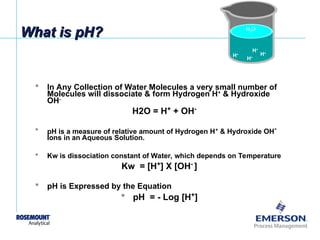
In Any Collection of Water Molecules a very small number of
Molecules will dissociate & form Hydrogen H+
& Hydroxide
OH-
H2O = H+
+ OH-
pH is a measure of relative amount of Hydrogen H+
& Hydroxide OH-
Ions in an Aqueous Solution.
Kw is dissociation constant of Water, which depends on Temperature
Kw = [H+
] X [OH-
]
pH is Expressed by the Equation
pH = - Log [H+
]
H+
H2O
H+
H+
H+
3.
What is pH?
Whatis pH?
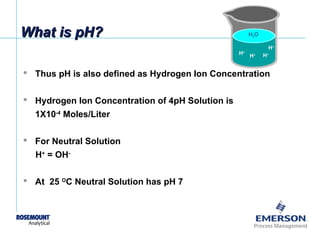
Thus pH is also defined as Hydrogen Ion Concentration
Hydrogen Ion Concentration of 4pH Solution is
1X10⁻⁴
Moles/Liter
For Neutral Solution
H+
= OH-
At 25 O
C Neutral Solution has pH 7
H+
H2O
H+
H+
H+
Why is pHMeasurement Necessary?
Why is pH Measurement Necessary?
Control a Chemical Reaction
– Corrosion Control
– Water and Wastewater Treatment
– Raw Material and Product Quality Control
6.
pH Values ofAcids and Bases
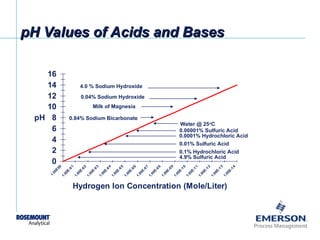
pH Values of Acids and Bases
0
2
4
6
8
10
12
14
16
1
.
0
0
E
0
0
1
.
0
0
E
-
0
1
1
.
0
0
E
-
0
2
1
.
0
0
E
-
0
3
1
.
0
0
E
-
0
4
1
.
0
0
E
-
0
5
1
.
0
0
E
-
0
6
1
.
0
0
E
-
0
7
1
.
0
0
E
-
0
8
1
.
0
0
E
-
0
9
1
.
0
0
E
-
1
0
1
.
0
0
E
-
1
1
1
.
0
0
E
-
1
2
1
.
0
0
E
-
1
3
1
.
0
0
E
-
1
4
Hydrogen Ion Concentration (Mole/Liter)
pH
4.0 % Sodium Hydroxide
0.04% Sodium Hydroxide
Milk of Magnesia
0.84% Sodium Bicarbonate
Water @ 25o
C
0.00001% Sulfuric Acid
0.0001% Hydrochloric Acid
0.01% Sulfuric Acid
0.1% Hydrochloric Acid
4.9% Sulfuric Acid
7.
Key pH SensorComponents
Key pH Sensor Components
Measuring Electrode
– Develops a millivolt potential directly proportional to pH in an
aqueous solution
Reference Electrode
– Maintains a stable reference potential regardless of changes in
solution pH or other ionic activity
Reference Electrode Liquid Junction
– Maintain electrical contact between the pH measuring electrode
and the reference cell via the process solution
Temperature Compensator
– Corrects for changes in the millivolt output of the pH sensor due
to process temperature change
8.
pH Measuring Electrode
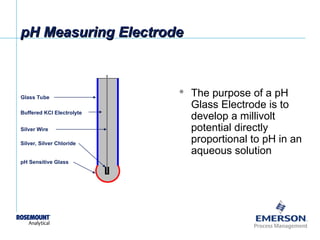
pHMeasuring Electrode
The purpose of a pH
Glass Electrode is to
develop a millivolt
potential directly
proportional to pH in an
aqueous solution
Buffered KCl Electrolyte
Silver Wire
Silver, Silver Chloride
pH Sensitive Glass
Glass Tube
9.
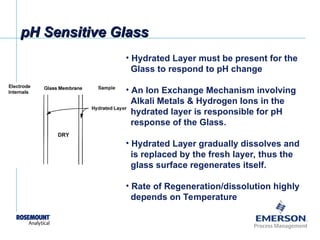
pH Sensitive Glass
pHSensitive Glass
• Hydrated Layer must be present for the
Glass to respond to pH change
• An Ion Exchange Mechanism involving
Alkali Metals & Hydrogen Ions in the
hydrated layer is responsible for pH
response of the Glass.
• Hydrated Layer gradually dissolves and
is replaced by the fresh layer, thus the
glass surface regenerates itself.
• Rate of Regeneration/dissolution highly
depends on Temperature
10.
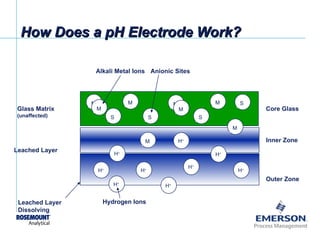
How Does apH Electrode Work?
How Does a pH Electrode Work?
Glass Matrix
(unaffected)
Leached Layer
Leached Layer
Dissolving
Core Glass
Inner Zone
Outer Zone
Alkali Metal Ions
Hydrogen Ions
Anionic Sites
H+
M
H+
H+
H+
S
S S S
M
M
M M
H+
H+
H+
H+
H+
M M
M
11.
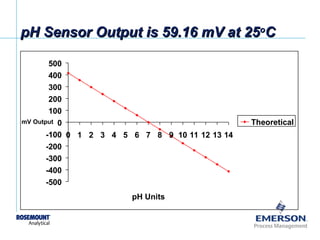
pH Sensor Outputis 59.16 mV at 25
pH Sensor Output is 59.16 mV at 25o
o
C
C
-500
-400
-300
-200
-100
0
100
200
300
400
500
0 1 2 3 4 5 6 7 8 9 10 11 12 13 14
pH Units
mV Output Theoretical
12.
Importance of thepH Preamplifier
Importance of the pH Preamplifier
At 25o
C the pH electrode produces 59.16 mV per pH unit
The impedance of a general purpose pH electrode is
approximately 100 Meg ohms
Ohms Law
– Voltage (E) / Resistance (R) = Current (I)
– E/ R = I
0.05916 / 100,000,000 = 0.000000001 Amps
A close coupled preamp is required for signal stability
13.
The Effect ofTemperature
The Effect of Temperature
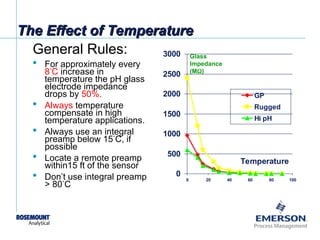
General Rules:
For approximately every
8°
C increase in
temperature the pH glass
electrode impedance
drops by 50%.
Always temperature
compensate in high
temperature applications.
Always use an integral
preamp below 15°
C, if
possible
Locate a remote preamp
within15 ft of the sensor
Don’t use integral preamp
> 80°
C
0
500
1000
1500
2000
2500
3000
0 20 40 60 80 100
Temperature
GP
Rugged
Hi pH
Glass
Impedance
(M)
14.
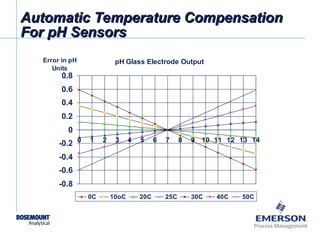
Automatic Temperature Compensation
AutomaticTemperature Compensation
For pH Sensors
For pH Sensors
pH Glass Electrode Output
-0.8
-0.6
-0.4
-0.2
0
0.2
0.4
0.6
0.8
0 1 2 3 4 5 6 7 8 9 10 11 12 13 14
Error in pH
Units
0C 10oC 20C 25C 30C 40C 50C
15.
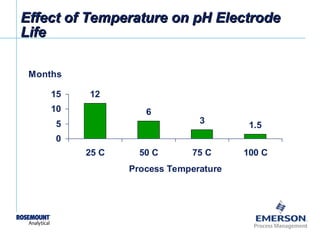
Effect of Temperatureon pH Electrode
Effect of Temperature on pH Electrode
Life
Life
12
6
3 1.5
0
5
10
15
25 C 50 C 75 C 100 C
Process Temperature
Months
16.
Solution Temperature Compensation
SolutionTemperature Compensation
Permits the standard (electrode) temperature
compensation routine to be modified to also
correct for the solution pH changes with
temperature
Implemented by adding the the temperature
coefficient of the solution (change in pH per
degree C) to the temperature compensation
algorithm
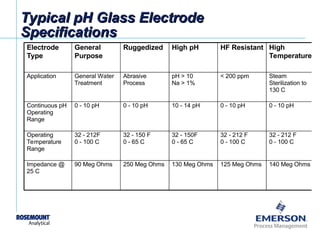
Typical pH GlassElectrode
Typical pH Glass Electrode
Specifications
Specifications
Electrode
Type
General
Purpose
Ruggedized High pH HF Resistant High
Temperature
Application General Water
Treatment
Abrasive
Process
pH > 10
Na > 1%
< 200 ppm Steam
Sterilization to
130 C
Continuous pH
Operating
Range
0 - 10 pH 0 - 10 pH 10 - 14 pH 0 - 10 pH 0 - 10 pH
Operating
Temperature
Range
32 - 212F
0 - 100 C
32 - 150 F
0 - 65 C
32 - 150F
0 - 65 C
32 - 212 F
0 - 100 C
32 - 212 F
0 - 100 C
Impedance @
25 C
90 Meg Ohms 250 Meg Ohms 130 Meg Ohms 125 Meg Ohms 140 Meg Ohms
19.
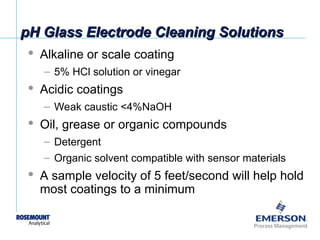
pH Glass ElectrodeCleaning Solutions
pH Glass Electrode Cleaning Solutions
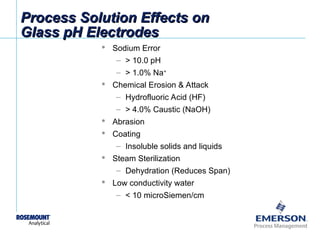
Alkaline or scale coating
– 5% HCl solution or vinegar
Acidic coatings
– Weak caustic <4%NaOH
Oil, grease or organic compounds
– Detergent
– Organic solvent compatible with sensor materials
A sample velocity of 5 feet/second will help hold
most coatings to a minimum
20.
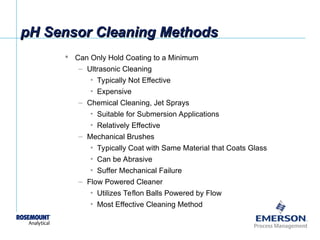
pH Sensor CleaningMethods
pH Sensor Cleaning Methods
Can Only Hold Coating to a Minimum
– Ultrasonic Cleaning
• Typically Not Effective
• Expensive
– Chemical Cleaning, Jet Sprays
• Suitable for Submersion Applications
• Relatively Effective
– Mechanical Brushes
• Typically Coat with Same Material that Coats Glass
• Can be Abrasive
• Suffer Mechanical Failure
– Flow Powered Cleaner
• Utilizes Teflon Balls Powered by Flow
• Most Effective Cleaning Method
21.
pH sensor mounting
pHsensor mounting
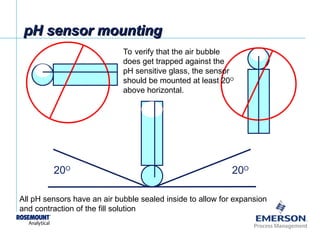
20O
20O
All pH sensors have an air bubble sealed inside to allow for expansion
and contraction of the fill solution
To verify that the air bubble
does get trapped against the
pH sensitive glass, the sensor
should be mounted at least 20O
above horizontal.
22.
pH Reference Electrode
pHReference Electrode
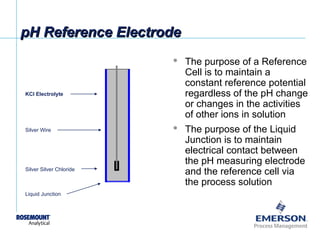
The purpose of a Reference
Cell is to maintain a
constant reference potential
regardless of the pH change
or changes in the activities
of other ions in solution
The purpose of the Liquid
Junction is to maintain
electrical contact between
the pH measuring electrode
and the reference cell via
the process solution
KCl Electrolyte
Silver Wire
Silver Silver Chloride
Liquid Junction
23.
pH Reference Cells
pHReference Cells
Typically defined by the number of chambers to impede dilution and
contamination
– Single, Double or Triple Junction
Other Methods
– Differential Glass Electrode (GLI)
– Salt Saturated Series of Wood Dowels and Rings (ABB-TBI)
Liquid Junction Materials
– Wood, Ceramic and Plastic Materials
– Other fibrous materials
– Large Orifice
Electrolytic Fill Solutions
– Salt & Water - Pressurized Flowing Junctions
– Gels - Resist dilution and contamination
– Solids - utilize Zeolyte as molecular sieve
24.
Liquid Junction Materials
LiquidJunction Materials
Wood
– Natural fiber made for capillary action
– Delignifies at High pH (>10)
Ceramic
– Slower Diffusion Rate
– Increased Sensitivity to Flow
Teflon
– Excellent corrosion resistance
– High impedance
Plastic Composites
– Provide Large Surface Area for Low Impedance
– Duplicates the Desirable Properties of Wood
– Blocks Typical Contamination
25.
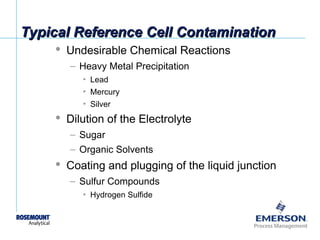
Typical Reference CellContamination
Typical Reference Cell Contamination
Undesirable Chemical Reactions
– Heavy Metal Precipitation
• Lead
• Mercury
• Silver
Dilution of the Electrolyte
– Sugar
– Organic Solvents
Coating and plugging of the liquid junction
– Sulfur Compounds
• Hydrogen Sulfide
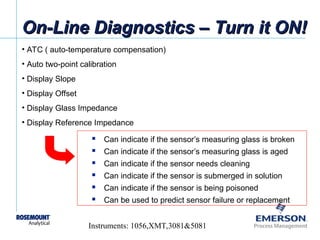
On-Line Diagnostics –Turn it ON!
On-Line Diagnostics – Turn it ON!
Can indicate if the sensor’s measuring glass is broken
Can indicate if the sensor’s measuring glass is aged
Can indicate if the sensor needs cleaning
Can indicate if the sensor is submerged in solution
Can indicate if the sensor is being poisoned
Can be used to predict sensor failure or replacement
Instruments: 1056,XMT,3081&5081
• ATC ( auto-temperature compensation)
• Auto two-point calibration
• Display Slope
• Display Offset
• Display Glass Impedance
• Display Reference Impedance
28.
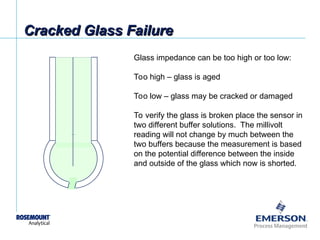
Cracked Glass Failure
CrackedGlass Failure
Glass impedance can be too high or too low:
Too high – glass is aged
Too low – glass may be cracked or damaged
To verify the glass is broken place the sensor in
two different buffer solutions. The millivolt
reading will not change by much between the
two buffers because the measurement is based
on the potential difference between the inside
and outside of the glass which now is shorted.
29.
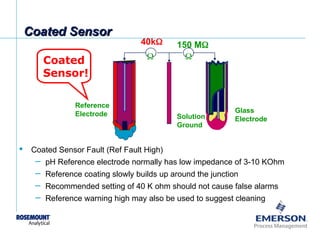
Coated SensorFault (Ref Fault High)
pH Reference electrode normally has low impedance of 3-10 KOhm
Reference coating slowly builds up around the junction
Recommended setting of 40 K ohm should not cause false alarms
Reference warning high may also be used to suggest cleaning
Coated
Sensor!
Reference
Electrode Glass
Electrode
Solution
Ground
40k 150 M
Coated Sensor
Coated Sensor
30.
Summary of Diagnostics
Summaryof Diagnostics
An extremely high glass and reference impedance (all 9999)
indicates the sensor is not submerged in the process solution.
An extremely low glass impedance (zero) indicates the sensor is
cracked.
– Having two preamplifiers in the loop will also cause a cracked
glass error.
A high reference impedance indicates the sensor is being coated. If
the reference impedance reaches 70k ohms it is time to clean the
sensor.
– clean off the sensor with DI water
Diagnostic information can be viewed on a 375, AMS package, or
DeltaV program if a compatible instrument is used.
31.
Recommended* pH Maintenance
Recommended*pH Maintenance
Weekly
– check sensor in grab sample or buffer
– adjust using single point standardize (if needed)
Monthly
– Remove sensor from process
– Calibrate sensor in 2 buffers (4 and 7)
– Clean sensor and check diagnostics
Quarterly
– recharge reference solution (repairable)
– replace liquid junction (repairable)
– check O-rings, grease (repairable)
Yearly
– Replace sensor (disposable)
– replace glass electrode (repairable)
– replace reference electrode (repairable)
*Note: These
are guidelines
for a relatively
simple process
installation.
32.
Grab Sample Standardization
GrabSample Standardization
0
2
4
6
8
10
12
14
0 3 6 9 12
Normal Slope
Cracked (No Slope)
Standardized
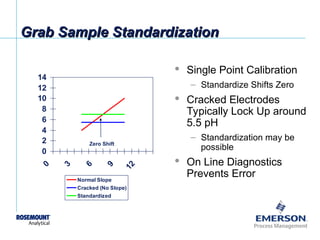
Single Point Calibration
– Standardize Shifts Zero
Cracked Electrodes
Typically Lock Up around
5.5 pH
– Standardization may be
possible
On Line Diagnostics
Prevents Error
Zero Shift
33.
Two Point pHBuffer Calibration
Two Point pH Buffer Calibration
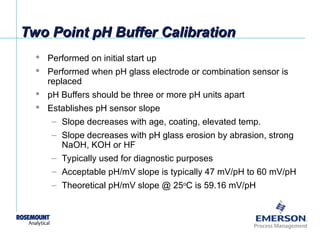
Performed on initial start up
Performed when pH glass electrode or combination sensor is
replaced
pH Buffers should be three or more pH units apart
Establishes pH sensor slope
– Slope decreases with age, coating, elevated temp.
– Slope decreases with pH glass erosion by abrasion, strong
NaOH, KOH or HF
– Typically used for diagnostic purposes
– Acceptable pH/mV slope is typically 47 mV/pH to 60 mV/pH
– Theoretical pH/mV slope @ 25o
C is 59.16 mV/pH
34.
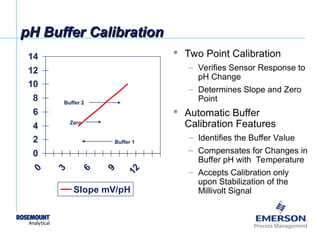
pH Buffer Calibration
pHBuffer Calibration
0
2
4
6
8
10
12
14
Slope mV/pH
Two Point Calibration
– Verifies Sensor Response to
pH Change
– Determines Slope and Zero
Point
Automatic Buffer
Calibration Features
– Identifies the Buffer Value
– Compensates for Changes in
Buffer pH with Temperature
– Accepts Calibration only
upon Stabilization of the
Millivolt Signal
Buffer 2
Buffer 1
Zero
35.
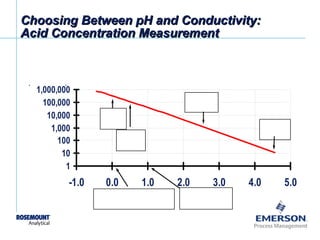
Choosing Between pHand Conductivity:
Choosing Between pH and Conductivity:
Acid Concentration Measurement
Acid Concentration Measurement
1
10
100
1,000
10,000
100,000
1,000,000
-1.0 0.0 1.0 2.0 3.0 4.0 5.0
Conductivity
(microS/cm)
pH vs Conductivity for a Strong Acid
pH
Acid Error Below
1.0 pH
Less Than 0.0 pH
Not Possible with pH
1 ppm
Acid
100 ppm
Acid
1%
Acid
4%
Acid
36.
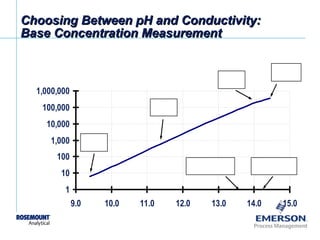
Choosing Between pHand Conductivity:
Choosing Between pH and Conductivity:
Base Concentration Measurement
Base Concentration Measurement
1
10
100
1,000
10,000
100,000
1,000,000
9.0 10.0 11.0 12.0 13.0 14.0 15.0
pH
Conductivity
microS/cm
pH vs Conductivity for a Strong Base
Large
Sodium Error
pH Electrode
Destroyed
1 ppm
Base
100 ppm
Base
4%
Base
10%
Base
37.
Points To Remember
PointsTo Remember
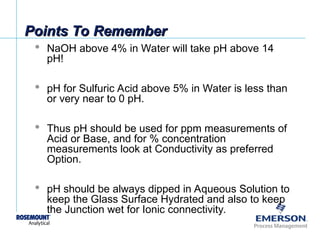
NaOH above 4% in Water will take pH above 14
pH!
pH for Sulfuric Acid above 5% in Water is less than
or very near to 0 pH.
Thus pH should be used for ppm measurements of
Acid or Base, and for % concentration
measurements look at Conductivity as preferred
Option.
pH should be always dipped in Aqueous Solution to
keep the Glass Surface Hydrated and also to keep
the Junction wet for Ionic connectivity.
38.
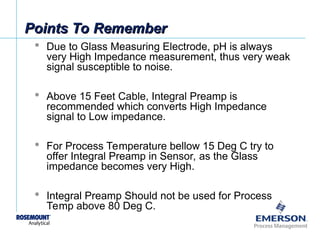
Due toGlass Measuring Electrode, pH is always
very High Impedance measurement, thus very weak
signal susceptible to noise.
Above 15 Feet Cable, Integral Preamp is
recommended which converts High Impedance
signal to Low impedance.
For Process Temperature bellow 15 Deg C try to
offer Integral Preamp in Sensor, as the Glass
impedance becomes very High.
Integral Preamp Should not be used for Process
Temp above 80 Deg C.
Points To Remember
Points To Remember
39.
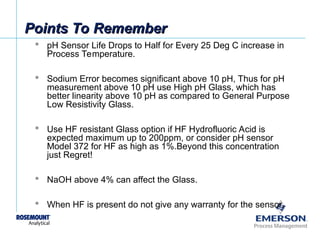
pH SensorLife Drops to Half for Every 25 Deg C increase in
Process Temperature.
Sodium Error becomes significant above 10 pH, Thus for pH
measurement above 10 pH use High pH Glass, which has
better linearity above 10 pH as compared to General Purpose
Low Resistivity Glass.
Use HF resistant Glass option if HF Hydrofluoric Acid is
expected maximum up to 200ppm, or consider pH sensor
Model 372 for HF as high as 1%.Beyond this concentration
just Regret!
NaOH above 4% can affect the Glass.
When HF is present do not give any warranty for the sensor.
Points To Remember
Points To Remember
40.
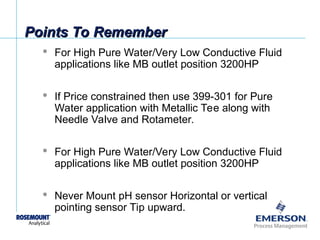
For HighPure Water/Very Low Conductive Fluid
applications like MB outlet position 3200HP
If Price constrained then use 399-301 for Pure
Water application with Metallic Tee along with
Needle Valve and Rotameter.
For High Pure Water/Very Low Conductive Fluid
applications like MB outlet position 3200HP
Never Mount pH sensor Horizontal or vertical
pointing sensor Tip upward.
Points To Remember
Points To Remember
41.
For allFouling Applications (eg ETP), consider pH
sensor with Large Area Liquid Junction
(TupH/PERpHEX)
Use Triple Junction/TupH/PERpHEX pH sensors
for Process Fluids having poisoning ions like
Sulfides / Chlorides / Cyanides etc.
Advance Diagnostics including the Reference
Electrode Diagnostics is possible when the pH
sensor has Solution Ground Electrode
(396P/396R/385+/PERpHEX/pHASER)
Points To Remember
Points To Remember
Editor's Notes
#2
In the strict definition, pH is the negative logarithm of the hydrogen ion activity. Activity is the concentration multiplied by a constant (the activity coefficient), which corrects the concentration for the effects of ion to ion interactions in solution.
In general usage, pH is, for the most part, a shorthand, which allows concentrations of hydrogen ions over a tremendous range to be conveniently expressed. In most applications, the activity coefficient is assumed to be a constant, and is eliminated by calibration.
#3
In the strict definition, pH is the negative logarithm of the hydrogen ion activity. Activity is the concentration multiplied by a constant (the activity coefficient), which corrects the concentration for the effects of ion to ion interactions in solution.
In general usage, pH is, for the most part, a shorthand, which allows concentrations of hydrogen ions over a tremendous range to be conveniently expressed. In most applications, the activity coefficient is assumed to be a constant, and is eliminated by calibration.
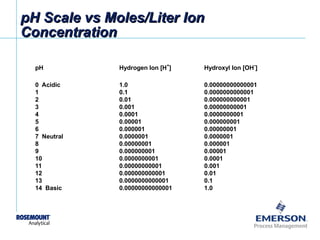
#4 The above table shows the convenience of pH as a shorthand for the wide range of hydrogen ion concentrations possible in water solutions, and the very small numbers involved.
For every change of 1 pH unit, there is a ten-fold change in the hydrogen ion concentration. This is useful to keep in mind, when reviewing pH control applications and helps in planning for reagent demand.
#5 The pH of a solution can effect the course of a chemical reaction. In the case of corrosion control, the pH is adjusted to prevent a reaction from occurring, while in the course of chemical production, a particular pH range may be required to promote a desired chemical reaction. pH is an important variable in the treatment of water and wastewater. The importance of pH requires that it be controlled in a wide variety of instances.
#6 The full range of pH (0 to 14 pH) is encounter in relatively common chemicals and even common household items.
#8 The glass pH electrode is made from a tube of conventional glass, on to which has been blown a bulb of pH sensitive glass, which develops a millivolt potential proportional to pH.
The glass electrode contains a silver / silver chloride wire which generates a constant millivolt potential at a given temperature, which depends upon the concentration of silver ion present in the fill solution. The concentration of silver ion in the fill solution is controlled by the concentration of potassium chloride (KCl). This internal potential is designed to match the reference electrode, so as to cancel as much as possible, changes in the internal pH and reference electrode potential with temperature.
#9 pH glass is a special formulation of glass which contains alkali metals to lower the impedance. When placed in water, the glass matrix is attacked by the water which opens up silanol groups (Si--OH) that are in equilibrium with hydrogen ions in solution: Si--OH <=> Si--O- + H+.
When the matrix is opened up by the attack of water, alkali metals occupying anionic sites in the original glass matrix, leave the glass matrix and are replaced by hydrogen ions, which forms silanol groups:
Si--OM + H+ => Si--OH + M+
#10 The surface of a glass pH electrode (both inner and outer) can be considered to consist of three zones. The first, the core glass, is the original glass matrix, which has not been affected by the corrosive effects of water. Immediately adjacent to the outer surface of the core glass is the inner zone of the leached layer, where the the leached layer is being formed and akali metal ions are being replaced by hydrogen ions. The outer zone of the leached layer extends outward to the surface of the glass electrode and is where pH response occurs.
A hydrogen ion moving from the solution into the leached layer of the glass electrode is at a different chemical potential than it was in the solution due to the different chemical environment within the leached layer. The difference in chemical potential between the solution and the leached layer provides a chemical driving force which favors hydrogen ions either moving into, or out of, the leached layer. Since the hydrogen ions are charged, there is an electrical potential that balances the chemical potential, leading to an overall electrochemical potential, which relates solution pH to the potential developed at the surface of the electrode.
The outer surface of the glass electrode will develop a potential in response to the process solution, while the inner surface of the glass electrode will develop a potential in response to the electrode fill solution, which is a known pH. The overall potential of the glass electrode will be the difference of these two potentials.
#11 This slide illustrates the theoretical response of a pH electrode and reference electrode at 25 deg C. The theoretical slope of the pH and reference electrode pair is -59.16 mV/pH, which is a benchmark for the glass electrode slope actually observed after a calibration.
#12 A simple calculation based on the voltage (potential) and resistance (impedance) of a pH electrode shows the extremely low range the of the signal (current)of the pH measuring circuit before preamplification.
#14 The purpose of this slide is to show the importance of temperature compensation for the pH and reference electrodes.
At 7.0 pH the electrode pair has (typically by design) a zero millivolt output. This is the isopotential point of the electrode. No temperature compensation is required at or near this point.
Temperature compensation is required at other pH values, as the change in potential of the pH and reference electrodes with temperature can result in substantial errors. Since the equation that governs the change in potential with temperature is well known, virtually all modern pH analyzers provide electrode temperature compensation.
#15 The typical useful life of a pH electrode in a benign process is one year at room temperature, although it can be much longer. In any case, an increase in the process temperature will shorten the life of the glass electrode. The general rule, which applies to electrodes from all manufacturers, is that the life of the glass electrode is halved for each 25 deg C increase in temperature.
#16 The change in the pH of a solution per degree centigrade is called the temperature coefficient. In the previous chart, the temperature coefficients of the basic solutions were around -0.026 pH/ degree C. The temperature coefficient of a solution can be measured in the laboratory by simply measuring the solution’s pH as it is being warmed or cooled.
Adding temperature compensation for solution pH changes with temperature is a simple matter of inputting the temperature coefficient into the analyzer. The analyzer then includes the temperature coefficient in its temperature compensation routine and compensates the measurement for temperature changes in both the electrodes and the solution.
It should be noted that this enhanced temperature compensation is applicable to process solutions, which characteristically do not vary widely in composition.
However streams, with wide swings in composition and pH over time, such as waste streams, will have a variable temperature coefficient of the solution will also vary. Since no characteristic temperature coefficient can be defined, enhanced temperature compensation can not be so easily handled.
#17 At high pH, the concentration of sodium ion can be many orders of magnitude greater than the hydrogen ion concentration. As a result, the minor response of the glass pH electrode to sodium ion becomes significant. The electrode response to pH appears to flatten out with increasing pH, leading to errors.
Hydrofluoric acid attacks glass. While fluoride ion itself does not attack glass, a significant concentration of fluoride ion and a sufficiently low pH will cause hydrofluoric acid to be formed, which does.
Strong caustic also attacks glass and a pH electrode can be quickly destroyed in solutions containing more than 4% caustic. Ironically, the pH of such solutions is greater than 14 pH and no meaningful pH measurement can be made due to large sodium errors. pH measurement should simply be avoided. Conductivity measurement can often be used as a successful alternative.
pH electrodes can be abraded by particulates in solution or broken by the impact of larger particles. The electrode should be shielded from impact by a shroud or baffle.
Coating of the pH sensor increases the frequency of removal and cleaning, which increases the maintenance costs.
pH measurements in low conductivity water involve a number of sources of error, which are not encountered in higher conductivity solutions.
#18 The millivolt response at high pH is shown for three pH glass electrode formulations, against the theoretical response. In all cases, the actual mV response drops below the theoretical value due to sodium error.
The traditional formulation (red) shows the lowest response versus the theoretical response (blue).
A more recent formulation (black), exhibits about one half the sodium error of the traditional formulation.
The best millivolt response is given by the standard high pH glass (green), which has been formulated to minimize sodium error. A high pH glass formulation should always be used when an accurate pH reading is required above 10 pH.
#19 pH glass electrode formulations have been designed to meet specific process application needs. Of these, the most important distinction should be made between general purpose glass formulations and high pH formulations.
In the case of HF and ruggedized formulations, these can resist to some extent attack by hydrofluoric acid (HF) and abrasion, but this resistance is limited to 200 ppm HF in the case of the HF electrode. Although a ruggedized glass formulation (thicker pH glass) can stand up to abrasion longer than a general purpose electrode, the best course of action, in an abrasive situation, is to protect the sensor from direct impact of the sample flow.
The typical impedance of these pH electrodes are also shown above. The variation in impedance of the electrodes is a function of the thickness and surface area of the particular electrode, as well as a function of the glass formulation.
#20 The general rule for cleaning glass pH electrodes and sensors is to use the mildest cleaning solution that effectively cleans it.
It is also a good practice to limit the exposure of the electrode or sensor to the minimum time required for cleaning, so as to minimize any chemical attack on the various sensor parts, and minimize the volume of cleaning solution that is drawn up into the liquid junction.
#21 On-line cleaning methods only serve to minimize coating. Among the techniques used, ultrasonic has almost universally been judged as being ineffective dealing with coatings.
The effectiveness of the other techniques tends to be situation specific; the jet spray method tending to be more effective than the brush method. The flow powered cleaner is a very effective method if the sample flow can be provided with in the prescribed limits for optimum cleaning.
#23 As was the case with the glass pH electrode, the silver/silver chloride wire within the reference electrode develops a standard potential at a given temperature, in response to the concentration of silver ions in the fill solution, which is controlled by maintaining the potassium chloride (KCl) at a constant concentration. This fulfills the first purpose of the reference electrode as a source of a constant reference potential.
However, the second purpose of the reference electrode, which is to maintain electrical contact between the pH electrode and the reference element, jeopardizes stable chemical environment within the reference electrode. Electrical contact is maintained by electrolytic (ionic) conduction, which necessitates the transfer of ions from the reference fill solution to the process solution and vice-versa.
#24 Single, double and triple junction reference electrodes refer to the number of liquid junctions and fill solutions that separate the reference element from the process solution. The goal of multiple junctions is to retard the rate that ions from the process reach the reference element.
The differential glass electrode is a reference that uses a second glass pH electrode immersed in a buffer solution, and in contact with the process solution, through a salt solution.
Salt saturated wood dowels and rings retard the progress of process ions toward the reference element, by creating a torturous path.
Liquid junctions can be made of a number of materials, wood being an excellent material due to its natural capillary action and wettability by water. Sintered ceramic is also a popular reference material. A large orifice can be used as a reference if a sufficiently gelled fill solution is used.
Generally, the major effect of gelling an electrolyte is to retard the transport of ions by convection, due to temperature changes about the reference. Solid fill solutions are actually very stiff gels, because in spite of their solid appearance, these reference fills must allow the diffusion of ions through them.
#25 As a liquid junction material, the excellent properties of wood are lost in samples above pH 10 due to the delignification of the wood at and above that pH. Ceramic junctions are the usual alternative in high pH solutions, but can show some flow sensitivity.
Teflon provides excellent chemical resistance as a junction material, but due to cold flow, the reference can exhibit high impedance.
Plastic composite reference junctions, a recent development, combine the properties of wood, with the high pH resistance of ceramic. They characteristically have a small pore size, which reduces the diffusion of process ions into the reference, and can be made with a large surface area, which lowers the overall reference impedance.
#26 The outermost liquid junction of a reference junction can be plugged by heavy metals (lead, mercury, and silver) because they form insoluble precipitates with the chloride ion in the fill solution. This problem can be greatly lessened by using potassium nitrate, which does not form a precipitate, as an outer reference fill.
The reference fill solution can be diluted by organic solvents or sugars, which can lower the ionic conduction through the fill solution, or in the case of an organic solvent which separates into a non-aqueous phase, the conductive path through the fill solution can be lost altogether.
Sulfur compounds, hydrogen sulfide in particular, forms an insoluble salt with silver ions. When the sulfur compound comes into contact with the silver ion at the face of a liquid junction, a precipitate is formed which blocks the liquid junction.
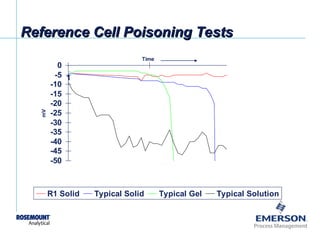
#27 The above plot shows the rate of poisoning over time (180 days) of a reference element by potassium iodide (KI) as evidenced by the change in millivolt potential.
The typical reference solution (ungelled) shows the fastest most pronounced effect from poisoning. As expected, the poisoning rate is retarded by gelling the reference fill (green), and even further retarded by solidifying the gel.
The best resistance to poisoning is shown by the R1 solid (red), which is a solid reference fill, which has been provided with a torturous path in addition to the solid reference fill.
#28 Advanced impedance diagnostics use a temperature compensated impedance measurement, which allows the numerical value to be displayed, transmitted, and alarmed.
In addition to indicating a cracked or broken electrode, advanced pH diagnostics are able to detect severe coating on the pH electrode and aging of the electrode, which is usually accompanied by an increase in impedance. A history of the impedance behavior of electrodes in a particular process can allow the user to avoid unnecessary cleaning or buffer calibration.
The reference impedance, which is much lower than that of the pH electrode and only marginally temperature dependent, can be used to detect coating.
As an added benefit, impedance diagnostics can indicate when a sensor is not immersed in the process (high impedance), and can detect the presence of a non-aqueous solvent (high impedance).
#29 The two point buffer calibration demonstrates that the pH electrode is actually responding to pH. How well the electrode responds can be seen by examining the slope.
But a buffer calibration requires that the sensor be taken off line and so the pH measurement is lost. The cost of a buffer calibration, in terms of the man-hours required to perform it, is also higher than a single point standardization.
#31 If the glass cracks, a short or low resistance pathway is created from the inside of the glass to the outside of the glass. The square wave signal amplitude will be unchanged thus indicated a cracked glass failure. The square wave signal travels through the glass matrix to make the impedance measurement.
#33 Advanced impedance diagnostics use a temperature compensated impedance measurement, which allows the numerical value to be displayed, transmitted, and alarmed.
In addition to indicating a cracked or broken electrode, advanced pH diagnostics are able to detect severe coating on the pH electrode and aging of the electrode, which is usually accompanied by an increase in impedance. A history of the impedance behavior of electrodes in a particular process can allow the user to avoid unnecessary cleaning or buffer calibration.
The reference impedance, which is much lower than that of the pH electrode and only marginally temperature dependent, can be used to detect coating.
As an added benefit, impedance diagnostics can indicate when a sensor is not immersed in the process (high impedance), and can detect the presence of a non-aqueous solvent (high impedance).
#35 Once installed in the process a slight drift can almost always be expected from initial buffer calibration of a new or cleaned pH electrode.
Coatings, however slight, are a natural occurrence and the standardize adjustment should be performed to cancel out these errors.
#36 While standardization is a easy adjustment to make, an analyzer connected to a cracked or broken glass electrode, can sometimes be standardized, as shown above. An on-line impedance measurement can eliminate the possibility of this error by detecting a broken or cracked glass electrode.
#37 The two point buffer calibration demonstrates that the pH electrode is actually responding to pH. How well the electrode responds can be seen by examining the slope.
But a buffer calibration requires that the sensor be taken off line and so the pH measurement is lost. The cost of a buffer calibration, in terms of the man-hours required to perform it, is also higher than a single point standardization.
#38 Two of the most common errors associated with buffer calibration is the failure to correct the buffer value for temperatures other than 25 deg C, and accepting a calibration value before the sensor has had time to fully respond. This also occurs as a result of a warm pH sensor being placed in a cool buffer solution; full stabilization and a correct pH reading will not occur until, all components of the pH sensor, and the buffer have reached the same temperature.
Automatic buffer calibration features help eliminate these errors by identifying and temperature correcting the calibration buffer, and not allowing the calibration procedure to be completed until a stabile reading has been reached.
#39 The above curve of the relation between the pH and conductivity of a strong acid, shows that the acid concentration being measured by the typical pH measurement is a ppm concentration. This is possible because pH is a specific measurement, i.e., it responds only to hydrogen ions, so it can detect low (ppm and below) concentrations of hydrogen ions, in the presence of much larger concentrations of other substances.
Conductivity, on the other hand, is non-specific, it responds to any and all electrolytes present in a solution. For conductivity to respond selectively to an acid, the acid has to be the only electrolyte present in the solution, or the acid has to be in a high enough concentration that its conductivity overwhelms the background conductivity of the solution. This makes conductivity the measurement of choice for more concentrated acid solutions (percent range), where pH measurement is difficult.
#40 As was the case with strong acid solutions, the concentration of solutions of a strong base in the ppm range are best measured by pH, due to its ability to respond selectively to hydrogen ion, whose concentration is directly related to the hydroxyl ion (base) concentration.
The reason for using conductivity to measure stronger, percent range concentrations of base is even more compelling, due to the fact that a pH electrode is subject to sodium error at pH values in excess of 10 pH, and outright destruction by percent range caustic solutions.