Downloaded 29 times

![The self-ionization of water does not occur to a great extent.
This reaction can be written as a simple dissociation
(Figure 2). At 25°C in pure water, each concentration of
hydrogen ions and hydroxide ions is only 1 x 10⁻⁷ M. It is
important to note that the amounts of hydrogen and
hydroxide ions produced from this reaction are equal. This
is why pure water is often described as a neutral solution.
Figure2. Dissociation of Water
In all other aqueous solutions, the relative concentrations of
each of these ions are unequal. When more of one ion is
added to the solution, the concentration of the other
decreases. The following equation describes this relationship:
[H+
] [OH-
] = 1 x 10-14 (mol/L)2 = KW
The product of the hydrogen and hydroxide ions is always
equal to 1 x 10-14 (mol/L)2. Therefore, if the concentration
of one ion increases by a factor of 10, then the concentration
of the other ion must decrease by a factor of 10. Since this
relationship is constant, it is given the symbol KW, which is
called the ion-product constant for water.
Aqueous solutions that have a hydrogen ion concentration
greater than the hydroxide ion concentration are called
acidic solutions. When the hydroxide ion concentration is
greater than the hydrogen ion concentration, the solution is
called basic or alkaline.
Molarity
The term "molarity" is used to describe the concentration of a
substance within a solution. By definition, a one "molar" solu-
tion of hydrogen ion contains one "mole" of hydrogen ion per
liter of solution. Therefore, a solution of 10 pH has 1 x 10⁻¹⁰
moles of hydrogen ions as shown by the following equation:
4
The Properties of Water
Water is the most common substance known to man, as well
as the most important. In vapor, liquid or solid form, water
covers more than seventy percent of the Earth’s surface, and
is a major component of the atmosphere. Water is also an
essential requirement for all forms of life. Most living things
are largely made up of water. Human beings, for example,
consist of about two-thirds water.
Pure water is a clear, colorless, and odorless liquid that is
made up of one oxygen and two hydrogen atoms. The
Italian scientist Stanislao Cannizzarro defined the chemical
formula of the water molecule, H2O, in 1860. Water is a
very powerful substance that acts as a medium for many
reactions, which is why it is often referred to as the "univer-
sal solvent." Although pure water is a poor conductor of
electricity, impurities that occur naturally in water transform
it into a relatively good conductor. Water has unusually high
boiling (100°C/212°F) and freezing (0°C/32°F) points. It
also shows unusual volume changes with temperature. As
water cools, it contracts to a maximum density of 1 gram per
cubic centimeter at 4°C (39°F). Further cooling actually
causes it to expand especially when it reaches the freezing
point. The fact that water is denser in the liquid form than
the solid form explains why an ice cube floats in a beverage,
or why a body of water freezes from the top down. While the
density property of water is of little importance to the bev-
erage example, it has a tremendous impact on the survival of
aquatic life inhabiting a body of water.
Ion Product Constant of Water
Water molecules are in continuous motion, even at lower
temperatures. When two water molecules collide, a hydro-
gen ion is transferred from one molecule to the other
(Figure 1). The water molecule that loses the hydrogen ion
becomes a negatively charged hydroxide ion. The water mol-
ecule that gains the hydrogen ion becomes a positively
charged hydronium ion. This process is commonly referred
to as the self ionization of water.
Figure 1. Self Ionization of Water
Chapter 2 – WATER AND AQUEOUS SOLUTIONS
H – O + H – O H – O – H + H – O
H H H
Hydronium
Ion
Hydroxide
Ion
H2O H
+
+ OH
-
Hydrogen
Ion
Hydroxide
Ion
1 x 10⁻¹⁰
mol =
1 x 10
-10
g hydrogen ion
1L](https://image.slidesharecdn.com/phtechnicalhandbook-140721060230-phpapp01/85/P-h-technical-handbook-4-320.jpg)
![5
Furthermore, a solution of 4 pH has 1 x 10⁻⁴ moles of
hydrogen ions, and so on. This also means that one liter of a
pH 10 solution would contain 1x10⁻¹⁰ grams of hydrogen
ion, because 1 mole = 1 g/L for hydrogen.
A one molar solution of sodium hydroxide (NaOH), a base,
is approximately 4% by weight, and has a pH value of 14.
A one molar solution of hydrochloric acid (HCl), an acid, is
approximately 3.7% by weight, and has a pH of 0. By dilut-
ing either of these two solutions, the molarity will decrease
as well. For example, diluting 1 ml of HCl acid by adding
9 ml of distilled water results in a 0.1 molar hydrochloric
acid solution, which has a pH value of 1.0. Diluting sodium
hydroxide using the same volumes yields a solution with a
pH value of 13. If this dilution procedure were continued,
the pH of each solution would approach a neutral pH of 7.
NOTE: For every 10-fold change in concentration
(example: 0.1 to 1.0), the pH changes by one unit.
If equal volumes of 4 pH (0.0001M HCl) and 10 pH
(0.0001 NaOH) solutions were mixed together, the resultant
solution would have a pH of 7.
NOTE: HCl and NaOH have opposing [H +
]/[OH -
]
concentrations.
The same result would apply when mixing equal volumes of
a 6 pH acid and an 8 pH base, a 2 pH acid and a 12 pH
base, and so on.](https://image.slidesharecdn.com/phtechnicalhandbook-140721060230-phpapp01/85/P-h-technical-handbook-5-320.jpg)
![6
Definition of pH
Just as the kilometer is a measure of distance, and the hour
a measure of time, the pH unit measures the degree of
acidity or basicity of a solution.
To be more exact, pH is the measurement of the hydrogen
ion concentration, [H+
]. Every aqueous solution can be
measured to determine its pH value. This value ranges from
0 to 14 pH. Values below 7 pH exhibit acidic properties.
Values above 7 pH exhibit basic (also known as caustic or
alkaline) properties. Since 7 pH is the center of the meas-
urement scale, it is neither acidic nor basic and is, therefore,
called "neutral."
pH is defined as the negative logarithm of the hydrogen ion
concentration. This definition of pH was introduced in
1909 by the Danish biochemist, Soren Peter Lauritz
Sorensen. It is expressed mathematically as:
pH = -log [H+
]
where: [H+
] is hydrogen ion concentration in mol/L
The pH value is an expression of the ratio of [H+
] to
[OH-
] (hydroxide ion concentration). Hence, if the [H+
] is
greater than [OH-
], the solution is acidic. Conversely, if the
[OH-
] is greater than the [H+
], the solution is basic.
At 7 pH, the ratio of [H+
] to [OH-
] is equal and, therefore,
the solution is neutral. As shown in the equation below, pH
is a logarithmic function. A change of one pH unit repre-
sents a 10-fold change in concentration of hydrogen ion.
In a neutral solution, the [H+
] = 1 x 10⁻⁷ mol/L. This repre-
sents a pH of 7.
pH = -log (1 x 10⁻⁷)
= -(log 1 + log 10-7)
= -(0.0 + (-7))
= 7.0
Since the concentration of hydrogen ions and hydroxide
ions are constant in a stable solution, either one can be quan-
tified if the value of the other is known. Therefore, when
determining the pH of a solution, (even though the hydro-
gen ion concentration is being measured), the hydroxide ion
concentration can be calculated:
[H+
][OH-
] = 10-14
pH Values and Hydrogen/
Hydroxide Concentrations
In Figure 3, the pH value corresponds to the number of
decimal places under the column for "hydrogen ion concen-
tration." The pH of the solution equals the exponential form
of the [H+
], with the minus sign changed to a plus. It is much
easier to write or say "10 pH" than it is to communicate
"a hydrogen-ion concentration of 0.0000000001 mol/L."
Chapter 3 – FUNDAMENTALS OF pH
Figure 3. Table of Relative [OH-
] and [H+
] Mol/Liter Concentrations
[OH-
] concentration (mol/l) pH [H+
] concentration (mol/l)
1 x 10-14 0.00000000000001 0 1 1 x 100
1 x 10-13 0.0000000000001 1 0.1 1 x 10⁻¹
1 x 10-12 0.000000000001 2 0.01 1 x 10⁻²
1 x 10-11 0.00000000001 3 0.001 1 x 10⁻³ Increasing
1 x 10⁻¹⁰ 0.0000000001 4 0.0001 1 x 10⁻⁴ acidity
1 x 10⁻⁹ 0.000000001 5 0.00001 1 x 10⁻⁵
1 x 10⁻⁸ 0.00000001 6 0.000001 1 x 10⁻⁶
1 x 10⁻⁷ 0.0000001 7 0.0000001 1 x 10⁻⁷ Neutral
1 x 10⁻⁶ 0.000001 8 0.00000001 1 x 10⁻⁸
1 x 10⁻⁵ 0.00001 9 0.000000001 1 x 10⁻⁹
1 x 10⁻⁴ 0.0001 10 0.0000000001 1 x 10⁻¹⁰ Increasing
1 x 10⁻³ 0.001 11 0.00000000001 1 x 10-11 basicity
1 x 10⁻² 0.01 12 0.000000000001 1 x 10-12
1 x 10⁻¹ 0.1 13 0.0000000000001 1 x 10-13
1 x 100 1 14 0.00000000000001 1 x 10-14](https://image.slidesharecdn.com/phtechnicalhandbook-140721060230-phpapp01/85/P-h-technical-handbook-6-320.jpg)
![7
How Is pH Measured?
The measurement of pH in an aqueous solution can be
made in a variety of ways. The most common way involves
the use of a pH sensitive glass electrode, a reference electrode
and a pH meter. Alternative methods for determining the
pH of a solution are:
• Indicators: Indicators are materials that are specifically
designed to change color when exposed to different pH
values. The color of a wetted sample paper is matched to
a color on a color chart to infer a pH value. pH paper is
available for narrow pH ranges (for example, 3.0 to 5.5
pH, 4.5 to 7.5 pH and 6.0 to 8.0 pH), and fairly wide
pH ranges of 1.0 to 11.0 pH.
NOTE: pH paper is typically used for preliminary and
small volume measuring. It cannot be used for contin-
uous monitoring of a process. Though pH paper is
fairly inexpensive, it can be attacked by process solu-
tions, which may interfere with the color change.
• Colorimeter: This device uses a vial filled with an appro-
priate volume of sample, to which a reagent is added. As
the reagent is added, a color change takes place. The color
of this solution is then compared to a color wheel or spec-
tral standard to interpolate the pH value.
The colorimeter can be used for grab sample measuring, but
not continuous on-line measuring. It is typically used to
determine the pH value of water in swimming pools, spas,
cooling towers, and boilers, as well as lake and river waters.
A pH meter is always recommended for precise and contin-
uous measuring. Most laboratories use a pH meter
connected to a strip chart recorder or some other data acqui-
sition device so that the reading can be recorded or stored
electronically over a user-defined time range.
Activity versus Concentration
Glass electrodes are sensitive to the hydrogen ion activity in
a solution. Consequently, the concentration of hydrogen ion
is not the only factor influencing the pH of a solution. The
concentration of other chemicals in the solution, or the
ionic strength of the solution, is also a major influence in
the measurement of pH.
The term "ionic strength" is used to describe the amount of
ionic species in a solution, as well as the magnitude of charge
on those species. Examples of ion species compounds are
sodium (Na+
) sulfate (SO4
2-), calcium (Ca2+) chloride
(Cl-
), and potassium (K+
) nitrate (NO3
-
). Presence of these
ions in solution tends to limit the mobility of the hydrogen
ion, thereby decreasing the activity of H+
.
The concept of limited mobility of the hydrogen ion is anal-
ogous to a person entering a shopping mall. If the shopping
crowd is very small, the person is free to move about the mall
in any direction. However, if the mall is very crowded, the
shopper has a difficult time moving from store to store,
which severely limits their activity. It is this same principle of
a "crowded environment" that limits the activity of the
hydrogen ion.
The following equation mathematically describes this effect
on the activity of H+
:
pH = - log {[H+
] x [f ]}
where: f is the activity coefficient
In solutions where the ionic strength is very low, the activity
coefficient is 1.00, making the activity of hydrogen ion equal
to its concentration. As the ionic strength of a solution
increases, the activity coefficient decreases. This has the effect
of lowering the activity of hydrogen ion, which is seen as an
increase in pH. The following example illustrates this point:
Example: The pH of a 0.00002 M solution of nitric acid can
be calculated using this equation:
pH = - log {[H+
] x [f ]}
pH = - log {[0.00002] x [1]}
pH = 4.70
The value of [ f ] can be derived from various equations, or
found in tables published in:
CRC Handbook of Chemistry and Physics by Robert C.
West, Ph.D., Ed., CRC Press, Inc., Boca Raton, FL
Lange’s Handbook of Chemistry by John A. Dean, Ph.D.,
Ed., McGraw-Hill Book Company, NY, NY
The product of the activity coefficient and hydrogen ion
concentration is equal to 0.00002. This means that the ionic
strength of the solution has no effect on the pH calculation.
If the ionic strength were 0.1, the new pH can be calculated
using this equation:
pH = - log {[H+
] x [f ]}
pH = - log {[0.00002] x [0.75]}
pH = 4.82
If the ionic strength of the solution was 0.1, the activity coef-
ficient, [ f ], would then be 0.75. The product of the activity
coefficient and hydrogen ion concentration is now less than
0.00002. This causes the pH calculation of the nitric acid
solution to increase by 0.12 pH unit. In this case, the ionic
strength has a major influence on the pH of the solution.](https://image.slidesharecdn.com/phtechnicalhandbook-140721060230-phpapp01/85/P-h-technical-handbook-7-320.jpg)

![10
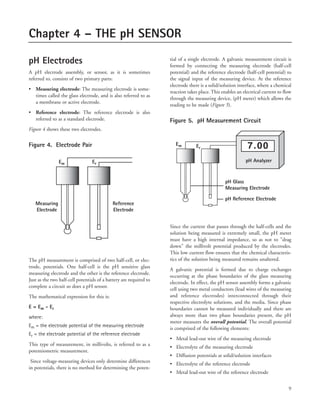
The measuring and reference electrodes can be in one of two
forms: two physically separate electrodes, known as an electrode
pair; or the electrodes can be joined together in a single glass
body assembly known as a combination electrode (Figure 6).
Figure 6. Combination Electrode
The electrode pair and combination electrode styles origi-
nated many years ago and continue to be widely used today.
In the 1970’s a different style pH sensor was specifically
developed (and patented) for continuous on-line measure-
ment applications. This pH sensor uses a differential
electrode technique (Figure 7) which employs two pH glass
measuring electrodes. One electrode is used as the active or
measuring electrode, and the other is used as part of a refer-
ence assembly. The reference assembly consists of a pH glass
measuring electrode immersed in a 7 pH buffer solution
which is mechanically isolated from the solution being meas-
ured by a double junction "salt bridge" (see "The Reference
Junction" subsection on page 14 for details). These two half-
cell potentials are then referenced to a third ground electrode.
The differential electrode technique is expressed as:
Eout = [(Em - Eg) - (Er - Eg)]
where:
Em = measuring electrode voltage
Er = reference electrode assembly voltage
Eg = solution ground electrode voltage
After canceling the Eg term:
Eout = Em - Er
Figure 7. Differential Electrode Measurement
Technique
Other major components of the differential pH sensor
include the sensor cable, a temperature compensation
device, electrolyte solutions, and reference junctions.
Based on field-proven results, the differential electrode tech-
nique has shown marked advantages over conventional
electrode pairs and combination electrodes. The double
junction salt bridge (part of the reference assembly) makes it
extremely difficult for an appreciable amount of the solution
being measured to migrate into the inner chamber. Since the
inner chamber is filled with a buffer, a 100 to 1 dilution
would only represent a change in measured pH of 0.05 pH
units. Similar dilutions to the conventional reference elec-
trode used in electrode pairs or combination electrodes
could cause shifts of up to 2.0 pH units.
Another advantage of the differential electrode technique is
the third "ground electrode." Since ground loop currents
will pass through only this electrode, and not through the
reference electrode, the overall pH signal output is unaf-
fected by the ground loop potential.
Measuring
Electrode (Em)
Reference
Electrode (Er)
Salt Bridge
(Junction)
Measuring
Electrode
Reference
Electrode
Assembly
Salt
Bridge
Solution
Ground
Electrode
Temperature
Compensator
Preamplifier
(Em – Eg)
-(Er – Eg)
(Em – Er)](https://image.slidesharecdn.com/phtechnicalhandbook-140721060230-phpapp01/85/P-h-technical-handbook-10-320.jpg)






This document provides an overview of pH and how it is measured. It discusses key topics such as: - pH is a measure of hydrogen ion concentration in a solution on a scale from 0 to 14, with 7 being neutral. - pH is defined as the negative logarithm of the hydrogen ion concentration and represents a 10-fold change in concentration for each unit change in pH. - pH is measured using a pH electrode and meter, with glass electrodes being the most common. The electrode responds to hydrogen ion activity. - Factors like temperature, ionic strength, and reference junctions must be accounted for to ensure accurate pH measurement.


