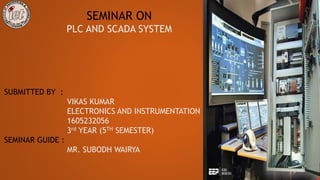
SEMINAR ON
PLC AND SCADA SYSTEM
SUBMITTED BY :
VIKAS KUMAR
ELECTRONICS AND INSTRUMENTATION
1605232056
3rd YEAR (5TH SEMESTER)
SEMINAR GUIDE :
MR. SUBODH WAIRYA
Contents
Abstract
What is PLC?
History of PLC
Block diagram of PLC
Operational sequence of PLC
Ladder logic
Example of starting and stopping of a motor
SCADA
What is the purpose of SCADA
Composition of SCADA system
Advantages
Disadvantages
Application
Conclusion
ABSTRACT
 Normally open and closed contacts.
 Relays and their relationship to ladder logic.
 PLC outputs can be inputs, as shown by the seal in
circuit.
 Programming can be done with ladder logic, mnemonics,
SFCs, and structured text.
 There are multiple ways to write a PLC program.
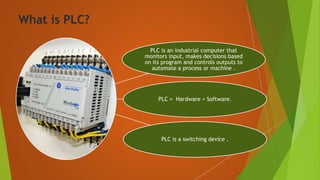
What is PLC?
PLC is an industrial computer that
monitors input, makes decisions based
on its program and controls outputs to
automate a process or machine .
PLC = Hardware + Software.
PLC is a switching device .
History of plc
 PLC was introduced in late 1960’s
 First commercial & successful Programmable Logic
Controllers was designed and developed by Modicon as a
relay replacer for General Motors.
 Earlier, it was a machine with thousands of electronic
parts.
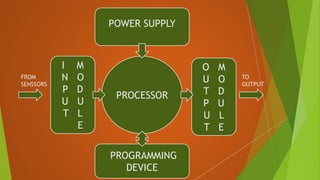
POWER SUPPLY
I M
N O
P D
U U
T L
E
O M
U O
T D
P U
U L
T E
PROGRAMMING
DEVICE
PROCESSOR
FROM
SENSSORS
TO
OUTPUT
Major Components of a Common PLC
POWER SUPPLY
 Provides the voltage needed to run the primary PLC
components
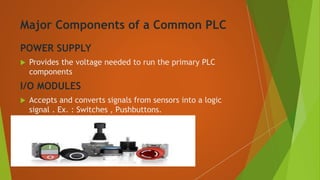
I/O MODULES
 Accepts and converts signals from sensors into a logic
signal . Ex. : Switches , Pushbuttons.
PROGRAMMING DEVICES
 The programming terminal is used for programming the
PLC and monitoring/sequencing PLCs operation .
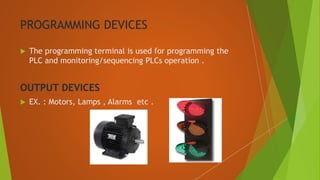
OUTPUT DEVICES
 EX. : Motors, Lamps , Alarms etc .
Programming Languages of PLC
 Most common languages encountered in PLC programming
are:
 1) Ladder Logic
 2) Functional Block Diagram
 3) Sequential Function Chart
 4) Boolean mnemonics
LADDER LOGIC

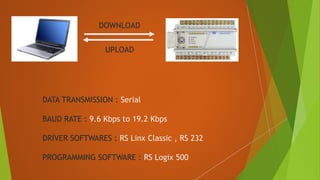
DOWNLOAD
UPLOAD
DATA TRANSMISSION : Serial
BAUD RATE : 9.6 Kbps to 19.2 Kbps
DRIVER SOFTWARES : RS Linx Classic , RS 232
PROGRAMMING SOFTWARE : RS Logix 500
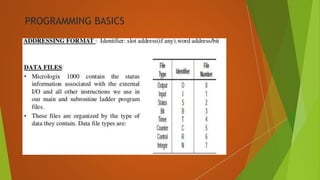
PROGRAMMING BASICS
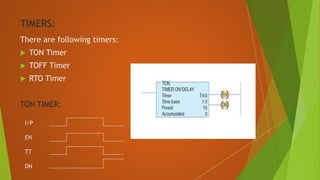
TIMERS:
There are following timers:
 TON Timer
 TOFF Timer
 RTO Timer
TON TIMER:
I/P
EN
TT
DN
COUNTERS
There are following counters present :
 Up Counter (CUP)
 Down Counter (CDOWN)
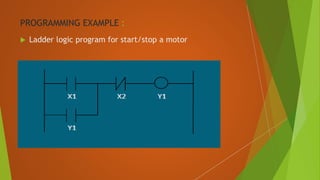
PROGRAMMING EXAMPLE :
 Ladder logic program for start/stop a motor
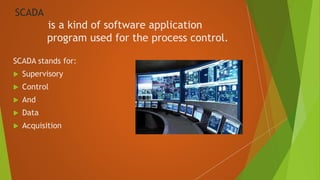
SCADA
is a kind of software application
program used for the process control.
SCADA stands for:
 Supervisory
 Control
 And
 Data
 Acquisition
What is the purpose of SCADA
The primary purpose of SCADA is:
 to monitor
 to control
 Alarming functions
 Data presentation
 Data acquisition
COMPOSITION
 Input/output signal hardware
 Network
 Human Machine Interface (HMI)
 Controllers
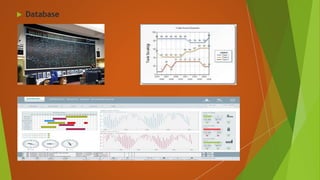
 Database
ADVANTAGES OF PLC
 Very fast
 Easy to change logic i.e. flexibility
 Reliable due to absence of moving parts
 Low power consumption
 Easy maintenance
 Facilities in fault finding and diagnostic
 Capable of handling of very complicated logic operations
 Ease operator interface
DISADVANTAGE OF PLC
 Initial costs are high
 Unemployment rate increases
ADVANTAGES OF SCADA
 Reduce time consumption
 Reduce human resource consumption
 Increase product/project revenue
 Greater accessibility (remotely)
 More security (implementation of user access
levels)
 Instantaneous alert on alarms or events
 Organized data records and report generation
automatically
 Data analysis (real-time and historical data
plotting of graphs, charts, trends, etc.)
 Automated calculation
APPLICATION OF SACADA SYSTEM
 Water and sewage treatment plants and supply
management
 Traffic controls
 Lift and Elevator controls
 Manufacturing Industries or plants
 Electric power system, operation and control
 Automatic car washing system
CONCLUSION
 With the development of a PLC and SCADA system ,it will
significantly reduce the labor cost and improves the
performance of plant in manufacturing industry.
 It has the capability of displaying the trends. Where
information gathered is displayed graphically , the system
shows the developing problems and help the management
in taking the corrective measures.
THANK YOU

Plc and scada presentation

  • 1.
    SEMINAR ON PLC ANDSCADA SYSTEM SUBMITTED BY : VIKAS KUMAR ELECTRONICS AND INSTRUMENTATION 1605232056 3rd YEAR (5TH SEMESTER) SEMINAR GUIDE : MR. SUBODH WAIRYA
  • 2.
    Contents Abstract What is PLC? Historyof PLC Block diagram of PLC Operational sequence of PLC Ladder logic Example of starting and stopping of a motor SCADA What is the purpose of SCADA Composition of SCADA system Advantages Disadvantages Application Conclusion
  • 3.
    ABSTRACT  Normally openand closed contacts.  Relays and their relationship to ladder logic.  PLC outputs can be inputs, as shown by the seal in circuit.  Programming can be done with ladder logic, mnemonics, SFCs, and structured text.  There are multiple ways to write a PLC program.
  • 4.
    What is PLC? PLCis an industrial computer that monitors input, makes decisions based on its program and controls outputs to automate a process or machine . PLC = Hardware + Software. PLC is a switching device .
  • 5.
    History of plc PLC was introduced in late 1960’s  First commercial & successful Programmable Logic Controllers was designed and developed by Modicon as a relay replacer for General Motors.  Earlier, it was a machine with thousands of electronic parts.
  • 6.
    POWER SUPPLY I M NO P D U U T L E O M U O T D P U U L T E PROGRAMMING DEVICE PROCESSOR FROM SENSSORS TO OUTPUT
  • 7.
    Major Components ofa Common PLC POWER SUPPLY  Provides the voltage needed to run the primary PLC components I/O MODULES  Accepts and converts signals from sensors into a logic signal . Ex. : Switches , Pushbuttons.
  • 8.
    PROGRAMMING DEVICES  Theprogramming terminal is used for programming the PLC and monitoring/sequencing PLCs operation . OUTPUT DEVICES  EX. : Motors, Lamps , Alarms etc .
  • 9.
    Programming Languages ofPLC  Most common languages encountered in PLC programming are:  1) Ladder Logic  2) Functional Block Diagram  3) Sequential Function Chart  4) Boolean mnemonics
  • 10.
  • 11.
    DOWNLOAD UPLOAD DATA TRANSMISSION :Serial BAUD RATE : 9.6 Kbps to 19.2 Kbps DRIVER SOFTWARES : RS Linx Classic , RS 232 PROGRAMMING SOFTWARE : RS Logix 500
  • 12.
  • 13.
    TIMERS: There are followingtimers:  TON Timer  TOFF Timer  RTO Timer TON TIMER: I/P EN TT DN
  • 14.
    COUNTERS There are followingcounters present :  Up Counter (CUP)  Down Counter (CDOWN)
  • 15.
    PROGRAMMING EXAMPLE : Ladder logic program for start/stop a motor
  • 17.
    SCADA is a kindof software application program used for the process control. SCADA stands for:  Supervisory  Control  And  Data  Acquisition
  • 18.
    What is thepurpose of SCADA The primary purpose of SCADA is:  to monitor  to control  Alarming functions  Data presentation  Data acquisition
  • 19.
  • 20.
     Human MachineInterface (HMI)  Controllers
  • 21.
  • 22.
    ADVANTAGES OF PLC Very fast  Easy to change logic i.e. flexibility  Reliable due to absence of moving parts  Low power consumption  Easy maintenance  Facilities in fault finding and diagnostic  Capable of handling of very complicated logic operations  Ease operator interface DISADVANTAGE OF PLC  Initial costs are high  Unemployment rate increases
  • 23.
    ADVANTAGES OF SCADA Reduce time consumption  Reduce human resource consumption  Increase product/project revenue  Greater accessibility (remotely)  More security (implementation of user access levels)  Instantaneous alert on alarms or events  Organized data records and report generation automatically  Data analysis (real-time and historical data plotting of graphs, charts, trends, etc.)  Automated calculation
  • 24.
    APPLICATION OF SACADASYSTEM  Water and sewage treatment plants and supply management  Traffic controls  Lift and Elevator controls  Manufacturing Industries or plants  Electric power system, operation and control  Automatic car washing system
  • 25.
    CONCLUSION  With thedevelopment of a PLC and SCADA system ,it will significantly reduce the labor cost and improves the performance of plant in manufacturing industry.  It has the capability of displaying the trends. Where information gathered is displayed graphically , the system shows the developing problems and help the management in taking the corrective measures.
  • 26.