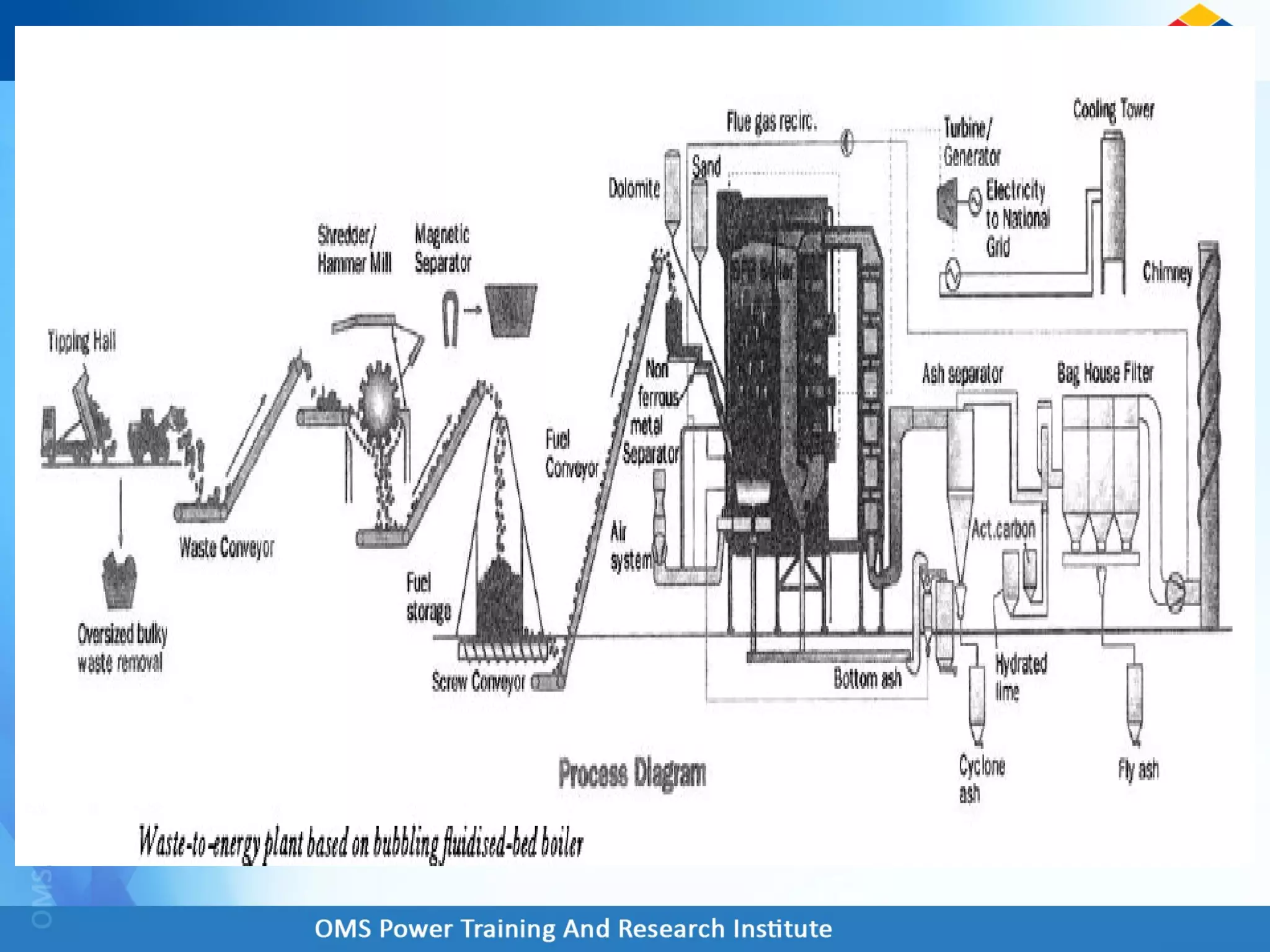
C&I of Power Plant
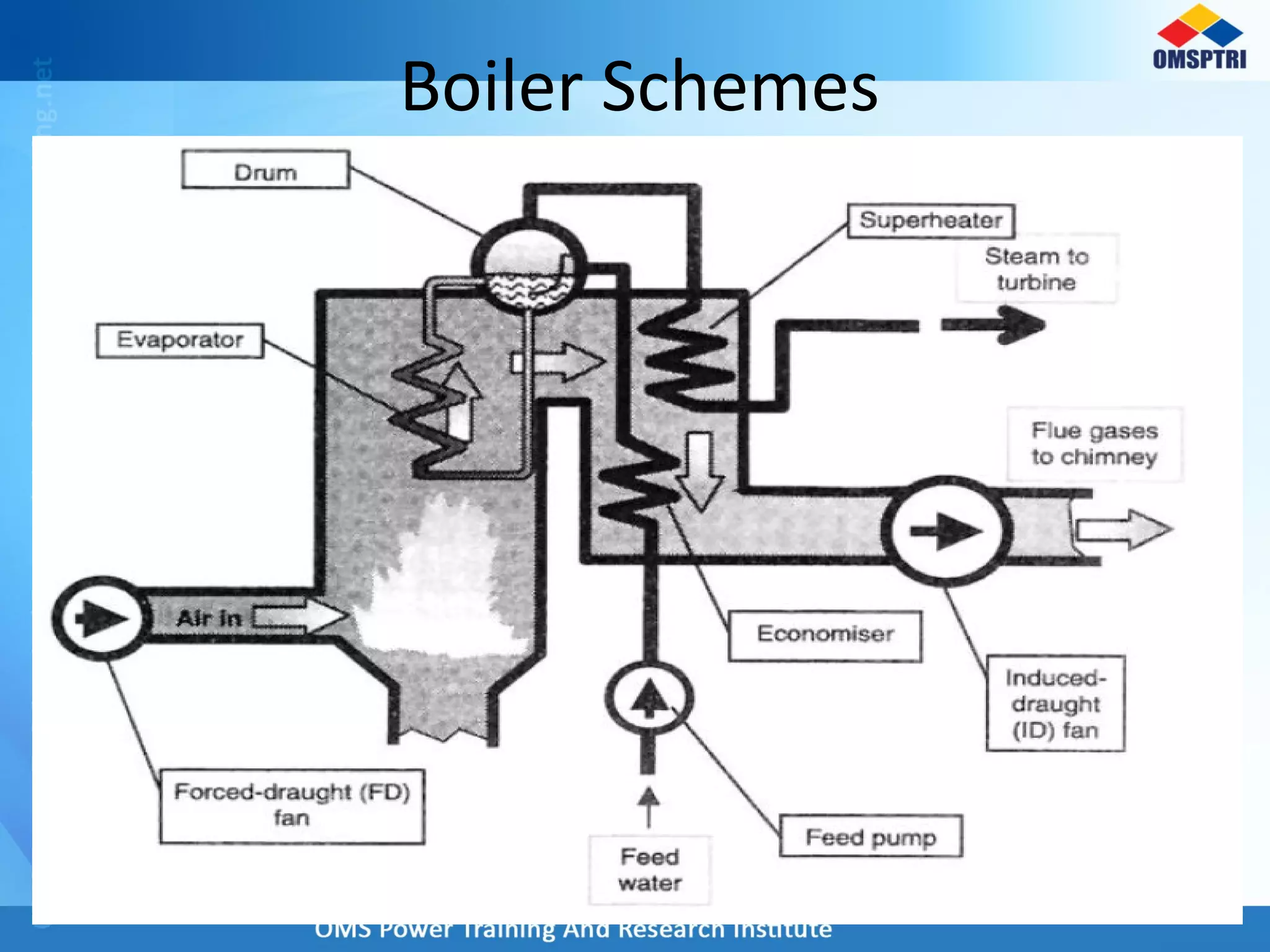
Boiler Schemes
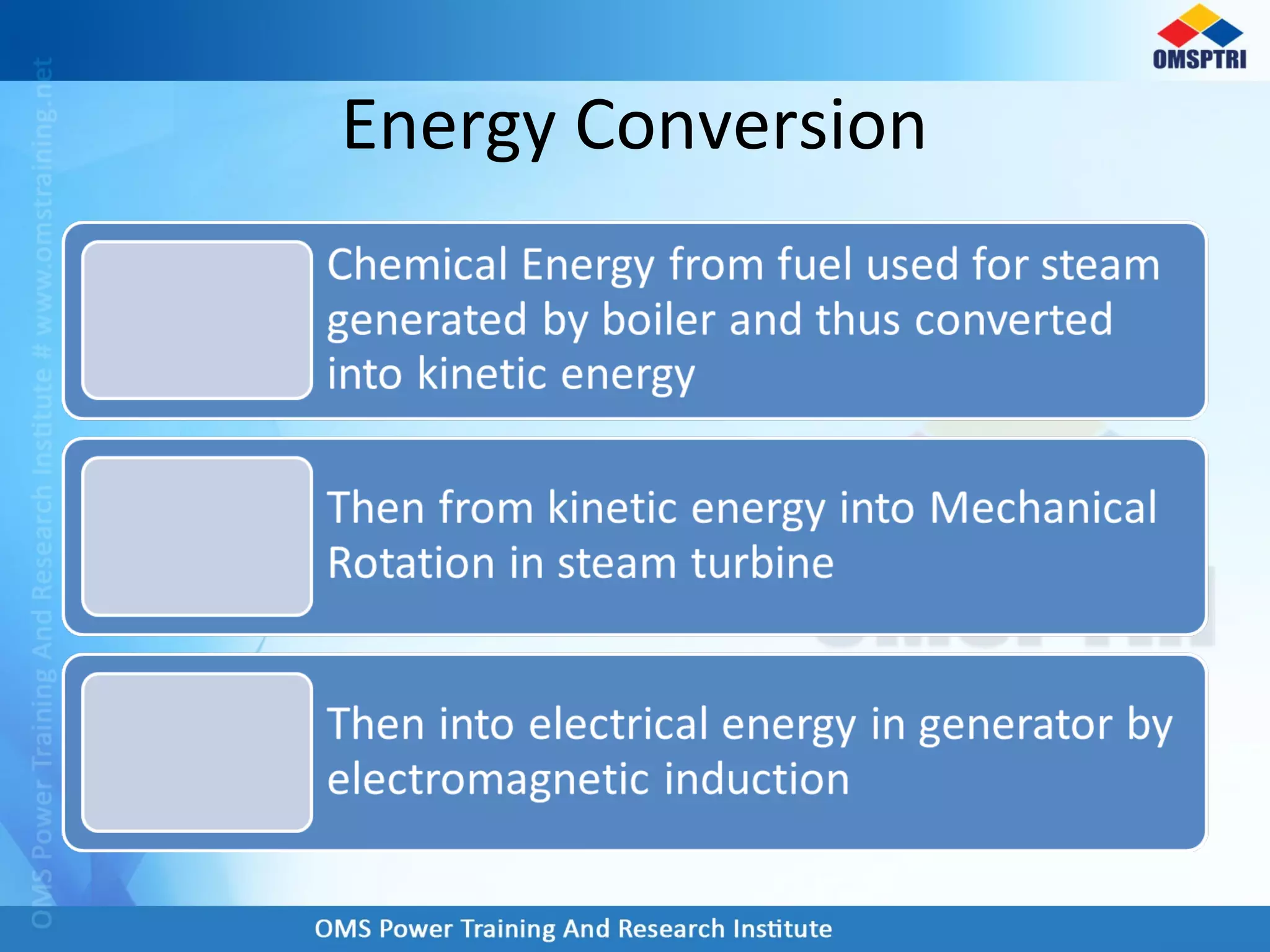
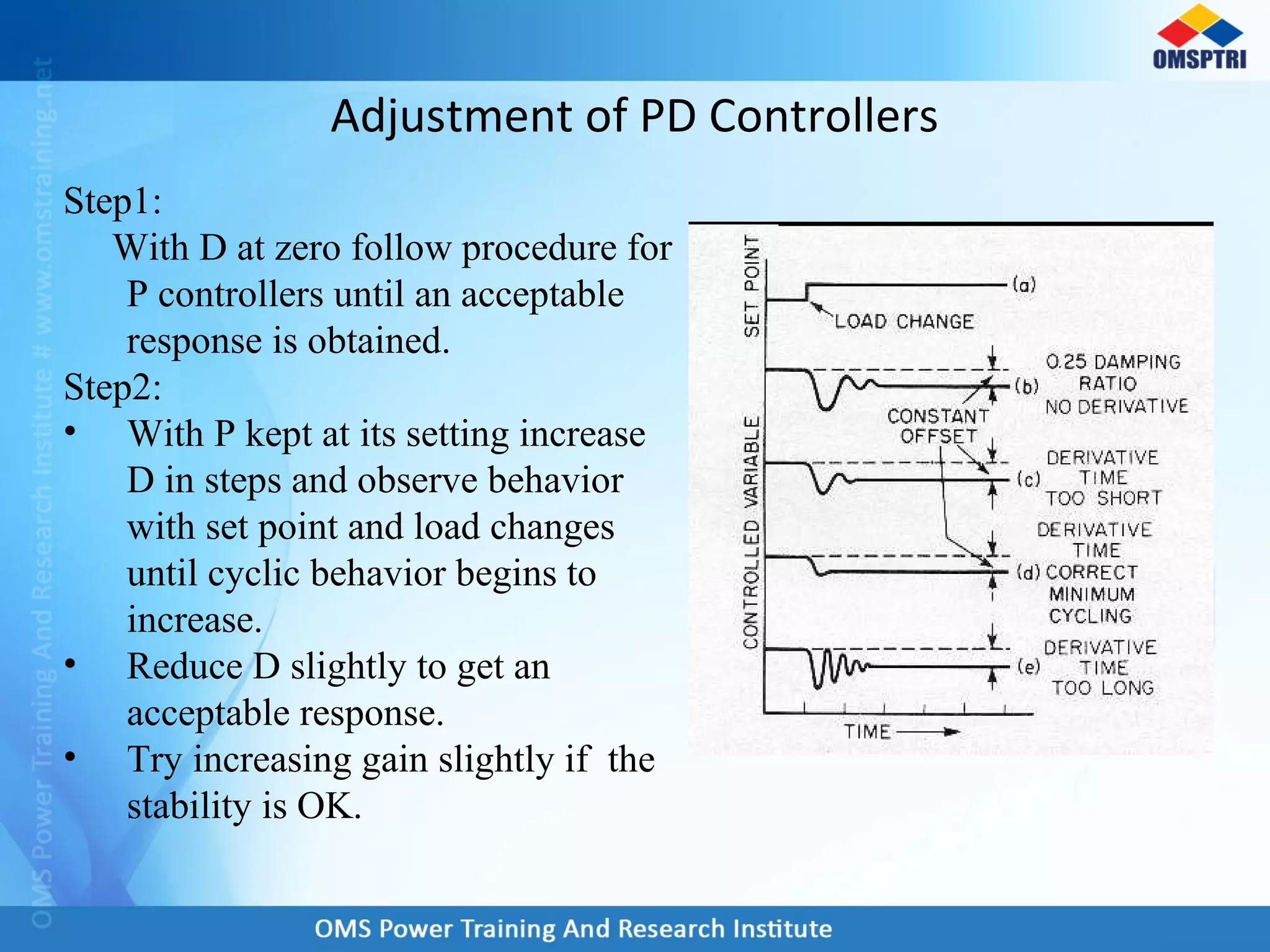
Energy Conversion
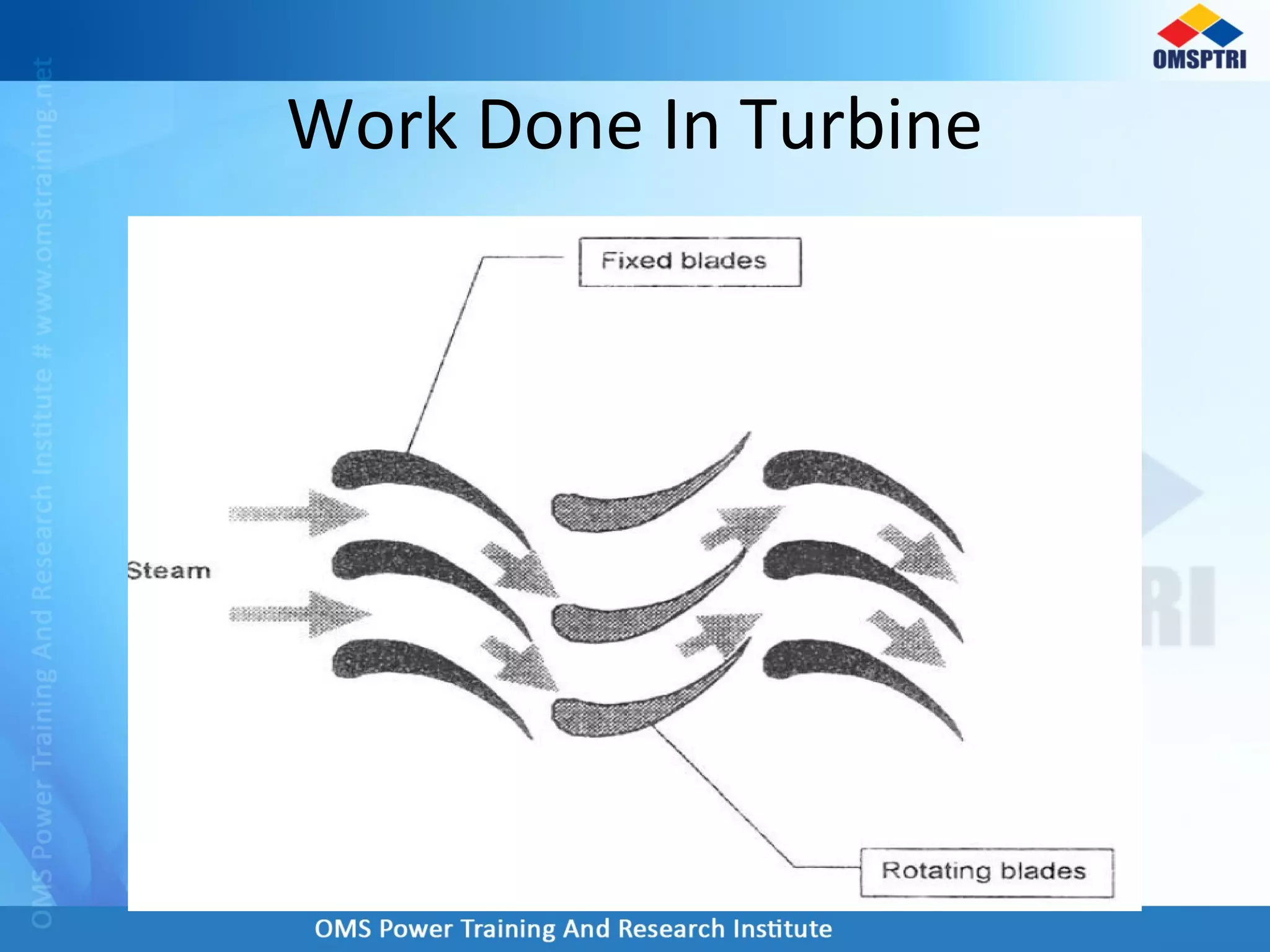
Work Done In Turbine
The heat Energy in the steam is converted first to kinetic energy as it
enters the Machine through nozzles, and then this kinetic energy is
converted to Mechanical work as it impinges onto the rotating blades.
•Further work is Done by the reaction of the steam leaving these blades
when it encounters Another set of fixed blades, which in turn redirect it
onto yet another set of Rotating blades.
•As the steam travels through the machine in this way it Continually
expands, giving up some of its energy at each ring of blades.
•The moment of rotation applied to the shaft at any one ring of blades is
the Multiple of the force applied to the blades and mean distance of the
force.
•Since each stage of rings abstracts energy from the steam, the force
applied At the subsequent stage is less than it was at the preceding ring
and, therefore, to ensure that a constant moment is applied to the shaft
at each stage, the length of the blades in all rings after the first is made
longer than that of the preceding ring.
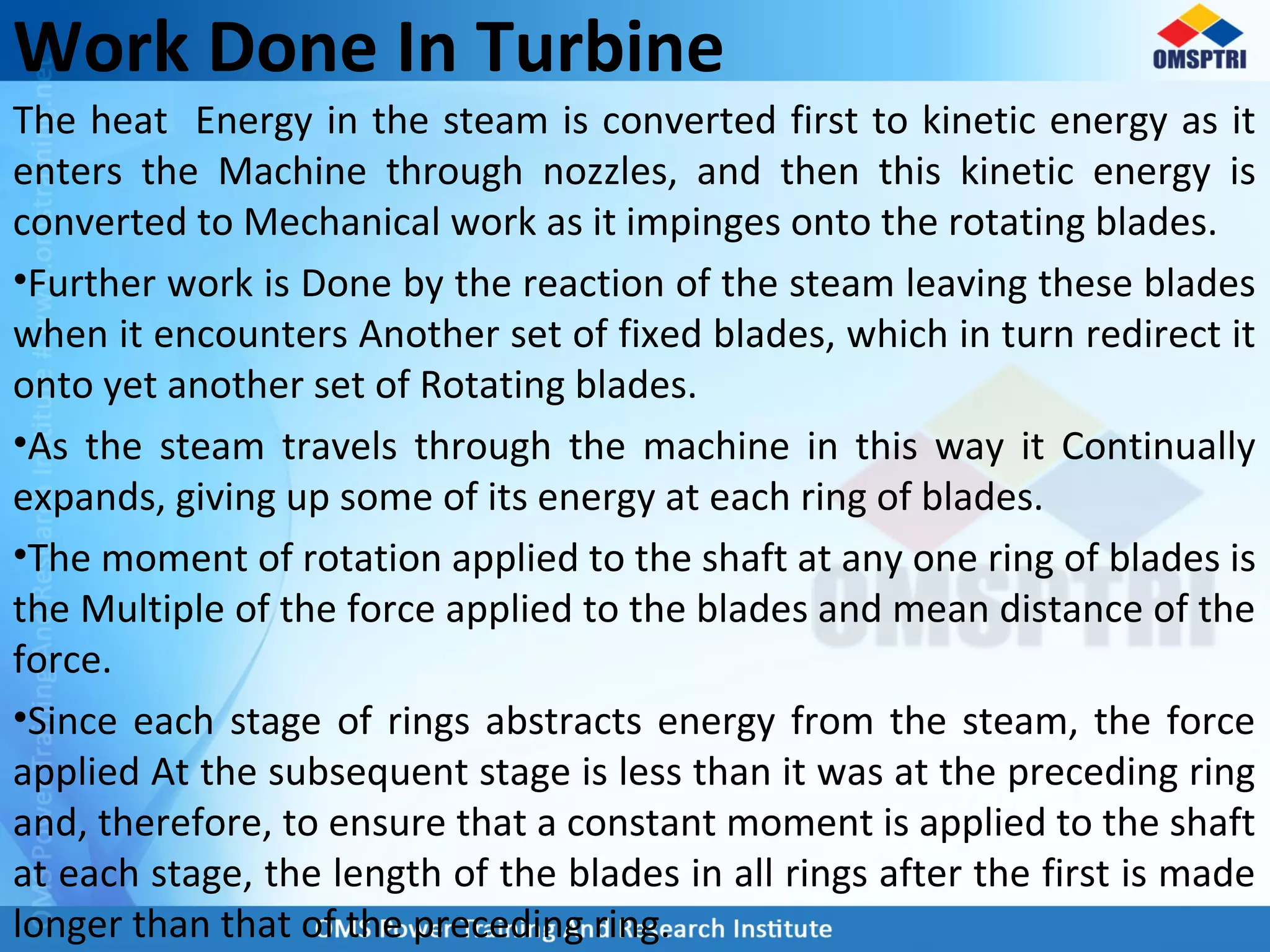
Work Done In Turbine
• This gives the turbine its
characteristic tapering
shape.
• The steam enters the
machine at the set of
blades with the smallest
diameter and leaves it
after the set of blades
with the largest
diameter.
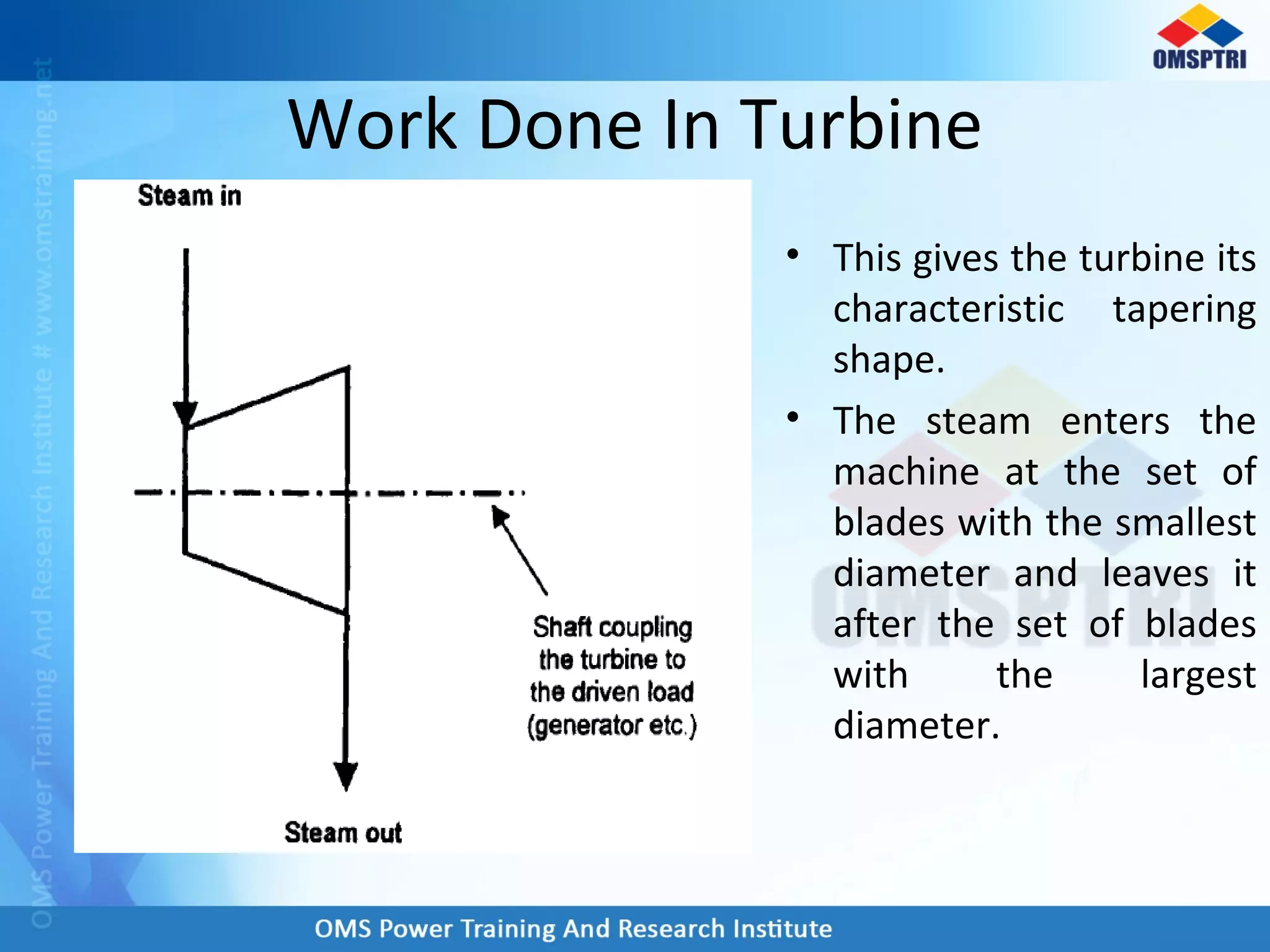
The huge cooling towers condense steam back into water. Some of the
steam escapes, creating huge clouds above the cooling towers.
Things that we commonly measure are:
•Temperature ,Pressure
•Speed, Flow rate
•Force Movement, Velocity and Acceleration
•Stress and Strain Level or Depth
•Mass or Weight Density
•Size or Volume Acidity/Alkalinity
Sensors may operate simple on/off switches to detect the following:
•Objects(Proximity switch) Empty or full (level switch)
•Hot or cold (thermostat) Pressure high or low (pressure switch)
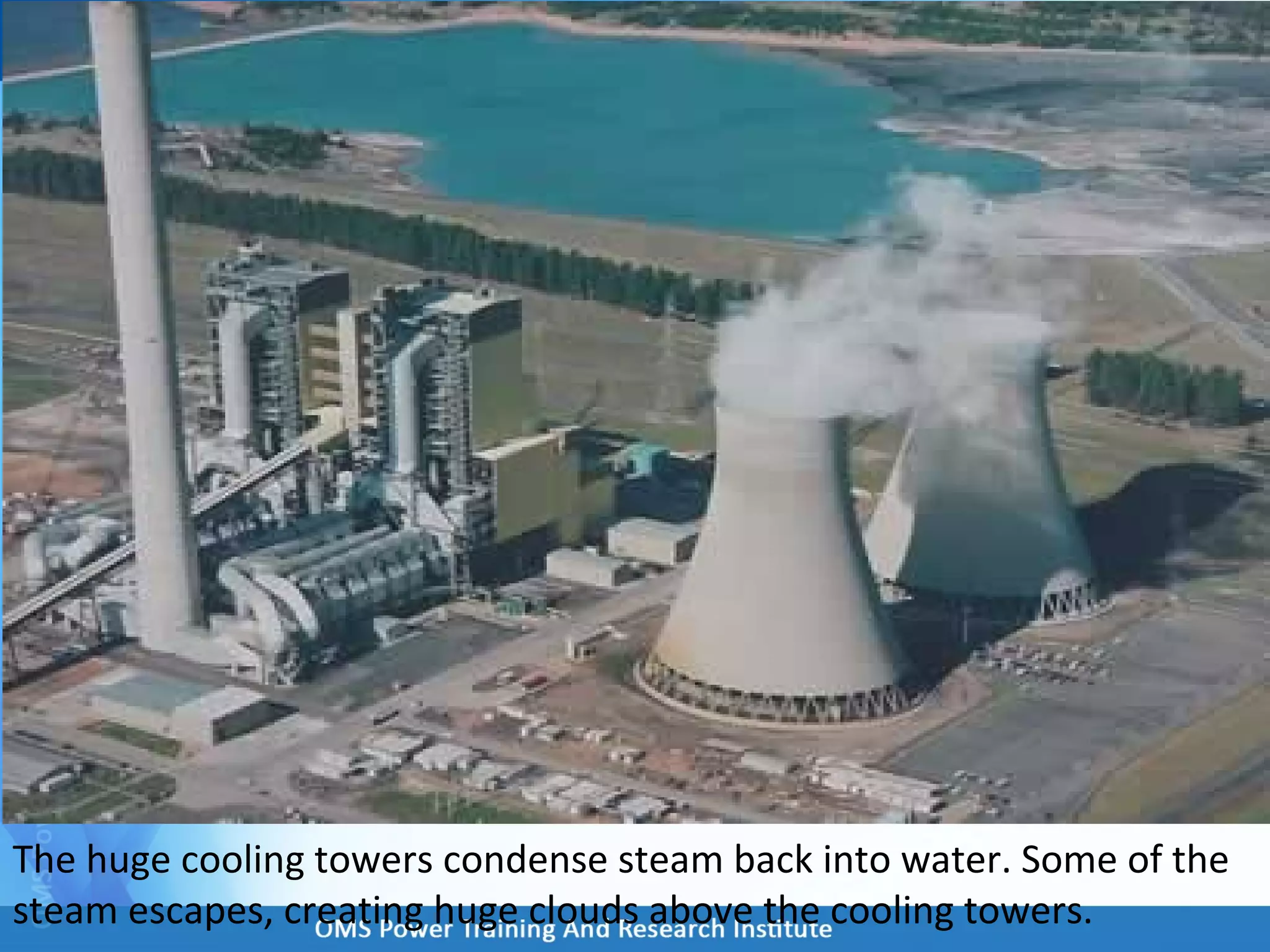
The block diagram of a sensor is shown below.
A successful Process Control Engineer has to
know something about the following subjects
• Electrical Engineering
• Electronic Engineering
• Computers
• Hydraulics
• Pneumatics
• Plumbing
• Physics
• Chemistry
• Finance
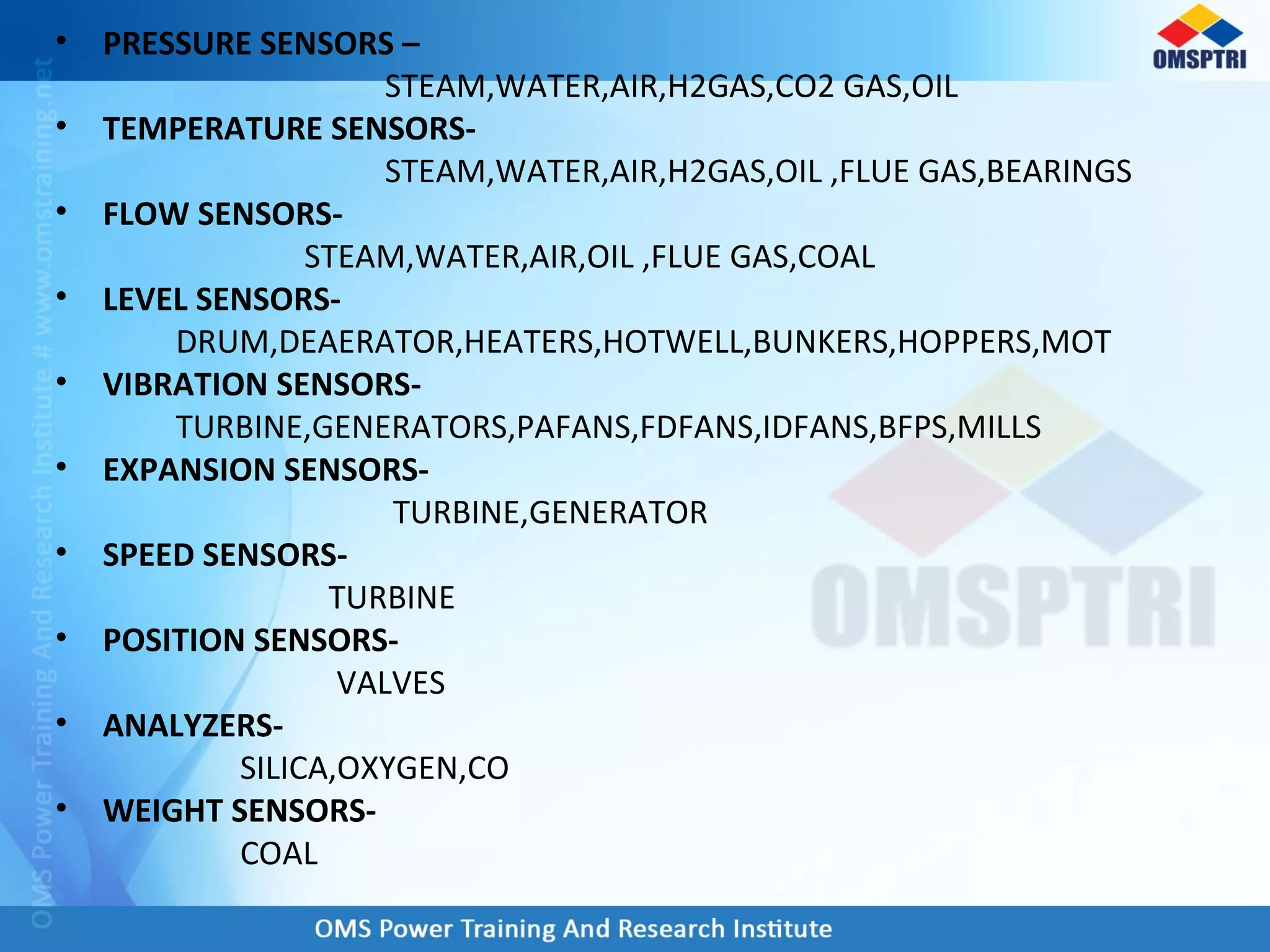
• PRESSURE SENSORS –
STEAM,WATER,AIR,H2GAS,CO2 GAS,OIL
• TEMPERATURE SENSORS-
STEAM,WATER,AIR,H2GAS,OIL ,FLUE GAS,BEARINGS
• FLOW SENSORS-
STEAM,WATER,AIR,OIL ,FLUE GAS,COAL
• LEVEL SENSORS-
DRUM,DEAERATOR,HEATERS,HOTWELL,BUNKERS,HOPPERS,MOT
• VIBRATION SENSORS-
TURBINE,GENERATORS,PAFANS,FDFANS,IDFANS,BFPS,MILLS
• EXPANSION SENSORS-
TURBINE,GENERATOR
• SPEED SENSORS-
TURBINE
• POSITION SENSORS-
VALVES
• ANALYZERS-
SILICA,OXYGEN,CO
• WEIGHT SENSORS-
COAL
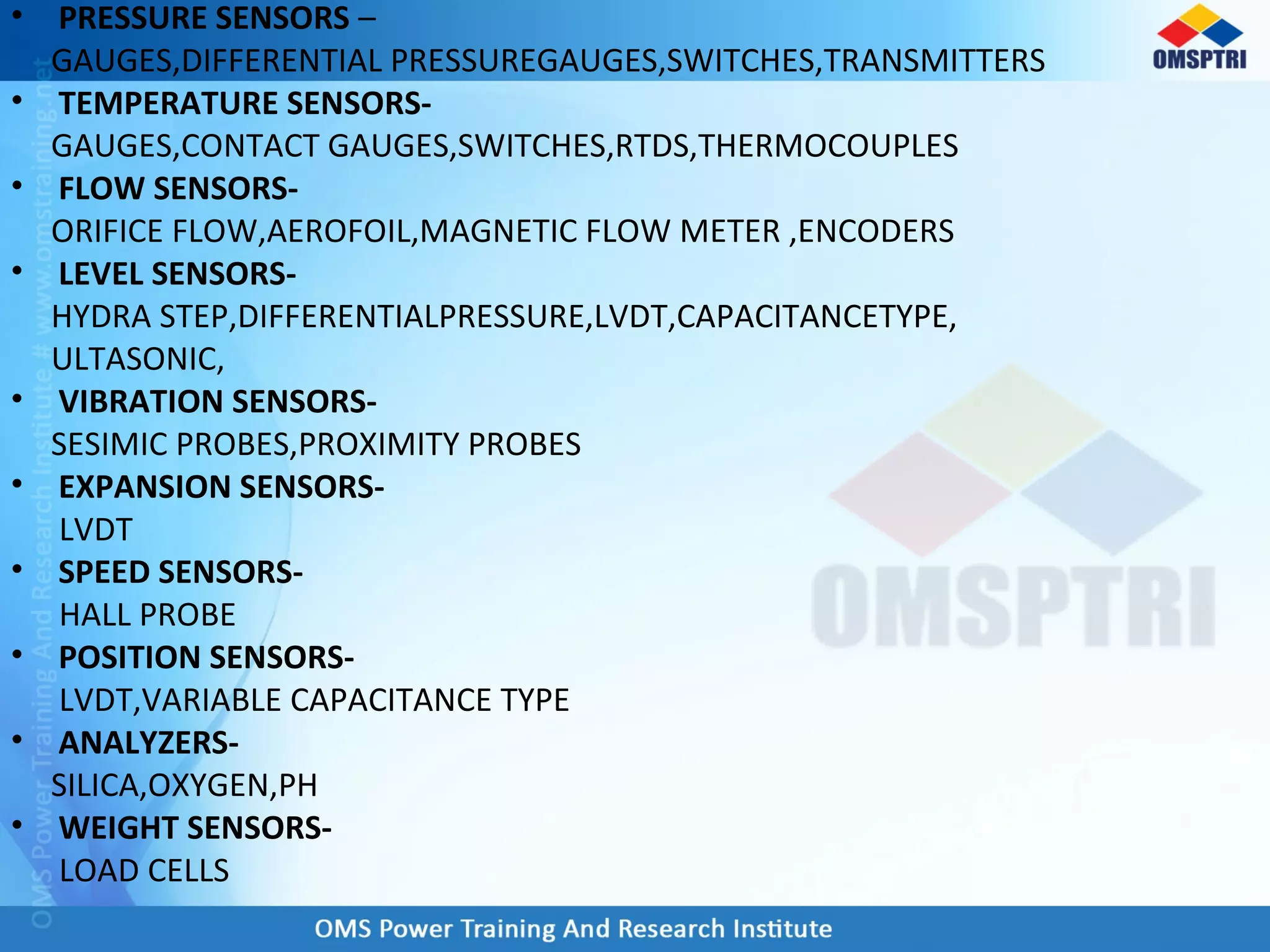
• PRESSURE SENSORS –
GAUGES,DIFFERENTIAL PRESSUREGAUGES,SWITCHES,TRANSMITTERS
• TEMPERATURE SENSORS-
GAUGES,CONTACT GAUGES,SWITCHES,RTDS,THERMOCOUPLES
• FLOW SENSORS-
ORIFICE FLOW,AEROFOIL,MAGNETIC FLOW METER ,ENCODERS
• LEVEL SENSORS-
HYDRA STEP,DIFFERENTIALPRESSURE,LVDT,CAPACITANCETYPE,
ULTASONIC,
• VIBRATION SENSORS-
SESIMIC PROBES,PROXIMITY PROBES
• EXPANSION SENSORS-
LVDT
• SPEED SENSORS-
HALL PROBE
• POSITION SENSORS-
LVDT,VARIABLE CAPACITANCE TYPE
• ANALYZERS-
SILICA,OXYGEN,PH
• WEIGHT SENSORS-
LOAD CELLS
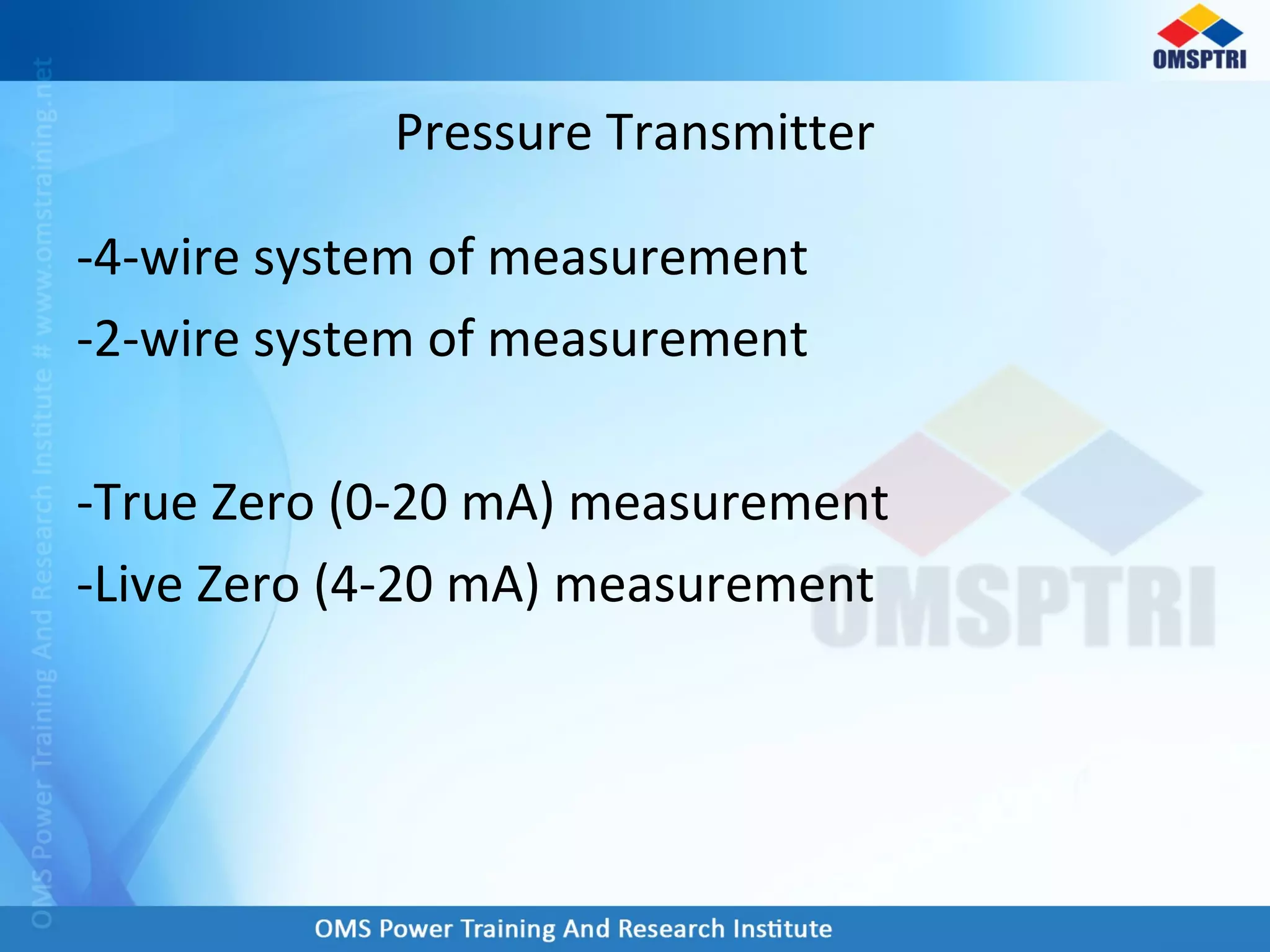
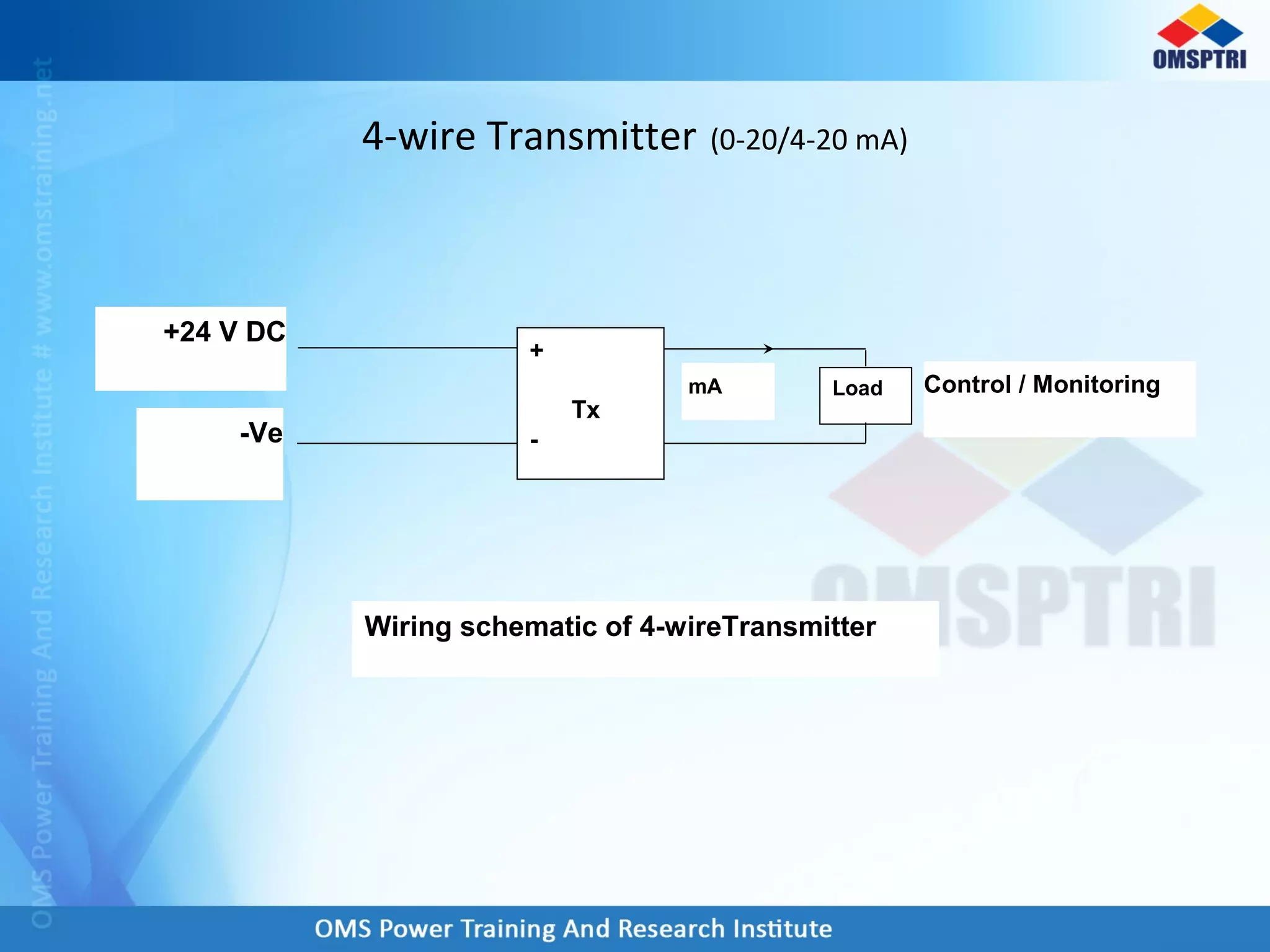
-4-wire system of measurement
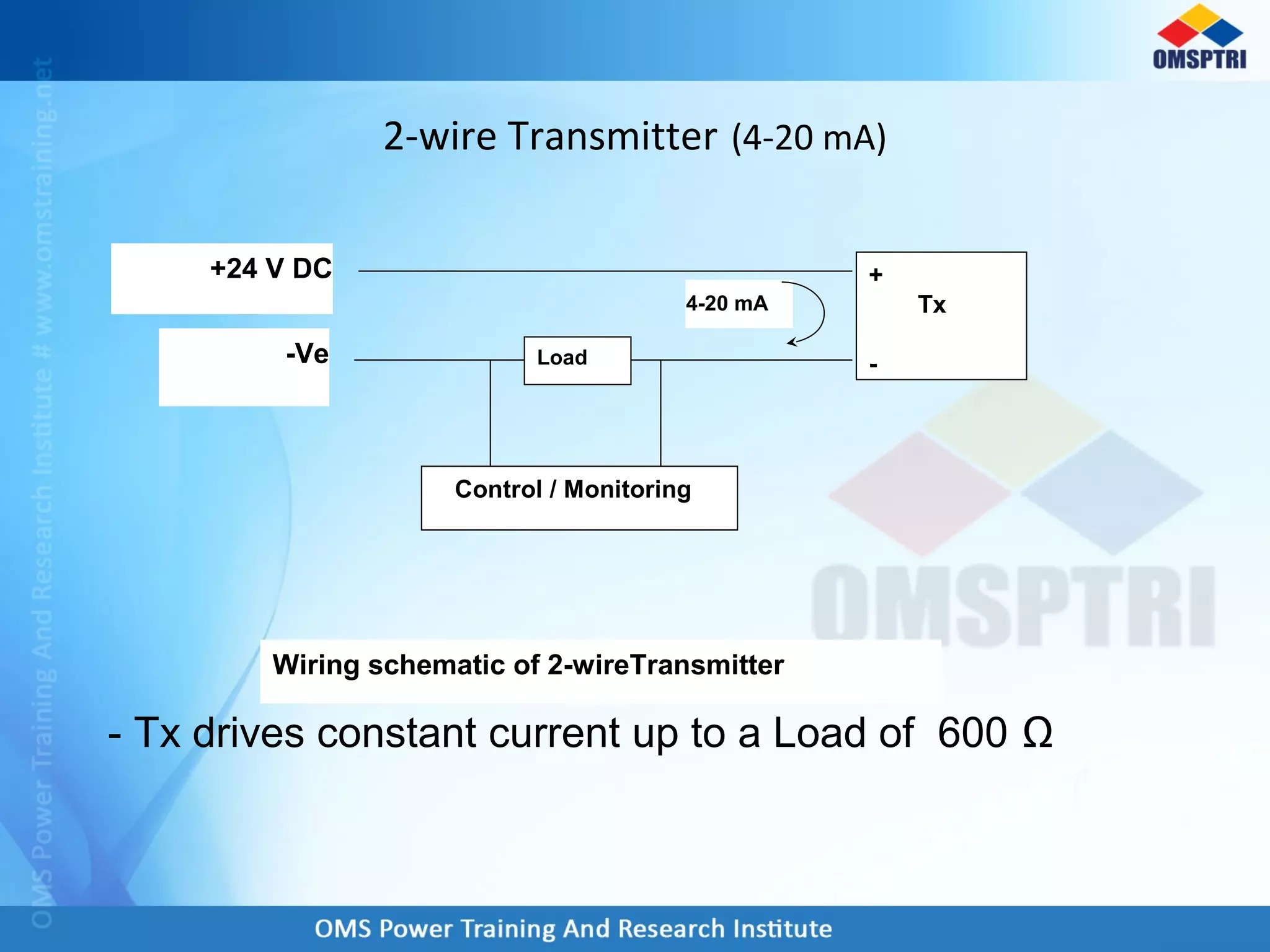
-2-wire system of measurement
-True Zero (0-20 mA) measurement
-Live Zero (4-20 mA) measurement
Pressure Transmitter
4-wire Transmitter (0-20/4-20 mA)
+
Tx
-
Load Control / MonitoringmA
Wiring schematic of 4-wireTransmitter
+24 V DC
-Ve
2-wire Transmitter (4-20 mA)
+
Tx
-Load
Control / Monitoring
4-20 mA
Wiring schematic of 2-wireTransmitter
+24 V DC
-Ve
- Tx drives constant current up to a Load of 600 Ω
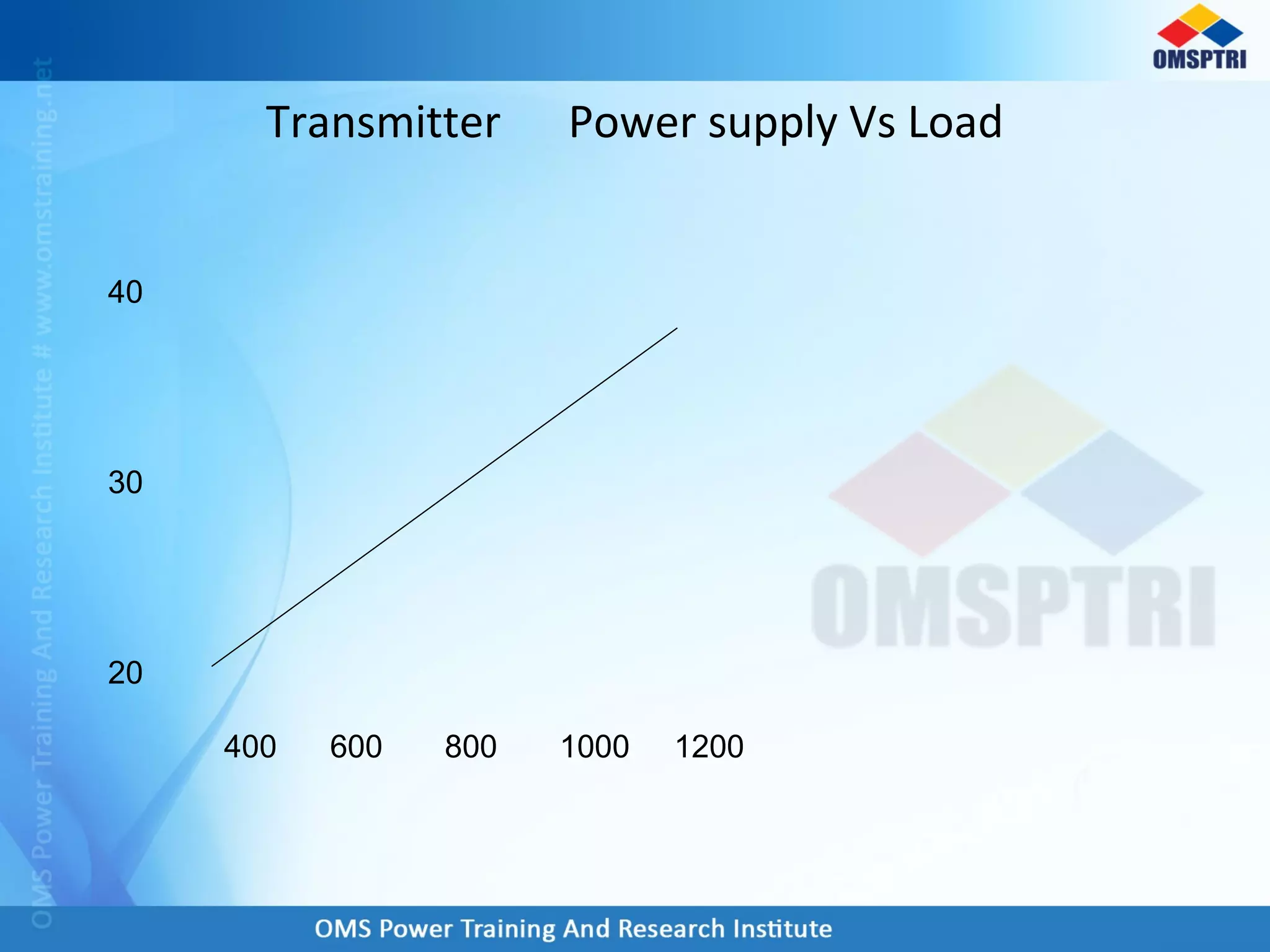
Transmitter Power supply Vs Load
400 600 800 1000 1200
40
30
20
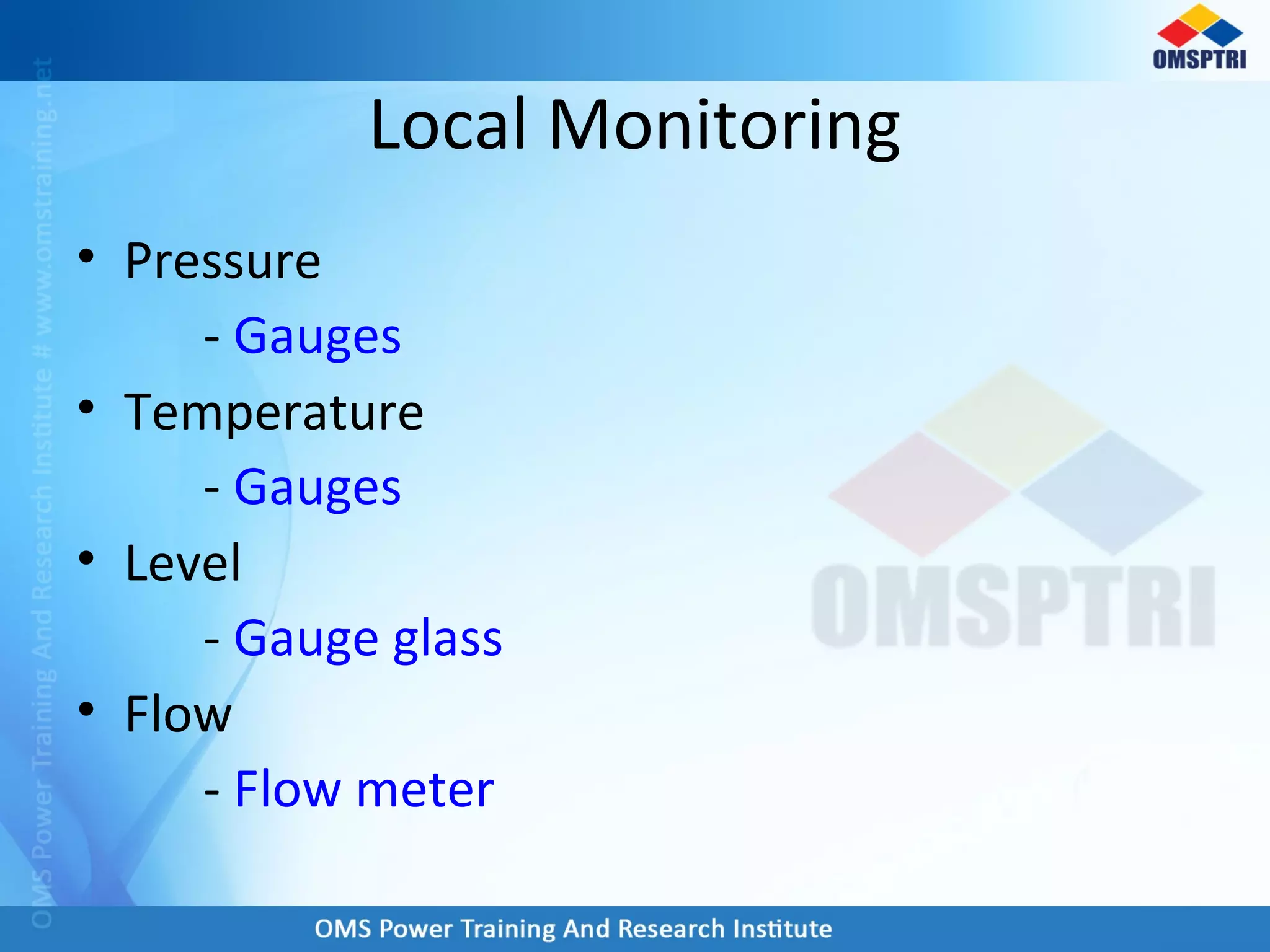
• Pressure
- Gauges
• Temperature
- Gauges
• Level
- Gauge glass
• Flow
- Flow meter
Local Monitoring
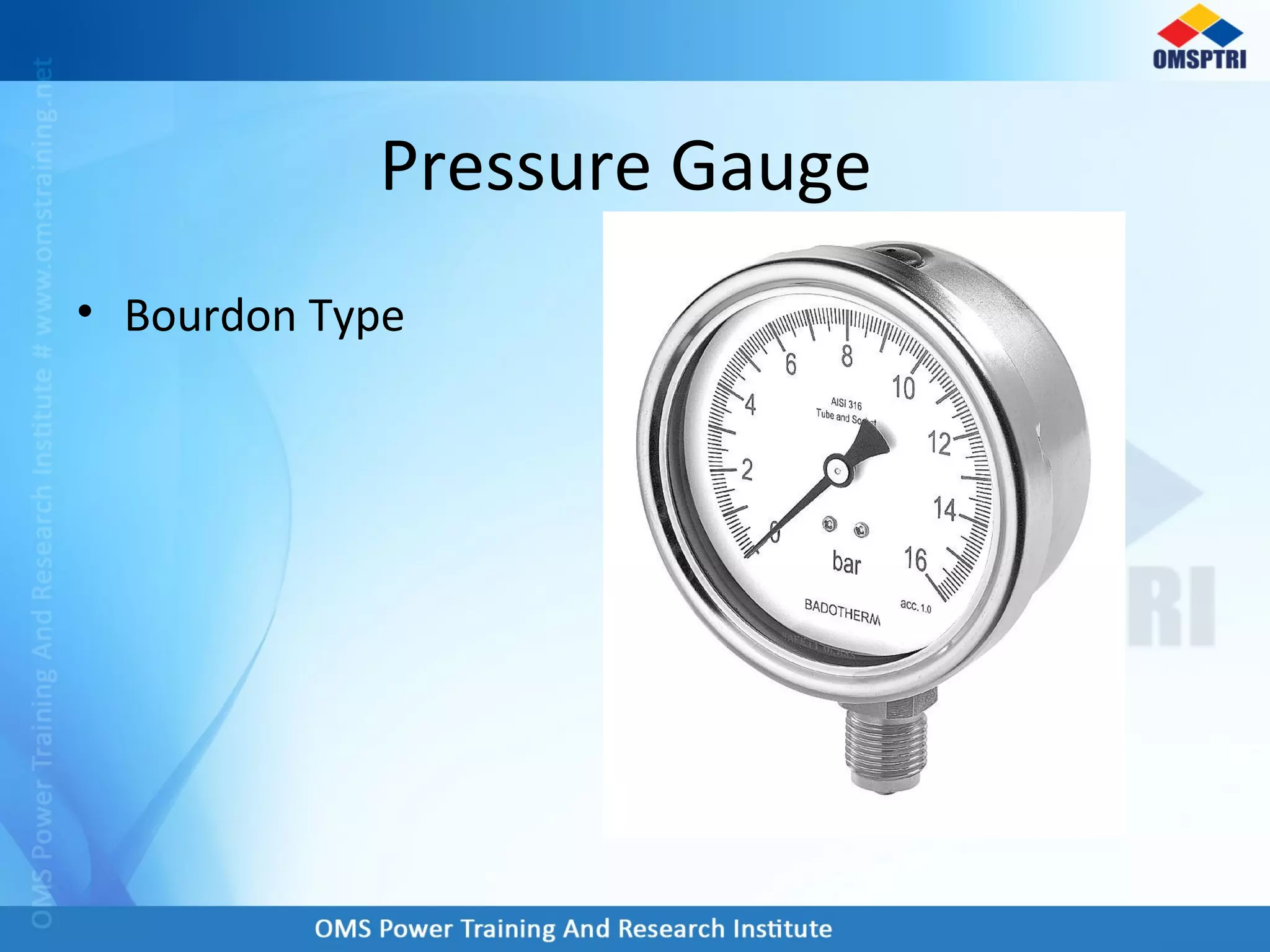
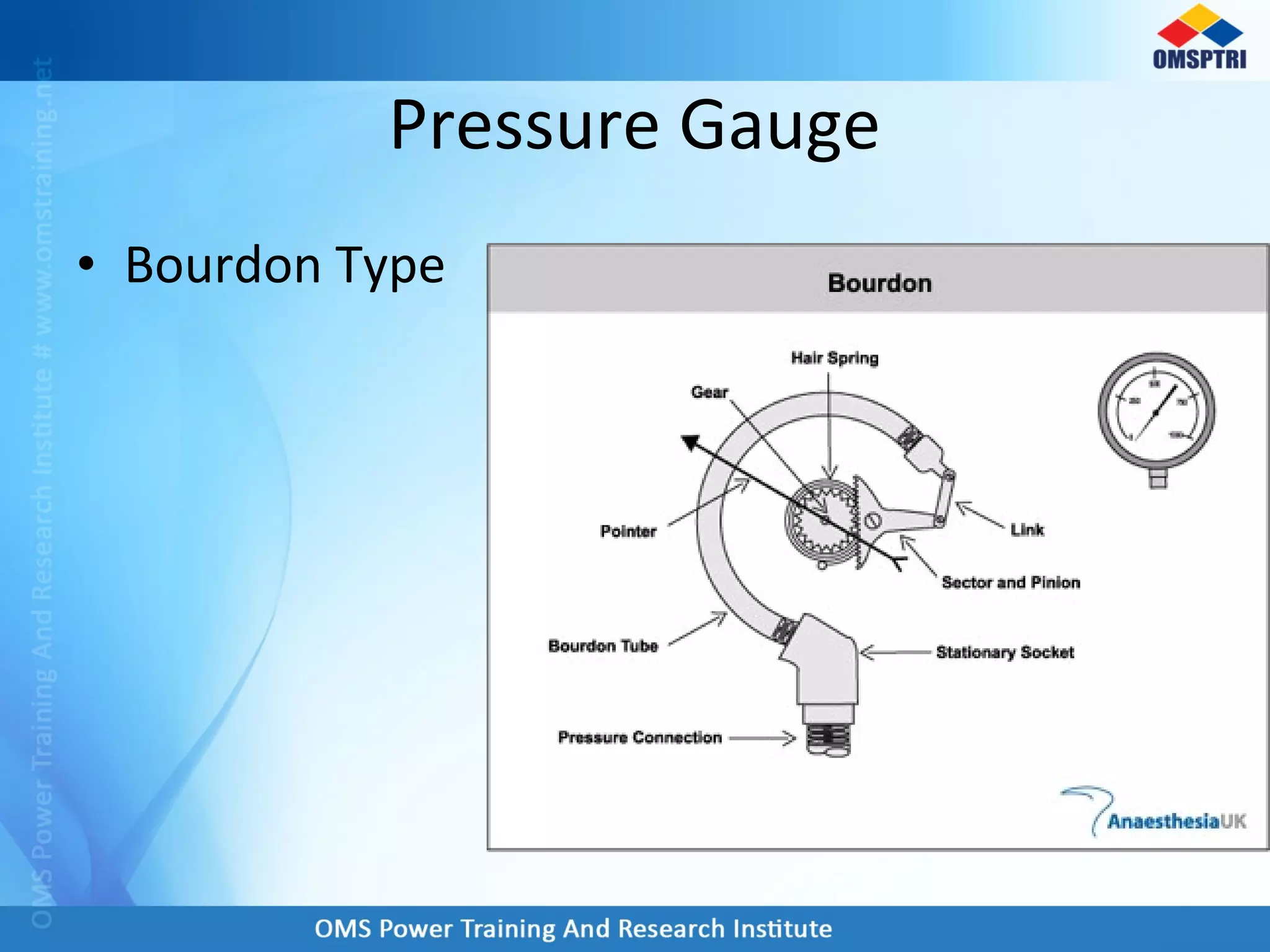
Pressure Gauge
• Bourdon Type
• Bourdon Type
Pressure Gauge
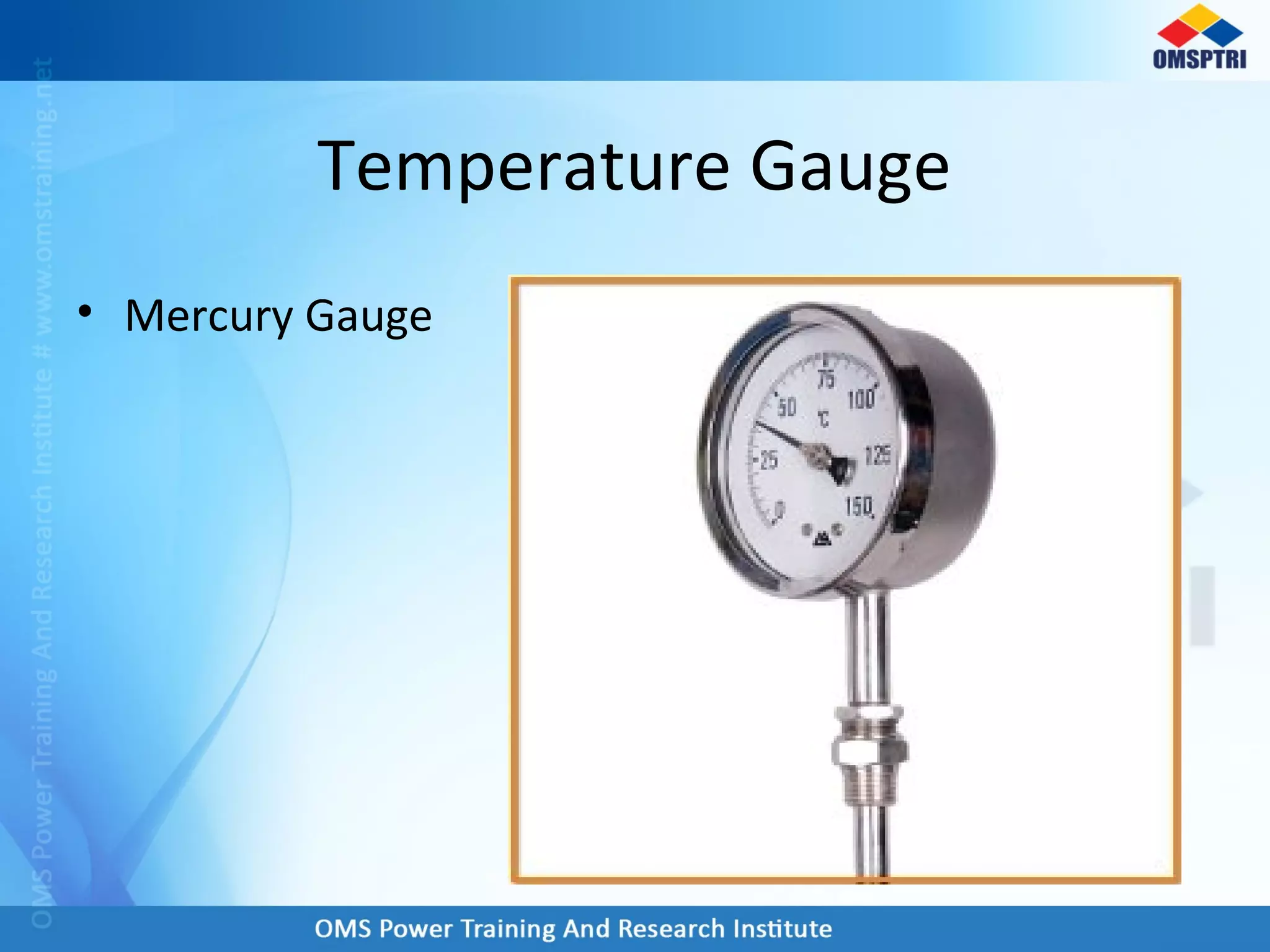
Temperature Gauge
• Mercury Gauge
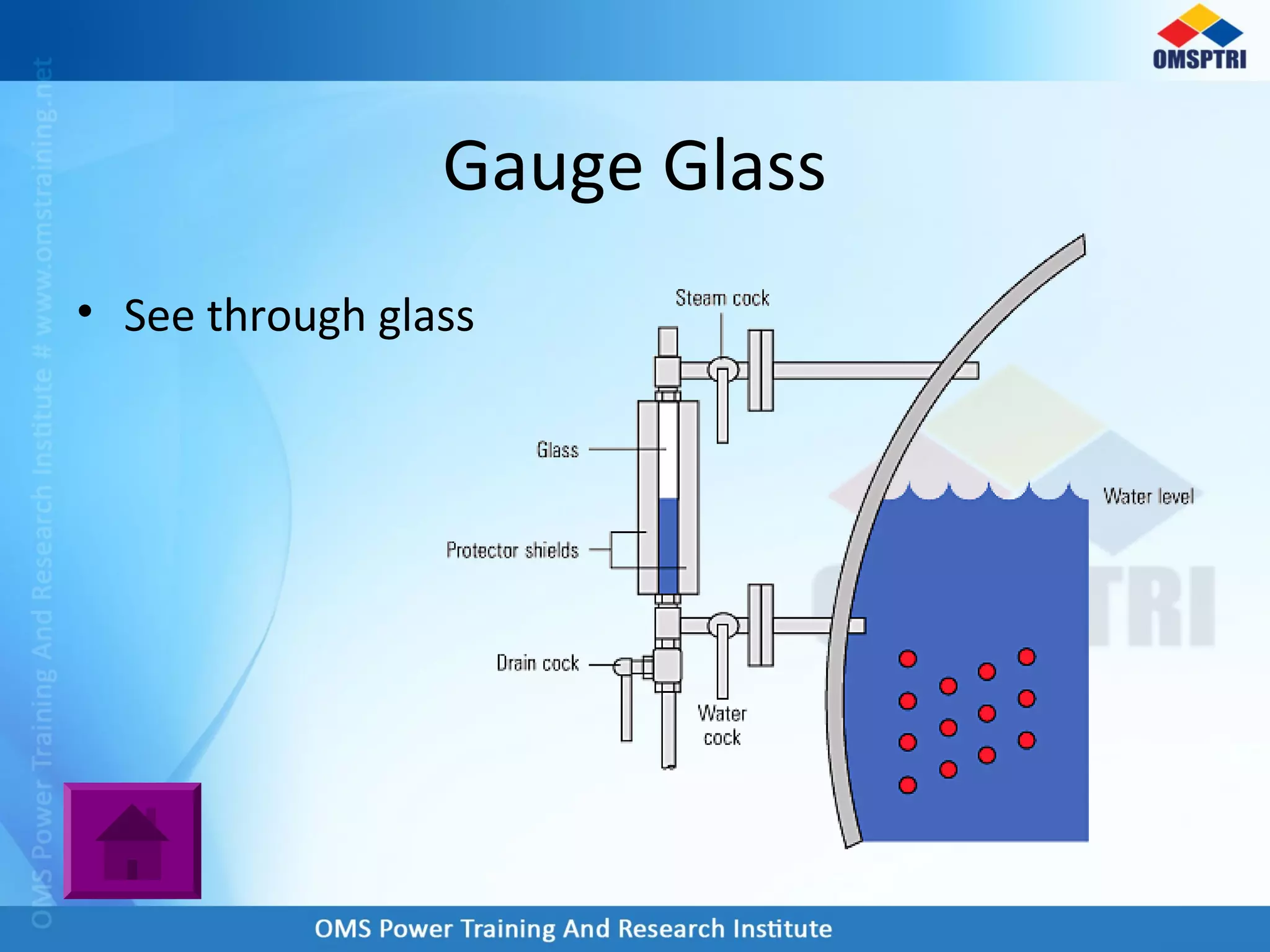
Gauge Glass
• See through glass
• Pressure/Flow/Level/Temperature
- Indicators, Recorders, Control System,
Monitors- TFTs
RemoteMonitoring
How Remote Monitoring is done?
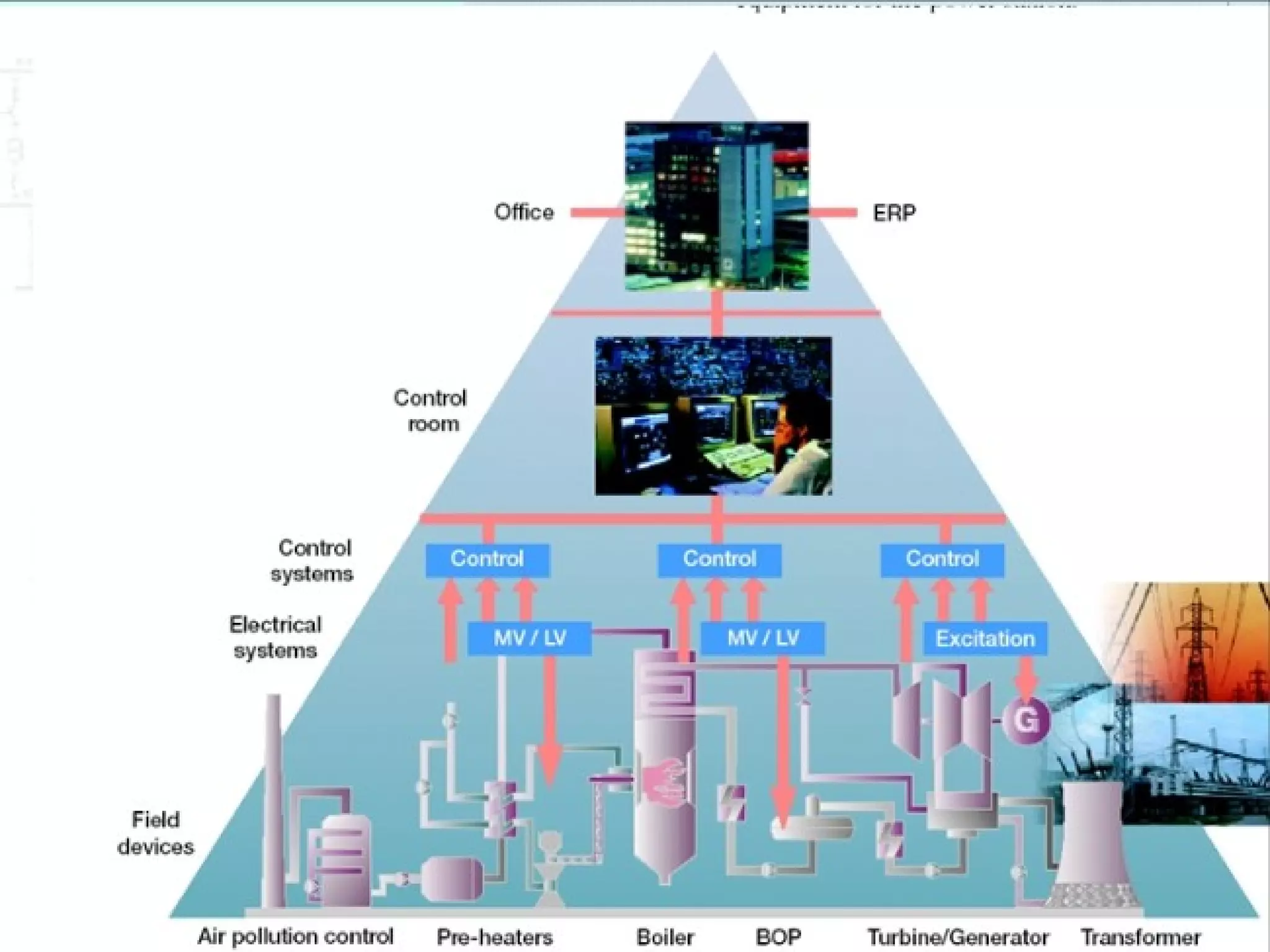
• Field data are communicated to the control
room.
• Based on the information the control system
takes care of safe , reliable and optimum
operation.
• Control & Instrumentation deals with the above.
Why signals are sent to the Control Room ?Why signals are sent to the Control Room ?
• The process parameters are monitored & controlled
from the control room.
• For monitoring the signal, termed measured value,
is displayed.
• For Controlling the measured value is fed to or from
the control panels through wires.
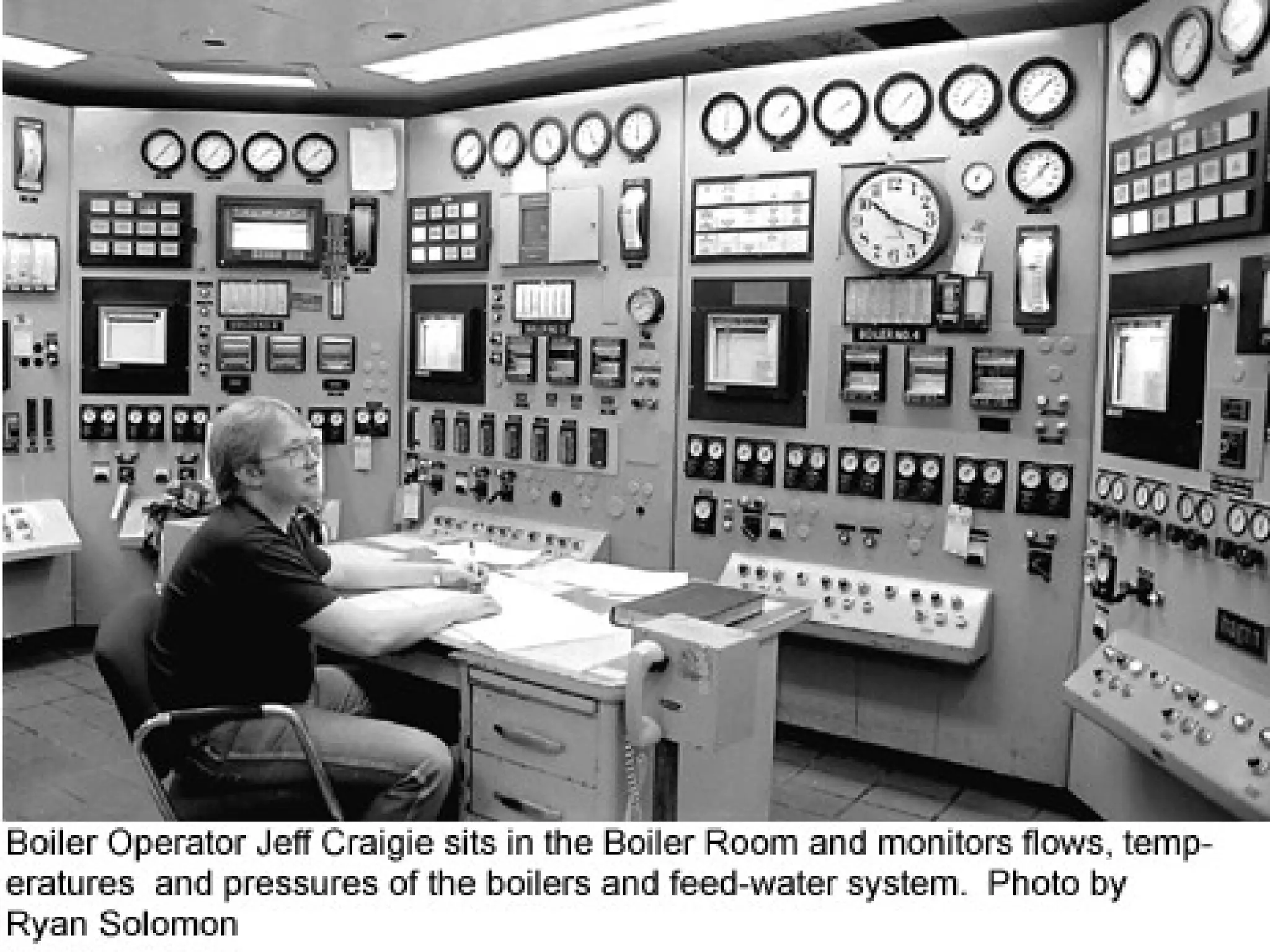
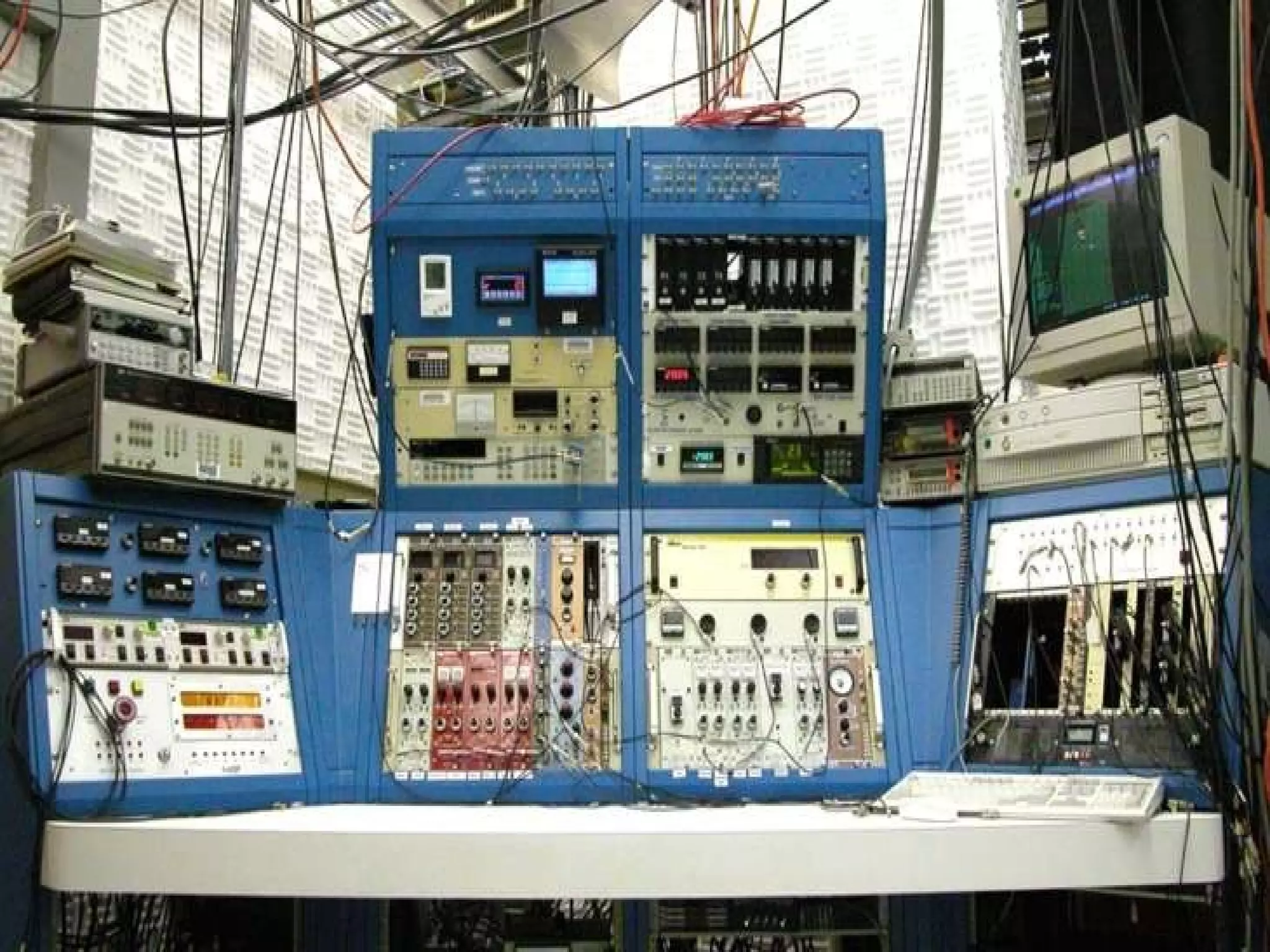
Control Room Instruments
• Indicators
• Recorders
• Display screens
• Annunciation windows
• Push Buttons
• Breakers
• Switches etc.
Process Control
Process control is extensively used in industry
and enables mass production of continuous
processes such as oil refining, paper
manufacturing, chemicals, power plants and
many other industries. Process control enables
automation, with which a small staff of
operating personnel can operate a complex
process from a central control room.
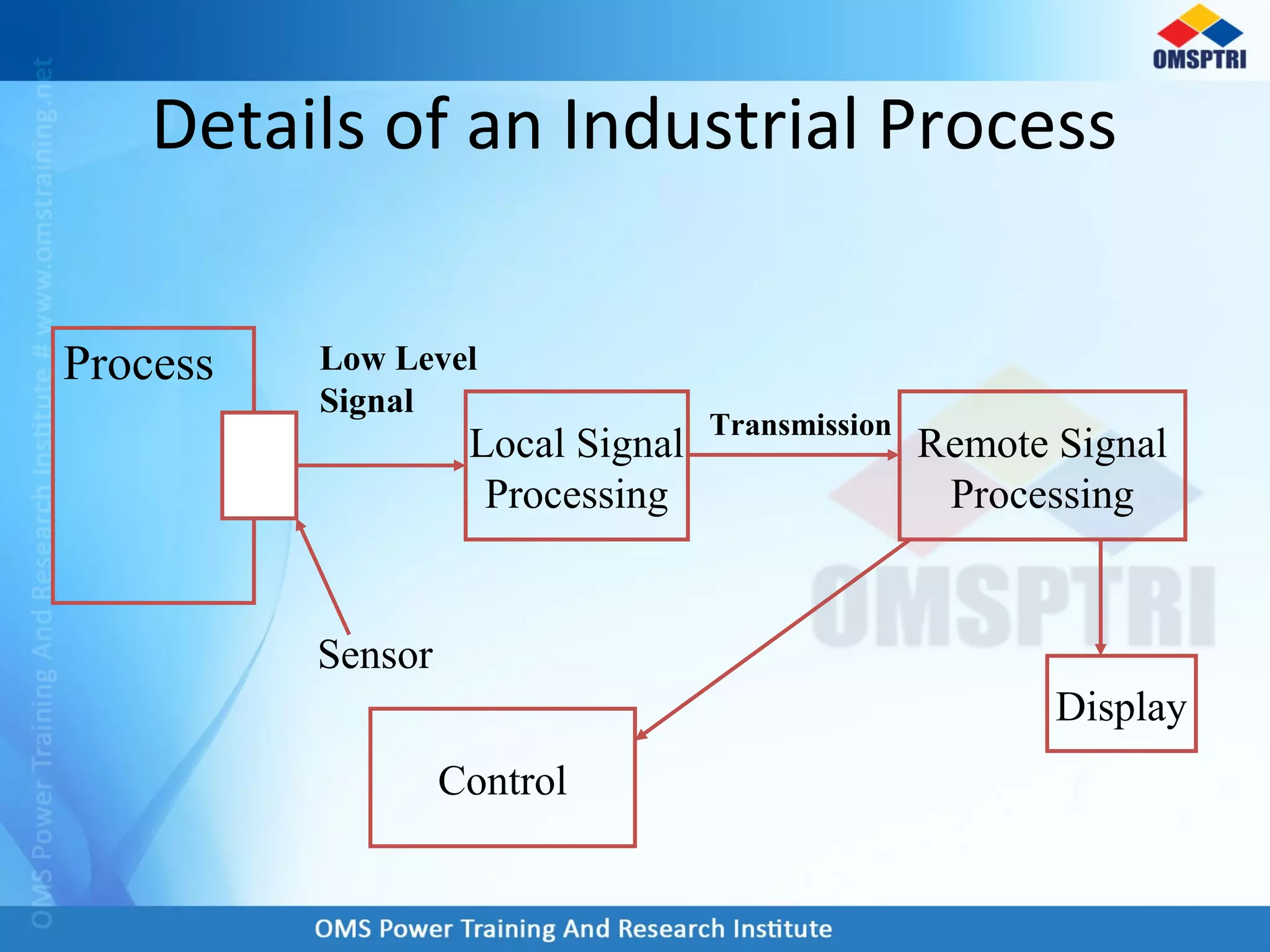
Details of an Industrial Process
Process
Sensor
Low Level
Signal
Local Signal
Processing
Transmission
Remote Signal
Processing
Display
Control
Control System Evolution
• Manual Control System in past involved direct operation of
manipulated variable by human. That was time consuming, tedious
and difficult for round the clock operation
• Auto Control System involved electrical control was based on relays.
These relays allow power to be switched on and off without a
mechanical switch. It involved lot of wirings to make simple logical
control decisions.
• Programmable Logic Controller (PLC) is developed with the
microprocessor technology. This has control logic/ ladder logic
software that eliminated the use of lot of wiring, relays & switches.
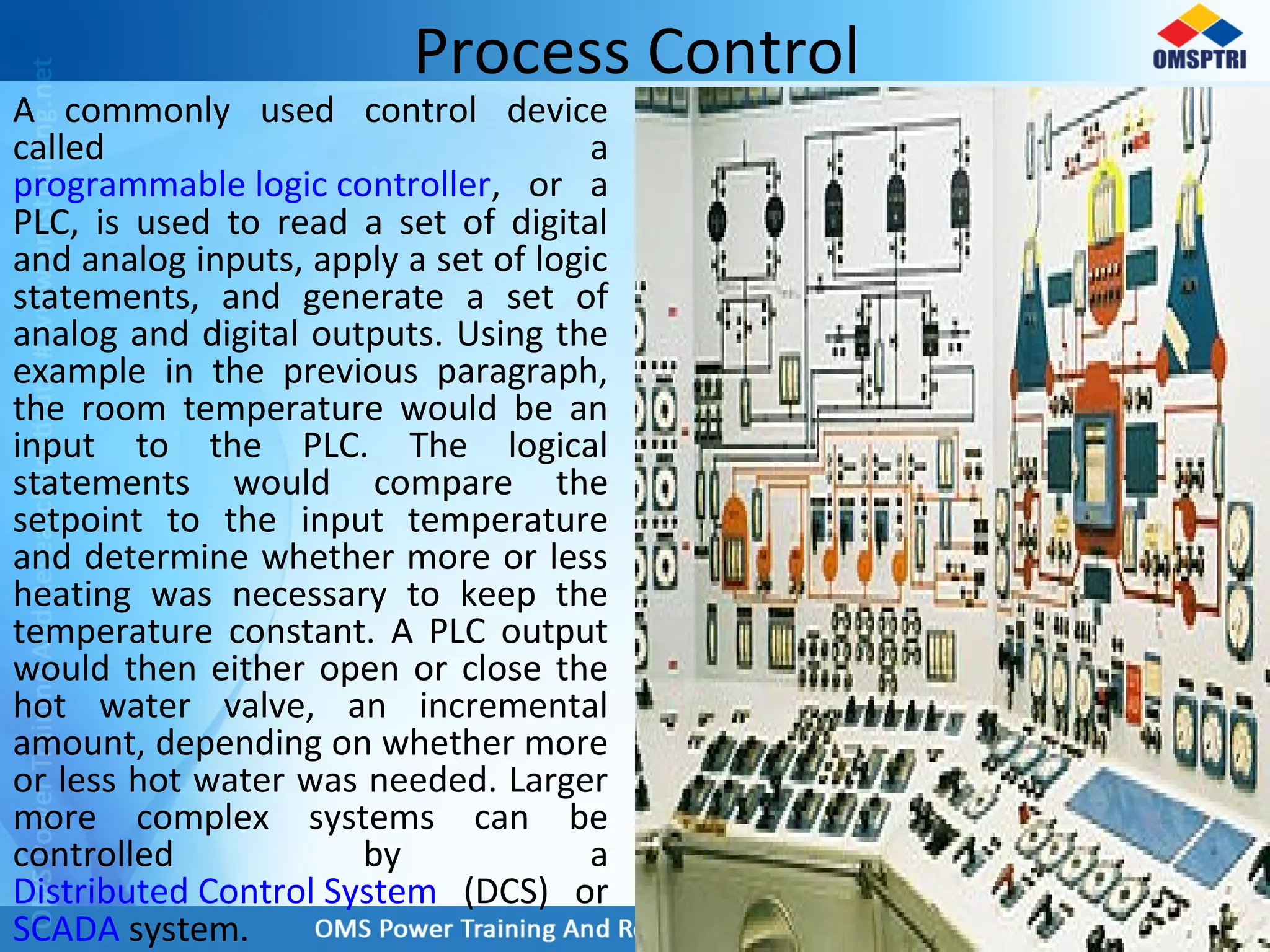
Process Control
A commonly used control device
called a
programmable logic controller, or a
PLC, is used to read a set of digital
and analog inputs, apply a set of logic
statements, and generate a set of
analog and digital outputs. Using the
example in the previous paragraph,
the room temperature would be an
input to the PLC. The logical
statements would compare the
setpoint to the input temperature
and determine whether more or less
heating was necessary to keep the
temperature constant. A PLC output
would then either open or close the
hot water valve, an incremental
amount, depending on whether more
or less hot water was needed. Larger
more complex systems can be
controlled by a
Distributed Control System (DCS) or
SCADA system.
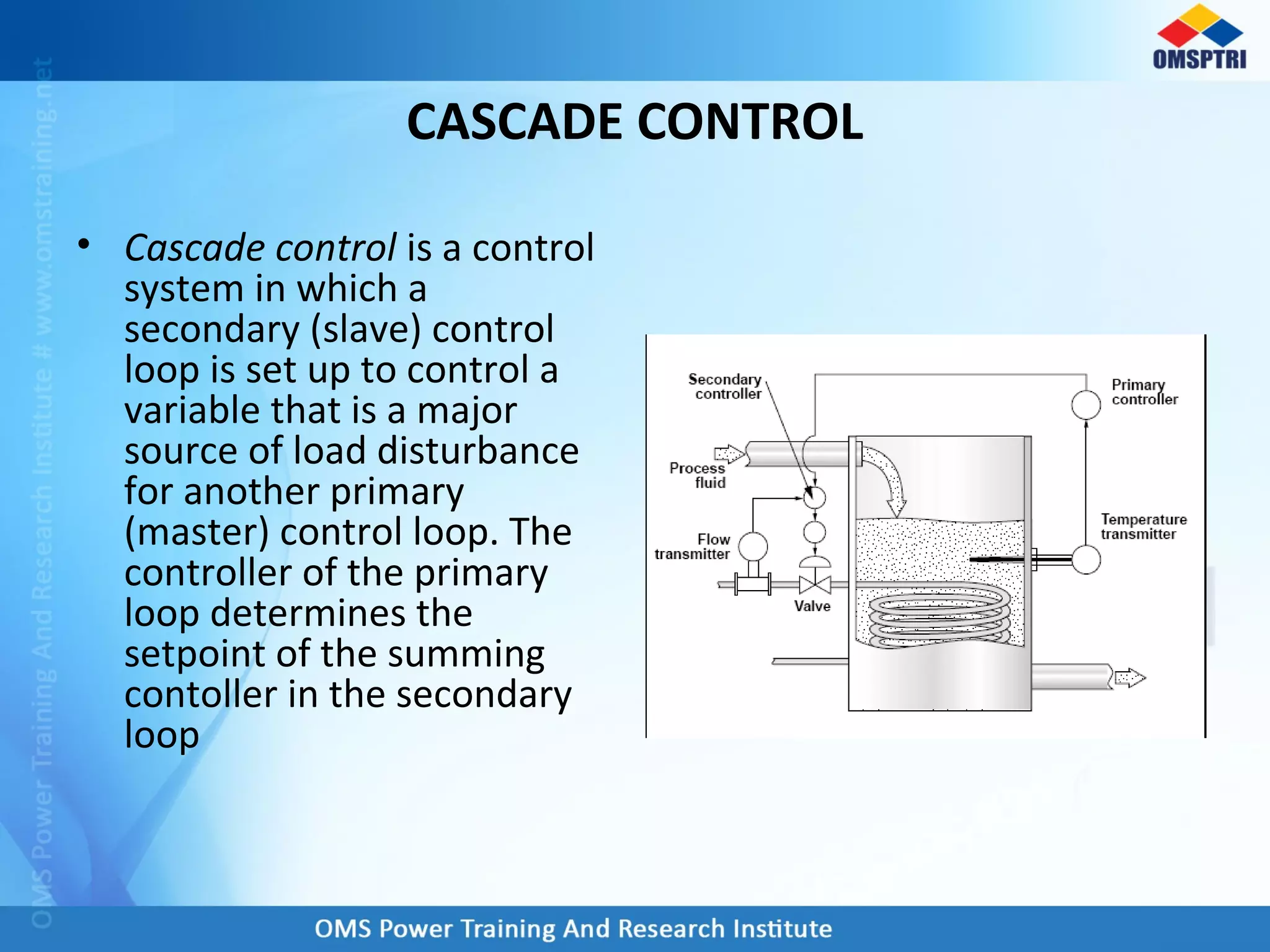
Types of control systems
• Logical/Discrete - The value to be controlled are easily
described as on-off. e.g. the Feed Pump is on-off based on
certain conditions.
• Continuous - The values to be controlled change smoothly. e.g.
the Drum Level.
• Linear - Can be described with a simple differential equation
e.g. We are measuring the perfect flow with no disturbances
like friction, turbulence, temperature change of process fluid
etc.
• Non-Linear - Not Linear. Takes into account the changes due
the disturbances. must change.
• Sequential - A logical controller that will keep track of time and
previous events.
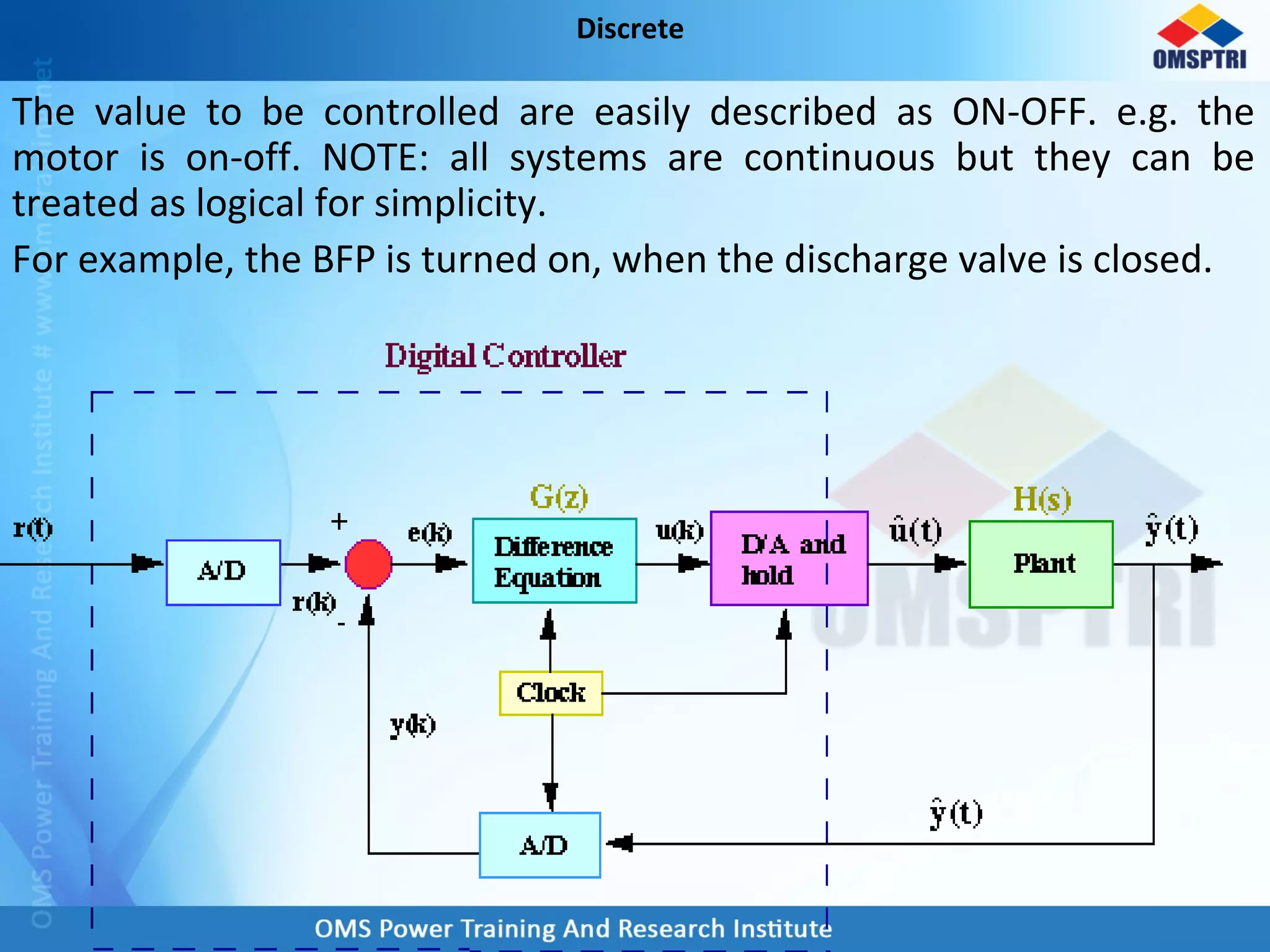
The value to be controlled are easily described as ON-OFF. e.g. the
motor is on-off. NOTE: all systems are continuous but they can be
treated as logical for simplicity.
For example, the BFP is turned on, when the discharge valve is closed.
Discrete
Logical and sequential control
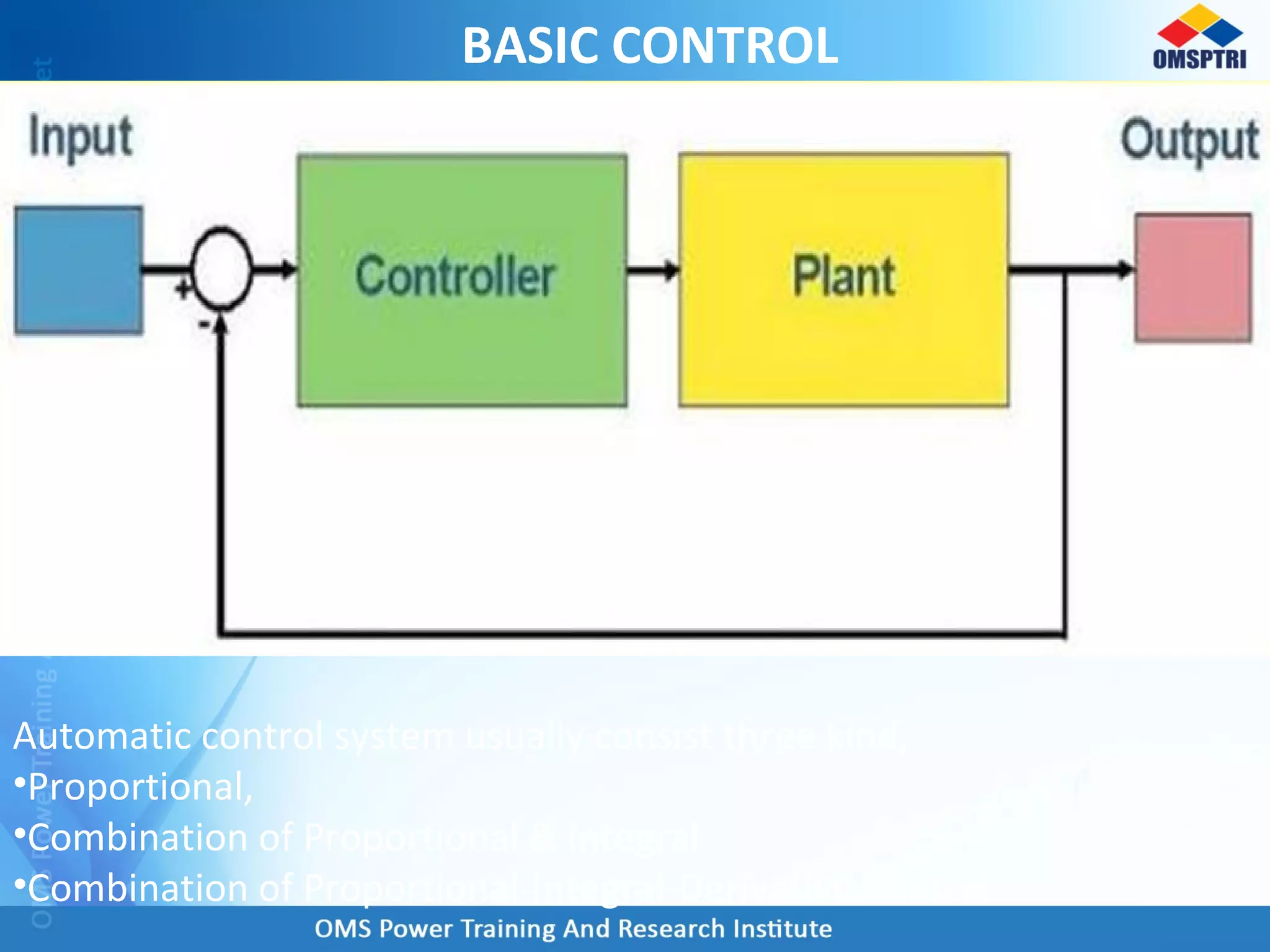
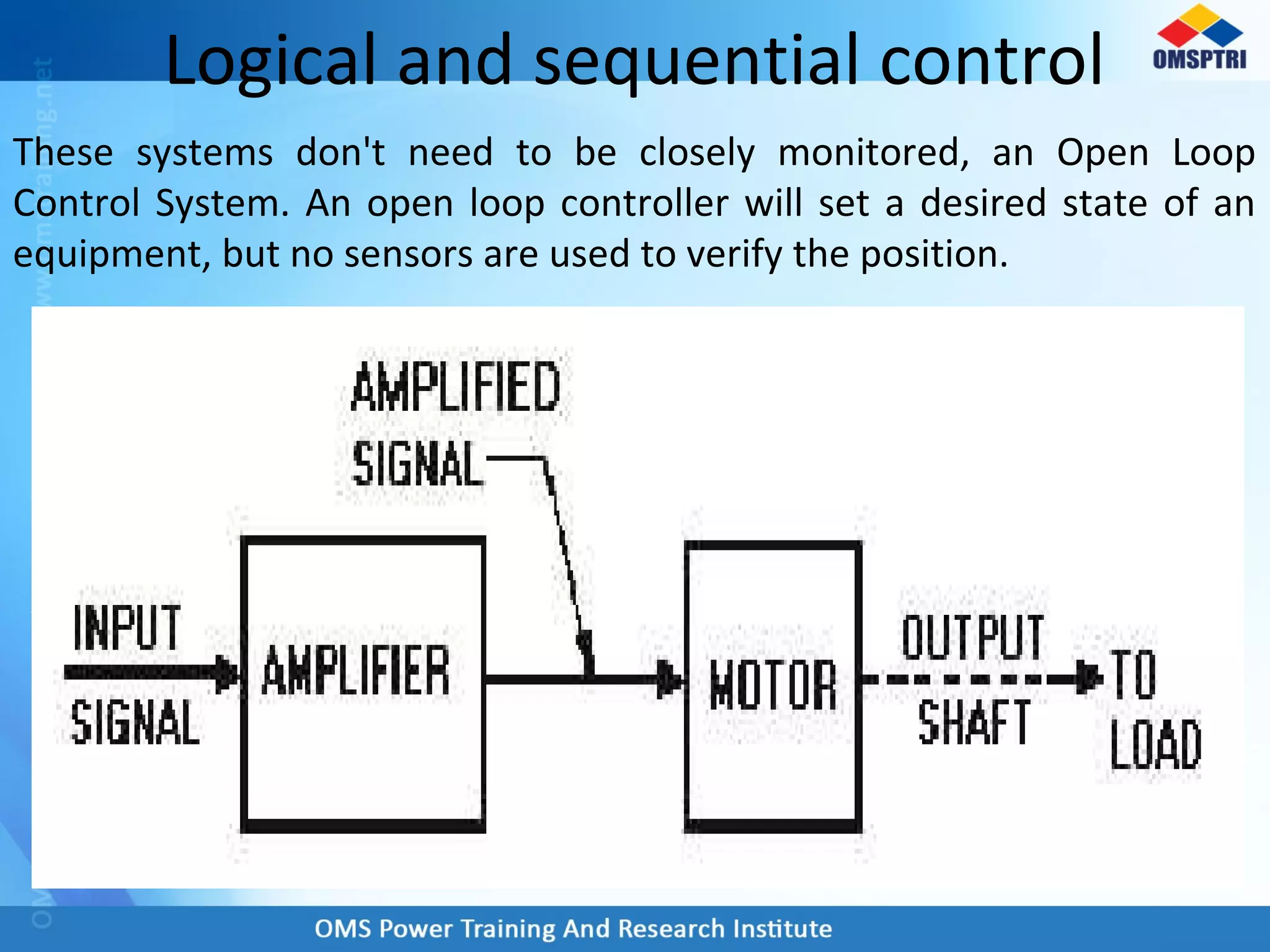
These systems don't need to be closely monitored, an Open Loop
Control System. An open loop controller will set a desired state of an
equipment, but no sensors are used to verify the position.
Continuous Control
A system i.e. constantly monitored and the control output adjusted is a
Closed Loop Control System.
For example, heating up the temperature in a room is a process that has
the specific, desired temperature the Set Point to reach and maintain
constant over time. Here, the hot water flow is the controlled or the
manipulated variable since it is subject to control actions. The
temperature of the water is the measured variable.
Programmable Logic Controller (PLC)
• Cost effective for automatically controlling complex
systems.
• Flexible and can be reapplied to control other systems
quickly and easily.
• Computational abilities allow more sophisticated
control.
• Trouble shooting aids make programming easier and
reduce downtime.
• Reliable components make these likely to operate for
years before failure.
Ladder Logic
Ladder logic is the main programming method used for PLCs. As
mentioned before, ladder logic has been developed to mimic relay logic.
A relay is a simple device that uses a magnetic field to control a switch.
A typical SCADA package polls numerous points in a PLC to retrieve live factory
data. The polling involves executing the protocol stacks on both the PC and the PLC
network board. Data is then retrieved from the PLC memory across the backplane
and sent back through the same protocol levels. This makes it unsuitable for time-
sensitive information. Embedding the web server in the plc ensures the timely flow
of information required on the factory floor.
When a voltage is applied to the input coil, the resulting current creates
a magnetic field. The magnetic field pulls a metal switch (or reed)
towards it and the normally open contacts touch, closing the switch.
The normally closed contacts touch when the input coil is not energized.
Ladder Logic
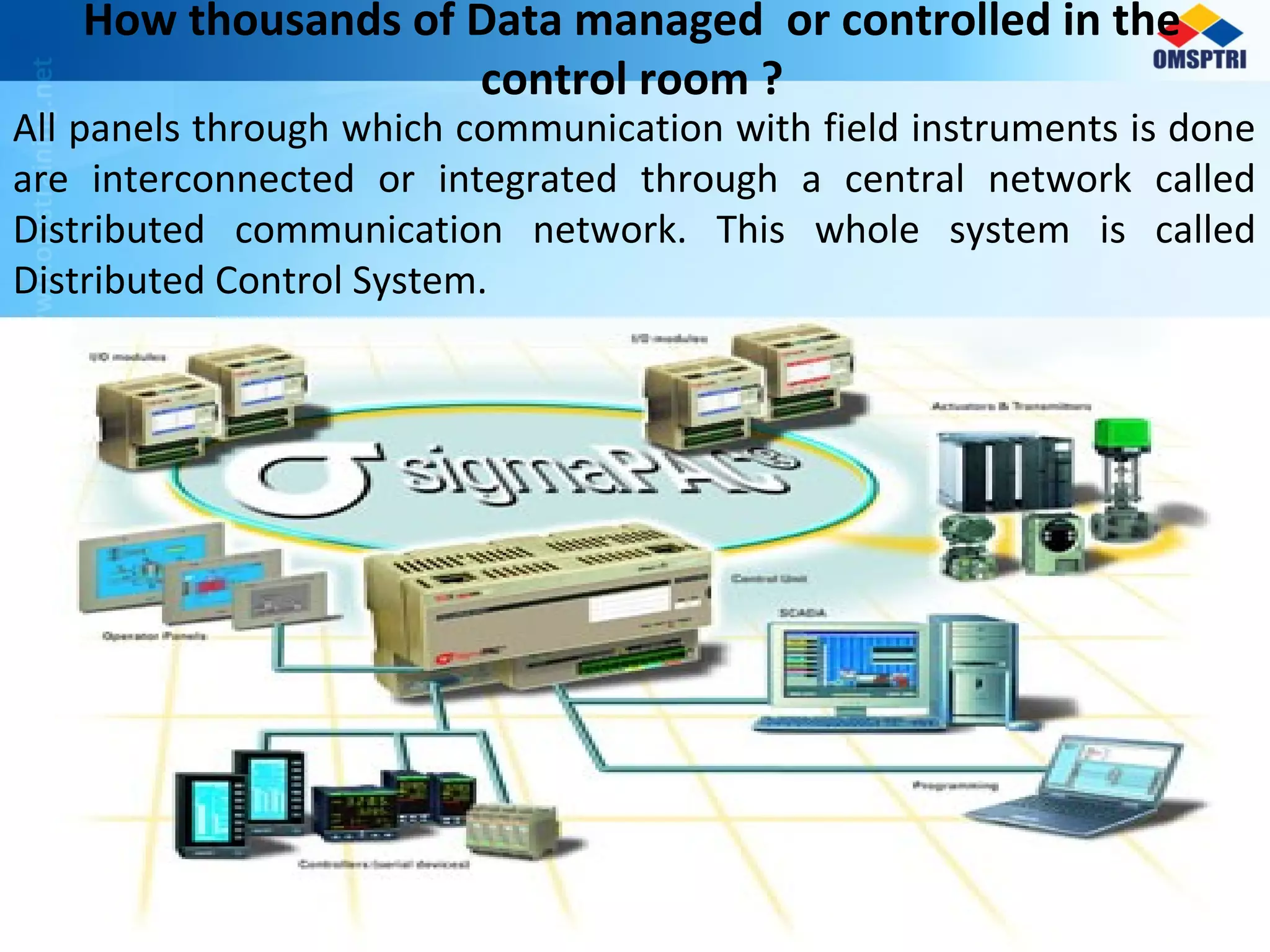
How thousands of Data managed or controlled in the
control room ?
All panels through which communication with field instruments is done
are interconnected or integrated through a central network called
Distributed communication network. This whole system is called
Distributed Control System.
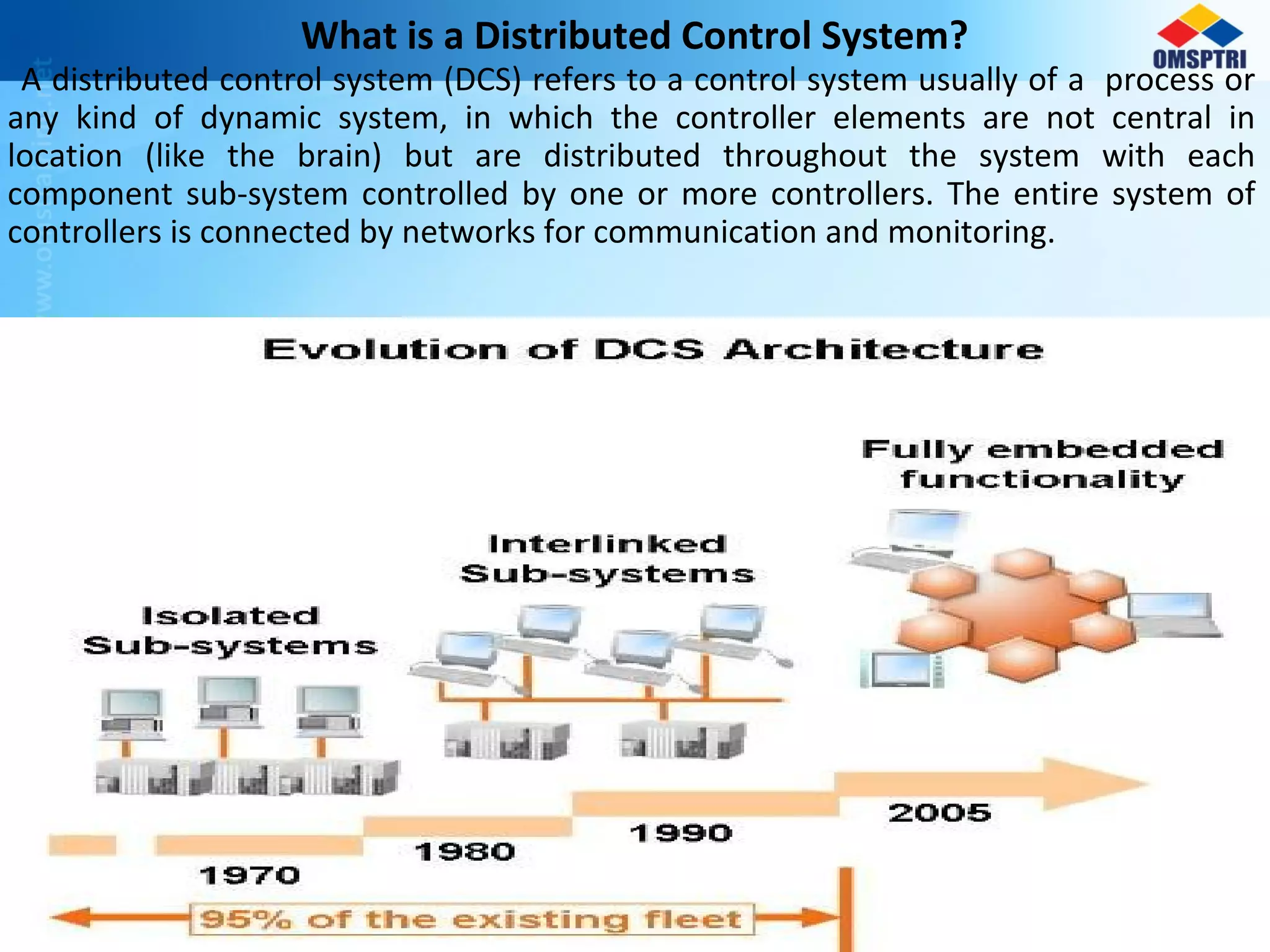
What is a Distributed Control System?
A distributed control system (DCS) refers to a control system usually of a process or
any kind of dynamic system, in which the controller elements are not central in
location (like the brain) but are distributed throughout the system with each
component sub-system controlled by one or more controllers. The entire system of
controllers is connected by networks for communication and monitoring.
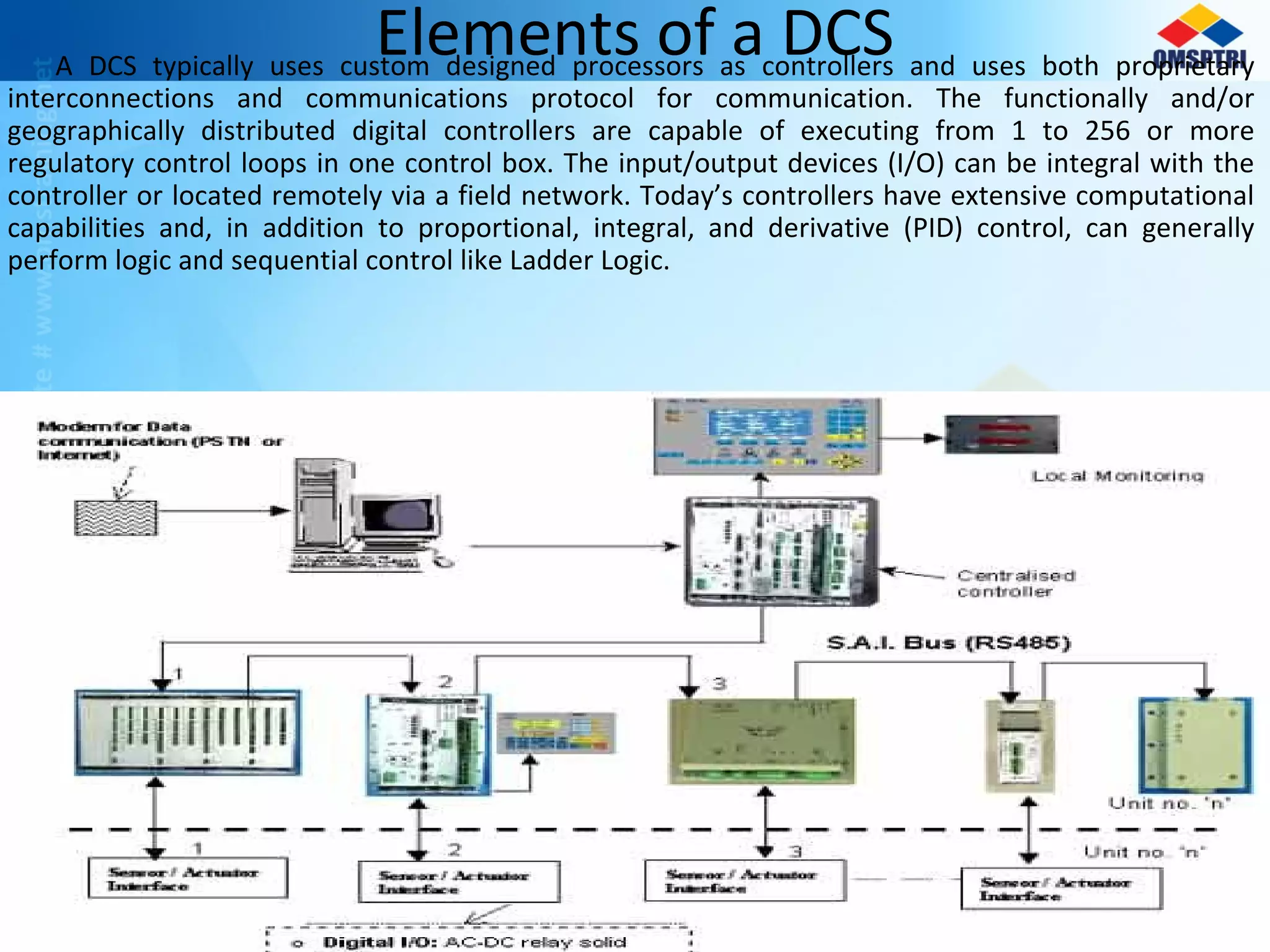
Elements of a DCSA DCS typically uses custom designed processors as controllers and uses both proprietary
interconnections and communications protocol for communication. The functionally and/or
geographically distributed digital controllers are capable of executing from 1 to 256 or more
regulatory control loops in one control box. The input/output devices (I/O) can be integral with the
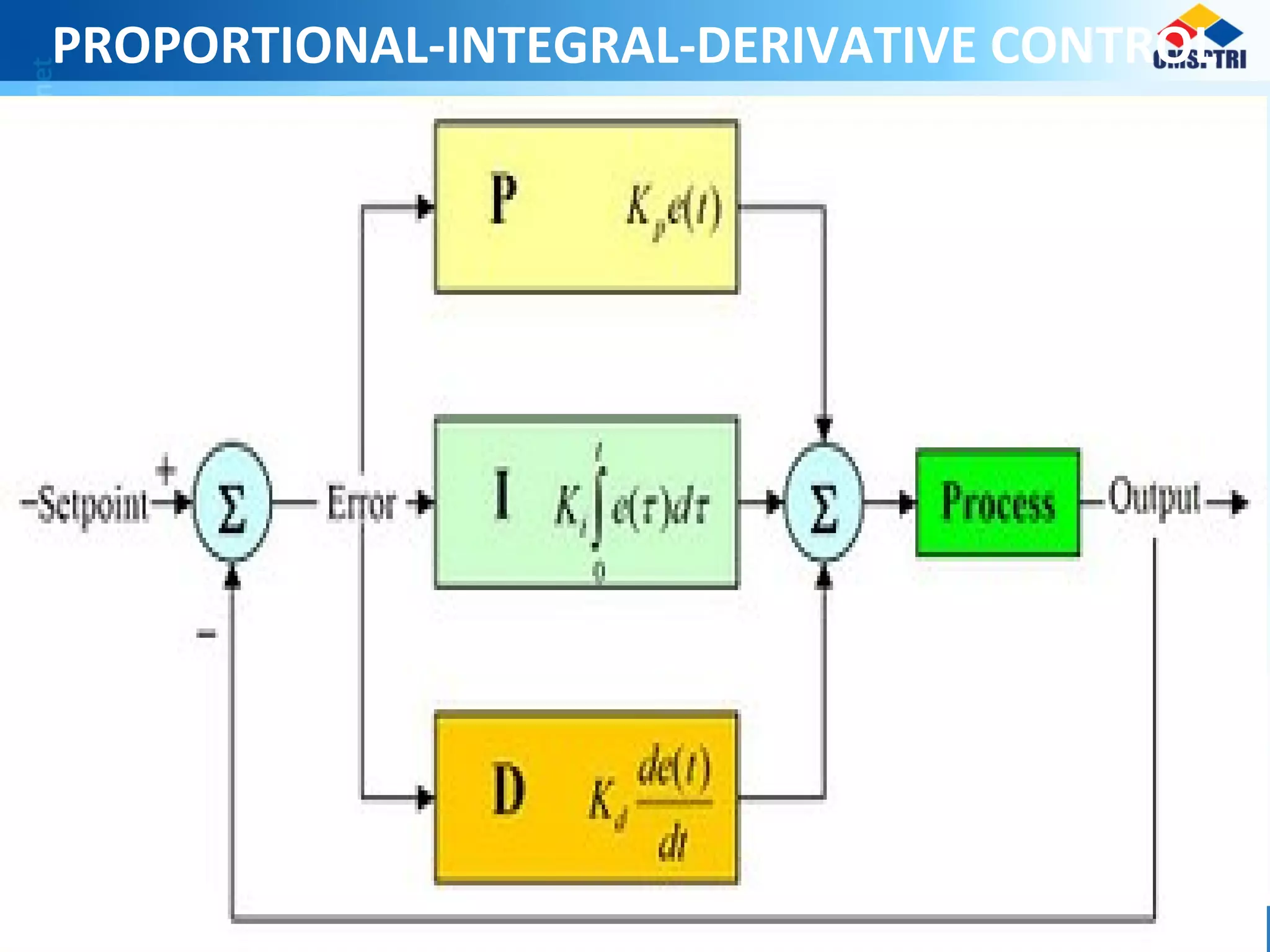
controller or located remotely via a field network. Today’s controllers have extensive computational
capabilities and, in addition to proportional, integral, and derivative (PID) control, can generally
perform logic and sequential control like Ladder Logic.
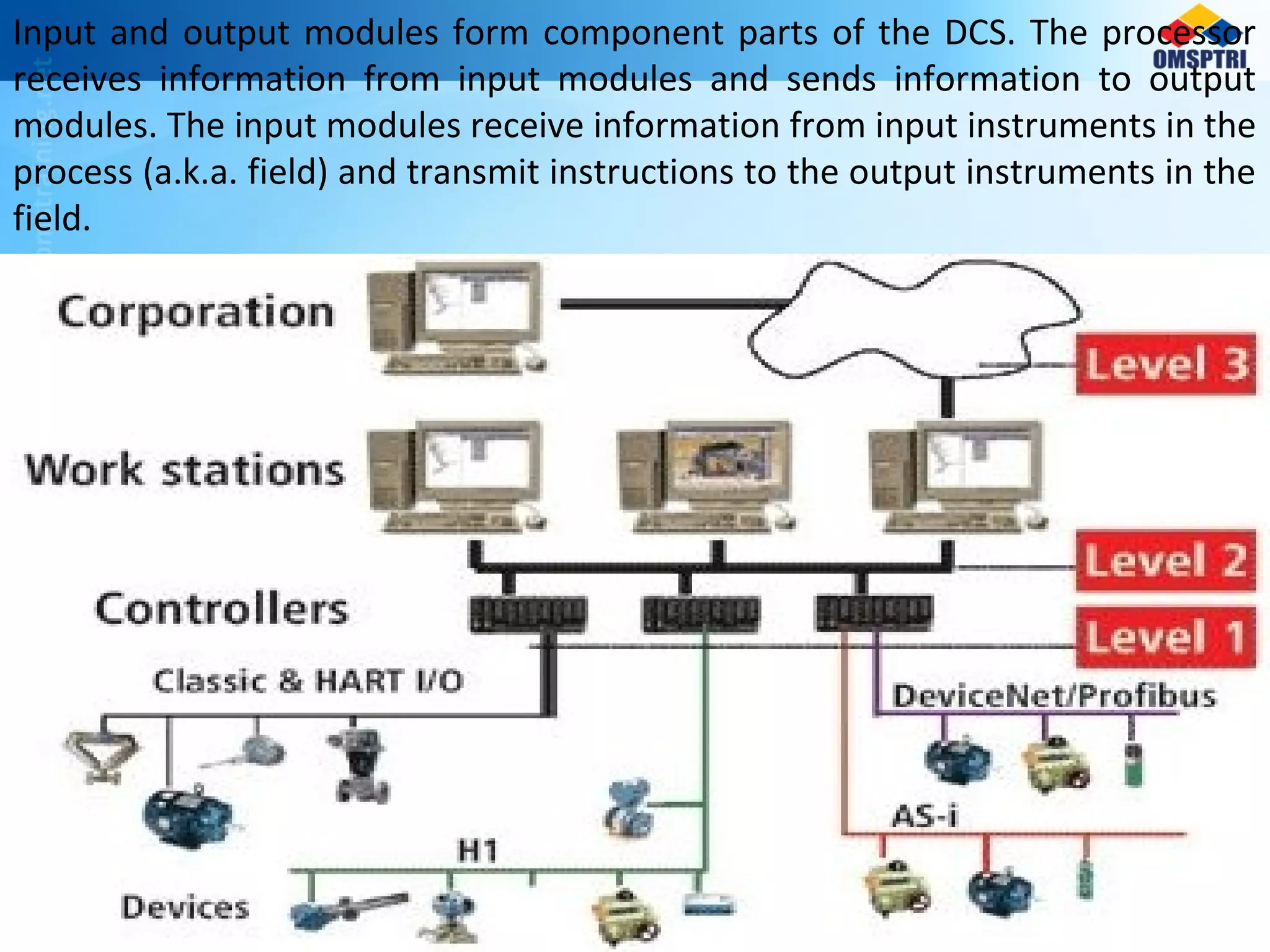
Input and output modules form component parts of the DCS. The processor
receives information from input modules and sends information to output
modules. The input modules receive information from input instruments in the
process (a.k.a. field) and transmit instructions to the output instruments in the
field.
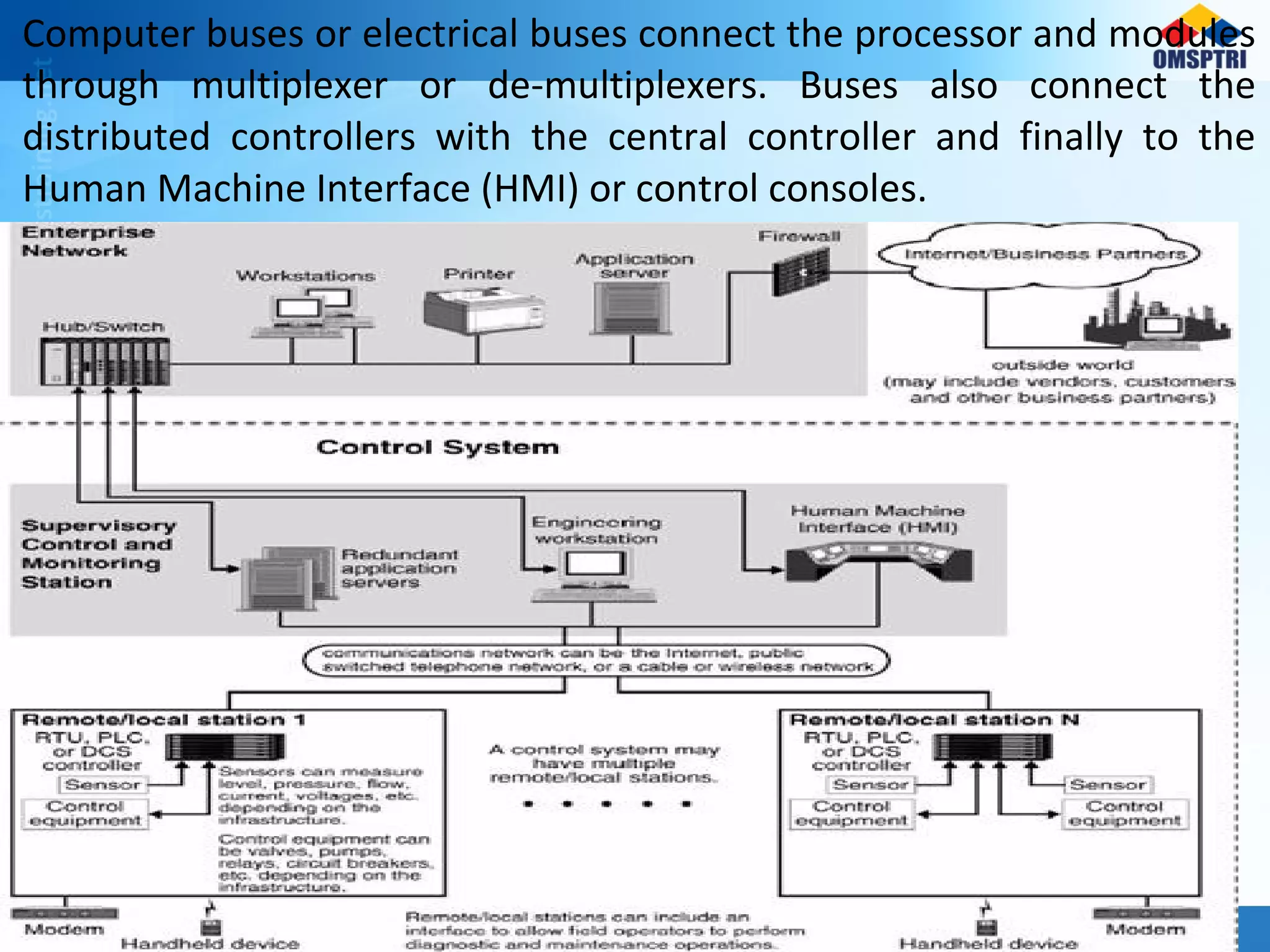
Computer buses or electrical buses connect the processor and modules
through multiplexer or de-multiplexers. Buses also connect the
distributed controllers with the central controller and finally to the
Human Machine Interface (HMI) or control consoles.
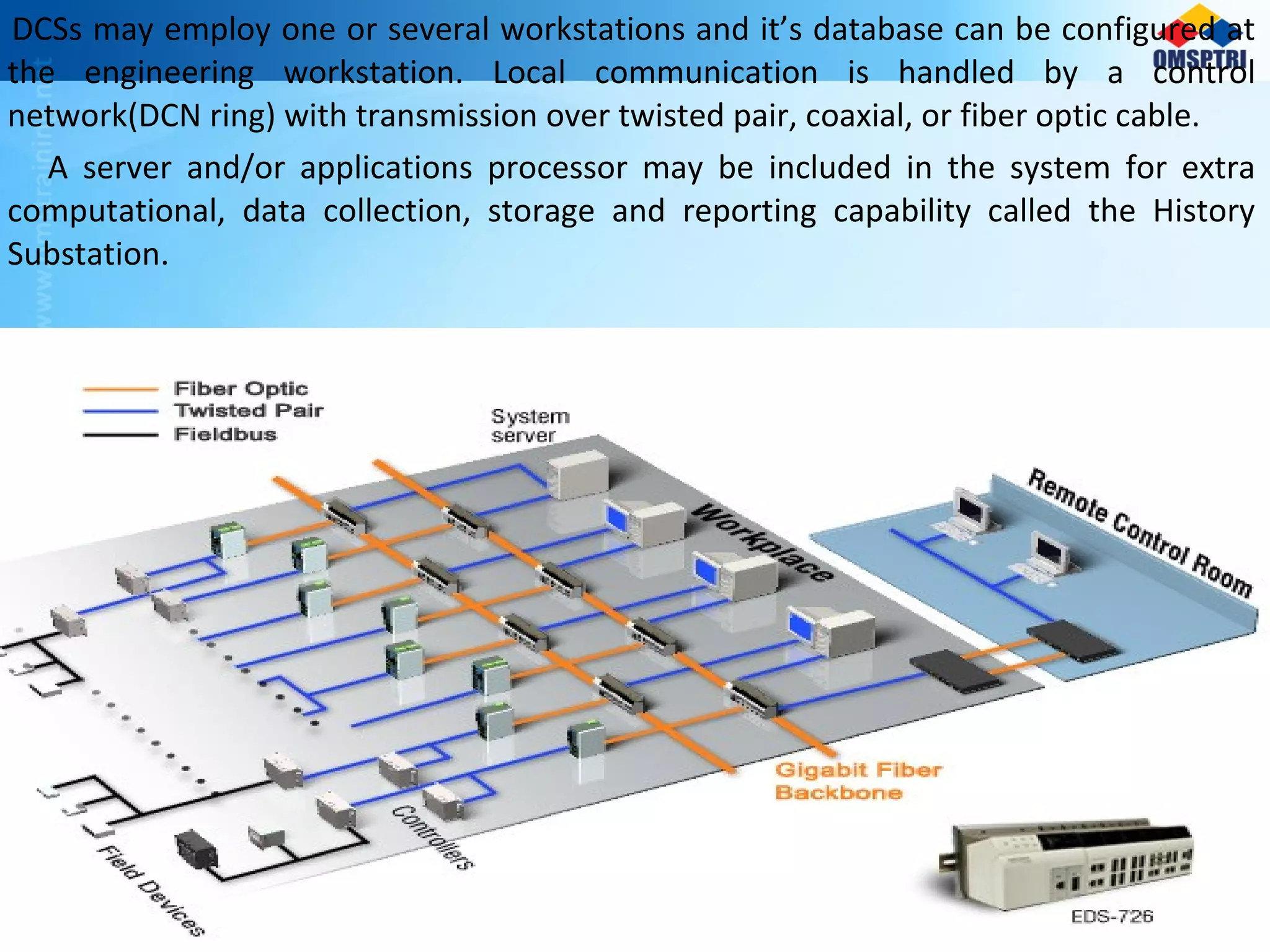
DCSs may employ one or several workstations and it’s database can be configured at
the engineering workstation. Local communication is handled by a control
network(DCN ring) with transmission over twisted pair, coaxial, or fiber optic cable.
A server and/or applications processor may be included in the system for extra
computational, data collection, storage and reporting capability called the History
Substation.
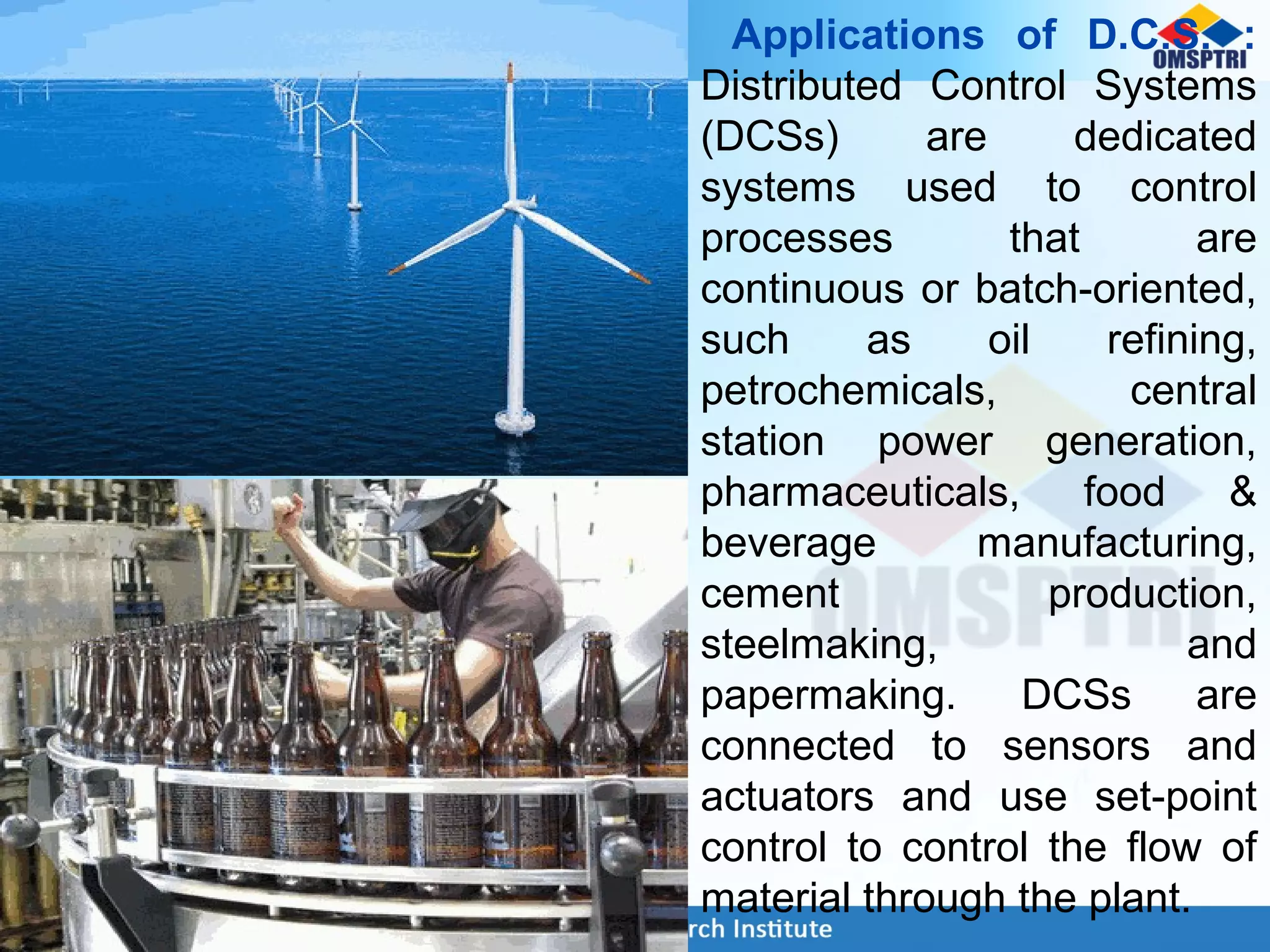
Applications of D.C.S. :
Distributed Control Systems
(DCSs) are dedicated
systems used to control
processes that are
continuous or batch-oriented,
such as oil refining,
petrochemicals, central
station power generation,
pharmaceuticals, food &
beverage manufacturing,
cement production,
steelmaking, and
papermaking. DCSs are
connected to sensors and
actuators and use set-point
control to control the flow of
material through the plant.
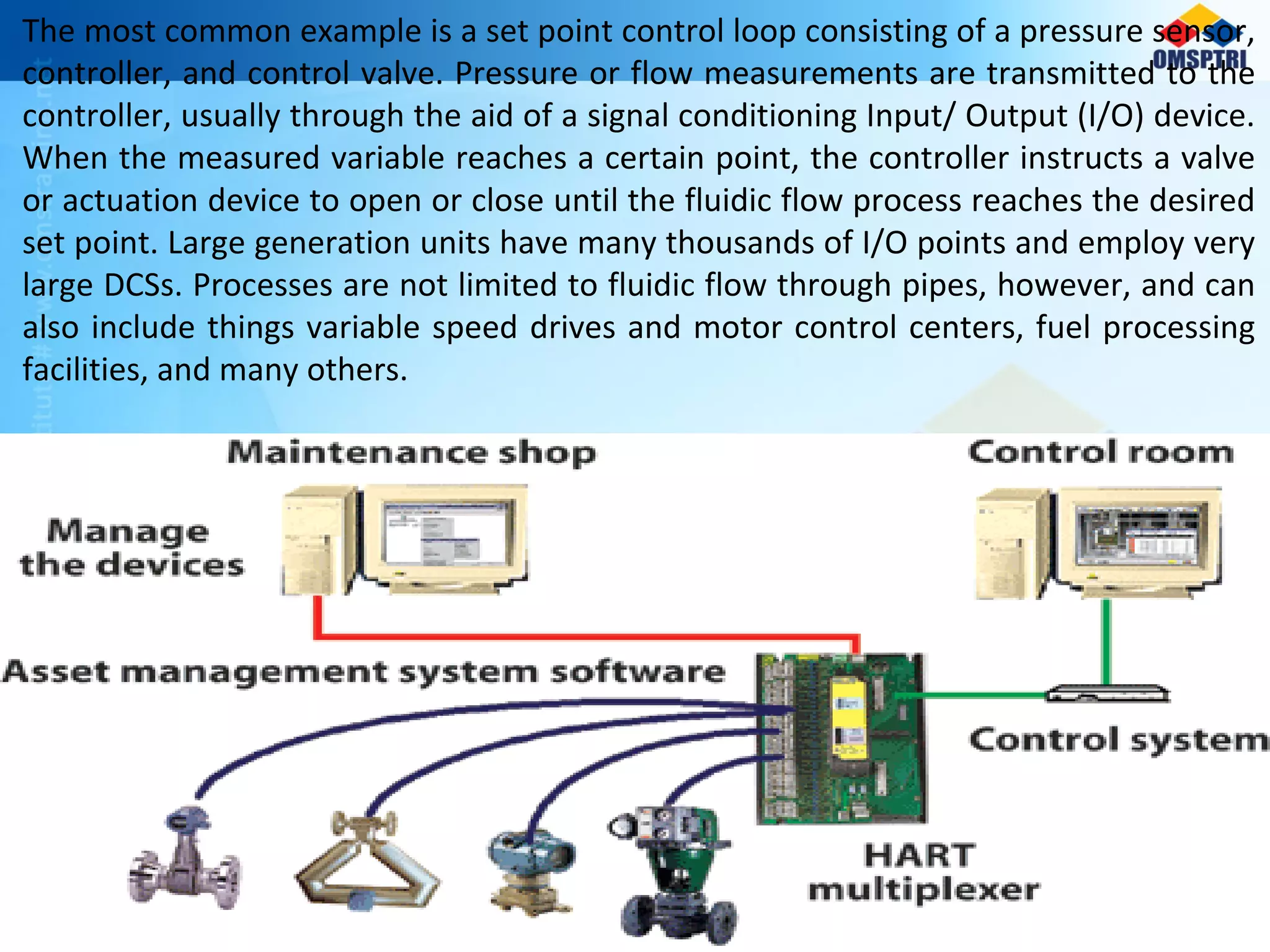
The most common example is a set point control loop consisting of a pressure sensor,
controller, and control valve. Pressure or flow measurements are transmitted to the
controller, usually through the aid of a signal conditioning Input/ Output (I/O) device.
When the measured variable reaches a certain point, the controller instructs a valve
or actuation device to open or close until the fluidic flow process reaches the desired
set point. Large generation units have many thousands of I/O points and employ very
large DCSs. Processes are not limited to fluidic flow through pipes, however, and can
also include things variable speed drives and motor control centers, fuel processing
facilities, and many others.
Process diagrams
The ‘process’ is an idea or concept that is developed to a certain level in
order to determine the feasibility of the project. ‘Feasibility’ study is the
name given to a small design project that is conducted to determine the
scope and cost of implementing the project from concept to operation.
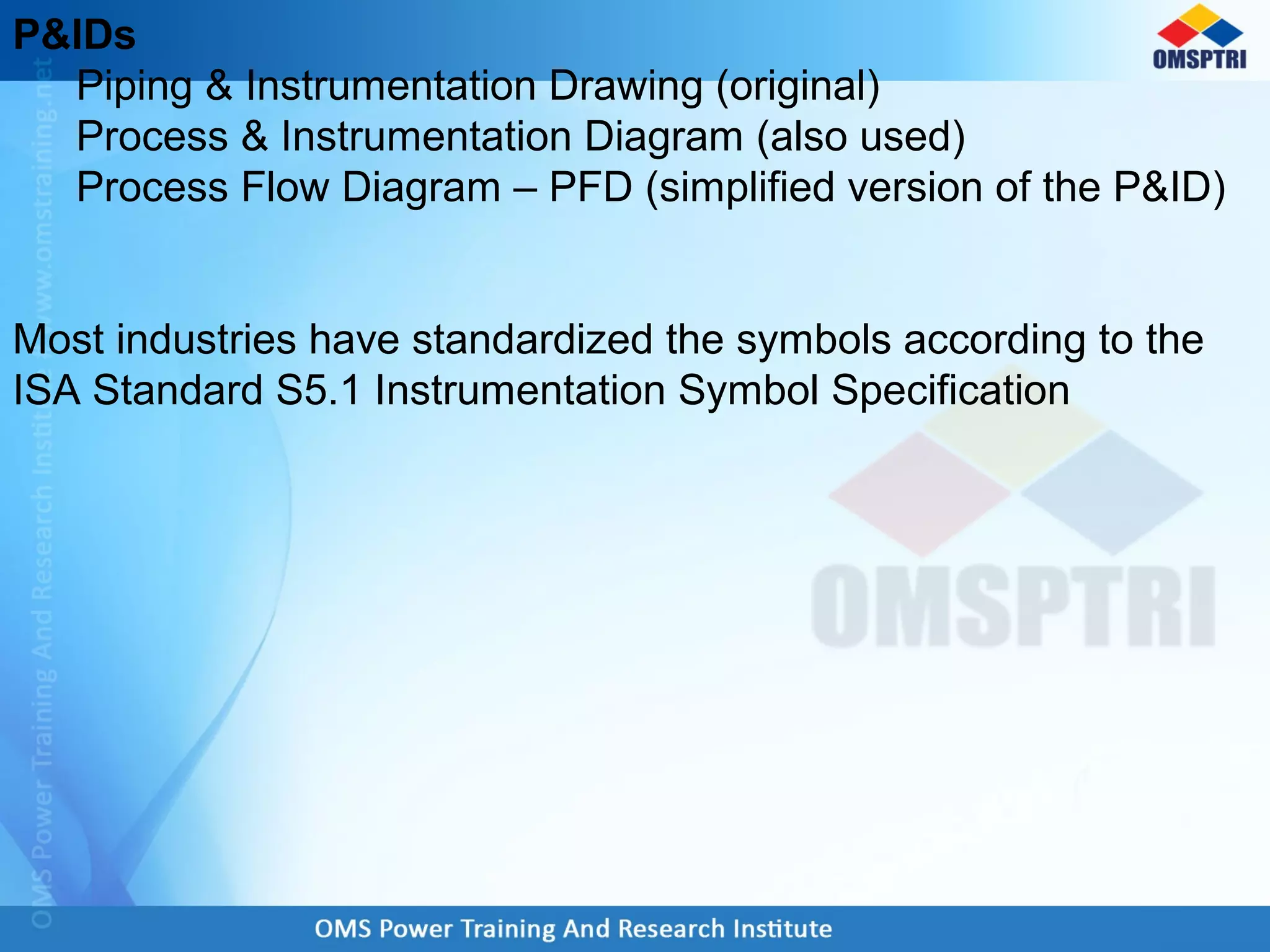
To keep things simple, for example, design an imaginary coffee bottling
plant to produce bottled coffee for distribution. Start by creating a basic
flow diagram that illustrates the objective for the proposed plant; this
diagram is called a “Process Block Diagram”.
Basic flow diagram of Coffee bottling plant
P&IDs
Piping & Instrumentation Drawing (original)
Process & Instrumentation Diagram (also used)
Process Flow Diagram – PFD (simplified version of the P&ID)
Most industries have standardized the symbols according to the
ISA Standard S5.1 Instrumentation Symbol Specification
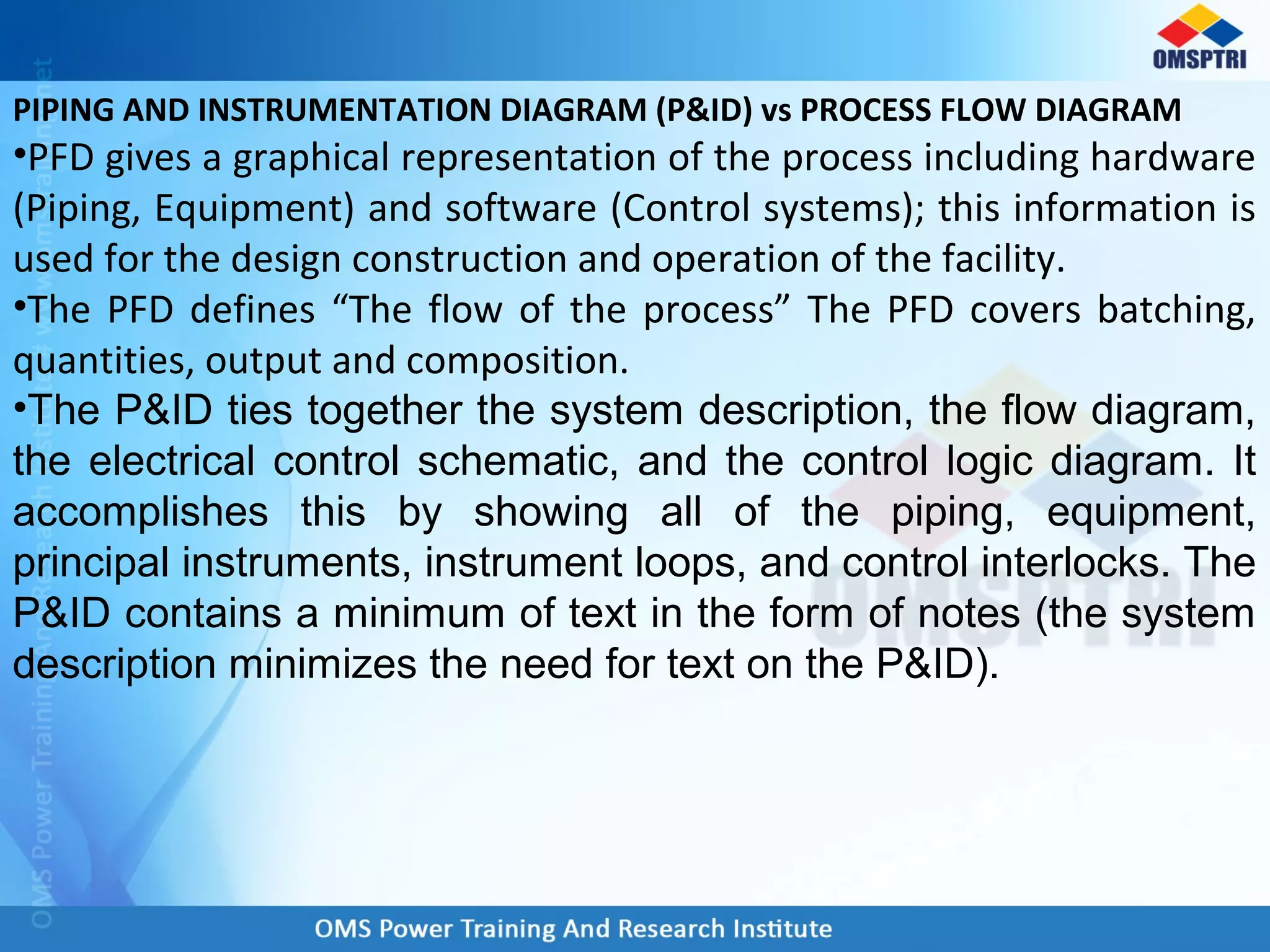
Process flow diagram or piping flow diagram (PFD)
The PFD is where we start to define the process by adding equipment
and the piping that joins the various items of equipment together. The
idea behind the PFD is to show the entire process (the big picture) on as
few drawing sheets as possible, as this document is used to develop the
process plant and therefore the process engineer wants to see as much
of the process as possible. This document is used to determine details
like the tank sizes and pipe sizes
PIPING AND INSTRUMENTATION DIAGRAM (P&ID) vs PROCESS FLOW DIAGRAM
•PFD gives a graphical representation of the process including hardware
(Piping, Equipment) and software (Control systems); this information is
used for the design construction and operation of the facility.
•The PFD defines “The flow of the process” The PFD covers batching,
quantities, output and composition.
•The P&ID ties together the system description, the flow diagram,
the electrical control schematic, and the control logic diagram. It
accomplishes this by showing all of the piping, equipment,
principal instruments, instrument loops, and control interlocks. The
P&ID contains a minimum of text in the form of notes (the system
description minimizes the need for text on the P&ID).
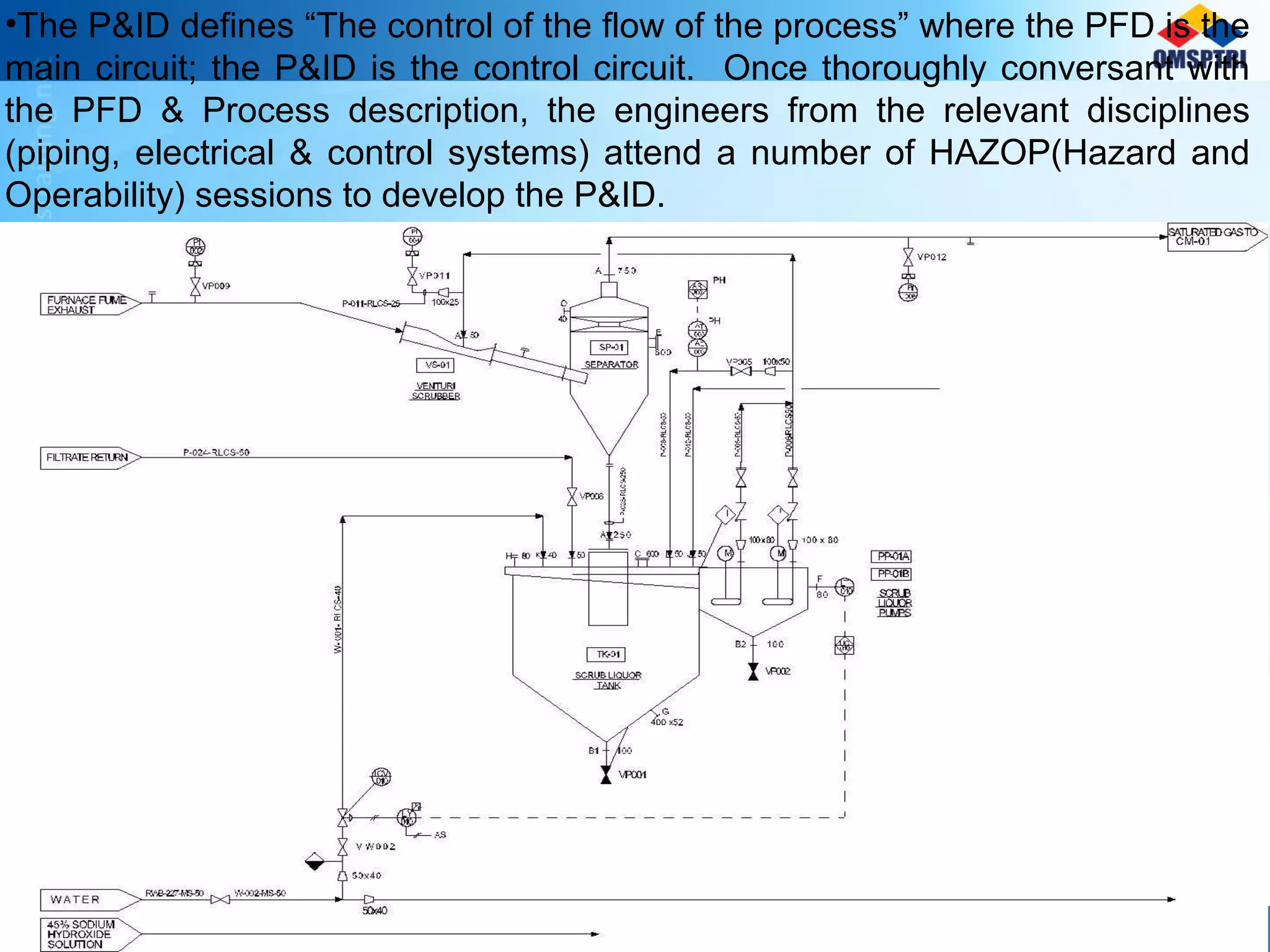
•The P&ID defines “The control of the flow of the process” where the PFD is the
main circuit; the P&ID is the control circuit. Once thoroughly conversant with
the PFD & Process description, the engineers from the relevant disciplines
(piping, electrical & control systems) attend a number of HAZOP(Hazard and
Operability) sessions to develop the P&ID.
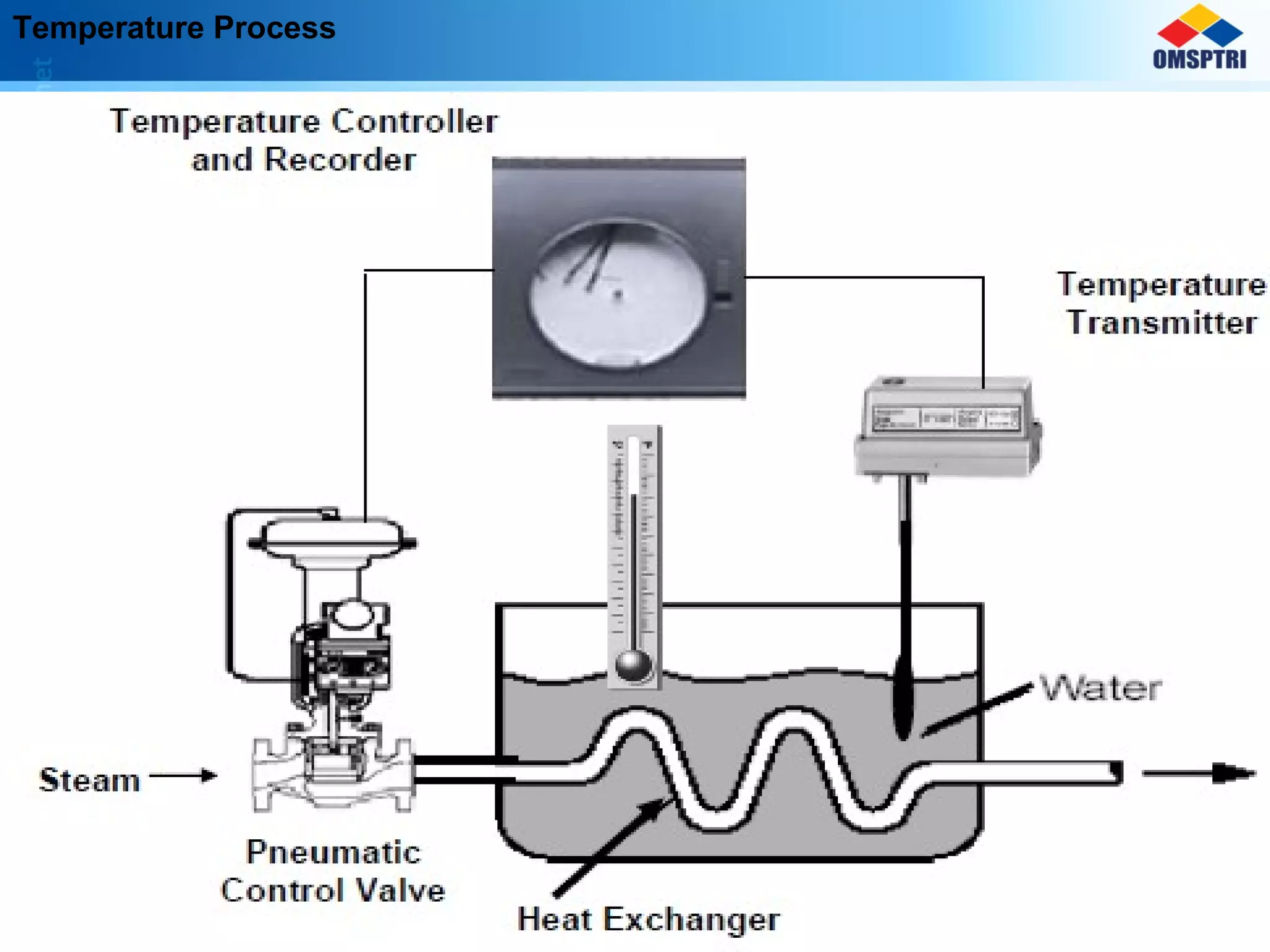
Temperature Process
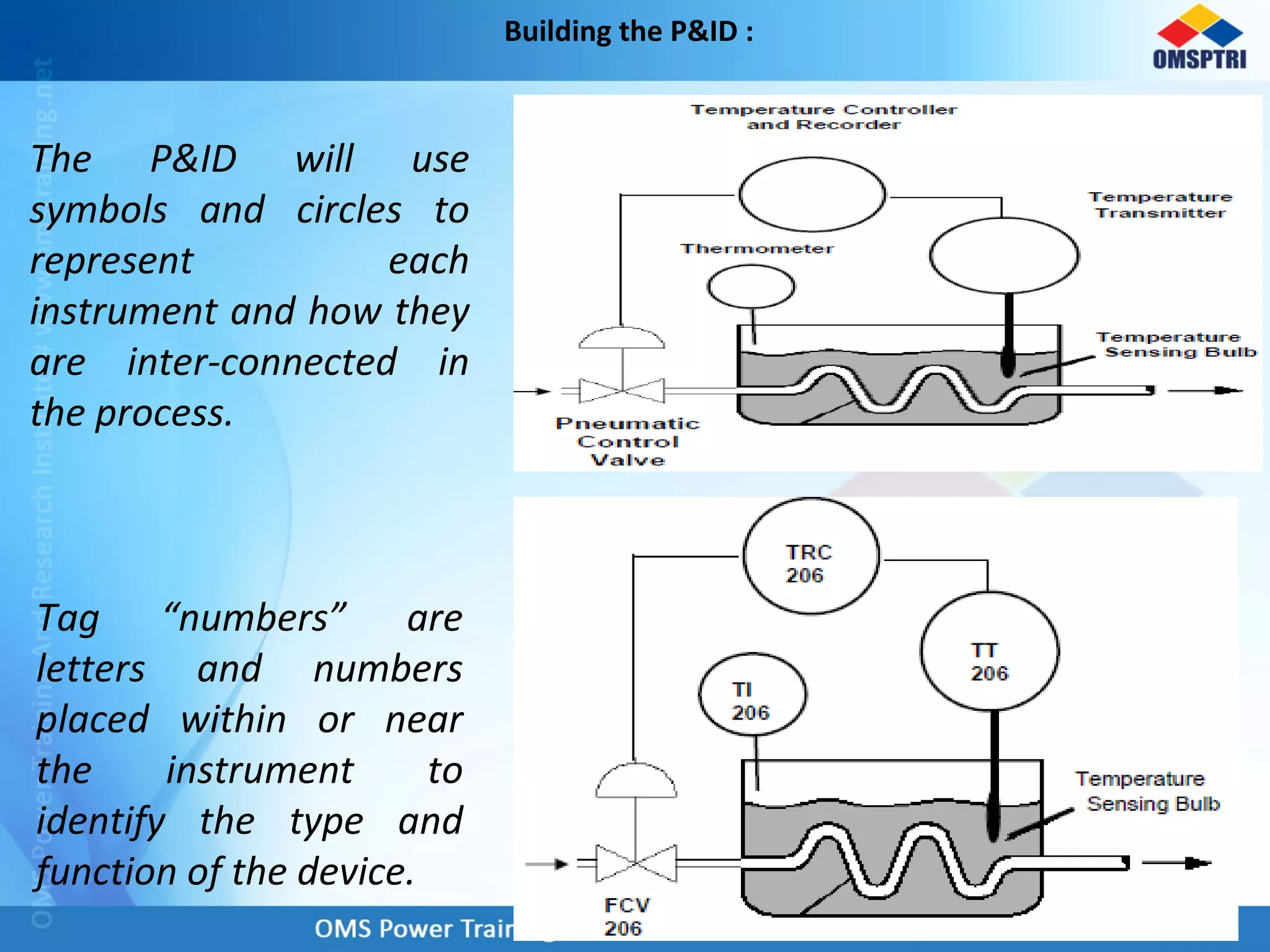
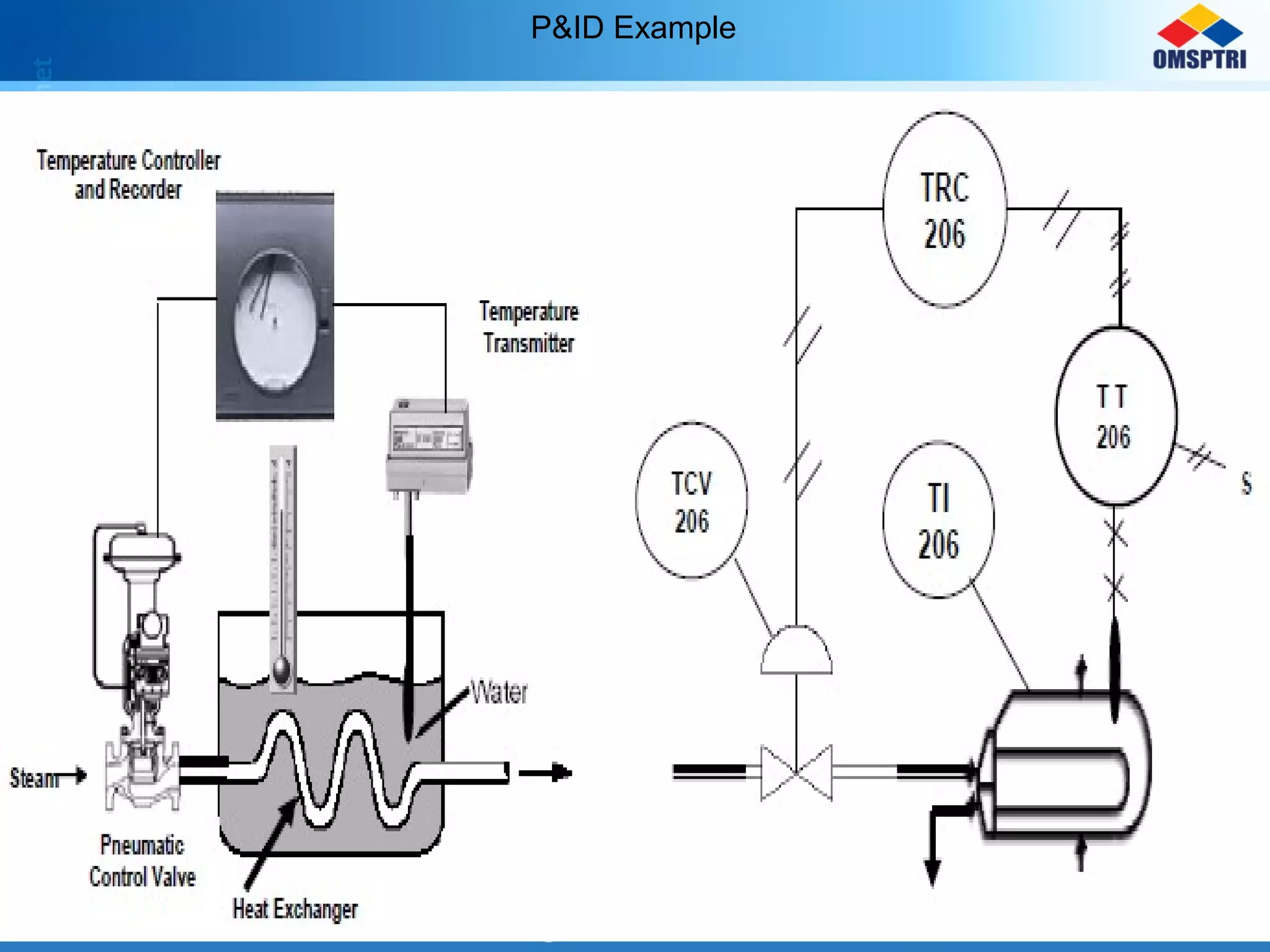
The P&ID will use
symbols and circles to
represent each
instrument and how they
are inter-connected in
the process.
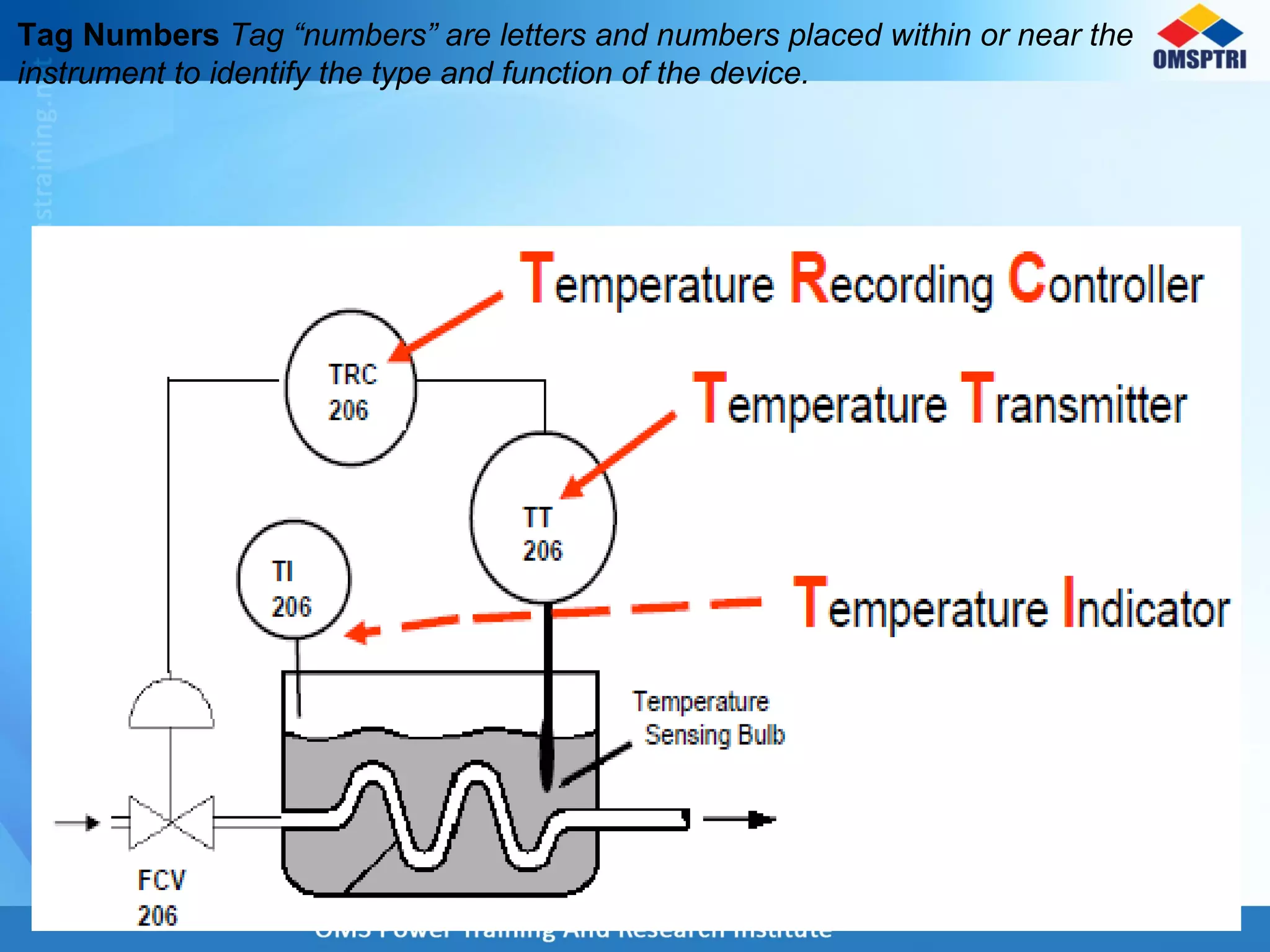
Tag “numbers” are
letters and numbers
placed within or near
the instrument to
identify the type and
function of the device.
Building the P&ID :
Tag Descriptors
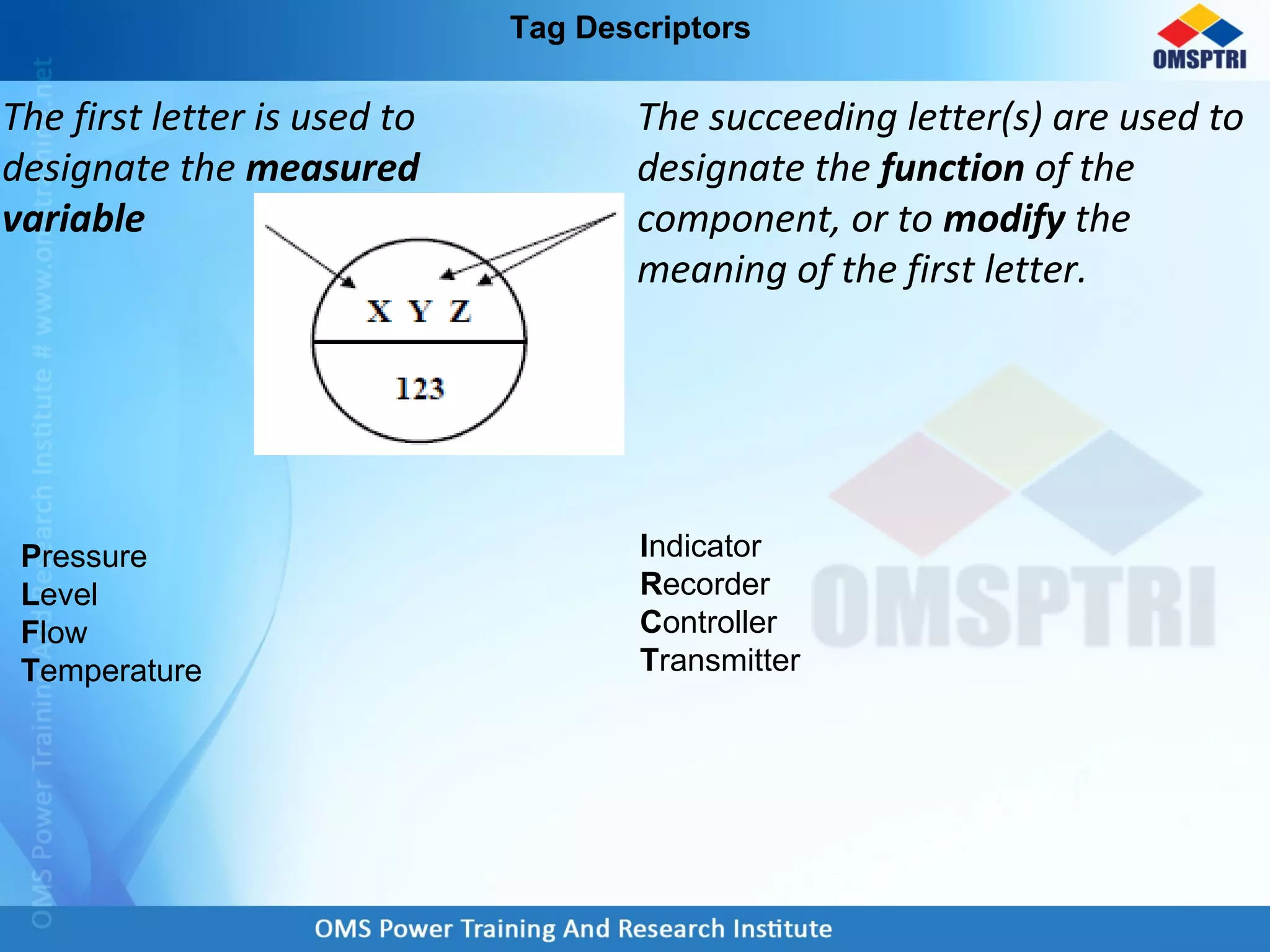
The first letter is used to
designate the measured
variable
The succeeding letter(s) are used to
designate the function of the
component, or to modify the
meaning of the first letter.
Pressure
Level
Flow
Temperature
Indicator
Recorder
Controller
Transmitter
Tag Numbers Tag “numbers” are letters and numbers placed within or near the
instrument to identify the type and function of the device.
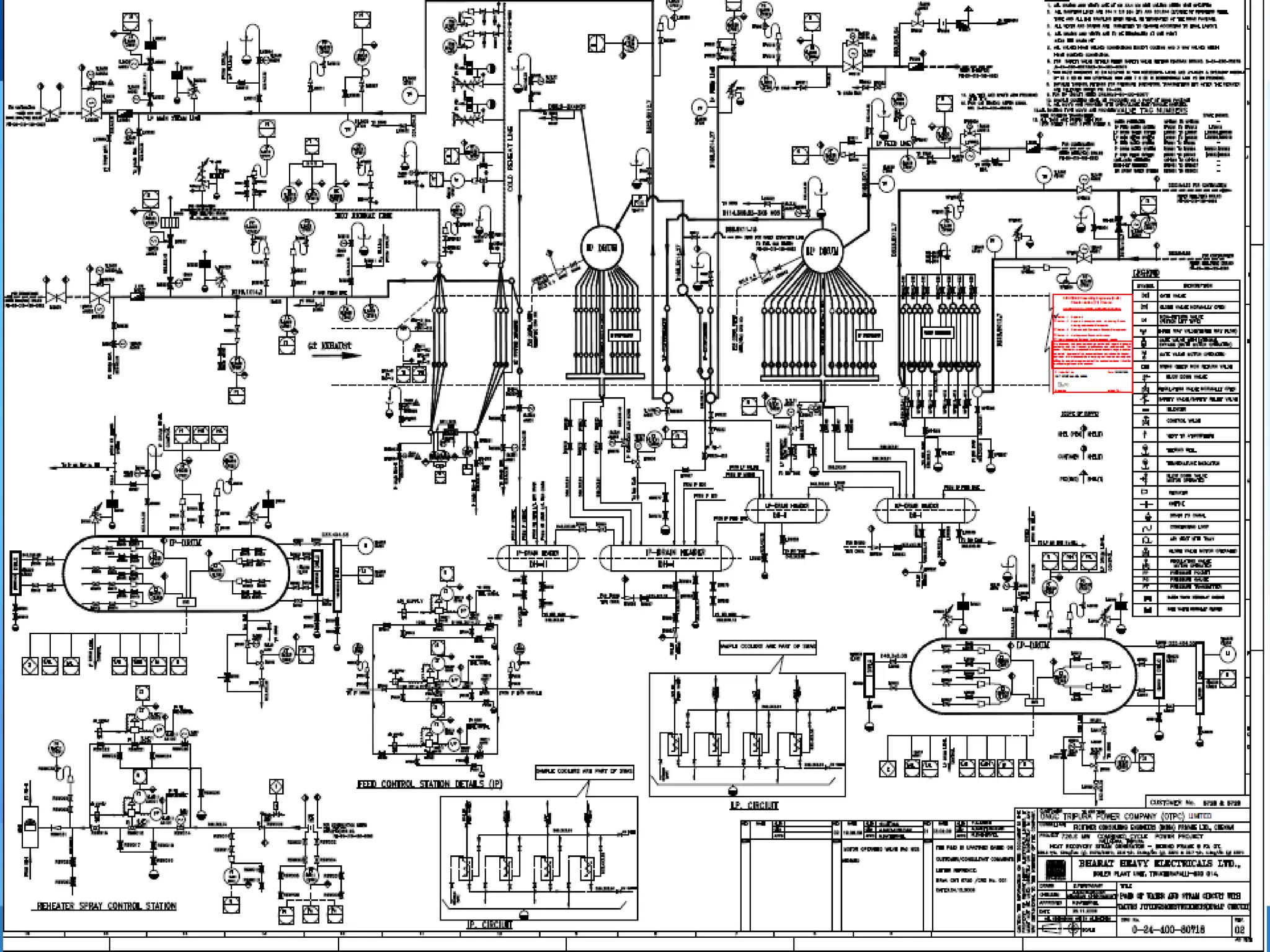
P&ID Example
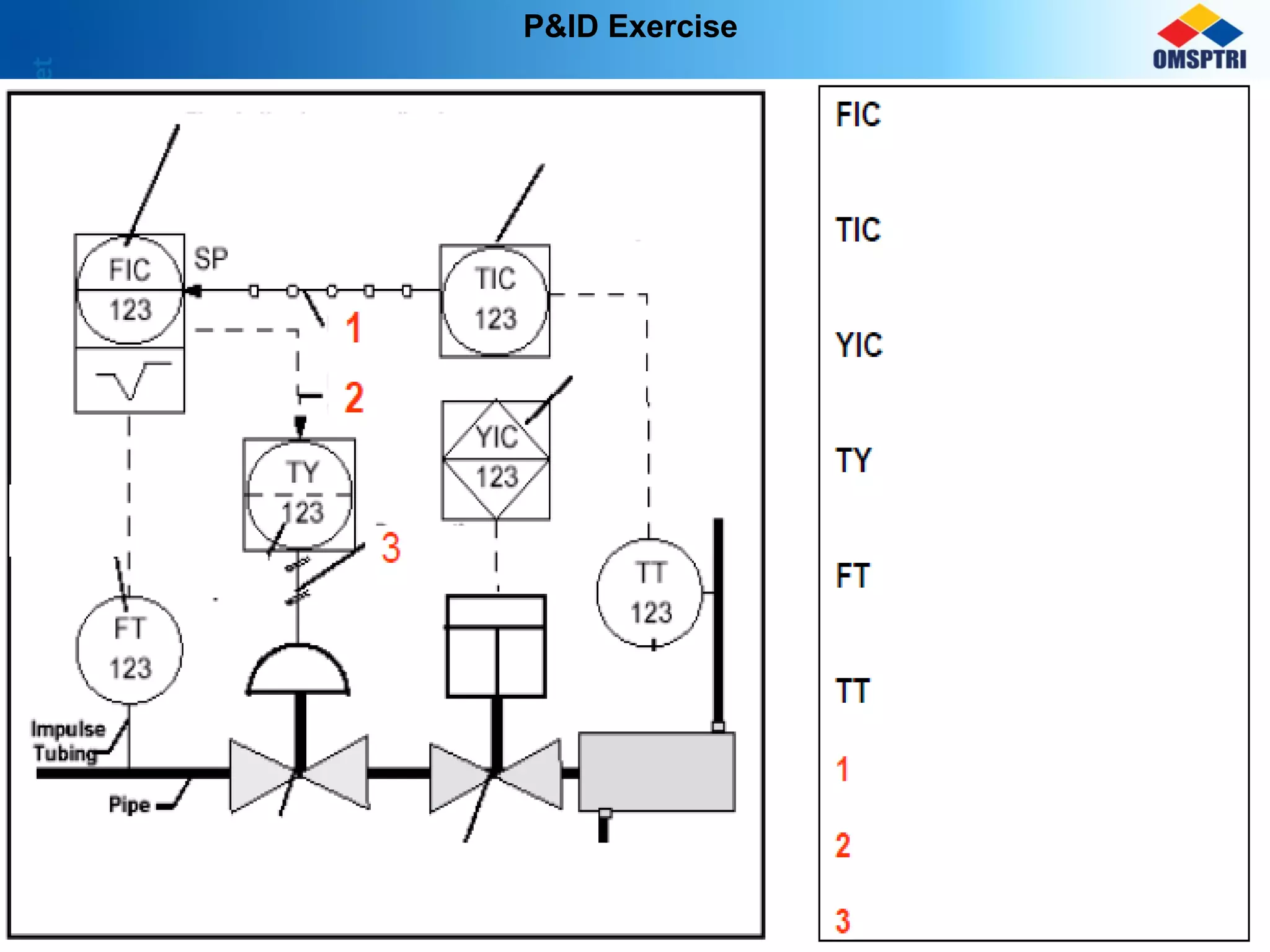
P&ID Exercise
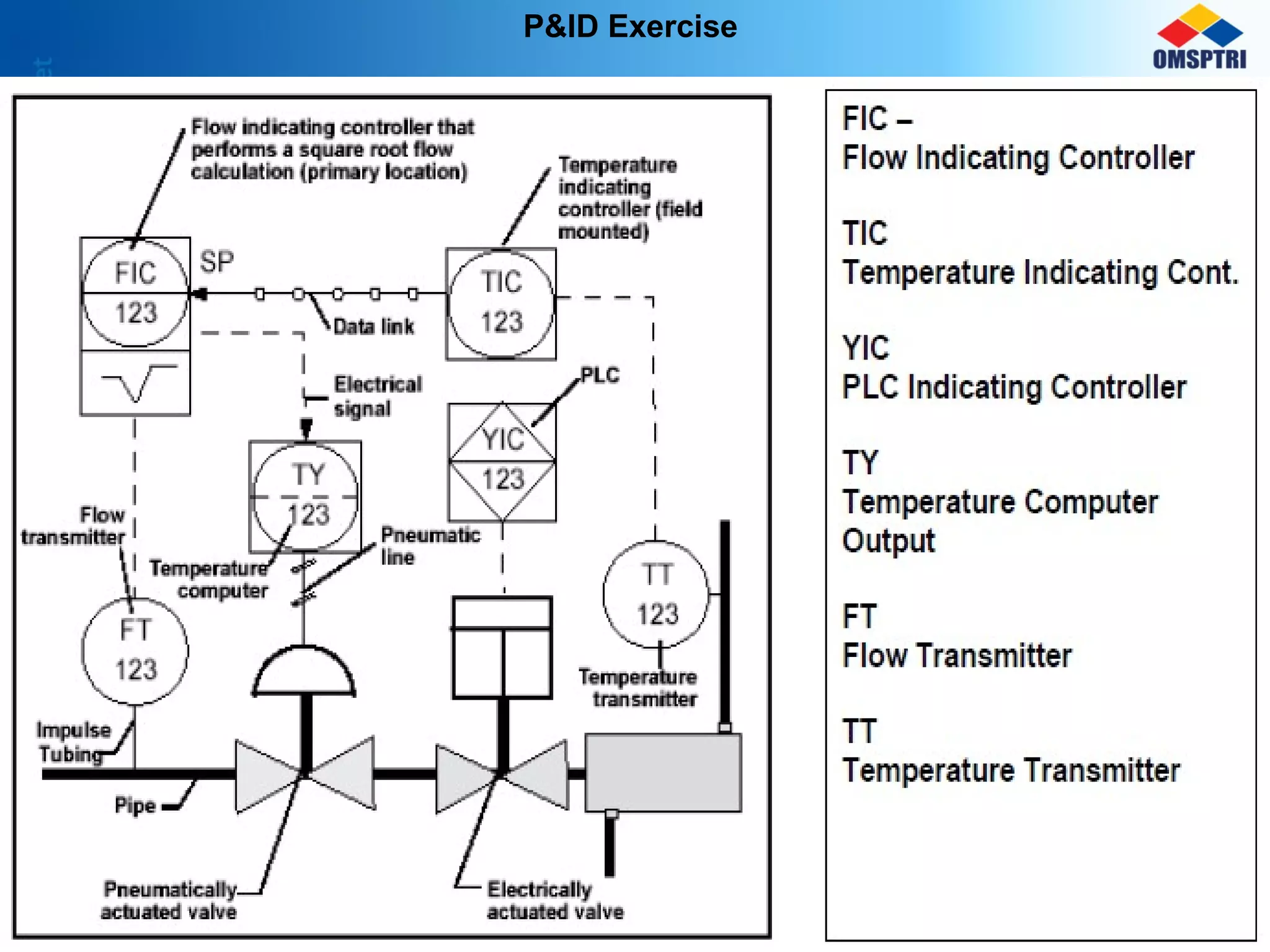
P&ID Exercise
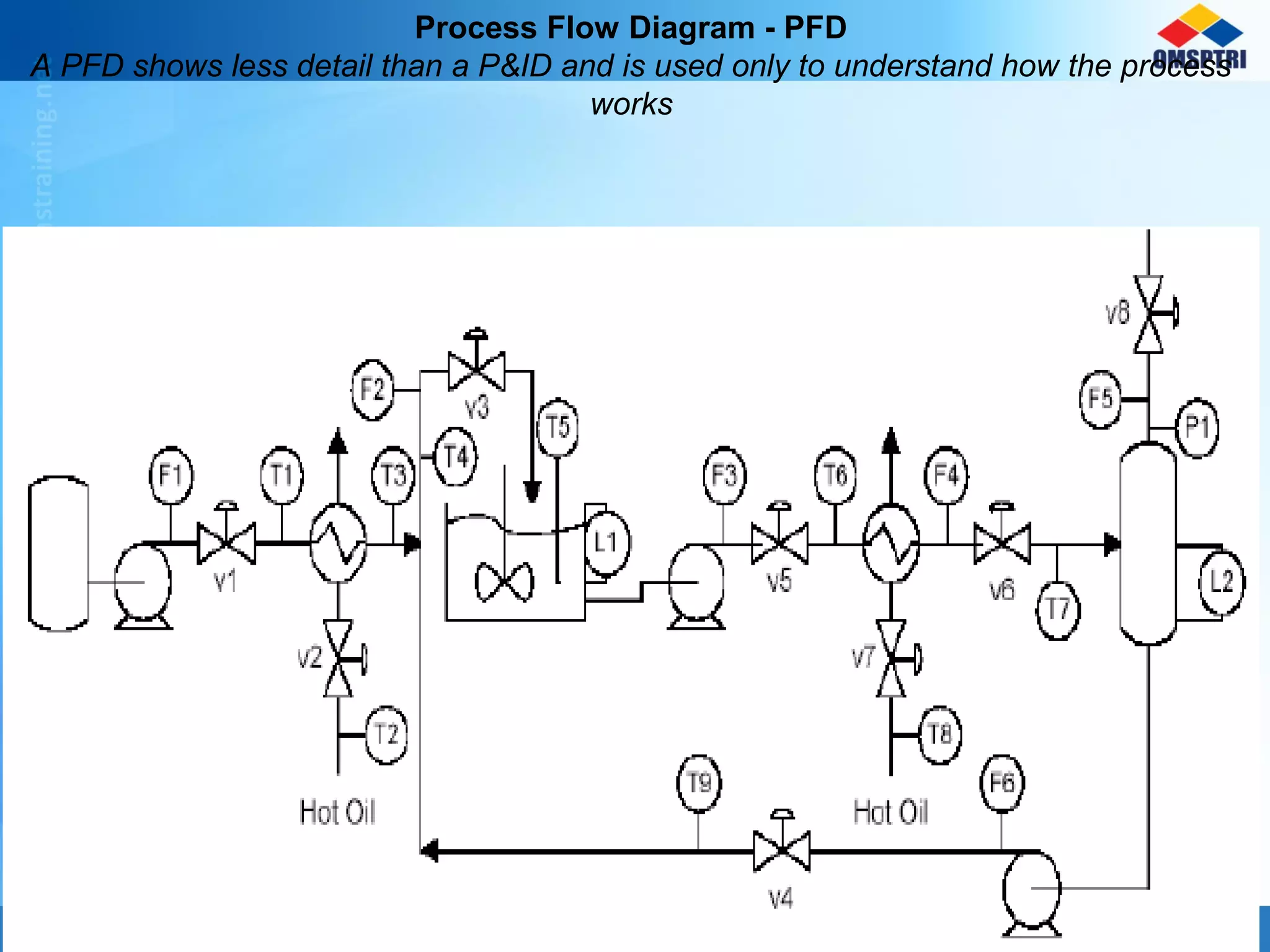
Process Flow Diagram - PFD
A PFD shows less detail than a P&ID and is used only to understand how the process
works
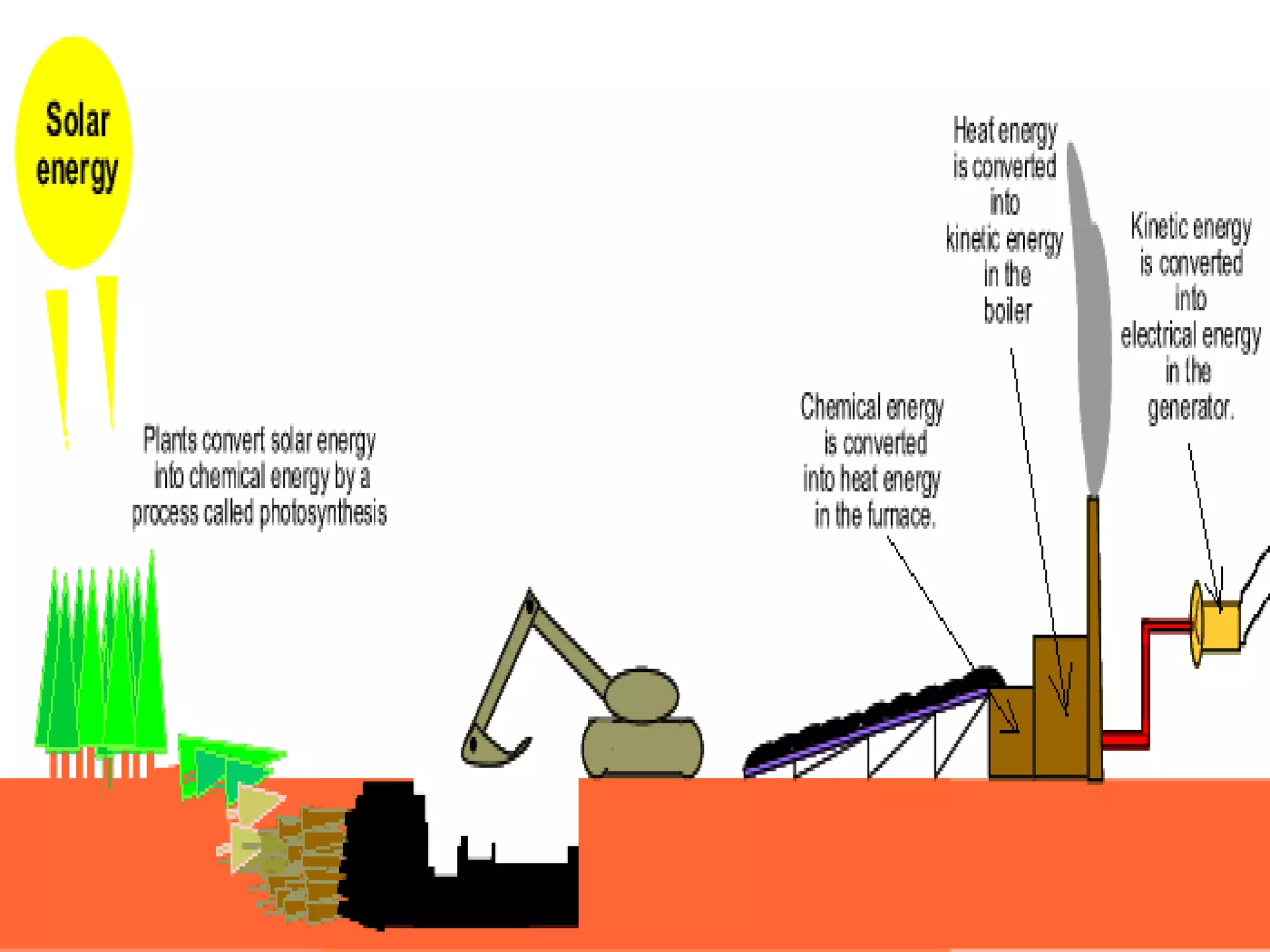
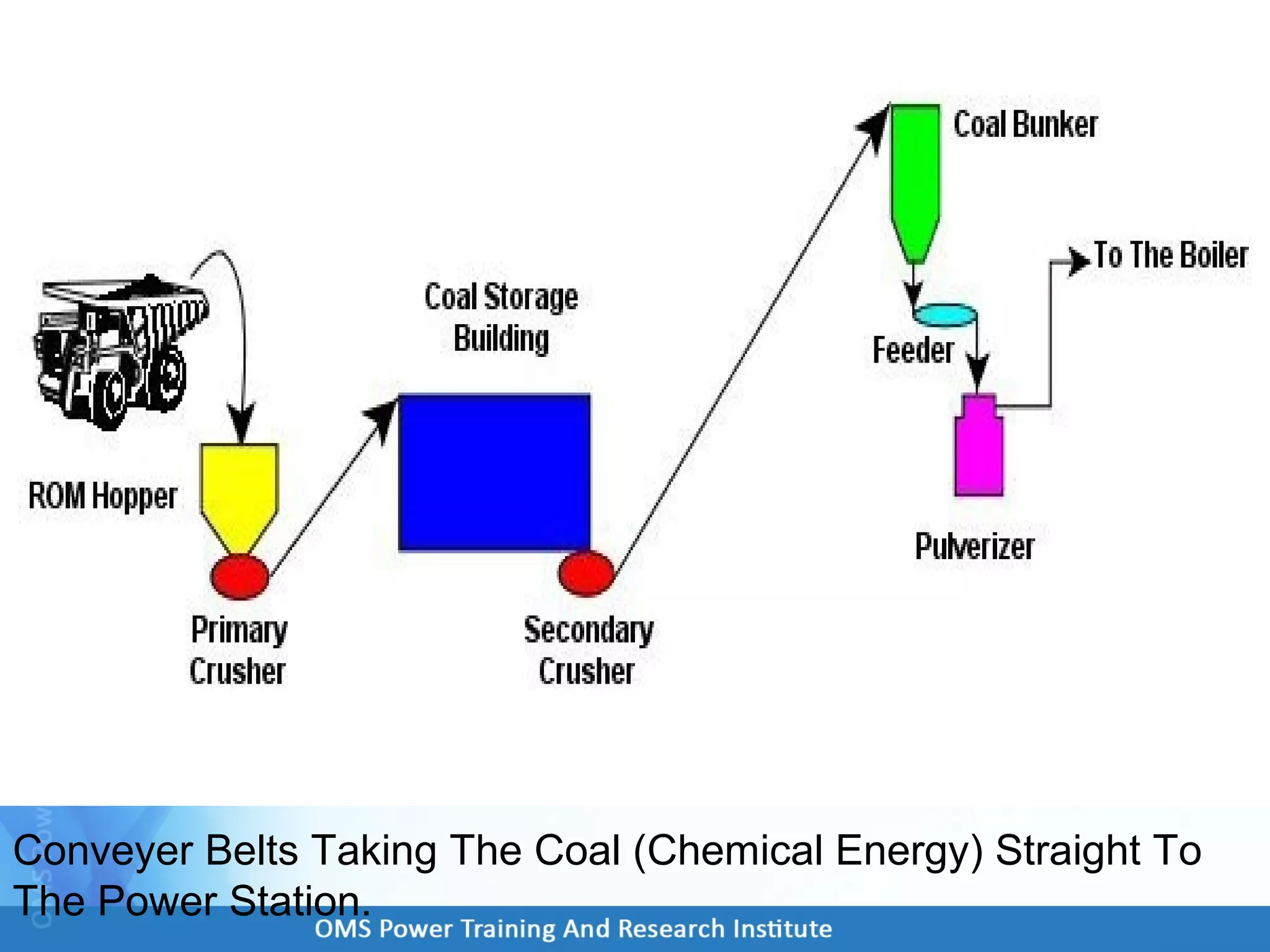
Conveyer Belts Taking The Coal (Chemical Energy) Straight To
The Power Station.
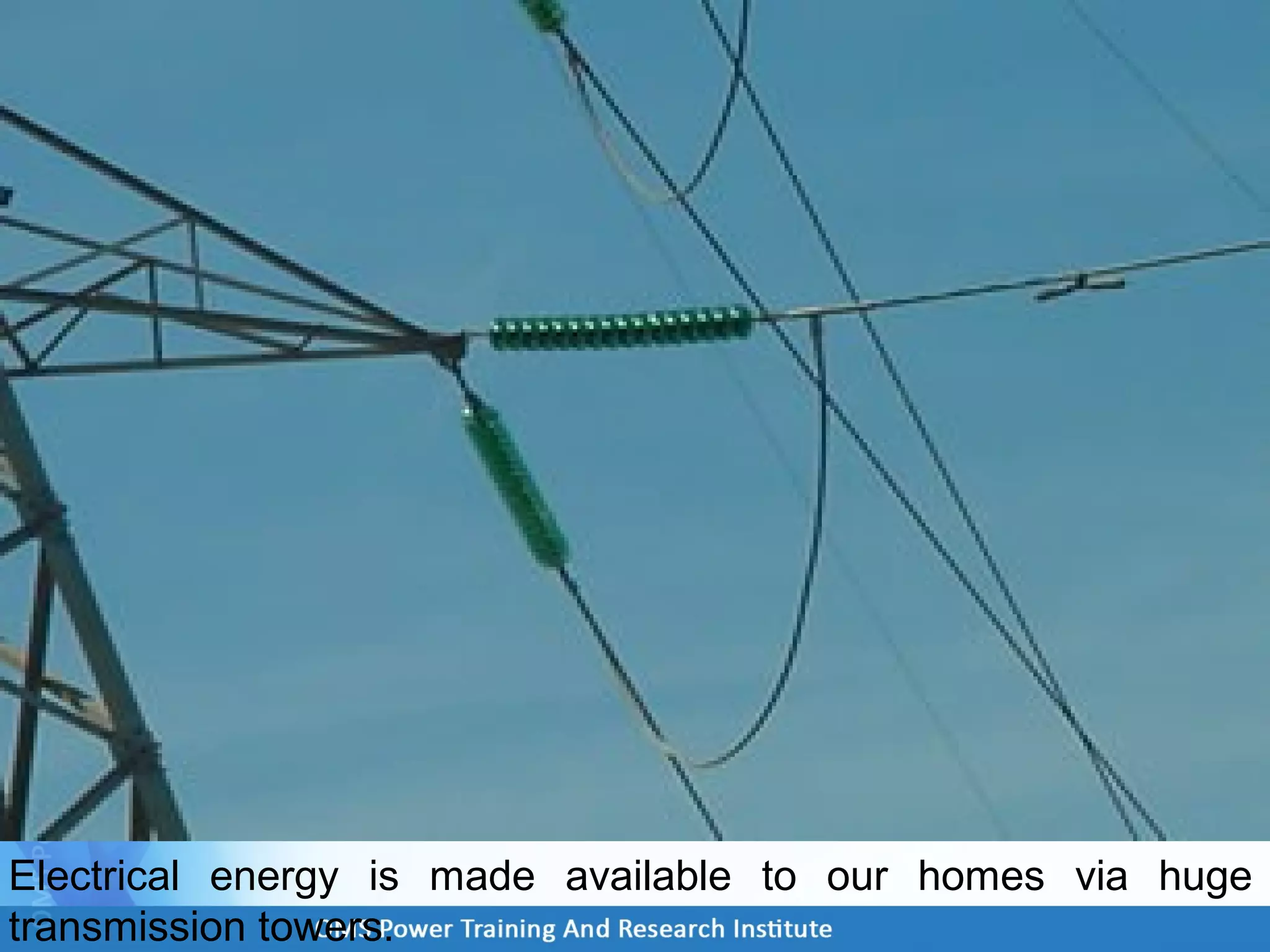
Electrical energy is made available to our homes via huge
transmission towers.
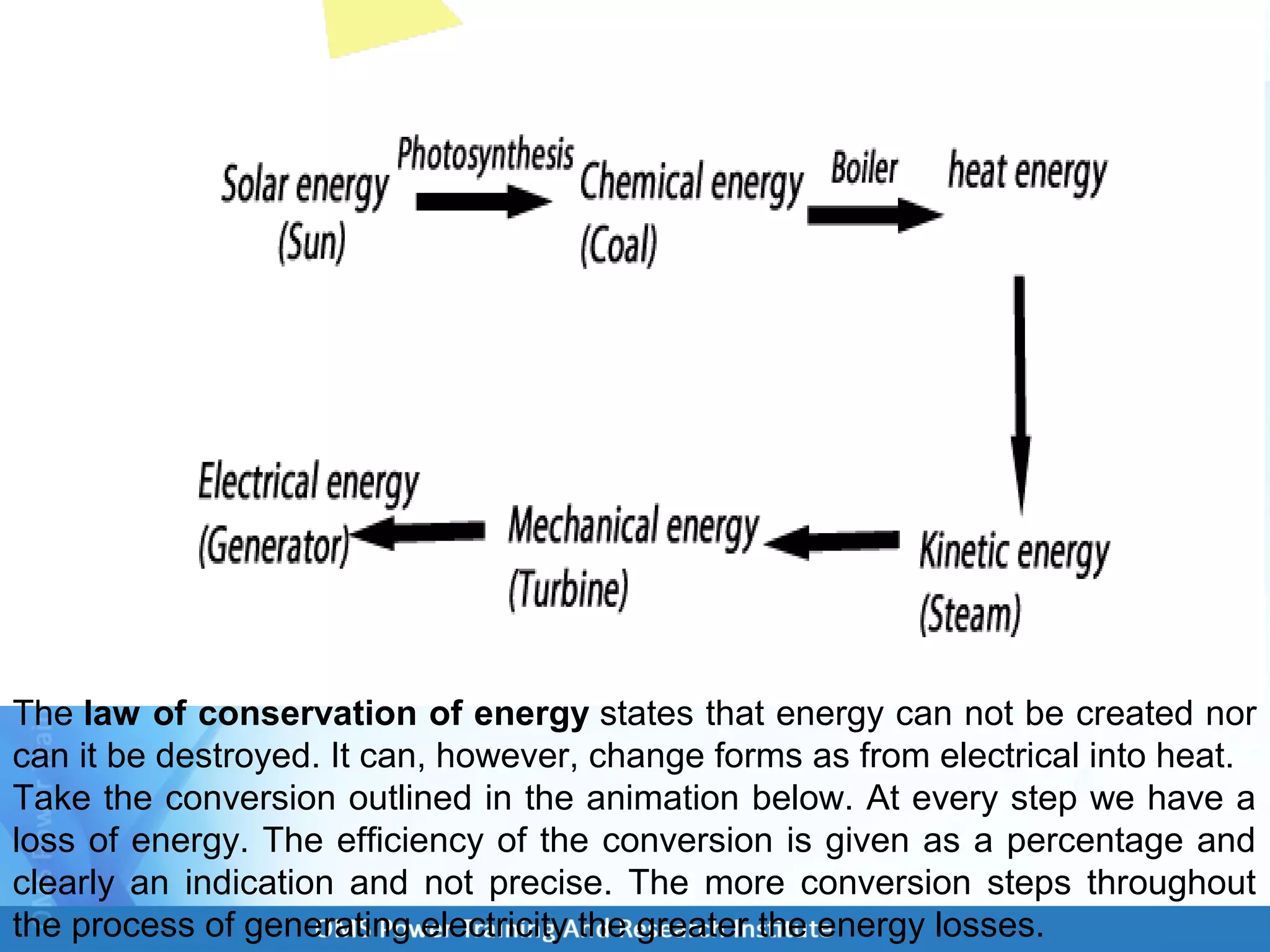
The law of conservation of energy states that energy can not be created nor
can it be destroyed. It can, however, change forms as from electrical into heat.
Take the conversion outlined in the animation below. At every step we have a
loss of energy. The efficiency of the conversion is given as a percentage and
clearly an indication and not precise. The more conversion steps throughout
the process of generating electricity the greater the energy losses.
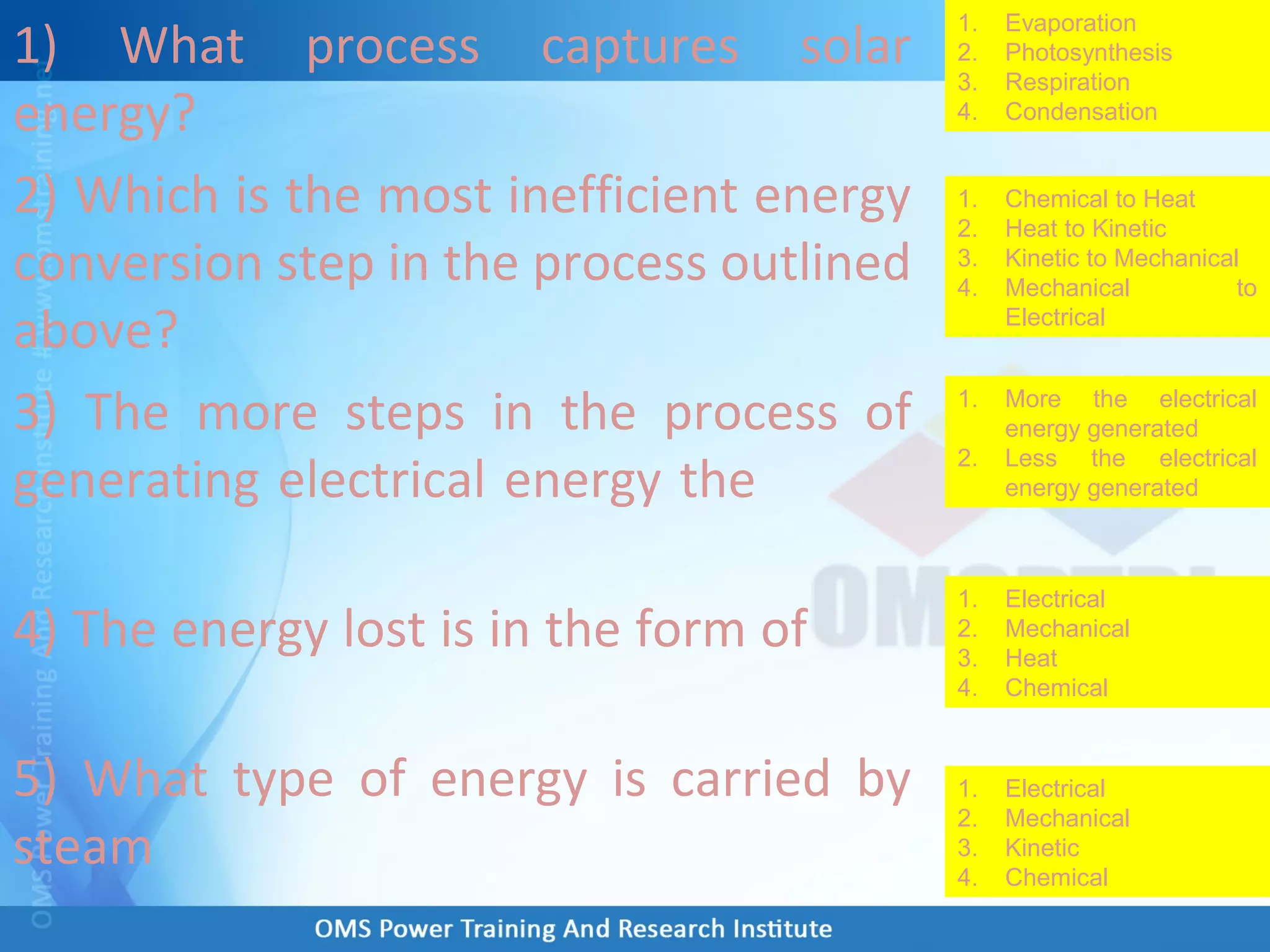
1) What process captures solar
energy?
2) Which is the most inefficient energy
conversion step in the process outlined
above?
3) The more steps in the process of
generating electrical energy the
4) The energy lost is in the form of
5) What type of energy is carried by
steam
1. Evaporation
2. Photosynthesis
3. Respiration
4. Condensation
1. Chemical to Heat
2. Heat to Kinetic
3. Kinetic to Mechanical
4. Mechanical to
Electrical
1. More the electrical
energy generated
2. Less the electrical
energy generated
1. Electrical
2. Mechanical
3. Heat
4. Chemical
1. Electrical
2. Mechanical
3. Kinetic
4. Chemical
1. The light globe provides us with
2. An incandescent light globe works
on heating a metal filament until it
glows brightly. What are the energy
conversion taking place in the
globe?
3. This type of globe is only 2%
efficient. What does this mean?
4. Most of the energy coming into the
light globe is transformed into
1. Electrical
2. Light
3. Heat
4. Chemical
1. Electrical>Heat>Light
2. Electrical>Chemical>He
at
3. Chemical>Heat>Light
4. Chemical>Heat> Light
1. 92% loss
2. 102% efficient
3. 98% loss
4. 98% efficient
1. Electrical
2. Light
3. Heat
4. Chemical
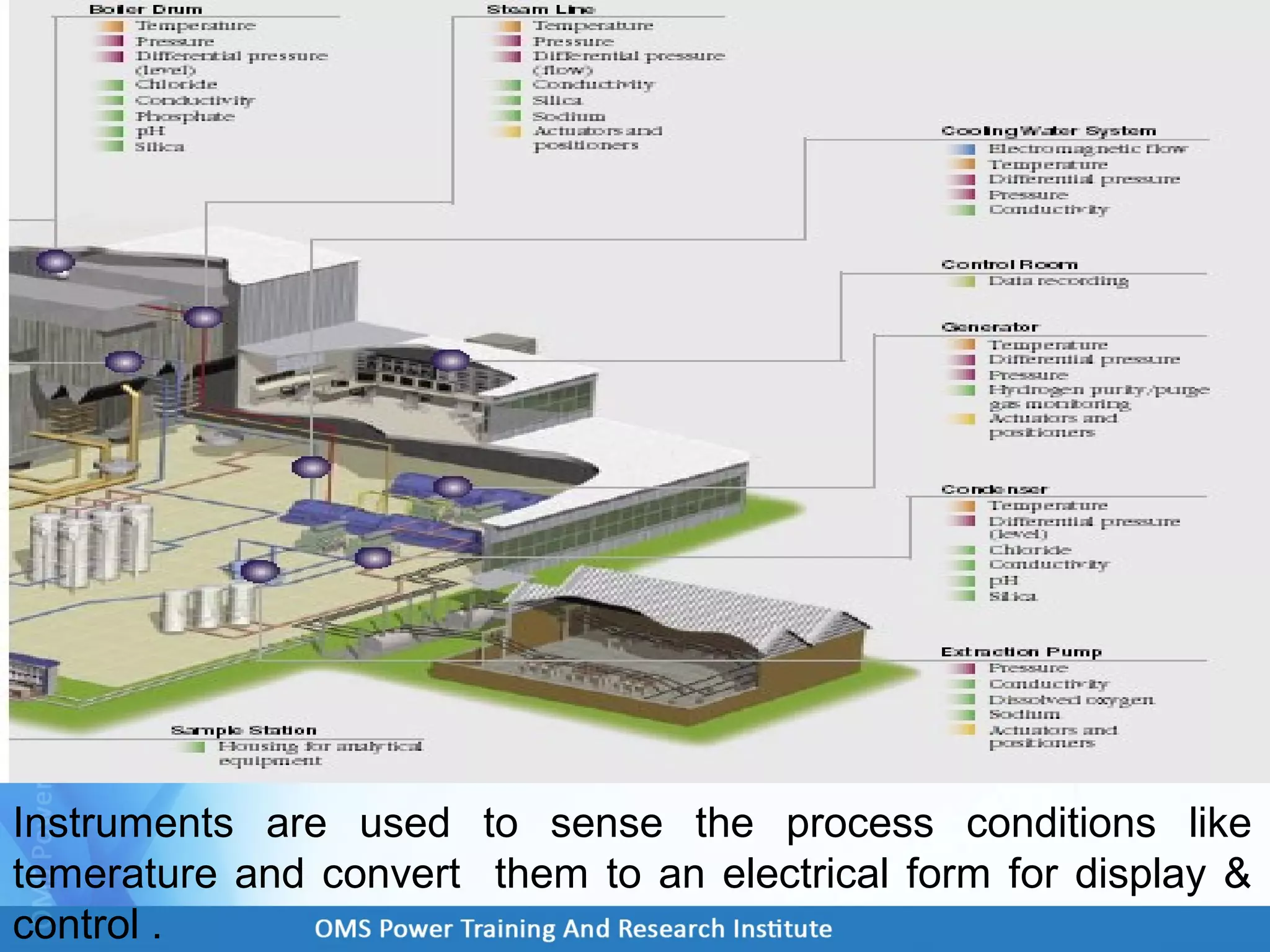
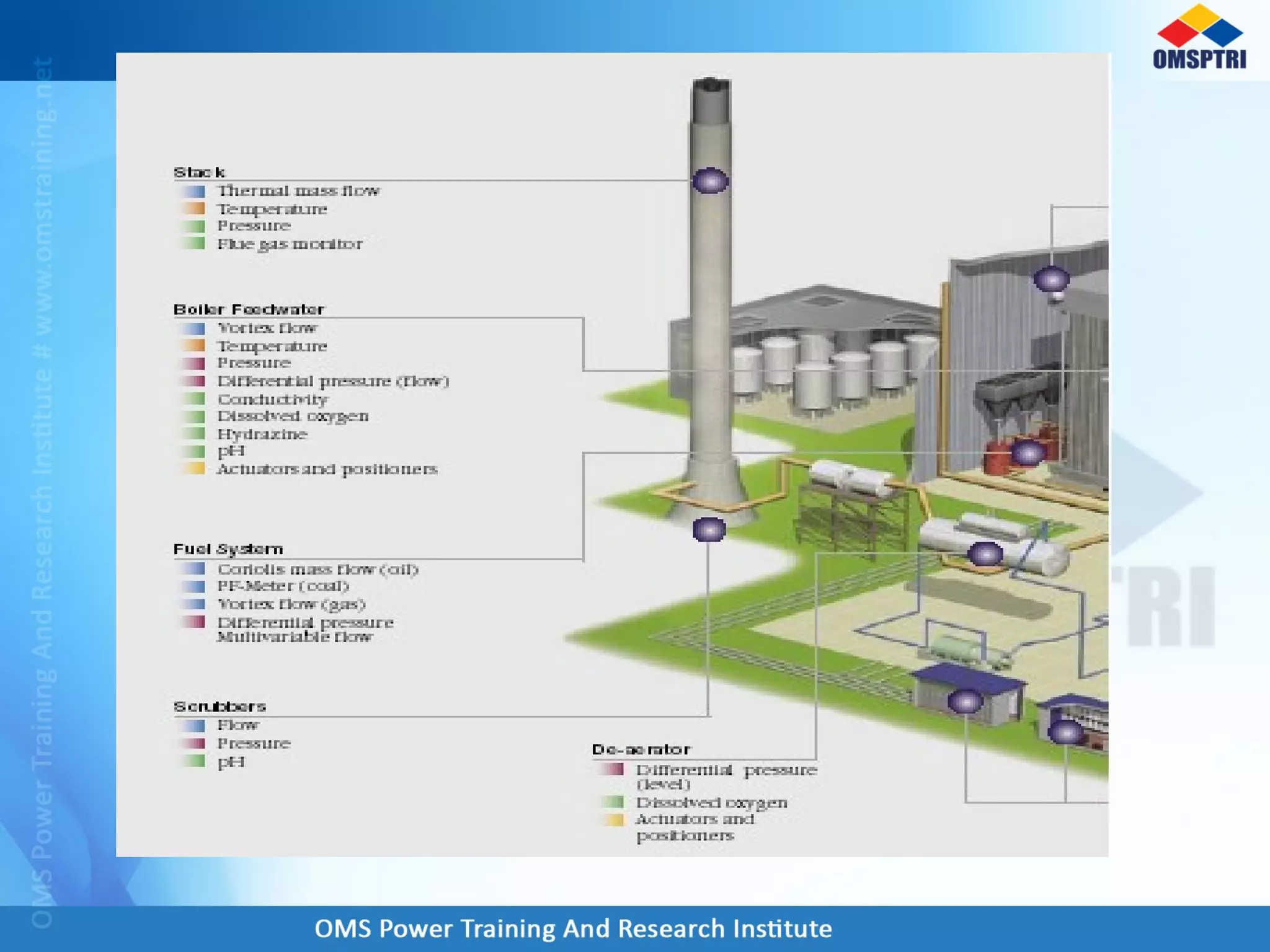
Instruments are used to sense the process conditions like
temerature and convert them to an electrical form for display &
control .
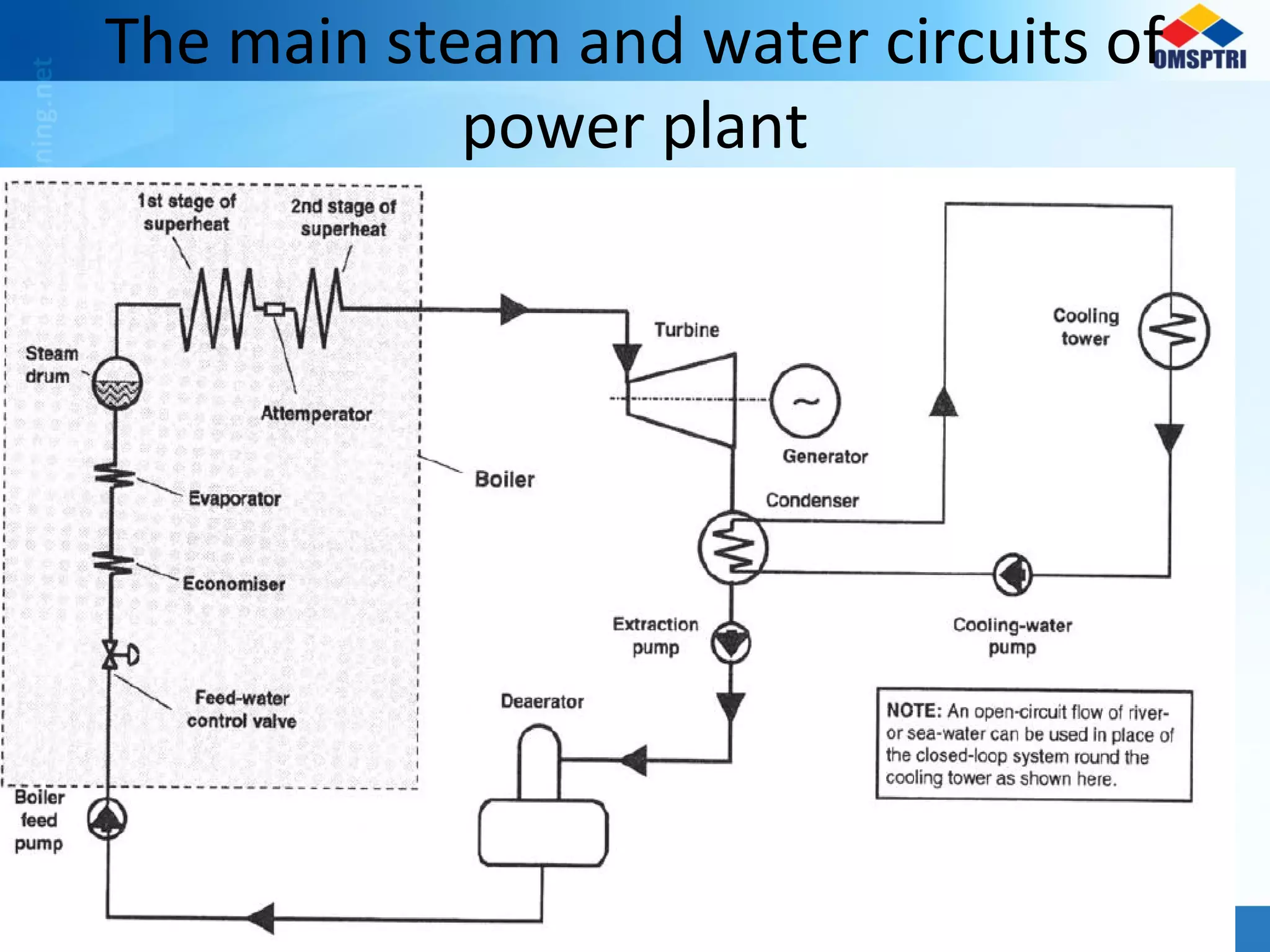
The main steam and water circuits of
power plant
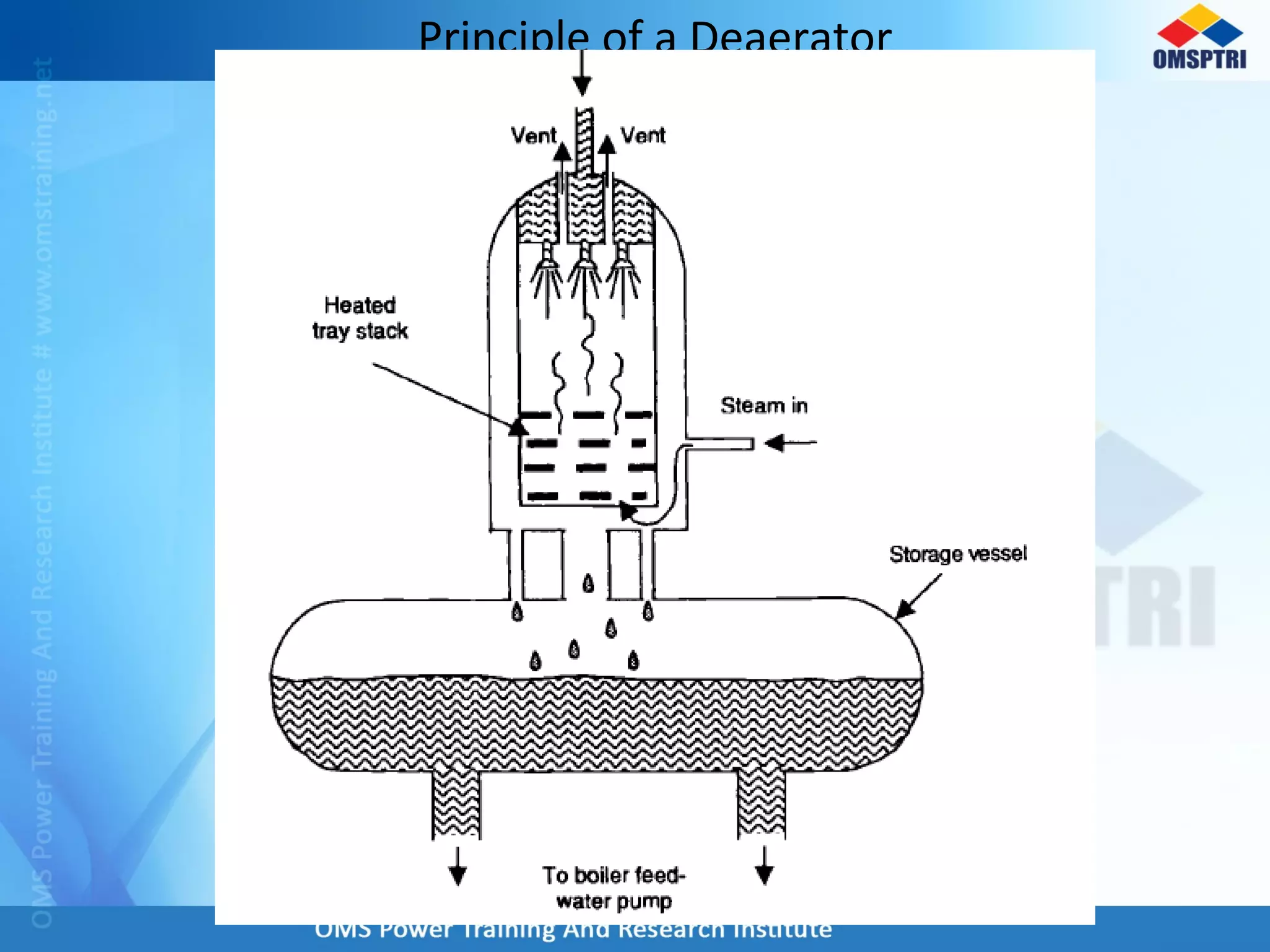
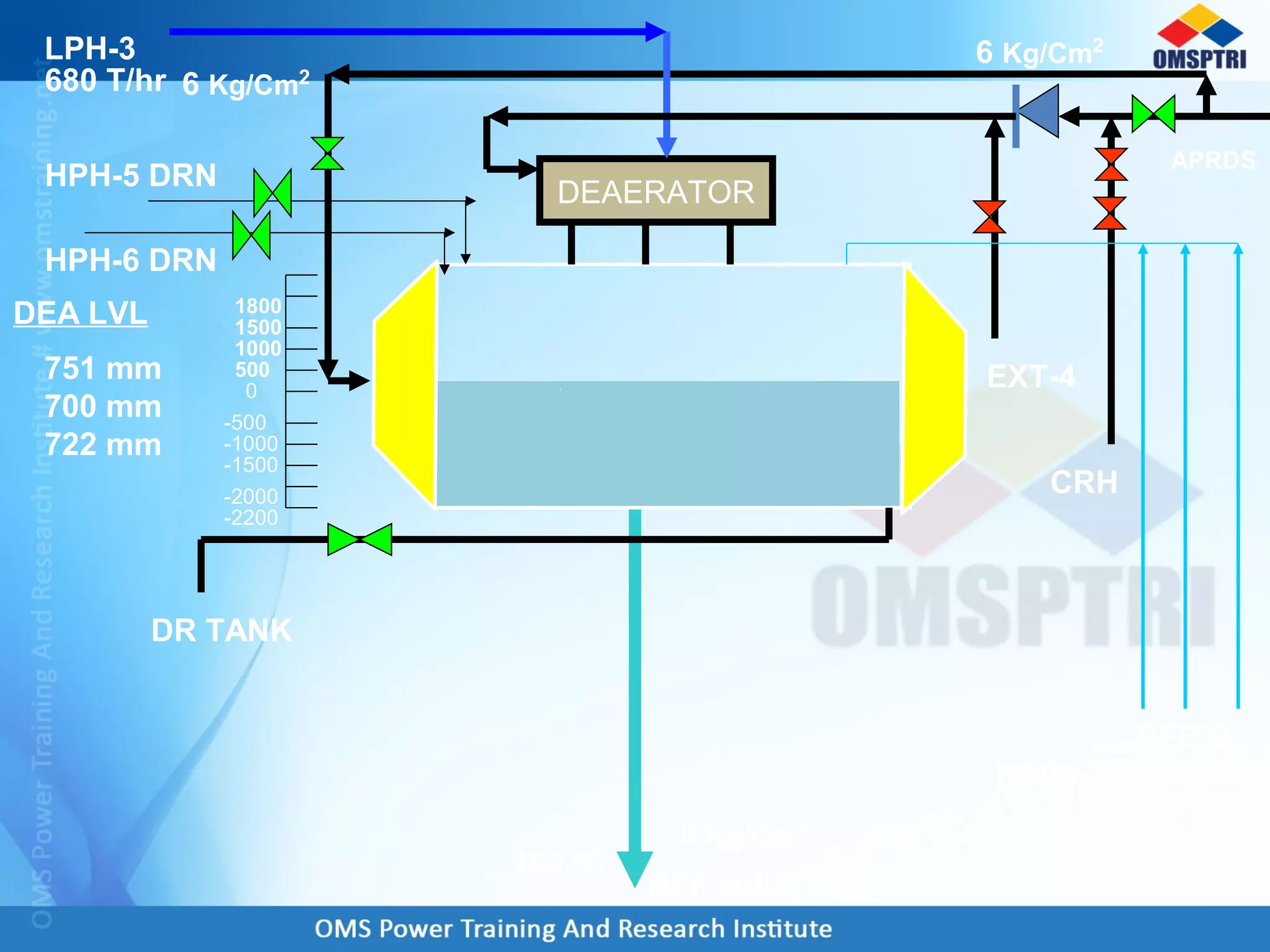
Principle of a Deaerator
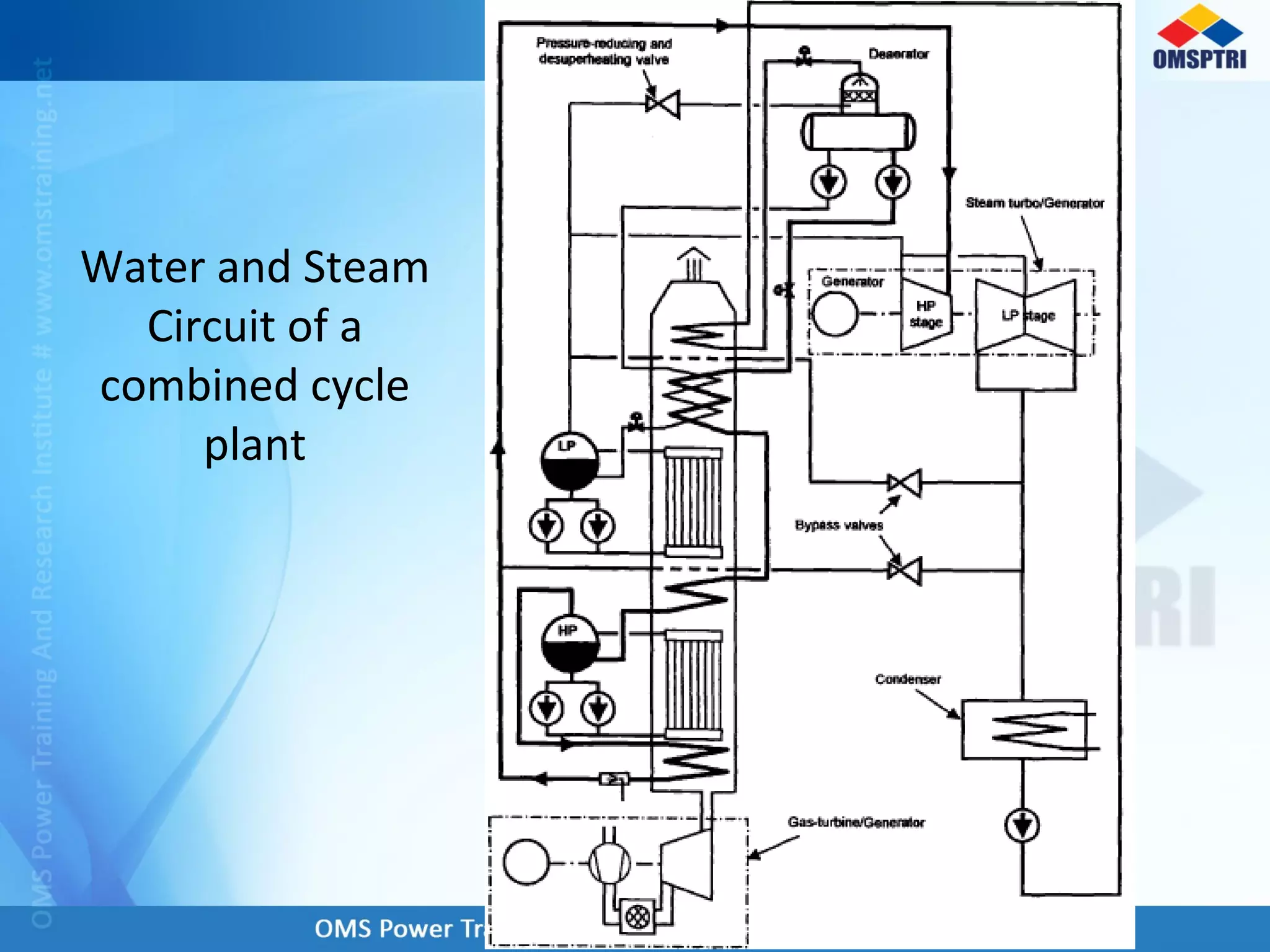
Water and Steam
Circuit of a
combined cycle
plant
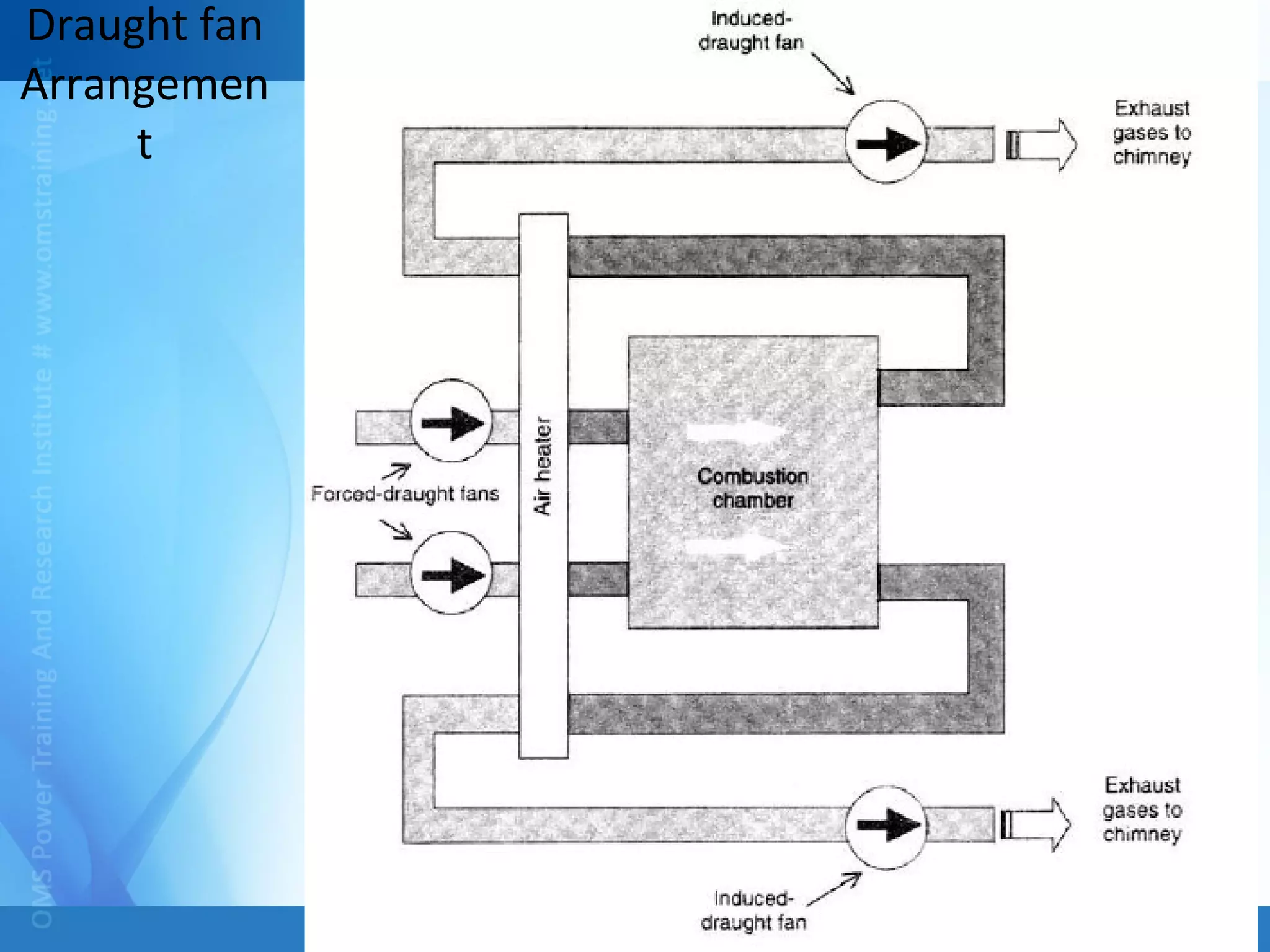
Draught fan
Arrangemen
t
BOILER INSTRUMENTS &
CONTROL
Boiler
Critical parts of the process would include the following
• lighting of the burners
• controlling the level of water in the drum
• controlling the steam pressure
An SIS is engineered to perform "specific control
functions" to failsafe or maintain safe operation of a
process when unacceptable or dangerous conditions
occur- FSSS
Safety Instrumented Systems is independent from all
other control system that control the same equipment
in order to ensure SIS functionality is not compromised.
 SIS is composed of the same types of control elements
(including sensors, logic solvers, actuators and other
control equipment) as a Basic Process Control System
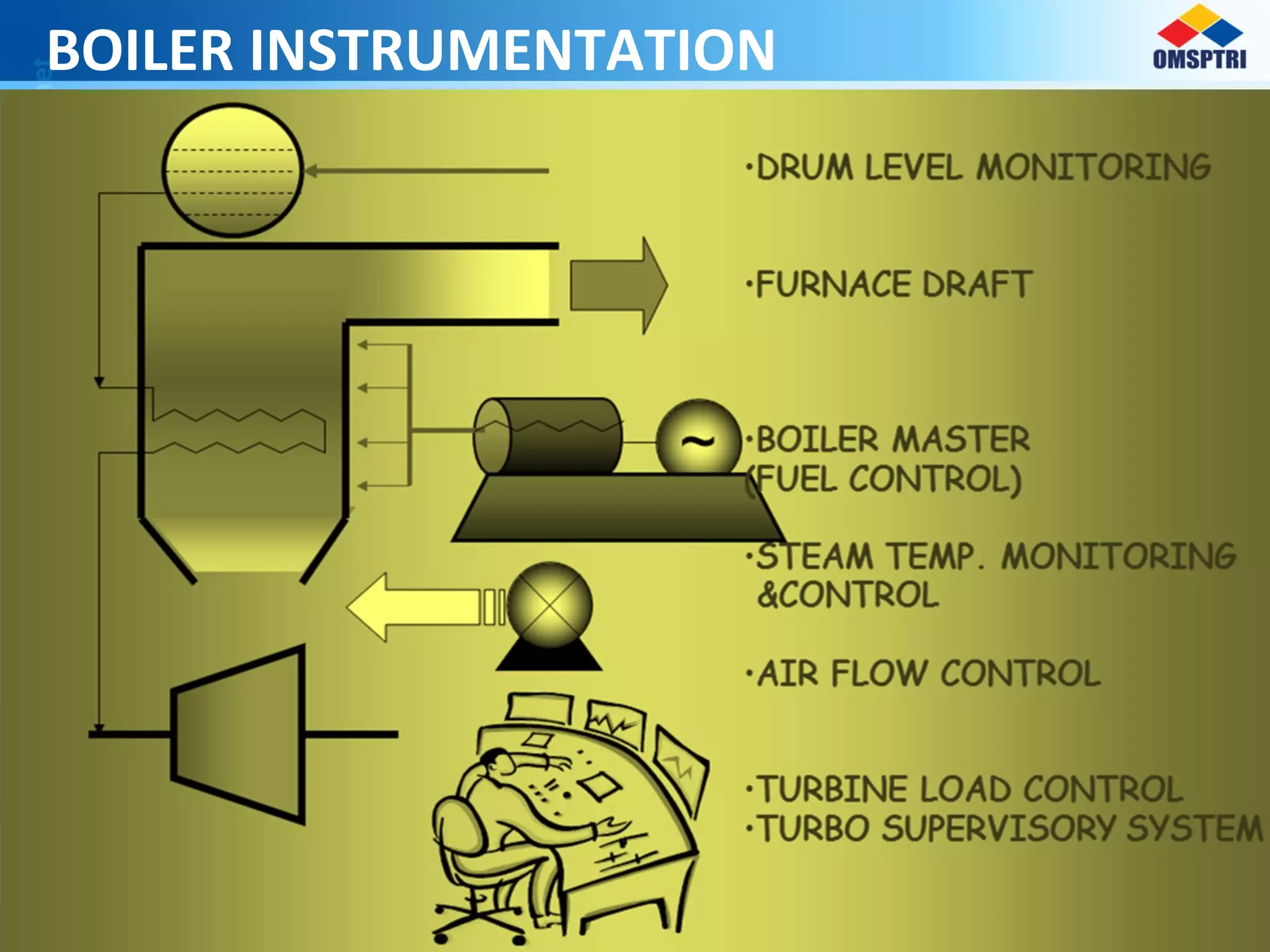
BOILER INSTRUMENTATION
1.FLUE GAS
2.SECONDARY AIR
3.SECONDARY AIR DAMPERS
4.PRIMARY AIR
5.MILLS
6.SCANNERS
7.OIL SYSTEM
8.STEAM CYCLE
9.FEED WATER CYCLE
10.DRUM
11.SOOTBLOWERS AND ASLDS
12.STEAM ,FEEDWATER AND FLUE GAS ANALYSERS
Control
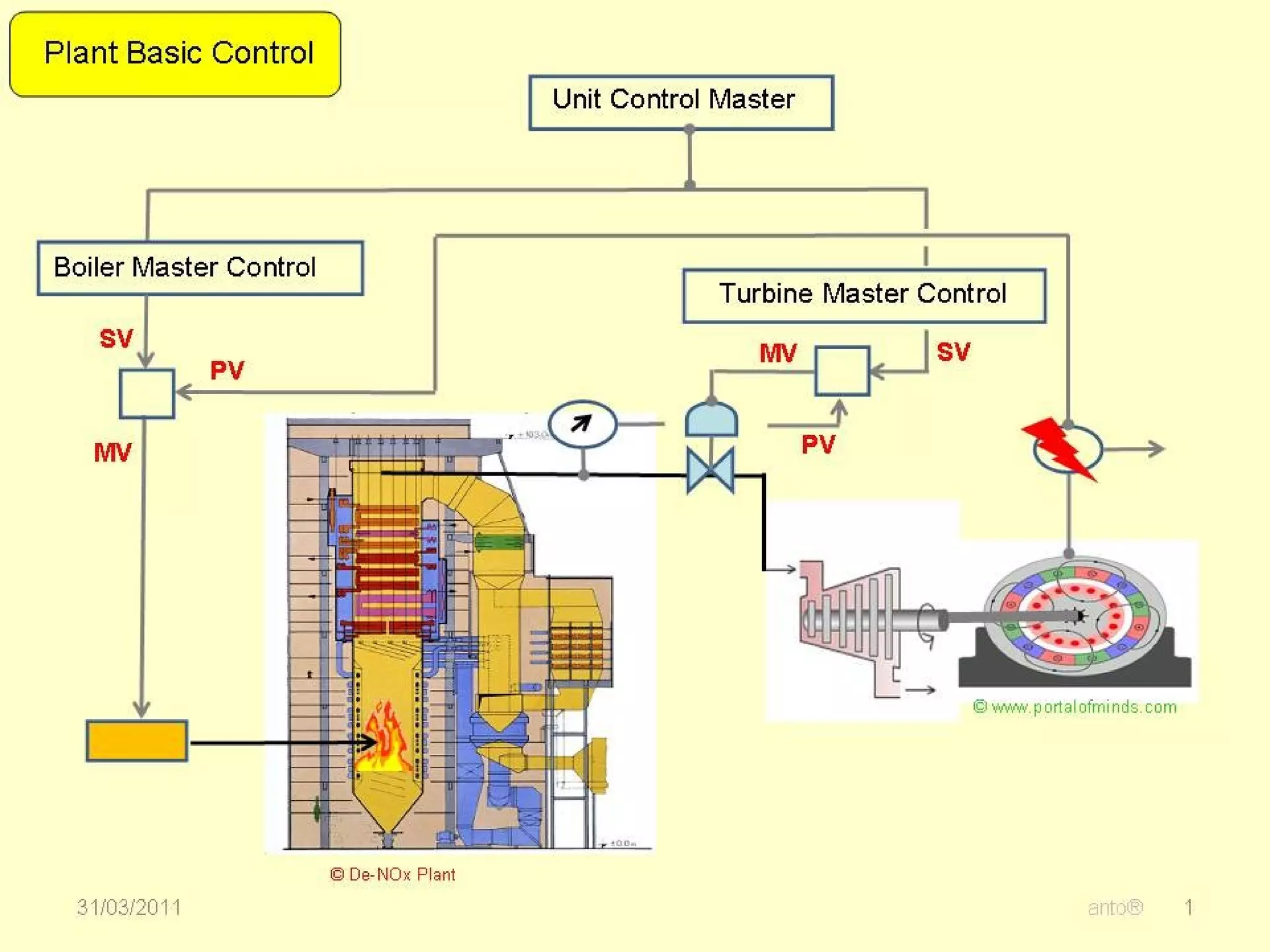
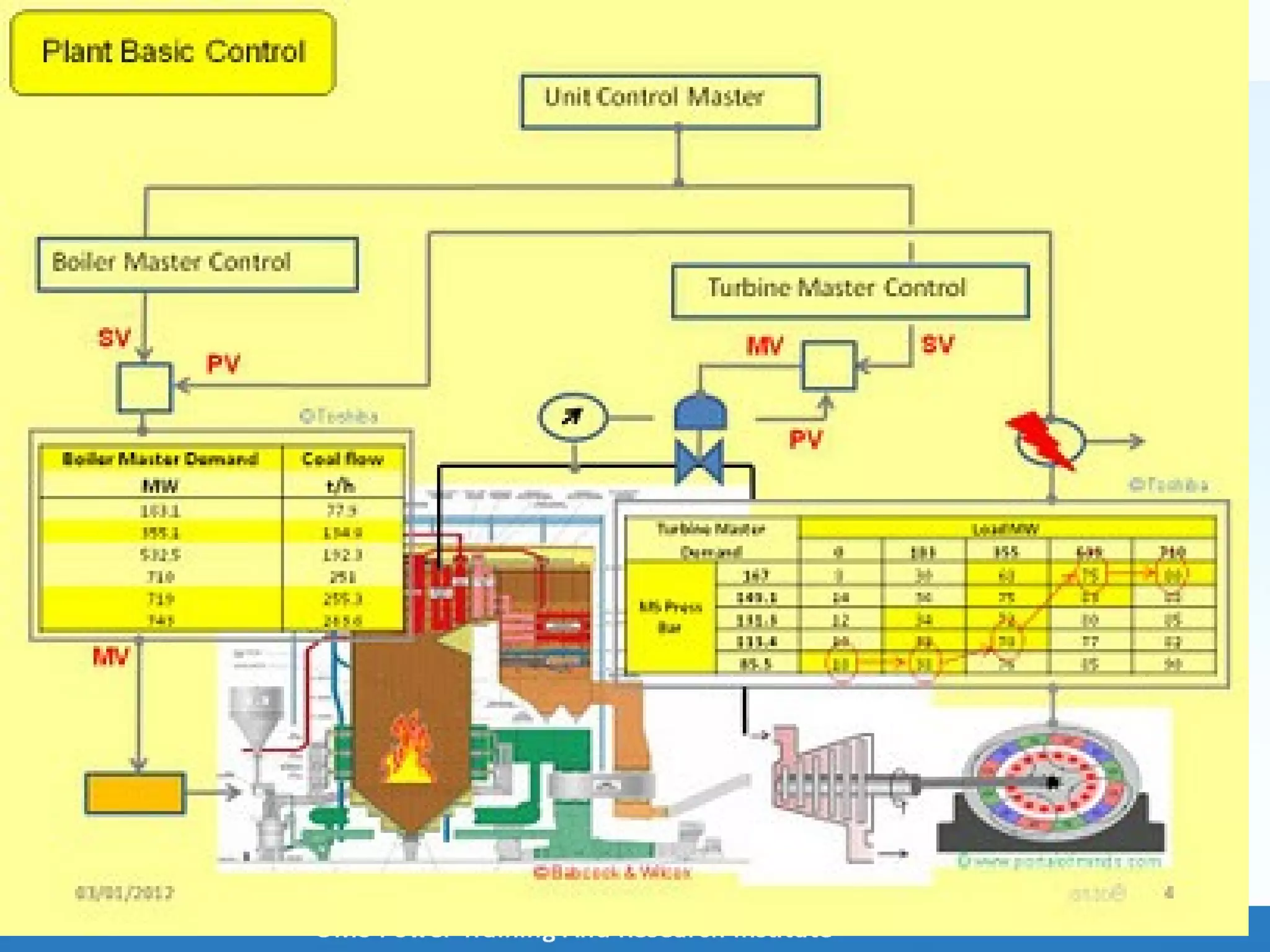
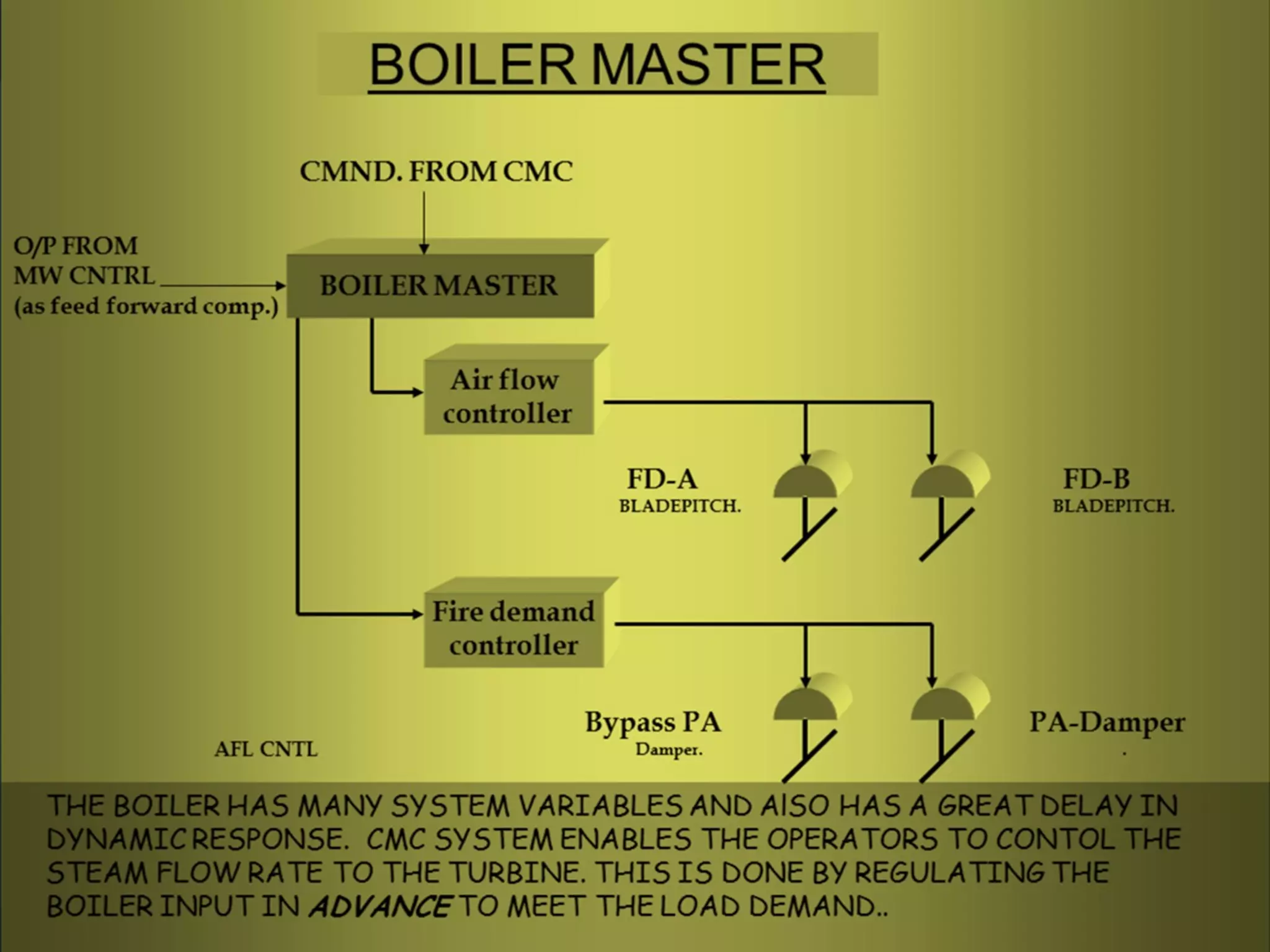
A Plant Control System is an integrated with demand
requirement applied simultaneously to the Boiler, Turbine
and major auxiliary equipment.
Boiler Control
Various types of Boiler control system for fossil fuel Boiler include:
•combustion (fuel and air) control- Total Air Control and Mill Air Flow Control,
•steam temperature control for superheater and reheater control,
•drum level and feedwater flow control,
•burner sequence control and management systems
•bypass and startup
•coordinated Control systems to integrate all of the above with the turbine and electric
generator control,
•data processing, sequence of event recording, trend recording and display ,
•performance calculation and analysis
•alarm annunciation system,
•management information system,
•unit trip system.
•Mill Outlet Temperature Control
•Hotwell Level Control
•LP / HP Heater Level Control
•De-aerator Level / Pressure Control
•Furnace Draft Control
•HFO / LDO Pressure / Flow Control
•event activated logs- alarm log/ trip log
•Time Activated Logs- Shift Log / Daily Log
•Operator Demand Logs- Summary Log, Performance Log, Maintenance Log
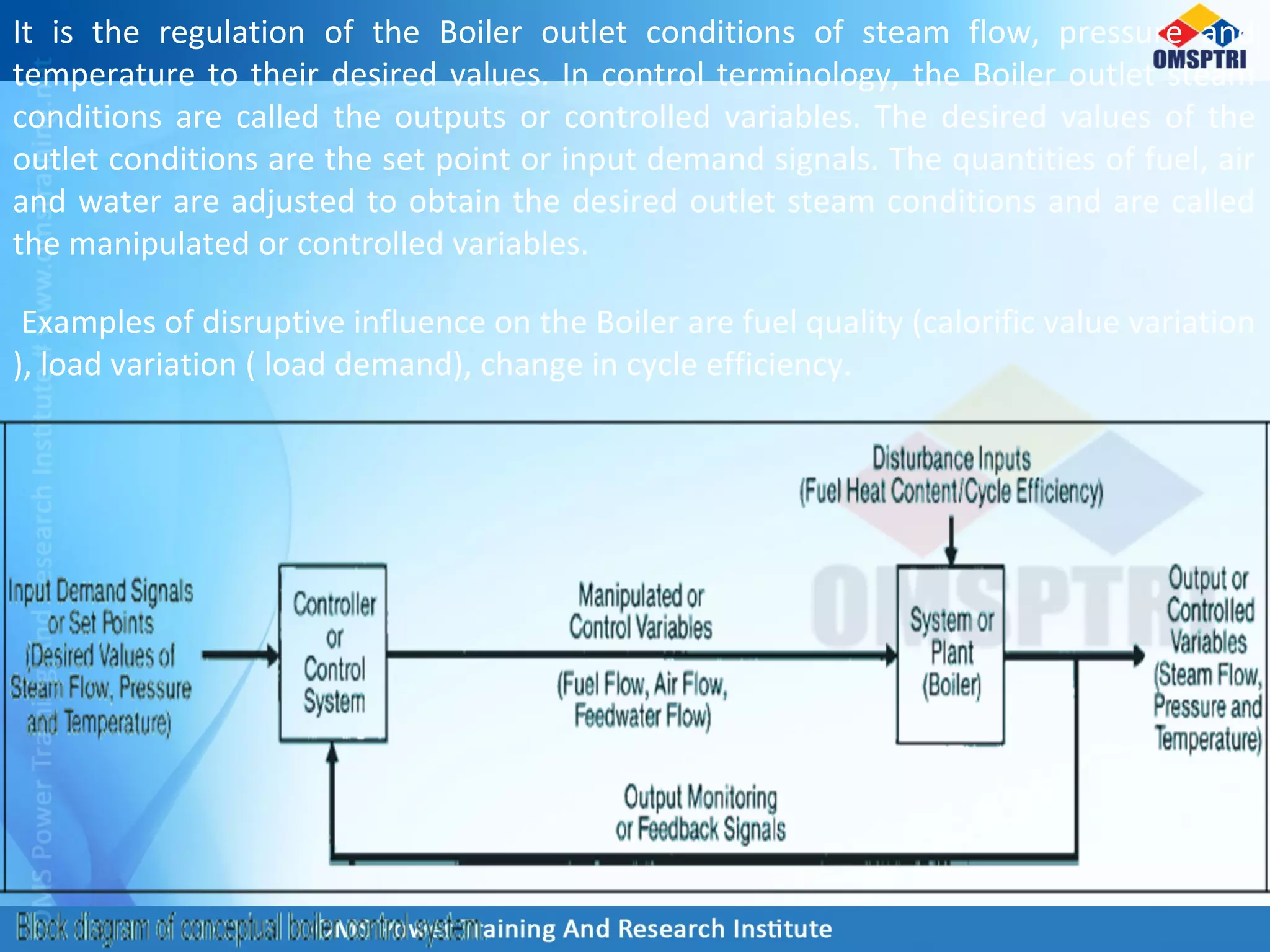
It is the regulation of the Boiler outlet conditions of steam flow, pressure and
temperature to their desired values. In control terminology, the Boiler outlet steam
conditions are called the outputs or controlled variables. The desired values of the
outlet conditions are the set point or input demand signals. The quantities of fuel, air
and water are adjusted to obtain the desired outlet steam conditions and are called
the manipulated or controlled variables.
Examples of disruptive influence on the Boiler are fuel quality (calorific value variation
), load variation ( load demand), change in cycle efficiency.
Characteristics of Different Control Modes
•Boiler-following Control
•Turbine-following Control
•Coordinated Boiler Turbine Control
•Integrated Boiler Turbine-generator Control
•Integrated Control System
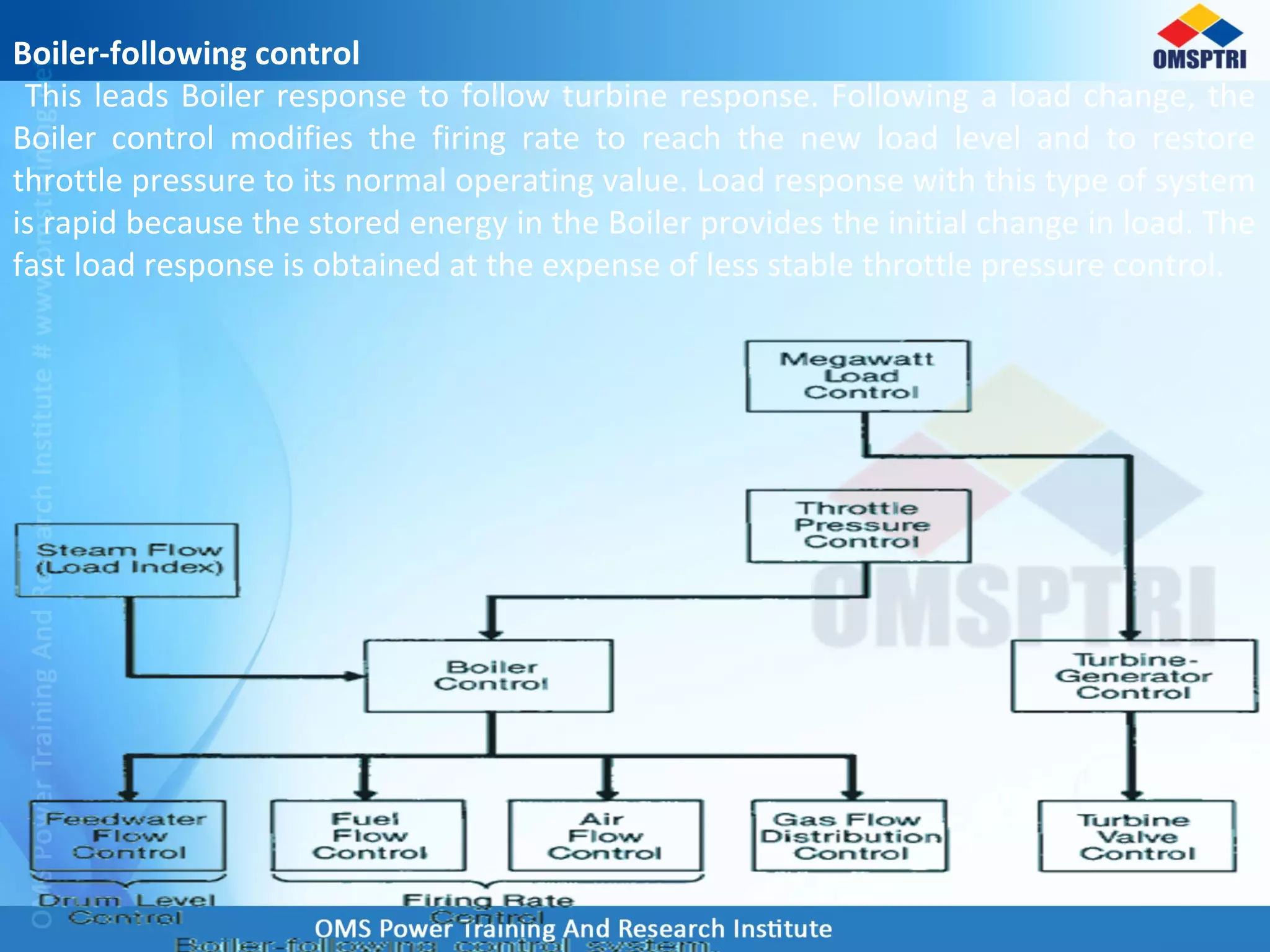
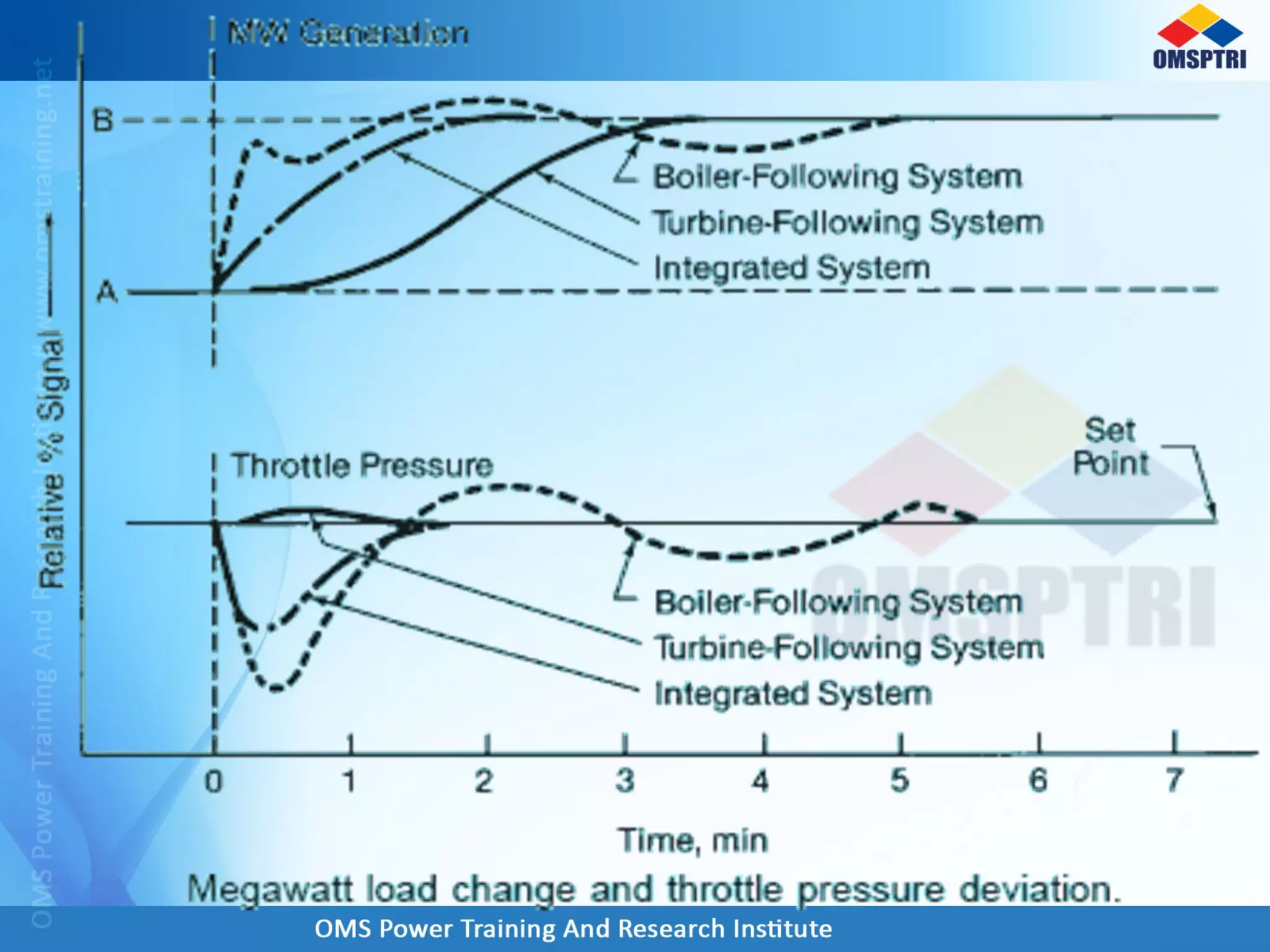
Boiler-following control
This leads Boiler response to follow turbine response. Following a load change, the
Boiler control modifies the firing rate to reach the new load level and to restore
throttle pressure to its normal operating value. Load response with this type of system
is rapid because the stored energy in the Boiler provides the initial change in load. The
fast load response is obtained at the expense of less stable throttle pressure control.
Sliding pressure operation
If boiler characteristics are such that it is capable of
delivering steam at lower pressure but at the rated
temperature it is beneficial to vary the load by
controlling the steam pressure with out throttling by
the governing .This improve the efficiency due to
• Reduction in the throttling losses across the stop &
regulating valves.
• Saves the pumping power – lower consumption by
the B F P
• Lower wetness in the exhaust.
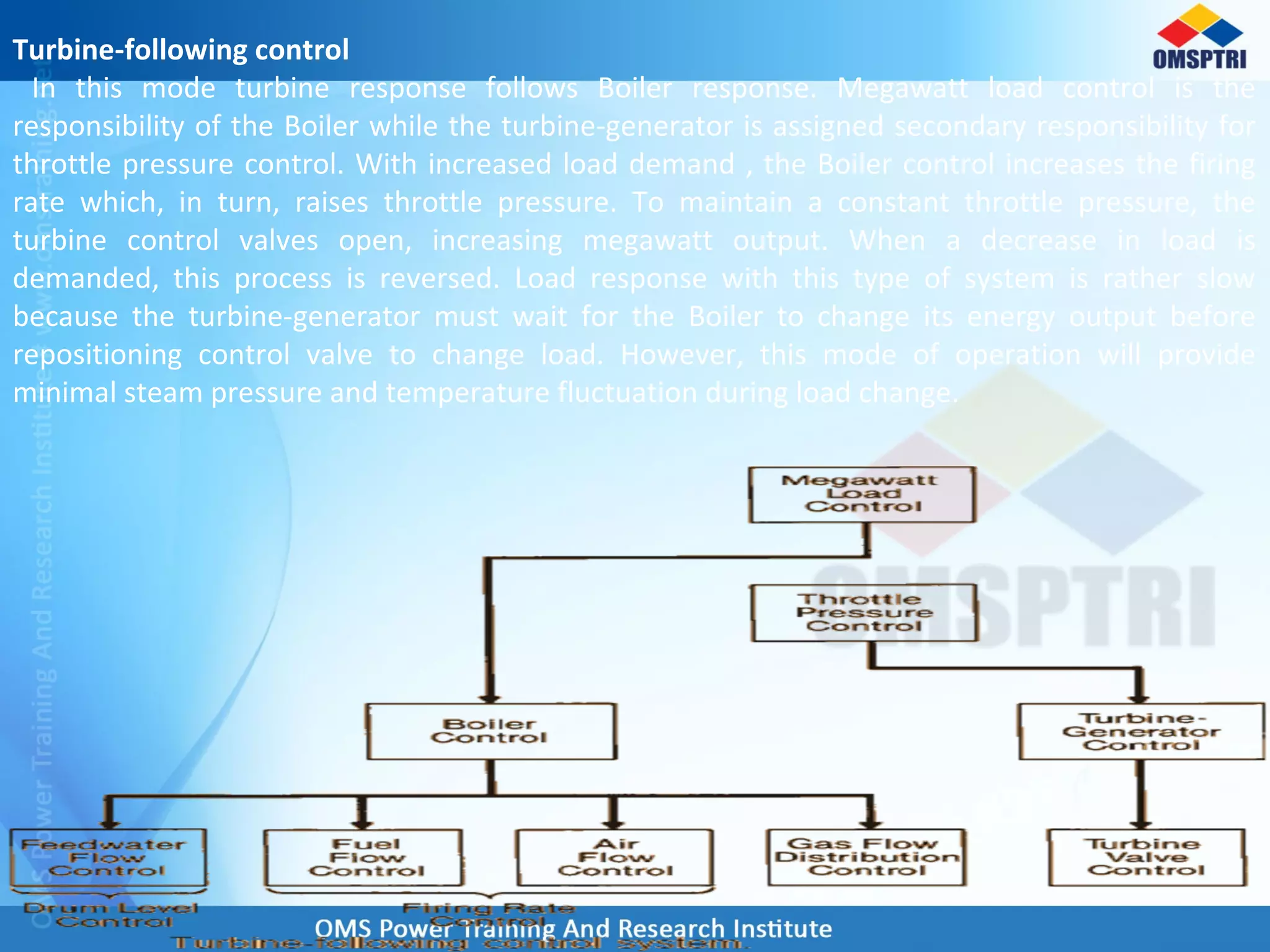
Turbine-following control
In this mode turbine response follows Boiler response. Megawatt load control is the
responsibility of the Boiler while the turbine-generator is assigned secondary responsibility for
throttle pressure control. With increased load demand , the Boiler control increases the firing
rate which, in turn, raises throttle pressure. To maintain a constant throttle pressure, the
turbine control valves open, increasing megawatt output. When a decrease in load is
demanded, this process is reversed. Load response with this type of system is rather slow
because the turbine-generator must wait for the Boiler to change its energy output before
repositioning control valve to change load. However, this mode of operation will provide
minimal steam pressure and temperature fluctuation during load change.
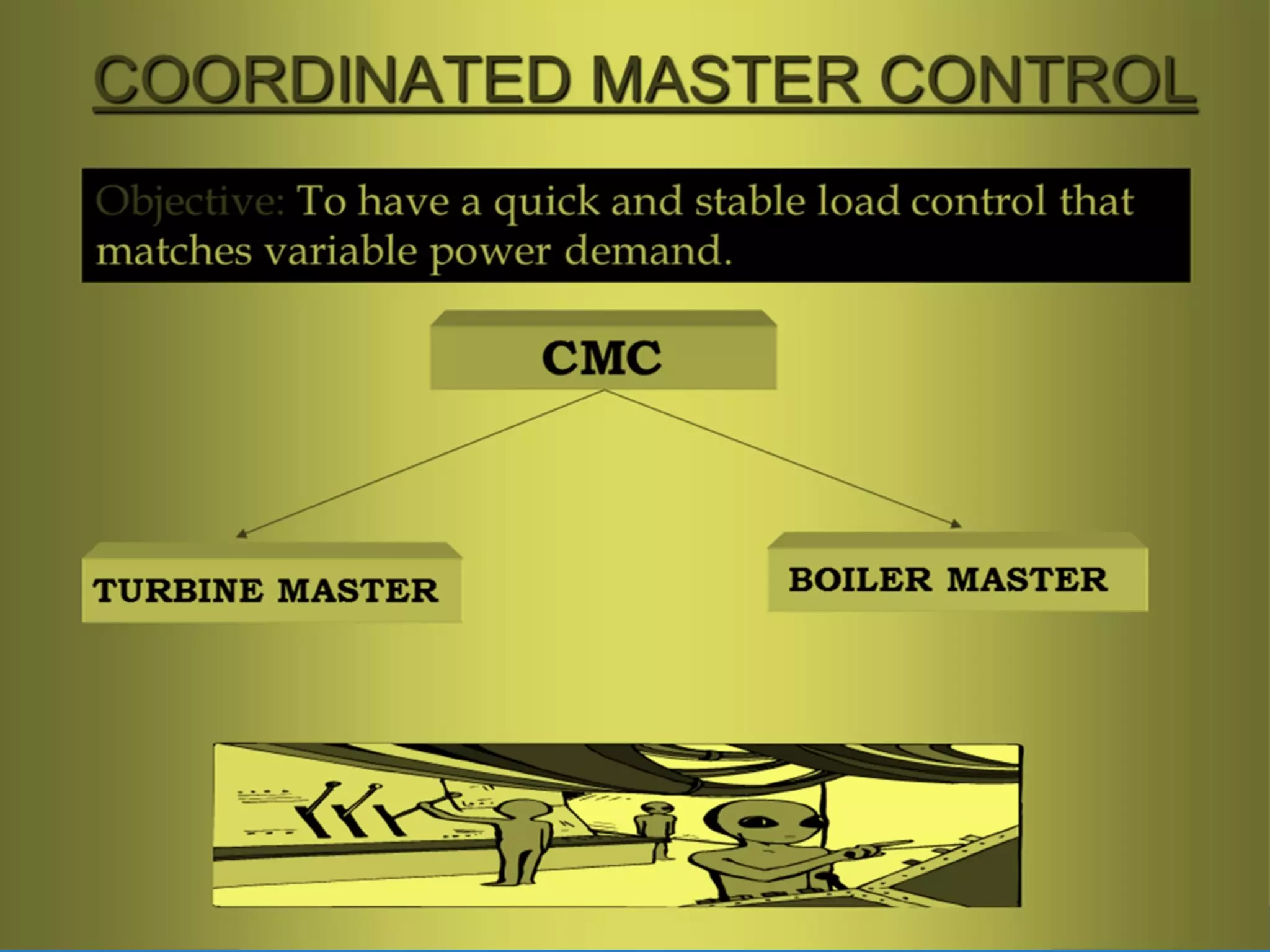
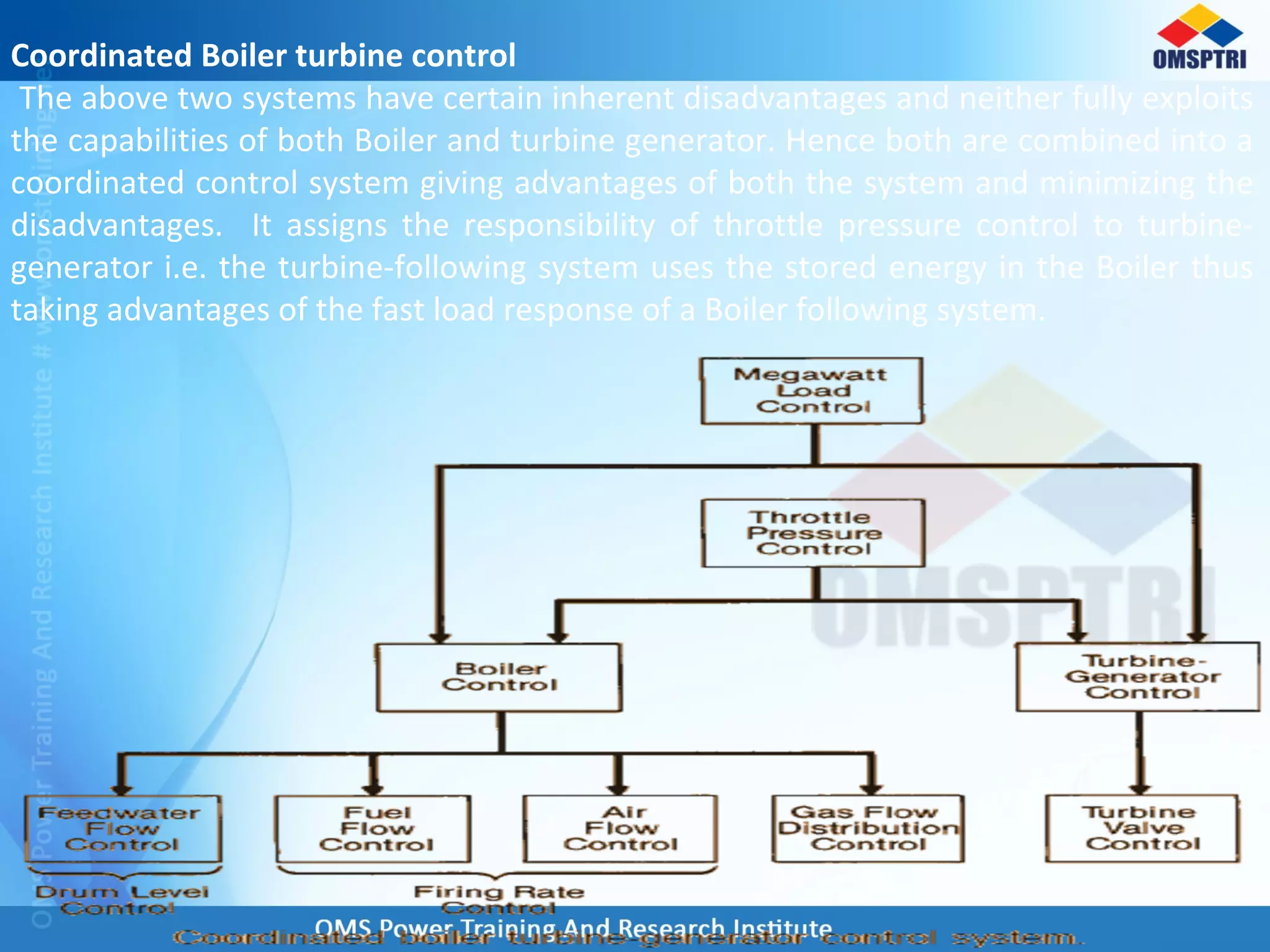
Coordinated Boiler turbine control
The above two systems have certain inherent disadvantages and neither fully exploits
the capabilities of both Boiler and turbine generator. Hence both are combined into a
coordinated control system giving advantages of both the system and minimizing the
disadvantages. It assigns the responsibility of throttle pressure control to turbine-
generator i.e. the turbine-following system uses the stored energy in the Boiler thus
taking advantages of the fast load response of a Boiler following system.
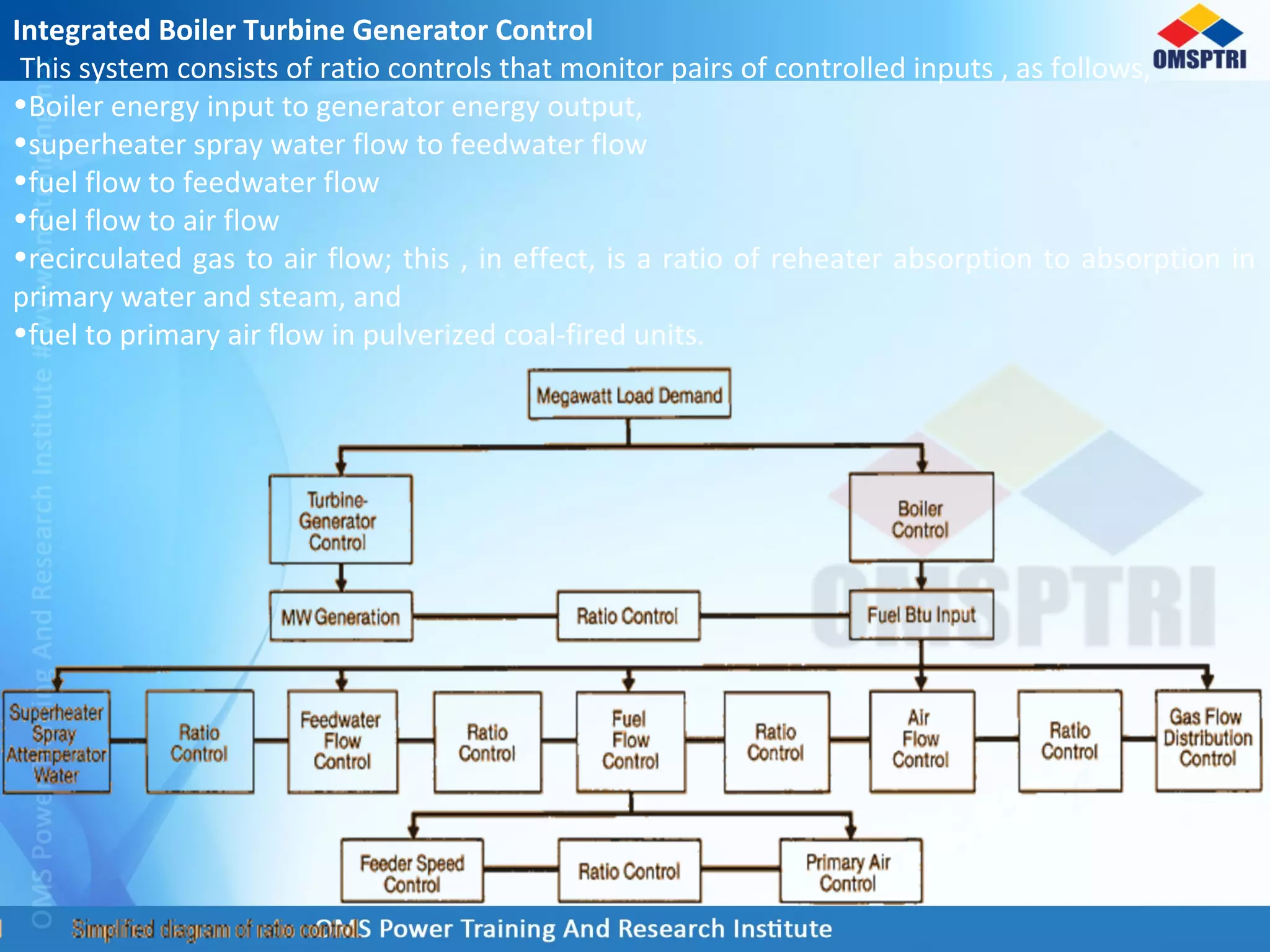
Integrated Boiler Turbine Generator Control
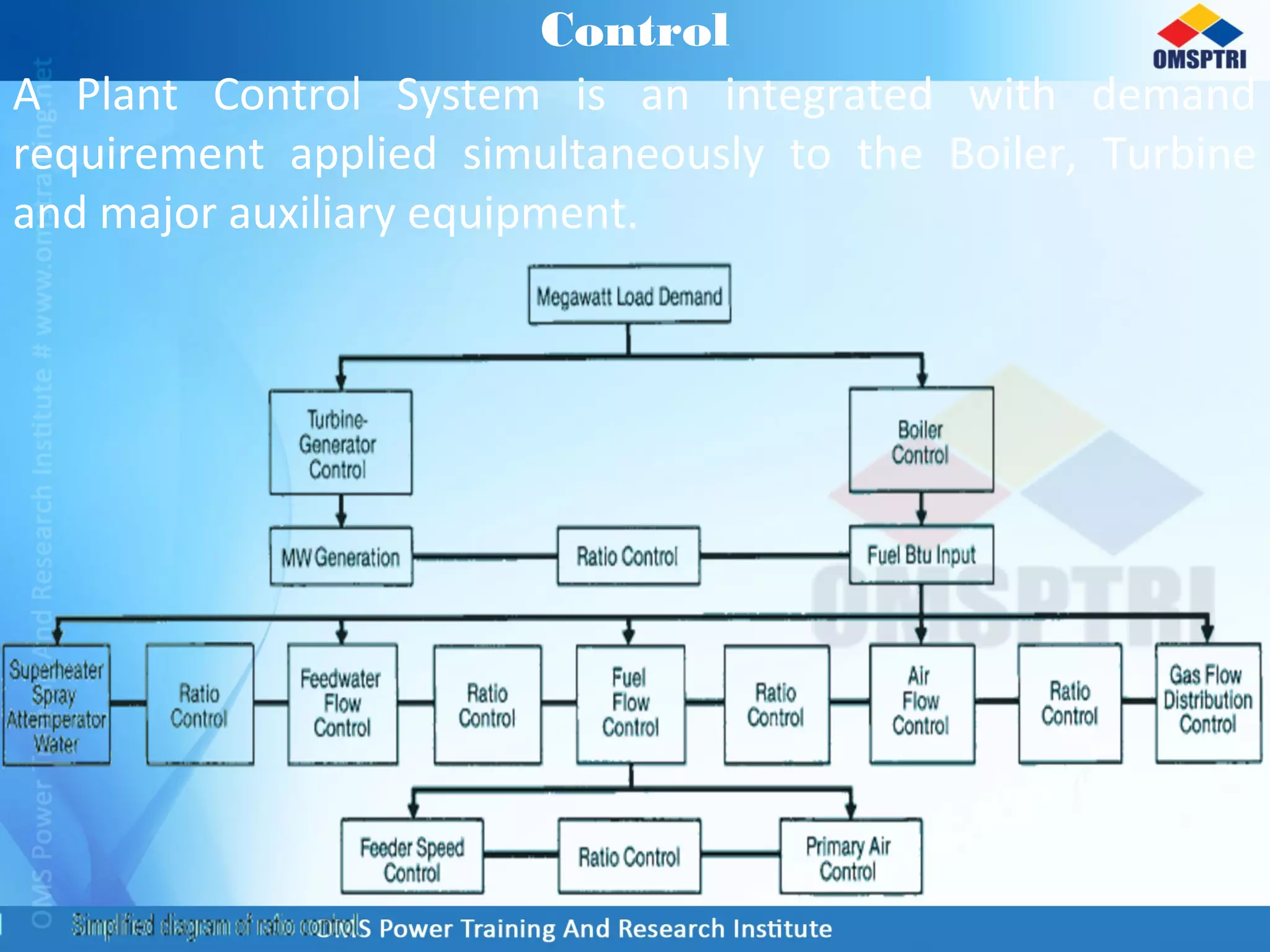
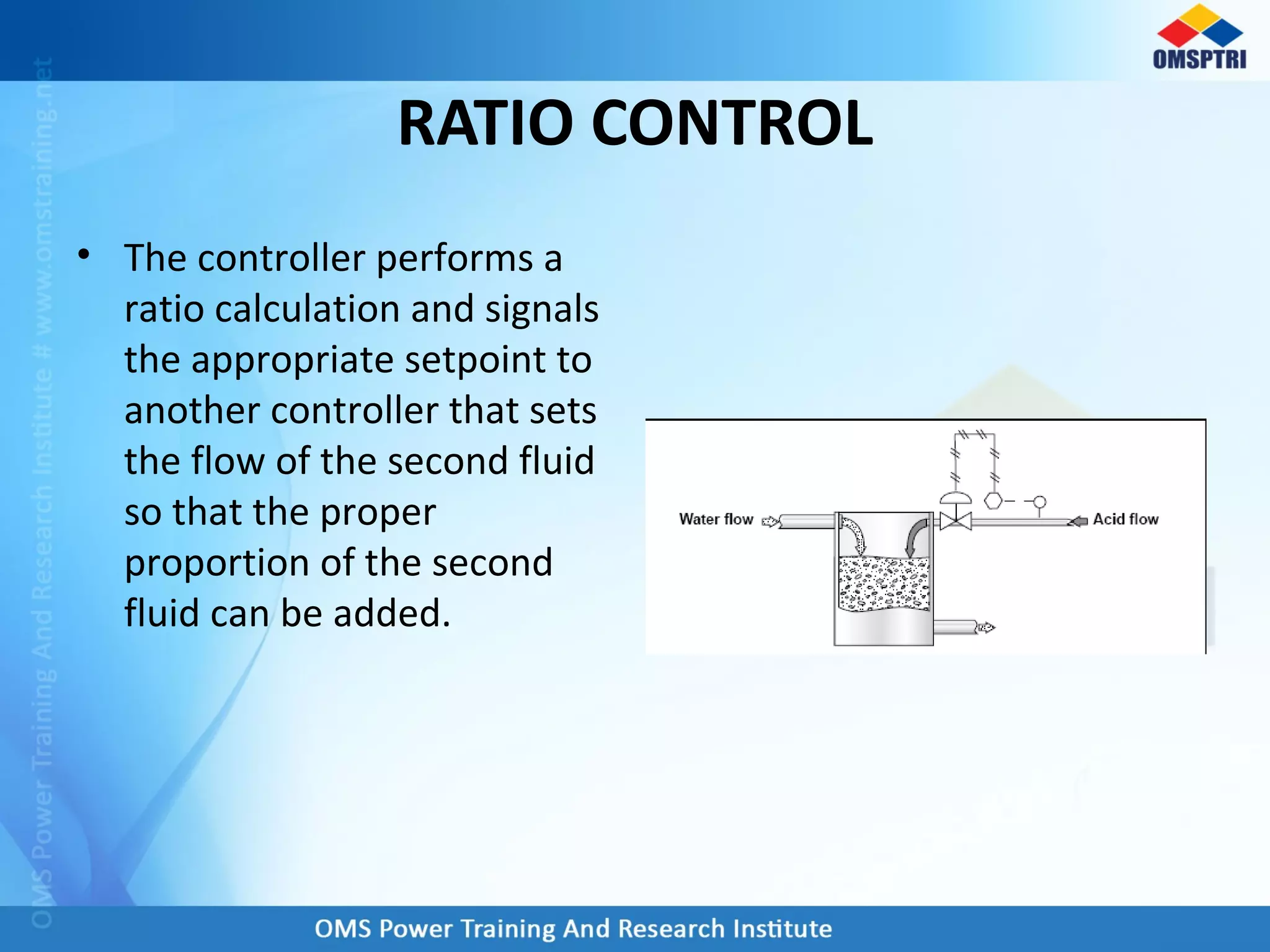
This system consists of ratio controls that monitor pairs of controlled inputs , as follows,
•Boiler energy input to generator energy output,
•superheater spray water flow to feedwater flow
•fuel flow to feedwater flow
•fuel flow to air flow
•recirculated gas to air flow; this , in effect, is a ratio of reheater absorption to absorption in
primary water and steam, and
•fuel to primary air flow in pulverized coal-fired units.
Integrated Control System: This co-ordinates the Boiler and turbine-generator for fast and
efficient response to load demand initiated by the automatic load dispatch system.
A Safety Instrumented System (SIS)
It consists of an engineered set of hardware and
software controls which are especially used on
critical process systems.
 A critical process system can be identified as one
which, once running and an operational problem
occurs, the system may need to be put into a "Safe
State" to avoid adverse Safety, Health and
Environmental(SH&E) consequences.
One of the more well known critical processes is the
operation of a steam boiler.
FURNACE SAFE GUARD SUPERVISORY
SYSTEM
SCOPE OF FSSS
MASTER FUEL
TRIP RELAYS
BOILER
PURGE
OIL
SYSTEM MILLS
SECONDARY
AIR
DAMPERS
FLAME
SCANNERS
FUNCTIONS OF FSSS
 Prevent any fuel firing unless a satisfactory furnace purge sequence has
first been completed.
 Prevent start-up of individual fuel firing equipment unless certain
permissive, interlocks have been satisfied.
 Monitor and control proper component sequencing during start-up and
shut-down of fuel firing equipment.
 Subject continued operation of fuel firing equipment to certain safety
interlocks remaining satisfied.
 Provide component status feedback to the operator and, in some cases,
to the unit control system and / or to the data logger.
 Provide flame supervision when fuel firing equipment is in service and
effect an Elevation Fuel Trip or Master Fuel Trip upon certain condition
of unacceptable firing / load combination.
 Effect a Master Fuel Trip upon certain adverse Unit operating conditions.
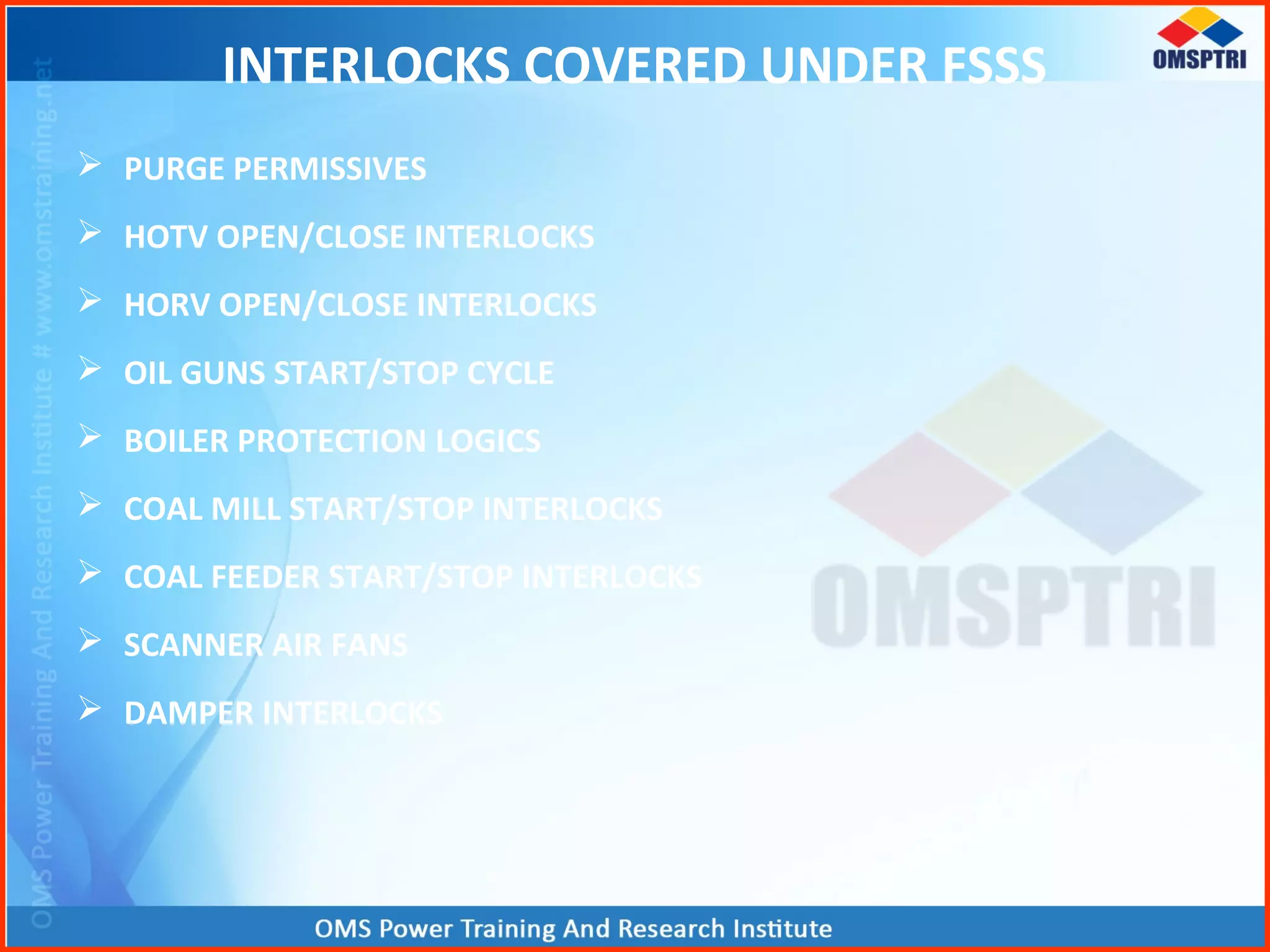
INTERLOCKS COVERED UNDER FSSS
 PURGE PERMISSIVES
 HOTV OPEN/CLOSE INTERLOCKS
 HORV OPEN/CLOSE INTERLOCKS
 OIL GUNS START/STOP CYCLE
 BOILER PROTECTION LOGICS
 COAL MILL START/STOP INTERLOCKS
 COAL FEEDER START/STOP INTERLOCKS
 SCANNER AIR FANS
 DAMPER INTERLOCKS
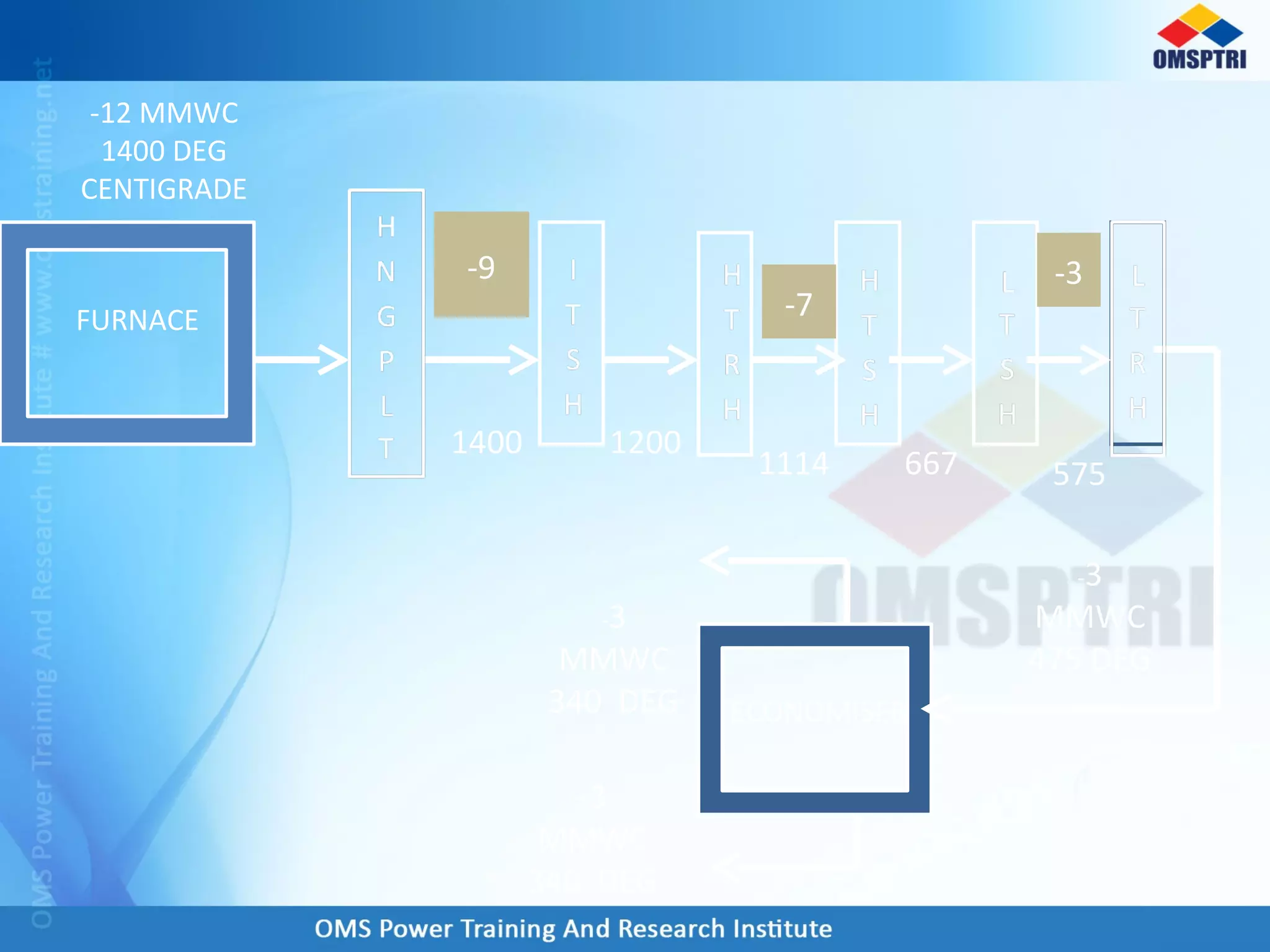
FURNACE
ECONOMISER
-12 MMWC
1400 DEG
CENTIGRADE
-3
MMWC
475 DEG
-3
MMWC
340 DEG
-3
MMWC
340 DEG
-9
1400
-7
-3
1200
1114 667 575
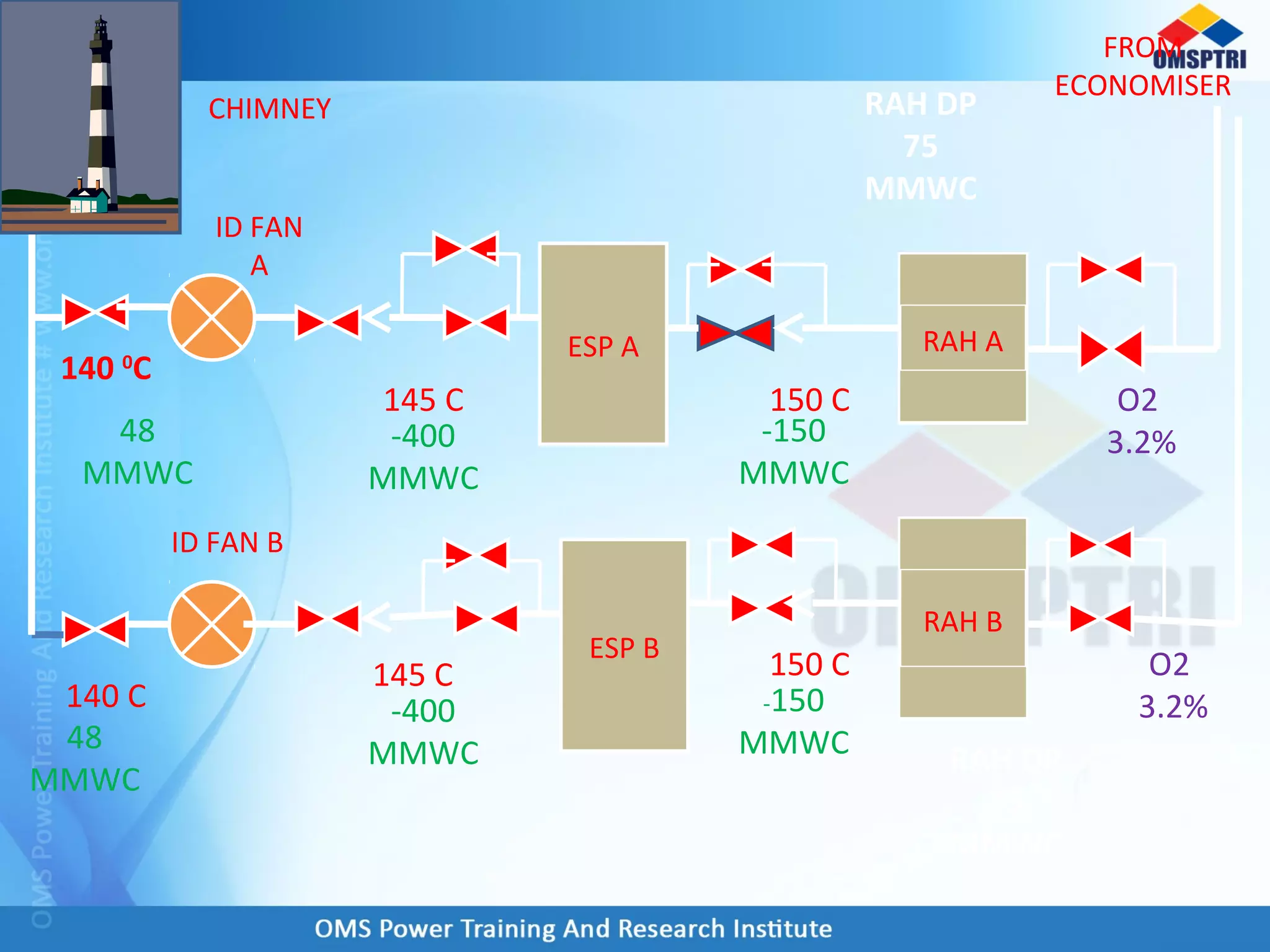
RAH A
RAH B
ESP B
ESP A
ID FAN
A
ID FAN B
CHIMNEY
FROM
ECONOMISER
140 C
140 0
C
145 C
145 C
150 C
150 C
O2
3.2%48
MMWC
48
MMWC
-400
MMWC
-150
MMWC
-400
MMWC
-150
MMWC
RAH DP
75
MMWC
RAH DP
75
MMWC
O2
3.2%
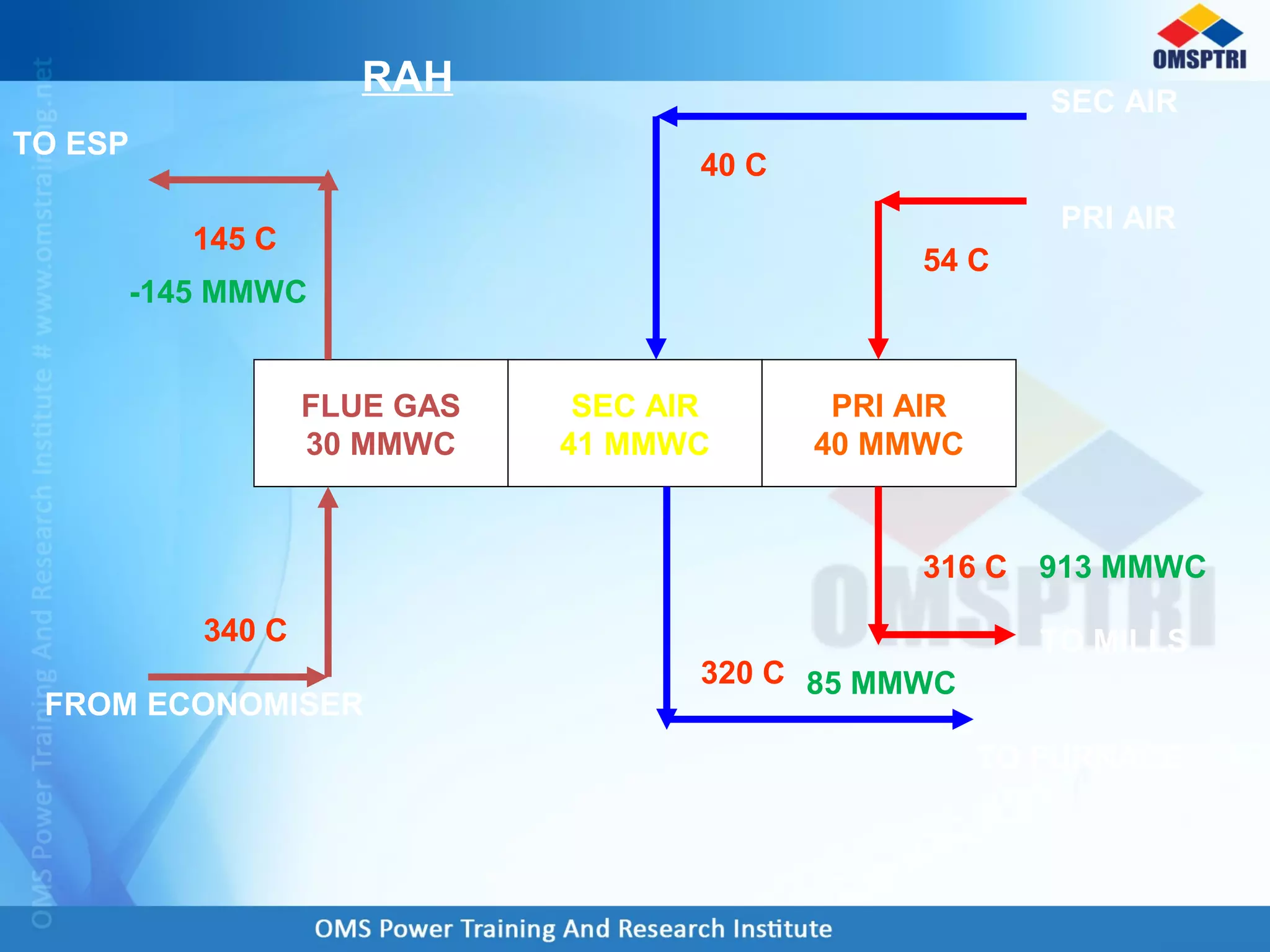
SEC AIR
41 MMWC
FLUE GAS
30 MMWC
PRI AIR
40 MMWC
145 C
340 C
40 C
320 C
54 C
316 C
-145 MMWC
913 MMWC
85 MMWC
FROM ECONOMISER
TO MILLS
TO FURNACE
TO ESP
RAH
PRI AIR
SEC AIR
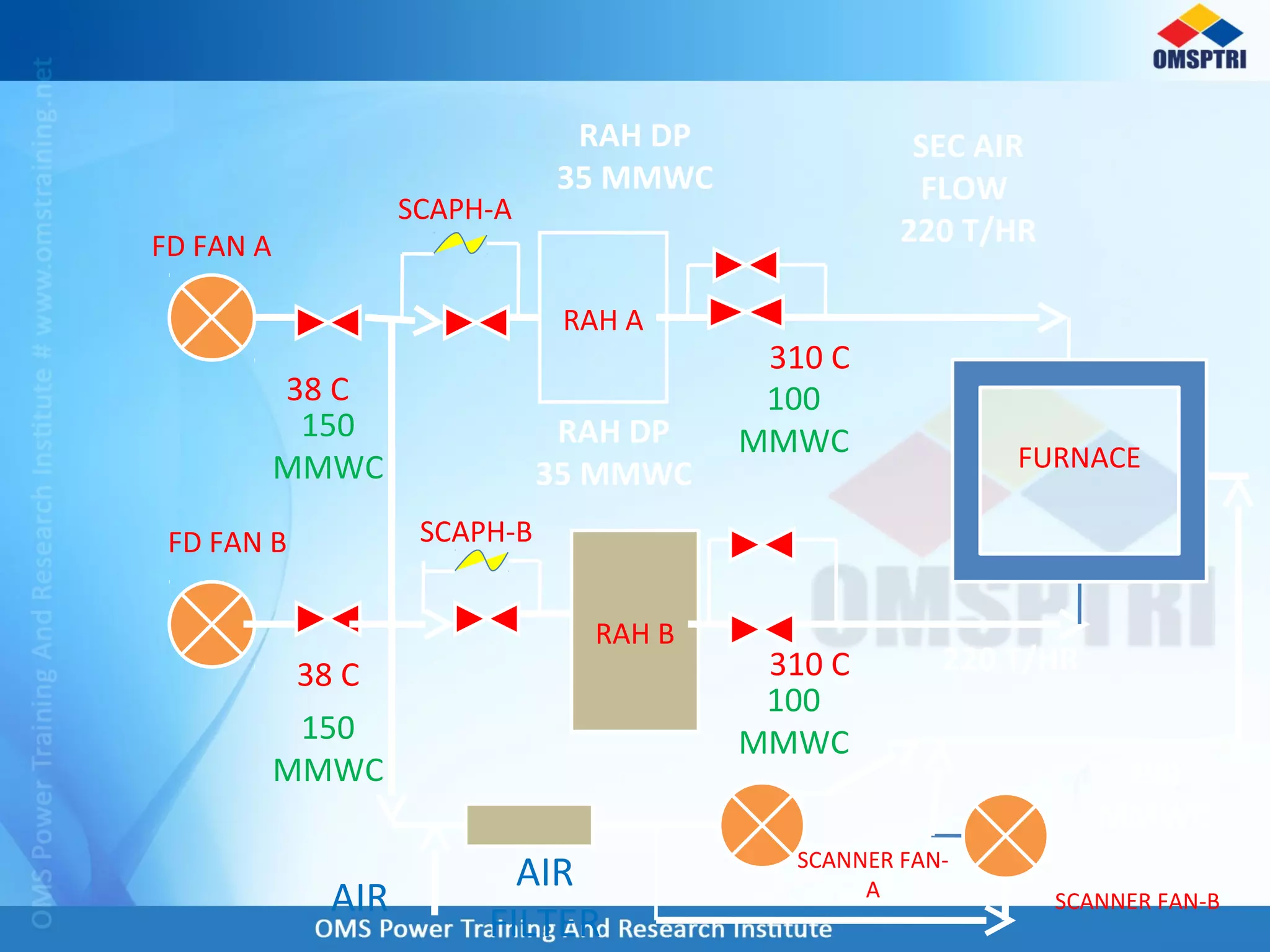
RAH A
RAH B
FD FAN A
FD FAN B
38 C
38 C
310 C
310 C
150
MMWC
100
MMWC
150
MMWC
100
MMWC
SCAPH-A
SCAPH-B
FURNACE
SEC AIR
FLOW
220 T/HR
220 T/HR
290
MMWC
AIR
SCANNER FAN-
A SCANNER FAN-B
AIR
FILTER
RAH DP
35 MMWC
RAH DP
35 MMWC
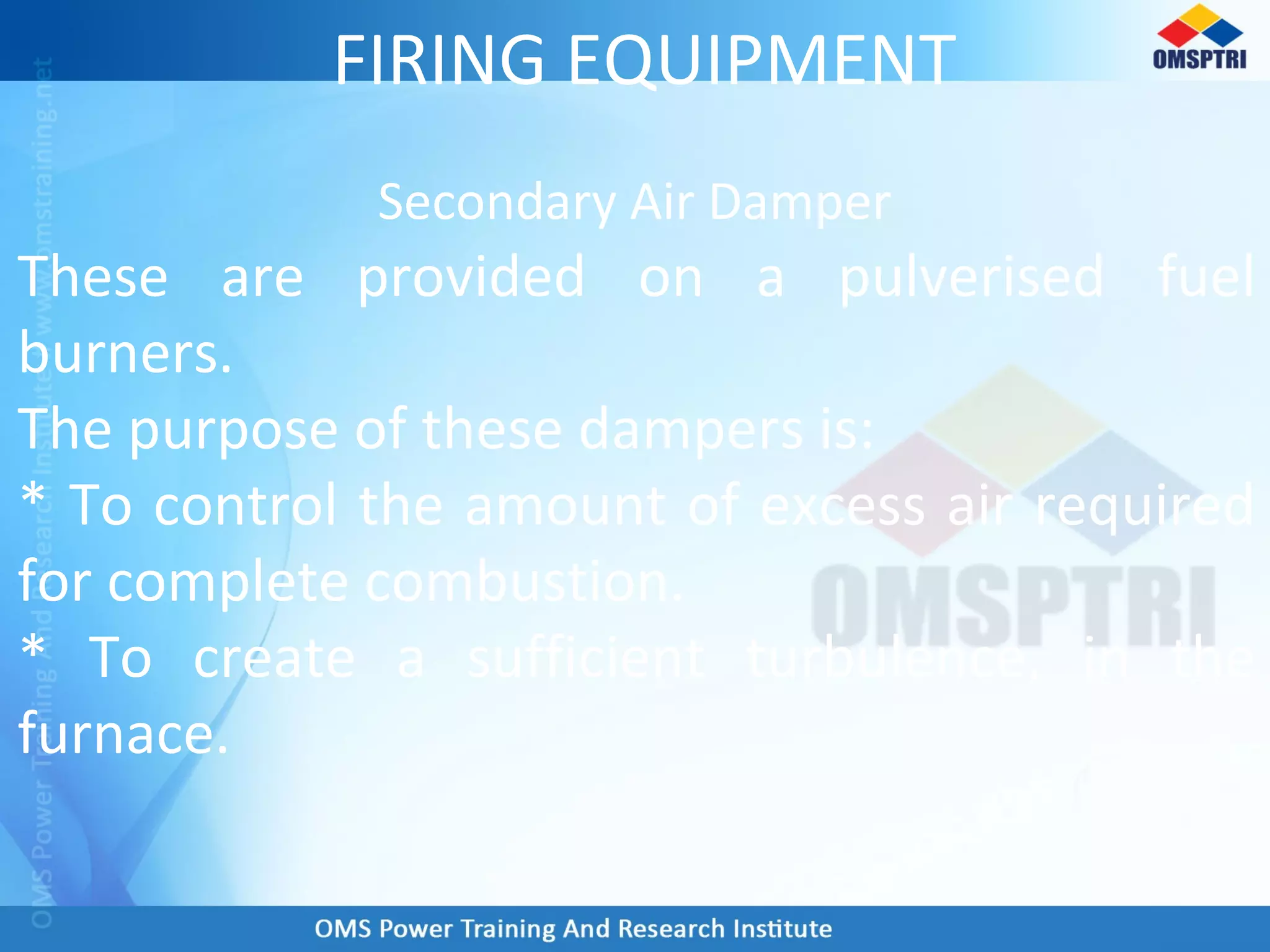
FIRING EQUIPMENT
Secondary Air Damper
These are provided on a pulverised fuel
burners.
The purpose of these dampers is:
* To control the amount of excess air required
for complete combustion.
* To create a sufficient turbulence, in the
furnace.
Maintenance
• The correct settings are determined by
Performance and Testing Department and it’s
ensured that the secondary air dampers are set
correctly to ensure that the air sweep through the
Boilers is kept at optimum conditions.
• The secondary air damper check is carried out on a
routine basis by the Mechanical and C&I
Maintenance Departments must.
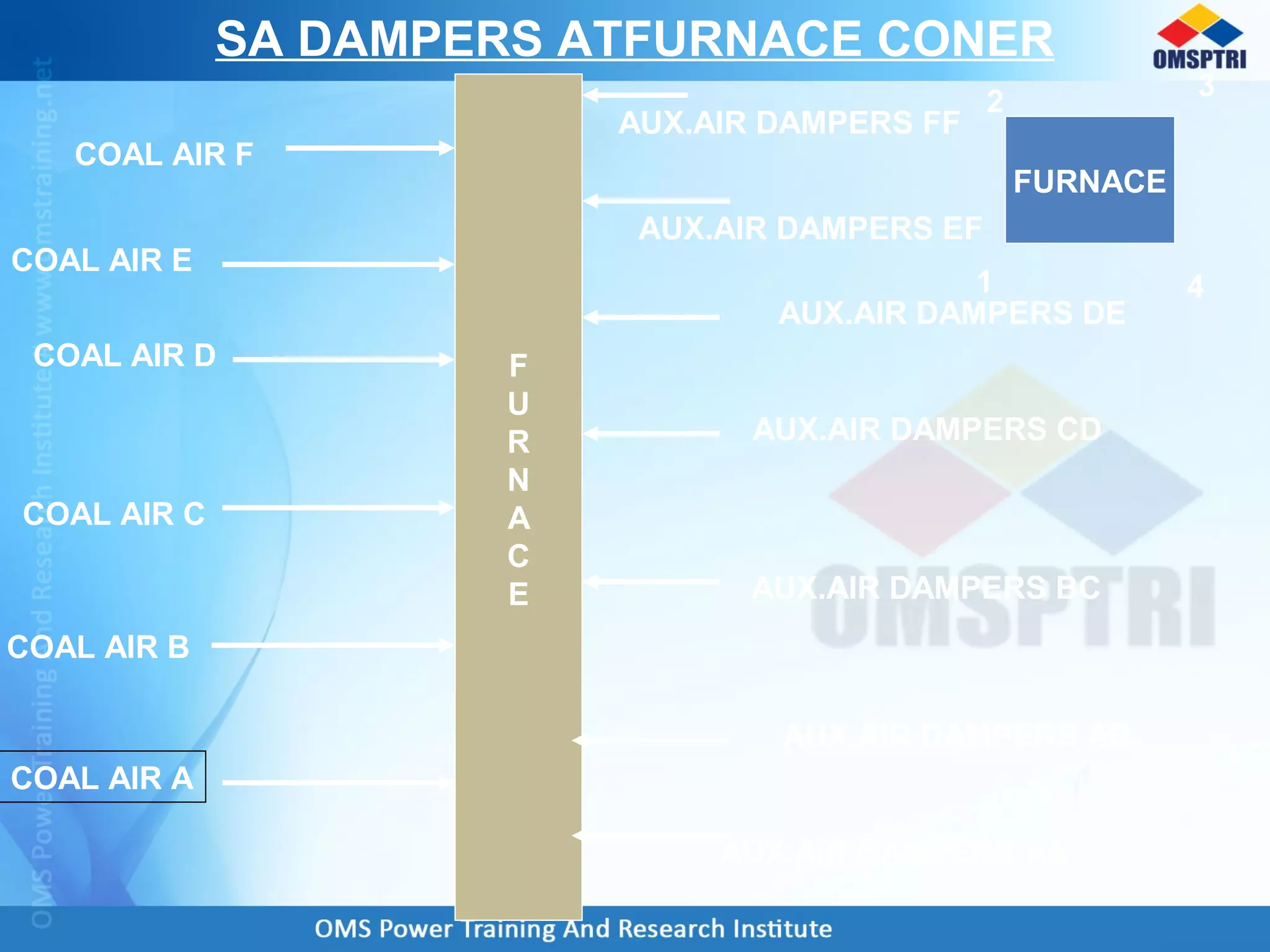
FURNACE
F
U
R
N
A
C
E
COAL AIR A
COAL AIR B
COAL AIR C
COAL AIR D
COAL AIR E
COAL AIR F
AUX.AIR DAMPERS AB
AUX.AIR DAMPERS CD
AUX.AIR DAMPERS DE
AUX.AIR DAMPERS EF
1
2
3
4
SA DAMPERS ATFURNACE CONER
AUX.AIR DAMPERS BC
AUX.AIR DAMPERS FF
AUX.AIR DAMPERS AA
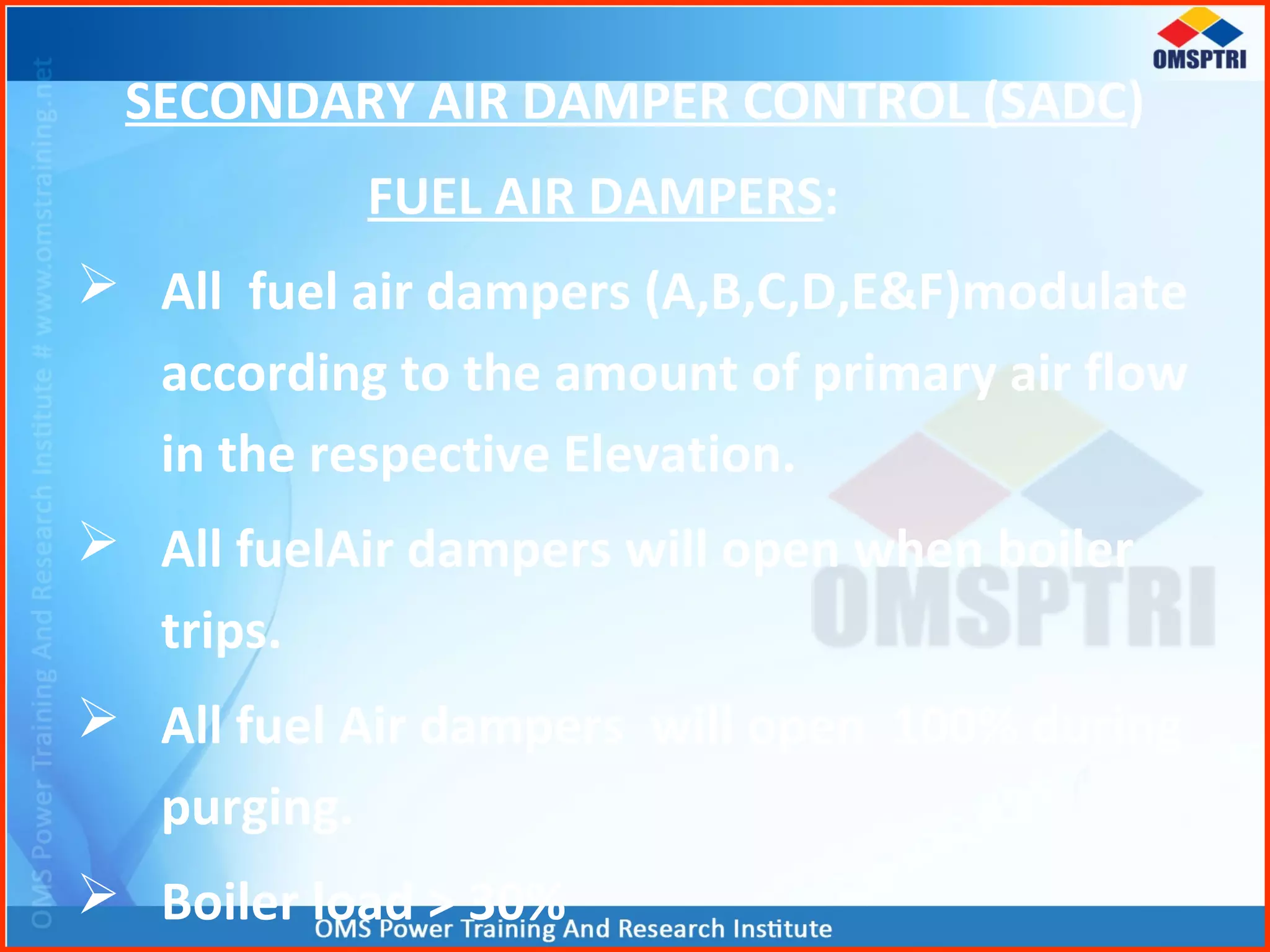
SECONDARY AIR DAMPER CONTROL (SADC)
FUEL AIR DAMPERS:
 All fuel air dampers (A,B,C,D,E&F)modulate
according to the amount of primary air flow
in the respective Elevation.
 All fuelAir dampers will open when boiler
trips.
 All fuel Air dampers will open 100% during
purging.
 Boiler load > 30%
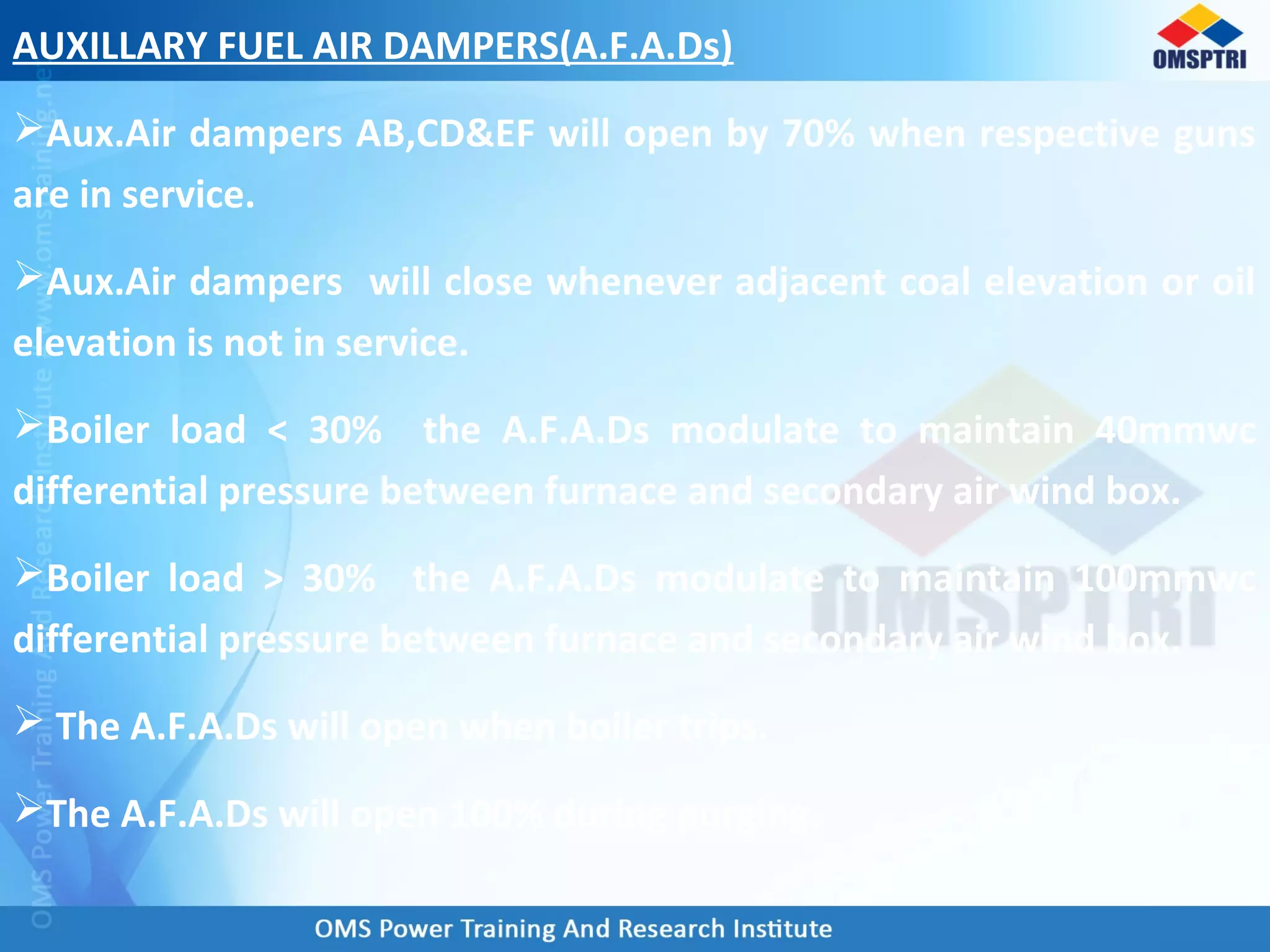
AUXILLARY FUEL AIR DAMPERS(A.F.A.Ds)
Aux.Air dampers AB,CD&EF will open by 70% when respective guns
are in service.
Aux.Air dampers will close whenever adjacent coal elevation or oil
elevation is not in service.
Boiler load < 30% the A.F.A.Ds modulate to maintain 40mmwc
differential pressure between furnace and secondary air wind box.
Boiler load > 30% the A.F.A.Ds modulate to maintain 100mmwc
differential pressure between furnace and secondary air wind box.
 The A.F.A.Ds will open when boiler trips.
The A.F.A.Ds will open 100% during purging.
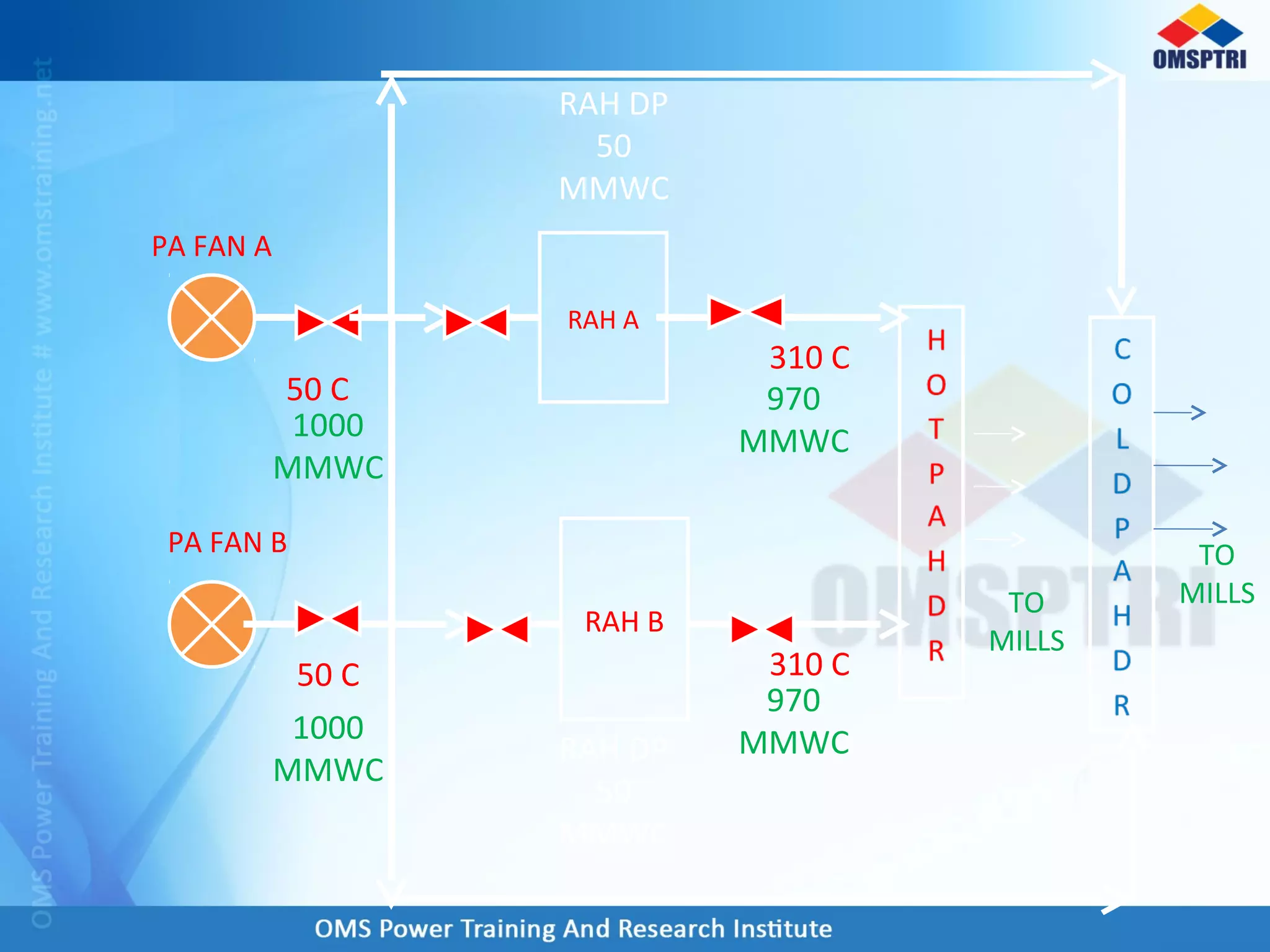
RAH A
RAH B
PA FAN A
PA FAN B
50 C
50 C
310 C
310 C
1000
MMWC
970
MMWC
1000
MMWC
970
MMWC
TO
MILLSTO
MILLS
RAH DP
50
MMWC
RAH DP
50
MMWC
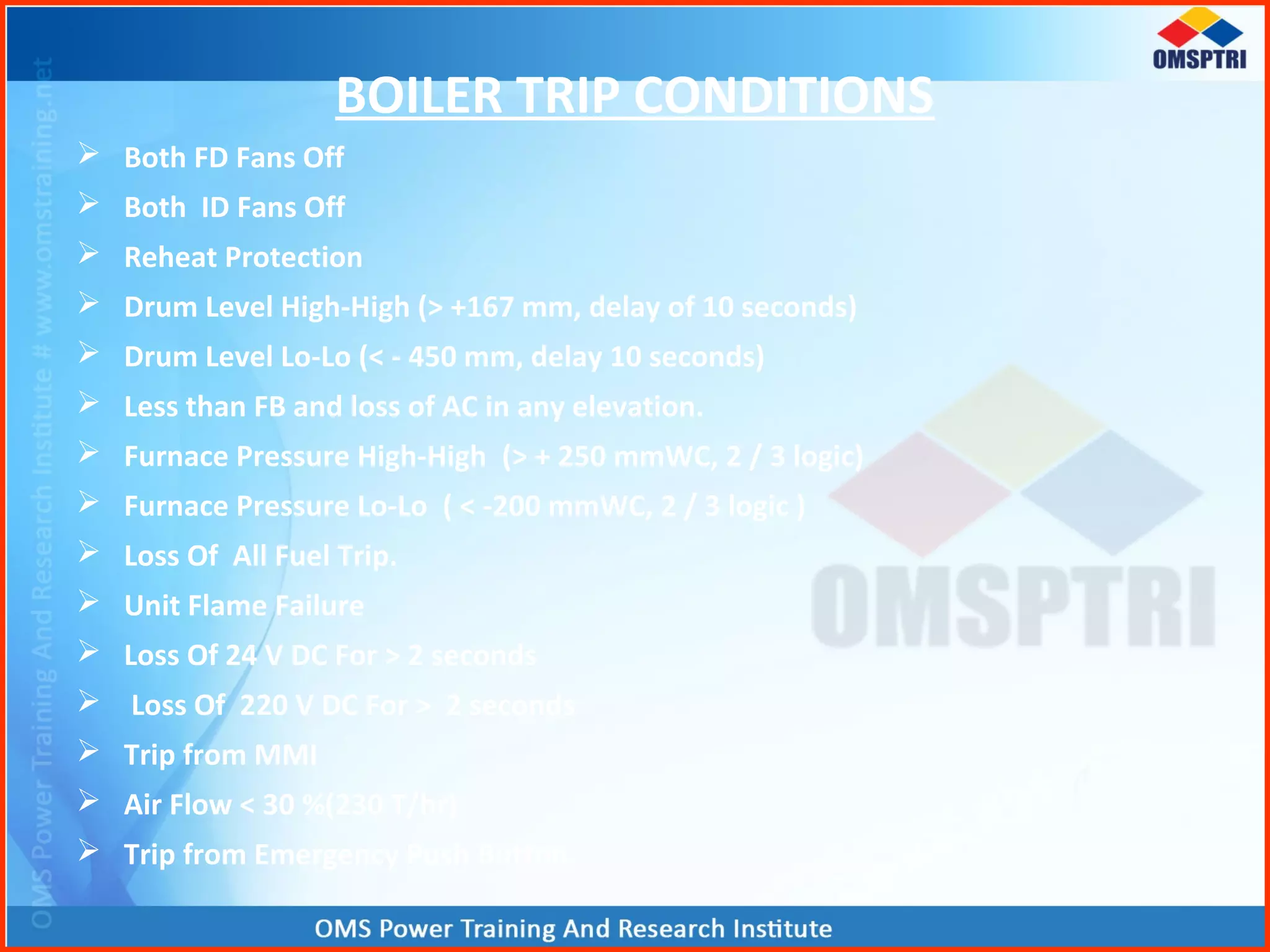
BOILER TRIP CONDITIONS
 Both FD Fans Off
 Both ID Fans Off
 Reheat Protection
 Drum Level High-High (> +167 mm, delay of 10 seconds)
 Drum Level Lo-Lo (< - 450 mm, delay 10 seconds)
 Less than FB and loss of AC in any elevation.
 Furnace Pressure High-High (> + 250 mmWC, 2 / 3 logic)
 Furnace Pressure Lo-Lo ( < -200 mmWC, 2 / 3 logic )
 Loss Of All Fuel Trip.
 Unit Flame Failure
 Loss Of 24 V DC For > 2 seconds
 Loss Of 220 V DC For > 2 seconds
 Trip from MMI
 Air Flow < 30 %(230 T/hr)
 Trip from Emergency Push Button.
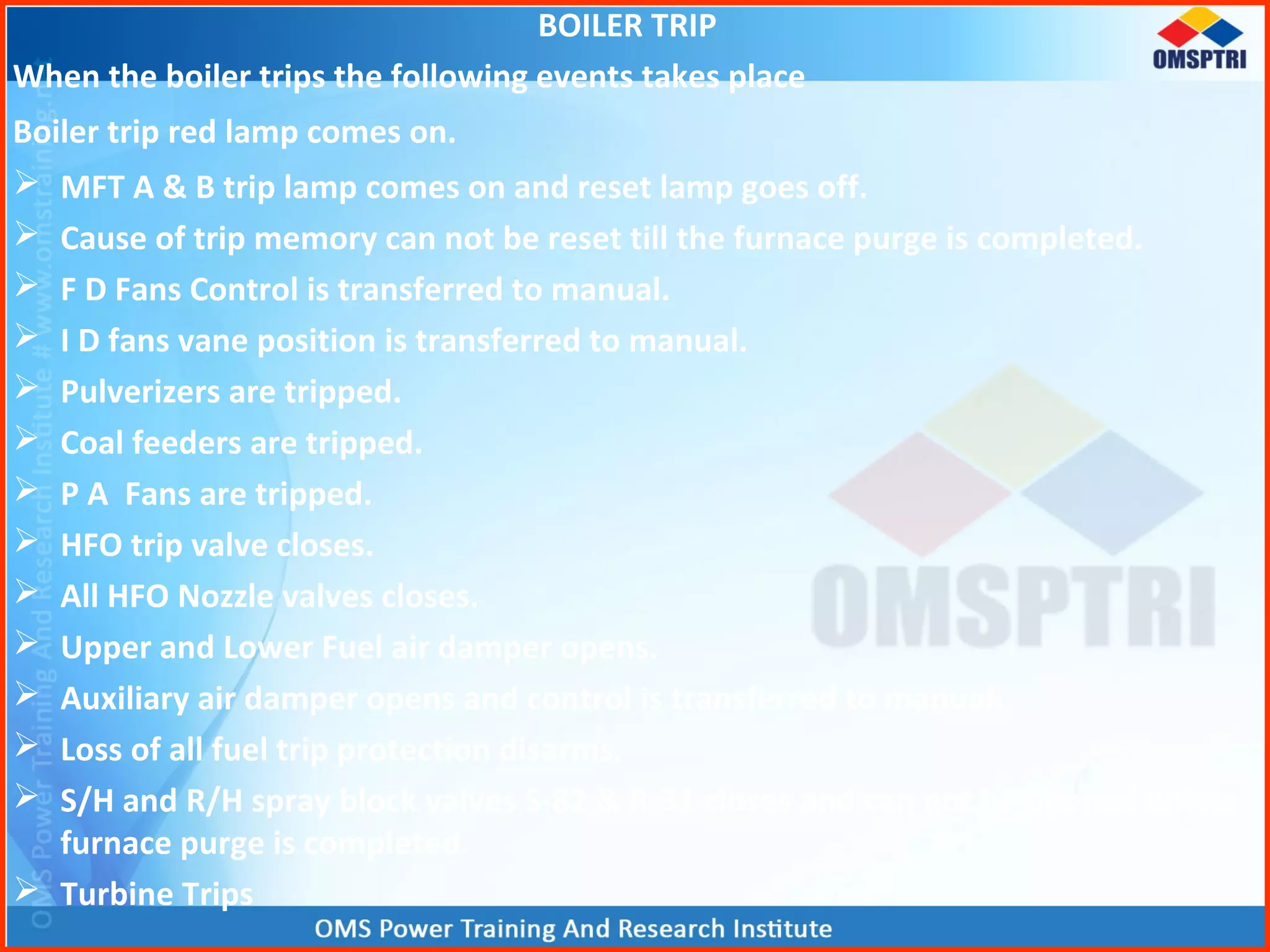
BOILER TRIP
When the boiler trips the following events takes place
Boiler trip red lamp comes on.
 MFT A & B trip lamp comes on and reset lamp goes off.
 Cause of trip memory can not be reset till the furnace purge is completed.
 F D Fans Control is transferred to manual.
 I D fans vane position is transferred to manual.
 Pulverizers are tripped.
 Coal feeders are tripped.
 P A Fans are tripped.
 HFO trip valve closes.
 All HFO Nozzle valves closes.
 Upper and Lower Fuel air damper opens.
 Auxiliary air damper opens and control is transferred to manual.
 Loss of all fuel trip protection disarms.
 S/H and R/H spray block valves S-82 & R-31 closes and can not be opened unless
furnace purge is completed.
 Turbine Trips
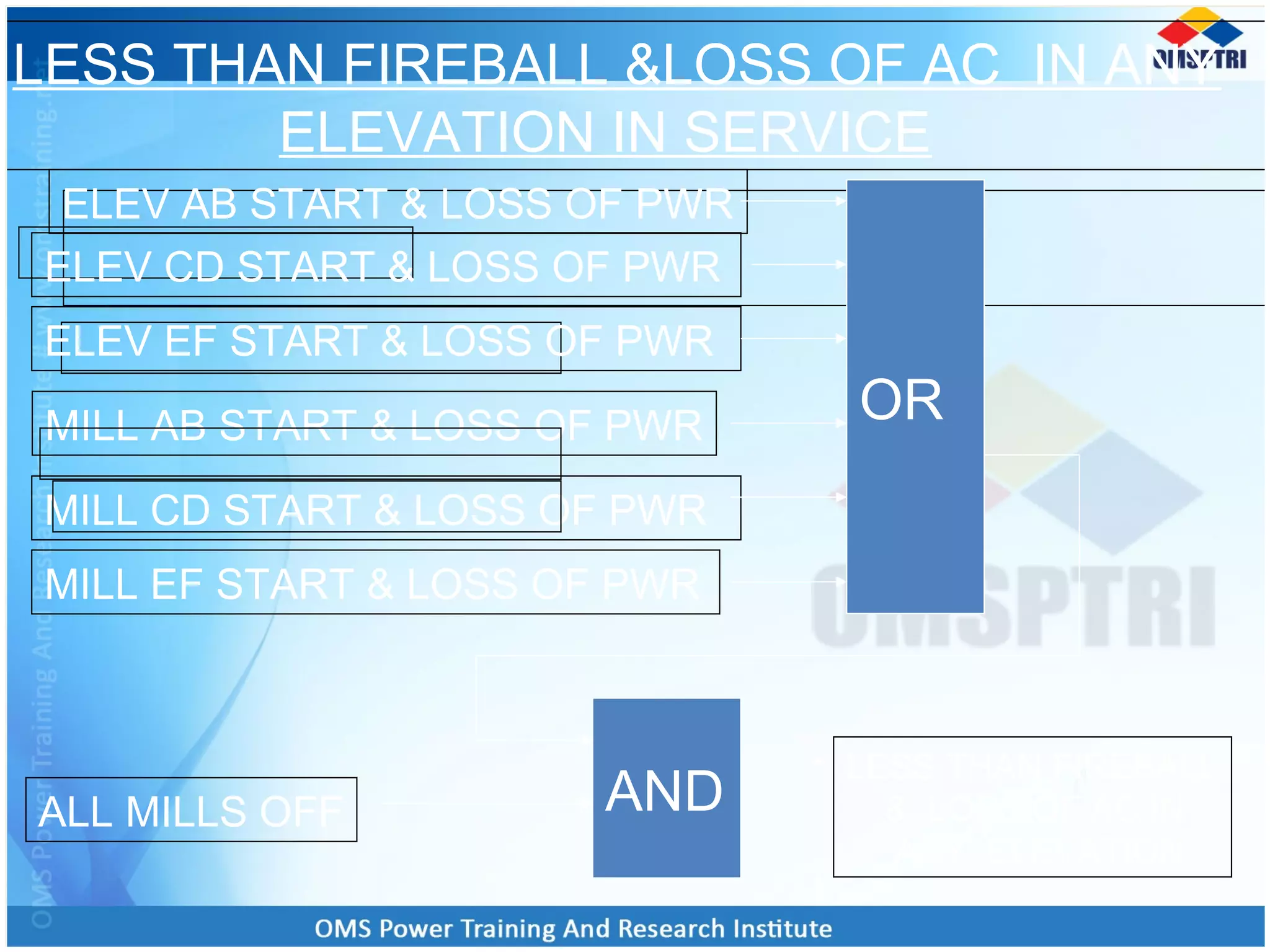
LESS THAN FIREBALL &LOSS OF AC IN ANY
ELEVATION IN SERVICE
OR
ELEV AB START & LOSS OF PWR
ELEV CD START & LOSS OF PWR
ELEV EF START & LOSS OF PWR
MILL AB START & LOSS OF PWR
MILL CD START & LOSS OF PWR
MILL EF START & LOSS OF PWR
ALL MILLS OFF AND
LESS THAN FIREBALL
& LOSS OF AC IN
ANY ELEVATION
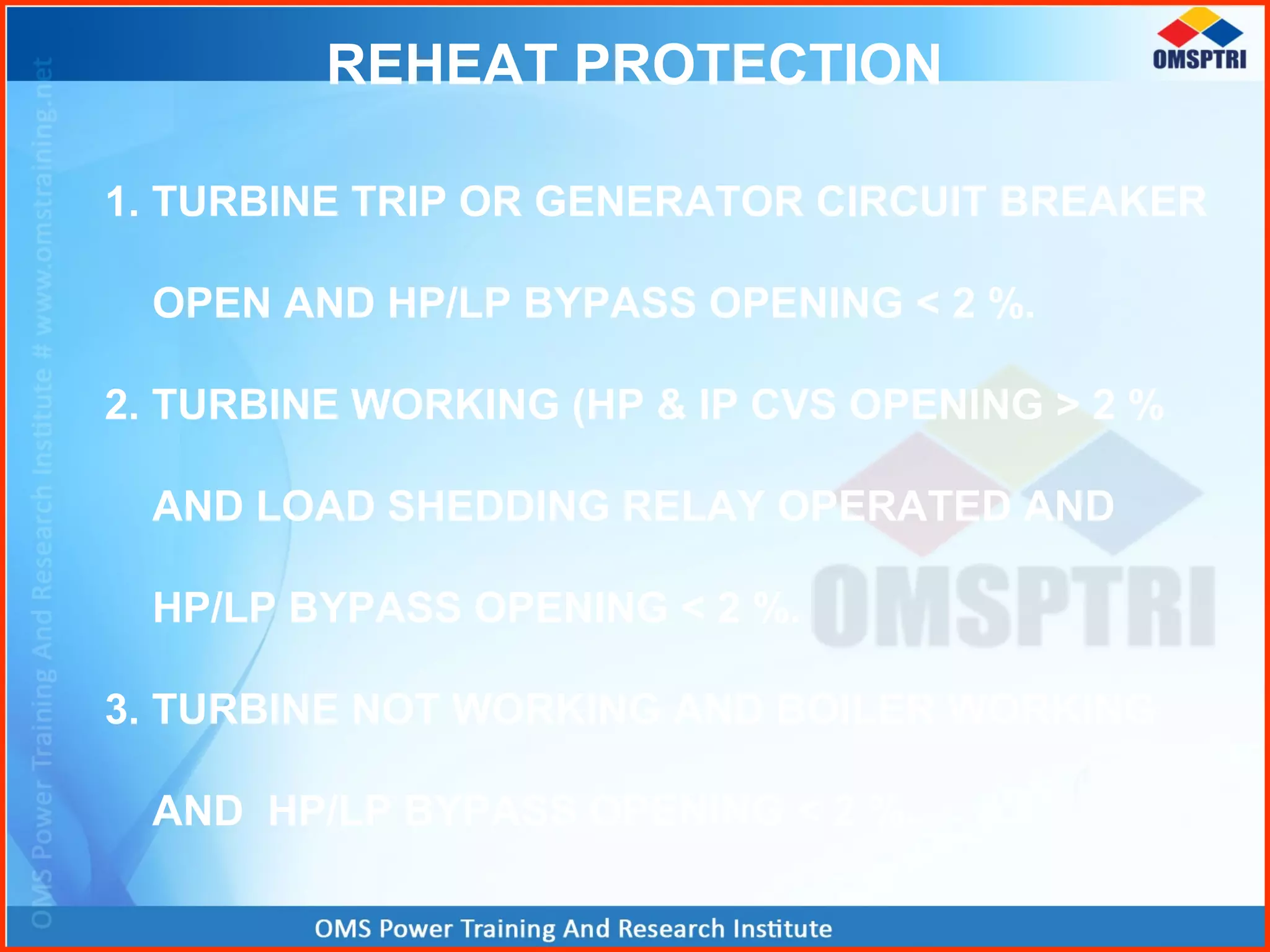
REHEAT PROTECTION
1. TURBINE TRIP OR GENERATOR CIRCUIT BREAKER
OPEN AND HP/LP BYPASS OPENING < 2 %.
2. TURBINE WORKING (HP & IP CVS OPENING > 2 %
AND LOAD SHEDDING RELAY OPERATED AND
HP/LP BYPASS OPENING < 2 %.
3. TURBINE NOT WORKING AND BOILER WORKING
AND HP/LP BYPASS OPENING < 2 %.
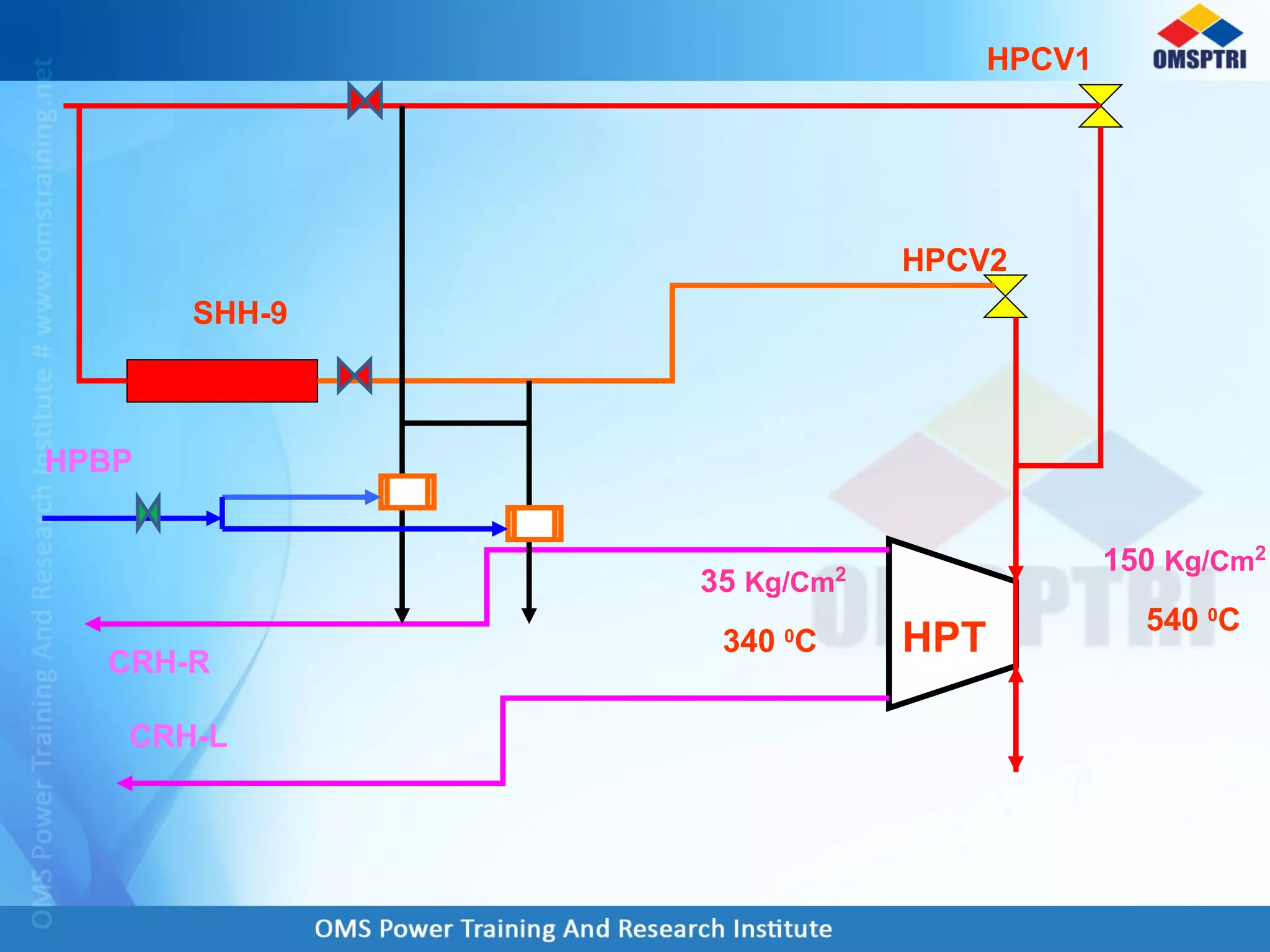
HPT
HPCV2
HPCV1
SHH-9
CRH-R
CRH-L
HPBP
150 Kg/Cm2
540 0
C
35 Kg/Cm2
340 0
C
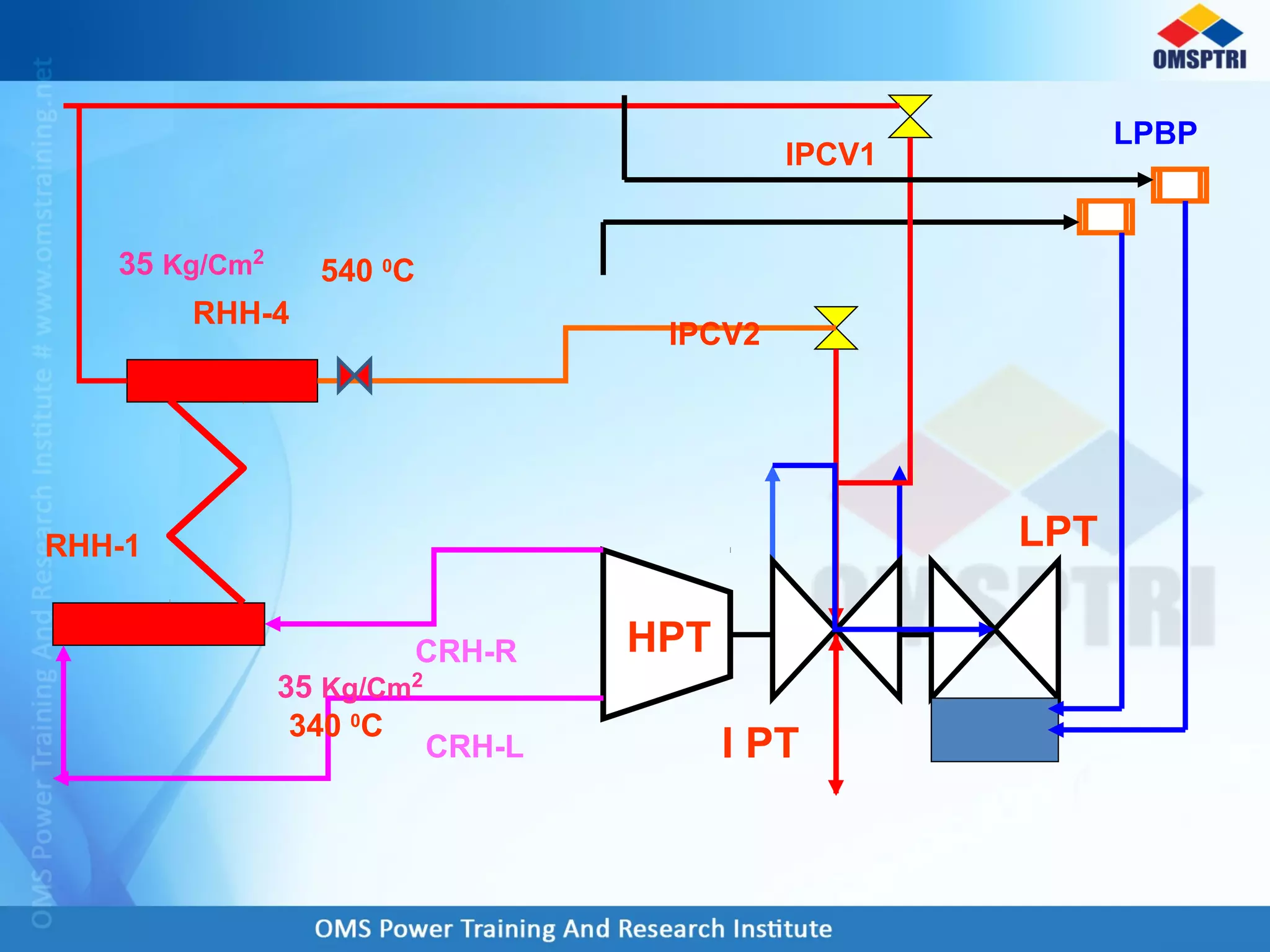
HPT
IPCV2
IPCV1
RHH-4
CRH-R
CRH-L
LPBP
540 0
C
RHH-1 LPT
I PT
35 Kg/Cm2
340 0
C
35 Kg/Cm2
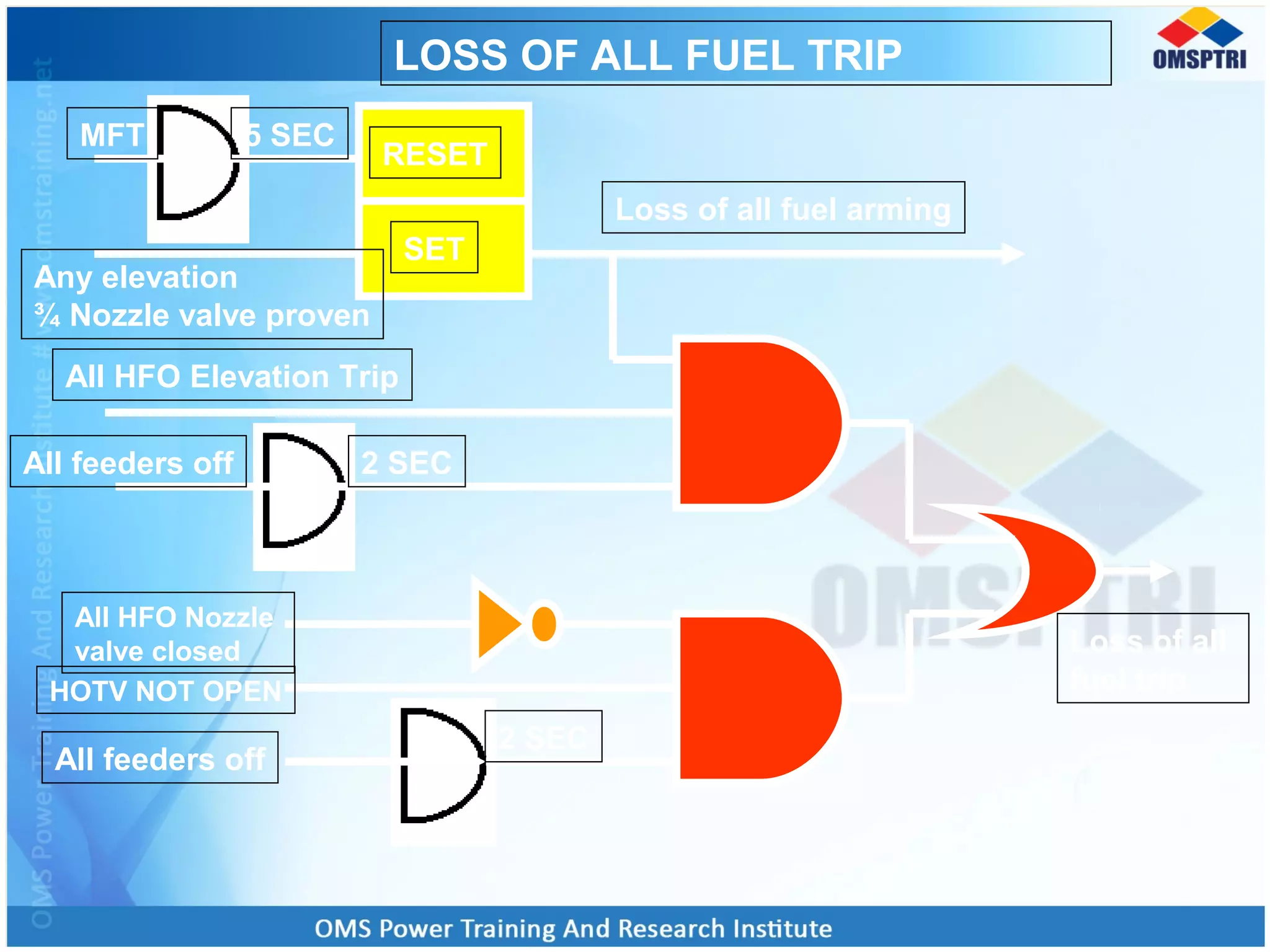
Loss of all fuel arming
SET
RESET
MFT 5 SEC
Any elevation
¾ Nozzle valve proven
All feeders off 2 SEC
All HFO Nozzle
valve closed
All feeders off
HOTV NOT OPEN
2 SEC
All HFO Elevation Trip
Loss of all
fuel trip
LOSS OF ALL FUEL TRIP
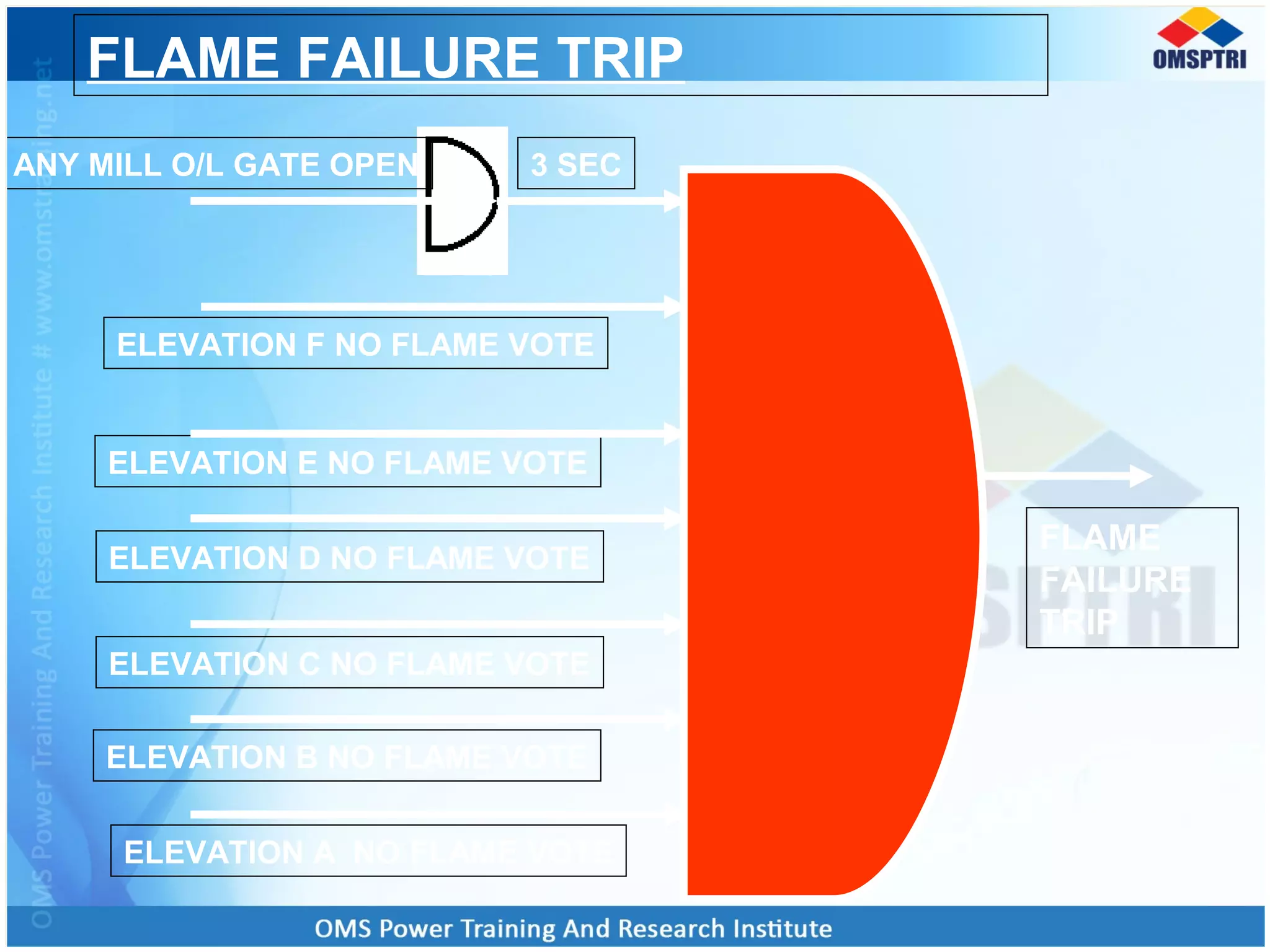
FLAME FAILURE TRIP
ELEVATION B NO FLAME VOTE
ELEVATION C NO FLAME VOTE
ELEVATION D NO FLAME VOTE
ELEVATION E NO FLAME VOTE
ELEVATION F NO FLAME VOTE
ANY MILL O/L GATE OPEN 3 SEC
FLAME
FAILURE
TRIP
ELEVATION A NO FLAME VOTE
INSIGHT AS TO USE OF THE FLAME
FAILURE PROTECTION
• To protect a furnace against an explosion, it is
necessary to monitor the combustion process.
• As soon as the fires are extinguished, tripping the
PA fans should stop the PF flow and the draught
plant should remain on load to clear out unburnt
PF from the furnace.
• In the event of the loss of Auxiliary, the draught
groups must be re-commissioned as soon as
possible to clear out the unburnt PF from the
furnace.
• If the above is not possible, damper positions to be
FLAME FAILURE PROTECTION
• It must be remembered that the protection circuit
should be in operation under high load conditions
for as long as possible, since the violence of an
explosion depends on the amount of PF dust
present at the time.
• During light-up or under low load conditions,
explosions are generally less violent, but, under
these conditions the boiler is usually under direct
control of the Operator who should guard against
losses of ignition and trip PA fans if necessary.
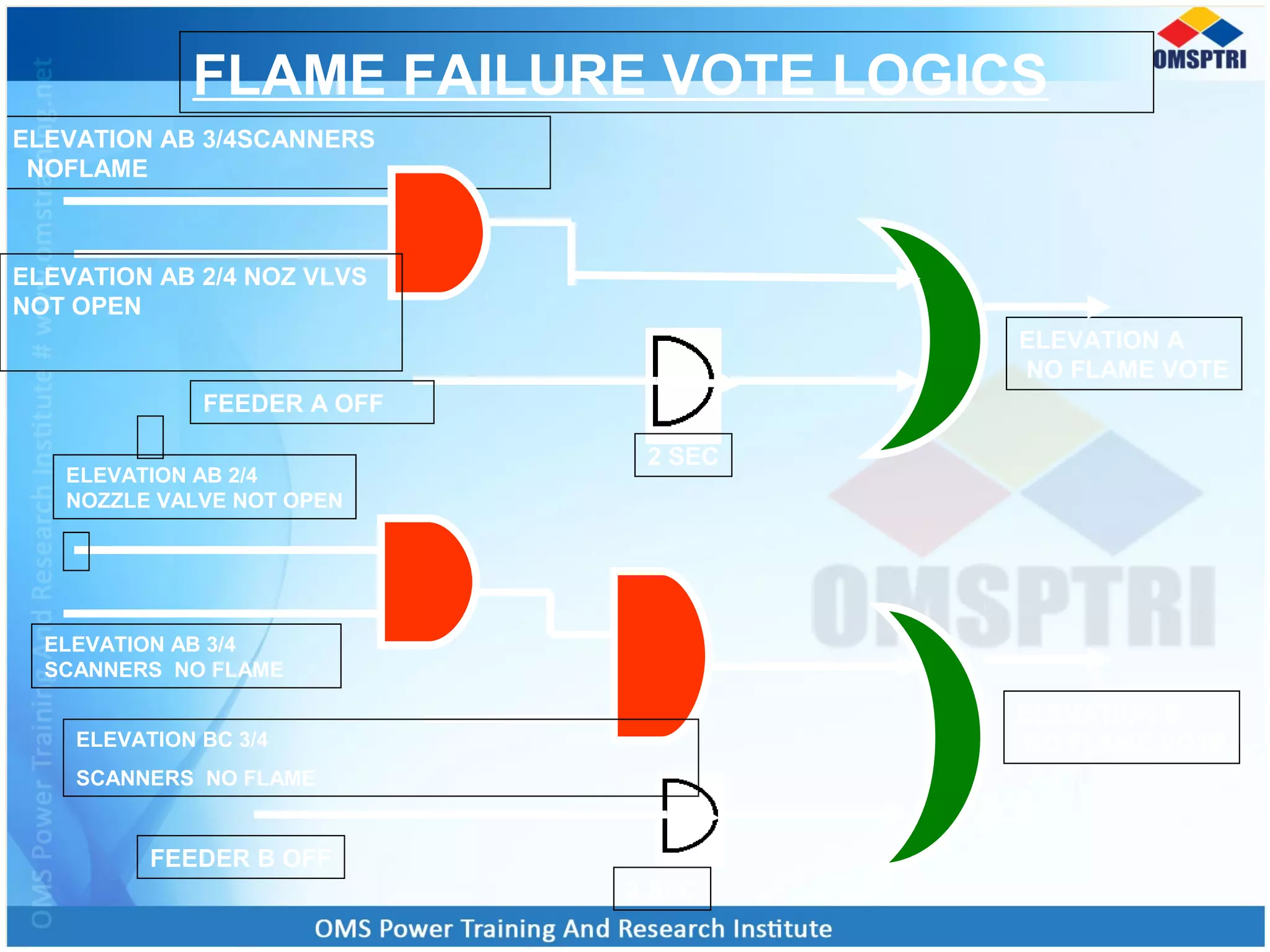
FLAME FAILURE VOTE LOGICS
FEEDER B OFF
2 SEC
ELEVATION AB 2/4
NOZZLE VALVE NOT OPEN
ELEVATION AB 3/4
SCANNERS NO FLAME
2 SEC
ELEVATION B
NO FLAME VOTE
ELEVATION A
NO FLAME VOTE
FEEDER A OFF
ELEVATION AB 3/4SCANNERS
NOFLAME
ELEVATION AB 2/4 NOZ VLVS
NOT OPEN
ELEVATION BC 3/4
SCANNERS NO FLAME
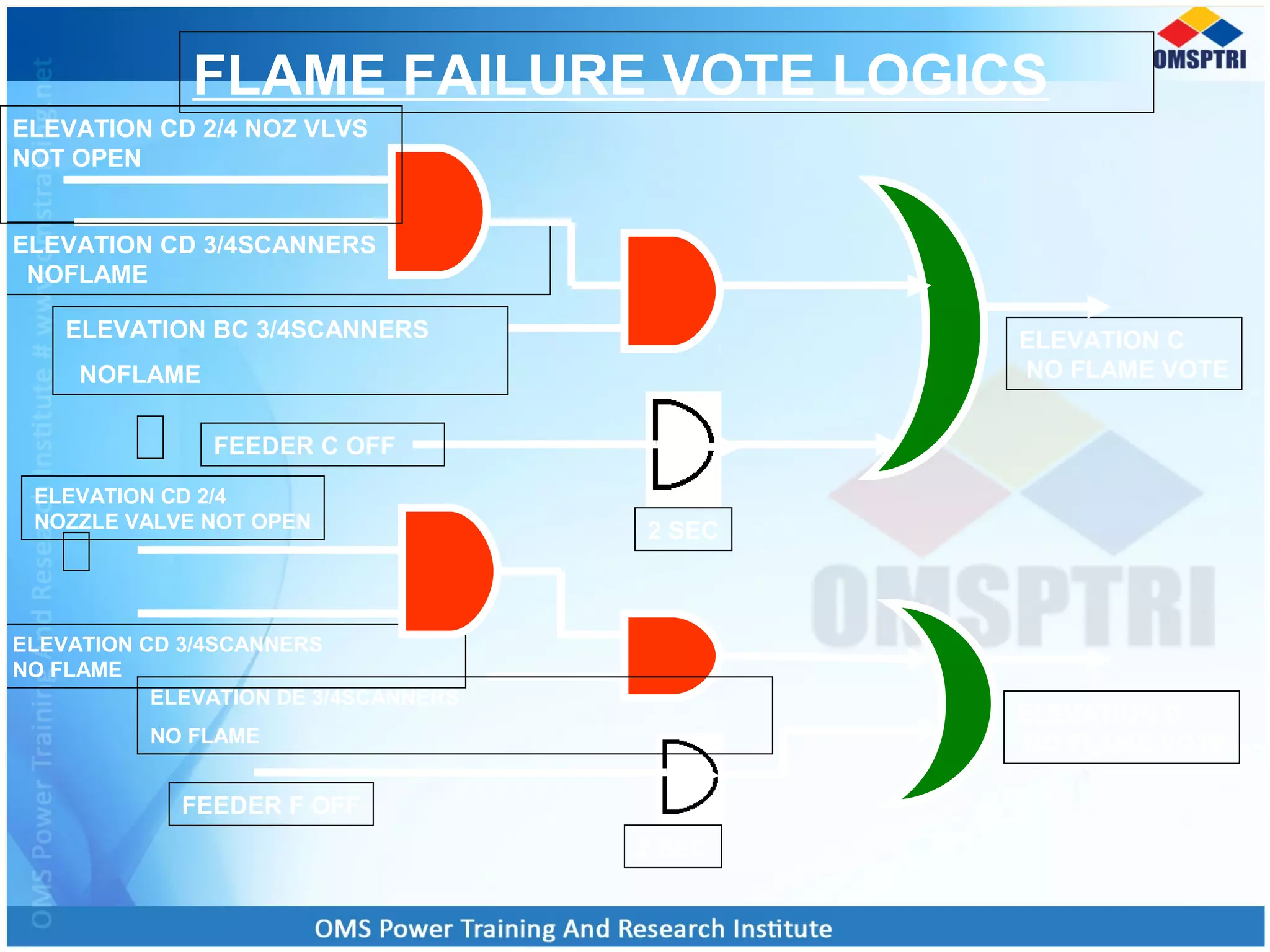
FLAME FAILURE VOTE LOGICS
FEEDER F OFF
2 SEC
ELEVATION CD 2/4
NOZZLE VALVE NOT OPEN
ELEVATION CD 3/4SCANNERS
NO FLAME
2 SEC
ELEVATION D
NO FLAME VOTE
ELEVATION C
NO FLAME VOTE
FEEDER C OFF
ELEVATION CD 3/4SCANNERS
NOFLAME
ELEVATION CD 2/4 NOZ VLVS
NOT OPEN
ELEVATION BC 3/4SCANNERS
NOFLAME
ELEVATION DE 3/4SCANNERS
NO FLAME
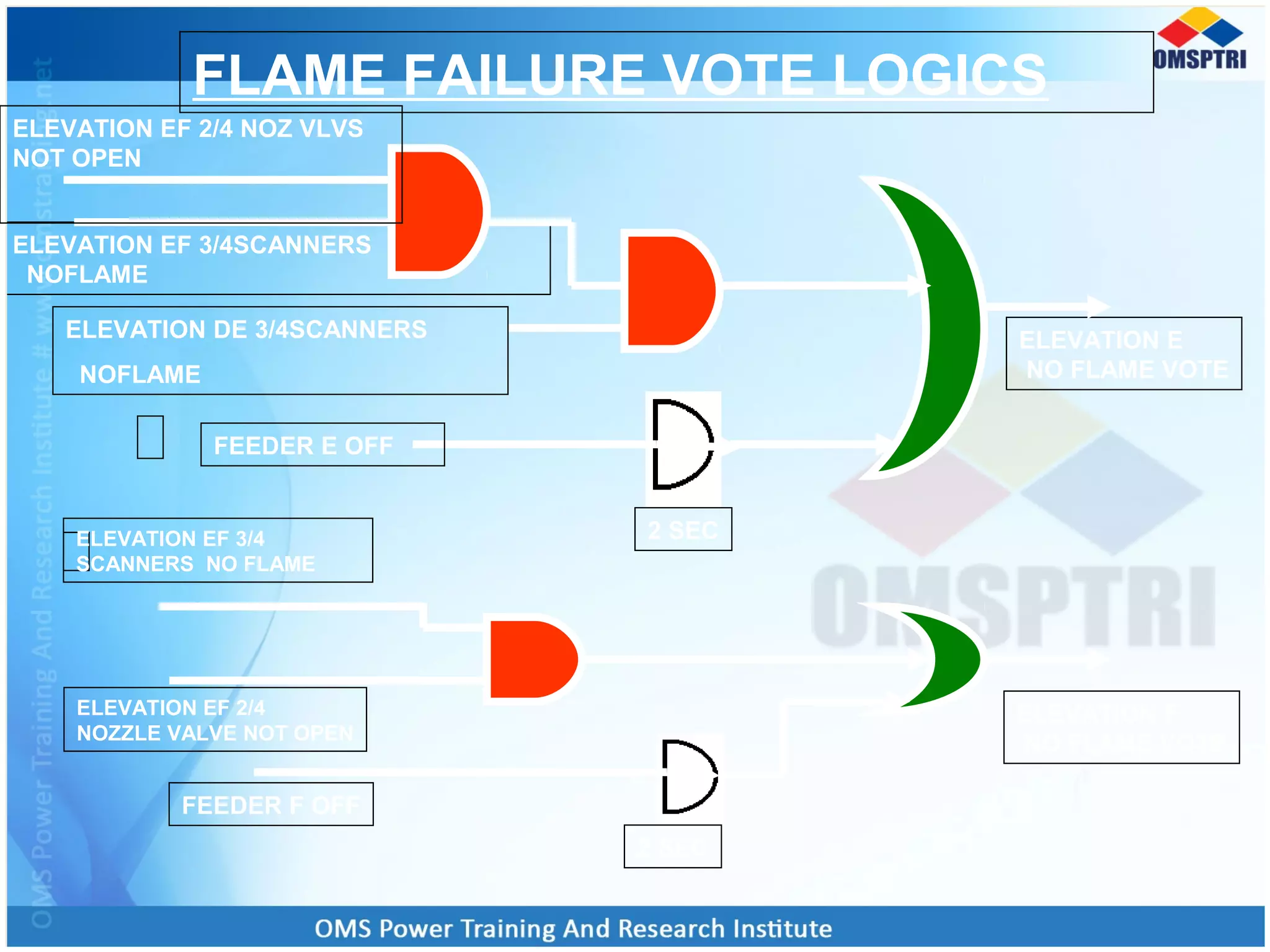
FLAME FAILURE VOTE LOGICS
FEEDER F OFF
2 SEC
ELEVATION EF 2/4
NOZZLE VALVE NOT OPEN
ELEVATION EF 3/4
SCANNERS NO FLAME
2 SEC
ELEVATION F
NO FLAME VOTE
ELEVATION E
NO FLAME VOTE
FEEDER E OFF
ELEVATION EF 3/4SCANNERS
NOFLAME
ELEVATION EF 2/4 NOZ VLVS
NOT OPEN
ELEVATION DE 3/4SCANNERS
NOFLAME
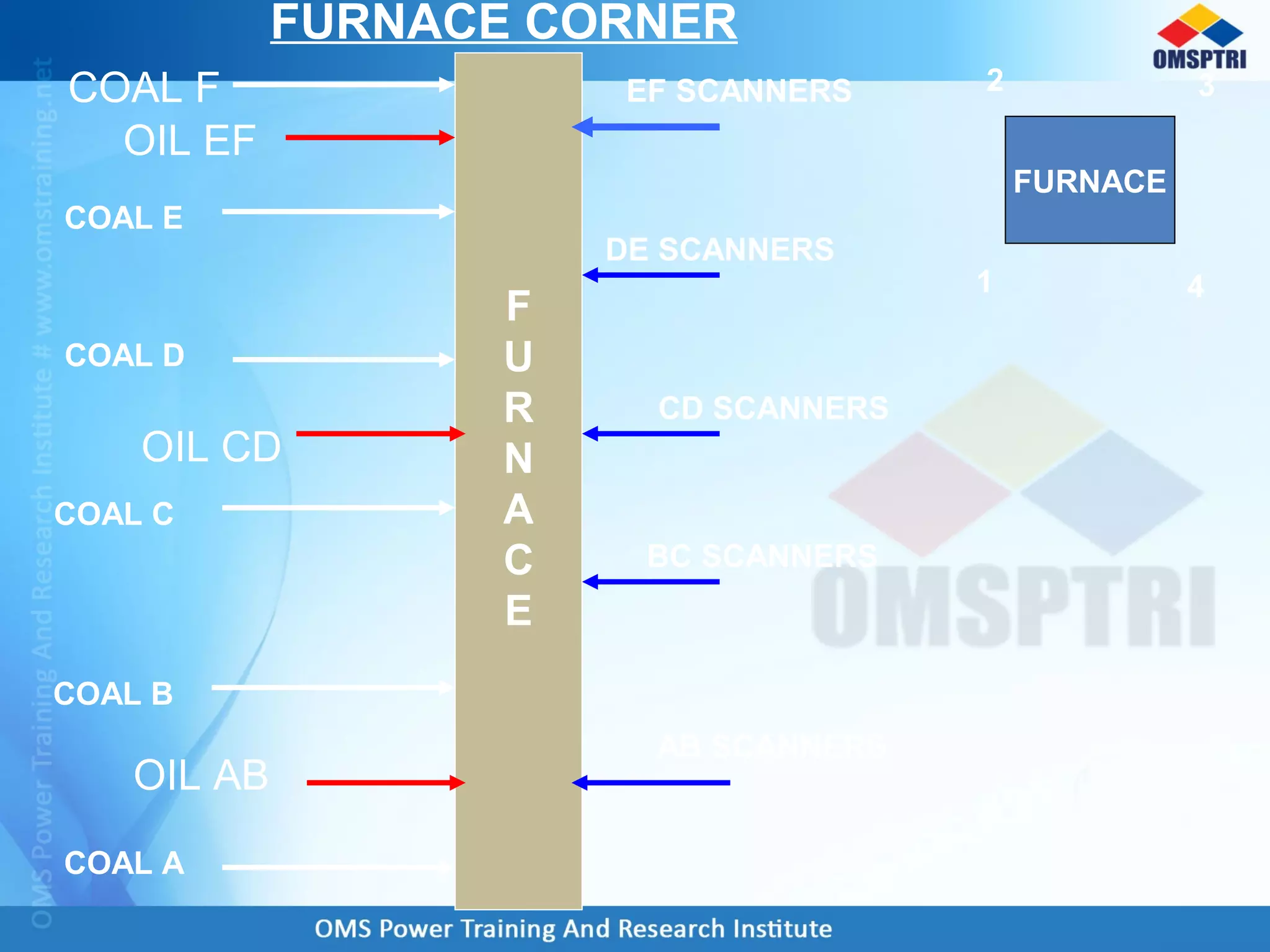
FURNACE
F
U
R
N
A
C
E
COAL A
COAL B
COAL C
COAL D
COAL E
COAL F
OIL AB
OIL CD
OIL EF
AB SCANNERS
BC SCANNERS
CD SCANNERS
DE SCANNERS
EF SCANNERS
1
2 3
4
FURNACE CORNER
Flame scanners
• There are several types of flame detector. The optical flame detector
is a detector that uses Optical Sensors to detect flames.
• There are also ionisation flame detectors, which use current flow in
the flame to detect flame presence, and thermocouple flame
detectors.
Working Principle of The Flame Detector
•Radiant intensity signals of the flame sent by a muffle burner change
into relevant voltage strength signals by the photoelectric sensor.
•The voltages are low and hence amplified into standard analog signals,
which would be processed in the single chip microcomputer and change
into relevant controlling signals to be output.
•The flame detector has functions of collecting, processing input signals
and output control signals.
Pyrometer
• A pyrometer is a non-contacting device that
intercepts and measures thermal radiation, a
process known as pyrometry.
• This device can be used to determine
the temperature of an object's surface.
Thermopiles Pyrometers
• Each thermopile consists of a large number of
thermocouples, on which the light from the fire is
concentrated by means of a lens.
• The thermocouples produce a voltage signal that
depends on the temperature of the fire only.
• This signal is amplified and used to control the trip
circuit.
Maintenance
• The lenses of the thermopiles is cleaned at all times, by
dedicated purge air fans.
• Proper alignment of the thermopile is essential. A small
view hole is provided at the back of the thermopile.
• Properly aligned at a fire of 1 400°C, the thermopile
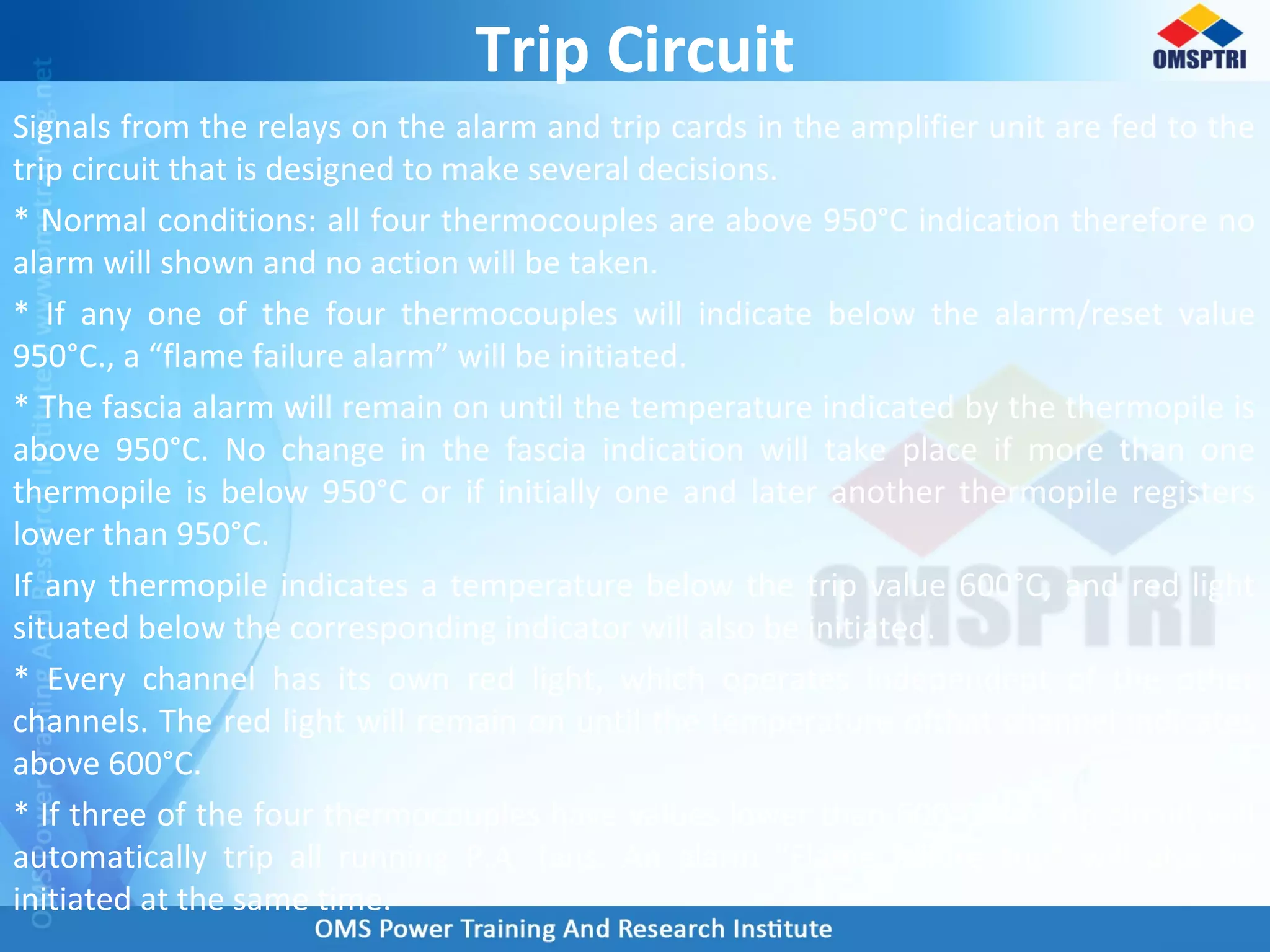
Trip Circuit
Signals from the relays on the alarm and trip cards in the amplifier unit are fed to the
trip circuit that is designed to make several decisions.
* Normal conditions: all four thermocouples are above 950°C indication therefore no
alarm will shown and no action will be taken.
* If any one of the four thermocouples will indicate below the alarm/reset value
950°C., a “flame failure alarm” will be initiated.
* The fascia alarm will remain on until the temperature indicated by the thermopile is
above 950°C. No change in the fascia indication will take place if more than one
thermopile is below 950°C or if initially one and later another thermopile registers
lower than 950°C.
If any thermopile indicates a temperature below the trip value 600°C, and red light
situated below the corresponding indicator will also be initiated.
* Every channel has its own red light, which operates independent of the other
channels. The red light will remain on until the temperature ofthat channel indicates
above 600°C.
* If three of the four thermocouples have values lower than 600°C the trip circuit will
automatically trip all running P.A. fans. An alarm “Flame failure trip” will also be
initiated at the same time.
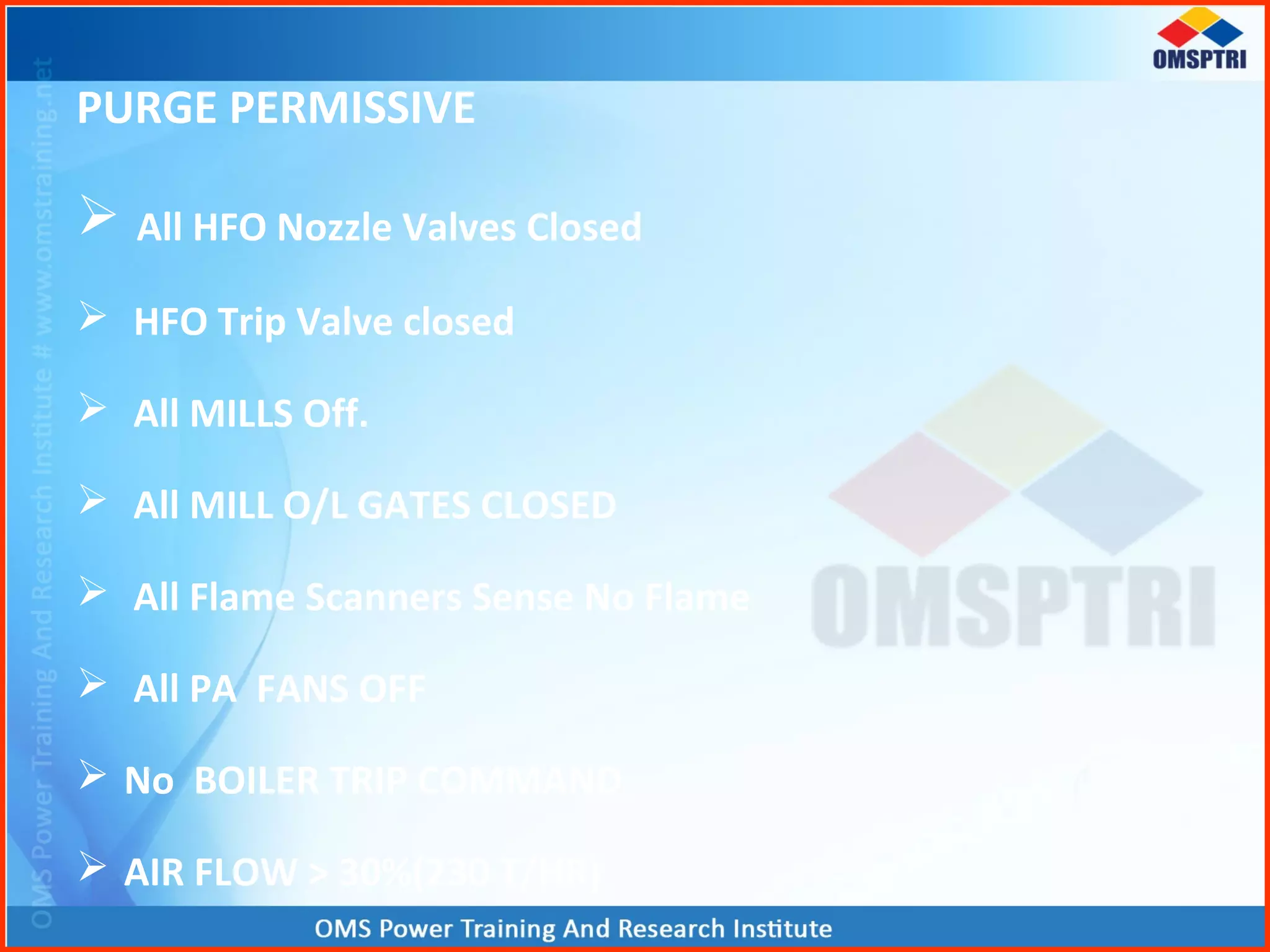
PURGE PERMISSIVE
 All HFO Nozzle Valves Closed
 HFO Trip Valve closed
 All MILLS Off.
 All MILL O/L GATES CLOSED
 All Flame Scanners Sense No Flame
 All PA FANS OFF
 No BOILER TRIP COMMAND
 AIR FLOW > 30%(230 T/HR)
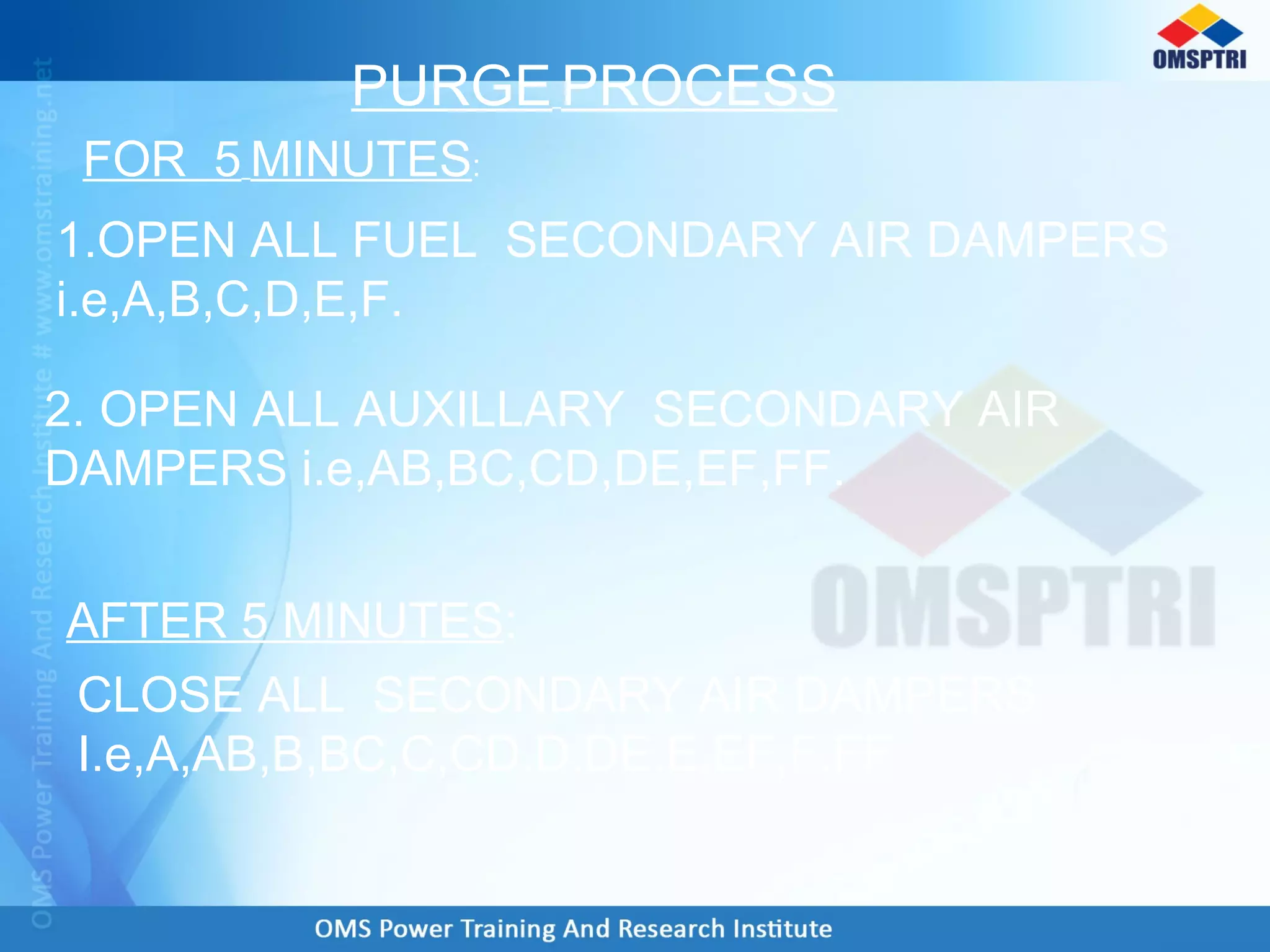
PURGE PROCESS
1.OPEN ALL FUEL SECONDARY AIR DAMPERS
i.e,A,B,C,D,E,F.
2. OPEN ALL AUXILLARY SECONDARY AIR
DAMPERS i.e,AB,BC,CD,DE,EF,FF.
FOR 5 MINUTES:
AFTER 5 MINUTES:
CLOSE ALL SECONDARY AIR DAMPERS
I.e,A,AB,B,BC,C,CD,D,DE,E,EF,F,FF.
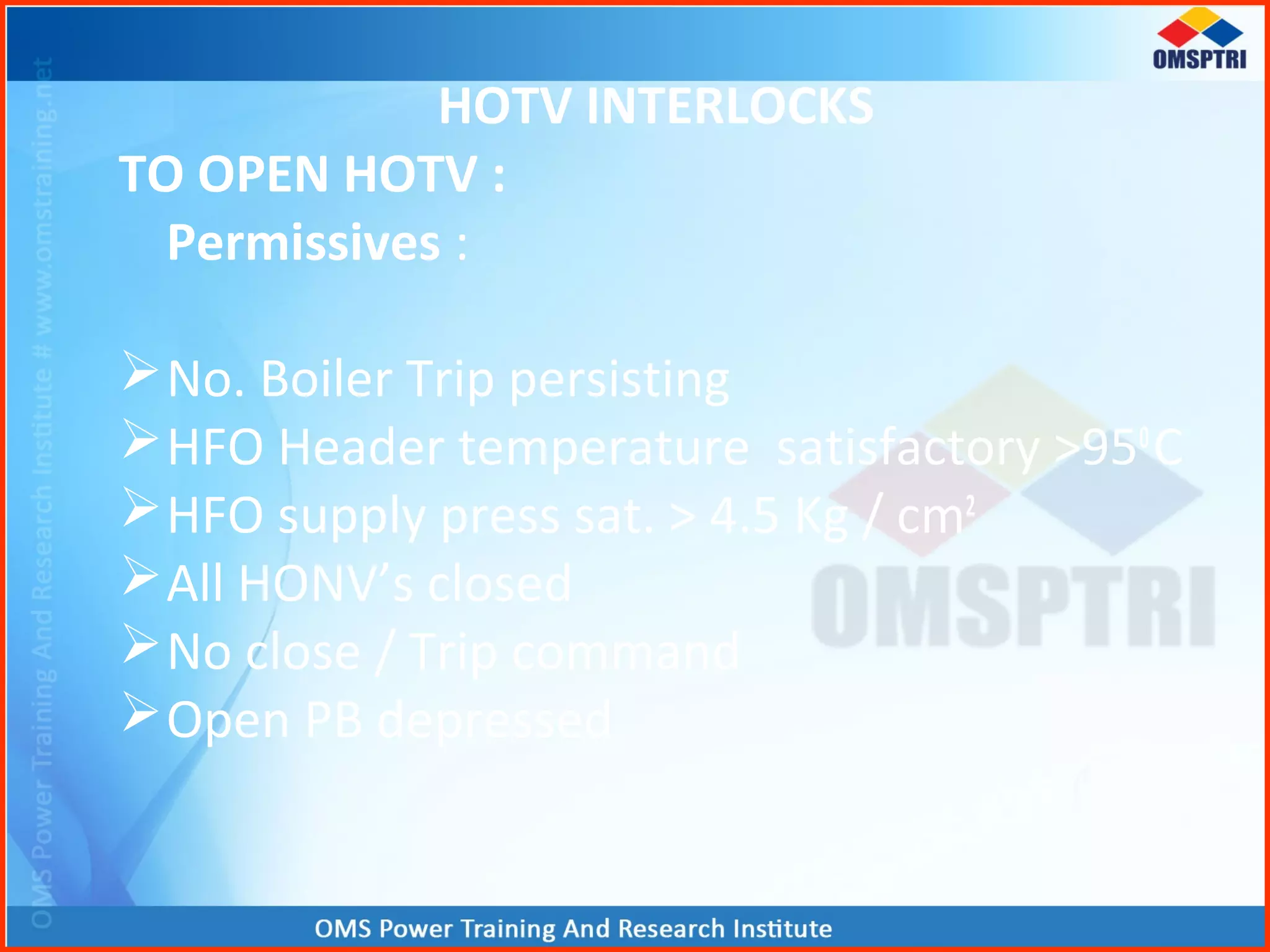
HOTV INTERLOCKS
TO OPEN HOTV :
Permissives :
No. Boiler Trip persisting
HFO Header temperature satisfactory >950
C
HFO supply press sat. > 4.5 Kg / cm2
All HONV’s closed
No close / Trip command
Open PB depressed
HOTV INTERLOCKS
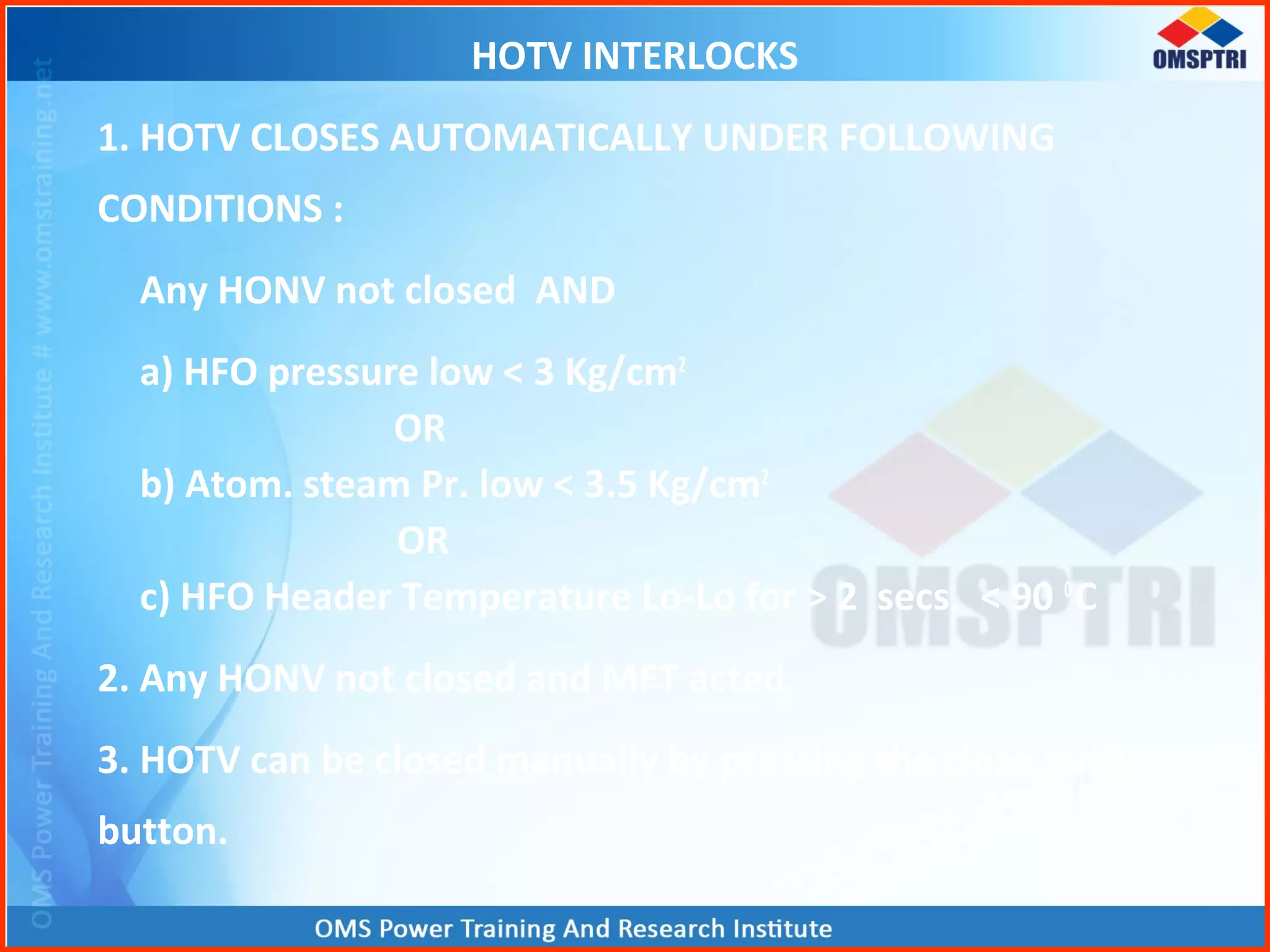
1. HOTV CLOSES AUTOMATICALLY UNDER FOLLOWING
CONDITIONS :
Any HONV not closed AND
a) HFO pressure low < 3 Kg/cm2
OR
b) Atom. steam Pr. low < 3.5 Kg/cm2
OR
c) HFO Header Temperature Lo-Lo for > 2 secs. < 90 0
C
2. Any HONV not closed and MFT acted
3. HOTV can be closed manually by pressing the close push
button.
HORV INTERLOCKS
 HORV can be opened by pressing the OPEN Push
button (PB) from Console if All the HONV s are
closed.
 HORV closes automatically when any HONV is not
closed OR by pressing close PB.
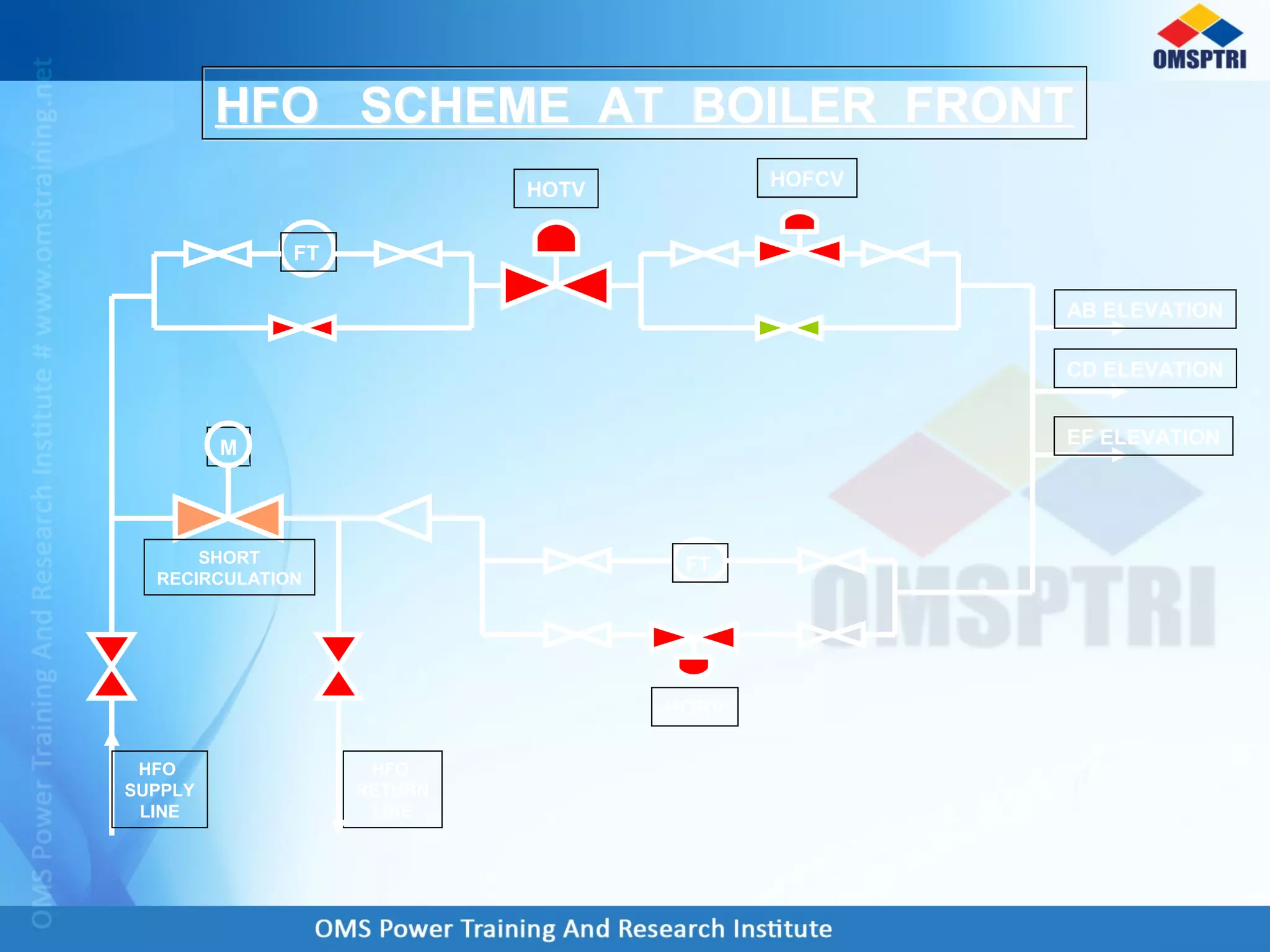
M
FT
FT
AB ELEVATION
CD ELEVATION
EF ELEVATION
HOFCV
HOTV
HORV
SHORT
RECIRCULATION
HFO
SUPPLY
LINE
HFO
RETURN
LINE
HFO SCHEME AT BOILER FRONTHFO SCHEME AT BOILER FRONT
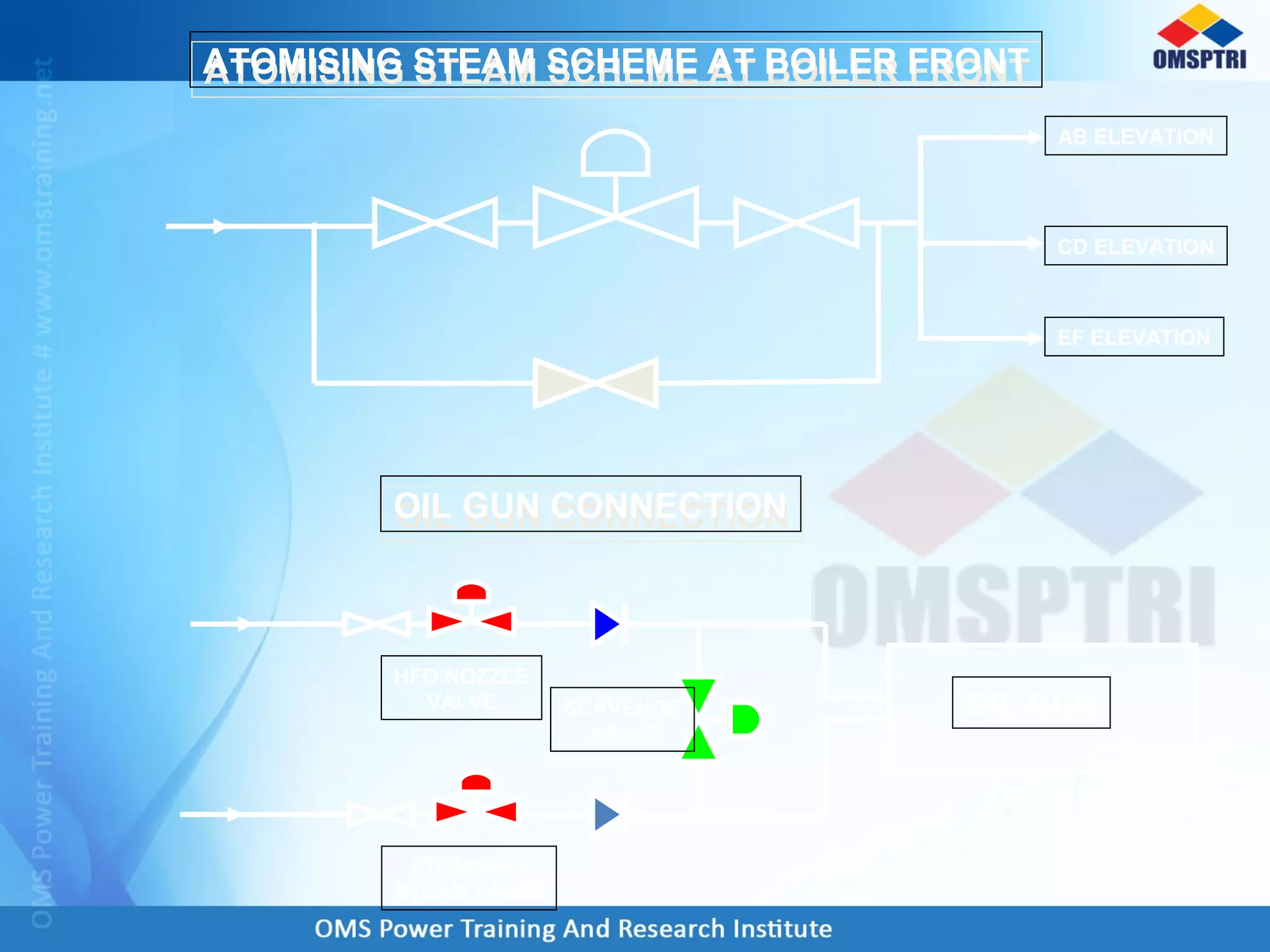
OIL GUN
ATOMISING
STEAM VALVE
HFO NOZZLE
VALVE SCAVENGE
VALVE
AB ELEVATION
CD ELEVATION
EF ELEVATION
ATOMISING STEAM SCHEME AT BOILER FRONTATOMISING STEAM SCHEME AT BOILER FRONT
OIL GUN CONNECTIONOIL GUN CONNECTION
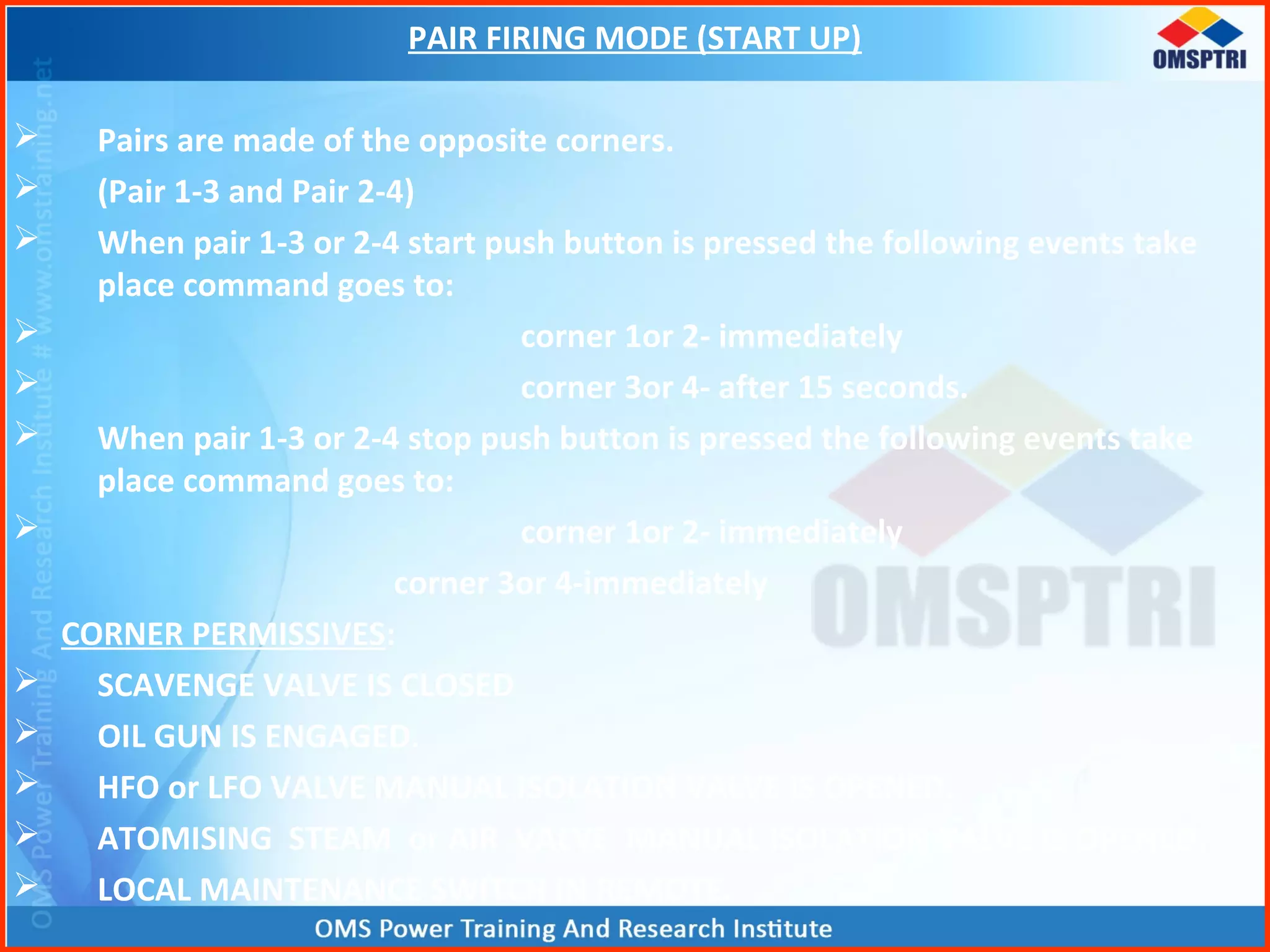
PAIR FIRING MODE (START UP)
 Pairs are made of the opposite corners.
 (Pair 1-3 and Pair 2-4)
 When pair 1-3 or 2-4 start push button is pressed the following events take
place command goes to:
 corner 1or 2- immediately
 corner 3or 4- after 15 seconds.
 When pair 1-3 or 2-4 stop push button is pressed the following events take
place command goes to:
 corner 1or 2- immediately
corner 3or 4-immediately
CORNER PERMISSIVES:
 SCAVENGE VALVE IS CLOSED
 OIL GUN IS ENGAGED.
 HFO or LFO VALVE MANUAL ISOLATION VALVE IS OPENED.
 ATOMISING STEAM or AIR VALVE MANUAL ISOLATION VALVE IS OPENED.
 LOCAL MAINTENANCE SWITCH IN REMOTE.
PAIR FIRING MODE (START UP)
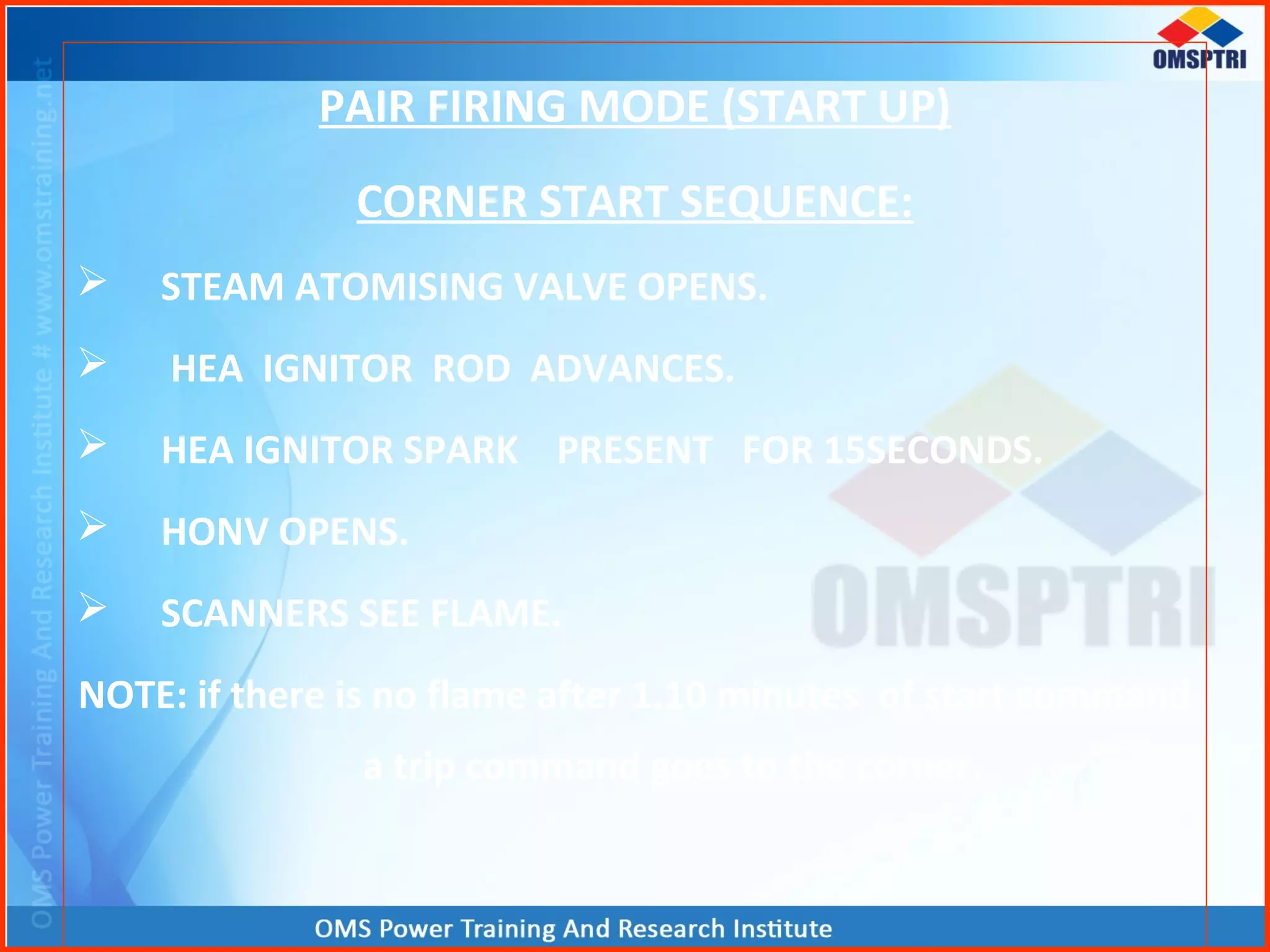
CORNER START SEQUENCE:
 STEAM ATOMISING VALVE OPENS.
 HEA IGNITOR ROD ADVANCES.
 HEA IGNITOR SPARK PRESENT FOR 15SECONDS.
 HONV OPENS.
 SCANNERS SEE FLAME.
NOTE: if there is no flame after 1.10 minutes of start command
a trip command goes to the corner.
PAIR FIRING MODE (SHUT DOWN)
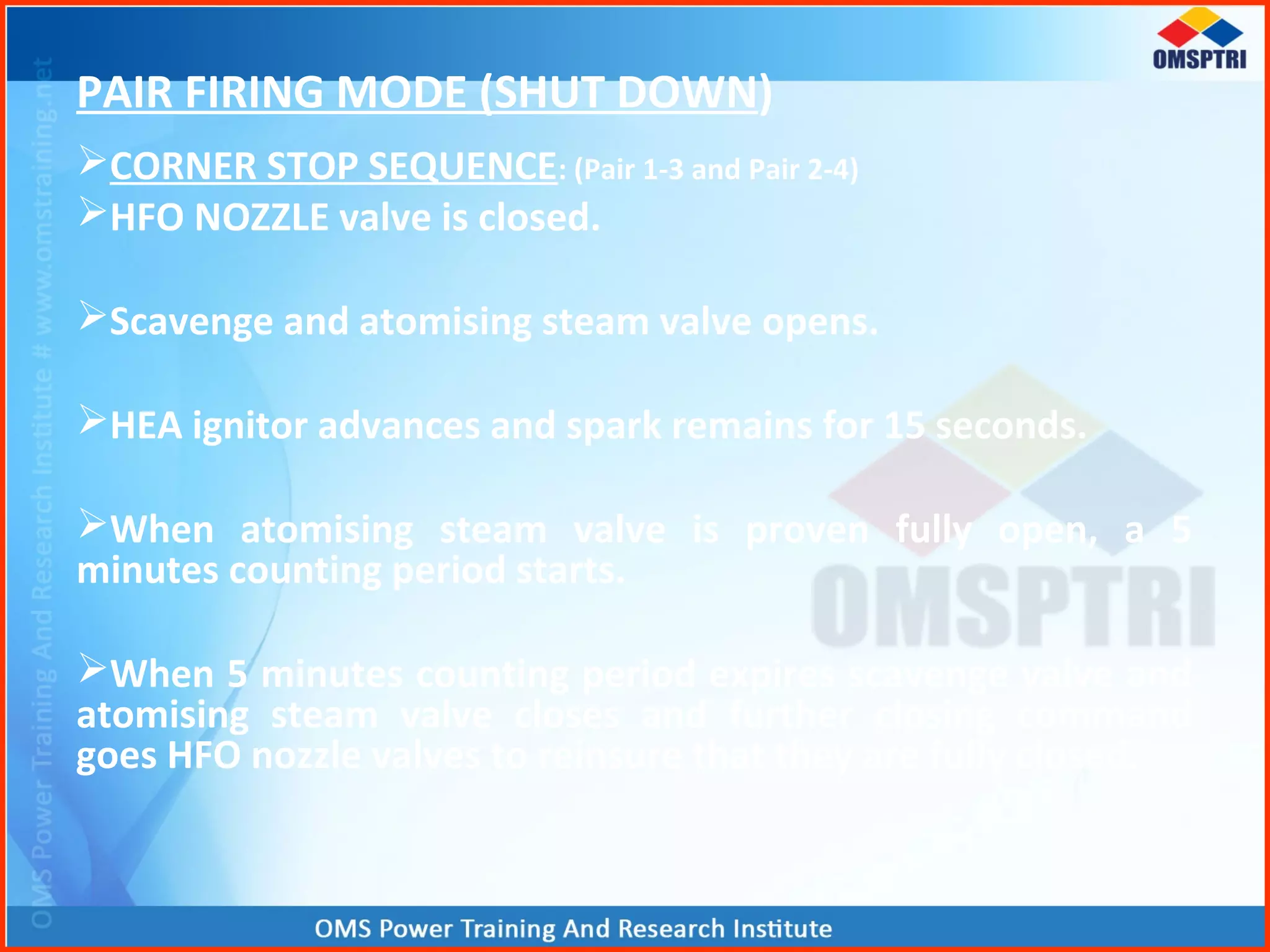
CORNER STOP SEQUENCE: (Pair 1-3 and Pair 2-4)
HFO NOZZLE valve is closed.
Scavenge and atomising steam valve opens.
HEA ignitor advances and spark remains for 15 seconds.
When atomising steam valve is proven fully open, a 5
minutes counting period starts.
When 5 minutes counting period expires scavenge valve and
atomising steam valve closes and further closing command
goes HFO nozzle valves to reinsure that they are fully closed.
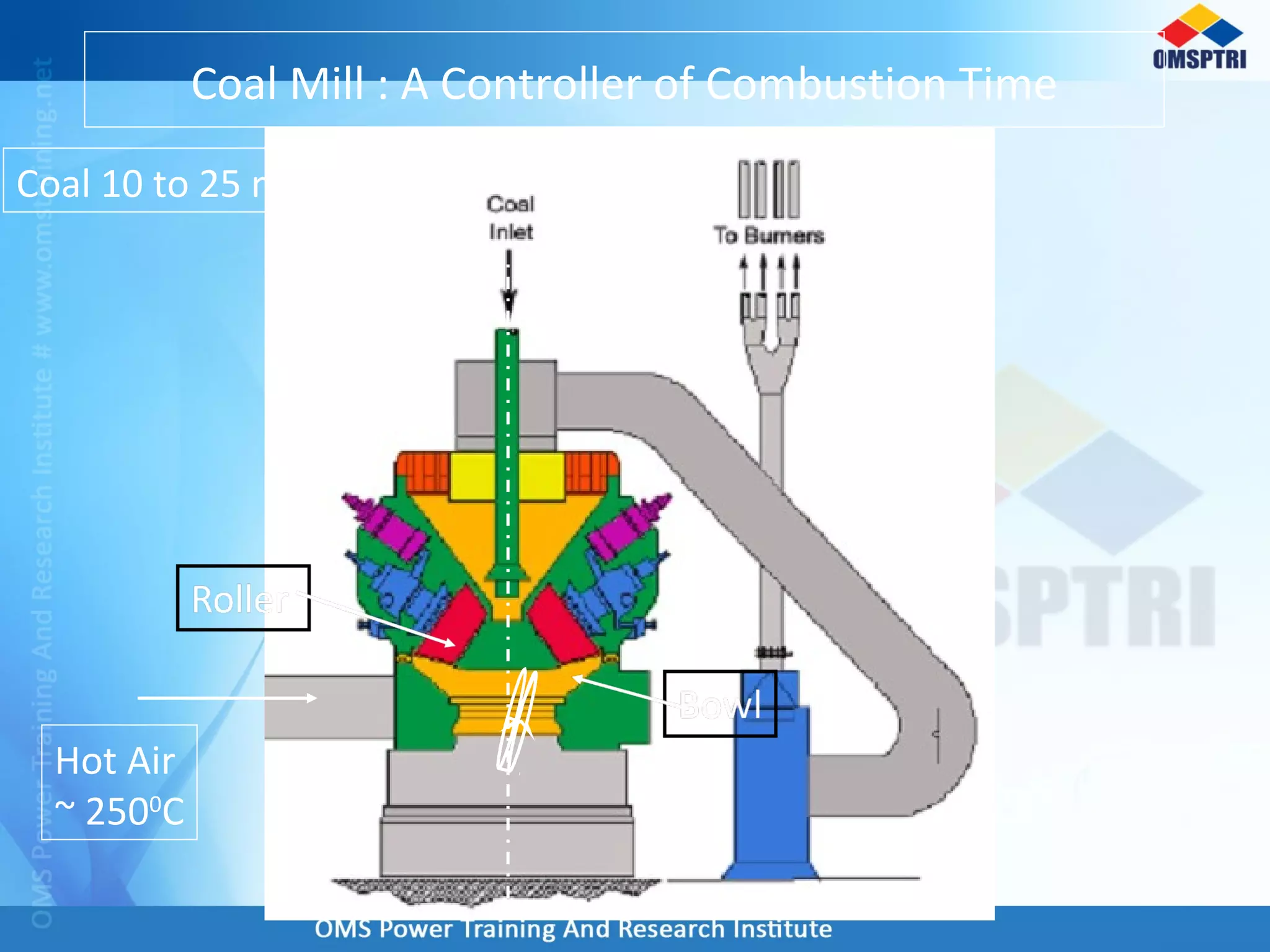
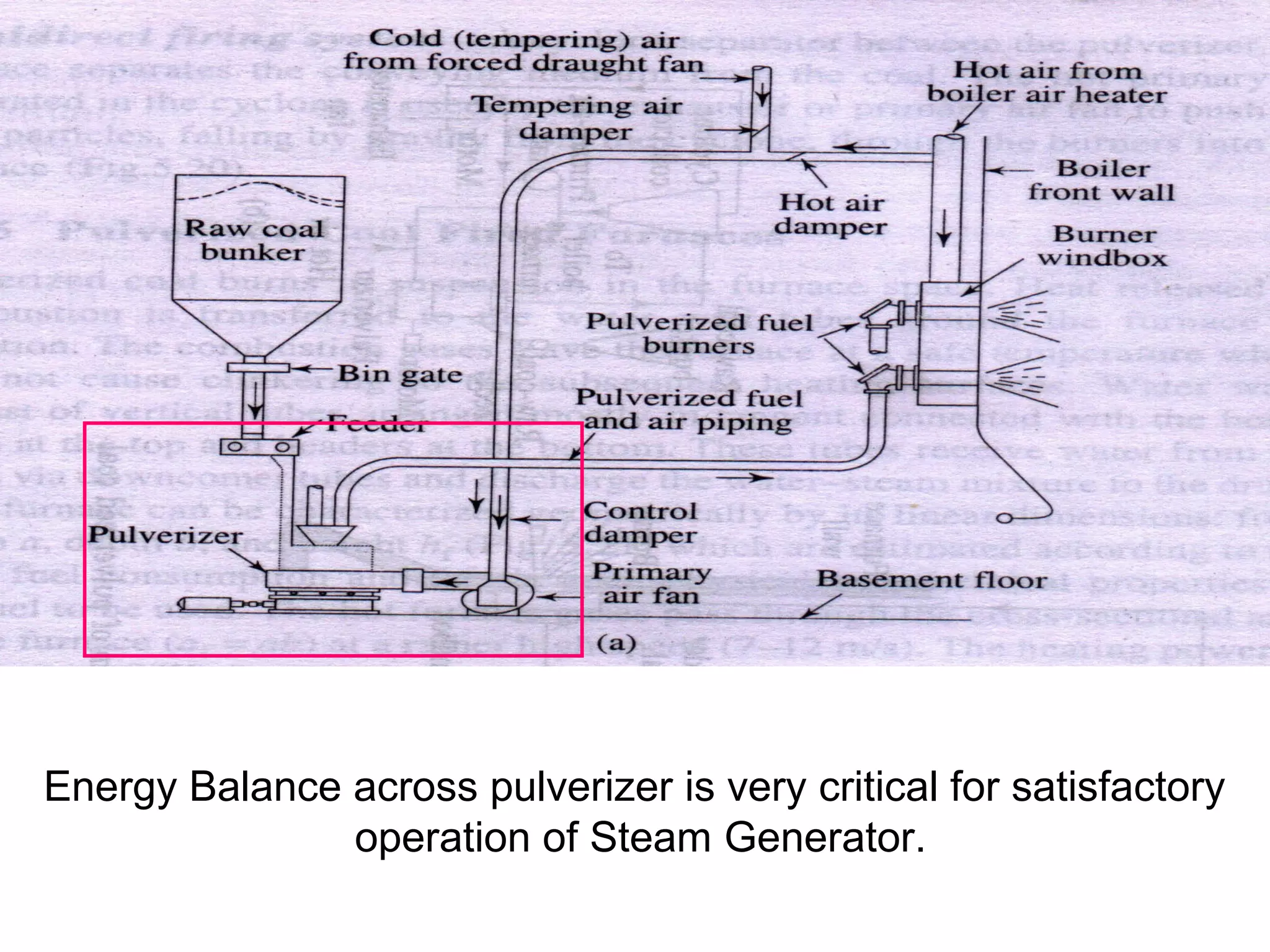
Coal Mill : A Controller of Combustion Time
Hot Air
~ 2500
C
Coal 10 to 25 mm Size
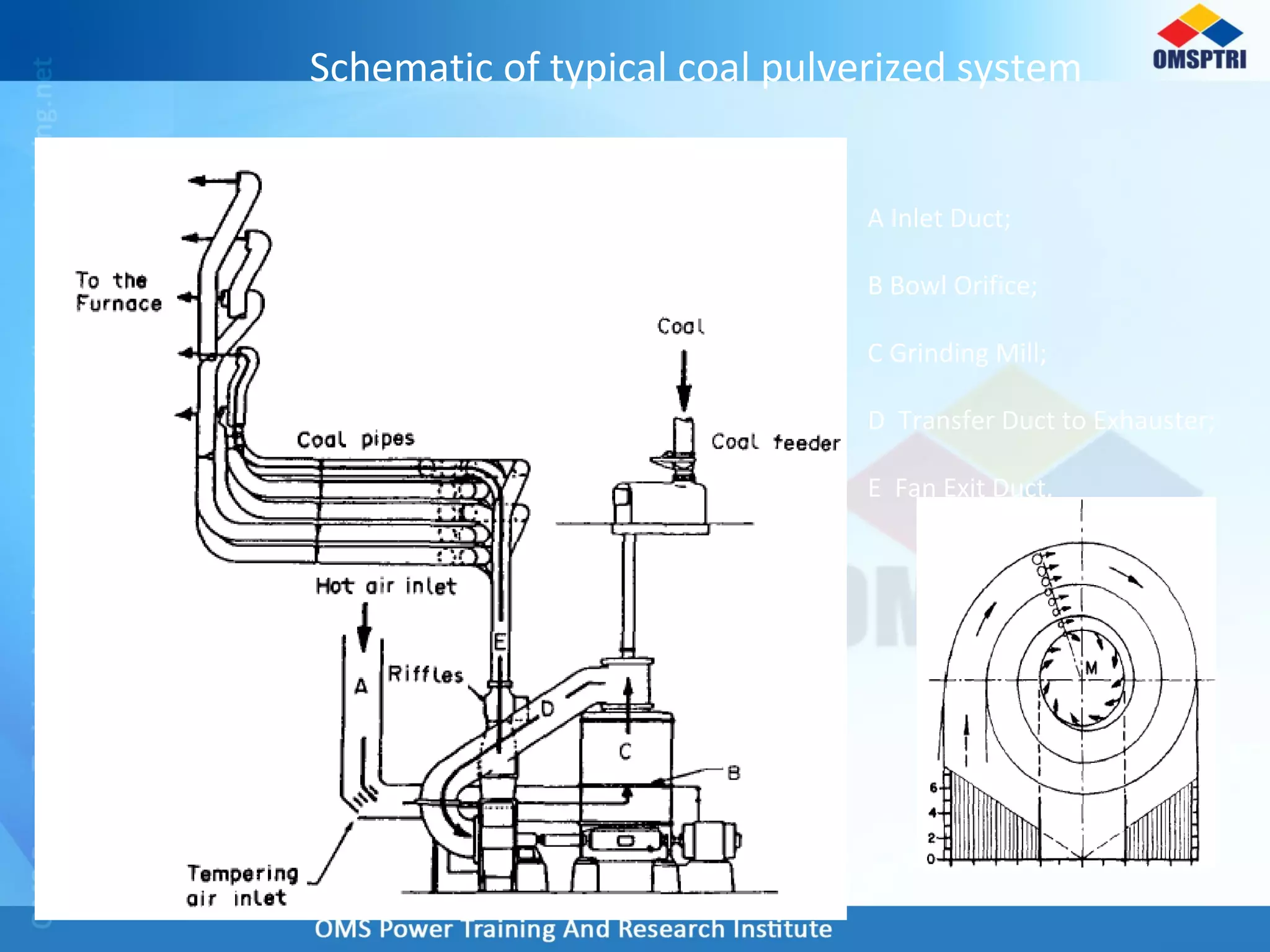
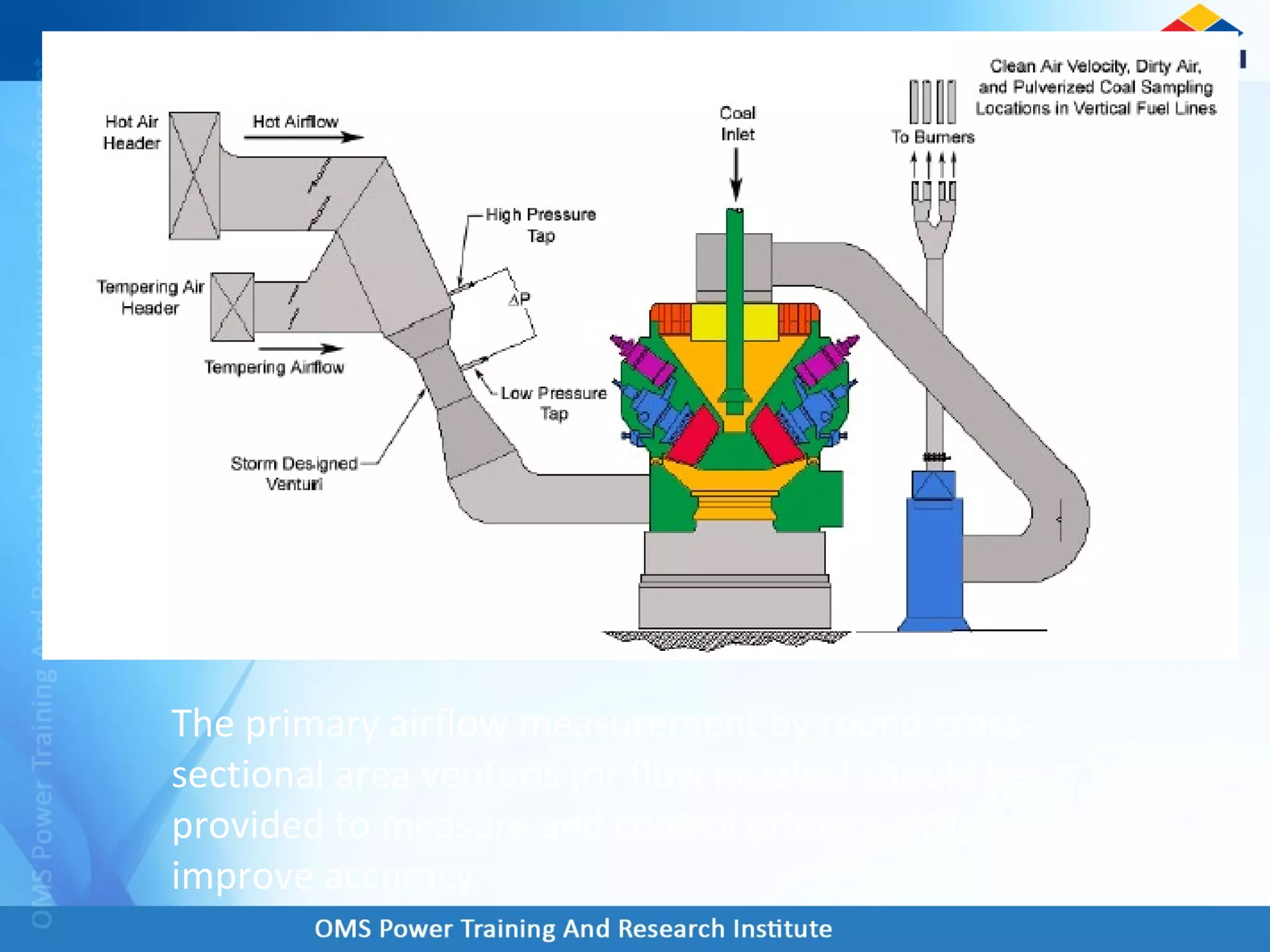
Schematic of typical coal pulverized system
A Inlet Duct;
B Bowl Orifice;
C Grinding Mill;
D Transfer Duct to Exhauster;
E Fan Exit Duct.
The primary airflow measurement by round cross-
sectional area venturis (or flow nozzles) should be
provided to measure and control primary airflow to
improve accuracy
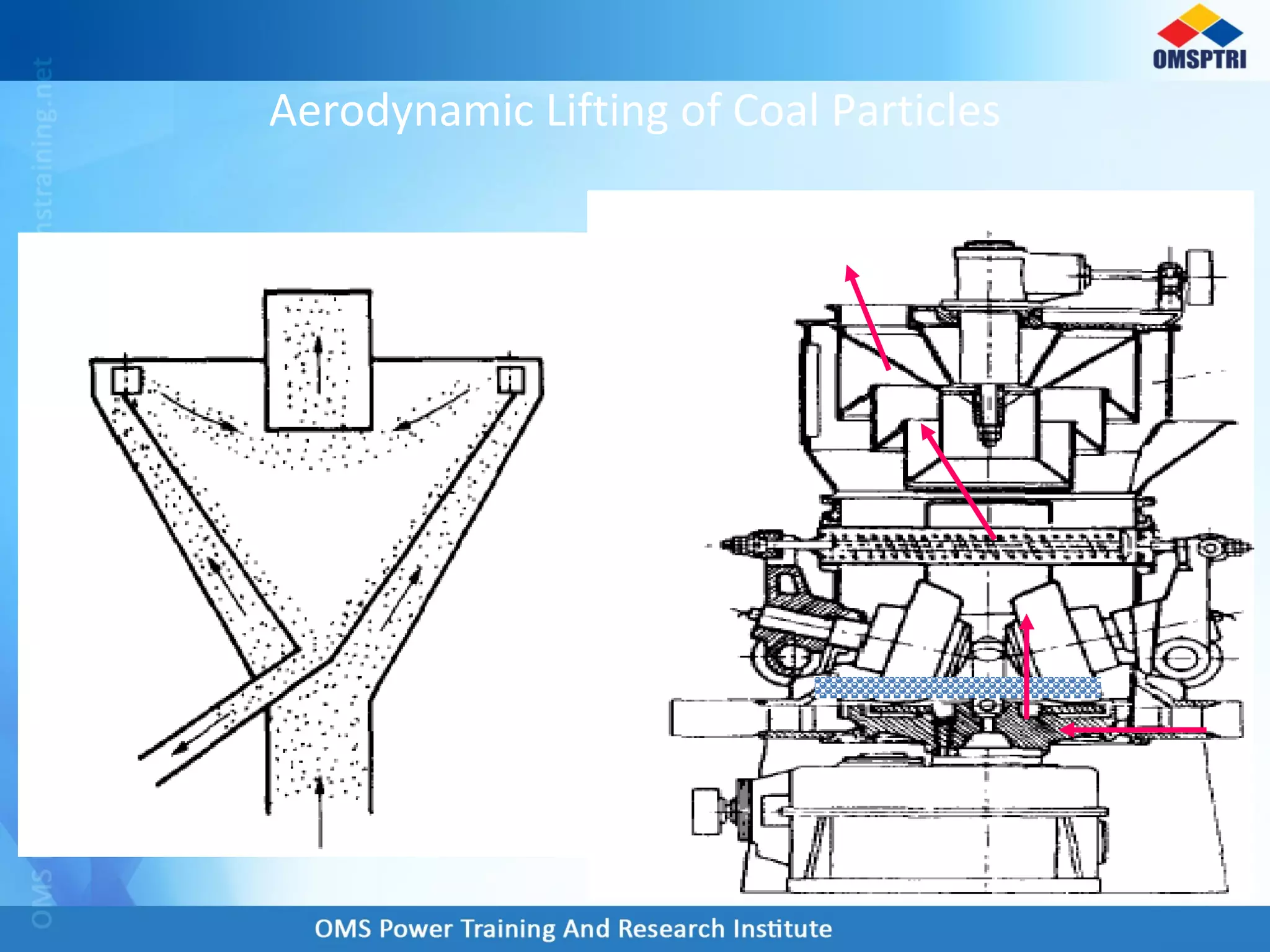
Aerodynamic Lifting of Coal Particles
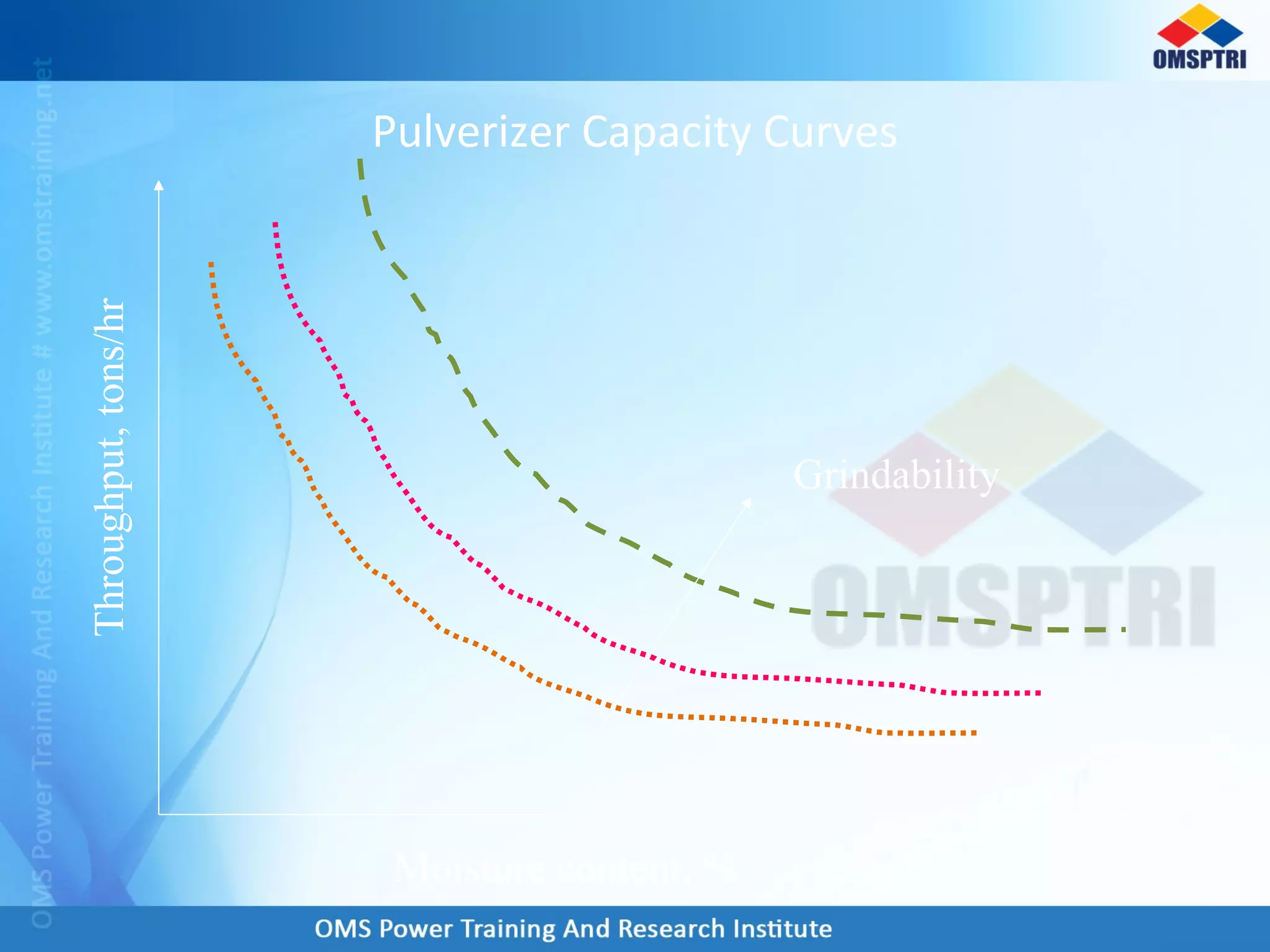
Pulverizer Capacity Curves
Moisture content, %
Throughput,tons/hr
Grindability
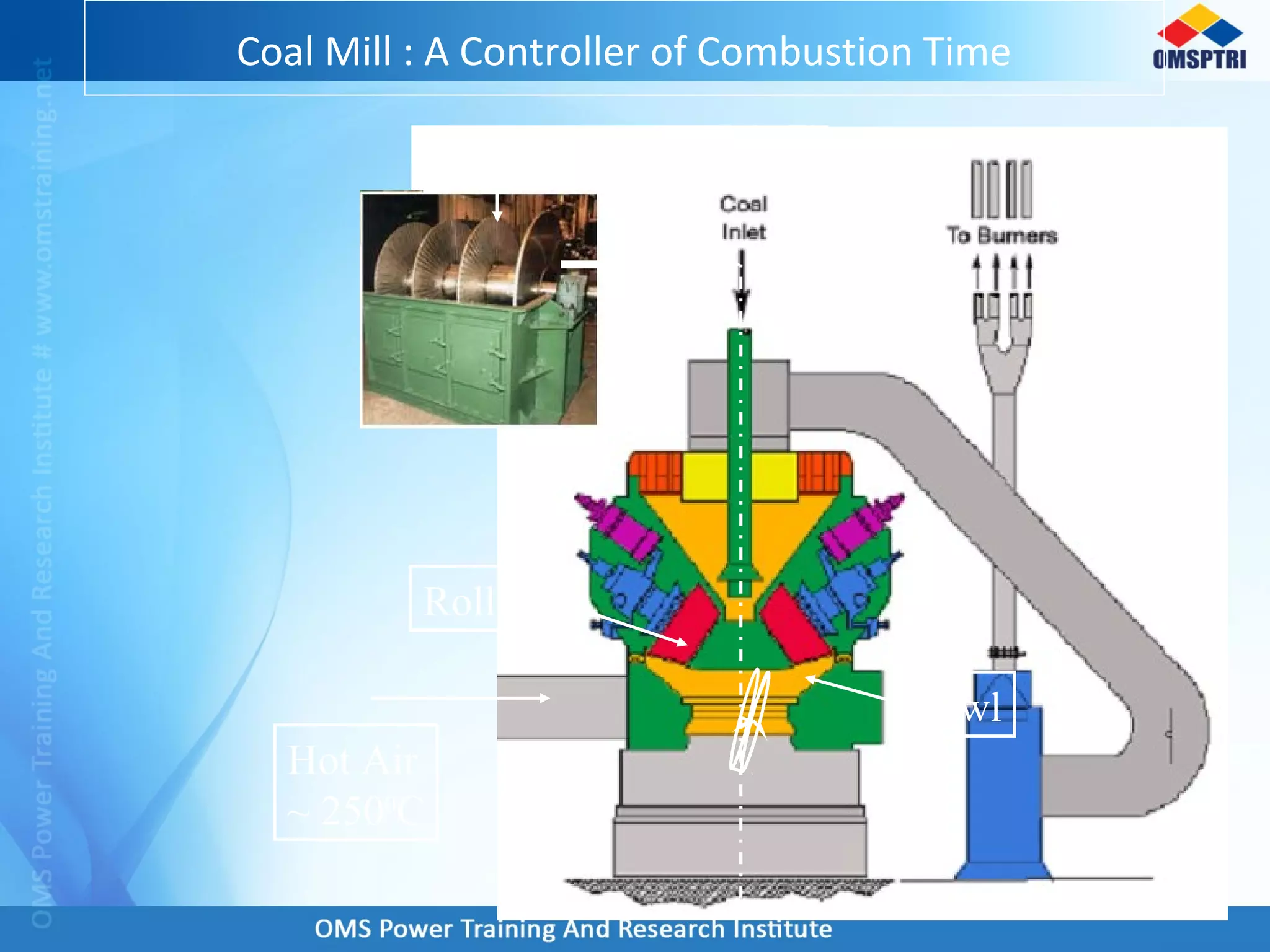
Coal Mill : A Controller of Combustion Time
Hot Air
~ 2500
C
Coal 10 to 25 mm Size
Roller
Bowl
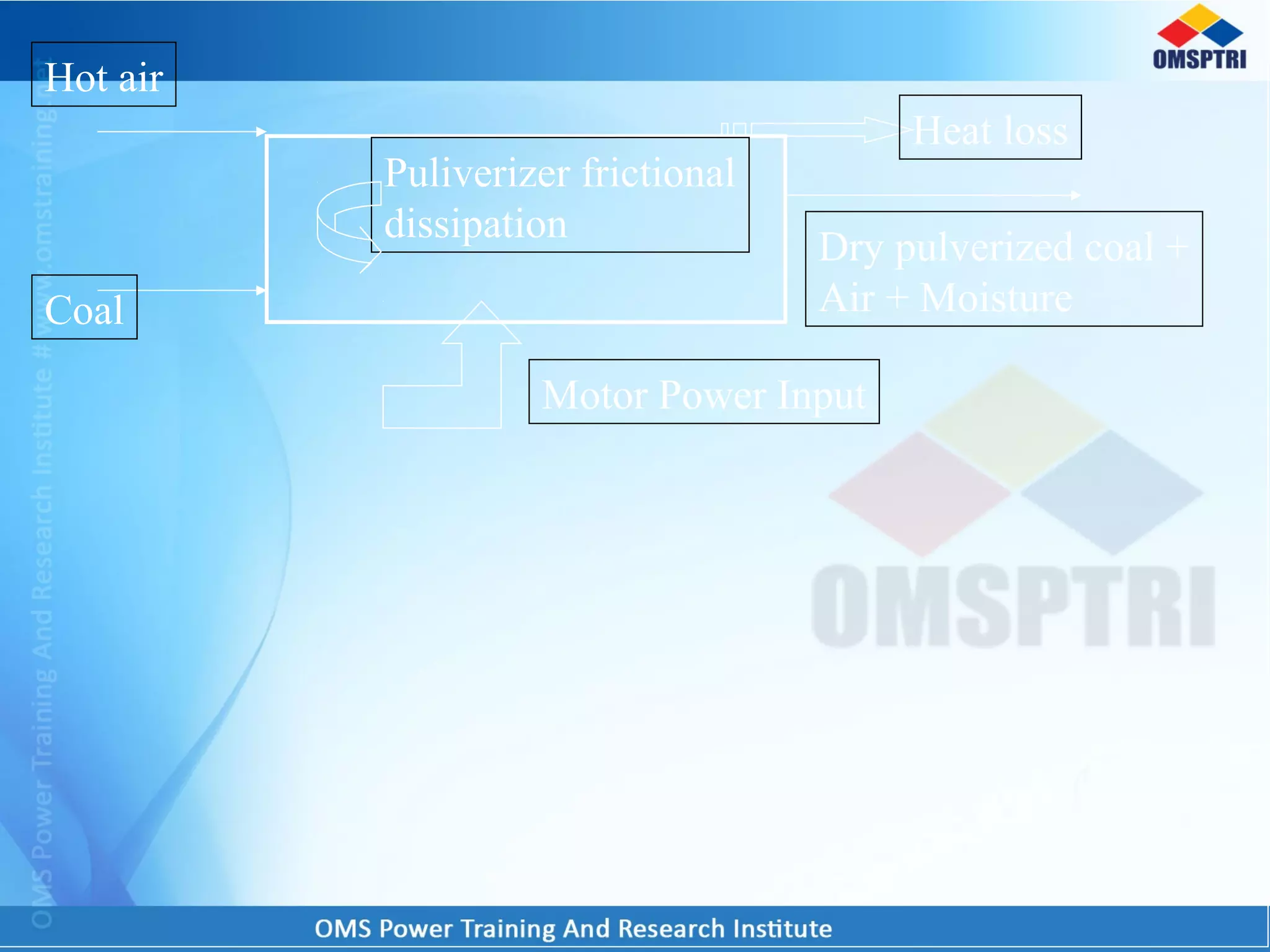
Energy Balance across pulverizer is very critical for satisfactory
operation of Steam Generator.
Hot air
Coal
Dry pulverized coal +
Air + Moisture
Puliverizer frictional
dissipation
Motor Power Input
Heat loss
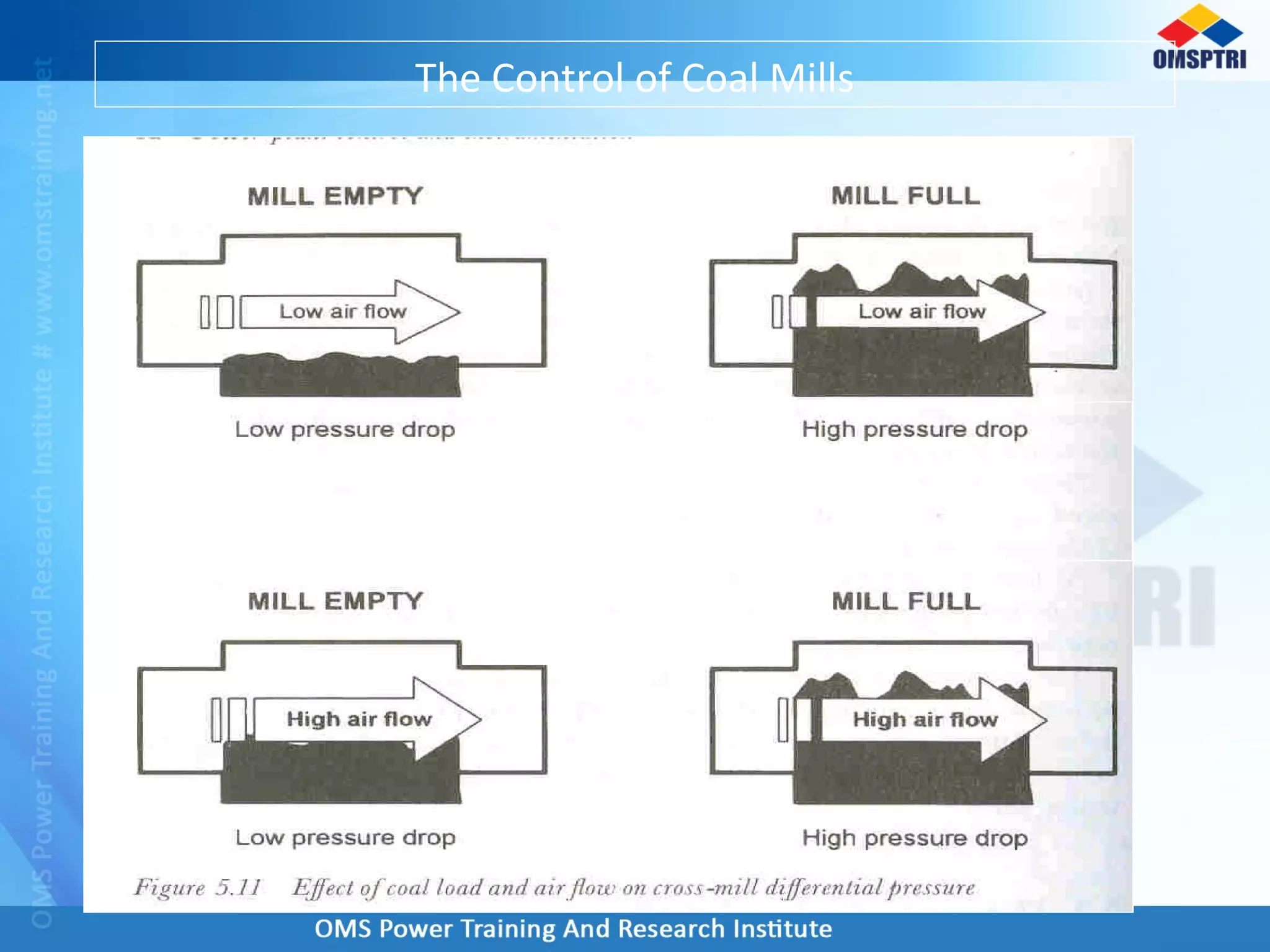
The Control of Coal Mills
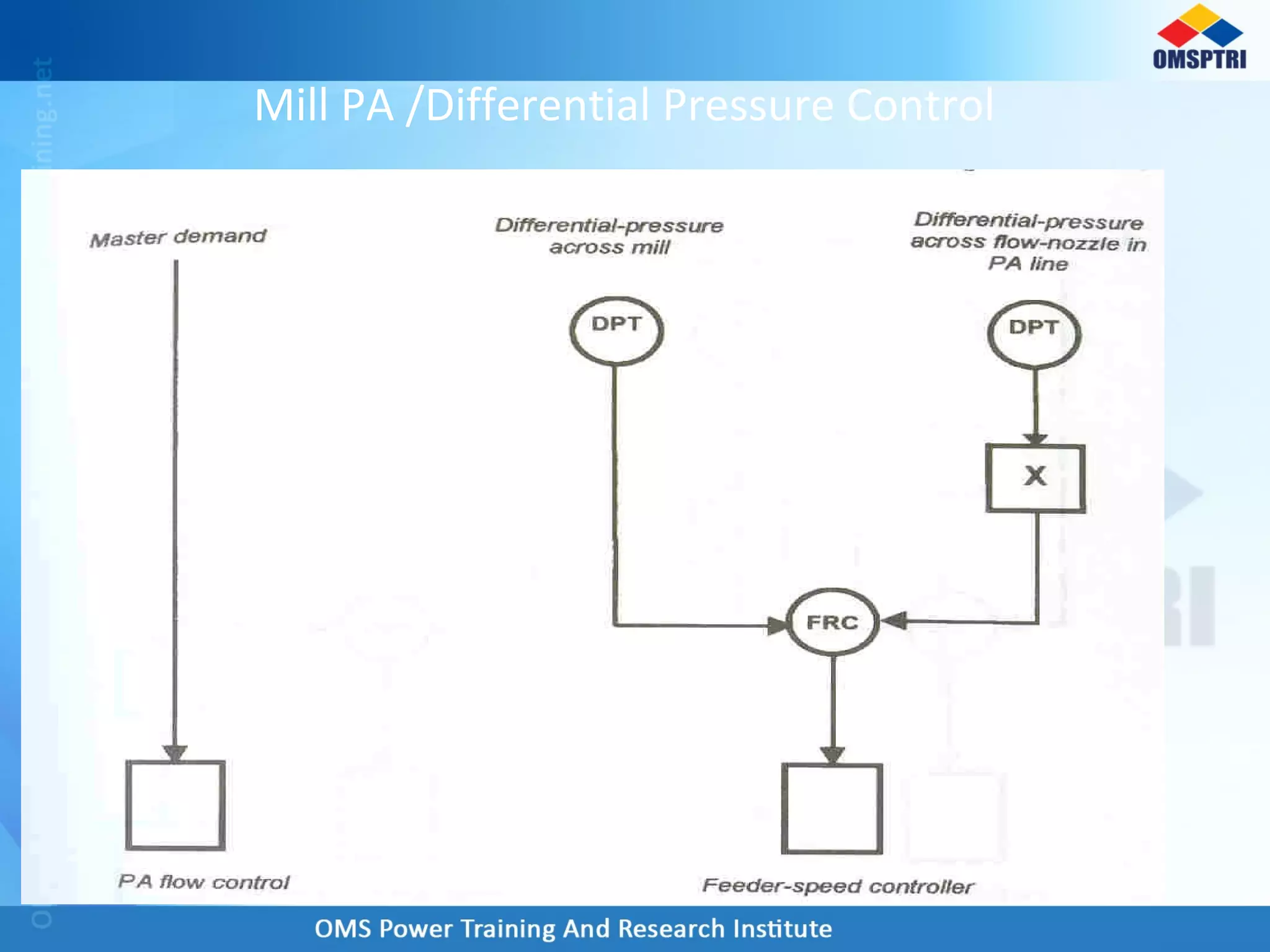
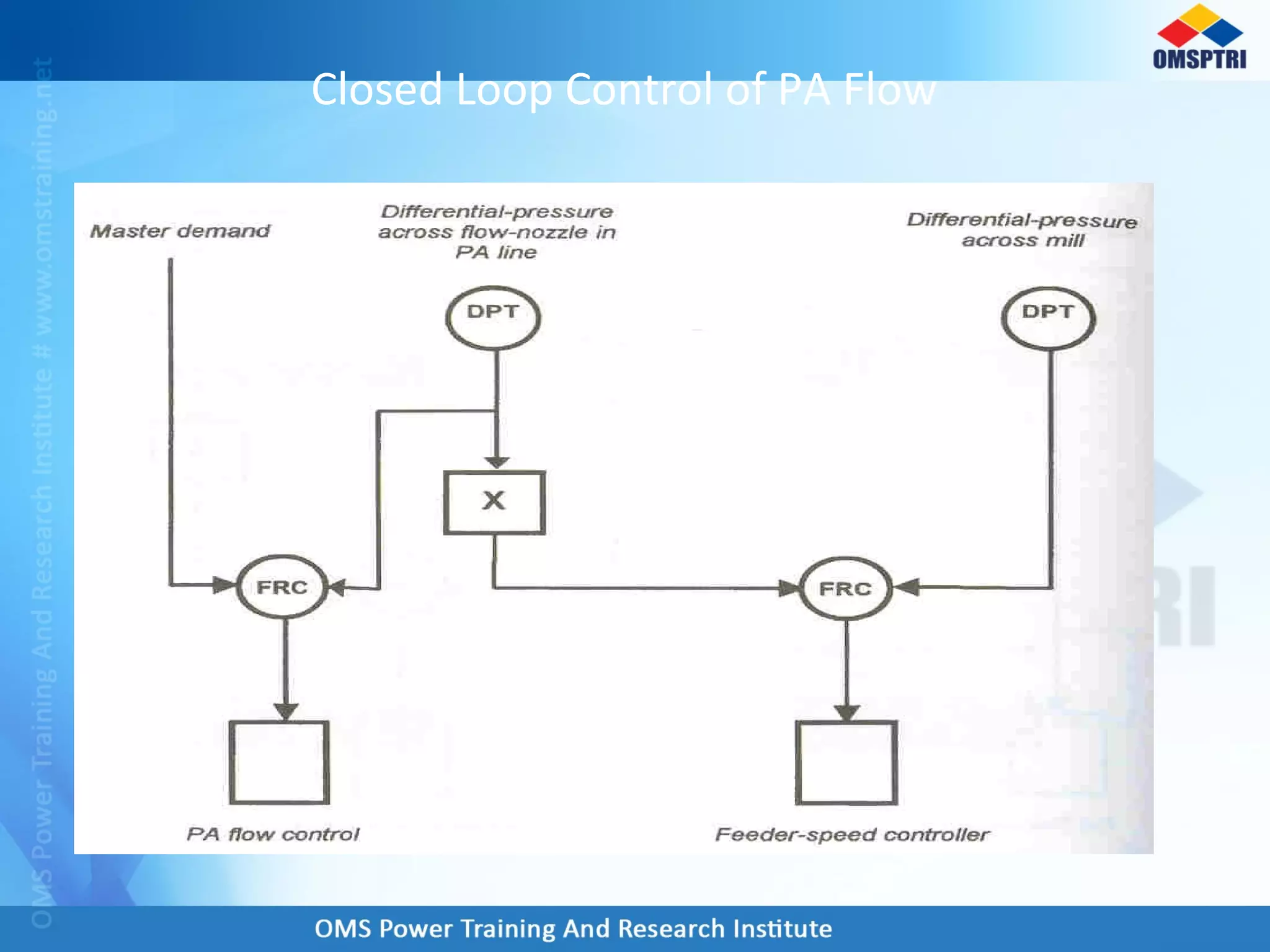
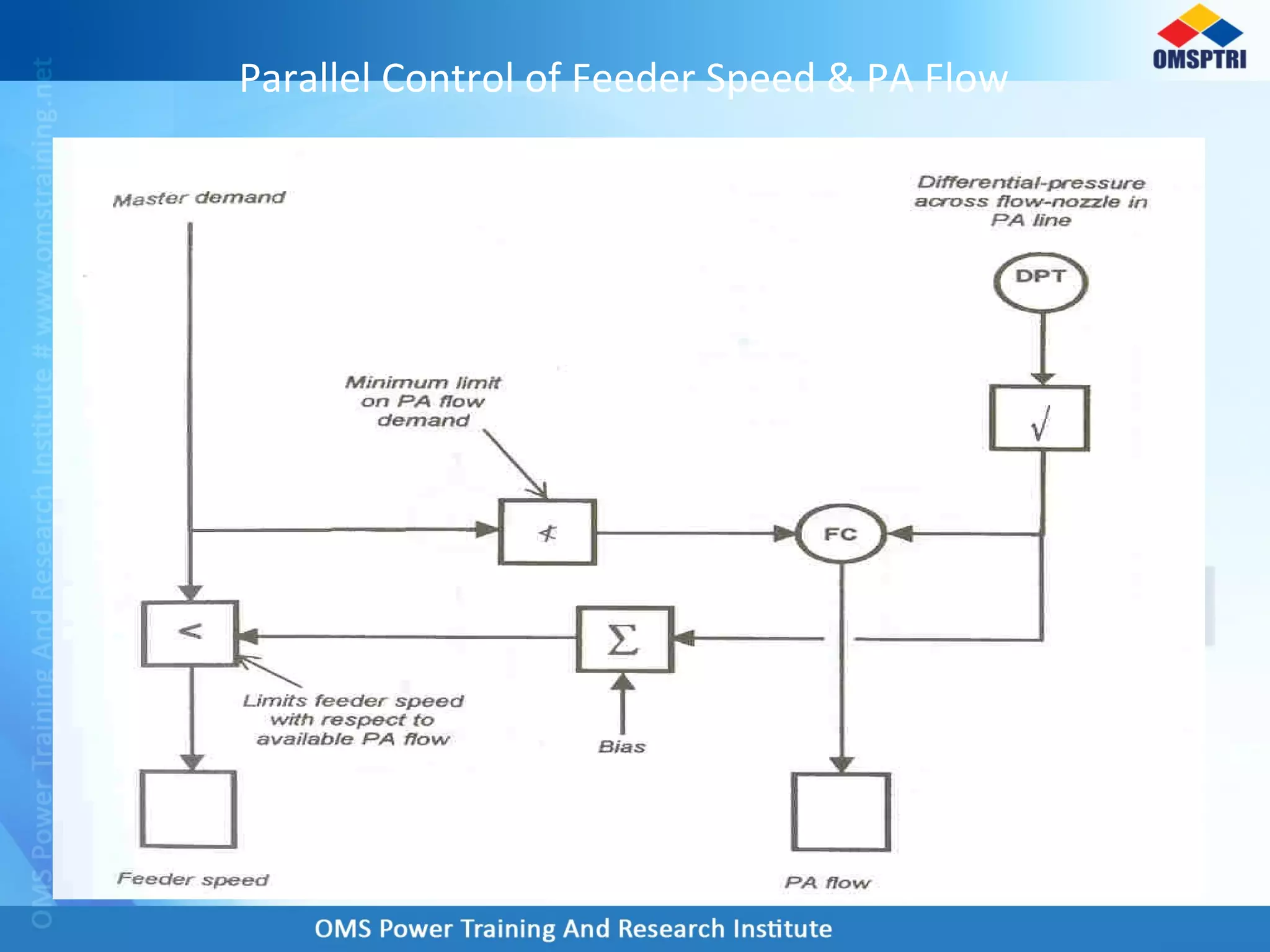
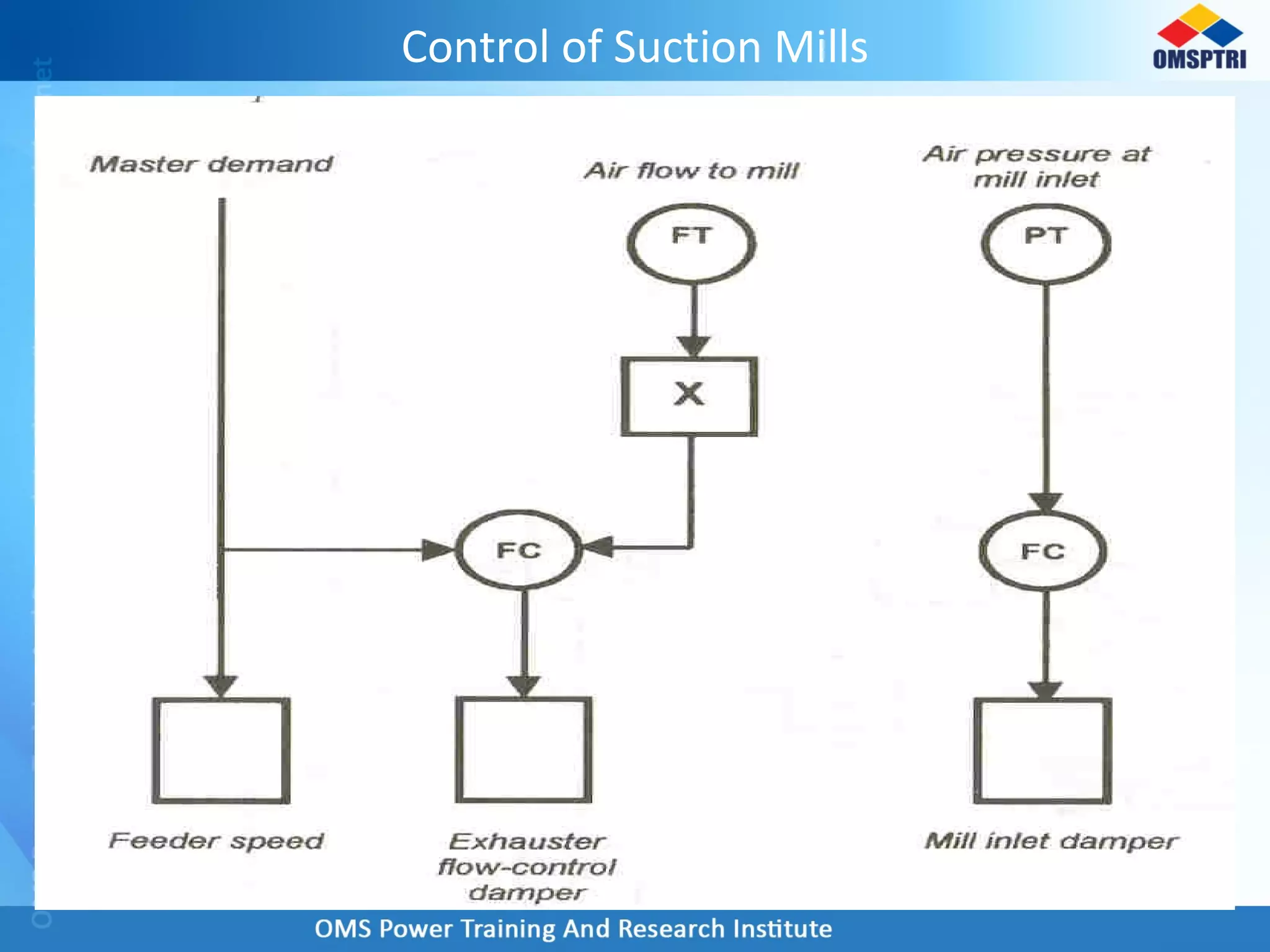
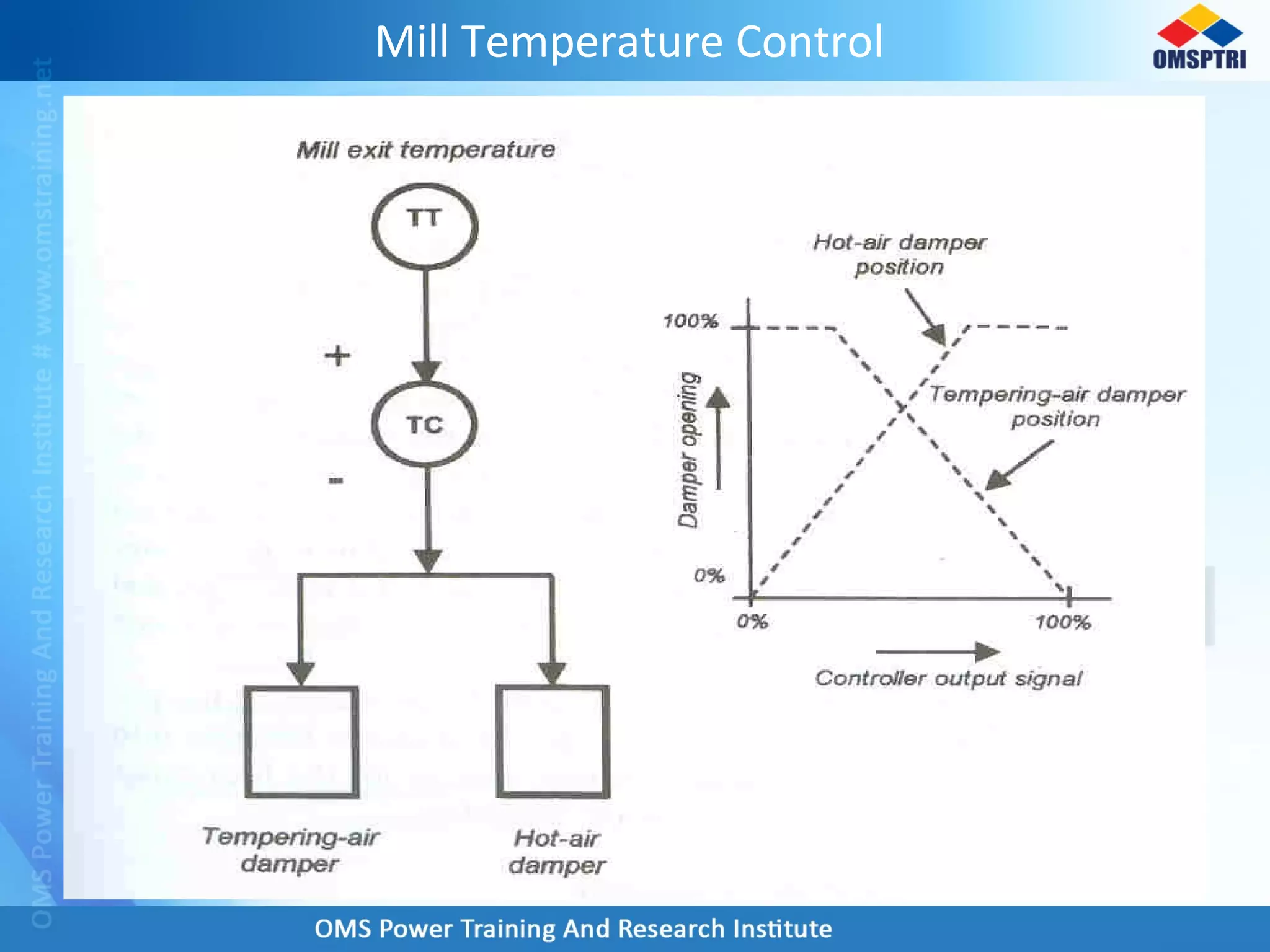
Mill PA /Differential Pressure Control
Closed Loop Control of PA Flow
Parallel Control of Feeder Speed & PA Flow
Control of Suction Mills
Mill Temperature Control
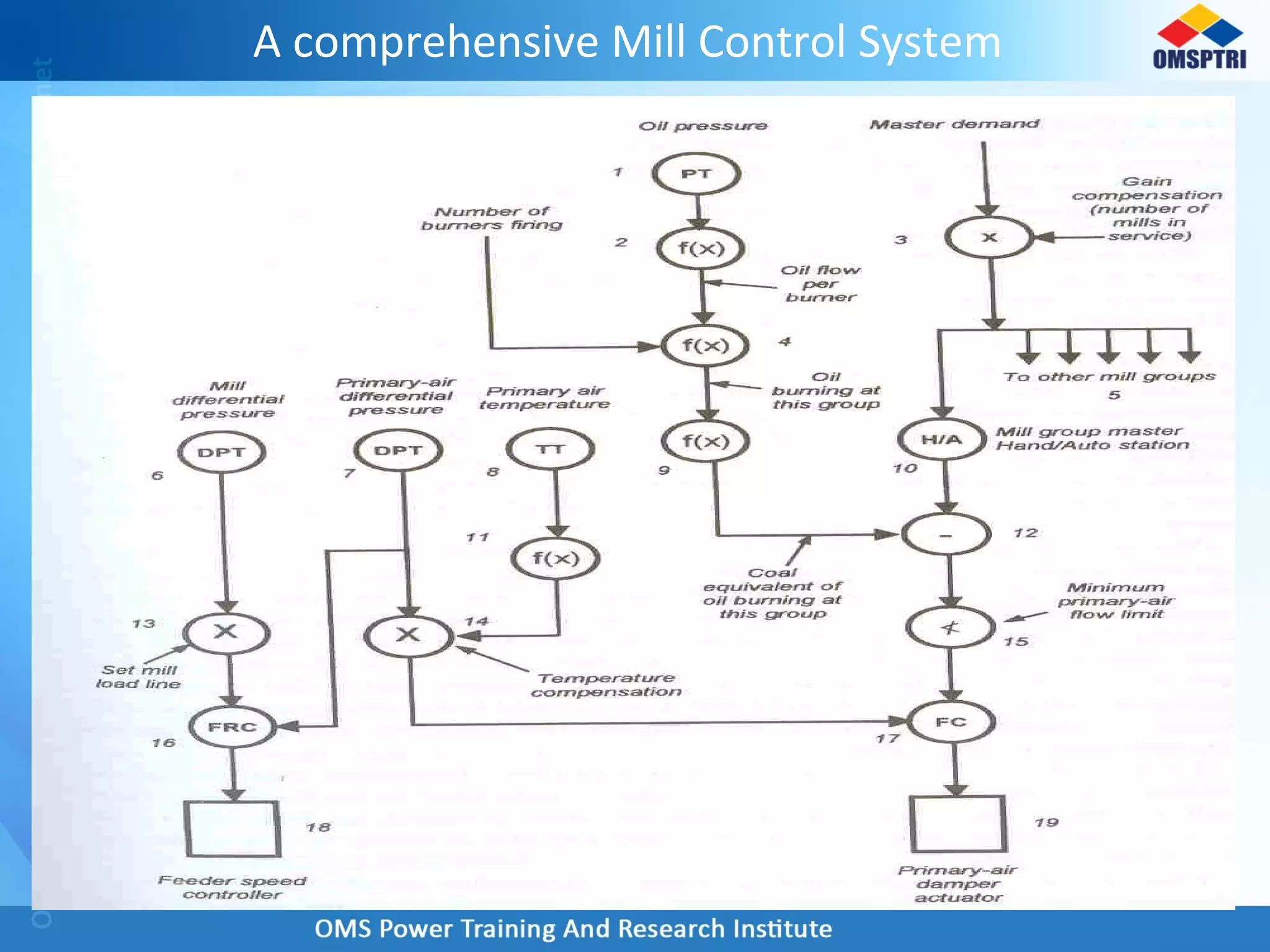
A comprehensive Mill Control System
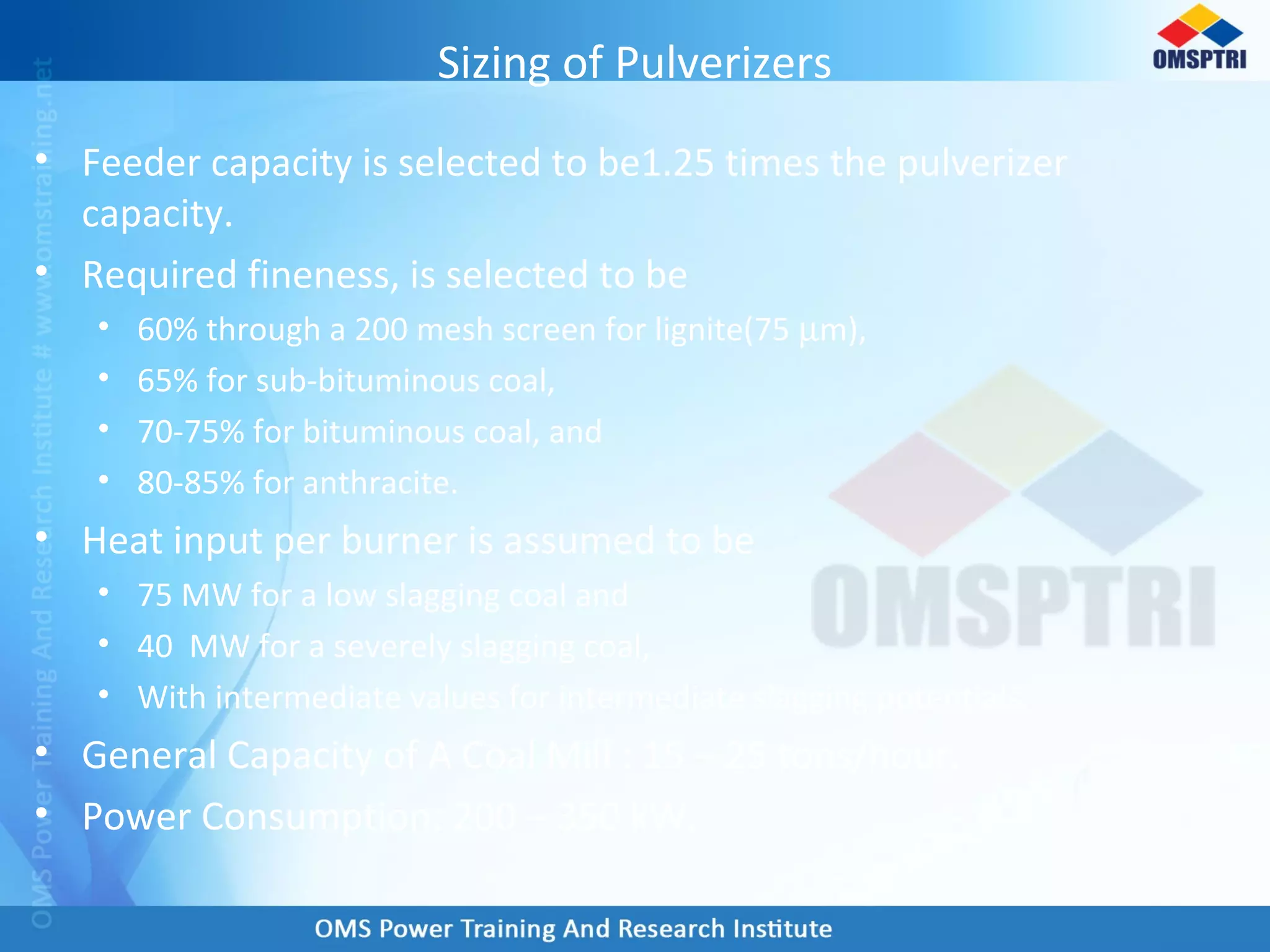
Sizing of Pulverizers
• Feeder capacity is selected to be1.25 times the pulverizer
capacity.
• Required fineness, is selected to be
• 60% through a 200 mesh screen for lignite(75 µm),
• 65% for sub-bituminous coal,
• 70-75% for bituminous coal, and
• 80-85% for anthracite.
• Heat input per burner is assumed to be
• 75 MW for a low slagging coal and
• 40 MW for a severely slagging coal,
• With intermediate values for intermediate slagging potentials.
• General Capacity of A Coal Mill : 15 – 25 tons/hour.
• Power Consumption: 200 – 350 kW.
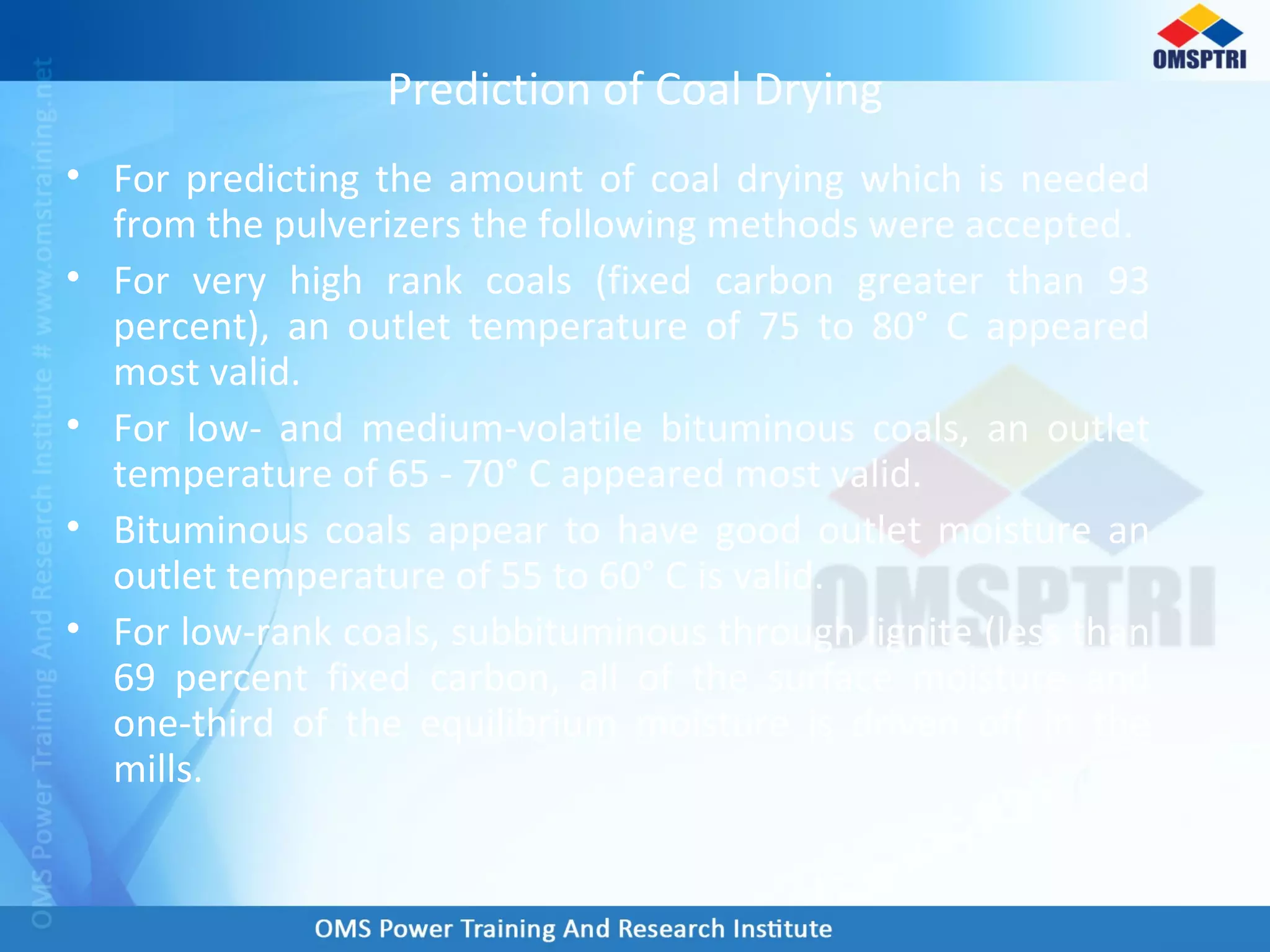
Prediction of Coal Drying
• For predicting the amount of coal drying which is needed
from the pulverizers the following methods were accepted.
• For very high rank coals (fixed carbon greater than 93
percent), an outlet temperature of 75 to 80° C appeared
most valid.
• For low- and medium-volatile bituminous coals, an outlet
temperature of 65 - 70° C appeared most valid.
• Bituminous coals appear to have good outlet moisture an
outlet temperature of 55 to 60° C is valid.
• For low-rank coals, subbituminous through lignite (less than
69 percent fixed carbon, all of the surface moisture and
one-third of the equilibrium moisture is driven off in the
mills.
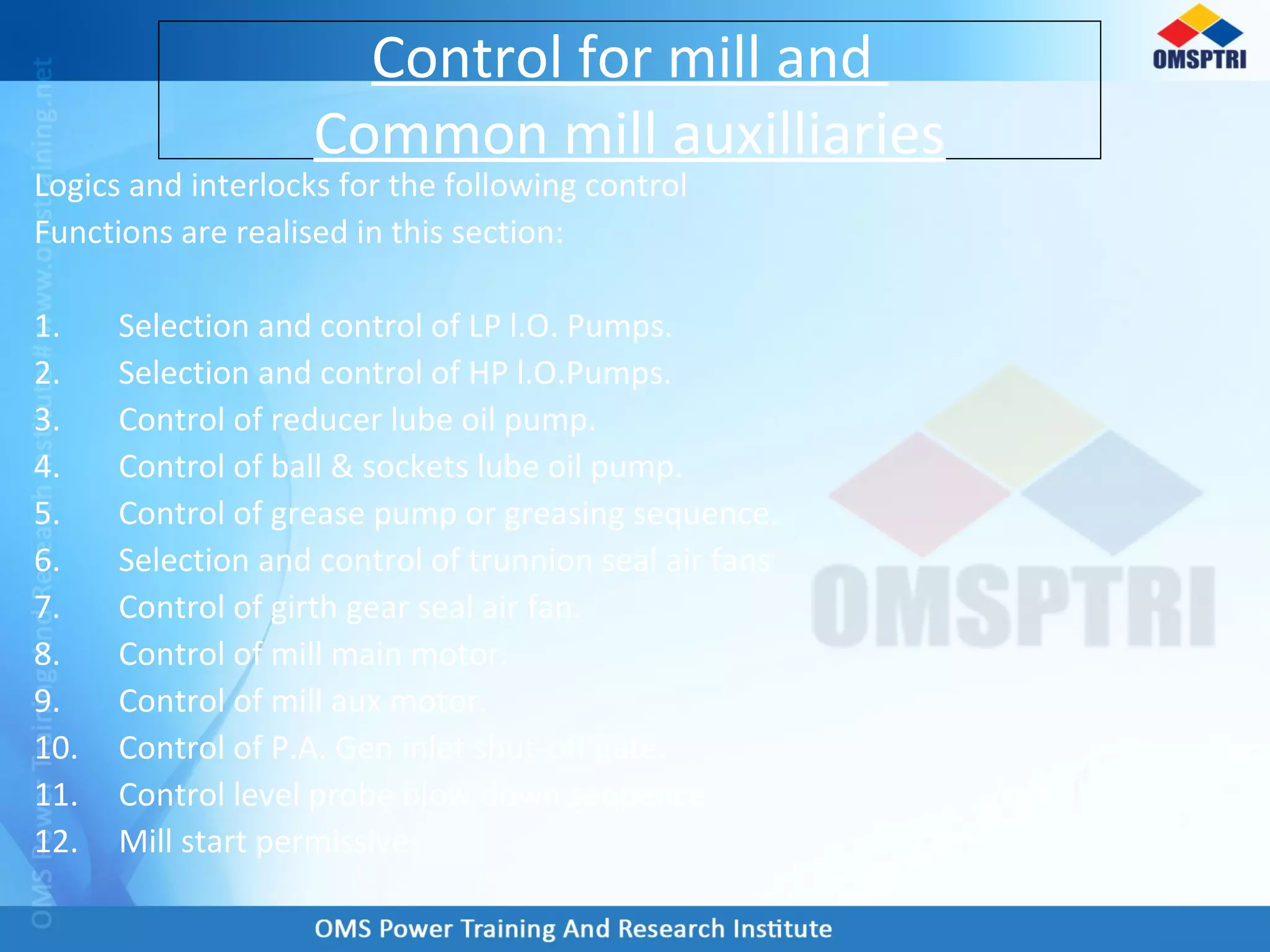
Logics and interlocks for the following control
Functions are realised in this section:
1. Selection and control of LP l.O. Pumps.
2. Selection and control of HP l.O.Pumps.
3. Control of reducer lube oil pump.
4. Control of ball & sockets lube oil pump.
5. Control of grease pump or greasing sequence.
6. Selection and control of trunnion seal air fans
7. Control of girth gear seal air fan.
8. Control of mill main motor.
9. Control of mill aux motor.
10. Control of P.A. Gen inlet shut-off gate.
11. Control level probe blow down sequence.
12. Mill start permissives.
Control for mill and
Common mill auxilliaries
Logics and interlocks for following Control functions are
realized in this section:
1. Elevation start/stop controls.
2. Control of coal feeder.
3. Control of prg air damper.
4. Control of mill outlet gates.
5. Control of raw coal iso- gate.
6. Automatic start-up and shut-down sequence of
elevation.
CONTROLS FOR
INDIVIDUAL ELEVATIONS :
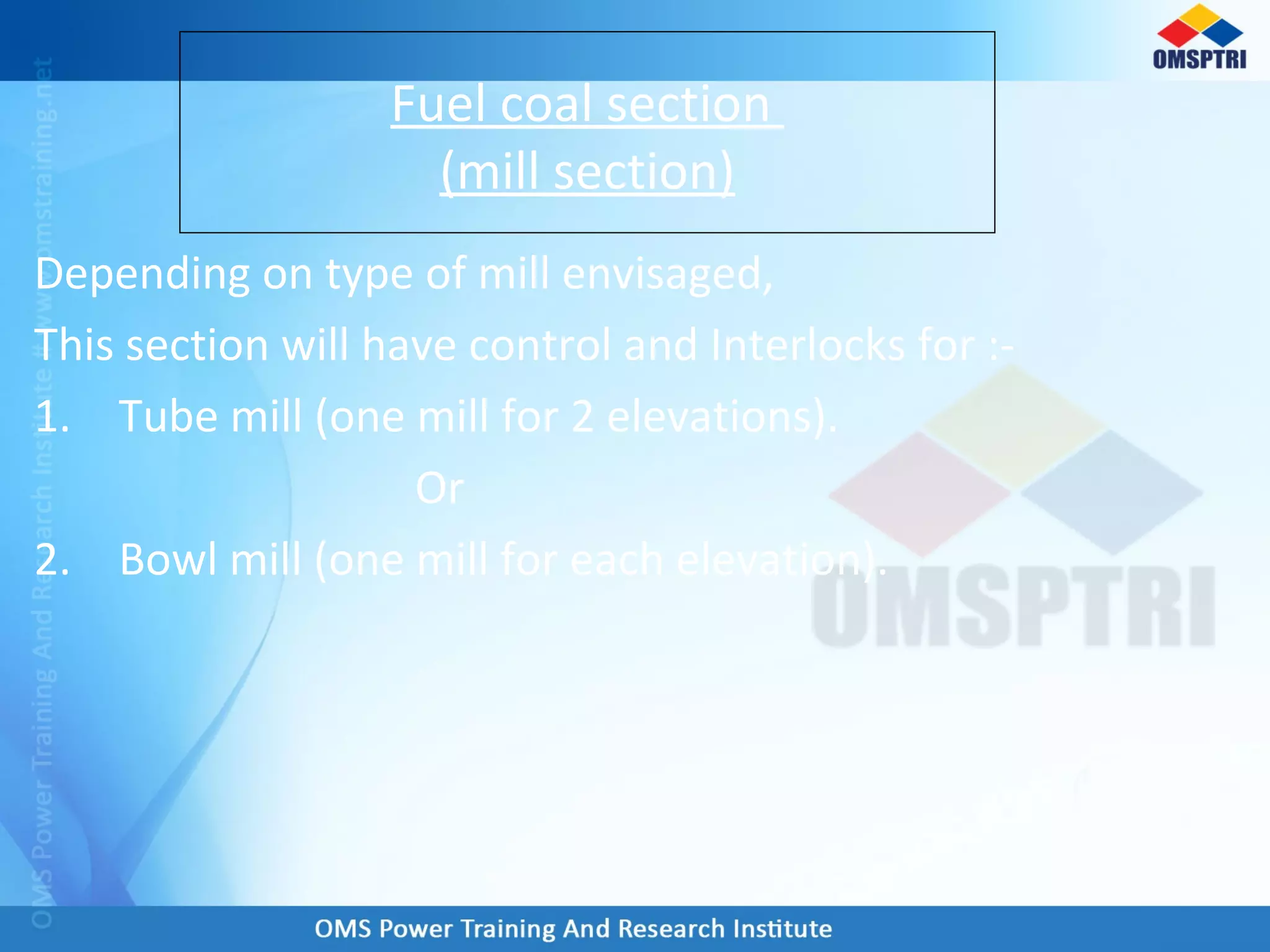
Depending on type of mill envisaged,
This section will have control and Interlocks for :-
1. Tube mill (one mill for 2 elevations).
Or
2. Bowl mill (one mill for each elevation).
Fuel coal section
(mill section)
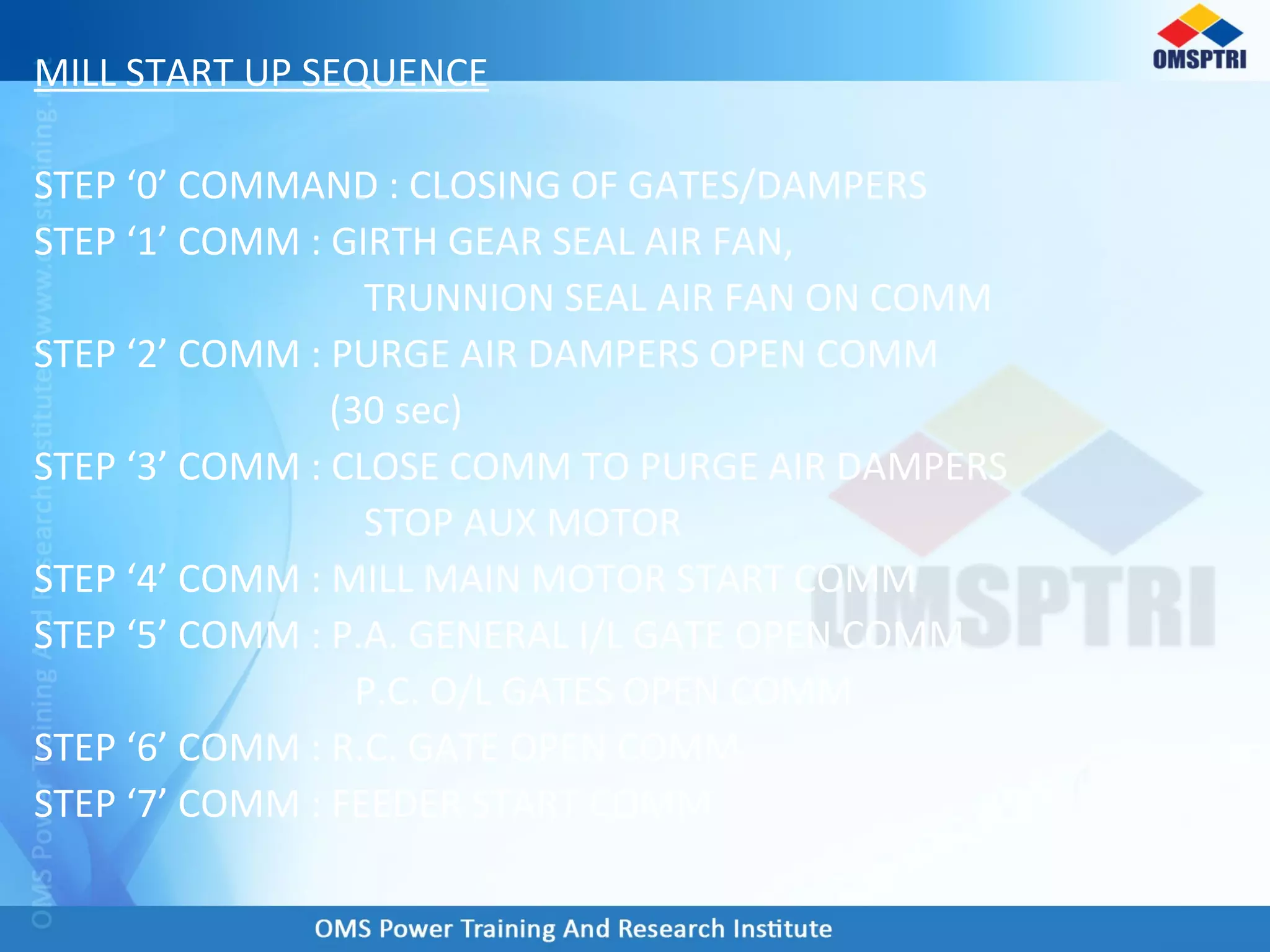
MILL START UP SEQUENCE
STEP ‘0’ COMMAND : CLOSING OF GATES/DAMPERS
STEP ‘1’ COMM : GIRTH GEAR SEAL AIR FAN,
TRUNNION SEAL AIR FAN ON COMM
STEP ‘2’ COMM : PURGE AIR DAMPERS OPEN COMM
(30 sec)
STEP ‘3’ COMM : CLOSE COMM TO PURGE AIR DAMPERS
STOP AUX MOTOR
STEP ‘4’ COMM : MILL MAIN MOTOR START COMM
STEP ‘5’ COMM : P.A. GENERAL I/L GATE OPEN COMM
P.C. O/L GATES OPEN COMM
STEP ‘6’ COMM : R.C. GATE OPEN COMM
STEP ‘7’ COMM : FEEDER START COMM
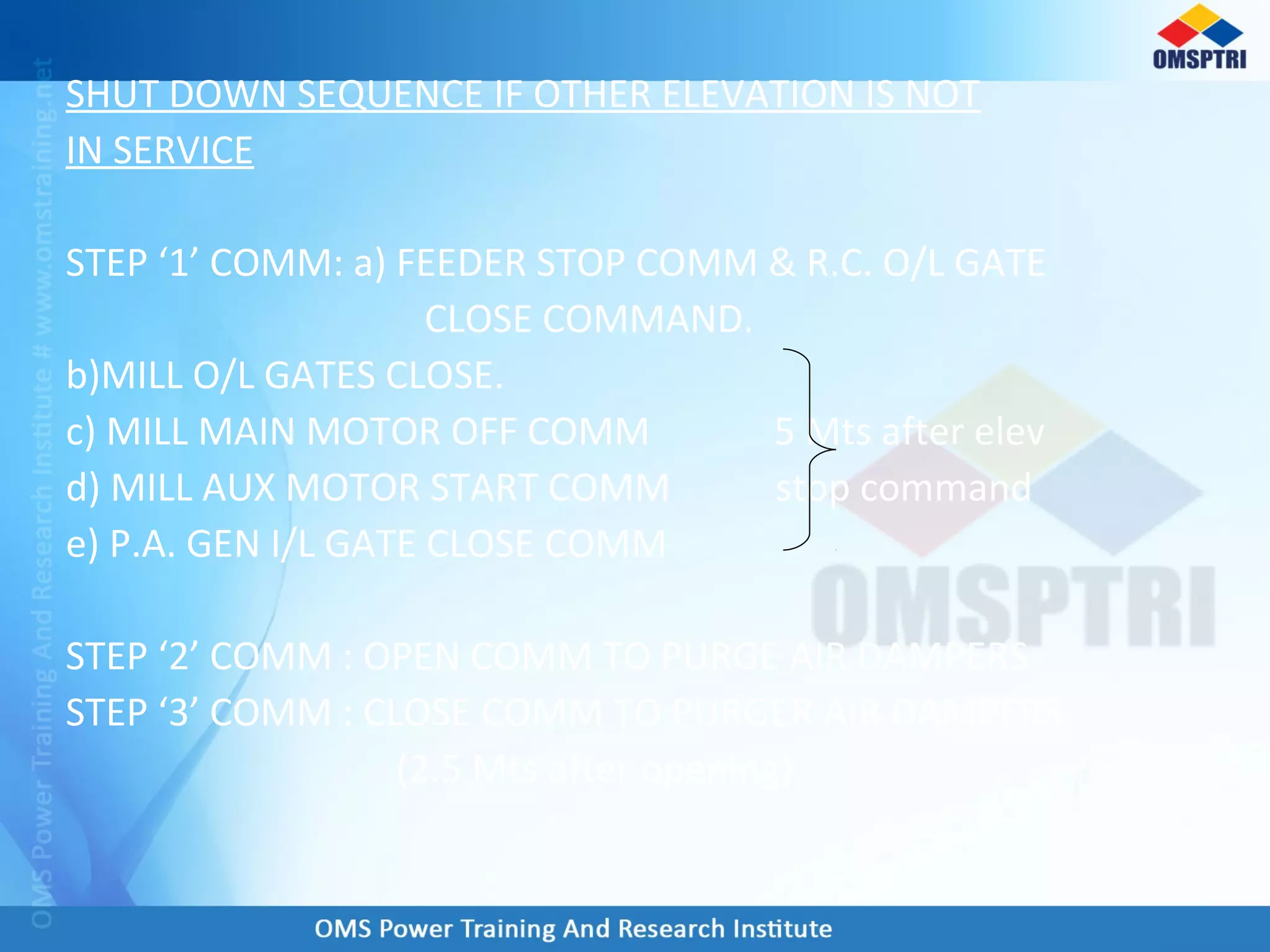
SHUT DOWN SEQUENCE IF OTHER ELEVATION IS NOT
IN SERVICE
STEP ‘1’ COMM: a) FEEDER STOP COMM & R.C. O/L GATE
CLOSE COMMAND.
b)MILL O/L GATES CLOSE.
c) MILL MAIN MOTOR OFF COMM 5 Mts after elev
d) MILL AUX MOTOR START COMM stop command
e) P.A. GEN I/L GATE CLOSE COMM
STEP ‘2’ COMM : OPEN COMM TO PURGE AIR DAMPERS
STEP ‘3’ COMM : CLOSE COMM TO PURGER AIR DAMPERS
(2.5 Mts after opening)
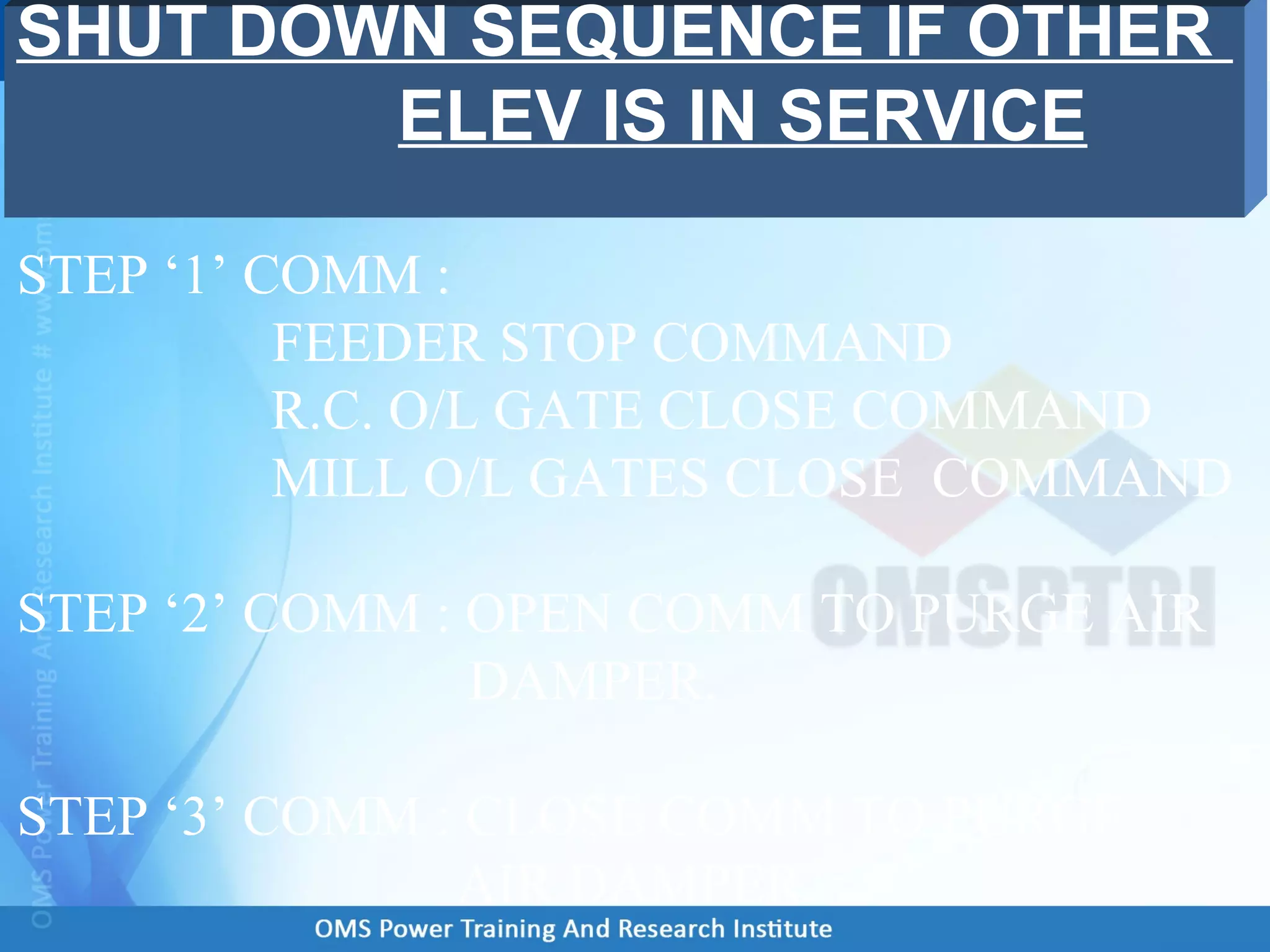
STEP ‘1’ COMM :
FEEDER STOP COMMAND
R.C. O/L GATE CLOSE COMMAND
MILL O/L GATES CLOSE COMMAND
STEP ‘2’ COMM : OPEN COMM TO PURGE AIR
DAMPER.
STEP ‘3’ COMM : CLOSE COMM TO PURGE
AIR DAMPER.
SHUT DOWN SEQUENCE IF OTHER
ELEV IS IN SERVICE
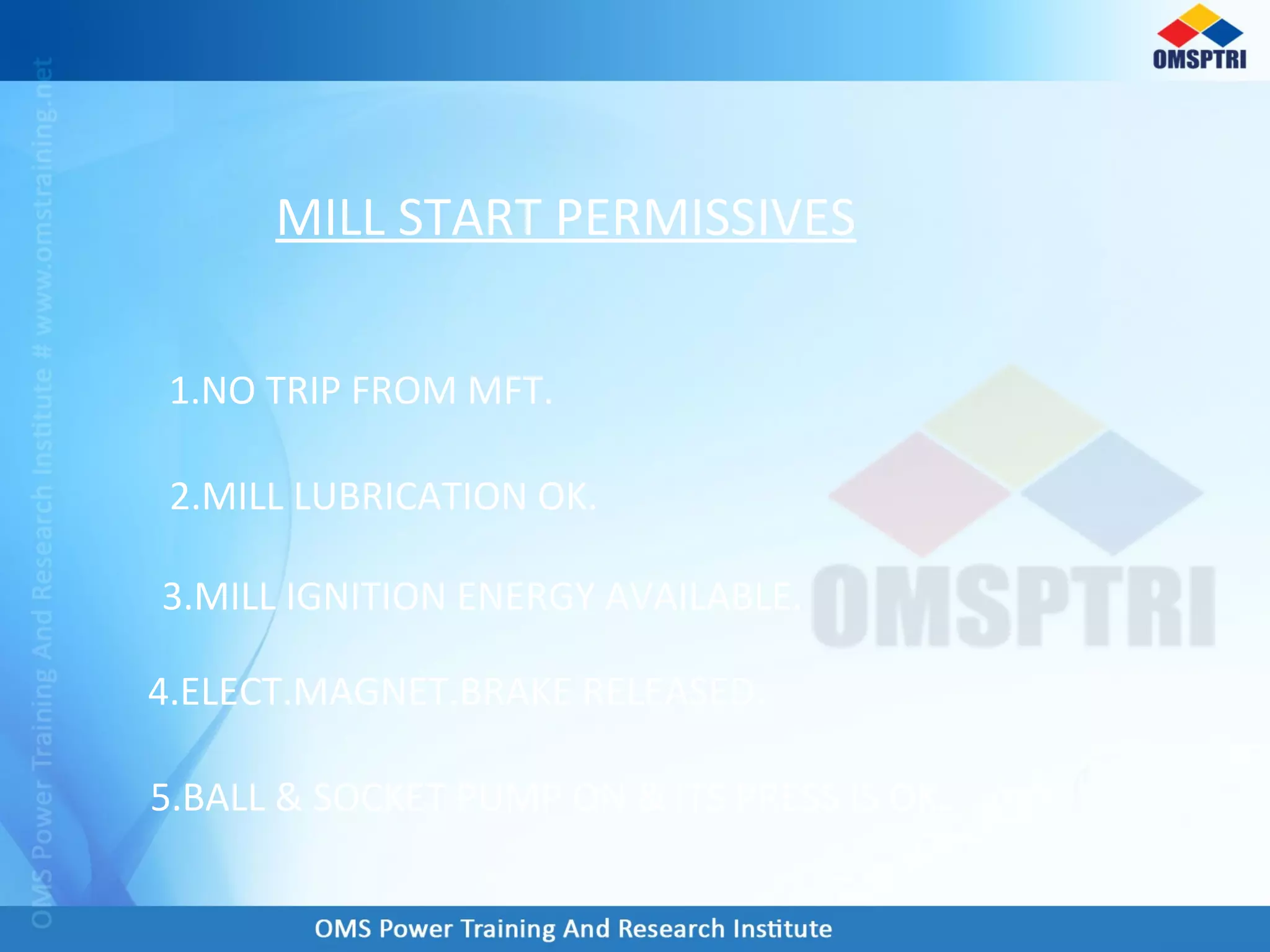
MILL START PERMISSIVES
1.NO TRIP FROM MFT.
2.MILL LUBRICATION OK.
3.MILL IGNITION ENERGY AVAILABLE.
4.ELECT.MAGNET.BRAKE RELEASED.
5.BALL & SOCKET PUMP ON & ITS PRESS IS OK.
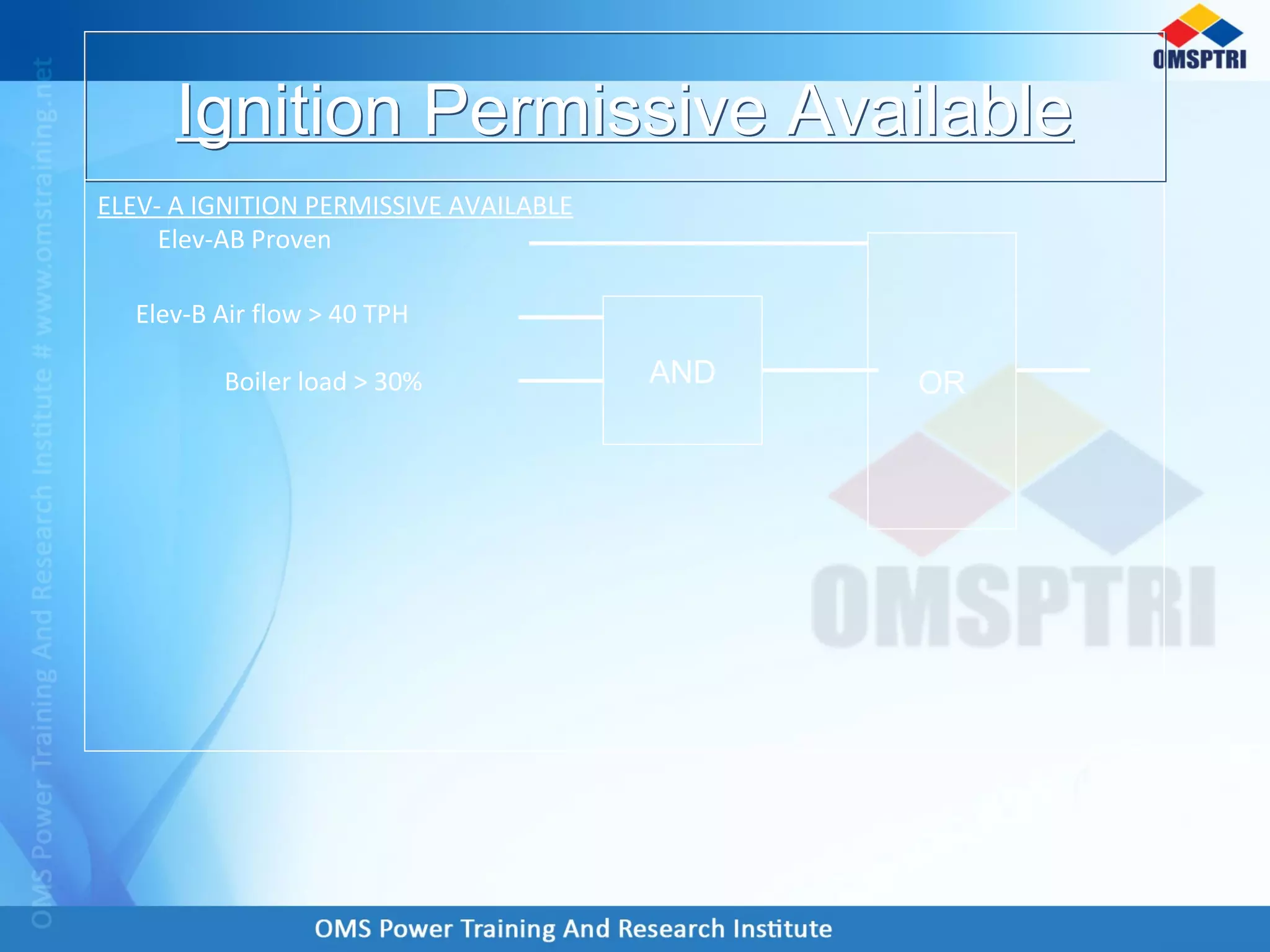
ELEV- A IGNITION PERMISSIVE AVAILABLE
Elev-AB Proven
Elev-B Air flow > 40 TPH
Boiler load > 30% AND OR
Ignition Permissive AvailableIgnition Permissive Available
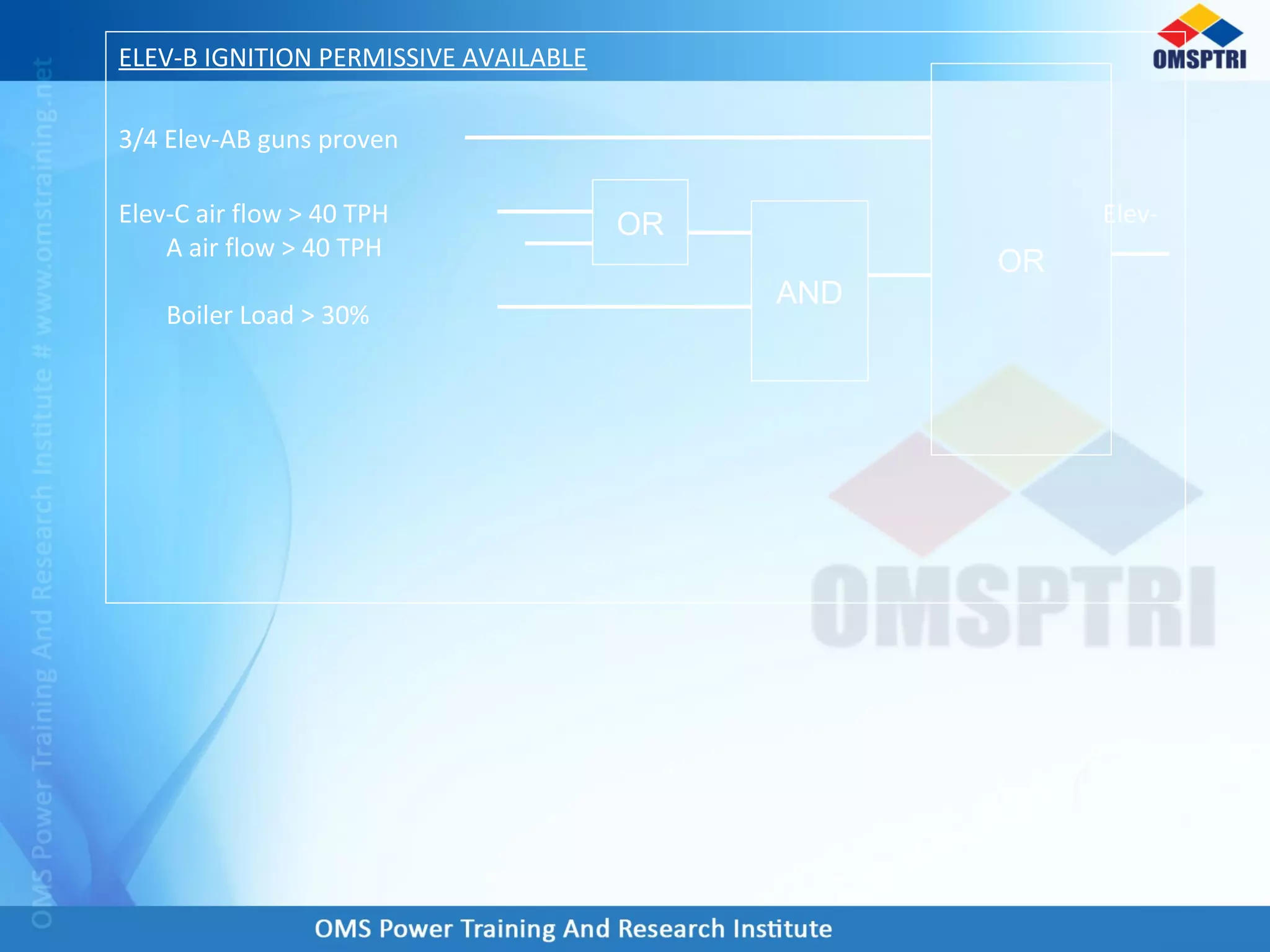
ELEV-B IGNITION PERMISSIVE AVAILABLE
3/4 Elev-AB guns proven
Elev-C air flow > 40 TPH Elev-
A air flow > 40 TPH
Boiler Load > 30%
OR
AND
OR
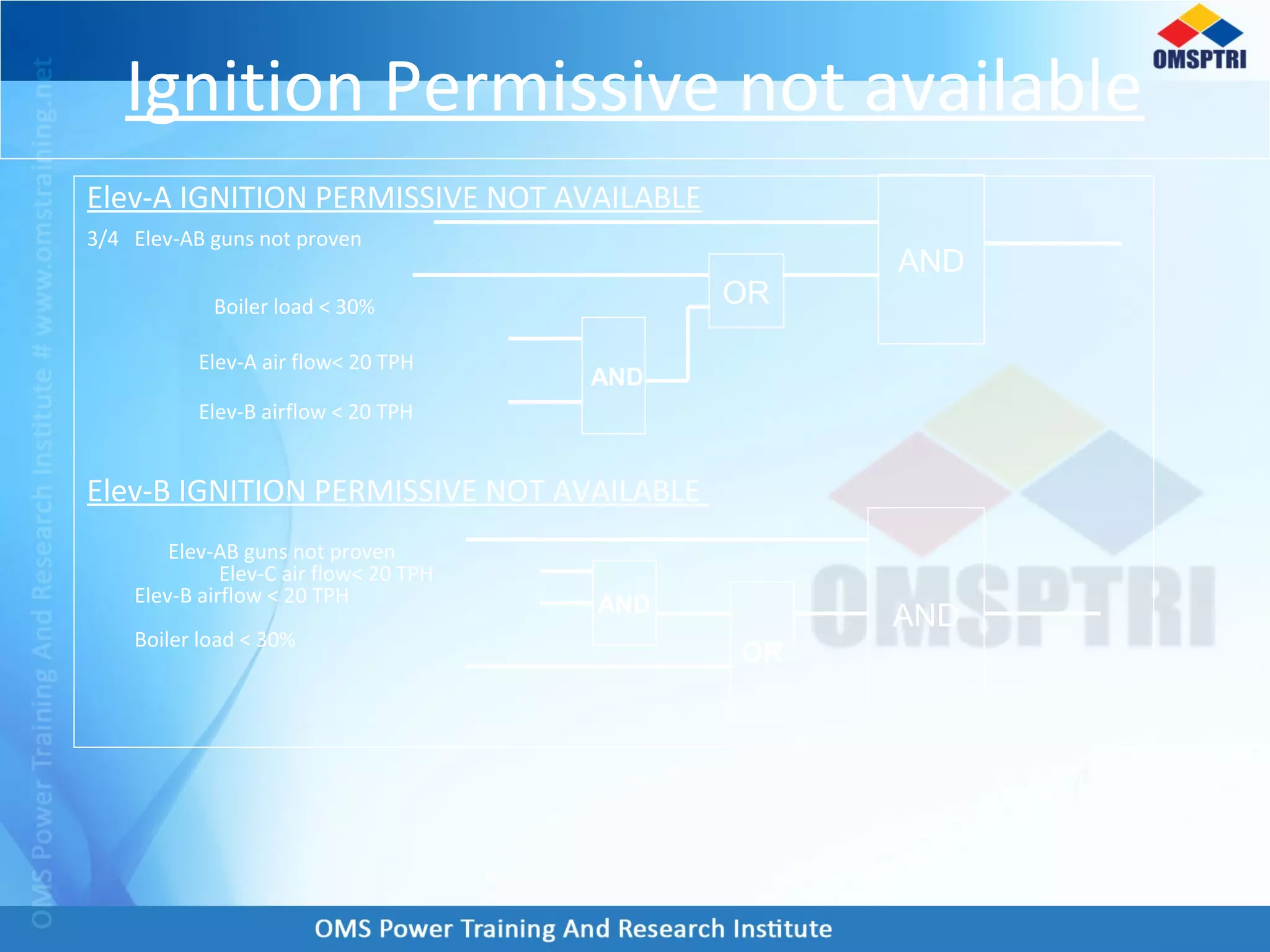
Ignition Permissive not available
Elev-A IGNITION PERMISSIVE NOT AVAILABLE
3/4 Elev-AB guns not proven
Boiler load < 30%
Elev-A air flow< 20 TPH
Elev-B airflow < 20 TPH
Elev-B IGNITION PERMISSIVE NOT AVAILABLE
Elev-AB guns not proven
Elev-C air flow< 20 TPH
Elev-B airflow < 20 TPH
Boiler load < 30%
AND
OR
AND
ANDAND
OR
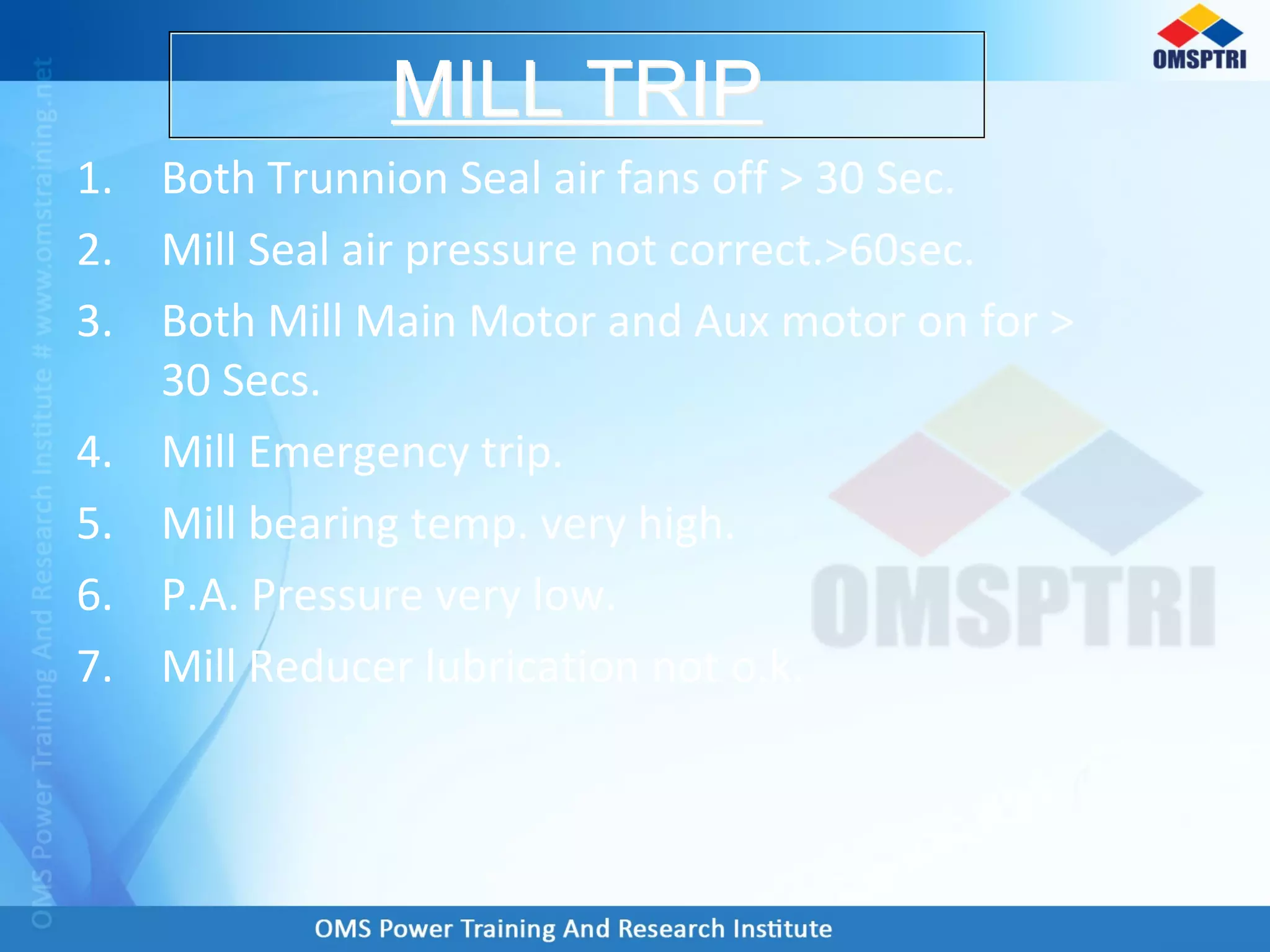
1. Both Trunnion Seal air fans off > 30 Sec.
2. Mill Seal air pressure not correct.>60sec.
3. Both Mill Main Motor and Aux motor on for >
30 Secs.
4. Mill Emergency trip.
5. Mill bearing temp. very high.
6. P.A. Pressure very low.
7. Mill Reducer lubrication not o.k.
MILL TRIPMILL TRIP
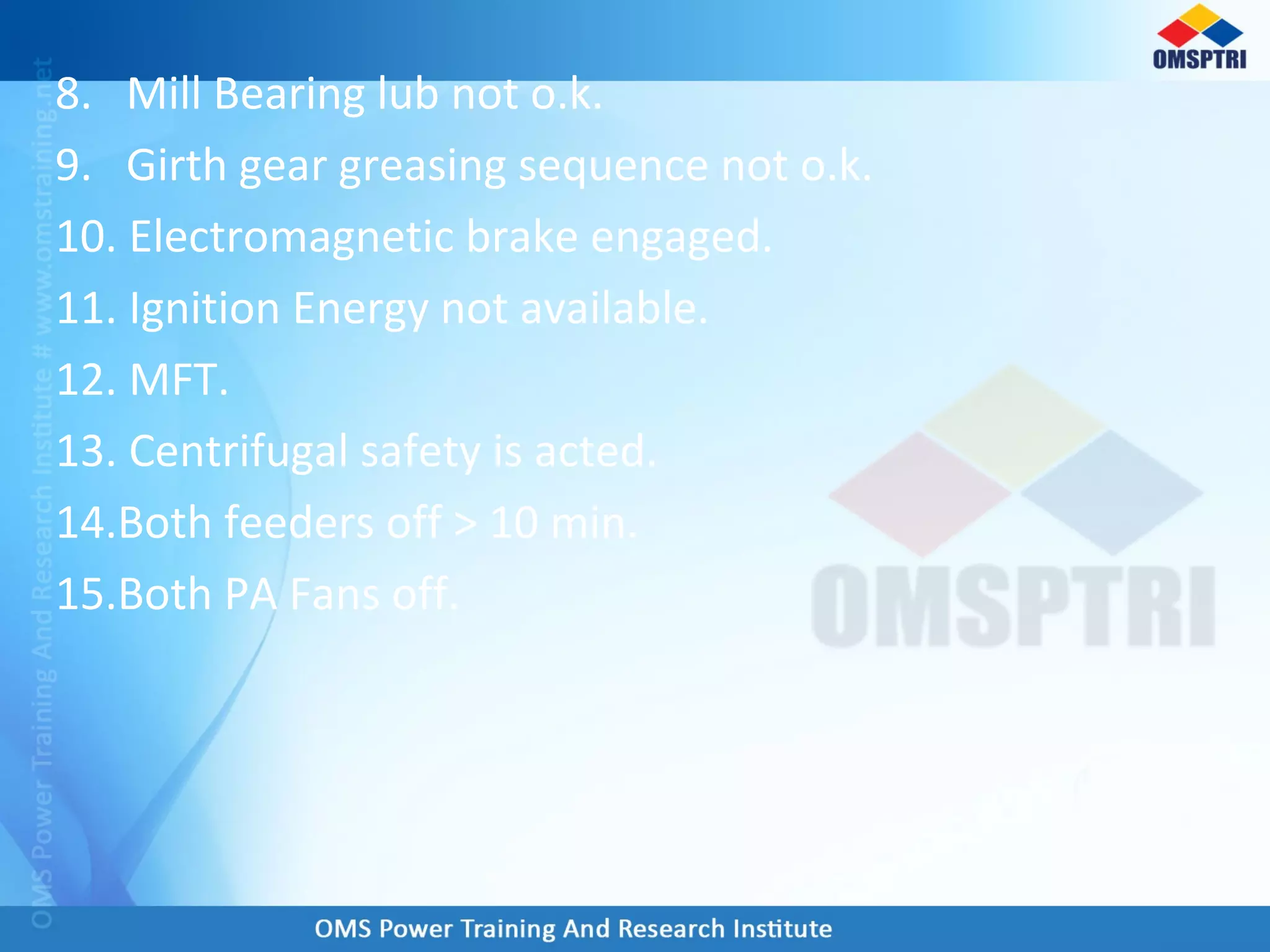
8. Mill Bearing lub not o.k.
9. Girth gear greasing sequence not o.k.
10. Electromagnetic brake engaged.
11. Ignition Energy not available.
12. MFT.
13. Centrifugal safety is acted.
14.Both feeders off > 10 min.
15.Both PA Fans off.
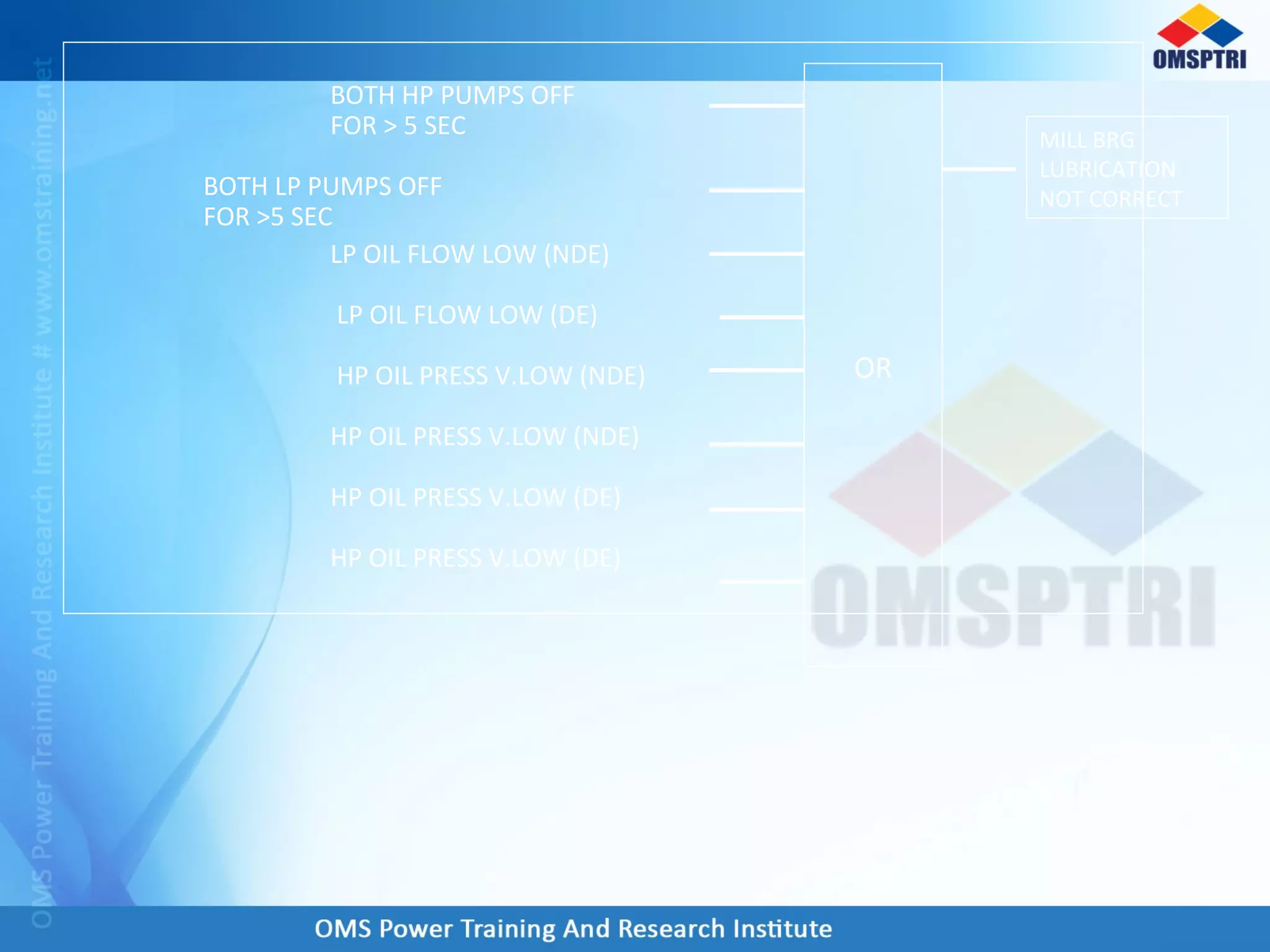
BOTH HP PUMPS OFF
FOR > 5 SEC
BOTH LP PUMPS OFF
FOR >5 SEC
LP OIL FLOW LOW (NDE)
LP OIL FLOW LOW (DE)
HP OIL PRESS V.LOW (NDE)
HP OIL PRESS V.LOW (DE)
OR
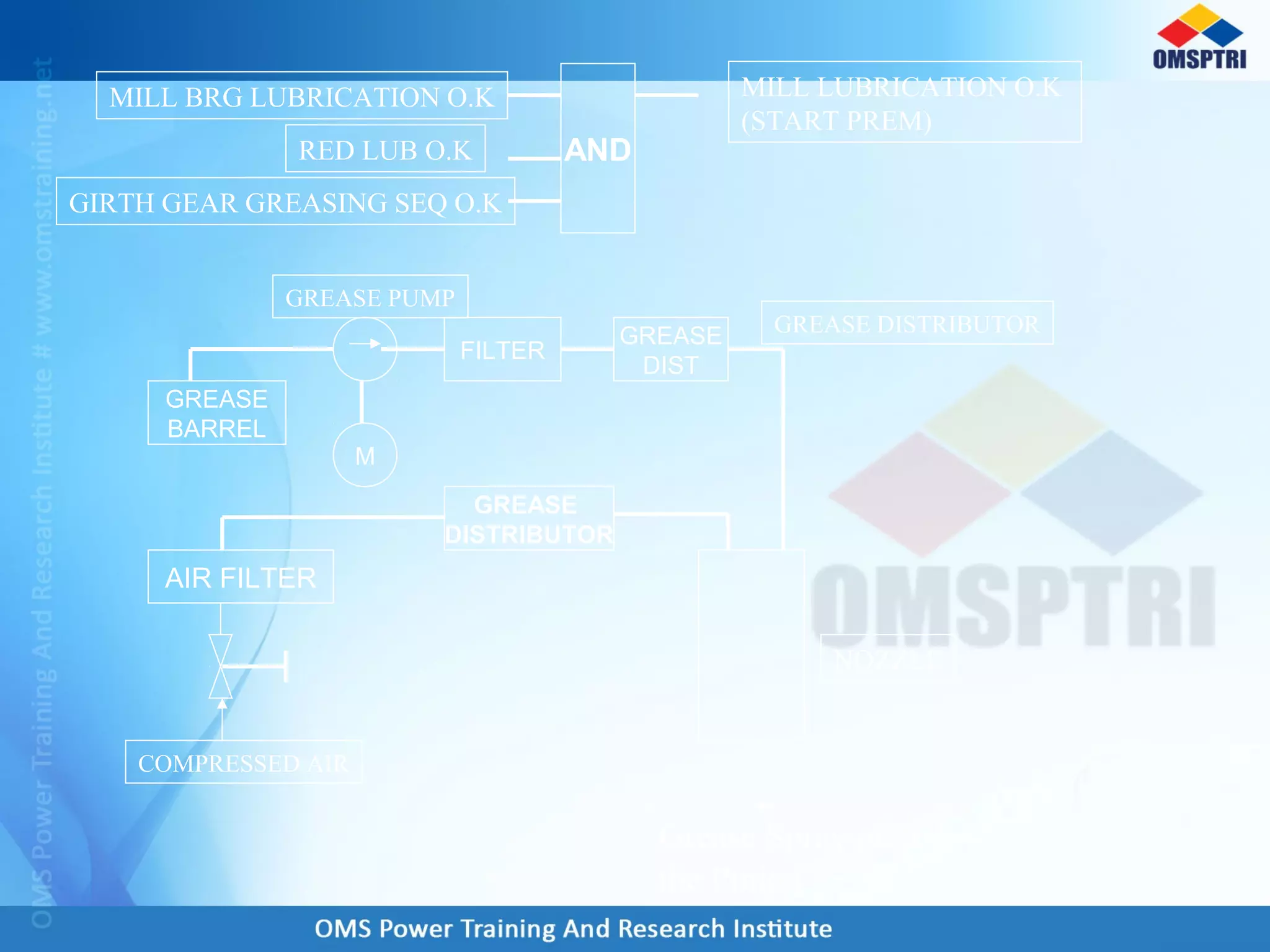
MILL BRG
LUBRICATION
NOT CORRECT
AND
MILL BRG LUBRICATION O.K
RED LUB O.K
GIRTH GEAR GREASING SEQ O.K
MILL LUBRICATION O.K
(START PREM)
FILTER
GREASE
BARREL
M
GREASE
DIST
GREASE
DISTRIBUTOR
AIR FILTER
COMPRESSED AIR
NOZZLE
GREASE PUMP
GREASE DISTRIBUTOR
Grease Spray on to
the Pinion
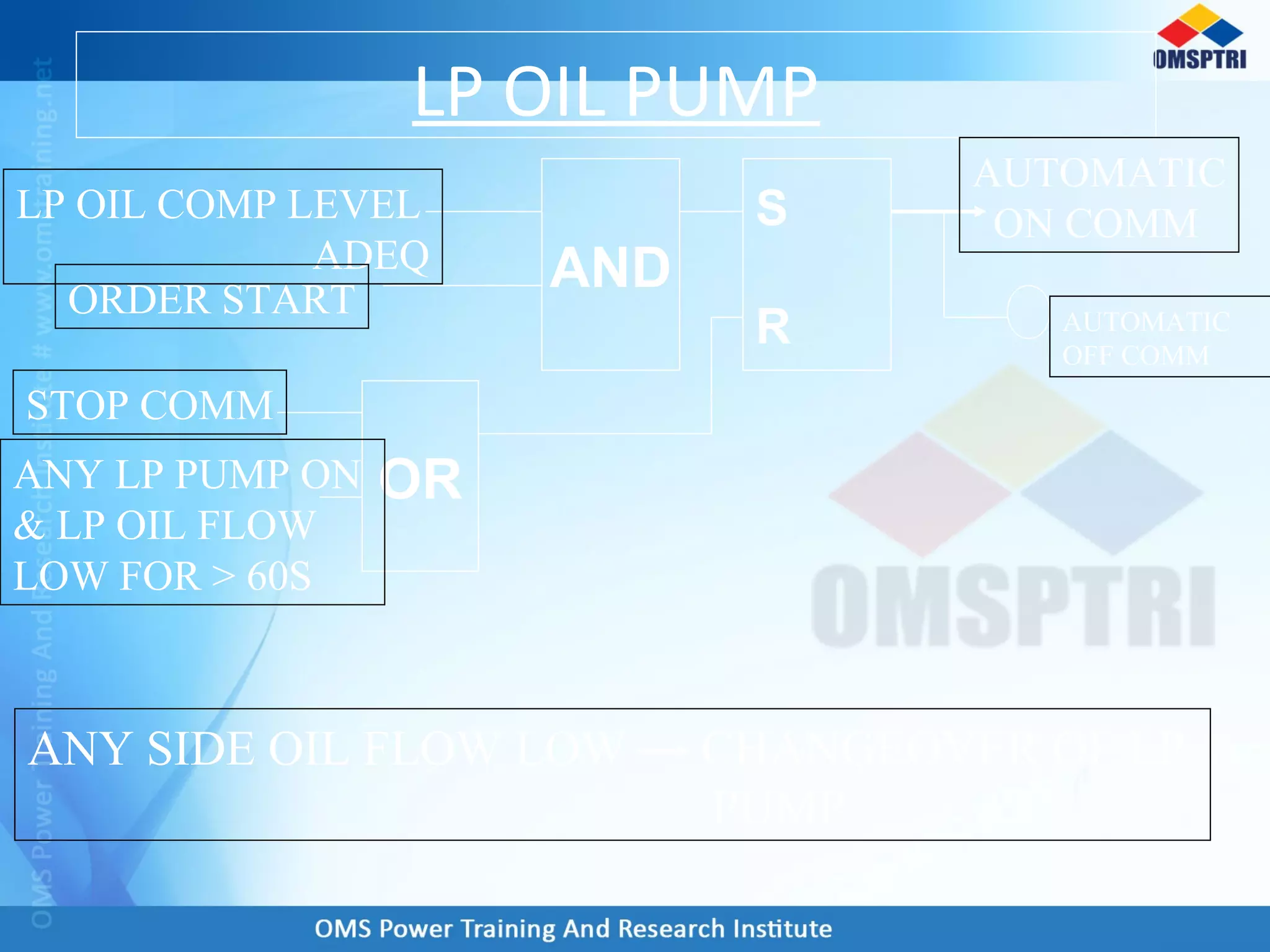
LP OIL PUMP
AND
S
R
OR
LP OIL COMP LEVEL
ADEQ
ORDER START
AUTOMATIC
ON COMM
AUTOMATIC
OFF COMM
STOP COMM
ANY LP PUMP ON
& LP OIL FLOW
LOW FOR > 60S
ANY SIDE OIL FLOW LOW CHANGEOVER OF LP
PUMP
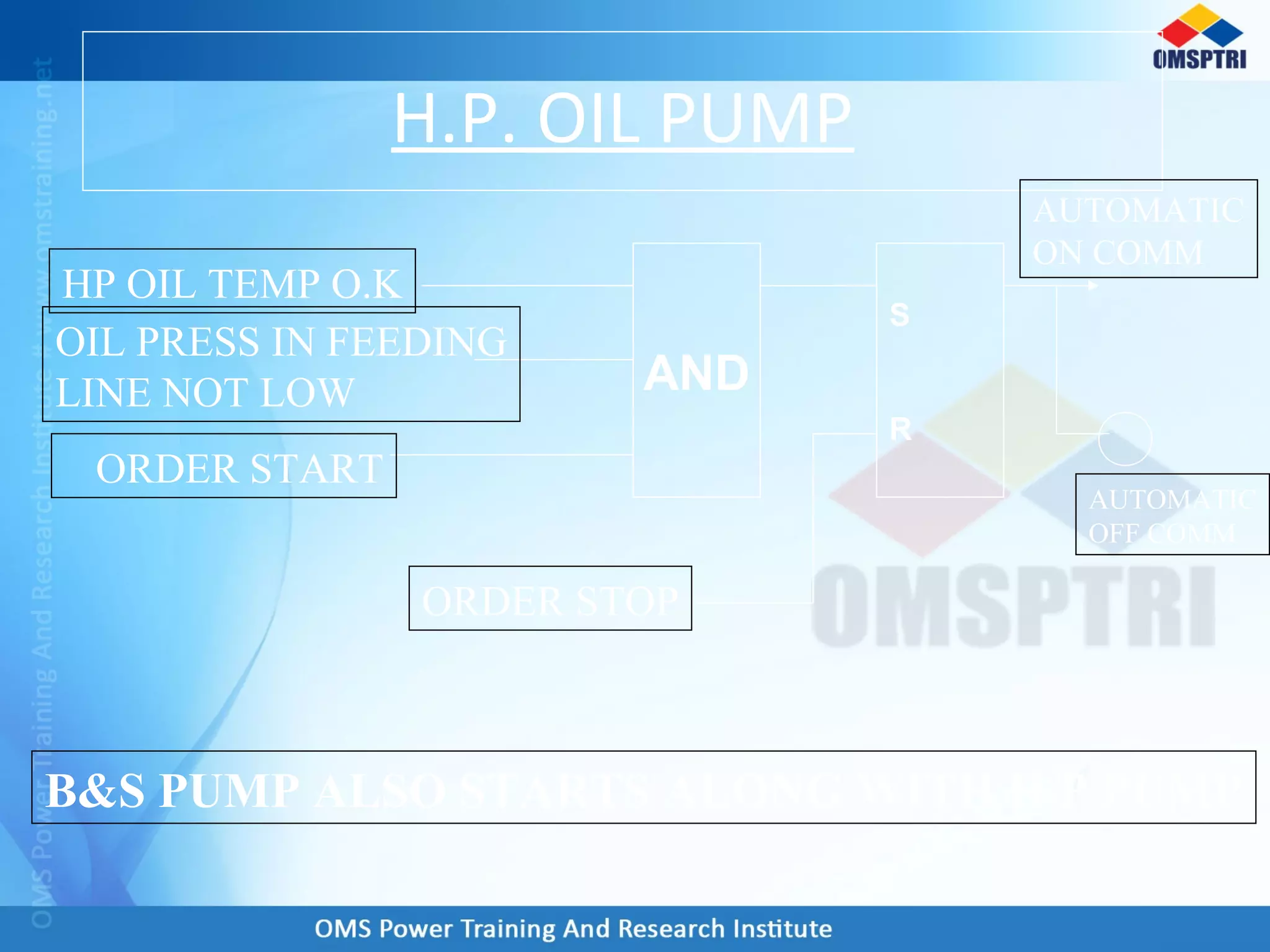
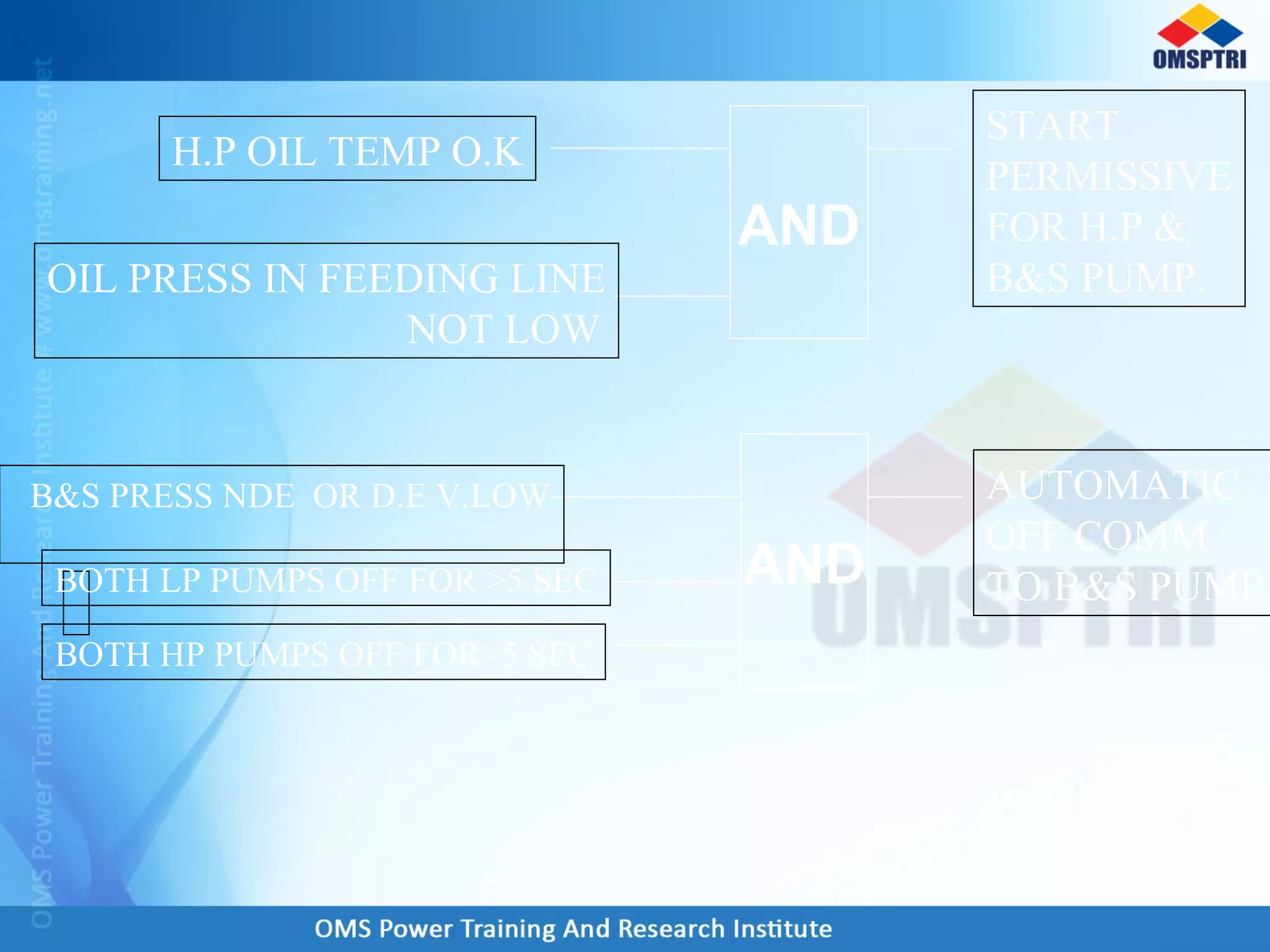
H.P. OIL PUMP
AND
S
R
HP OIL TEMP O.K
OIL PRESS IN FEEDING
LINE NOT LOW
ORDER START
ORDER STOP
AUTOMATIC
ON COMM
AUTOMATIC
OFF COMM
B&S PUMP ALSO STARTS ALONG WITH H.P PUMP
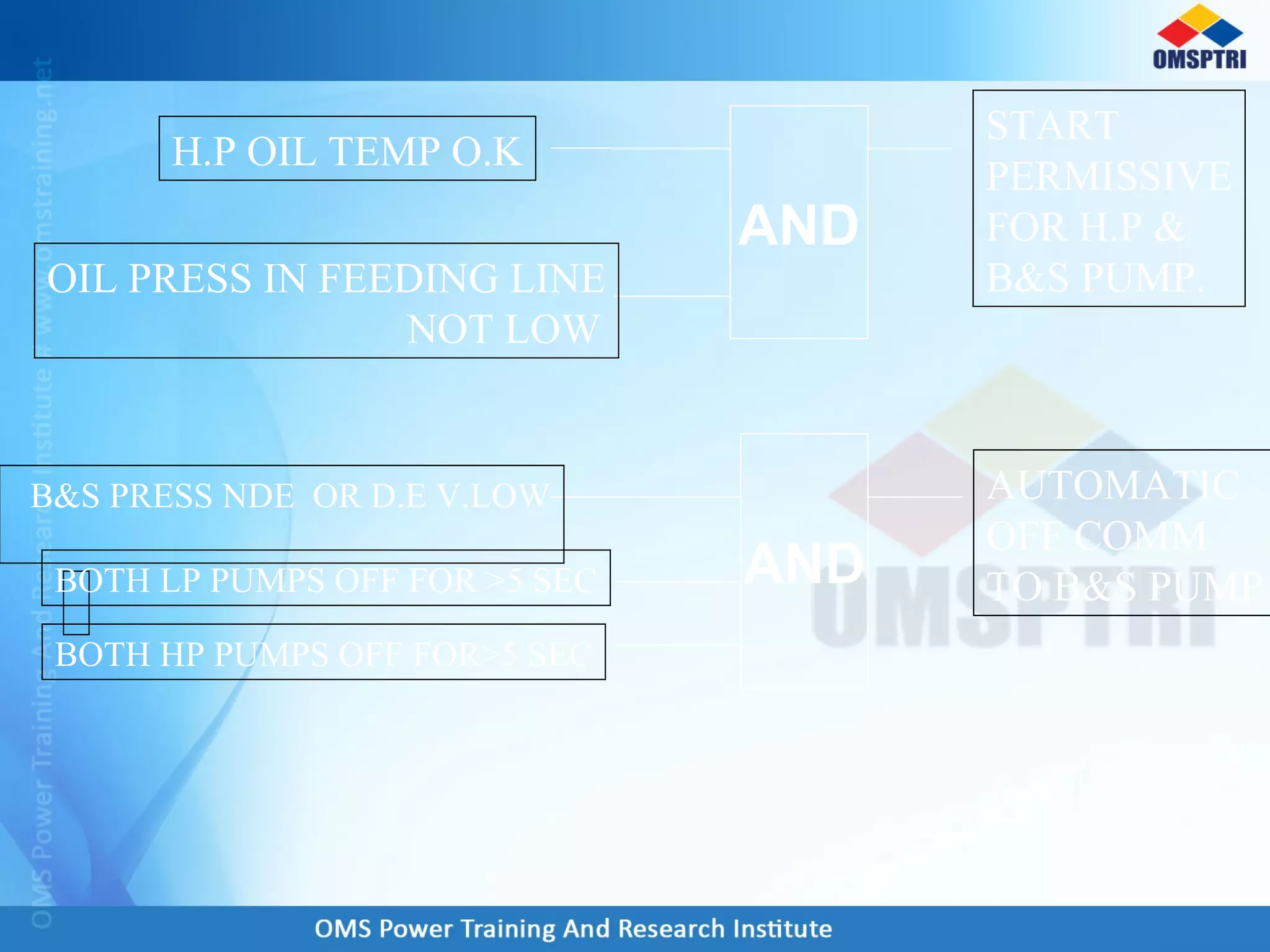
AND
H.P OIL TEMP O.K
OIL PRESS IN FEEDING LINE
NOT LOW
START
PERMISSIVE
FOR H.P &
B&S PUMP.
AND
B&S PRESS NDE OR D.E V.LOW
BOTH LP PUMPS OFF FOR >5 SEC
BOTH HP PUMPS OFF FOR>5 SEC
AUTOMATIC
OFF COMM
TO B&S PUMP
AND
H.P OIL TEMP O.K
OIL PRESS IN FEEDING LINE
NOT LOW
START
PERMISSIVE
FOR H.P &
B&S PUMP.
AND
B&S PRESS NDE OR D.E V.LOW
BOTH LP PUMPS OFF FOR >5 SEC
BOTH HP PUMPS OFF FOR>5 SEC
AUTOMATIC
OFF COMM
TO B&S PUMP
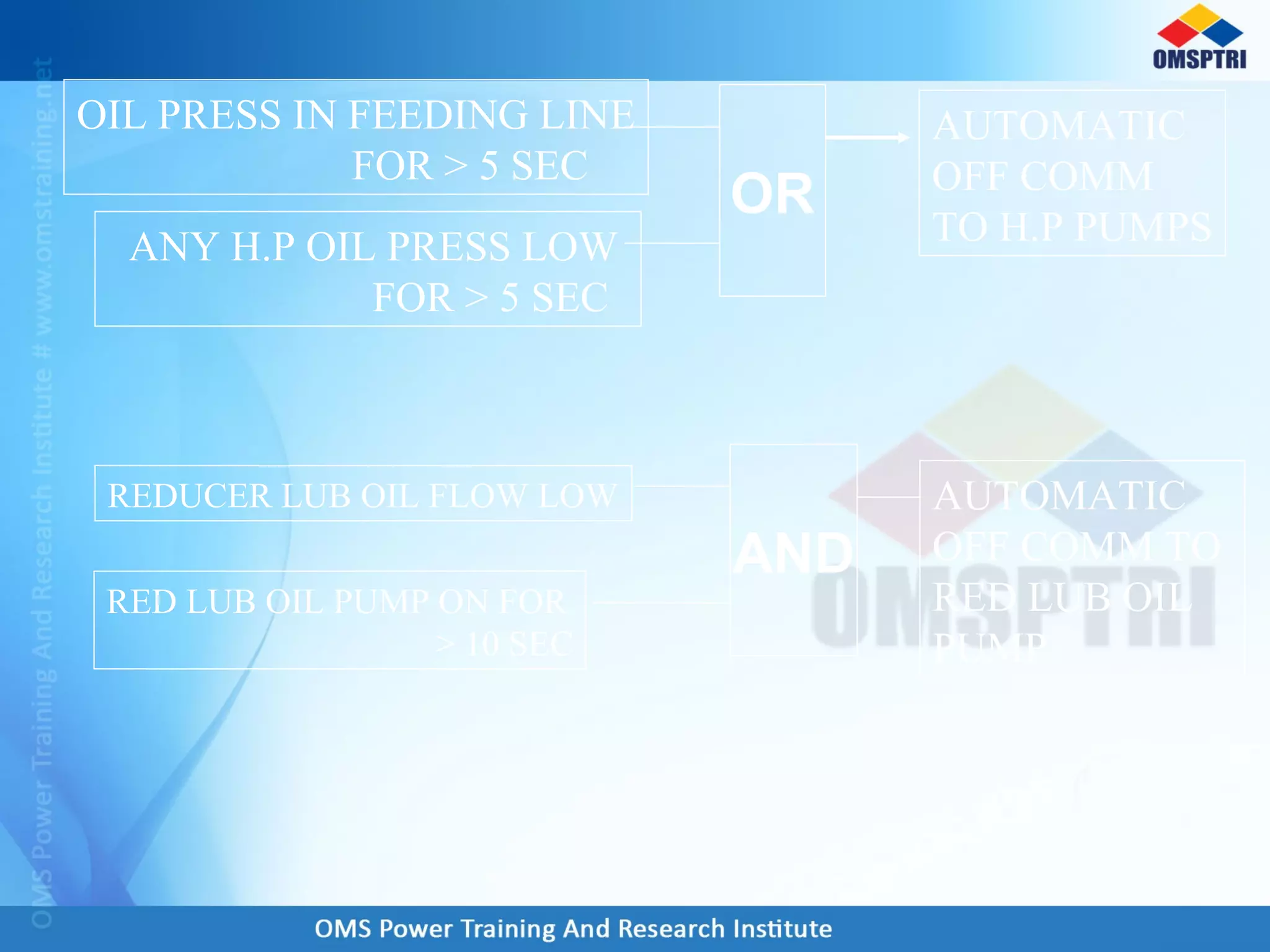
OR
OIL PRESS IN FEEDING LINE
FOR > 5 SEC
ANY H.P OIL PRESS LOW
FOR > 5 SEC
AUTOMATIC
OFF COMM
TO H.P PUMPS
AND
REDUCER LUB OIL FLOW LOW
RED LUB OIL PUMP ON FOR
> 10 SEC
AUTOMATIC
OFF COMM TO
RED LUB OIL
PUMP
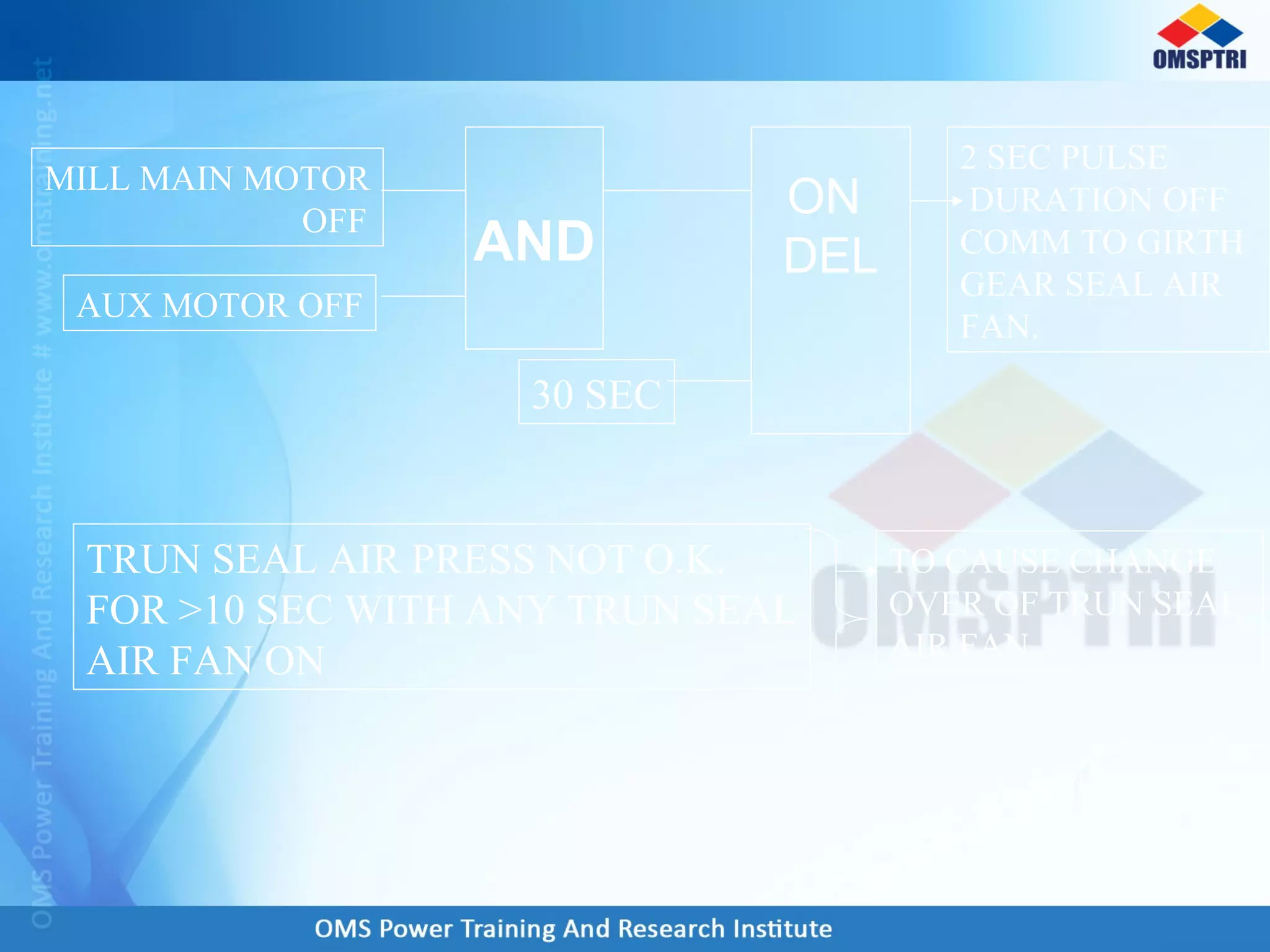
AND
ON
DEL
30 SEC
MILL MAIN MOTOR
OFF
AUX MOTOR OFF
2 SEC PULSE
DURATION OFF
COMM TO GIRTH
GEAR SEAL AIR
FAN.
TRUN SEAL AIR PRESS NOT O.K.
FOR >10 SEC WITH ANY TRUN SEAL
AIR FAN ON
TO CAUSE CHANGE
OVER OF TRUN SEAL
AIR FAN
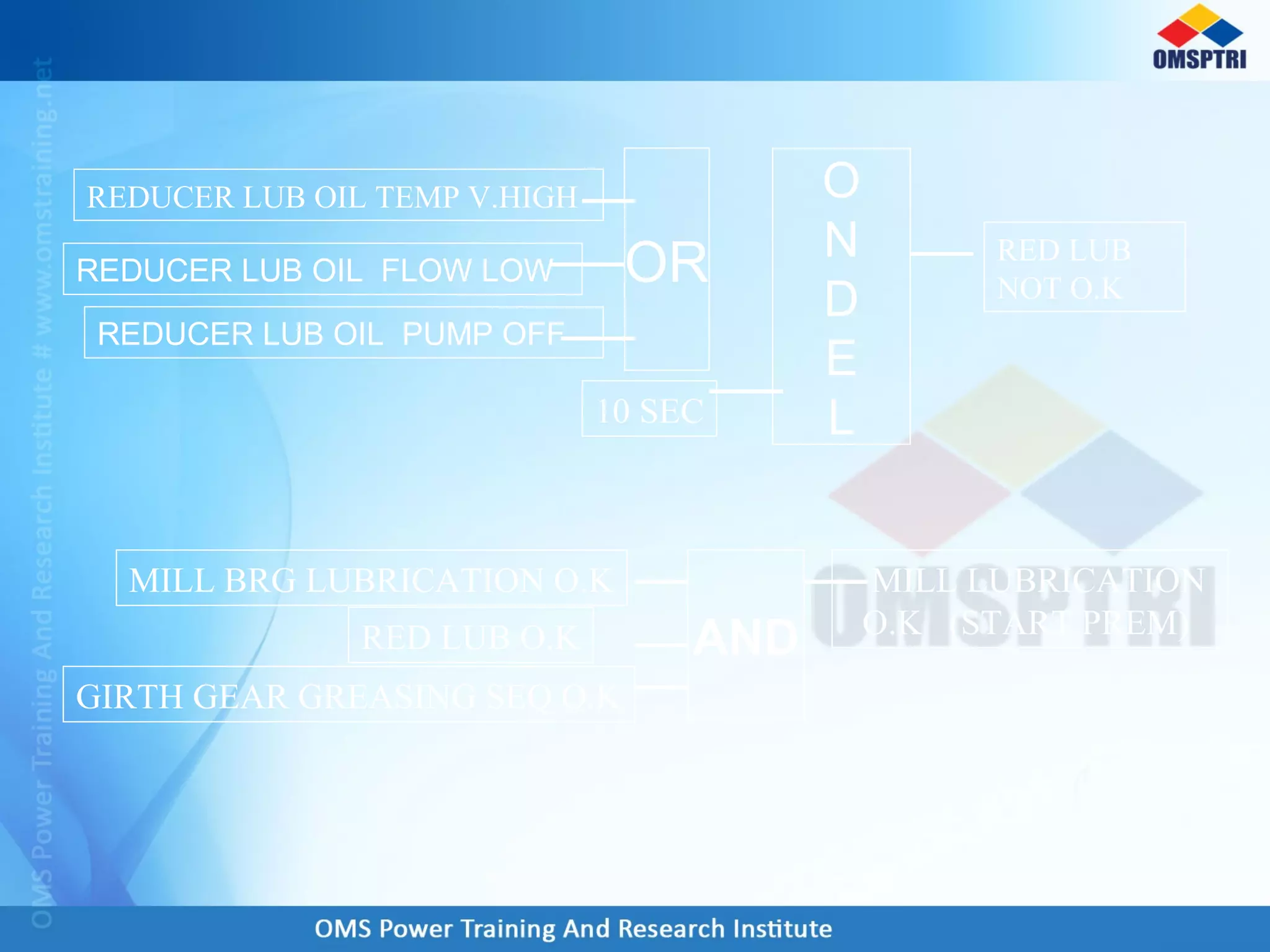
OR
O
N
D
E
L
REDUCER LUB OIL TEMP V.HIGH
10 SEC
RED LUB
NOT O.K
REDUCER LUB OIL FLOW LOW
REDUCER LUB OIL PUMP OFF
AND
MILL BRG LUBRICATION O.K
RED LUB O.K
GIRTH GEAR GREASING SEQ O.K
MILL LUBRICATION
O.K (START PREM)
O
R
R
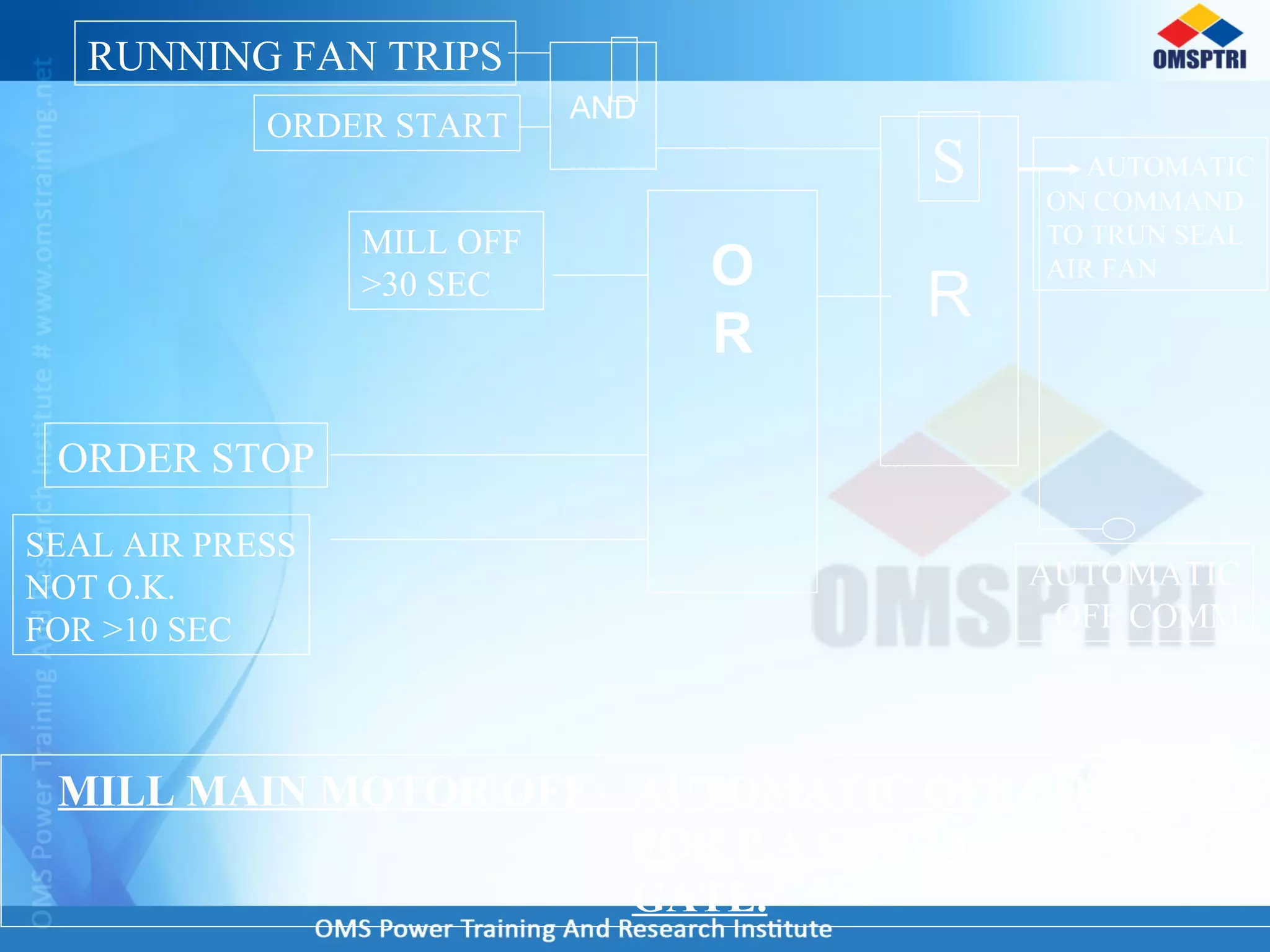
MILL OFF
>30 SEC
ORDER STOP
SEAL AIR PRESS
NOT O.K.
FOR >10 SEC
ORDER START
AUTOMATIC
ON COMMAND
TO TRUN SEAL
AIR FAN
AUTOMATIC
OFF COMM
MILL MAIN MOTOR OFF – AUTOMATIC OFF COMMAND
FOR P.A GEN I/L SHUT OFF
GATE.
S
RUNNING FAN TRIPS
AND
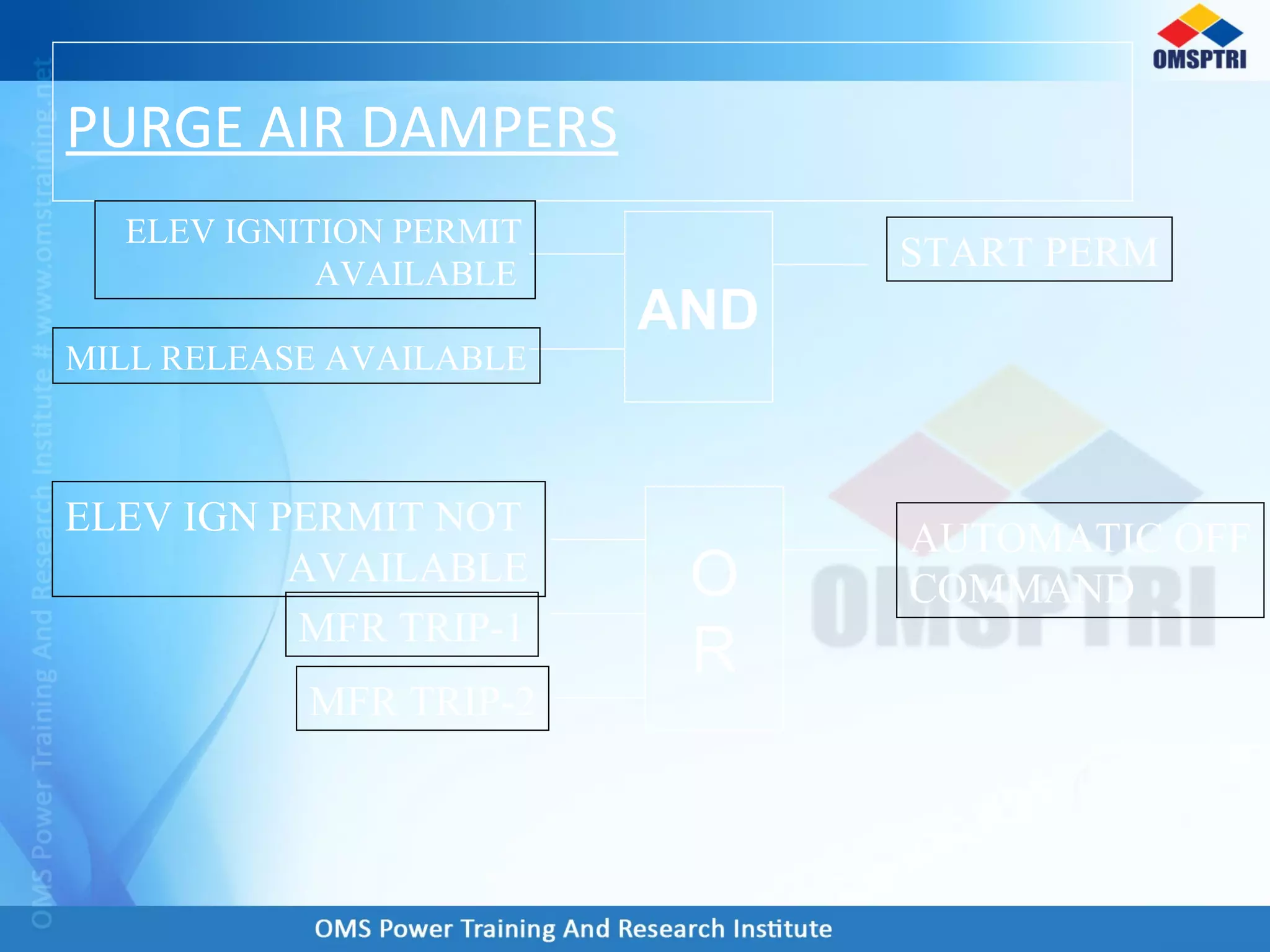
PURGE AIR DAMPERS
AND
ELEV IGNITION PERMIT
AVAILABLE
MILL RELEASE AVAILABLE
START PERM
O
R
ELEV IGN PERMIT NOT
AVAILABLE
MFR TRIP-1
MFR TRIP-2
AUTOMATIC OFF
COMMAND
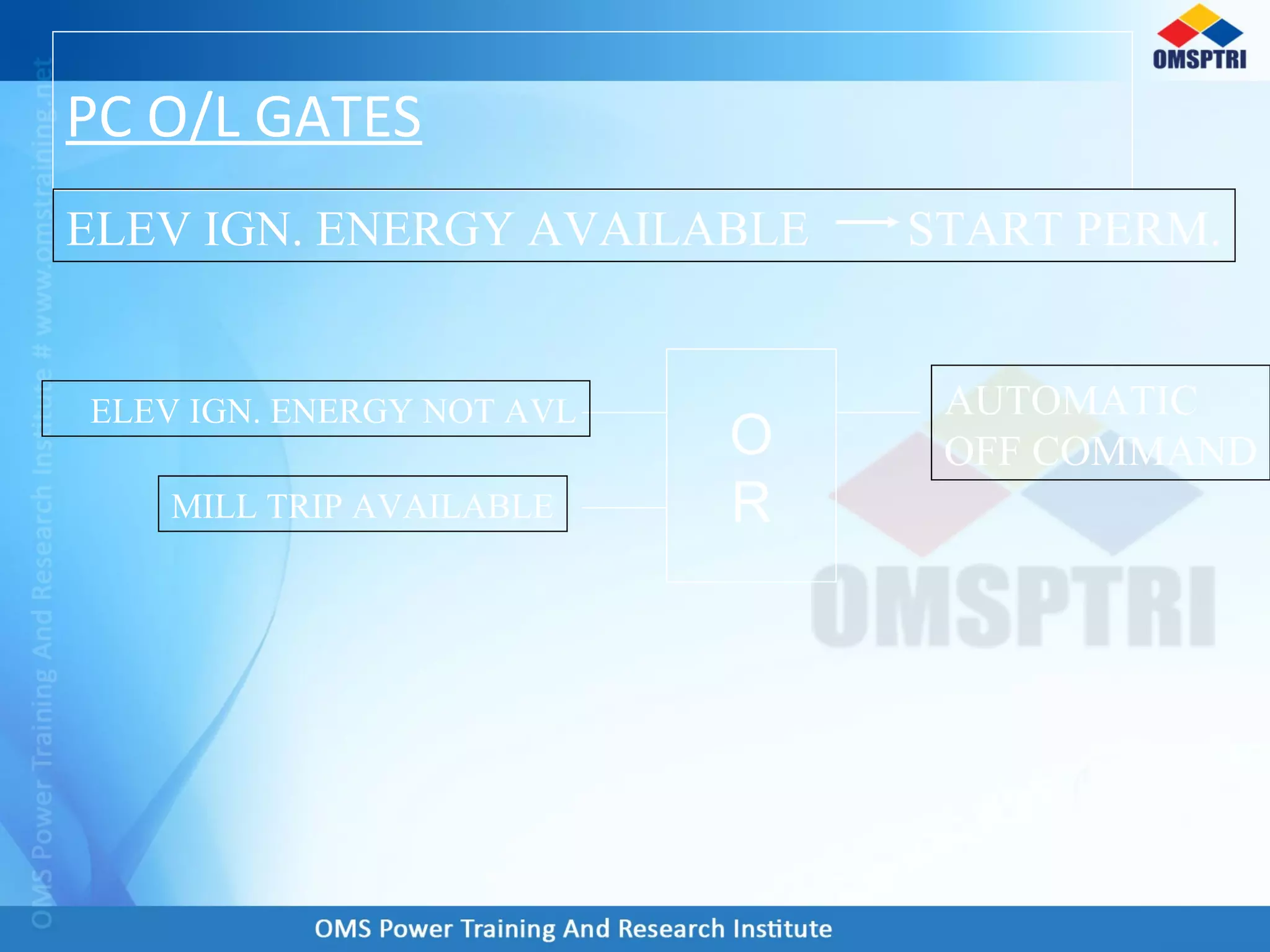
PC O/L GATES
ELEV IGN. ENERGY AVAILABLE START PERM.
O
R
ELEV IGN. ENERGY NOT AVL
MILL TRIP AVAILABLE
AUTOMATIC
OFF COMMAND
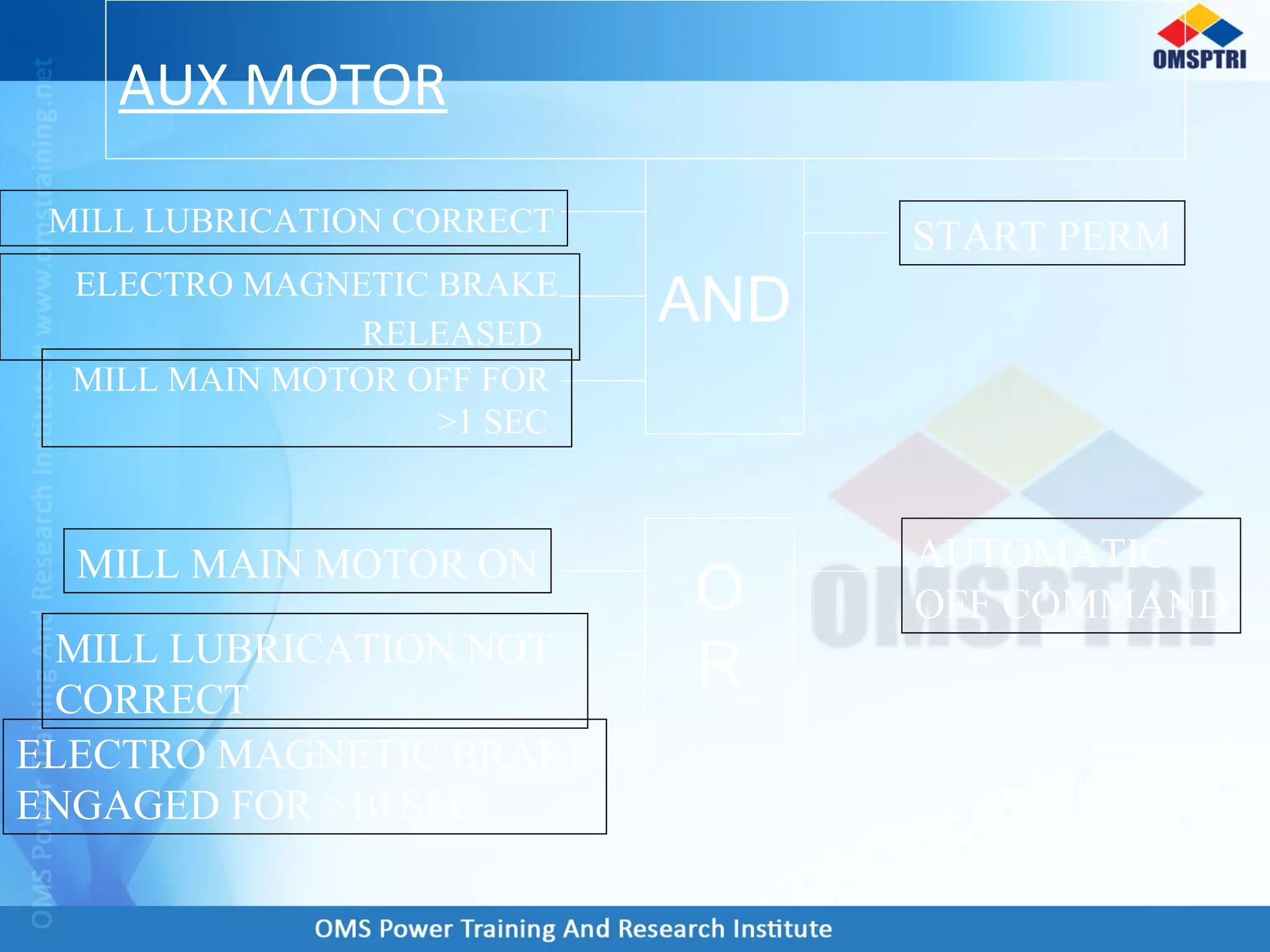
AUX MOTOR
AND
START PERMMILL LUBRICATION CORRECT
ELECTRO MAGNETIC BRAKE
RELEASED
MILL MAIN MOTOR OFF FOR
>1 SEC
O
R
AUTOMATIC
OFF COMMAND
MILL MAIN MOTOR ON
MILL LUBRICATION NOT
CORRECT
ELECTRO MAGNETIC BRAKE
ENGAGED FOR >10 SEC
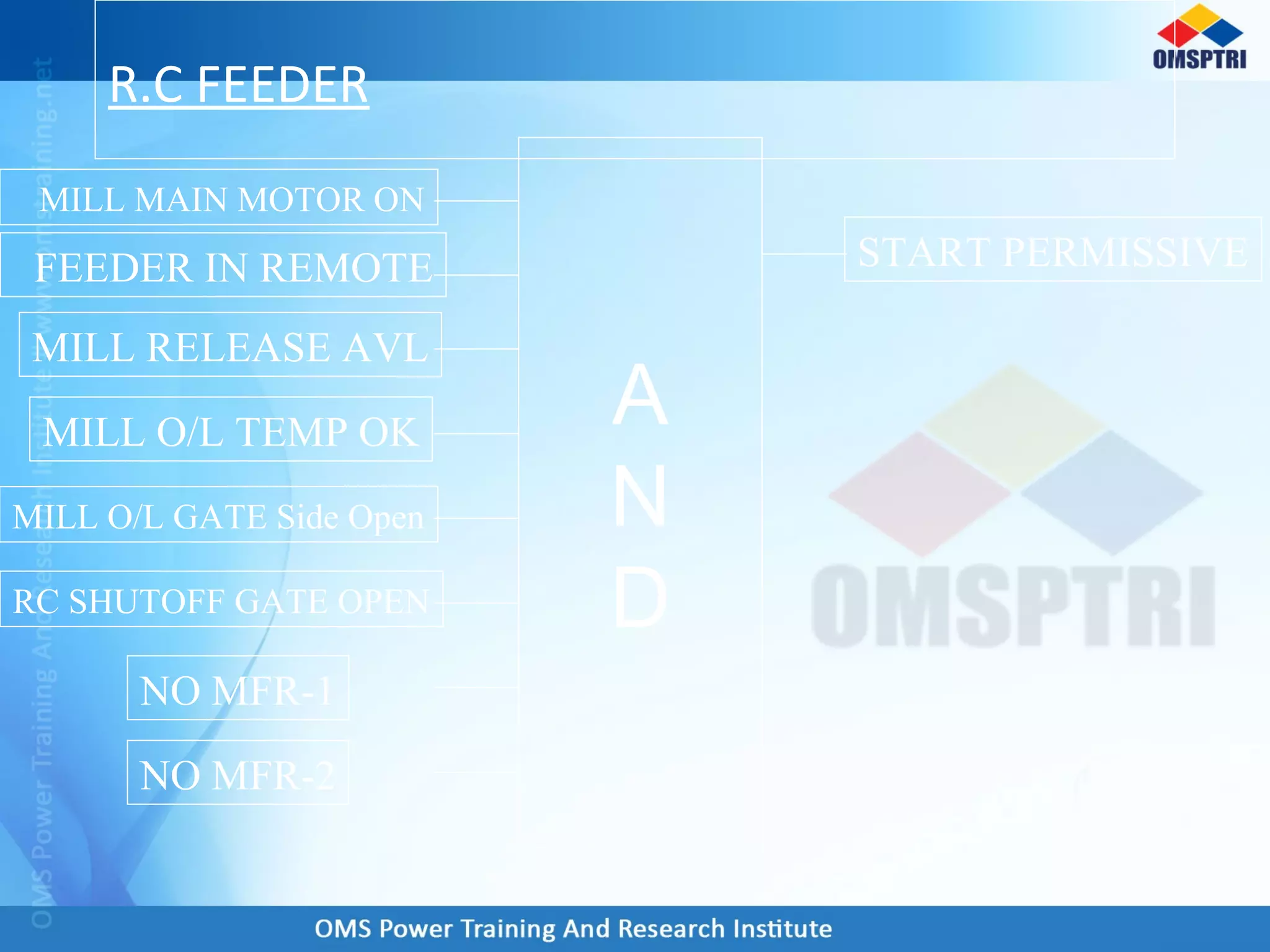
R.C FEEDER
A
N
D
START PERMISSIVE
MILL MAIN MOTOR ON
FEEDER IN REMOTE
MILL RELEASE AVL
MILL O/L TEMP OK
MILL O/L GATE Side Open
RC SHUTOFF GATE OPEN
NO MFR-1
NO MFR-2
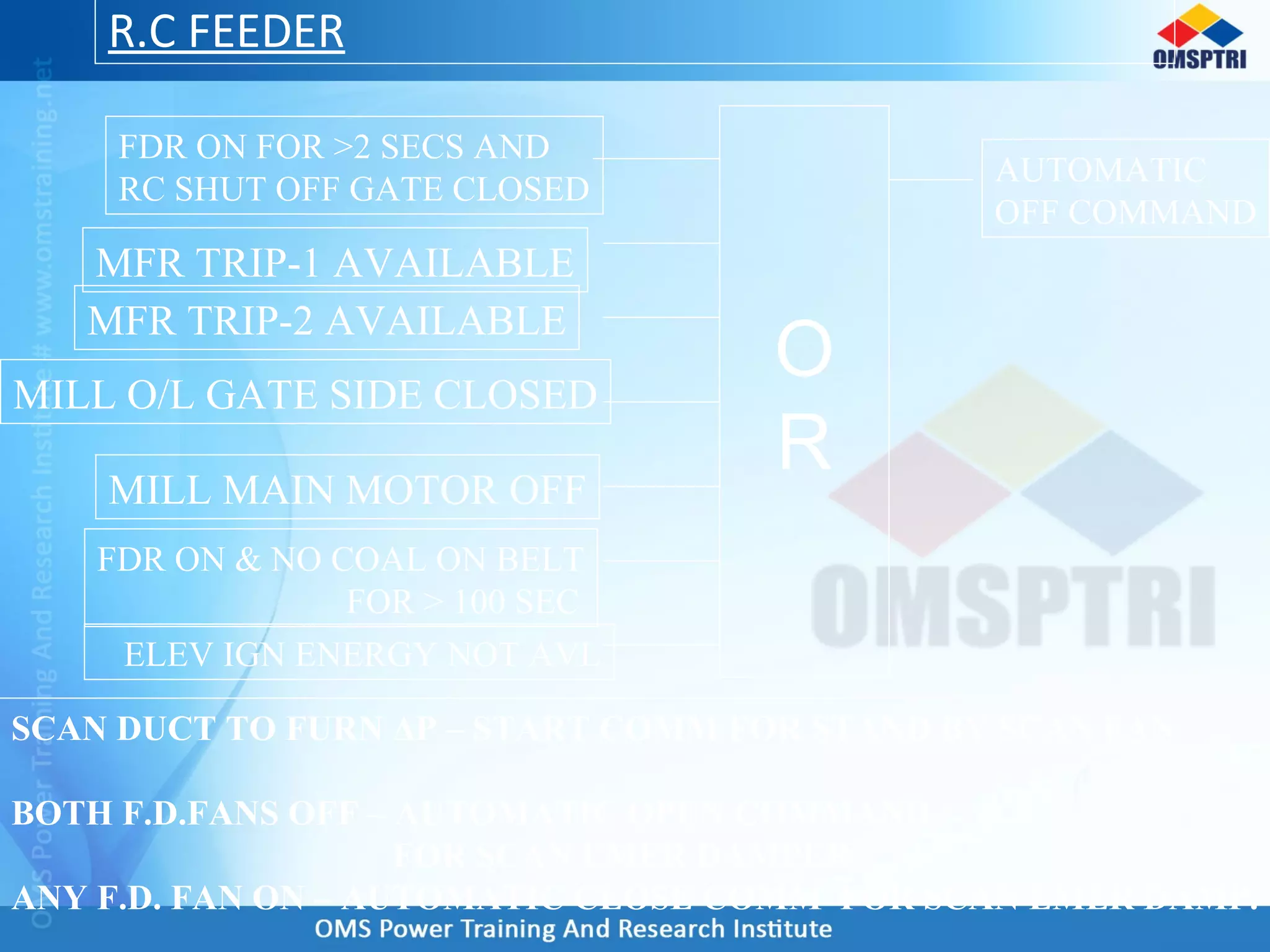
R.C FEEDER
O
R
AUTOMATIC
OFF COMMAND
FDR ON FOR >2 SECS AND
RC SHUT OFF GATE CLOSED
MFR TRIP-2 AVAILABLE
MFR TRIP-1 AVAILABLE
MILL O/L GATE SIDE CLOSED
MILL MAIN MOTOR OFF
FDR ON & NO COAL ON BELT
FOR > 100 SEC
ELEV IGN ENERGY NOT AVL
SCAN DUCT TO FURN ΔP – START COMM FOR STAND BY SCAN FAN
BOTH F.D.FANS OFF – AUTOMATIC OPEN COMMAND
FOR SCAN EMER DAMPER.
ANY F.D. FAN ON – AUTOMATIC CLOSE COMM FOR SCAN EMER DAMP.
OPERATIONS AND MAINTENANCE CONTROLLABLE FACTORS
• Four controllable heat rate factors are directly related with furnace
performance and furnace flue gas uniformity.
• These are: superheater temperature, reheater temperature,
desuperheating spray water flow to the superheater, and
desuperheating spray water flow to the reheater
• Balancing of the fuel and air to each burner has much to do with
furnace combustion efficiency, and the completeness of
combustion at the furnace exit.
• The residence time of the products of combustion from the
burners to the superheater flue gas inlet is about one or two
seconds.
• Not very long for furnace mixing of fuel rich and air rich lanes of
combustion products.
• Optimized combustion at the superheater inlet can be quantified
by use of a water-cooled high velocity thermocouple probe.
• Slagging at the superheater flue gas inlet has been a problem in
a number of boilers due to stratified flue gas.
• Slagging at the lower furnace results in large boulder sized
clinkers blocking the lower ash hopper.
• Tube spacing becomes ever closer as the heat transfer changes
from radiant in the furnace, to convective in the back pass.
• Example: The typical tube spacing of pendant superheater and
reheater tubes.
• If lanes in the furnace outlet flue gas approach the ash softening
or even the ash fluid temperature, upper furnace slagging and
blockage can result in a very short time.
• Several cases studies should be reviewed to show how the
application will improved slagging, heat-rate, capacity factor,
reliability, NOx and/or fly ash carbon content.
Superheater
Superheated steam boilers vaporize the water and
then further heat the steam in a superheater.
This provides steam at much higher temperature,
but can decrease the overall thermal efficiency of
the steam generating plant because the higher
steam temperature requires a higher flue gas
exhaust temperature. There are several ways to
circumvent this problem, typically by providing
– an economizer that heats the feed water,
– a combustion air heater in the hot flue gas exhaust path,
– both.
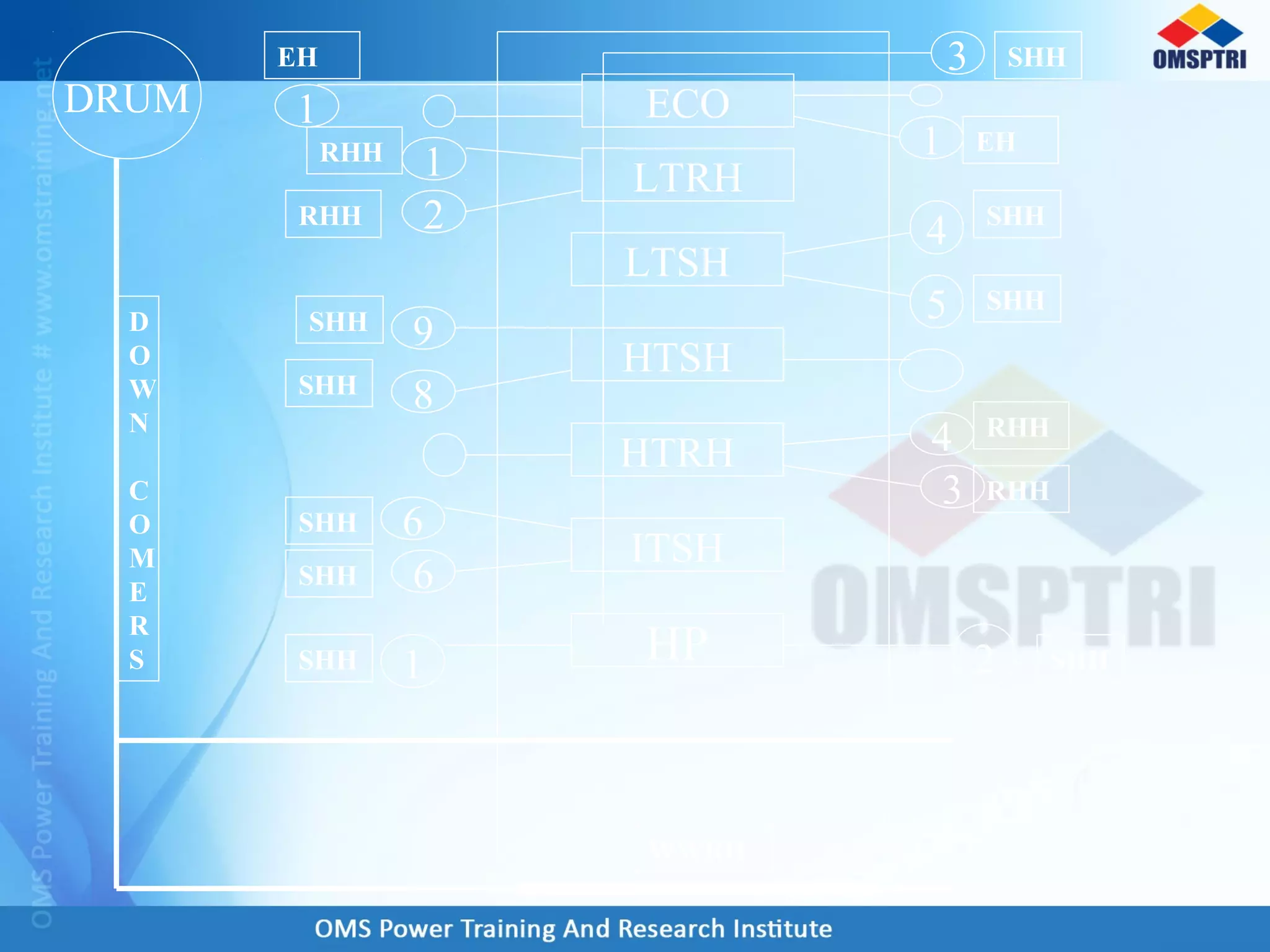
HP
ECO
LTRH
LTSH
HTSH
HTRH
ITSH
DRUM
6
3
5
4
21
6
8
9
3
4
2
1
1
1
SHH
RHH
EH
WWRH
EH
RHH
RHH
RHH
SHH
SHH
SHH
SHH
SHH
SHHSHH
SHH
D
O
W
N
C
O
M
E
R
S
Advantages of Superheated Steam
• Increase overall efficiency of both steam generation
and its utilisation
• Gains in input temperature to a turbine outweighs
any cost in additional boiler complication and
expense.
• Almost all steam superheater system designs remove
droplets entrained in the steam to prevent damage
to the turbine blading and associated piping.
• Overcomes the practical limitations in using wet
steam, as entrained condensation droplets will
damage turbine blades
Superheater Operation
• It is similar to that of the coils on an air conditioning
unit, although for a different purpose.
• The steam piping is directed through the flue gas
path in the boiler furnace.
• The temperature of flue gas in this area is typically
between 1300–1600 degrees celsius (2372–2912
°F).
• Some Superheaters are
radiant type; that is, they absorb heat by radiation.
Others are convection type, absorbing heat from a fluid.
Some are a combination of the two types.
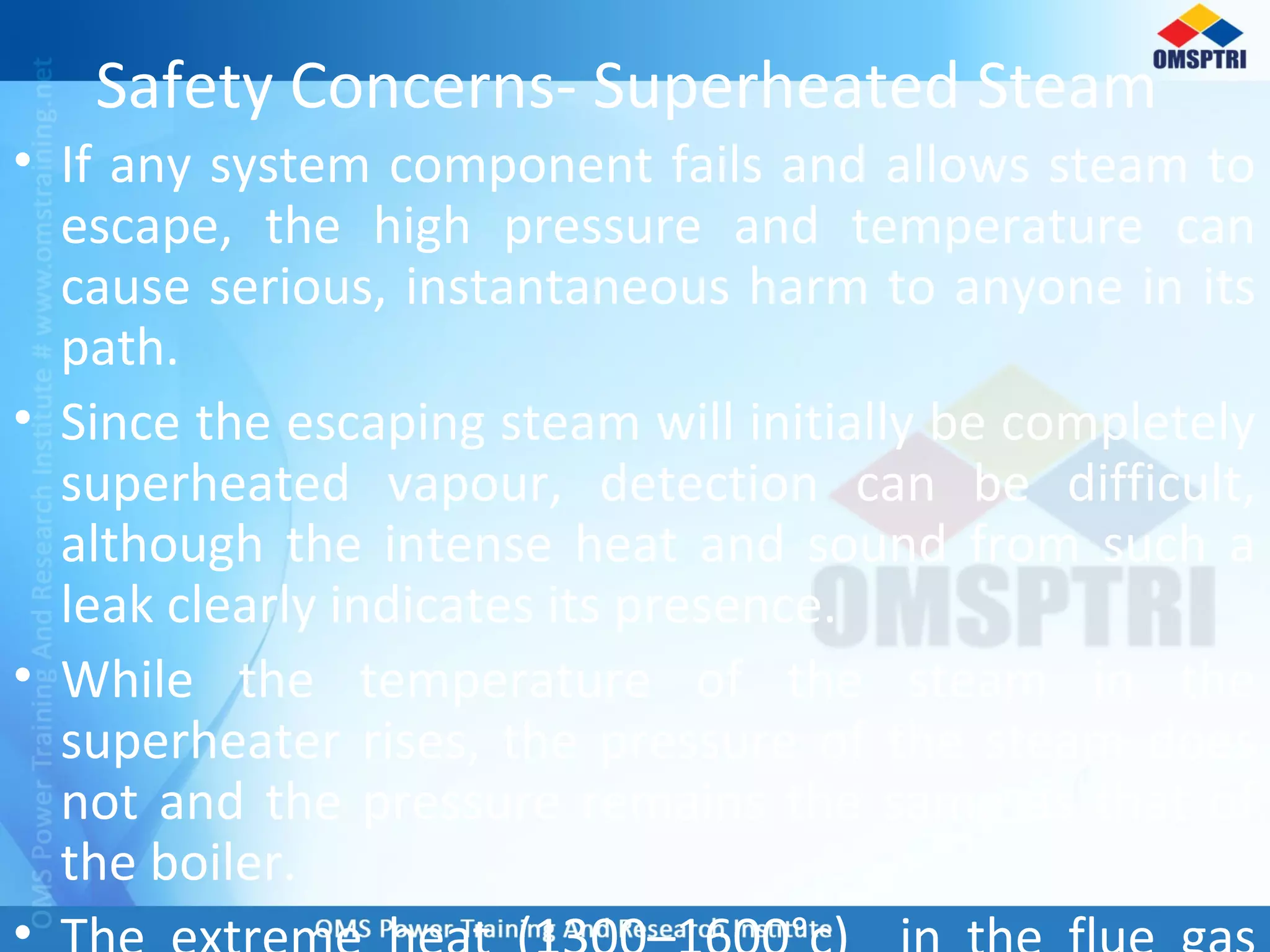
Safety Concerns- Superheated Steam
• If any system component fails and allows steam to
escape, the high pressure and temperature can
cause serious, instantaneous harm to anyone in its
path.
• Since the escaping steam will initially be completely
superheated vapour, detection can be difficult,
although the intense heat and sound from such a
leak clearly indicates its presence.
• While the temperature of the steam in the
superheater rises, the pressure of the steam does
not and the pressure remains the same as that of
the boiler.
•
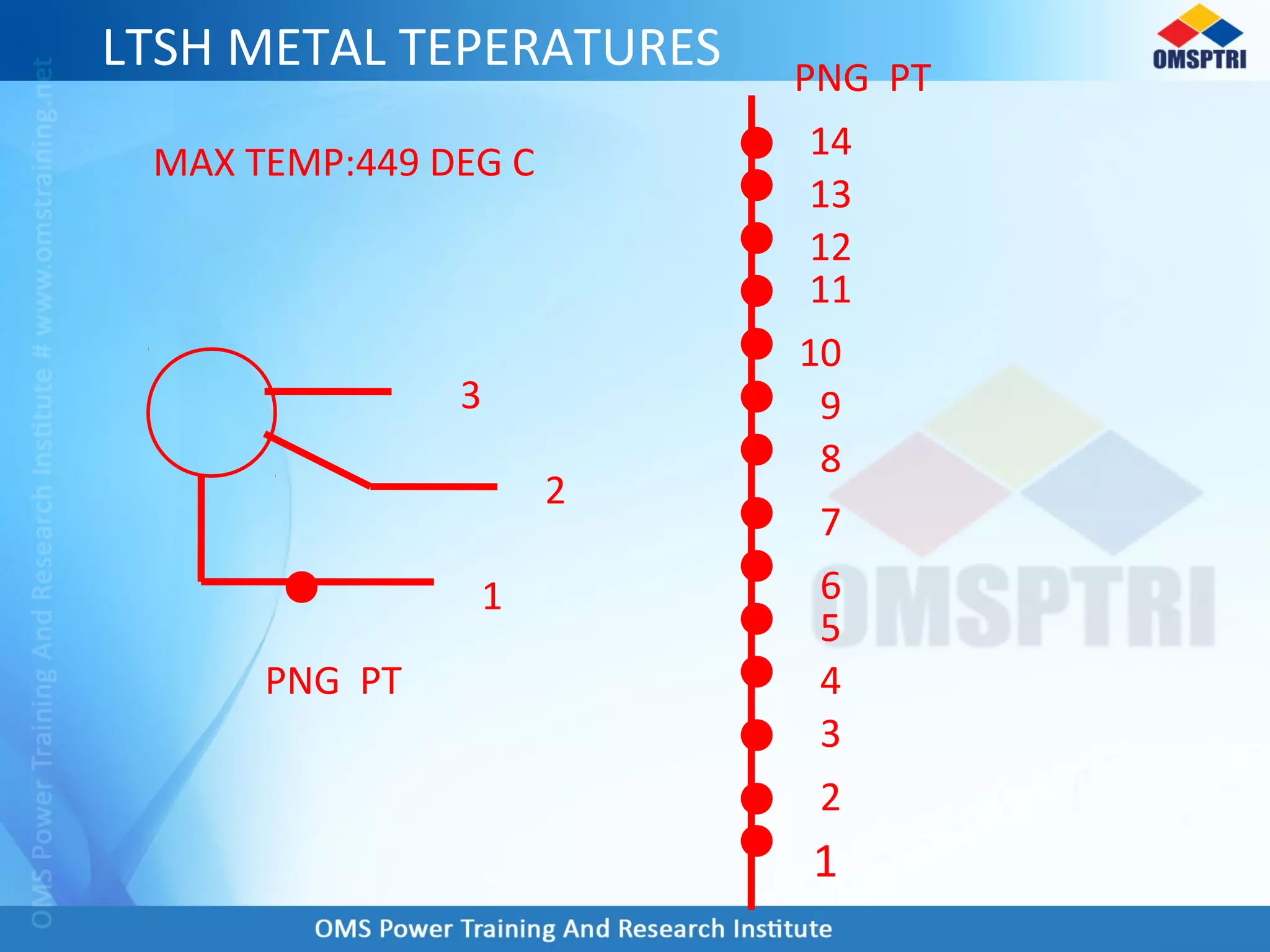
LTSH METAL TEPERATURES
PNG PT
1
PNG PT
14
5
13
6
12
11
10
9
8
7
4
3
2
1
2
3
MAX TEMP:449 DEG C
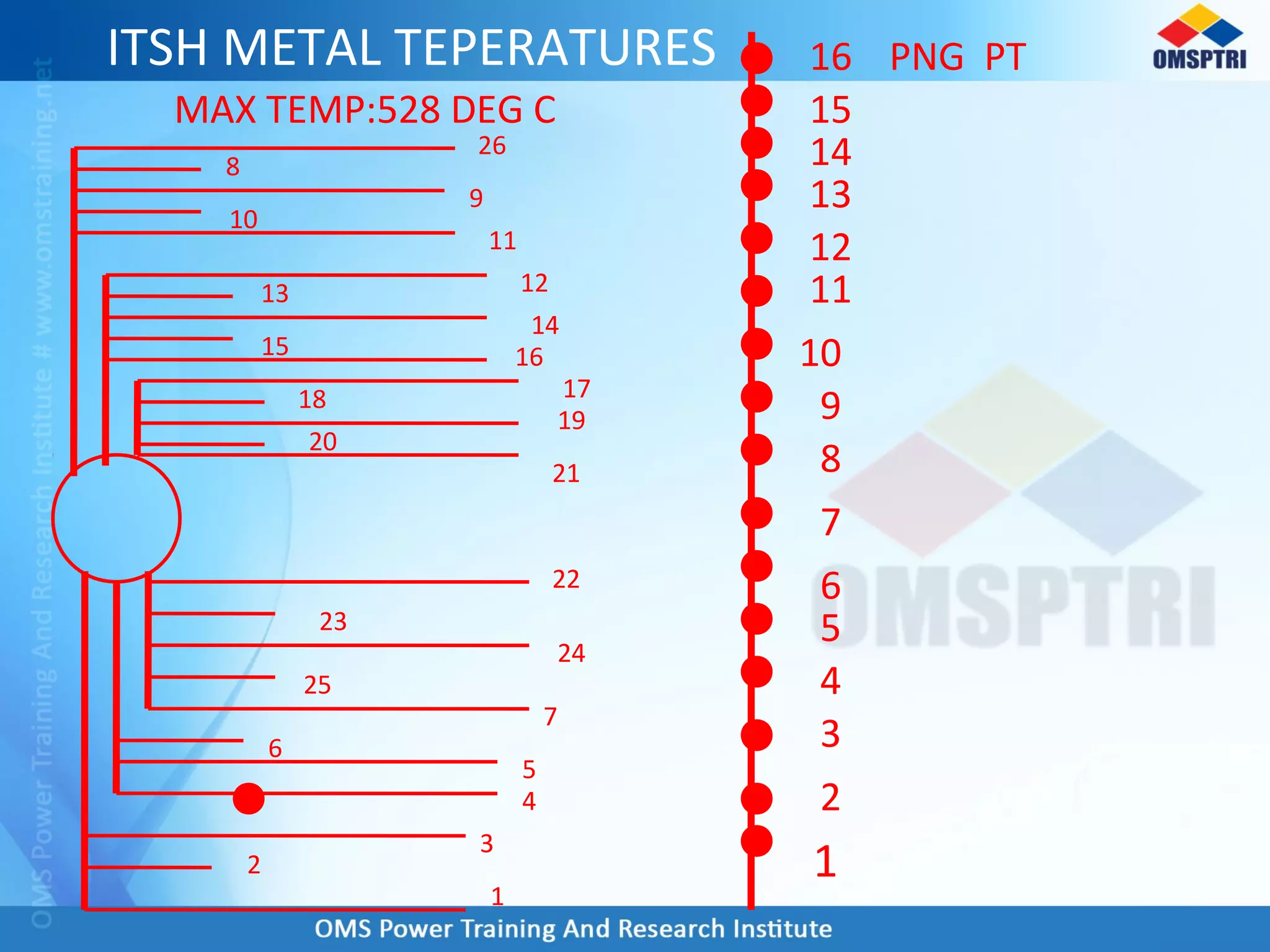
ITSH METAL TEPERATURES
1
PNG PT
15
5
13
6
12
11
10
9
8
7
4
3
2
1
MAX TEMP:528 DEG C
16
14
2
4
3
6
5
7
22
24
23
25
15 16
13
14
12
9
26
11
18
19
17
20
8
21
10
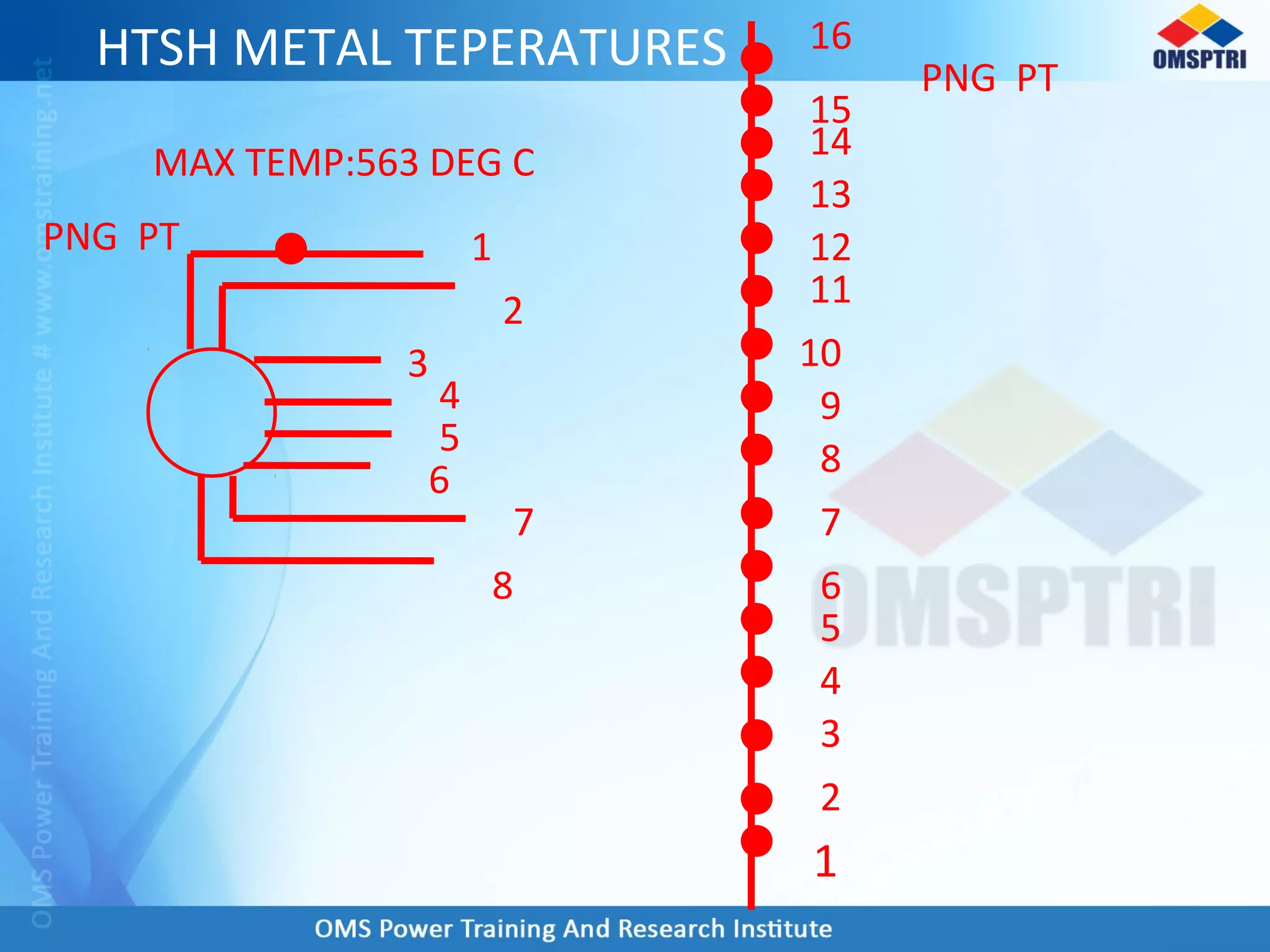
HTSH METAL TEPERATURES
PNG PT
1
PNG PT
14
5
13
6
12
11
10
9
8
7
4
3
2
1
2
3
MAX TEMP:563 DEG C
15
16
4
5
6
7
8
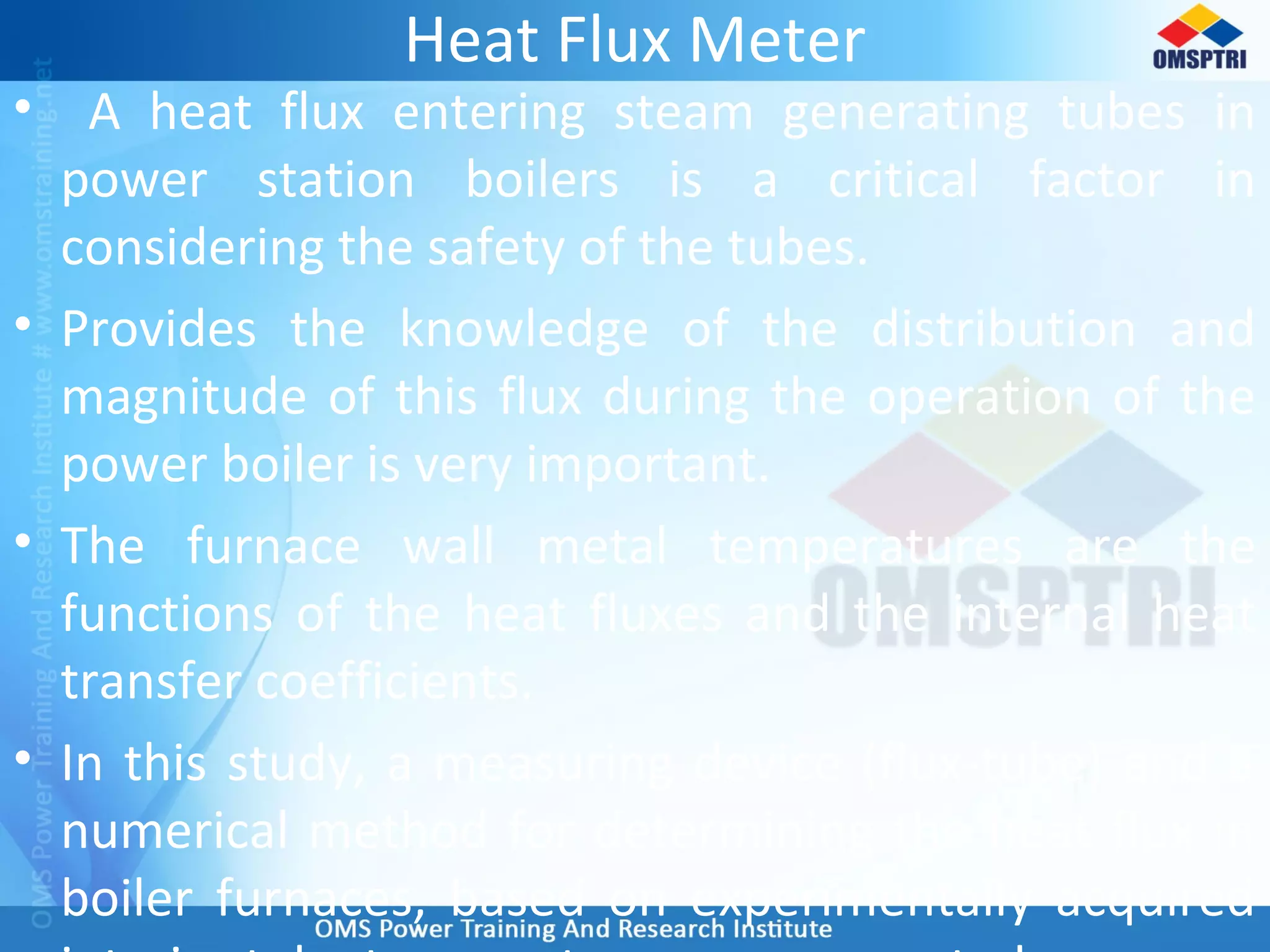
Heat Flux Meter
• A heat flux entering steam generating tubes in
power station boilers is a critical factor in
considering the safety of the tubes.
• Provides the knowledge of the distribution and
magnitude of this flux during the operation of the
power boiler is very important.
• The furnace wall metal temperatures are the
functions of the heat fluxes and the internal heat
transfer coefficients.
• In this study, a measuring device (flux-tube) and a
numerical method for determining the heat flux in
boiler furnaces, based on experimentally acquired
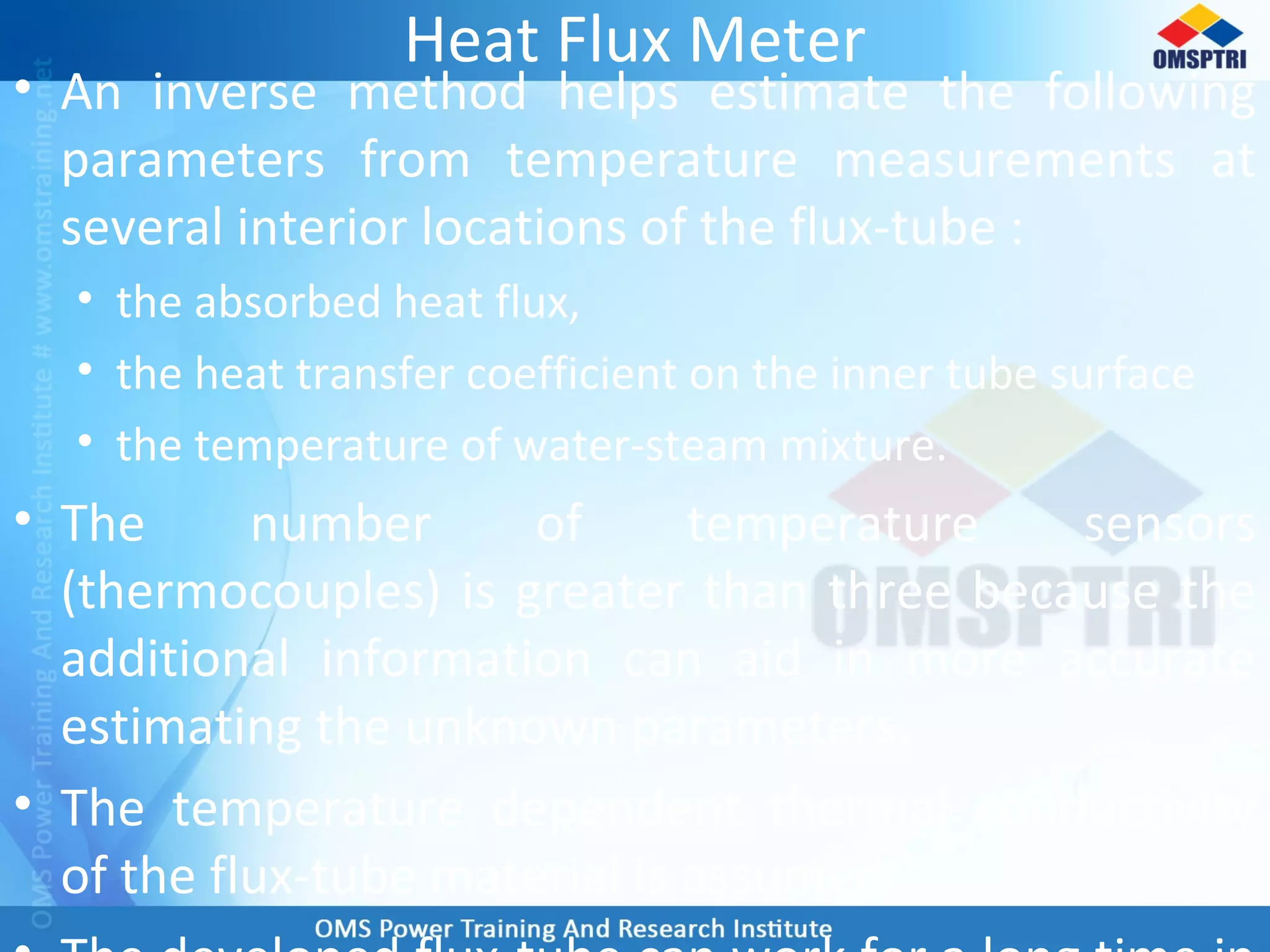
Heat Flux Meter
• An inverse method helps estimate the following
parameters from temperature measurements at
several interior locations of the flux-tube :
• the absorbed heat flux,
• the heat transfer coefficient on the inner tube surface
• the temperature of water-steam mixture.
• The number of temperature sensors
(thermocouples) is greater than three because the
additional information can aid in more accurate
estimating the unknown parameters.
• The temperature dependent thermal conductivity
of the flux-tube material is assumed.
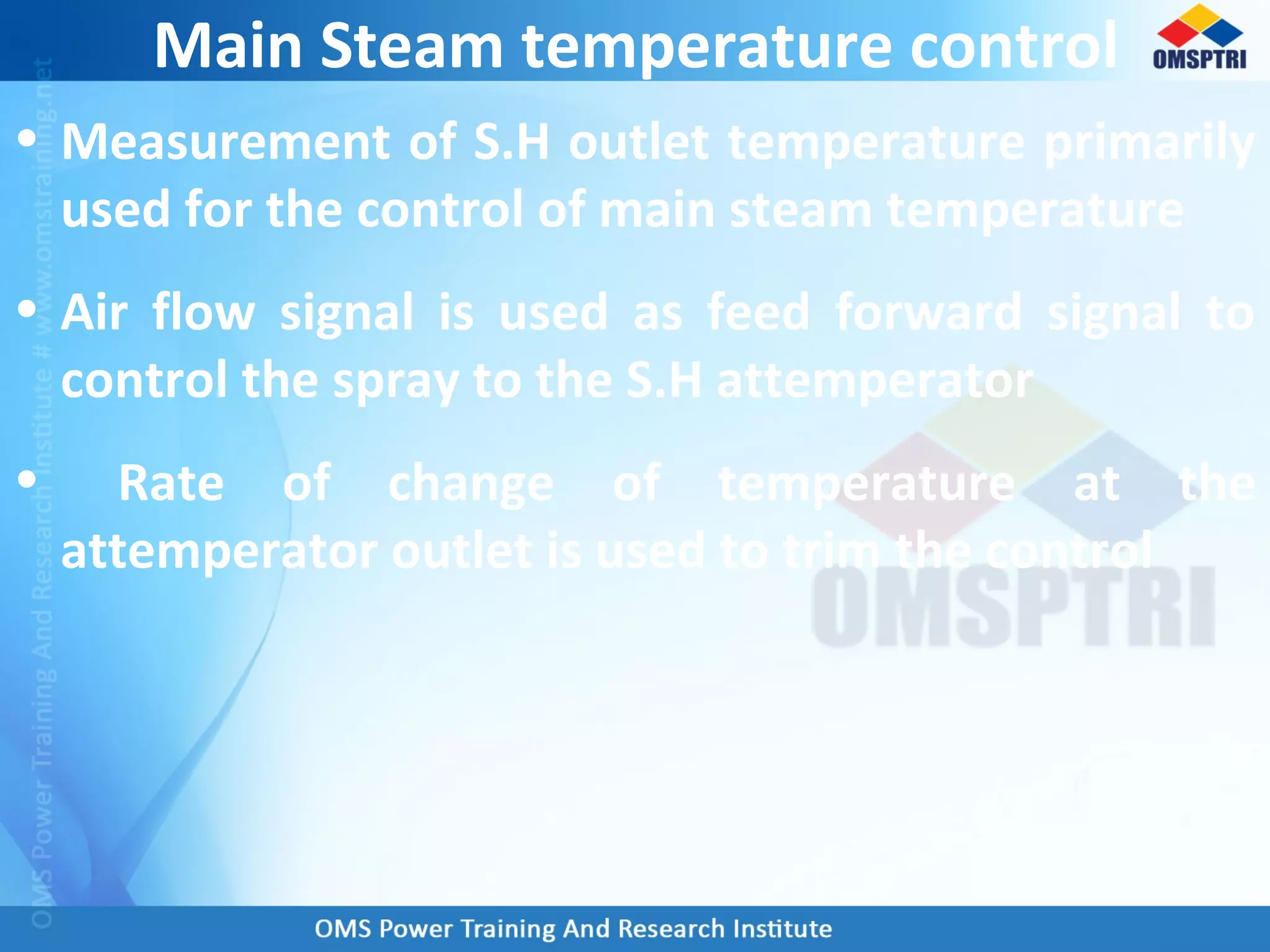
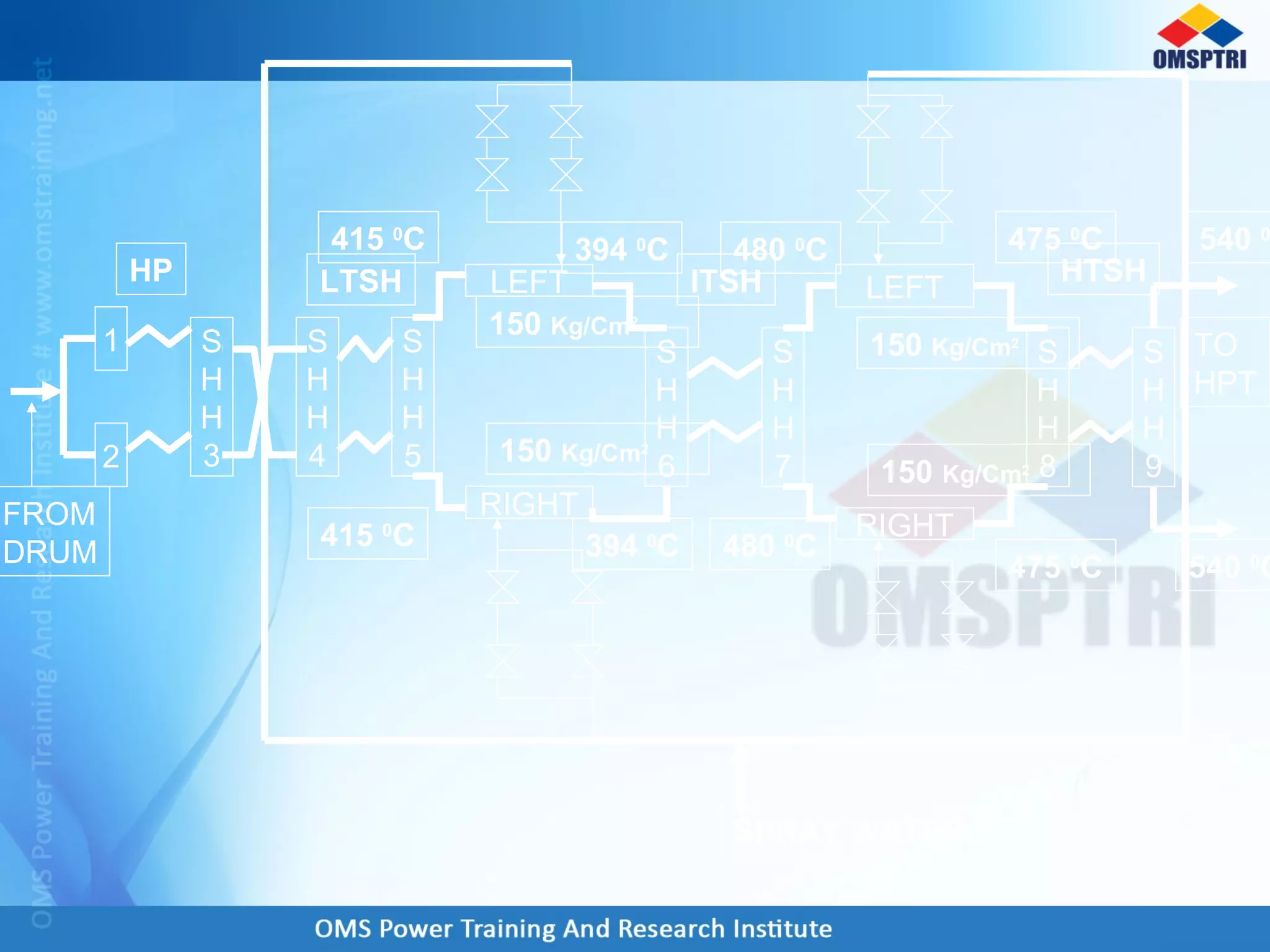
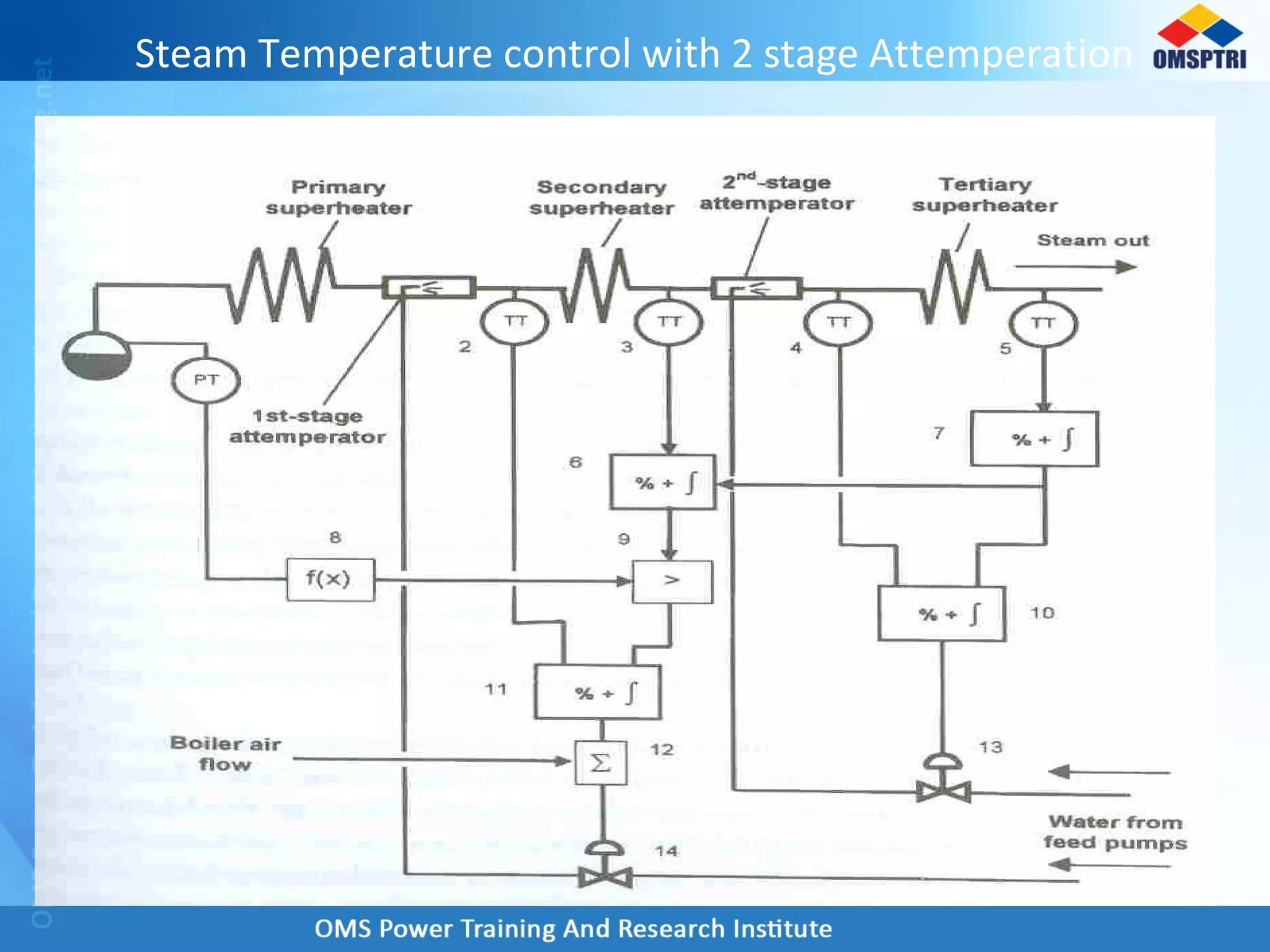
Main Steam temperature control
• Measurement of S.H outlet temperature primarily
used for the control of main steam temperature
• Air flow signal is used as feed forward signal to
control the spray to the S.H attemperator
• Rate of change of temperature at the
attemperator outlet is used to trim the control
S
H
H
7
1
LEFT
2
RIGHT
LEFT
RIGHT
S
H
H
8
S
H
H
9
S
H
H
6
S
H
H
5
S
H
H
4
S
H
H
3
LTSH ITSH HTSHHP
FROM
DRUM
TO
HPT
SPRAY WATER
415 0
C
540 0
C
540 0
475 0
C
475 0
C
480 0
C
480 0
C394 0
C
394 0
C
150 Kg/Cm2
150 Kg/Cm2
415 0
C
150 Kg/Cm2
150 Kg/Cm2
Steam Temperature control with 2 stage Attemperation
Reheat steam temperature
• Reheat steam temperature is primarily controlled by
burner tilt /gas by-pass on the case may be secondary
control is provided by the attemperator
• Using the attemperator (sprom) for control leads to
loss of efficiency and should not be used as primary
control
• Control philosophy for the attemperator is similar to
that of main steam
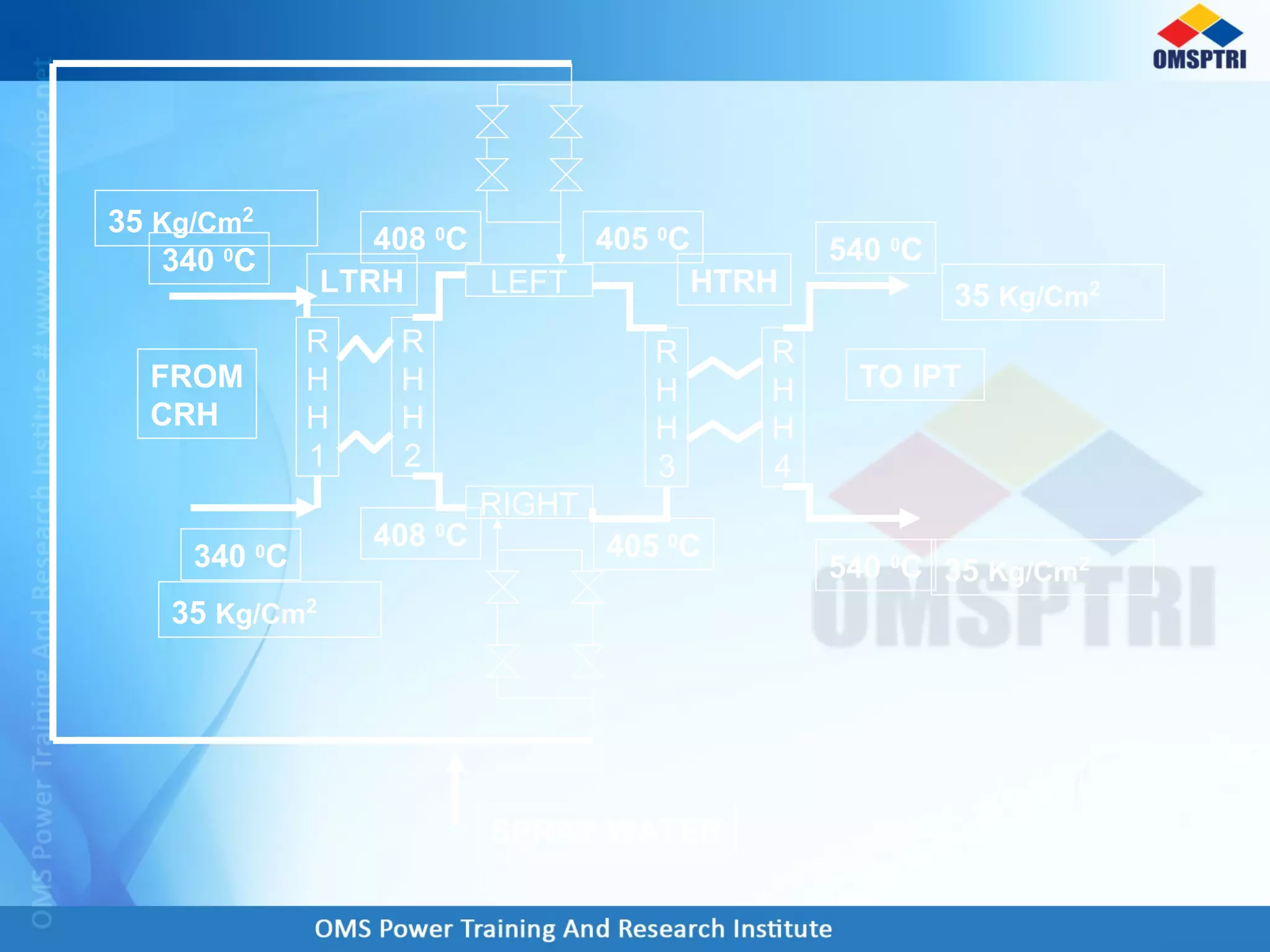
R
H
H
4
LEFT
RIGHT
R
H
H
3
R
H
H
2
R
H
H
1
LTRH HTRH
FROM
CRH
TO IPT
SPRAY WATER
35 Kg/Cm2
340 0
C
340 0
C 405 0
C
405 0
C
540 0
C
540 0
C408 0
C
408 0
C
35 Kg/Cm2
35 Kg/Cm2
35 Kg/Cm2
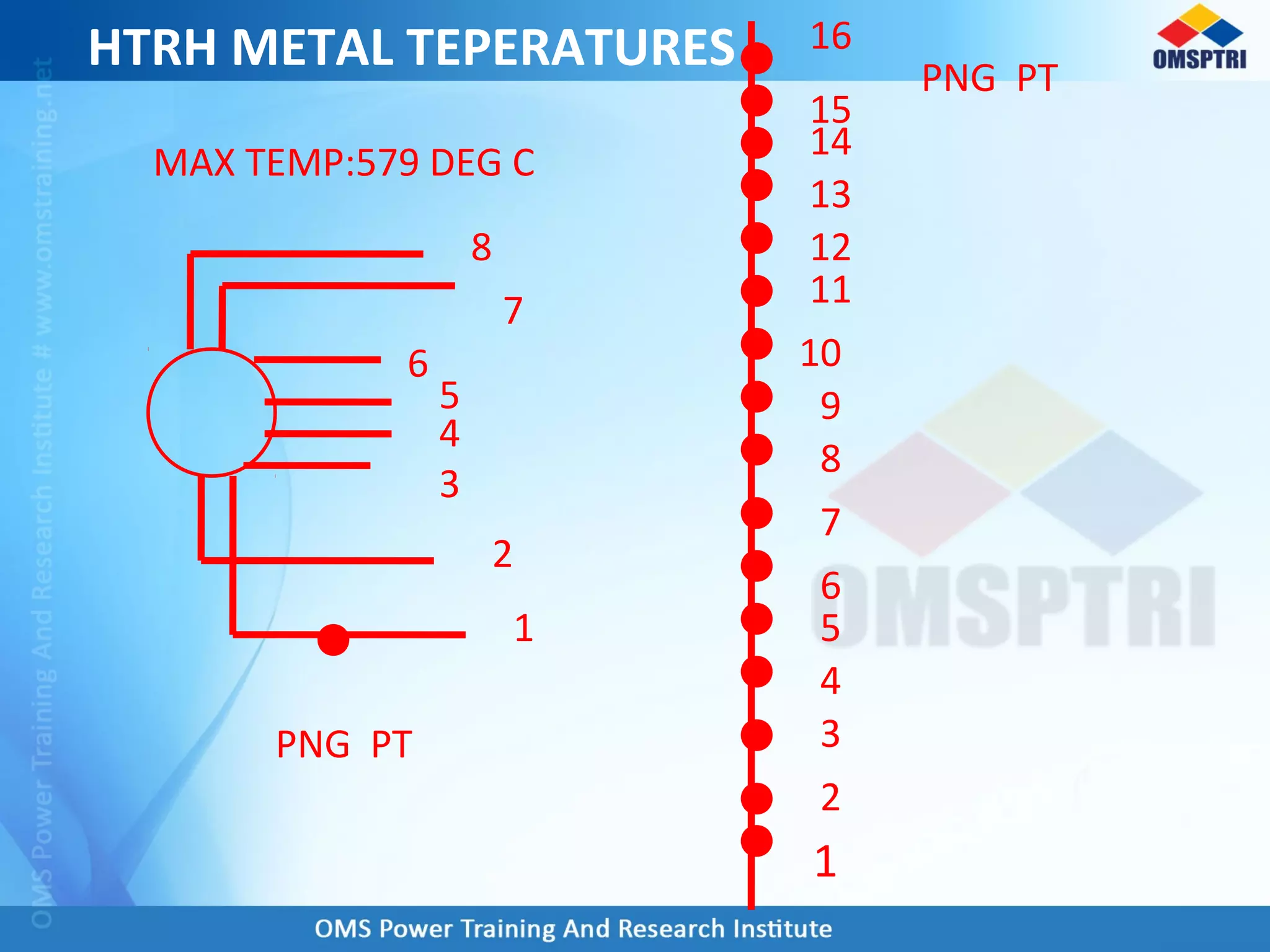
HTRH METAL TEPERATURES
PNG PT
1
PNG PT
14
5
13
6
12
11
10
9
8
7
4
3
2
8
7
6
MAX TEMP:579 DEG C
15
16
5
4
3
2
1
Superheat and reheat temperature control
The main steam temperature at boiler outlet is done through
a temperature control system that distributes the boiler heat
between steam generation, steam superheating and steam
reheating. The various methods used for controlling steam
temperature are:
•attemperation,
•gas proportioning dampers,
•gas recirculation, excess air,
•burner tilt control,
•divided furnace with differential firing and
•separately fired superheaters.
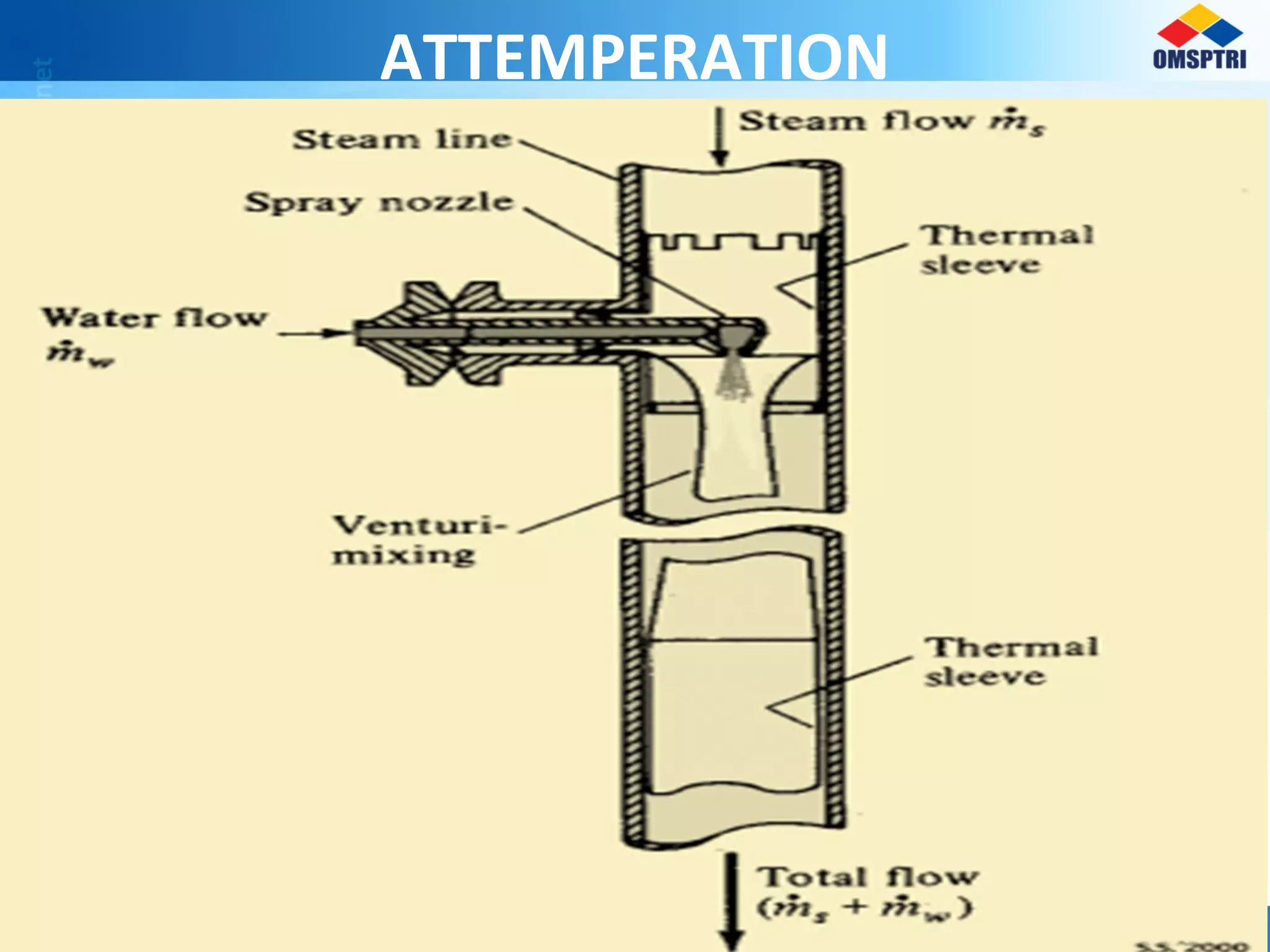
ATTEMPERATION
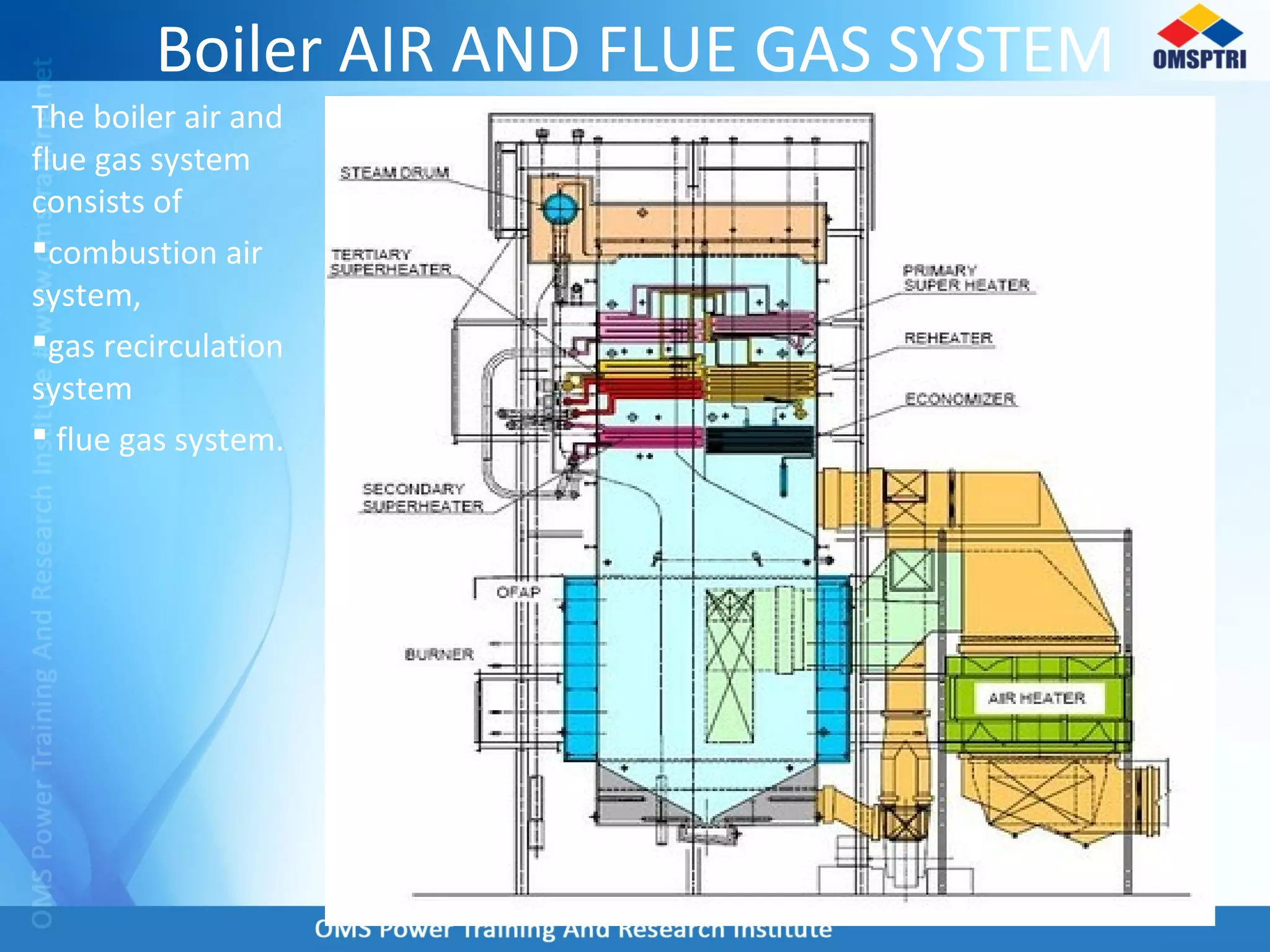
Boiler AIR AND FLUE GAS SYSTEM
The boiler air and
flue gas system
consists of
combustion air
system,
gas recirculation
system
 flue gas system.
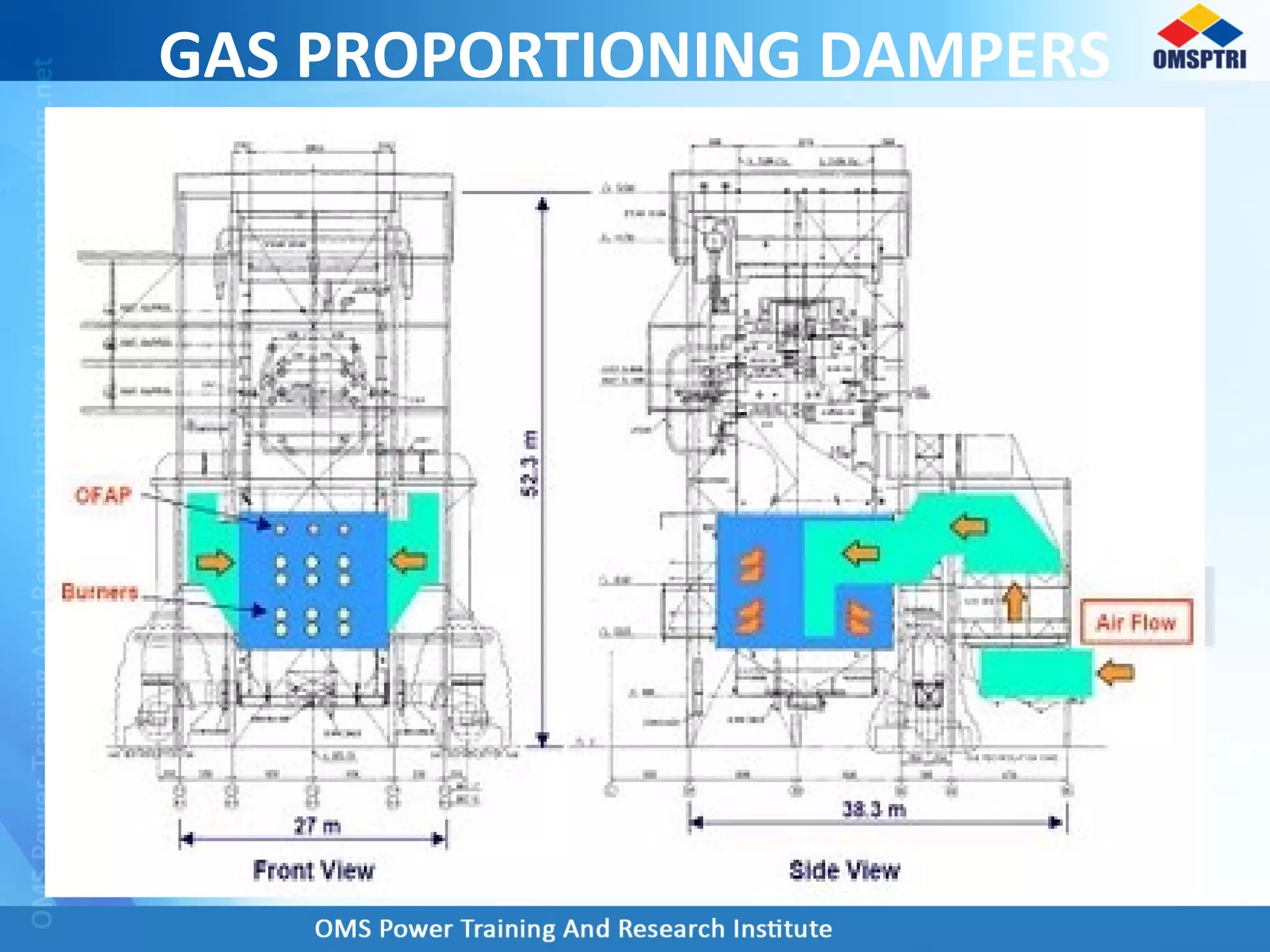
GAS PROPORTIONING DAMPERS
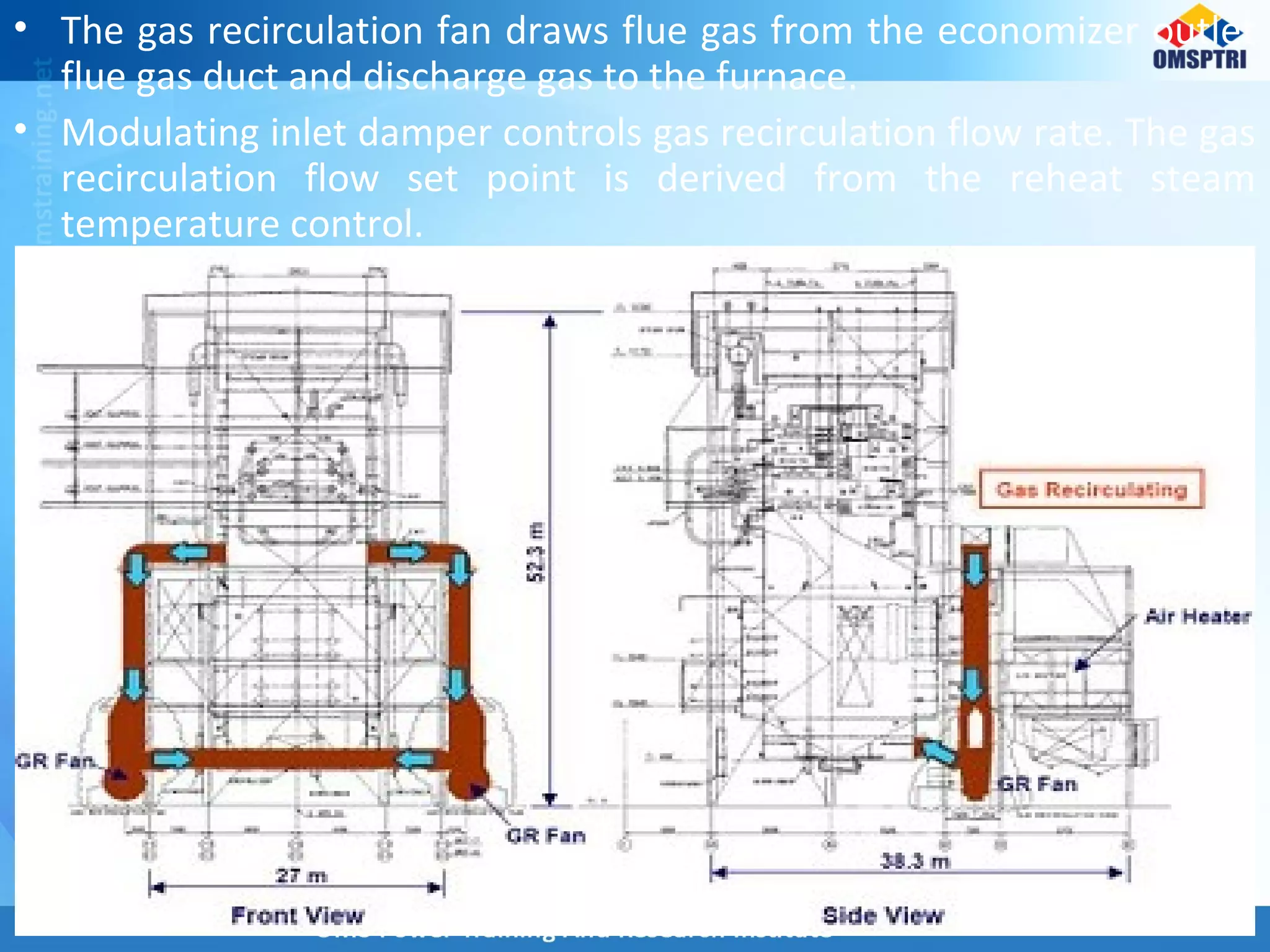
• The gas recirculation fan draws flue gas from the economizer outlet
flue gas duct and discharge gas to the furnace.
• Modulating inlet damper controls gas recirculation flow rate. The gas
recirculation flow set point is derived from the reheat steam
temperature control.
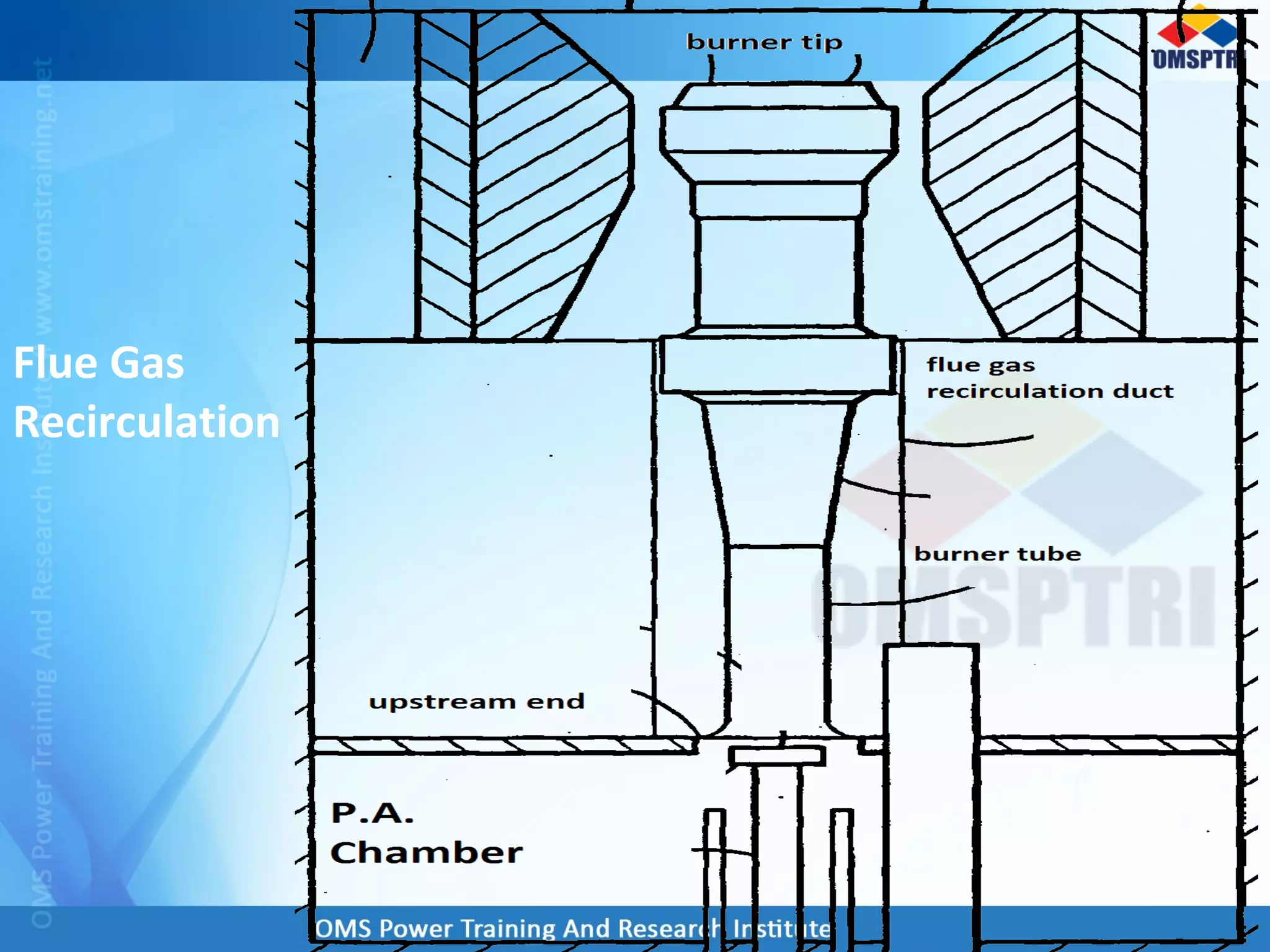
Flue Gas
Recirculation
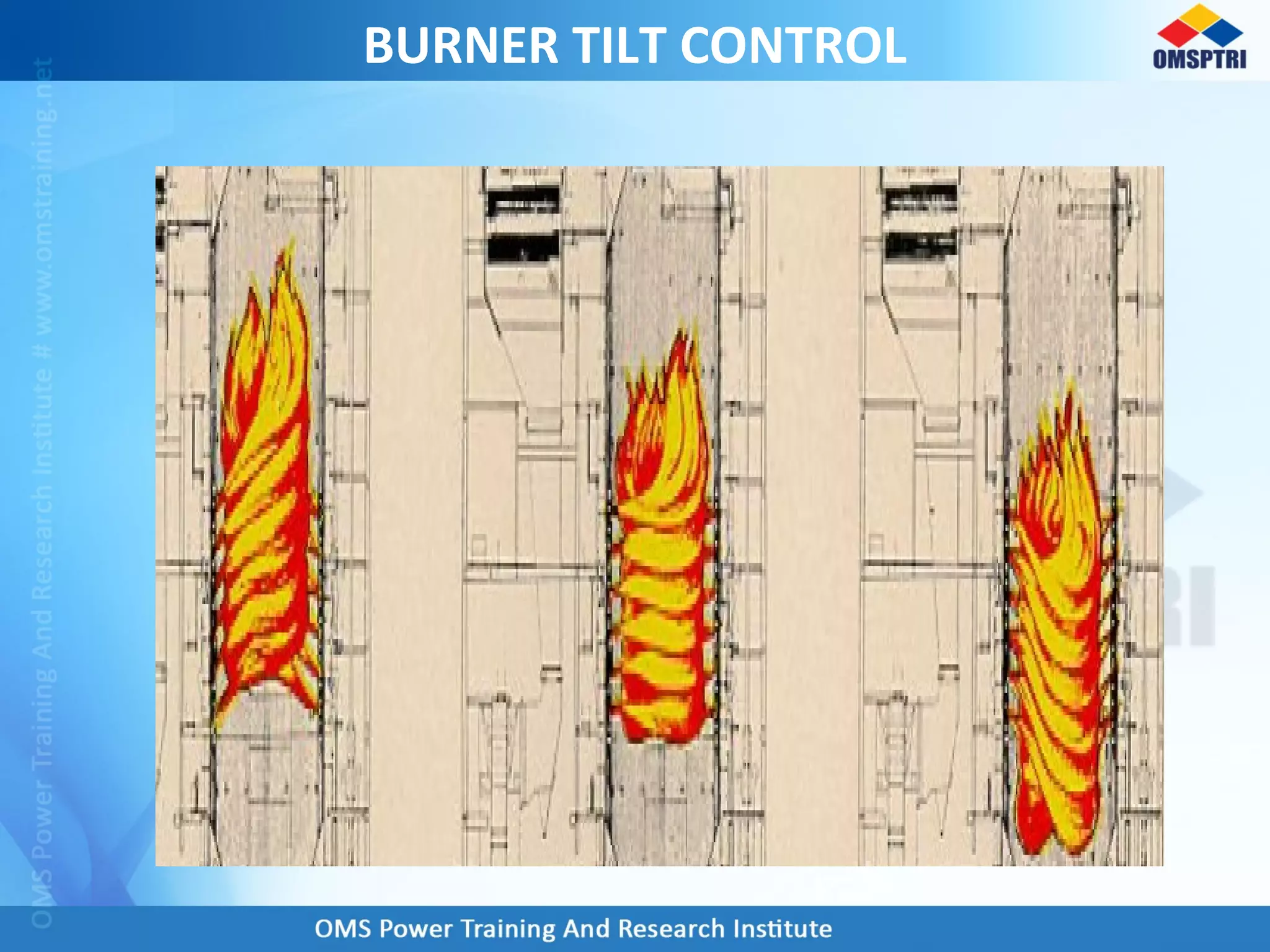
BURNER TILT CONTROL
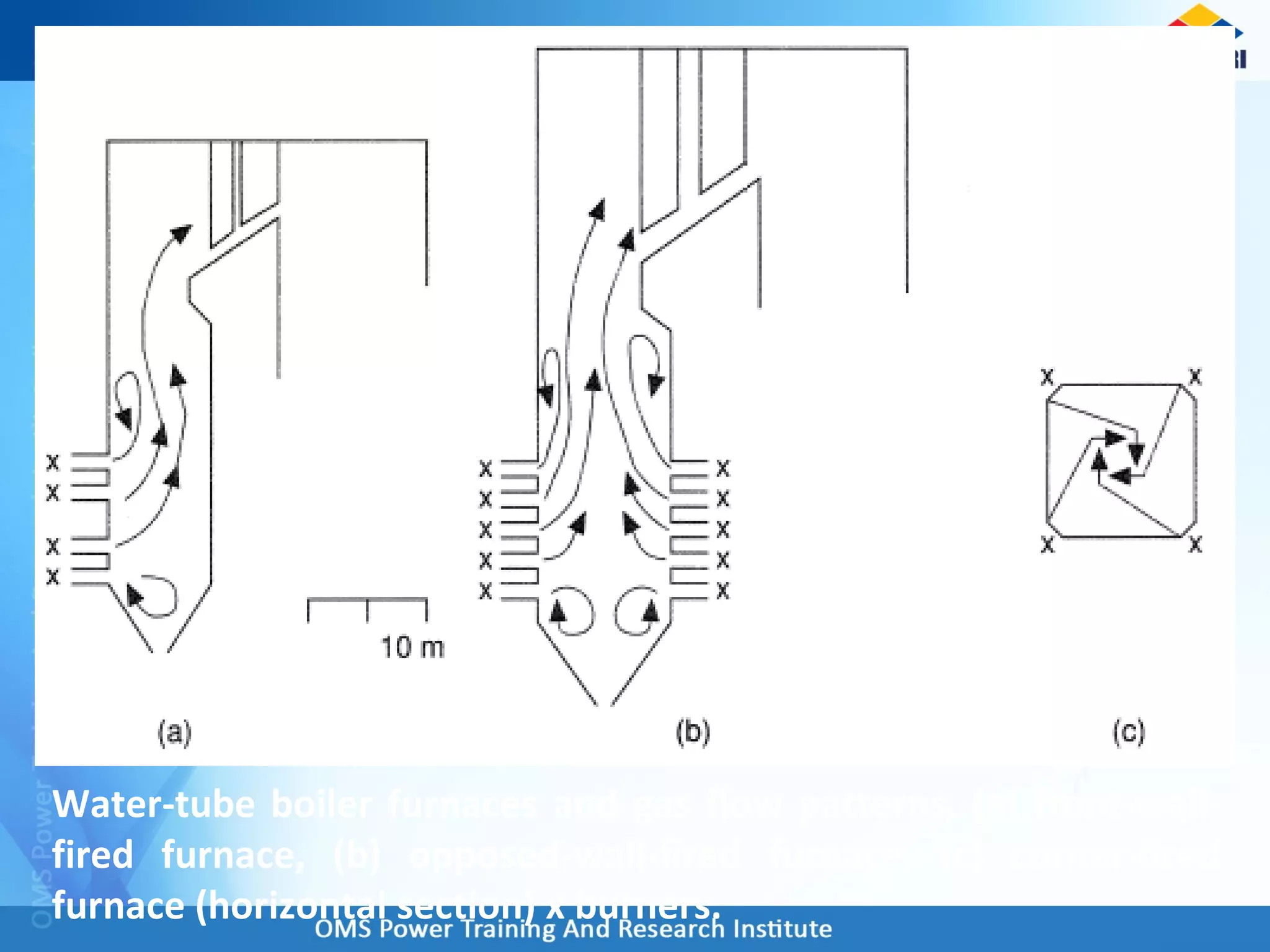
Water-tube boiler furnaces and gas flow patterns, (a) front-wall-
fired furnace, (b) opposed-wall-fired furnace, (c) corner-fired
furnace (horizontal section) x burners.
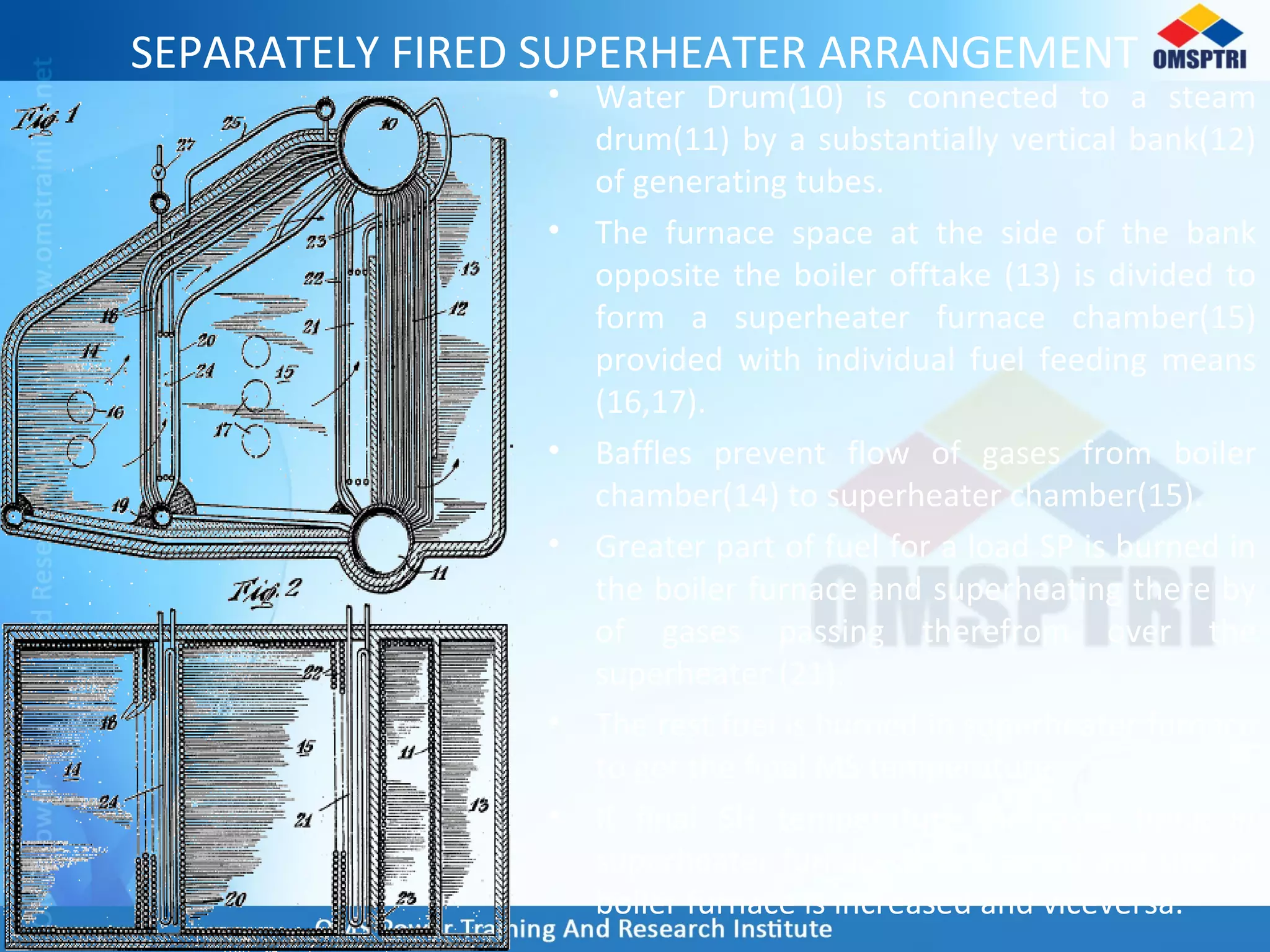
SEPARATELY FIRED SUPERHEATER ARRANGEMENT
• Water Drum(10) is connected to a steam
drum(11) by a substantially vertical bank(12)
of generating tubes.
• The furnace space at the side of the bank
opposite the boiler offtake (13) is divided to
form a superheater furnace chamber(15)
provided with individual fuel feeding means
(16,17).
• Baffles prevent flow of gases from boiler
chamber(14) to superheater chamber(15).
• Greater part of fuel for a load SP is burned in
the boiler furnace and superheating there by
of gases passing therefrom over the
superheater (21).
• The rest fuel is burned in superheater furnace
to get the final MS temperature.
• If final SH temperature increases firing in
superheater furnace is decreased and that in
boiler furnace is increased and viceversa.
Process Control for Optimisation
Combustion control – fuel and air to boiler
• Steam pressure signal is primarily used for
controlling the fuel flow and air flow to the boiler
• Steam flow signal is used for feed forward control
• It is ensured that the air flow is more than the
optimum excess air during the transient load
variation and restored to optimum during stable
load condition
• Measurement of O2 & CO is used to trim the air
flow
A combustion control system regulates the fuel and air input, or firing
rate, to the furnace in response to a load index.
•The demand for firing rate is, therefore, a demand for energy input into
the system to match a withdrawal of energy at some point in the cycle.
•For boiler operation and control systems, variations in the boiler outlet
steam pressure are often used as an index of an unbalance between fuel-
energy input and energy withdrawal in the output steam.
Combustion control systems (air and fuel flow
control)
WHAT IS A GOOD COMBUSTION?
GOOD COMBUSTION MEANS:-
1) Stable Combustion.
2) Non flickering and non pulsating flame.
3)Does not require oil support if mills
are operated as per FSSS logic.
4)High efficiency, i.e., ensuring minimum
mechanical and chemical unburnts.
5) Will cause the least erosion and tube failures.
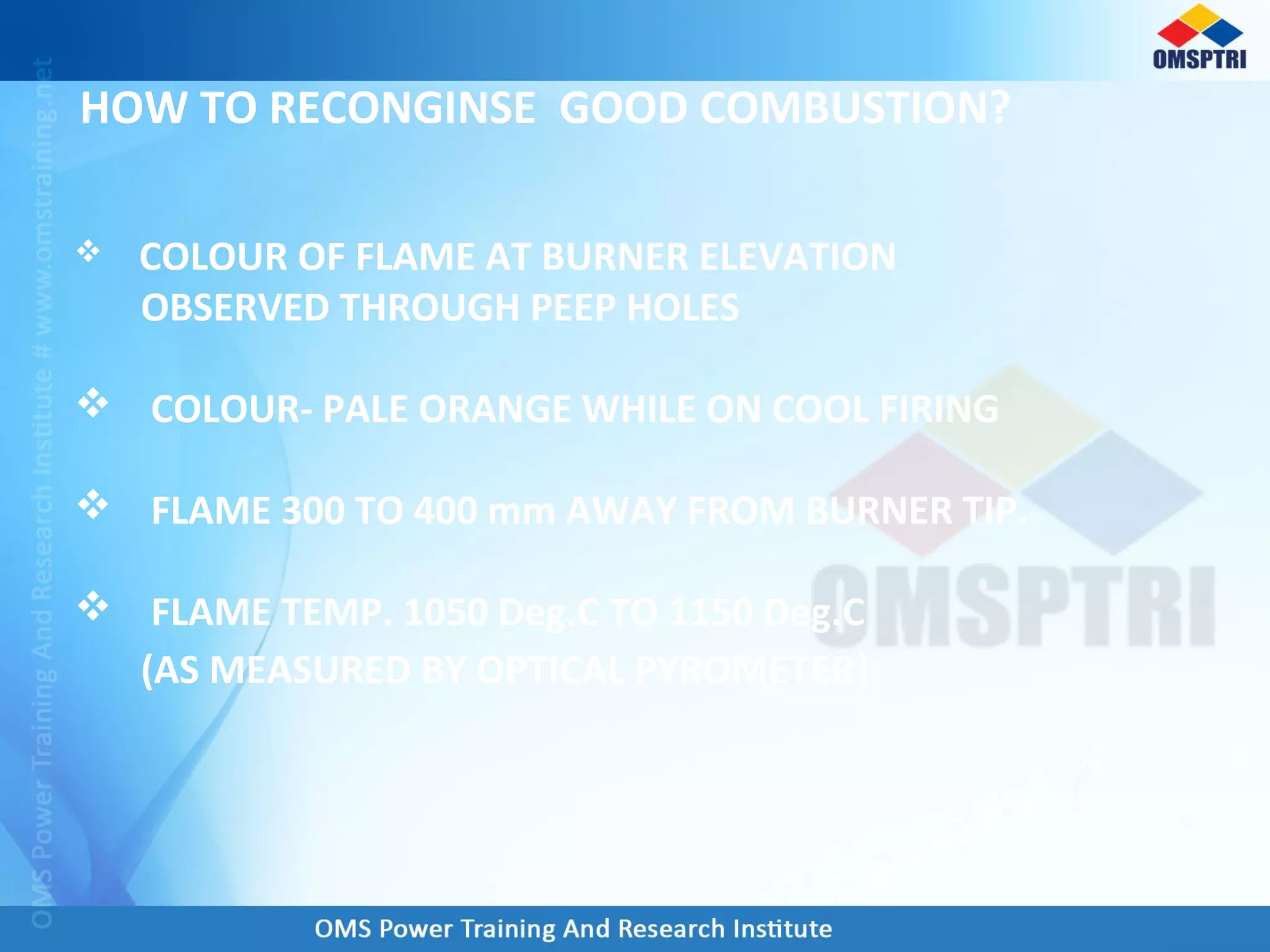
HOW TO RECONGINSE GOOD COMBUSTION?
 COLOUR OF FLAME AT BURNER ELEVATION
OBSERVED THROUGH PEEP HOLES
 COLOUR- PALE ORANGE WHILE ON COOL FIRING
 FLAME 300 TO 400 mm AWAY FROM BURNER TIP.
 FLAME TEMP. 1050 Deg.C TO 1150 Deg.C
(AS MEASURED BY OPTICAL PYROMETER)
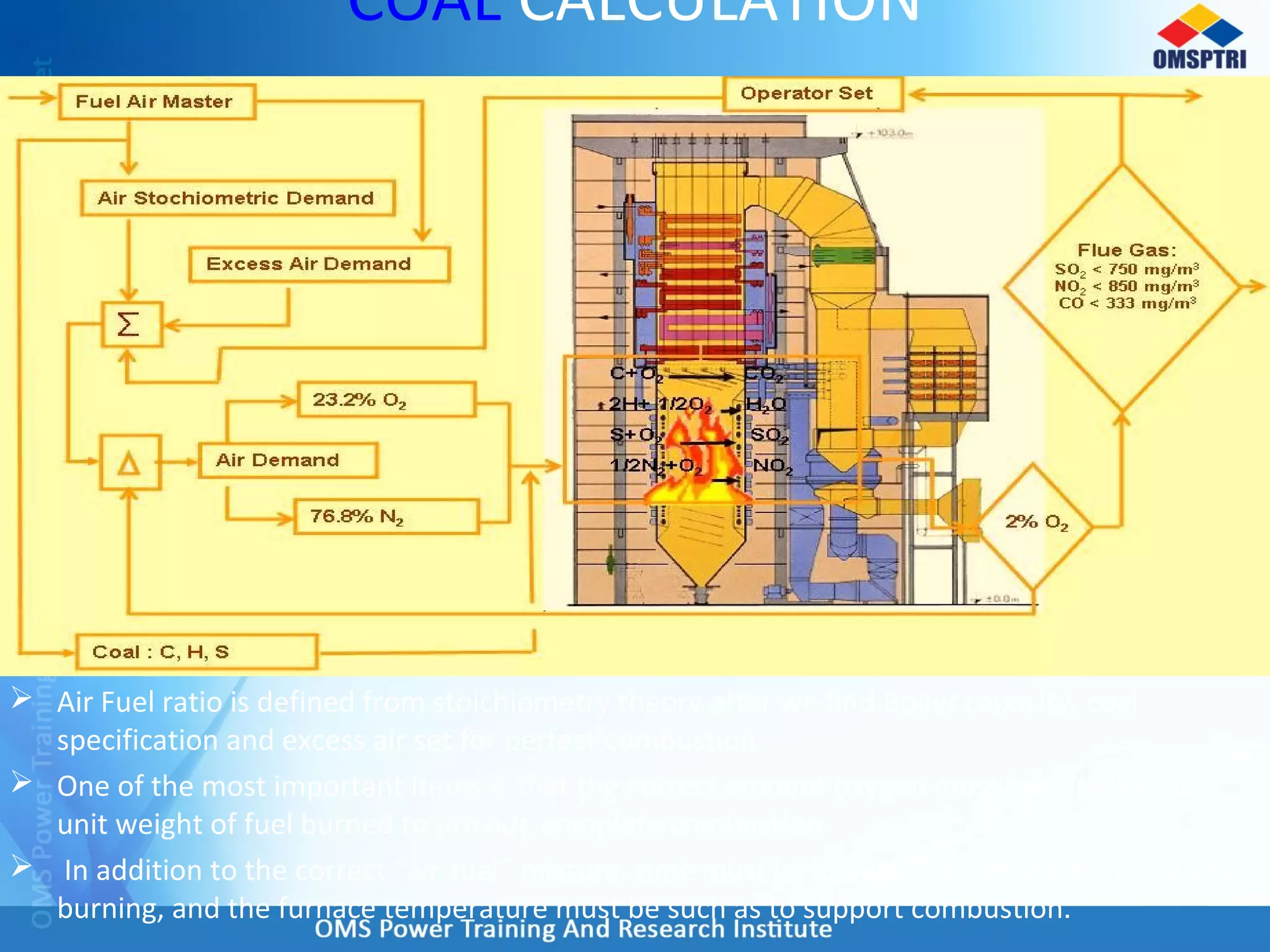
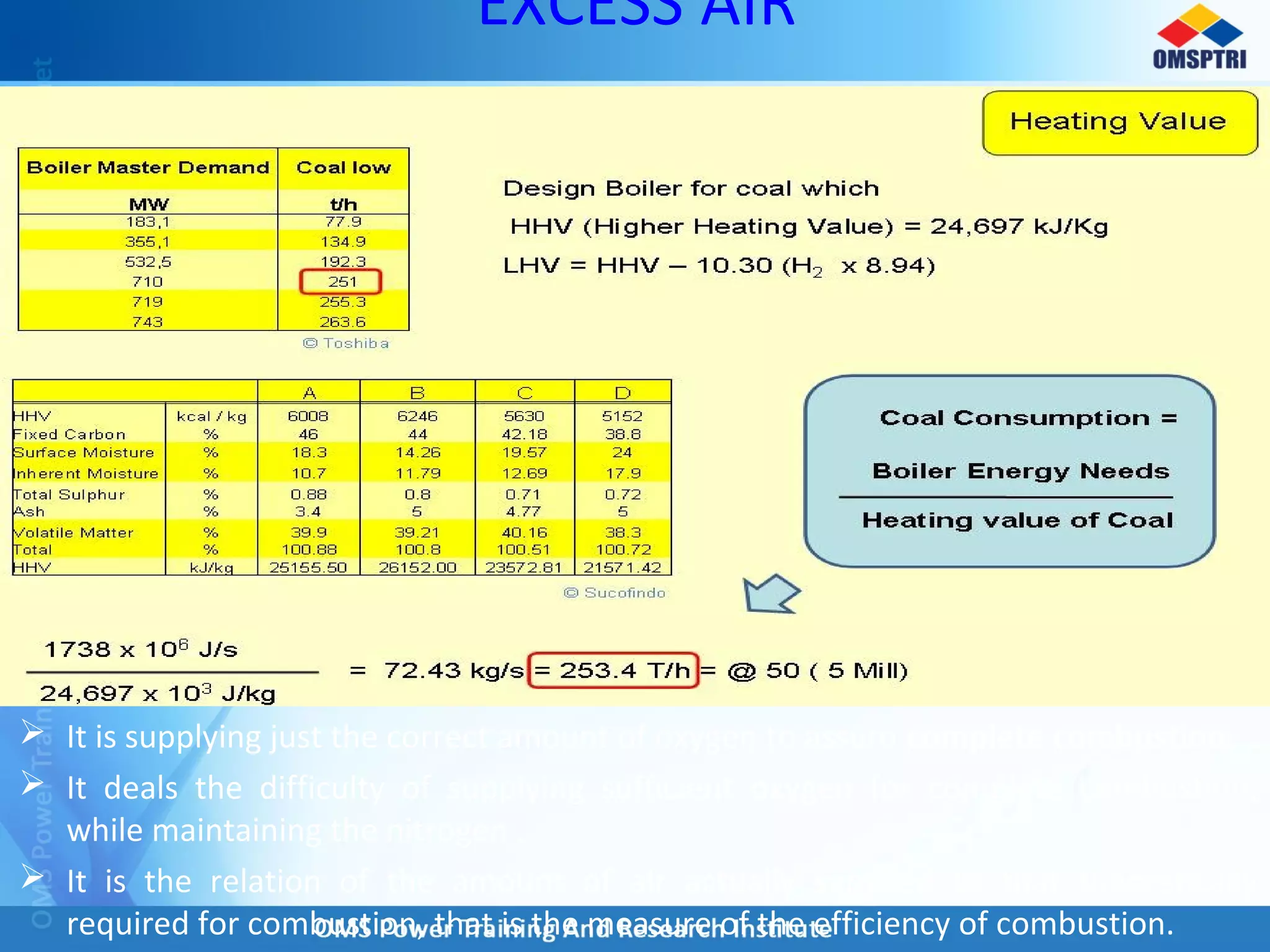
COAL CALCULATION
 Air Fuel ratio is defined from stoichiometry theory after we find Boiler capacity, coal
specification and excess air set for perfect combustion.
 One of the most important items is that the correct amount oxygen must be supplied per
unit weight of fuel burned to provide complete combustion.
 In addition to the correct “air-fuel” mixture, time must be allowed for complete mixing and
burning, and the furnace temperature must be such as to support combustion.
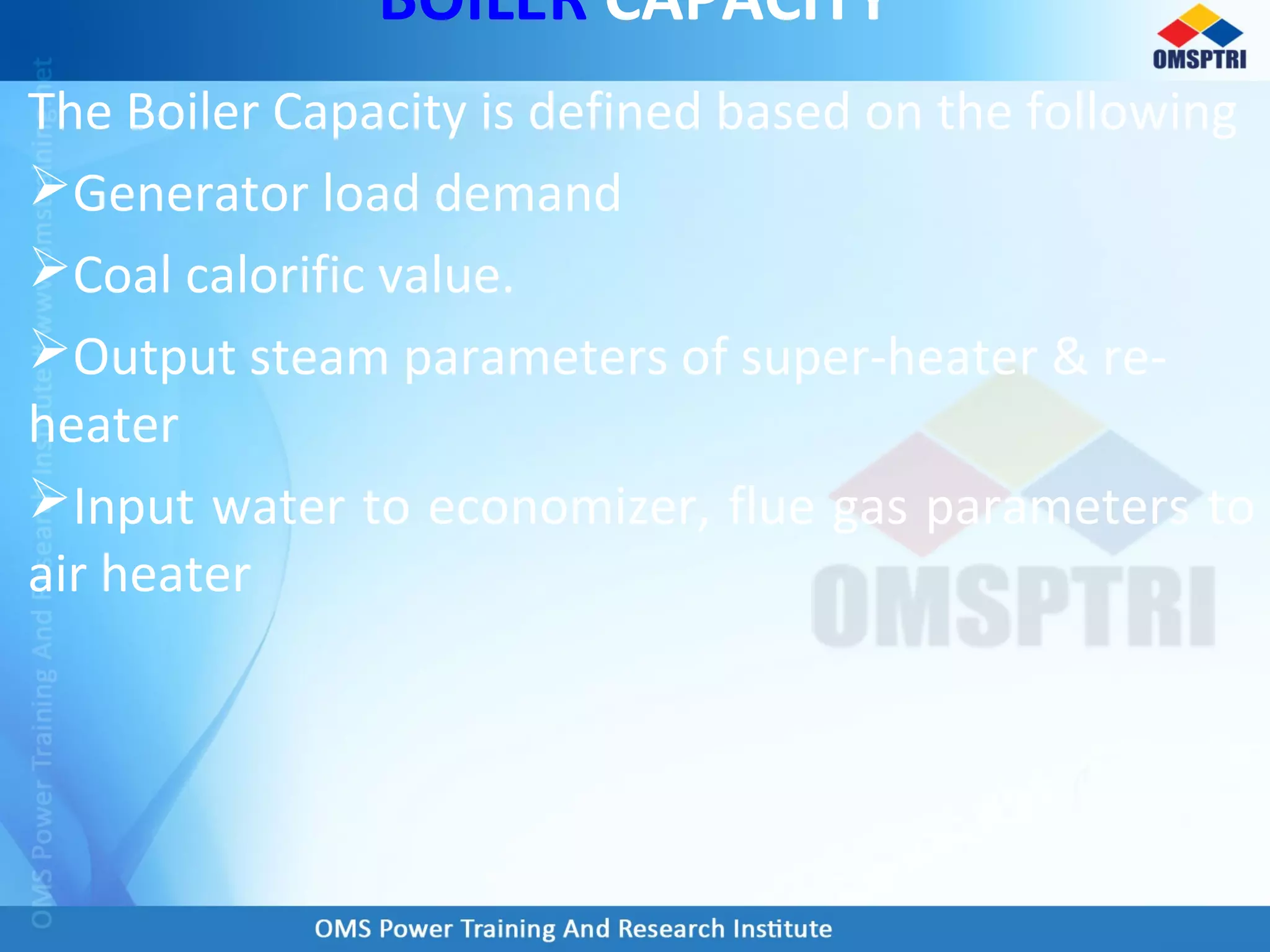
BOILER CAPACITY
The Boiler Capacity is defined based on the following
Generator load demand
Coal calorific value.
Output steam parameters of super-heater & re-
heater
Input water to economizer, flue gas parameters to
air heater
EXCESS AIR
 It is supplying just the correct amount of oxygen to assure complete combustion.
 It deals the difficulty of supplying sufficient oxygen for complete combustion,
while maintaining the nitrogen .
 It is the relation of the amount of air actually supplied to that theoretically
required for combustion, that is the measure of the efficiency of combustion.
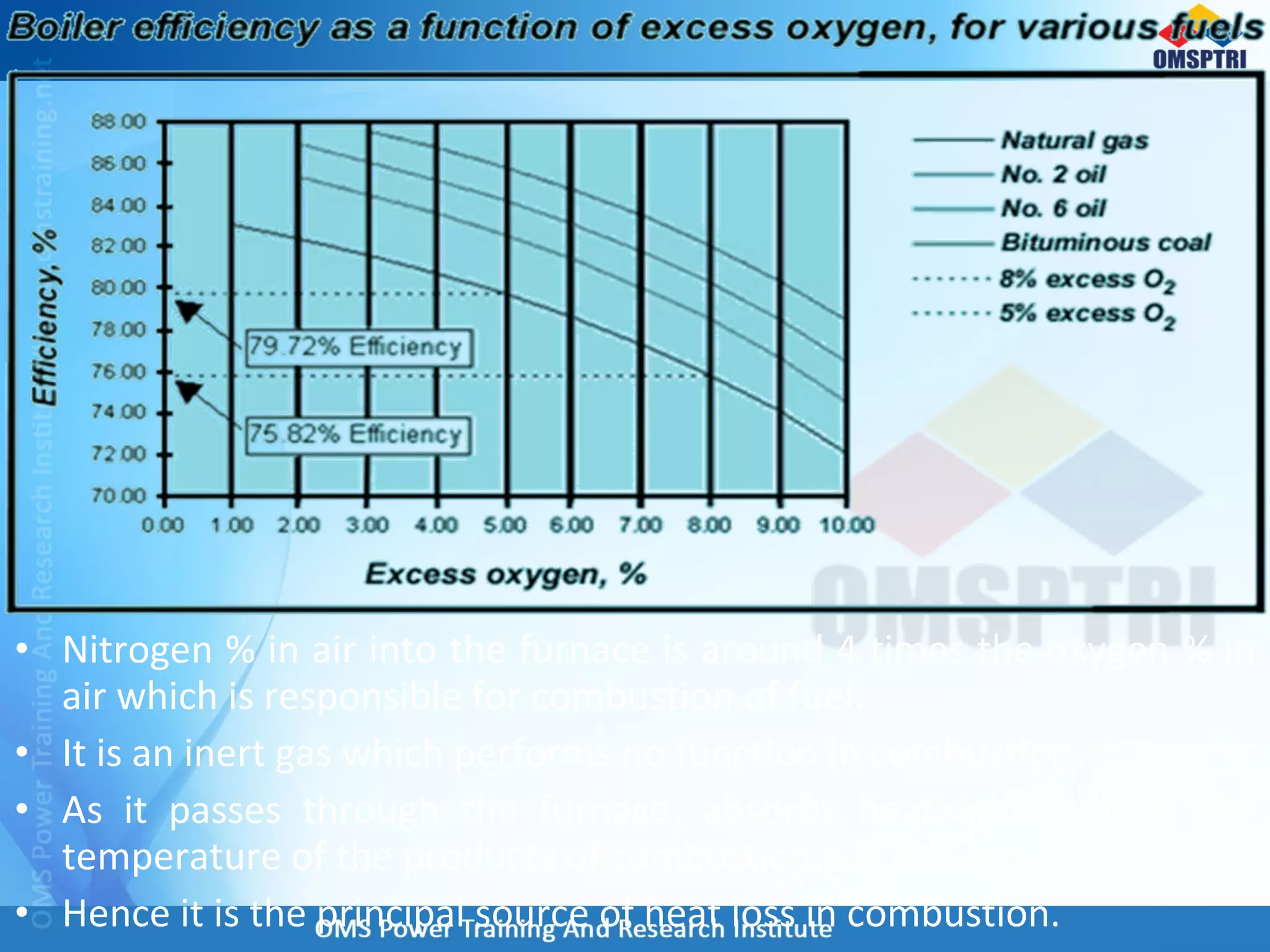
• Nitrogen % in air into the furnace is around 4 times the oxygen % in
air which is responsible for combustion of fuel.
• It is an inert gas which performs no function in combustion.
• As it passes through the furnace, absorbs heat and reduces the
temperature of the products of combustion, i.e. flue gas.
• Hence it is the principal source of heat loss in combustion.
• Any oxygen supplied to the furnace in excess of that required for
combustion results in the same losses as in the case for nitrogen, and
furthermore, such excess oxygen is accompanied by additional
nitrogen which accentuates the combustion losses.
• On the other hand, when there is insufficient oxygen for complete
combustion, the nitrogen losses become inappreciable, when
compared to the losses caused by the incomplete combustion of the
carbon fuel.
• If insufficient oxygen is present, carbon will not combust to CO2
(carbon dioxide) but to CO (carbon monoxide). From data previously
presented, burning one pound of carbon to CO2 will release
approximately 14,540 BTU's, while burning the same amount of
carbon to CO will only release approximately 4,380 BTU's.
• Hence an optimum amount (3-4 %) of oxygen in flue gas at air heater
inlet is maintained for effective combustion, that prevents insufficient
combustion as well as heat loss due to high % of nitrogen in excess
air.
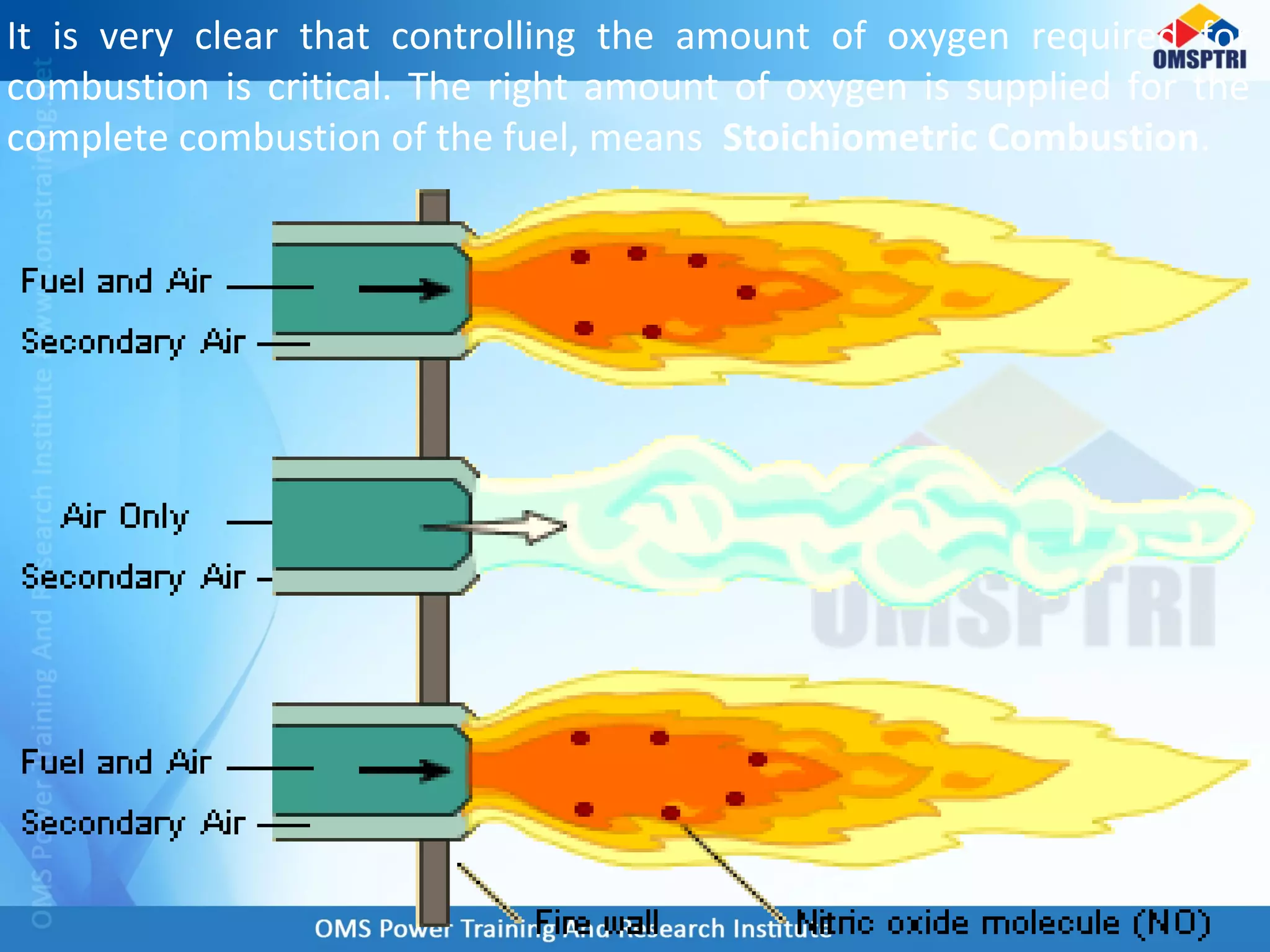
It is very clear that controlling the amount of oxygen required for
combustion is critical. The right amount of oxygen is supplied for the
complete combustion of the fuel, means Stoichiometric Combustion.
An insufficient amount of air is supplied to the burners causes the
following
•unburned fuel
•soot and smoke
•carbon monoxide (the incomplete conversion to carbon dioxide)
appear in the exhaust from the boiler stack
•heat transfer surface fouling
•Pollution
•lower combustion efficiency
•flame instability (i.e., the flame blows out), and the potential for an
explosion.
To avoid these costly and potentially unsafe conditions, boilers are
normally operated at excess air levels. This excess air level also provides
operating protection from an insufficient oxygen condition caused by
variations in fuel quality, and variation in fuel demand from MW
control.
• It is important to understand that "excess air" and"excess
oxygen" are not the same.
• The air we breathe is roughly 21% oxygen by volume.
• A 50% excess air condition implies approximately 10.5%
oxygen remains in the boiler exhaust stack.
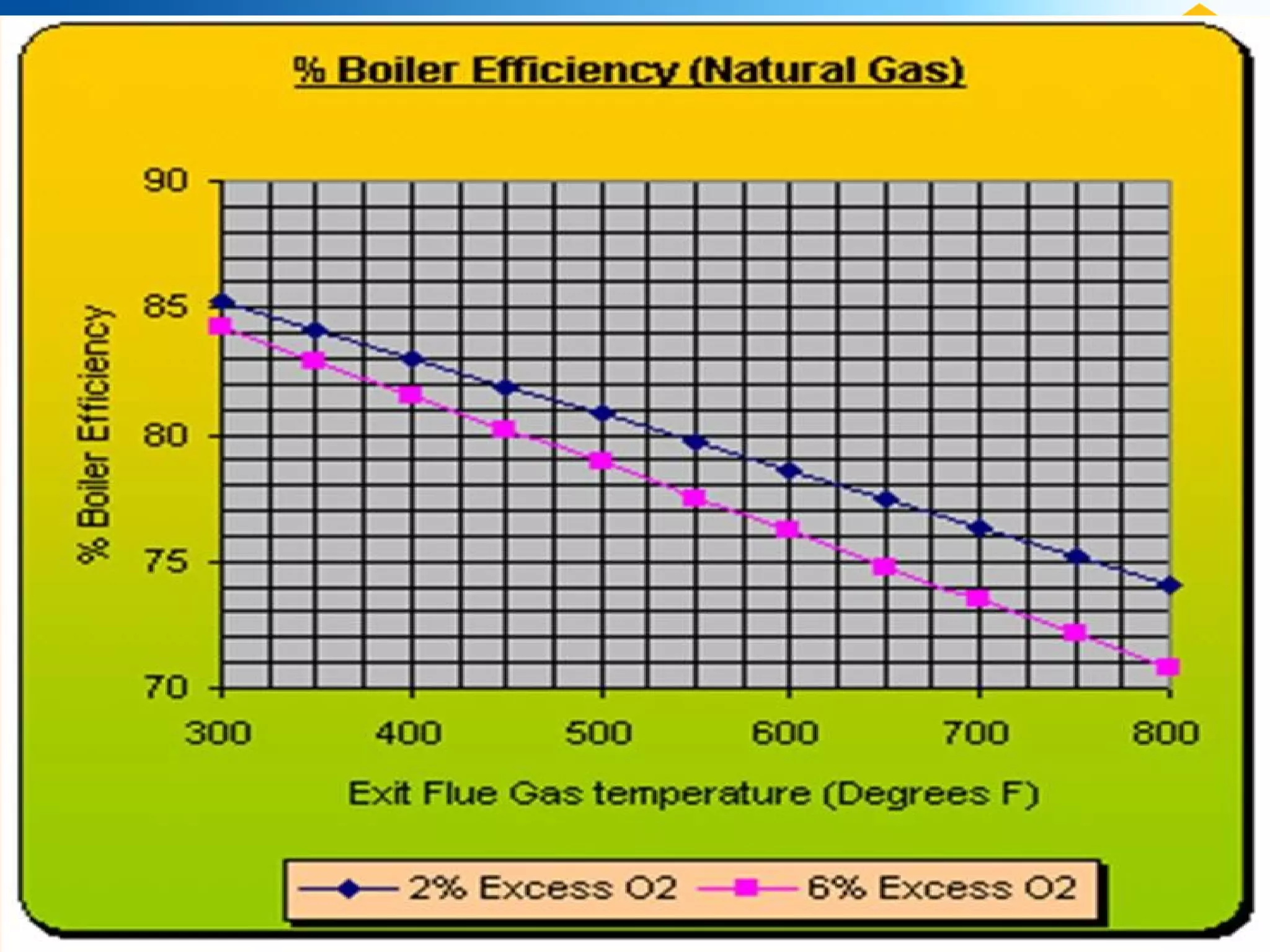
While insufficient air to the burners can be dangerous, air
flows in excess of those needed for stable flame
propagation and complete fuel
combustion needlessly increase flue gas flow and
consequent heat losses, thereby lowering boiler efficiency.
• Minimizing these losses requires monitoring and periodic
tuning.
• Ideally, the fuel/air ratio is automatically controlled based
on the percentage of O2 in the stack, and an unburned
hydrocarbons indication.
• These automated systems are called O2 trim packages.
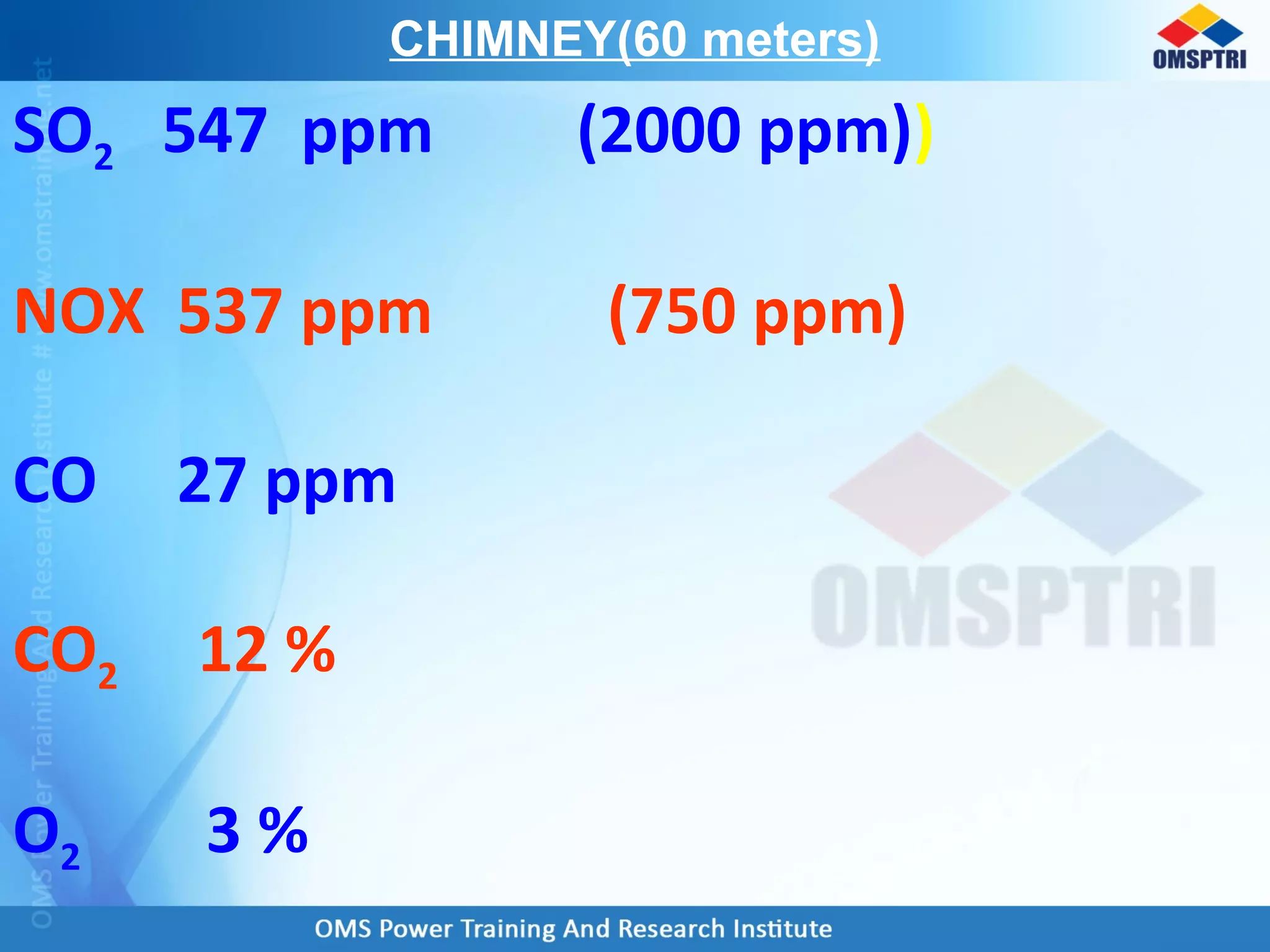
CHIMNEY(60 meters)
SO2 547 ppm (2000 ppm))
NOX 537 ppm (750 ppm)
CO 27 ppm
CO2 12 %
O2 3 %
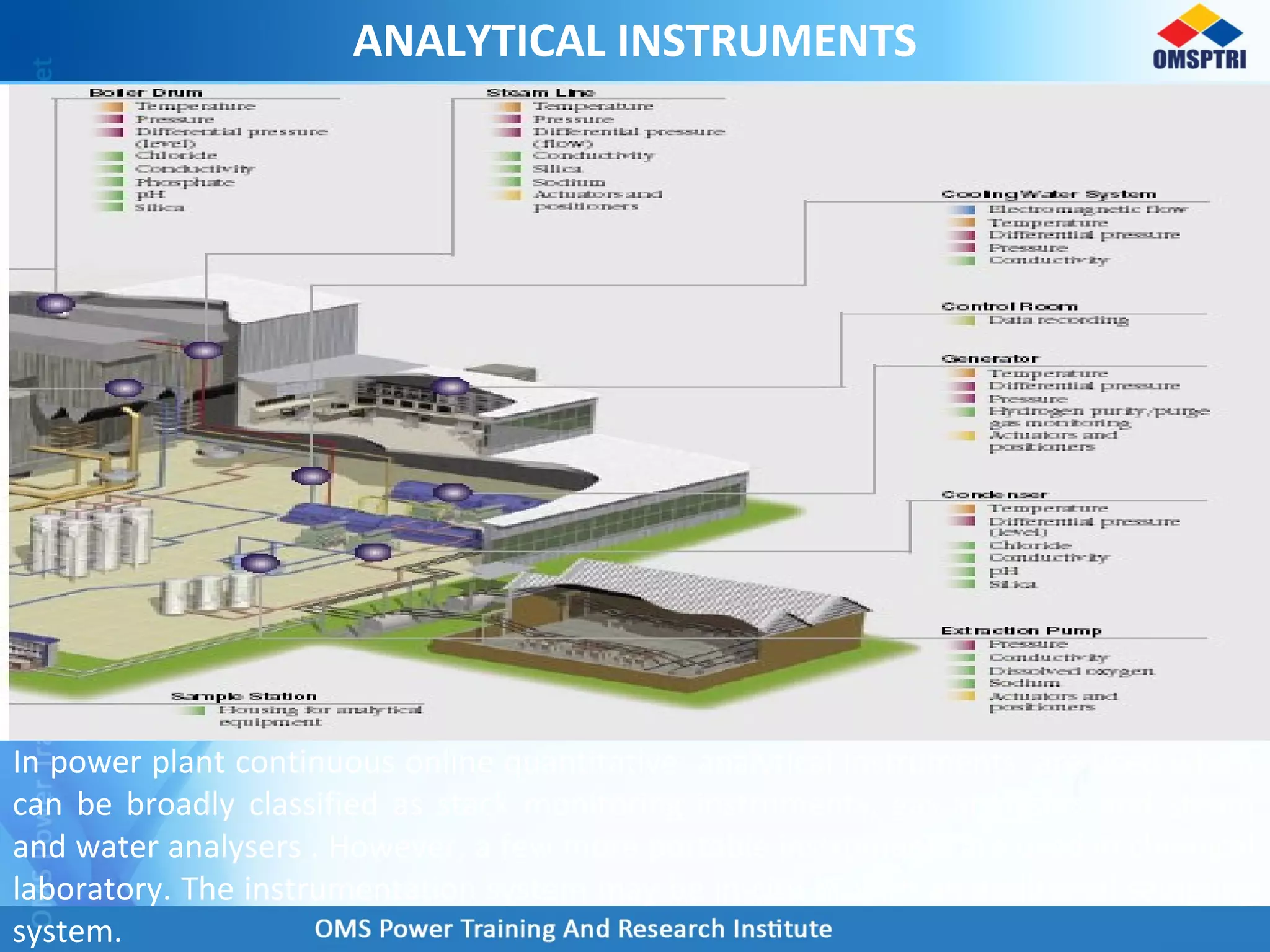
ANALYTICAL INSTRUMENTS
In power plant continuous online quantitative analytical instruments are used which
can be broadly classified as stack monitoring instruments, gas analysers and steam
and water analysers . However, a few more portable instruments are used in chemical
laboratory. The instrumentation system may be in-citu or with an additional sampling
system.
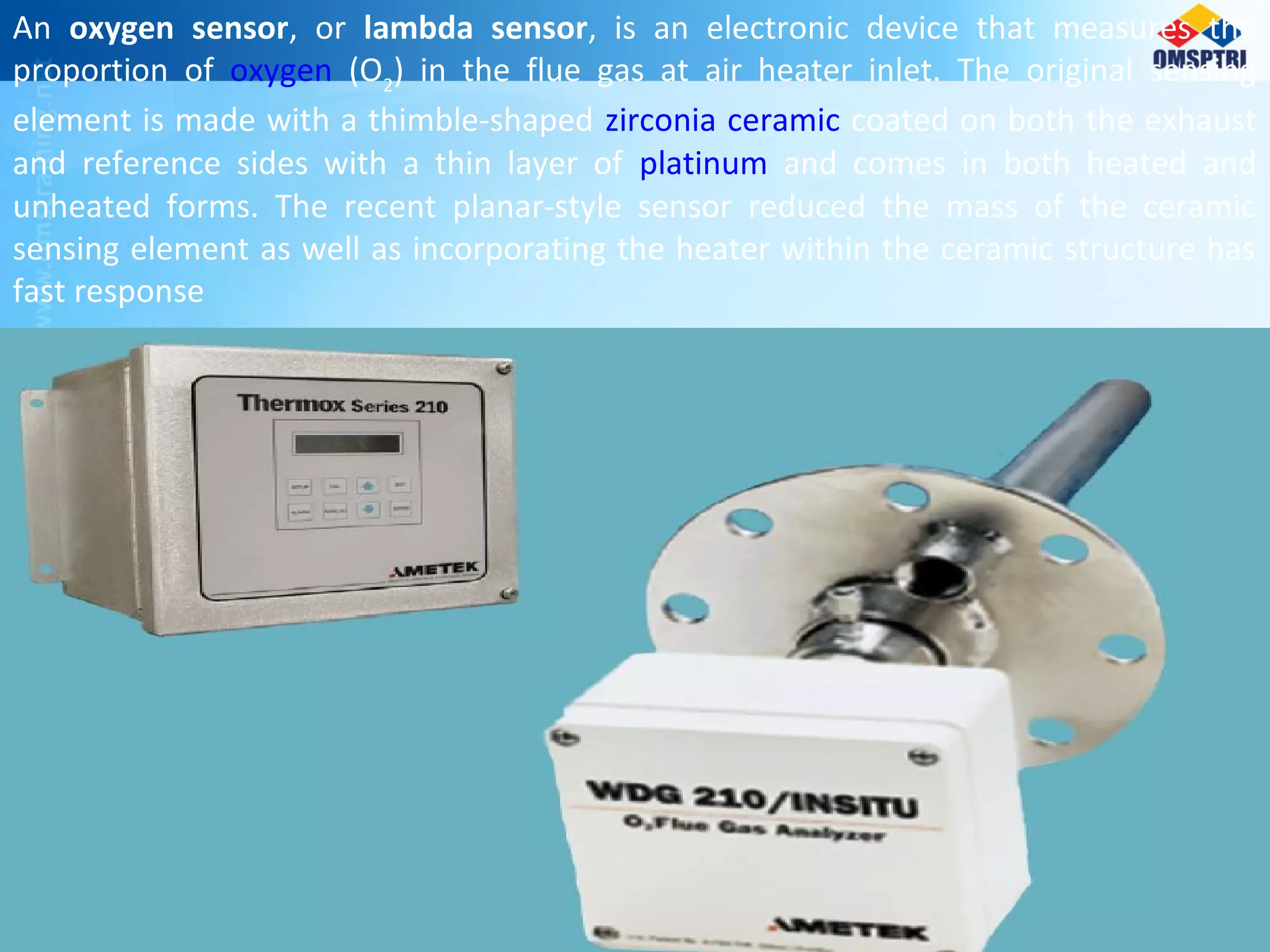
An oxygen sensor, or lambda sensor, is an electronic device that measures the
proportion of oxygen (O2
) in the flue gas at air heater inlet. The original sensing
element is made with a thimble-shaped zirconia ceramic coated on both the exhaust
and reference sides with a thin layer of platinum and comes in both heated and
unheated forms. The recent planar-style sensor reduced the mass of the ceramic
sensing element as well as incorporating the heater within the ceramic structure has
fast response
Ultraviolet (UV) Type Gas measuring principle
Ultraviolet (UV) light is often used for the analysis of NO, NO2
and SO2. Often, when the UV measuring principle is used it is
actually the NDUV (Non Dispersive Ultraviolet) principle. The
measurement is made by leading a gas flow through a cuvette
where the UV light source and the optical filter have been
placed at one end of the cuvette and a detector has been
placed at the other end. The UV light source sends out a
scattered UV light, and the wave length of the light that is led
through the gas in the cuvette is determined by the optical
filter installed between the light source and the cuvette.
Different kinds of wave lengths of UV light are used to analyse
different gasses.
Dust and Opacity monitor
•When a beam of light crosses a medium containing smokes or
dust particles, some of the light is transmitted and some is lost
due to scattering.
•The fraction, which is transmitted, is called the transmittance
and the fraction, which is lost, is the opacity.
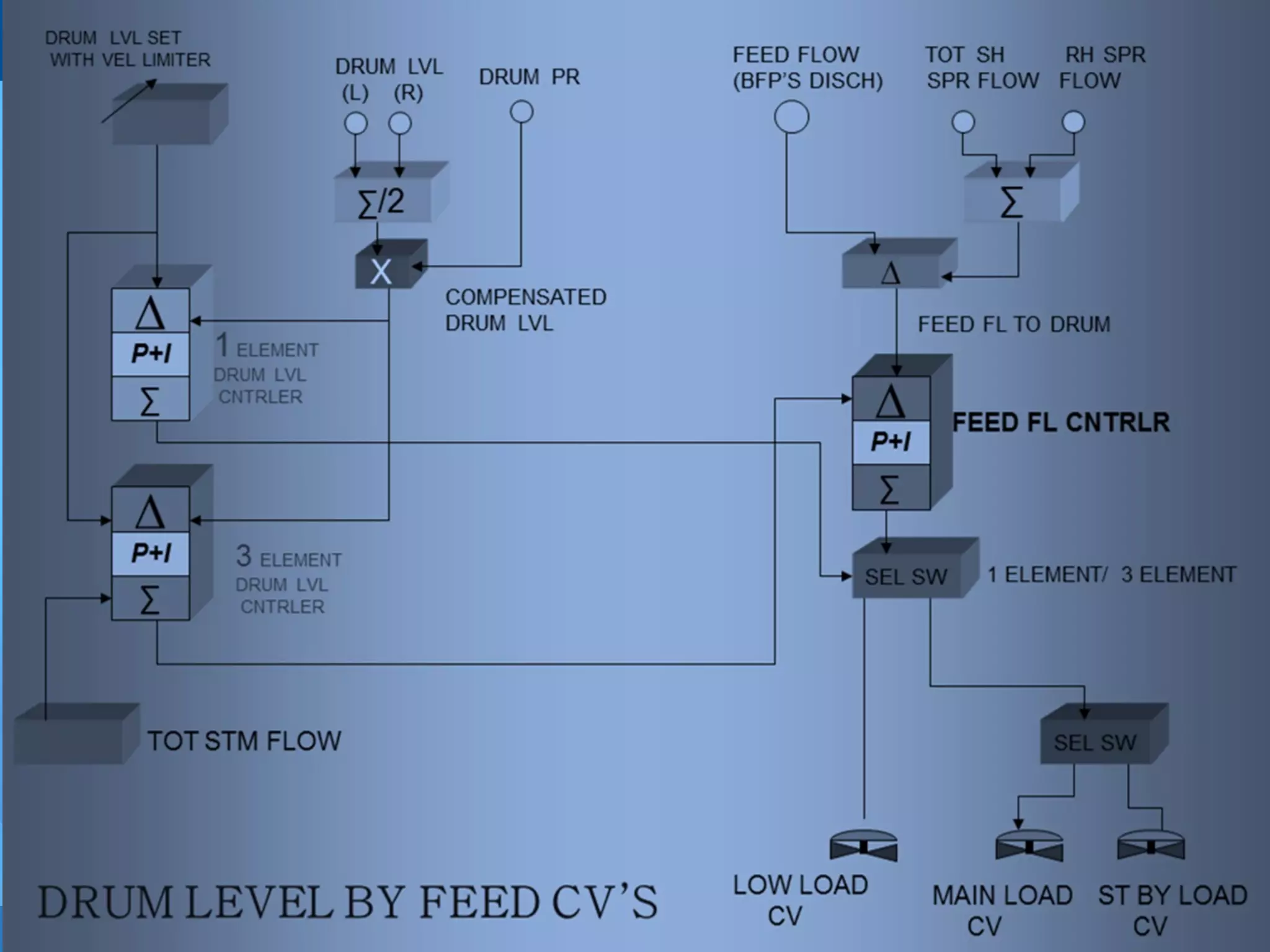
3. Feed water control
• There is a feed water regulating station with there
control valves; one for 0-25% load and two for full
load all are connected in parallel
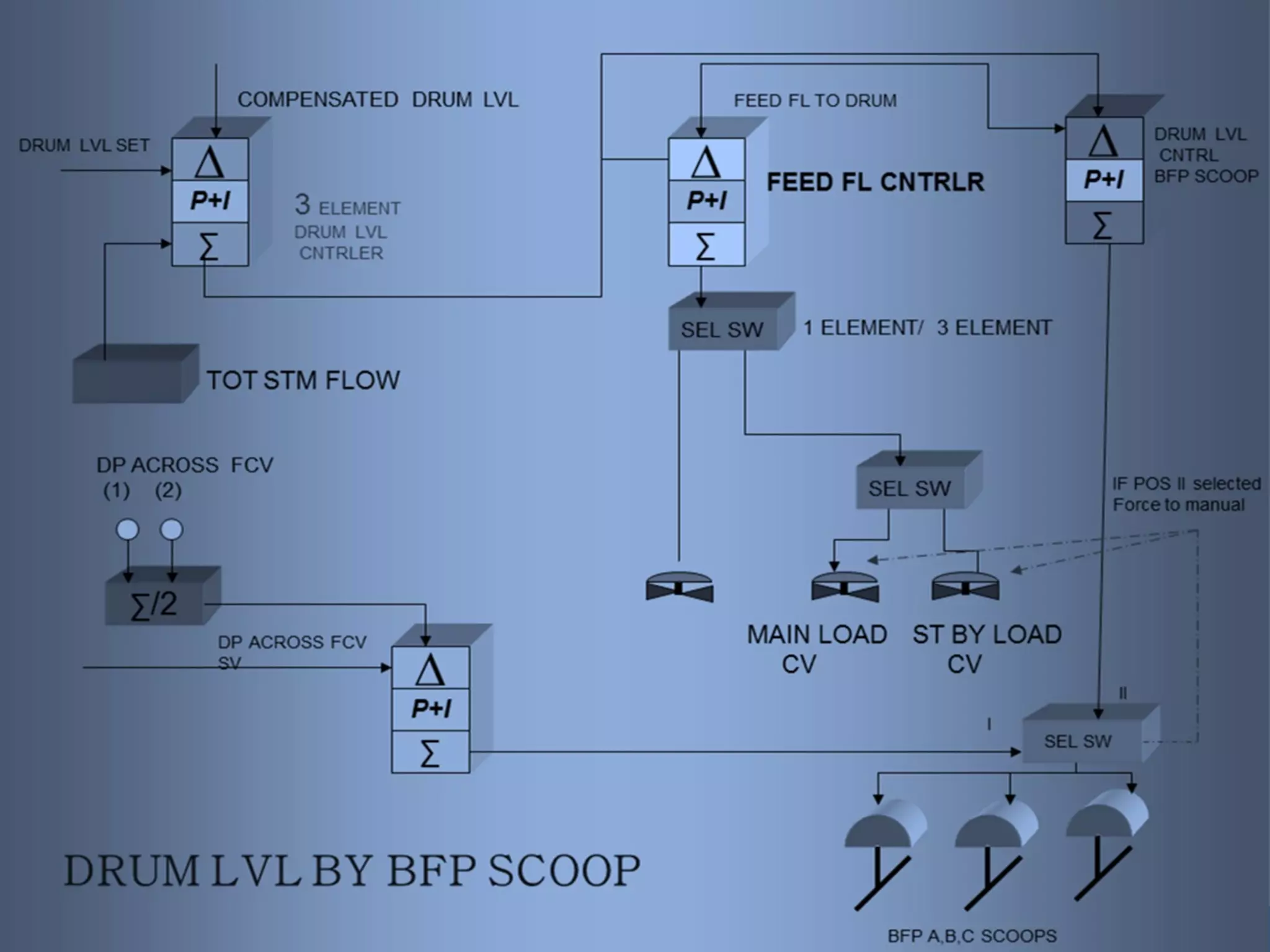
• In conjunction with feed regulating station , speed
control of BFP is provided to reduce the throttling
losses across the control valve
• Recirculation control is provided to maintain
minimum flow required to prevent flashing in the
pump casing
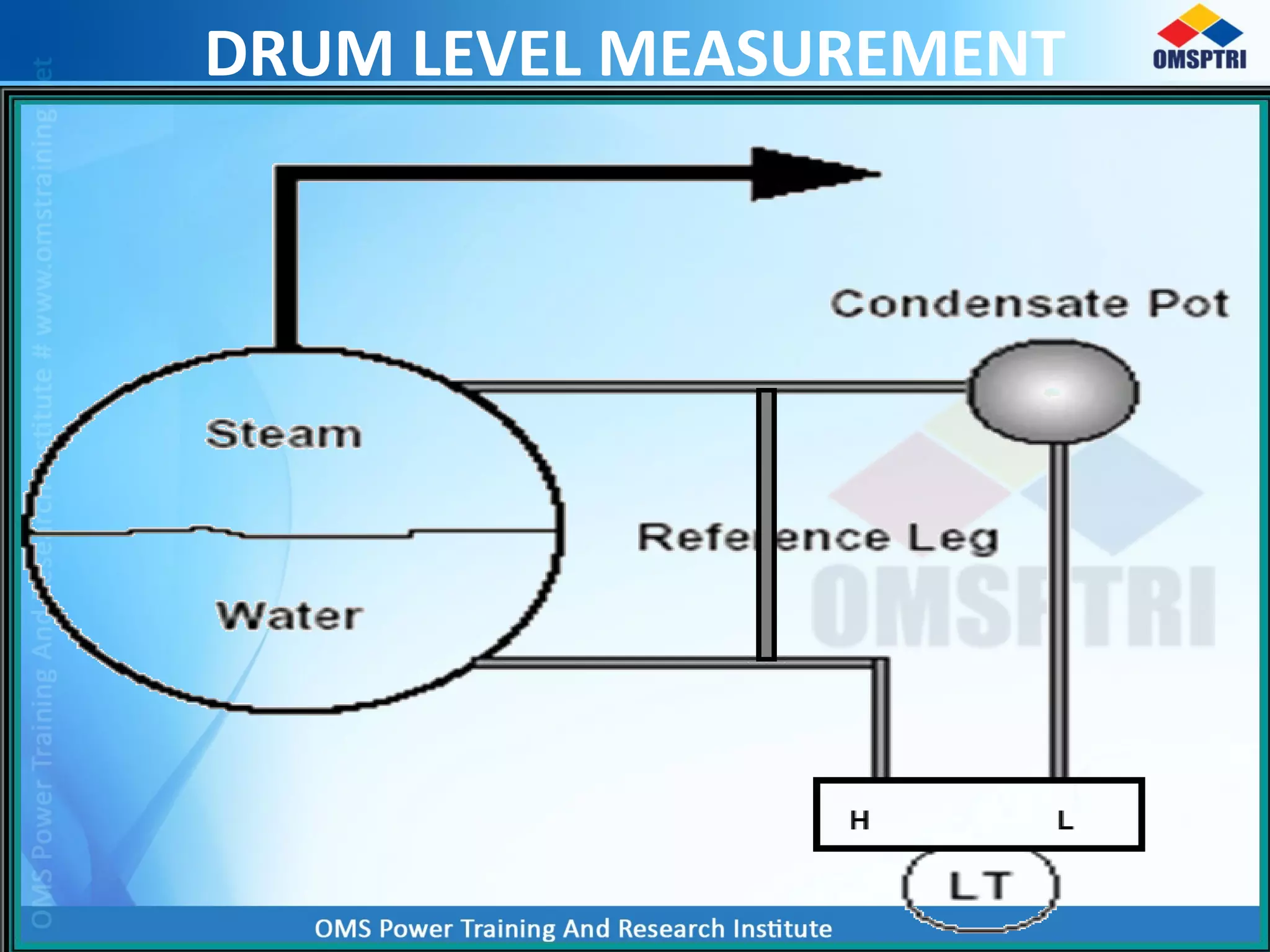
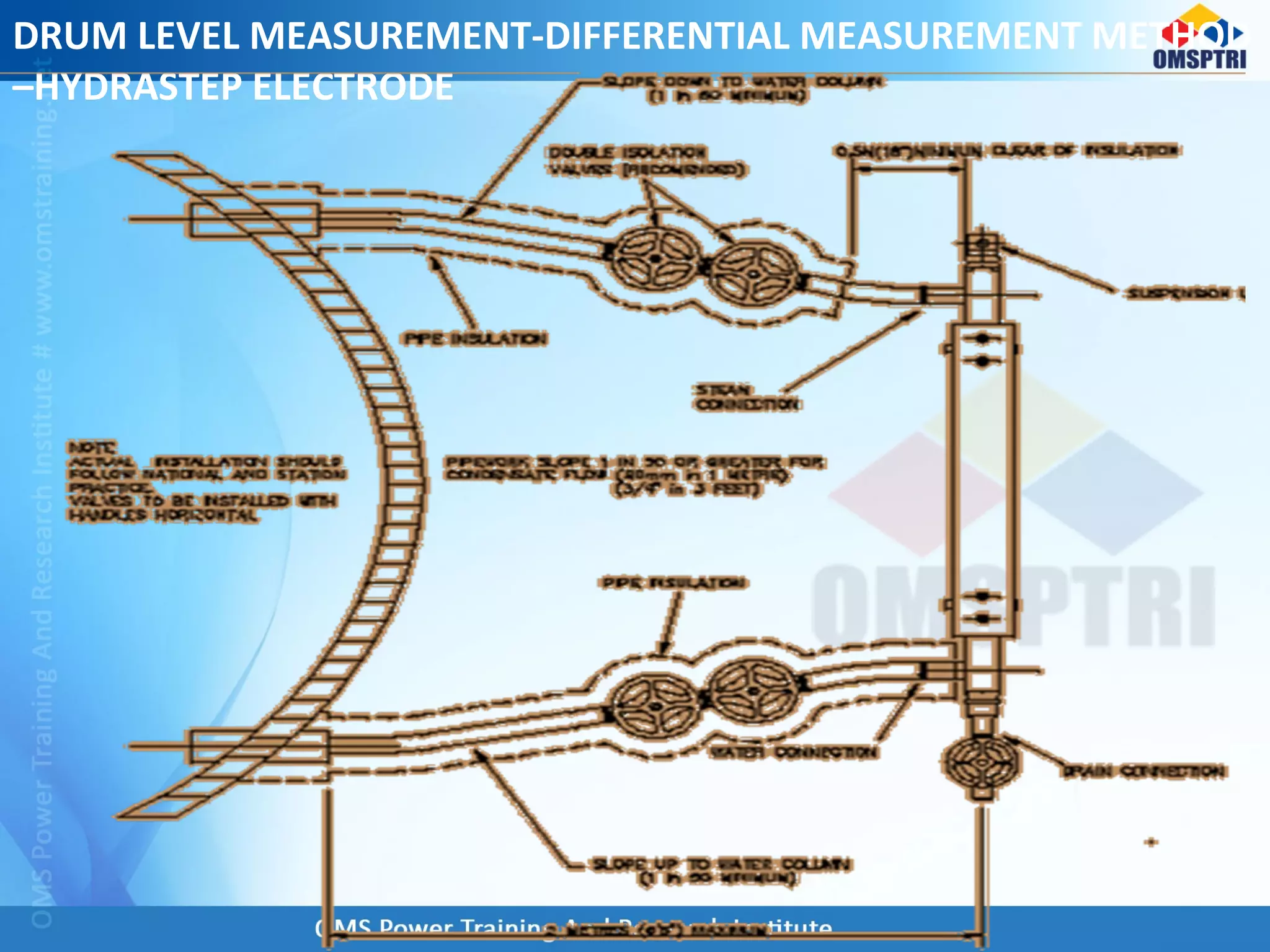
DRUM LEVEL MEASUREMENT
DRUM LEVEL MEASUREMENT-DIFFERENTIAL MEASUREMENT METHOD
–HYDRASTEP ELECTRODE
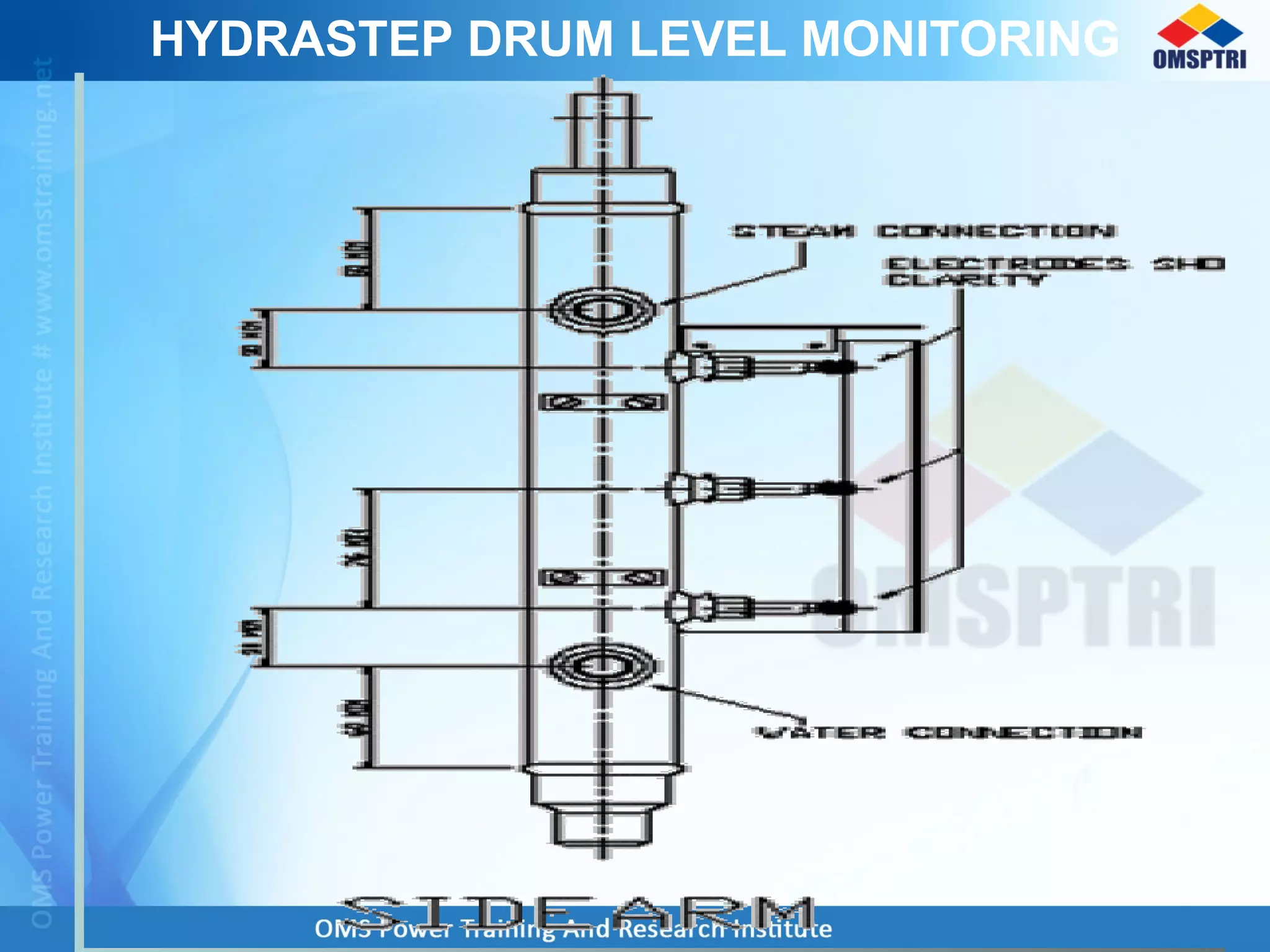
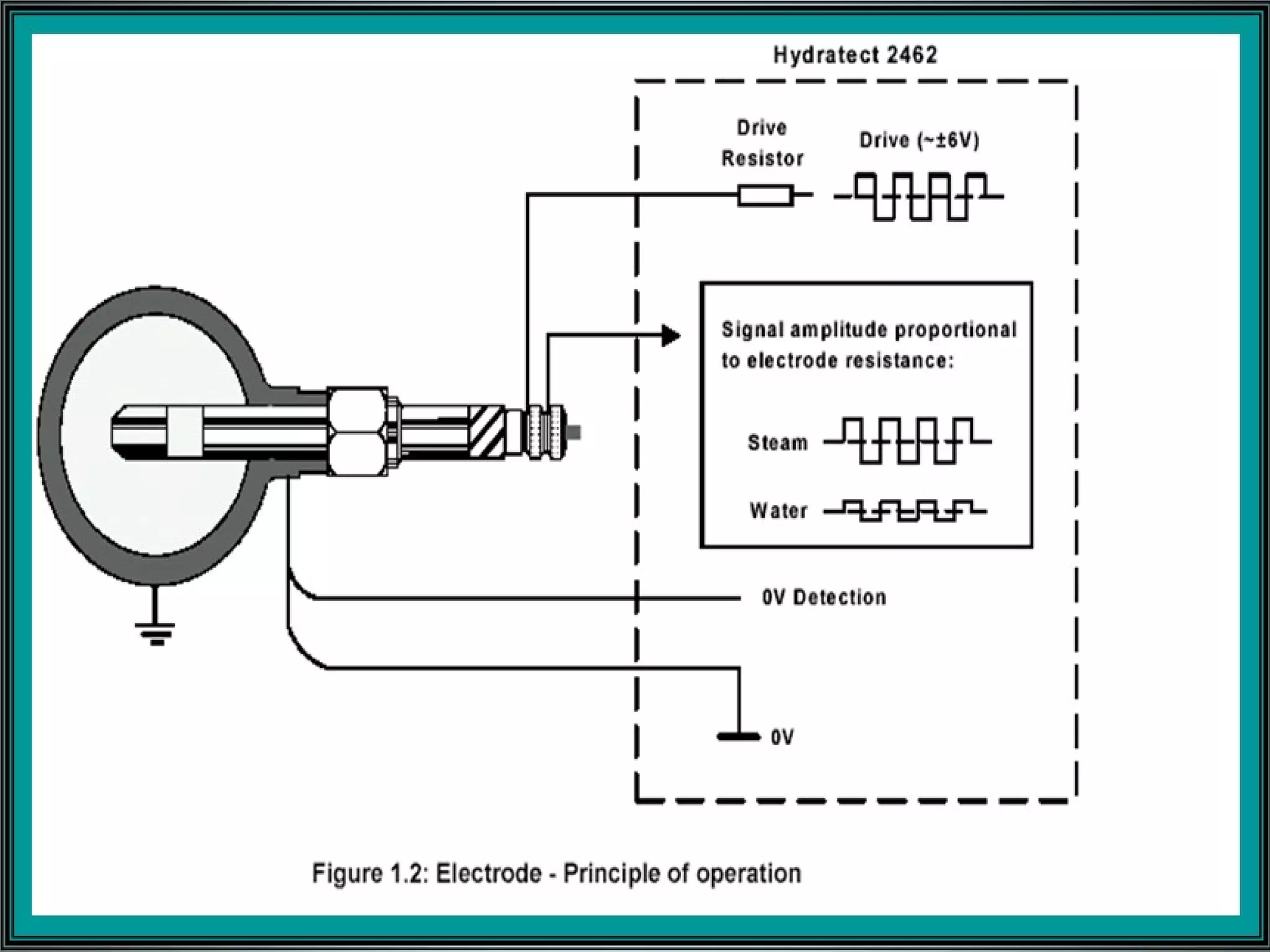
HYDRASTEP DRUM LEVEL MONITORING
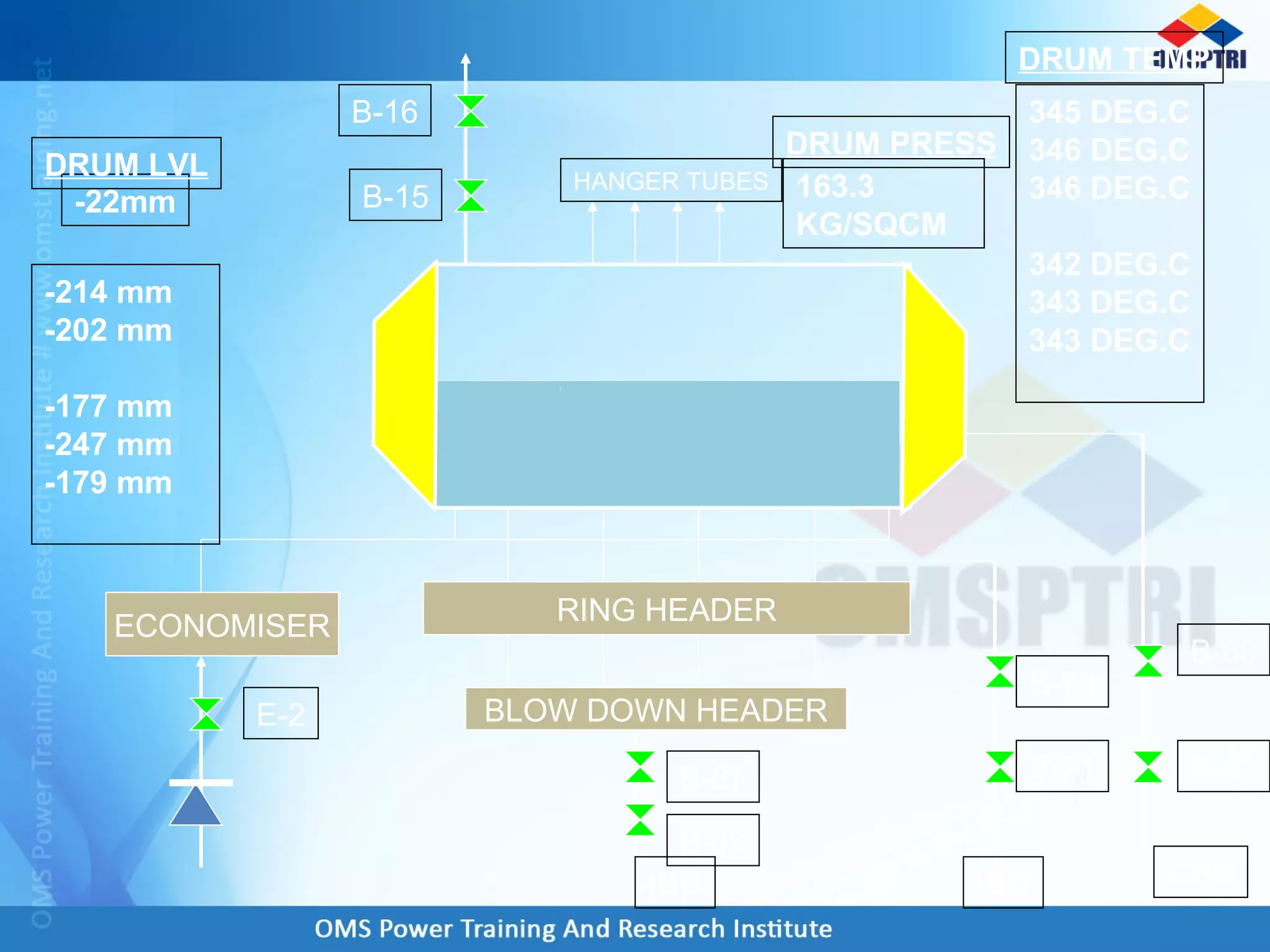
RING HEADER
BLOW DOWN HEADER
ECONOMISER
HANGER TUBES
345 DEG.C
346 DEG.C
346 DEG.C
342 DEG.C
343 DEG.C
343 DEG.C
-214 mm
-202 mm
-177 mm
-247 mm
-179 mm
-22mm B-15
B-16
E-2
B-67
B-68
B-70
B-71
B-60
B-61
IBD IBD CBD
163.3
KG/SQCM
DRUM LVL
DRUM TEMP
DRUM PRESS
• Drum water level is one of the most important
measurement for safe and reliable Boiler operation.
• If the level is too high,
• water flows into the superheater with droplets carried
into the turbine.
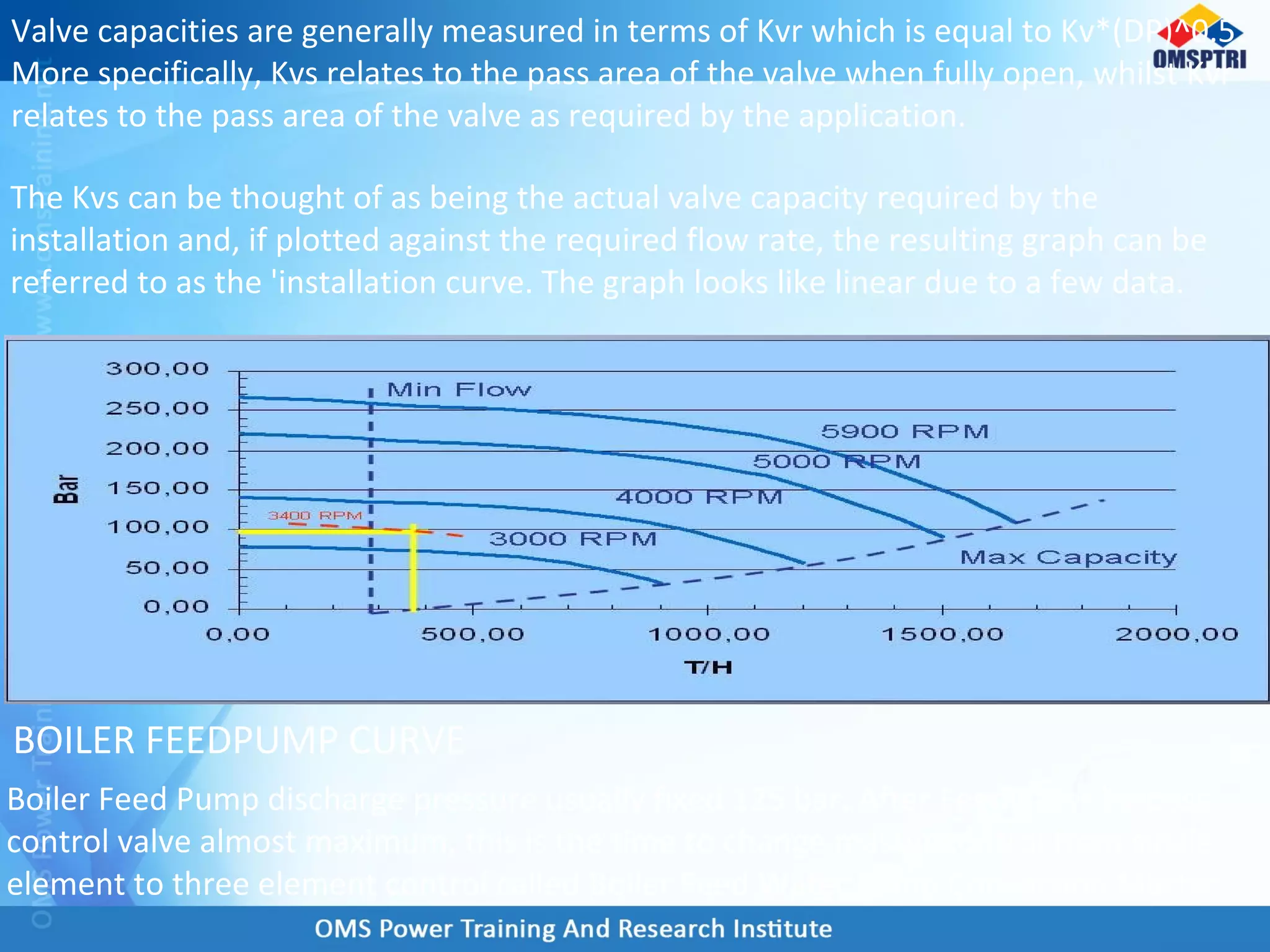
• leaves deposits in the superheater and turbine
• causes superheater tube failure
• turbine water damage.
• Low water level would cause
• starvation in water tube
• overheating
• failure.
DRUM LEVEL CONTROL
In single element feed water control the water in the drum is at the desired level
when signal from the level transmitter equals its set point. If a deviation of water level
exists, the controller applies proportional plus integral action to the difference
between the drum level and set point signals to change the position of the regulating
valve.
Feedwater control systems: This regulates the flow of water to a drum-type Boiler to
maintain the level in the drum within desired limits. They are classified as one-, two-
or three-element feed water control systems.
DRUM LEVEL CONTROL CONV MASTER
In the boiler the steam flow changes according to the load demand from the turbine
or from the process consuming the steam energy. To match the steam take off from
the boiler, the feed water flow has to be increased or decreased as required.
Single Element Control
During low load operation, three-
element control is not required.
•Drum level measurement with it's
set point is adequate.
•The output of the Drum Level
Controller is directly given to the
Feed water by-pass Control Valve.
•It is difficult to obtain steam and
water flow accurately because flow
transmitters are usually calibrated
for high load operation. Hence it’s
transferred to single element
control where drum level is the
only variable in the control scheme.
The Kvs can be thought of as being the actual valve capacity required by the
installation and, if plotted against the required flow rate, the resulting graph can be
referred to as the 'installation curve. The graph looks like linear due to a few data.
Boiler Feed Pump discharge pressure usually fixed 125 bar. After Feedwater by-pass
control valve almost maximum, this is the time to change master control from single
element to three element control called Boiler Feed Water Pump Conversion Master.
Valve capacities are generally measured in terms of Kvr which is equal to Kv*(DP)^0.5.
More specifically, Kvs relates to the pass area of the valve when fully open, whilst Kvr
relates to the pass area of the valve as required by the application.
BOILER FEEDPUMP CURVE
Three Element Feed water Control
For automatic control of the feed water flow to the boiler, following three(elements)
primary inputs are normally being considered. Drum level, Main Steam flow, Feed
water flow. The different of steam flow and feed water flow will trigger to controller
also change of level drum as a picture below.
The valve DP is the difference between the pump discharge pressure and a constant
boiler pressure of 10 barg. Note that the pump discharge pressure will fall as the feed
water flow increases. This means that the water pressure before the feed water valve
also falls with increased flow rate, which will affect the relationship between the
pressure drop and the flow rate through the valve.
Fluid coupling with a scoop tube adjust is maintain pump discharge is 10 bar above
steam drum pressure.
The control applies proportional action to the error between the drum level signal and
its set point. The sum of the drum level error signal and the steam flow signal is
compared with water flow input and the difference is the combined output of the
controller. Proportional plus integral action is added to provide a feed water
correction signal for valve regulation or pump speed control.
Two-element control comprises feedforward control loop which utilizes steam-flow
measurement to control feedwater input, with level measurement assuring correct
drum level.
Three-element control is a cascaded-feedforward control loop which maintains
water flow input equal to feedwater demand. Drum level measurement keeps the
level from changing due to flow meter errors, blowdown , or other causes.
Feed water heating and deaeration
The feed water used in the steam boiler is a means of
transferring heat energy from the burning fuel to the
mechanical energy of the spinning steam turbine.
The total feed water consists of
recirculated condensate water and purified makeup
water.
The metallic materials it contacts are subject
to corrosion at high temperatures and pressures, hence
the makeup water is highly purified before use.
A system of water softeners and ion
exchange demineralizers produces water so pure that it
coincidentally becomes an electrical insulator,
with conductivity in the range of 0.3–
1.0 microsiemens per centimeter.
SWAS : Is a system for on-line measurement of pH,
PH 8.8 TO 9.2 8.83
CONDUCTIVITY
micromho/cm2
<5 3.33
TOTAL HARDNESS NIL NIL
SILICA < 0.02 ppm 0.007 ppm
CONDENSATE
PH 8.8 TO 9.2 8.83
CONDUCTIVITY
micromho/cm2
<5 3.33
TOTAL HARDNESS NIL NIL
SILICA < 0.02 ppm 0.007 ppm
HYDRAZINE 0.02 -0.03
ppm
0.02
AMMONIA <1.0 ppm 0.16
FEED WATER
PH 9.4 TO 9.7 9.58
CONDUCTIVITY
micromho/cm2
<100 24
TOTAL HARDNESS NIL NIL
SILICA < 0.02 ppm 0.007 ppm
PHOSPHATE 3 - 8 ppm 4.4
BOILER DRUM
PH 8.8 TO 9.2 8.83
CONDUCTIVITY
micromho/cm2
<5 3.51
TOTAL HARDNESS NIL NIL
SILICA < 0.02 ppm 0.007 ppm
SATURATED STEAM
PH 8.8 TO 9.2 8.83
CONDUCTIVITY
micromho/cm2
<5 3.51
TOTAL HARDNESS NIL NIL
SILICA < 0.02 ppm 0.007 ppm
MAIN STEAM
Monitoring and maintaining proper chemical conditions are essential for reliable and efficient
power plant operation. Failure to meet purity and chemical composition requirements can
lead to inefficient operation and eventually component failure.
Several types of measurements can be done on a continuous basis in the process stream. For
example, conductivity and pH. These analyses can be performed by in-line analyzers.
There are also semi-continuous methods that, because of their monitoring techniques, can
not be made completely continuous. Examples of semi-continuous monitors are ones that
require addition of one or more reagents that react with the sample prior to detection. These
semi-continuous monitors have a controlled cycle time, or time interval, between repetitive
sample introductions. The cycle time is long enough to allow detection but short enough to
maintain the timely reporting of data. Silica, phosphate, and hydrazine inline analyzers are
examples of this type of monitor.
The most basic in-line analyzers are pH, conductivity, and oxygen monitors. These monitors
have been in use for a long time. In-line monitoring systems may reduce the number of
analyses performed by the chemistry staff and can provide accurate and reliable indications
to the operating group.
In-line monitor alarms are sometimes ignored. The alarm is often given low priority because it
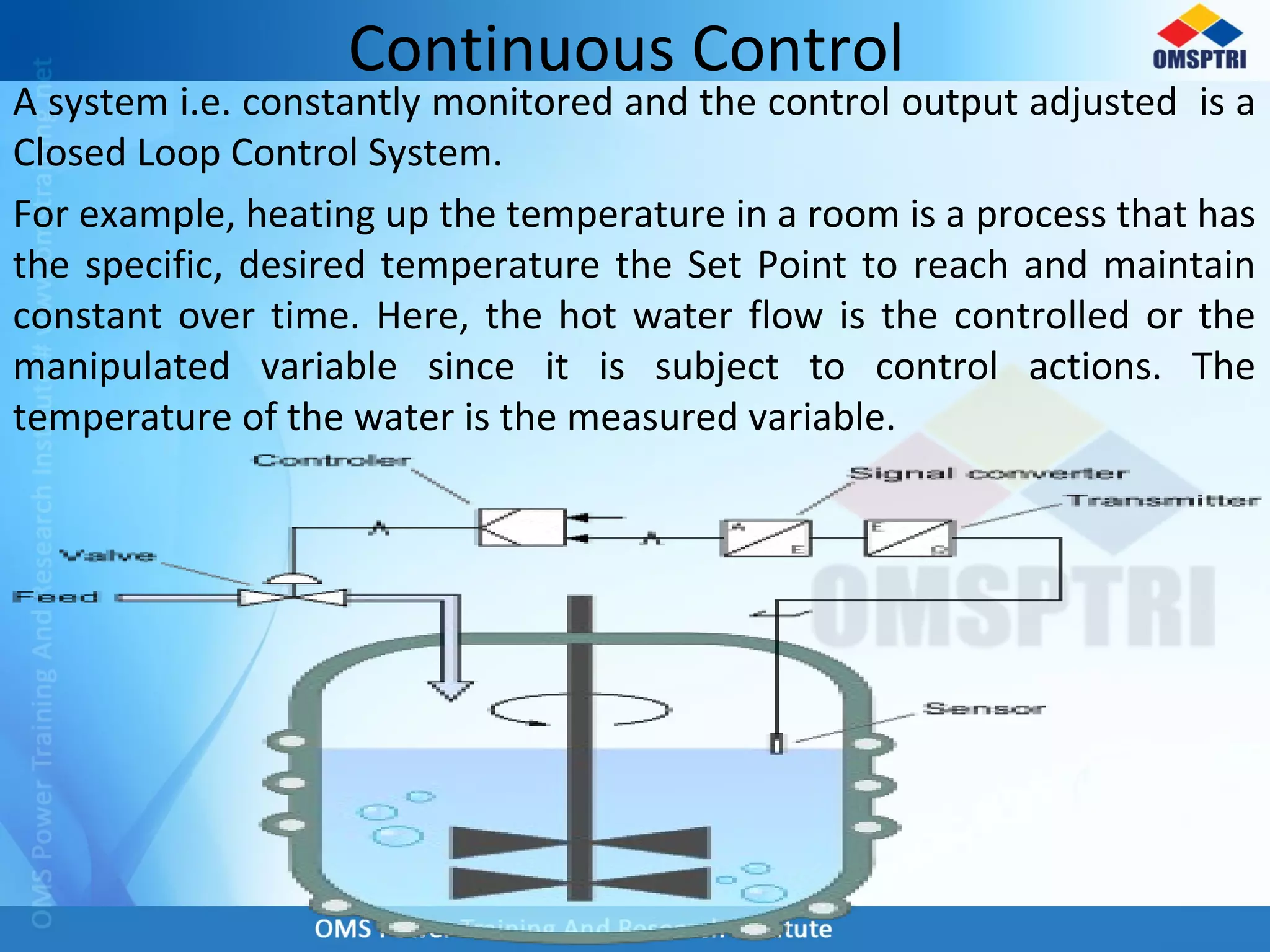
is assumed to be due to a malfunctioning analyzer, or to loss of sample flow. In-line monitors
that continually alarm due to these causes foster this belief by frequently "crying wolf". When
the monitor does alarm due to an action level incident, and it is again given low priority,
serious consequences can ensue.
It is therefore important that in-line monitors be maintained in good operating condition so
they will be reliable. Perpetually malfunctioning monitors or sample pumps should be
replaced. The integrity of the in-line chemistry monitoring system must be held in high
regard. It is dependent on the effort expended by laboratory staff and instrumentation
personnel to assure the system's accuracy and reliability.
The main purposes of analyzers are to:
Signal the existence of corrosive conditions within
the system.
Indicate the amount of scale-forming substances in
the system.
Monitor the carry-over in the steam.
Monitor demineralizer effluent quality.
pH Analysers
Monitoring the pH of water gives an indication of the acidity or alkalinity of the solution. This
is important since both high pH (alkalinity) or low pH (acidity) can contribute to the corrosion
of plant equipment. Proper control of pH can reduce corrosion along with maintaining the
integrity of protective films on metal surfaces. Continuous in-line pH monitoring is a simple
and reliable method of measuring the acidity of water.
In a power plant, the pH is usually monitored at the economizer inlet and in the boiler water.
In a system with mixed metallurgy, the pH is normally maintained between 8.8 and 9.3 (low
enough so ammonia will not corrode copper, but high enough so that iron is protected). In all
steel systems, the pH is normally maintained somewhat higher, between 9.0 and 9.6 to
provide greater protection for the iron surfaces.
In order to maintain these pH levels, either ammonia or morpholine is added to the system.
Since the amount of Morpholine added to the system will effect the final system pH, there
must be some feedback between the pH controlling chemical addition and system pH.
Water chemistry monitoring provides essential information to the plant staff so that the plant
can be operated at optimum efficiency. A variety of instruments and methods are used to
analyze system streams throughout the power generation cycle.
History has shown it is impossible to control system pH without considering the chemical
composition of the fluid, as well as process temperature, pressure and flow rate. pH control
systems can range from very simple ON / OFF control, to more complex feedforward /
feedback control loops.
Conductivity is the ability of a material to carry an electrical current. The measurement of
specific conductivity is the most common of the conductivity measurements in a power plant.
It gives a good indication of the concentration of dissolved solids, or ionic impurities in the
sample.
Since water is a poorly ionizing substance, the addition of even the slightest trace of
electrolytic material causes a large increase in conductivity. For example, a solution of pure
water will double its conductance with the addition of 1 ppm of a typical salt, and 1 ppm of a
strong acid will increase the specific conductivity by as much as 500%
Dissolved Oxygen Analyzers
Oxygen is a main factor in boiler system corrosion. Dissolved oxygen,
in boiler water containing traces of chlorides or solids, is a common
cause of pitting corrosion on metal surfaces.
To prevent corrosion, oxygen and
other gases are removed from
the feedwater before it enters
the boiler. Removal can be
accomplished either mechanically
or chemically. Deaerators are
mechanical means of removing
dissolved oxygen. The injection of
chemicals, known as oxygen
scavengers, such as sulfites or
hydrazine will also reduce the
levels of oxygen dissolved in the
feedwater.
In-line monitoring of dissolved oxygen, or DO, is performed
at several points in the cycle,
•the condensate pump discharge,
•the deaerator inlet and outlet,
•the economizer inlet.
Typically, the dissolved oxygen concentration at the
condensate pump discharge is less than 20 ppb.
The deaerator normally reduces the DO content to below 7
ppb.
The chemical oxygen scavengers further reduce the DO
content to less than 5 ppb at the economizer inlet.
DEAERATOR
-2200
-2000
1000
-1500
-1000
-500
0
500751 mm
700 mm
722 mm
BFP SUCTION
CRH
BFP’S
RECIRCULATION
DEA LVL
DR TANK
1500
8 Kg/Cm2
160 0
C
1800
EXT-4
HPH-5 DRN
HPH-6 DRN
LPH-3
680 T/hr 6 Kg/Cm2
6 Kg/Cm2
APRDS
LTRH
LTSH
HTSH
HTRH
ITSH/HP
LTRH
LTSH
HTSH
ECO ECO
ITSH/HP
HTRH
WATER WALL SB
LONG
RETRACTABLE
SB
HALF
RETRACTABLE
SB
front
left
rear
right
Acoustic
Steam
Leak Detector
Acoustic Steam Leak Detector
Benefits of the early detection of tube leaks:
• Increased Personnel Safety
• Early warning of a small boiler tube leak can prevent expensive
secondary damage and unscheduled outages
• Increased availability, reduces repair time, and increases plant
efficiency
• Planned and scheduled orderly shutdown of a boiler at the most
convenient time
• An increase in boiler availability of just one day will more than
cover the cost of a leak detection system
• Safeguards your investments
• Increased operating profits by Reducing Financial Penalties
• Other benefits include the Detection of abnormal boiler operating
conditions, for example the incorrect operation of soot blowers,
inspection ports being left open, and steam leaks external to the
boiler
4. Control of secondary condensate / drain in the feed
heaters
• Drain is cascade from higher pressure heaters to
lower pressure heaters to maintain a constant level in
the heater shells ultimately dumping in the dearator
(D/A) or condenser hot well as the case may be .
•Some times, it is advantageous to dump the drain of
L.P heaters in to the D/A to conserve all the heat with
out losing to the C.W , even if requires a drain pump
Automatic control system usually consist three kind,
•Proportional,
•Combination of Proportional & Integral
•Combination of Proportional-Integral-Derivative Control.
BASIC CONTROL
PROPORTIONAL-INTEGRAL-DERIVATIVE CONTROL
Proportional Control
• Produces output proportional to error.
• The greater the error, the greater the control
effort; and as long as the error remains, the
controller will continue to try to generate a
corrective effort.
Gain of the controller
The constant of proportionality is the Gain of the
controller, which is related to the proportional band
of the controller.
Example of Gain
0%
1000
C
70%
1700
C
100%
2000
C
0%
100%
%output
Electricaloutput
4 mA
20 mA
% Measured Value
Measured Temperature
% PB = 70
A controller has input range of
1000
C - 2000
C and its output is
current in the range 4 -20 mA.
What is the numerical gain of
the controller?
Gain of the Controller
The numerical gain of the controller is the numerical value
of the slope of the output/input graph.
If the controller has 70% proportional band(PB) then
Gain =
input
output
in
in
change
change
fractional
Fractional
100% of(20 mA – 4 mA)
70% of (2000
C - 1000
C)
= =
16 mA
700
C
= 0.229 mA/0
C
In some cases if output span = input span then
Gain = 100 / %PB
A mechanical flow controller manipulates the valve to maintain the
downstream flow rate in spite of the leakage. The size of the valve
opening at time t is V(t). The flowrate is measured by the vertical
position of the float F(t). The gain of the controller is A/B. This
arrangement would be entirely impractical for a modern flow control
application, but a similar principle was actually used in James Watt’s
original fly-ball governor. Watt used a float to measure the speed of his
steam engine (through a mechanical linkage) and a lever arm to adjust
the steam flow to keep the speed constant.
Flow control example
A portion of the water flowing through the tube is bled off through the nozzle on the
left, driving the spherical float upwards in proportion to the flow rate. If the flowrate
slows because of a disturbance such as leakage, the float falls and the valve opens
until the desired flow rate is restored.
In this example, the water flowing through the tube is the process, and its flow rate is
the process variable that is to be measured and controlled. The lever arm serves as
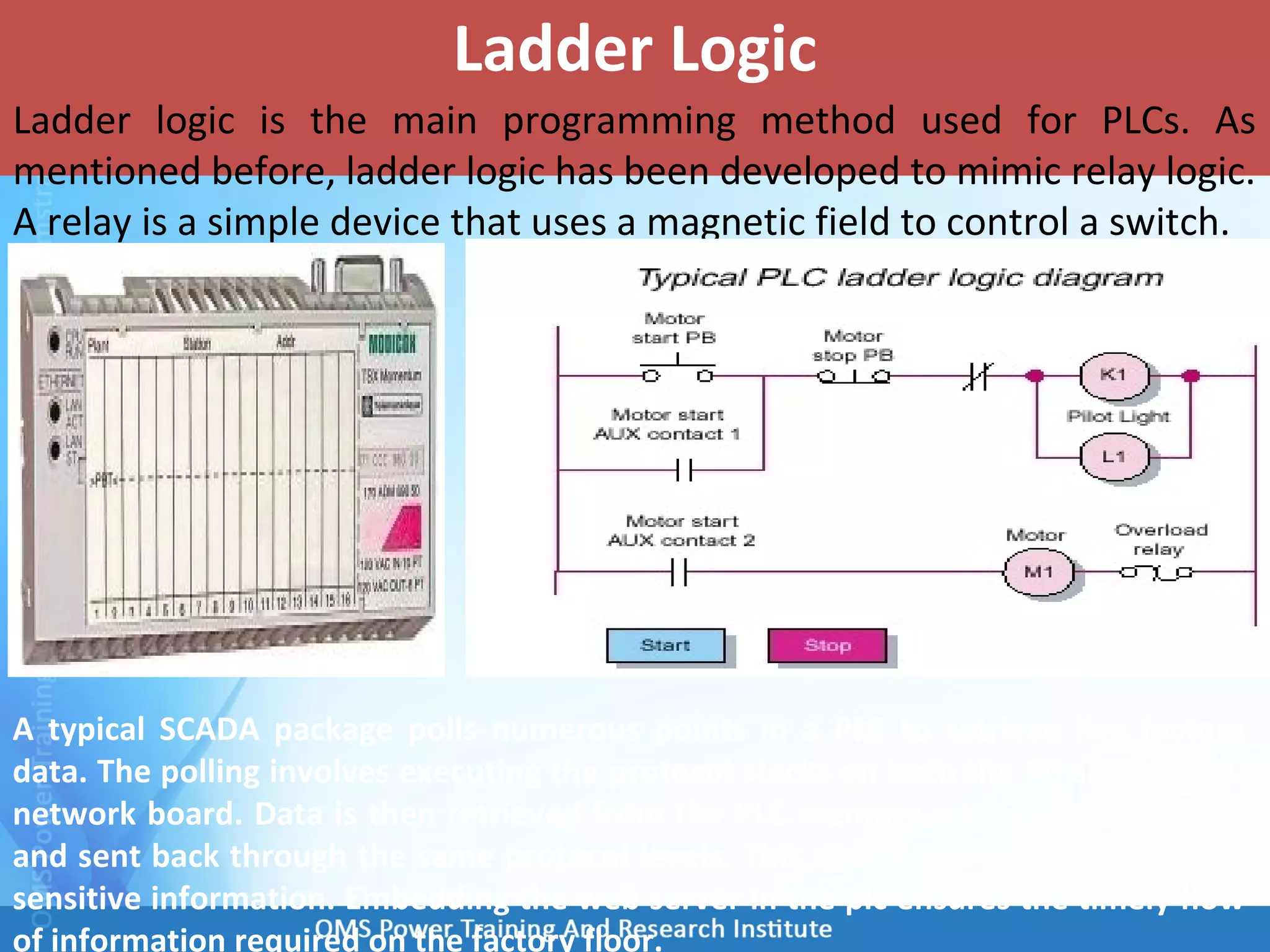
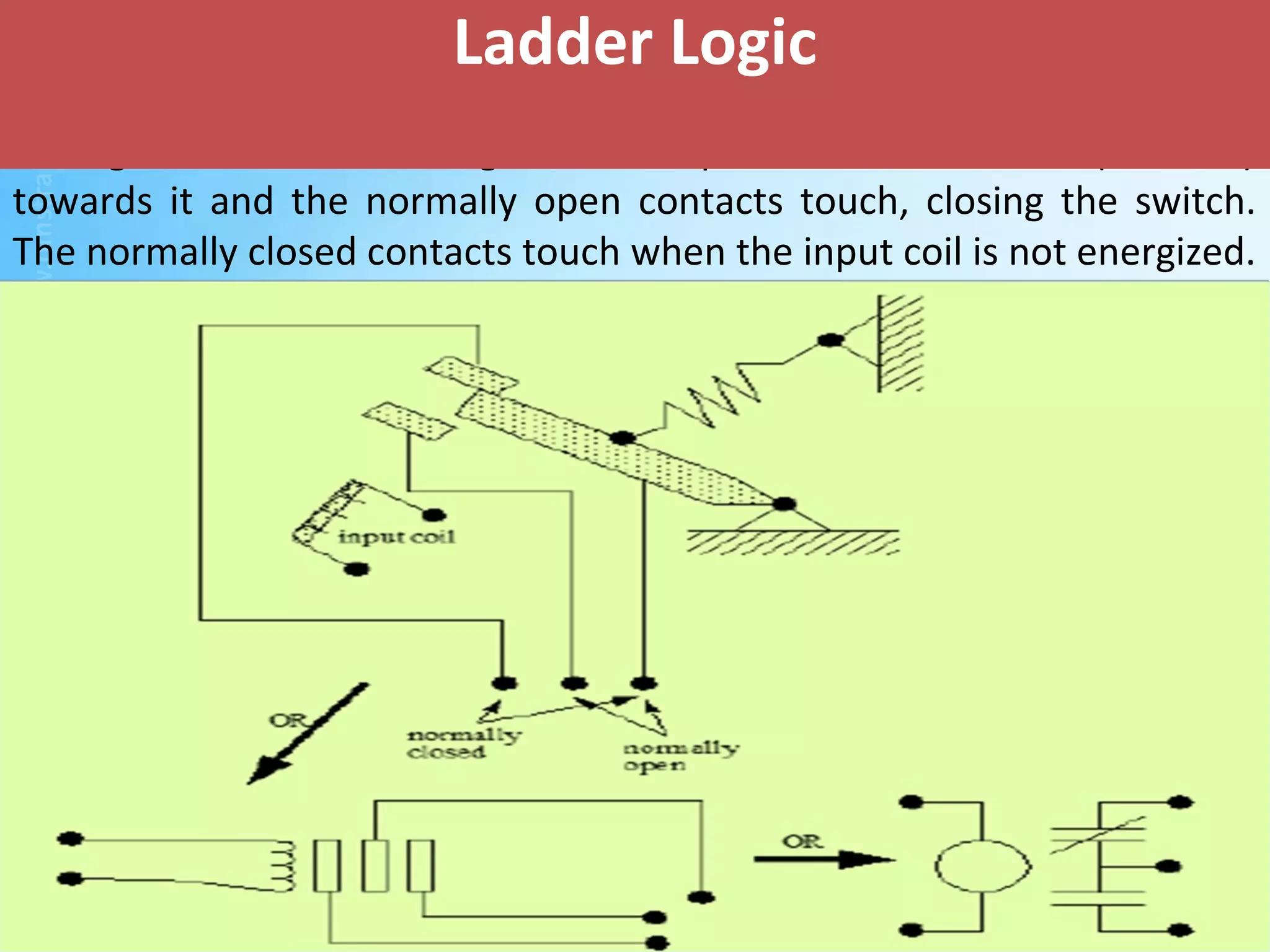
the controller, taking the process variable measured by the float’s position and
generating an output that moves the valve’s piston. Adjusting the length of the piston
rod sets the desired flow rate; a longer rod corresponds to a lower set point and vice
versa.
Proportional Control Terminology
Percentage Values of Controller output:
•In a practical situation the controller will only recognize
variations of the signal between the lowest possible level i.e.
0% and the maximum possible level i.e. 100%.
•Thus process control engineers talk of in terms of percentage
values of pressure, temperature, flow etc. instead of actual
values.
An Example
Suppose a temperature controller works within the range of
200° C and 500° C
Then 200 refers to 0% of measured value
and 500 refers to 100% of measured value
Span of the instrument = 500 – 200 = 300° C
If set point of the controller is 350° C and the the value of the
output temperature is 300 ° C
Then Actual Deviation = 350 – 300 = 50 ° C
% Deviation = actual dev / Measurement span X 100
= 50 / 300 X100 = 16.67%
Proportional Band
• Proportional Band of the controller is the %deviation
which gives rise to 100% change in controller output.
Thus a narrow proportional band means a small change in
deviation produces a large change in controller output. Or
the controller has a large Gain.
Proportional Band
0
10
20
30
40
50
60
70
80
90
100
0 20 40 60 80 100
Set Point
%ControllerOutput
20% Proportional Band
200% Proportional Band
100%Proportional Band
Proportional Control & Steady State Error
An important property of proportional control is
that there will always be a steady state error or
offset. Thus the controlled out put will never match
the set point. Increase of gain can reduce the offset
but this can never be zero, also too much increase
of gain can cause the system to become unstable.
Response of Proportional Controller
200% PB
100% PB
20% PB
• Even with 20%PB there is offset.
• Narrow bands like 20% are not common.
100
TIM
Effect of adjustment of PB on the system
Smaller Proportional band
1. Faster response
2. Less stability
3. Low offset
Larger Proportional band
1. Slow response
2. More stable
3. Large offset
We saw that for proportional action there will always be an offset no
matter how high the gain of the controller. So what we need is a
mechanism which will cause the controller output to increase as long as
the offset remains.
Only when the offset is zero will the controller output be constant.
The same mechanical controller now manipulates the valve to shut off
the flow once the tank has filled to the desired level Fset
. The controller’
gain of A/B has been set much lower, since the float position now spans
Integral Action
Integral Action
The Proportional Integral controller integrates the error signal so long
as the error exists to obtain zero offset. Integral action is also called
Reset action
PI Control
From the figure we can see the law for PI Control.
Controller output = K E + ∫1
1
T
E dt
Where KE is the contribution of the proportional controller
∫1
1
T Edt is the integral contribution.and K
T1 is called Integral Action Time or Reset Time
Integral Time or Reset Time
Larger Reset time less Integral action
Smaller Reset time more Integral action
Reduction of
Integral action
• System takes more time to
reach zero offset.
• Less overshoot
• More stable system
The Derivative Action
In the figure
a) shows setpoint
b) shows system output and
c) shows error for a PI controller.
The error waveform has a wrong
shape to produce the response i.e.
output reaches final value without
overshoot. Thus the shape of the
controller output should be
d) i.e. the controller goes negative
to prevent overshoot.
e) The additional signal is given by
Derivative of the error (f).
DERIVATIVE KICKER
Derivative kicker is used for elimination excessive overshoot at
begin and undershoot control after reaching the set point. As we
know that proportional-integral control already have overshoot and
undershoot and will reduce by integral control but output will take
long time to reach the set point.
Derivative control will improve response but in the steam power
plant control, derivative kicker is not necessary to apply.
This modification is going to tweak the derivative term a bit. The
The image here illustrates
the problem. Since
error=Setpoint-Input, any
change in Setpoint causes
an instantaneous change in
error. The derivative of this
change is infinity (in practice,
since dt isn’t 0 it just winds
up being a really big
number.) This number gets
fed into the pid equation,
which results in an
undesirable spike in the
output. Luckily there is an
easy way to get rid of this.
It turns out that the derivative of the Error is equal to negative
derivative of Input, EXCEPT when the Setpoint is changing. This
winds up being a perfect solution. Instead of adding (Kd *
derivative of Error), we subtract (Kd * derivative of Input). This is
known as using “Derivative on Measurement”
The modifications here
are pretty easy. We’re
replacing +dError with
-dInput. Instead of
remembering the last
Error, we now
remember the last
input. Here’s what
those modifications get
us. Notice that the input
still looks about the
same. So we get the
same performance, but
we don’t send out a
huge Output spike
every time the Setpoint
changes.
This may or may not be a big deal. It all depends on how sensitive
your application is to output spikes. The way I see it though, it
doesn’t take any more work to do it without kicking so why not do
PID Controller
• The derivative signal is the rate of change of error signal.
• It is obtained by a circuit which differentiates the error.
• Thus adding D to PI controller we get a controller which can
give rapid response without much overshoot.
• PID controller is also called Three Term Controller
Controller
Output = K E + ∫1
1
T
E dt + Td
dE
dt
Td is derivative time
Making Td = 0
removes D action from
the controller
PID Controller Response
PB 100%
I = 0
D = 0
PB 100%
I = 1.5 τ
D = 0
PB 100%
I = 1.5 τ
D = 0.3 τ
PD Controller
In case of a PD controller the Derivative component has
no effect on the offset. It can only reduce overshoot and
make the system respond rapidly.
Setting for P, I & D
1. More exponential lags in the system higher the chance of
oscillations.
2. If the system contains more transport delays there is more chance
of instability.
3. Low Proportional Band (high gain) can reduce offset. But it can
not eliminate offset and can reduce stability.
4. Integral action removes offset but too rapid integral action can
reduce stability.
5. Derivative improves response and makes the system settle down
quickly.
6. Derivative is not normally used in fast systems like flow control
with minimum process lags. As the D element can over react to
quick changes of measured value.
Adjustment of Proportional Controllers
1. Start with a wide band (low gain)
observe behavior.
2. Increase gain step by step and
observe behavior.
3. At a certain narrow band the offset
will be small. If the oscillation is
acceptable this can be kept.
4. Else reduce gain to get optimum
response.
Adjustment of PI Controllers
Step 1:
1. With I at zero (lowest rate) follow
procedure for P controller.
2. Increase band slightly to obtain a
response slightly slower than ideal.
Step 2:
1. With P remaining at its setting
increase integral rate in small steps
while creating set point and load
changes and observing the behavior
until cyclic behavior increases.
2. Reduce integral rate to obtain
optimum value.
Adjustment of PD Controllers
Step1:
With D at zero follow procedure for
P controllers until an acceptable
response is obtained.
Step2:
• With P kept at its setting increase
D in steps and observe behavior
with set point and load changes
until cyclic behavior begins to
increase.
• Reduce D slightly to get an
acceptable response.
• Try increasing gain slightly if the
stability is OK.
Adjustment of PID Controllers
Step1: I and D at zero (or minimum setting). Follow procedure
for proportional controllers until a result more oscillatory than
desirable is obtained.
Step2: With P set increase I as before until point of instability
is approached.
Step3: With P and I set slowly increase D as for PD control.
Step4: After setting of D, try increasing gain for better result.
Detection of Excessive adjustment
The following guide line may help:
1. Integral cycling has relatively long period.
2. Proportional cycling has relatively moderate period.
3. Derivative cycling has relatively short period.
While adjusting a controller there often will be excessive
adjustment which will cause oscillations, the practical
difficulty is to detect which control action is at fault.
These are practical difficulties and one can only learn to
deal with them with experience.
FEEDBACK CONTROL
A feedback loop measures a
process variable and sends the
measurement to a controller for
comparison to setpoint. If the
process variable is not at
setpoint, control action is taken
to return the process variable to
setpoint. Figure illustrates a
feedback loop in which a
transmitter measures the
temperature of a fluid and, if
necessary, opens or closes a hot
steam valve to adjust the fluid’s
temperature.
FEEDFORWARD CONTROL
Feedforward control is a
control system that
anticipates load disturbances
and controls them before
they can impact the process
variable. For feedforward
control to work, the user
must have a mathematical
understanding of how the
manipulated variables will
impact the process variable.
FEEDFORWARD PLUS FEEDBACK
• Figure shows a
feedforward-plus-feedback
loop in which both a flow
transmitter and a
temperature transmitter
provide information for
controlling a hot steam
valve.
CASCADE CONTROL
• Cascade control is a control
system in which a
secondary (slave) control
loop is set up to control a
variable that is a major
source of load disturbance
for another primary
(master) control loop. The
controller of the primary
loop determines the
setpoint of the summing
contoller in the secondary
loop
RATIO CONTROL
• The controller performs a
ratio calculation and signals
the appropriate setpoint to
another controller that sets
the flow of the second fluid
so that the proper
proportion of the second
fluid can be added.
Heading-2
Page Content…..
Heading-1Heading-1
OMS POWER TRAINING AND RESEARCH
INSTITUTE
N-2/170, IRC VIllage, Nayapalli, BHUBANESWAR-751015.
Tel. : 0674-2552984, 2552985.
website - www.omstraining.net. Email - info@omstraining.net

C&i systems

  • 1.
  • 2.
  • 3.
  • 5.
    Work Done InTurbine
  • 6.
    Work Done InTurbine The heat Energy in the steam is converted first to kinetic energy as it enters the Machine through nozzles, and then this kinetic energy is converted to Mechanical work as it impinges onto the rotating blades. •Further work is Done by the reaction of the steam leaving these blades when it encounters Another set of fixed blades, which in turn redirect it onto yet another set of Rotating blades. •As the steam travels through the machine in this way it Continually expands, giving up some of its energy at each ring of blades. •The moment of rotation applied to the shaft at any one ring of blades is the Multiple of the force applied to the blades and mean distance of the force. •Since each stage of rings abstracts energy from the steam, the force applied At the subsequent stage is less than it was at the preceding ring and, therefore, to ensure that a constant moment is applied to the shaft at each stage, the length of the blades in all rings after the first is made longer than that of the preceding ring.
  • 7.
    Work Done InTurbine • This gives the turbine its characteristic tapering shape. • The steam enters the machine at the set of blades with the smallest diameter and leaves it after the set of blades with the largest diameter.
  • 8.
    The huge coolingtowers condense steam back into water. Some of the steam escapes, creating huge clouds above the cooling towers.
  • 9.
    Things that wecommonly measure are: •Temperature ,Pressure •Speed, Flow rate •Force Movement, Velocity and Acceleration •Stress and Strain Level or Depth •Mass or Weight Density •Size or Volume Acidity/Alkalinity Sensors may operate simple on/off switches to detect the following: •Objects(Proximity switch) Empty or full (level switch) •Hot or cold (thermostat) Pressure high or low (pressure switch) The block diagram of a sensor is shown below.
  • 10.
    A successful ProcessControl Engineer has to know something about the following subjects • Electrical Engineering • Electronic Engineering • Computers • Hydraulics • Pneumatics • Plumbing • Physics • Chemistry • Finance
  • 11.
    • PRESSURE SENSORS– STEAM,WATER,AIR,H2GAS,CO2 GAS,OIL • TEMPERATURE SENSORS- STEAM,WATER,AIR,H2GAS,OIL ,FLUE GAS,BEARINGS • FLOW SENSORS- STEAM,WATER,AIR,OIL ,FLUE GAS,COAL • LEVEL SENSORS- DRUM,DEAERATOR,HEATERS,HOTWELL,BUNKERS,HOPPERS,MOT • VIBRATION SENSORS- TURBINE,GENERATORS,PAFANS,FDFANS,IDFANS,BFPS,MILLS • EXPANSION SENSORS- TURBINE,GENERATOR • SPEED SENSORS- TURBINE • POSITION SENSORS- VALVES • ANALYZERS- SILICA,OXYGEN,CO • WEIGHT SENSORS- COAL
  • 12.
    • PRESSURE SENSORS– GAUGES,DIFFERENTIAL PRESSUREGAUGES,SWITCHES,TRANSMITTERS • TEMPERATURE SENSORS- GAUGES,CONTACT GAUGES,SWITCHES,RTDS,THERMOCOUPLES • FLOW SENSORS- ORIFICE FLOW,AEROFOIL,MAGNETIC FLOW METER ,ENCODERS • LEVEL SENSORS- HYDRA STEP,DIFFERENTIALPRESSURE,LVDT,CAPACITANCETYPE, ULTASONIC, • VIBRATION SENSORS- SESIMIC PROBES,PROXIMITY PROBES • EXPANSION SENSORS- LVDT • SPEED SENSORS- HALL PROBE • POSITION SENSORS- LVDT,VARIABLE CAPACITANCE TYPE • ANALYZERS- SILICA,OXYGEN,PH • WEIGHT SENSORS- LOAD CELLS
  • 13.
    -4-wire system ofmeasurement -2-wire system of measurement -True Zero (0-20 mA) measurement -Live Zero (4-20 mA) measurement Pressure Transmitter
  • 14.
    4-wire Transmitter (0-20/4-20mA) + Tx - Load Control / MonitoringmA Wiring schematic of 4-wireTransmitter +24 V DC -Ve
  • 15.
    2-wire Transmitter (4-20mA) + Tx -Load Control / Monitoring 4-20 mA Wiring schematic of 2-wireTransmitter +24 V DC -Ve - Tx drives constant current up to a Load of 600 Ω
  • 16.
    Transmitter Power supplyVs Load 400 600 800 1000 1200 40 30 20
  • 17.
    • Pressure - Gauges •Temperature - Gauges • Level - Gauge glass • Flow - Flow meter Local Monitoring
  • 18.
  • 19.
  • 20.
  • 21.
    Gauge Glass • Seethrough glass
  • 22.
    • Pressure/Flow/Level/Temperature - Indicators,Recorders, Control System, Monitors- TFTs RemoteMonitoring
  • 24.
    How Remote Monitoringis done? • Field data are communicated to the control room. • Based on the information the control system takes care of safe , reliable and optimum operation. • Control & Instrumentation deals with the above.
  • 26.
    Why signals aresent to the Control Room ?Why signals are sent to the Control Room ? • The process parameters are monitored & controlled from the control room. • For monitoring the signal, termed measured value, is displayed. • For Controlling the measured value is fed to or from the control panels through wires.
  • 27.
    Control Room Instruments •Indicators • Recorders • Display screens • Annunciation windows • Push Buttons • Breakers • Switches etc.
  • 29.
    Process Control Process controlis extensively used in industry and enables mass production of continuous processes such as oil refining, paper manufacturing, chemicals, power plants and many other industries. Process control enables automation, with which a small staff of operating personnel can operate a complex process from a central control room.
  • 30.
    Details of anIndustrial Process Process Sensor Low Level Signal Local Signal Processing Transmission Remote Signal Processing Display Control
  • 31.
    Control System Evolution •Manual Control System in past involved direct operation of manipulated variable by human. That was time consuming, tedious and difficult for round the clock operation • Auto Control System involved electrical control was based on relays. These relays allow power to be switched on and off without a mechanical switch. It involved lot of wirings to make simple logical control decisions. • Programmable Logic Controller (PLC) is developed with the microprocessor technology. This has control logic/ ladder logic software that eliminated the use of lot of wiring, relays & switches.
  • 32.
    Process Control A commonlyused control device called a programmable logic controller, or a PLC, is used to read a set of digital and analog inputs, apply a set of logic statements, and generate a set of analog and digital outputs. Using the example in the previous paragraph, the room temperature would be an input to the PLC. The logical statements would compare the setpoint to the input temperature and determine whether more or less heating was necessary to keep the temperature constant. A PLC output would then either open or close the hot water valve, an incremental amount, depending on whether more or less hot water was needed. Larger more complex systems can be controlled by a Distributed Control System (DCS) or SCADA system.
  • 33.
    Types of controlsystems • Logical/Discrete - The value to be controlled are easily described as on-off. e.g. the Feed Pump is on-off based on certain conditions. • Continuous - The values to be controlled change smoothly. e.g. the Drum Level. • Linear - Can be described with a simple differential equation e.g. We are measuring the perfect flow with no disturbances like friction, turbulence, temperature change of process fluid etc. • Non-Linear - Not Linear. Takes into account the changes due the disturbances. must change. • Sequential - A logical controller that will keep track of time and previous events.
  • 34.
    The value tobe controlled are easily described as ON-OFF. e.g. the motor is on-off. NOTE: all systems are continuous but they can be treated as logical for simplicity. For example, the BFP is turned on, when the discharge valve is closed. Discrete
  • 35.
    Logical and sequentialcontrol These systems don't need to be closely monitored, an Open Loop Control System. An open loop controller will set a desired state of an equipment, but no sensors are used to verify the position.
  • 36.
    Continuous Control A systemi.e. constantly monitored and the control output adjusted is a Closed Loop Control System. For example, heating up the temperature in a room is a process that has the specific, desired temperature the Set Point to reach and maintain constant over time. Here, the hot water flow is the controlled or the manipulated variable since it is subject to control actions. The temperature of the water is the measured variable.
  • 37.
    Programmable Logic Controller(PLC) • Cost effective for automatically controlling complex systems. • Flexible and can be reapplied to control other systems quickly and easily. • Computational abilities allow more sophisticated control. • Trouble shooting aids make programming easier and reduce downtime. • Reliable components make these likely to operate for years before failure.
  • 38.
    Ladder Logic Ladder logicis the main programming method used for PLCs. As mentioned before, ladder logic has been developed to mimic relay logic. A relay is a simple device that uses a magnetic field to control a switch. A typical SCADA package polls numerous points in a PLC to retrieve live factory data. The polling involves executing the protocol stacks on both the PC and the PLC network board. Data is then retrieved from the PLC memory across the backplane and sent back through the same protocol levels. This makes it unsuitable for time- sensitive information. Embedding the web server in the plc ensures the timely flow of information required on the factory floor.
  • 39.
    When a voltageis applied to the input coil, the resulting current creates a magnetic field. The magnetic field pulls a metal switch (or reed) towards it and the normally open contacts touch, closing the switch. The normally closed contacts touch when the input coil is not energized. Ladder Logic
  • 40.
    How thousands ofData managed or controlled in the control room ? All panels through which communication with field instruments is done are interconnected or integrated through a central network called Distributed communication network. This whole system is called Distributed Control System.
  • 41.
    What is aDistributed Control System? A distributed control system (DCS) refers to a control system usually of a process or any kind of dynamic system, in which the controller elements are not central in location (like the brain) but are distributed throughout the system with each component sub-system controlled by one or more controllers. The entire system of controllers is connected by networks for communication and monitoring.
  • 42.
    Elements of aDCSA DCS typically uses custom designed processors as controllers and uses both proprietary interconnections and communications protocol for communication. The functionally and/or geographically distributed digital controllers are capable of executing from 1 to 256 or more regulatory control loops in one control box. The input/output devices (I/O) can be integral with the controller or located remotely via a field network. Today’s controllers have extensive computational capabilities and, in addition to proportional, integral, and derivative (PID) control, can generally perform logic and sequential control like Ladder Logic.
  • 43.
    Input and outputmodules form component parts of the DCS. The processor receives information from input modules and sends information to output modules. The input modules receive information from input instruments in the process (a.k.a. field) and transmit instructions to the output instruments in the field.
  • 44.
    Computer buses orelectrical buses connect the processor and modules through multiplexer or de-multiplexers. Buses also connect the distributed controllers with the central controller and finally to the Human Machine Interface (HMI) or control consoles.
  • 45.
    DCSs may employone or several workstations and it’s database can be configured at the engineering workstation. Local communication is handled by a control network(DCN ring) with transmission over twisted pair, coaxial, or fiber optic cable. A server and/or applications processor may be included in the system for extra computational, data collection, storage and reporting capability called the History Substation.
  • 46.
    Applications of D.C.S.: Distributed Control Systems (DCSs) are dedicated systems used to control processes that are continuous or batch-oriented, such as oil refining, petrochemicals, central station power generation, pharmaceuticals, food & beverage manufacturing, cement production, steelmaking, and papermaking. DCSs are connected to sensors and actuators and use set-point control to control the flow of material through the plant.
  • 47.
    The most commonexample is a set point control loop consisting of a pressure sensor, controller, and control valve. Pressure or flow measurements are transmitted to the controller, usually through the aid of a signal conditioning Input/ Output (I/O) device. When the measured variable reaches a certain point, the controller instructs a valve or actuation device to open or close until the fluidic flow process reaches the desired set point. Large generation units have many thousands of I/O points and employ very large DCSs. Processes are not limited to fluidic flow through pipes, however, and can also include things variable speed drives and motor control centers, fuel processing facilities, and many others.
  • 48.
    Process diagrams The ‘process’is an idea or concept that is developed to a certain level in order to determine the feasibility of the project. ‘Feasibility’ study is the name given to a small design project that is conducted to determine the scope and cost of implementing the project from concept to operation. To keep things simple, for example, design an imaginary coffee bottling plant to produce bottled coffee for distribution. Start by creating a basic flow diagram that illustrates the objective for the proposed plant; this diagram is called a “Process Block Diagram”. Basic flow diagram of Coffee bottling plant
  • 49.
    P&IDs Piping & InstrumentationDrawing (original) Process & Instrumentation Diagram (also used) Process Flow Diagram – PFD (simplified version of the P&ID) Most industries have standardized the symbols according to the ISA Standard S5.1 Instrumentation Symbol Specification
  • 50.
    Process flow diagramor piping flow diagram (PFD) The PFD is where we start to define the process by adding equipment and the piping that joins the various items of equipment together. The idea behind the PFD is to show the entire process (the big picture) on as few drawing sheets as possible, as this document is used to develop the process plant and therefore the process engineer wants to see as much of the process as possible. This document is used to determine details like the tank sizes and pipe sizes
  • 51.
    PIPING AND INSTRUMENTATIONDIAGRAM (P&ID) vs PROCESS FLOW DIAGRAM •PFD gives a graphical representation of the process including hardware (Piping, Equipment) and software (Control systems); this information is used for the design construction and operation of the facility. •The PFD defines “The flow of the process” The PFD covers batching, quantities, output and composition. •The P&ID ties together the system description, the flow diagram, the electrical control schematic, and the control logic diagram. It accomplishes this by showing all of the piping, equipment, principal instruments, instrument loops, and control interlocks. The P&ID contains a minimum of text in the form of notes (the system description minimizes the need for text on the P&ID).
  • 52.
    •The P&ID defines“The control of the flow of the process” where the PFD is the main circuit; the P&ID is the control circuit. Once thoroughly conversant with the PFD & Process description, the engineers from the relevant disciplines (piping, electrical & control systems) attend a number of HAZOP(Hazard and Operability) sessions to develop the P&ID.
  • 53.
  • 54.
    The P&ID willuse symbols and circles to represent each instrument and how they are inter-connected in the process. Tag “numbers” are letters and numbers placed within or near the instrument to identify the type and function of the device. Building the P&ID :
  • 55.
    Tag Descriptors The firstletter is used to designate the measured variable The succeeding letter(s) are used to designate the function of the component, or to modify the meaning of the first letter. Pressure Level Flow Temperature Indicator Recorder Controller Transmitter
  • 56.
    Tag Numbers Tag“numbers” are letters and numbers placed within or near the instrument to identify the type and function of the device.
  • 57.
  • 58.
  • 59.
  • 60.
    Process Flow Diagram- PFD A PFD shows less detail than a P&ID and is used only to understand how the process works
  • 62.
    Conveyer Belts TakingThe Coal (Chemical Energy) Straight To The Power Station.
  • 63.
    Electrical energy ismade available to our homes via huge transmission towers.
  • 64.
    The law ofconservation of energy states that energy can not be created nor can it be destroyed. It can, however, change forms as from electrical into heat. Take the conversion outlined in the animation below. At every step we have a loss of energy. The efficiency of the conversion is given as a percentage and clearly an indication and not precise. The more conversion steps throughout the process of generating electricity the greater the energy losses.
  • 65.
    1) What processcaptures solar energy? 2) Which is the most inefficient energy conversion step in the process outlined above? 3) The more steps in the process of generating electrical energy the 4) The energy lost is in the form of 5) What type of energy is carried by steam 1. Evaporation 2. Photosynthesis 3. Respiration 4. Condensation 1. Chemical to Heat 2. Heat to Kinetic 3. Kinetic to Mechanical 4. Mechanical to Electrical 1. More the electrical energy generated 2. Less the electrical energy generated 1. Electrical 2. Mechanical 3. Heat 4. Chemical 1. Electrical 2. Mechanical 3. Kinetic 4. Chemical
  • 66.
    1. The lightglobe provides us with 2. An incandescent light globe works on heating a metal filament until it glows brightly. What are the energy conversion taking place in the globe? 3. This type of globe is only 2% efficient. What does this mean? 4. Most of the energy coming into the light globe is transformed into 1. Electrical 2. Light 3. Heat 4. Chemical 1. Electrical>Heat>Light 2. Electrical>Chemical>He at 3. Chemical>Heat>Light 4. Chemical>Heat> Light 1. 92% loss 2. 102% efficient 3. 98% loss 4. 98% efficient 1. Electrical 2. Light 3. Heat 4. Chemical
  • 67.
    Instruments are usedto sense the process conditions like temerature and convert them to an electrical form for display & control .
  • 69.
    The main steamand water circuits of power plant
  • 70.
    Principle of aDeaerator
  • 71.
    Water and Steam Circuitof a combined cycle plant
  • 72.
  • 74.
  • 75.
    Boiler Critical parts ofthe process would include the following • lighting of the burners • controlling the level of water in the drum • controlling the steam pressure An SIS is engineered to perform "specific control functions" to failsafe or maintain safe operation of a process when unacceptable or dangerous conditions occur- FSSS Safety Instrumented Systems is independent from all other control system that control the same equipment in order to ensure SIS functionality is not compromised.  SIS is composed of the same types of control elements (including sensors, logic solvers, actuators and other control equipment) as a Basic Process Control System
  • 76.
  • 77.
    BOILER INSTRUMENTATION 1.FLUE GAS 2.SECONDARYAIR 3.SECONDARY AIR DAMPERS 4.PRIMARY AIR 5.MILLS 6.SCANNERS 7.OIL SYSTEM 8.STEAM CYCLE 9.FEED WATER CYCLE 10.DRUM 11.SOOTBLOWERS AND ASLDS 12.STEAM ,FEEDWATER AND FLUE GAS ANALYSERS
  • 78.
    Control A Plant ControlSystem is an integrated with demand requirement applied simultaneously to the Boiler, Turbine and major auxiliary equipment.
  • 82.
    Boiler Control Various typesof Boiler control system for fossil fuel Boiler include: •combustion (fuel and air) control- Total Air Control and Mill Air Flow Control, •steam temperature control for superheater and reheater control, •drum level and feedwater flow control, •burner sequence control and management systems •bypass and startup •coordinated Control systems to integrate all of the above with the turbine and electric generator control, •data processing, sequence of event recording, trend recording and display , •performance calculation and analysis •alarm annunciation system, •management information system, •unit trip system. •Mill Outlet Temperature Control •Hotwell Level Control •LP / HP Heater Level Control •De-aerator Level / Pressure Control •Furnace Draft Control •HFO / LDO Pressure / Flow Control •event activated logs- alarm log/ trip log •Time Activated Logs- Shift Log / Daily Log •Operator Demand Logs- Summary Log, Performance Log, Maintenance Log
  • 84.
    It is theregulation of the Boiler outlet conditions of steam flow, pressure and temperature to their desired values. In control terminology, the Boiler outlet steam conditions are called the outputs or controlled variables. The desired values of the outlet conditions are the set point or input demand signals. The quantities of fuel, air and water are adjusted to obtain the desired outlet steam conditions and are called the manipulated or controlled variables. Examples of disruptive influence on the Boiler are fuel quality (calorific value variation ), load variation ( load demand), change in cycle efficiency.
  • 85.
    Characteristics of DifferentControl Modes •Boiler-following Control •Turbine-following Control •Coordinated Boiler Turbine Control •Integrated Boiler Turbine-generator Control •Integrated Control System
  • 86.
    Boiler-following control This leadsBoiler response to follow turbine response. Following a load change, the Boiler control modifies the firing rate to reach the new load level and to restore throttle pressure to its normal operating value. Load response with this type of system is rapid because the stored energy in the Boiler provides the initial change in load. The fast load response is obtained at the expense of less stable throttle pressure control.
  • 88.
    Sliding pressure operation Ifboiler characteristics are such that it is capable of delivering steam at lower pressure but at the rated temperature it is beneficial to vary the load by controlling the steam pressure with out throttling by the governing .This improve the efficiency due to • Reduction in the throttling losses across the stop & regulating valves. • Saves the pumping power – lower consumption by the B F P • Lower wetness in the exhaust.
  • 89.
    Turbine-following control In thismode turbine response follows Boiler response. Megawatt load control is the responsibility of the Boiler while the turbine-generator is assigned secondary responsibility for throttle pressure control. With increased load demand , the Boiler control increases the firing rate which, in turn, raises throttle pressure. To maintain a constant throttle pressure, the turbine control valves open, increasing megawatt output. When a decrease in load is demanded, this process is reversed. Load response with this type of system is rather slow because the turbine-generator must wait for the Boiler to change its energy output before repositioning control valve to change load. However, this mode of operation will provide minimal steam pressure and temperature fluctuation during load change.
  • 91.
    Coordinated Boiler turbinecontrol The above two systems have certain inherent disadvantages and neither fully exploits the capabilities of both Boiler and turbine generator. Hence both are combined into a coordinated control system giving advantages of both the system and minimizing the disadvantages. It assigns the responsibility of throttle pressure control to turbine- generator i.e. the turbine-following system uses the stored energy in the Boiler thus taking advantages of the fast load response of a Boiler following system.
  • 93.
    Integrated Boiler TurbineGenerator Control This system consists of ratio controls that monitor pairs of controlled inputs , as follows, •Boiler energy input to generator energy output, •superheater spray water flow to feedwater flow •fuel flow to feedwater flow •fuel flow to air flow •recirculated gas to air flow; this , in effect, is a ratio of reheater absorption to absorption in primary water and steam, and •fuel to primary air flow in pulverized coal-fired units.
  • 94.
    Integrated Control System:This co-ordinates the Boiler and turbine-generator for fast and efficient response to load demand initiated by the automatic load dispatch system.
  • 96.
    A Safety InstrumentedSystem (SIS) It consists of an engineered set of hardware and software controls which are especially used on critical process systems.  A critical process system can be identified as one which, once running and an operational problem occurs, the system may need to be put into a "Safe State" to avoid adverse Safety, Health and Environmental(SH&E) consequences. One of the more well known critical processes is the operation of a steam boiler.
  • 97.
    FURNACE SAFE GUARDSUPERVISORY SYSTEM
  • 98.
    SCOPE OF FSSS MASTERFUEL TRIP RELAYS BOILER PURGE OIL SYSTEM MILLS SECONDARY AIR DAMPERS FLAME SCANNERS
  • 99.
    FUNCTIONS OF FSSS Prevent any fuel firing unless a satisfactory furnace purge sequence has first been completed.  Prevent start-up of individual fuel firing equipment unless certain permissive, interlocks have been satisfied.  Monitor and control proper component sequencing during start-up and shut-down of fuel firing equipment.  Subject continued operation of fuel firing equipment to certain safety interlocks remaining satisfied.  Provide component status feedback to the operator and, in some cases, to the unit control system and / or to the data logger.  Provide flame supervision when fuel firing equipment is in service and effect an Elevation Fuel Trip or Master Fuel Trip upon certain condition of unacceptable firing / load combination.  Effect a Master Fuel Trip upon certain adverse Unit operating conditions.
  • 100.
    INTERLOCKS COVERED UNDERFSSS  PURGE PERMISSIVES  HOTV OPEN/CLOSE INTERLOCKS  HORV OPEN/CLOSE INTERLOCKS  OIL GUNS START/STOP CYCLE  BOILER PROTECTION LOGICS  COAL MILL START/STOP INTERLOCKS  COAL FEEDER START/STOP INTERLOCKS  SCANNER AIR FANS  DAMPER INTERLOCKS
  • 101.
    FURNACE ECONOMISER -12 MMWC 1400 DEG CENTIGRADE -3 MMWC 475DEG -3 MMWC 340 DEG -3 MMWC 340 DEG -9 1400 -7 -3 1200 1114 667 575
  • 102.
    RAH A RAH B ESPB ESP A ID FAN A ID FAN B CHIMNEY FROM ECONOMISER 140 C 140 0 C 145 C 145 C 150 C 150 C O2 3.2%48 MMWC 48 MMWC -400 MMWC -150 MMWC -400 MMWC -150 MMWC RAH DP 75 MMWC RAH DP 75 MMWC O2 3.2%
  • 103.
    SEC AIR 41 MMWC FLUEGAS 30 MMWC PRI AIR 40 MMWC 145 C 340 C 40 C 320 C 54 C 316 C -145 MMWC 913 MMWC 85 MMWC FROM ECONOMISER TO MILLS TO FURNACE TO ESP RAH PRI AIR SEC AIR
  • 104.
    RAH A RAH B FDFAN A FD FAN B 38 C 38 C 310 C 310 C 150 MMWC 100 MMWC 150 MMWC 100 MMWC SCAPH-A SCAPH-B FURNACE SEC AIR FLOW 220 T/HR 220 T/HR 290 MMWC AIR SCANNER FAN- A SCANNER FAN-B AIR FILTER RAH DP 35 MMWC RAH DP 35 MMWC
  • 105.
    FIRING EQUIPMENT Secondary AirDamper These are provided on a pulverised fuel burners. The purpose of these dampers is: * To control the amount of excess air required for complete combustion. * To create a sufficient turbulence, in the furnace.
  • 106.
    Maintenance • The correctsettings are determined by Performance and Testing Department and it’s ensured that the secondary air dampers are set correctly to ensure that the air sweep through the Boilers is kept at optimum conditions. • The secondary air damper check is carried out on a routine basis by the Mechanical and C&I Maintenance Departments must.
  • 107.
    FURNACE F U R N A C E COAL AIR A COALAIR B COAL AIR C COAL AIR D COAL AIR E COAL AIR F AUX.AIR DAMPERS AB AUX.AIR DAMPERS CD AUX.AIR DAMPERS DE AUX.AIR DAMPERS EF 1 2 3 4 SA DAMPERS ATFURNACE CONER AUX.AIR DAMPERS BC AUX.AIR DAMPERS FF AUX.AIR DAMPERS AA
  • 108.
    SECONDARY AIR DAMPERCONTROL (SADC) FUEL AIR DAMPERS:  All fuel air dampers (A,B,C,D,E&F)modulate according to the amount of primary air flow in the respective Elevation.  All fuelAir dampers will open when boiler trips.  All fuel Air dampers will open 100% during purging.  Boiler load > 30%
  • 109.
    AUXILLARY FUEL AIRDAMPERS(A.F.A.Ds) Aux.Air dampers AB,CD&EF will open by 70% when respective guns are in service. Aux.Air dampers will close whenever adjacent coal elevation or oil elevation is not in service. Boiler load < 30% the A.F.A.Ds modulate to maintain 40mmwc differential pressure between furnace and secondary air wind box. Boiler load > 30% the A.F.A.Ds modulate to maintain 100mmwc differential pressure between furnace and secondary air wind box.  The A.F.A.Ds will open when boiler trips. The A.F.A.Ds will open 100% during purging.
  • 110.
    RAH A RAH B PAFAN A PA FAN B 50 C 50 C 310 C 310 C 1000 MMWC 970 MMWC 1000 MMWC 970 MMWC TO MILLSTO MILLS RAH DP 50 MMWC RAH DP 50 MMWC
  • 111.
    BOILER TRIP CONDITIONS Both FD Fans Off  Both ID Fans Off  Reheat Protection  Drum Level High-High (> +167 mm, delay of 10 seconds)  Drum Level Lo-Lo (< - 450 mm, delay 10 seconds)  Less than FB and loss of AC in any elevation.  Furnace Pressure High-High (> + 250 mmWC, 2 / 3 logic)  Furnace Pressure Lo-Lo ( < -200 mmWC, 2 / 3 logic )  Loss Of All Fuel Trip.  Unit Flame Failure  Loss Of 24 V DC For > 2 seconds  Loss Of 220 V DC For > 2 seconds  Trip from MMI  Air Flow < 30 %(230 T/hr)  Trip from Emergency Push Button.
  • 112.
    BOILER TRIP When theboiler trips the following events takes place Boiler trip red lamp comes on.  MFT A & B trip lamp comes on and reset lamp goes off.  Cause of trip memory can not be reset till the furnace purge is completed.  F D Fans Control is transferred to manual.  I D fans vane position is transferred to manual.  Pulverizers are tripped.  Coal feeders are tripped.  P A Fans are tripped.  HFO trip valve closes.  All HFO Nozzle valves closes.  Upper and Lower Fuel air damper opens.  Auxiliary air damper opens and control is transferred to manual.  Loss of all fuel trip protection disarms.  S/H and R/H spray block valves S-82 & R-31 closes and can not be opened unless furnace purge is completed.  Turbine Trips
  • 113.
    LESS THAN FIREBALL&LOSS OF AC IN ANY ELEVATION IN SERVICE OR ELEV AB START & LOSS OF PWR ELEV CD START & LOSS OF PWR ELEV EF START & LOSS OF PWR MILL AB START & LOSS OF PWR MILL CD START & LOSS OF PWR MILL EF START & LOSS OF PWR ALL MILLS OFF AND LESS THAN FIREBALL & LOSS OF AC IN ANY ELEVATION
  • 114.
    REHEAT PROTECTION 1. TURBINETRIP OR GENERATOR CIRCUIT BREAKER OPEN AND HP/LP BYPASS OPENING < 2 %. 2. TURBINE WORKING (HP & IP CVS OPENING > 2 % AND LOAD SHEDDING RELAY OPERATED AND HP/LP BYPASS OPENING < 2 %. 3. TURBINE NOT WORKING AND BOILER WORKING AND HP/LP BYPASS OPENING < 2 %.
  • 115.
  • 116.
  • 117.
    Loss of allfuel arming SET RESET MFT 5 SEC Any elevation ¾ Nozzle valve proven All feeders off 2 SEC All HFO Nozzle valve closed All feeders off HOTV NOT OPEN 2 SEC All HFO Elevation Trip Loss of all fuel trip LOSS OF ALL FUEL TRIP
  • 118.
    FLAME FAILURE TRIP ELEVATIONB NO FLAME VOTE ELEVATION C NO FLAME VOTE ELEVATION D NO FLAME VOTE ELEVATION E NO FLAME VOTE ELEVATION F NO FLAME VOTE ANY MILL O/L GATE OPEN 3 SEC FLAME FAILURE TRIP ELEVATION A NO FLAME VOTE
  • 119.
    INSIGHT AS TOUSE OF THE FLAME FAILURE PROTECTION • To protect a furnace against an explosion, it is necessary to monitor the combustion process. • As soon as the fires are extinguished, tripping the PA fans should stop the PF flow and the draught plant should remain on load to clear out unburnt PF from the furnace. • In the event of the loss of Auxiliary, the draught groups must be re-commissioned as soon as possible to clear out the unburnt PF from the furnace. • If the above is not possible, damper positions to be
  • 120.
    FLAME FAILURE PROTECTION •It must be remembered that the protection circuit should be in operation under high load conditions for as long as possible, since the violence of an explosion depends on the amount of PF dust present at the time. • During light-up or under low load conditions, explosions are generally less violent, but, under these conditions the boiler is usually under direct control of the Operator who should guard against losses of ignition and trip PA fans if necessary.
  • 121.
    FLAME FAILURE VOTELOGICS FEEDER B OFF 2 SEC ELEVATION AB 2/4 NOZZLE VALVE NOT OPEN ELEVATION AB 3/4 SCANNERS NO FLAME 2 SEC ELEVATION B NO FLAME VOTE ELEVATION A NO FLAME VOTE FEEDER A OFF ELEVATION AB 3/4SCANNERS NOFLAME ELEVATION AB 2/4 NOZ VLVS NOT OPEN ELEVATION BC 3/4 SCANNERS NO FLAME
  • 122.
    FLAME FAILURE VOTELOGICS FEEDER F OFF 2 SEC ELEVATION CD 2/4 NOZZLE VALVE NOT OPEN ELEVATION CD 3/4SCANNERS NO FLAME 2 SEC ELEVATION D NO FLAME VOTE ELEVATION C NO FLAME VOTE FEEDER C OFF ELEVATION CD 3/4SCANNERS NOFLAME ELEVATION CD 2/4 NOZ VLVS NOT OPEN ELEVATION BC 3/4SCANNERS NOFLAME ELEVATION DE 3/4SCANNERS NO FLAME
  • 123.
    FLAME FAILURE VOTELOGICS FEEDER F OFF 2 SEC ELEVATION EF 2/4 NOZZLE VALVE NOT OPEN ELEVATION EF 3/4 SCANNERS NO FLAME 2 SEC ELEVATION F NO FLAME VOTE ELEVATION E NO FLAME VOTE FEEDER E OFF ELEVATION EF 3/4SCANNERS NOFLAME ELEVATION EF 2/4 NOZ VLVS NOT OPEN ELEVATION DE 3/4SCANNERS NOFLAME
  • 124.
    FURNACE F U R N A C E COAL A COAL B COALC COAL D COAL E COAL F OIL AB OIL CD OIL EF AB SCANNERS BC SCANNERS CD SCANNERS DE SCANNERS EF SCANNERS 1 2 3 4 FURNACE CORNER
  • 125.
    Flame scanners • Thereare several types of flame detector. The optical flame detector is a detector that uses Optical Sensors to detect flames. • There are also ionisation flame detectors, which use current flow in the flame to detect flame presence, and thermocouple flame detectors. Working Principle of The Flame Detector •Radiant intensity signals of the flame sent by a muffle burner change into relevant voltage strength signals by the photoelectric sensor. •The voltages are low and hence amplified into standard analog signals, which would be processed in the single chip microcomputer and change into relevant controlling signals to be output. •The flame detector has functions of collecting, processing input signals and output control signals.
  • 126.
    Pyrometer • A pyrometeris a non-contacting device that intercepts and measures thermal radiation, a process known as pyrometry. • This device can be used to determine the temperature of an object's surface.
  • 127.
    Thermopiles Pyrometers • Eachthermopile consists of a large number of thermocouples, on which the light from the fire is concentrated by means of a lens. • The thermocouples produce a voltage signal that depends on the temperature of the fire only. • This signal is amplified and used to control the trip circuit. Maintenance • The lenses of the thermopiles is cleaned at all times, by dedicated purge air fans. • Proper alignment of the thermopile is essential. A small view hole is provided at the back of the thermopile. • Properly aligned at a fire of 1 400°C, the thermopile
  • 128.
    Trip Circuit Signals fromthe relays on the alarm and trip cards in the amplifier unit are fed to the trip circuit that is designed to make several decisions. * Normal conditions: all four thermocouples are above 950°C indication therefore no alarm will shown and no action will be taken. * If any one of the four thermocouples will indicate below the alarm/reset value 950°C., a “flame failure alarm” will be initiated. * The fascia alarm will remain on until the temperature indicated by the thermopile is above 950°C. No change in the fascia indication will take place if more than one thermopile is below 950°C or if initially one and later another thermopile registers lower than 950°C. If any thermopile indicates a temperature below the trip value 600°C, and red light situated below the corresponding indicator will also be initiated. * Every channel has its own red light, which operates independent of the other channels. The red light will remain on until the temperature ofthat channel indicates above 600°C. * If three of the four thermocouples have values lower than 600°C the trip circuit will automatically trip all running P.A. fans. An alarm “Flame failure trip” will also be initiated at the same time.
  • 129.
    PURGE PERMISSIVE  AllHFO Nozzle Valves Closed  HFO Trip Valve closed  All MILLS Off.  All MILL O/L GATES CLOSED  All Flame Scanners Sense No Flame  All PA FANS OFF  No BOILER TRIP COMMAND  AIR FLOW > 30%(230 T/HR)
  • 130.
    PURGE PROCESS 1.OPEN ALLFUEL SECONDARY AIR DAMPERS i.e,A,B,C,D,E,F. 2. OPEN ALL AUXILLARY SECONDARY AIR DAMPERS i.e,AB,BC,CD,DE,EF,FF. FOR 5 MINUTES: AFTER 5 MINUTES: CLOSE ALL SECONDARY AIR DAMPERS I.e,A,AB,B,BC,C,CD,D,DE,E,EF,F,FF.
  • 131.
    HOTV INTERLOCKS TO OPENHOTV : Permissives : No. Boiler Trip persisting HFO Header temperature satisfactory >950 C HFO supply press sat. > 4.5 Kg / cm2 All HONV’s closed No close / Trip command Open PB depressed
  • 132.
    HOTV INTERLOCKS 1. HOTVCLOSES AUTOMATICALLY UNDER FOLLOWING CONDITIONS : Any HONV not closed AND a) HFO pressure low < 3 Kg/cm2 OR b) Atom. steam Pr. low < 3.5 Kg/cm2 OR c) HFO Header Temperature Lo-Lo for > 2 secs. < 90 0 C 2. Any HONV not closed and MFT acted 3. HOTV can be closed manually by pressing the close push button.
  • 133.
    HORV INTERLOCKS  HORVcan be opened by pressing the OPEN Push button (PB) from Console if All the HONV s are closed.  HORV closes automatically when any HONV is not closed OR by pressing close PB.
  • 134.
    M FT FT AB ELEVATION CD ELEVATION EFELEVATION HOFCV HOTV HORV SHORT RECIRCULATION HFO SUPPLY LINE HFO RETURN LINE HFO SCHEME AT BOILER FRONTHFO SCHEME AT BOILER FRONT
  • 135.
    OIL GUN ATOMISING STEAM VALVE HFONOZZLE VALVE SCAVENGE VALVE AB ELEVATION CD ELEVATION EF ELEVATION ATOMISING STEAM SCHEME AT BOILER FRONTATOMISING STEAM SCHEME AT BOILER FRONT OIL GUN CONNECTIONOIL GUN CONNECTION
  • 136.
    PAIR FIRING MODE(START UP)  Pairs are made of the opposite corners.  (Pair 1-3 and Pair 2-4)  When pair 1-3 or 2-4 start push button is pressed the following events take place command goes to:  corner 1or 2- immediately  corner 3or 4- after 15 seconds.  When pair 1-3 or 2-4 stop push button is pressed the following events take place command goes to:  corner 1or 2- immediately corner 3or 4-immediately CORNER PERMISSIVES:  SCAVENGE VALVE IS CLOSED  OIL GUN IS ENGAGED.  HFO or LFO VALVE MANUAL ISOLATION VALVE IS OPENED.  ATOMISING STEAM or AIR VALVE MANUAL ISOLATION VALVE IS OPENED.  LOCAL MAINTENANCE SWITCH IN REMOTE.
  • 137.
    PAIR FIRING MODE(START UP) CORNER START SEQUENCE:  STEAM ATOMISING VALVE OPENS.  HEA IGNITOR ROD ADVANCES.  HEA IGNITOR SPARK PRESENT FOR 15SECONDS.  HONV OPENS.  SCANNERS SEE FLAME. NOTE: if there is no flame after 1.10 minutes of start command a trip command goes to the corner.
  • 138.
    PAIR FIRING MODE(SHUT DOWN) CORNER STOP SEQUENCE: (Pair 1-3 and Pair 2-4) HFO NOZZLE valve is closed. Scavenge and atomising steam valve opens. HEA ignitor advances and spark remains for 15 seconds. When atomising steam valve is proven fully open, a 5 minutes counting period starts. When 5 minutes counting period expires scavenge valve and atomising steam valve closes and further closing command goes HFO nozzle valves to reinsure that they are fully closed.
  • 139.
    Coal Mill :A Controller of Combustion Time Hot Air ~ 2500 C Coal 10 to 25 mm Size
  • 140.
    Schematic of typicalcoal pulverized system A Inlet Duct; B Bowl Orifice; C Grinding Mill; D Transfer Duct to Exhauster; E Fan Exit Duct.
  • 141.
    The primary airflowmeasurement by round cross- sectional area venturis (or flow nozzles) should be provided to measure and control primary airflow to improve accuracy
  • 142.
    Aerodynamic Lifting ofCoal Particles
  • 143.
    Pulverizer Capacity Curves Moisturecontent, % Throughput,tons/hr Grindability
  • 144.
    Coal Mill :A Controller of Combustion Time Hot Air ~ 2500 C Coal 10 to 25 mm Size Roller Bowl
  • 145.
    Energy Balance acrosspulverizer is very critical for satisfactory operation of Steam Generator.
  • 146.
    Hot air Coal Dry pulverizedcoal + Air + Moisture Puliverizer frictional dissipation Motor Power Input Heat loss
  • 147.
    The Control ofCoal Mills
  • 148.
    Mill PA /DifferentialPressure Control
  • 149.
  • 150.
    Parallel Control ofFeeder Speed & PA Flow
  • 151.
  • 152.
  • 153.
    A comprehensive MillControl System
  • 154.
    Sizing of Pulverizers •Feeder capacity is selected to be1.25 times the pulverizer capacity. • Required fineness, is selected to be • 60% through a 200 mesh screen for lignite(75 µm), • 65% for sub-bituminous coal, • 70-75% for bituminous coal, and • 80-85% for anthracite. • Heat input per burner is assumed to be • 75 MW for a low slagging coal and • 40 MW for a severely slagging coal, • With intermediate values for intermediate slagging potentials. • General Capacity of A Coal Mill : 15 – 25 tons/hour. • Power Consumption: 200 – 350 kW.
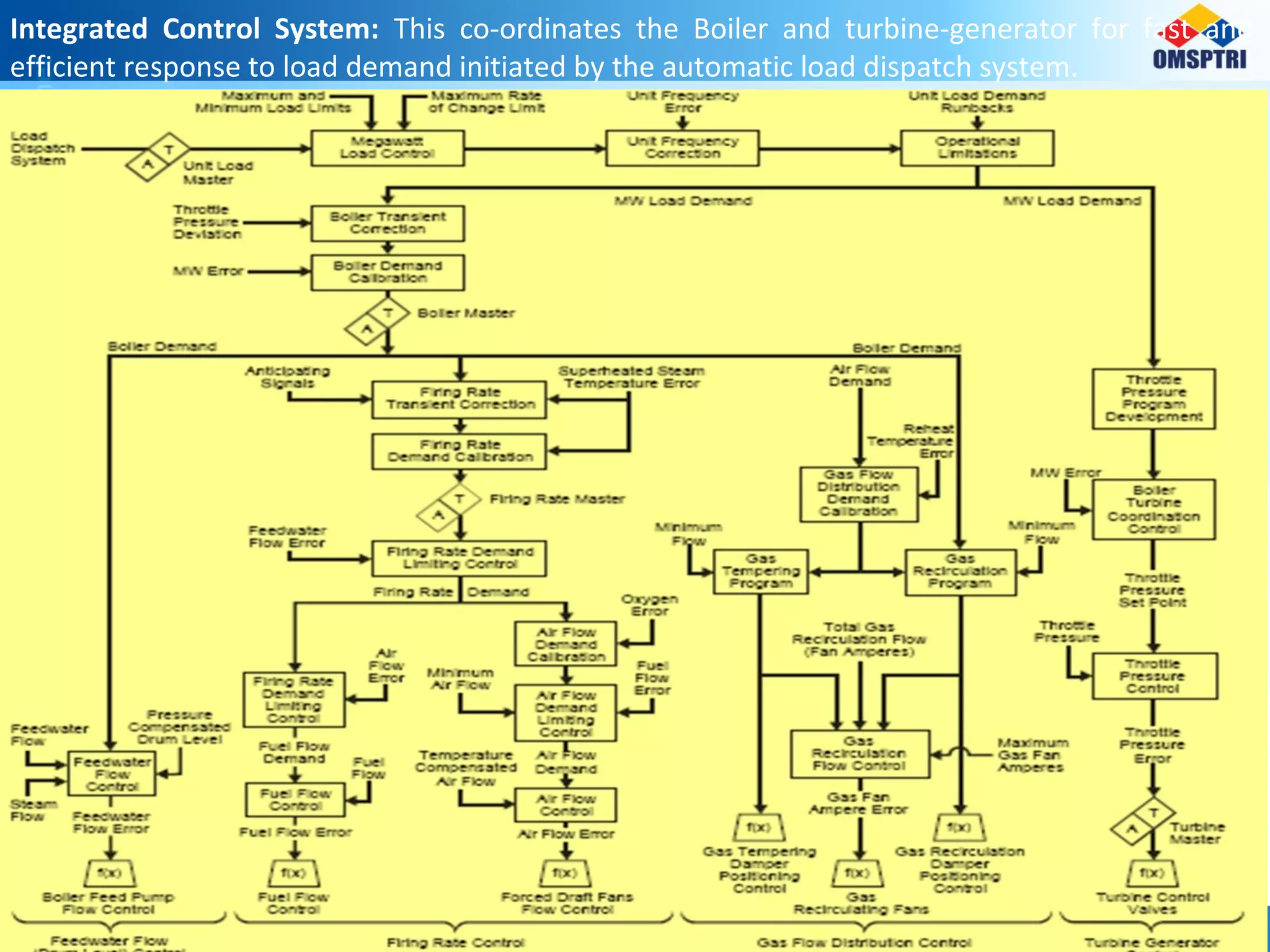
  • 155.
    Prediction of CoalDrying • For predicting the amount of coal drying which is needed from the pulverizers the following methods were accepted. • For very high rank coals (fixed carbon greater than 93 percent), an outlet temperature of 75 to 80° C appeared most valid. • For low- and medium-volatile bituminous coals, an outlet temperature of 65 - 70° C appeared most valid. • Bituminous coals appear to have good outlet moisture an outlet temperature of 55 to 60° C is valid. • For low-rank coals, subbituminous through lignite (less than 69 percent fixed carbon, all of the surface moisture and one-third of the equilibrium moisture is driven off in the mills.
  • 156.
    Logics and interlocksfor the following control Functions are realised in this section: 1. Selection and control of LP l.O. Pumps. 2. Selection and control of HP l.O.Pumps. 3. Control of reducer lube oil pump. 4. Control of ball & sockets lube oil pump. 5. Control of grease pump or greasing sequence. 6. Selection and control of trunnion seal air fans 7. Control of girth gear seal air fan. 8. Control of mill main motor. 9. Control of mill aux motor. 10. Control of P.A. Gen inlet shut-off gate. 11. Control level probe blow down sequence. 12. Mill start permissives. Control for mill and Common mill auxilliaries
  • 157.
    Logics and interlocksfor following Control functions are realized in this section: 1. Elevation start/stop controls. 2. Control of coal feeder. 3. Control of prg air damper. 4. Control of mill outlet gates. 5. Control of raw coal iso- gate. 6. Automatic start-up and shut-down sequence of elevation. CONTROLS FOR INDIVIDUAL ELEVATIONS :
  • 158.
    Depending on typeof mill envisaged, This section will have control and Interlocks for :- 1. Tube mill (one mill for 2 elevations). Or 2. Bowl mill (one mill for each elevation). Fuel coal section (mill section)
  • 159.
    MILL START UPSEQUENCE STEP ‘0’ COMMAND : CLOSING OF GATES/DAMPERS STEP ‘1’ COMM : GIRTH GEAR SEAL AIR FAN, TRUNNION SEAL AIR FAN ON COMM STEP ‘2’ COMM : PURGE AIR DAMPERS OPEN COMM (30 sec) STEP ‘3’ COMM : CLOSE COMM TO PURGE AIR DAMPERS STOP AUX MOTOR STEP ‘4’ COMM : MILL MAIN MOTOR START COMM STEP ‘5’ COMM : P.A. GENERAL I/L GATE OPEN COMM P.C. O/L GATES OPEN COMM STEP ‘6’ COMM : R.C. GATE OPEN COMM STEP ‘7’ COMM : FEEDER START COMM
  • 160.
    SHUT DOWN SEQUENCEIF OTHER ELEVATION IS NOT IN SERVICE STEP ‘1’ COMM: a) FEEDER STOP COMM & R.C. O/L GATE CLOSE COMMAND. b)MILL O/L GATES CLOSE. c) MILL MAIN MOTOR OFF COMM 5 Mts after elev d) MILL AUX MOTOR START COMM stop command e) P.A. GEN I/L GATE CLOSE COMM STEP ‘2’ COMM : OPEN COMM TO PURGE AIR DAMPERS STEP ‘3’ COMM : CLOSE COMM TO PURGER AIR DAMPERS (2.5 Mts after opening)
  • 161.
    STEP ‘1’ COMM: FEEDER STOP COMMAND R.C. O/L GATE CLOSE COMMAND MILL O/L GATES CLOSE COMMAND STEP ‘2’ COMM : OPEN COMM TO PURGE AIR DAMPER. STEP ‘3’ COMM : CLOSE COMM TO PURGE AIR DAMPER. SHUT DOWN SEQUENCE IF OTHER ELEV IS IN SERVICE
  • 162.
    MILL START PERMISSIVES 1.NOTRIP FROM MFT. 2.MILL LUBRICATION OK. 3.MILL IGNITION ENERGY AVAILABLE. 4.ELECT.MAGNET.BRAKE RELEASED. 5.BALL & SOCKET PUMP ON & ITS PRESS IS OK.
  • 163.
    ELEV- A IGNITIONPERMISSIVE AVAILABLE Elev-AB Proven Elev-B Air flow > 40 TPH Boiler load > 30% AND OR Ignition Permissive AvailableIgnition Permissive Available
  • 164.
    ELEV-B IGNITION PERMISSIVEAVAILABLE 3/4 Elev-AB guns proven Elev-C air flow > 40 TPH Elev- A air flow > 40 TPH Boiler Load > 30% OR AND OR
  • 165.
    Ignition Permissive notavailable Elev-A IGNITION PERMISSIVE NOT AVAILABLE 3/4 Elev-AB guns not proven Boiler load < 30% Elev-A air flow< 20 TPH Elev-B airflow < 20 TPH Elev-B IGNITION PERMISSIVE NOT AVAILABLE Elev-AB guns not proven Elev-C air flow< 20 TPH Elev-B airflow < 20 TPH Boiler load < 30% AND OR AND ANDAND OR
  • 166.
    1. Both TrunnionSeal air fans off > 30 Sec. 2. Mill Seal air pressure not correct.>60sec. 3. Both Mill Main Motor and Aux motor on for > 30 Secs. 4. Mill Emergency trip. 5. Mill bearing temp. very high. 6. P.A. Pressure very low. 7. Mill Reducer lubrication not o.k. MILL TRIPMILL TRIP
  • 167.
    8. Mill Bearinglub not o.k. 9. Girth gear greasing sequence not o.k. 10. Electromagnetic brake engaged. 11. Ignition Energy not available. 12. MFT. 13. Centrifugal safety is acted. 14.Both feeders off > 10 min. 15.Both PA Fans off.
  • 168.
    BOTH HP PUMPSOFF FOR > 5 SEC BOTH LP PUMPS OFF FOR >5 SEC LP OIL FLOW LOW (NDE) LP OIL FLOW LOW (DE) HP OIL PRESS V.LOW (NDE) HP OIL PRESS V.LOW (NDE) HP OIL PRESS V.LOW (DE) HP OIL PRESS V.LOW (DE) OR MILL BRG LUBRICATION NOT CORRECT
  • 169.
    AND MILL BRG LUBRICATIONO.K RED LUB O.K GIRTH GEAR GREASING SEQ O.K MILL LUBRICATION O.K (START PREM) FILTER GREASE BARREL M GREASE DIST GREASE DISTRIBUTOR AIR FILTER COMPRESSED AIR NOZZLE GREASE PUMP GREASE DISTRIBUTOR Grease Spray on to the Pinion
  • 170.
    LP OIL PUMP AND S R OR LPOIL COMP LEVEL ADEQ ORDER START AUTOMATIC ON COMM AUTOMATIC OFF COMM STOP COMM ANY LP PUMP ON & LP OIL FLOW LOW FOR > 60S ANY SIDE OIL FLOW LOW CHANGEOVER OF LP PUMP
  • 171.
    H.P. OIL PUMP AND S R HPOIL TEMP O.K OIL PRESS IN FEEDING LINE NOT LOW ORDER START ORDER STOP AUTOMATIC ON COMM AUTOMATIC OFF COMM B&S PUMP ALSO STARTS ALONG WITH H.P PUMP
  • 172.
    AND H.P OIL TEMPO.K OIL PRESS IN FEEDING LINE NOT LOW START PERMISSIVE FOR H.P & B&S PUMP. AND B&S PRESS NDE OR D.E V.LOW BOTH LP PUMPS OFF FOR >5 SEC BOTH HP PUMPS OFF FOR>5 SEC AUTOMATIC OFF COMM TO B&S PUMP
  • 173.
    AND H.P OIL TEMPO.K OIL PRESS IN FEEDING LINE NOT LOW START PERMISSIVE FOR H.P & B&S PUMP. AND B&S PRESS NDE OR D.E V.LOW BOTH LP PUMPS OFF FOR >5 SEC BOTH HP PUMPS OFF FOR>5 SEC AUTOMATIC OFF COMM TO B&S PUMP
  • 174.
    OR OIL PRESS INFEEDING LINE FOR > 5 SEC ANY H.P OIL PRESS LOW FOR > 5 SEC AUTOMATIC OFF COMM TO H.P PUMPS AND REDUCER LUB OIL FLOW LOW RED LUB OIL PUMP ON FOR > 10 SEC AUTOMATIC OFF COMM TO RED LUB OIL PUMP
  • 175.
    AND ON DEL 30 SEC MILL MAINMOTOR OFF AUX MOTOR OFF 2 SEC PULSE DURATION OFF COMM TO GIRTH GEAR SEAL AIR FAN. TRUN SEAL AIR PRESS NOT O.K. FOR >10 SEC WITH ANY TRUN SEAL AIR FAN ON TO CAUSE CHANGE OVER OF TRUN SEAL AIR FAN
  • 176.
    OR O N D E L REDUCER LUB OILTEMP V.HIGH 10 SEC RED LUB NOT O.K REDUCER LUB OIL FLOW LOW REDUCER LUB OIL PUMP OFF AND MILL BRG LUBRICATION O.K RED LUB O.K GIRTH GEAR GREASING SEQ O.K MILL LUBRICATION O.K (START PREM)
  • 177.
    O R R MILL OFF >30 SEC ORDERSTOP SEAL AIR PRESS NOT O.K. FOR >10 SEC ORDER START AUTOMATIC ON COMMAND TO TRUN SEAL AIR FAN AUTOMATIC OFF COMM MILL MAIN MOTOR OFF – AUTOMATIC OFF COMMAND FOR P.A GEN I/L SHUT OFF GATE. S RUNNING FAN TRIPS AND
  • 178.
    PURGE AIR DAMPERS AND ELEVIGNITION PERMIT AVAILABLE MILL RELEASE AVAILABLE START PERM O R ELEV IGN PERMIT NOT AVAILABLE MFR TRIP-1 MFR TRIP-2 AUTOMATIC OFF COMMAND
  • 179.
    PC O/L GATES ELEVIGN. ENERGY AVAILABLE START PERM. O R ELEV IGN. ENERGY NOT AVL MILL TRIP AVAILABLE AUTOMATIC OFF COMMAND
  • 180.
    AUX MOTOR AND START PERMMILLLUBRICATION CORRECT ELECTRO MAGNETIC BRAKE RELEASED MILL MAIN MOTOR OFF FOR >1 SEC O R AUTOMATIC OFF COMMAND MILL MAIN MOTOR ON MILL LUBRICATION NOT CORRECT ELECTRO MAGNETIC BRAKE ENGAGED FOR >10 SEC
  • 181.
    R.C FEEDER A N D START PERMISSIVE MILLMAIN MOTOR ON FEEDER IN REMOTE MILL RELEASE AVL MILL O/L TEMP OK MILL O/L GATE Side Open RC SHUTOFF GATE OPEN NO MFR-1 NO MFR-2
  • 182.
    R.C FEEDER O R AUTOMATIC OFF COMMAND FDRON FOR >2 SECS AND RC SHUT OFF GATE CLOSED MFR TRIP-2 AVAILABLE MFR TRIP-1 AVAILABLE MILL O/L GATE SIDE CLOSED MILL MAIN MOTOR OFF FDR ON & NO COAL ON BELT FOR > 100 SEC ELEV IGN ENERGY NOT AVL SCAN DUCT TO FURN ΔP – START COMM FOR STAND BY SCAN FAN BOTH F.D.FANS OFF – AUTOMATIC OPEN COMMAND FOR SCAN EMER DAMPER. ANY F.D. FAN ON – AUTOMATIC CLOSE COMM FOR SCAN EMER DAMP.
  • 183.
    OPERATIONS AND MAINTENANCECONTROLLABLE FACTORS • Four controllable heat rate factors are directly related with furnace performance and furnace flue gas uniformity. • These are: superheater temperature, reheater temperature, desuperheating spray water flow to the superheater, and desuperheating spray water flow to the reheater • Balancing of the fuel and air to each burner has much to do with furnace combustion efficiency, and the completeness of combustion at the furnace exit. • The residence time of the products of combustion from the burners to the superheater flue gas inlet is about one or two seconds. • Not very long for furnace mixing of fuel rich and air rich lanes of combustion products. • Optimized combustion at the superheater inlet can be quantified by use of a water-cooled high velocity thermocouple probe.
  • 184.
    • Slagging atthe superheater flue gas inlet has been a problem in a number of boilers due to stratified flue gas. • Slagging at the lower furnace results in large boulder sized clinkers blocking the lower ash hopper. • Tube spacing becomes ever closer as the heat transfer changes from radiant in the furnace, to convective in the back pass. • Example: The typical tube spacing of pendant superheater and reheater tubes. • If lanes in the furnace outlet flue gas approach the ash softening or even the ash fluid temperature, upper furnace slagging and blockage can result in a very short time. • Several cases studies should be reviewed to show how the application will improved slagging, heat-rate, capacity factor, reliability, NOx and/or fly ash carbon content.
  • 185.
    Superheater Superheated steam boilersvaporize the water and then further heat the steam in a superheater. This provides steam at much higher temperature, but can decrease the overall thermal efficiency of the steam generating plant because the higher steam temperature requires a higher flue gas exhaust temperature. There are several ways to circumvent this problem, typically by providing – an economizer that heats the feed water, – a combustion air heater in the hot flue gas exhaust path, – both.
  • 186.
  • 187.
    Advantages of SuperheatedSteam • Increase overall efficiency of both steam generation and its utilisation • Gains in input temperature to a turbine outweighs any cost in additional boiler complication and expense. • Almost all steam superheater system designs remove droplets entrained in the steam to prevent damage to the turbine blading and associated piping. • Overcomes the practical limitations in using wet steam, as entrained condensation droplets will damage turbine blades
  • 188.
    Superheater Operation • Itis similar to that of the coils on an air conditioning unit, although for a different purpose. • The steam piping is directed through the flue gas path in the boiler furnace. • The temperature of flue gas in this area is typically between 1300–1600 degrees celsius (2372–2912 °F). • Some Superheaters are radiant type; that is, they absorb heat by radiation. Others are convection type, absorbing heat from a fluid. Some are a combination of the two types.
  • 189.
    Safety Concerns- SuperheatedSteam • If any system component fails and allows steam to escape, the high pressure and temperature can cause serious, instantaneous harm to anyone in its path. • Since the escaping steam will initially be completely superheated vapour, detection can be difficult, although the intense heat and sound from such a leak clearly indicates its presence. • While the temperature of the steam in the superheater rises, the pressure of the steam does not and the pressure remains the same as that of the boiler. •
  • 190.
    LTSH METAL TEPERATURES PNGPT 1 PNG PT 14 5 13 6 12 11 10 9 8 7 4 3 2 1 2 3 MAX TEMP:449 DEG C
  • 191.
    ITSH METAL TEPERATURES 1 PNGPT 15 5 13 6 12 11 10 9 8 7 4 3 2 1 MAX TEMP:528 DEG C 16 14 2 4 3 6 5 7 22 24 23 25 15 16 13 14 12 9 26 11 18 19 17 20 8 21 10
  • 192.
    HTSH METAL TEPERATURES PNGPT 1 PNG PT 14 5 13 6 12 11 10 9 8 7 4 3 2 1 2 3 MAX TEMP:563 DEG C 15 16 4 5 6 7 8
  • 193.
    Heat Flux Meter •A heat flux entering steam generating tubes in power station boilers is a critical factor in considering the safety of the tubes. • Provides the knowledge of the distribution and magnitude of this flux during the operation of the power boiler is very important. • The furnace wall metal temperatures are the functions of the heat fluxes and the internal heat transfer coefficients. • In this study, a measuring device (flux-tube) and a numerical method for determining the heat flux in boiler furnaces, based on experimentally acquired
  • 194.
    Heat Flux Meter •An inverse method helps estimate the following parameters from temperature measurements at several interior locations of the flux-tube : • the absorbed heat flux, • the heat transfer coefficient on the inner tube surface • the temperature of water-steam mixture. • The number of temperature sensors (thermocouples) is greater than three because the additional information can aid in more accurate estimating the unknown parameters. • The temperature dependent thermal conductivity of the flux-tube material is assumed.
  • 195.
    Main Steam temperaturecontrol • Measurement of S.H outlet temperature primarily used for the control of main steam temperature • Air flow signal is used as feed forward signal to control the spray to the S.H attemperator • Rate of change of temperature at the attemperator outlet is used to trim the control
  • 196.
    S H H 7 1 LEFT 2 RIGHT LEFT RIGHT S H H 8 S H H 9 S H H 6 S H H 5 S H H 4 S H H 3 LTSH ITSH HTSHHP FROM DRUM TO HPT SPRAYWATER 415 0 C 540 0 C 540 0 475 0 C 475 0 C 480 0 C 480 0 C394 0 C 394 0 C 150 Kg/Cm2 150 Kg/Cm2 415 0 C 150 Kg/Cm2 150 Kg/Cm2
  • 197.
    Steam Temperature controlwith 2 stage Attemperation
  • 198.
    Reheat steam temperature •Reheat steam temperature is primarily controlled by burner tilt /gas by-pass on the case may be secondary control is provided by the attemperator • Using the attemperator (sprom) for control leads to loss of efficiency and should not be used as primary control • Control philosophy for the attemperator is similar to that of main steam
  • 199.
    R H H 4 LEFT RIGHT R H H 3 R H H 2 R H H 1 LTRH HTRH FROM CRH TO IPT SPRAYWATER 35 Kg/Cm2 340 0 C 340 0 C 405 0 C 405 0 C 540 0 C 540 0 C408 0 C 408 0 C 35 Kg/Cm2 35 Kg/Cm2 35 Kg/Cm2
  • 200.
    HTRH METAL TEPERATURES PNGPT 1 PNG PT 14 5 13 6 12 11 10 9 8 7 4 3 2 8 7 6 MAX TEMP:579 DEG C 15 16 5 4 3 2 1
  • 201.
    Superheat and reheattemperature control The main steam temperature at boiler outlet is done through a temperature control system that distributes the boiler heat between steam generation, steam superheating and steam reheating. The various methods used for controlling steam temperature are: •attemperation, •gas proportioning dampers, •gas recirculation, excess air, •burner tilt control, •divided furnace with differential firing and •separately fired superheaters.
  • 202.
  • 203.
    Boiler AIR ANDFLUE GAS SYSTEM The boiler air and flue gas system consists of combustion air system, gas recirculation system  flue gas system.
  • 204.
  • 205.
    • The gasrecirculation fan draws flue gas from the economizer outlet flue gas duct and discharge gas to the furnace. • Modulating inlet damper controls gas recirculation flow rate. The gas recirculation flow set point is derived from the reheat steam temperature control.
  • 206.
  • 207.
  • 208.
    Water-tube boiler furnacesand gas flow patterns, (a) front-wall- fired furnace, (b) opposed-wall-fired furnace, (c) corner-fired furnace (horizontal section) x burners.
  • 209.
    SEPARATELY FIRED SUPERHEATERARRANGEMENT • Water Drum(10) is connected to a steam drum(11) by a substantially vertical bank(12) of generating tubes. • The furnace space at the side of the bank opposite the boiler offtake (13) is divided to form a superheater furnace chamber(15) provided with individual fuel feeding means (16,17). • Baffles prevent flow of gases from boiler chamber(14) to superheater chamber(15). • Greater part of fuel for a load SP is burned in the boiler furnace and superheating there by of gases passing therefrom over the superheater (21). • The rest fuel is burned in superheater furnace to get the final MS temperature. • If final SH temperature increases firing in superheater furnace is decreased and that in boiler furnace is increased and viceversa.
  • 210.
    Process Control forOptimisation Combustion control – fuel and air to boiler • Steam pressure signal is primarily used for controlling the fuel flow and air flow to the boiler • Steam flow signal is used for feed forward control • It is ensured that the air flow is more than the optimum excess air during the transient load variation and restored to optimum during stable load condition • Measurement of O2 & CO is used to trim the air flow
  • 211.
    A combustion controlsystem regulates the fuel and air input, or firing rate, to the furnace in response to a load index. •The demand for firing rate is, therefore, a demand for energy input into the system to match a withdrawal of energy at some point in the cycle. •For boiler operation and control systems, variations in the boiler outlet steam pressure are often used as an index of an unbalance between fuel- energy input and energy withdrawal in the output steam. Combustion control systems (air and fuel flow control)
  • 212.
    WHAT IS AGOOD COMBUSTION? GOOD COMBUSTION MEANS:- 1) Stable Combustion. 2) Non flickering and non pulsating flame. 3)Does not require oil support if mills are operated as per FSSS logic. 4)High efficiency, i.e., ensuring minimum mechanical and chemical unburnts. 5) Will cause the least erosion and tube failures.
  • 213.
    HOW TO RECONGINSEGOOD COMBUSTION?  COLOUR OF FLAME AT BURNER ELEVATION OBSERVED THROUGH PEEP HOLES  COLOUR- PALE ORANGE WHILE ON COOL FIRING  FLAME 300 TO 400 mm AWAY FROM BURNER TIP.  FLAME TEMP. 1050 Deg.C TO 1150 Deg.C (AS MEASURED BY OPTICAL PYROMETER)
  • 214.
    COAL CALCULATION  AirFuel ratio is defined from stoichiometry theory after we find Boiler capacity, coal specification and excess air set for perfect combustion.  One of the most important items is that the correct amount oxygen must be supplied per unit weight of fuel burned to provide complete combustion.  In addition to the correct “air-fuel” mixture, time must be allowed for complete mixing and burning, and the furnace temperature must be such as to support combustion.
  • 216.
    BOILER CAPACITY The BoilerCapacity is defined based on the following Generator load demand Coal calorific value. Output steam parameters of super-heater & re- heater Input water to economizer, flue gas parameters to air heater
  • 217.
    EXCESS AIR  Itis supplying just the correct amount of oxygen to assure complete combustion.  It deals the difficulty of supplying sufficient oxygen for complete combustion, while maintaining the nitrogen .  It is the relation of the amount of air actually supplied to that theoretically required for combustion, that is the measure of the efficiency of combustion.
  • 218.
    • Nitrogen %in air into the furnace is around 4 times the oxygen % in air which is responsible for combustion of fuel. • It is an inert gas which performs no function in combustion. • As it passes through the furnace, absorbs heat and reduces the temperature of the products of combustion, i.e. flue gas. • Hence it is the principal source of heat loss in combustion.
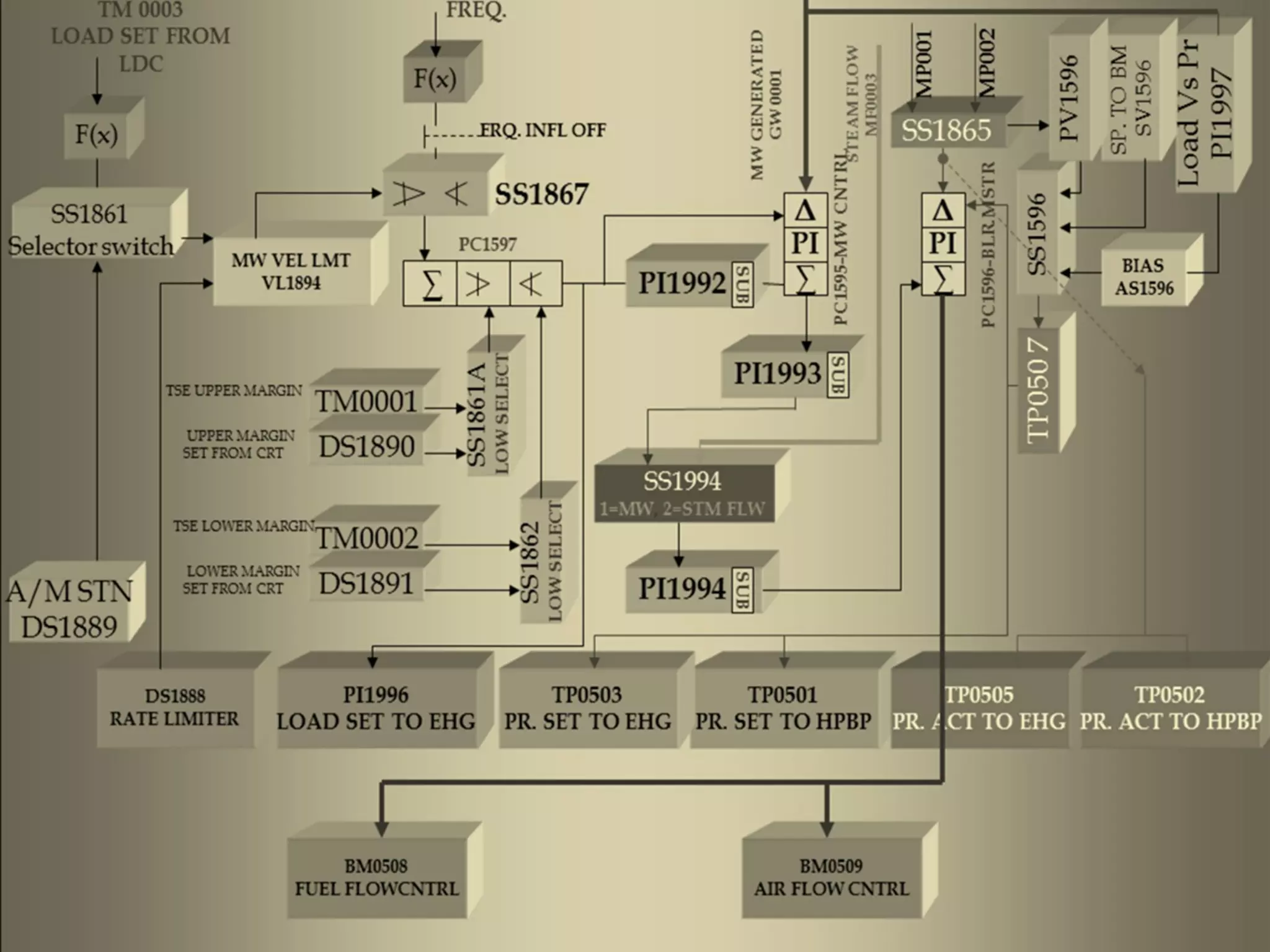
  • 219.
    • Any oxygensupplied to the furnace in excess of that required for combustion results in the same losses as in the case for nitrogen, and furthermore, such excess oxygen is accompanied by additional nitrogen which accentuates the combustion losses. • On the other hand, when there is insufficient oxygen for complete combustion, the nitrogen losses become inappreciable, when compared to the losses caused by the incomplete combustion of the carbon fuel. • If insufficient oxygen is present, carbon will not combust to CO2 (carbon dioxide) but to CO (carbon monoxide). From data previously presented, burning one pound of carbon to CO2 will release approximately 14,540 BTU's, while burning the same amount of carbon to CO will only release approximately 4,380 BTU's. • Hence an optimum amount (3-4 %) of oxygen in flue gas at air heater inlet is maintained for effective combustion, that prevents insufficient combustion as well as heat loss due to high % of nitrogen in excess air.
  • 220.
    It is veryclear that controlling the amount of oxygen required for combustion is critical. The right amount of oxygen is supplied for the complete combustion of the fuel, means Stoichiometric Combustion.
  • 221.
    An insufficient amountof air is supplied to the burners causes the following •unburned fuel •soot and smoke •carbon monoxide (the incomplete conversion to carbon dioxide) appear in the exhaust from the boiler stack •heat transfer surface fouling •Pollution •lower combustion efficiency •flame instability (i.e., the flame blows out), and the potential for an explosion. To avoid these costly and potentially unsafe conditions, boilers are normally operated at excess air levels. This excess air level also provides operating protection from an insufficient oxygen condition caused by variations in fuel quality, and variation in fuel demand from MW control.
  • 223.
    • It isimportant to understand that "excess air" and"excess oxygen" are not the same. • The air we breathe is roughly 21% oxygen by volume. • A 50% excess air condition implies approximately 10.5% oxygen remains in the boiler exhaust stack. While insufficient air to the burners can be dangerous, air flows in excess of those needed for stable flame propagation and complete fuel combustion needlessly increase flue gas flow and consequent heat losses, thereby lowering boiler efficiency. • Minimizing these losses requires monitoring and periodic tuning. • Ideally, the fuel/air ratio is automatically controlled based on the percentage of O2 in the stack, and an unburned hydrocarbons indication. • These automated systems are called O2 trim packages.
  • 224.
    CHIMNEY(60 meters) SO2 547ppm (2000 ppm)) NOX 537 ppm (750 ppm) CO 27 ppm CO2 12 % O2 3 %
  • 225.
    ANALYTICAL INSTRUMENTS In powerplant continuous online quantitative analytical instruments are used which can be broadly classified as stack monitoring instruments, gas analysers and steam and water analysers . However, a few more portable instruments are used in chemical laboratory. The instrumentation system may be in-citu or with an additional sampling system.
  • 226.
    An oxygen sensor,or lambda sensor, is an electronic device that measures the proportion of oxygen (O2 ) in the flue gas at air heater inlet. The original sensing element is made with a thimble-shaped zirconia ceramic coated on both the exhaust and reference sides with a thin layer of platinum and comes in both heated and unheated forms. The recent planar-style sensor reduced the mass of the ceramic sensing element as well as incorporating the heater within the ceramic structure has fast response
  • 227.
    Ultraviolet (UV) TypeGas measuring principle Ultraviolet (UV) light is often used for the analysis of NO, NO2 and SO2. Often, when the UV measuring principle is used it is actually the NDUV (Non Dispersive Ultraviolet) principle. The measurement is made by leading a gas flow through a cuvette where the UV light source and the optical filter have been placed at one end of the cuvette and a detector has been placed at the other end. The UV light source sends out a scattered UV light, and the wave length of the light that is led through the gas in the cuvette is determined by the optical filter installed between the light source and the cuvette. Different kinds of wave lengths of UV light are used to analyse different gasses.
  • 228.
    Dust and Opacitymonitor •When a beam of light crosses a medium containing smokes or dust particles, some of the light is transmitted and some is lost due to scattering. •The fraction, which is transmitted, is called the transmittance and the fraction, which is lost, is the opacity.
  • 229.
    3. Feed watercontrol • There is a feed water regulating station with there control valves; one for 0-25% load and two for full load all are connected in parallel • In conjunction with feed regulating station , speed control of BFP is provided to reduce the throttling losses across the control valve • Recirculation control is provided to maintain minimum flow required to prevent flashing in the pump casing
  • 230.
  • 231.
    DRUM LEVEL MEASUREMENT-DIFFERENTIALMEASUREMENT METHOD –HYDRASTEP ELECTRODE
  • 232.
  • 234.
    RING HEADER BLOW DOWNHEADER ECONOMISER HANGER TUBES 345 DEG.C 346 DEG.C 346 DEG.C 342 DEG.C 343 DEG.C 343 DEG.C -214 mm -202 mm -177 mm -247 mm -179 mm -22mm B-15 B-16 E-2 B-67 B-68 B-70 B-71 B-60 B-61 IBD IBD CBD 163.3 KG/SQCM DRUM LVL DRUM TEMP DRUM PRESS
  • 235.
    • Drum waterlevel is one of the most important measurement for safe and reliable Boiler operation. • If the level is too high, • water flows into the superheater with droplets carried into the turbine. • leaves deposits in the superheater and turbine • causes superheater tube failure • turbine water damage. • Low water level would cause • starvation in water tube • overheating • failure.
  • 236.
  • 237.
    In single elementfeed water control the water in the drum is at the desired level when signal from the level transmitter equals its set point. If a deviation of water level exists, the controller applies proportional plus integral action to the difference between the drum level and set point signals to change the position of the regulating valve. Feedwater control systems: This regulates the flow of water to a drum-type Boiler to maintain the level in the drum within desired limits. They are classified as one-, two- or three-element feed water control systems.
  • 238.
    DRUM LEVEL CONTROLCONV MASTER In the boiler the steam flow changes according to the load demand from the turbine or from the process consuming the steam energy. To match the steam take off from the boiler, the feed water flow has to be increased or decreased as required. Single Element Control During low load operation, three- element control is not required. •Drum level measurement with it's set point is adequate. •The output of the Drum Level Controller is directly given to the Feed water by-pass Control Valve. •It is difficult to obtain steam and water flow accurately because flow transmitters are usually calibrated for high load operation. Hence it’s transferred to single element control where drum level is the only variable in the control scheme.
  • 239.
    The Kvs canbe thought of as being the actual valve capacity required by the installation and, if plotted against the required flow rate, the resulting graph can be referred to as the 'installation curve. The graph looks like linear due to a few data. Boiler Feed Pump discharge pressure usually fixed 125 bar. After Feedwater by-pass control valve almost maximum, this is the time to change master control from single element to three element control called Boiler Feed Water Pump Conversion Master. Valve capacities are generally measured in terms of Kvr which is equal to Kv*(DP)^0.5. More specifically, Kvs relates to the pass area of the valve when fully open, whilst Kvr relates to the pass area of the valve as required by the application. BOILER FEEDPUMP CURVE
  • 240.
    Three Element Feedwater Control For automatic control of the feed water flow to the boiler, following three(elements) primary inputs are normally being considered. Drum level, Main Steam flow, Feed water flow. The different of steam flow and feed water flow will trigger to controller also change of level drum as a picture below. The valve DP is the difference between the pump discharge pressure and a constant boiler pressure of 10 barg. Note that the pump discharge pressure will fall as the feed water flow increases. This means that the water pressure before the feed water valve also falls with increased flow rate, which will affect the relationship between the pressure drop and the flow rate through the valve. Fluid coupling with a scoop tube adjust is maintain pump discharge is 10 bar above steam drum pressure.
  • 241.
    The control appliesproportional action to the error between the drum level signal and its set point. The sum of the drum level error signal and the steam flow signal is compared with water flow input and the difference is the combined output of the controller. Proportional plus integral action is added to provide a feed water correction signal for valve regulation or pump speed control.
  • 242.
    Two-element control comprisesfeedforward control loop which utilizes steam-flow measurement to control feedwater input, with level measurement assuring correct drum level. Three-element control is a cascaded-feedforward control loop which maintains water flow input equal to feedwater demand. Drum level measurement keeps the level from changing due to flow meter errors, blowdown , or other causes.
  • 245.
    Feed water heatingand deaeration The feed water used in the steam boiler is a means of transferring heat energy from the burning fuel to the mechanical energy of the spinning steam turbine. The total feed water consists of recirculated condensate water and purified makeup water. The metallic materials it contacts are subject to corrosion at high temperatures and pressures, hence the makeup water is highly purified before use. A system of water softeners and ion exchange demineralizers produces water so pure that it coincidentally becomes an electrical insulator, with conductivity in the range of 0.3– 1.0 microsiemens per centimeter. SWAS : Is a system for on-line measurement of pH,
  • 247.
    PH 8.8 TO9.2 8.83 CONDUCTIVITY micromho/cm2 <5 3.33 TOTAL HARDNESS NIL NIL SILICA < 0.02 ppm 0.007 ppm CONDENSATE
  • 248.
    PH 8.8 TO9.2 8.83 CONDUCTIVITY micromho/cm2 <5 3.33 TOTAL HARDNESS NIL NIL SILICA < 0.02 ppm 0.007 ppm HYDRAZINE 0.02 -0.03 ppm 0.02 AMMONIA <1.0 ppm 0.16 FEED WATER
  • 249.
    PH 9.4 TO9.7 9.58 CONDUCTIVITY micromho/cm2 <100 24 TOTAL HARDNESS NIL NIL SILICA < 0.02 ppm 0.007 ppm PHOSPHATE 3 - 8 ppm 4.4 BOILER DRUM
  • 250.
    PH 8.8 TO9.2 8.83 CONDUCTIVITY micromho/cm2 <5 3.51 TOTAL HARDNESS NIL NIL SILICA < 0.02 ppm 0.007 ppm SATURATED STEAM
  • 251.
    PH 8.8 TO9.2 8.83 CONDUCTIVITY micromho/cm2 <5 3.51 TOTAL HARDNESS NIL NIL SILICA < 0.02 ppm 0.007 ppm MAIN STEAM
  • 252.
    Monitoring and maintainingproper chemical conditions are essential for reliable and efficient power plant operation. Failure to meet purity and chemical composition requirements can lead to inefficient operation and eventually component failure.
  • 253.
    Several types ofmeasurements can be done on a continuous basis in the process stream. For example, conductivity and pH. These analyses can be performed by in-line analyzers.
  • 254.
    There are alsosemi-continuous methods that, because of their monitoring techniques, can not be made completely continuous. Examples of semi-continuous monitors are ones that require addition of one or more reagents that react with the sample prior to detection. These semi-continuous monitors have a controlled cycle time, or time interval, between repetitive sample introductions. The cycle time is long enough to allow detection but short enough to maintain the timely reporting of data. Silica, phosphate, and hydrazine inline analyzers are examples of this type of monitor.
  • 255.
    The most basicin-line analyzers are pH, conductivity, and oxygen monitors. These monitors have been in use for a long time. In-line monitoring systems may reduce the number of analyses performed by the chemistry staff and can provide accurate and reliable indications to the operating group.
  • 256.
    In-line monitor alarmsare sometimes ignored. The alarm is often given low priority because it is assumed to be due to a malfunctioning analyzer, or to loss of sample flow. In-line monitors that continually alarm due to these causes foster this belief by frequently "crying wolf". When the monitor does alarm due to an action level incident, and it is again given low priority, serious consequences can ensue.
  • 257.
    It is thereforeimportant that in-line monitors be maintained in good operating condition so they will be reliable. Perpetually malfunctioning monitors or sample pumps should be replaced. The integrity of the in-line chemistry monitoring system must be held in high regard. It is dependent on the effort expended by laboratory staff and instrumentation personnel to assure the system's accuracy and reliability. The main purposes of analyzers are to: Signal the existence of corrosive conditions within the system. Indicate the amount of scale-forming substances in the system. Monitor the carry-over in the steam. Monitor demineralizer effluent quality.
  • 258.
    pH Analysers Monitoring thepH of water gives an indication of the acidity or alkalinity of the solution. This is important since both high pH (alkalinity) or low pH (acidity) can contribute to the corrosion of plant equipment. Proper control of pH can reduce corrosion along with maintaining the integrity of protective films on metal surfaces. Continuous in-line pH monitoring is a simple and reliable method of measuring the acidity of water.
  • 259.
    In a powerplant, the pH is usually monitored at the economizer inlet and in the boiler water. In a system with mixed metallurgy, the pH is normally maintained between 8.8 and 9.3 (low enough so ammonia will not corrode copper, but high enough so that iron is protected). In all steel systems, the pH is normally maintained somewhat higher, between 9.0 and 9.6 to provide greater protection for the iron surfaces.
  • 260.
    In order tomaintain these pH levels, either ammonia or morpholine is added to the system. Since the amount of Morpholine added to the system will effect the final system pH, there must be some feedback between the pH controlling chemical addition and system pH.
  • 261.
    Water chemistry monitoringprovides essential information to the plant staff so that the plant can be operated at optimum efficiency. A variety of instruments and methods are used to analyze system streams throughout the power generation cycle.
  • 262.
    History has shownit is impossible to control system pH without considering the chemical composition of the fluid, as well as process temperature, pressure and flow rate. pH control systems can range from very simple ON / OFF control, to more complex feedforward / feedback control loops.
  • 263.
    Conductivity is theability of a material to carry an electrical current. The measurement of specific conductivity is the most common of the conductivity measurements in a power plant. It gives a good indication of the concentration of dissolved solids, or ionic impurities in the sample.
  • 264.
    Since water isa poorly ionizing substance, the addition of even the slightest trace of electrolytic material causes a large increase in conductivity. For example, a solution of pure water will double its conductance with the addition of 1 ppm of a typical salt, and 1 ppm of a strong acid will increase the specific conductivity by as much as 500%
  • 265.
    Dissolved Oxygen Analyzers Oxygenis a main factor in boiler system corrosion. Dissolved oxygen, in boiler water containing traces of chlorides or solids, is a common cause of pitting corrosion on metal surfaces. To prevent corrosion, oxygen and other gases are removed from the feedwater before it enters the boiler. Removal can be accomplished either mechanically or chemically. Deaerators are mechanical means of removing dissolved oxygen. The injection of chemicals, known as oxygen scavengers, such as sulfites or hydrazine will also reduce the levels of oxygen dissolved in the feedwater.
  • 266.
    In-line monitoring ofdissolved oxygen, or DO, is performed at several points in the cycle, •the condensate pump discharge, •the deaerator inlet and outlet, •the economizer inlet. Typically, the dissolved oxygen concentration at the condensate pump discharge is less than 20 ppb. The deaerator normally reduces the DO content to below 7 ppb. The chemical oxygen scavengers further reduce the DO content to less than 5 ppb at the economizer inlet.
  • 267.
    DEAERATOR -2200 -2000 1000 -1500 -1000 -500 0 500751 mm 700 mm 722mm BFP SUCTION CRH BFP’S RECIRCULATION DEA LVL DR TANK 1500 8 Kg/Cm2 160 0 C 1800 EXT-4 HPH-5 DRN HPH-6 DRN LPH-3 680 T/hr 6 Kg/Cm2 6 Kg/Cm2 APRDS
  • 268.
    LTRH LTSH HTSH HTRH ITSH/HP LTRH LTSH HTSH ECO ECO ITSH/HP HTRH WATER WALLSB LONG RETRACTABLE SB HALF RETRACTABLE SB front left rear right Acoustic Steam Leak Detector
  • 269.
    Acoustic Steam LeakDetector Benefits of the early detection of tube leaks: • Increased Personnel Safety • Early warning of a small boiler tube leak can prevent expensive secondary damage and unscheduled outages • Increased availability, reduces repair time, and increases plant efficiency • Planned and scheduled orderly shutdown of a boiler at the most convenient time • An increase in boiler availability of just one day will more than cover the cost of a leak detection system • Safeguards your investments • Increased operating profits by Reducing Financial Penalties • Other benefits include the Detection of abnormal boiler operating conditions, for example the incorrect operation of soot blowers, inspection ports being left open, and steam leaks external to the boiler
  • 270.
    4. Control ofsecondary condensate / drain in the feed heaters • Drain is cascade from higher pressure heaters to lower pressure heaters to maintain a constant level in the heater shells ultimately dumping in the dearator (D/A) or condenser hot well as the case may be . •Some times, it is advantageous to dump the drain of L.P heaters in to the D/A to conserve all the heat with out losing to the C.W , even if requires a drain pump
  • 271.
    Automatic control systemusually consist three kind, •Proportional, •Combination of Proportional & Integral •Combination of Proportional-Integral-Derivative Control. BASIC CONTROL
  • 272.
  • 273.
    Proportional Control • Producesoutput proportional to error. • The greater the error, the greater the control effort; and as long as the error remains, the controller will continue to try to generate a corrective effort.
  • 274.
    Gain of thecontroller The constant of proportionality is the Gain of the controller, which is related to the proportional band of the controller.
  • 275.
    Example of Gain 0% 1000 C 70% 1700 C 100% 2000 C 0% 100% %output Electricaloutput 4mA 20 mA % Measured Value Measured Temperature % PB = 70 A controller has input range of 1000 C - 2000 C and its output is current in the range 4 -20 mA. What is the numerical gain of the controller?
  • 276.
    Gain of theController The numerical gain of the controller is the numerical value of the slope of the output/input graph. If the controller has 70% proportional band(PB) then Gain = input output in in change change fractional Fractional 100% of(20 mA – 4 mA) 70% of (2000 C - 1000 C) = = 16 mA 700 C = 0.229 mA/0 C In some cases if output span = input span then Gain = 100 / %PB
  • 277.
    A mechanical flowcontroller manipulates the valve to maintain the downstream flow rate in spite of the leakage. The size of the valve opening at time t is V(t). The flowrate is measured by the vertical position of the float F(t). The gain of the controller is A/B. This arrangement would be entirely impractical for a modern flow control application, but a similar principle was actually used in James Watt’s original fly-ball governor. Watt used a float to measure the speed of his steam engine (through a mechanical linkage) and a lever arm to adjust the steam flow to keep the speed constant.

  • 278.
    Flow control example Aportion of the water flowing through the tube is bled off through the nozzle on the left, driving the spherical float upwards in proportion to the flow rate. If the flowrate slows because of a disturbance such as leakage, the float falls and the valve opens until the desired flow rate is restored. In this example, the water flowing through the tube is the process, and its flow rate is the process variable that is to be measured and controlled. The lever arm serves as the controller, taking the process variable measured by the float’s position and generating an output that moves the valve’s piston. Adjusting the length of the piston rod sets the desired flow rate; a longer rod corresponds to a lower set point and vice versa.
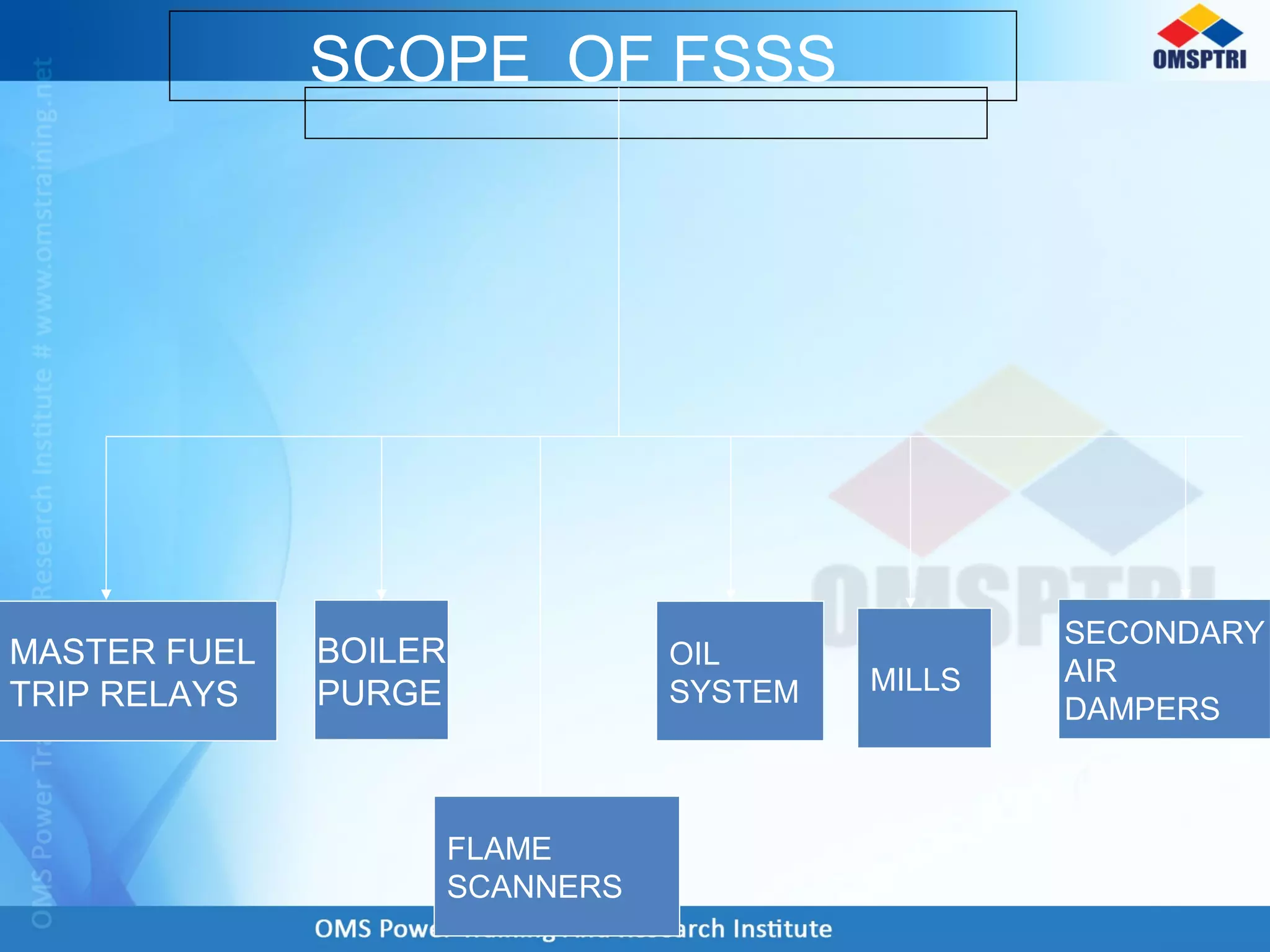
  • 279.
    Proportional Control Terminology PercentageValues of Controller output: •In a practical situation the controller will only recognize variations of the signal between the lowest possible level i.e. 0% and the maximum possible level i.e. 100%. •Thus process control engineers talk of in terms of percentage values of pressure, temperature, flow etc. instead of actual values.
  • 280.
    An Example Suppose atemperature controller works within the range of 200° C and 500° C Then 200 refers to 0% of measured value and 500 refers to 100% of measured value Span of the instrument = 500 – 200 = 300° C If set point of the controller is 350° C and the the value of the output temperature is 300 ° C Then Actual Deviation = 350 – 300 = 50 ° C % Deviation = actual dev / Measurement span X 100 = 50 / 300 X100 = 16.67%
  • 281.
    Proportional Band • ProportionalBand of the controller is the %deviation which gives rise to 100% change in controller output. Thus a narrow proportional band means a small change in deviation produces a large change in controller output. Or the controller has a large Gain. Proportional Band 0 10 20 30 40 50 60 70 80 90 100 0 20 40 60 80 100 Set Point %ControllerOutput 20% Proportional Band 200% Proportional Band 100%Proportional Band
  • 282.
    Proportional Control &Steady State Error An important property of proportional control is that there will always be a steady state error or offset. Thus the controlled out put will never match the set point. Increase of gain can reduce the offset but this can never be zero, also too much increase of gain can cause the system to become unstable.
  • 283.
    Response of ProportionalController 200% PB 100% PB 20% PB • Even with 20%PB there is offset. • Narrow bands like 20% are not common. 100 TIM
  • 284.
    Effect of adjustmentof PB on the system Smaller Proportional band 1. Faster response 2. Less stability 3. Low offset Larger Proportional band 1. Slow response 2. More stable 3. Large offset We saw that for proportional action there will always be an offset no matter how high the gain of the controller. So what we need is a mechanism which will cause the controller output to increase as long as the offset remains. Only when the offset is zero will the controller output be constant.
  • 285.
    The same mechanicalcontroller now manipulates the valve to shut off the flow once the tank has filled to the desired level Fset . The controller’ gain of A/B has been set much lower, since the float position now spans Integral Action
  • 286.
    Integral Action The ProportionalIntegral controller integrates the error signal so long as the error exists to obtain zero offset. Integral action is also called Reset action
  • 287.
    PI Control From thefigure we can see the law for PI Control. Controller output = K E + ∫1 1 T E dt Where KE is the contribution of the proportional controller ∫1 1 T Edt is the integral contribution.and K T1 is called Integral Action Time or Reset Time
  • 288.
    Integral Time orReset Time Larger Reset time less Integral action Smaller Reset time more Integral action Reduction of Integral action • System takes more time to reach zero offset. • Less overshoot • More stable system
  • 290.
    The Derivative Action Inthe figure a) shows setpoint b) shows system output and c) shows error for a PI controller. The error waveform has a wrong shape to produce the response i.e. output reaches final value without overshoot. Thus the shape of the controller output should be d) i.e. the controller goes negative to prevent overshoot. e) The additional signal is given by Derivative of the error (f).
  • 291.
    DERIVATIVE KICKER Derivative kickeris used for elimination excessive overshoot at begin and undershoot control after reaching the set point. As we know that proportional-integral control already have overshoot and undershoot and will reduce by integral control but output will take long time to reach the set point. Derivative control will improve response but in the steam power plant control, derivative kicker is not necessary to apply. This modification is going to tweak the derivative term a bit. The
  • 292.
    The image hereillustrates the problem. Since error=Setpoint-Input, any change in Setpoint causes an instantaneous change in error. The derivative of this change is infinity (in practice, since dt isn’t 0 it just winds up being a really big number.) This number gets fed into the pid equation, which results in an undesirable spike in the output. Luckily there is an easy way to get rid of this. It turns out that the derivative of the Error is equal to negative derivative of Input, EXCEPT when the Setpoint is changing. This winds up being a perfect solution. Instead of adding (Kd * derivative of Error), we subtract (Kd * derivative of Input). This is known as using “Derivative on Measurement”
  • 293.
    The modifications here arepretty easy. We’re replacing +dError with -dInput. Instead of remembering the last Error, we now remember the last input. Here’s what those modifications get us. Notice that the input still looks about the same. So we get the same performance, but we don’t send out a huge Output spike every time the Setpoint changes. This may or may not be a big deal. It all depends on how sensitive your application is to output spikes. The way I see it though, it doesn’t take any more work to do it without kicking so why not do
  • 294.
    PID Controller • Thederivative signal is the rate of change of error signal. • It is obtained by a circuit which differentiates the error. • Thus adding D to PI controller we get a controller which can give rapid response without much overshoot. • PID controller is also called Three Term Controller Controller Output = K E + ∫1 1 T E dt + Td dE dt Td is derivative time Making Td = 0 removes D action from the controller
  • 295.
    PID Controller Response PB100% I = 0 D = 0 PB 100% I = 1.5 τ D = 0 PB 100% I = 1.5 τ D = 0.3 τ
  • 296.
    PD Controller In caseof a PD controller the Derivative component has no effect on the offset. It can only reduce overshoot and make the system respond rapidly.
  • 297.
    Setting for P,I & D 1. More exponential lags in the system higher the chance of oscillations. 2. If the system contains more transport delays there is more chance of instability. 3. Low Proportional Band (high gain) can reduce offset. But it can not eliminate offset and can reduce stability. 4. Integral action removes offset but too rapid integral action can reduce stability. 5. Derivative improves response and makes the system settle down quickly. 6. Derivative is not normally used in fast systems like flow control with minimum process lags. As the D element can over react to quick changes of measured value.
  • 298.
    Adjustment of ProportionalControllers 1. Start with a wide band (low gain) observe behavior. 2. Increase gain step by step and observe behavior. 3. At a certain narrow band the offset will be small. If the oscillation is acceptable this can be kept. 4. Else reduce gain to get optimum response.
  • 299.
    Adjustment of PIControllers Step 1: 1. With I at zero (lowest rate) follow procedure for P controller. 2. Increase band slightly to obtain a response slightly slower than ideal. Step 2: 1. With P remaining at its setting increase integral rate in small steps while creating set point and load changes and observing the behavior until cyclic behavior increases. 2. Reduce integral rate to obtain optimum value.
  • 300.
    Adjustment of PDControllers Step1: With D at zero follow procedure for P controllers until an acceptable response is obtained. Step2: • With P kept at its setting increase D in steps and observe behavior with set point and load changes until cyclic behavior begins to increase. • Reduce D slightly to get an acceptable response. • Try increasing gain slightly if the stability is OK.
  • 301.
    Adjustment of PIDControllers Step1: I and D at zero (or minimum setting). Follow procedure for proportional controllers until a result more oscillatory than desirable is obtained. Step2: With P set increase I as before until point of instability is approached. Step3: With P and I set slowly increase D as for PD control. Step4: After setting of D, try increasing gain for better result.
  • 302.
    Detection of Excessiveadjustment The following guide line may help: 1. Integral cycling has relatively long period. 2. Proportional cycling has relatively moderate period. 3. Derivative cycling has relatively short period. While adjusting a controller there often will be excessive adjustment which will cause oscillations, the practical difficulty is to detect which control action is at fault. These are practical difficulties and one can only learn to deal with them with experience.
  • 303.
    FEEDBACK CONTROL A feedbackloop measures a process variable and sends the measurement to a controller for comparison to setpoint. If the process variable is not at setpoint, control action is taken to return the process variable to setpoint. Figure illustrates a feedback loop in which a transmitter measures the temperature of a fluid and, if necessary, opens or closes a hot steam valve to adjust the fluid’s temperature.
  • 304.
    FEEDFORWARD CONTROL Feedforward controlis a control system that anticipates load disturbances and controls them before they can impact the process variable. For feedforward control to work, the user must have a mathematical understanding of how the manipulated variables will impact the process variable.
  • 306.
    FEEDFORWARD PLUS FEEDBACK •Figure shows a feedforward-plus-feedback loop in which both a flow transmitter and a temperature transmitter provide information for controlling a hot steam valve.
  • 308.
    CASCADE CONTROL • Cascadecontrol is a control system in which a secondary (slave) control loop is set up to control a variable that is a major source of load disturbance for another primary (master) control loop. The controller of the primary loop determines the setpoint of the summing contoller in the secondary loop
  • 309.
    RATIO CONTROL • Thecontroller performs a ratio calculation and signals the appropriate setpoint to another controller that sets the flow of the second fluid so that the proper proportion of the second fluid can be added.
  • 312.
  • 313.
    OMS POWER TRAININGAND RESEARCH INSTITUTE N-2/170, IRC VIllage, Nayapalli, BHUBANESWAR-751015. Tel. : 0674-2552984, 2552985. website - www.omstraining.net. Email - info@omstraining.net