PID Advances in Industrial Control

                Terry Blevins
                Principal Technologist
                DeltaV Future Architecture Team
                Austin, TX


Slide 1
Agenda

           State of Industrial Process Control as seen by
            one manufacturer of distributed control systems
           Advances over the last 10 years
             – Performance Monitoring
             – On-Demand and Adaptive Tuning

           Current Areas of Research and Development
             – PID Recovery From Process Saturation
             – PID Control Using Wireless Devices

           Conclusion, Future


   2
Slide 2
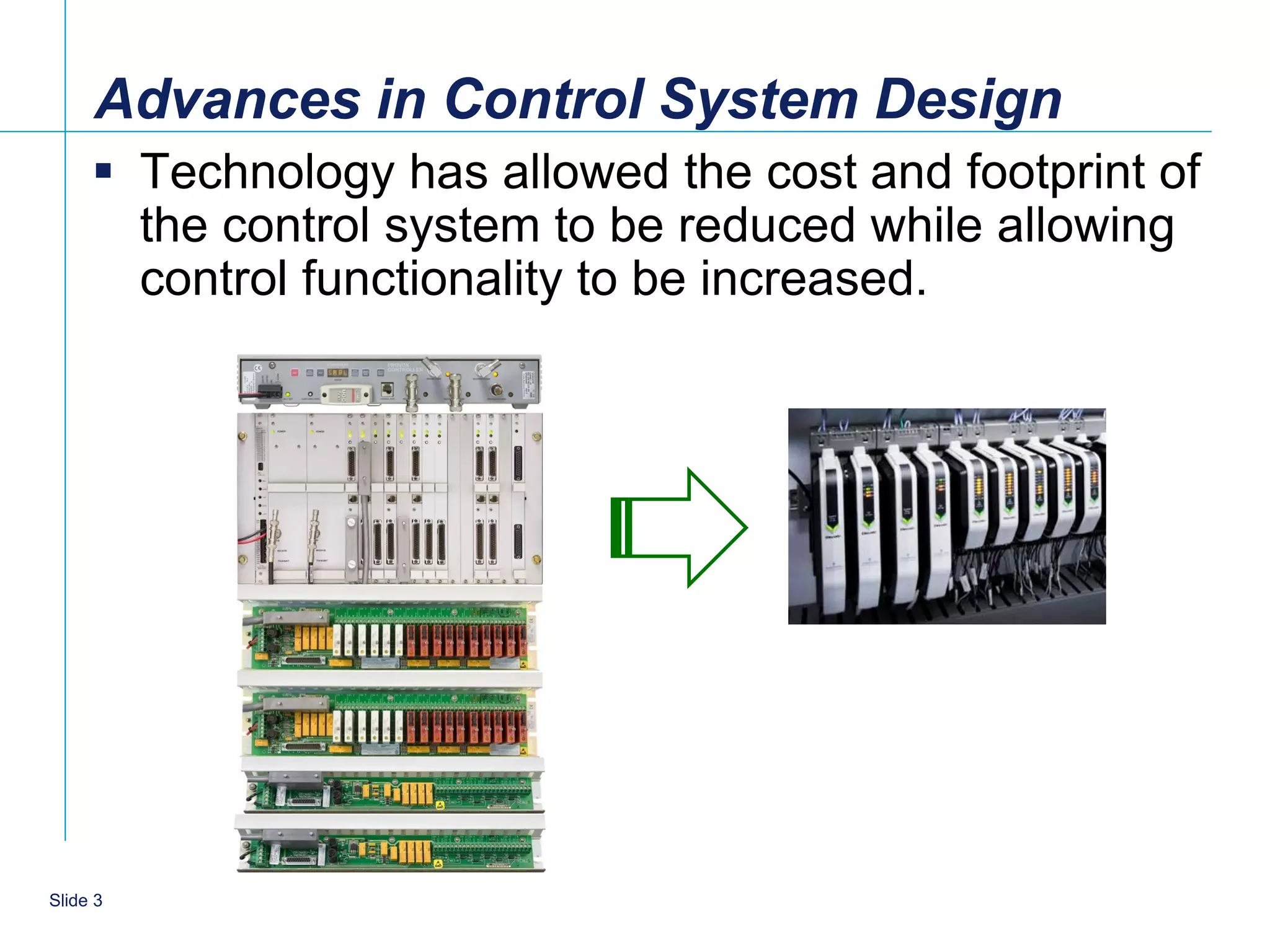
Advances in Control System Design
      Technology has allowed the cost and footprint of
       the control system to be reduced while allowing
       control functionality to be increased.


   3
Slide 3
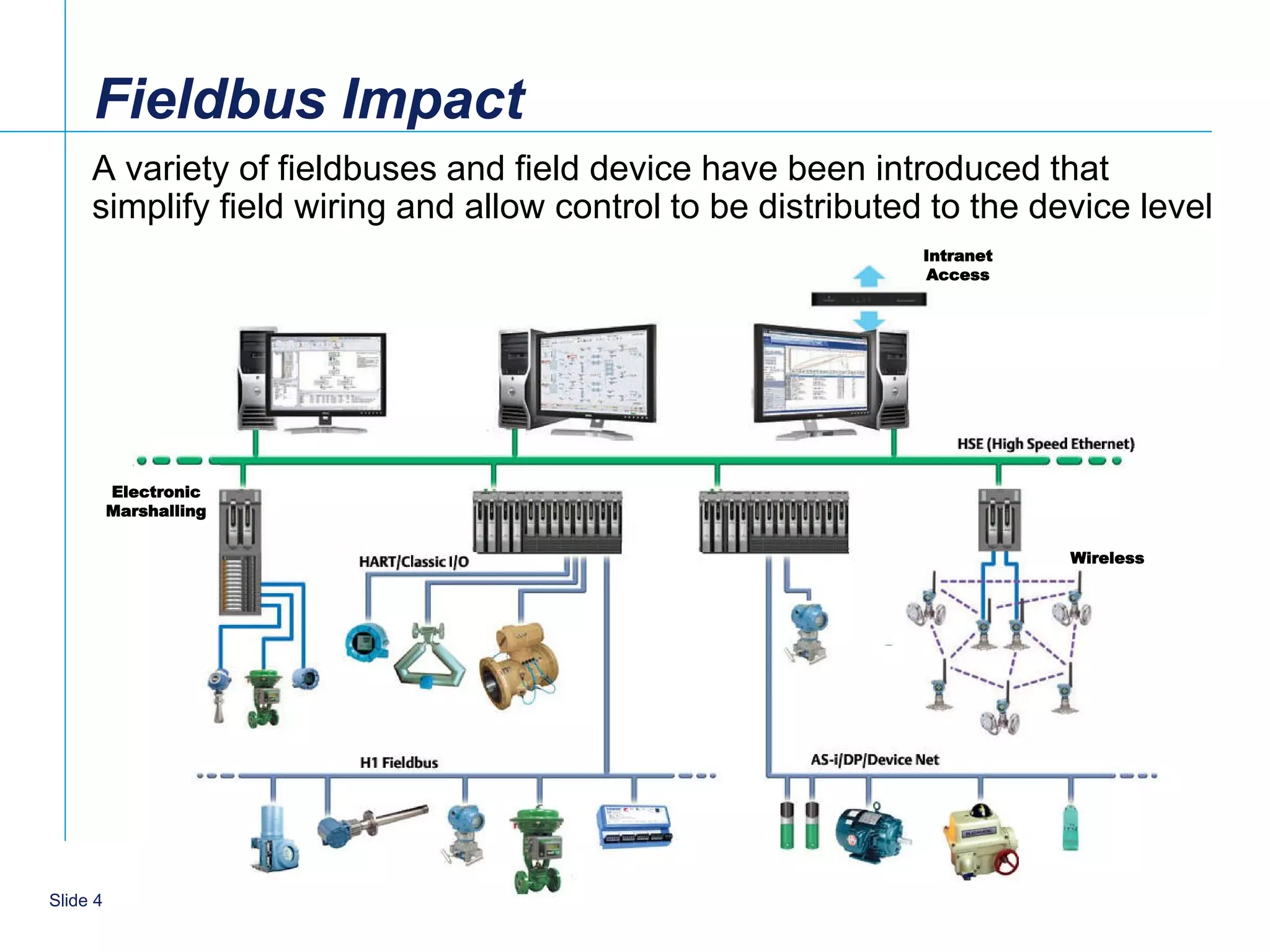
Fieldbus Impact
     A variety of fieldbuses and field device have been introduced that
     simplify field wiring and allow control to be distributed to the device level
                                                              Intranet
                                                              Access


          Electronic
          Marshalling

                                                                         Wireless


   4
Slide 4
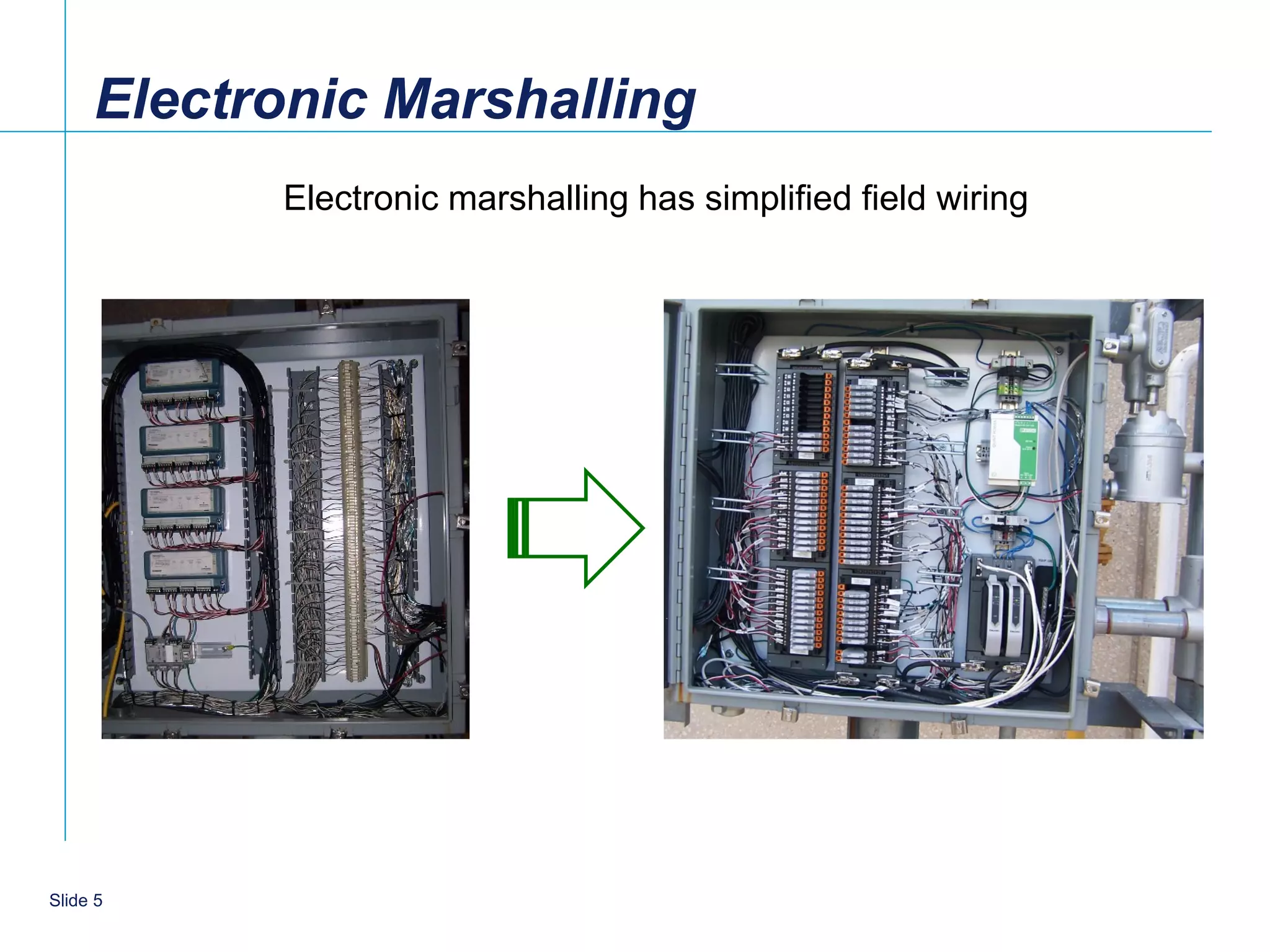
Electronic Marshalling
           Electronic marshalling has simplified field wiring


   5
Slide 5
The impact of standards
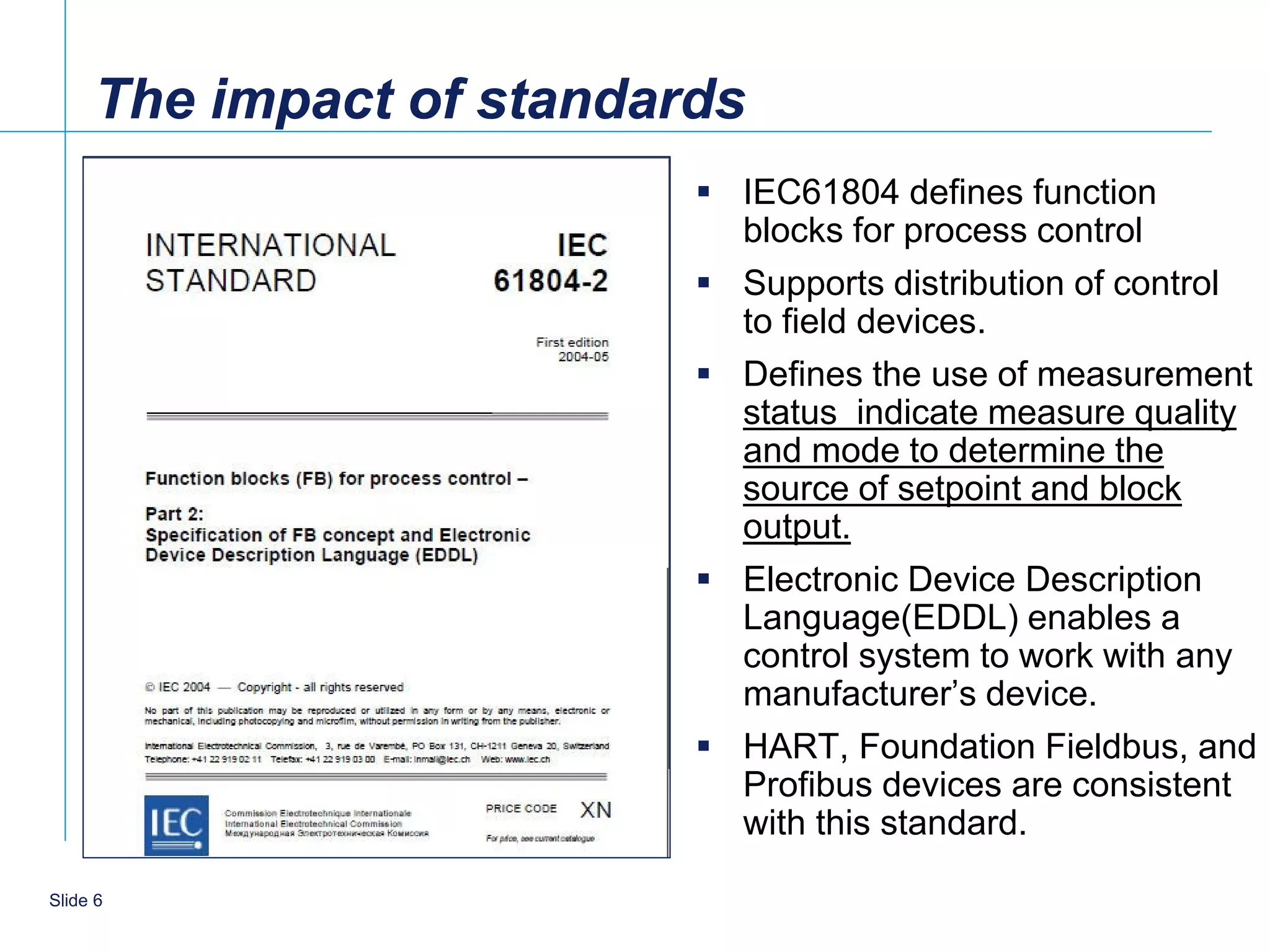
                           IEC61804 defines function
                            blocks for process control
                           Supports distribution of control
                            to field devices.
                           Defines the use of measurement
                            status indicate measure quality
                            and mode to determine the
                            source of setpoint and block
                            output.
                           Electronic Device Description
                            Language(EDDL) enables a
                            control system to work with any
                            manufacturer’s device.
                           HART, Foundation Fieldbus, and
                            Profibus devices are consistent
                            with this standard.

   6
Slide 6
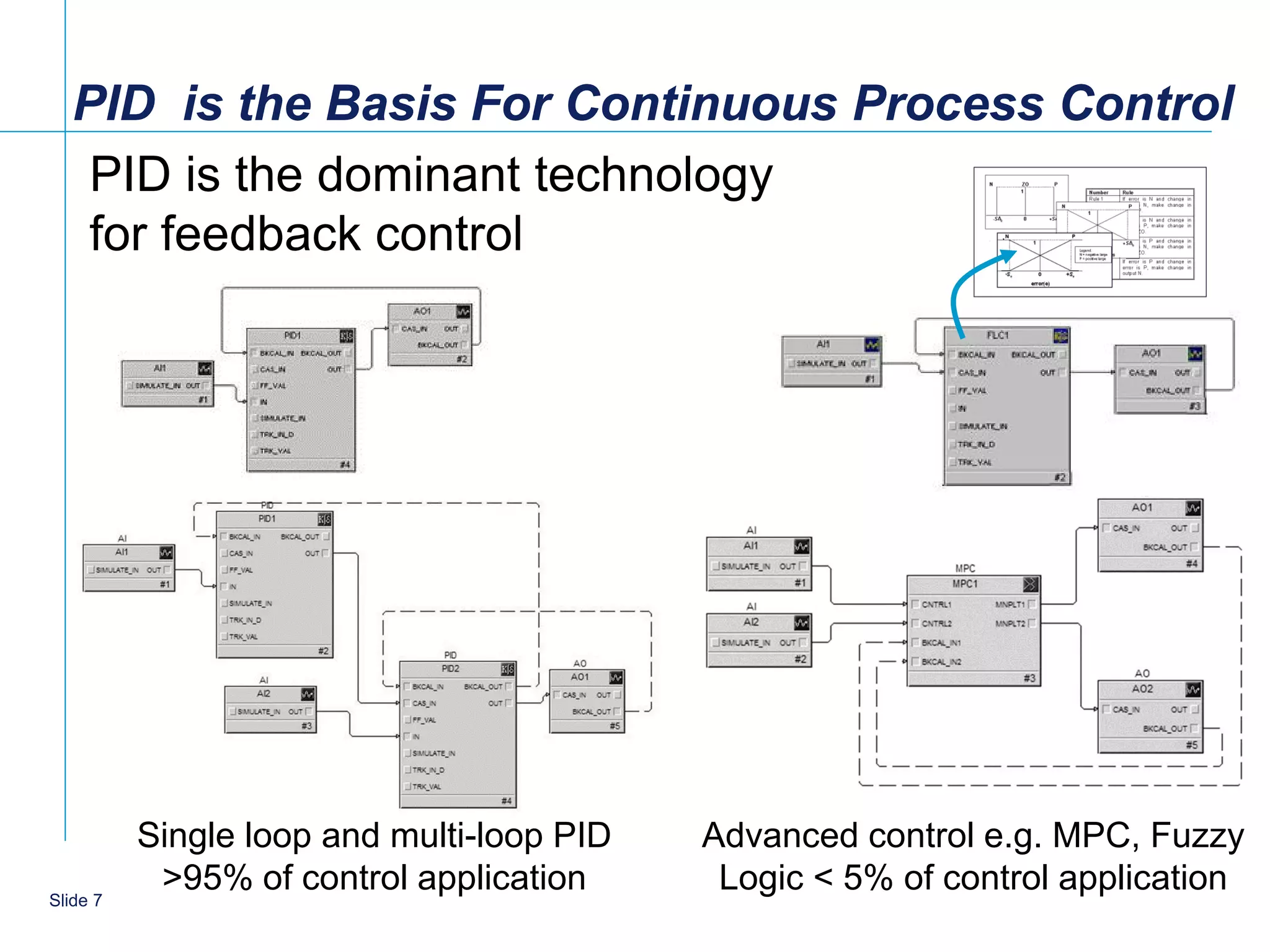
PID is the Basis For Continuous Process Control
    PID is the dominant technology
    for feedback control


          Single loop and multi-loop PID   Advanced control e.g. MPC, Fuzzy
   7
Slide 7
           >95% of control application      Logic < 5% of control application
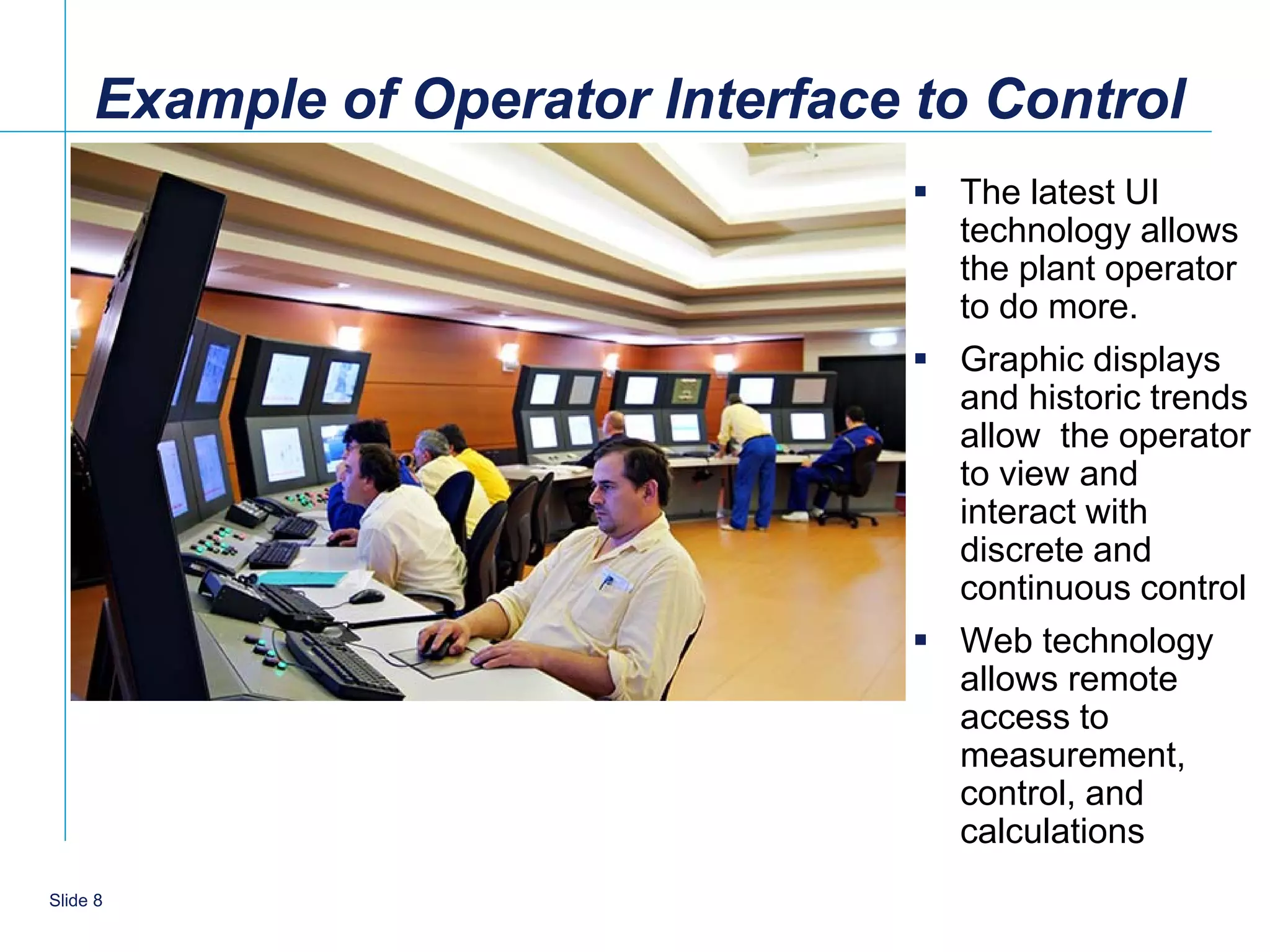
Example of Operator Interface to Control
                                    The latest UI
                                     technology allows
                                     the plant operator
                                     to do more.
                                    Graphic displays
                                     and historic trends
                                     allow the operator
                                     to view and
                                     interact with
                                     discrete and
                                     continuous control
                                    Web technology
                                     allows remote
                                     access to
                                     measurement,
                                     control, and
                                     calculations
   8
Slide 8
Issues Confronting The Process Industry
     In many cases the staffing at the plant level has been
      reduced. Plant support at the corporate level may have been
      severely downsized or eliminated.
     Process engineers and instrumentation technicians may not
      have sufficient training to fully understand control setup and
      tune PID loops for best performance.
     Resources at the plant level may only be sufficient to
      address issues that disrupt production.
     The impact of control utilization/performance may not be
      monitored, documented and/or effectively communicated to
      plant management.
     This is a global issue – Not specific to the control system
      manufacturer, commonly encountered in many major plants
      located in the US, Europe, Asia Pacific, Middle East.

   9
Slide 9
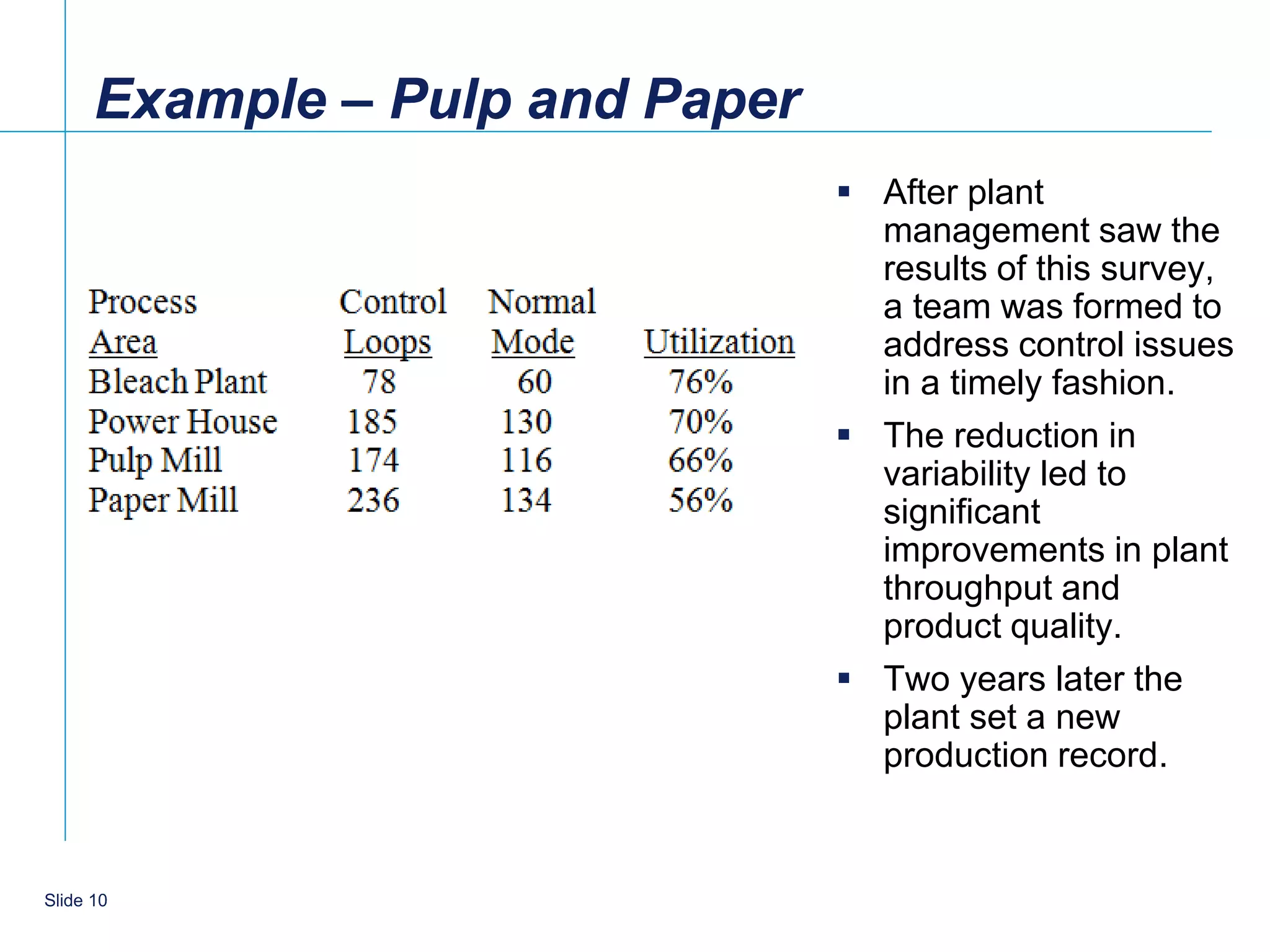
Example – Pulp and Paper
                                  After plant
                                   management saw the
                                   results of this survey,
                                   a team was formed to
                                   address control issues
                                   in a timely fashion.
                                  The reduction in
                                   variability led to
                                   significant
                                   improvements in plant
                                   throughput and
                                   product quality.
                                  Two years later the
                                   plant set a new
                                   production record.


    10
Slide 10
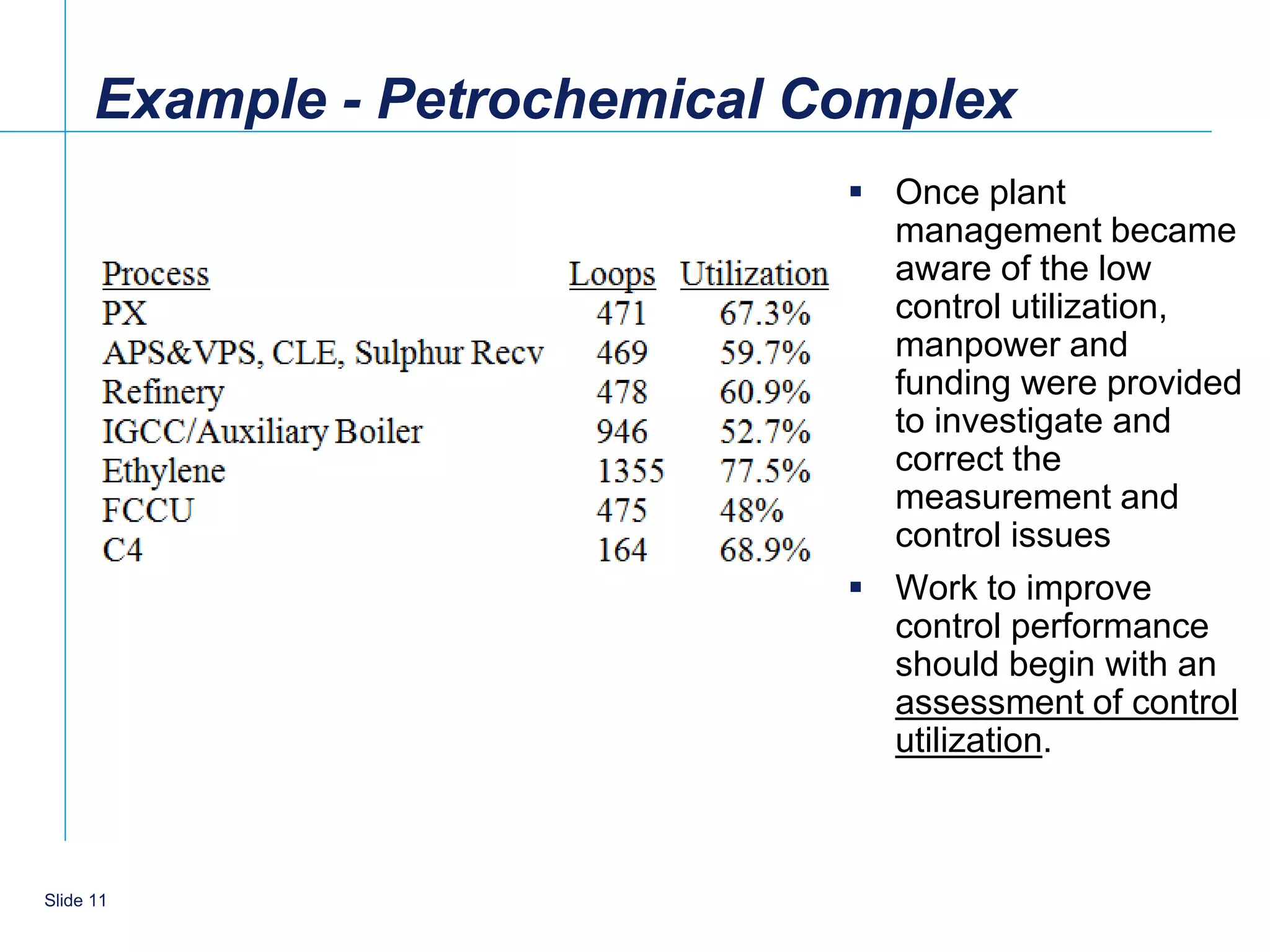
Example - Petrochemical Complex
                                Once plant
                                 management became
                                 aware of the low
                                 control utilization,
                                 manpower and
                                 funding were provided
                                 to investigate and
                                 correct the
                                 measurement and
                                 control issues
                                Work to improve
                                 control performance
                                 should begin with an
                                 assessment of control
                                 utilization.


    11
Slide 11
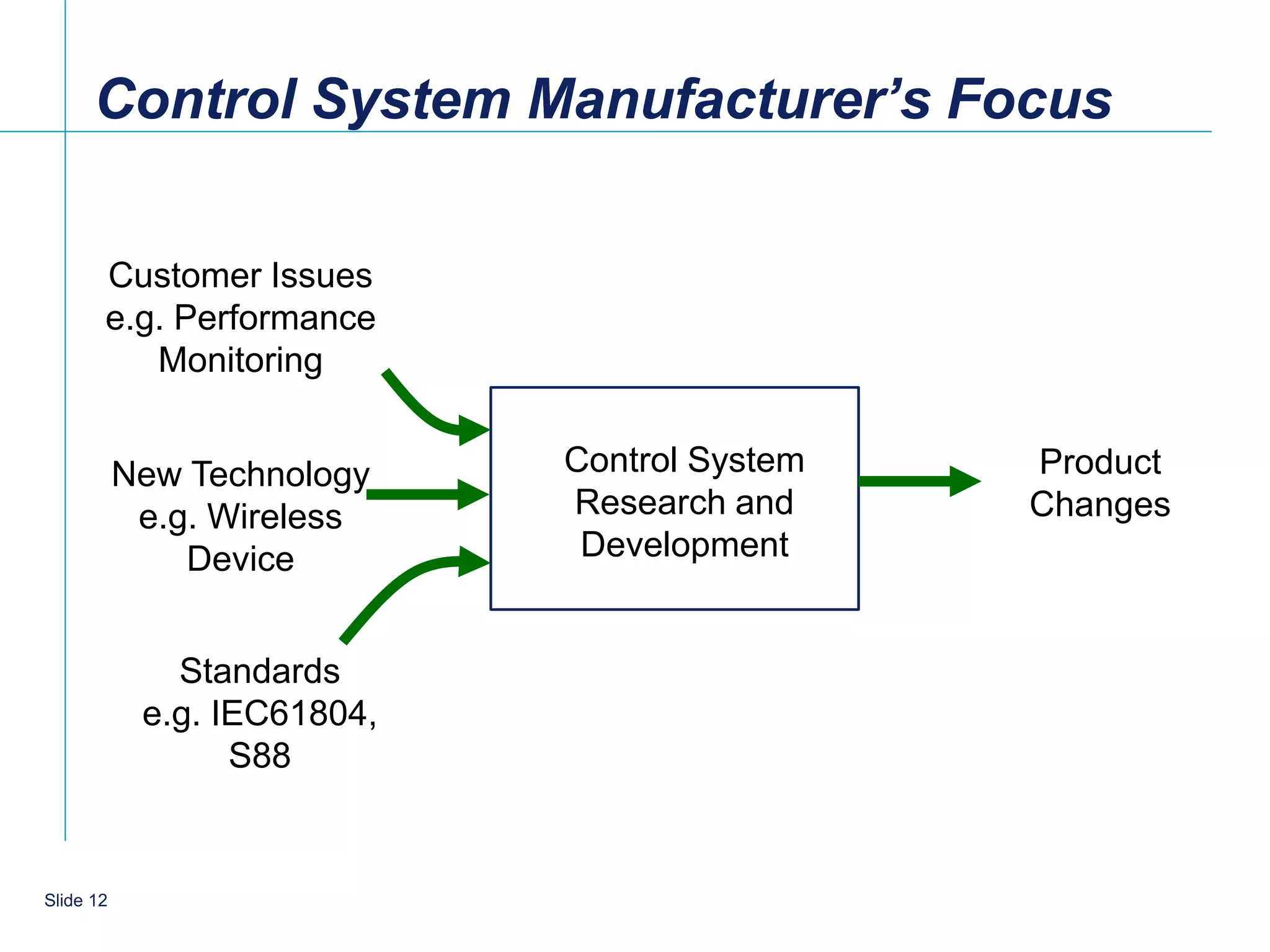
Control System Manufacturer’s Focus

       Customer Issues
       e.g. Performance
          Monitoring


           New Technology    Control System   Product
            e.g. Wireless    Research and     Changes
               Device         Development


              Standards
            e.g. IEC61804,
                  S88


    12
Slide 12
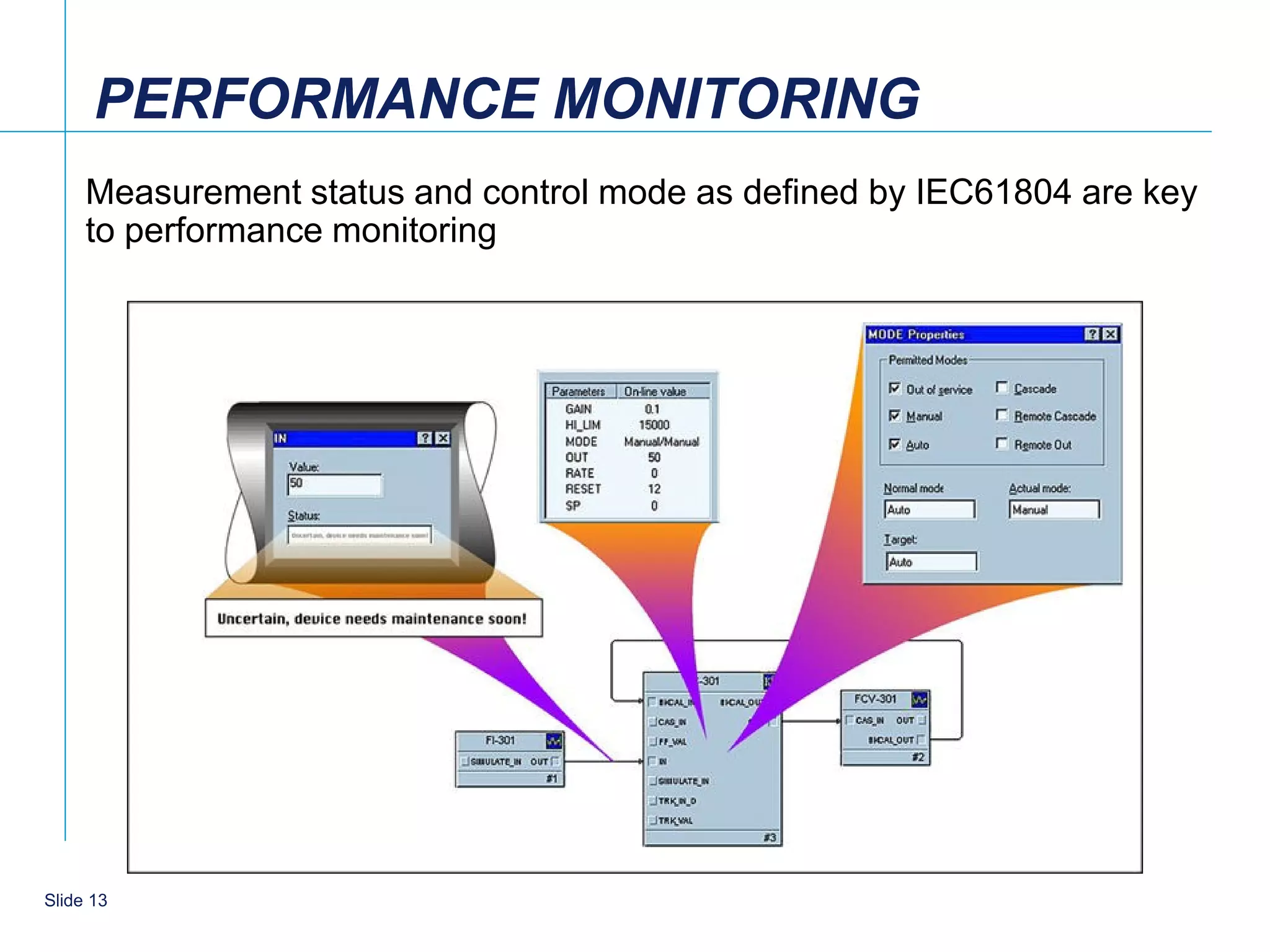
PERFORMANCE MONITORING
     Measurement status and control mode as defined by IEC61804 are key
     to performance monitoring


    13
Slide 13
Performance Monitoring - Example
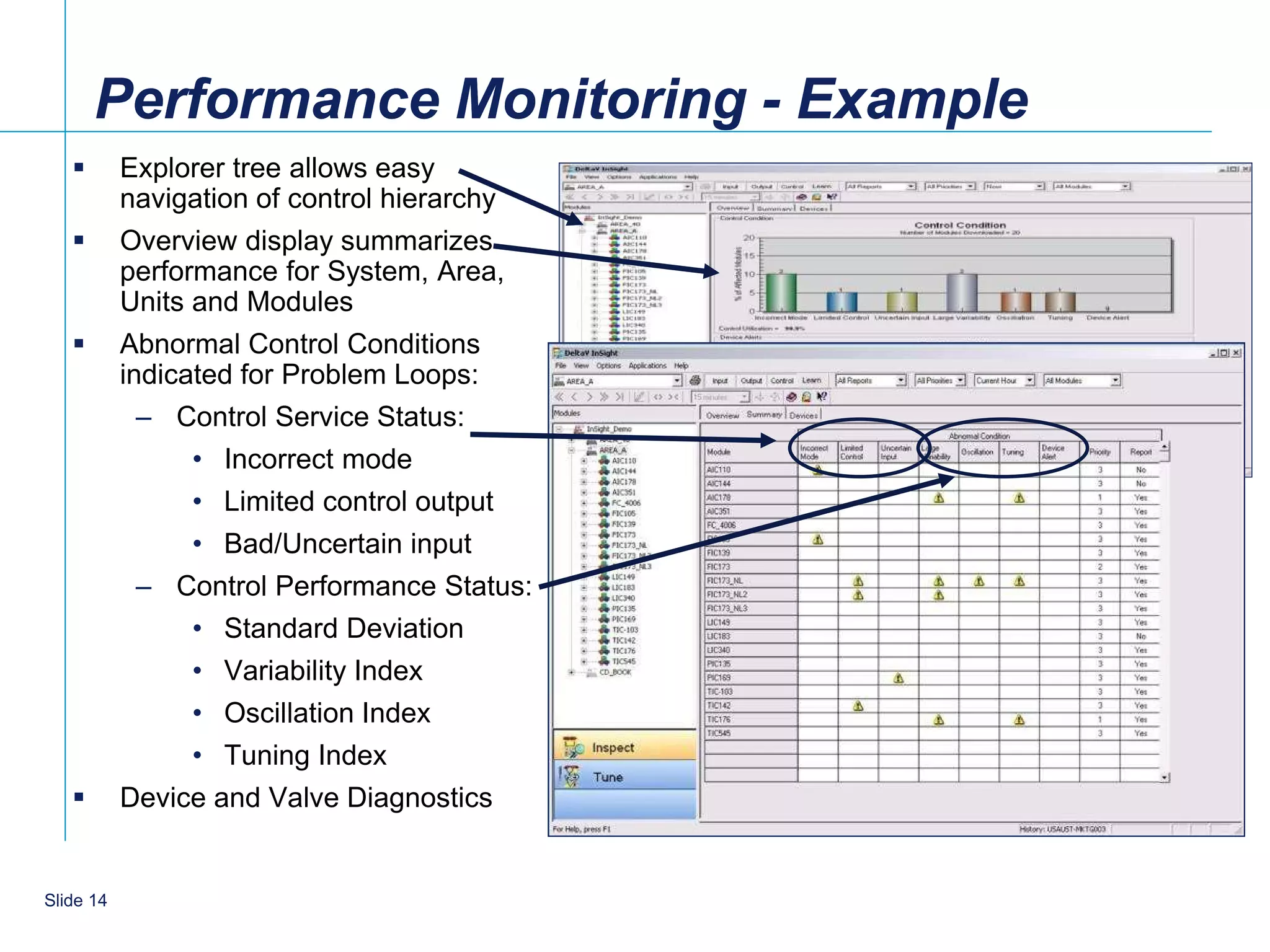
          Explorer tree allows easy
           navigation of control hierarchy
          Overview display summarizes
           performance for System, Area,
           Units and Modules
          Abnormal Control Conditions
           indicated for Problem Loops:
            – Control Service Status:
                • Incorrect mode
                • Limited control output
                • Bad/Uncertain input
            – Control Performance Status:
                • Standard Deviation
                • Variability Index
                • Oscillation Index
                • Tuning Index
          Device and Valve Diagnostics


    14
Slide 14
Performance Reports - Example
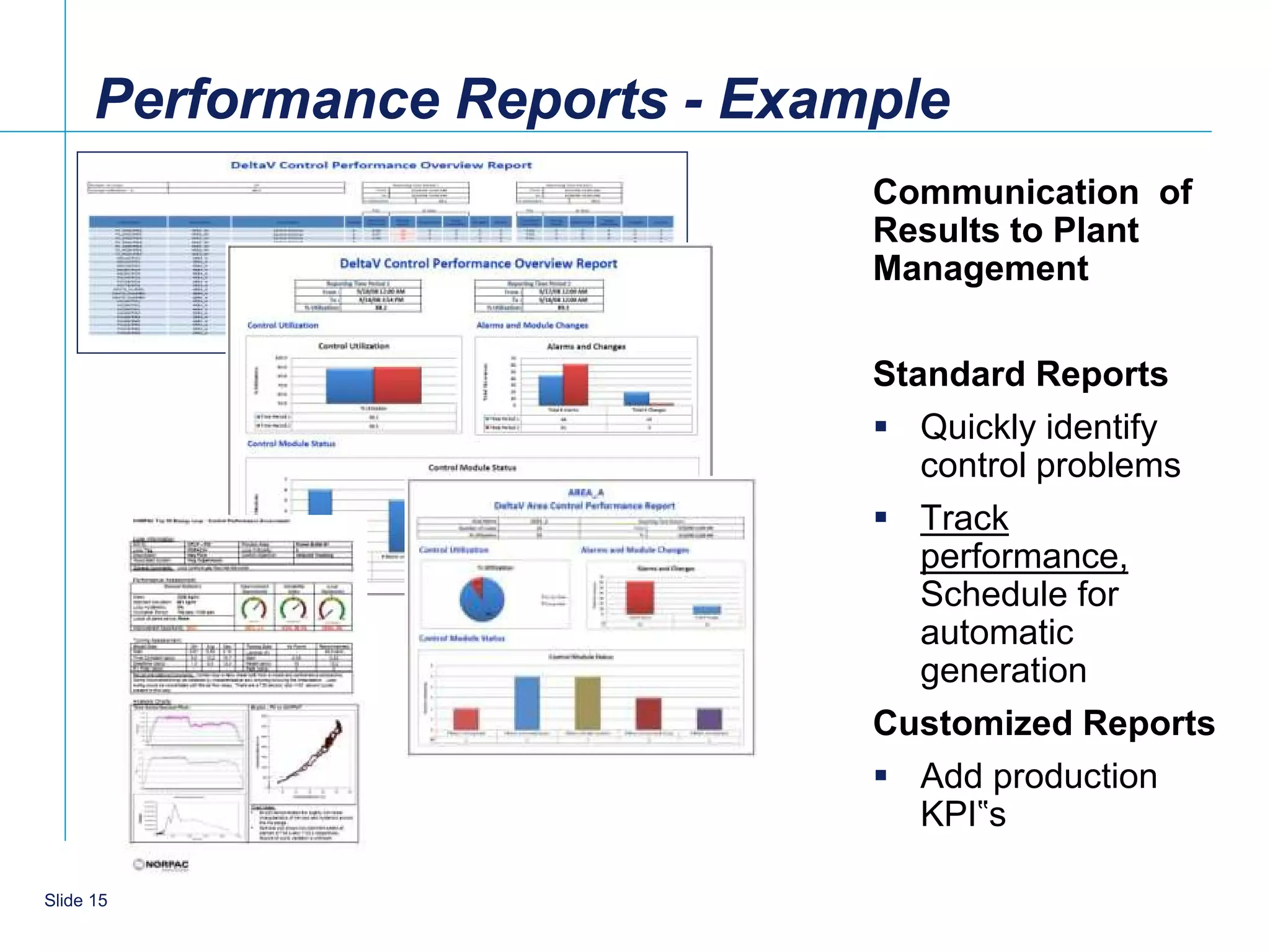
                                Communication of
                                Results to Plant
                                Management

                                Standard Reports
                                 Quickly identify
                                   control problems
                                 Track
                                   performance,
                                   Schedule for
                                   automatic
                                   generation
                                Customized Reports
                                 Add production
                                   KPI‟s

    15
Slide 15
On-Demand Tuning - Example
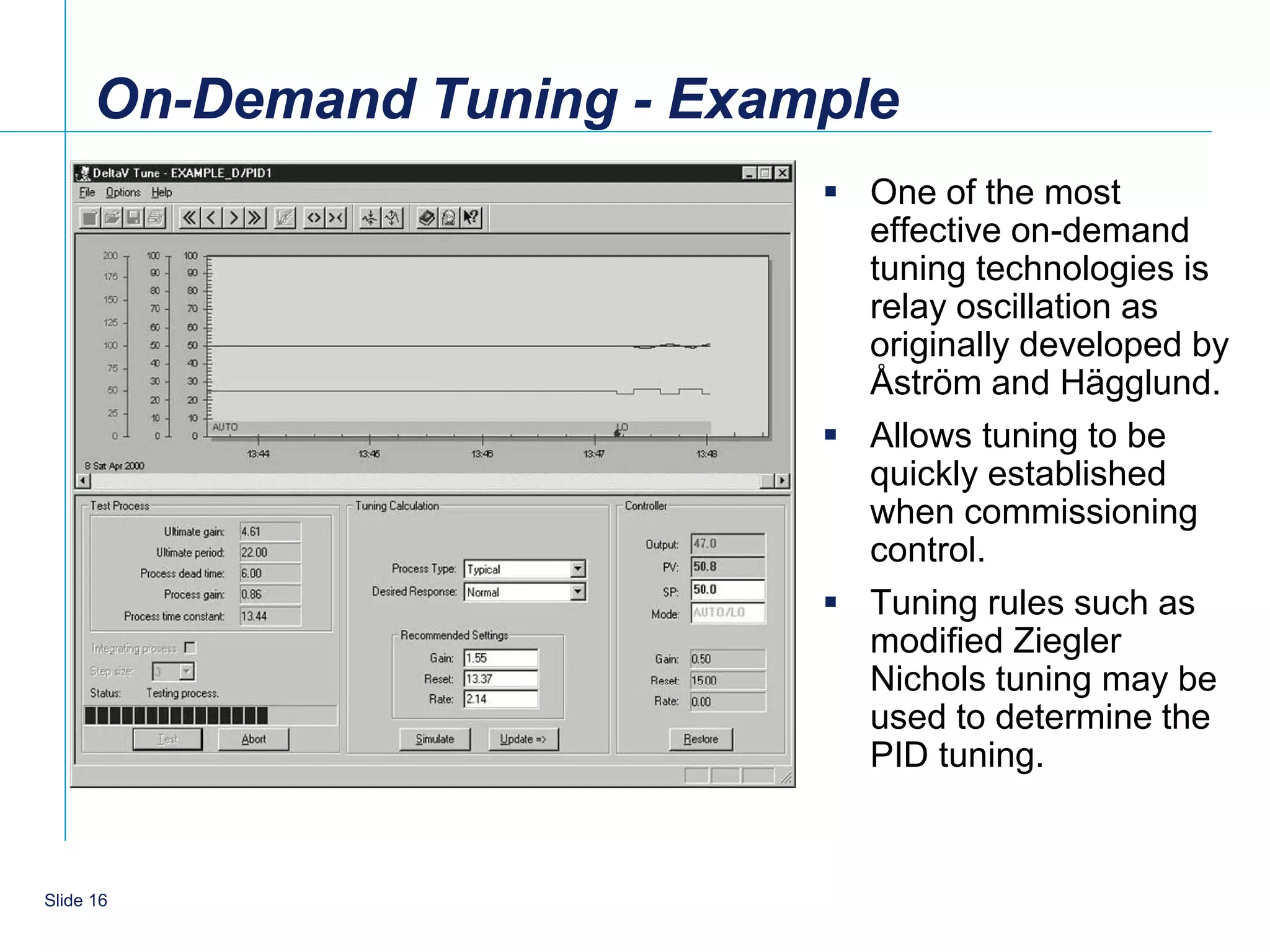
                              One of the most
                               effective on-demand
                               tuning technologies is
                               relay oscillation as
                               originally developed by
                               Åstrӧm and Hägglund.
                              Allows tuning to be
                               quickly established
                               when commissioning
                               control.
                              Tuning rules such as
                               modified Ziegler
                               Nichols tuning may be
                               used to determine the
                               PID tuning.


    16
Slide 16
Adaptive Tuning
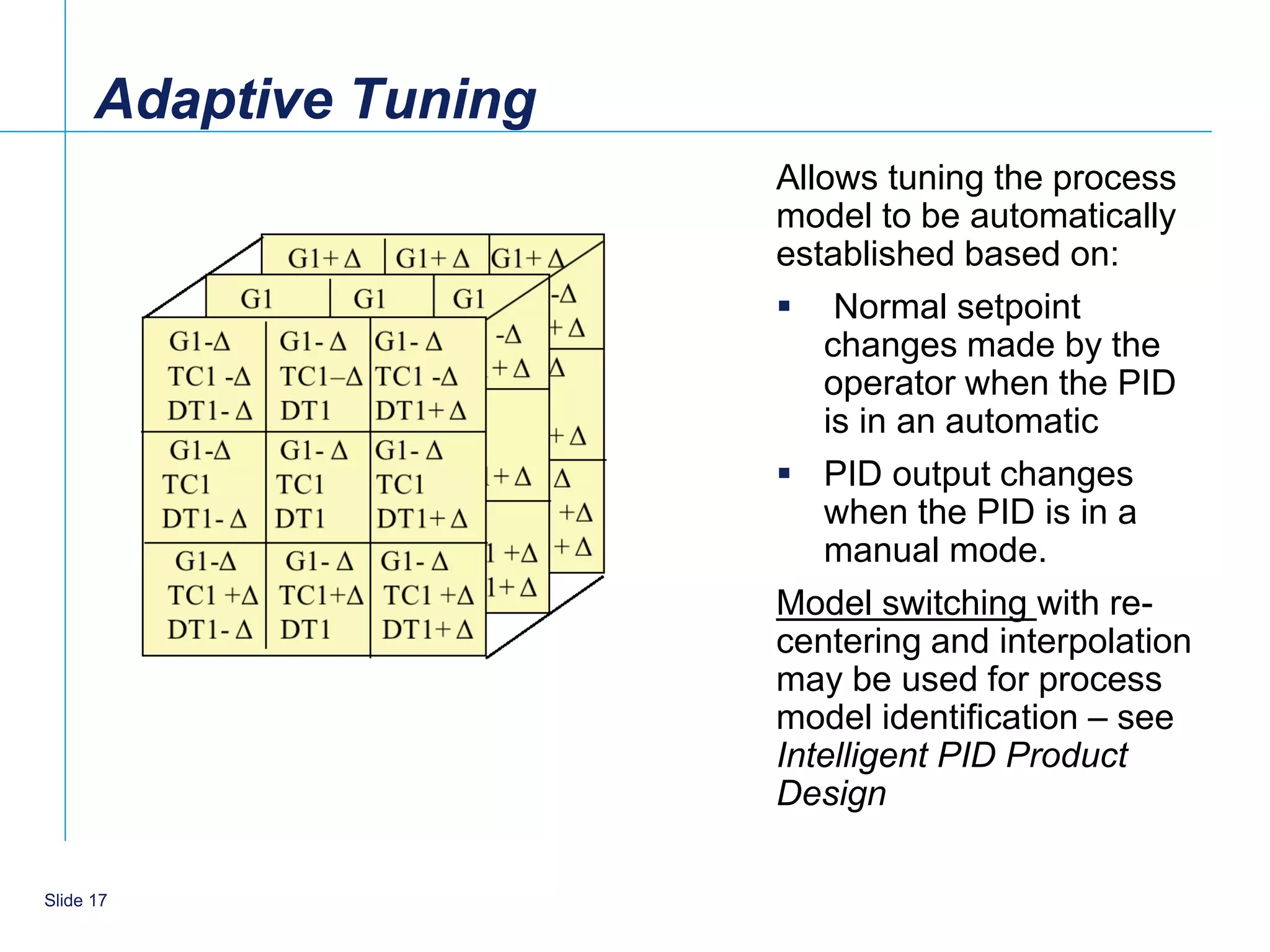
                        Allows tuning the process
                        model to be automatically
                        established based on:
                         Normal setpoint
                           changes made by the
                           operator when the PID
                           is in an automatic
                         PID output changes
                           when the PID is in a
                           manual mode.
                        Model switching with re-
                        centering and interpolation
                        may be used for process
                        model identification – see
                        Intelligent PID Product
                        Design

    17
Slide 17
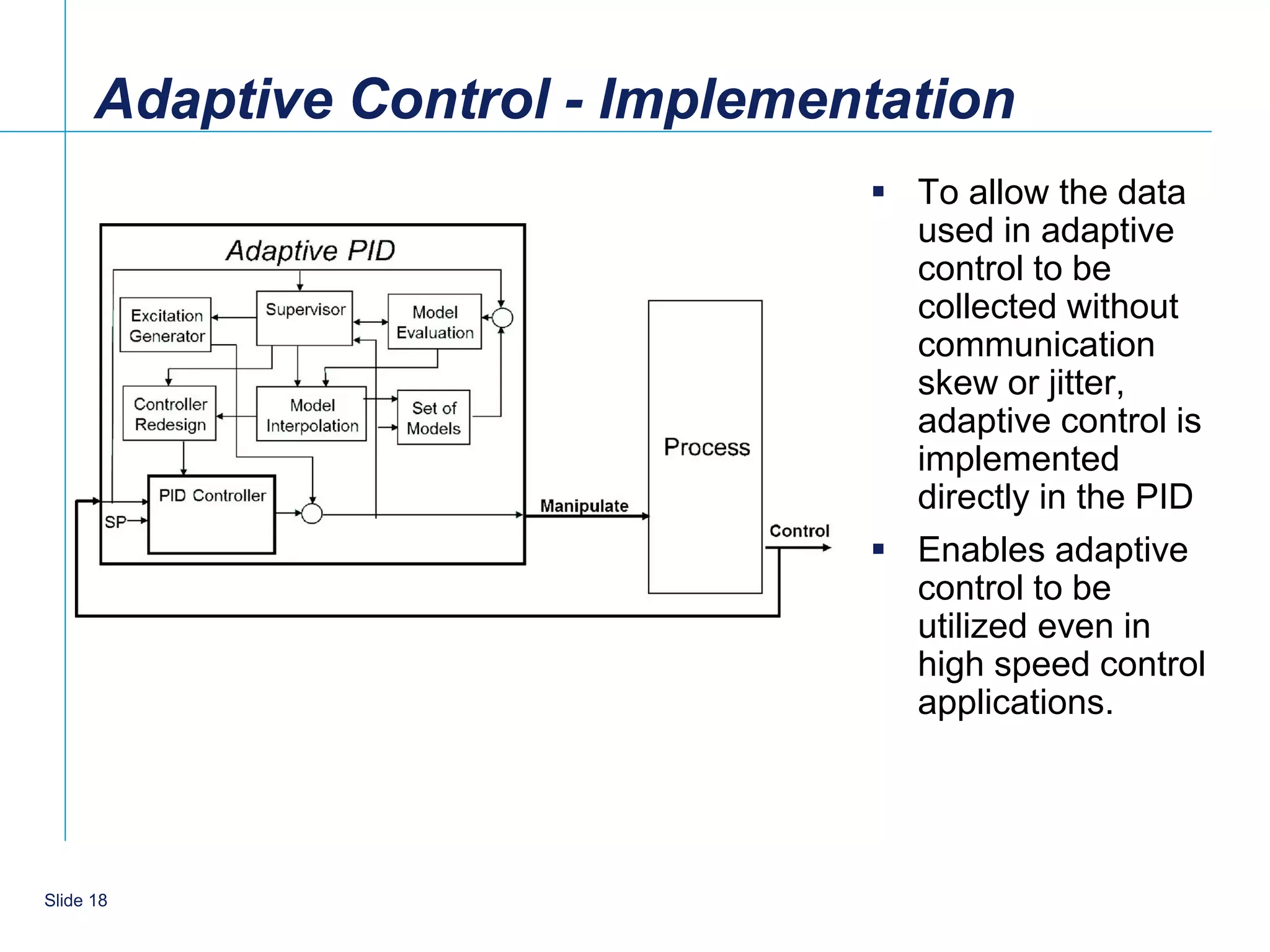
Adaptive Control - Implementation
                                  To allow the data
                                   used in adaptive
                                   control to be
                                   collected without
                                   communication
                                   skew or jitter,
                                   adaptive control is
                                   implemented
                                   directly in the PID
                                  Enables adaptive
                                   control to be
                                   utilized even in
                                   high speed control
                                   applications.


    18
Slide 18
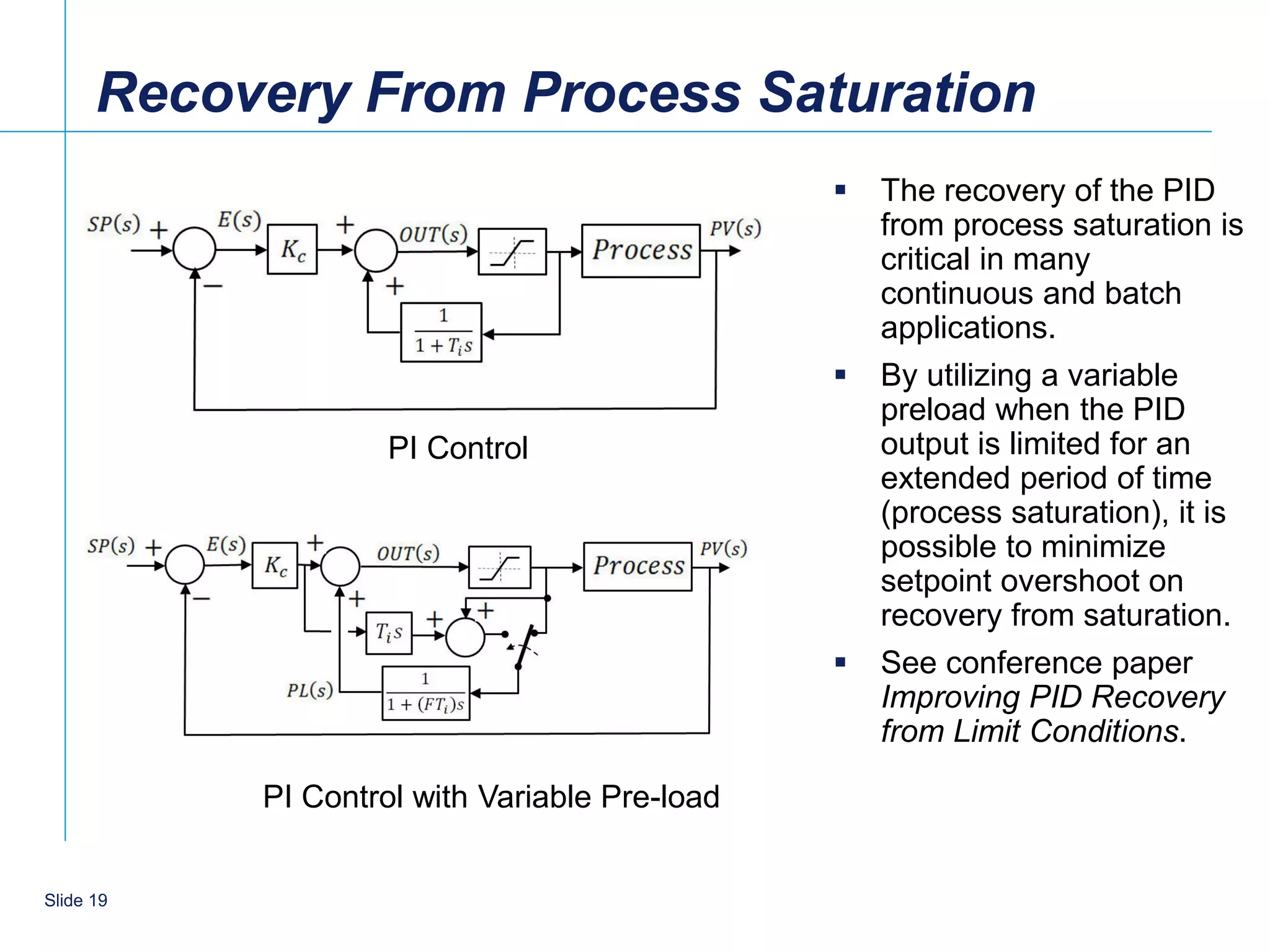
Recovery From Process Saturation
                                                  The recovery of the PID
                                                   from process saturation is
                                                   critical in many
                                                   continuous and batch
                                                   applications.
                                                  By utilizing a variable
                                                   preload when the PID
                    PI Control                     output is limited for an
                                                   extended period of time
                                                   (process saturation), it is
                                                   possible to minimize
                                                   setpoint overshoot on
                                                   recovery from saturation.
                                                  See conference paper
                                                   Improving PID Recovery
                                                   from Limit Conditions.

           PI Control with Variable Pre-load


    19
Slide 19
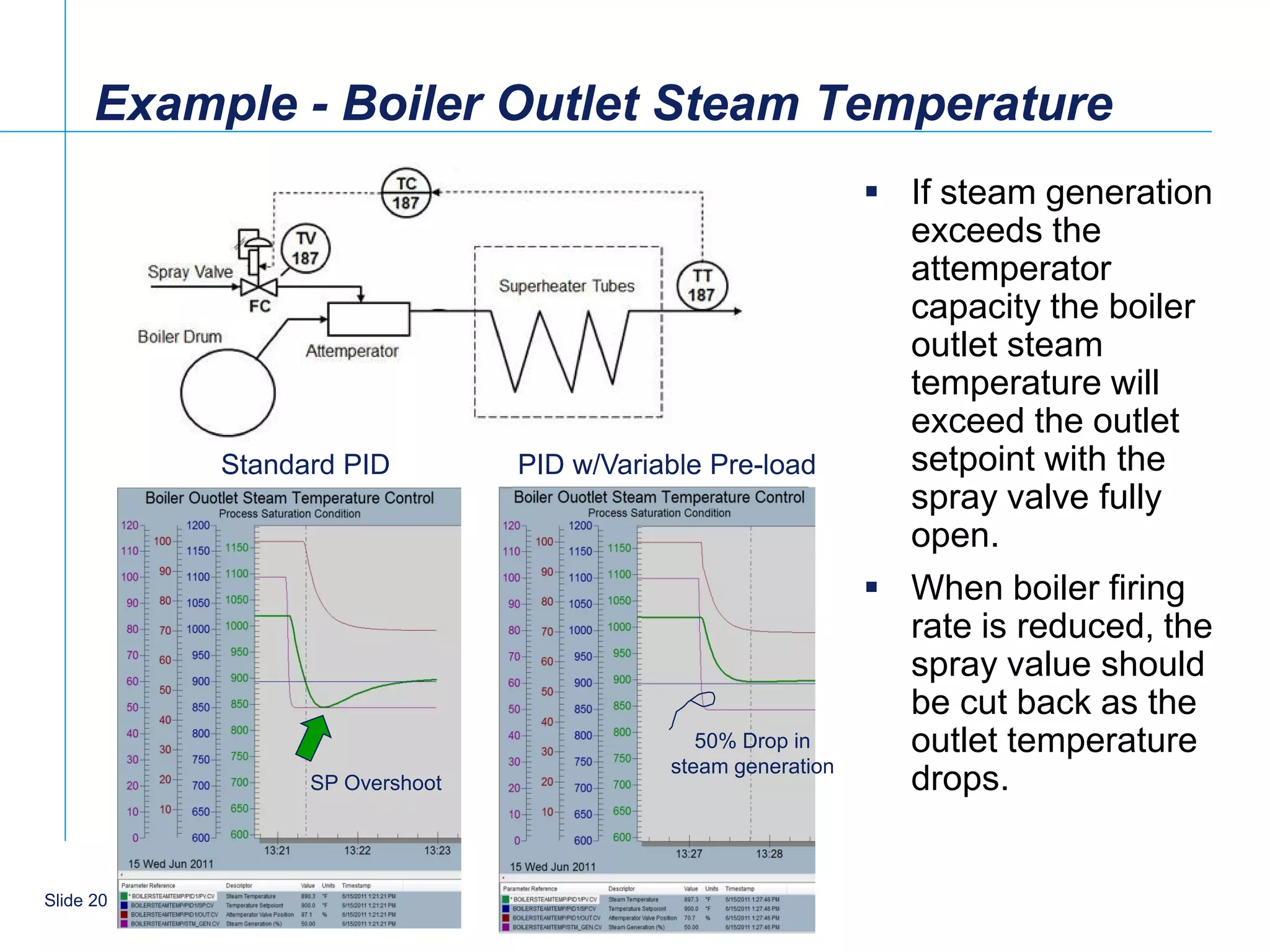
Example - Boiler Outlet Steam Temperature
                                                               If steam generation
                                                                exceeds the
                                                                attemperator
                                                                capacity the boiler
                                                                outlet steam
                                                                temperature will
                                                                exceed the outlet
           Standard PID         PID w/Variable Pre-load         setpoint with the
                                                                spray valve fully
                                                                open.
                                                               When boiler firing
                                                                rate is reduced, the
                                                                spray value should
                                                                be cut back as the
                                              50% Drop in       outlet temperature
                                           steam generation
                 SP Overshoot                                   drops.


    20
Slide 20
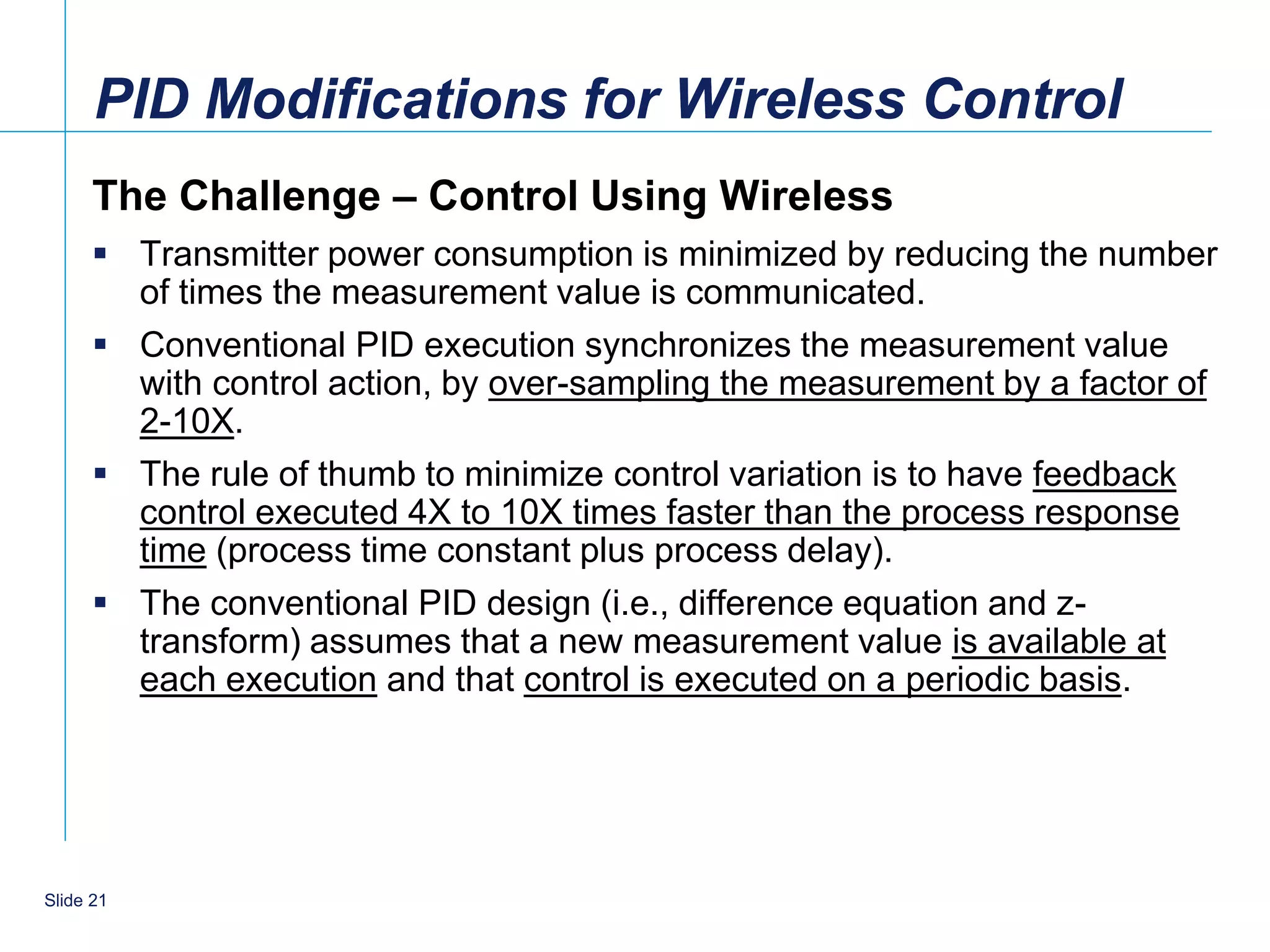
PID Modifications for Wireless Control
      The Challenge – Control Using Wireless
       Transmitter power consumption is minimized by reducing the number
        of times the measurement value is communicated.
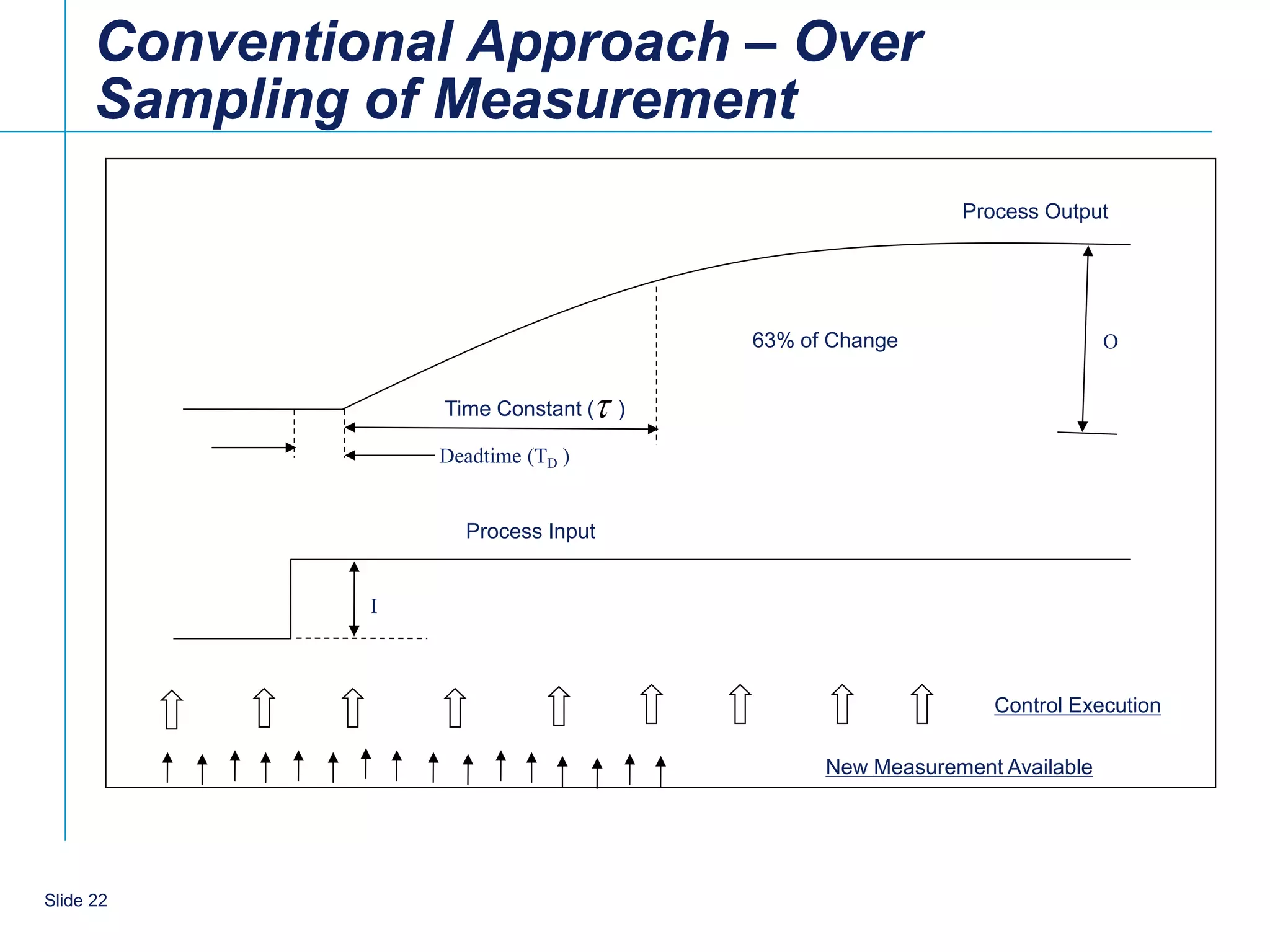
       Conventional PID execution synchronizes the measurement value
        with control action, by over-sampling the measurement by a factor of
        2-10X.
       The rule of thumb to minimize control variation is to have feedback
        control executed 4X to 10X times faster than the process response
        time (process time constant plus process delay).
       The conventional PID design (i.e., difference equation and z-
        transform) assumes that a new measurement value is available at
        each execution and that control is executed on a periodic basis.


    21
Slide 21
Conventional Approach – Over
      Sampling of Measurement
                                                           Process Output


                                         63% of Change                     O


                   Time Constant (  )
                   Deadtime (TD )


                     Process Input


               I


                                                              Control Execution

                                               New Measurement Available


    22
Slide 22
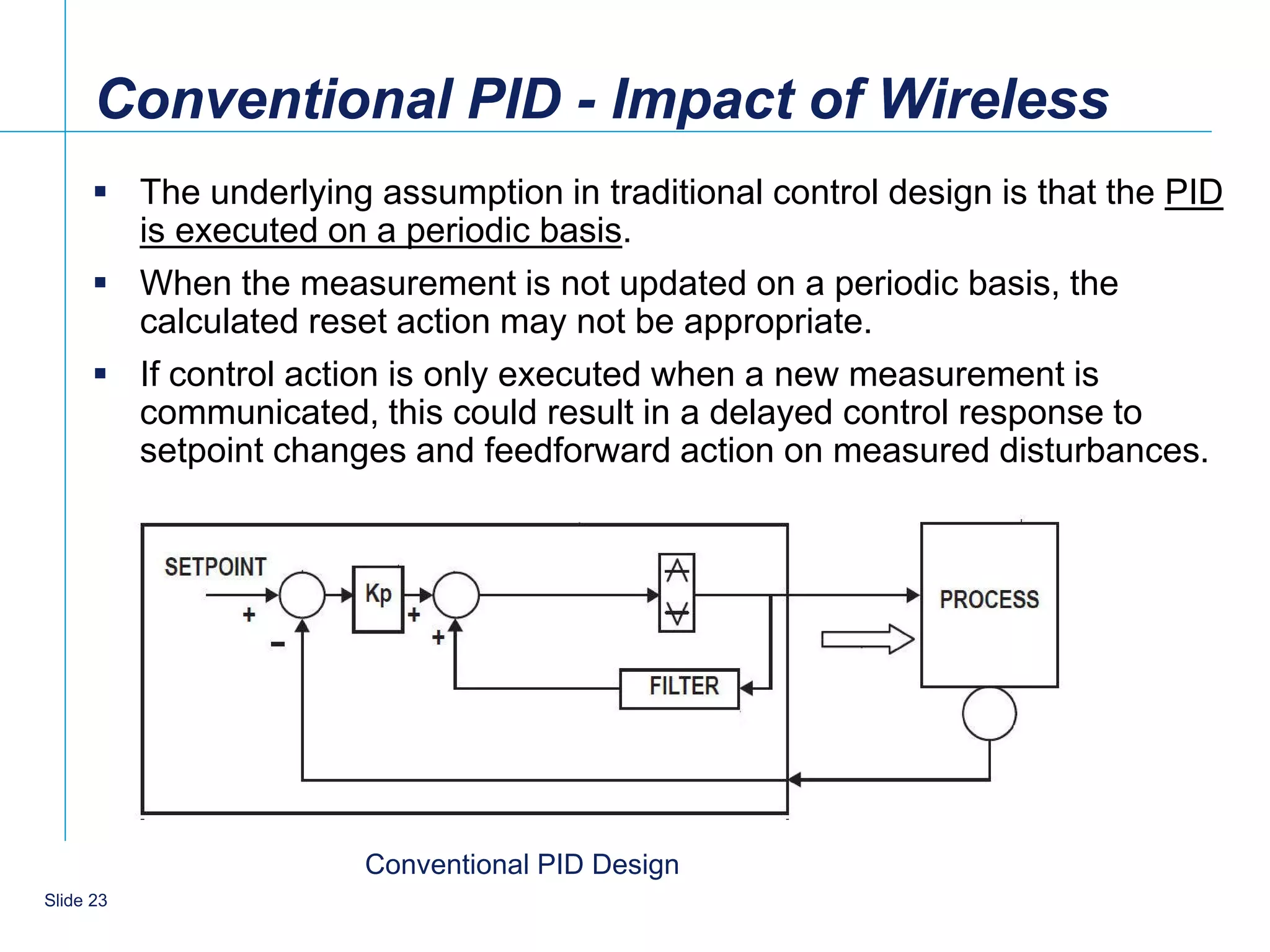
Conventional PID - Impact of Wireless
       The underlying assumption in traditional control design is that the PID
        is executed on a periodic basis.
       When the measurement is not updated on a periodic basis, the
        calculated reset action may not be appropriate.
       If control action is only executed when a new measurement is
        communicated, this could result in a delayed control response to
        setpoint changes and feedforward action on measured disturbances.


                       Conventional PID Design
    23
Slide 23
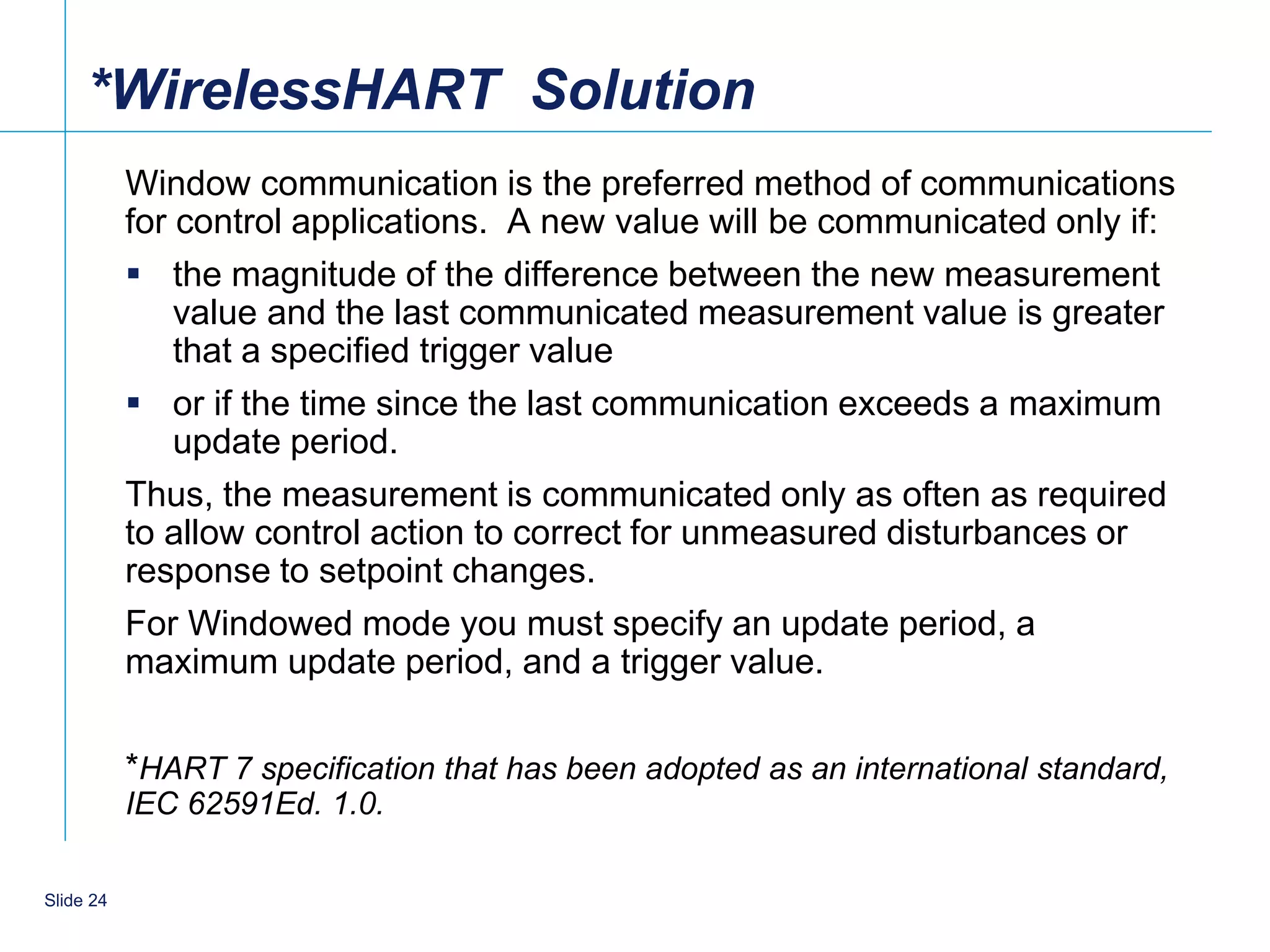
*WirelessHART Solution
           Window communication is the preferred method of communications
           for control applications. A new value will be communicated only if:
            the magnitude of the difference between the new measurement
               value and the last communicated measurement value is greater
               that a specified trigger value
            or if the time since the last communication exceeds a maximum
               update period.
           Thus, the measurement is communicated only as often as required
           to allow control action to correct for unmeasured disturbances or
           response to setpoint changes.
           For Windowed mode you must specify an update period, a
           maximum update period, and a trigger value.

           *HART 7 specification that has been adopted as an international standard,
           IEC 62591Ed. 1.0.

    24
Slide 24
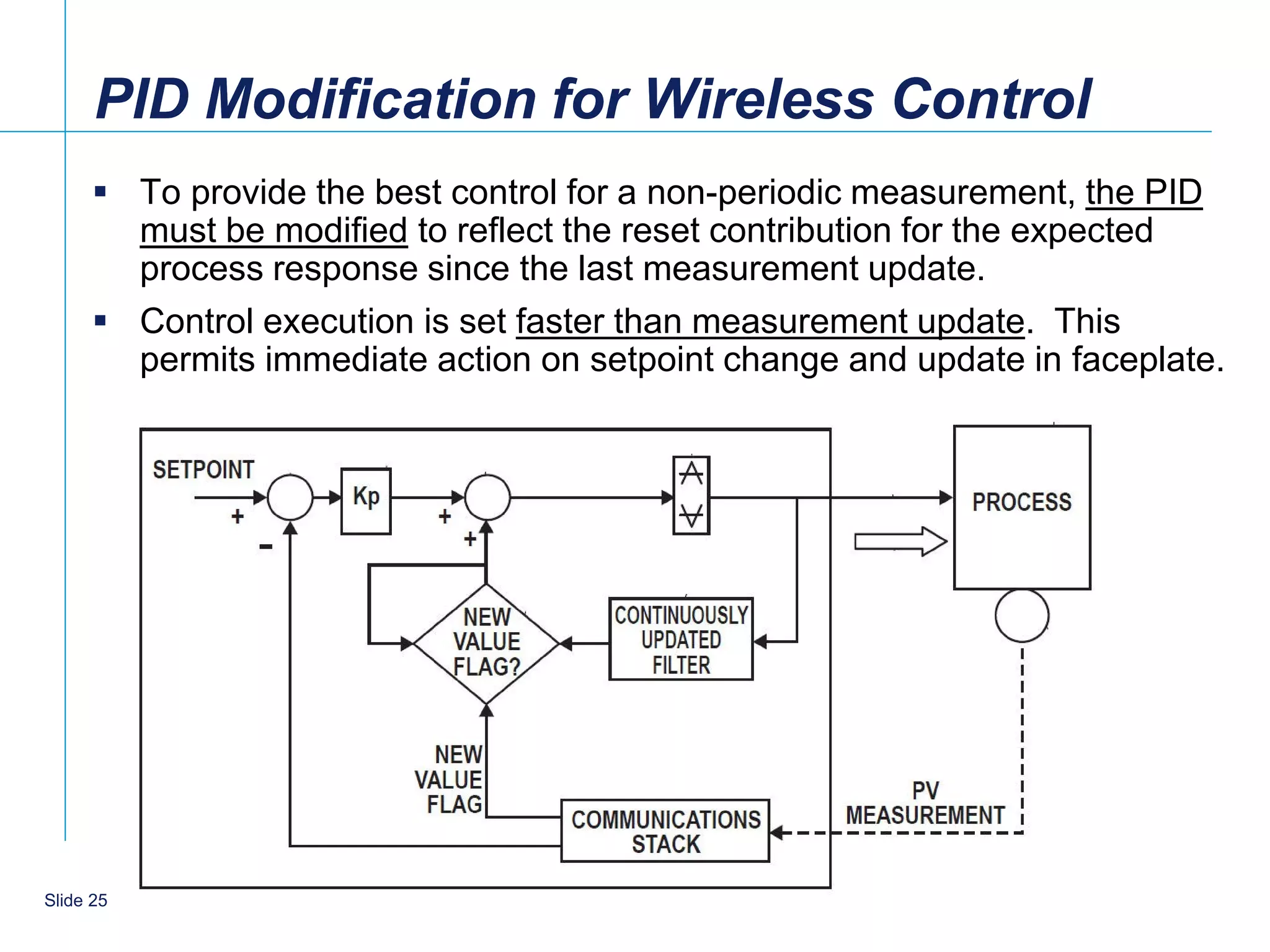
PID Modification for Wireless Control
       To provide the best control for a non-periodic measurement, the PID
        must be modified to reflect the reset contribution for the expected
        process response since the last measurement update.
       Control execution is set faster than measurement update. This
        permits immediate action on setpoint change and update in faceplate.


    25
Slide 25
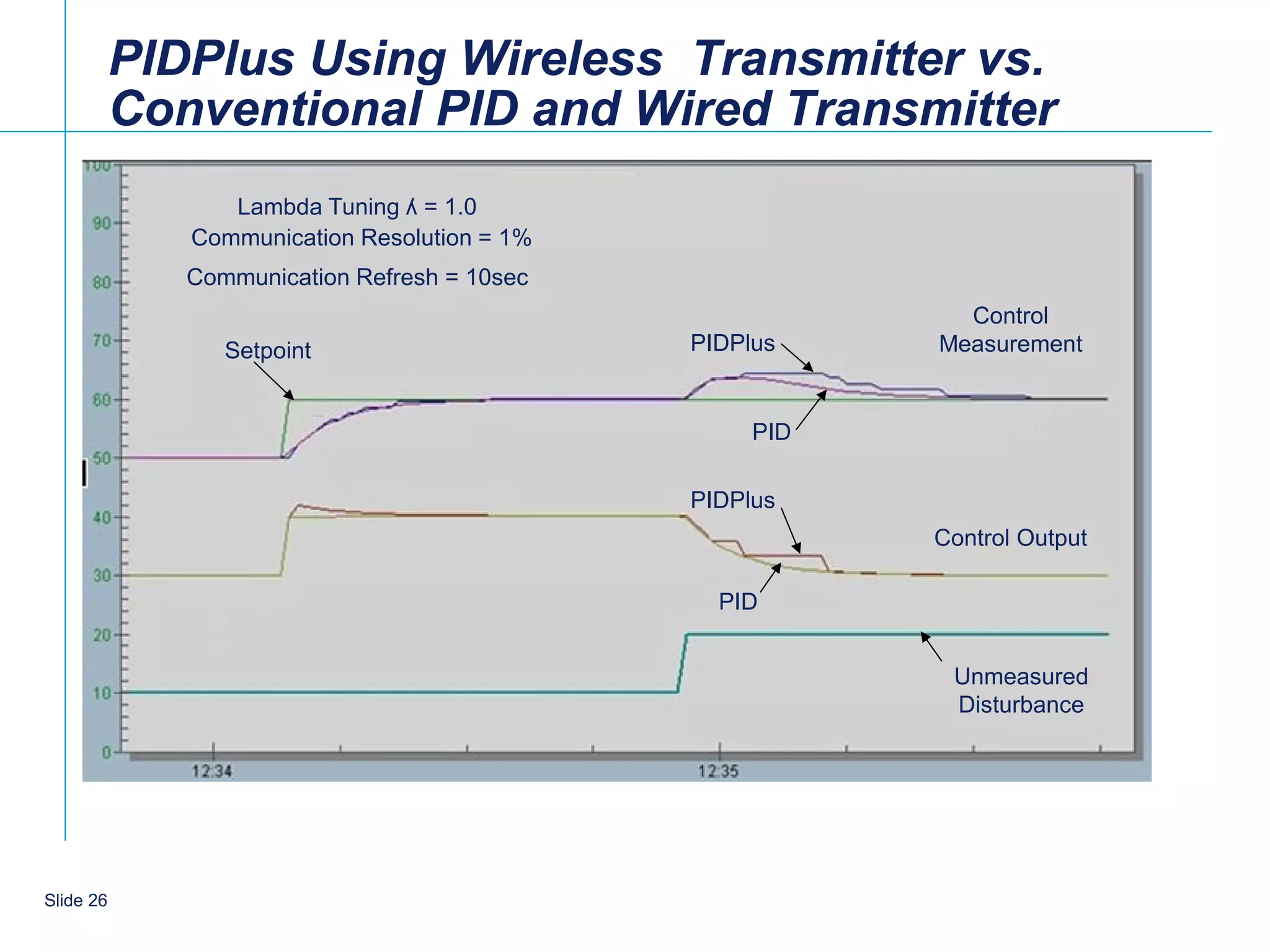
PIDPlus Using Wireless Transmitter vs.
           Conventional PID and Wired Transmitter
                 Lambda Tuning ʎ = 1.0
              Communication Resolution = 1%
              Communication Refresh = 10sec
                                                           Control
                 Setpoint                     PIDPlus    Measurement


                                                   PID

                                              PIDPlus
                                                         Control Output

                                                PID


                                                          Unmeasured
                                                          Disturbance


    26
Slide 26
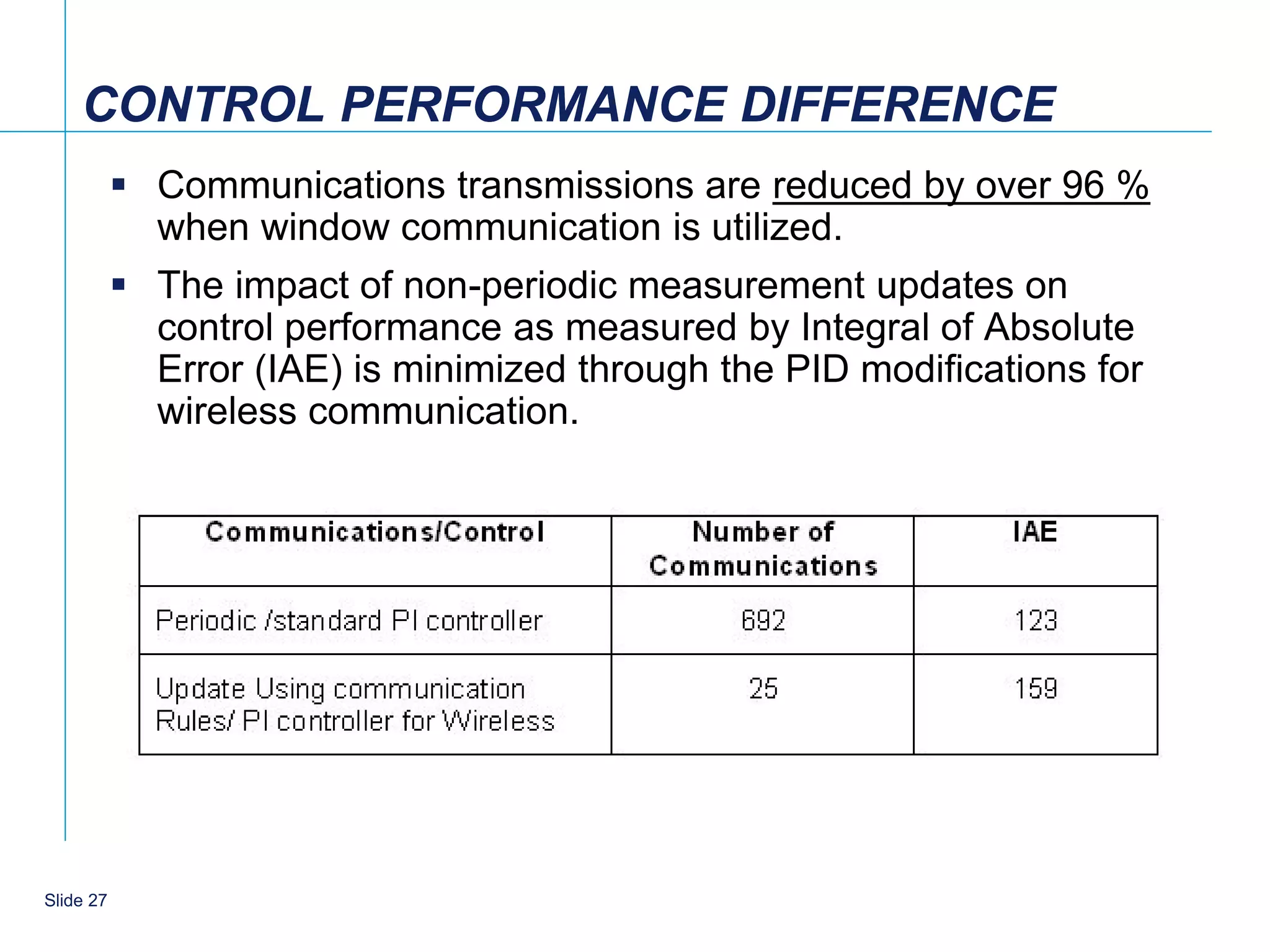
CONTROL PERFORMANCE DIFFERENCE
            Communications transmissions are reduced by over 96 %
             when window communication is utilized.
            The impact of non-periodic measurement updates on
             control performance as measured by Integral of Absolute
             Error (IAE) is minimized through the PID modifications for
             wireless communication.


    27
Slide 27
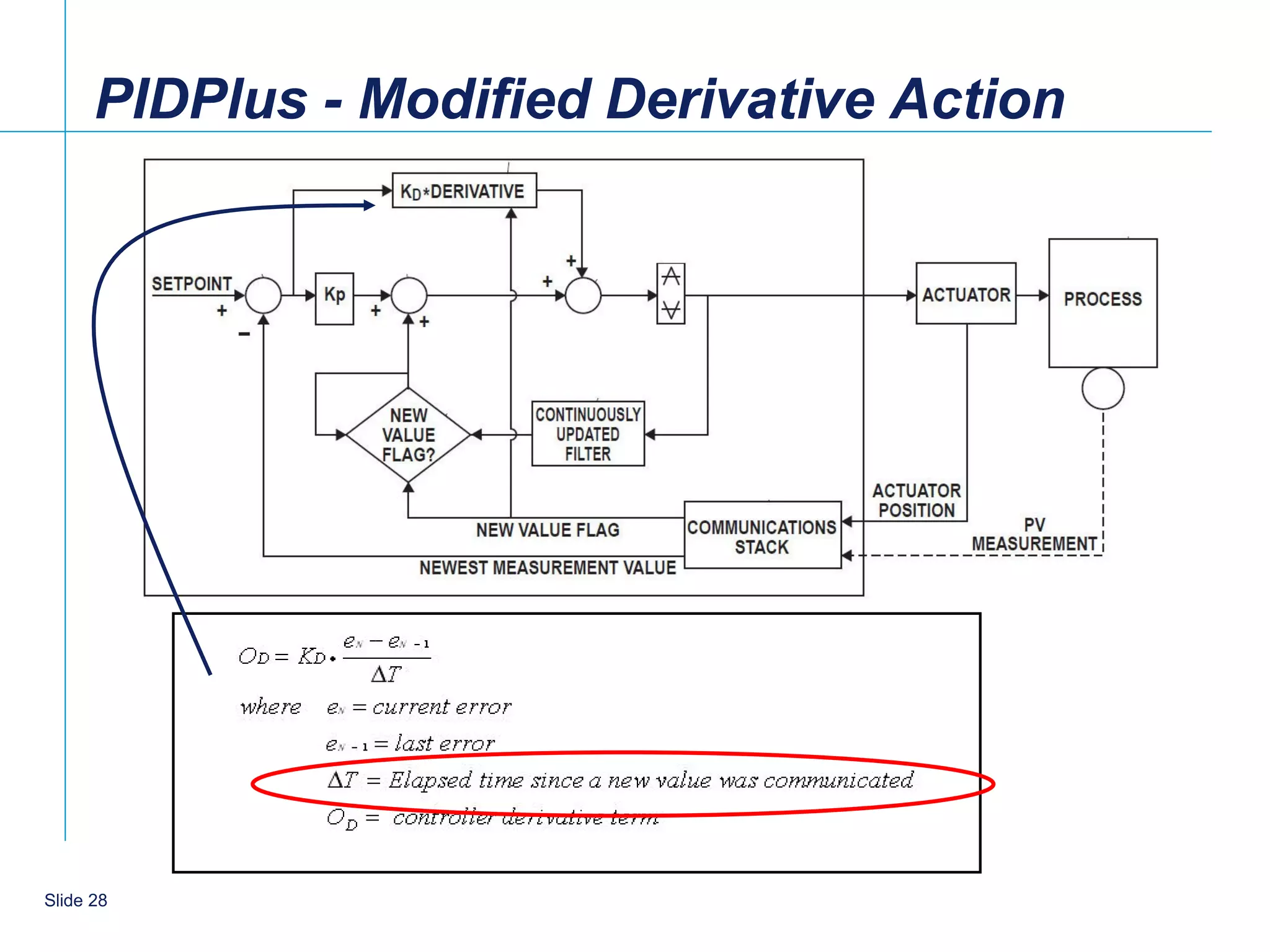
PIDPlus - Modified Derivative Action


    28
Slide 28
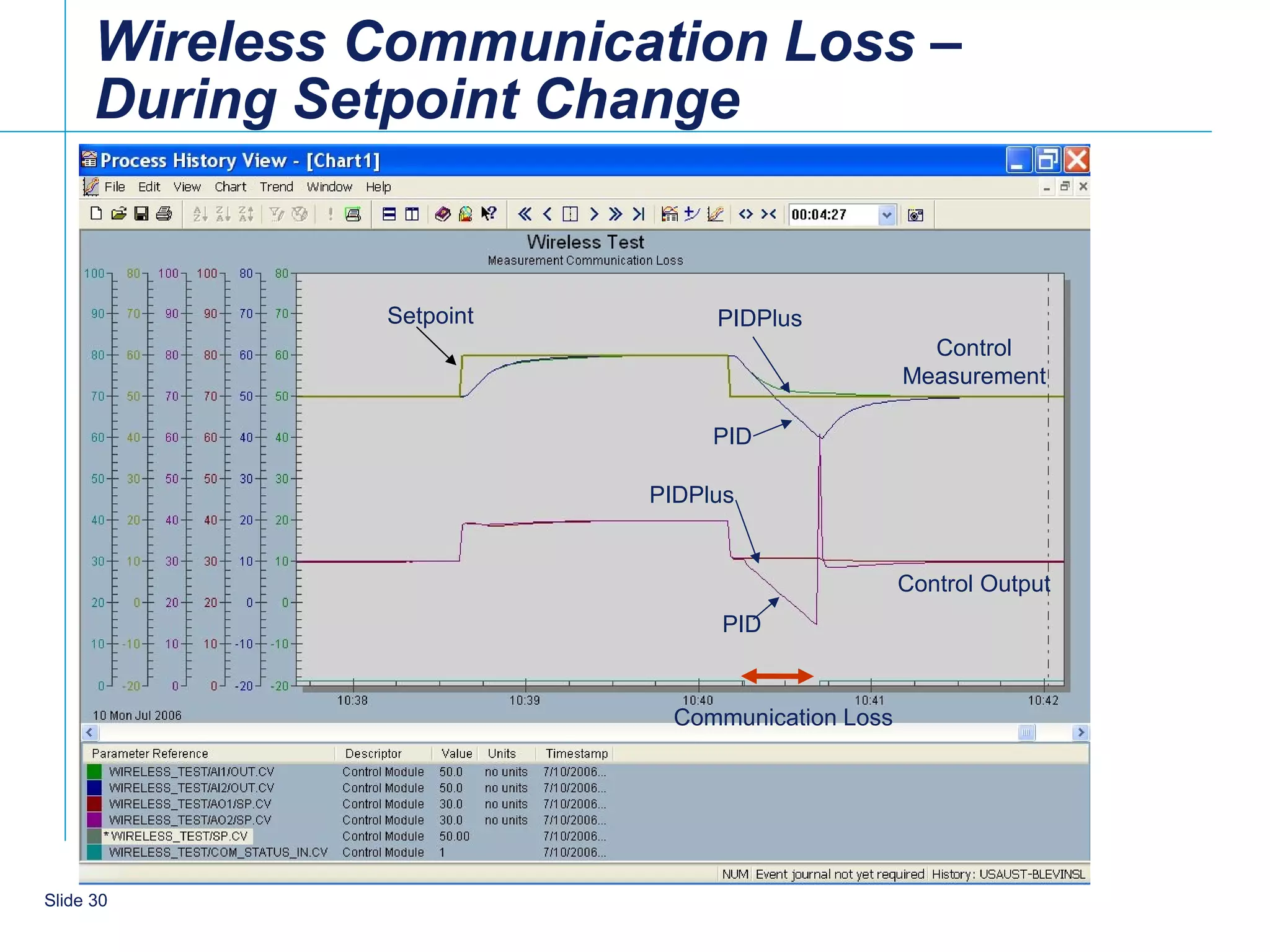
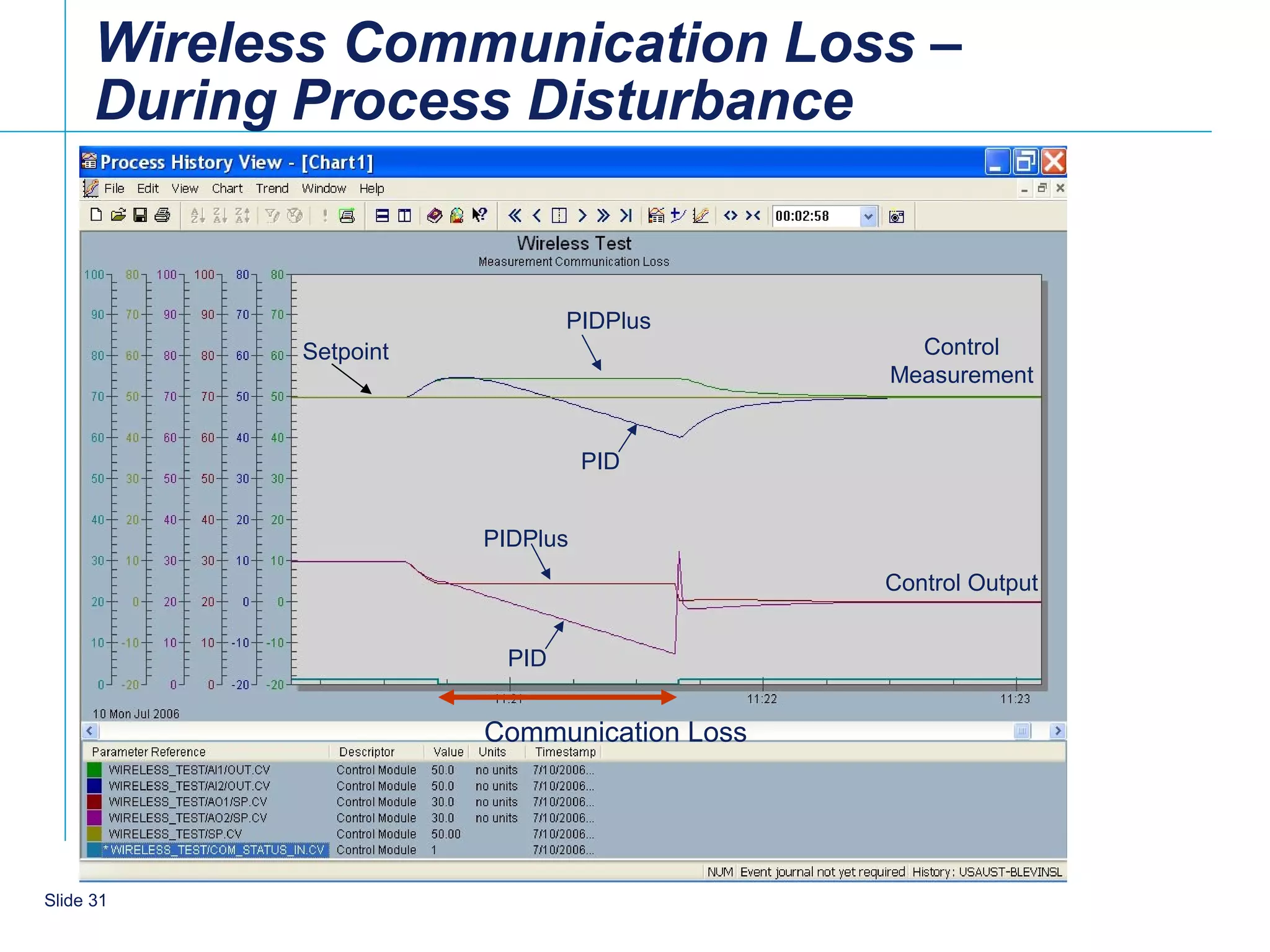
PID Performance for Lost Communications

            The Conventional PID provides poor
             dynamic response when wireless
             communications are lost.
            The PID modified for wireless control
             provides improved dynamic response under
             these conditions


    29
Slide 29
Wireless Communication Loss –
      During Setpoint Change


               Setpoint        PIDPlus
                                                   Control
                                                 Measurement

                               PID

                          PIDPlus


                                                 Control Output
                                PID


                            Communication Loss


    30
Slide 30
Wireless Communication Loss –
      During Process Disturbance


                               PIDPlus
            Setpoint                          Control
                                            Measurement


                                 PID


                       PIDPlus
                                            Control Output


                         PID


                       Communication Loss


    31
Slide 31
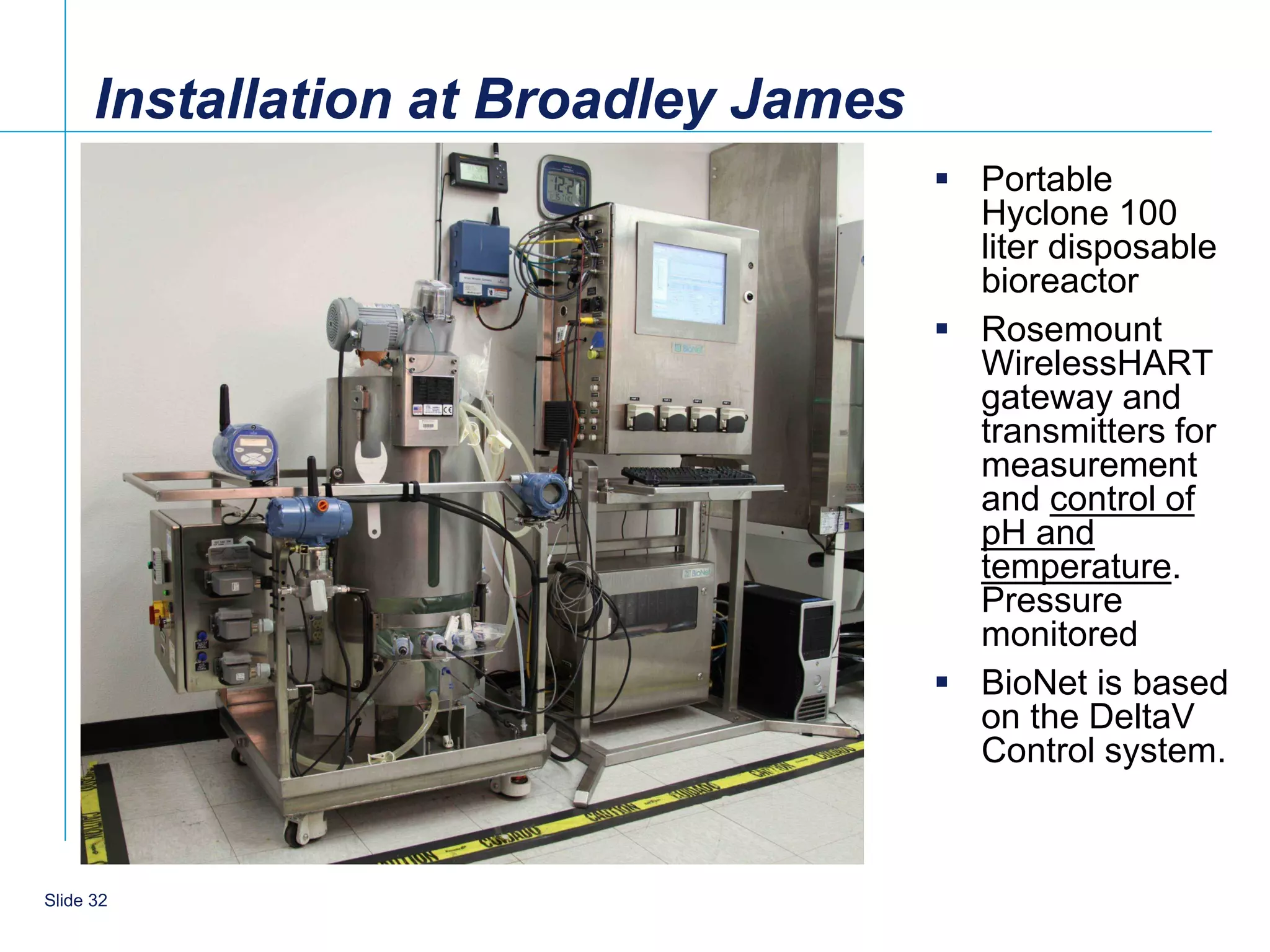
Installation at Broadley James
                                        Portable
                                         Hyclone 100
                                         liter disposable
                                         bioreactor
                                        Rosemount
                                         WirelessHART
                                         gateway and
                                         transmitters for
                                         measurement
                                         and control of
                                         pH and
                                         temperature.
                                         Pressure
                                         monitored
                                        BioNet is based
                                         on the DeltaV
                                         Control system.


    32
Slide 32
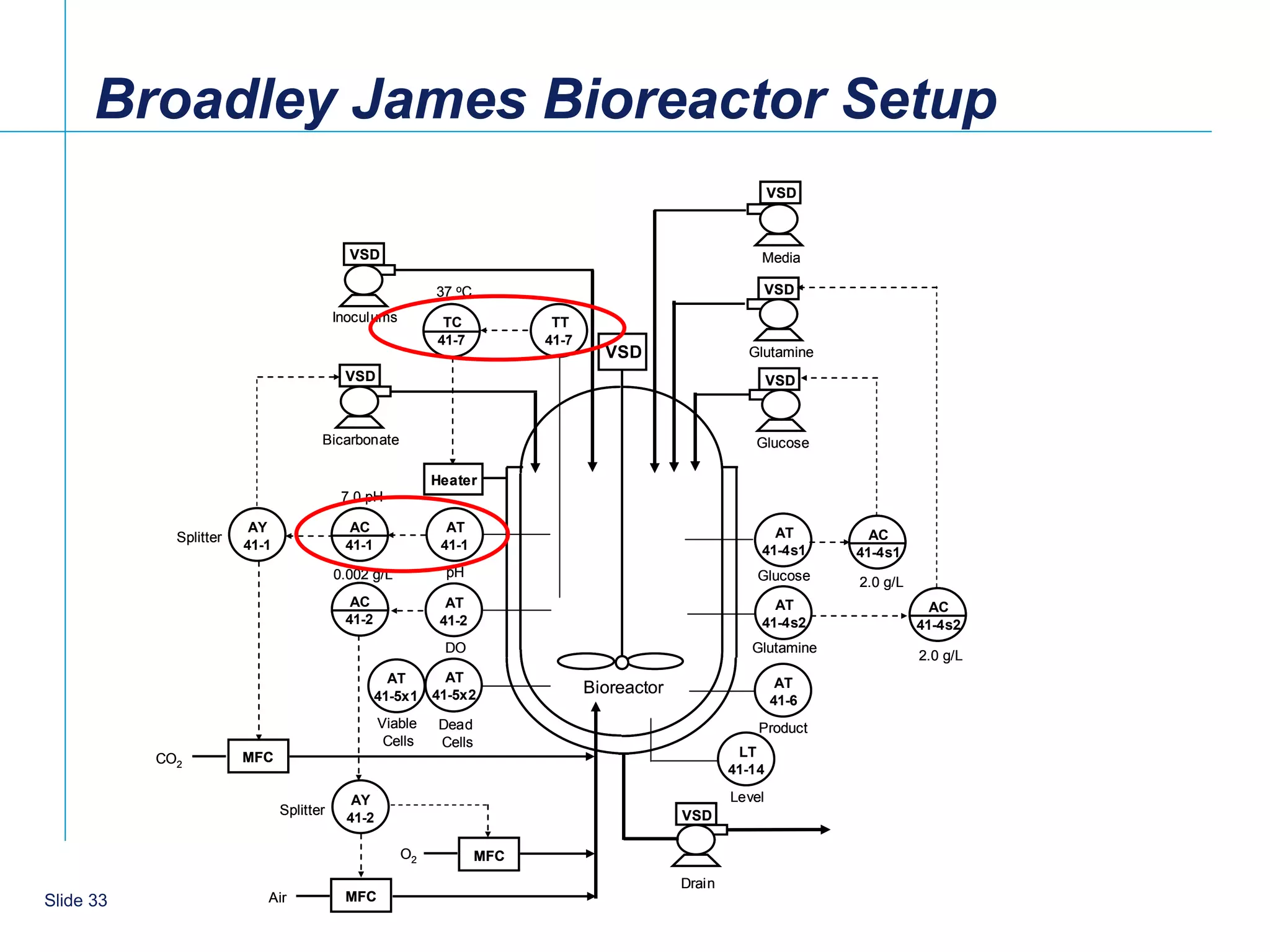
Broadley James Bioreactor Setup
                                                                                                             VSD


                                            VSD                                                          Media

                                                           37 oC                                             VSD
                                          Inoculums         TC            TT
                                                           41-7          41-7
                                                                                  VSD                  Glutamine
                                           VSD                                                               VSD


                                      Bicarbonate                                                       Glucose

                                                           Heater
                                           7.0 pH

                         AY                 AC               AT                                            AT
             Splitter                                                                                                 AC
                        41-1               41-1             41-1                                         41-4s1     41-4s1
                                          0.002 g/L         pH                                           Glucose    2.0 g/L
                                            AC               AT                                            AT                   AC
                                           41-2             41-2                                         41-4s2               41-4s2
                                                            DO                                          Glutamine
                                                                                                                              2.0 g/L
                                                    AT     AT                                                 AT
                                                  41-5x1 41-5x2
                                                                                Bioreactor
                                                                                                             41-6
                                                  Viable   Dead                                          Product
                                                   Cells   Cells
           CO2          MFC                                                                           LT
                                                                                                     41-14

                                            AY                                                       Level
                               Splitter                                                      VSD
                                           41-2

                                                      O2           MFC
                                                                                             Drain
    33
Slide 33                   Air             MFC
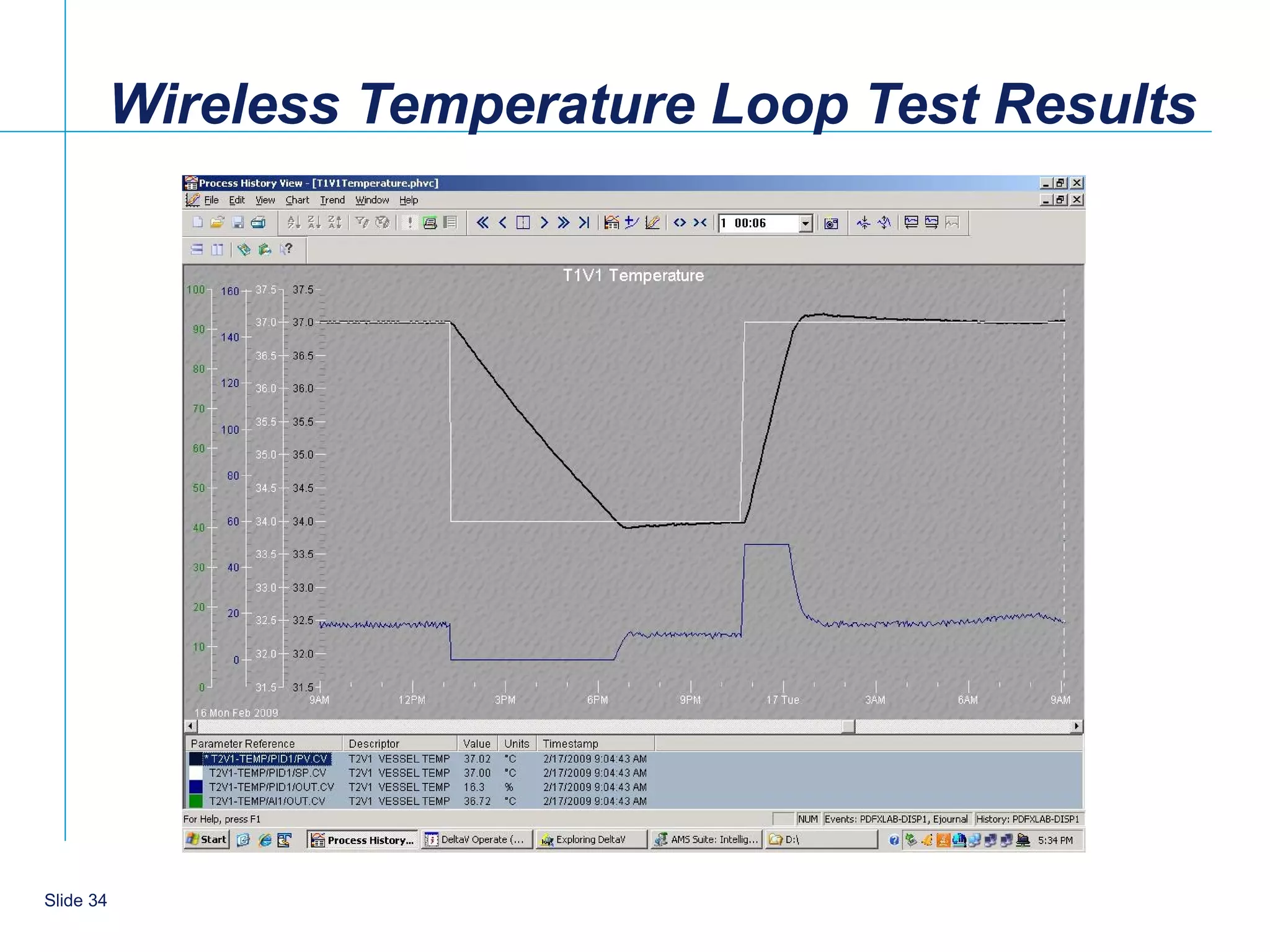
Wireless Temperature Loop Test Results


    34
Slide 34
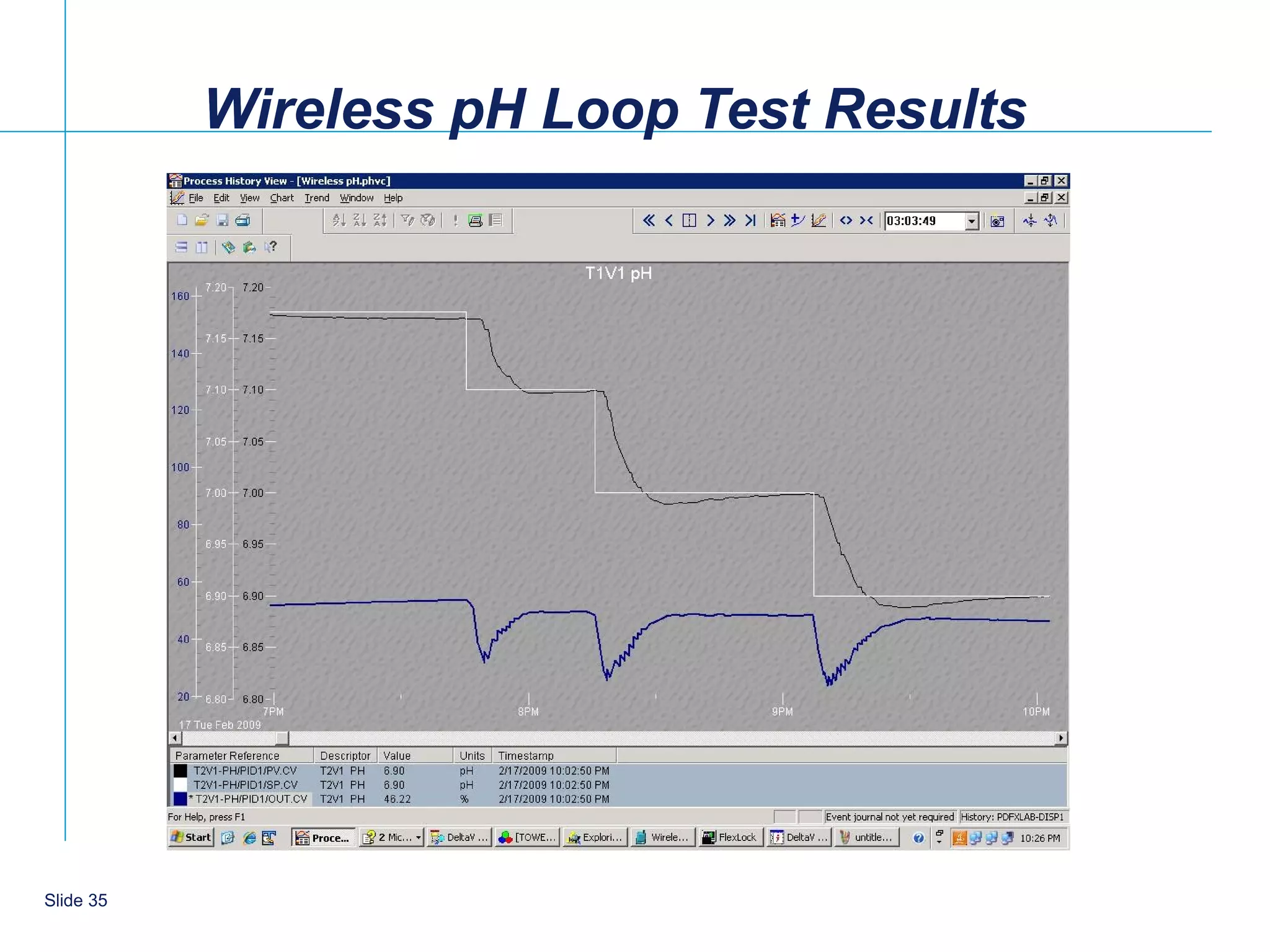
Wireless pH Loop Test Results


    35
Slide 35
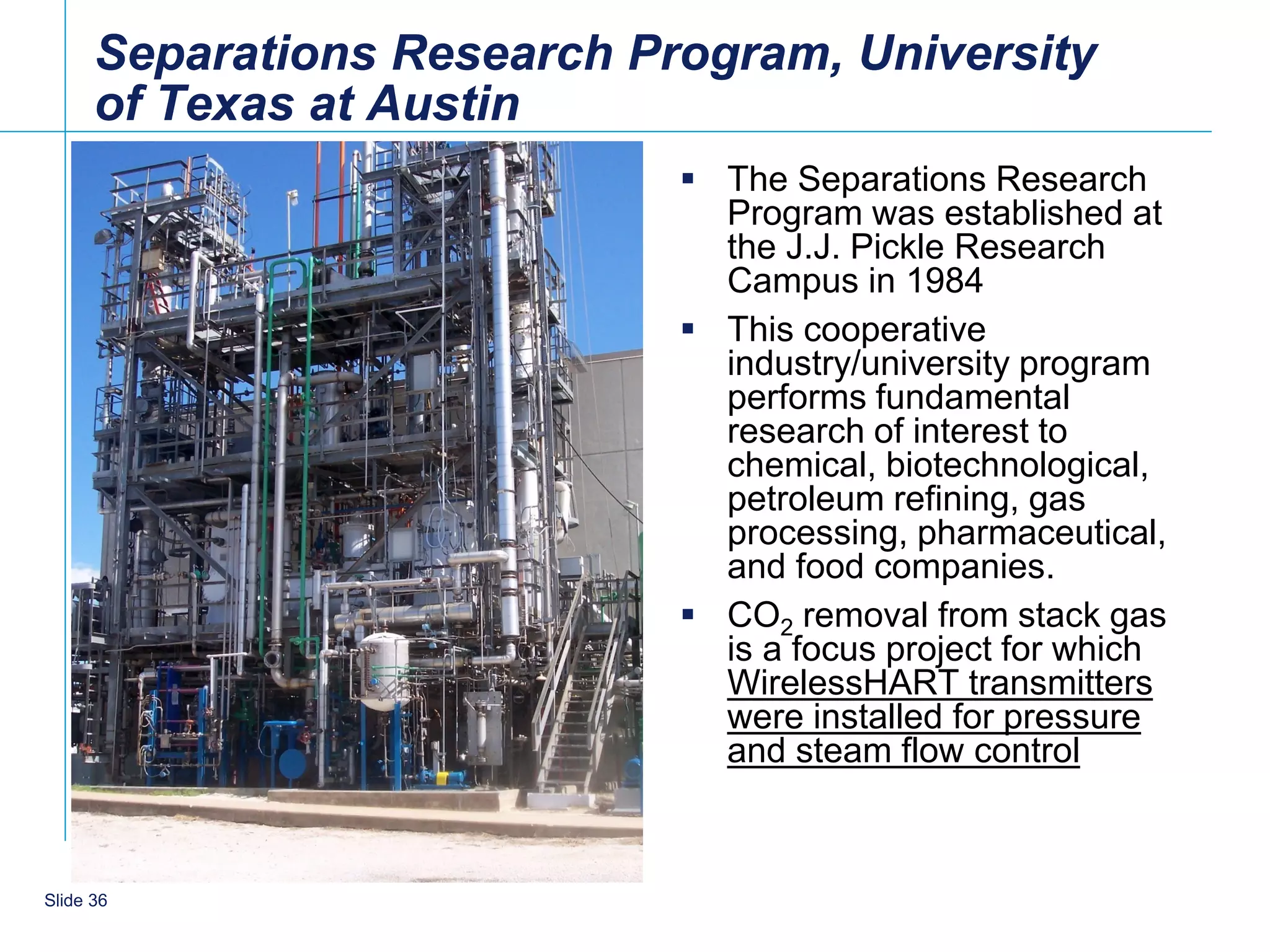
Separations Research Program, University
      of Texas at Austin
                              The Separations Research
                               Program was established at
                               the J.J. Pickle Research
                               Campus in 1984
                              This cooperative
                               industry/university program
                               performs fundamental
                               research of interest to
                               chemical, biotechnological,
                               petroleum refining, gas
                               processing, pharmaceutical,
                               and food companies.
                              CO2 removal from stack gas
                               is a focus project for which
                               WirelessHART transmitters
                               were installed for pressure
                               and steam flow control


    36
Slide 36
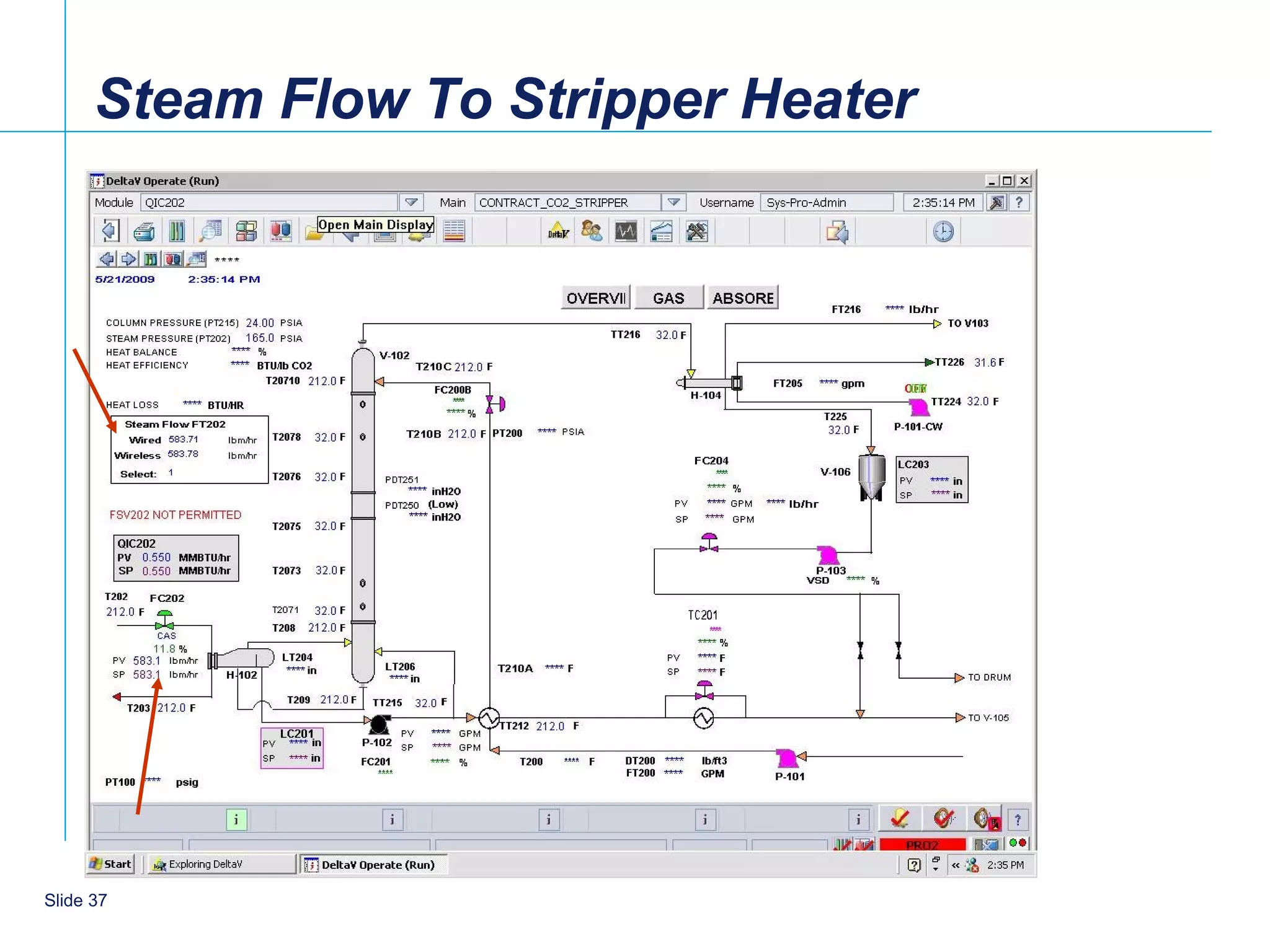
Steam Flow To Stripper Heater


    37
Slide 37
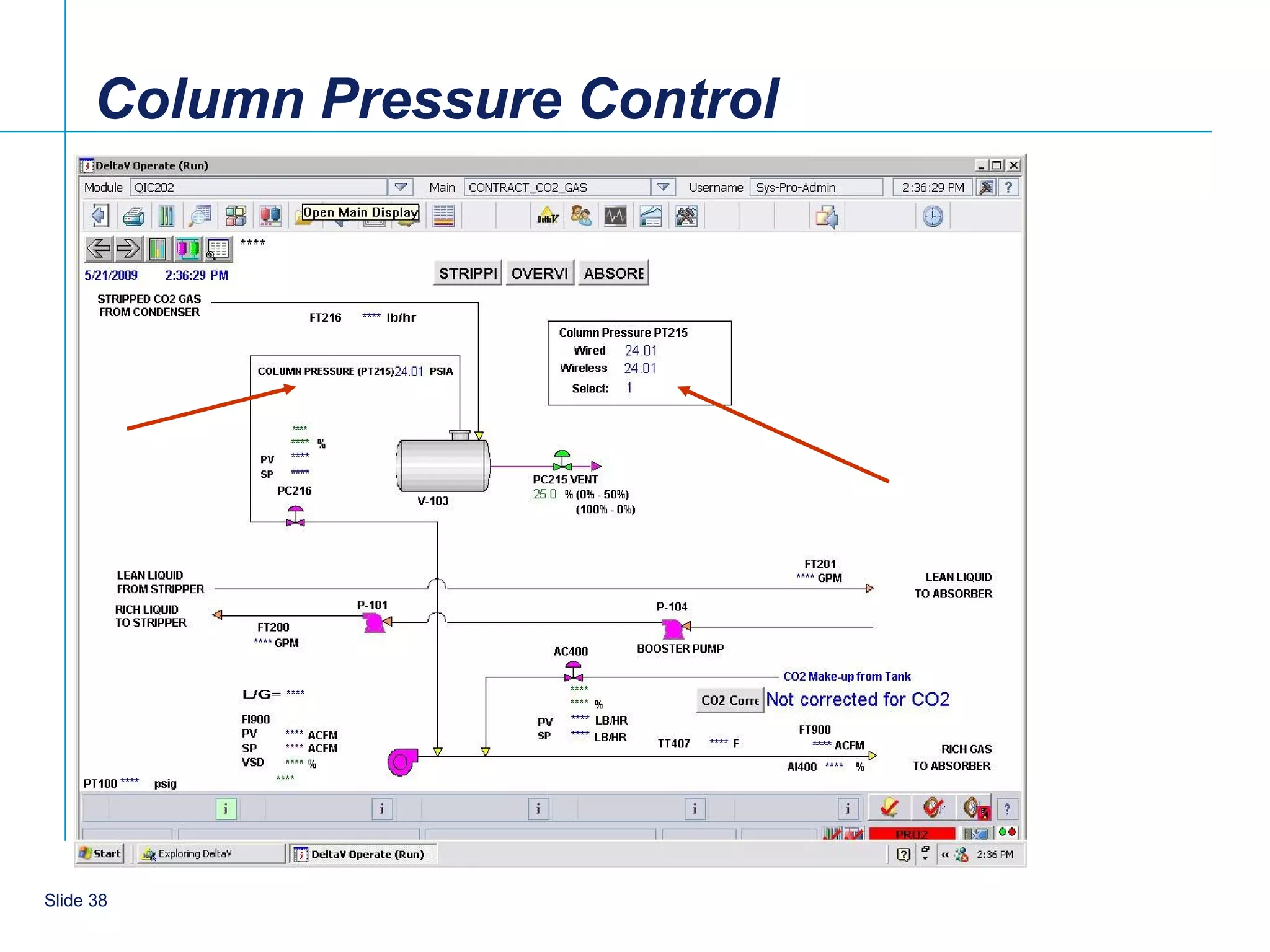
Column Pressure Control


    38
Slide 38
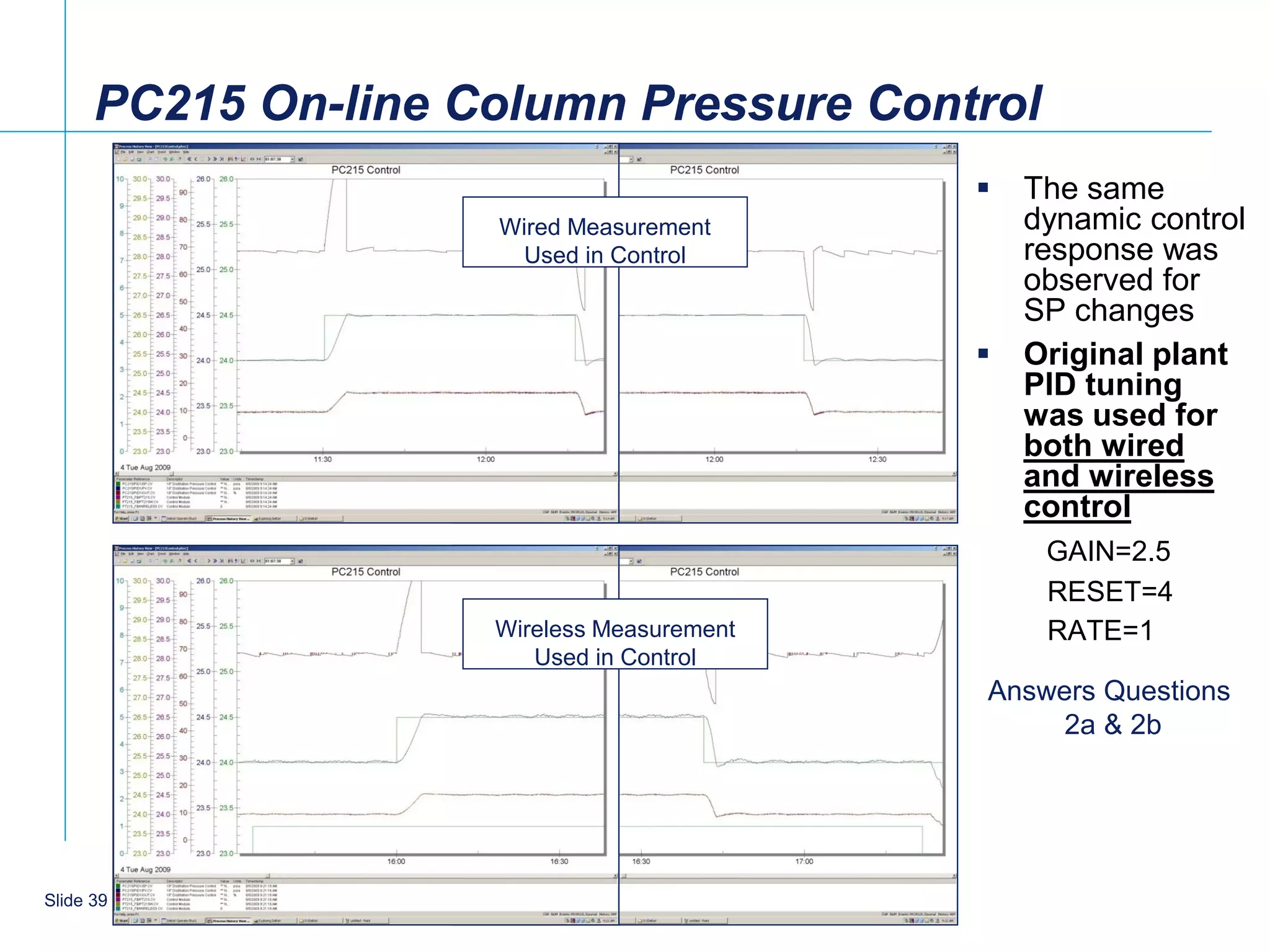
PC215 On-line Column Pressure Control
                                               The same
                     Wired Measurement          dynamic control
                      Used in Control           response was
                                                observed for
                                                SP changes
                                               Original plant
                                                PID tuning
                                                was used for
                                                both wired
                                                and wireless
                                                control
                                                 GAIN=2.5
                                                 RESET=4
                     Wireless Measurement        RATE=1
                        Used in Control
                                            Answers Questions
                                                 2a & 2b


    39
Slide 39
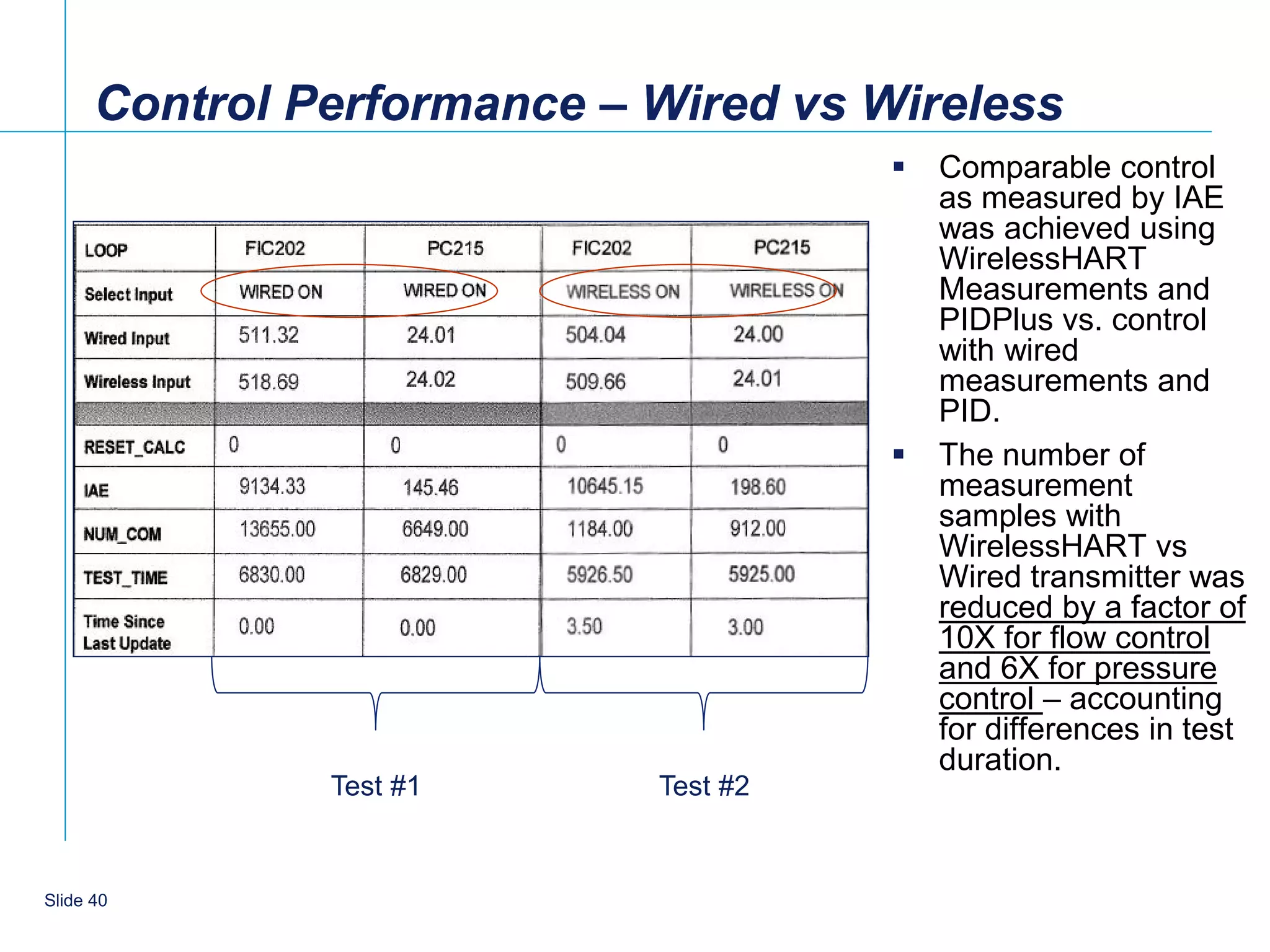
Control Performance – Wired vs Wireless
                                         Comparable control
                                          as measured by IAE
                                          was achieved using
                                          WirelessHART
                                          Measurements and
                                          PIDPlus vs. control
                                          with wired
                                          measurements and
                                          PID.
                                         The number of
                                          measurement
                                          samples with
                                          WirelessHART vs
                                          Wired transmitter was
                                          reduced by a factor of
                                          10X for flow control
                                          and 6X for pressure
                                          control – accounting
                                          for differences in test
                                          duration.
               Test #1      Test #2


    40
Slide 40
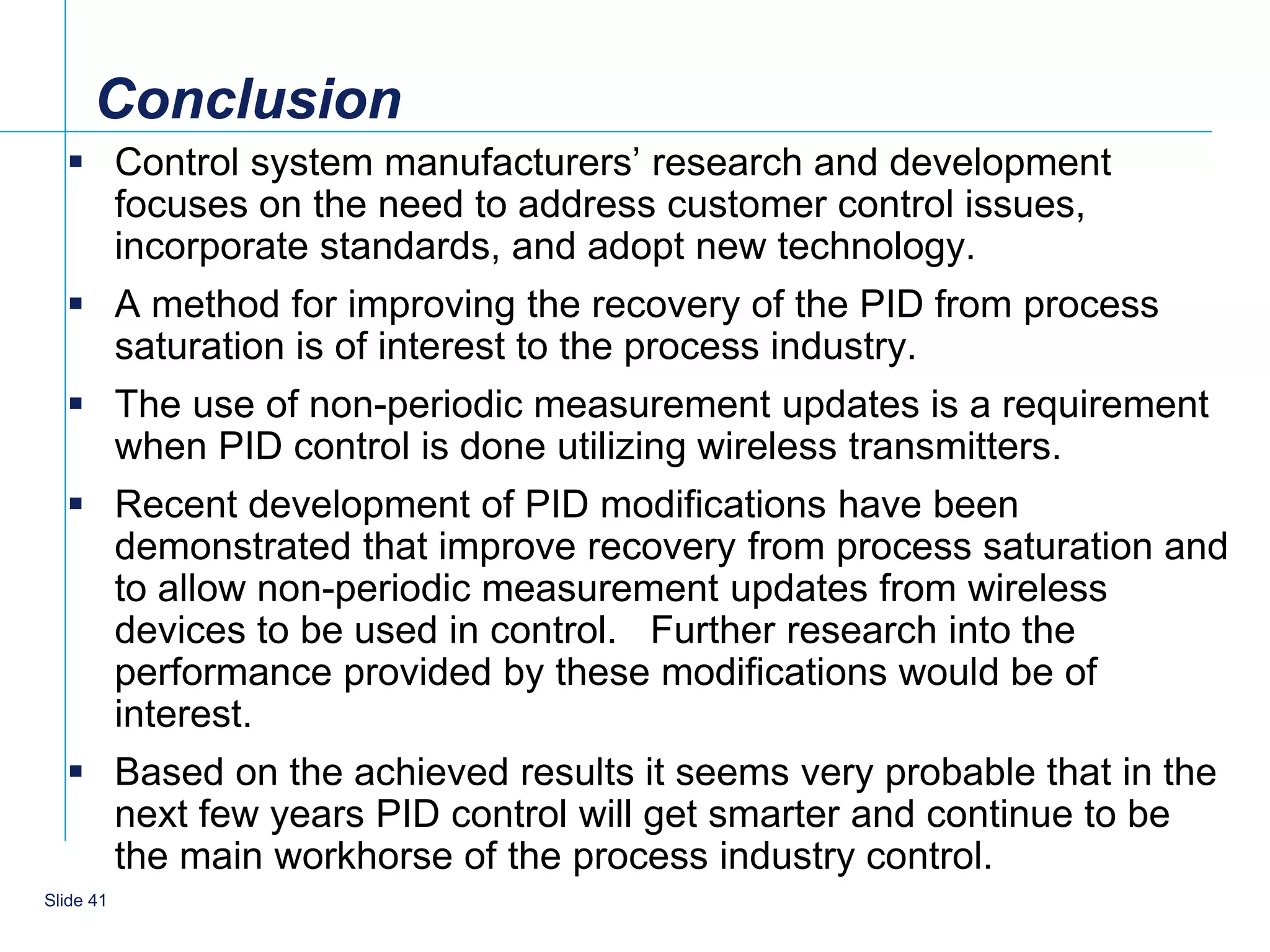
Conclusion
   Control system manufacturers’ research and development
    focuses on the need to address customer control issues,
    incorporate standards, and adopt new technology.
   A method for improving the recovery of the PID from process
    saturation is of interest to the process industry.
   The use of non-periodic measurement updates is a requirement
    when PID control is done utilizing wireless transmitters.
   Recent development of PID modifications have been
    demonstrated that improve recovery from process saturation and
    to allow non-periodic measurement updates from wireless
    devices to be used in control. Further research into the
    performance provided by these modifications would be of
    interest.
   Based on the achieved results it seems very probable that in the
    next few years PID control will get smarter and continue to be
    the main workhorse of the process industry control.
    41
Slide 41

PID Advances in Industrial Control

  • 1.
    PID Advances inIndustrial Control Terry Blevins Principal Technologist DeltaV Future Architecture Team Austin, TX Slide 1
  • 2.
    Agenda  State of Industrial Process Control as seen by one manufacturer of distributed control systems  Advances over the last 10 years – Performance Monitoring – On-Demand and Adaptive Tuning  Current Areas of Research and Development – PID Recovery From Process Saturation – PID Control Using Wireless Devices  Conclusion, Future 2 Slide 2
  • 3.
    Advances in ControlSystem Design  Technology has allowed the cost and footprint of the control system to be reduced while allowing control functionality to be increased. 3 Slide 3
  • 4.
    Fieldbus Impact A variety of fieldbuses and field device have been introduced that simplify field wiring and allow control to be distributed to the device level Intranet Access Electronic Marshalling Wireless 4 Slide 4
  • 5.
    Electronic Marshalling Electronic marshalling has simplified field wiring 5 Slide 5
  • 6.
    The impact ofstandards  IEC61804 defines function blocks for process control  Supports distribution of control to field devices.  Defines the use of measurement status indicate measure quality and mode to determine the source of setpoint and block output.  Electronic Device Description Language(EDDL) enables a control system to work with any manufacturer’s device.  HART, Foundation Fieldbus, and Profibus devices are consistent with this standard. 6 Slide 6
  • 7.
    PID is theBasis For Continuous Process Control PID is the dominant technology for feedback control Single loop and multi-loop PID Advanced control e.g. MPC, Fuzzy 7 Slide 7 >95% of control application Logic < 5% of control application
  • 8.
    Example of OperatorInterface to Control  The latest UI technology allows the plant operator to do more.  Graphic displays and historic trends allow the operator to view and interact with discrete and continuous control  Web technology allows remote access to measurement, control, and calculations 8 Slide 8
  • 9.
    Issues Confronting TheProcess Industry  In many cases the staffing at the plant level has been reduced. Plant support at the corporate level may have been severely downsized or eliminated.  Process engineers and instrumentation technicians may not have sufficient training to fully understand control setup and tune PID loops for best performance.  Resources at the plant level may only be sufficient to address issues that disrupt production.  The impact of control utilization/performance may not be monitored, documented and/or effectively communicated to plant management.  This is a global issue – Not specific to the control system manufacturer, commonly encountered in many major plants located in the US, Europe, Asia Pacific, Middle East. 9 Slide 9
  • 10.
    Example – Pulpand Paper  After plant management saw the results of this survey, a team was formed to address control issues in a timely fashion.  The reduction in variability led to significant improvements in plant throughput and product quality.  Two years later the plant set a new production record. 10 Slide 10
  • 11.
    Example - PetrochemicalComplex  Once plant management became aware of the low control utilization, manpower and funding were provided to investigate and correct the measurement and control issues  Work to improve control performance should begin with an assessment of control utilization. 11 Slide 11
  • 12.
    Control System Manufacturer’sFocus Customer Issues e.g. Performance Monitoring New Technology Control System Product e.g. Wireless Research and Changes Device Development Standards e.g. IEC61804, S88 12 Slide 12
  • 13.
    PERFORMANCE MONITORING Measurement status and control mode as defined by IEC61804 are key to performance monitoring 13 Slide 13
  • 14.
    Performance Monitoring -Example  Explorer tree allows easy navigation of control hierarchy  Overview display summarizes performance for System, Area, Units and Modules  Abnormal Control Conditions indicated for Problem Loops: – Control Service Status: • Incorrect mode • Limited control output • Bad/Uncertain input – Control Performance Status: • Standard Deviation • Variability Index • Oscillation Index • Tuning Index  Device and Valve Diagnostics 14 Slide 14
  • 15.
    Performance Reports -Example Communication of Results to Plant Management Standard Reports  Quickly identify control problems  Track performance, Schedule for automatic generation Customized Reports  Add production KPI‟s 15 Slide 15
  • 16.
    On-Demand Tuning -Example  One of the most effective on-demand tuning technologies is relay oscillation as originally developed by Åstrӧm and Hägglund.  Allows tuning to be quickly established when commissioning control.  Tuning rules such as modified Ziegler Nichols tuning may be used to determine the PID tuning. 16 Slide 16
  • 17.
    Adaptive Tuning Allows tuning the process model to be automatically established based on:  Normal setpoint changes made by the operator when the PID is in an automatic  PID output changes when the PID is in a manual mode. Model switching with re- centering and interpolation may be used for process model identification – see Intelligent PID Product Design 17 Slide 17
  • 18.
    Adaptive Control -Implementation  To allow the data used in adaptive control to be collected without communication skew or jitter, adaptive control is implemented directly in the PID  Enables adaptive control to be utilized even in high speed control applications. 18 Slide 18
  • 19.
    Recovery From ProcessSaturation  The recovery of the PID from process saturation is critical in many continuous and batch applications.  By utilizing a variable preload when the PID PI Control output is limited for an extended period of time (process saturation), it is possible to minimize setpoint overshoot on recovery from saturation.  See conference paper Improving PID Recovery from Limit Conditions. PI Control with Variable Pre-load 19 Slide 19
  • 20.
    Example - BoilerOutlet Steam Temperature  If steam generation exceeds the attemperator capacity the boiler outlet steam temperature will exceed the outlet Standard PID PID w/Variable Pre-load setpoint with the spray valve fully open.  When boiler firing rate is reduced, the spray value should be cut back as the 50% Drop in outlet temperature steam generation SP Overshoot drops. 20 Slide 20
  • 21.
    PID Modifications forWireless Control The Challenge – Control Using Wireless  Transmitter power consumption is minimized by reducing the number of times the measurement value is communicated.  Conventional PID execution synchronizes the measurement value with control action, by over-sampling the measurement by a factor of 2-10X.  The rule of thumb to minimize control variation is to have feedback control executed 4X to 10X times faster than the process response time (process time constant plus process delay).  The conventional PID design (i.e., difference equation and z- transform) assumes that a new measurement value is available at each execution and that control is executed on a periodic basis. 21 Slide 21
  • 22.
    Conventional Approach –Over Sampling of Measurement Process Output 63% of Change O Time Constant ( ) Deadtime (TD ) Process Input I Control Execution New Measurement Available 22 Slide 22
  • 23.
    Conventional PID -Impact of Wireless  The underlying assumption in traditional control design is that the PID is executed on a periodic basis.  When the measurement is not updated on a periodic basis, the calculated reset action may not be appropriate.  If control action is only executed when a new measurement is communicated, this could result in a delayed control response to setpoint changes and feedforward action on measured disturbances. Conventional PID Design 23 Slide 23
  • 24.
    *WirelessHART Solution Window communication is the preferred method of communications for control applications. A new value will be communicated only if:  the magnitude of the difference between the new measurement value and the last communicated measurement value is greater that a specified trigger value  or if the time since the last communication exceeds a maximum update period. Thus, the measurement is communicated only as often as required to allow control action to correct for unmeasured disturbances or response to setpoint changes. For Windowed mode you must specify an update period, a maximum update period, and a trigger value. *HART 7 specification that has been adopted as an international standard, IEC 62591Ed. 1.0. 24 Slide 24
  • 25.
    PID Modification forWireless Control  To provide the best control for a non-periodic measurement, the PID must be modified to reflect the reset contribution for the expected process response since the last measurement update.  Control execution is set faster than measurement update. This permits immediate action on setpoint change and update in faceplate. 25 Slide 25
  • 26.
    PIDPlus Using WirelessTransmitter vs. Conventional PID and Wired Transmitter Lambda Tuning ʎ = 1.0 Communication Resolution = 1% Communication Refresh = 10sec Control Setpoint PIDPlus Measurement PID PIDPlus Control Output PID Unmeasured Disturbance 26 Slide 26
  • 27.
    CONTROL PERFORMANCE DIFFERENCE  Communications transmissions are reduced by over 96 % when window communication is utilized.  The impact of non-periodic measurement updates on control performance as measured by Integral of Absolute Error (IAE) is minimized through the PID modifications for wireless communication. 27 Slide 27
  • 28.
    PIDPlus - ModifiedDerivative Action 28 Slide 28
  • 29.
    PID Performance forLost Communications  The Conventional PID provides poor dynamic response when wireless communications are lost.  The PID modified for wireless control provides improved dynamic response under these conditions 29 Slide 29
  • 30.
    Wireless Communication Loss– During Setpoint Change Setpoint PIDPlus Control Measurement PID PIDPlus Control Output PID Communication Loss 30 Slide 30
  • 31.
    Wireless Communication Loss– During Process Disturbance PIDPlus Setpoint Control Measurement PID PIDPlus Control Output PID Communication Loss 31 Slide 31
  • 32.
    Installation at BroadleyJames  Portable Hyclone 100 liter disposable bioreactor  Rosemount WirelessHART gateway and transmitters for measurement and control of pH and temperature. Pressure monitored  BioNet is based on the DeltaV Control system. 32 Slide 32
  • 33.
    Broadley James BioreactorSetup VSD VSD Media 37 oC VSD Inoculums TC TT 41-7 41-7 VSD Glutamine VSD VSD Bicarbonate Glucose Heater 7.0 pH AY AC AT AT Splitter AC 41-1 41-1 41-1 41-4s1 41-4s1 0.002 g/L pH Glucose 2.0 g/L AC AT AT AC 41-2 41-2 41-4s2 41-4s2 DO Glutamine 2.0 g/L AT AT AT 41-5x1 41-5x2 Bioreactor 41-6 Viable Dead Product Cells Cells CO2 MFC LT 41-14 AY Level Splitter VSD 41-2 O2 MFC Drain 33 Slide 33 Air MFC
  • 34.
    Wireless Temperature LoopTest Results 34 Slide 34
  • 35.
    Wireless pH LoopTest Results 35 Slide 35
  • 36.
    Separations Research Program,University of Texas at Austin  The Separations Research Program was established at the J.J. Pickle Research Campus in 1984  This cooperative industry/university program performs fundamental research of interest to chemical, biotechnological, petroleum refining, gas processing, pharmaceutical, and food companies.  CO2 removal from stack gas is a focus project for which WirelessHART transmitters were installed for pressure and steam flow control 36 Slide 36
  • 37.
    Steam Flow ToStripper Heater 37 Slide 37
  • 38.
  • 39.
    PC215 On-line ColumnPressure Control  The same Wired Measurement dynamic control Used in Control response was observed for SP changes  Original plant PID tuning was used for both wired and wireless control GAIN=2.5 RESET=4 Wireless Measurement RATE=1 Used in Control Answers Questions 2a & 2b 39 Slide 39
  • 40.
    Control Performance –Wired vs Wireless  Comparable control as measured by IAE was achieved using WirelessHART Measurements and PIDPlus vs. control with wired measurements and PID.  The number of measurement samples with WirelessHART vs Wired transmitter was reduced by a factor of 10X for flow control and 6X for pressure control – accounting for differences in test duration. Test #1 Test #2 40 Slide 40
  • 41.
    Conclusion Control system manufacturers’ research and development focuses on the need to address customer control issues, incorporate standards, and adopt new technology.  A method for improving the recovery of the PID from process saturation is of interest to the process industry.  The use of non-periodic measurement updates is a requirement when PID control is done utilizing wireless transmitters.  Recent development of PID modifications have been demonstrated that improve recovery from process saturation and to allow non-periodic measurement updates from wireless devices to be used in control. Further research into the performance provided by these modifications would be of interest.  Based on the achieved results it seems very probable that in the next few years PID control will get smarter and continue to be the main workhorse of the process industry control. 41 Slide 41