ICE401: PROCESS INSTRUMENTATION
AND CONTROL
Class 16
Floating and Proportional Control Mode
Dr. S. Meenatchisundaram
Email: meenasundar@gmail.com
Process Instrumentation and Control (ICE 401)
Dr. S.Meenatchisundaram, MIT, Manipal, Aug – Nov 2015
Floating Control Mode:
Process Instrumentation and Control (ICE 401)
Dr. S.Meenatchisundaram, MIT, Manipal, Aug – Nov 2015
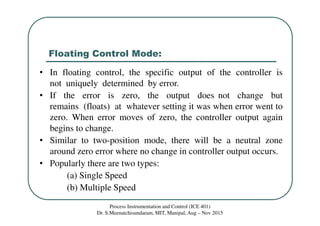
• In floating control, the specific output of the controller is
not uniquely determined by error.
• If the error is zero, the output does not change but
remains (floats) at whatever setting it was when error went to
zero. When error moves of zero, the controller output again
begins to change.
• Similar to two-position mode, there will be a neutral zone
around zero error where no change in controller output occurs.
• Popularly there are two types:
(a) Single Speed
(b) Multiple Speed
Floating Control Mode:
Process Instrumentation and Control (ICE 401)
Dr. S.Meenatchisundaram, MIT, Manipal, Aug – Nov 2015
Single Speed:
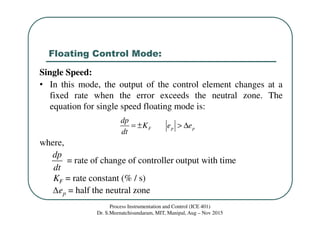
• In this mode, the output of the control element changes at a
fixed rate when the error exceeds the neutral zone. The
equation for single speed floating mode is:
where,
= rate of change of controller output with time
KF = rate constant (% / s)
∆ep = half the neutral zone
F p p
dp
K e e
dt
= ± > ∆
dp
dt
Floating Control Mode:
Process Instrumentation and Control (ICE 401)
Dr. S.Meenatchisundaram, MIT, Manipal, Aug – Nov 2015
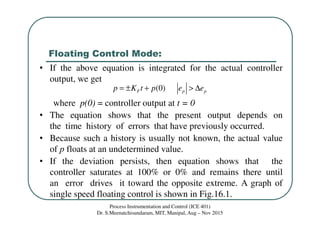
• If the above equation is integrated for the actual controller
output, we get
where p(0) = controller output at t = 0
• The equation shows that the present output depends on
the time history of errors that have previously occurred.
• Because such a history is usually not known, the actual value
of p floats at an undetermined value.
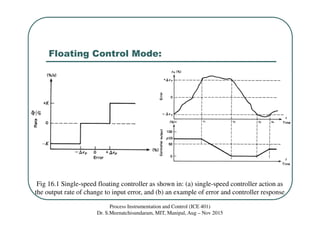
• If the deviation persists, then equation shows that the
controller saturates at 100% or 0% and remains there until
an error drives it toward the opposite extreme. A graph of
single speed floating control is shown in Fig.16.1.
(0)F p pp K t p e e= ± + > ∆
Floating Control Mode:
Process Instrumentation and Control (ICE 401)
Dr. S.Meenatchisundaram, MIT, Manipal, Aug – Nov 2015
Fig 16.1 Single-speed floating controller as shown in: (a) single-speed controller action as
the output rate of change to input error, and (b) an example of error and controller response
Floating Control Mode:
Process Instrumentation and Control (ICE 401)
Dr. S.Meenatchisundaram, MIT, Manipal, Aug – Nov 2015
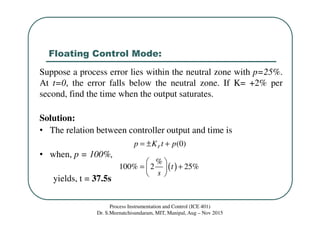
Suppose a process error lies within the neutral zone with p=25%.
At t=0, the error falls below the neutral zone. If K= +2% per
second, find the time when the output saturates.
Solution:
• The relation between controller output and time is
• when, p = 100%,
yields, t = 37.5s
(0)Fp K t p= ± +
( )
%
100% 2 25%t
s
 
= + 
 
Floating Control Mode:
Process Instrumentation and Control (ICE 401)
Dr. S.Meenatchisundaram, MIT, Manipal, Aug – Nov 2015
Multiple Speed:
• In this mode several possible speeds (rate) are changed by
controller output.
• Usually, the rate increases as the deviation exceeds certain
limits.
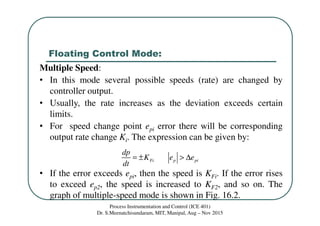
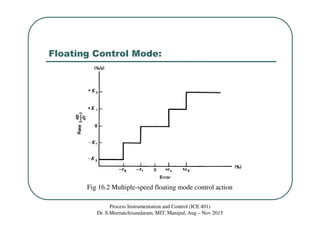
• For speed change point epi error there will be corresponding
output rate change Ki. The expression can be given by:
• If the error exceeds epi, then the speed is KFi. If the error rises
to exceed ep2, the speed is increased to KF2, and so on. The
graph of multiple-speed mode is shown in Fig. 16.2.
Fi p pi
dp
K e e
dt
= ± > ∆
Floating Control Mode:
Process Instrumentation and Control (ICE 401)
Dr. S.Meenatchisundaram, MIT, Manipal, Aug – Nov 2015
Fig 16.2 Multiple-speed floating mode control action
Continuous Controller Modes:
Process Instrumentation and Control (ICE 401)
Dr. S.Meenatchisundaram, MIT, Manipal, Aug – Nov 2015
Proportional Control Mode:
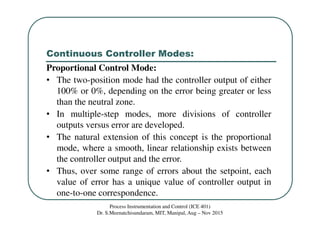
• The two-position mode had the controller output of either
100% or 0%, depending on the error being greater or less
than the neutral zone.
• In multiple-step modes, more divisions of controller
outputs versus error are developed.
• The natural extension of this concept is the proportional
mode, where a smooth, linear relationship exists between
the controller output and the error.
• Thus, over some range of errors about the setpoint, each
value of error has a unique value of controller output in
one-to-one correspondence.
Proportional Control Mode:
Process Instrumentation and Control (ICE 401)
Dr. S.Meenatchisundaram, MIT, Manipal, Aug – Nov 2015
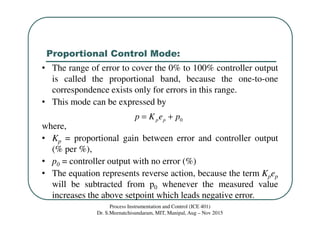
• The range of error to cover the 0% to 100% controller output
is called the proportional band, because the one-to-one
correspondence exists only for errors in this range.
• This mode can be expressed by
where,
• Kp = proportional gain between error and controller output
(% per %),
• p0 = controller output with no error (%)
• The equation represents reverse action, because the term Kpep
will be subtracted from p0 whenever the measured value
increases the above setpoint which leads negative error.
0p pp K e p= +
Proportional Control Mode:
Process Instrumentation and Control (ICE 401)
Dr. S.Meenatchisundaram, MIT, Manipal, Aug – Nov 2015
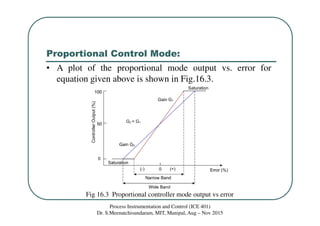
• A plot of the proportional mode output vs. error for
equation given above is shown in Fig.16.3.
Fig 16.3 Proportional controller mode output vs error
Proportional Control Mode:
Process Instrumentation and Control (ICE 401)
Dr. S.Meenatchisundaram, MIT, Manipal, Aug – Nov 2015
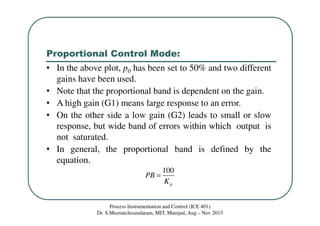
• In the above plot, p0 has been set to 50% and two different
gains have been used.
• Note that the proportional band is dependent on the gain.
• A high gain (G1) means large response to an error.
• On the other side a low gain (G2) leads to small or slow
response, but wide band of errors within which output is
not saturated.
• In general, the proportional band is defined by the
equation.
100
p
PB
K
=
Proportional Control Mode:
Process Instrumentation and Control (ICE 401)
Dr. S.Meenatchisundaram, MIT, Manipal, Aug – Nov 2015
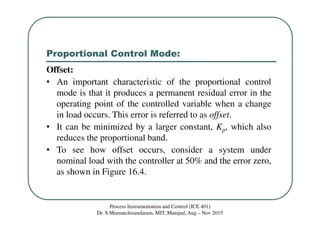
Offset:
• An important characteristic of the proportional control
mode is that it produces a permanent residual error in the
operating point of the controlled variable when a change
in load occurs. This error is referred to as offset.
• It can be minimized by a larger constant, Kp, which also
reduces the proportional band.
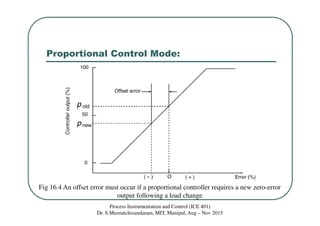
• To see how offset occurs, consider a system under
nominal load with the controller at 50% and the error zero,
as shown in Figure 16.4.
Proportional Control Mode:
Process Instrumentation and Control (ICE 401)
Dr. S.Meenatchisundaram, MIT, Manipal, Aug – Nov 2015
Fig 16.4 An offset error must occur if a proportional controller requires a new zero-error
output following a load change
Proportional Control Mode:
Process Instrumentation and Control (ICE 401)
Dr. S.Meenatchisundaram, MIT, Manipal, Aug – Nov 2015
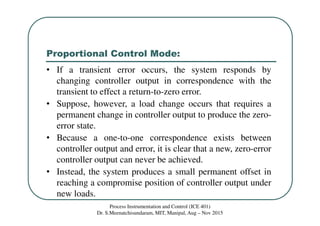
• If a transient error occurs, the system responds by
changing controller output in correspondence with the
transient to effect a return-to-zero error.
• Suppose, however, a load change occurs that requires a
permanent change in controller output to produce the zero-
error state.
• Because a one-to-one correspondence exists between
controller output and error, it is clear that a new, zero-error
controller output can never be achieved.
• Instead, the system produces a small permanent offset in
reaching a compromise position of controller output under
new loads.
Proportional Control Mode:
Process Instrumentation and Control (ICE 401)
Dr. S.Meenatchisundaram, MIT, Manipal, Aug – Nov 2015
Try this one:
• For a proportional controller, the controlled variable is a
process temperature with a range of 50 to 130 oC and a
setpoint of 73.5 oC. Under nominal conditions, the
setpoint is maintained with an output of 50%.
Find the proportional offset resulting from a load
change that requires a 55% output if the proportional gain
is (a) 0.1 (b) 0.7 (c) 2.0 and (d) 5.0.
Proportional Control Mode:
Process Instrumentation and Control (ICE 401)
Dr. S.Meenatchisundaram, MIT, Manipal, Aug – Nov 2015
Solution:
Given data:
Temperature Range = 50 to 130 oC
Setpoint = 73.5 oC
P0 = 50%
P = 55%
ep = ?
Offset error = ? for Kp = 0.1, 0.7, 2.0 & 5.0
For proportional controller: P = Kpep + P0
ep = [P - P0] / Kp = [55 – 50] / Kp = 5 / Kp %
Proportional Control Mode:
Process Instrumentation and Control (ICE 401)
Dr. S.Meenatchisundaram, MIT, Manipal, Aug – Nov 2015
Solution:
(a) when Kp = 0.1 Offset error, ep = 5/0.1 = 50%
(b) when Kp = 0.7 Offset error, ep = 5/0.7 = 7.1%
(c) when Kp = 2.0 Offset error, ep = 5/2.0 = 2.5%
(d) when Kp = 5.0 Offset error, ep = 5/5.0 = 1%
[It can be observed from the results that as proportional gain
Kp increases the offset error decreases.]
Proportional Control Mode:
Process Instrumentation and Control (ICE 401)
Dr. S.Meenatchisundaram, MIT, Manipal, Aug – Nov 2015
Try this one:
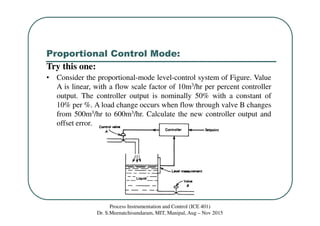
• Consider the proportional-mode level-control system of Figure. Value
A is linear, with a flow scale factor of 10m3/hr per percent controller
output. The controller output is nominally 50% with a constant of
10% per %. A load change occurs when flow through valve B changes
from 500m3/hr to 600m3/hr. Calculate the new controller output and
offset error.
References:
• Process Control Instrumentation Technology, by Curtis D.
Johnson, Eighth Edition, Pearson Education Limited.
Process Instrumentation and Control (ICE 401)
Dr. S.Meenatchisundaram, MIT, Manipal, Aug – Nov 2015

Class 16 floating and proportional control mode

  • 1.
    ICE401: PROCESS INSTRUMENTATION ANDCONTROL Class 16 Floating and Proportional Control Mode Dr. S. Meenatchisundaram Email: meenasundar@gmail.com Process Instrumentation and Control (ICE 401) Dr. S.Meenatchisundaram, MIT, Manipal, Aug – Nov 2015
  • 2.
    Floating Control Mode: ProcessInstrumentation and Control (ICE 401) Dr. S.Meenatchisundaram, MIT, Manipal, Aug – Nov 2015 • In floating control, the specific output of the controller is not uniquely determined by error. • If the error is zero, the output does not change but remains (floats) at whatever setting it was when error went to zero. When error moves of zero, the controller output again begins to change. • Similar to two-position mode, there will be a neutral zone around zero error where no change in controller output occurs. • Popularly there are two types: (a) Single Speed (b) Multiple Speed
  • 3.
    Floating Control Mode: ProcessInstrumentation and Control (ICE 401) Dr. S.Meenatchisundaram, MIT, Manipal, Aug – Nov 2015 Single Speed: • In this mode, the output of the control element changes at a fixed rate when the error exceeds the neutral zone. The equation for single speed floating mode is: where, = rate of change of controller output with time KF = rate constant (% / s) ∆ep = half the neutral zone F p p dp K e e dt = ± > ∆ dp dt
  • 4.
    Floating Control Mode: ProcessInstrumentation and Control (ICE 401) Dr. S.Meenatchisundaram, MIT, Manipal, Aug – Nov 2015 • If the above equation is integrated for the actual controller output, we get where p(0) = controller output at t = 0 • The equation shows that the present output depends on the time history of errors that have previously occurred. • Because such a history is usually not known, the actual value of p floats at an undetermined value. • If the deviation persists, then equation shows that the controller saturates at 100% or 0% and remains there until an error drives it toward the opposite extreme. A graph of single speed floating control is shown in Fig.16.1. (0)F p pp K t p e e= ± + > ∆
  • 5.
    Floating Control Mode: ProcessInstrumentation and Control (ICE 401) Dr. S.Meenatchisundaram, MIT, Manipal, Aug – Nov 2015 Fig 16.1 Single-speed floating controller as shown in: (a) single-speed controller action as the output rate of change to input error, and (b) an example of error and controller response
  • 6.
    Floating Control Mode: ProcessInstrumentation and Control (ICE 401) Dr. S.Meenatchisundaram, MIT, Manipal, Aug – Nov 2015 Suppose a process error lies within the neutral zone with p=25%. At t=0, the error falls below the neutral zone. If K= +2% per second, find the time when the output saturates. Solution: • The relation between controller output and time is • when, p = 100%, yields, t = 37.5s (0)Fp K t p= ± + ( ) % 100% 2 25%t s   = +   
  • 7.
    Floating Control Mode: ProcessInstrumentation and Control (ICE 401) Dr. S.Meenatchisundaram, MIT, Manipal, Aug – Nov 2015 Multiple Speed: • In this mode several possible speeds (rate) are changed by controller output. • Usually, the rate increases as the deviation exceeds certain limits. • For speed change point epi error there will be corresponding output rate change Ki. The expression can be given by: • If the error exceeds epi, then the speed is KFi. If the error rises to exceed ep2, the speed is increased to KF2, and so on. The graph of multiple-speed mode is shown in Fig. 16.2. Fi p pi dp K e e dt = ± > ∆
  • 8.
    Floating Control Mode: ProcessInstrumentation and Control (ICE 401) Dr. S.Meenatchisundaram, MIT, Manipal, Aug – Nov 2015 Fig 16.2 Multiple-speed floating mode control action
  • 9.
    Continuous Controller Modes: ProcessInstrumentation and Control (ICE 401) Dr. S.Meenatchisundaram, MIT, Manipal, Aug – Nov 2015 Proportional Control Mode: • The two-position mode had the controller output of either 100% or 0%, depending on the error being greater or less than the neutral zone. • In multiple-step modes, more divisions of controller outputs versus error are developed. • The natural extension of this concept is the proportional mode, where a smooth, linear relationship exists between the controller output and the error. • Thus, over some range of errors about the setpoint, each value of error has a unique value of controller output in one-to-one correspondence.
  • 10.
    Proportional Control Mode: ProcessInstrumentation and Control (ICE 401) Dr. S.Meenatchisundaram, MIT, Manipal, Aug – Nov 2015 • The range of error to cover the 0% to 100% controller output is called the proportional band, because the one-to-one correspondence exists only for errors in this range. • This mode can be expressed by where, • Kp = proportional gain between error and controller output (% per %), • p0 = controller output with no error (%) • The equation represents reverse action, because the term Kpep will be subtracted from p0 whenever the measured value increases the above setpoint which leads negative error. 0p pp K e p= +
  • 11.
    Proportional Control Mode: ProcessInstrumentation and Control (ICE 401) Dr. S.Meenatchisundaram, MIT, Manipal, Aug – Nov 2015 • A plot of the proportional mode output vs. error for equation given above is shown in Fig.16.3. Fig 16.3 Proportional controller mode output vs error
  • 12.
    Proportional Control Mode: ProcessInstrumentation and Control (ICE 401) Dr. S.Meenatchisundaram, MIT, Manipal, Aug – Nov 2015 • In the above plot, p0 has been set to 50% and two different gains have been used. • Note that the proportional band is dependent on the gain. • A high gain (G1) means large response to an error. • On the other side a low gain (G2) leads to small or slow response, but wide band of errors within which output is not saturated. • In general, the proportional band is defined by the equation. 100 p PB K =
  • 13.
    Proportional Control Mode: ProcessInstrumentation and Control (ICE 401) Dr. S.Meenatchisundaram, MIT, Manipal, Aug – Nov 2015 Offset: • An important characteristic of the proportional control mode is that it produces a permanent residual error in the operating point of the controlled variable when a change in load occurs. This error is referred to as offset. • It can be minimized by a larger constant, Kp, which also reduces the proportional band. • To see how offset occurs, consider a system under nominal load with the controller at 50% and the error zero, as shown in Figure 16.4.
  • 14.
    Proportional Control Mode: ProcessInstrumentation and Control (ICE 401) Dr. S.Meenatchisundaram, MIT, Manipal, Aug – Nov 2015 Fig 16.4 An offset error must occur if a proportional controller requires a new zero-error output following a load change
  • 15.
    Proportional Control Mode: ProcessInstrumentation and Control (ICE 401) Dr. S.Meenatchisundaram, MIT, Manipal, Aug – Nov 2015 • If a transient error occurs, the system responds by changing controller output in correspondence with the transient to effect a return-to-zero error. • Suppose, however, a load change occurs that requires a permanent change in controller output to produce the zero- error state. • Because a one-to-one correspondence exists between controller output and error, it is clear that a new, zero-error controller output can never be achieved. • Instead, the system produces a small permanent offset in reaching a compromise position of controller output under new loads.
  • 16.
    Proportional Control Mode: ProcessInstrumentation and Control (ICE 401) Dr. S.Meenatchisundaram, MIT, Manipal, Aug – Nov 2015 Try this one: • For a proportional controller, the controlled variable is a process temperature with a range of 50 to 130 oC and a setpoint of 73.5 oC. Under nominal conditions, the setpoint is maintained with an output of 50%. Find the proportional offset resulting from a load change that requires a 55% output if the proportional gain is (a) 0.1 (b) 0.7 (c) 2.0 and (d) 5.0.
  • 17.
    Proportional Control Mode: ProcessInstrumentation and Control (ICE 401) Dr. S.Meenatchisundaram, MIT, Manipal, Aug – Nov 2015 Solution: Given data: Temperature Range = 50 to 130 oC Setpoint = 73.5 oC P0 = 50% P = 55% ep = ? Offset error = ? for Kp = 0.1, 0.7, 2.0 & 5.0 For proportional controller: P = Kpep + P0 ep = [P - P0] / Kp = [55 – 50] / Kp = 5 / Kp %
  • 18.
    Proportional Control Mode: ProcessInstrumentation and Control (ICE 401) Dr. S.Meenatchisundaram, MIT, Manipal, Aug – Nov 2015 Solution: (a) when Kp = 0.1 Offset error, ep = 5/0.1 = 50% (b) when Kp = 0.7 Offset error, ep = 5/0.7 = 7.1% (c) when Kp = 2.0 Offset error, ep = 5/2.0 = 2.5% (d) when Kp = 5.0 Offset error, ep = 5/5.0 = 1% [It can be observed from the results that as proportional gain Kp increases the offset error decreases.]
  • 19.
    Proportional Control Mode: ProcessInstrumentation and Control (ICE 401) Dr. S.Meenatchisundaram, MIT, Manipal, Aug – Nov 2015 Try this one: • Consider the proportional-mode level-control system of Figure. Value A is linear, with a flow scale factor of 10m3/hr per percent controller output. The controller output is nominally 50% with a constant of 10% per %. A load change occurs when flow through valve B changes from 500m3/hr to 600m3/hr. Calculate the new controller output and offset error.
  • 20.
    References: • Process ControlInstrumentation Technology, by Curtis D. Johnson, Eighth Edition, Pearson Education Limited. Process Instrumentation and Control (ICE 401) Dr. S.Meenatchisundaram, MIT, Manipal, Aug – Nov 2015