LIGHT INTERACTION WITH
ATOMS AND MOLECULES


Atomic spectra


                 COMPILED BY TANVEER AHMED   1
Atomic spectra
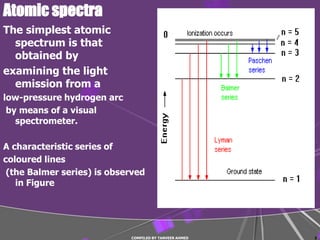
The simplest atomic
  spectrum is that
  obtained by
examining the light
  emission from a
low-pressure hydrogen arc
 by means of a visual
   spectrometer.

A characteristic series of
coloured lines
 (the Balmer series) is observed
   in Figure


                            COMPILED BY TANVEER AHMED   2
Balmer series
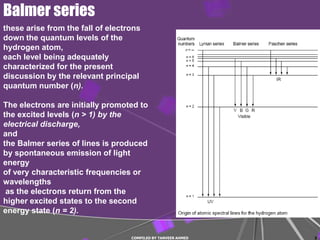
these arise from the fall of electrons
down the quantum levels of the
hydrogen atom,
each level being adequately
characterized for the present
discussion by the relevant principal
quantum number (n).

The electrons are initially promoted to
the excited levels (n > 1) by the
electrical discharge,
and
the Balmer series of lines is produced
by spontaneous emission of light
energy
of very characteristic frequencies or
wavelengths
 as the electrons return from the
higher excited states to the second
energy state (n = 2).


                                   COMPILED BY TANVEER AHMED   3
Lymen series ( UV ) – Paschen (IR ) –
Pfund Series
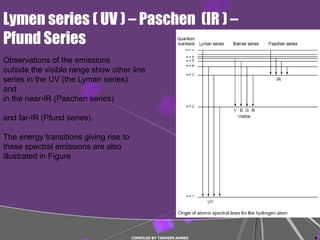
Observations of the emissions
outside the visible range show other line
series in the UV (the Lyman series)
and
in the near-IR (Paschen series)

and far-IR (Pfund series).

The energy transitions giving rise to
these spectral emissions are also
illustrated in Figure


                                        COMPILED BY TANVEER AHMED   4
atomic emission spectra of
more complex atoms such as
sodium and
mercury
To explain the atomic emission spectra of more complex atoms such as
sodium and
mercury
it is necessary to label the states using symbols
representative of
 three of the four quantum numbers
which characterise the electrons in an atom.
                             COMPILED BY TANVEER AHMED                 5
Thus the inclusion
of the secondary quantum number l
defines s, p, d and f electrons
(l = 0, 1, 2 and 3 respectively)

while the inclusion of the spin quantum
number s (= ±1/2) gives the
overall resultant spin

indicated by the superscripts in the term
symbols

used to define
the ground and excited states of the atom.


                                  COMPILED BY TANVEER AHMED   6
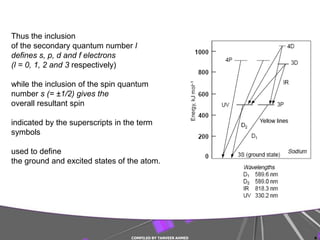
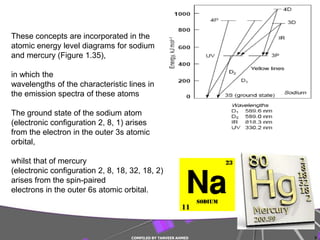
These concepts are incorporated in the
atomic energy level diagrams for sodium
and mercury (Figure 1.35),

in which the
wavelengths of the characteristic lines in
the emission spectra of these atoms

The ground state of the sodium atom
(electronic configuration 2, 8, 1) arises
from the electron in the outer 3s atomic
orbital,

whilst that of mercury
(electronic configuration 2, 8, 18, 32, 18, 2)
arises from the spin-paired
electrons in the outer 6s atomic orbital.


                                    COMPILED BY TANVEER AHMED   7
Atomic absorption spectroscopy results from the
  reverse transitions in atoms,

in
which the absorption of a quantum of radiation
   absorbed
   results in the promotion of the electron in the atom

from the ground-state energy level
 to an upper energy level.


                        COMPILED BY TANVEER AHMED          8
Sodium ATOMIC SPECTRUM
Thus atomic sodium shows strong absorption at 589.3 nm due to
the reverse 3s to 3p transition (and at 330 nm due to 3s to 4p transition).

Atomic absorption spectroscopy
has become one of the major analytical tools for determining
trace amounts of metals in solution.

Atomic absorption is also responsible for the dark lines
(the Fraunhofer lines) seen in the spectrum of the sun.

The sodium atomic absorption line was the
fourth in the dominant series of lines first observed by Fraunhofer
and was labelled as
line D;
 to this day the orange-yellow 589.3 nm line of sodium
(actually a pair of lines at 589.0 and 589.6 nm
due to electron spin differences) is known as the sodium D line.


                                  COMPILED BY TANVEER AHMED                   9
Electronic transitions in the
He–Ne laser
The principles involved in laser action were
described in section 1.5.5,
   the important characteristic being the
formation of a relatively long-lived excited state
(the metastable state),

which allows stimulated emission to be
generated before spontaneous
emission takes place.   COMPILED BY TANVEER AHMED    10
HELLIUM-NEON METASTABLE
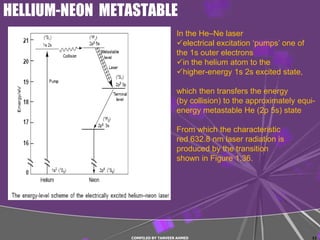
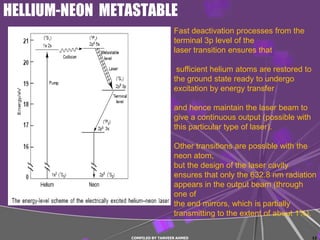
                                   In the He–Ne laser
                                   electrical excitation ‘pumps’ one of
                                   the 1s outer electrons
                                   in the helium atom to the
                                   higher-energy 1s 2s excited state,

                                   which then transfers the energy
                                   (by collision) to the approximately equi-
                                   energy metastable He (2p 5s) state

                                   From which the characteristic
                                   red 632.8 nm laser radiation is
                                   produced by the transition
                                   shown in Figure 1.36.


                COMPILED BY TANVEER AHMED                                  11
HELLIUM-NEON METASTABLE
                                  Fast deactivation processes from the
                                  terminal 3p level of the
                                  laser transition ensures that

                                   sufficient helium atoms are restored to
                                  the ground state ready to undergo
                                  excitation by energy transfer

                                  and hence maintain the laser beam to
                                  give a continuous output (possible with
                                  this particular type of laser).

                                  Other transitions are possible with the
                                  neon atom,
                                  but the design of the laser cavity
                                  ensures that only the 632.8 nm radiation
                                  appears in the output beam (through
                                  one of
                                  the end mirrors, which is partially
                                  transmitting to the extent of about 1%).

                COMPILED BY TANVEER AHMED                                    12
UV absorption in simple molecules
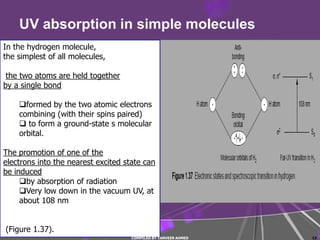
In the hydrogen molecule,
the simplest of all molecules,

 the two atoms are held together
by a single bond

    formed by the two atomic electrons
    combining (with their spins paired)
     to form a ground-state s molecular
    orbital.

The promotion of one of the
electrons into the nearest excited state can
be induced
     by absorption of radiation
     Very low down in the vacuum UV, at
     about 108 nm


(Figure 1.37).
                                     COMPILED BY TANVEER AHMED   13
The absorption occurs so low in the UV
  because of the significant energy difference between
   the highest occupied molecular orbital (HOMO)
  and the lowest unoccupied molecular orbital (LUMO).


To obtain absorption in a more accessible region of the
UV (i.e. above 200 nm) it is necessary to use
    organic molecules with double bonds
     or containing heteroatoms such as oxygen, nitrogen or sulphur.


For example,
    ethene with its single double bond absorbs at about 180 nm,
    but 1,3-butadiene and 1,3,5- hexatriene absorb at longer wavelengths
    with increasing strength of absorption
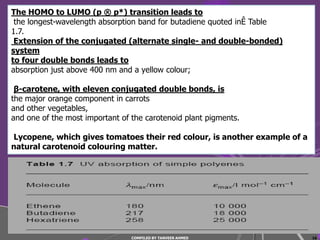
    as indicated by the values of their molar absorptivities, emax (Table 1.7).


                                 COMPILED BY TANVEER AHMED                         14
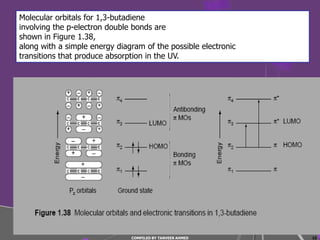
Molecular orbitals for 1,3-butadiene
involving the p-electron double bonds are
shown in Figure 1.38,
along with a simple energy diagram of the possible electronic
transitions that produce absorption in the UV.


                               COMPILED BY TANVEER AHMED        15
The HOMO to LUMO (p ® p*) transition leads to
 the longest-wavelength absorption band for butadiene quoted inÊ Table
1.7.
 Extension of the conjugated (alternate single- and double-bonded)
system
to four double bonds leads to
absorption just above 400 nm and a yellow colour;

 β-carotene, with eleven conjugated double bonds, is
the major orange component in carrots
and other vegetables,
and one of the most important of the carotenoid plant pigments.

Lycopene, which gives tomatoes their red colour, is another example of a
natural carotenoid colouring matter.


                                 COMPILED BY TANVEER AHMED                 16
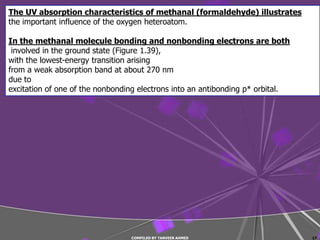
The UV absorption characteristics of methanal (formaldehyde) illustrates
the important influence of the oxygen heteroatom.

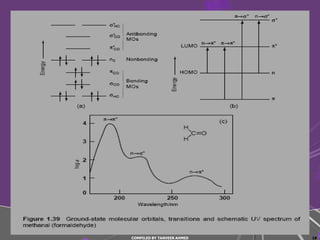
In the methanal molecule bonding and nonbonding electrons are both
 involved in the ground state (Figure 1.39),
with the lowest-energy transition arising
from a weak absorption band at about 270 nm
due to
excitation of one of the nonbonding electrons into an antibonding p* orbital.


                                 COMPILED BY TANVEER AHMED                      17
COMPILED BY TANVEER AHMED   18
The schematic UV absorption spectrum
shows
 two bands of significantly different absorption
intensities
 (note the logarithmic absorptivity scale),

which is typical of simple carbonyl
compounds.

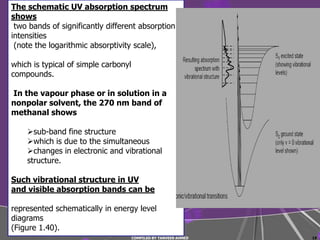
In the vapour phase or in solution in a
nonpolar solvent, the 270 nm band of
methanal shows

    sub-band fine structure
    which is due to the simultaneous
    changes in electronic and vibrational
    structure.

Such vibrational structure in UV
and visible absorption bands can be

represented schematically in energy level
diagrams
(Figure 1.40).
                                      COMPILED BY TANVEER AHMED   19
Absorption spectra of aromatic
compounds and simple colorants
 The structure of benzene is often represented as
      three pairs of conjugated p-bonds
      in the hexagonal ring structure,
     with three of the six p-orbital states available
      being occupied
     in the ground state by spin-paired electrons.


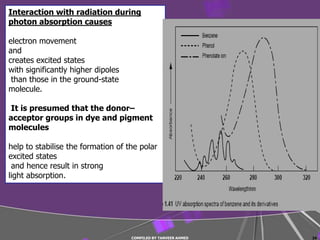
 The UV spectrum of benzene shows
 an intense absorption band near 200 nm
 with a weaker but characteristic band near 255 nm.


                            COMPILED BY TANVEER AHMED    20
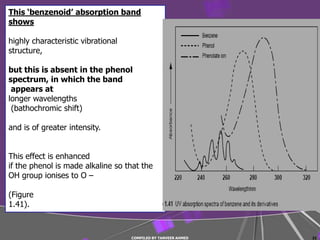
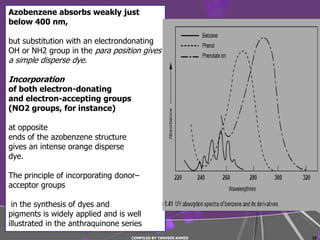
This ‘benzenoid’ absorption band
shows

highly characteristic vibrational
structure,

but this is absent in the phenol
spectrum, in which the band
 appears at
longer wavelengths
 (bathochromic shift)

and is of greater intensity.


This effect is enhanced
if the phenol is made alkaline so that the
OH group ionises to O –

(Figure
1.41).


                                    COMPILED BY TANVEER AHMED   21
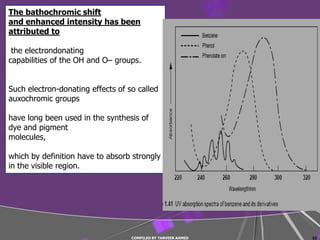
The bathochromic shift
and enhanced intensity has been
attributed to

 the electrondonating
capabilities of the OH and O– groups.


Such electron-donating effects of so called
auxochromic groups

have long been used in the synthesis of
dye and pigment
molecules,

which by definition have to absorb strongly
in the visible region.


                                   COMPILED BY TANVEER AHMED   22
Azobenzene absorbs weakly just
below 400 nm,

but substitution with an electrondonating
OH or NH2 group in the para position gives
a simple disperse dye.

Incorporation
of both electron-donating
and electron-accepting groups
(NO2 groups, for instance)

at opposite
ends of the azobenzene structure
gives an intense orange disperse
dye.

The principle of incorporating donor–
acceptor groups

 in the synthesis of dyes and
pigments is widely applied and is well
illustrated in the anthraquinone series
                                   COMPILED BY TANVEER AHMED   23
Interaction with radiation during
photon absorption causes

electron movement
and
creates excited states
with significantly higher dipoles
 than those in the ground-state
molecule.

 It is presumed that the donor–
acceptor groups in dye and pigment
molecules

help to stabilise the formation of the polar
excited states
 and hence result in strong
light absorption.


                                    COMPILED BY TANVEER AHMED   24

1.10atomic spectra

  • 1.
    LIGHT INTERACTION WITH ATOMSAND MOLECULES Atomic spectra COMPILED BY TANVEER AHMED 1
  • 2.
    Atomic spectra The simplestatomic spectrum is that obtained by examining the light emission from a low-pressure hydrogen arc by means of a visual spectrometer. A characteristic series of coloured lines (the Balmer series) is observed in Figure COMPILED BY TANVEER AHMED 2
  • 3.
    Balmer series these arisefrom the fall of electrons down the quantum levels of the hydrogen atom, each level being adequately characterized for the present discussion by the relevant principal quantum number (n). The electrons are initially promoted to the excited levels (n > 1) by the electrical discharge, and the Balmer series of lines is produced by spontaneous emission of light energy of very characteristic frequencies or wavelengths as the electrons return from the higher excited states to the second energy state (n = 2). COMPILED BY TANVEER AHMED 3
  • 4.
    Lymen series (UV ) – Paschen (IR ) – Pfund Series Observations of the emissions outside the visible range show other line series in the UV (the Lyman series) and in the near-IR (Paschen series) and far-IR (Pfund series). The energy transitions giving rise to these spectral emissions are also illustrated in Figure COMPILED BY TANVEER AHMED 4
  • 5.
    atomic emission spectraof more complex atoms such as sodium and mercury To explain the atomic emission spectra of more complex atoms such as sodium and mercury it is necessary to label the states using symbols representative of three of the four quantum numbers which characterise the electrons in an atom. COMPILED BY TANVEER AHMED 5
  • 6.
    Thus the inclusion ofthe secondary quantum number l defines s, p, d and f electrons (l = 0, 1, 2 and 3 respectively) while the inclusion of the spin quantum number s (= ±1/2) gives the overall resultant spin indicated by the superscripts in the term symbols used to define the ground and excited states of the atom. COMPILED BY TANVEER AHMED 6
  • 7.
    These concepts areincorporated in the atomic energy level diagrams for sodium and mercury (Figure 1.35), in which the wavelengths of the characteristic lines in the emission spectra of these atoms The ground state of the sodium atom (electronic configuration 2, 8, 1) arises from the electron in the outer 3s atomic orbital, whilst that of mercury (electronic configuration 2, 8, 18, 32, 18, 2) arises from the spin-paired electrons in the outer 6s atomic orbital. COMPILED BY TANVEER AHMED 7
  • 8.
    Atomic absorption spectroscopyresults from the reverse transitions in atoms, in which the absorption of a quantum of radiation absorbed  results in the promotion of the electron in the atom from the ground-state energy level  to an upper energy level. COMPILED BY TANVEER AHMED 8
  • 9.
    Sodium ATOMIC SPECTRUM Thusatomic sodium shows strong absorption at 589.3 nm due to the reverse 3s to 3p transition (and at 330 nm due to 3s to 4p transition). Atomic absorption spectroscopy has become one of the major analytical tools for determining trace amounts of metals in solution. Atomic absorption is also responsible for the dark lines (the Fraunhofer lines) seen in the spectrum of the sun. The sodium atomic absorption line was the fourth in the dominant series of lines first observed by Fraunhofer and was labelled as line D;  to this day the orange-yellow 589.3 nm line of sodium (actually a pair of lines at 589.0 and 589.6 nm due to electron spin differences) is known as the sodium D line. COMPILED BY TANVEER AHMED 9
  • 10.
    Electronic transitions inthe He–Ne laser The principles involved in laser action were described in section 1.5.5,  the important characteristic being the formation of a relatively long-lived excited state (the metastable state), which allows stimulated emission to be generated before spontaneous emission takes place. COMPILED BY TANVEER AHMED 10
  • 11.
    HELLIUM-NEON METASTABLE In the He–Ne laser electrical excitation ‘pumps’ one of the 1s outer electrons in the helium atom to the higher-energy 1s 2s excited state, which then transfers the energy (by collision) to the approximately equi- energy metastable He (2p 5s) state From which the characteristic red 632.8 nm laser radiation is produced by the transition shown in Figure 1.36. COMPILED BY TANVEER AHMED 11
  • 12.
    HELLIUM-NEON METASTABLE Fast deactivation processes from the terminal 3p level of the laser transition ensures that sufficient helium atoms are restored to the ground state ready to undergo excitation by energy transfer and hence maintain the laser beam to give a continuous output (possible with this particular type of laser). Other transitions are possible with the neon atom, but the design of the laser cavity ensures that only the 632.8 nm radiation appears in the output beam (through one of the end mirrors, which is partially transmitting to the extent of about 1%). COMPILED BY TANVEER AHMED 12
  • 13.
    UV absorption insimple molecules In the hydrogen molecule, the simplest of all molecules, the two atoms are held together by a single bond formed by the two atomic electrons combining (with their spins paired)  to form a ground-state s molecular orbital. The promotion of one of the electrons into the nearest excited state can be induced by absorption of radiation Very low down in the vacuum UV, at about 108 nm (Figure 1.37). COMPILED BY TANVEER AHMED 13
  • 14.
    The absorption occursso low in the UV because of the significant energy difference between  the highest occupied molecular orbital (HOMO) and the lowest unoccupied molecular orbital (LUMO). To obtain absorption in a more accessible region of the UV (i.e. above 200 nm) it is necessary to use organic molecules with double bonds  or containing heteroatoms such as oxygen, nitrogen or sulphur. For example,  ethene with its single double bond absorbs at about 180 nm,  but 1,3-butadiene and 1,3,5- hexatriene absorb at longer wavelengths  with increasing strength of absorption  as indicated by the values of their molar absorptivities, emax (Table 1.7). COMPILED BY TANVEER AHMED 14
  • 15.
    Molecular orbitals for1,3-butadiene involving the p-electron double bonds are shown in Figure 1.38, along with a simple energy diagram of the possible electronic transitions that produce absorption in the UV. COMPILED BY TANVEER AHMED 15
  • 16.
    The HOMO toLUMO (p ® p*) transition leads to the longest-wavelength absorption band for butadiene quoted inÊ Table 1.7. Extension of the conjugated (alternate single- and double-bonded) system to four double bonds leads to absorption just above 400 nm and a yellow colour; β-carotene, with eleven conjugated double bonds, is the major orange component in carrots and other vegetables, and one of the most important of the carotenoid plant pigments. Lycopene, which gives tomatoes their red colour, is another example of a natural carotenoid colouring matter. COMPILED BY TANVEER AHMED 16
  • 17.
    The UV absorptioncharacteristics of methanal (formaldehyde) illustrates the important influence of the oxygen heteroatom. In the methanal molecule bonding and nonbonding electrons are both involved in the ground state (Figure 1.39), with the lowest-energy transition arising from a weak absorption band at about 270 nm due to excitation of one of the nonbonding electrons into an antibonding p* orbital. COMPILED BY TANVEER AHMED 17
  • 18.
  • 19.
    The schematic UVabsorption spectrum shows two bands of significantly different absorption intensities (note the logarithmic absorptivity scale), which is typical of simple carbonyl compounds. In the vapour phase or in solution in a nonpolar solvent, the 270 nm band of methanal shows sub-band fine structure which is due to the simultaneous changes in electronic and vibrational structure. Such vibrational structure in UV and visible absorption bands can be represented schematically in energy level diagrams (Figure 1.40). COMPILED BY TANVEER AHMED 19
  • 20.
    Absorption spectra ofaromatic compounds and simple colorants The structure of benzene is often represented as  three pairs of conjugated p-bonds  in the hexagonal ring structure, with three of the six p-orbital states available  being occupied in the ground state by spin-paired electrons. The UV spectrum of benzene shows an intense absorption band near 200 nm with a weaker but characteristic band near 255 nm. COMPILED BY TANVEER AHMED 20
  • 21.
    This ‘benzenoid’ absorptionband shows highly characteristic vibrational structure, but this is absent in the phenol spectrum, in which the band appears at longer wavelengths (bathochromic shift) and is of greater intensity. This effect is enhanced if the phenol is made alkaline so that the OH group ionises to O – (Figure 1.41). COMPILED BY TANVEER AHMED 21
  • 22.
    The bathochromic shift andenhanced intensity has been attributed to the electrondonating capabilities of the OH and O– groups. Such electron-donating effects of so called auxochromic groups have long been used in the synthesis of dye and pigment molecules, which by definition have to absorb strongly in the visible region. COMPILED BY TANVEER AHMED 22
  • 23.
    Azobenzene absorbs weaklyjust below 400 nm, but substitution with an electrondonating OH or NH2 group in the para position gives a simple disperse dye. Incorporation of both electron-donating and electron-accepting groups (NO2 groups, for instance) at opposite ends of the azobenzene structure gives an intense orange disperse dye. The principle of incorporating donor– acceptor groups in the synthesis of dyes and pigments is widely applied and is well illustrated in the anthraquinone series COMPILED BY TANVEER AHMED 23
  • 24.
    Interaction with radiationduring photon absorption causes electron movement and creates excited states with significantly higher dipoles than those in the ground-state molecule. It is presumed that the donor– acceptor groups in dye and pigment molecules help to stabilise the formation of the polar excited states and hence result in strong light absorption. COMPILED BY TANVEER AHMED 24