ELECTRON AFFINITY
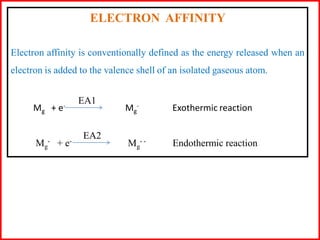
Electron affinity is conventionally defined as the energy released when an
electron is added to the valence shell of an isolated gaseous atom.
Mg + e- Mg
- Exothermic reaction
EA1
Mg
- + e- Mg
- - Endothermic reaction
EA2
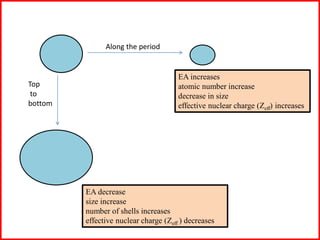
EA increases
atomic number increase
decrease in size
effective nuclear charge (Zeff) increases
EA decrease
size increase
number of shells increases
effective nuclear charge (Zeff ) decreases
Along the period
Top
to
bottom
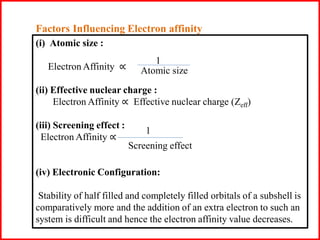
Factors Influencing Electron affinity
(i) Atomic size :
Electron Affinity ∝
(ii) Effective nuclear charge :
Electron Affinity ∝ Effective nuclear charge (Zeff)
(iii) Screening effect :
Electron Affinity ∝
(iv) Electronic Configuration:
Stability of half filled and completely filled orbitals of a subshell is
comparatively more and the addition of an extra electron to such an
system is difficult and hence the electron affinity value decreases.
1
Atomic size
1
Screening effect
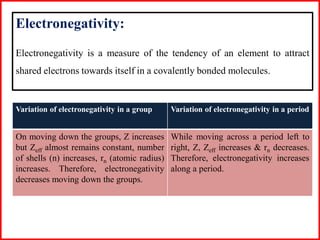
Variation of electronegativity in a group Variation of electronegativity in a period
On moving down the groups, Z increases
but Zeff almost remains constant, number
of shells (n) increases, rn (atomic radius)
increases. Therefore, electronegativity
decreases moving down the groups.
While moving across a period left to
right, Z, Zeff increases & rn decreases.
Therefore, electronegativity increases
along a period.
Electronegativity:
Electronegativity is a measure of the tendency of an element to attract
shared electrons towards itself in a covalently bonded molecules.
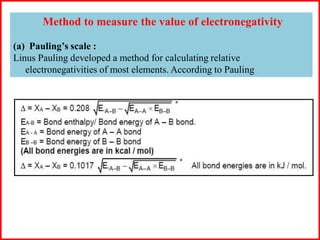
Method to measure the value of electronegativity
(a) Pauling’s scale :
Linus Pauling developed a method for calculating relative
electronegativities of most elements. According to Pauling
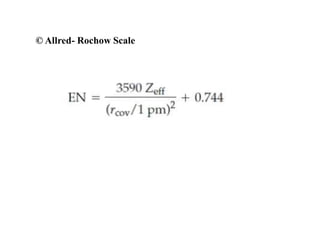
© Allred- Rochow Scale
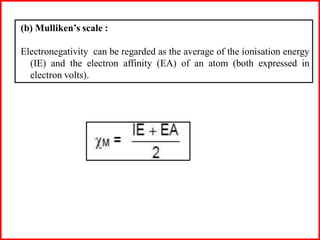
(b) Mulliken’s scale :
Electronegativity can be regarded as the average of the ionisation energy
(IE) and the electron affinity (EA) of an atom (both expressed in
electron volts).
THANK YOU

Electron affinity

  • 2.
    ELECTRON AFFINITY Electron affinityis conventionally defined as the energy released when an electron is added to the valence shell of an isolated gaseous atom. Mg + e- Mg - Exothermic reaction EA1 Mg - + e- Mg - - Endothermic reaction EA2
  • 3.
    EA increases atomic numberincrease decrease in size effective nuclear charge (Zeff) increases EA decrease size increase number of shells increases effective nuclear charge (Zeff ) decreases Along the period Top to bottom
  • 4.
    Factors Influencing Electronaffinity (i) Atomic size : Electron Affinity ∝ (ii) Effective nuclear charge : Electron Affinity ∝ Effective nuclear charge (Zeff) (iii) Screening effect : Electron Affinity ∝ (iv) Electronic Configuration: Stability of half filled and completely filled orbitals of a subshell is comparatively more and the addition of an extra electron to such an system is difficult and hence the electron affinity value decreases. 1 Atomic size 1 Screening effect
  • 5.
    Variation of electronegativityin a group Variation of electronegativity in a period On moving down the groups, Z increases but Zeff almost remains constant, number of shells (n) increases, rn (atomic radius) increases. Therefore, electronegativity decreases moving down the groups. While moving across a period left to right, Z, Zeff increases & rn decreases. Therefore, electronegativity increases along a period. Electronegativity: Electronegativity is a measure of the tendency of an element to attract shared electrons towards itself in a covalently bonded molecules.
  • 6.
    Method to measurethe value of electronegativity (a) Pauling’s scale : Linus Pauling developed a method for calculating relative electronegativities of most elements. According to Pauling
  • 7.
  • 8.
    (b) Mulliken’s scale: Electronegativity can be regarded as the average of the ionisation energy (IE) and the electron affinity (EA) of an atom (both expressed in electron volts).
  • 9.