Teacher Prep
• Spectroscope
• Gas tubes
Revisiting Atomic Structure
What you know isn’t necessarily what it is.
LIGHT AND ATOMIC
   STRUCTURE
LIGHT AND ATOMIC STRUCTURE
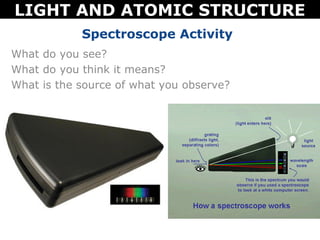
            Spectroscope Activity
What do you see?
What do you think it means?
What is the source of what you observe?
LIGHT AND ATOMIC STRUCTURE
          Light & Atomic Structure
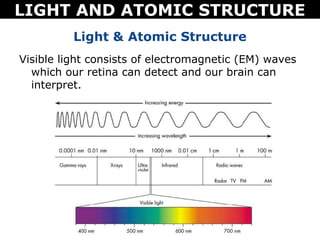
Visible light consists of electromagnetic (EM) waves
  which our retina can detect and our brain can
  interpret.
LIGHT AND ATOMIC STRUCTURE
          Light & Atomic Structure
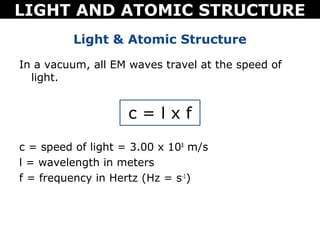
In a vacuum, all EM waves travel at the speed of
  light.


                    c=lxf
c = speed of light = 3.00 x 10⁸ m/s
l = wavelength in meters
f = frequency in Hertz (Hz = s-1)
LIGHT AND ATOMIC STRUCTURE
           Light & Atomic Structure

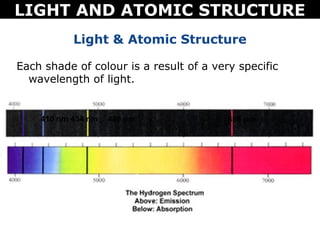
Each shade of colour is a result of a very specific
  wavelength of light.


    410 nm 434 nm   486 nm               656 nm
LIGHT AND ATOMIC STRUCTURE
         Light & Atomic Structure
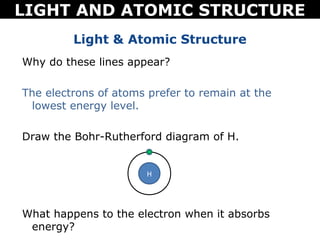
Why do these lines appear?

The electrons of atoms prefer to remain at the
 lowest energy level.

Draw the Bohr-Rutherford diagram of H.


                       H


What happens to the electron when it absorbs
 energy?
LIGHT AND ATOMIC STRUCTURE
            Light & Atomic Structure
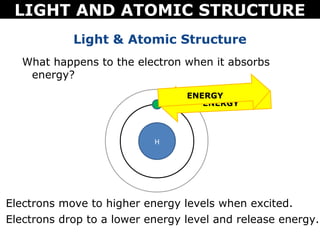
   What happens to the electron when it absorbs
    energy?
                                 ENERGY
                                    ENERGY


                           H


Electrons move to higher energy levels when excited.
Electrons drop to a lower energy level and release energy.
LIGHT AND ATOMIC STRUCTURE
             Light & Atomic Structure


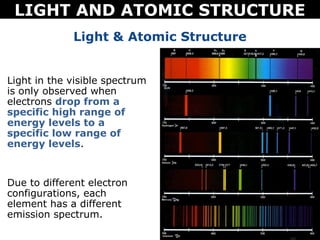
Light in the visible spectrum
is only observed when
electrons drop from a
specific high range of
energy levels to a
specific low range of
energy levels.


Due to different electron
configurations, each
element has a different
emission spectrum.
LIGHT AND ATOMIC STRUCTURE
     Light & Atomic Structure
LIGHT AND ATOMIC STRUCTURE
         Light & Atomic Structure

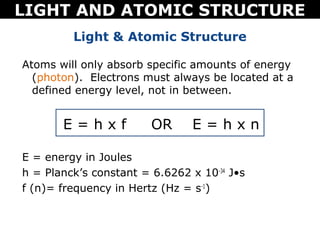
Atoms will only absorb specific amounts of energy
  (photon). Electrons must always be located at a
  defined energy level, not in between.


       E=hxf            OR      E=hxn

E = energy in Joules
h = Planck’s constant = 6.6262 x 10⁻³⁴ J•s
f (n)= frequency in Hertz (Hz = s-1)
LIGHT AND ATOMIC STRUCTURE
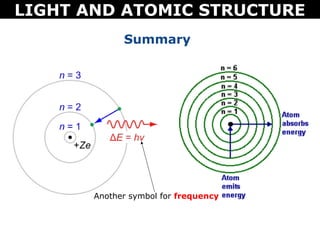
             Summary


       Another symbol for frequency
LIGHT AND ATOMIC STRUCTURE
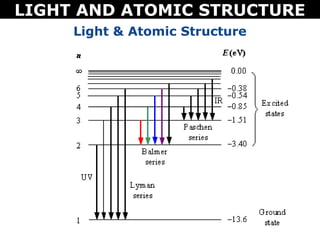
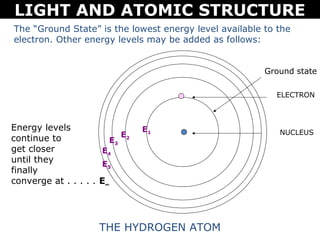
The “Ground State” is the lowest energy level available to the
electron. Other energy levels may be added as follows:


                                                        Ground state

                                                          ELECTRON


Energy levels                   E1                         NUCLEUS
continue to                E
                         E3 2
get closer            E4
until they            E5
finally
converge at . . . . . E∞


                     THE HYDROGEN ATOM
LIGHT AND ATOMIC STRUCTURE
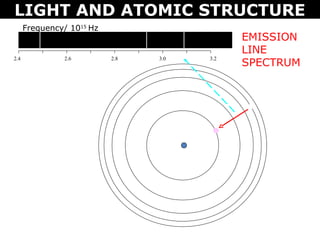
       Frequency/ 1015 Hz
                                                  EMISSION
                                                  LINE
                                                  SPECTRUM
 2.4            2.6         2.8   3.0       3.2


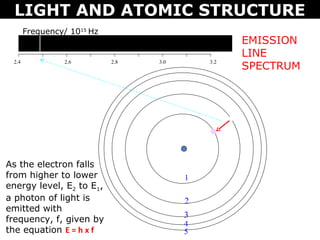
As the electron falls
from higher to lower                    1
energy level, E2 to E1,
a photon of light is                    2
emitted with
                                        3
frequency, f, given by                  4
the equation E = h x f                  5
LIGHT AND ATOMIC STRUCTURE
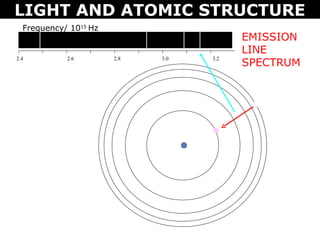
      Frequency/ 1015 Hz
                                             EMISSION
                                             LINE
                                             SPECTRUM
2.4            2.6         2.8   3.0   3.2
LIGHT AND ATOMIC STRUCTURE
      Frequency/ 1015 Hz
                                             EMISSION
                                             LINE
                                             SPECTRUM
2.4            2.6         2.8   3.0   3.2
LIGHT AND ATOMIC STRUCTURE
  Frequency/ 1015 Hz
                                         EMISSION
                                         LINE
                                         SPECTRUM
2.4         2.6        2.8   3.0   3.2

Tang 01 light and atomic structure

  • 1.
  • 2.
    Revisiting Atomic Structure Whatyou know isn’t necessarily what it is.
  • 3.
  • 4.
    LIGHT AND ATOMICSTRUCTURE Spectroscope Activity What do you see? What do you think it means? What is the source of what you observe?
  • 5.
    LIGHT AND ATOMICSTRUCTURE Light & Atomic Structure Visible light consists of electromagnetic (EM) waves which our retina can detect and our brain can interpret.
  • 6.
    LIGHT AND ATOMICSTRUCTURE Light & Atomic Structure In a vacuum, all EM waves travel at the speed of light. c=lxf c = speed of light = 3.00 x 10⁸ m/s l = wavelength in meters f = frequency in Hertz (Hz = s-1)
  • 7.
    LIGHT AND ATOMICSTRUCTURE Light & Atomic Structure Each shade of colour is a result of a very specific wavelength of light. 410 nm 434 nm 486 nm 656 nm
  • 8.
    LIGHT AND ATOMICSTRUCTURE Light & Atomic Structure Why do these lines appear? The electrons of atoms prefer to remain at the lowest energy level. Draw the Bohr-Rutherford diagram of H. H What happens to the electron when it absorbs energy?
  • 9.
    LIGHT AND ATOMICSTRUCTURE Light & Atomic Structure What happens to the electron when it absorbs energy? ENERGY ENERGY H Electrons move to higher energy levels when excited. Electrons drop to a lower energy level and release energy.
  • 10.
    LIGHT AND ATOMICSTRUCTURE Light & Atomic Structure Light in the visible spectrum is only observed when electrons drop from a specific high range of energy levels to a specific low range of energy levels. Due to different electron configurations, each element has a different emission spectrum.
  • 11.
    LIGHT AND ATOMICSTRUCTURE Light & Atomic Structure
  • 12.
    LIGHT AND ATOMICSTRUCTURE Light & Atomic Structure Atoms will only absorb specific amounts of energy (photon). Electrons must always be located at a defined energy level, not in between. E=hxf OR E=hxn E = energy in Joules h = Planck’s constant = 6.6262 x 10⁻³⁴ J•s f (n)= frequency in Hertz (Hz = s-1)
  • 13.
    LIGHT AND ATOMICSTRUCTURE Summary Another symbol for frequency
  • 14.
    LIGHT AND ATOMICSTRUCTURE The “Ground State” is the lowest energy level available to the electron. Other energy levels may be added as follows: Ground state ELECTRON Energy levels E1 NUCLEUS continue to E E3 2 get closer E4 until they E5 finally converge at . . . . . E∞ THE HYDROGEN ATOM
  • 15.
    LIGHT AND ATOMICSTRUCTURE Frequency/ 1015 Hz EMISSION LINE SPECTRUM 2.4 2.6 2.8 3.0 3.2 As the electron falls from higher to lower 1 energy level, E2 to E1, a photon of light is 2 emitted with 3 frequency, f, given by 4 the equation E = h x f 5
  • 16.
    LIGHT AND ATOMICSTRUCTURE Frequency/ 1015 Hz EMISSION LINE SPECTRUM 2.4 2.6 2.8 3.0 3.2
  • 17.
    LIGHT AND ATOMICSTRUCTURE Frequency/ 1015 Hz EMISSION LINE SPECTRUM 2.4 2.6 2.8 3.0 3.2
  • 18.
    LIGHT AND ATOMICSTRUCTURE Frequency/ 1015 Hz EMISSION LINE SPECTRUM 2.4 2.6 2.8 3.0 3.2