JISHU- HOZEN
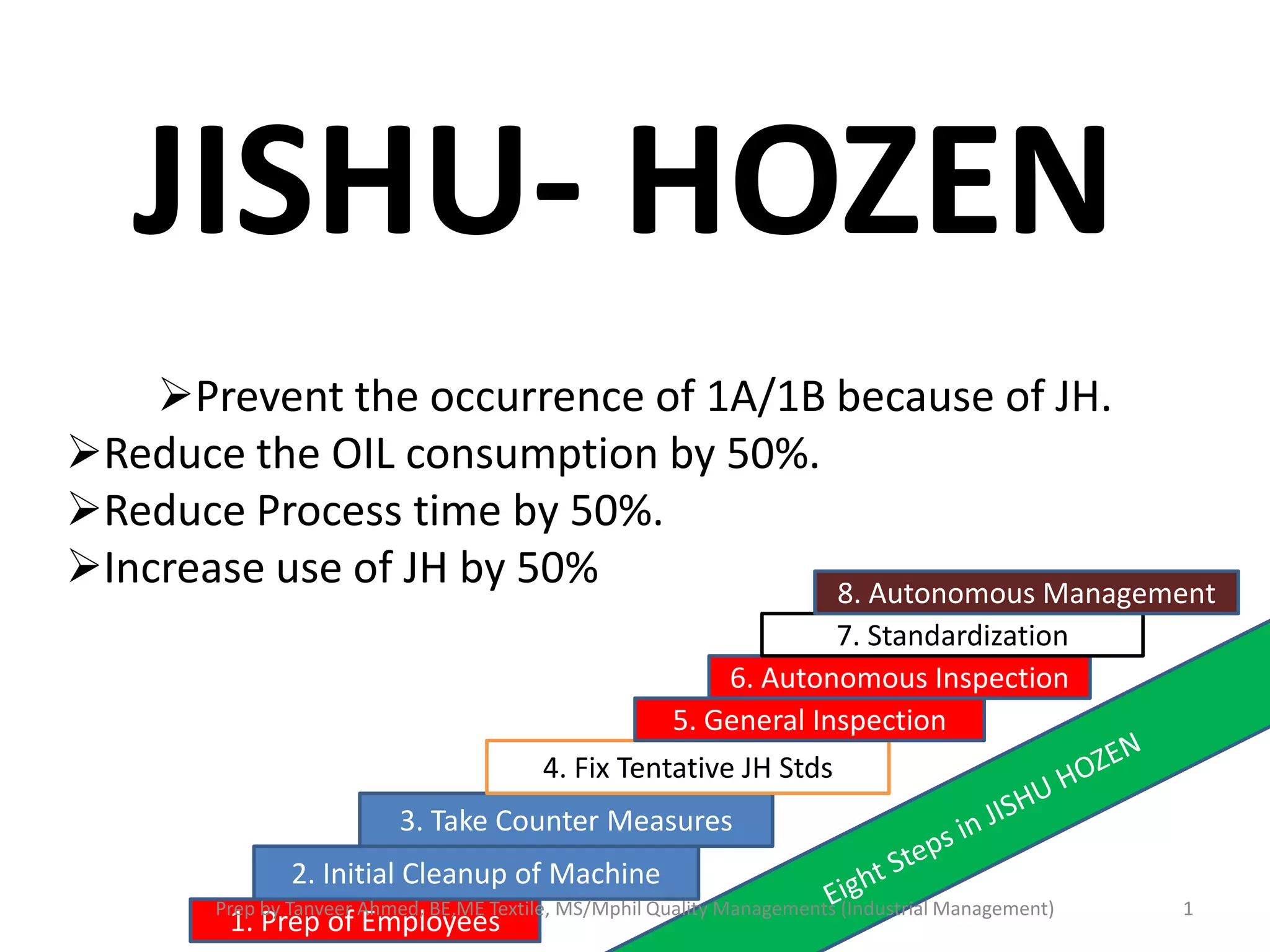
Prevent the occurrence of 1A/1B because of JH.
Reduce the OIL consumption by 50%.
Reduce Process time by 50%.
Increase use of JH by 50%
8. Autonomous Management
7. Standardization
6. Autonomous Inspection
5. General Inspection

4. Fix Tentative JH Stds
3. Take Counter Measures
2. Initial Cleanup of Machine
Prep by Tanveer Ahmed, BE,ME Textile, MS/Mphil Quality Managements (Industrial Management)
1. Prep of Employees

1
JISHU- HOZEN
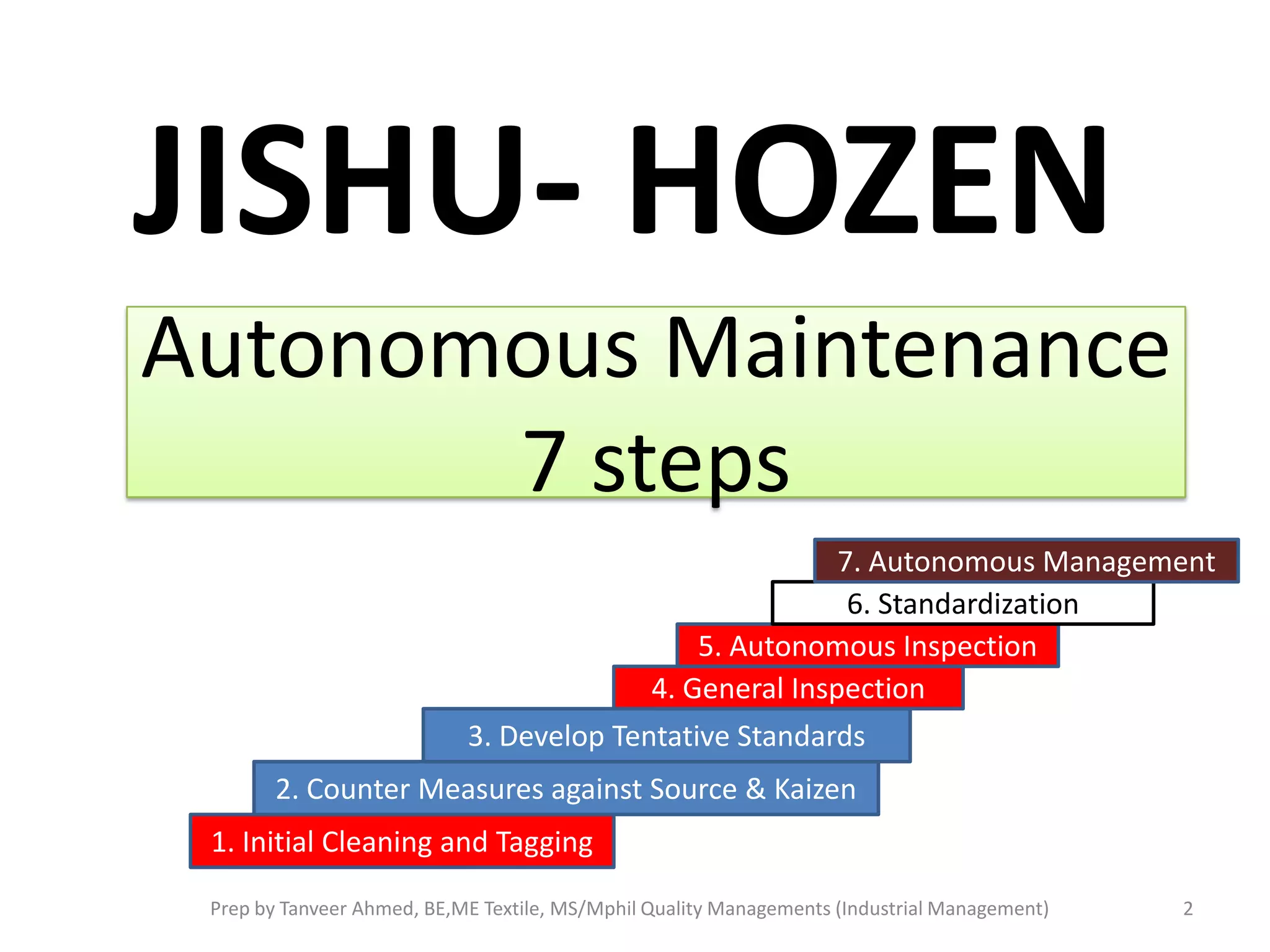
Autonomous Maintenance
7 steps
7. Autonomous Management
6. Standardization
5. Autonomous Inspection
4. General Inspection
3. Develop Tentative Standards
2. Counter Measures against Source & Kaizen
1. Initial Cleaning and Tagging
Prep by Tanveer Ahmed, BE,ME Textile, MS/Mphil Quality Managements (Industrial Management)

2
JISHU- HOZEN
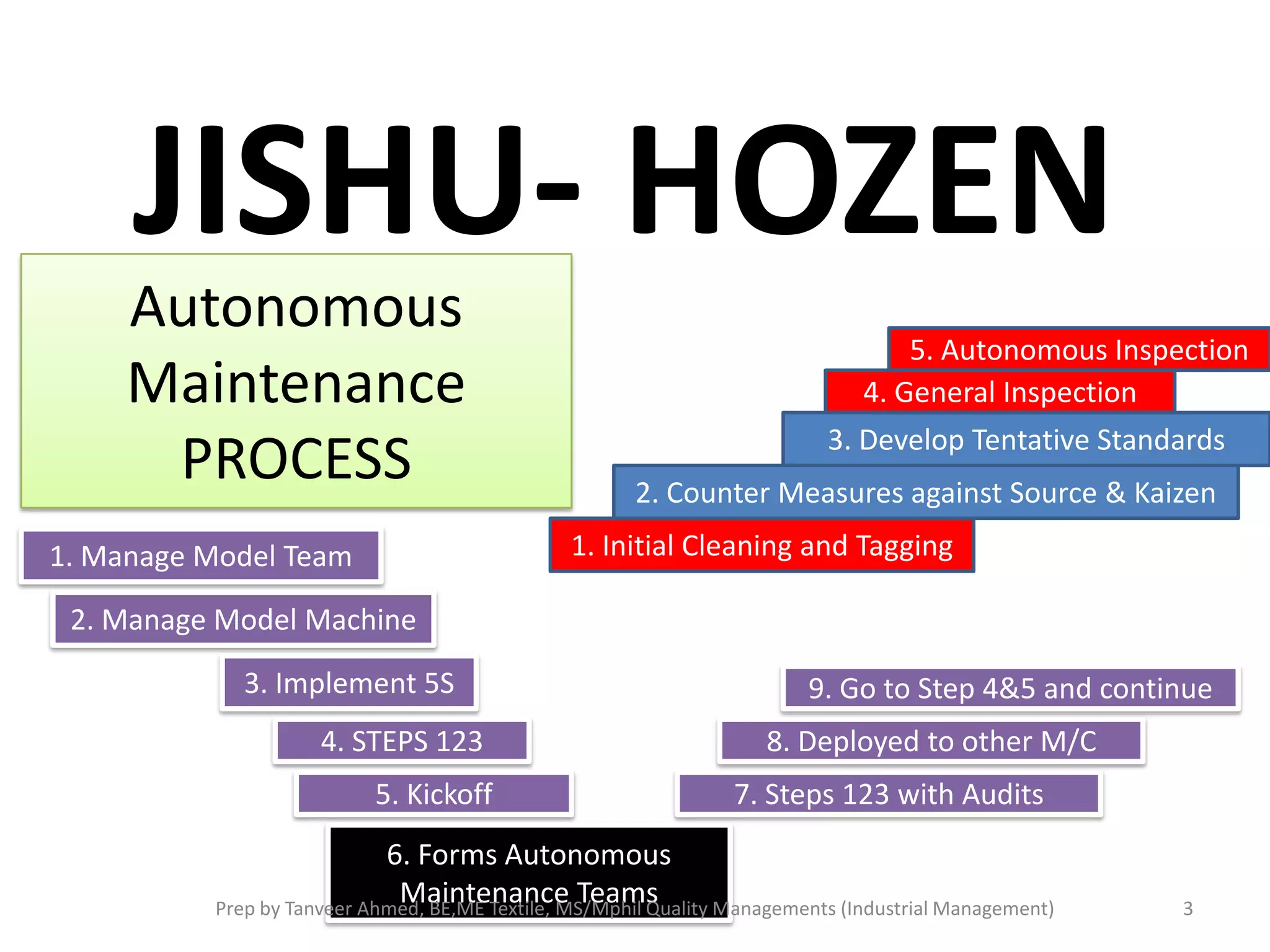
Autonomous
Maintenance
PROCESS

5. Autonomous Inspection
4. General Inspection
3. Develop Tentative Standards
2. Counter Measures against Source & Kaizen

1. Initial Cleaning and Tagging

1. Manage Model Team
2. Manage Model Machine
3. Implement 5S
4. STEPS 123
5. Kickoff

9. Go to Step 4&5 and continue
8. Deployed to other M/C
7. Steps 123 with Audits

6. Forms Autonomous
Maintenance Teams
Prep by Tanveer Ahmed, BE,ME Textile, MS/Mphil Quality Managements (Industrial Management)

3
JISHU- HOZEN

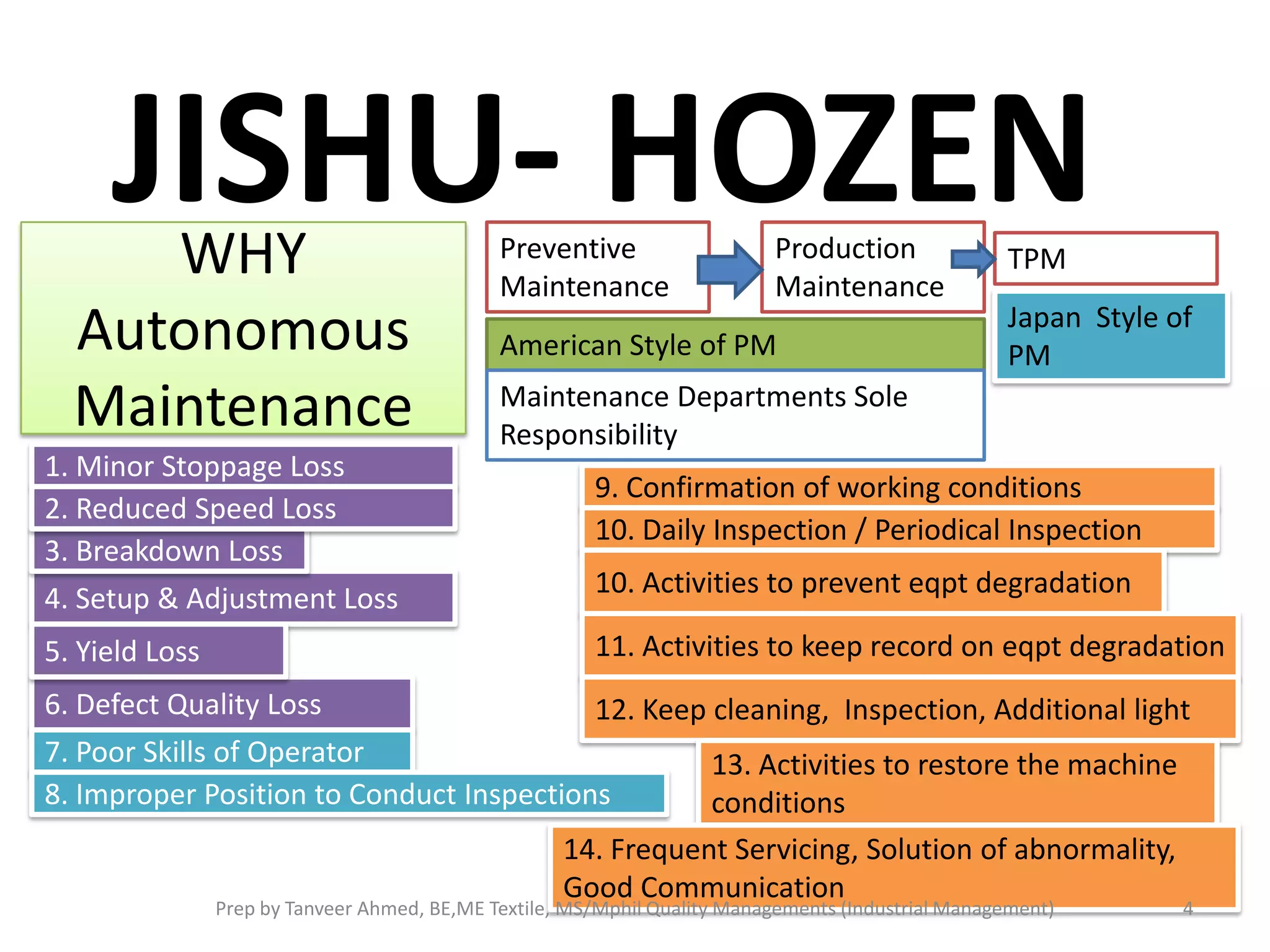
WHY
Autonomous
Maintenance
1. Minor Stoppage Loss
2. Reduced Speed Loss
3. Breakdown Loss
4. Setup & Adjustment Loss

Preventive
Maintenance

Production
Maintenance

American Style of PM

TPM
Japan Style of
PM

Maintenance Departments Sole
Responsibility
9. Confirmation of working conditions
10. Daily Inspection / Periodical Inspection
10. Activities to prevent eqpt degradation

5. Yield Loss

11. Activities to keep record on eqpt degradation

6. Defect Quality Loss

12. Keep cleaning, Inspection, Additional light

7. Poor Skills of Operator
8. Improper Position to Conduct Inspections

13. Activities to restore the machine
conditions
14. Frequent Servicing, Solution of abnormality,
Good Communication

Prep by Tanveer Ahmed, BE,ME Textile, MS/Mphil Quality Managements (Industrial Management)

4
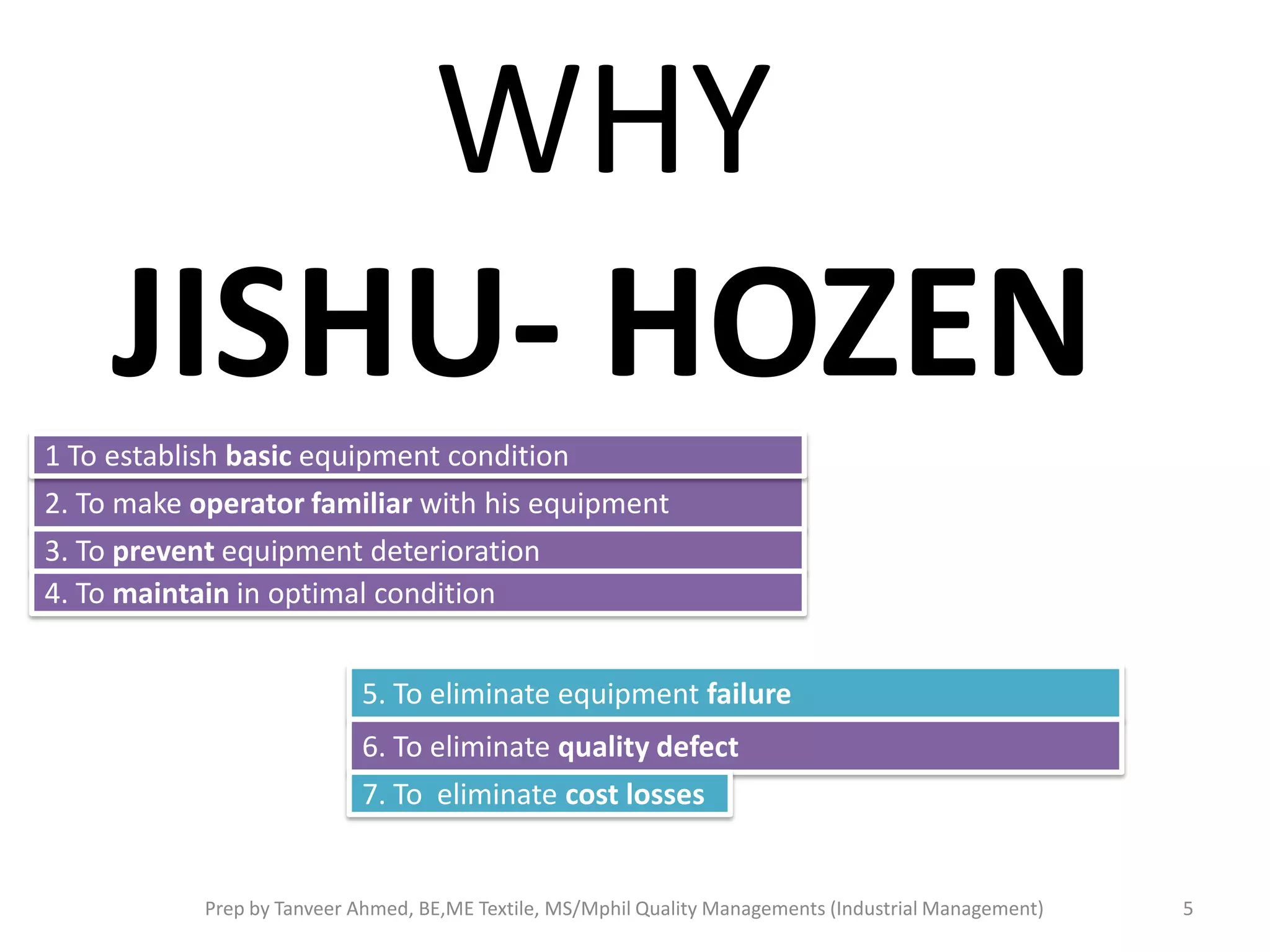
WHY
JISHU- HOZEN
1 To establish basic equipment condition
2. To make operator familiar with his equipment

3. To prevent equipment deterioration
4. To maintain in optimal condition
5. To eliminate equipment failure

6. To eliminate quality defect
7. To eliminate cost losses

Prep by Tanveer Ahmed, BE,ME Textile, MS/Mphil Quality Managements (Industrial Management)

5
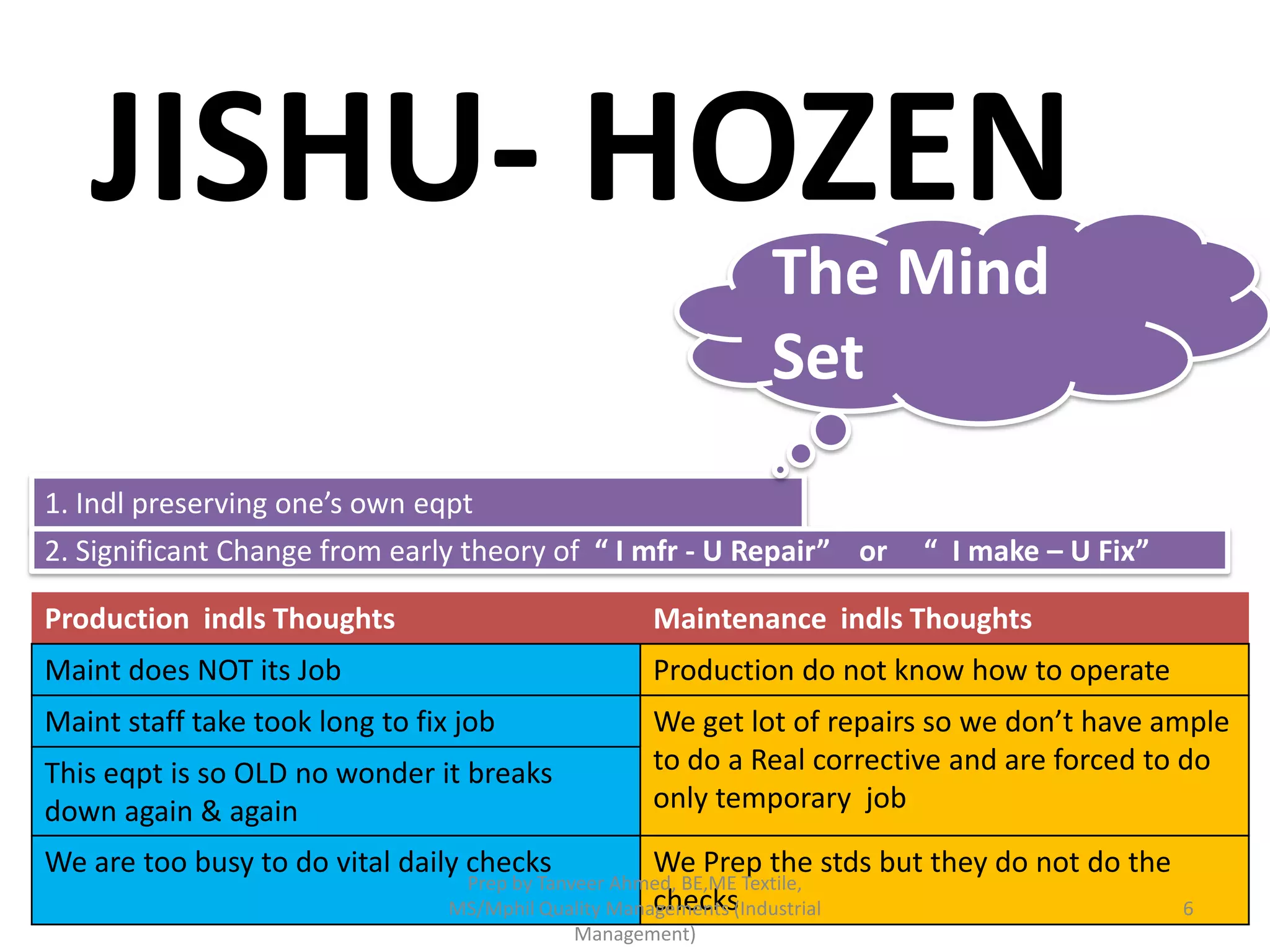
JISHU- HOZEN
The Mind
Set

1. Indl preserving one’s own eqpt

2. Significant Change from early theory of “ I mfr - U Repair” or

“ I make – U Fix”

Production indls Thoughts

Maintenance indls Thoughts

Maint does NOT its Job

Production do not know how to operate

Maint staff take took long to fix job
This eqpt is so OLD no wonder it breaks
down again & again

We get lot of repairs so we don’t have ample
to do a Real corrective and are forced to do
only temporary job

We are too busy to do vital daily checks

We Prep the stds but they do not do the

Prep by Tanveer Ahmed, BE,ME Textile,
checks
MS/Mphil Quality Managements (Industrial
Management)

6
JISHU- HOZEN

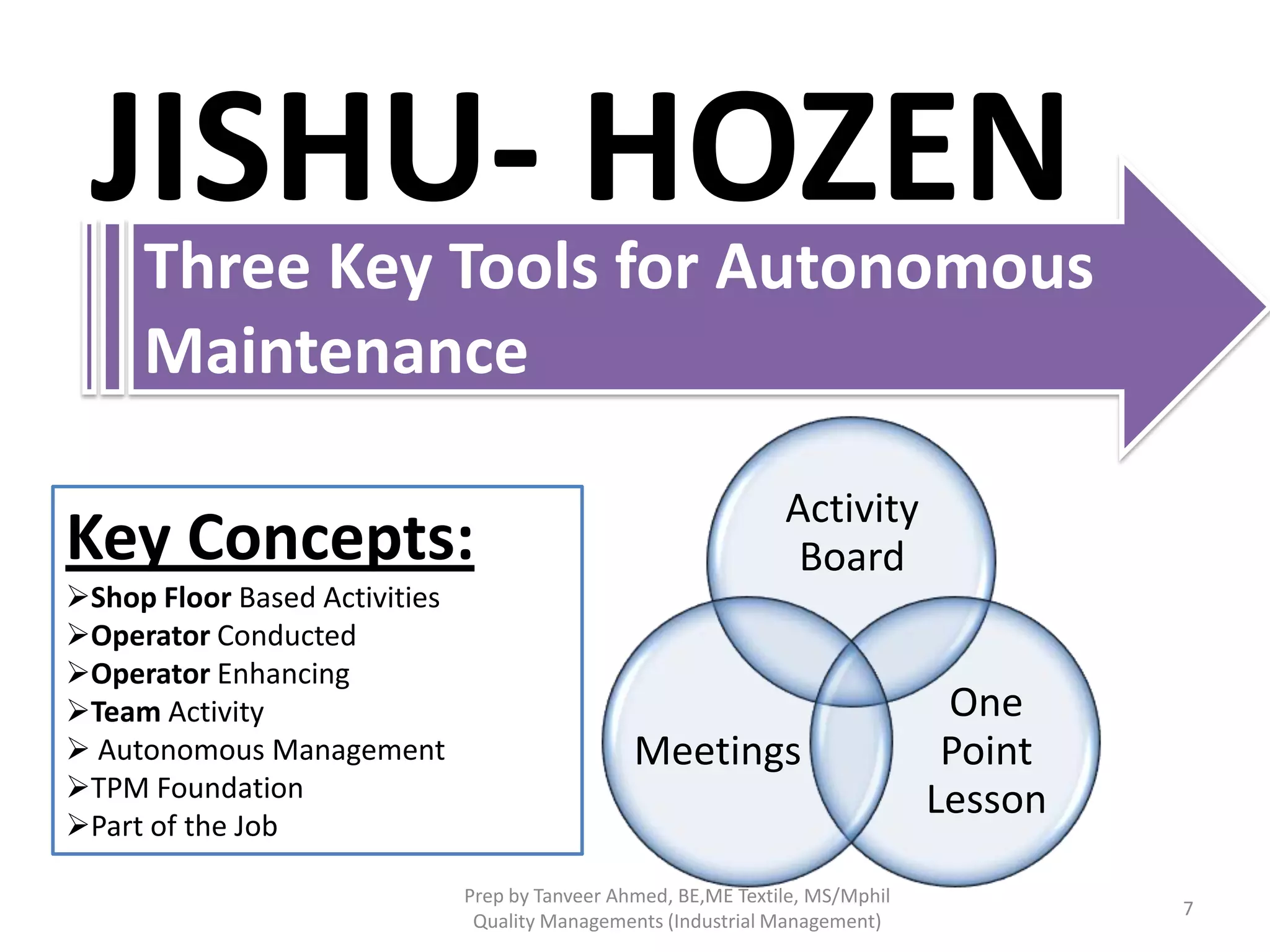
Three Key Tools for Autonomous
Maintenance

Key Concepts:
Shop Floor Based Activities
Operator Conducted
Operator Enhancing
Team Activity
 Autonomous Management
TPM Foundation
Part of the Job

Activity
Board

Meetings

Prep by Tanveer Ahmed, BE,ME Textile, MS/Mphil
Quality Managements (Industrial Management)

One
Point
Lesson
7
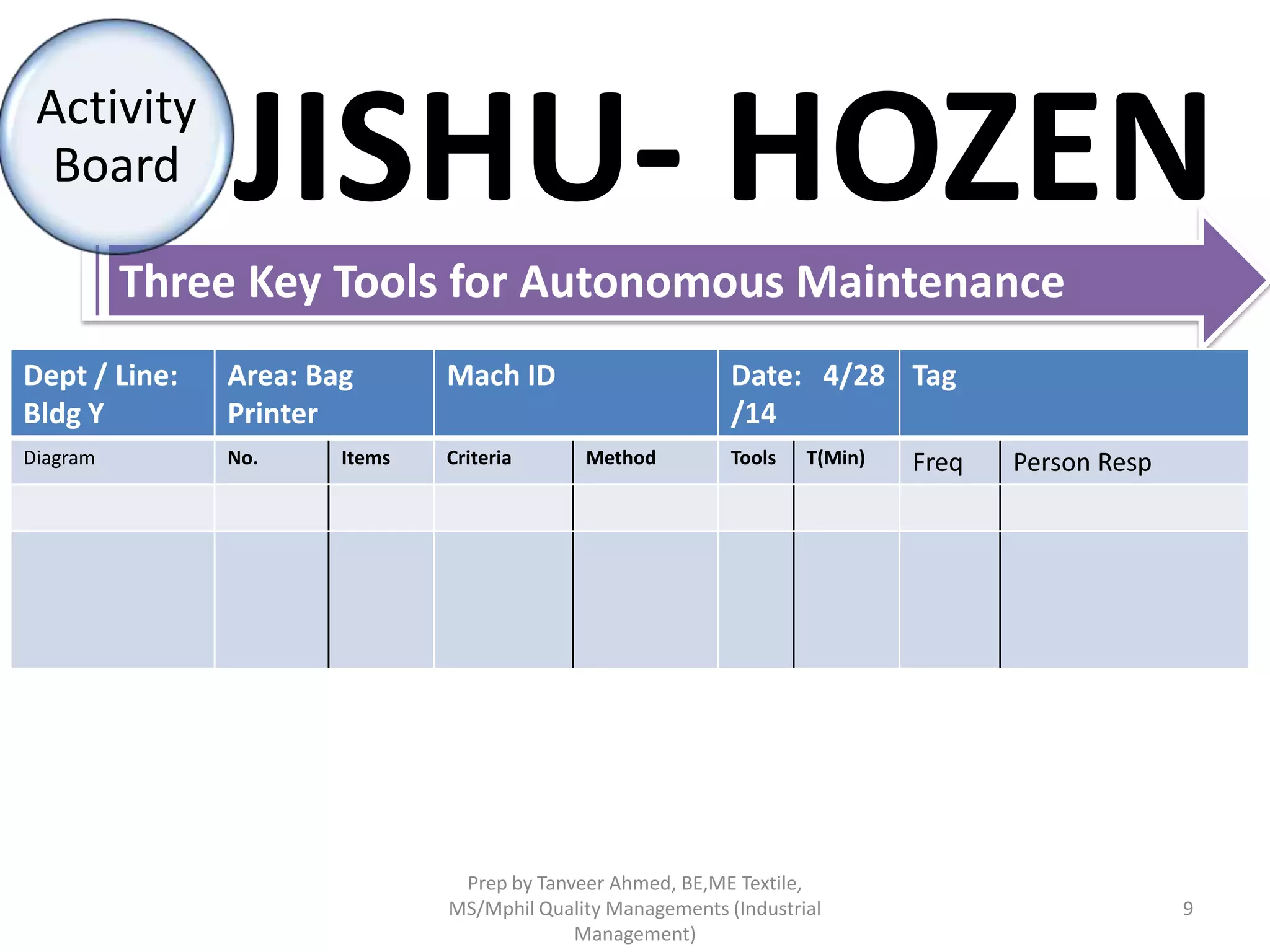
Activity
Board

JISHU- HOZEN

Three Key Tools for Autonomous Maintenance
People

Activity & Findings

Treasures

Team & Team Mission

Step1initial Cleaning

Display Actual Findings from initial
cleaning, such as Trash, Unnecessary
Items, Dust and other contamination

Line Layout & identified
important areas

-Definition
-Pics before / after

Step 2Source of Contamination
“ Explain & show Focused
Improvement activities for Source of
Contamination”

-Safety Hazard
- Contamination
- Hard –to - Reach
- Maint Failure

- Tag List Production/
Maintenance
- Tag Movement / Actual tags

One Point Lesson

Prep by Tanveer Ahmed, BE,ME Textile,
MS/Mphil Quality Managements (Industrial
Management)

8
Activity
Board

JISHU- HOZEN

Three Key Tools for Autonomous Maintenance
Dept / Line:
Bldg Y

Area: Bag
Printer

Mach ID

Diagram

No.

Criteria

Items

Date: 4/28 Tag
/14
Method

Tools

T(Min)

Prep by Tanveer Ahmed, BE,ME Textile,
MS/Mphil Quality Managements (Industrial
Management)

Freq

Person Resp

9
One
Point
Lesson

JISHU- HOZEN

Three Key Tools for Autonomous Maintenance
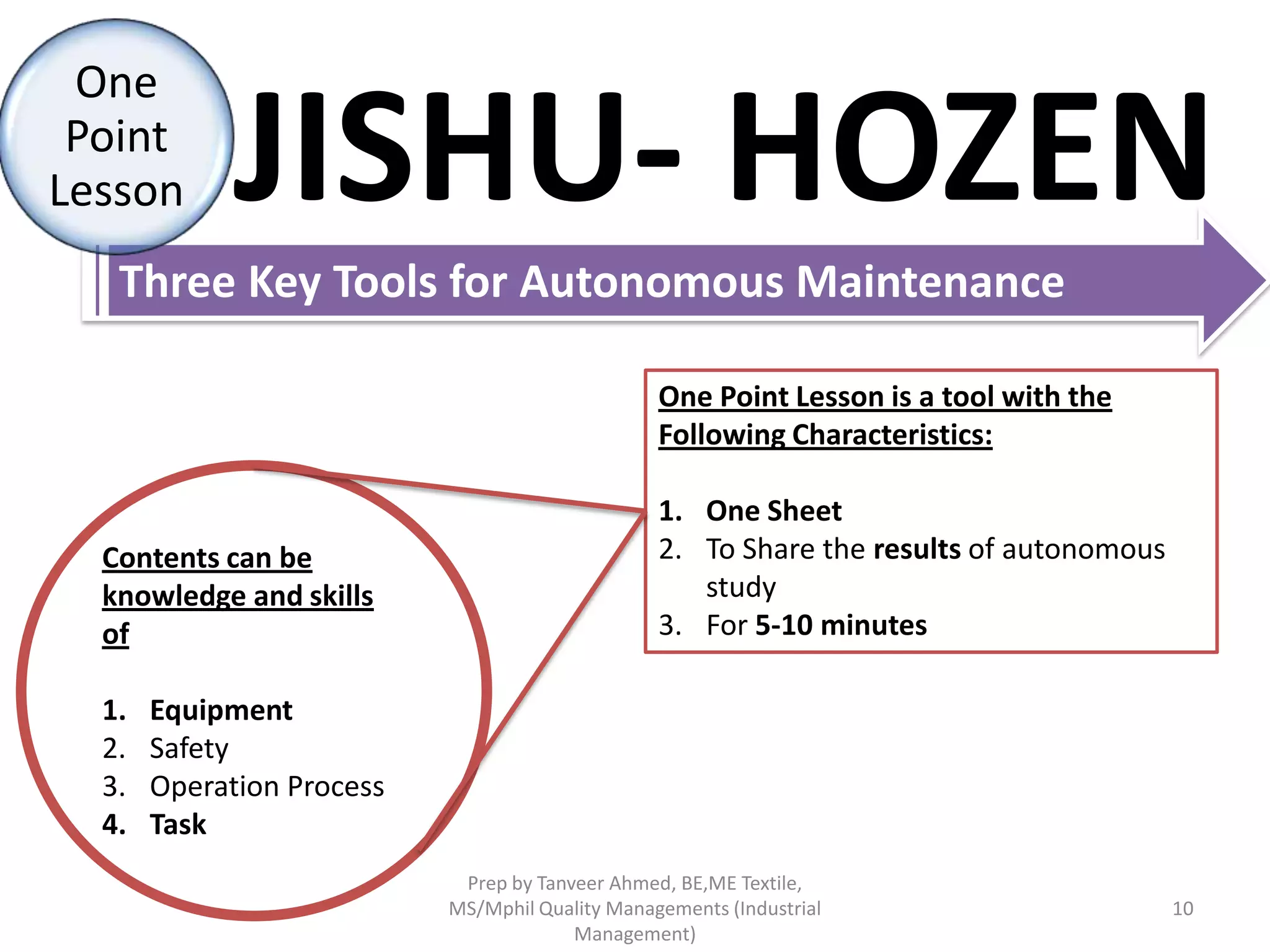
One Point Lesson is a tool with the
Following Characteristics:

Contents can be
knowledge and skills
of
1.
2.
3.
4.

1. One Sheet
2. To Share the results of autonomous
study
3. For 5-10 minutes

Equipment
Safety
Operation Process
Task
Prep by Tanveer Ahmed, BE,ME Textile,
MS/Mphil Quality Managements (Industrial
Management)

10
JISHU- HOZEN
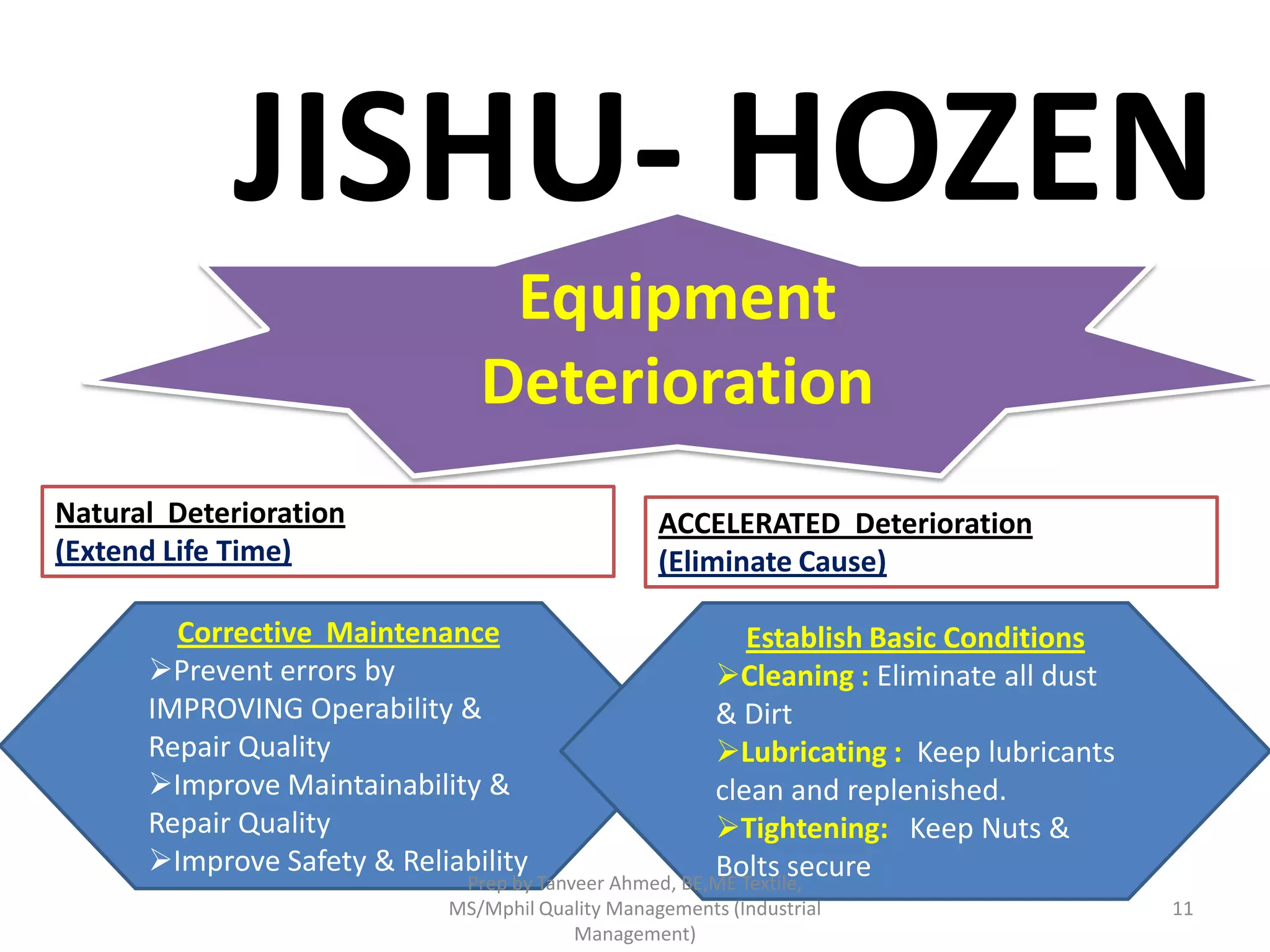
Equipment
Deterioration
Natural Deterioration
(Extend Life Time)

ACCELERATED Deterioration
(Eliminate Cause)

Corrective Maintenance
Prevent errors by
IMPROVING Operability &
Repair Quality
Improve Maintainability &
Repair Quality
Improve Safety & Reliability

Establish Basic Conditions
Cleaning : Eliminate all dust
& Dirt
Lubricating : Keep lubricants
clean and replenished.
Tightening: Keep Nuts &
Bolts secure
Prep by Tanveer Ahmed, BE,ME Textile,

MS/Mphil Quality Managements (Industrial
Management)

11
JISHU- HOZEN
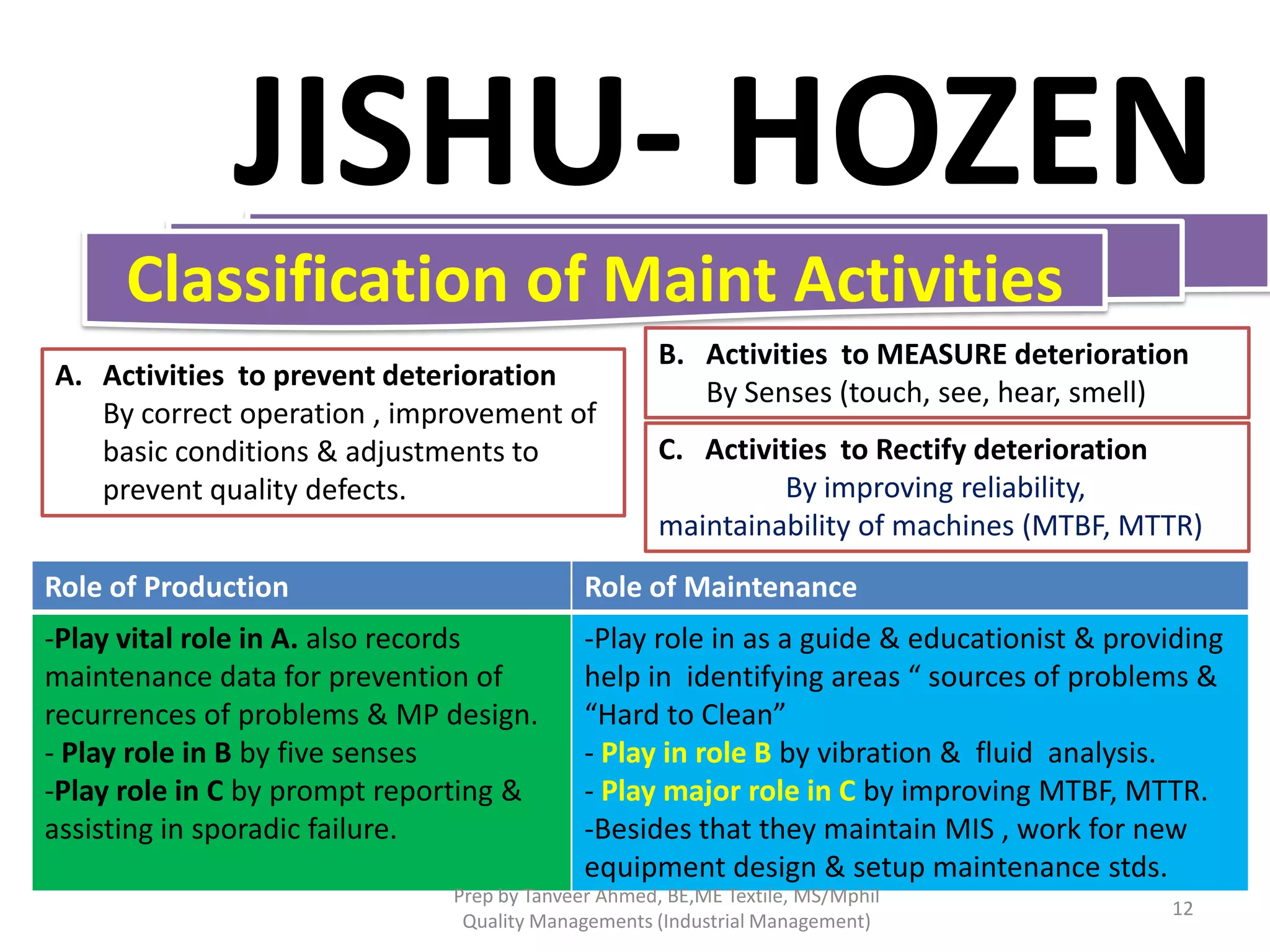
Classification of Maint Activities
A. Activities to prevent deterioration
By correct operation , improvement of
basic conditions & adjustments to
prevent quality defects.

B. Activities to MEASURE deterioration
By Senses (touch, see, hear, smell)
C. Activities to Rectify deterioration
By improving reliability,
maintainability of machines (MTBF, MTTR)

Role of Production

Role of Maintenance

-Play vital role in A. also records
maintenance data for prevention of
recurrences of problems & MP design.
- Play role in B by five senses
-Play role in C by prompt reporting &
assisting in sporadic failure.

-Play role in as a guide & educationist & providing
help in identifying areas “ sources of problems &
“Hard to Clean”
- Play in role B by vibration & fluid analysis.
- Play major role in C by improving MTBF, MTTR.
-Besides that they maintain MIS , work for new
equipment design & setup maintenance stds.

Prep by Tanveer Ahmed, BE,ME Textile, MS/Mphil
Quality Managements (Industrial Management)

12
JISHU- HOZEN
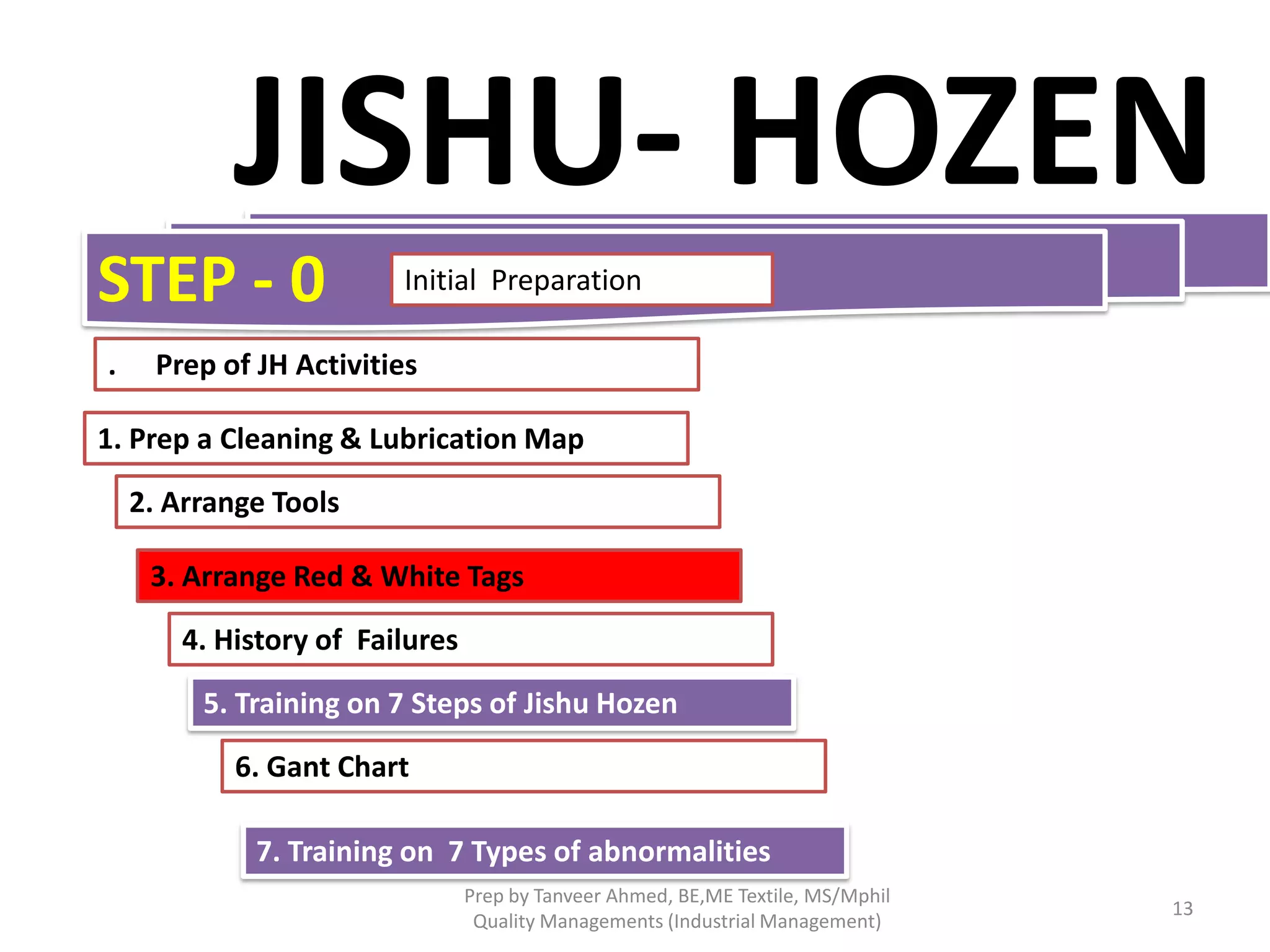
STEP - 0
.

Initial Preparation

Prep of JH Activities

1. Prep a Cleaning & Lubrication Map
2. Arrange Tools
3. Arrange Red & White Tags
4. History of Failures
5. Training on 7 Steps of Jishu Hozen

6. Gant Chart
7. Training on 7 Types of abnormalities
Prep by Tanveer Ahmed, BE,ME Textile, MS/Mphil
Quality Managements (Industrial Management)

13
JISHU- HOZEN
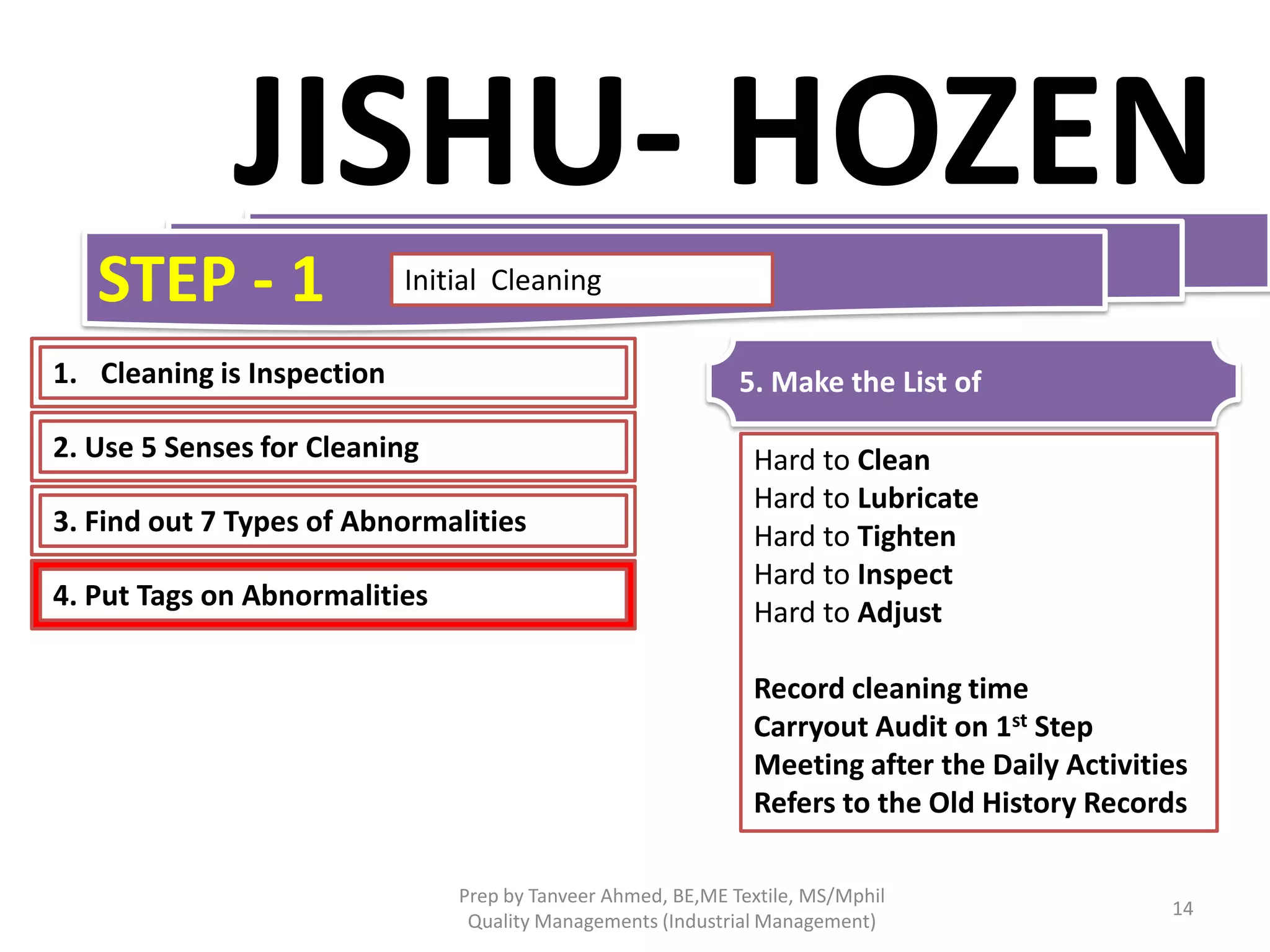
STEP - 1

Initial Cleaning

1. Cleaning is Inspection

5. Make the List of

2. Use 5 Senses for Cleaning
3. Find out 7 Types of Abnormalities
4. Put Tags on Abnormalities

Hard to Clean
Hard to Lubricate
Hard to Tighten
Hard to Inspect
Hard to Adjust
Record cleaning time
Carryout Audit on 1st Step
Meeting after the Daily Activities
Refers to the Old History Records

Prep by Tanveer Ahmed, BE,ME Textile, MS/Mphil
Quality Managements (Industrial Management)

14
JISHU- HOZEN
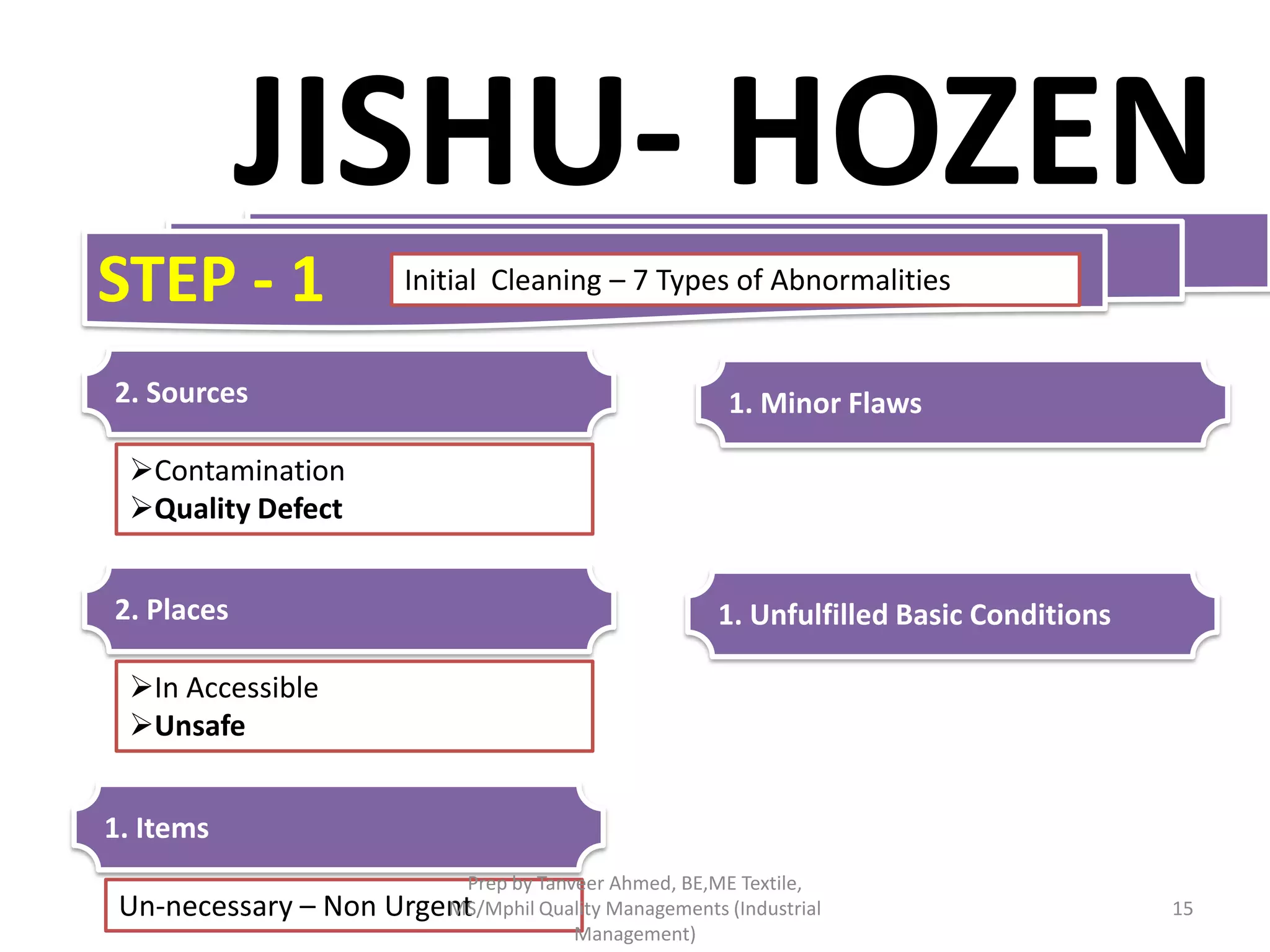
STEP - 1

Initial Cleaning – 7 Types of Abnormalities

2. Sources

1. Minor Flaws

Contamination
Quality Defect

2. Places

1. Unfulfilled Basic Conditions

In Accessible
Unsafe
1. Items
Prep by Tanveer Ahmed, BE,ME Textile,

MS/Mphil Quality Managements (Industrial
Un-necessary – Non Urgent
Management)

15
JISHU- HOZEN
STEP - 1

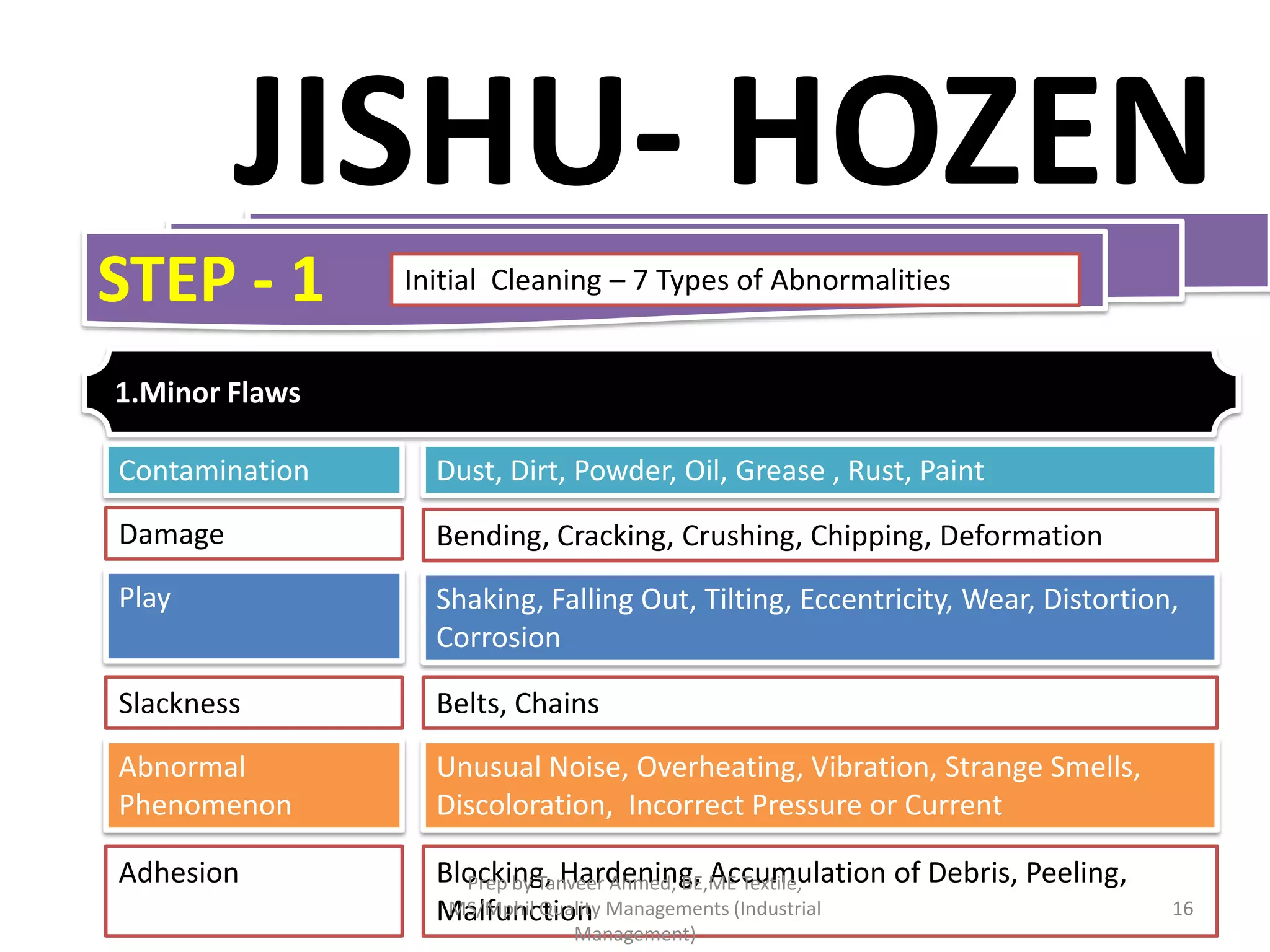
Initial Cleaning – 7 Types of Abnormalities

1.Minor Flaws
Contamination

Dust, Dirt, Powder, Oil, Grease , Rust, Paint

Damage

Bending, Cracking, Crushing, Chipping, Deformation

Play

Shaking, Falling Out, Tilting, Eccentricity, Wear, Distortion,
Corrosion

Slackness

Belts, Chains

Abnormal
Phenomenon

Unusual Noise, Overheating, Vibration, Strange Smells,
Discoloration, Incorrect Pressure or Current

Adhesion

Blocking, Hardening, Accumulation of Debris, Peeling,
Prep by Tanveer Ahmed, BE,ME Textile,
MS/Mphil Quality Managements (Industrial
Malfunction
Management)

16
JISHU- HOZEN
STEP - 1

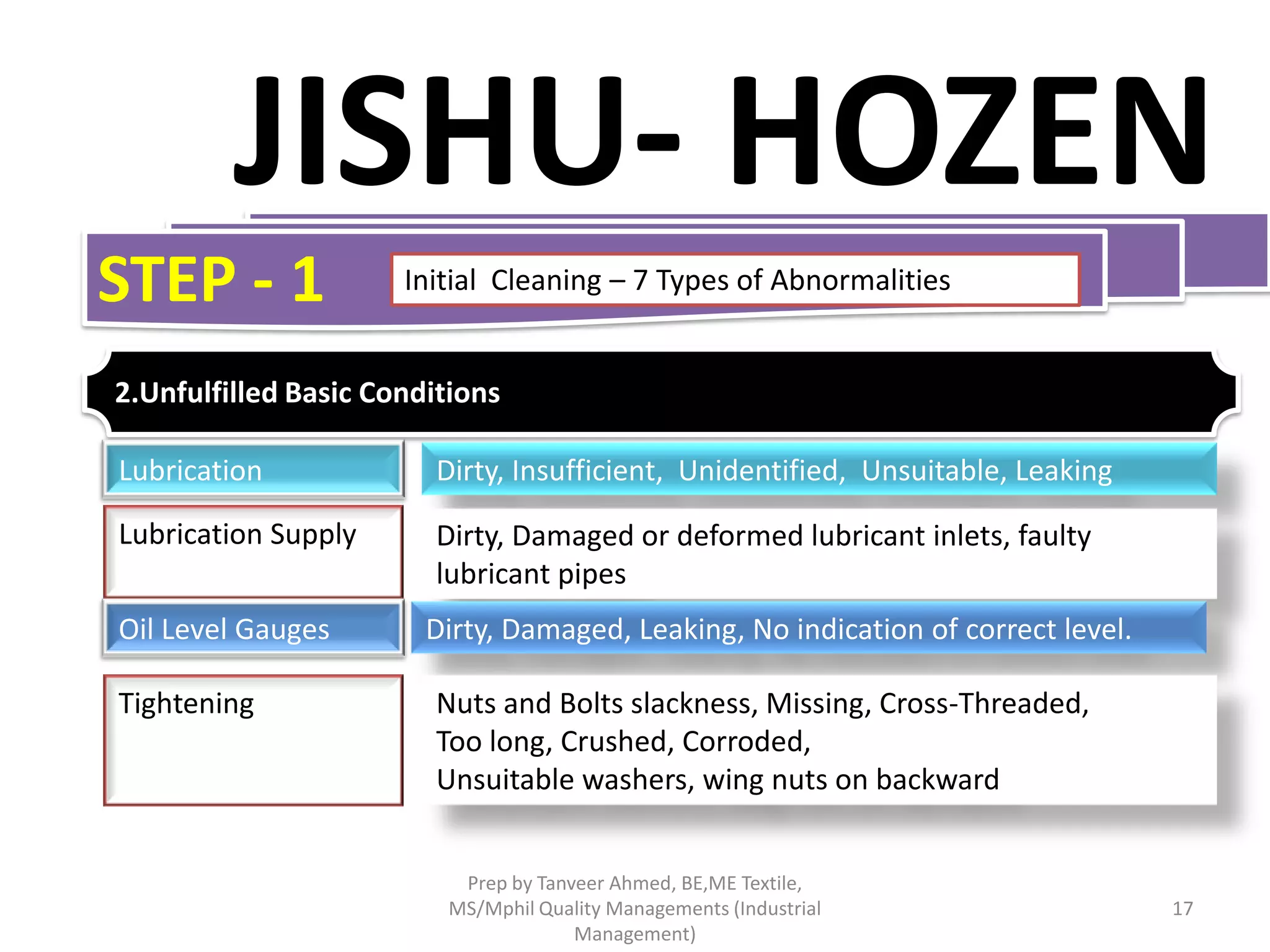
Initial Cleaning – 7 Types of Abnormalities

2.Unfulfilled Basic Conditions
Lubrication

Dirty, Insufficient, Unidentified, Unsuitable, Leaking

Lubrication Supply

Dirty, Damaged or deformed lubricant inlets, faulty
lubricant pipes

Oil Level Gauges
Tightening

Dirty, Damaged, Leaking, No indication of correct level.
Nuts and Bolts slackness, Missing, Cross-Threaded,
Too long, Crushed, Corroded,
Unsuitable washers, wing nuts on backward
Prep by Tanveer Ahmed, BE,ME Textile,
MS/Mphil Quality Managements (Industrial
Management)

17
JISHU- HOZEN
STEP - 1

Initial Cleaning – 7 Types of Abnormalities

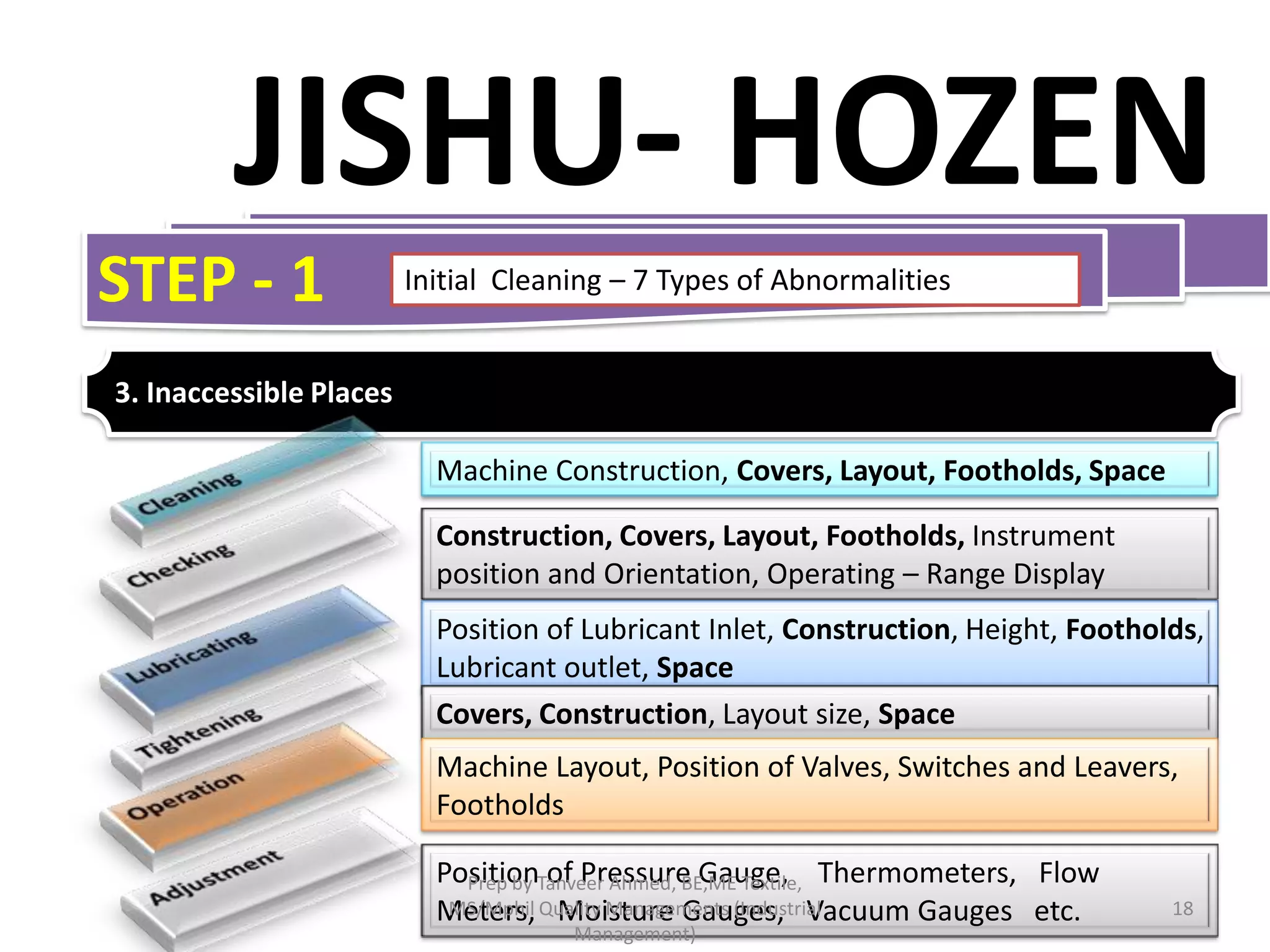
3. Inaccessible Places
Machine Construction, Covers, Layout, Footholds, Space
Construction, Covers, Layout, Footholds, Instrument
position and Orientation, Operating – Range Display
Position of Lubricant Inlet, Construction, Height, Footholds,
Lubricant outlet, Space
Covers, Construction, Layout size, Space

Machine Layout, Position of Valves, Switches and Leavers,
Footholds
PositionTanveer Ahmed, BE,ME Textile, Thermometers, Flow
Prep by of Pressure Gauge,
MS/Mphil Moisture Gauges, Vacuum Gauges etc.
Meters, Quality Managements (Industrial
Management)

18
JISHU- HOZEN
STEP - 1

Initial Cleaning – 7 Types of Abnormalities

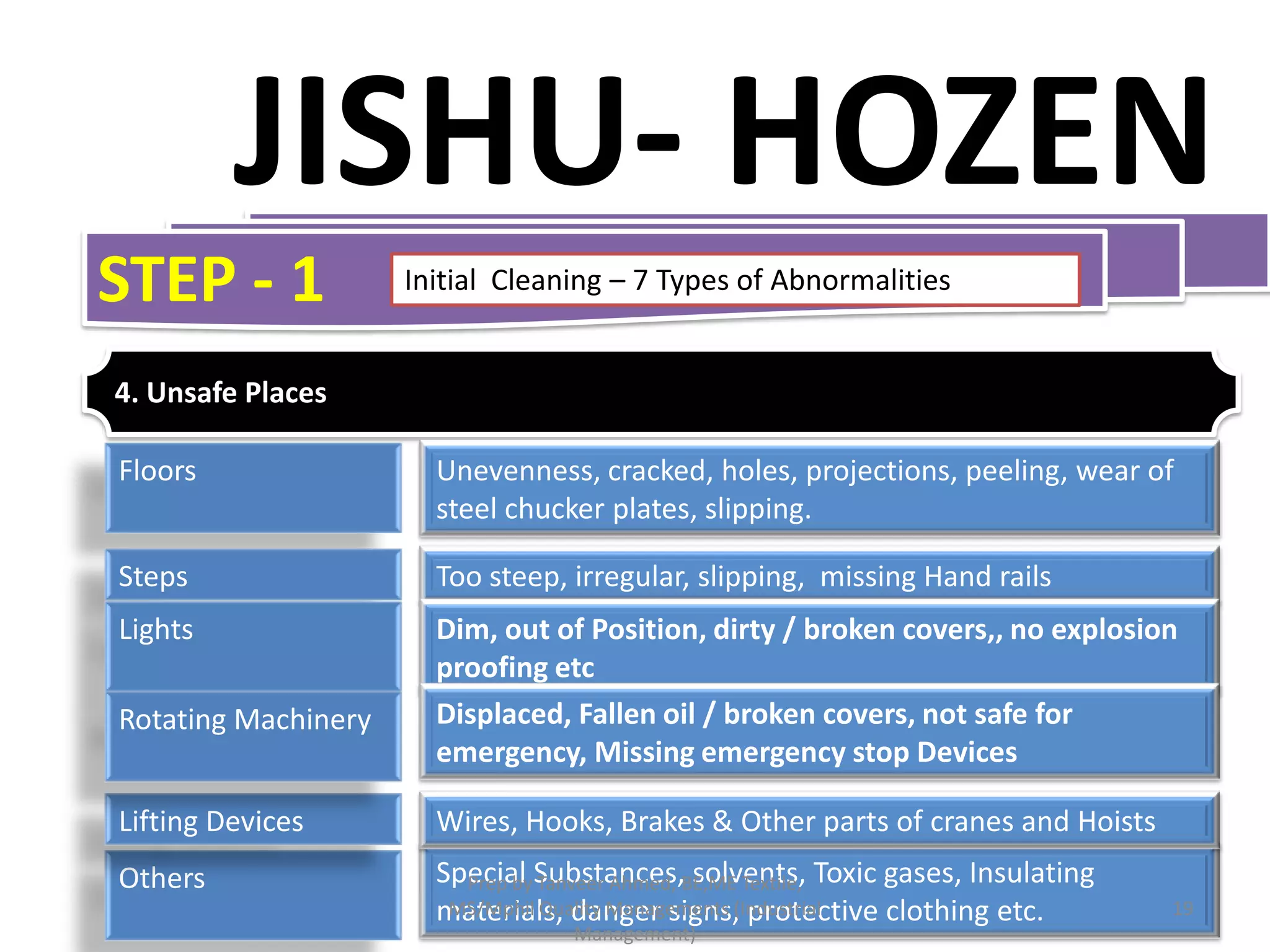
4. Unsafe Places
Floors

Unevenness, cracked, holes, projections, peeling, wear of
steel chucker plates, slipping.

Steps

Too steep, irregular, slipping, missing Hand rails

Lights

Dim, out of Position, dirty / broken covers,, no explosion
proofing etc
Displaced, Fallen oil / broken covers, not safe for
emergency, Missing emergency stop Devices

Rotating Machinery
Lifting Devices

Wires, Hooks, Brakes & Other parts of cranes and Hoists

Others

Special Substances,BE,ME Textile, Toxic gases, Insulating
Prep by Tanveer Ahmed, solvents,
MS/Mphil Quality Managements (Industrial
materials, danger signs, protective clothing etc.
Management)

19
JISHU- HOZEN
STEP - 1

Initial Cleaning – 7 Types of Abnormalities

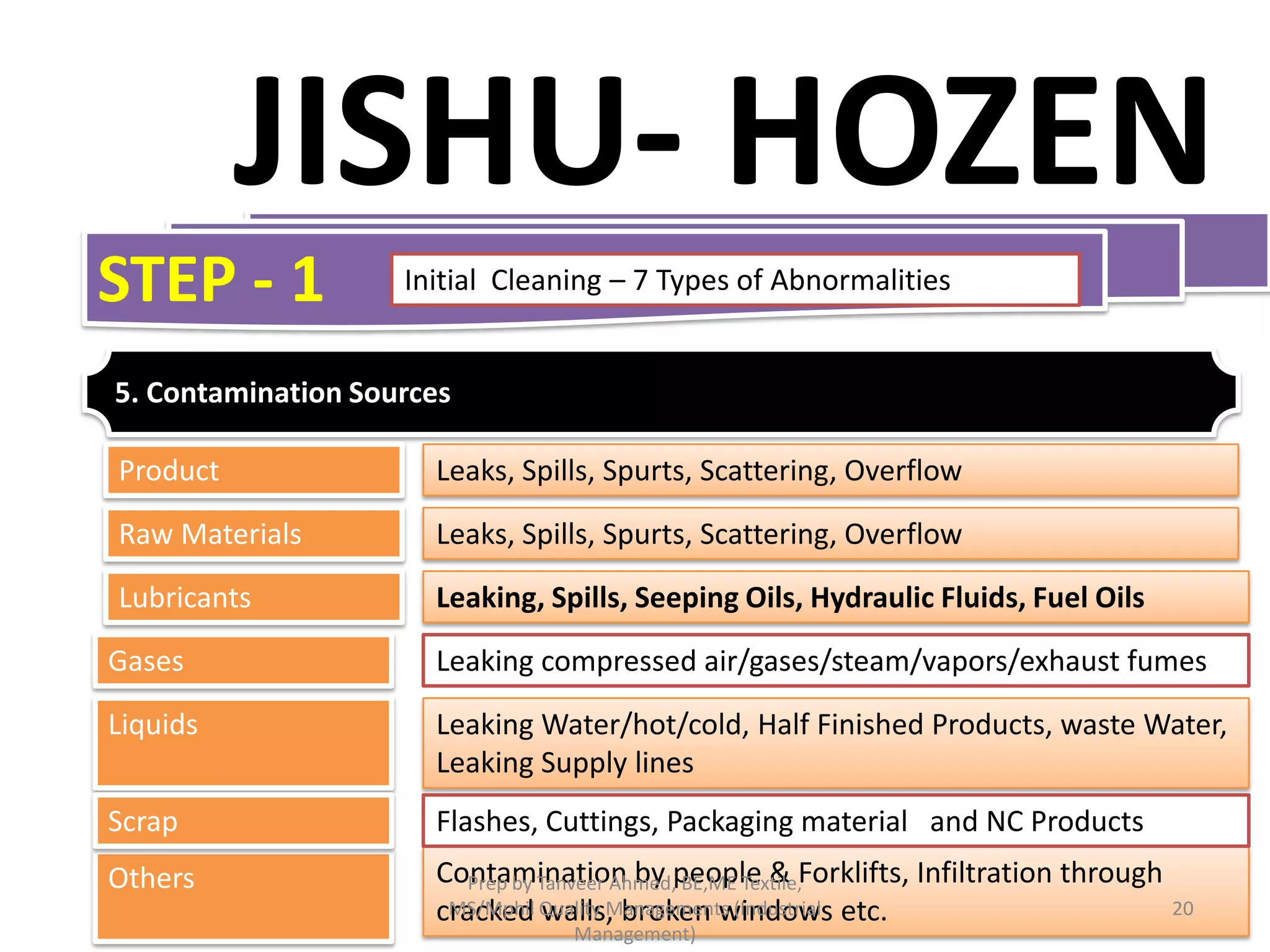
5. Contamination Sources
Product

Leaks, Spills, Spurts, Scattering, Overflow

Raw Materials

Leaks, Spills, Spurts, Scattering, Overflow

Lubricants

Leaking, Spills, Seeping Oils, Hydraulic Fluids, Fuel Oils

Gases

Leaking compressed air/gases/steam/vapors/exhaust fumes

Liquids

Leaking Water/hot/cold, Half Finished Products, waste Water,
Leaking Supply lines

Scrap

Flashes, Cuttings, Packaging material and NC Products

Others

Contamination by people & Forklifts, Infiltration through
Prep by Tanveer Ahmed, BE,ME Textile,
MS/Mphil Quality Managements (Industrial etc.
20
cracked walls, broken windows
Management)
JISHU- HOZEN
STEP - 1

Initial Cleaning – 7 Types of Abnormalities

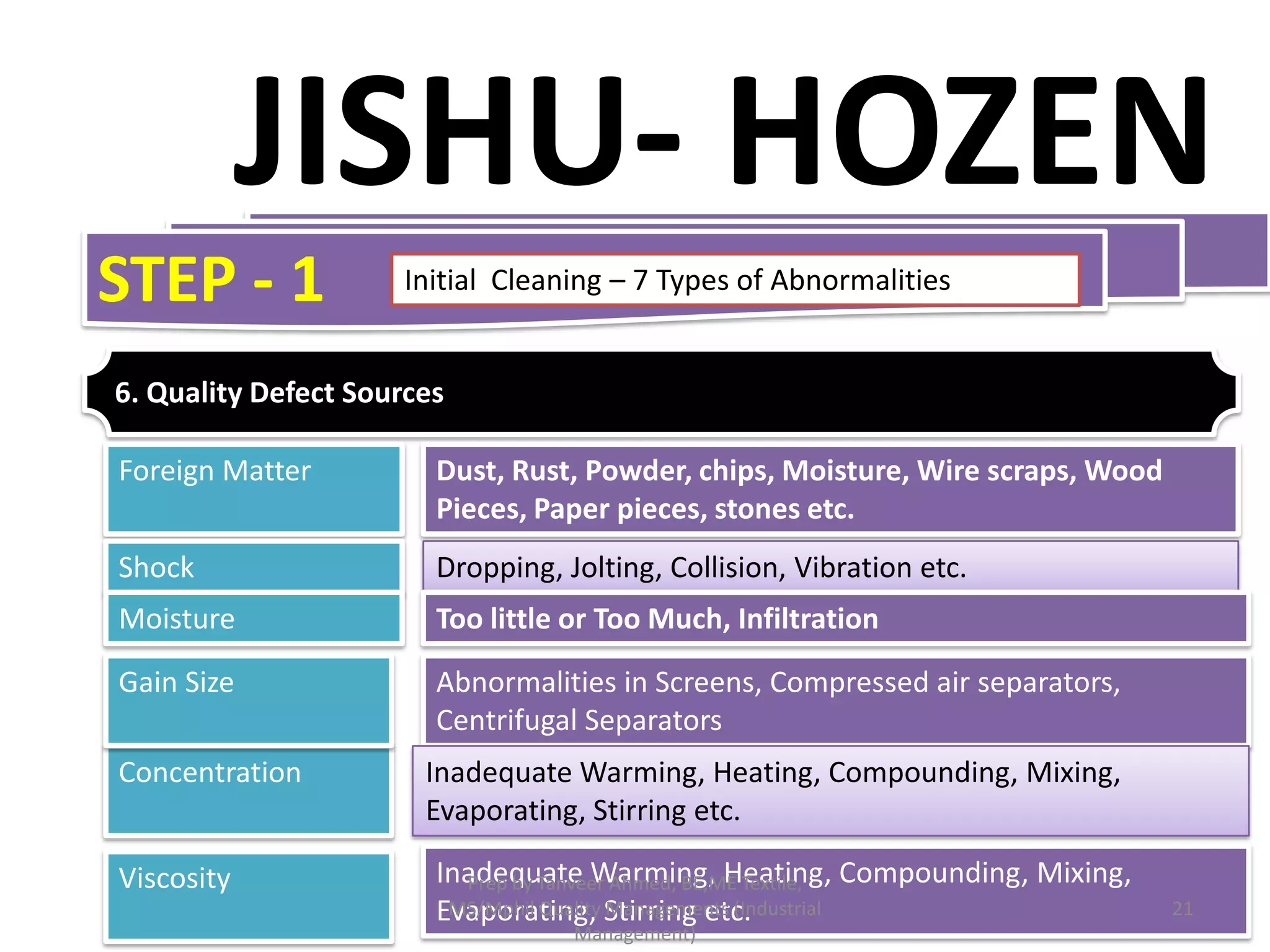
6. Quality Defect Sources
Foreign Matter

Dust, Rust, Powder, chips, Moisture, Wire scraps, Wood
Pieces, Paper pieces, stones etc.

Shock

Dropping, Jolting, Collision, Vibration etc.

Moisture

Too little or Too Much, Infiltration

Gain Size

Abnormalities in Screens, Compressed air separators,
Centrifugal Separators

Concentration

Viscosity

Inadequate Warming, Heating, Compounding, Mixing,
Evaporating, Stirring etc.
Inadequate Warming, Heating, Compounding, Mixing,
Prep by Tanveer Ahmed, BE,ME Textile,
MS/Mphil Quality Stirring etc.
Evaporating, Managements (Industrial
Management)

21
JISHU- HOZEN
STEP - 1

Initial Cleaning – 7 Types of Abnormalities

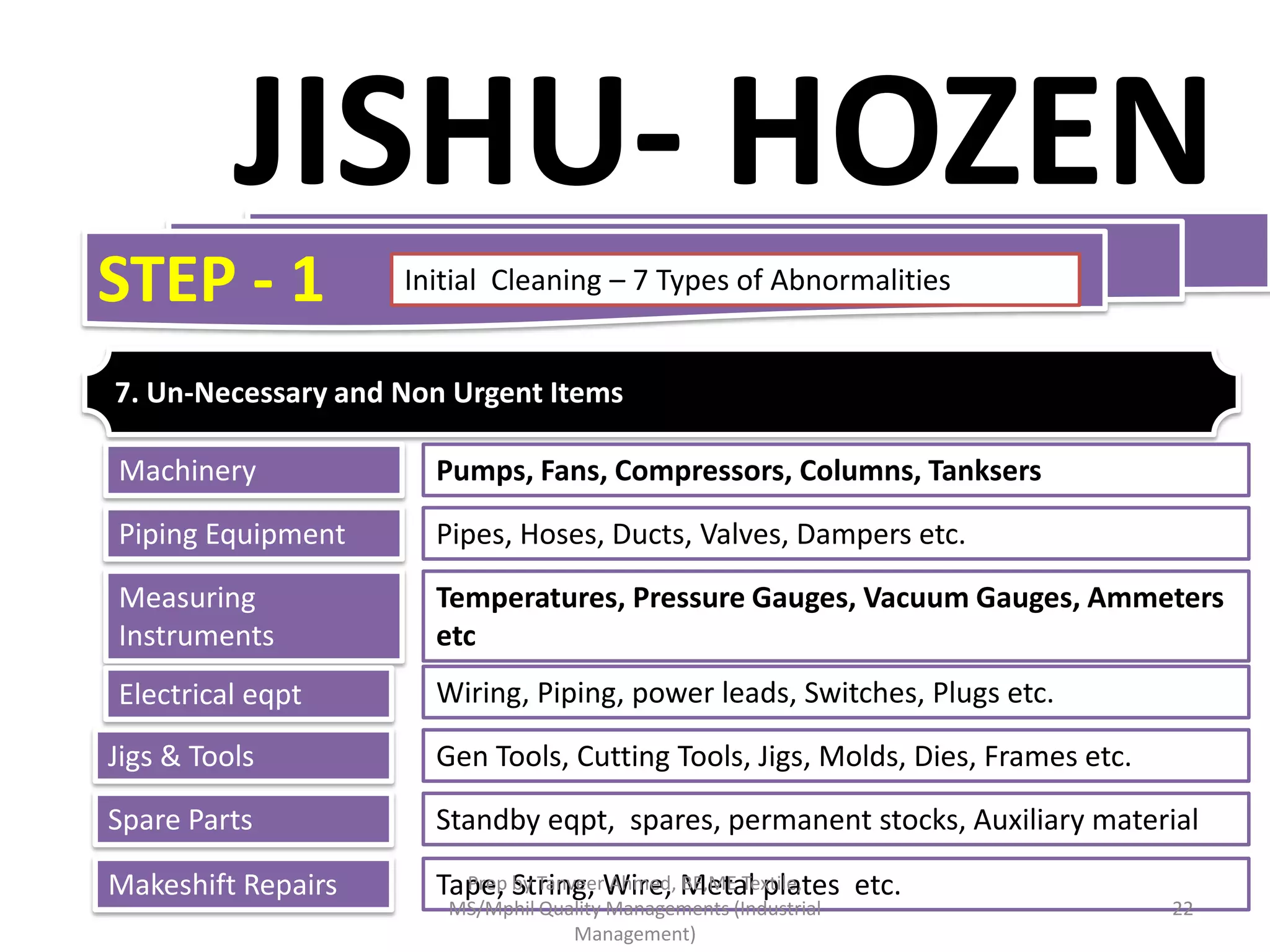
7. Un-Necessary and Non Urgent Items
Machinery

Pumps, Fans, Compressors, Columns, Tanksers

Piping Equipment

Pipes, Hoses, Ducts, Valves, Dampers etc.

Measuring
Instruments

Temperatures, Pressure Gauges, Vacuum Gauges, Ammeters
etc

Electrical eqpt

Wiring, Piping, power leads, Switches, Plugs etc.

Jigs & Tools

Gen Tools, Cutting Tools, Jigs, Molds, Dies, Frames etc.

Spare Parts

Standby eqpt, spares, permanent stocks, Auxiliary material

Makeshift Repairs

Prep String, Ahmed, BE,ME Textile,
Tape, by TanveerWire, Metal plates etc.
MS/Mphil Quality Managements (Industrial
Management)

22
JISHU- HOZEN
STEP - 2

Measure Against Sources

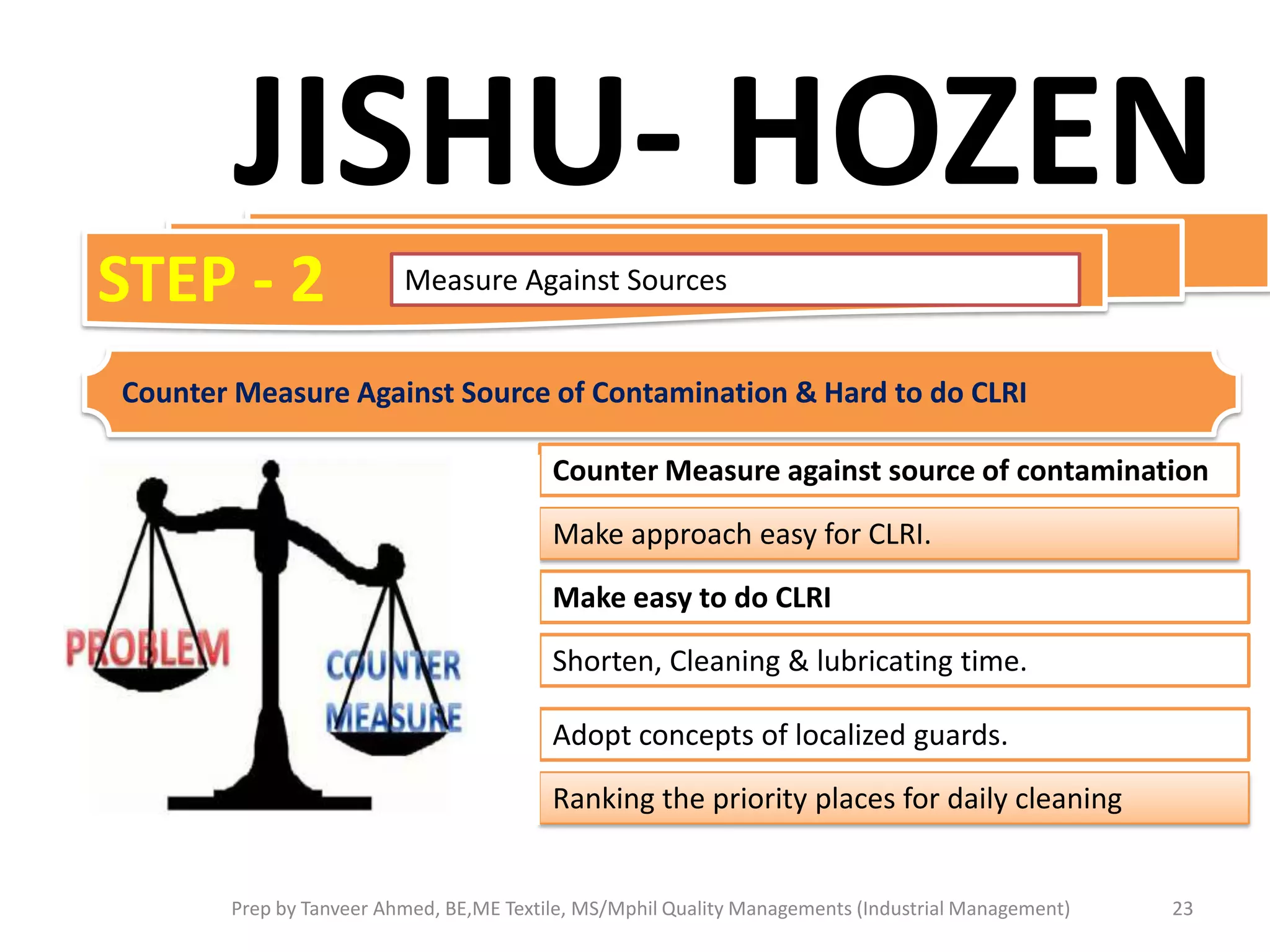
Counter Measure Against Source of Contamination & Hard to do CLRI
Counter Measure against source of contamination

Make approach easy for CLRI.
Make easy to do CLRI
Shorten, Cleaning & lubricating time.
Adopt concepts of localized guards.
Ranking the priority places for daily cleaning

Prep by Tanveer Ahmed, BE,ME Textile, MS/Mphil Quality Managements (Industrial Management)

23
JISHU- HOZEN
STEP - 3

Formulation of Cleanup and Lubrication Standards

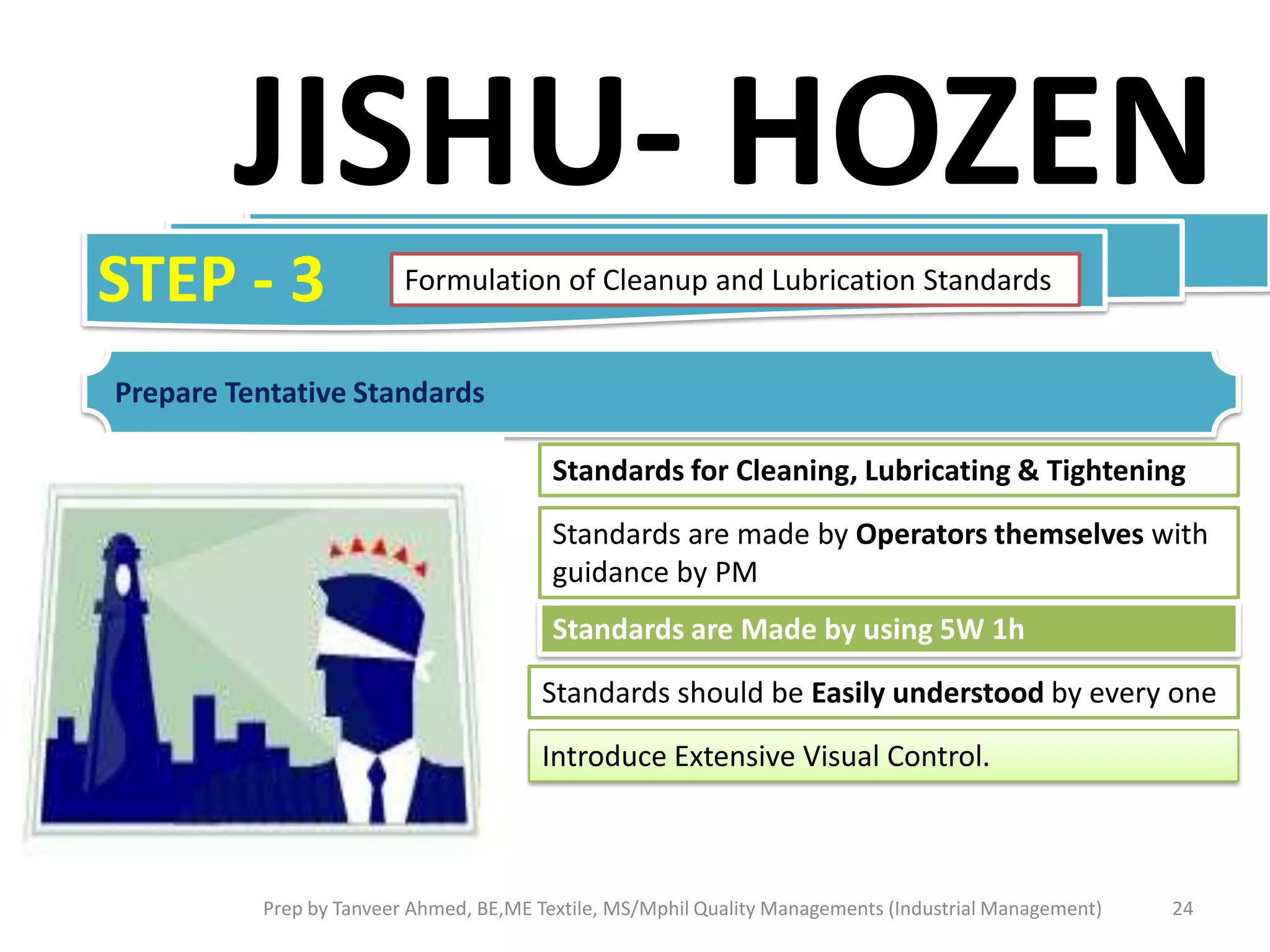
Prepare Tentative Standards
Standards for Cleaning, Lubricating & Tightening

Standards are made by Operators themselves with
guidance by PM
Standards are Made by using 5W 1h
Standards should be Easily understood by every one

Introduce Extensive Visual Control.

Prep by Tanveer Ahmed, BE,ME Textile, MS/Mphil Quality Managements (Industrial Management)

24
Prep by Tanveer Ahmed, BE,ME Textile,
MS/Mphil Quality Managements (Industrial
Management)

25

Jishu hozen

  • 1.
    JISHU- HOZEN Prevent theoccurrence of 1A/1B because of JH. Reduce the OIL consumption by 50%. Reduce Process time by 50%. Increase use of JH by 50% 8. Autonomous Management 7. Standardization 6. Autonomous Inspection 5. General Inspection 4. Fix Tentative JH Stds 3. Take Counter Measures 2. Initial Cleanup of Machine Prep by Tanveer Ahmed, BE,ME Textile, MS/Mphil Quality Managements (Industrial Management) 1. Prep of Employees 1
  • 2.
    JISHU- HOZEN Autonomous Maintenance 7steps 7. Autonomous Management 6. Standardization 5. Autonomous Inspection 4. General Inspection 3. Develop Tentative Standards 2. Counter Measures against Source & Kaizen 1. Initial Cleaning and Tagging Prep by Tanveer Ahmed, BE,ME Textile, MS/Mphil Quality Managements (Industrial Management) 2
  • 3.
    JISHU- HOZEN Autonomous Maintenance PROCESS 5. AutonomousInspection 4. General Inspection 3. Develop Tentative Standards 2. Counter Measures against Source & Kaizen 1. Initial Cleaning and Tagging 1. Manage Model Team 2. Manage Model Machine 3. Implement 5S 4. STEPS 123 5. Kickoff 9. Go to Step 4&5 and continue 8. Deployed to other M/C 7. Steps 123 with Audits 6. Forms Autonomous Maintenance Teams Prep by Tanveer Ahmed, BE,ME Textile, MS/Mphil Quality Managements (Industrial Management) 3
  • 4.
    JISHU- HOZEN WHY Autonomous Maintenance 1. MinorStoppage Loss 2. Reduced Speed Loss 3. Breakdown Loss 4. Setup & Adjustment Loss Preventive Maintenance Production Maintenance American Style of PM TPM Japan Style of PM Maintenance Departments Sole Responsibility 9. Confirmation of working conditions 10. Daily Inspection / Periodical Inspection 10. Activities to prevent eqpt degradation 5. Yield Loss 11. Activities to keep record on eqpt degradation 6. Defect Quality Loss 12. Keep cleaning, Inspection, Additional light 7. Poor Skills of Operator 8. Improper Position to Conduct Inspections 13. Activities to restore the machine conditions 14. Frequent Servicing, Solution of abnormality, Good Communication Prep by Tanveer Ahmed, BE,ME Textile, MS/Mphil Quality Managements (Industrial Management) 4
  • 5.
    WHY JISHU- HOZEN 1 Toestablish basic equipment condition 2. To make operator familiar with his equipment 3. To prevent equipment deterioration 4. To maintain in optimal condition 5. To eliminate equipment failure 6. To eliminate quality defect 7. To eliminate cost losses Prep by Tanveer Ahmed, BE,ME Textile, MS/Mphil Quality Managements (Industrial Management) 5
  • 6.
    JISHU- HOZEN The Mind Set 1.Indl preserving one’s own eqpt 2. Significant Change from early theory of “ I mfr - U Repair” or “ I make – U Fix” Production indls Thoughts Maintenance indls Thoughts Maint does NOT its Job Production do not know how to operate Maint staff take took long to fix job This eqpt is so OLD no wonder it breaks down again & again We get lot of repairs so we don’t have ample to do a Real corrective and are forced to do only temporary job We are too busy to do vital daily checks We Prep the stds but they do not do the Prep by Tanveer Ahmed, BE,ME Textile, checks MS/Mphil Quality Managements (Industrial Management) 6
  • 7.
    JISHU- HOZEN Three KeyTools for Autonomous Maintenance Key Concepts: Shop Floor Based Activities Operator Conducted Operator Enhancing Team Activity  Autonomous Management TPM Foundation Part of the Job Activity Board Meetings Prep by Tanveer Ahmed, BE,ME Textile, MS/Mphil Quality Managements (Industrial Management) One Point Lesson 7
  • 8.
    Activity Board JISHU- HOZEN Three KeyTools for Autonomous Maintenance People Activity & Findings Treasures Team & Team Mission Step1initial Cleaning Display Actual Findings from initial cleaning, such as Trash, Unnecessary Items, Dust and other contamination Line Layout & identified important areas -Definition -Pics before / after Step 2Source of Contamination “ Explain & show Focused Improvement activities for Source of Contamination” -Safety Hazard - Contamination - Hard –to - Reach - Maint Failure - Tag List Production/ Maintenance - Tag Movement / Actual tags One Point Lesson Prep by Tanveer Ahmed, BE,ME Textile, MS/Mphil Quality Managements (Industrial Management) 8
  • 9.
    Activity Board JISHU- HOZEN Three KeyTools for Autonomous Maintenance Dept / Line: Bldg Y Area: Bag Printer Mach ID Diagram No. Criteria Items Date: 4/28 Tag /14 Method Tools T(Min) Prep by Tanveer Ahmed, BE,ME Textile, MS/Mphil Quality Managements (Industrial Management) Freq Person Resp 9
  • 10.
    One Point Lesson JISHU- HOZEN Three KeyTools for Autonomous Maintenance One Point Lesson is a tool with the Following Characteristics: Contents can be knowledge and skills of 1. 2. 3. 4. 1. One Sheet 2. To Share the results of autonomous study 3. For 5-10 minutes Equipment Safety Operation Process Task Prep by Tanveer Ahmed, BE,ME Textile, MS/Mphil Quality Managements (Industrial Management) 10
  • 11.
    JISHU- HOZEN Equipment Deterioration Natural Deterioration (ExtendLife Time) ACCELERATED Deterioration (Eliminate Cause) Corrective Maintenance Prevent errors by IMPROVING Operability & Repair Quality Improve Maintainability & Repair Quality Improve Safety & Reliability Establish Basic Conditions Cleaning : Eliminate all dust & Dirt Lubricating : Keep lubricants clean and replenished. Tightening: Keep Nuts & Bolts secure Prep by Tanveer Ahmed, BE,ME Textile, MS/Mphil Quality Managements (Industrial Management) 11
  • 12.
    JISHU- HOZEN Classification ofMaint Activities A. Activities to prevent deterioration By correct operation , improvement of basic conditions & adjustments to prevent quality defects. B. Activities to MEASURE deterioration By Senses (touch, see, hear, smell) C. Activities to Rectify deterioration By improving reliability, maintainability of machines (MTBF, MTTR) Role of Production Role of Maintenance -Play vital role in A. also records maintenance data for prevention of recurrences of problems & MP design. - Play role in B by five senses -Play role in C by prompt reporting & assisting in sporadic failure. -Play role in as a guide & educationist & providing help in identifying areas “ sources of problems & “Hard to Clean” - Play in role B by vibration & fluid analysis. - Play major role in C by improving MTBF, MTTR. -Besides that they maintain MIS , work for new equipment design & setup maintenance stds. Prep by Tanveer Ahmed, BE,ME Textile, MS/Mphil Quality Managements (Industrial Management) 12
  • 13.
    JISHU- HOZEN STEP -0 . Initial Preparation Prep of JH Activities 1. Prep a Cleaning & Lubrication Map 2. Arrange Tools 3. Arrange Red & White Tags 4. History of Failures 5. Training on 7 Steps of Jishu Hozen 6. Gant Chart 7. Training on 7 Types of abnormalities Prep by Tanveer Ahmed, BE,ME Textile, MS/Mphil Quality Managements (Industrial Management) 13
  • 14.
    JISHU- HOZEN STEP -1 Initial Cleaning 1. Cleaning is Inspection 5. Make the List of 2. Use 5 Senses for Cleaning 3. Find out 7 Types of Abnormalities 4. Put Tags on Abnormalities Hard to Clean Hard to Lubricate Hard to Tighten Hard to Inspect Hard to Adjust Record cleaning time Carryout Audit on 1st Step Meeting after the Daily Activities Refers to the Old History Records Prep by Tanveer Ahmed, BE,ME Textile, MS/Mphil Quality Managements (Industrial Management) 14
  • 15.
    JISHU- HOZEN STEP -1 Initial Cleaning – 7 Types of Abnormalities 2. Sources 1. Minor Flaws Contamination Quality Defect 2. Places 1. Unfulfilled Basic Conditions In Accessible Unsafe 1. Items Prep by Tanveer Ahmed, BE,ME Textile, MS/Mphil Quality Managements (Industrial Un-necessary – Non Urgent Management) 15
  • 16.
    JISHU- HOZEN STEP -1 Initial Cleaning – 7 Types of Abnormalities 1.Minor Flaws Contamination Dust, Dirt, Powder, Oil, Grease , Rust, Paint Damage Bending, Cracking, Crushing, Chipping, Deformation Play Shaking, Falling Out, Tilting, Eccentricity, Wear, Distortion, Corrosion Slackness Belts, Chains Abnormal Phenomenon Unusual Noise, Overheating, Vibration, Strange Smells, Discoloration, Incorrect Pressure or Current Adhesion Blocking, Hardening, Accumulation of Debris, Peeling, Prep by Tanveer Ahmed, BE,ME Textile, MS/Mphil Quality Managements (Industrial Malfunction Management) 16
  • 17.
    JISHU- HOZEN STEP -1 Initial Cleaning – 7 Types of Abnormalities 2.Unfulfilled Basic Conditions Lubrication Dirty, Insufficient, Unidentified, Unsuitable, Leaking Lubrication Supply Dirty, Damaged or deformed lubricant inlets, faulty lubricant pipes Oil Level Gauges Tightening Dirty, Damaged, Leaking, No indication of correct level. Nuts and Bolts slackness, Missing, Cross-Threaded, Too long, Crushed, Corroded, Unsuitable washers, wing nuts on backward Prep by Tanveer Ahmed, BE,ME Textile, MS/Mphil Quality Managements (Industrial Management) 17
  • 18.
    JISHU- HOZEN STEP -1 Initial Cleaning – 7 Types of Abnormalities 3. Inaccessible Places Machine Construction, Covers, Layout, Footholds, Space Construction, Covers, Layout, Footholds, Instrument position and Orientation, Operating – Range Display Position of Lubricant Inlet, Construction, Height, Footholds, Lubricant outlet, Space Covers, Construction, Layout size, Space Machine Layout, Position of Valves, Switches and Leavers, Footholds PositionTanveer Ahmed, BE,ME Textile, Thermometers, Flow Prep by of Pressure Gauge, MS/Mphil Moisture Gauges, Vacuum Gauges etc. Meters, Quality Managements (Industrial Management) 18
  • 19.
    JISHU- HOZEN STEP -1 Initial Cleaning – 7 Types of Abnormalities 4. Unsafe Places Floors Unevenness, cracked, holes, projections, peeling, wear of steel chucker plates, slipping. Steps Too steep, irregular, slipping, missing Hand rails Lights Dim, out of Position, dirty / broken covers,, no explosion proofing etc Displaced, Fallen oil / broken covers, not safe for emergency, Missing emergency stop Devices Rotating Machinery Lifting Devices Wires, Hooks, Brakes & Other parts of cranes and Hoists Others Special Substances,BE,ME Textile, Toxic gases, Insulating Prep by Tanveer Ahmed, solvents, MS/Mphil Quality Managements (Industrial materials, danger signs, protective clothing etc. Management) 19
  • 20.
    JISHU- HOZEN STEP -1 Initial Cleaning – 7 Types of Abnormalities 5. Contamination Sources Product Leaks, Spills, Spurts, Scattering, Overflow Raw Materials Leaks, Spills, Spurts, Scattering, Overflow Lubricants Leaking, Spills, Seeping Oils, Hydraulic Fluids, Fuel Oils Gases Leaking compressed air/gases/steam/vapors/exhaust fumes Liquids Leaking Water/hot/cold, Half Finished Products, waste Water, Leaking Supply lines Scrap Flashes, Cuttings, Packaging material and NC Products Others Contamination by people & Forklifts, Infiltration through Prep by Tanveer Ahmed, BE,ME Textile, MS/Mphil Quality Managements (Industrial etc. 20 cracked walls, broken windows Management)
  • 21.
    JISHU- HOZEN STEP -1 Initial Cleaning – 7 Types of Abnormalities 6. Quality Defect Sources Foreign Matter Dust, Rust, Powder, chips, Moisture, Wire scraps, Wood Pieces, Paper pieces, stones etc. Shock Dropping, Jolting, Collision, Vibration etc. Moisture Too little or Too Much, Infiltration Gain Size Abnormalities in Screens, Compressed air separators, Centrifugal Separators Concentration Viscosity Inadequate Warming, Heating, Compounding, Mixing, Evaporating, Stirring etc. Inadequate Warming, Heating, Compounding, Mixing, Prep by Tanveer Ahmed, BE,ME Textile, MS/Mphil Quality Stirring etc. Evaporating, Managements (Industrial Management) 21
  • 22.
    JISHU- HOZEN STEP -1 Initial Cleaning – 7 Types of Abnormalities 7. Un-Necessary and Non Urgent Items Machinery Pumps, Fans, Compressors, Columns, Tanksers Piping Equipment Pipes, Hoses, Ducts, Valves, Dampers etc. Measuring Instruments Temperatures, Pressure Gauges, Vacuum Gauges, Ammeters etc Electrical eqpt Wiring, Piping, power leads, Switches, Plugs etc. Jigs & Tools Gen Tools, Cutting Tools, Jigs, Molds, Dies, Frames etc. Spare Parts Standby eqpt, spares, permanent stocks, Auxiliary material Makeshift Repairs Prep String, Ahmed, BE,ME Textile, Tape, by TanveerWire, Metal plates etc. MS/Mphil Quality Managements (Industrial Management) 22
  • 23.
    JISHU- HOZEN STEP -2 Measure Against Sources Counter Measure Against Source of Contamination & Hard to do CLRI Counter Measure against source of contamination Make approach easy for CLRI. Make easy to do CLRI Shorten, Cleaning & lubricating time. Adopt concepts of localized guards. Ranking the priority places for daily cleaning Prep by Tanveer Ahmed, BE,ME Textile, MS/Mphil Quality Managements (Industrial Management) 23
  • 24.
    JISHU- HOZEN STEP -3 Formulation of Cleanup and Lubrication Standards Prepare Tentative Standards Standards for Cleaning, Lubricating & Tightening Standards are made by Operators themselves with guidance by PM Standards are Made by using 5W 1h Standards should be Easily understood by every one Introduce Extensive Visual Control. Prep by Tanveer Ahmed, BE,ME Textile, MS/Mphil Quality Managements (Industrial Management) 24
  • 25.
    Prep by TanveerAhmed, BE,ME Textile, MS/Mphil Quality Managements (Industrial Management) 25