SECTION 4 TOPIC 1THE STRUCTURE OF THE ATOM
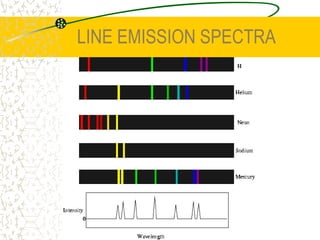
LINE EMISSION SPECTRAExcite a gas and observe through a spectrometer, and the light is made up of specific frequencies and is referred to as spectral lines and the full spectrum seen is known as a line emission spectrum.Unlike solids and dense liquids, gases do not produce a continuous spectrum.
LINE EMISSION SPECTRAThey are not vibrating back and forth at a variety of frequencies because they are not bonded together. Instead, they emit SPECIFIC frequencies of light as seen in the spectroscope.These are produced by electrons falling from higher energy levels to lower energy levels.A photon of a specific frequency is emitted in the process.
LINE EMISSION SPECTRAA good example of line emission spectra is the burning of sodium.The gaseous sodium’s electrons produce two distinct spectral lines in the yellow region of the E-M spectrum.Hydrogen gives off spectra that are in the very low frequency radio wave range.Radio telescopes are used to study where hydrogen is present in the universe.
LINE EMISSION SPECTRA
LINE EMISSION SPECTRALine emission spectra of each element is uniqueit is a characteristic of that elementIt means that the spectra can be used to identify unknown substances through comparison to standards
What does this mean?The presence of discrete lines in the spectra and that they are unique for atoms led to Bohr assuming that the energy carried by an electron was quantized. From this assumption, he formed three postulates from which he developed a mathematical description.
THE BOHR MODEL OF THE ATOM1.  Electrons in the atom can only have fixed amounts of energy. The electrons revolve around the nucleus only in certain allowed orbits called stationary states. When in a stationary state, the electron cannot radiate any of its energy.The electron is only found in the stationary state so the energy is quantized inside the atom.
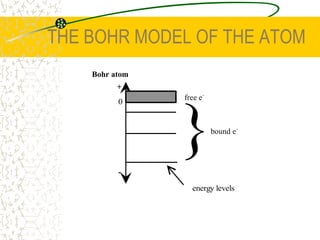
THE BOHR MODEL OF THE ATOM
THE BOHR MODEL OF THE ATOM2.  Electrons can jump from one stationary state to another by the absorption or emission of a photonThe energy of this photon will exactly equal the difference in energy of the two stationary states.Light energy is emitted or absorbed by atoms in fixed amounts called quanta. The quantum is equal to the difference in energy levels of the electrons. This accounts for the existence of line emission and line absorption spectra.
THE BOHR MODEL OF THE ATOMThe frequencies of the bright lines of the line emission and dark lines of the absorption spectrum of an element will be identical. Note how energy conservation is embodied in this postulate.Bohr’s Third Postulate is not part of the examination.
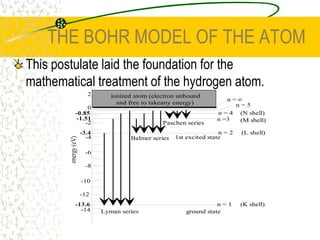
THE BOHR MODEL OF THE ATOMThis postulate laid the foundation for the mathematical treatment of the hydrogen atom.
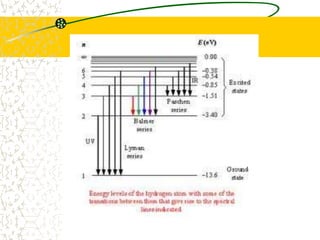
THE BOHR MODEL OF THE ATOMThe number n is known as the principal quantum number and refers to the energy level under consideration. n = 1 is the lowest energy level or the ground state from the German grund meaning ‘fundamental’. n = 2 is the principal quantum number for the first excited state and so on. Although Bohr allows the value of n to reach infinity, in reality only the first few are used.
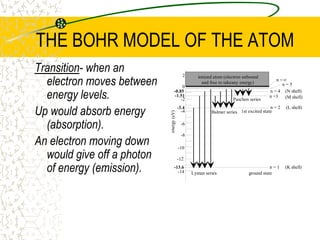
THE BOHR MODEL OF THE ATOMTransition- when an electron moves between energy levels. Up would absorb energy (absorption).  An electron moving down would give off a photon of energy (emission).
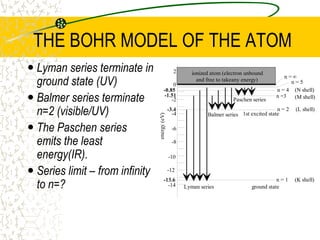
THE BOHR MODEL OF THE ATOMLyman series terminate in ground state (UV)
Balmer series terminate n=2 (visible/UV)
The Paschen series emits the least energy(IR).
Series limit – from infinity to n=?
THE BOHR MODEL OF THE ATOMAn electron can be moved to a higher energy level by…1. INCOMING PHOTON- Must be of exactly the same energy as E2 – E12.  INCOMING ELECTRON- remaining energy stays with the incoming electron.3.  HEAT- gives the electron vibrational energy.
IONISATION ENERGYIONISATION- minimum energy required to remove an electron from the atom in its most stable state.Example:  the ionization energy required to remove an electron from its ground state (K=1) for Hydrogen is 13.6 eV.
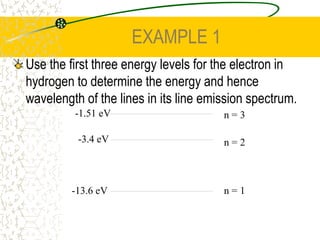
EXAMPLE 1Use the first three energy levels for the electron in hydrogen to determine the energy and hence wavelength of the lines in its line emission spectrum.
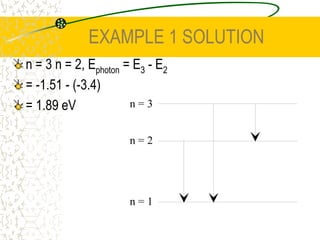
EXAMPLE 1 SOLUTIONFrom the diagram, the atom can be excited to the first (n = 2) and second (n = 3) excited states. From these, it will return to the ground state emitting a photon. The electron can make the following transitions:
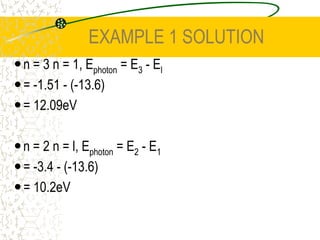
EXAMPLE 1 SOLUTIONn = 3 n = 1, Ephoton = E3 - El
= -1.51 - (-13.6)
= 12.09eV
n = 2 n = l, Ephoton = E2 - E1
= -3.4 - (-13.6)
= 10.2eVEXAMPLE 1 SOLUTIONn = 3 n = 2, Ephoton = E3 - E2= -1.51 - (-3.4)= 1.89eV
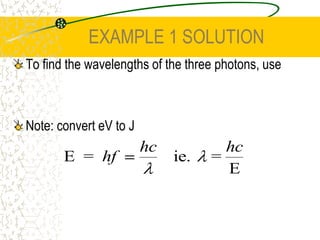
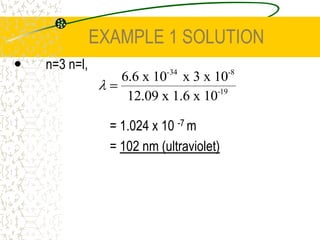
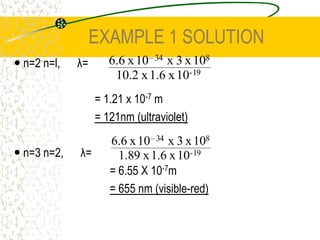
EXAMPLE 1 SOLUTIONTo find the wavelengths of the three photons, useNote: convert eV to J
EXAMPLE 1 SOLUTION	n=3n=l,		= 1.024 x 10 -7 m			= 102 nm (ultraviolet)
EXAMPLE 1 SOLUTIONn=2n=l,λ== 1.21 x 10⁻⁷ m = 121nm (ultraviolet)n=3 n=2,λ=			= 6.55 X 10⁻⁷m= 655 nm (visible-red)
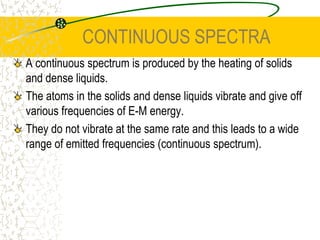
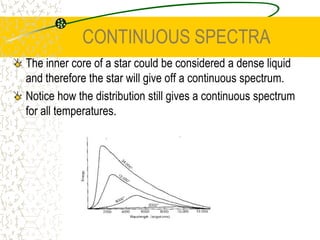
CONTINUOUS SPECTRAHeating an object such as a filament in an incandescent globe produces this. When viewed through a spectroscope, all spectral colours are seen. An object’s spectrum can extend beyond the visible part of the spectrum.
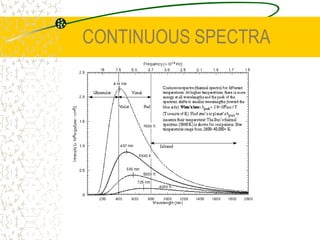
CONTINUOUS SPECTRAA hotter object will produce more energy at all wavelengths than does a cooler object. The hotter the object, the more energy is emitted at shorter wavelengths. The distribution of wavelengths depends on the temperature. This is why the colour of objects change as the object is heated.
CONTINUOUS SPECTRAA continuous spectrum is produced by the heating of solids and dense liquids.The atoms in the solids and dense liquids vibrate and give off various frequencies of E-M energy.They do not vibrate at the same rate and this leads to a wide range of emitted frequencies (continuous spectrum).
CONTINUOUS SPECTRA
CONTINUOUS SPECTRAThe inner core of a star could be considered a dense liquid and therefore the star will give off a continuous spectrum.Notice how the distribution still gives a continuous spectrum for all temperatures.
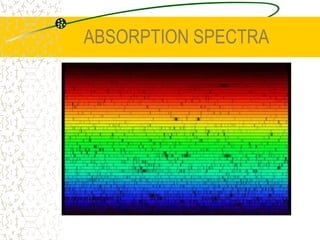
ABSORPTION SPECTRAAstronomers have found over 30 000 ‘Fraunhofer lines.'  in the spectra from the sun.These gaps occurred because the cooler outer layers of the sun’s atmosphere remove some of the frequencies. The frequencies absorbed are specific and depend not only on the atoms present, but also whether the atom has had electrons removed from it (ionised) or if it is neutral.
As the sun is at a very high temperature all series for absorption for hydrogen are observed because hydrogen exists in excited states at high temperatures.
ABSORPTION SPECTRA
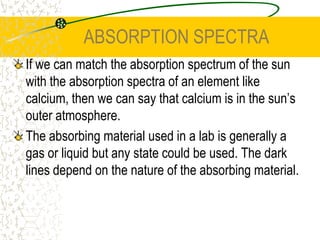
ABSORPTION SPECTRAIf we can match the absorption spectrum of the sun with the absorption spectra of an element like calcium, then we can say that calcium is in the sun’s outer atmosphere.The absorbing material used in a lab is generally a gas or liquid but any state could be used. The dark lines depend on the nature of the absorbing material.
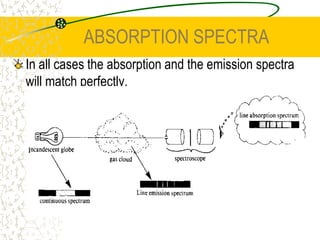
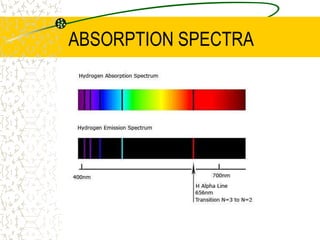
ABSORPTION SPECTRAIn all cases the absorption and the emission spectra will match perfectly.
ABSORPTION SPECTRA
Hydrogen – room temperatureThere are NO visible absorption lines for hydrogen at room temperatureAt room temperature hydrogen does not exist in the first excited state and therefore cannot transition from the 1st excited state to a higher one
FLUORESCENCEIf an electron is excited from one energy state, it may be able to make a jump of two or more energy levels. When it returns to a lower level, it may do so in more than one jump. The photons of light emitted will both have a lower energy, and hence frequency, than the photon that was absorbed.
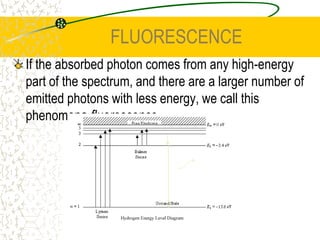
FLUORESCENCEIf the absorbed photon comes from any high-energy part of the spectrum, and there are a larger number of emitted photons with less energy, we call this phenomena fluorescence.
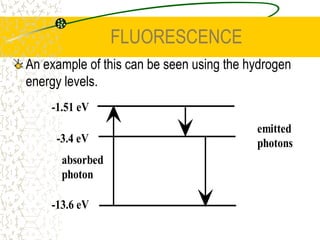
FLUORESCENCEAn example of this can be seen using the hydrogen energy levels.
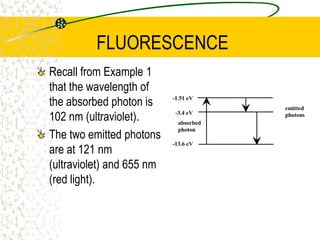
FLUORESCENCERecall from Example 1 that the wavelength of the absorbed photon is 102 nm (ultraviolet).The two emitted photons are at 121 nm (ultraviolet) and 655 nm (red light).
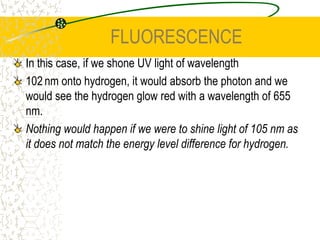
FLUORESCENCEIn this case, if we shone UV light of wavelength 102nm onto hydrogen, it would absorb the photon and we would see the hydrogen glow red with a wavelength of 655 nm.Nothing would happen if we were to shine light of 105 nm as it does not match the energy level difference for hydrogen.
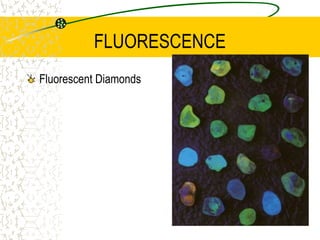
FLUORESCENCEFluorescent Diamonds
SPONTANEOUS or NOT?Spontaneous emission of photonsEnergy equal to energy diff between final and initial statesEmitted in random directionsEmitted with random phaseStimulated emission of photonsEnergy equal to energy diff between final and initial statesEmitted in same direction as stimulating photonEmitted with same phase as simulating photon
STIMULATED EMISSIONStimulated emission is the principle behind LASER technology.Normally, atoms that absorb energy and move to an excited state become unstable. The electron immediately (less than 10-8 s) drops back to the ground state. This may occur at any time and so two electrons that emit a photon of light do so at different times and so are not coherent.
STIMULATED EMISSIONIf a photon with exactly the same energy required for the electron to jump down to the ground state interacts with an atom that has an electron in an excited state, it can stimulate the emission of a photon from the excited electron.
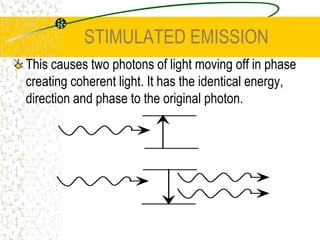
STIMULATED EMISSIONThis causes two photons of light moving off in phase creating coherent light. It has the identical energy, direction and phase to the original photon.
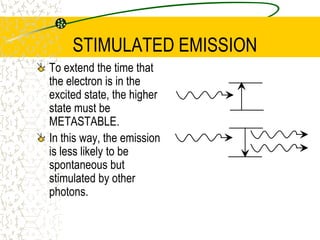
STIMULATED EMISSIONTo extend the time that the electron is in the excited state, the higher state must be METASTABLE. In this way, the emission is less likely to be spontaneous but stimulated by other photons.
APPLICATION-LASERSThe Pump (a way of exciting the electrons – high PD)electrons need to be elevated, or ‘pumped’ to an excited level. Absorbing light from a source like a flash used in cameras can do this.Typically the pump is an electrical discharge
APPLICATION-LASERSA helium neon laser uses an electrical discharge through a gas. Electrons are excited across a P.D. and collide with electrons in the gas causing them to become elevated to an excited level. This is more effective with helium than neon, which explains the presence of helium in the laser.
APPLICATION-LASERSLaser Medium – Gas Medium (substance made from atoms in metastable state – Neon gas)Imagine that a laser has two states, a ground and excited state. An electron can change state in three different ways.1. Absorption (move to an outer shell).2. Spontaneous emission (10-8 s).   3. Stimulated emission(Metastable).
APPLICATION-LASERSAs a laser amplifies light, the first two ways of changing state are not useful as no extra photons are created. Electrons are elevated to an excited state and held there in a metastable state. This causes a population inversion where there are more electrons in the stimulated state than in the ground state.
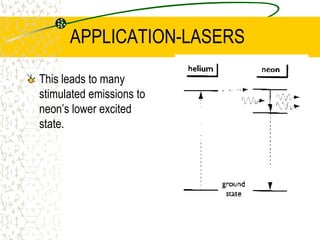
APPLICATION-LASERSIn the Helium Neon laser, Neon is the laser (gas) medium (hence the red colour characteristic of neon) but the helium makes the process easier and more efficient.Helium is stimulated to the excited state. The excited state of helium is very close to the upper excited state of neon (it has two excited states).
APPLICATION-LASERSIf an electron in the excited state of helium decays, it can easily transfer the energy to the neon atom by exciting an electron in neon to the upper excited state. We do not see the photon from helium as its energy is used to excite a neon atom. This particular state is metastable and so a population inversion occurs.
APPLICATION-LASERSThis leads to many stimulated emissions to neon’s lower excited state.
APPLICATION-LASERSAs this state is not metastable, many spontaneous emissions are made to the ground state, leaving space for more stimulated emissions. This means the process can continue indefinitely resulting in a continuous beam of photons corresponding to the energy difference between the two excited states of neon. The  of this beam is 6.328 x 10⁻⁷m.
APPLICATION-LASERSThe Cavity (space in the tube)To increase significantly the amplification of the light in a laser, it is made to cross the laser medium by reflecting it back and forth from mirrors. The mirrors are shaped so that they will focus the light and compensate for the spreading of the light due to diffraction. One of the mirrors partially transmits light so when the intensity is great enough, it can pass through from the cavity and be seen as a beam.
APPLICATION-LASERSProperties of Laser LightAs the beam is reflected back and forth between parallel mirrors, it diverges only marginally. The divergence is in the order of 1mm per 1m of travel. Laser light is said to be unidirectional.
APPLICATION-LASERSThe intensity can be varied to suit the use. In CD players, the intensity is very low. It can be very high when used to weld metals. Changing the partially reflecting mirror varies the intensity.
APPLICATION-LASERSThe wavelength of the light beam is determined by the energy levels of the atom being excited. As they are fixed, the light is monochromatic. There is, for reasons outside the course, a small range of wavelengths ( 10-15 m).
APPLICATION-LASERSThe light from laser is extremely coherent. As the photon emitted from each emission is identical in wavelength, phase and direction to the stimulating photon, all photons have the same properties.
APPLICATION-LASERSSafe Handling
As laser light can have very high intensities, it is important that the beam doesn’t come in contact with the body.
If using the laser in a room that is darkened, the pupil is dilated and so the beam can cause more damage.
Even if not shone directly into the eye, reflections from other surfaces (or particles in the air) may also cause damage.APPLICATION-LASERSSome lasers produce radiation in the ultraviolet and infrared parts of the spectrum. As this part of the spectrum is invisible to us, the laser may appear to have only a very low intensity beam. The radiation from the UV or infrared beam could also cause serious damage.
APPLICATION-LASERSAs most lasers use a gas discharge, large P.D.’s may be involved. If the case is tampered with, a person may receive a large electrical shock.
APPLICATION-LASERSUses of LasersLasers are used in manufacturing for welding metals under computer control. In the semiconductor industry, components such as resistors can be trimmed and integrated circuits can also be made.Laser light is used in fibre optics for communications. This could take any form from cable T.V. to undersea telephone links.In surveying, lasers are used to check the alignment of structures such as ceilings, walls, ribs or frames.
APPLICATION-LASERSIt can also measure distances. The first major use for this was to find the distance from the earth to the moon using a reflector placed on the moon by Apollo astronauts. Nowadays, the military has found a use for it to determine the distance to targets and for aiming weapons.Shops and libraries use lasers for barcode scanning. A beam is scanned across the barcode that has different width and spacing of bars to identify the product.
APPLICATION-LASERSSurgeryAs lasers can be focussed very well onto small points, it can be used as a scalpel and burn target tissue without damaging the surrounding tissue. Dermatologists use this to remove ‘portwine stains’ such as the one on Michael Gorbachev.
THE STRUCTURE OF THE NUCLEUSSECTION 4 TOPIC 2
NUCLEAR TERMS                          A specific nucleus can be exactly identified using the following notation: zXA or ZXA .X is the symbol of the element.Z the atomic number (number of protons).A the mass number (number of protons and neutrons). The term ‘nucleon’ refers to the protons or neutrons in the nucleus.
ISOTOPESRemember, if you change the number of protons, you change the element.If you change the number of neutrons, you have the same element but a different isotope.Isotopes can be shown to exist by the study of the element carbon. They have 6 electrons and 6 protons and so are electrically neutral. This accounts for its chemical properties. The number of neutrons can change without altering the chemical properties.
ISOTOPESTake care not to mix up the words ‘isotope’ and ‘ion’.An ion has an unequal number of protons and electrons. It is electrically charged. THIS CHANGES THE CHEMISTRY OF THE ATOM.An isotope has a unequal number of protons and neutrons. This DOES NOT CHANGE THE CHEMISTRY OF THE ATOM.
NUCLEONSProtons and neutrons are both found in the nucleus and hence called nucleons			N = A – ZNumber of neutrons, N can be found from the mass number, A and the proton number, ZTHE NUCLEAR FORCEMost atoms have more than one proton in the nucleus. This means that there will be a Coulombic repulsive force. Why does the nucleus remain stable and not fall apart?This is because there is an attractive force between nucleons called the nuclear force. There are a number characteristics that can be deduced.
THE NUCLEAR FORCEThe force must be very strong to overcome electrostatic repulsion. It is 1000 times stronger than the electric force and 1038 times stronger than gravitational attraction.	The force is independent of charge. This means the force is the same whether it acts between two protons, two neutrons or a proton and a neutron.
THE NUCLEAR FORCE	The force acts over a very short range. Within the nucleus, the force acts between a nucleon and its very nearest neighbours. The range of the force is only about 1 x 10-15 m or about the diameter of a proton. The electric force is different in that it acts between all charged pairs and over any distance.
	4 The force acts changes nature dependent upon distance. It is attractive at short distances but at extremely short distances it becomes repulsive in nature – to stop the nucleus imploding.THE NUCLEAR FORCE
MASS DEFECTThe simplest bound nuclear system is the nucleus of deuterium ( 1H2 ) that is often called heavy hydrogen. Accurate measurements of the mass of the nucleus have found it to be 3.34374 x 10⁻²⁷ kg.
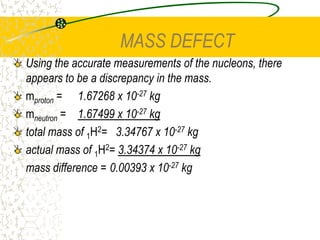
MASS DEFECTUsing the accurate measurements of the nucleons, there appears to be a discrepancy in the mass.mproton =	1.67268 x 10⁻²⁷ kgmneutron =	1.67499 x 10⁻²⁷ kgtotal mass of 1H2=   3.34767 x 10⁻²⁷ kgactual mass of 1H2= 3.34374 x 10⁻²⁷ kg	mass difference =	0.00393 x 10⁻²⁷ kg
MASS DEFECTThis loss appears to come from the process that fuses the proton and neutron together. It is 4 times as great as the mass of an electron and too great to be explained as experimental error.In every nucleus there is some missing mass. The correct name for this is ‘mass defect’ m and the calculation requires the rest mass of each particle.
MASS DEFECTThe mass defect for a nucleus (m) is defined as the difference between the rest mass of the atomic nucleus and the sum of the rest masses of its individual nucleons in an unbound state.
BINDING ENERGYThe law of the conservation of energy should be modified to become the law of conservation of mass-energy.If a nucleus loses mass, energy is released by the system.If a nucleus gains mass, energy is required for the nuclear reaction to occur.
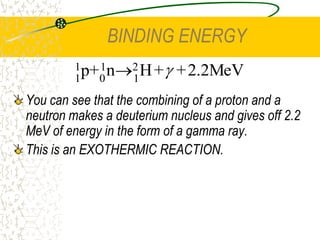
BINDING ENERGYYou can see that the combining of a proton and a neutron makes a deuterium nucleus and gives off 2.2 MeV of energy in the form of a gamma ray. This is an EXOTHERMIC REACTION.
BINDING ENERGYTo reverse the process, the energy from the mass defect must be added to the nucleus. This is usually in the form of a gamma ray or kinetic energy from a particle. This energy is called thebinding energy.This would be an ENDOTHERMIC REACTION.
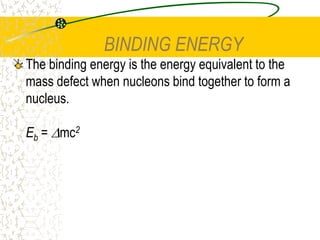
BINDING ENERGYThe binding energy is the energy equivalent to the mass defect when nucleons bind together to form a nucleus.Eb = mc2
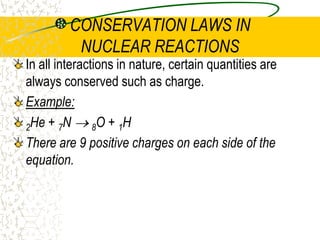
CONSERVATION LAWS IN NUCLEAR REACTIONSIn all interactions in nature, certain quantities are always conserved such as charge.Example:2He + 7N 8O + 1HThere are 9 positive charges on each side of the equation.
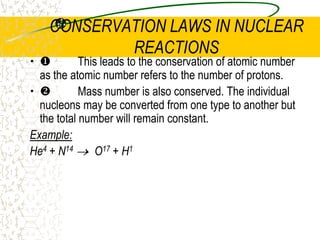
CONSERVATION LAWS IN NUCLEAR REACTIONSThis leads to the conservation of atomic number as the atomic number refers to the number of protons.	Mass number is also conserved. The individual nucleons may be converted from one type to another but the total number will remain constant.Example:He4 + N14  O17 + H1
CONSERVATION LAWS IN NUCLEAR REACTIONS	Linear and angular momentum are also conserved as they are isolated systems.	The total amount of mass and energy is conserved. It may be converted from one form to another, i.e. mass to energy by E = mc2.The mass of the elements in a nuclear reaction is always greater than the products. This has already been covered earlier.
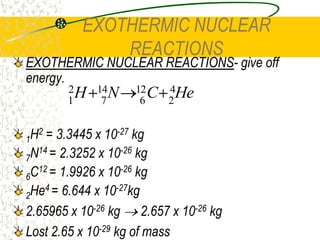
EXOTHERMIC NUCLEAR REACTIONSEXOTHERMIC NUCLEAR REACTIONS- give off energy.1H2 = 3.3445 x 10⁻²⁷ kg7N14 = 2.3252 x 10⁻²⁶ kg6C12 = 1.9926 x 10⁻²⁶ kg2He4 = 6.644 x 10⁻²⁷kg2.65965 x 10-26 kg  2.657 x 10⁻²⁶ kgLost 2.65 x 10⁻²⁹ kg of mass
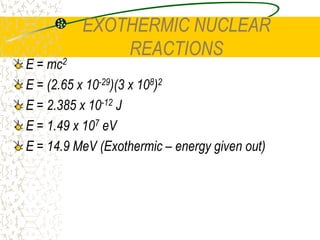
EXOTHERMIC NUCLEAR REACTIONSE = mc2E = (2.65 x 10⁻²⁹)(3 x 10⁸)2E = 2.385 x 10⁻¹² JE = 1.49 x 10⁷ eVE = 14.9 MeV (Exothermic – energy given out)
Conservation of MomentumIn all interactions, the total momentum before the interaction is equal to the total momentum after the interaction. This is also true for nuclear interactions.
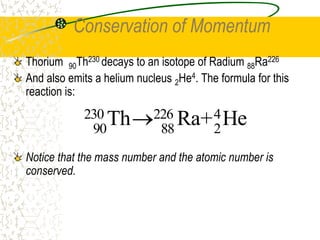
Conservation of MomentumThorium  90Th230 decays to an isotope of Radium 88Ra226And also emits a helium nucleus 2He4. The formula for this reaction is:Notice that the mass number and the atomic number is conserved.
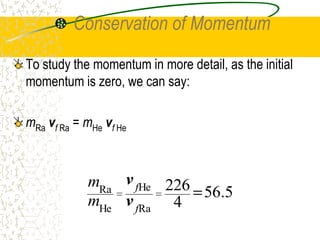
Conservation of MomentumTo study the momentum in more detail, as the initial momentum is zero, we can say:mRavf Ra = mHevf He
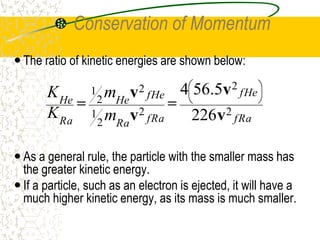
Conservation of MomentumThe ratio of kinetic energies are shown below:
As a general rule, the particle with the smaller mass has the greater kinetic energy.
If a particle, such as an electron is ejected, it will have a much higher kinetic energy, as its mass is much smaller.APP - PRODUCTION OF MEDICAL RADIOISOTOPESAn atom can be changed from one type to another by the absorption or emission of a photon. A nucleus can also be changed from one type to another by the absorption or emission of a proton or neutron.
APP - PRODUCTION OF MEDICAL RADIOISOTOPESThe emission of protons or neutrons occurs naturally in radioactive material or in the bombardment of atmospheric gases by high-energy particles from space.Artificially, radioisotopes are produced in one of two ways:
APP - PRODUCTION OF MEDICAL RADIOISOTOPESNuclear ReactorNuclear Fission produces many radioisotopes in small quantities. Stable isotopes are introduced and bombarding them with the many neutrons that are a part of the nuclear reactions. The unstable nucleus can absorb the neutron and form a radioactive isotope of the same element or eject a proton and form a radioisotope of a different element.
APP - PRODUCTION OF MEDICAL RADIOISOTOPESCyclotronCharged particles such as protons or deuteronsare accelerated in the cyclotron and directed towards a stable nucleus. As protons are fired at stable nuclei, only isotopes of different elements are formed.
APP - PRODUCTION OF MEDICAL RADIOISOTOPESPhosphorus 32Used in the treatment of:
polycythemiavera
excess red blood cells, most common in white males over 50
chronic myelocytic leukaemia,
chronic lymphocytic leukaemia,
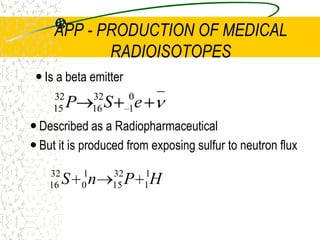
certain ovarian and prostate carcinomas,APP - PRODUCTION OF MEDICAL RADIOISOTOPESIs a beta emitter
Described as a Radiopharmaceutical
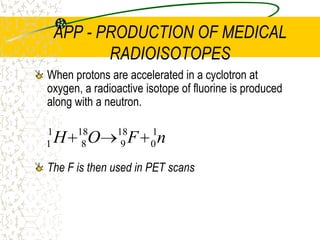
But it is produced from exposing sulfur to neutron fluxAPP - PRODUCTION OF MEDICAL RADIOISOTOPESWhen protons are accelerated in a cyclotron at oxygen, a radioactive isotope of fluorine is produced along with a neutron.The F is then used in PET scans
RADIOACTIVITYSECTION 4 TOPIC 3
RADIOACTIVITYIt has been determined that many isotopes of radioactive nuclei are unstable. They become more stable by emitting sub atomic particles or photons. Radioactive nuclei decay by the emission of alpha or beta particles or gamma radiation.
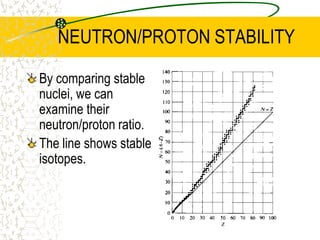
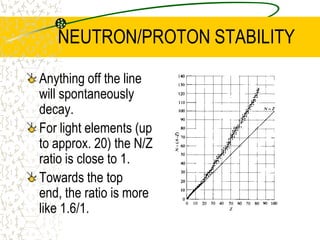
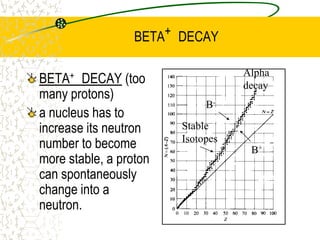
NEUTRON/PROTON STABILITYBy comparing stable nuclei, we can examine their neutron/proton ratio. The line shows stable isotopes.
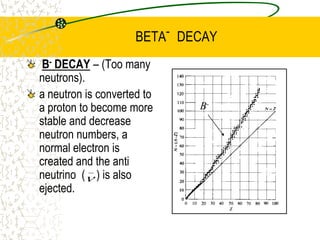
NEUTRON/PROTON STABILITYAnything off the line will spontaneously decay. For light elements (up to approx. 20) the N/Z ratio is close to 1.Towards the top end, the ratio is more like 1.6/1.
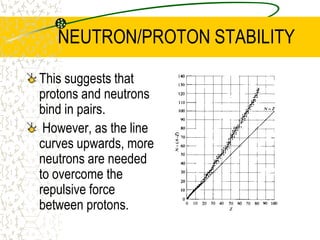
NEUTRON/PROTON STABILITYThis suggests that protons and neutrons bind in pairs. However, as the line curves upwards, more neutrons are needed to overcome the repulsive force between protons.
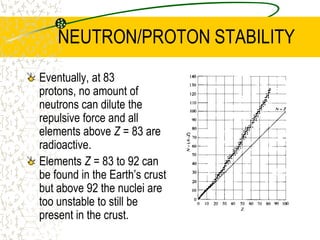
NEUTRON/PROTON STABILITYEventually, at 83 protons, no amount of neutrons can dilute the repulsive force and all elements above Z = 83 are radioactive. Elements Z = 83 to 92 can be found in the Earth’s crust but above 92 the nuclei are too unstable to still be present in the crust.
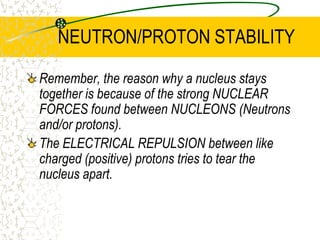
NEUTRON/PROTON STABILITYRemember, the reason why a nucleus stays together is because of the strong NUCLEAR FORCES found between NUCLEONS (Neutrons and/or protons).The ELECTRICAL REPULSION between like charged (positive) protons tries to tear the nucleus apart.
NEUTRON/PROTON STABILITYAt low atomic numbers (under 20), the attractive nuclear forces overcome the repulsive electrical forces within the nucleus.The protons and neutrons exist in a 1 to 1 ratio.
NEUTRON/PROTON STABILITYAt higher atomic numbers (between 20 and 84), the nucleus gets larger.The repulsive electrical forces act between all protonsThe attractive nuclear forces are only found between adjacent nucleons.The nucleus needs more neutrons to create a stronger nuclear force without adding to the repulsive electrical force.
THE FOUR TYPES OF RADIOACTIVE DECAYThere are four types of radioactive decay included in the syllabus.They are:alpha,beta minusbeta plusgamma decay.
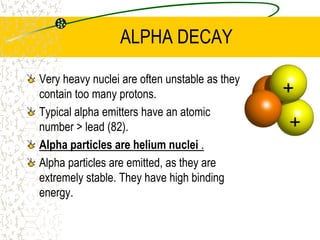
ALPHA DECAYVery heavy nuclei are often unstable as they contain too many protons. Typical alpha emitters have an atomic number > lead (82).Alpha particles are helium nuclei .Alpha particles are emitted, as they are extremely stable. They have high binding energy.
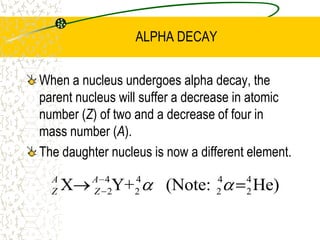
ALPHA DECAYWhen a nucleus undergoes alpha decay, the parent nucleus will suffer a decrease in atomic number (Z) of two and a decrease of four in mass number (A). The daughter nucleus is now a different element.
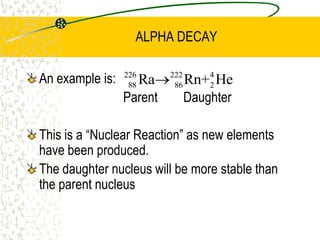
ALPHA DECAYAn example is:				Parent        DaughterThis is a “Nuclear Reaction” as new elements have been produced.The daughter nucleus will be more stable than the parent nucleus
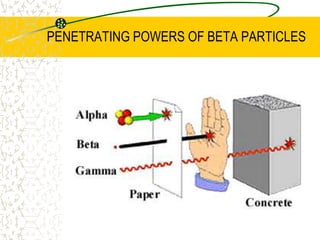
ALPHA DECAYAlpha particles have a relatively high mass and so are ejected with a moderate speed, typically about  2 x 10⁷ ms-1. Because their charge is high (2+) and speed low, they interact with matter easily, thus they are able to penetrate air only by a few centimetres.
ALPHA DECAYA thin piece of cardboard is enough to stop a beam of alpha particles.As alpha particles have large amounts of kinetic energy, they damage human flesh by destroying parts of cells on impact.Alpha particles are emitted with quantised energy, which suggests that the nucleus may have a discrete energy level structure.
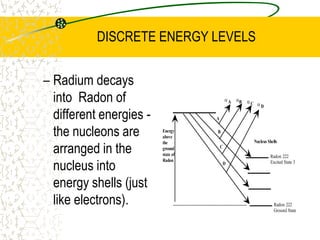
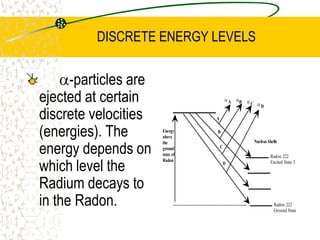
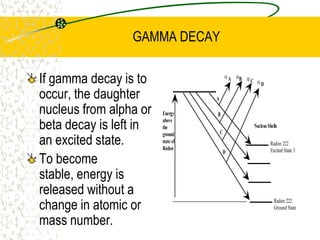
DISCRETE ENERGY LEVELSRadium decays into  Radon of different energies -the nucleons are arranged in the nucleus into energy shells (just like electrons).
DISCRETE ENERGY LEVELS	-particles are ejected at certain discrete velocities (energies). The energy depends on which level the Radium decays to in the Radon.
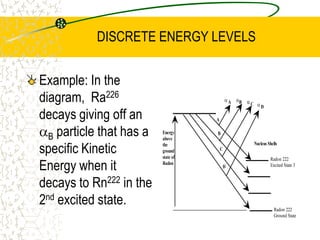
DISCRETE ENERGY LEVELSExample: In the diagram,  Ra226  decays giving off an B particle that has a specific Kinetic Energy when it decays to Rn222 in the 2nd excited state.
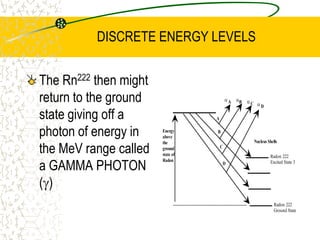
DISCRETE ENERGY LEVELSThe Rn222 then might return to the ground state giving off a photon of energy in the MeV range called a GAMMA PHOTON ()
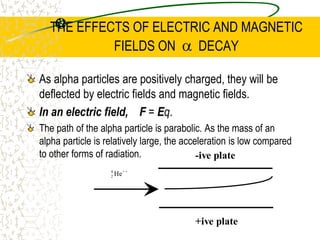
THE EFFECTS OF ELECTRIC AND MAGNETIC FIELDS ON    DECAYAs alpha particles are positively charged, they will be deflected by electric fields and magnetic fields. In an electric field,    F = Eq.The path of the alpha particle is parabolic. As the mass of an alpha particle is relatively large, the acceleration is low compared to other forms of radiation.
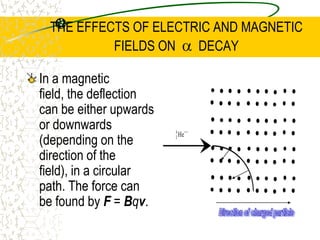
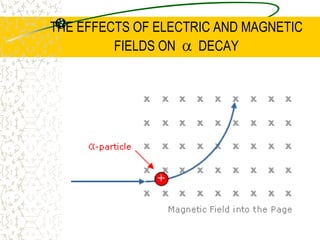
THE EFFECTS OF ELECTRIC AND MAGNETIC FIELDS ON    DECAYIn a magnetic field, the deflection can be either upwards or downwards (depending on the direction of the field), in a circular path. The force can be found by F = Bqv.Direction of charged particle
THE EFFECTS OF ELECTRIC AND MAGNETIC FIELDS ON    DECAY
BETA DECAYNuclei that have an imbalance of protons or neutrons can be unstable and also undergo radioactive decay. The process involves the change of a proton into a neutron or more commonly a neutron into a proton with the ejection of an electron from the nucleus.This decay is called beta decay, and the electron is referred to as a beta particle.
BETA+ DECAYBETA+   DECAY (too many protons)a nucleus has to increase its neutron number to become more stable, a proton can spontaneously change into a neutron.Alpha decayB-Stable IsotopesB+
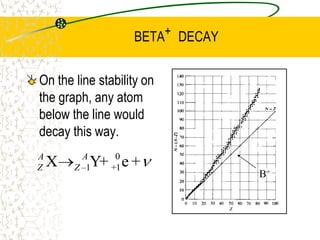
BETA+ DECAYOn the line stability on the graph, any atom below the line would decay this way.B+
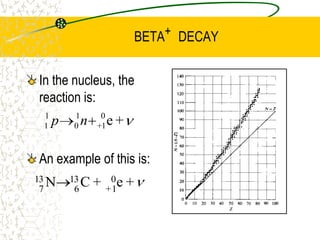
BETA+ DECAYIn the nucleus, the reaction is:An example of this is:
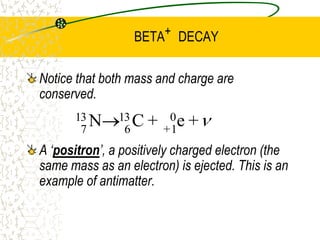
BETA+ DECAYNotice that both mass and charge are conserved.A ‘positron’, a positively charged electron (the same mass as an electron) is ejected. This is an example of antimatter.
BETA+ DECAYA Neutrino  (v) is also released. Note a new element is formed. There are no natural positron emitters since positron half-lives are very small.Note- as the 13N might decay into a metastable form of 13C, the 13C could then drop down to a more stable state, giving off a GAMMA RAY.
BETA- DECAYB- DECAY – (Too many neutrons).a neutron is converted to a proton to become more stable and decrease neutron numbers, a normal electron is created and the anti neutrino  (    ) is also ejected.B-
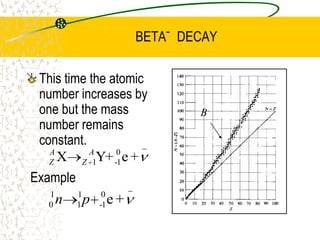
BETA- DECAYThis time the atomic number increases by one but the mass number remains constant. ExampleB-
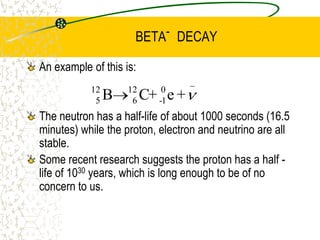
BETA- DECAYAn example of this is:The neutron has a half-life of about 1000 seconds (16.5 minutes) while the proton, electron and neutrino are all stable. Some recent research suggests the proton has a half -life of 1030 years, which is long enough to be of no concern to us.
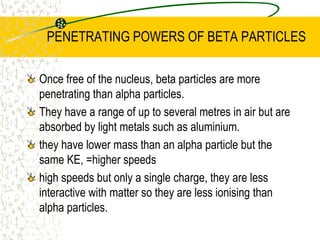
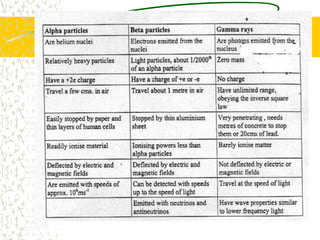
PENETRATING POWERS OF BETA PARTICLESOnce free of the nucleus, beta particles are more penetrating than alpha particles. They have a range of up to several metres in air but are absorbed by light metals such as aluminium.they have lower mass than an alpha particle but the same KE, =higher speeds high speeds but only a single charge, they are less interactive with matter so they are less ionising than alpha particles.
PENETRATING POWERS OF BETA PARTICLES
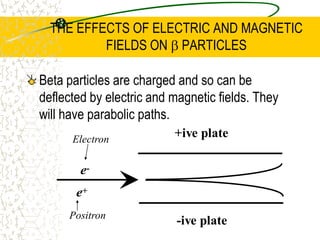
THE EFFECTS OF ELECTRIC AND MAGNETIC FIELDS ON  PARTICLESBeta particles are charged and so can be deflected by electric and magnetic fields. They will have parabolic paths. ElectronPositron
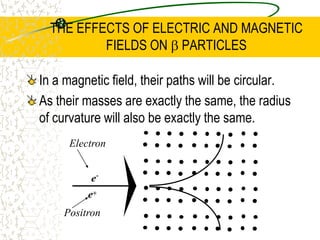
THE EFFECTS OF ELECTRIC AND MAGNETIC FIELDS ON  PARTICLESIn a magnetic field, their paths will be circular. As their masses are exactly the same, the radius of curvature will also be exactly the same.ElectronPositron
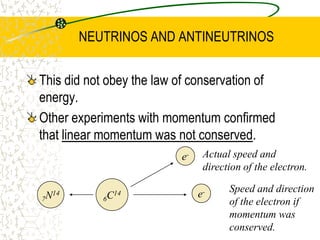
NEUTRINOS AND ANTINEUTRINOSBeta particles are emitted with a range of energies up to a maximum of a few MeV.It seemed strange that the electrons with the maximum kinetic energy carried away all the available energy, yet those with less than he maximum kinetic energy appeared to have energy missing.
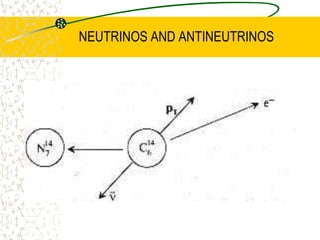
NEUTRINOS AND ANTINEUTRINOSThis did not obey the law of conservation of energy. Other experiments with momentum confirmed that linear momentum was not conserved.Actual speed and direction of the electron.e-6C14Speed and directionof the electron if momentum was conserved.7N14e-
NEUTRINOS AND ANTINEUTRINOS
NEUTRINOS AND ANTINEUTRINOSUsing the conservation laws, Fermi postulated the properties for the neutrino.Neutrinos are uncharged. This is because charge is already conserved. A neutron decays into a proton and an electron.Neutrinos have zero rest mass but carry energy and momentum. The conservation laws would not hold otherwise.
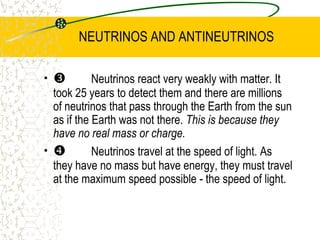
NEUTRINOS AND ANTINEUTRINOSNeutrinos react very weakly with matter. It took 25 years to detect them and there are millions of neutrinos that pass through the Earth from the sun as if the Earth was not there. This is because they have no real mass or charge.Neutrinos travel at the speed of light. As they have no mass but have energy, they must travel at the maximum speed possible - the speed of light.
GAMMA DECAYIf gamma decay is to occur, the daughter nucleus from alpha or beta decay is left in an excited state. To become stable, energy is released without a change in atomic or mass number.
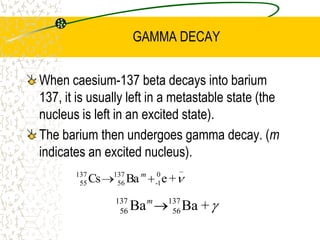
GAMMA DECAYWhen caesium-137 beta decays into barium 137, it is usually left in a metastable state (the nucleus is left in an excited state). The barium then undergoes gamma decay. (m indicates an excited nucleus).
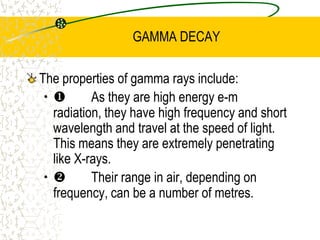
GAMMA DECAYThe properties of gamma rays include:	As they are high energy e-m radiation, they have high frequency and short wavelength and travel at the speed of light. This means they are extremely penetrating like X-rays.	Their range in air, depending on frequency, can be a number of metres.
GAMMA DECAY	They can penetrate several centimetres of lead or concrete before being absorbed. 4 cm of lead reduces the intensity of a gamma ray beam by 10%.	They carry no charge and are undeflected by electric and magnetic fields and are therefore only weakly ionising. They cannot attract electrons but can knock them out similar to the photoelectric effect.
HALF-LIFE AND ACTIVITYRadioactive decay is a completely random process. No one can predict when a particular nucleus will decay into its daughter. Statistics however, allow us to predict the behaviour of large samples of radioactive isotopes.
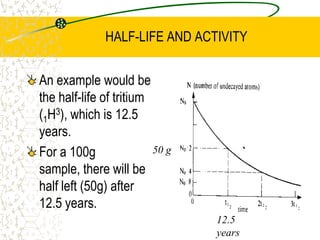
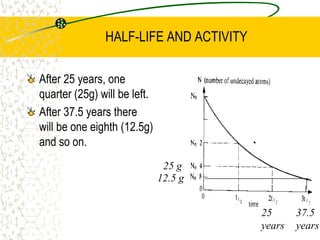
HALF-LIFE AND ACTIVITYWe can define a constant for the decay of a particular isotope, which is called the half-life.This is defined as the time it takes for the activity of the isotope to fall to half of its previous value. From a nuclear point of view, the half-life of a radioisotope is the time it takes half of the atoms of that isotope in a given sample to decay.The unit for activity, Becquerel (Bq), is the number of decays per second.
HALF-LIFE AND ACTIVITYAn example would be the half-life of tritium (1H3), which is 12.5 years. For a 100g sample, there will be half left (50g) after 12.5 years.50 g12.5 years
HALF-LIFE AND ACTIVITYAfter 25 years, one quarter (25g) will be left.After 37.5 years there will be one eighth (12.5g) and so on.25 g12.5 g25years37.5years
EFFECT OF IONISING RADIATION ON LIVING MATTERBesides alpha, beta and gamma radiation, there are other types of radiation that causes ionisation. This includes X-rays, neutrons and protons. Different types of radiation ionise atoms in different ways, however, the result on living tissue can be devastating.
EFFECT OF IONISING RADIATION ON LIVING MATTERParticles such as alpha, beta particles and protons are all charged themselves. As they pass through tissue, they can remove electrons using the coulombic force. As the energies required to remove electrons is in the order of 10 eV and alpha particles have energies of 10MeV, one alpha particle has the ability to ionise many atoms.
EFFECT OF IONISING RADIATION ON LIVING MATTERNeutral particles such as neutrons can only ionise atoms by direct collision with an atom. It can collide with a nucleus and fuse with it. This can make the nucleus unstable and then decay into new nuclei with large amounts of energy. They can then collide with other atoms and ionise them.
EFFECT OF IONISING RADIATION ON LIVING MATTERHigh-energy photons such as X-rays and gamma rays can remove electrons in photoelectric interactions. Gamma rays can be absorbed by the nucleus causing charged particles to be emitted with high energies causing further ionisation.
IONISING RADIATION DAMAGE TO LIVING MATTERRemoving electrons from atoms can…		- Cause molecules in living tissue to break 		  down.		- DNA can be affected, this can lead to      	  	  defective cells.		- Genetic defects.
IONISING RADIATION DAMAGE TO NON-LIVING MATTERIonising radiation can affect non-living material.Plastics and paints often fade from high energy particles ionising the atoms within them.Ionising radiation can be particularly devastating to materials used in space as there is no protection from our atmosphere.
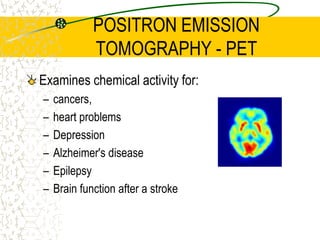
POSITRON EMISSION TOMOGRAPHY - PETExamines chemical activity for:cancers,heart problemsDepressionAlzheimer's diseaseEpilepsyBrain function after a stroke
POSITRON EMISSION TOMOGRAPHY - PETInvolves a radiopharmaceutical injected into the bloodstreamRadiopharmaceuticals become concentrated in body tissueDifferent tissues take up different radiopharmaceuticalsDifferent radiopharmaceuticals are required.
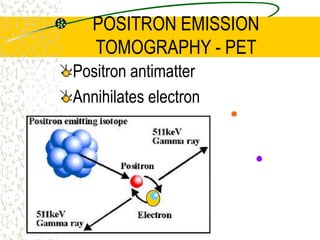
POSITRON EMISSION TOMOGRAPHY - PETRadiopharmaceuticals absorbed by areas of interest e.g. tumoursThey then decay emitting a positronCollides with electronAnnihilates producing gamma photonsDetected by sensorsLocation then determined.
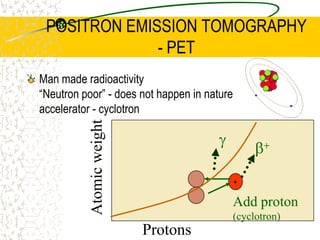
POSITRON EMISSION TOMOGRAPHY - PETMan made radioactivity“Neutron poor” - does not happen in natureaccelerator - cyclotron+Add proton(cyclotron)Atomic weightProtons
POSITRON EMISSION TOMOGRAPHY - PETRadiopharmaceuticals are produced by:Firing protons or deuterons into nucleusUse cyclotronsOr other particle acceleratorsProduces radioactive isotopes which decays by:+Positron
POSITRON EMISSION TOMOGRAPHY - PETPositron antimatterAnnihilates electron
POSITRON EMISSION TOMOGRAPHY - PETRadioactive 18F is used so that the glucose produces gamma rays for detection.18F concentrates in high glucose using cells e.g.HeartBrainKidneyCancer cellsInflammatory conditionsReflects very well the distribution of glucose uptake
POSITRON EMISSION TOMOGRAPHY - PETAnother radioisotope which is used is:Oxygen 1515OUsed to measure:Brain blood flowBlood volumeOxygen extraction
POSITRON EMISSION TOMOGRAPHY - PETUses 15O labelled gaseous tracersCO2, CO, O2Administered by inhalationAlso used for organ blood flowUses 15O labelled water or butanol15O produced by particle acceleratorsCyclotron
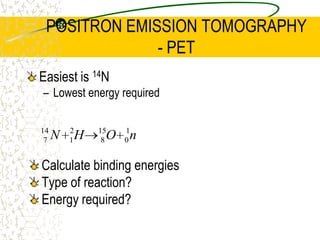
POSITRON EMISSION TOMOGRAPHY - PETEasiest is 14NLowest energy requiredCalculate binding energiesType of reaction?Energy required?
POSITRON EMISSION TOMOGRAPHY - PETAs radiopharmaceuticals have short half livesCyclotron must be located close to PET hospitalsTime is important, not distance.
NUCLEAR FISSION AND FUSIONSECTION 4 TOPIC 4
NUCLEAR FISSIONinduced fission occurs when the nucleus is ‘prodded’. Spontaneous fission occurs in some extremely unstable nuclei. The half-life for 92U238 if decaying by spontaneous fission, would be 1016 years.Spontaneous Fission
NUCLEAR FISSIONSpontaneous Fission can be seen when Uranium naturally decays in the mineral mica (found in granite).Scar marks can be seen in the granite from the energy released (kinetic energy in the fragments and the gamma ray released).
NUCLEAR FISSIONInduced Fission can occurwhen a slow moving neutron (0.03eV = 20000 ms-1) strikes the 92U235It is absorbed momentarily resulting in 92U236This is extremely unstable and decays into two approximately equal fragments in about 5 x 10⁻⁸ sec.
NUCLEAR FISSIONA slow thermal neutron is needed so that it may be captured by the nucleus. The neutron gets close enough to the nucleus for the nuclear force to act and pull it in. If it travelled too fast, it would collide with the Uranium nucleus, causing the ejection of an alpha particle.
NUCLEAR FISSIONThe reason that the neutron is pulled in is because it has no electrical charge, the nuclear force can therefore pull it into the Uranium nucleus.A proton cannot be pulled in because of its positive electrical charge. It would be repelled by the nucleus.
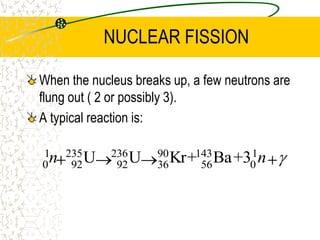
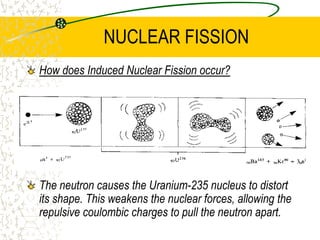
NUCLEAR FISSIONWhen the nucleus breaks up, a few neutrons are flung out ( 2 or possibly 3). A typical reaction is:
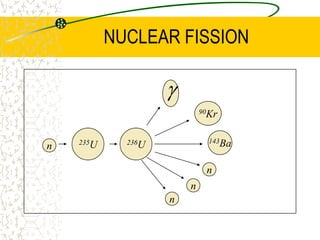
NUCLEAR FISSION90Kr235U236U143Bannnn
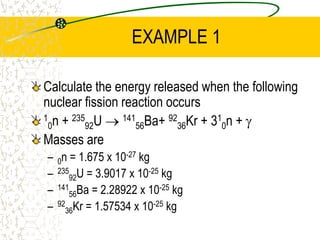
EXAMPLE 1Calculate the energy released when the following nuclear fission reaction occurs10n + 23592U  14156Ba+ 9236Kr + 310n + Masses are0n = 1.675 x 10⁻²⁷ kg23592U = 3.9017 x 10⁻²⁵ kg14156Ba = 2.28922 x 10⁻²⁵ kg9236Kr = 1.57534 x 10⁻²⁵ kg
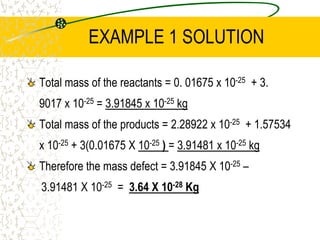
EXAMPLE 1 SOLUTIONTotal mass of the reactants = 0. 01675 x 10-25  + 3. 9017 x 10-25 = 3.91845 x 10⁻²⁵kg Total mass of the products = 2.28922 x 10⁻²⁵  + 1.57534 x 10⁻²⁵ + 3(0.01675 X 10⁻²⁵ ) = 3.91481 x 10⁻²⁵kgTherefore the mass defect = 3.91845 X 10⁻²⁵ –     3.91481 X 10-25  =  3.64 X 10⁻²⁸ Kg
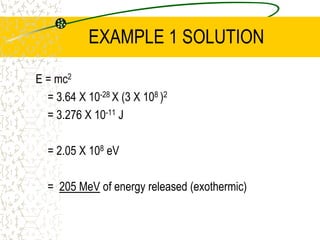
EXAMPLE 1 SOLUTION   E = mc2	   = 3.64 X 10-28 X (3 X 108 )2	   = 3.276 X 10⁻¹¹ J	   = 2.05 X 10⁸ eV	   =  205 MeV of energy released (exothermic)
NUCLEAR FISSIONHow does Induced Nuclear Fission occur?The neutron causes the Uranium-235 nucleus to distort its shape. This weakens the nuclear forces, allowing the repulsive coulombic charges to pull the neutron apart.
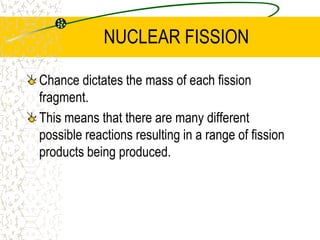
NUCLEAR FISSIONChance dictates the mass of each fission fragment. This means that there are many different possible reactions resulting in a range of fission products being produced.
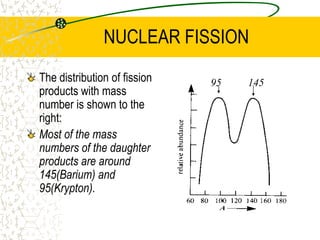
NUCLEAR FISSIONThe distribution of fission products with mass number is shown to the right:Most of the mass numbers of the daughter products are around 145(Barium) and 95(Krypton).95145
NUCLEAR FISSIONWhen the nucleus splits, the Coulombic repulsion forces between the protons are great but are not only reduced by the emission of nucleons, but also minimised, and so much more energy is released. Calculations indicate a loss of energy of as much as 200 MeV compared with 10 MeV for alpha decay.
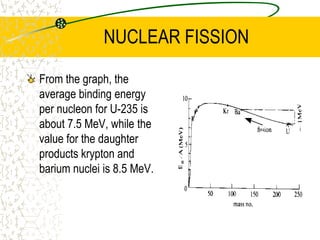
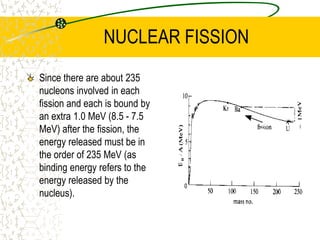
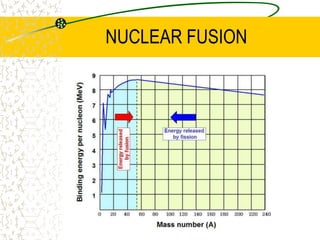
NUCLEAR FISSIONFrom the graph, the average binding energy per nucleon for U-235 is about 7.5 MeV, while the value for the daughter products krypton and barium nuclei is 8.5 MeV.
NUCLEAR FISSIONSince there are about 235 nucleons involved in each fission and each is bound by an extra 1.0 MeV (8.5 - 7.5 MeV) after the fission, the energy released must be in the order of 235 MeV (as binding energy refers to the energy released by the nucleus).
NUCLEAR FISSIONThe energy released is some million times greater than the energy released from an equivalent mass of coal or petrol. The burning of coal or petrol is a chemical process involving much less binding energy and so the smaller amount of energy is to be expected.Nuclear Fission gives off gamma rays while chemical reactions give off visible light.
NUCLEAR FISSIONDANGERS OF DAUGHTER PRODUCTSAfter fission occurs, the daughters are radioactive and usually  emitters. Looking at the proton/neutron ratio for the uranium nucleus, N/Z = 1.55. As no protons or neutrons are destroyed, the ratio for the barium and krypton nucleus is the same.
NUCLEAR FISSIONStable nuclei for middle order mass elements have a ratio of 1.3. This means there are too many neutrons present in the daughter nuclei which makes them radioactive.The daughter product undergoes Beta minus decay.
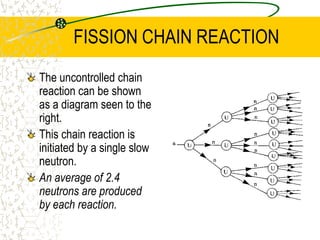
FISSION CHAIN REACTIONThe uncontrolled chain reaction can be shown as a diagram seen to the right.This chain reaction is initiated by a single slow neutron.An average of 2.4 neutrons are produced by each reaction.
FISSION CHAIN REACTIONThe key is to have at least one neutron go on to make another successful fission reaction.This can provide a continuous supply of energy.MAJOR PROBLEM:  A chain reaction cannot occur if the neutrons are moving too fast. They must be slowed down.
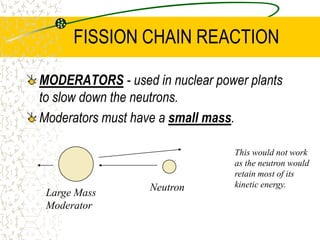
FISSION CHAIN REACTIONMODERATORS - used in nuclear power plants to slow down the neutrons.  Moderators must have a small mass.This would not workas the neutron wouldretain most of its kinetic energy.NeutronLarge MassModerator
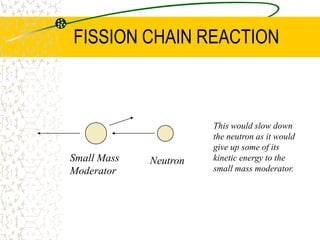
FISSION CHAIN REACTIONThis would slow downthe neutron as it wouldgive up some of itskinetic energy to thesmall mass moderator.Small MassModeratorNeutron
FISSION CHAIN REACTIONA good example of a moderator is the Deuterium ( 2H ) nucleus.It is called “heavy hydrogen”.It has a similar mass to neutrons.We cannot use normal Hydrogen ( 1H ) as it would simply absorb the neutron.
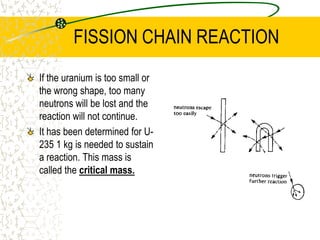
FISSION CHAIN REACTIONIf the uranium is too small or the wrong shape, too many neutrons will be lost and the reaction will not continue.It has been determined for U-235 1 kg is needed to sustain a reaction. This mass is called the critical mass.
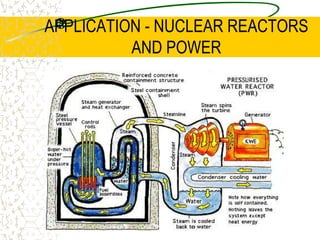
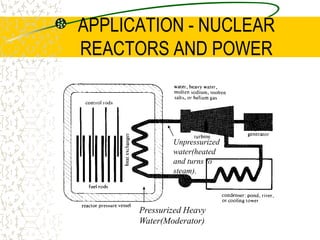
APPLICATION - NUCLEAR REACTORS AND POWERThe core is the region containing the uranium fuel where the fission chain reaction occurs. This core is enclosed by a thick steel ‘pressure vessel’.The fuel rods are long thin metal tubes filled with pellets of uranium oxide containing a certain percentage of uranium 235. Also in the tubes is helium gas to help with the heat transfer with the ends sealed with leak-tight caps. Hundreds of fuel rods are clustered together to form a fuel element.
APPLICATION - NUCLEAR REACTORS AND POWERThe moderator in a pressurised water reactor is ordinary water under about 150 atmospheres of pressure. The temperature of the water can be increased to about 325oC without boiling. The job of the moderator (water) is to slow the neutrons down to an energy of about 1 eV so the uranium can capture them.
APPLICATION - NUCLEAR REACTORS AND POWERWater is also plentiful and can be used to transport the heat produced in the reactor. The water is also the primary coolant removing heat from the core to the heat exchanger. Other types of reactors may have a different coolant to the moderator.
APPLICATION - NUCLEAR REACTORS AND POWERThe reaction must be slowed down so it can be controlled. Using thin cadmium or boron rods, which absorb the neutrons that are produced by each fission, does this. These control rods are positioned so that they can be inserted to slow or stop the reaction or withdrawn to increase the speed.
APPLICATION - NUCLEAR REACTORS AND POWERThe energy created is in the form of heat and is carried away by pipes of unpressurised water. This water is known as a secondary coolant. The pressurised water is cooled to about 293oC and returned to the core to be heated again. It then turns water into steam in a heat exchanger to drive a turbine connected to an electric generator.
APPLICATION - NUCLEAR REACTORS AND POWERSafety rods are also placed into the reactor so that the reactor can be shut down if necessary in a matter of seconds. They are triggered automatically if the coolant pressure falls because of a pipe failure for example.
APPLICATION - NUCLEAR REACTORS AND POWER
APPLICATION - NUCLEAR REACTORS AND POWERUnpressurizedwater(heated and turns to steam).Pressurized HeavyWater(Moderator)
APPLICATION - NUCLEAR REACTORS AND POWERAround the steel pressure vessel is a thick concrete shield. This means that there are two layers of shielding. The building itself is also another layer of shielding. It has an inner shell of steel and reinforced by concrete. The building is designed to withstand the pressure of the entire primary coolant, should it be released due to a fracture in a coolant pipe.
APPLICATION - NUCLEAR REACTORS AND POWERA major problem is that the only isotope of uranium that is fissile (undergoes fission) is 235. This only makes up 0.7% of the total uranium, the rest being uranium-238. This means that using uranium-238 is not an option, as a chain reaction cannot be sustained. As they are both chemically identical, they cannot be separated by conventional means.
APPLICATION - NUCLEAR REACTORS AND POWEREnrichment of uranium occurs so that the percentage of uranium-235 is increased to 2 or 3%. This allows the reaction to keep its ‘critical mass’ (the mass required to keep the chain reaction going).The method used to enrich the uranium relies on the different masses of the isotopes. This takes many stages and is very costly.
APPLICATION - NUCLEAR REACTORS AND POWERAdvantages and Disadvantages of Nuclear Fission PowerAdvantagesAfter initial start up costs, the power is relatively cheap in large-scale production. The energy extracted is much greater than for the same amount of fossil fuels.
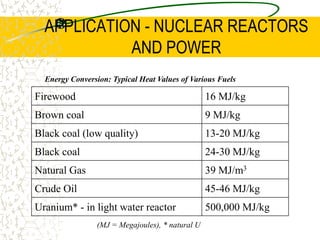
Energy Conversion: Typical Heat Values of Various Fuels(MJ = Megajoules), * natural UAPPLICATION - NUCLEAR REACTORS AND POWER
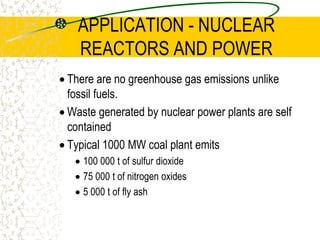
APPLICATION - NUCLEAR REACTORS AND POWER	There are no greenhouse gas emissions unlike fossil fuels.Waste generated by nuclear power plants are self contained
Typical 1000 MW coal plant emits
100 000 t of sulfur dioxide
75 000 t of nitrogen oxides
5 000 t of fly ashAPPLICATION - NUCLEAR REACTORS AND POWER	As they can reprocess fuel, most of the original uranium can be used. Breeder reactors can produce their own fuel and so the lifetime of this fuel source is much greater than fossil fuels.
APPLICATION - NUCLEAR REACTORS AND POWEROther uses:Using relatively small special-purpose nuclear reactors it has become possible to make a wide range of radioactive materials (radioisotopes) at low cost. For this reason the use of artificially produced radioisotopes has become widespread since the early 1950s, and there are now some 270 "research" reactors in 59 countries producing them.
APPLICATION - NUCLEAR REACTORS AND POWERRadioisotopes Medicine, radioisotopes are widely used for diagnosis and research.
 Preservation of food
 Growing of crops and breeding of livestock
 Industrially
 Smoke detectors.
 Other reactorsOver 200 small nuclear reactors power some 150 ships, mostly submarines, but ranging from icebreakers to aircraft carriers. APPLICATION - NUCLEAR REACTORS AND POWERDisadvantagesExpensive to establish power plantsStorage of waste products is difficult. The waste products have very long half-lives.

Section4revision

  • 1.
    SECTION 4 TOPIC1THE STRUCTURE OF THE ATOM
  • 2.
    LINE EMISSION SPECTRAExcitea gas and observe through a spectrometer, and the light is made up of specific frequencies and is referred to as spectral lines and the full spectrum seen is known as a line emission spectrum.Unlike solids and dense liquids, gases do not produce a continuous spectrum.
  • 3.
    LINE EMISSION SPECTRATheyare not vibrating back and forth at a variety of frequencies because they are not bonded together. Instead, they emit SPECIFIC frequencies of light as seen in the spectroscope.These are produced by electrons falling from higher energy levels to lower energy levels.A photon of a specific frequency is emitted in the process.
  • 4.
    LINE EMISSION SPECTRAAgood example of line emission spectra is the burning of sodium.The gaseous sodium’s electrons produce two distinct spectral lines in the yellow region of the E-M spectrum.Hydrogen gives off spectra that are in the very low frequency radio wave range.Radio telescopes are used to study where hydrogen is present in the universe.
  • 5.
  • 6.
    LINE EMISSION SPECTRALineemission spectra of each element is uniqueit is a characteristic of that elementIt means that the spectra can be used to identify unknown substances through comparison to standards
  • 7.
    What does thismean?The presence of discrete lines in the spectra and that they are unique for atoms led to Bohr assuming that the energy carried by an electron was quantized. From this assumption, he formed three postulates from which he developed a mathematical description.
  • 8.
    THE BOHR MODELOF THE ATOM1. Electrons in the atom can only have fixed amounts of energy. The electrons revolve around the nucleus only in certain allowed orbits called stationary states. When in a stationary state, the electron cannot radiate any of its energy.The electron is only found in the stationary state so the energy is quantized inside the atom.
  • 9.
    THE BOHR MODELOF THE ATOM
  • 10.
    THE BOHR MODELOF THE ATOM2. Electrons can jump from one stationary state to another by the absorption or emission of a photonThe energy of this photon will exactly equal the difference in energy of the two stationary states.Light energy is emitted or absorbed by atoms in fixed amounts called quanta. The quantum is equal to the difference in energy levels of the electrons. This accounts for the existence of line emission and line absorption spectra.
  • 11.
    THE BOHR MODELOF THE ATOMThe frequencies of the bright lines of the line emission and dark lines of the absorption spectrum of an element will be identical. Note how energy conservation is embodied in this postulate.Bohr’s Third Postulate is not part of the examination.
  • 12.
    THE BOHR MODELOF THE ATOMThis postulate laid the foundation for the mathematical treatment of the hydrogen atom.
  • 13.
    THE BOHR MODELOF THE ATOMThe number n is known as the principal quantum number and refers to the energy level under consideration. n = 1 is the lowest energy level or the ground state from the German grund meaning ‘fundamental’. n = 2 is the principal quantum number for the first excited state and so on. Although Bohr allows the value of n to reach infinity, in reality only the first few are used.
  • 14.
    THE BOHR MODELOF THE ATOMTransition- when an electron moves between energy levels. Up would absorb energy (absorption). An electron moving down would give off a photon of energy (emission).
  • 15.
    THE BOHR MODELOF THE ATOMLyman series terminate in ground state (UV)
  • 16.
    Balmer series terminaten=2 (visible/UV)
  • 17.
    The Paschen seriesemits the least energy(IR).
  • 18.
    Series limit –from infinity to n=?
  • 19.
    THE BOHR MODELOF THE ATOMAn electron can be moved to a higher energy level by…1. INCOMING PHOTON- Must be of exactly the same energy as E2 – E12. INCOMING ELECTRON- remaining energy stays with the incoming electron.3. HEAT- gives the electron vibrational energy.
  • 20.
    IONISATION ENERGYIONISATION- minimumenergy required to remove an electron from the atom in its most stable state.Example: the ionization energy required to remove an electron from its ground state (K=1) for Hydrogen is 13.6 eV.
  • 21.
    EXAMPLE 1Use thefirst three energy levels for the electron in hydrogen to determine the energy and hence wavelength of the lines in its line emission spectrum.
  • 22.
    EXAMPLE 1 SOLUTIONFromthe diagram, the atom can be excited to the first (n = 2) and second (n = 3) excited states. From these, it will return to the ground state emitting a photon. The electron can make the following transitions:
  • 23.
    EXAMPLE 1 SOLUTIONn= 3 n = 1, Ephoton = E3 - El
  • 24.
    = -1.51 -(-13.6)
  • 25.
  • 26.
    n = 2n = l, Ephoton = E2 - E1
  • 27.
    = -3.4 -(-13.6)
  • 28.
    = 10.2eVEXAMPLE 1SOLUTIONn = 3 n = 2, Ephoton = E3 - E2= -1.51 - (-3.4)= 1.89eV
  • 29.
    EXAMPLE 1 SOLUTIONTofind the wavelengths of the three photons, useNote: convert eV to J
  • 30.
    EXAMPLE 1 SOLUTION n=3n=l, =1.024 x 10 -7 m = 102 nm (ultraviolet)
  • 31.
    EXAMPLE 1 SOLUTIONn=2n=l,λ==1.21 x 10⁻⁷ m = 121nm (ultraviolet)n=3 n=2,λ= = 6.55 X 10⁻⁷m= 655 nm (visible-red)
  • 32.
    CONTINUOUS SPECTRAHeating anobject such as a filament in an incandescent globe produces this. When viewed through a spectroscope, all spectral colours are seen. An object’s spectrum can extend beyond the visible part of the spectrum.
  • 33.
    CONTINUOUS SPECTRAA hotterobject will produce more energy at all wavelengths than does a cooler object. The hotter the object, the more energy is emitted at shorter wavelengths. The distribution of wavelengths depends on the temperature. This is why the colour of objects change as the object is heated.
  • 34.
    CONTINUOUS SPECTRAA continuousspectrum is produced by the heating of solids and dense liquids.The atoms in the solids and dense liquids vibrate and give off various frequencies of E-M energy.They do not vibrate at the same rate and this leads to a wide range of emitted frequencies (continuous spectrum).
  • 35.
  • 36.
    CONTINUOUS SPECTRAThe innercore of a star could be considered a dense liquid and therefore the star will give off a continuous spectrum.Notice how the distribution still gives a continuous spectrum for all temperatures.
  • 37.
    ABSORPTION SPECTRAAstronomers havefound over 30 000 ‘Fraunhofer lines.' in the spectra from the sun.These gaps occurred because the cooler outer layers of the sun’s atmosphere remove some of the frequencies. The frequencies absorbed are specific and depend not only on the atoms present, but also whether the atom has had electrons removed from it (ionised) or if it is neutral.
  • 38.
    As the sunis at a very high temperature all series for absorption for hydrogen are observed because hydrogen exists in excited states at high temperatures.
  • 39.
  • 40.
    ABSORPTION SPECTRAIf wecan match the absorption spectrum of the sun with the absorption spectra of an element like calcium, then we can say that calcium is in the sun’s outer atmosphere.The absorbing material used in a lab is generally a gas or liquid but any state could be used. The dark lines depend on the nature of the absorbing material.
  • 41.
    ABSORPTION SPECTRAIn allcases the absorption and the emission spectra will match perfectly.
  • 42.
  • 43.
    Hydrogen – roomtemperatureThere are NO visible absorption lines for hydrogen at room temperatureAt room temperature hydrogen does not exist in the first excited state and therefore cannot transition from the 1st excited state to a higher one
  • 44.
    FLUORESCENCEIf an electronis excited from one energy state, it may be able to make a jump of two or more energy levels. When it returns to a lower level, it may do so in more than one jump. The photons of light emitted will both have a lower energy, and hence frequency, than the photon that was absorbed.
  • 45.
    FLUORESCENCEIf the absorbedphoton comes from any high-energy part of the spectrum, and there are a larger number of emitted photons with less energy, we call this phenomena fluorescence.
  • 46.
    FLUORESCENCEAn example ofthis can be seen using the hydrogen energy levels.
  • 47.
    FLUORESCENCERecall from Example1 that the wavelength of the absorbed photon is 102 nm (ultraviolet).The two emitted photons are at 121 nm (ultraviolet) and 655 nm (red light).
  • 48.
    FLUORESCENCEIn this case,if we shone UV light of wavelength 102nm onto hydrogen, it would absorb the photon and we would see the hydrogen glow red with a wavelength of 655 nm.Nothing would happen if we were to shine light of 105 nm as it does not match the energy level difference for hydrogen.
  • 49.
  • 50.
    SPONTANEOUS or NOT?Spontaneousemission of photonsEnergy equal to energy diff between final and initial statesEmitted in random directionsEmitted with random phaseStimulated emission of photonsEnergy equal to energy diff between final and initial statesEmitted in same direction as stimulating photonEmitted with same phase as simulating photon
  • 51.
    STIMULATED EMISSIONStimulated emissionis the principle behind LASER technology.Normally, atoms that absorb energy and move to an excited state become unstable. The electron immediately (less than 10-8 s) drops back to the ground state. This may occur at any time and so two electrons that emit a photon of light do so at different times and so are not coherent.
  • 52.
    STIMULATED EMISSIONIf aphoton with exactly the same energy required for the electron to jump down to the ground state interacts with an atom that has an electron in an excited state, it can stimulate the emission of a photon from the excited electron.
  • 53.
    STIMULATED EMISSIONThis causestwo photons of light moving off in phase creating coherent light. It has the identical energy, direction and phase to the original photon.
  • 54.
    STIMULATED EMISSIONTo extendthe time that the electron is in the excited state, the higher state must be METASTABLE. In this way, the emission is less likely to be spontaneous but stimulated by other photons.
  • 55.
    APPLICATION-LASERSThe Pump (away of exciting the electrons – high PD)electrons need to be elevated, or ‘pumped’ to an excited level. Absorbing light from a source like a flash used in cameras can do this.Typically the pump is an electrical discharge
  • 56.
    APPLICATION-LASERSA helium neonlaser uses an electrical discharge through a gas. Electrons are excited across a P.D. and collide with electrons in the gas causing them to become elevated to an excited level. This is more effective with helium than neon, which explains the presence of helium in the laser.
  • 57.
    APPLICATION-LASERSLaser Medium –Gas Medium (substance made from atoms in metastable state – Neon gas)Imagine that a laser has two states, a ground and excited state. An electron can change state in three different ways.1. Absorption (move to an outer shell).2. Spontaneous emission (10-8 s). 3. Stimulated emission(Metastable).
  • 58.
    APPLICATION-LASERSAs a laseramplifies light, the first two ways of changing state are not useful as no extra photons are created. Electrons are elevated to an excited state and held there in a metastable state. This causes a population inversion where there are more electrons in the stimulated state than in the ground state.
  • 59.
    APPLICATION-LASERSIn the HeliumNeon laser, Neon is the laser (gas) medium (hence the red colour characteristic of neon) but the helium makes the process easier and more efficient.Helium is stimulated to the excited state. The excited state of helium is very close to the upper excited state of neon (it has two excited states).
  • 60.
    APPLICATION-LASERSIf an electronin the excited state of helium decays, it can easily transfer the energy to the neon atom by exciting an electron in neon to the upper excited state. We do not see the photon from helium as its energy is used to excite a neon atom. This particular state is metastable and so a population inversion occurs.
  • 61.
    APPLICATION-LASERSThis leads tomany stimulated emissions to neon’s lower excited state.
  • 62.
    APPLICATION-LASERSAs this stateis not metastable, many spontaneous emissions are made to the ground state, leaving space for more stimulated emissions. This means the process can continue indefinitely resulting in a continuous beam of photons corresponding to the energy difference between the two excited states of neon. The  of this beam is 6.328 x 10⁻⁷m.
  • 63.
    APPLICATION-LASERSThe Cavity (spacein the tube)To increase significantly the amplification of the light in a laser, it is made to cross the laser medium by reflecting it back and forth from mirrors. The mirrors are shaped so that they will focus the light and compensate for the spreading of the light due to diffraction. One of the mirrors partially transmits light so when the intensity is great enough, it can pass through from the cavity and be seen as a beam.
  • 64.
    APPLICATION-LASERSProperties of LaserLightAs the beam is reflected back and forth between parallel mirrors, it diverges only marginally. The divergence is in the order of 1mm per 1m of travel. Laser light is said to be unidirectional.
  • 65.
    APPLICATION-LASERSThe intensity canbe varied to suit the use. In CD players, the intensity is very low. It can be very high when used to weld metals. Changing the partially reflecting mirror varies the intensity.
  • 66.
    APPLICATION-LASERSThe wavelength ofthe light beam is determined by the energy levels of the atom being excited. As they are fixed, the light is monochromatic. There is, for reasons outside the course, a small range of wavelengths ( 10-15 m).
  • 67.
    APPLICATION-LASERSThe light fromlaser is extremely coherent. As the photon emitted from each emission is identical in wavelength, phase and direction to the stimulating photon, all photons have the same properties.
  • 68.
  • 69.
    As laser lightcan have very high intensities, it is important that the beam doesn’t come in contact with the body.
  • 70.
    If using thelaser in a room that is darkened, the pupil is dilated and so the beam can cause more damage.
  • 71.
    Even if notshone directly into the eye, reflections from other surfaces (or particles in the air) may also cause damage.APPLICATION-LASERSSome lasers produce radiation in the ultraviolet and infrared parts of the spectrum. As this part of the spectrum is invisible to us, the laser may appear to have only a very low intensity beam. The radiation from the UV or infrared beam could also cause serious damage.
  • 72.
    APPLICATION-LASERSAs most lasersuse a gas discharge, large P.D.’s may be involved. If the case is tampered with, a person may receive a large electrical shock.
  • 73.
    APPLICATION-LASERSUses of LasersLasersare used in manufacturing for welding metals under computer control. In the semiconductor industry, components such as resistors can be trimmed and integrated circuits can also be made.Laser light is used in fibre optics for communications. This could take any form from cable T.V. to undersea telephone links.In surveying, lasers are used to check the alignment of structures such as ceilings, walls, ribs or frames.
  • 74.
    APPLICATION-LASERSIt can alsomeasure distances. The first major use for this was to find the distance from the earth to the moon using a reflector placed on the moon by Apollo astronauts. Nowadays, the military has found a use for it to determine the distance to targets and for aiming weapons.Shops and libraries use lasers for barcode scanning. A beam is scanned across the barcode that has different width and spacing of bars to identify the product.
  • 75.
    APPLICATION-LASERSSurgeryAs lasers canbe focussed very well onto small points, it can be used as a scalpel and burn target tissue without damaging the surrounding tissue. Dermatologists use this to remove ‘portwine stains’ such as the one on Michael Gorbachev.
  • 76.
    THE STRUCTURE OFTHE NUCLEUSSECTION 4 TOPIC 2
  • 77.
    NUCLEAR TERMS A specific nucleus can be exactly identified using the following notation: zXA or ZXA .X is the symbol of the element.Z the atomic number (number of protons).A the mass number (number of protons and neutrons). The term ‘nucleon’ refers to the protons or neutrons in the nucleus.
  • 78.
    ISOTOPESRemember, if youchange the number of protons, you change the element.If you change the number of neutrons, you have the same element but a different isotope.Isotopes can be shown to exist by the study of the element carbon. They have 6 electrons and 6 protons and so are electrically neutral. This accounts for its chemical properties. The number of neutrons can change without altering the chemical properties.
  • 79.
    ISOTOPESTake care notto mix up the words ‘isotope’ and ‘ion’.An ion has an unequal number of protons and electrons. It is electrically charged. THIS CHANGES THE CHEMISTRY OF THE ATOM.An isotope has a unequal number of protons and neutrons. This DOES NOT CHANGE THE CHEMISTRY OF THE ATOM.
  • 80.
    NUCLEONSProtons and neutronsare both found in the nucleus and hence called nucleons N = A – ZNumber of neutrons, N can be found from the mass number, A and the proton number, ZTHE NUCLEAR FORCEMost atoms have more than one proton in the nucleus. This means that there will be a Coulombic repulsive force. Why does the nucleus remain stable and not fall apart?This is because there is an attractive force between nucleons called the nuclear force. There are a number characteristics that can be deduced.
  • 81.
    THE NUCLEAR FORCETheforce must be very strong to overcome electrostatic repulsion. It is 1000 times stronger than the electric force and 1038 times stronger than gravitational attraction. The force is independent of charge. This means the force is the same whether it acts between two protons, two neutrons or a proton and a neutron.
  • 82.
    THE NUCLEAR FORCE Theforce acts over a very short range. Within the nucleus, the force acts between a nucleon and its very nearest neighbours. The range of the force is only about 1 x 10-15 m or about the diameter of a proton. The electric force is different in that it acts between all charged pairs and over any distance.
  • 83.
    4 The forceacts changes nature dependent upon distance. It is attractive at short distances but at extremely short distances it becomes repulsive in nature – to stop the nucleus imploding.THE NUCLEAR FORCE
  • 84.
    MASS DEFECTThe simplestbound nuclear system is the nucleus of deuterium ( 1H2 ) that is often called heavy hydrogen. Accurate measurements of the mass of the nucleus have found it to be 3.34374 x 10⁻²⁷ kg.
  • 85.
    MASS DEFECTUsing theaccurate measurements of the nucleons, there appears to be a discrepancy in the mass.mproton = 1.67268 x 10⁻²⁷ kgmneutron = 1.67499 x 10⁻²⁷ kgtotal mass of 1H2= 3.34767 x 10⁻²⁷ kgactual mass of 1H2= 3.34374 x 10⁻²⁷ kg mass difference = 0.00393 x 10⁻²⁷ kg
  • 86.
    MASS DEFECTThis lossappears to come from the process that fuses the proton and neutron together. It is 4 times as great as the mass of an electron and too great to be explained as experimental error.In every nucleus there is some missing mass. The correct name for this is ‘mass defect’ m and the calculation requires the rest mass of each particle.
  • 87.
    MASS DEFECTThe massdefect for a nucleus (m) is defined as the difference between the rest mass of the atomic nucleus and the sum of the rest masses of its individual nucleons in an unbound state.
  • 88.
    BINDING ENERGYThe lawof the conservation of energy should be modified to become the law of conservation of mass-energy.If a nucleus loses mass, energy is released by the system.If a nucleus gains mass, energy is required for the nuclear reaction to occur.
  • 89.
    BINDING ENERGYYou cansee that the combining of a proton and a neutron makes a deuterium nucleus and gives off 2.2 MeV of energy in the form of a gamma ray. This is an EXOTHERMIC REACTION.
  • 90.
    BINDING ENERGYTo reversethe process, the energy from the mass defect must be added to the nucleus. This is usually in the form of a gamma ray or kinetic energy from a particle. This energy is called thebinding energy.This would be an ENDOTHERMIC REACTION.
  • 91.
    BINDING ENERGYThe bindingenergy is the energy equivalent to the mass defect when nucleons bind together to form a nucleus.Eb = mc2
  • 92.
    CONSERVATION LAWS INNUCLEAR REACTIONSIn all interactions in nature, certain quantities are always conserved such as charge.Example:2He + 7N 8O + 1HThere are 9 positive charges on each side of the equation.
  • 93.
    CONSERVATION LAWS INNUCLEAR REACTIONSThis leads to the conservation of atomic number as the atomic number refers to the number of protons. Mass number is also conserved. The individual nucleons may be converted from one type to another but the total number will remain constant.Example:He4 + N14 O17 + H1
  • 94.
    CONSERVATION LAWS INNUCLEAR REACTIONS Linear and angular momentum are also conserved as they are isolated systems. The total amount of mass and energy is conserved. It may be converted from one form to another, i.e. mass to energy by E = mc2.The mass of the elements in a nuclear reaction is always greater than the products. This has already been covered earlier.
  • 95.
    EXOTHERMIC NUCLEAR REACTIONSEXOTHERMICNUCLEAR REACTIONS- give off energy.1H2 = 3.3445 x 10⁻²⁷ kg7N14 = 2.3252 x 10⁻²⁶ kg6C12 = 1.9926 x 10⁻²⁶ kg2He4 = 6.644 x 10⁻²⁷kg2.65965 x 10-26 kg  2.657 x 10⁻²⁶ kgLost 2.65 x 10⁻²⁹ kg of mass
  • 96.
    EXOTHERMIC NUCLEAR REACTIONSE= mc2E = (2.65 x 10⁻²⁹)(3 x 10⁸)2E = 2.385 x 10⁻¹² JE = 1.49 x 10⁷ eVE = 14.9 MeV (Exothermic – energy given out)
  • 97.
    Conservation of MomentumInall interactions, the total momentum before the interaction is equal to the total momentum after the interaction. This is also true for nuclear interactions.
  • 98.
    Conservation of MomentumThorium 90Th230 decays to an isotope of Radium 88Ra226And also emits a helium nucleus 2He4. The formula for this reaction is:Notice that the mass number and the atomic number is conserved.
  • 99.
    Conservation of MomentumTostudy the momentum in more detail, as the initial momentum is zero, we can say:mRavf Ra = mHevf He
  • 100.
    Conservation of MomentumTheratio of kinetic energies are shown below:
  • 101.
    As a generalrule, the particle with the smaller mass has the greater kinetic energy.
  • 102.
    If a particle,such as an electron is ejected, it will have a much higher kinetic energy, as its mass is much smaller.APP - PRODUCTION OF MEDICAL RADIOISOTOPESAn atom can be changed from one type to another by the absorption or emission of a photon. A nucleus can also be changed from one type to another by the absorption or emission of a proton or neutron.
  • 103.
    APP - PRODUCTIONOF MEDICAL RADIOISOTOPESThe emission of protons or neutrons occurs naturally in radioactive material or in the bombardment of atmospheric gases by high-energy particles from space.Artificially, radioisotopes are produced in one of two ways:
  • 104.
    APP - PRODUCTIONOF MEDICAL RADIOISOTOPESNuclear ReactorNuclear Fission produces many radioisotopes in small quantities. Stable isotopes are introduced and bombarding them with the many neutrons that are a part of the nuclear reactions. The unstable nucleus can absorb the neutron and form a radioactive isotope of the same element or eject a proton and form a radioisotope of a different element.
  • 105.
    APP - PRODUCTIONOF MEDICAL RADIOISOTOPESCyclotronCharged particles such as protons or deuteronsare accelerated in the cyclotron and directed towards a stable nucleus. As protons are fired at stable nuclei, only isotopes of different elements are formed.
  • 106.
    APP - PRODUCTIONOF MEDICAL RADIOISOTOPESPhosphorus 32Used in the treatment of:
  • 107.
  • 108.
    excess red bloodcells, most common in white males over 50
  • 109.
  • 110.
  • 111.
    certain ovarian andprostate carcinomas,APP - PRODUCTION OF MEDICAL RADIOISOTOPESIs a beta emitter
  • 112.
    Described as aRadiopharmaceutical
  • 113.
    But it isproduced from exposing sulfur to neutron fluxAPP - PRODUCTION OF MEDICAL RADIOISOTOPESWhen protons are accelerated in a cyclotron at oxygen, a radioactive isotope of fluorine is produced along with a neutron.The F is then used in PET scans
  • 114.
  • 115.
    RADIOACTIVITYIt has beendetermined that many isotopes of radioactive nuclei are unstable. They become more stable by emitting sub atomic particles or photons. Radioactive nuclei decay by the emission of alpha or beta particles or gamma radiation.
  • 116.
    NEUTRON/PROTON STABILITYBy comparingstable nuclei, we can examine their neutron/proton ratio. The line shows stable isotopes.
  • 117.
    NEUTRON/PROTON STABILITYAnything offthe line will spontaneously decay. For light elements (up to approx. 20) the N/Z ratio is close to 1.Towards the top end, the ratio is more like 1.6/1.
  • 118.
    NEUTRON/PROTON STABILITYThis suggeststhat protons and neutrons bind in pairs. However, as the line curves upwards, more neutrons are needed to overcome the repulsive force between protons.
  • 119.
    NEUTRON/PROTON STABILITYEventually, at83 protons, no amount of neutrons can dilute the repulsive force and all elements above Z = 83 are radioactive. Elements Z = 83 to 92 can be found in the Earth’s crust but above 92 the nuclei are too unstable to still be present in the crust.
  • 120.
    NEUTRON/PROTON STABILITYRemember, thereason why a nucleus stays together is because of the strong NUCLEAR FORCES found between NUCLEONS (Neutrons and/or protons).The ELECTRICAL REPULSION between like charged (positive) protons tries to tear the nucleus apart.
  • 121.
    NEUTRON/PROTON STABILITYAt lowatomic numbers (under 20), the attractive nuclear forces overcome the repulsive electrical forces within the nucleus.The protons and neutrons exist in a 1 to 1 ratio.
  • 122.
    NEUTRON/PROTON STABILITYAt higheratomic numbers (between 20 and 84), the nucleus gets larger.The repulsive electrical forces act between all protonsThe attractive nuclear forces are only found between adjacent nucleons.The nucleus needs more neutrons to create a stronger nuclear force without adding to the repulsive electrical force.
  • 123.
    THE FOUR TYPESOF RADIOACTIVE DECAYThere are four types of radioactive decay included in the syllabus.They are:alpha,beta minusbeta plusgamma decay.
  • 124.
    ALPHA DECAYVery heavynuclei are often unstable as they contain too many protons. Typical alpha emitters have an atomic number > lead (82).Alpha particles are helium nuclei .Alpha particles are emitted, as they are extremely stable. They have high binding energy.
  • 125.
    ALPHA DECAYWhen anucleus undergoes alpha decay, the parent nucleus will suffer a decrease in atomic number (Z) of two and a decrease of four in mass number (A). The daughter nucleus is now a different element.
  • 126.
    ALPHA DECAYAn exampleis: Parent DaughterThis is a “Nuclear Reaction” as new elements have been produced.The daughter nucleus will be more stable than the parent nucleus
  • 127.
    ALPHA DECAYAlpha particleshave a relatively high mass and so are ejected with a moderate speed, typically about 2 x 10⁷ ms-1. Because their charge is high (2+) and speed low, they interact with matter easily, thus they are able to penetrate air only by a few centimetres.
  • 128.
    ALPHA DECAYA thinpiece of cardboard is enough to stop a beam of alpha particles.As alpha particles have large amounts of kinetic energy, they damage human flesh by destroying parts of cells on impact.Alpha particles are emitted with quantised energy, which suggests that the nucleus may have a discrete energy level structure.
  • 129.
    DISCRETE ENERGY LEVELSRadiumdecays into Radon of different energies -the nucleons are arranged in the nucleus into energy shells (just like electrons).
  • 130.
    DISCRETE ENERGY LEVELS -particlesare ejected at certain discrete velocities (energies). The energy depends on which level the Radium decays to in the Radon.
  • 131.
    DISCRETE ENERGY LEVELSExample:In the diagram, Ra226 decays giving off an B particle that has a specific Kinetic Energy when it decays to Rn222 in the 2nd excited state.
  • 132.
    DISCRETE ENERGY LEVELSTheRn222 then might return to the ground state giving off a photon of energy in the MeV range called a GAMMA PHOTON ()
  • 133.
    THE EFFECTS OFELECTRIC AND MAGNETIC FIELDS ON  DECAYAs alpha particles are positively charged, they will be deflected by electric fields and magnetic fields. In an electric field, F = Eq.The path of the alpha particle is parabolic. As the mass of an alpha particle is relatively large, the acceleration is low compared to other forms of radiation.
  • 134.
    THE EFFECTS OFELECTRIC AND MAGNETIC FIELDS ON  DECAYIn a magnetic field, the deflection can be either upwards or downwards (depending on the direction of the field), in a circular path. The force can be found by F = Bqv.Direction of charged particle
  • 135.
    THE EFFECTS OFELECTRIC AND MAGNETIC FIELDS ON  DECAY
  • 136.
    BETA DECAYNuclei thathave an imbalance of protons or neutrons can be unstable and also undergo radioactive decay. The process involves the change of a proton into a neutron or more commonly a neutron into a proton with the ejection of an electron from the nucleus.This decay is called beta decay, and the electron is referred to as a beta particle.
  • 137.
    BETA+ DECAYBETA+ DECAY (too many protons)a nucleus has to increase its neutron number to become more stable, a proton can spontaneously change into a neutron.Alpha decayB-Stable IsotopesB+
  • 138.
    BETA+ DECAYOn theline stability on the graph, any atom below the line would decay this way.B+
  • 139.
    BETA+ DECAYIn thenucleus, the reaction is:An example of this is:
  • 140.
    BETA+ DECAYNotice thatboth mass and charge are conserved.A ‘positron’, a positively charged electron (the same mass as an electron) is ejected. This is an example of antimatter.
  • 141.
    BETA+ DECAYA Neutrino (v) is also released. Note a new element is formed. There are no natural positron emitters since positron half-lives are very small.Note- as the 13N might decay into a metastable form of 13C, the 13C could then drop down to a more stable state, giving off a GAMMA RAY.
  • 142.
    BETA- DECAYB- DECAY– (Too many neutrons).a neutron is converted to a proton to become more stable and decrease neutron numbers, a normal electron is created and the anti neutrino ( ) is also ejected.B-
  • 143.
    BETA- DECAYThis timethe atomic number increases by one but the mass number remains constant. ExampleB-
  • 144.
    BETA- DECAYAn exampleof this is:The neutron has a half-life of about 1000 seconds (16.5 minutes) while the proton, electron and neutrino are all stable. Some recent research suggests the proton has a half -life of 1030 years, which is long enough to be of no concern to us.
  • 145.
    PENETRATING POWERS OFBETA PARTICLESOnce free of the nucleus, beta particles are more penetrating than alpha particles. They have a range of up to several metres in air but are absorbed by light metals such as aluminium.they have lower mass than an alpha particle but the same KE, =higher speeds high speeds but only a single charge, they are less interactive with matter so they are less ionising than alpha particles.
  • 146.
    PENETRATING POWERS OFBETA PARTICLES
  • 147.
    THE EFFECTS OFELECTRIC AND MAGNETIC FIELDS ON  PARTICLESBeta particles are charged and so can be deflected by electric and magnetic fields. They will have parabolic paths. ElectronPositron
  • 148.
    THE EFFECTS OFELECTRIC AND MAGNETIC FIELDS ON  PARTICLESIn a magnetic field, their paths will be circular. As their masses are exactly the same, the radius of curvature will also be exactly the same.ElectronPositron
  • 149.
    NEUTRINOS AND ANTINEUTRINOSBetaparticles are emitted with a range of energies up to a maximum of a few MeV.It seemed strange that the electrons with the maximum kinetic energy carried away all the available energy, yet those with less than he maximum kinetic energy appeared to have energy missing.
  • 150.
    NEUTRINOS AND ANTINEUTRINOSThisdid not obey the law of conservation of energy. Other experiments with momentum confirmed that linear momentum was not conserved.Actual speed and direction of the electron.e-6C14Speed and directionof the electron if momentum was conserved.7N14e-
  • 151.
  • 152.
    NEUTRINOS AND ANTINEUTRINOSUsingthe conservation laws, Fermi postulated the properties for the neutrino.Neutrinos are uncharged. This is because charge is already conserved. A neutron decays into a proton and an electron.Neutrinos have zero rest mass but carry energy and momentum. The conservation laws would not hold otherwise.
  • 153.
    NEUTRINOS AND ANTINEUTRINOSNeutrinosreact very weakly with matter. It took 25 years to detect them and there are millions of neutrinos that pass through the Earth from the sun as if the Earth was not there. This is because they have no real mass or charge.Neutrinos travel at the speed of light. As they have no mass but have energy, they must travel at the maximum speed possible - the speed of light.
  • 154.
    GAMMA DECAYIf gammadecay is to occur, the daughter nucleus from alpha or beta decay is left in an excited state. To become stable, energy is released without a change in atomic or mass number.
  • 155.
    GAMMA DECAYWhen caesium-137beta decays into barium 137, it is usually left in a metastable state (the nucleus is left in an excited state). The barium then undergoes gamma decay. (m indicates an excited nucleus).
  • 156.
    GAMMA DECAYThe propertiesof gamma rays include: As they are high energy e-m radiation, they have high frequency and short wavelength and travel at the speed of light. This means they are extremely penetrating like X-rays. Their range in air, depending on frequency, can be a number of metres.
  • 157.
    GAMMA DECAY They canpenetrate several centimetres of lead or concrete before being absorbed. 4 cm of lead reduces the intensity of a gamma ray beam by 10%. They carry no charge and are undeflected by electric and magnetic fields and are therefore only weakly ionising. They cannot attract electrons but can knock them out similar to the photoelectric effect.
  • 159.
    HALF-LIFE AND ACTIVITYRadioactivedecay is a completely random process. No one can predict when a particular nucleus will decay into its daughter. Statistics however, allow us to predict the behaviour of large samples of radioactive isotopes.
  • 160.
    HALF-LIFE AND ACTIVITYWecan define a constant for the decay of a particular isotope, which is called the half-life.This is defined as the time it takes for the activity of the isotope to fall to half of its previous value. From a nuclear point of view, the half-life of a radioisotope is the time it takes half of the atoms of that isotope in a given sample to decay.The unit for activity, Becquerel (Bq), is the number of decays per second.
  • 161.
    HALF-LIFE AND ACTIVITYAnexample would be the half-life of tritium (1H3), which is 12.5 years. For a 100g sample, there will be half left (50g) after 12.5 years.50 g12.5 years
  • 162.
    HALF-LIFE AND ACTIVITYAfter25 years, one quarter (25g) will be left.After 37.5 years there will be one eighth (12.5g) and so on.25 g12.5 g25years37.5years
  • 163.
    EFFECT OF IONISINGRADIATION ON LIVING MATTERBesides alpha, beta and gamma radiation, there are other types of radiation that causes ionisation. This includes X-rays, neutrons and protons. Different types of radiation ionise atoms in different ways, however, the result on living tissue can be devastating.
  • 164.
    EFFECT OF IONISINGRADIATION ON LIVING MATTERParticles such as alpha, beta particles and protons are all charged themselves. As they pass through tissue, they can remove electrons using the coulombic force. As the energies required to remove electrons is in the order of 10 eV and alpha particles have energies of 10MeV, one alpha particle has the ability to ionise many atoms.
  • 165.
    EFFECT OF IONISINGRADIATION ON LIVING MATTERNeutral particles such as neutrons can only ionise atoms by direct collision with an atom. It can collide with a nucleus and fuse with it. This can make the nucleus unstable and then decay into new nuclei with large amounts of energy. They can then collide with other atoms and ionise them.
  • 166.
    EFFECT OF IONISINGRADIATION ON LIVING MATTERHigh-energy photons such as X-rays and gamma rays can remove electrons in photoelectric interactions. Gamma rays can be absorbed by the nucleus causing charged particles to be emitted with high energies causing further ionisation.
  • 167.
    IONISING RADIATION DAMAGETO LIVING MATTERRemoving electrons from atoms can… - Cause molecules in living tissue to break down. - DNA can be affected, this can lead to defective cells. - Genetic defects.
  • 168.
    IONISING RADIATION DAMAGETO NON-LIVING MATTERIonising radiation can affect non-living material.Plastics and paints often fade from high energy particles ionising the atoms within them.Ionising radiation can be particularly devastating to materials used in space as there is no protection from our atmosphere.
  • 169.
    POSITRON EMISSION TOMOGRAPHY- PETExamines chemical activity for:cancers,heart problemsDepressionAlzheimer's diseaseEpilepsyBrain function after a stroke
  • 170.
    POSITRON EMISSION TOMOGRAPHY- PETInvolves a radiopharmaceutical injected into the bloodstreamRadiopharmaceuticals become concentrated in body tissueDifferent tissues take up different radiopharmaceuticalsDifferent radiopharmaceuticals are required.
  • 171.
    POSITRON EMISSION TOMOGRAPHY- PETRadiopharmaceuticals absorbed by areas of interest e.g. tumoursThey then decay emitting a positronCollides with electronAnnihilates producing gamma photonsDetected by sensorsLocation then determined.
  • 172.
    POSITRON EMISSION TOMOGRAPHY- PETMan made radioactivity“Neutron poor” - does not happen in natureaccelerator - cyclotron+Add proton(cyclotron)Atomic weightProtons
  • 173.
    POSITRON EMISSION TOMOGRAPHY- PETRadiopharmaceuticals are produced by:Firing protons or deuterons into nucleusUse cyclotronsOr other particle acceleratorsProduces radioactive isotopes which decays by:+Positron
  • 174.
    POSITRON EMISSION TOMOGRAPHY- PETPositron antimatterAnnihilates electron
  • 175.
    POSITRON EMISSION TOMOGRAPHY- PETRadioactive 18F is used so that the glucose produces gamma rays for detection.18F concentrates in high glucose using cells e.g.HeartBrainKidneyCancer cellsInflammatory conditionsReflects very well the distribution of glucose uptake
  • 176.
    POSITRON EMISSION TOMOGRAPHY- PETAnother radioisotope which is used is:Oxygen 1515OUsed to measure:Brain blood flowBlood volumeOxygen extraction
  • 177.
    POSITRON EMISSION TOMOGRAPHY- PETUses 15O labelled gaseous tracersCO2, CO, O2Administered by inhalationAlso used for organ blood flowUses 15O labelled water or butanol15O produced by particle acceleratorsCyclotron
  • 178.
    POSITRON EMISSION TOMOGRAPHY- PETEasiest is 14NLowest energy requiredCalculate binding energiesType of reaction?Energy required?
  • 179.
    POSITRON EMISSION TOMOGRAPHY- PETAs radiopharmaceuticals have short half livesCyclotron must be located close to PET hospitalsTime is important, not distance.
  • 180.
    NUCLEAR FISSION ANDFUSIONSECTION 4 TOPIC 4
  • 181.
    NUCLEAR FISSIONinduced fissionoccurs when the nucleus is ‘prodded’. Spontaneous fission occurs in some extremely unstable nuclei. The half-life for 92U238 if decaying by spontaneous fission, would be 1016 years.Spontaneous Fission
  • 182.
    NUCLEAR FISSIONSpontaneous Fissioncan be seen when Uranium naturally decays in the mineral mica (found in granite).Scar marks can be seen in the granite from the energy released (kinetic energy in the fragments and the gamma ray released).
  • 183.
    NUCLEAR FISSIONInduced Fissioncan occurwhen a slow moving neutron (0.03eV = 20000 ms-1) strikes the 92U235It is absorbed momentarily resulting in 92U236This is extremely unstable and decays into two approximately equal fragments in about 5 x 10⁻⁸ sec.
  • 184.
    NUCLEAR FISSIONA slowthermal neutron is needed so that it may be captured by the nucleus. The neutron gets close enough to the nucleus for the nuclear force to act and pull it in. If it travelled too fast, it would collide with the Uranium nucleus, causing the ejection of an alpha particle.
  • 185.
    NUCLEAR FISSIONThe reasonthat the neutron is pulled in is because it has no electrical charge, the nuclear force can therefore pull it into the Uranium nucleus.A proton cannot be pulled in because of its positive electrical charge. It would be repelled by the nucleus.
  • 186.
    NUCLEAR FISSIONWhen thenucleus breaks up, a few neutrons are flung out ( 2 or possibly 3). A typical reaction is:
  • 187.
  • 188.
    EXAMPLE 1Calculate theenergy released when the following nuclear fission reaction occurs10n + 23592U  14156Ba+ 9236Kr + 310n + Masses are0n = 1.675 x 10⁻²⁷ kg23592U = 3.9017 x 10⁻²⁵ kg14156Ba = 2.28922 x 10⁻²⁵ kg9236Kr = 1.57534 x 10⁻²⁵ kg
  • 189.
    EXAMPLE 1 SOLUTIONTotalmass of the reactants = 0. 01675 x 10-25 + 3. 9017 x 10-25 = 3.91845 x 10⁻²⁵kg Total mass of the products = 2.28922 x 10⁻²⁵ + 1.57534 x 10⁻²⁵ + 3(0.01675 X 10⁻²⁵ ) = 3.91481 x 10⁻²⁵kgTherefore the mass defect = 3.91845 X 10⁻²⁵ – 3.91481 X 10-25 = 3.64 X 10⁻²⁸ Kg
  • 190.
    EXAMPLE 1 SOLUTION E = mc2 = 3.64 X 10-28 X (3 X 108 )2 = 3.276 X 10⁻¹¹ J = 2.05 X 10⁸ eV = 205 MeV of energy released (exothermic)
  • 191.
    NUCLEAR FISSIONHow doesInduced Nuclear Fission occur?The neutron causes the Uranium-235 nucleus to distort its shape. This weakens the nuclear forces, allowing the repulsive coulombic charges to pull the neutron apart.
  • 192.
    NUCLEAR FISSIONChance dictatesthe mass of each fission fragment. This means that there are many different possible reactions resulting in a range of fission products being produced.
  • 193.
    NUCLEAR FISSIONThe distributionof fission products with mass number is shown to the right:Most of the mass numbers of the daughter products are around 145(Barium) and 95(Krypton).95145
  • 194.
    NUCLEAR FISSIONWhen thenucleus splits, the Coulombic repulsion forces between the protons are great but are not only reduced by the emission of nucleons, but also minimised, and so much more energy is released. Calculations indicate a loss of energy of as much as 200 MeV compared with 10 MeV for alpha decay.
  • 195.
    NUCLEAR FISSIONFrom thegraph, the average binding energy per nucleon for U-235 is about 7.5 MeV, while the value for the daughter products krypton and barium nuclei is 8.5 MeV.
  • 196.
    NUCLEAR FISSIONSince thereare about 235 nucleons involved in each fission and each is bound by an extra 1.0 MeV (8.5 - 7.5 MeV) after the fission, the energy released must be in the order of 235 MeV (as binding energy refers to the energy released by the nucleus).
  • 197.
    NUCLEAR FISSIONThe energyreleased is some million times greater than the energy released from an equivalent mass of coal or petrol. The burning of coal or petrol is a chemical process involving much less binding energy and so the smaller amount of energy is to be expected.Nuclear Fission gives off gamma rays while chemical reactions give off visible light.
  • 198.
    NUCLEAR FISSIONDANGERS OFDAUGHTER PRODUCTSAfter fission occurs, the daughters are radioactive and usually  emitters. Looking at the proton/neutron ratio for the uranium nucleus, N/Z = 1.55. As no protons or neutrons are destroyed, the ratio for the barium and krypton nucleus is the same.
  • 199.
    NUCLEAR FISSIONStable nucleifor middle order mass elements have a ratio of 1.3. This means there are too many neutrons present in the daughter nuclei which makes them radioactive.The daughter product undergoes Beta minus decay.
  • 200.
    FISSION CHAIN REACTIONTheuncontrolled chain reaction can be shown as a diagram seen to the right.This chain reaction is initiated by a single slow neutron.An average of 2.4 neutrons are produced by each reaction.
  • 201.
    FISSION CHAIN REACTIONThekey is to have at least one neutron go on to make another successful fission reaction.This can provide a continuous supply of energy.MAJOR PROBLEM: A chain reaction cannot occur if the neutrons are moving too fast. They must be slowed down.
  • 202.
    FISSION CHAIN REACTIONMODERATORS- used in nuclear power plants to slow down the neutrons. Moderators must have a small mass.This would not workas the neutron wouldretain most of its kinetic energy.NeutronLarge MassModerator
  • 203.
    FISSION CHAIN REACTIONThiswould slow downthe neutron as it wouldgive up some of itskinetic energy to thesmall mass moderator.Small MassModeratorNeutron
  • 204.
    FISSION CHAIN REACTIONAgood example of a moderator is the Deuterium ( 2H ) nucleus.It is called “heavy hydrogen”.It has a similar mass to neutrons.We cannot use normal Hydrogen ( 1H ) as it would simply absorb the neutron.
  • 205.
    FISSION CHAIN REACTIONIfthe uranium is too small or the wrong shape, too many neutrons will be lost and the reaction will not continue.It has been determined for U-235 1 kg is needed to sustain a reaction. This mass is called the critical mass.
  • 206.
    APPLICATION - NUCLEARREACTORS AND POWERThe core is the region containing the uranium fuel where the fission chain reaction occurs. This core is enclosed by a thick steel ‘pressure vessel’.The fuel rods are long thin metal tubes filled with pellets of uranium oxide containing a certain percentage of uranium 235. Also in the tubes is helium gas to help with the heat transfer with the ends sealed with leak-tight caps. Hundreds of fuel rods are clustered together to form a fuel element.
  • 207.
    APPLICATION - NUCLEARREACTORS AND POWERThe moderator in a pressurised water reactor is ordinary water under about 150 atmospheres of pressure. The temperature of the water can be increased to about 325oC without boiling. The job of the moderator (water) is to slow the neutrons down to an energy of about 1 eV so the uranium can capture them.
  • 208.
    APPLICATION - NUCLEARREACTORS AND POWERWater is also plentiful and can be used to transport the heat produced in the reactor. The water is also the primary coolant removing heat from the core to the heat exchanger. Other types of reactors may have a different coolant to the moderator.
  • 209.
    APPLICATION - NUCLEARREACTORS AND POWERThe reaction must be slowed down so it can be controlled. Using thin cadmium or boron rods, which absorb the neutrons that are produced by each fission, does this. These control rods are positioned so that they can be inserted to slow or stop the reaction or withdrawn to increase the speed.
  • 210.
    APPLICATION - NUCLEARREACTORS AND POWERThe energy created is in the form of heat and is carried away by pipes of unpressurised water. This water is known as a secondary coolant. The pressurised water is cooled to about 293oC and returned to the core to be heated again. It then turns water into steam in a heat exchanger to drive a turbine connected to an electric generator.
  • 211.
    APPLICATION - NUCLEARREACTORS AND POWERSafety rods are also placed into the reactor so that the reactor can be shut down if necessary in a matter of seconds. They are triggered automatically if the coolant pressure falls because of a pipe failure for example.
  • 212.
    APPLICATION - NUCLEARREACTORS AND POWER
  • 213.
    APPLICATION - NUCLEARREACTORS AND POWERUnpressurizedwater(heated and turns to steam).Pressurized HeavyWater(Moderator)
  • 214.
    APPLICATION - NUCLEARREACTORS AND POWERAround the steel pressure vessel is a thick concrete shield. This means that there are two layers of shielding. The building itself is also another layer of shielding. It has an inner shell of steel and reinforced by concrete. The building is designed to withstand the pressure of the entire primary coolant, should it be released due to a fracture in a coolant pipe.
  • 215.
    APPLICATION - NUCLEARREACTORS AND POWERA major problem is that the only isotope of uranium that is fissile (undergoes fission) is 235. This only makes up 0.7% of the total uranium, the rest being uranium-238. This means that using uranium-238 is not an option, as a chain reaction cannot be sustained. As they are both chemically identical, they cannot be separated by conventional means.
  • 216.
    APPLICATION - NUCLEARREACTORS AND POWEREnrichment of uranium occurs so that the percentage of uranium-235 is increased to 2 or 3%. This allows the reaction to keep its ‘critical mass’ (the mass required to keep the chain reaction going).The method used to enrich the uranium relies on the different masses of the isotopes. This takes many stages and is very costly.
  • 217.
    APPLICATION - NUCLEARREACTORS AND POWERAdvantages and Disadvantages of Nuclear Fission PowerAdvantagesAfter initial start up costs, the power is relatively cheap in large-scale production. The energy extracted is much greater than for the same amount of fossil fuels.
  • 218.
    Energy Conversion: TypicalHeat Values of Various Fuels(MJ = Megajoules), * natural UAPPLICATION - NUCLEAR REACTORS AND POWER
  • 219.
    APPLICATION - NUCLEARREACTORS AND POWER There are no greenhouse gas emissions unlike fossil fuels.Waste generated by nuclear power plants are self contained
  • 220.
    Typical 1000 MWcoal plant emits
  • 221.
    100 000 tof sulfur dioxide
  • 222.
    75 000 tof nitrogen oxides
  • 223.
    5 000 tof fly ashAPPLICATION - NUCLEAR REACTORS AND POWER As they can reprocess fuel, most of the original uranium can be used. Breeder reactors can produce their own fuel and so the lifetime of this fuel source is much greater than fossil fuels.
  • 224.
    APPLICATION - NUCLEARREACTORS AND POWEROther uses:Using relatively small special-purpose nuclear reactors it has become possible to make a wide range of radioactive materials (radioisotopes) at low cost. For this reason the use of artificially produced radioisotopes has become widespread since the early 1950s, and there are now some 270 "research" reactors in 59 countries producing them.
  • 225.
    APPLICATION - NUCLEARREACTORS AND POWERRadioisotopes Medicine, radioisotopes are widely used for diagnosis and research.
  • 226.
  • 227.
    Growing ofcrops and breeding of livestock
  • 228.
  • 229.
  • 230.
    Other reactorsOver200 small nuclear reactors power some 150 ships, mostly submarines, but ranging from icebreakers to aircraft carriers. APPLICATION - NUCLEAR REACTORS AND POWERDisadvantagesExpensive to establish power plantsStorage of waste products is difficult. The waste products have very long half-lives.