

NUCLEAR MODELS AND
NUCLEAR FORCES
RABIA AZIZ,
PHYSICAL CHEMISTRY,
BS-III CHEMISTRY, VI SEMESTER,
JINNAH UNIVERSITY FOR WOMEN
Nuclear Models:
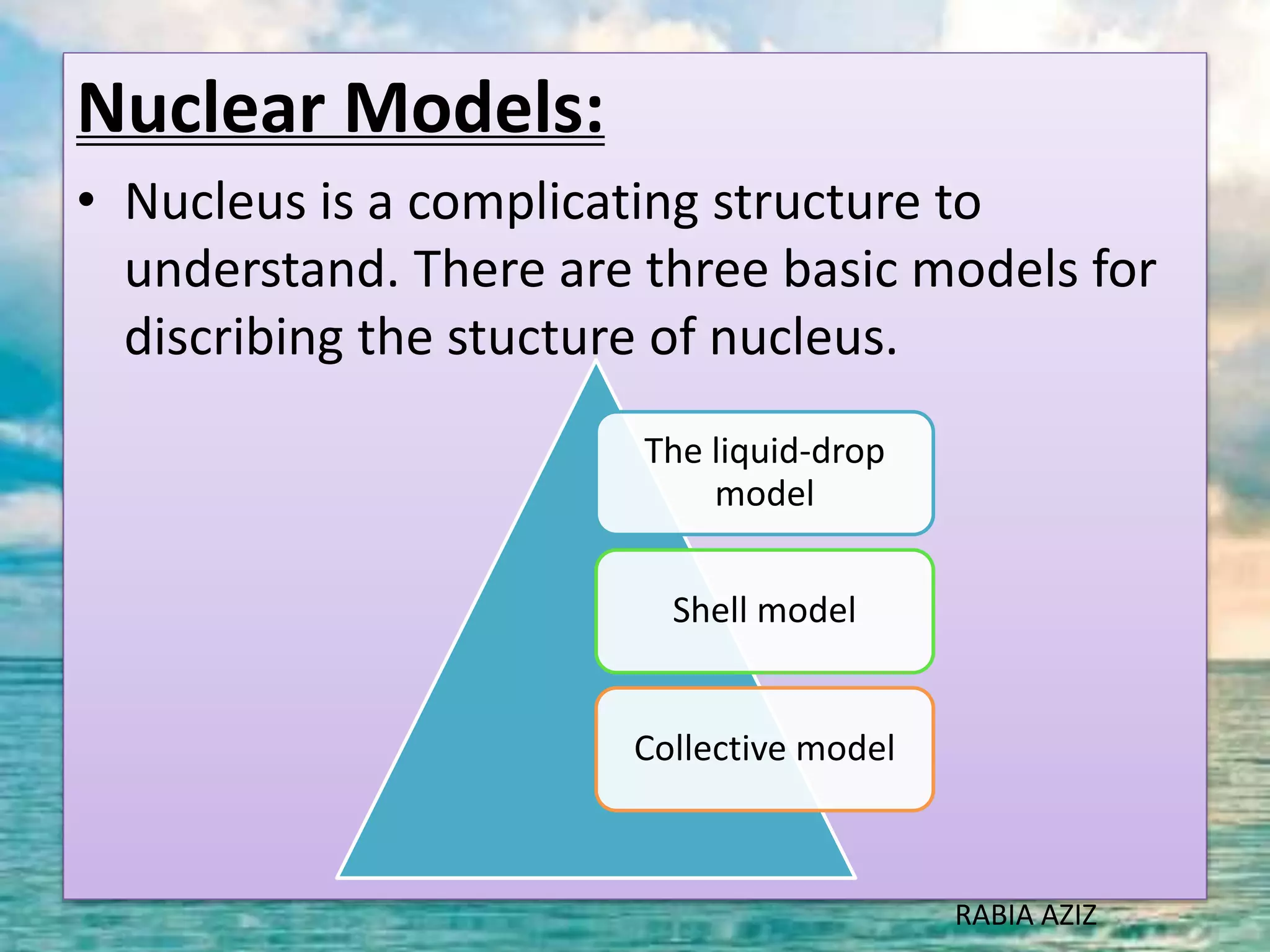
• Nucleus is a complicating structure to
understand. There are three basic models for
discribing the stucture of nucleus.
The liquid-drop
model
Shell model
Collective model
RABIA AZIZ
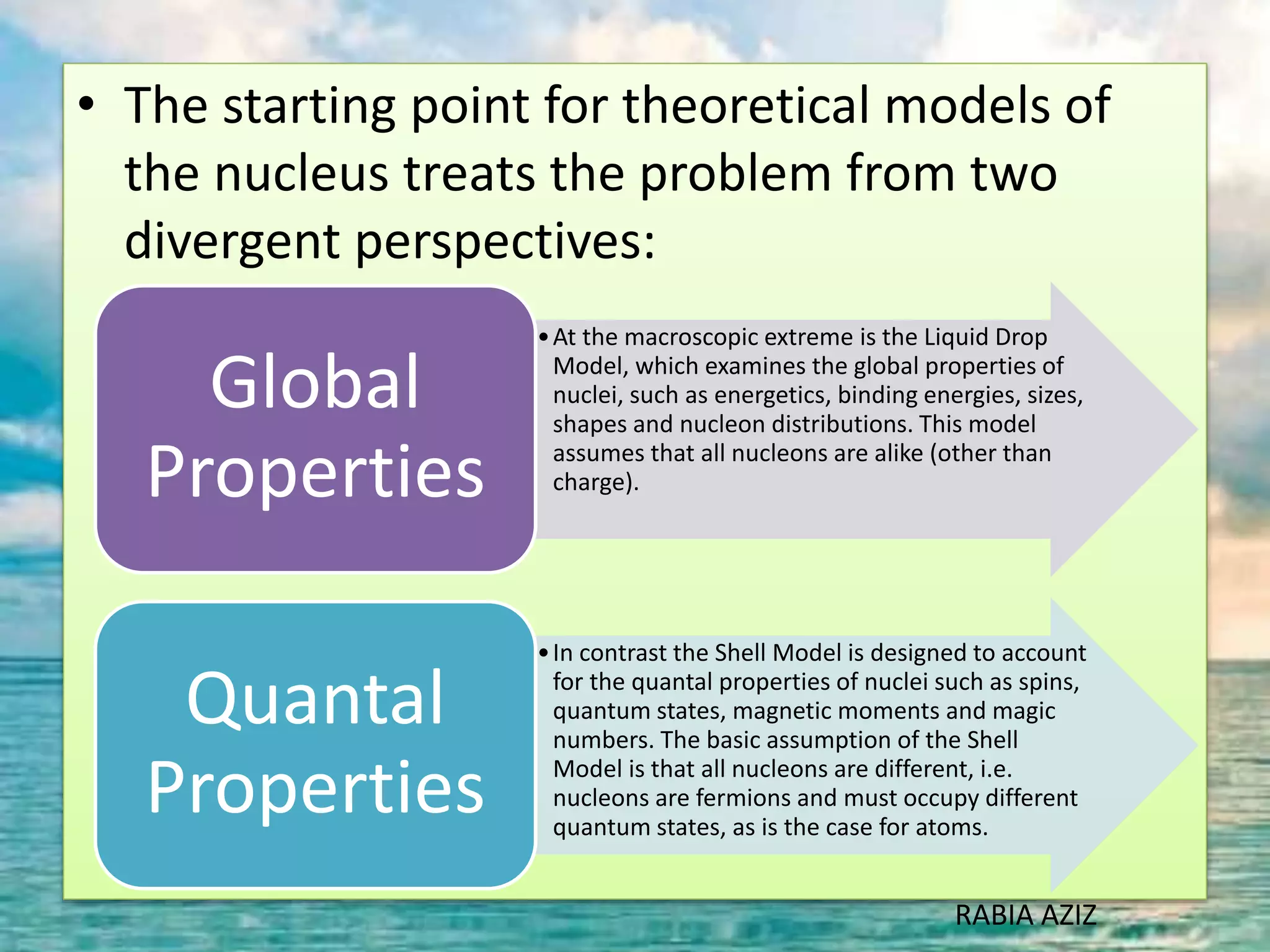
• The starting point for theoretical models of
the nucleus treats the problem from two
divergent perspectives:
•At the macroscopic extreme is the Liquid Drop
Model, which examines the global properties of
nuclei, such as energetics, binding energies, sizes,
shapes and nucleon distributions. This model
assumes that all nucleons are alike (other than
charge).
Global
Properties
•In contrast the Shell Model is designed to account
for the quantal properties of nuclei such as spins,
quantum states, magnetic moments and magic
numbers. The basic assumption of the Shell
Model is that all nucleons are different, i.e.
nucleons are fermions and must occupy different
quantum states, as is the case for atoms.
Quantal
Properties
RABIA AZIZ
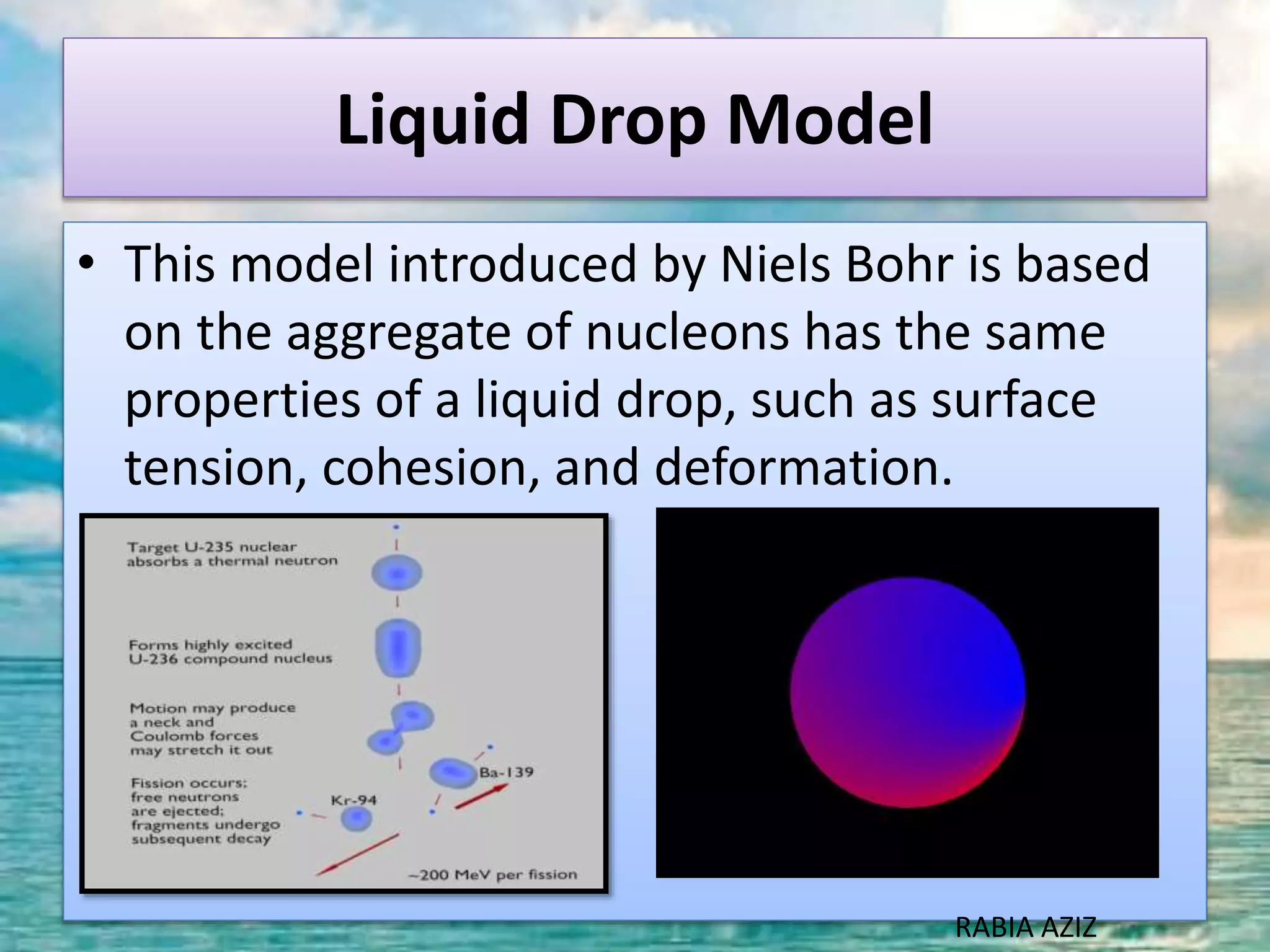
Liquid Drop Model
• This model introduced by Niels Bohr is based
on the aggregate of nucleons has the same
properties of a liquid drop, such as surface
tension, cohesion, and deformation.
RABIA AZIZ
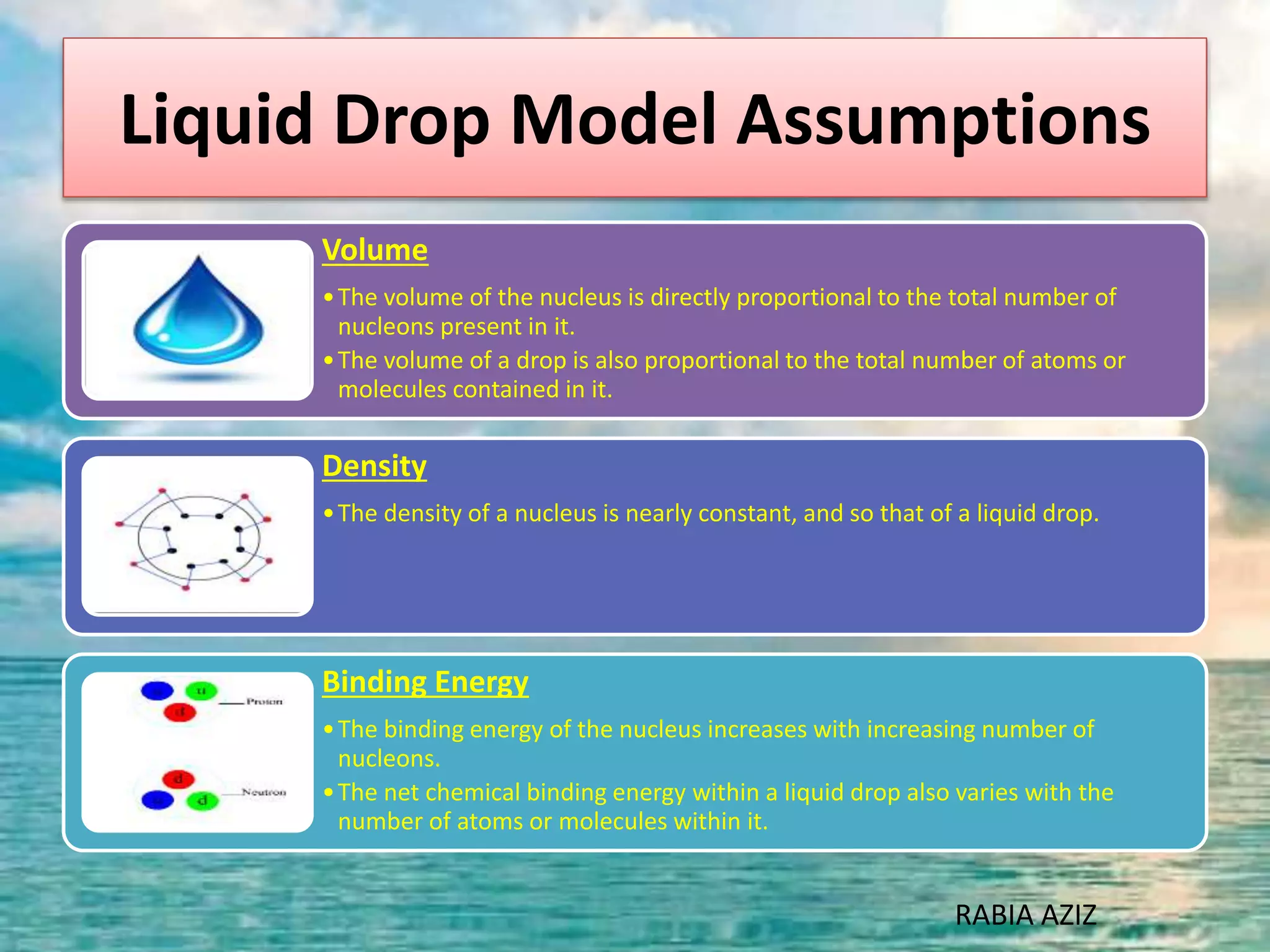
Liquid Drop Model Assumptions
Volume
•The volume of the nucleus is directly proportional to the total number of
nucleons present in it.
•The volume of a drop is also proportional to the total number of atoms or
molecules contained in it.
Density
•The density of a nucleus is nearly constant, and so that of a liquid drop.
Binding Energy
•The binding energy of the nucleus increases with increasing number of
nucleons.
•The net chemical binding energy within a liquid drop also varies with the
number of atoms or molecules within it.
RABIA AZIZ
Nuclear Forces
• This is analogous to the cohesive force of surface tension
within a liquid drop. Under the influence of surface
tension, the liquid drop attains spherical shape.
• Nuclear forces are short range forces. The atomic
nucleus is also spherical.
Disintegration
• Very large drops of a liquid are not stable for long, since
the force of surface tension progressively becomes
weak. The large drop dissoicates into smaller droplets.
• In case of atomic nuclei, the size of the nucleus increases
with mass number. For very heavy elements the size of
the nuclei reaches a critical value and gets deformed. A
slight provocation is enough to cause its disintegration.
RABIA AZIZ
Advantages and Disadvantages of
Liquid Drop Model
Advantages
• Liquid Drop Model examines the macro properties of nuclei, such as
energetics, binding energies, sizes, shapes and nucleon
distributions.
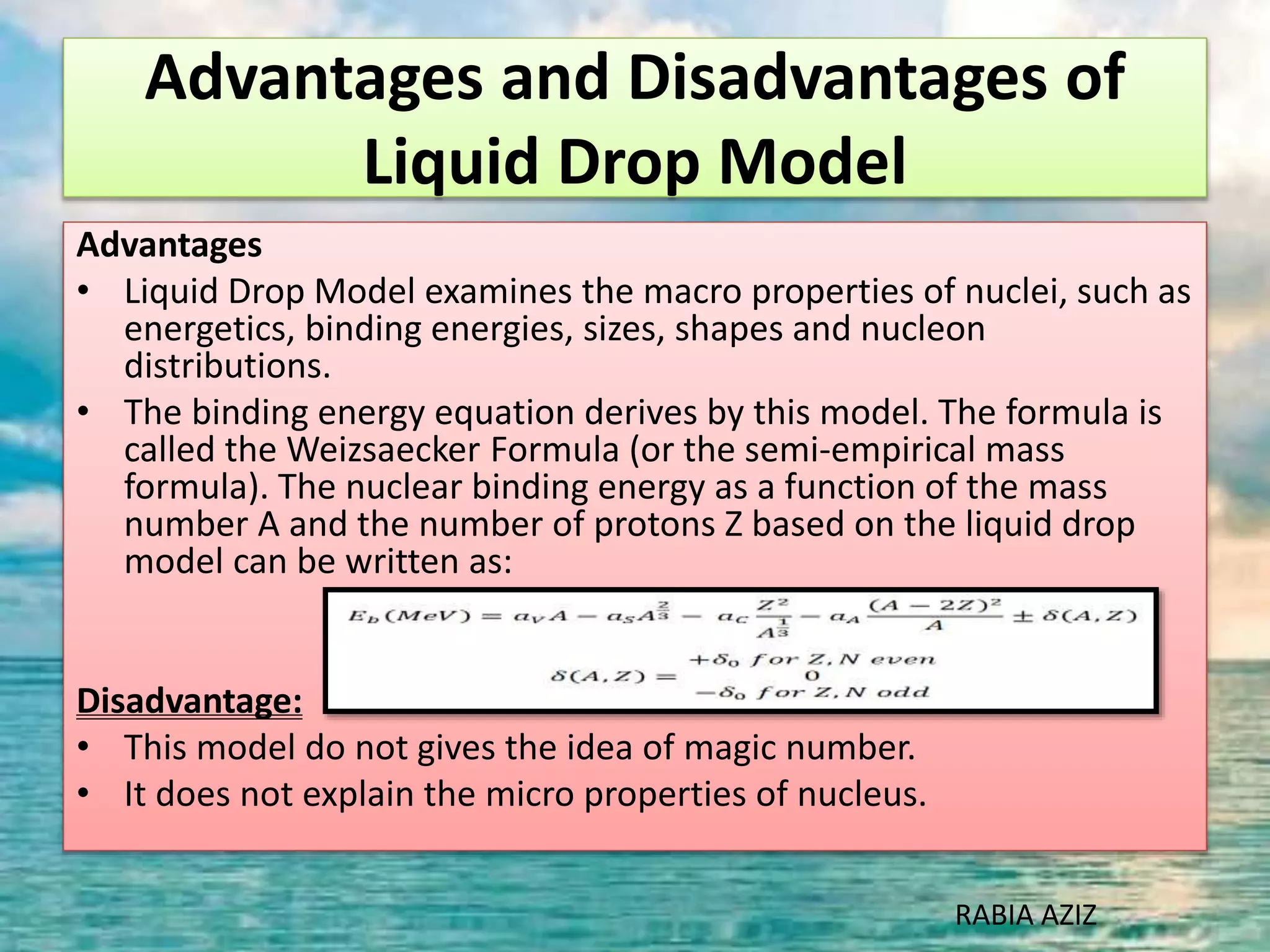
• The binding energy equation derives by this model. The formula is
called the Weizsaecker Formula (or the semi-empirical mass
formula). The nuclear binding energy as a function of the mass
number A and the number of protons Z based on the liquid drop
model can be written as:
Disadvantage:
• This model do not gives the idea of magic number.
• It does not explain the micro properties of nucleus.
RABIA AZIZ
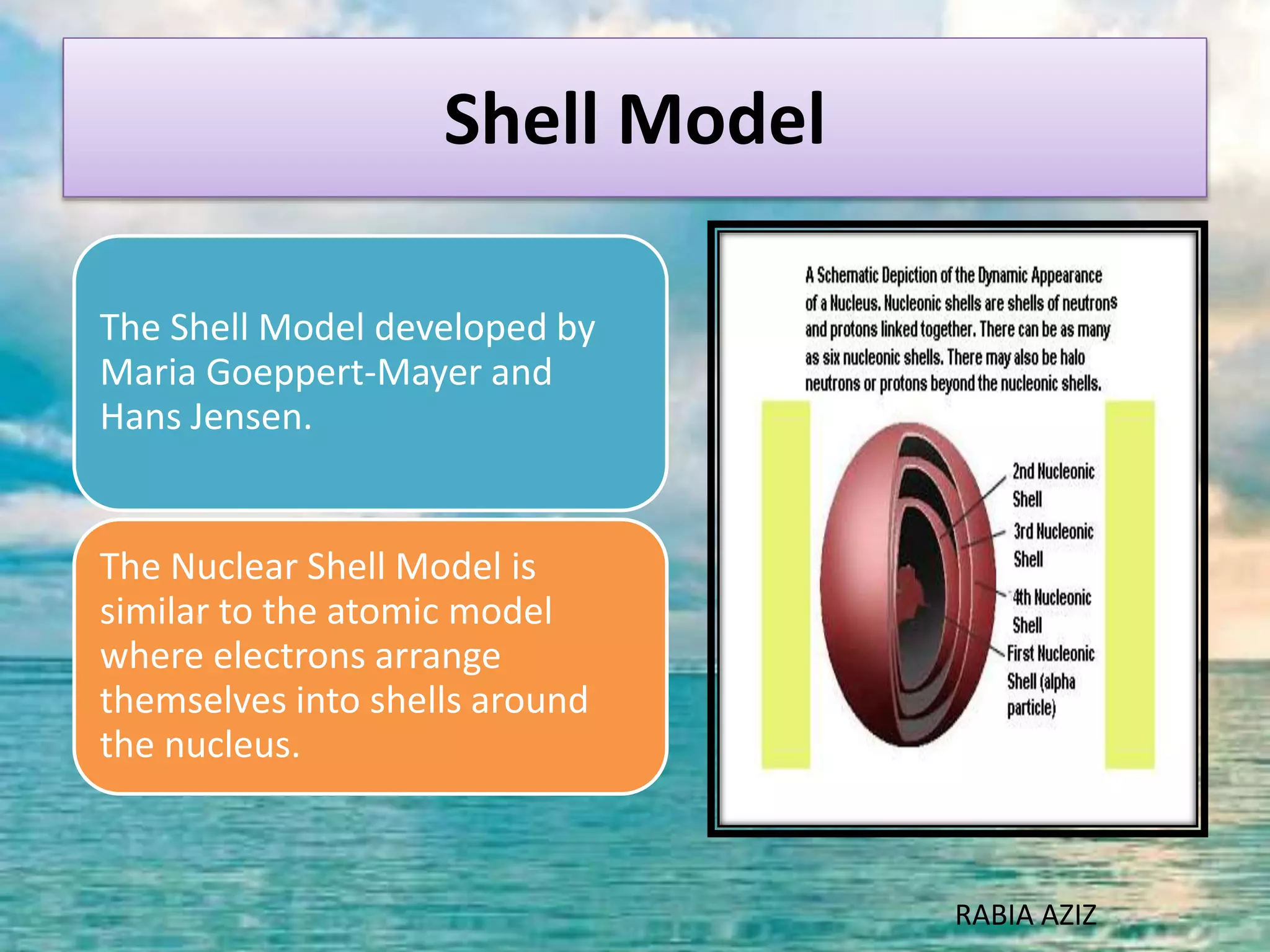
Shell Model
The Shell Model developed by
Maria Goeppert-Mayer and
Hans Jensen.
The Nuclear Shell Model is
similar to the atomic model
where electrons arrange
themselves into shells around
the nucleus.
RABIA AZIZ
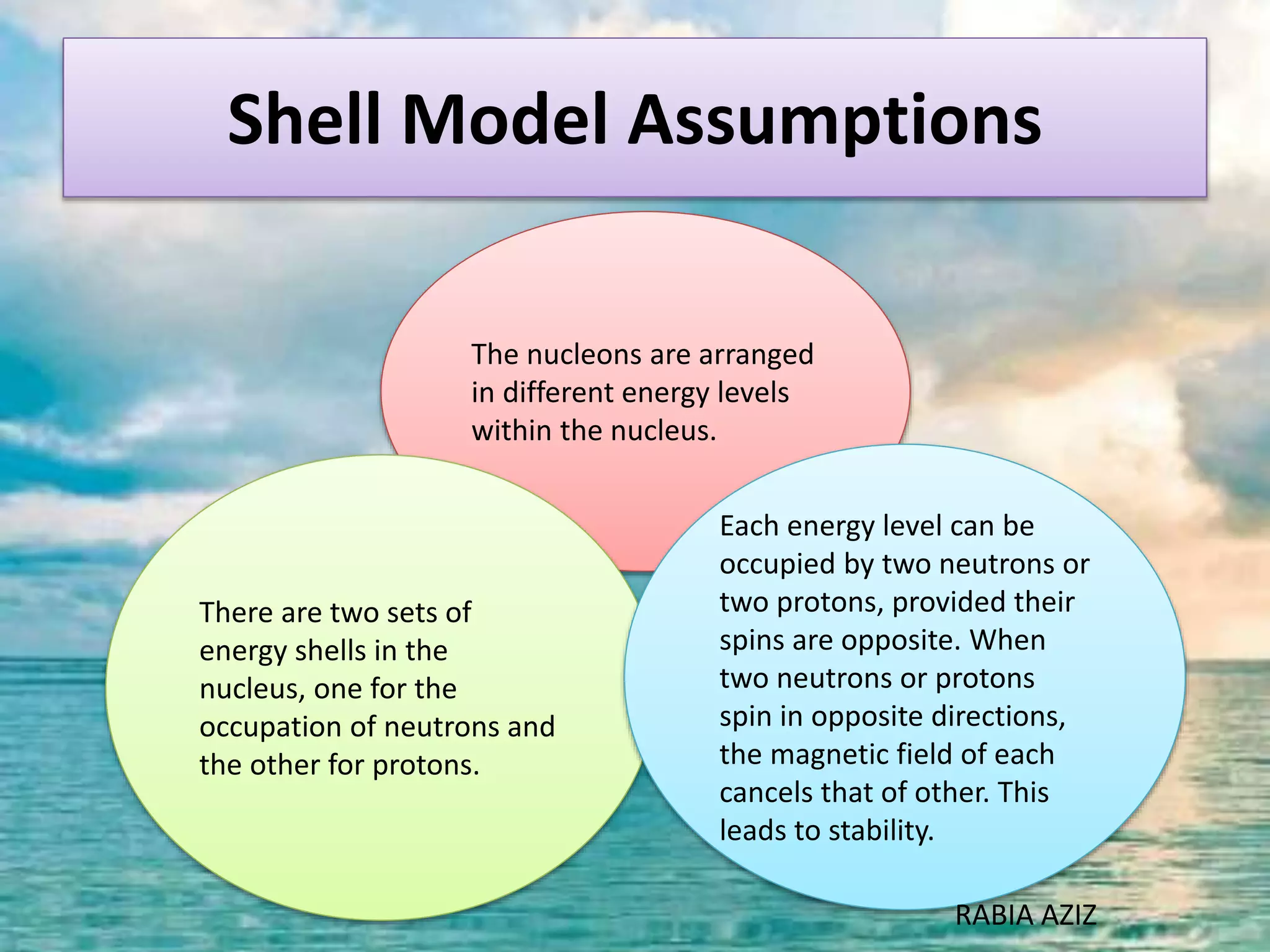
Shell Model Assumptions
The nucleons are arranged
in different energy levels
within the nucleus.
There are two sets of
energy shells in the
nucleus, one for the
occupation of neutrons and
the other for protons.
Each energy level can be
occupied by two neutrons or
two protons, provided their
spins are opposite. When
two neutrons or protons
spin in opposite directions,
the magnetic field of each
cancels that of other. This
leads to stability.
RABIA AZIZ
Advantages of Shell Model
Properties
• This model has been very successful in
explaining the basic nuclear properties
(angular momentum, magnetic moment,
shape, etc.)
Magic
Number
• The nuclear shell model explains the
existence of "magic numbers".
Nuclear
Stability
• It explains the Relationship between the
Number of Protons and the Number of
Neutrons and Nuclear Stability.
RABIA AZIZ
The Collective Model
Collective model is the sum of the
liquid drop model and shell model.
It explains both global properties
and quantal properties.
RABIA AZIZ
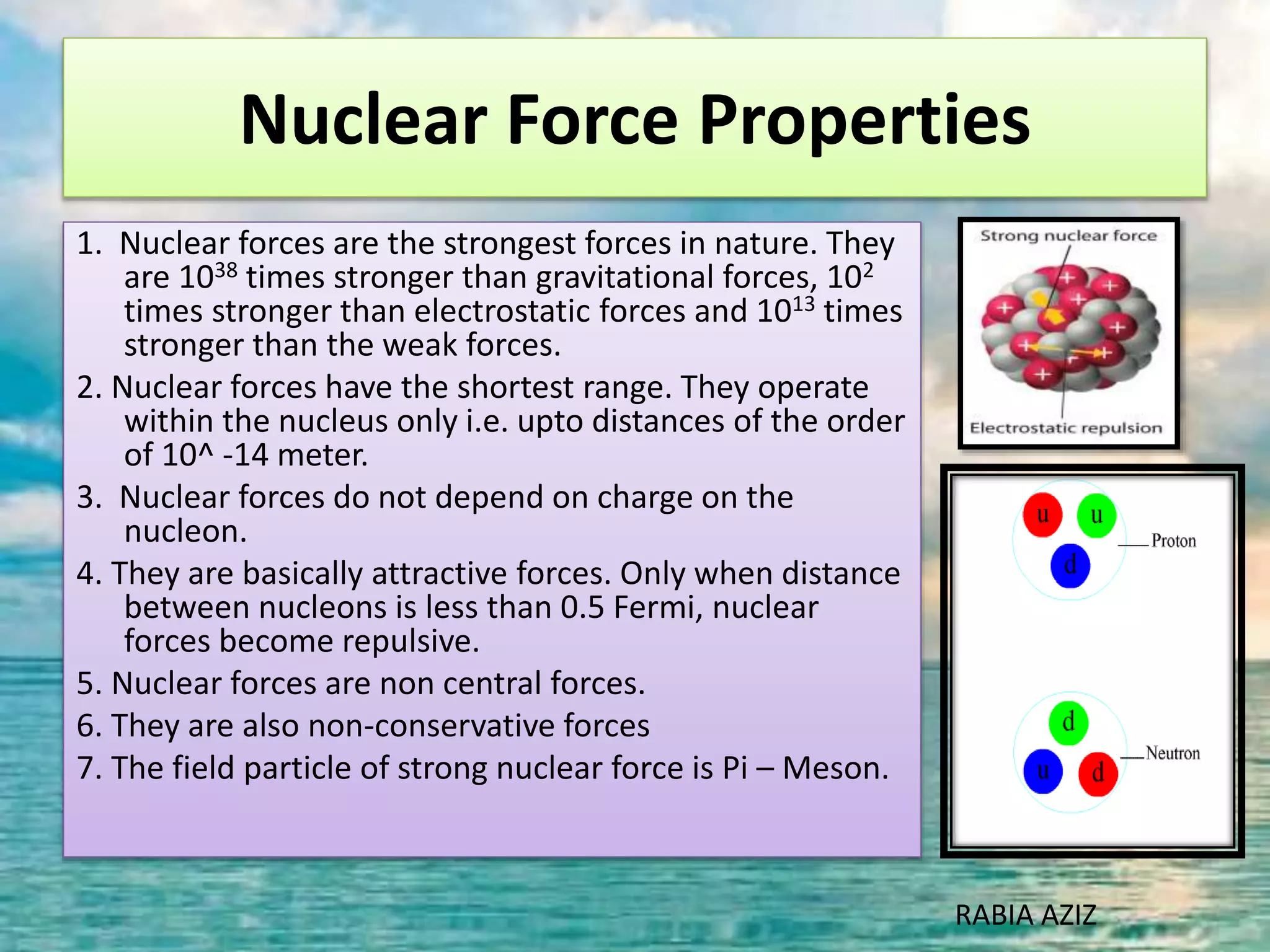
Nuclear Force
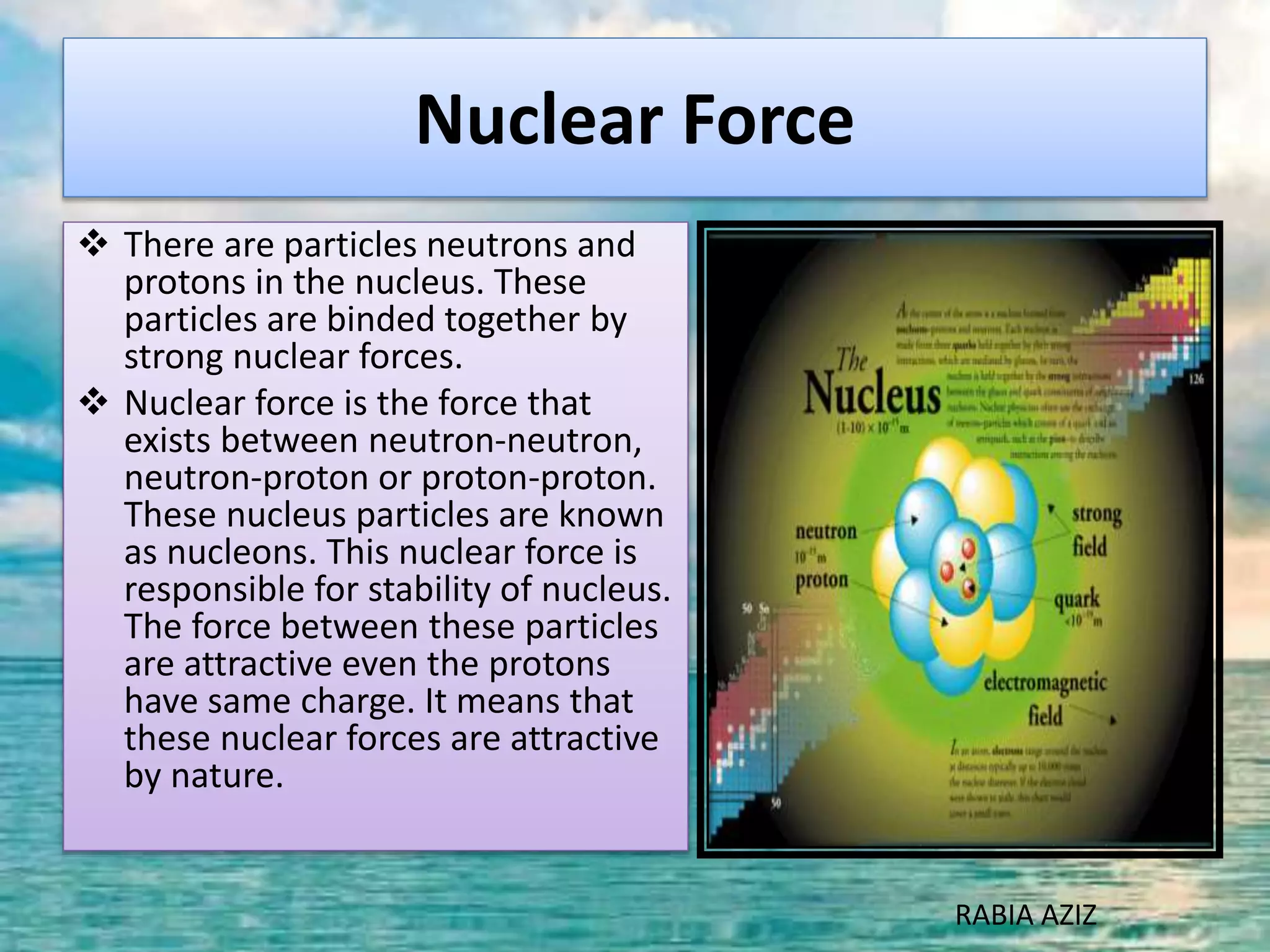
 There are particles neutrons and
protons in the nucleus. These
particles are binded together by
strong nuclear forces.
 Nuclear force is the force that
exists between neutron-neutron,
neutron-proton or proton-proton.
These nucleus particles are known
as nucleons. This nuclear force is
responsible for stability of nucleus.
The force between these particles
are attractive even the protons
have same charge. It means that
these nuclear forces are attractive
by nature.
RABIA AZIZ
Nuclear Force Properties
1. Nuclear forces are the strongest forces in nature. They
are 1038 times stronger than gravitational forces, 102
times stronger than electrostatic forces and 1013 times
stronger than the weak forces.
2. Nuclear forces have the shortest range. They operate
within the nucleus only i.e. upto distances of the order
of 10^ -14 meter.
3. Nuclear forces do not depend on charge on the
nucleon.
4. They are basically attractive forces. Only when distance
between nucleons is less than 0.5 Fermi, nuclear
forces become repulsive.
5. Nuclear forces are non central forces.
6. They are also non-conservative forces
7. The field particle of strong nuclear force is Pi – Meson.
RABIA AZIZ

NUCLEAR MODELS AND NUCLEAR FORCES

  • 1.
    NUCLEAR MODELS AND NUCLEARFORCES RABIA AZIZ, PHYSICAL CHEMISTRY, BS-III CHEMISTRY, VI SEMESTER, JINNAH UNIVERSITY FOR WOMEN
  • 2.
    Nuclear Models: • Nucleusis a complicating structure to understand. There are three basic models for discribing the stucture of nucleus. The liquid-drop model Shell model Collective model RABIA AZIZ
  • 3.
    • The startingpoint for theoretical models of the nucleus treats the problem from two divergent perspectives: •At the macroscopic extreme is the Liquid Drop Model, which examines the global properties of nuclei, such as energetics, binding energies, sizes, shapes and nucleon distributions. This model assumes that all nucleons are alike (other than charge). Global Properties •In contrast the Shell Model is designed to account for the quantal properties of nuclei such as spins, quantum states, magnetic moments and magic numbers. The basic assumption of the Shell Model is that all nucleons are different, i.e. nucleons are fermions and must occupy different quantum states, as is the case for atoms. Quantal Properties RABIA AZIZ
  • 4.
    Liquid Drop Model •This model introduced by Niels Bohr is based on the aggregate of nucleons has the same properties of a liquid drop, such as surface tension, cohesion, and deformation. RABIA AZIZ
  • 5.
    Liquid Drop ModelAssumptions Volume •The volume of the nucleus is directly proportional to the total number of nucleons present in it. •The volume of a drop is also proportional to the total number of atoms or molecules contained in it. Density •The density of a nucleus is nearly constant, and so that of a liquid drop. Binding Energy •The binding energy of the nucleus increases with increasing number of nucleons. •The net chemical binding energy within a liquid drop also varies with the number of atoms or molecules within it. RABIA AZIZ
  • 6.
    Nuclear Forces • Thisis analogous to the cohesive force of surface tension within a liquid drop. Under the influence of surface tension, the liquid drop attains spherical shape. • Nuclear forces are short range forces. The atomic nucleus is also spherical. Disintegration • Very large drops of a liquid are not stable for long, since the force of surface tension progressively becomes weak. The large drop dissoicates into smaller droplets. • In case of atomic nuclei, the size of the nucleus increases with mass number. For very heavy elements the size of the nuclei reaches a critical value and gets deformed. A slight provocation is enough to cause its disintegration. RABIA AZIZ
  • 7.
    Advantages and Disadvantagesof Liquid Drop Model Advantages • Liquid Drop Model examines the macro properties of nuclei, such as energetics, binding energies, sizes, shapes and nucleon distributions. • The binding energy equation derives by this model. The formula is called the Weizsaecker Formula (or the semi-empirical mass formula). The nuclear binding energy as a function of the mass number A and the number of protons Z based on the liquid drop model can be written as: Disadvantage: • This model do not gives the idea of magic number. • It does not explain the micro properties of nucleus. RABIA AZIZ
  • 8.
    Shell Model The ShellModel developed by Maria Goeppert-Mayer and Hans Jensen. The Nuclear Shell Model is similar to the atomic model where electrons arrange themselves into shells around the nucleus. RABIA AZIZ
  • 9.
    Shell Model Assumptions Thenucleons are arranged in different energy levels within the nucleus. There are two sets of energy shells in the nucleus, one for the occupation of neutrons and the other for protons. Each energy level can be occupied by two neutrons or two protons, provided their spins are opposite. When two neutrons or protons spin in opposite directions, the magnetic field of each cancels that of other. This leads to stability. RABIA AZIZ
  • 10.
    Advantages of ShellModel Properties • This model has been very successful in explaining the basic nuclear properties (angular momentum, magnetic moment, shape, etc.) Magic Number • The nuclear shell model explains the existence of "magic numbers". Nuclear Stability • It explains the Relationship between the Number of Protons and the Number of Neutrons and Nuclear Stability. RABIA AZIZ
  • 11.
    The Collective Model Collectivemodel is the sum of the liquid drop model and shell model. It explains both global properties and quantal properties. RABIA AZIZ
  • 12.
    Nuclear Force  Thereare particles neutrons and protons in the nucleus. These particles are binded together by strong nuclear forces.  Nuclear force is the force that exists between neutron-neutron, neutron-proton or proton-proton. These nucleus particles are known as nucleons. This nuclear force is responsible for stability of nucleus. The force between these particles are attractive even the protons have same charge. It means that these nuclear forces are attractive by nature. RABIA AZIZ
  • 13.
    Nuclear Force Properties 1.Nuclear forces are the strongest forces in nature. They are 1038 times stronger than gravitational forces, 102 times stronger than electrostatic forces and 1013 times stronger than the weak forces. 2. Nuclear forces have the shortest range. They operate within the nucleus only i.e. upto distances of the order of 10^ -14 meter. 3. Nuclear forces do not depend on charge on the nucleon. 4. They are basically attractive forces. Only when distance between nucleons is less than 0.5 Fermi, nuclear forces become repulsive. 5. Nuclear forces are non central forces. 6. They are also non-conservative forces 7. The field particle of strong nuclear force is Pi – Meson. RABIA AZIZ