
de Broglie Wavelength
Dr. Mithil Fal Desai
Shree Mallikarjun and Shri
Chetan Manju Desai College
Canacona Goa
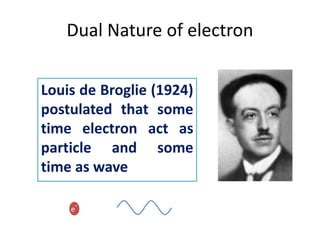
Dual Nature of electron
Louis de Broglie (1924)
postulated that some
time electron act as
particle and some
time as wave
e-
Calculating de Broglie wavelenth
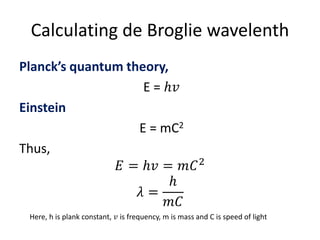
Planck’s quantum theory,
E = ℎ𝑣
Einstein
E = mC2
Thus,
𝐸 = ℎ𝑣 = 𝑚𝐶2
𝜆 =
ℎ
𝑚𝐶
Here, h is plank constant, 𝑣 is frequency, m is mass and C is speed of light
Calculating de Broglie wavelength
Mass and speed of light can be replaced by a mass of matter and velocity, we have or momentum
(p)
𝜆 =
ℎ
𝑚𝑣
=
ℎ
𝑝
… de Broglie relation
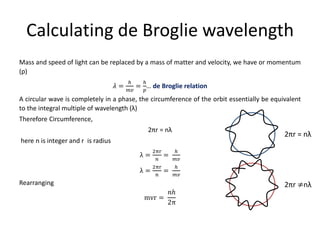
A circular wave is completely in a phase, the circumference of the orbit essentially be equivalent
to the integral multiple of wavelength (λ)
Therefore Circumference,
2πr = nλ
here n is integer and r is radius
λ =
2πr
𝑛
=
ℎ
𝑚𝑣
λ =
2πr
𝑛
=
ℎ
𝑚𝑣
Rearranging
mvr =
𝑛ℎ
2π
2πr = nλ
2πr ≠nλ
Summary
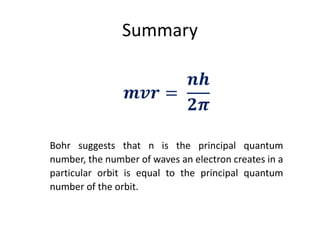
𝒎𝒗𝒓 =
𝒏𝒉
𝟐𝝅
Bohr suggests that n is the principal quantum
number, the number of waves an electron creates in a
particular orbit is equal to the principal quantum
number of the orbit.

de Broglie wavelength

  • 1.
    de Broglie Wavelength Dr.Mithil Fal Desai Shree Mallikarjun and Shri Chetan Manju Desai College Canacona Goa
  • 2.
    Dual Nature ofelectron Louis de Broglie (1924) postulated that some time electron act as particle and some time as wave e-
  • 3.
    Calculating de Brogliewavelenth Planck’s quantum theory, E = ℎ𝑣 Einstein E = mC2 Thus, 𝐸 = ℎ𝑣 = 𝑚𝐶2 𝜆 = ℎ 𝑚𝐶 Here, h is plank constant, 𝑣 is frequency, m is mass and C is speed of light
  • 4.
    Calculating de Brogliewavelength Mass and speed of light can be replaced by a mass of matter and velocity, we have or momentum (p) 𝜆 = ℎ 𝑚𝑣 = ℎ 𝑝 … de Broglie relation A circular wave is completely in a phase, the circumference of the orbit essentially be equivalent to the integral multiple of wavelength (λ) Therefore Circumference, 2πr = nλ here n is integer and r is radius λ = 2πr 𝑛 = ℎ 𝑚𝑣 λ = 2πr 𝑛 = ℎ 𝑚𝑣 Rearranging mvr = 𝑛ℎ 2π 2πr = nλ 2πr ≠nλ
  • 5.
    Summary 𝒎𝒗𝒓 = 𝒏𝒉 𝟐𝝅 Bohr suggeststhat n is the principal quantum number, the number of waves an electron creates in a particular orbit is equal to the principal quantum number of the orbit.