Atomic Spectroscopy
Dr. Sajjad Ullah
Institute of Chemical Sciences
University of Peshawar, Pak
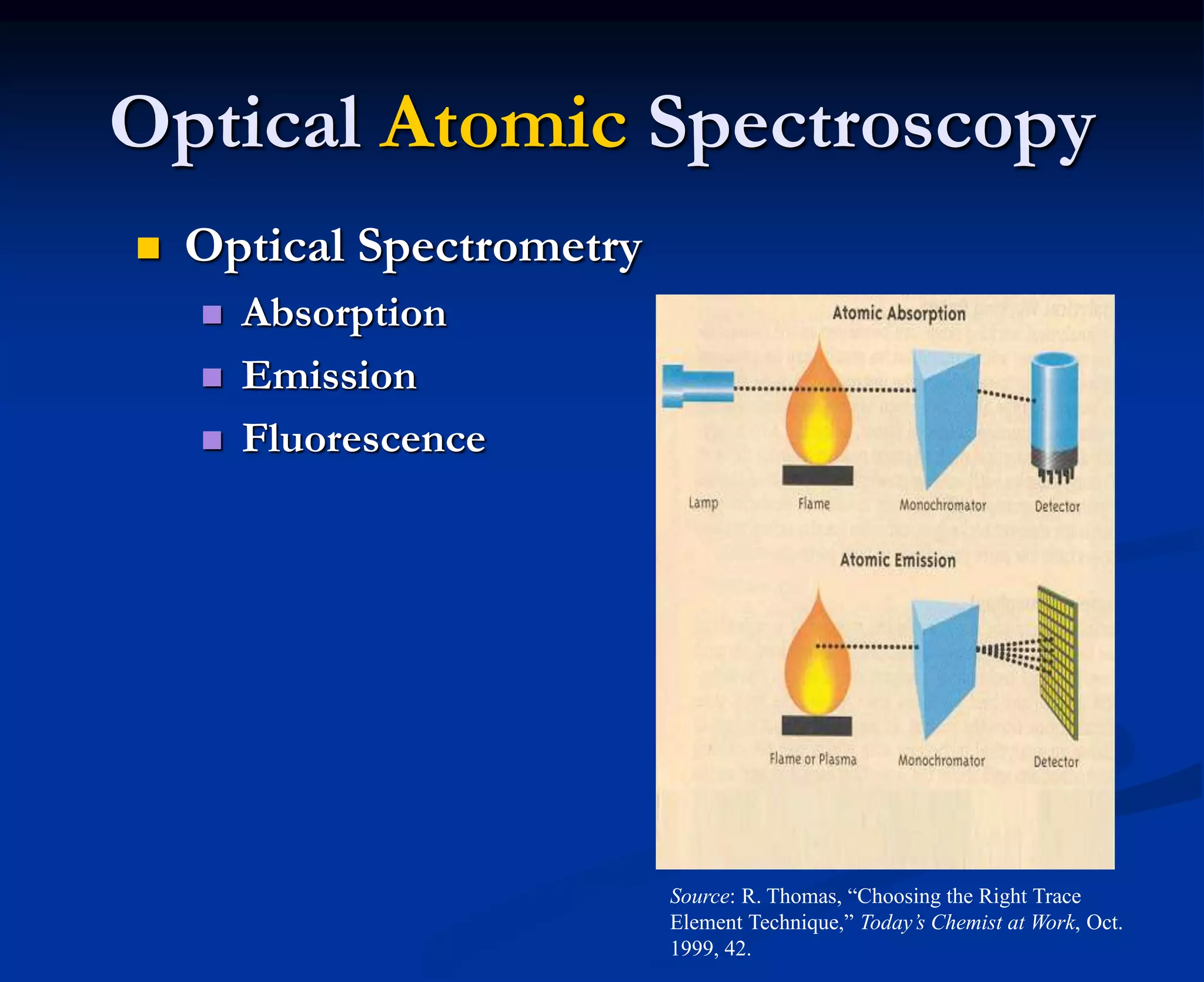
Optical Atomic Spectroscopy
 Optical Spectrometry
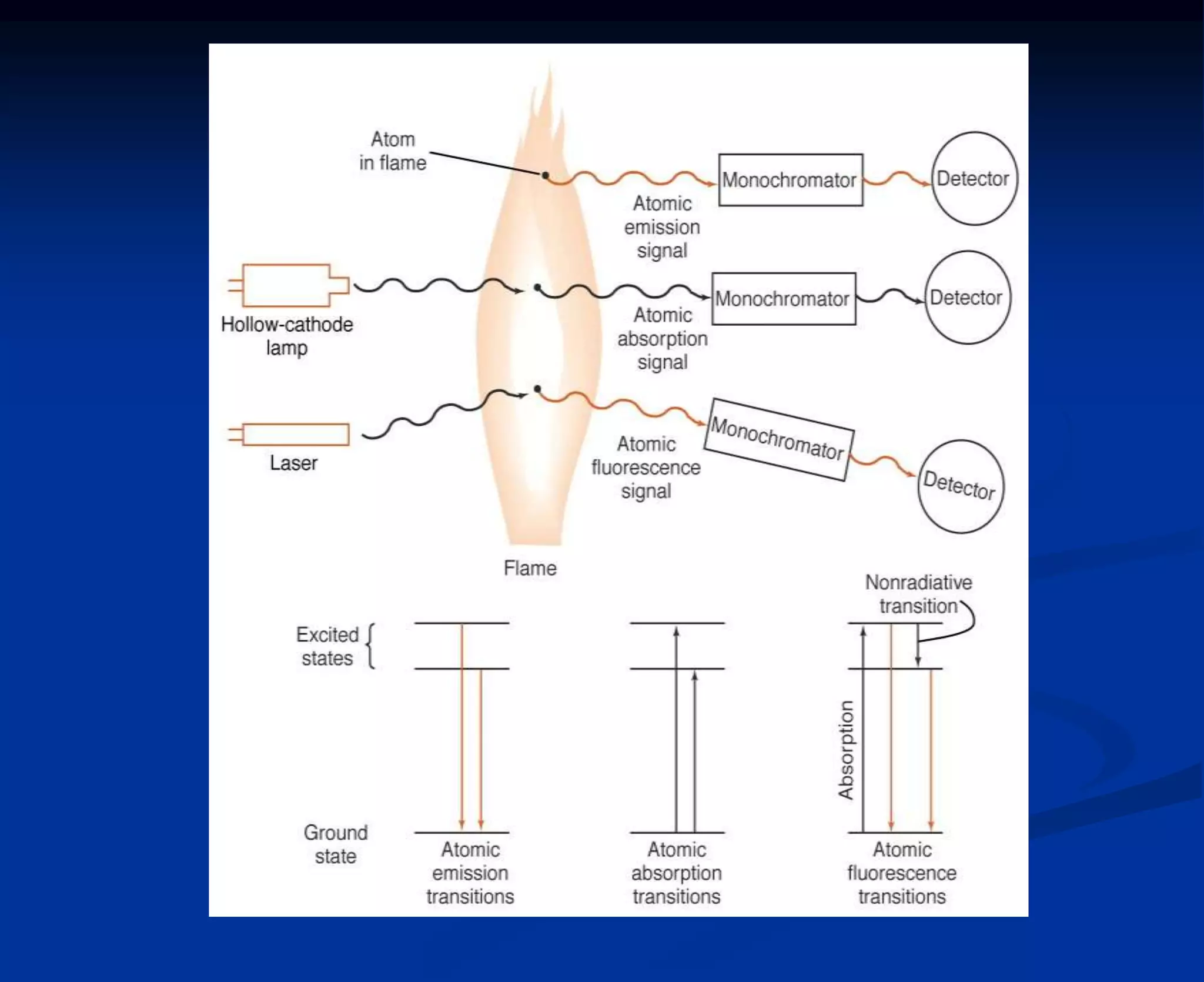
 Absorption
 Emission
 Fluorescence
Source: R. Thomas, “Choosing the Right Trace
Element Technique,” Today’s Chemist at Work, Oct.
1999, 42.
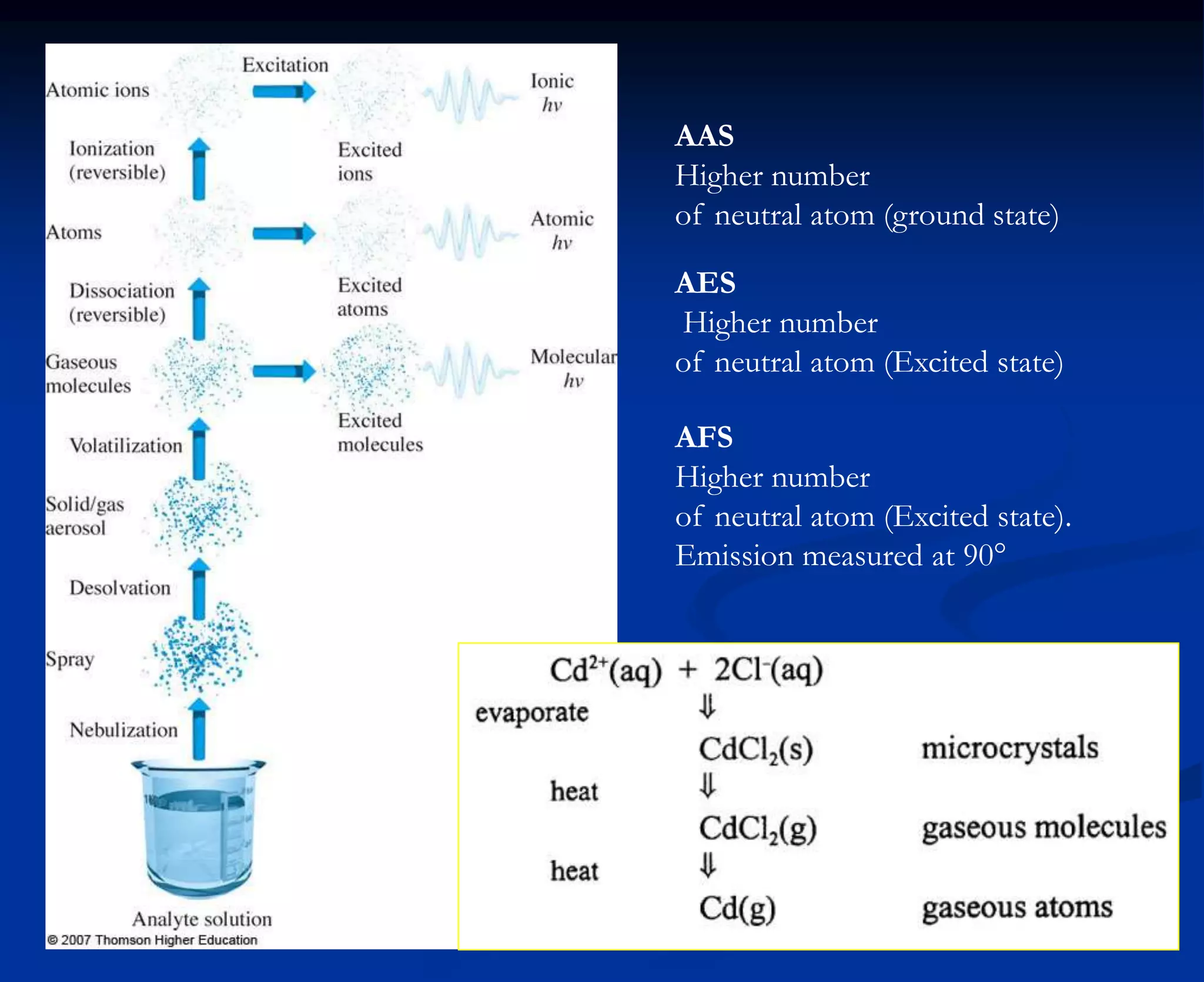
AAS
Higher number
of neutral atom (ground state)
AES
Higher number
of neutral atom (Excited state)
AFS
Higher number
of neutral atom (Excited state).
Emission measured at 90°
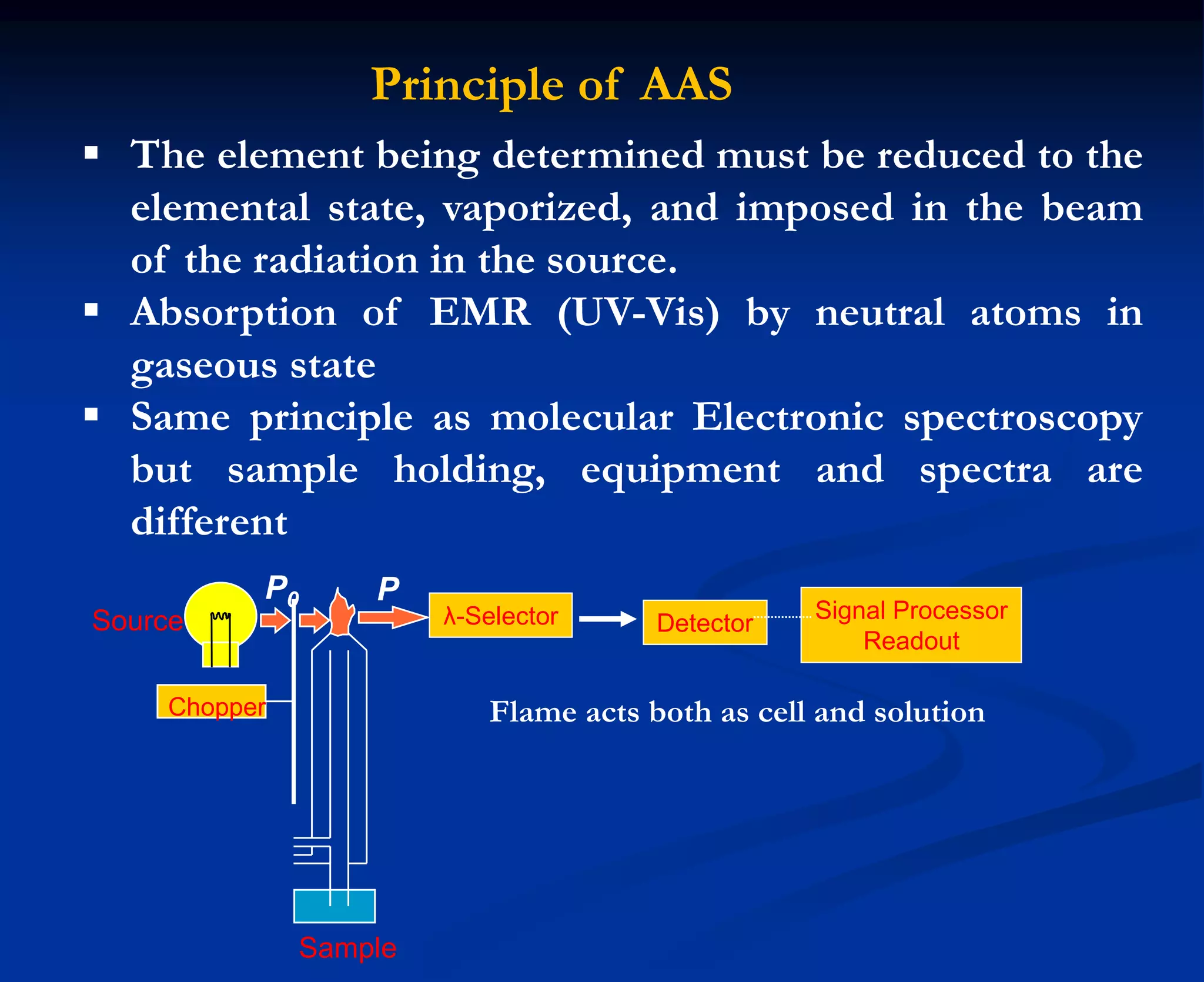
Principle of AAS
 The element being determined must be reduced to the
elemental state, vaporized, and imposed in the beam
of the radiation in the source.
 Absorption of EMR (UV-Vis) by neutral atoms in
gaseous state
 Same principle as molecular Electronic spectroscopy
but sample holding, equipment and spectra are
different
Source
Sample
PP0
Chopper
λ-Selector Detector
Signal Processor
Readout
Flame acts both as cell and solution
 A. Walsh, "The application of atomic
absorption spectra to chemical analysis",
Spectrochimica Acta, 1955, 7, 108-117.
http://www.science.org.au/academy/memoirs/walsh2.htm#1
The invention of hollow cathode lamp by Walsh in 1955 made practical
applications of AAS possible
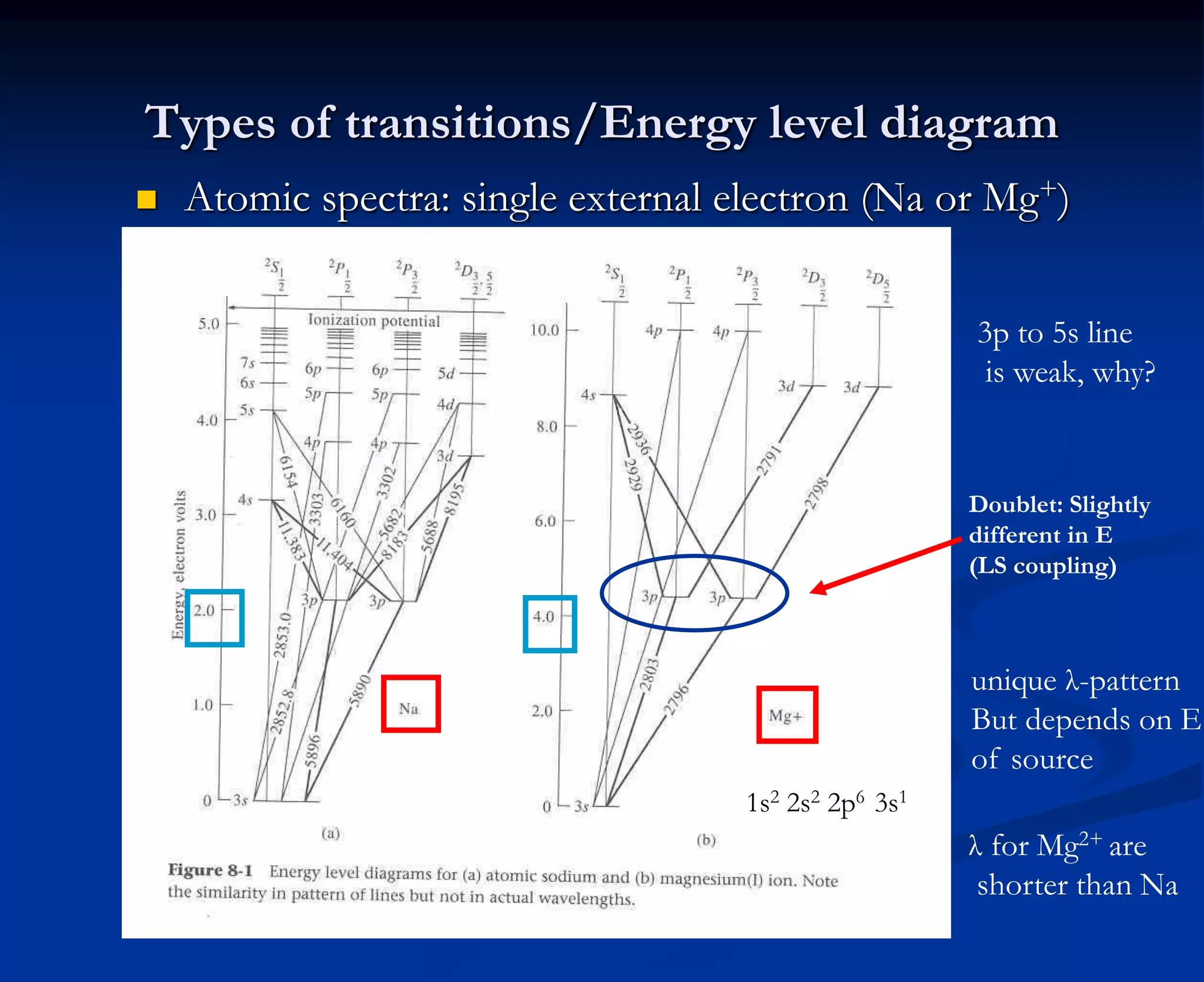
Types of transitions/Energy level diagram
 Atomic spectra: single external electron (Na or Mg+)
Doublet: Slightly
different in E
(LS coupling)
3p to 5s line
is weak, why?
unique λ-pattern
But depends on E
of source
λ for Mg2+ are
shorter than Na
1s2 2s2 2p6 3s1
Why a doublet for p-orbital?
When e- spin is parallel to orbital motion (L+S), E is High (repulsive interaction b/w the fields)
When e- spin is opposite to orbital motion (L-S), E is Low (attractive interaction b/w the field)
The magnitudes of such splitting for d and f orbitals are small
Both the spin and the orbital motions create magnetic fields
owing to rotation of charge carried by the electron
A doublet line is observed for species containing single e- : Na, Mg1+, Al2+
Higher no of e-, complex spectra (e.g., Fe, U have hundreds of such
electron transitions as shown in the simple Na
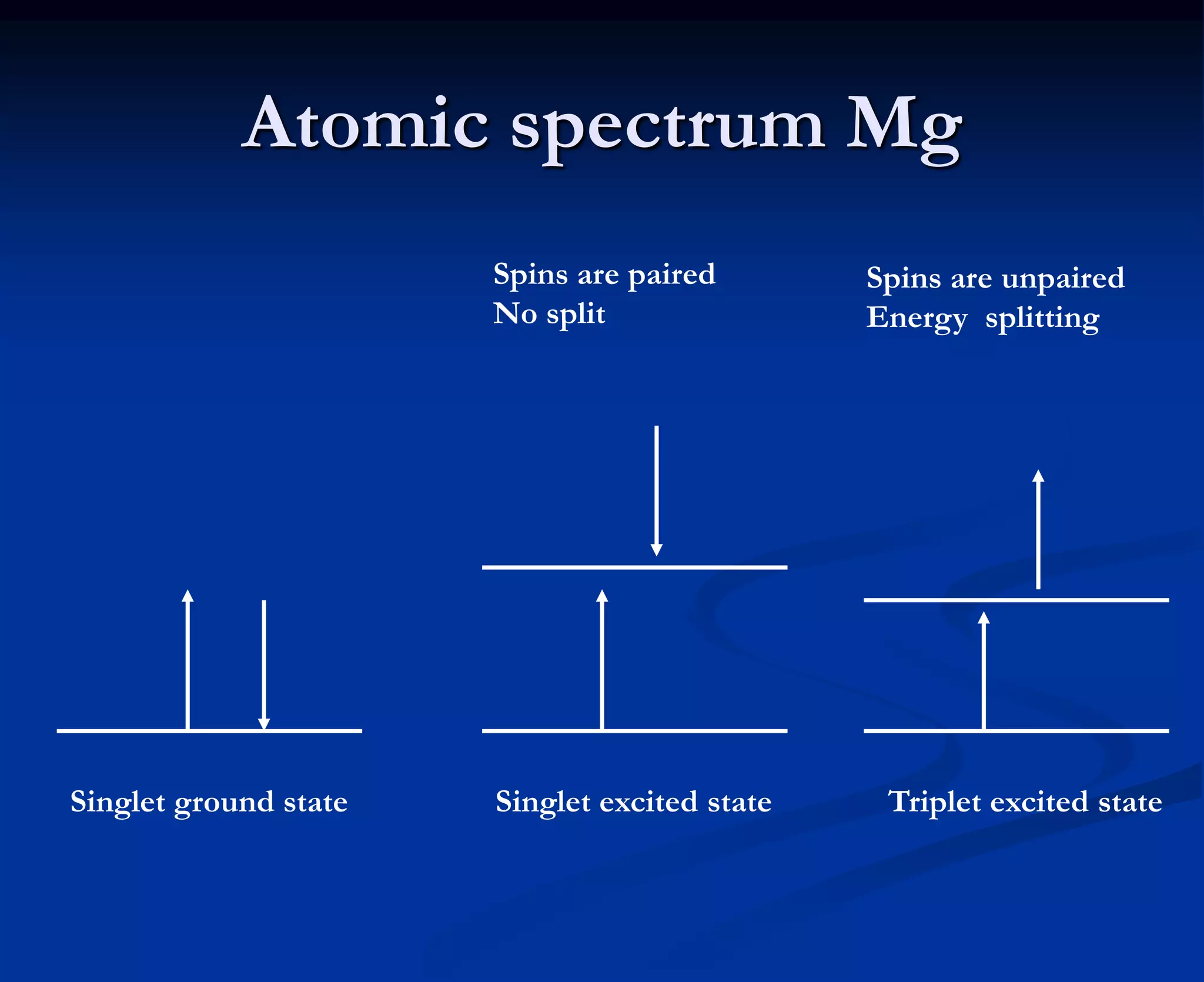
Atomic spectrum Mg
Singlet ground state Triplet excited stateSinglet excited state
Spins are paired
No split
Spins are unpaired
Energy splitting
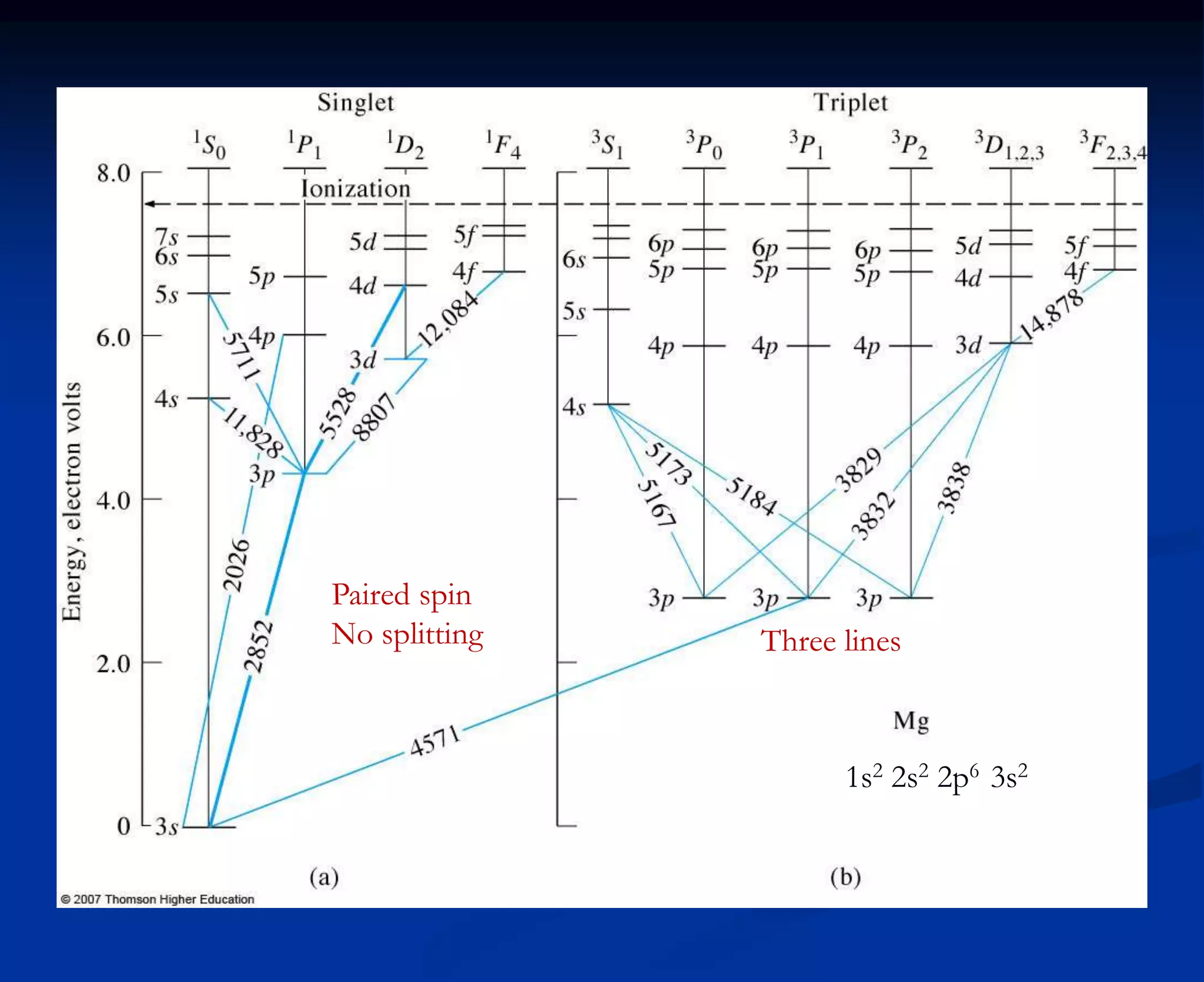
1s2 2s2 2p6 3s2
Paired spin
No splitting Three lines
Excitation in flame
(Temperature Effects)
 Boltzmann equation
Boltzmann Equation relates Excited state population/Ground State
population ratios to Energy, Temperature and Degeneracy
Nj/No is exponentially related to T
 Effects on AAS and AES
)exp(
00 kT
E
g
g
N
N jj 

k= 1.38 x10⁻¹⁶ erg/degree
∆E btw ground and excited states
g = statistical weight factors
g= 2J+1 (J= L±S)
J is the internal atomic quantum number for the atom in
particular energetic level
For Na (3s 3p @ 598nm) at 2600 K
2600)x10^-16x/1.381210^x(3.72-
o
e)
2
4
(
N
*N -

N*/No = 1.67 x 10⁻⁴
<0.02% atoms are in
excited state
Boltzmann Distribution
All systems are more stable at lower energy. Even in the flame, most of the atoms will be in their
lowest energy state.
At 3000K, for every 7 Cs atoms available for emission, there are 1000 Cs atoms available for
absorption.
At 3000 K, for each Zn available for emission, there are approximately 1 000 000 000 Zn atoms
available for absorption.
Nj = 10-12 to 1 in most cases
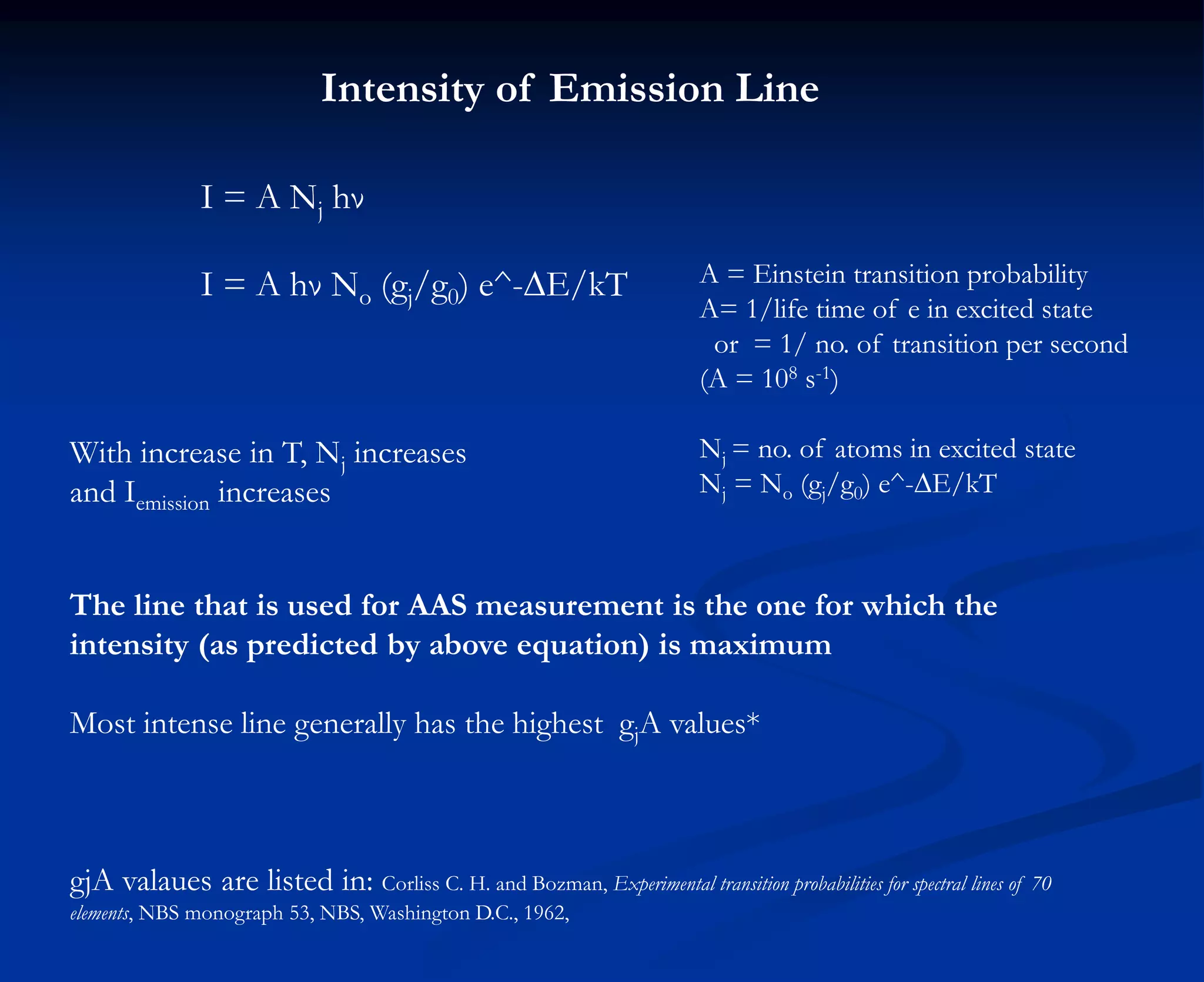
Intensity of Emission Line
I = A Nj hν
I = A hν No (gj/g0) e^-∆E/kT A = Einstein transition probability
A= 1/life time of e in excited state
or = 1/ no. of transition per second
(A = 108 s-1)
Nj = no. of atoms in excited state
Nj = No (gj/g0) e^-∆E/kT
With increase in T, Nj increases
and Iemission increases
The line that is used for AAS measurement is the one for which the
intensity (as predicted by above equation) is maximum
Most intense line generally has the highest gjA values*
gjA valaues are listed in: Corliss C. H. and Bozman, Experimental transition probabilities for spectral lines of 70
elements, NBS monograph 53, NBS, Washington D.C., 1962,
AAS vs. AES (Effect of T)
Both occur in flame
AES: Iemission is dependent on concentration of atoms in the excited
state (↑ Nj/No)
-more dependent on T
AAS: Iabsorption is dependent on concentration of atoms in the ground
state( ↓ Nj/No)
-less dependent on T (however no of reduced atom ↑ with ↑ T
- high T, more no. of reduced atoms, more P broadening
- FWHM ↑ and peak height ↓ with ↑ in T (fast moving atoms,
Doppler Broadening)
FLAME TEMPRATURE must be CONTROLLED!
Line Broadening
 Natural Line width: 10-5 nm
 Observed Line width: 0.001-0.01 nm
Two main Reasons:
(i) Doppler Broadening
(ii) Pressure Broadening
The narrow band of absorbed or emitted radiation that is observed
is called a spectral line
Line Broadening
 Doppler broadening
 Doppler shift:
The wavelength of radiation emitted or absorbed by a
rapidly moving atom decreases if the motion is toward a
transducer, and increases if the motion is receding from
the transducer.
λ↑
λ↓
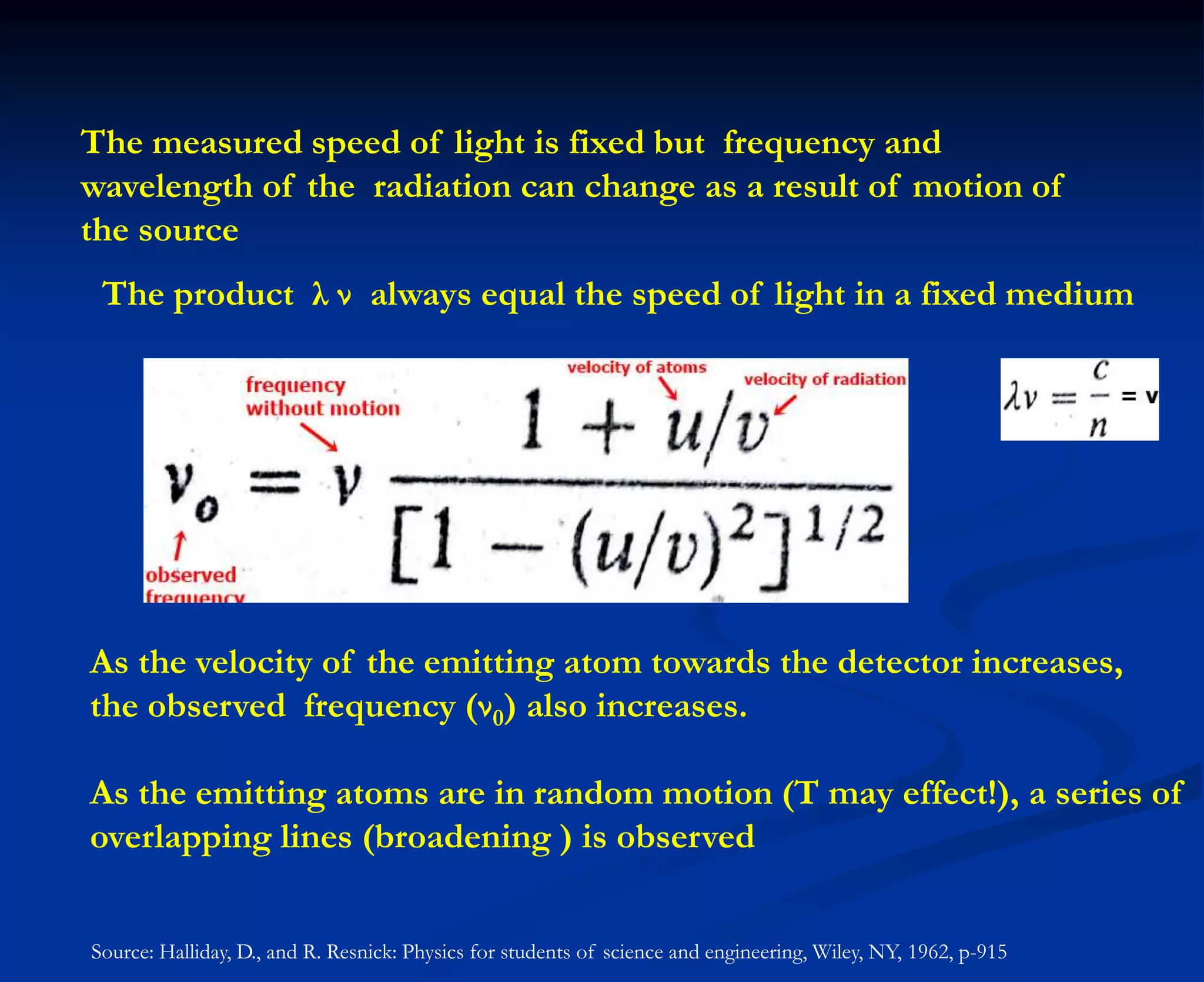
The measured speed of light is fixed but frequency and
wavelength of the radiation can change as a result of motion of
the source
The product λ ν always equal the speed of light in a fixed medium
As the velocity of the emitting atom towards the detector increases,
the observed frequency (ν0) also increases.
As the emitting atoms are in random motion (T may effect!), a series of
overlapping lines (broadening ) is observed
Source: Halliday, D., and R. Resnick: Physics for students of science and engineering, Wiley, NY, 1962, p-915
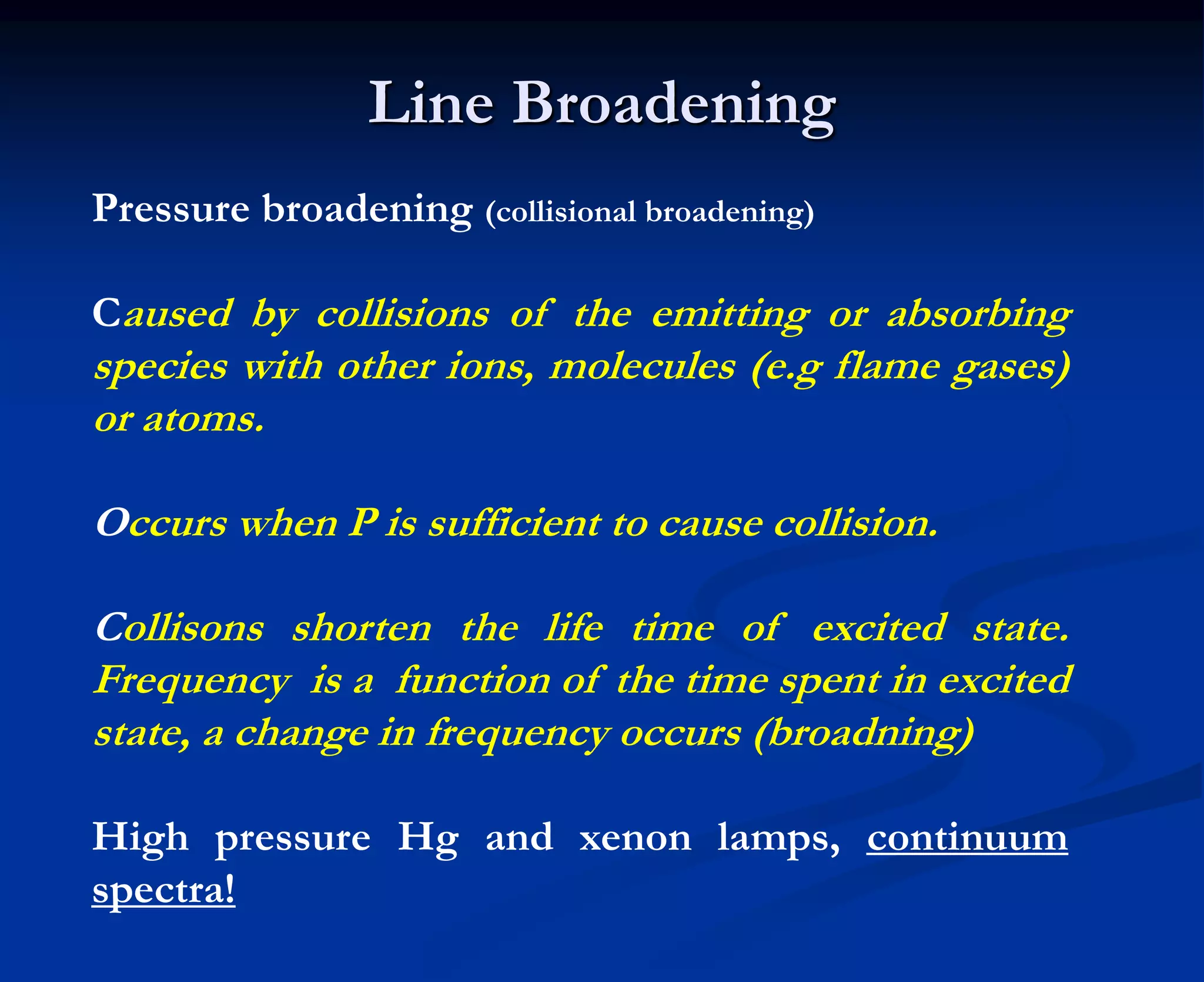
Line Broadening
Pressure broadening (collisional broadening)
Caused by collisions of the emitting or absorbing
species with other ions, molecules (e.g flame gases)
or atoms.
Occurs when P is sufficient to cause collision.
Collisons shorten the life time of excited state.
Frequency is a function of the time spent in excited
state, a change in frequency occurs (broadning)
High pressure Hg and xenon lamps, continuum
spectra!
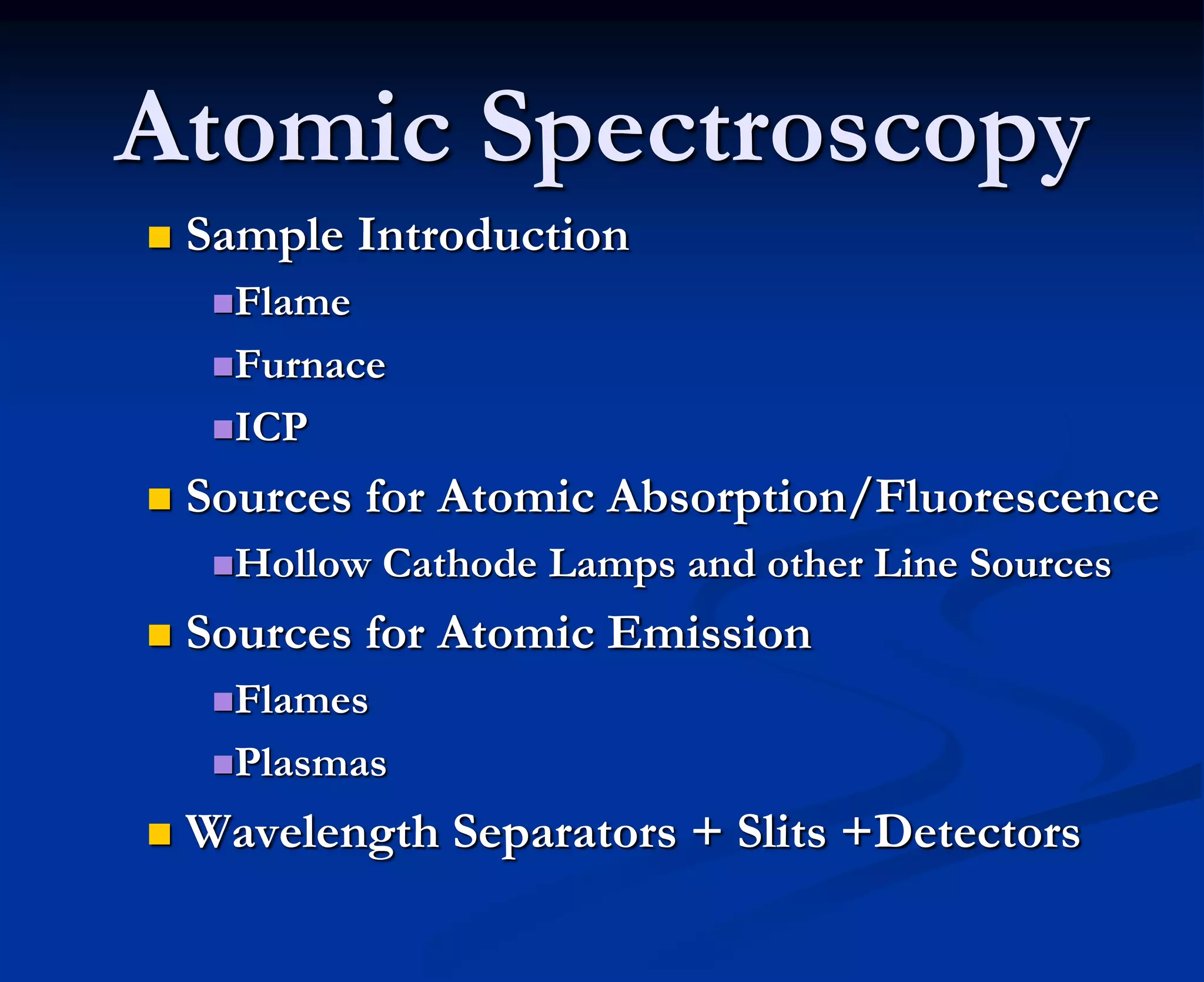
Atomic Spectroscopy
 Sample Introduction
Flame
Furnace
ICP
 Sources for Atomic Absorption/Fluorescence
Hollow Cathode Lamps and other Line Sources
 Sources for Atomic Emission
Flames
Plasmas
 Wavelength Separators + Slits +Detectors
21
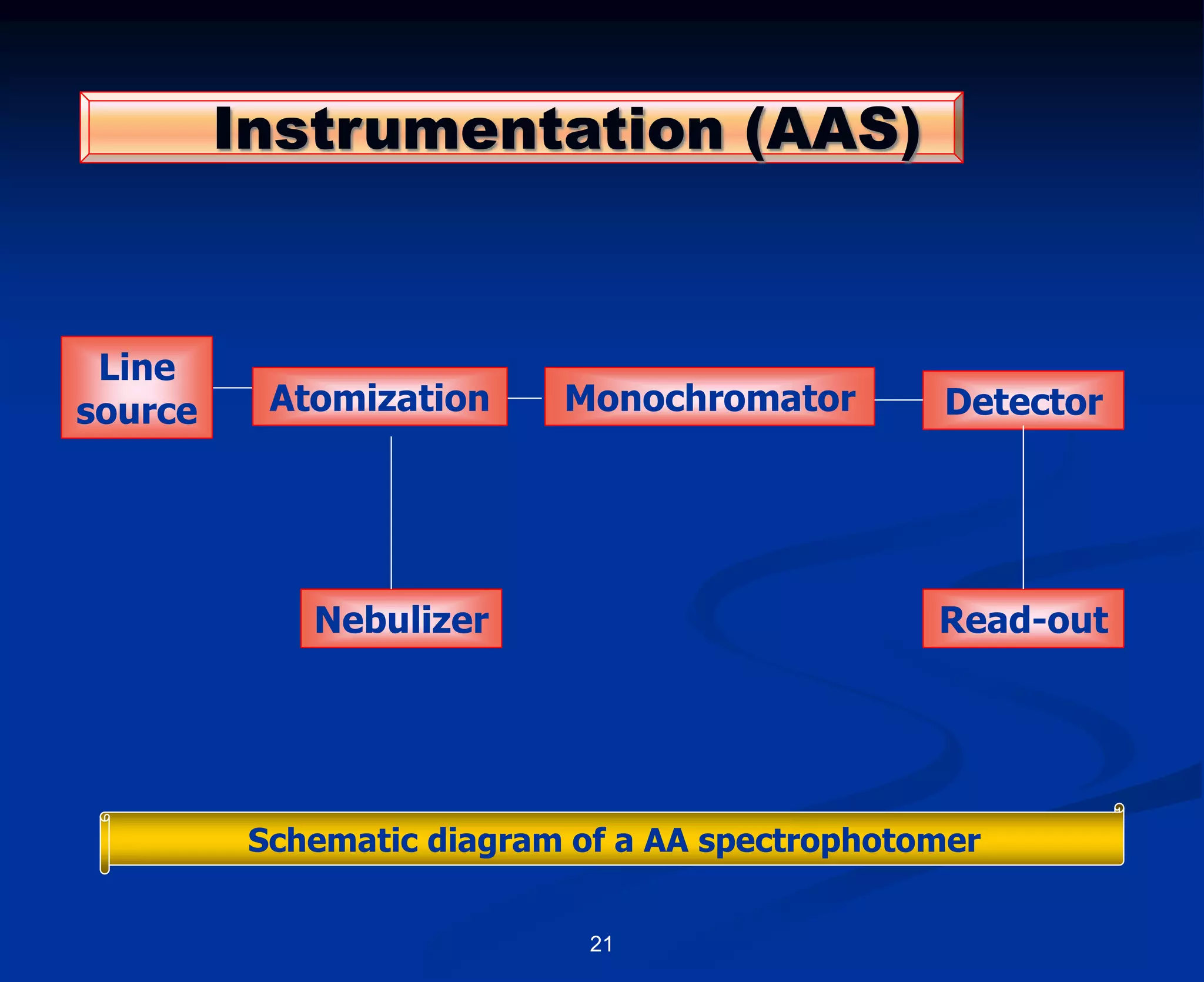
Instrumentation (AAS)
Line
source Monochromator Detector
Read-outNebulizer
Schematic diagram of a AA spectrophotomer
Atomization
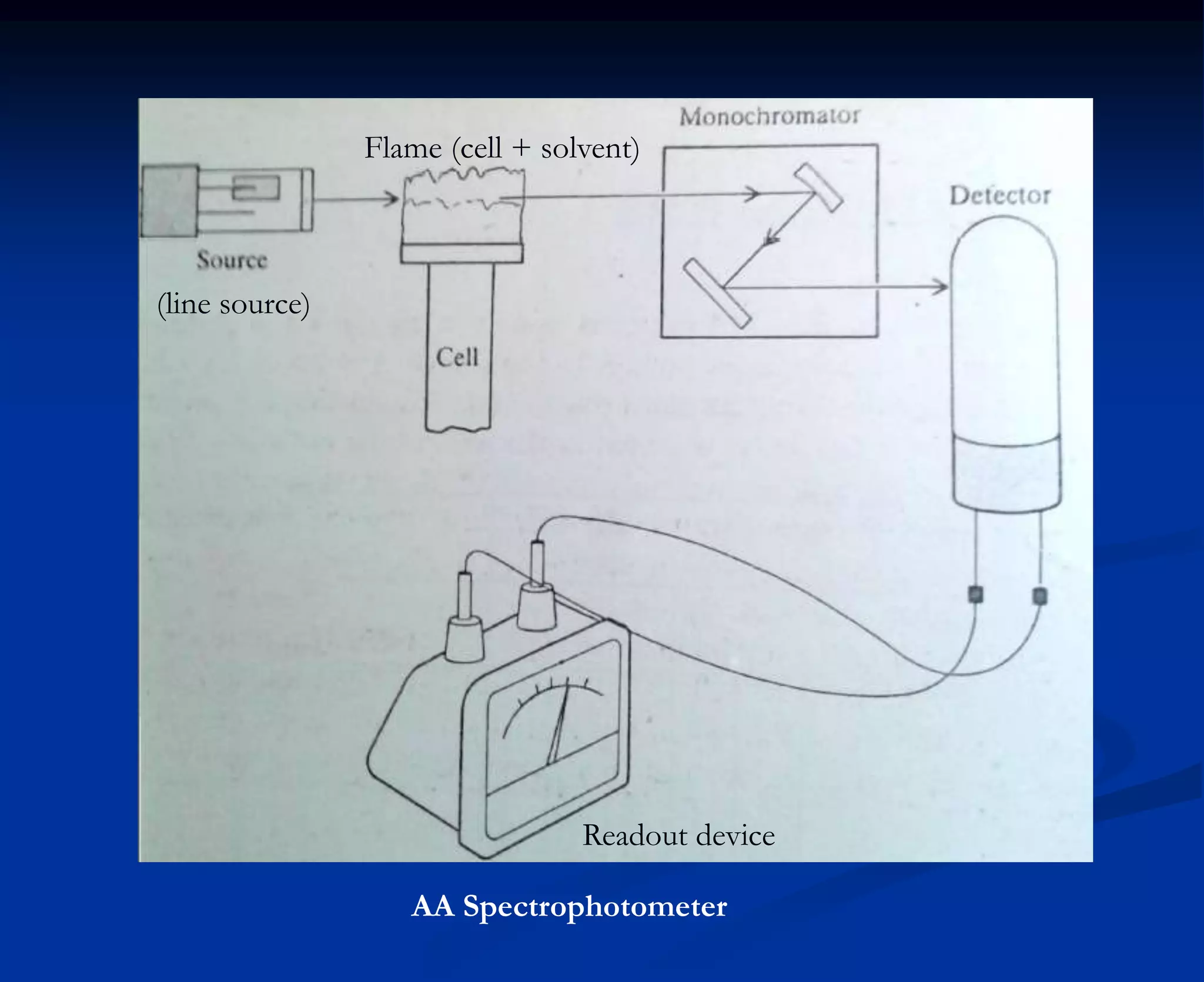
Readout device
(line source)
Flame (cell + solvent)
AA Spectrophotometer
The Atomic Absorption
Spectrometer
 Atomic absorption spectrometers have 4
principal components
1 - A light source ( usually a hollow cathode
lamp )
2 – An atom cell ( atomizer )
3 - A monochromator
4 - A detector , and read out device .
Atomic Absorption
Spectrophotometer
Sample is
vaporized
in the flame.
Aspirator
tube sucks the
sample into the
flame in the
sample
compartment.
Light beam
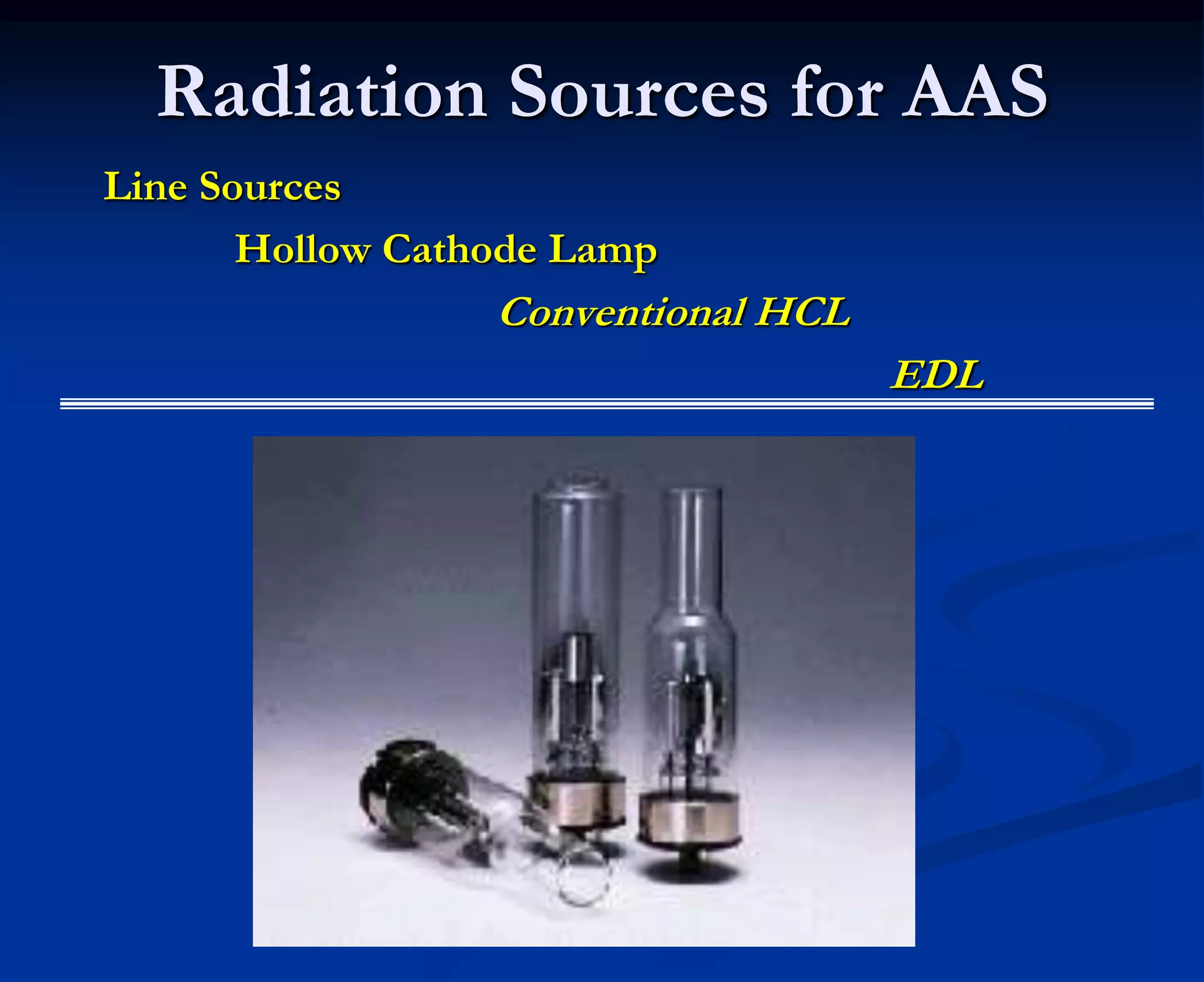
Line Sources
Hollow Cathode Lamp
Conventional HCL
EDL
Radiation Sources for AAS
A = log Po/P = k C
So Source Intensity, I, must be very high within this
narrow absorptive bands.
Why?
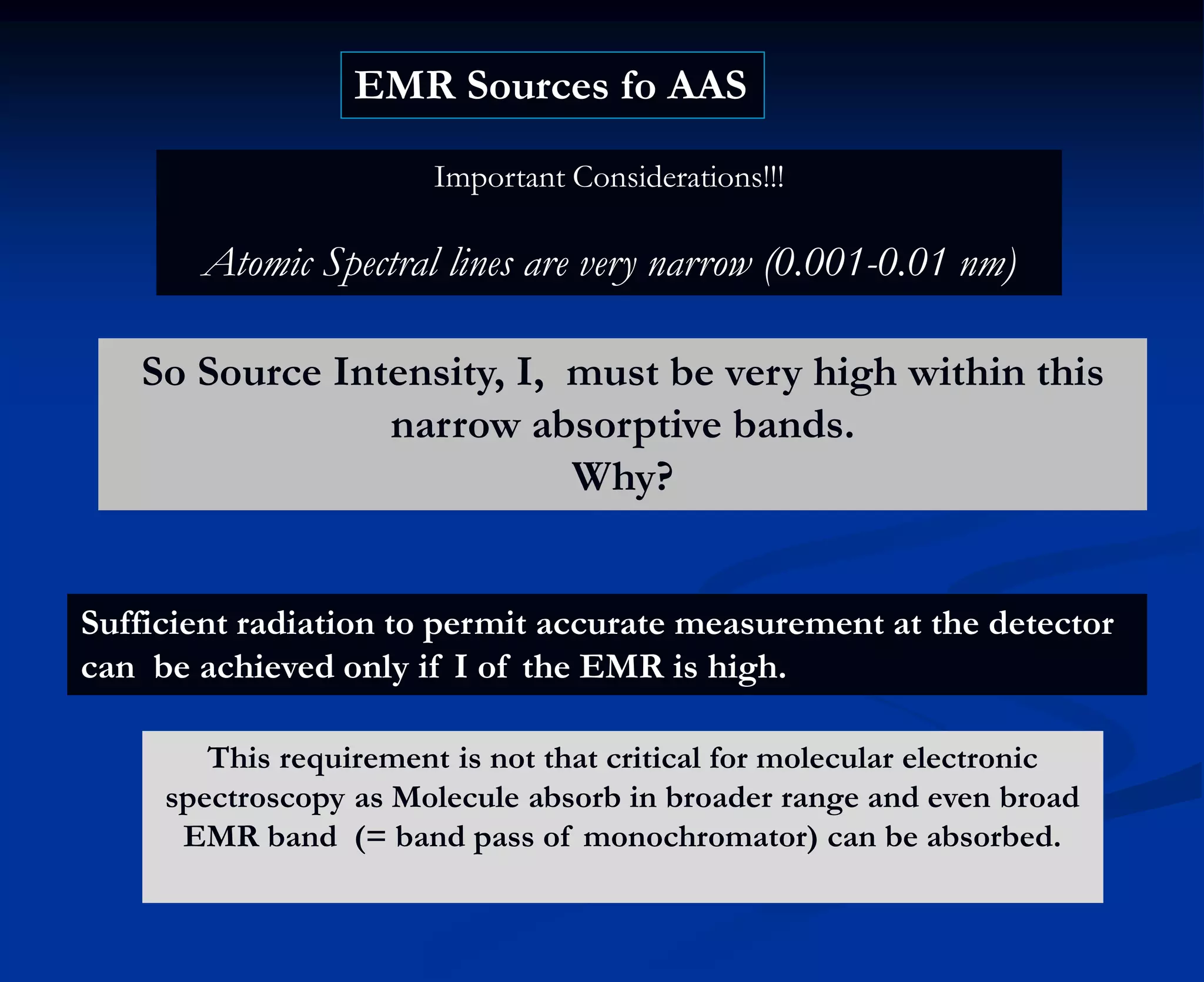
EMR Sources fo AAS
Sufficient radiation to permit accurate measurement at the detector
can be achieved only if I of the EMR is high.
Important Considerations!!!
Atomic Spectral lines are very narrow (0.001-0.01 nm)
This requirement is not that critical for molecular electronic
spectroscopy as Molecule absorb in broader range and even broad
EMR band (= band pass of monochromator) can be absorbed.
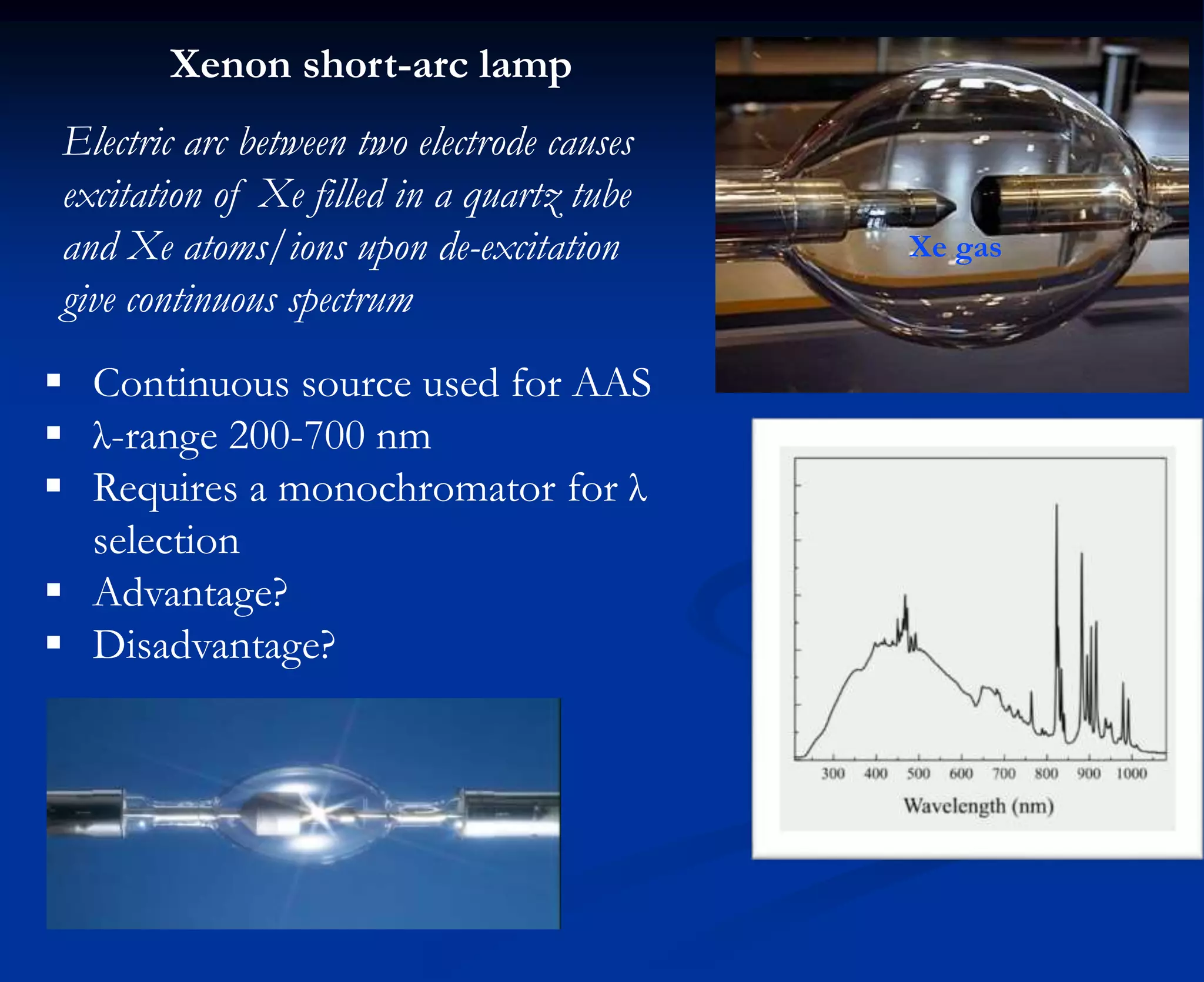
Xenon short-arc lamp
 Continuous source used for AAS
 λ-range 200-700 nm
 Requires a monochromator for λ
selection
 Advantage?
 Disadvantage?
Xe gas
Electric arc between two electrode causes
excitation of Xe filled in a quartz tube
and Xe atoms/ions upon de-excitation
give continuous spectrum
Line Sources (AAS)
 Hollow Cathode Lamp (HCL)
• Multielement HCL
• Demountable HCL
• High Intensity HCL
 Electrodeless Discharge Lamp (EDL)
 Temperature Gradient Lamp
Hollow Cathode Lamp
(Most popular)
Quartz window
Pyrex body
Anode
Cathode
Filler Gas
(Ne or Ar)
at 1-2 Torr
W, Zr, Ni
Made up of
element of
interest or its
alloy
100-200 V
(1-25 mA) Ar+
Ar+ ions strike the cathode to cause Sputtering.
Why Low P?
Sputtering?
Disadvantage?
Multi-element HCL (2-7 elements)/Suffer
Composition change/More volatile
elements distills first and more, Caution!
Demountable HCL. Replaceable cathode,
but time/effort involved.
1 torr = 0.0013158 atm
HOW Hollow Cathode Lamp works?
a tungsten anode and a
cylindrical cathode
neon or argon at a pressure of 1
to 5 torr
The cathode is constructed of
the metal whose spectrum is
desired or served to support a
layer of that metal
Ionize the inert gas at a potential of ~ 300 V
Generate a current of ~ 5 to 15 mA as ions
and electrons migrate to the electrodes.
The gaseous cations acquire enough kinetic energy to dislodge some of the
metal atoms from the cathode surface and produce an atomic cloud.
A portion of sputtered metal atoms is in excited states and thus emits their
characteristic radiation as they return to the ground sate
Eventually, the metal atoms diffuse back to the cathode surface or to the glass
walls of the tube and are re-deposited
Hollow Cathode Lamp (Cont’d)
 High potential, and thus high currents lead to
greater intensities (Operators’ control) as more
sputtering occurs, BUT also leads to self-absorption
and resonant broading.
 Self-absorption or Self-reversal: the greater currents
produce an increased number of unexcited atoms in
the cloud. The unexcited atoms, in turn, are capable
of absorbing the radiation emitted by the excited
ones.This self-absorption leads to lowered
intensities, particular at the center of the emission
band
 Resonanat Broading: Pressure broadening caused by
collision between identical atoms
Improvement…….High Intensity HCL
 Most direct method of obtaining improved lamps
for the emission of more intense atomic resonance
lines is to separate the two functions involving the
production and excitation of atomic vapor
 Boosted discharge hollow-cathode lamp (BDHCL)
or High Intensity HCL is introduced as an AFS*
excitation source by Sullivan and Walsh.
 It has received a great deal of attention and a
number of modifications to this type of source have
been conducted.
*rarely used for AAS
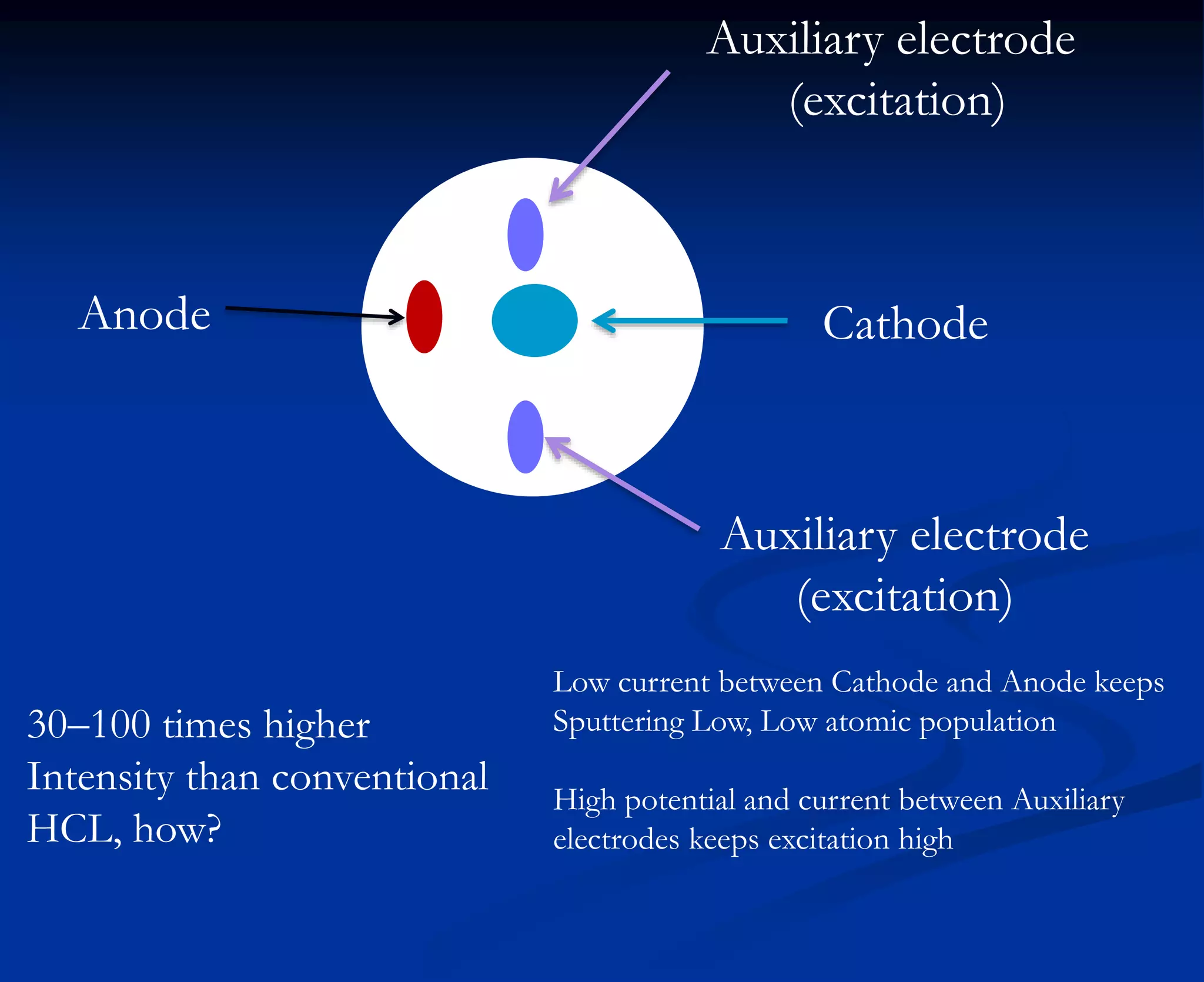
Auxiliary electrode
(excitation)
Auxiliary electrode
(excitation)
CathodeAnode
30⎼100 times higher
Intensity than conventional
HCL, how?
Low current between Cathode and Anode keeps
Sputtering Low, Low atomic population
High potential and current between Auxiliary
electrodes keeps excitation high
Electrodeless Discharge Lamps (EDL)
Evacuated
quartz tube
= M or MX (~ 5 mg)
Construction of EDL
Avalible for
As, Bi, Cd, Cs, Ge, Hg, K, P,, Pb,
Rb, Ti, Zn
Operation of EDL
 Constructed from a sealed quartz tube containing a few torr
(0.1-5 torr) of an inert gas such as argon and a small quantity
of the metal of interest (or its salt).
 The vapour pressure of the elements used in EDL are
sufficiently high to permit some gaseous atoms of the
element to form in the low P environment of the lamp.
 The lamp does not contain an electrode but instead is
energized by an intense field of radio-frequency or microwave
(2450 MHz) radiation.
 Radiant intensities usually one or two orders of magnitude
greater than the normal HCLs. Mostly used for AFS.
 The main drawbacks: their performance does not appear to
be as reliable as that of the HCL lamps (signal instability
with time) and they are only commercially available for some
elements only. Their Intensity depends on T so T controlled
required ; they are less stable than HCL.
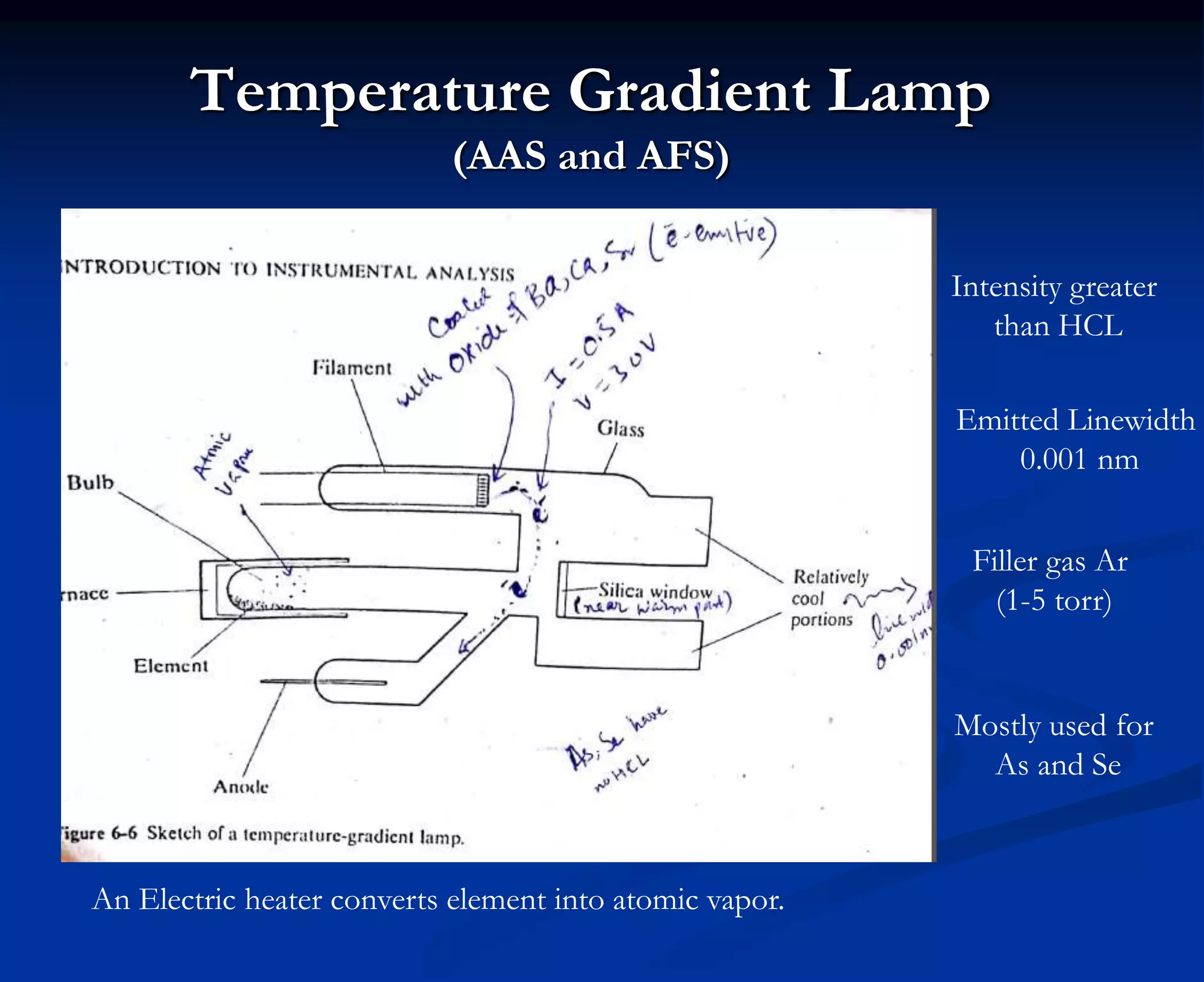
Temperature Gradient Lamp
(AAS and AFS)
Intensity greater
than HCL
Emitted Linewidth
0.001 nm
An Electric heater converts element into atomic vapor.
Filler gas Ar
(1-5 torr)
Mostly used for
As and Se
Atomizer
Nebulizer Burner Flame
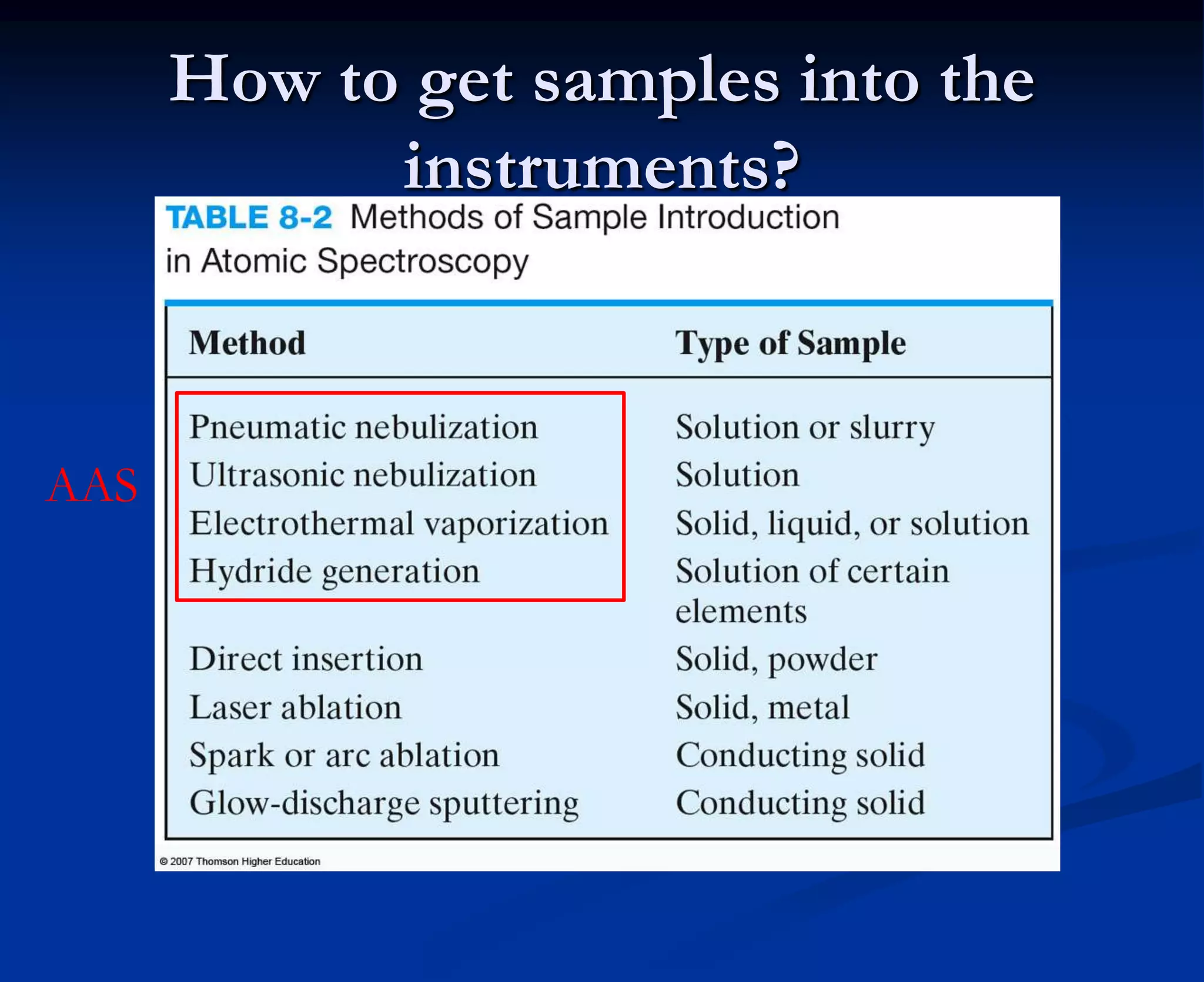
How to get samples into the
instruments?
AAS
How to get sample atomize?
What is a nebulizer?
(Breaks sample into fine mist)
SAMPLE
AEROSOL
Nebulizers
 Controlled droplet size distribution
 Uniform flow rate
 Easy cleaning
 No Blockage
 No chemical reaction with solution
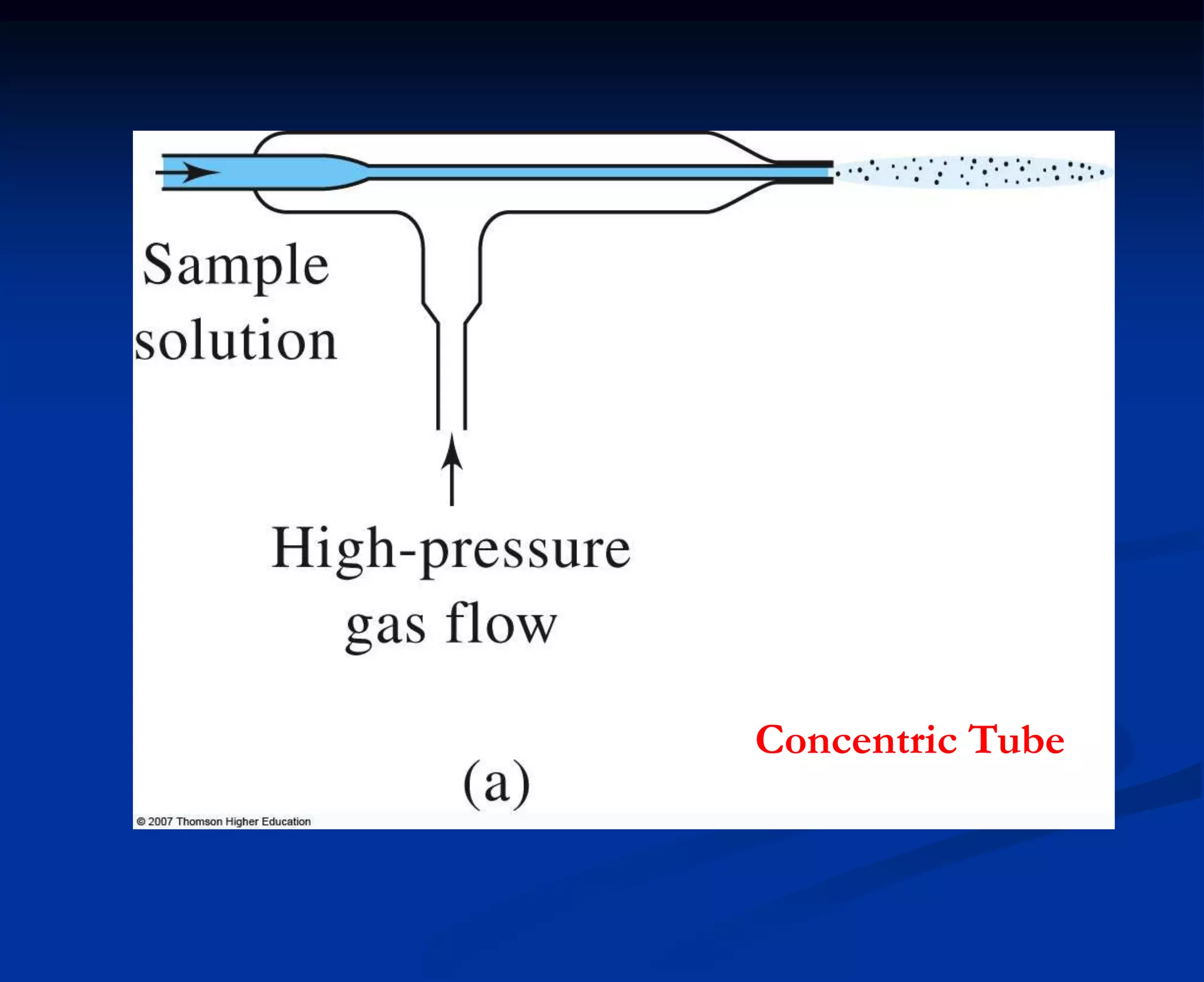
 Pneumatic Nebulizers
 Simplest, for clear non-turbid solutions
 Break the sample solution into small droplets.
 Solvent evaporates from many of the droplets.
 Most (>99%) are collected as waste
 The small fraction that reach the flame have been de-
solvated to a great extent.
 Efficiency of Nebulizer (droplet size distribution)
depends on flow rate, viscosity, surface tension of
solvent
 A corrosion-resistant bead placed at the outlet of the
nebulizer increase efficiency by removing big droplets.
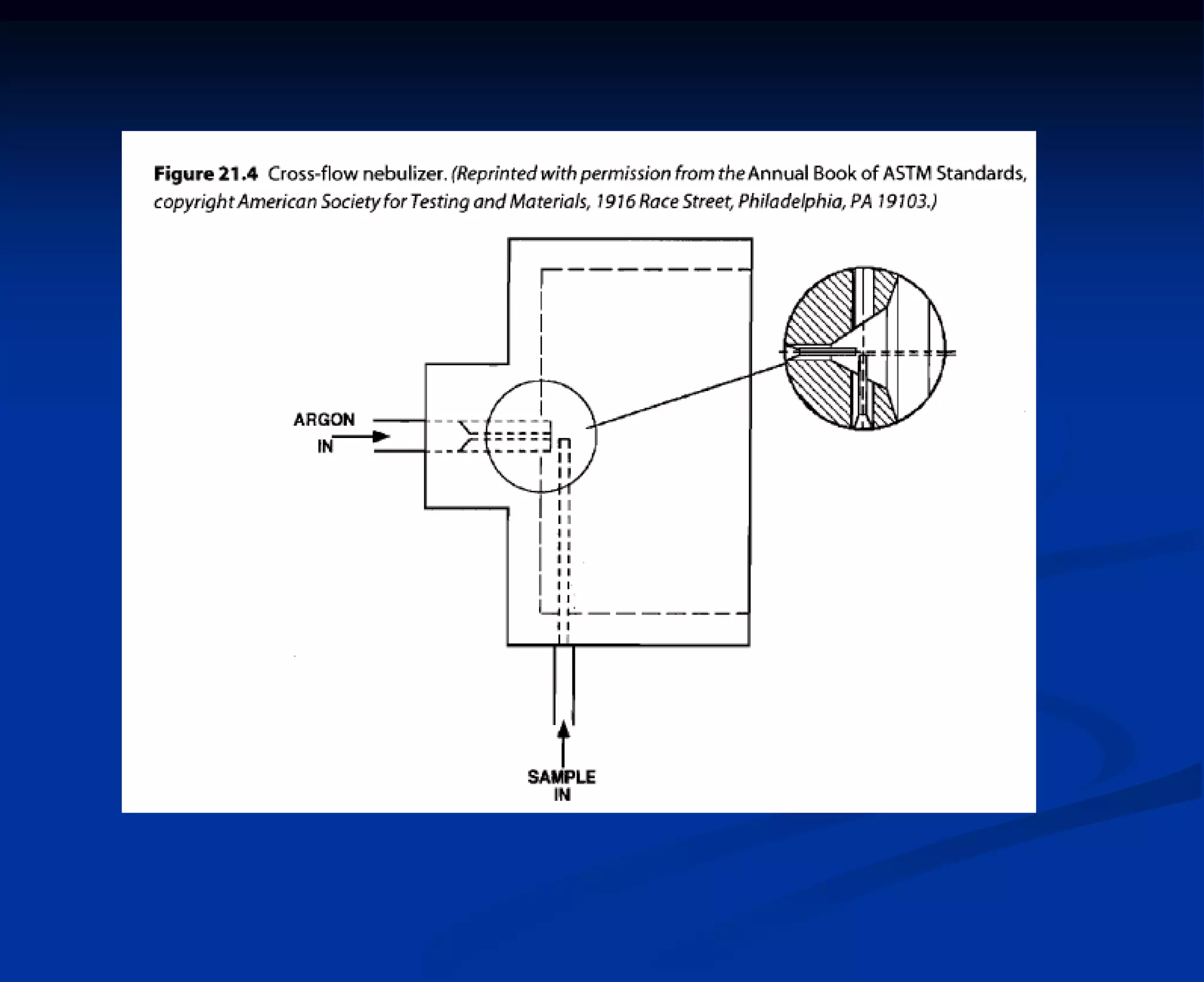
Concentric Tube
Cross-flow
Fritted-disk
Babington
 Viscous liquids
 No Blockage
ULTRASONIC NEBULZIERS
 Sample is placed in a tank and ultrasound waves
are passed through it from the base.
 The dense fog formed is swept with an oxidants
into the flame.
 Particle size distribution depends on frequencyand
is independent of flow rate of oxidant
How to get sample atomize?
BURNERS
Total Consumption Burner
Premix or Laminar-flow Burner
Total Consumption Burner
 Fuel, Oxidant and Sample flow directly into the flame
 No mixing of flame gases prior to being burned in
flame (Advantage!!!)
 No risk of explosion and gases with high burning velocity
Can be used
Disadvantages:
 Turbulent flame (erratic cooling caused by large droplets
 Scattering by large droplets (incomplete vaporization)
 Flame shape not ideal for AAS measurements (short
pathlength)
 More sample enter the flame but efficiency of atomization
is low
 TCB rarely used
Premix Burner
Turbulence decreases if large droplets are
Avoided.
Fuel is mixed with oxidant and sample (Risk!)
Only fine droplets reach the flame
Large droplets (90% sample) are drained out
(Disadvantage)
Less sample enter the flame but atomization is
efficient (advantage)
Longer pathlength (suitable burner head) (Advantage!)
Smoother burning flame results in high S/N ration (Better for Quantitative analysis!)
• Sample is “pulled” into the nebulization chamber by the flow of fuel
and oxidant.
Laminar Flow Burners
• Contains spoilers
(baffles) to allow only the
finest droplets to reach
the burner head.
• Burner head has a long
path length and is ideal
for atomic absorption
spectroscopy.
Advantages:
1. Uniform dropsize
2. Homogeneous flame
3. Quiet flame and a long path length
Disadvantages:
1. Flash back if Vburning > Vflow
2. ~90% of sample is lost
3. Large mixing volume
FLAMES
Rich in
free atoms
The sequence of events in not the same for every drop (drop size, Fuel/Oxd flow rate,
type of flame, oxides formation tendency
1. Types of Flames
Fuel / Oxidant Temperature
H-CC-H acetylene / air 2100 °C – 2400 °C (most common)
acetylene / N2O 2600 °C – 2800 °C
acetylene / O2 3050 °C – 3150 °C
• Selection of flame type depends on the volatilization temperature of
the atom of interest.
2. Flame Structure
• Interzonal region is the hottest part of the
flame and best for atomic absorption.
• Fuel rich flames are best for atoms because
the likelihood of oxidation of the atoms is
reduced.
• Oxidation of the atoms occurs in the
secondary combustion zone where the atoms
will form molecular oxides and are dispersed
into the surroundings.
• A α Ɩ and A α C
C of atoms in flam can be increased by decreasing volume.
Unfortunately, increasing Ɩ increases volume.
So then?
Use a burner head that gives long but thin/narrow flame
Too thin/narrow a flame can gets easily cooled and atomic
population may decrease, Caution!
TEMPRATURE of flame depends on FUEL/OXD. Ratio
FUEL-RICH FLAME, more fuel than oxidant, reducing but low T)
LEAN FLAME: Oxidant rich flame (oxidizing but hotter)
3. Temperature Profiles
• It is important to focus the entrance slit of the
monochromator on the same part of the flame
for all calibration and sample measurements.
4. Flame Absorption Profiles
• Mg - atomized by longer exposure to
flame, but is eventually oxidized.
• Ag - slow to oxidize, the number of atoms
increases with flame height.
• Cr - oxidizes readily, highest
concentration of atoms at the base of
the flame.
Flame absorbance Profiles:
Fig. 9-4 shows typical absorption
profiles for three elements.
Magnesium exhibits a maximumin
absorbance at the middle of the
flame. The behavior of silver,
which is not readily oxidized, is
quite different, a continuous
increase in the number of atoms,
and thus the absorbance, is
observed from the base to the
periphery of the flame. Chromium,
which forms very stable oxides,
shows a continuous decrease in
absorbance beginning close to the
burner tip.
Flame Burner
 Mn+(aq) + anion(aq)  salt(s)
 salt(s)  salt(g)
 salt(g)  atoms (g)
 M(g) + hn  M*(g)
FLAMES
Types of Flames Used in Atomic
Spectroscopy
Ca Cu
K Mn
Cold vapour technique (uheated cell)
Hg2+ + Sn2+ = Hg + Sn (IV)
5% H2SO4
+
0.05 M KMnO4
Hg
lamp
253.7 nm
SnCl2
Cold vapour technique (unheated cell)
Hg2+ + Sn2+ = Hg + Sn (IV)
71
Hydride generation methods
(HGAAS)
For arsenic (As), antimony (Te) and selenium (Se)
As0
(gas) + H2As (V) AsH3
NaBH4
(sol)
heat
in flame[H+]
The reaction of many metalloids with sodium borohydride
and HCl produces a volatile hydride: H2Te, H2Se, H3As,
H3Sb, etc.
72
H
(HGAAS)
http://www.shsu.edu/~chm_tgc/sounds/flashfiles/HGAAS.scrubber.swf
(HGAAS)
http://www.shsu.edu/~chm_tgc/primers/primers.html
(HGAAS)
Electrothermal AAS (ETAAS or GFAAS)
(Flameless atomizers)
Tubular graphite furnaces Carbon rod/cup atomizers
L’ vov, B.V.: Spectrochim. Acta, 17: 761 (1961)
Professor Boris Vladimirovich L’vov with
his wife after the award ceremony
(Fijalkowski award 2010)
Electrothermal AAS (ETAAS or GFAAS)
(Flameless atomizers)
 The sample is contained in a heated, graphite
furnace.
 The furnace is heated (up to 3500°C) in a controlled
manner by passing an electrical current through it
(electro-thermal).
 To prevent oxidation of the furnace, it is sheathed in
gas, Ar or N2 (up to 2500°C (cyanogens formation!))
 There is no nebulzation, etc. The sample is
introduced as a drop (usually 5-50 µL), slurry or
solid particle (rare)
 The furnace goes through several steps.
 Drying (usually just above 110 °C, 10 s)…Solvent evaporation
 Ashing (350⎼1200 ° C, 45 s)…Organic volatilized/matrix destroyed
 Atomization (Up to 2000 ⎼ 3000 °C, 5 s)… Discrete gaseous atoms
formed and absorbance measured
 Cleanout (quick ramp up to 3500 ° C or so)… Waste is blown out with
a blast of Ar.
 Heating rate is kept high (1000°C to 108°C) to ensure high atomic
concentration during atomization. The light from the source (HCL) passes
through the furnace and absorption during the atomization step is recorded
over several seconds. This makes ETAAS more sensitive than FAAS for
most elements.
Steps involved in atomization process in Furnaces
Drying (usually just above 110 °C)
Ashing (350⎼1200 ° C)
Atomization (Up to 2000 ⎼ 3000 °C)
Cleanout (quick ramp up to 3500 ° C)
Steps involved in atomization process in Furnaces
Tubular Graphite Furnace
Tubular graphite furnace is often coated with pyrolytic graphite (less porous than graphite)
Drawbacks: Significant background absorption and matrix effect.
Matrix effect is eliminated by using a furnace that operates at constant temperature
Platform Tubular Graphite Furnace
Carbon Rod Atomizers
 Not very famous
 Cylindrical graphite rod/cup with a hole
 Argon-sheathed (prevention of oxidation)
 Temperature of sample point is high than
 surrounding (avoids wastage of sample)
 Inert-gas flow: stop gas flow at atomization step
 Sample amount: adequate sample needed. Too much sample leads to
greater atomization and expulsion of vapours to surrounding (abs↓)
 Organic compounds surrounding metallic analytes makes it difficult for
sample to get uniformly heated.
 Carbides formation (Refractory!)
 Cyanogen formation (N2 react with graphite above 2500°C)
Factors affecting atomization in Furnaces
Flames vs. Furnaces
Flames
 Large sample volume
 Sample stay shorter in flame
Furnaces
 Small sample volume (5-50 µL)
 Sample stay longer in path of EMR (can be used to
assay smaller sample volumes and lower concentrations
 Expensive (power supply)
 Extra care to get reproducible results
 Background correction
 Requires fast responding detector
Wavelength Selectors
 Generally monochromator are used .
 Band pass of monochromators: 0.2, 0.5, or 1 nm
 Width of absorptive lines: 0.004 nm (narrower
than band pass of monochromator)
A monochromators consists of entrance/exit slits, a prism or
diffraction grating (dispersive component) and lenses/mirrors
(to collimate/focus the beam).
They generally employ a diffraction grating to disperse the
radiation into its component wavelengths. Older instruments
used prisms for this purpose.
Monochromator
By rotating the grating or Prism, different wavelengths can be made to pass
through an exit slit. The output wavelength of a monochromator is thus
continuously variable over a considerable spectral range
Prism monochromators
Grating
Monochro
-mators
Grating monochromator
By rotating the grating, different wavelengths can be made to pass through an exit slit. The
output wavelength of a monochromator is thus continuously variable over a considerable
spectral range. The wavelength range passed by a monochromator, called the spectral
bandpass or effective bandwidth, can be less than 1 nm for moderately expensive
instruments to grater than 20 nm for inexpensive systems.
The output of a grating monochrmomator
λ2 < λ1
Effective bandwidth- the width of the
band of transmitted radiation in λ units at half
the peak height.
For monochormators EBW = few 10th of a nm
For absorption Filter EBW = 200 nm or more
Transmittance at nominal λ
nominal λ
Photomultiplier Detector
 PMT is commonly used.
 The detector consists of a photoemissive
cathode coupled with a series of electron-
multiplying dynode stages, and usually called a
photomultiplier.
 The primary electrons ejected from the photo-
cathode are accelerated by an electric field so as
to strike a small area on the first dynode.
Detectors
Amplification: nd
n = average no. of e emitted by each dynode
d = number of dynodes
Photomultiplier Detector
Single-beam design
DOUBLE BEAM FAA
SPECTROMETER
Note: the Ref beam does not pass
through the flame thus does not correct for the
interferences from the flame!
synchronized
Interferences in AAS
1- Chemical Interferences
2- Ionization interferences
3- Spectral interferences
4- Matrix interferences
 Chemical Interferences
 Chemical reaction in cell (removal of atoms)
 Formation of compounds of low volatility
Calcium analysis in the presence of Sulfate (CaO.SO3) or
phosphate(CaO.P2O5)
Formations of refractory oxides (Al2O3, Fe2O3) of unusual stability
in flames
Formation of carbides or cyanogen (CN)2 in furnaces
Solutions
 Higher temperature or deceases O2 concentration (fuel rich
flame), e.g., changing air-C2H2 flame to N2O-C2H2 flame
 Releasing agents: Cations (e.g LaCl3 used for Ca, Mg, Sr) hat
react preferentially with the interference ions.
(Ca2+
(analyte) + PO4
3-
(interfering) + La3+  LaPO4 + Ca2
(free) )
 Protection agents: form stable but volatile species with the
analytes (i.e. EDTA)
 Ionization Interferences
 Atom ionization (usually due to high T)
M ↔ M+ + e (group IA and IIA have low IE)
 Spectral lines occur at different λ than atomic lines
-decrease in AA signal
 Ionization decreases at high concentration
- competition B/W atom for available E
Solutions
 Use low temperature flame (air-propane)
 Add large amount of easily ionizing element
(500-5000 µg/mL of Li, Na, K) element
 Use high concentration of analyte
 Matrix interferences
 These are caused by the physical nature of the matrix enhancing
or depressing sensitivity
 Example: Viscosity difference b/w sample and stadards
(different nebulzation/aspiration/atomization)
Solutions
 Standard addition technique
 Matching the matrix of sample
with that of standards
 Solvent extraction or so to
isolate the analyte
 Spectral Interferences
 Overlapping (spectra of analyte and another atomic/molecular
species)
 Background (non-specific) Interferences :
-Spectral interferences resulting from emission of EMR
from elements in cell
-Scattering or absorption by sample matrix or polyatomic
species
 Positive error (analyte and matrix absorb the same λ)
 Negative error: Interfering species emits same λ as used for
measurement
Tb/Mg = 285.2 nm
Cr/Os = 290.0 nm
Ca/Ge = 422.7 nm
Examples:
Spectral Interferences…
Solutions
 Chemical Separation prior to the assay
 Modulation of the detector
 Background correction
Modulation of the detector:
The detector is tuned to the frequency of oscillation of the
EMR source, it doesn’t respond to the steady-state emissions
from the cell. Therefore, interference owing to emission from
the cell is eliminated
Background Correction
Background (non-specific) Interferences:
-Spectral interferences resulting from emission of EMR
from elements in cell
-absorption by polyatomic species or scattering within the
cell
- More severe in furnaces than flames
- Greater at shorter λs (more scattering)
Continuum-Source Correction
Background Correction
AHCL = Aanalyte + Abackground
AD2 = Abackground
Continuum-Source Correction
0.04 nm
A B
The light from the HCL is absorbed by both the sample and the background, but
the light from the D2 lamp is absorbed almost entirely by the background
A: HCL lamp, the shaded portion shows the light absorbed from the HCL. The emission
has a much narrower line width than the absorption line.
B: D2 lamp, the shaded portion shows the light absorbed from the D2 lamp. The lamp
emission is much broader than the sample absorption, and an averaged absorbance taken
over the whole band pass of the monochromator.
(The draw is not to scale)
Quantitative analysis (AAS)
Beer’s Law is obeyed: A = kbC
Concentration in cell α concentration in solution
(under fixed experimental condition)
Absorbance α Concentration in cell
Absorbance α concentration in solution
Thus
As
And
b = pathlength
C= concentration
k = constant representing molar
absorptivity and other factors that may
affect absorbance such as
aspiration rate, degree of atomization,
the position of flame where signal is
measured, flow rate of gases entering
the flame, T of cell
A working curve method or standard addition method can be used
for quantitative analysis
Sample Problem: pg. 312, #3
Lead is extracted from a sample of blood and analyzed at 283 nm and gave an
absorbance of 0.340 in an AA spectrometer. Using the data provided, graph a
calibration curve and find the concentration of lead ions in the blood sample.
[Pb+2] (ppm) Absorbance Calculated Pb (II) concentraions (ppm) Absorbance
0.000 0.000 0.324 0.340
0.100 0.116
0.200 0.216
0.300 0.310
0.400 0.425
0.500 0.520
y = 1.0505x
R² = 0.9988
0.000
0.100
0.200
0.300
0.400
0.500
0.600
0.000 0.100 0.200 0.300 0.400 0.500 0.600
Absorbance
[Pb+2] (ppm)
Lead (II) Calibration Curve
• The data provided
in the problem
appears in the
upper left hand
corner of this MS
EXCEL worksheet.
• The graph was
used to calculate
the best fit line.
• The equation was
then used to
calculate the
concentration of
Pb (II) ions with an
absorbance of
0.340.
• The result, 0.324
ppm, is displayed
above the graph.
Elements detectable by atomic absorption are highlighted in pink in
this periodic table
Comparison Between Atomic
Absorption and Emission
Spectroscopy
Absorption
- Measure trace metal
concentrations in
complex matrices .
- Atomic absorption
depends upon the
number of ground state
atoms .
Emission
- Measure trace metal
concentrations in
complex matrices .
- Atomic emission depends
upon the number of
excited atoms .
- It measures the
radiation absorbed by
the ground state atoms.
- Presence of a light
source ( HCL ) .
- The temperature in
the atomizer is adjusted
to atomize the analyte
atoms in the ground
state only.
- It measures the
radiation emitted by
the excited atoms .
- Absence of the light
source .
- The temperature in the
atomizer is big enough
to atomize the analyte
atoms and excite them
to a higher energy level.
3
AAS APPLICATIONS
The are many applications for atomic
absorption:
- Clinical analysis : Analyzing metals in
biological fluids such as blood and urine.
- Environmental analysis : Monitoring our
environment – e g finding out the levels of
various elements in rivers, seawater,
drinking water, air, and petrol.
- Pharmaceuticals. In some pharmaceutical
manufacturing processes, minute quantities of a
catalyst used in the process (usually a metal) are
sometimes present in the final product. By using
AAS the amount of catalyst present can be
determined.
- Industry : Many raw materials are examined and
AAS is widely used to check that the major elements
are present and that toxic impurities are lower than
specified – e g in concrete, where calcium is a major
constituent, the lead level should be low because it is
toxic.
- Mining: By using AAS the amount of metals
such as gold in rocks can be determined to
see whether it is worth mining the rocks to
extract the gold .
- Trace elements in food analysis
- Trace element analysis of cosmetics
- Trace element analysis of hair
Paper 1
Determination of lead in dialysis
concentrates using FI – HG AAS
- Dialysis is a medical treatment that is given to patients with
abnormal function of the kidney .
- Washing the kidney from the various trace elements that the
kidney itself should have done .
- - One of the elements that is present in a dialysis concentrate is
lead ,which is very toxic and become fatal if it exceeds the level of 380
กg / l in our body .
- - In order to determine the Pb concentration in a dialysis
concentrate, a flow injection hydride generation atomic
absorption spectroscopy was proposed .
- The hydride generation is very applicable since its is a
reducing agent and for some metals with high
oxidation state the atomization energy is high, so the
hydride simply reduces the oxidation sate and thus the
atomization energy .
- Lead hydride is usually unstable but in an acidic medium of
HCl with the presence of a mild oxidant K3 Fe (CN )6, it
showed high precision and freedom from
interferences .
- Sample is injected in an HCl , K3 Fe (CN )6 carrier
solution and then combined with with NaBH4 to mix
in the mixing coil .
- An Argon gas carrier is used to sweep out the lead
hydride carrier all the way to the atomizer .
- Comparison was done with an electro thermal AAS ,and
the results were close but in FI HG AAS interference
was absent .
- Finally FI HG AAS showed to be easy, simple ,and low
cost compared to ICP; and it is applicable to all
hydride standards .
paper 2
Online separation for the speciation of
mercury in natural waters by flow injection
Atomic Absorption Spectrometry ratio
- Nowadays methyl mercury is considered as the
most toxic mercury compound .
- In this application separation of inorganic
mercury Hg+ from methyl mercury CH3Hg+ will
be performed in an ion exchanger in a FIA
apparatus, and then followed by detection of
CH3Hg+ in an atomic absorption spectrometer .
- An ion exchanger is used to take out the Hg+
since at pH < 10 Hg+ is completely anionic
(HgCl)4-2 while CH3HgCl remains neutral .
- The left CH3Hgcl is detected by an atomic
absorption Spectrometer .
- This application is very interesting because it
used AAS , and FIA techniques to do both
separation and detection .
Supplementary Slides
Line Broadening
 Uncertainty Effects
 Heisenberg uncertainty principle:
The nature of the matter places limits on the
precision with which certain pairs of physical
measurements (complementary variables) can be
made.
One of the important forms Heisenberg uncertainty
principle:
tn ≥ 1
To determine n with negligibly small uncertainty, a huge measurement time
is required.
 Natural line width
INTERFERENCES IN ATOMIC
ABSORPTION SPECTROSCOPY
1. Spectral Interferences:
(I) Spectral interference can occur due to overlapping
lines. e.g. a vanadium line at 3082.11Å interferes in an
analysis based upon the aluminum absorption line at
3082.15 Å. This type of interference can be avoid by
employing the aluminum line at 3092.7 Å instead.
(II) Spectral interferences result from the presence of
combustion products that exhibit broadband absorption
or particulate products that scatter radiation. Both
diminish the power of the transmitted beam. A blank
can be aspirated into the flame to make the correction.
…Spectral Interferences continued…
(III) Source of absorption or scattering can
be originated in the sample matrix. An
example of a potential matrix interference
due to absorption occurs in the
determination of barium in alkaline earth
mixture. The wavelength of Ba line used for
atomic absorption analysis appears in the
center of a broad absorption band for
CaOH. The effect can be eliminated by
substituting nitrous oxide for air as the
oxidant which yields a higher temperature
that decomposed the CaOH and eliminates
the absorption band.
…Spectral Interferences continued…
(IV) Concentrated solution of elements
such as Ti, Zr and W which form
refractory oxides can cause spectral
interference due to scattering.
(V) Organic solvent or organic impurities
in the sample can cause scattering
interference from carbonaceous particle
because of incomplete combustion of the
organic matrix.
2. Chemical Interferences:
(I) Formation of Compounds of Low
Volatility: The most common type of
interference is by anions that form compounds
of low volatility with the analyte and thus
reduce the rate at which the analyte is atomized.
The decrease in calcium absorbance that is
observed with increasing concentrations of
sulfate or phosphate. Example of cation
interference have also been recognized.
Aluminum is found to cause low results in the
determination of magnesium, apparently as a
result of the formation of a heat-stable
…Formation of Compounds of Low Volatility
continued…
Interference due to formation of species of low
volatility can often be eliminated or moderated
by use of higher temperatures. Releasing
agents which are cations that react
preferentially with the interferant and prevent
its interaction with the analyte, can be
employed. Protective agents prevent
interference by forming stable but volatile
species with the analyte. Three common
reagents for this purpose are EDTA, 8-
…Chemical Interferences continued…
(II) Dissociation Equilibria: Gaseous
environment of a flame or a furnace, numerous
dissociation and association reactions lead to
conversion of the metallic constituents to the
elemental state. Some of these reactions are
reversible
MO M + O
M(OH)2 M + 2OH
Where M is the analyte atom.
VOx V + Ox
AlOx Al + Ox
TiOx Ti + Ox
…Chemical Interferences continued…
(III) Ionization Equilibria: Ionization of
atoms and molecules is small in combustion
mixtures that involve air as the oxidant, and
generally can be neglected. In higher
temperatures of flames where oxygen or nitrous
oxide serves as the oxidant, however, ionization
becomes important, and a significant
concentration of free electrons exists as a
consequence of the equilibrium
M M+ + e-
The equilibrium constant K for this reaction
takes the form
K= [M+][e-]

Atomic Absorption Spectroscopy (AAS)

  • 1.
    Atomic Spectroscopy Dr. SajjadUllah Institute of Chemical Sciences University of Peshawar, Pak
  • 2.
    Optical Atomic Spectroscopy Optical Spectrometry  Absorption  Emission  Fluorescence Source: R. Thomas, “Choosing the Right Trace Element Technique,” Today’s Chemist at Work, Oct. 1999, 42.
  • 4.
    AAS Higher number of neutralatom (ground state) AES Higher number of neutral atom (Excited state) AFS Higher number of neutral atom (Excited state). Emission measured at 90°
  • 5.
    Principle of AAS The element being determined must be reduced to the elemental state, vaporized, and imposed in the beam of the radiation in the source.  Absorption of EMR (UV-Vis) by neutral atoms in gaseous state  Same principle as molecular Electronic spectroscopy but sample holding, equipment and spectra are different Source Sample PP0 Chopper λ-Selector Detector Signal Processor Readout Flame acts both as cell and solution
  • 6.
     A. Walsh,"The application of atomic absorption spectra to chemical analysis", Spectrochimica Acta, 1955, 7, 108-117. http://www.science.org.au/academy/memoirs/walsh2.htm#1 The invention of hollow cathode lamp by Walsh in 1955 made practical applications of AAS possible
  • 7.
    Types of transitions/Energylevel diagram  Atomic spectra: single external electron (Na or Mg+) Doublet: Slightly different in E (LS coupling) 3p to 5s line is weak, why? unique λ-pattern But depends on E of source λ for Mg2+ are shorter than Na 1s2 2s2 2p6 3s1
  • 8.
    Why a doubletfor p-orbital? When e- spin is parallel to orbital motion (L+S), E is High (repulsive interaction b/w the fields) When e- spin is opposite to orbital motion (L-S), E is Low (attractive interaction b/w the field) The magnitudes of such splitting for d and f orbitals are small Both the spin and the orbital motions create magnetic fields owing to rotation of charge carried by the electron A doublet line is observed for species containing single e- : Na, Mg1+, Al2+ Higher no of e-, complex spectra (e.g., Fe, U have hundreds of such electron transitions as shown in the simple Na
  • 9.
    Atomic spectrum Mg Singletground state Triplet excited stateSinglet excited state Spins are paired No split Spins are unpaired Energy splitting
  • 10.
    1s2 2s2 2p63s2 Paired spin No splitting Three lines
  • 11.
    Excitation in flame (TemperatureEffects)  Boltzmann equation Boltzmann Equation relates Excited state population/Ground State population ratios to Energy, Temperature and Degeneracy Nj/No is exponentially related to T  Effects on AAS and AES )exp( 00 kT E g g N N jj   k= 1.38 x10⁻¹⁶ erg/degree ∆E btw ground and excited states g = statistical weight factors g= 2J+1 (J= L±S) J is the internal atomic quantum number for the atom in particular energetic level
  • 12.
    For Na (3s3p @ 598nm) at 2600 K 2600)x10^-16x/1.381210^x(3.72- o e) 2 4 ( N *N -  N*/No = 1.67 x 10⁻⁴ <0.02% atoms are in excited state
  • 13.
    Boltzmann Distribution All systemsare more stable at lower energy. Even in the flame, most of the atoms will be in their lowest energy state. At 3000K, for every 7 Cs atoms available for emission, there are 1000 Cs atoms available for absorption. At 3000 K, for each Zn available for emission, there are approximately 1 000 000 000 Zn atoms available for absorption. Nj = 10-12 to 1 in most cases
  • 14.
    Intensity of EmissionLine I = A Nj hν I = A hν No (gj/g0) e^-∆E/kT A = Einstein transition probability A= 1/life time of e in excited state or = 1/ no. of transition per second (A = 108 s-1) Nj = no. of atoms in excited state Nj = No (gj/g0) e^-∆E/kT With increase in T, Nj increases and Iemission increases The line that is used for AAS measurement is the one for which the intensity (as predicted by above equation) is maximum Most intense line generally has the highest gjA values* gjA valaues are listed in: Corliss C. H. and Bozman, Experimental transition probabilities for spectral lines of 70 elements, NBS monograph 53, NBS, Washington D.C., 1962,
  • 15.
    AAS vs. AES(Effect of T) Both occur in flame AES: Iemission is dependent on concentration of atoms in the excited state (↑ Nj/No) -more dependent on T AAS: Iabsorption is dependent on concentration of atoms in the ground state( ↓ Nj/No) -less dependent on T (however no of reduced atom ↑ with ↑ T - high T, more no. of reduced atoms, more P broadening - FWHM ↑ and peak height ↓ with ↑ in T (fast moving atoms, Doppler Broadening) FLAME TEMPRATURE must be CONTROLLED!
  • 16.
    Line Broadening  NaturalLine width: 10-5 nm  Observed Line width: 0.001-0.01 nm Two main Reasons: (i) Doppler Broadening (ii) Pressure Broadening The narrow band of absorbed or emitted radiation that is observed is called a spectral line
  • 17.
    Line Broadening  Dopplerbroadening  Doppler shift: The wavelength of radiation emitted or absorbed by a rapidly moving atom decreases if the motion is toward a transducer, and increases if the motion is receding from the transducer. λ↑ λ↓
  • 18.
    The measured speedof light is fixed but frequency and wavelength of the radiation can change as a result of motion of the source The product λ ν always equal the speed of light in a fixed medium As the velocity of the emitting atom towards the detector increases, the observed frequency (ν0) also increases. As the emitting atoms are in random motion (T may effect!), a series of overlapping lines (broadening ) is observed Source: Halliday, D., and R. Resnick: Physics for students of science and engineering, Wiley, NY, 1962, p-915
  • 19.
    Line Broadening Pressure broadening(collisional broadening) Caused by collisions of the emitting or absorbing species with other ions, molecules (e.g flame gases) or atoms. Occurs when P is sufficient to cause collision. Collisons shorten the life time of excited state. Frequency is a function of the time spent in excited state, a change in frequency occurs (broadning) High pressure Hg and xenon lamps, continuum spectra!
  • 20.
    Atomic Spectroscopy  SampleIntroduction Flame Furnace ICP  Sources for Atomic Absorption/Fluorescence Hollow Cathode Lamps and other Line Sources  Sources for Atomic Emission Flames Plasmas  Wavelength Separators + Slits +Detectors
  • 21.
    21 Instrumentation (AAS) Line source MonochromatorDetector Read-outNebulizer Schematic diagram of a AA spectrophotomer Atomization
  • 22.
    Readout device (line source) Flame(cell + solvent) AA Spectrophotometer
  • 23.
    The Atomic Absorption Spectrometer Atomic absorption spectrometers have 4 principal components 1 - A light source ( usually a hollow cathode lamp ) 2 – An atom cell ( atomizer ) 3 - A monochromator 4 - A detector , and read out device .
  • 24.
  • 25.
    Sample is vaporized in theflame. Aspirator tube sucks the sample into the flame in the sample compartment. Light beam
  • 26.
    Line Sources Hollow CathodeLamp Conventional HCL EDL Radiation Sources for AAS
  • 27.
    A = logPo/P = k C
  • 28.
    So Source Intensity,I, must be very high within this narrow absorptive bands. Why? EMR Sources fo AAS Sufficient radiation to permit accurate measurement at the detector can be achieved only if I of the EMR is high. Important Considerations!!! Atomic Spectral lines are very narrow (0.001-0.01 nm) This requirement is not that critical for molecular electronic spectroscopy as Molecule absorb in broader range and even broad EMR band (= band pass of monochromator) can be absorbed.
  • 29.
    Xenon short-arc lamp Continuous source used for AAS  λ-range 200-700 nm  Requires a monochromator for λ selection  Advantage?  Disadvantage? Xe gas Electric arc between two electrode causes excitation of Xe filled in a quartz tube and Xe atoms/ions upon de-excitation give continuous spectrum
  • 30.
    Line Sources (AAS) Hollow Cathode Lamp (HCL) • Multielement HCL • Demountable HCL • High Intensity HCL  Electrodeless Discharge Lamp (EDL)  Temperature Gradient Lamp
  • 31.
    Hollow Cathode Lamp (Mostpopular) Quartz window Pyrex body Anode Cathode
  • 32.
    Filler Gas (Ne orAr) at 1-2 Torr W, Zr, Ni Made up of element of interest or its alloy 100-200 V (1-25 mA) Ar+ Ar+ ions strike the cathode to cause Sputtering. Why Low P? Sputtering? Disadvantage? Multi-element HCL (2-7 elements)/Suffer Composition change/More volatile elements distills first and more, Caution! Demountable HCL. Replaceable cathode, but time/effort involved. 1 torr = 0.0013158 atm
  • 33.
    HOW Hollow CathodeLamp works? a tungsten anode and a cylindrical cathode neon or argon at a pressure of 1 to 5 torr The cathode is constructed of the metal whose spectrum is desired or served to support a layer of that metal Ionize the inert gas at a potential of ~ 300 V Generate a current of ~ 5 to 15 mA as ions and electrons migrate to the electrodes. The gaseous cations acquire enough kinetic energy to dislodge some of the metal atoms from the cathode surface and produce an atomic cloud. A portion of sputtered metal atoms is in excited states and thus emits their characteristic radiation as they return to the ground sate Eventually, the metal atoms diffuse back to the cathode surface or to the glass walls of the tube and are re-deposited
  • 34.
    Hollow Cathode Lamp(Cont’d)  High potential, and thus high currents lead to greater intensities (Operators’ control) as more sputtering occurs, BUT also leads to self-absorption and resonant broading.  Self-absorption or Self-reversal: the greater currents produce an increased number of unexcited atoms in the cloud. The unexcited atoms, in turn, are capable of absorbing the radiation emitted by the excited ones.This self-absorption leads to lowered intensities, particular at the center of the emission band  Resonanat Broading: Pressure broadening caused by collision between identical atoms
  • 35.
    Improvement…….High Intensity HCL Most direct method of obtaining improved lamps for the emission of more intense atomic resonance lines is to separate the two functions involving the production and excitation of atomic vapor  Boosted discharge hollow-cathode lamp (BDHCL) or High Intensity HCL is introduced as an AFS* excitation source by Sullivan and Walsh.  It has received a great deal of attention and a number of modifications to this type of source have been conducted. *rarely used for AAS
  • 36.
    Auxiliary electrode (excitation) Auxiliary electrode (excitation) CathodeAnode 30⎼100times higher Intensity than conventional HCL, how? Low current between Cathode and Anode keeps Sputtering Low, Low atomic population High potential and current between Auxiliary electrodes keeps excitation high
  • 37.
  • 38.
    Evacuated quartz tube = Mor MX (~ 5 mg) Construction of EDL Avalible for As, Bi, Cd, Cs, Ge, Hg, K, P,, Pb, Rb, Ti, Zn
  • 39.
    Operation of EDL Constructed from a sealed quartz tube containing a few torr (0.1-5 torr) of an inert gas such as argon and a small quantity of the metal of interest (or its salt).  The vapour pressure of the elements used in EDL are sufficiently high to permit some gaseous atoms of the element to form in the low P environment of the lamp.  The lamp does not contain an electrode but instead is energized by an intense field of radio-frequency or microwave (2450 MHz) radiation.  Radiant intensities usually one or two orders of magnitude greater than the normal HCLs. Mostly used for AFS.  The main drawbacks: their performance does not appear to be as reliable as that of the HCL lamps (signal instability with time) and they are only commercially available for some elements only. Their Intensity depends on T so T controlled required ; they are less stable than HCL.
  • 40.
    Temperature Gradient Lamp (AASand AFS) Intensity greater than HCL Emitted Linewidth 0.001 nm An Electric heater converts element into atomic vapor. Filler gas Ar (1-5 torr) Mostly used for As and Se
  • 41.
  • 42.
    How to getsamples into the instruments? AAS
  • 43.
    How to getsample atomize?
  • 44.
    What is anebulizer? (Breaks sample into fine mist) SAMPLE AEROSOL
  • 45.
    Nebulizers  Controlled dropletsize distribution  Uniform flow rate  Easy cleaning  No Blockage  No chemical reaction with solution
  • 46.
     Pneumatic Nebulizers Simplest, for clear non-turbid solutions  Break the sample solution into small droplets.  Solvent evaporates from many of the droplets.  Most (>99%) are collected as waste  The small fraction that reach the flame have been de- solvated to a great extent.  Efficiency of Nebulizer (droplet size distribution) depends on flow rate, viscosity, surface tension of solvent  A corrosion-resistant bead placed at the outlet of the nebulizer increase efficiency by removing big droplets.
  • 47.
  • 48.
  • 50.
  • 51.
  • 52.
    ULTRASONIC NEBULZIERS  Sampleis placed in a tank and ultrasound waves are passed through it from the base.  The dense fog formed is swept with an oxidants into the flame.  Particle size distribution depends on frequencyand is independent of flow rate of oxidant
  • 53.
    How to getsample atomize?
  • 54.
  • 55.
    Total Consumption Burner Fuel, Oxidant and Sample flow directly into the flame  No mixing of flame gases prior to being burned in flame (Advantage!!!)  No risk of explosion and gases with high burning velocity Can be used Disadvantages:  Turbulent flame (erratic cooling caused by large droplets  Scattering by large droplets (incomplete vaporization)  Flame shape not ideal for AAS measurements (short pathlength)  More sample enter the flame but efficiency of atomization is low  TCB rarely used
  • 56.
    Premix Burner Turbulence decreasesif large droplets are Avoided. Fuel is mixed with oxidant and sample (Risk!) Only fine droplets reach the flame Large droplets (90% sample) are drained out (Disadvantage) Less sample enter the flame but atomization is efficient (advantage) Longer pathlength (suitable burner head) (Advantage!) Smoother burning flame results in high S/N ration (Better for Quantitative analysis!)
  • 57.
    • Sample is“pulled” into the nebulization chamber by the flow of fuel and oxidant. Laminar Flow Burners • Contains spoilers (baffles) to allow only the finest droplets to reach the burner head. • Burner head has a long path length and is ideal for atomic absorption spectroscopy.
  • 59.
    Advantages: 1. Uniform dropsize 2.Homogeneous flame 3. Quiet flame and a long path length Disadvantages: 1. Flash back if Vburning > Vflow 2. ~90% of sample is lost 3. Large mixing volume
  • 60.
    FLAMES Rich in free atoms Thesequence of events in not the same for every drop (drop size, Fuel/Oxd flow rate, type of flame, oxides formation tendency
  • 61.
    1. Types ofFlames Fuel / Oxidant Temperature H-CC-H acetylene / air 2100 °C – 2400 °C (most common) acetylene / N2O 2600 °C – 2800 °C acetylene / O2 3050 °C – 3150 °C • Selection of flame type depends on the volatilization temperature of the atom of interest. 2. Flame Structure • Interzonal region is the hottest part of the flame and best for atomic absorption. • Fuel rich flames are best for atoms because the likelihood of oxidation of the atoms is reduced. • Oxidation of the atoms occurs in the secondary combustion zone where the atoms will form molecular oxides and are dispersed into the surroundings.
  • 62.
    • A αƖ and A α C C of atoms in flam can be increased by decreasing volume. Unfortunately, increasing Ɩ increases volume. So then? Use a burner head that gives long but thin/narrow flame Too thin/narrow a flame can gets easily cooled and atomic population may decrease, Caution! TEMPRATURE of flame depends on FUEL/OXD. Ratio FUEL-RICH FLAME, more fuel than oxidant, reducing but low T) LEAN FLAME: Oxidant rich flame (oxidizing but hotter)
  • 63.
    3. Temperature Profiles •It is important to focus the entrance slit of the monochromator on the same part of the flame for all calibration and sample measurements. 4. Flame Absorption Profiles • Mg - atomized by longer exposure to flame, but is eventually oxidized. • Ag - slow to oxidize, the number of atoms increases with flame height. • Cr - oxidizes readily, highest concentration of atoms at the base of the flame.
  • 64.
    Flame absorbance Profiles: Fig.9-4 shows typical absorption profiles for three elements. Magnesium exhibits a maximumin absorbance at the middle of the flame. The behavior of silver, which is not readily oxidized, is quite different, a continuous increase in the number of atoms, and thus the absorbance, is observed from the base to the periphery of the flame. Chromium, which forms very stable oxides, shows a continuous decrease in absorbance beginning close to the burner tip.
  • 65.
    Flame Burner  Mn+(aq)+ anion(aq)  salt(s)  salt(s)  salt(g)  salt(g)  atoms (g)  M(g) + hn  M*(g)
  • 66.
  • 67.
    Types of FlamesUsed in Atomic Spectroscopy
  • 68.
  • 69.
    Cold vapour technique(uheated cell) Hg2+ + Sn2+ = Hg + Sn (IV) 5% H2SO4 + 0.05 M KMnO4 Hg lamp 253.7 nm SnCl2
  • 70.
    Cold vapour technique(unheated cell) Hg2+ + Sn2+ = Hg + Sn (IV)
  • 71.
    71 Hydride generation methods (HGAAS) Forarsenic (As), antimony (Te) and selenium (Se) As0 (gas) + H2As (V) AsH3 NaBH4 (sol) heat in flame[H+] The reaction of many metalloids with sodium borohydride and HCl produces a volatile hydride: H2Te, H2Se, H3As, H3Sb, etc.
  • 72.
  • 73.
  • 74.
  • 75.
    Electrothermal AAS (ETAASor GFAAS) (Flameless atomizers) Tubular graphite furnaces Carbon rod/cup atomizers L’ vov, B.V.: Spectrochim. Acta, 17: 761 (1961) Professor Boris Vladimirovich L’vov with his wife after the award ceremony (Fijalkowski award 2010)
  • 76.
    Electrothermal AAS (ETAASor GFAAS) (Flameless atomizers)  The sample is contained in a heated, graphite furnace.  The furnace is heated (up to 3500°C) in a controlled manner by passing an electrical current through it (electro-thermal).  To prevent oxidation of the furnace, it is sheathed in gas, Ar or N2 (up to 2500°C (cyanogens formation!))  There is no nebulzation, etc. The sample is introduced as a drop (usually 5-50 µL), slurry or solid particle (rare)
  • 77.
     The furnacegoes through several steps.  Drying (usually just above 110 °C, 10 s)…Solvent evaporation  Ashing (350⎼1200 ° C, 45 s)…Organic volatilized/matrix destroyed  Atomization (Up to 2000 ⎼ 3000 °C, 5 s)… Discrete gaseous atoms formed and absorbance measured  Cleanout (quick ramp up to 3500 ° C or so)… Waste is blown out with a blast of Ar.  Heating rate is kept high (1000°C to 108°C) to ensure high atomic concentration during atomization. The light from the source (HCL) passes through the furnace and absorption during the atomization step is recorded over several seconds. This makes ETAAS more sensitive than FAAS for most elements. Steps involved in atomization process in Furnaces
  • 78.
    Drying (usually justabove 110 °C) Ashing (350⎼1200 ° C) Atomization (Up to 2000 ⎼ 3000 °C) Cleanout (quick ramp up to 3500 ° C) Steps involved in atomization process in Furnaces
  • 79.
    Tubular Graphite Furnace Tubulargraphite furnace is often coated with pyrolytic graphite (less porous than graphite) Drawbacks: Significant background absorption and matrix effect. Matrix effect is eliminated by using a furnace that operates at constant temperature
  • 80.
  • 82.
    Carbon Rod Atomizers Not very famous  Cylindrical graphite rod/cup with a hole  Argon-sheathed (prevention of oxidation)  Temperature of sample point is high than  surrounding (avoids wastage of sample)
  • 83.
     Inert-gas flow:stop gas flow at atomization step  Sample amount: adequate sample needed. Too much sample leads to greater atomization and expulsion of vapours to surrounding (abs↓)  Organic compounds surrounding metallic analytes makes it difficult for sample to get uniformly heated.  Carbides formation (Refractory!)  Cyanogen formation (N2 react with graphite above 2500°C) Factors affecting atomization in Furnaces
  • 84.
    Flames vs. Furnaces Flames Large sample volume  Sample stay shorter in flame Furnaces  Small sample volume (5-50 µL)  Sample stay longer in path of EMR (can be used to assay smaller sample volumes and lower concentrations  Expensive (power supply)  Extra care to get reproducible results  Background correction  Requires fast responding detector
  • 85.
    Wavelength Selectors  Generallymonochromator are used .  Band pass of monochromators: 0.2, 0.5, or 1 nm  Width of absorptive lines: 0.004 nm (narrower than band pass of monochromator)
  • 86.
    A monochromators consistsof entrance/exit slits, a prism or diffraction grating (dispersive component) and lenses/mirrors (to collimate/focus the beam). They generally employ a diffraction grating to disperse the radiation into its component wavelengths. Older instruments used prisms for this purpose. Monochromator By rotating the grating or Prism, different wavelengths can be made to pass through an exit slit. The output wavelength of a monochromator is thus continuously variable over a considerable spectral range Prism monochromators Grating Monochro -mators
  • 87.
    Grating monochromator By rotatingthe grating, different wavelengths can be made to pass through an exit slit. The output wavelength of a monochromator is thus continuously variable over a considerable spectral range. The wavelength range passed by a monochromator, called the spectral bandpass or effective bandwidth, can be less than 1 nm for moderately expensive instruments to grater than 20 nm for inexpensive systems. The output of a grating monochrmomator λ2 < λ1
  • 88.
    Effective bandwidth- thewidth of the band of transmitted radiation in λ units at half the peak height. For monochormators EBW = few 10th of a nm For absorption Filter EBW = 200 nm or more Transmittance at nominal λ nominal λ
  • 89.
    Photomultiplier Detector  PMTis commonly used.  The detector consists of a photoemissive cathode coupled with a series of electron- multiplying dynode stages, and usually called a photomultiplier.  The primary electrons ejected from the photo- cathode are accelerated by an electric field so as to strike a small area on the first dynode. Detectors Amplification: nd n = average no. of e emitted by each dynode d = number of dynodes
  • 90.
  • 91.
  • 92.
    DOUBLE BEAM FAA SPECTROMETER Note:the Ref beam does not pass through the flame thus does not correct for the interferences from the flame! synchronized
  • 93.
    Interferences in AAS 1-Chemical Interferences 2- Ionization interferences 3- Spectral interferences 4- Matrix interferences
  • 94.
     Chemical Interferences Chemical reaction in cell (removal of atoms)  Formation of compounds of low volatility Calcium analysis in the presence of Sulfate (CaO.SO3) or phosphate(CaO.P2O5) Formations of refractory oxides (Al2O3, Fe2O3) of unusual stability in flames Formation of carbides or cyanogen (CN)2 in furnaces Solutions  Higher temperature or deceases O2 concentration (fuel rich flame), e.g., changing air-C2H2 flame to N2O-C2H2 flame  Releasing agents: Cations (e.g LaCl3 used for Ca, Mg, Sr) hat react preferentially with the interference ions. (Ca2+ (analyte) + PO4 3- (interfering) + La3+  LaPO4 + Ca2 (free) )  Protection agents: form stable but volatile species with the analytes (i.e. EDTA)
  • 95.
     Ionization Interferences Atom ionization (usually due to high T) M ↔ M+ + e (group IA and IIA have low IE)
  • 96.
     Spectral linesoccur at different λ than atomic lines -decrease in AA signal  Ionization decreases at high concentration - competition B/W atom for available E Solutions  Use low temperature flame (air-propane)  Add large amount of easily ionizing element (500-5000 µg/mL of Li, Na, K) element  Use high concentration of analyte
  • 98.
     Matrix interferences These are caused by the physical nature of the matrix enhancing or depressing sensitivity  Example: Viscosity difference b/w sample and stadards (different nebulzation/aspiration/atomization) Solutions  Standard addition technique  Matching the matrix of sample with that of standards  Solvent extraction or so to isolate the analyte
  • 99.
     Spectral Interferences Overlapping (spectra of analyte and another atomic/molecular species)  Background (non-specific) Interferences : -Spectral interferences resulting from emission of EMR from elements in cell -Scattering or absorption by sample matrix or polyatomic species  Positive error (analyte and matrix absorb the same λ)  Negative error: Interfering species emits same λ as used for measurement Tb/Mg = 285.2 nm Cr/Os = 290.0 nm Ca/Ge = 422.7 nm Examples:
  • 100.
    Spectral Interferences… Solutions  ChemicalSeparation prior to the assay  Modulation of the detector  Background correction Modulation of the detector: The detector is tuned to the frequency of oscillation of the EMR source, it doesn’t respond to the steady-state emissions from the cell. Therefore, interference owing to emission from the cell is eliminated
  • 101.
    Background Correction Background (non-specific)Interferences: -Spectral interferences resulting from emission of EMR from elements in cell -absorption by polyatomic species or scattering within the cell - More severe in furnaces than flames - Greater at shorter λs (more scattering)
  • 102.
    Continuum-Source Correction Background Correction AHCL= Aanalyte + Abackground AD2 = Abackground
  • 103.
  • 104.
    0.04 nm A B Thelight from the HCL is absorbed by both the sample and the background, but the light from the D2 lamp is absorbed almost entirely by the background A: HCL lamp, the shaded portion shows the light absorbed from the HCL. The emission has a much narrower line width than the absorption line. B: D2 lamp, the shaded portion shows the light absorbed from the D2 lamp. The lamp emission is much broader than the sample absorption, and an averaged absorbance taken over the whole band pass of the monochromator. (The draw is not to scale)
  • 105.
    Quantitative analysis (AAS) Beer’sLaw is obeyed: A = kbC Concentration in cell α concentration in solution (under fixed experimental condition) Absorbance α Concentration in cell Absorbance α concentration in solution Thus As And b = pathlength C= concentration k = constant representing molar absorptivity and other factors that may affect absorbance such as aspiration rate, degree of atomization, the position of flame where signal is measured, flow rate of gases entering the flame, T of cell A working curve method or standard addition method can be used for quantitative analysis
  • 106.
    Sample Problem: pg.312, #3 Lead is extracted from a sample of blood and analyzed at 283 nm and gave an absorbance of 0.340 in an AA spectrometer. Using the data provided, graph a calibration curve and find the concentration of lead ions in the blood sample. [Pb+2] (ppm) Absorbance Calculated Pb (II) concentraions (ppm) Absorbance 0.000 0.000 0.324 0.340 0.100 0.116 0.200 0.216 0.300 0.310 0.400 0.425 0.500 0.520 y = 1.0505x R² = 0.9988 0.000 0.100 0.200 0.300 0.400 0.500 0.600 0.000 0.100 0.200 0.300 0.400 0.500 0.600 Absorbance [Pb+2] (ppm) Lead (II) Calibration Curve • The data provided in the problem appears in the upper left hand corner of this MS EXCEL worksheet. • The graph was used to calculate the best fit line. • The equation was then used to calculate the concentration of Pb (II) ions with an absorbance of 0.340. • The result, 0.324 ppm, is displayed above the graph.
  • 107.
    Elements detectable byatomic absorption are highlighted in pink in this periodic table
  • 108.
    Comparison Between Atomic Absorptionand Emission Spectroscopy Absorption - Measure trace metal concentrations in complex matrices . - Atomic absorption depends upon the number of ground state atoms . Emission - Measure trace metal concentrations in complex matrices . - Atomic emission depends upon the number of excited atoms .
  • 109.
    - It measuresthe radiation absorbed by the ground state atoms. - Presence of a light source ( HCL ) . - The temperature in the atomizer is adjusted to atomize the analyte atoms in the ground state only. - It measures the radiation emitted by the excited atoms . - Absence of the light source . - The temperature in the atomizer is big enough to atomize the analyte atoms and excite them to a higher energy level.
  • 110.
    3 AAS APPLICATIONS The aremany applications for atomic absorption: - Clinical analysis : Analyzing metals in biological fluids such as blood and urine. - Environmental analysis : Monitoring our environment – e g finding out the levels of various elements in rivers, seawater, drinking water, air, and petrol.
  • 111.
    - Pharmaceuticals. Insome pharmaceutical manufacturing processes, minute quantities of a catalyst used in the process (usually a metal) are sometimes present in the final product. By using AAS the amount of catalyst present can be determined.
  • 112.
    - Industry :Many raw materials are examined and AAS is widely used to check that the major elements are present and that toxic impurities are lower than specified – e g in concrete, where calcium is a major constituent, the lead level should be low because it is toxic.
  • 113.
    - Mining: Byusing AAS the amount of metals such as gold in rocks can be determined to see whether it is worth mining the rocks to extract the gold . - Trace elements in food analysis - Trace element analysis of cosmetics - Trace element analysis of hair
  • 114.
    Paper 1 Determination oflead in dialysis concentrates using FI – HG AAS - Dialysis is a medical treatment that is given to patients with abnormal function of the kidney . - Washing the kidney from the various trace elements that the kidney itself should have done . - - One of the elements that is present in a dialysis concentrate is lead ,which is very toxic and become fatal if it exceeds the level of 380 กg / l in our body . - - In order to determine the Pb concentration in a dialysis concentrate, a flow injection hydride generation atomic absorption spectroscopy was proposed .
  • 115.
    - The hydridegeneration is very applicable since its is a reducing agent and for some metals with high oxidation state the atomization energy is high, so the hydride simply reduces the oxidation sate and thus the atomization energy . - Lead hydride is usually unstable but in an acidic medium of HCl with the presence of a mild oxidant K3 Fe (CN )6, it showed high precision and freedom from interferences .
  • 116.
    - Sample isinjected in an HCl , K3 Fe (CN )6 carrier solution and then combined with with NaBH4 to mix in the mixing coil . - An Argon gas carrier is used to sweep out the lead hydride carrier all the way to the atomizer . - Comparison was done with an electro thermal AAS ,and the results were close but in FI HG AAS interference was absent . - Finally FI HG AAS showed to be easy, simple ,and low cost compared to ICP; and it is applicable to all hydride standards .
  • 117.
    paper 2 Online separationfor the speciation of mercury in natural waters by flow injection Atomic Absorption Spectrometry ratio - Nowadays methyl mercury is considered as the most toxic mercury compound . - In this application separation of inorganic mercury Hg+ from methyl mercury CH3Hg+ will be performed in an ion exchanger in a FIA apparatus, and then followed by detection of CH3Hg+ in an atomic absorption spectrometer .
  • 118.
    - An ionexchanger is used to take out the Hg+ since at pH < 10 Hg+ is completely anionic (HgCl)4-2 while CH3HgCl remains neutral . - The left CH3Hgcl is detected by an atomic absorption Spectrometer . - This application is very interesting because it used AAS , and FIA techniques to do both separation and detection .
  • 119.
  • 120.
    Line Broadening  UncertaintyEffects  Heisenberg uncertainty principle: The nature of the matter places limits on the precision with which certain pairs of physical measurements (complementary variables) can be made. One of the important forms Heisenberg uncertainty principle: tn ≥ 1 To determine n with negligibly small uncertainty, a huge measurement time is required.  Natural line width
  • 122.
    INTERFERENCES IN ATOMIC ABSORPTIONSPECTROSCOPY 1. Spectral Interferences: (I) Spectral interference can occur due to overlapping lines. e.g. a vanadium line at 3082.11Å interferes in an analysis based upon the aluminum absorption line at 3082.15 Å. This type of interference can be avoid by employing the aluminum line at 3092.7 Å instead. (II) Spectral interferences result from the presence of combustion products that exhibit broadband absorption or particulate products that scatter radiation. Both diminish the power of the transmitted beam. A blank can be aspirated into the flame to make the correction.
  • 123.
    …Spectral Interferences continued… (III)Source of absorption or scattering can be originated in the sample matrix. An example of a potential matrix interference due to absorption occurs in the determination of barium in alkaline earth mixture. The wavelength of Ba line used for atomic absorption analysis appears in the center of a broad absorption band for CaOH. The effect can be eliminated by substituting nitrous oxide for air as the oxidant which yields a higher temperature that decomposed the CaOH and eliminates the absorption band.
  • 125.
    …Spectral Interferences continued… (IV)Concentrated solution of elements such as Ti, Zr and W which form refractory oxides can cause spectral interference due to scattering. (V) Organic solvent or organic impurities in the sample can cause scattering interference from carbonaceous particle because of incomplete combustion of the organic matrix.
  • 126.
    2. Chemical Interferences: (I)Formation of Compounds of Low Volatility: The most common type of interference is by anions that form compounds of low volatility with the analyte and thus reduce the rate at which the analyte is atomized. The decrease in calcium absorbance that is observed with increasing concentrations of sulfate or phosphate. Example of cation interference have also been recognized. Aluminum is found to cause low results in the determination of magnesium, apparently as a result of the formation of a heat-stable
  • 127.
    …Formation of Compoundsof Low Volatility continued… Interference due to formation of species of low volatility can often be eliminated or moderated by use of higher temperatures. Releasing agents which are cations that react preferentially with the interferant and prevent its interaction with the analyte, can be employed. Protective agents prevent interference by forming stable but volatile species with the analyte. Three common reagents for this purpose are EDTA, 8-
  • 128.
    …Chemical Interferences continued… (II)Dissociation Equilibria: Gaseous environment of a flame or a furnace, numerous dissociation and association reactions lead to conversion of the metallic constituents to the elemental state. Some of these reactions are reversible MO M + O M(OH)2 M + 2OH Where M is the analyte atom. VOx V + Ox AlOx Al + Ox TiOx Ti + Ox
  • 129.
    …Chemical Interferences continued… (III)Ionization Equilibria: Ionization of atoms and molecules is small in combustion mixtures that involve air as the oxidant, and generally can be neglected. In higher temperatures of flames where oxygen or nitrous oxide serves as the oxidant, however, ionization becomes important, and a significant concentration of free electrons exists as a consequence of the equilibrium M M+ + e- The equilibrium constant K for this reaction takes the form K= [M+][e-]