BINDING ENERGY
Presented by:
Ahmed Nawaz
Assigned By:
Prof. Dr. Aziza Aftab
Contents
Binding Energy
Mass Defect
Example of Binding
energy & Mass Defect
Binding
Energy
Binding energy is the energy required to
disassemble or break a whole system into
separate parts.
Nuclear binding energy is the energy that would
be required to disassemble or break the nucleus
of an atom into its component parts. These
component parts are neutrons and protons, which
are collectively called nucleons.
The mass of an atomic nucleus is usually less
than the sum of the individual masses of
the constituent protons and neutrons (according
to Einstein's equation E=mc2) and this 'missing
mass' is known as the mass defect, and
represents the energy that was released when the
nucleus was formed.
Mass defect
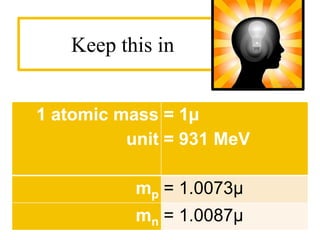
Keep this in
1 atomic mass
unit
= 1µ
= 931 MeV
mp = 1.0073µ
mn = 1.0087µ
Alpha Decay
of Uranium
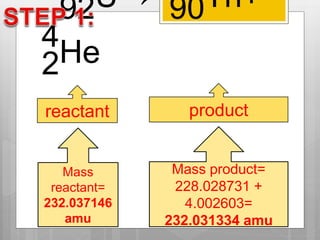
92U→ 90Th+
2
4
He
reactant product
Mass
reactant=
232.037146
amu
Mass product=
228.028731 +
4.002603=
232.031334 amu
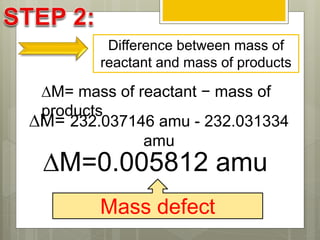
Difference between mass of
reactant and mass of products
∆M= mass of reactant − mass of
products
∆M= 232.037146 amu - 232.031334
amu
∆M=0.005812 amu
Mass defect
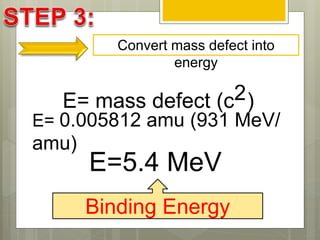
Convert mass defect into
energy
E= mass defect (c2)
E= 0.005812 amu (931 MeV/
amu)
E=5.4 MeV
Binding Energy
Fission of
Uranium
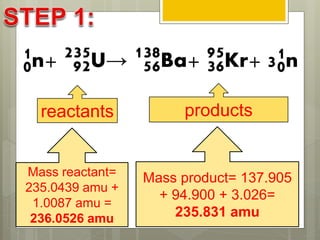
0
1n+ 92
235U→ 56
138Ba+ 36
95Kr+ 30
1n
reactants products
Mass reactant=
235.0439 amu +
1.0087 amu =
236.0526 amu
Mass product= 137.905
+ 94.900 + 3.026=
235.831 amu
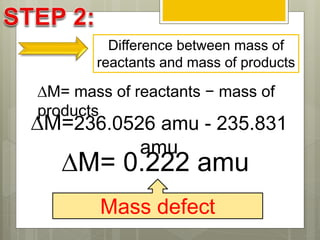
Difference between mass of
reactants and mass of products
∆M= mass of reactants − mass of
products
∆M=236.0526 amu - 235.831
amu
∆M= 0.222 amu
Mass defect
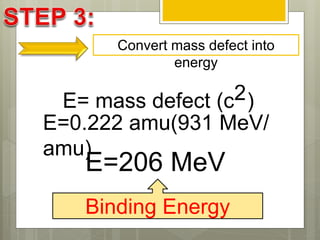
Convert mass defect into
energy
E= mass defect (c2)
E=0.222 amu(931 MeV/
amu)
E=206 MeV
Binding Energy
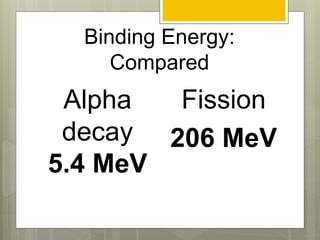
Binding Energy:
Compared
Alpha
decay
5.4 MeV
Fission
206 MeV
THANK YOU

Binding energy