Quantum PhenomenaExcitation EnergyIonization EnergyAbsorption and Emission SpectraThursday, 18 October 2007
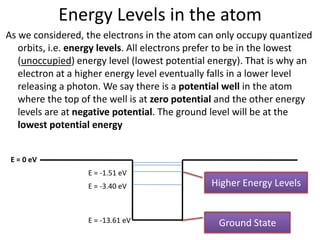
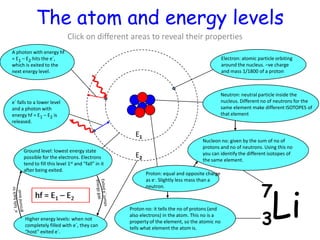
Energy Levels in the atomAs we considered, the electrons in the atom can only occupy quantized orbits, i.e. energy levels. All electrons prefer to be in the lowest (unoccupied) energy level (lowest potential energy). That is why an electron at a higher energy level eventually falls in a lower level releasing a photon. We say there is a potential well in the atom where the top of the well is at zero potential and the other energy levels are at negative potential. The ground level will be at the lowest potential energyE = 0 eVE = -1.51 eVHigher Energy LevelsE = -3.40 eVGround StateE = -13.61 eV
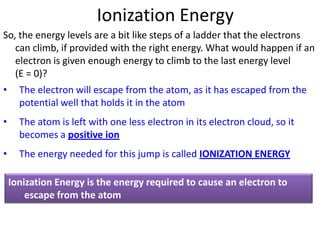
Ionization EnergySo, the energy levels are a bit like steps of a ladder that the electrons can climb, if provided with the right energy. What would happen if an electron is given enough energy to climb to the last energy level        (E = 0)?The electron will escape from the atom, as it has escaped from the potential well that holds it in the atom
The atom is left with one less electron in its electron cloud, so it becomes a positive ion
The energy needed for this jump is called IONIZATION ENERGYIonization Energy is the energy required to cause an electron to escape from the atom
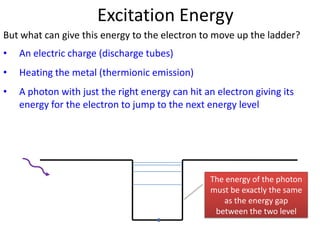
Excitation EnergyBut what can give this energy to the electron to move up the ladder?An electric charge (discharge tubes)
Heating the metal (thermionic emission)
A photon with just the right energy can hit an electron giving its energy for the electron to jump to the next energy levelThe energy of the photon must be exactly the same as the energy gap between the two level
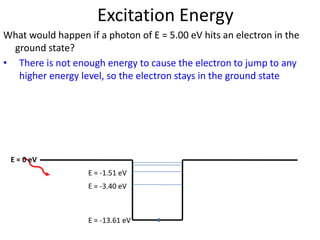
Excitation EnergyWhat would happen if a photon of E = 5.00 eV hits an electron in the ground state?There is not enough energy to cause the electron to jump to any higher energy level, so the electron stays in the ground stateE = 0 eVE = -1.51 eVE = -3.40 eVE = -13.61 eV
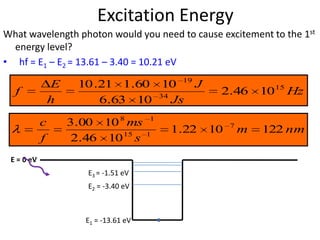
Excitation EnergyWhat wavelength photon would you need to cause excitement to the 1st energy level?hf = E1 – E2 = 13.61 – 3.40 = 10.21 eVE = 0 eVE3 = -1.51 eVE2 = -3.40 eVE1 = -13.61 eV
Excitation EnergyIn what region of the EM spectrum is the wavelength from the previous question?U.V. What energy photon would you need to ionize the atom?DE = 13.61 – 0 = 13.61 eVE = 0 eVE = -1.51 eVE = -3.40 eVE = -13.61 eV
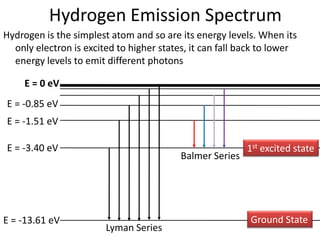
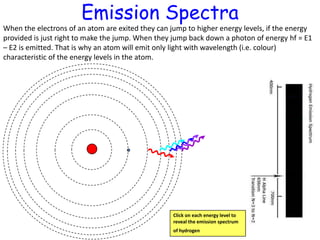
Hydrogen Emission SpectrumHydrogen is the simplest atom and so are its energy levels. When its only electron is excited to higher states, it can fall back to lower energy levels to emit different photonsE = 0 eVE = -0.85 eVE = -1.51 eVE = -3.40 eV1st excited stateBalmer SeriesGround StateE = -13.61 eVLyman Series
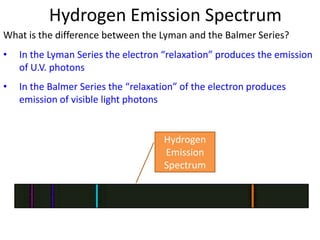
Hydrogen Emission SpectrumWhat is the difference between the Lyman and the Balmer Series?In the Lyman Series the electron “relaxation” produces the emission of U.V. photons
In the Balmer Series the “relaxation” of the electron produces emission of visible light photonsHydrogen Emission Spectrum

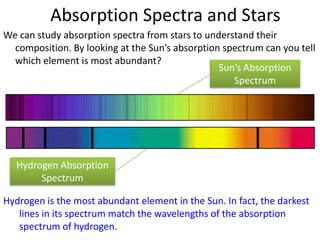
Energy levels and absorption spectra

  • 1.
    Quantum PhenomenaExcitation EnergyIonizationEnergyAbsorption and Emission SpectraThursday, 18 October 2007
  • 2.
    Energy Levels inthe atomAs we considered, the electrons in the atom can only occupy quantized orbits, i.e. energy levels. All electrons prefer to be in the lowest (unoccupied) energy level (lowest potential energy). That is why an electron at a higher energy level eventually falls in a lower level releasing a photon. We say there is a potential well in the atom where the top of the well is at zero potential and the other energy levels are at negative potential. The ground level will be at the lowest potential energyE = 0 eVE = -1.51 eVHigher Energy LevelsE = -3.40 eVGround StateE = -13.61 eV
  • 3.
    Ionization EnergySo, theenergy levels are a bit like steps of a ladder that the electrons can climb, if provided with the right energy. What would happen if an electron is given enough energy to climb to the last energy level (E = 0)?The electron will escape from the atom, as it has escaped from the potential well that holds it in the atom
  • 4.
    The atom isleft with one less electron in its electron cloud, so it becomes a positive ion
  • 5.
    The energy neededfor this jump is called IONIZATION ENERGYIonization Energy is the energy required to cause an electron to escape from the atom
  • 6.
    Excitation EnergyBut whatcan give this energy to the electron to move up the ladder?An electric charge (discharge tubes)
  • 7.
    Heating the metal(thermionic emission)
  • 8.
    A photon withjust the right energy can hit an electron giving its energy for the electron to jump to the next energy levelThe energy of the photon must be exactly the same as the energy gap between the two level
  • 9.
    Excitation EnergyWhat wouldhappen if a photon of E = 5.00 eV hits an electron in the ground state?There is not enough energy to cause the electron to jump to any higher energy level, so the electron stays in the ground stateE = 0 eVE = -1.51 eVE = -3.40 eVE = -13.61 eV
  • 10.
    Excitation EnergyWhat wavelengthphoton would you need to cause excitement to the 1st energy level?hf = E1 – E2 = 13.61 – 3.40 = 10.21 eVE = 0 eVE3 = -1.51 eVE2 = -3.40 eVE1 = -13.61 eV
  • 11.
    Excitation EnergyIn whatregion of the EM spectrum is the wavelength from the previous question?U.V. What energy photon would you need to ionize the atom?DE = 13.61 – 0 = 13.61 eVE = 0 eVE = -1.51 eVE = -3.40 eVE = -13.61 eV
  • 12.
    Hydrogen Emission SpectrumHydrogenis the simplest atom and so are its energy levels. When its only electron is excited to higher states, it can fall back to lower energy levels to emit different photonsE = 0 eVE = -0.85 eVE = -1.51 eVE = -3.40 eV1st excited stateBalmer SeriesGround StateE = -13.61 eVLyman Series
  • 13.
    Hydrogen Emission SpectrumWhatis the difference between the Lyman and the Balmer Series?In the Lyman Series the electron “relaxation” produces the emission of U.V. photons
  • 14.
    In the BalmerSeries the “relaxation” of the electron produces emission of visible light photonsHydrogen Emission Spectrum