Spectra and Energy Levels
1
Introduction
From the time our ancestors first gazed at rainbows,
spectra have been a source of both wonder and new
understanding.
From gamma rays to radio waves, spectra have given us
new understanding, ranging from the structure of atoms
to the nature of distant quasars.
In this series of lessons you will learn:
1. About the electromagnetic spectrum,
2. About absorption and emission spectra,
3. How spectra depend upon energy jumps.
2
3
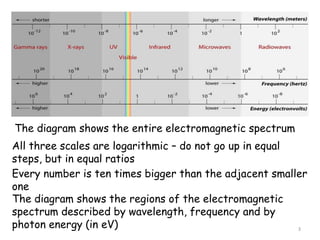
The diagram shows the entire electromagnetic spectrum
All three scales are logarithmic – do not go up in equal
steps, but in equal ratios
Every number is ten times bigger than the adjacent smaller
one
The diagram shows the regions of the electromagnetic
spectrum described by wavelength, frequency and by
photon energy (in eV)
Regions of the EM spectrum
4
The diagram on slide 3 shows the usual way in which the
spectrum is divided – but there are no sudden
boundaries between the different regions
Gamma radiation and X-rays
Radioactive nuclei emit gamma rays – range in energy
from 104 eV to 5 x 10⁶ eV
X-rays produced when high speed electrons decelerate
quickly.
High energy X-rays have shorter wavelengths than low
energy gamma rays.
Impossible to tell them apart by observation – given
different names only because of the way they are
produced.
Regions of the EM spectrum
5
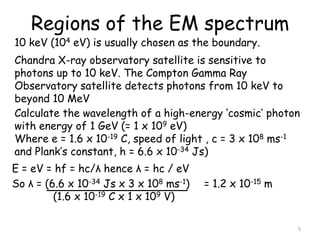
10 keV (104 eV) is usually chosen as the boundary.
Chandra X-ray observatory satellite is sensitive to
photons up to 10 keV. The Compton Gamma Ray
Observatory satellite detects photons from 10 keV to
beyond 10 MeV
Calculate the wavelength of a high-energy ‘cosmic’ photon
with energy of 1 GeV (= 1 x 10⁹ eV)
Where e = 1.6 x 10⁻¹⁹ C, speed of light , c = 3 x 10⁸ ms-1
and Plank’s constant, h = 6.6 x 10⁻³⁴ Js)
E = eV = hf = hc/λ hence λ = hc / eV
So λ = (6.6 x 10-34 Js x 3 x 108 ms-1) = 1.2 x 10⁻¹⁵ m
(1.6 x 10-19 C x 1 x 109 V)
Regions of the EM spectrum
6
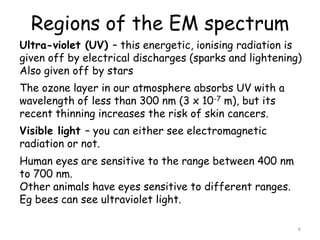
Ultra-violet (UV) – this energetic, ionising radiation is
given off by electrical discharges (sparks and lightening)
Also given off by stars
The ozone layer in our atmosphere absorbs UV with a
wavelength of less than 300 nm (3 x 10⁻⁷ m), but its
recent thinning increases the risk of skin cancers.
Visible light – you can either see electromagnetic
radiation or not.
Human eyes are sensitive to the range between 400 nm
to 700 nm.
Other animals have eyes sensitive to different ranges.
Eg bees can see ultraviolet light.
Regions of the EM spectrum
7
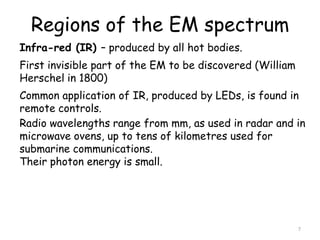
Infra-red (IR) – produced by all hot bodies.
First invisible part of the EM to be discovered (William
Herschel in 1800)
Common application of IR, produced by LEDs, is found in
remote controls.
Radio wavelengths range from mm, as used in radar and in
microwave ovens, up to tens of kilometres used for
submarine communications.
Their photon energy is small.
Line spectra
8
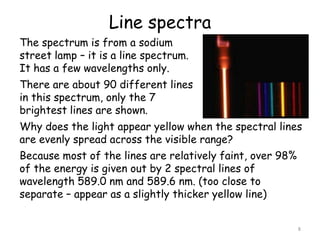
The spectrum is from a sodium
street lamp – it is a line spectrum.
It has a few wavelengths only.
There are about 90 different lines
in this spectrum, only the 7
brightest lines are shown.
Why does the light appear yellow when the spectral lines
are evenly spread across the visible range?
Because most of the lines are relatively faint, over 98%
of the energy is given out by 2 spectral lines of
wavelength 589.0 nm and 589.6 nm. (too close to
separate – appear as a slightly thicker yellow line)
What causes line spectra?
9
Line spectra always observed when atoms have been
excited (heated or by electrical discharge)
Energy is given to electrons, which then is released as light
Line spectra are caused by changes in energy of the
electrons. Large complicated atoms like Neon give very
complex line spectra (many electrons).
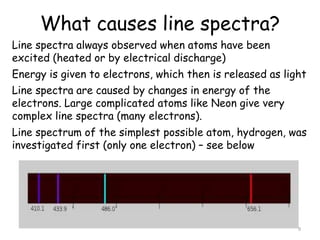
Line spectrum of the simplest possible atom, hydrogen, was
investigated first (only one electron) – see below
Hydrogen spectrum
10
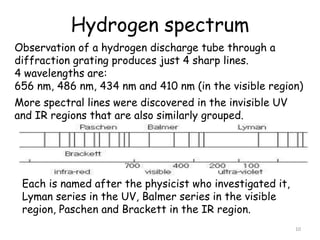
Observation of a hydrogen discharge tube through a
diffraction grating produces just 4 sharp lines.
4 wavelengths are:
656 nm, 486 nm, 434 nm and 410 nm (in the visible region)
More spectral lines were discovered in the invisible UV
and IR regions that are also similarly grouped.
Each is named after the physicist who investigated it,
Lyman series in the UV, Balmer series in the visible
region, Paschen and Brackett in the IR region.
Photon energies
11
Need to look at photon energies instead of wavelengths
to see the cause.
Calculate the photon energy of the 656 nm line in the
hydrogen spectrum. Speed of light, c = 3 x 10⁸ ms-1, and
the Plank constant h = 6.6 x 10⁻³⁴ Js.
E = hc/λ = 3 x 10⁸ ms-1 x 6.6 x 10-34 Js / 656 x 10-9 m
= 3.03 x 10⁻¹⁹ J
As 1.6 x 10⁻¹⁹ J = 1 eV then 3.03 x 10⁻¹⁹ J = 1.9 eV
Repeating this calculation for the other spectral lines,
gives following photon energies (in eV) for the first few
lines in Lyman and Balmer series.
Photon energies
12
Lyman energies/eV 10.2 12.1 12.8
Balmer energies/eV 1.9 2.6
Can a pattern be spotted?
Each of the Balmer energies is the difference between
two of the Lyman energies.
This is true for all the Balmer lines, not just the two
given above.
The explanation of the spectrum of hydrogen is a story
of energy differences which will be discussed in the
next lesson.

2 spectra and energy levels

  • 1.
  • 2.
    Introduction From the timeour ancestors first gazed at rainbows, spectra have been a source of both wonder and new understanding. From gamma rays to radio waves, spectra have given us new understanding, ranging from the structure of atoms to the nature of distant quasars. In this series of lessons you will learn: 1. About the electromagnetic spectrum, 2. About absorption and emission spectra, 3. How spectra depend upon energy jumps. 2
  • 3.
    3 The diagram showsthe entire electromagnetic spectrum All three scales are logarithmic – do not go up in equal steps, but in equal ratios Every number is ten times bigger than the adjacent smaller one The diagram shows the regions of the electromagnetic spectrum described by wavelength, frequency and by photon energy (in eV)
  • 4.
    Regions of theEM spectrum 4 The diagram on slide 3 shows the usual way in which the spectrum is divided – but there are no sudden boundaries between the different regions Gamma radiation and X-rays Radioactive nuclei emit gamma rays – range in energy from 104 eV to 5 x 10⁶ eV X-rays produced when high speed electrons decelerate quickly. High energy X-rays have shorter wavelengths than low energy gamma rays. Impossible to tell them apart by observation – given different names only because of the way they are produced.
  • 5.
    Regions of theEM spectrum 5 10 keV (104 eV) is usually chosen as the boundary. Chandra X-ray observatory satellite is sensitive to photons up to 10 keV. The Compton Gamma Ray Observatory satellite detects photons from 10 keV to beyond 10 MeV Calculate the wavelength of a high-energy ‘cosmic’ photon with energy of 1 GeV (= 1 x 10⁹ eV) Where e = 1.6 x 10⁻¹⁹ C, speed of light , c = 3 x 10⁸ ms-1 and Plank’s constant, h = 6.6 x 10⁻³⁴ Js) E = eV = hf = hc/λ hence λ = hc / eV So λ = (6.6 x 10-34 Js x 3 x 108 ms-1) = 1.2 x 10⁻¹⁵ m (1.6 x 10-19 C x 1 x 109 V)
  • 6.
    Regions of theEM spectrum 6 Ultra-violet (UV) – this energetic, ionising radiation is given off by electrical discharges (sparks and lightening) Also given off by stars The ozone layer in our atmosphere absorbs UV with a wavelength of less than 300 nm (3 x 10⁻⁷ m), but its recent thinning increases the risk of skin cancers. Visible light – you can either see electromagnetic radiation or not. Human eyes are sensitive to the range between 400 nm to 700 nm. Other animals have eyes sensitive to different ranges. Eg bees can see ultraviolet light.
  • 7.
    Regions of theEM spectrum 7 Infra-red (IR) – produced by all hot bodies. First invisible part of the EM to be discovered (William Herschel in 1800) Common application of IR, produced by LEDs, is found in remote controls. Radio wavelengths range from mm, as used in radar and in microwave ovens, up to tens of kilometres used for submarine communications. Their photon energy is small.
  • 8.
    Line spectra 8 The spectrumis from a sodium street lamp – it is a line spectrum. It has a few wavelengths only. There are about 90 different lines in this spectrum, only the 7 brightest lines are shown. Why does the light appear yellow when the spectral lines are evenly spread across the visible range? Because most of the lines are relatively faint, over 98% of the energy is given out by 2 spectral lines of wavelength 589.0 nm and 589.6 nm. (too close to separate – appear as a slightly thicker yellow line)
  • 9.
    What causes linespectra? 9 Line spectra always observed when atoms have been excited (heated or by electrical discharge) Energy is given to electrons, which then is released as light Line spectra are caused by changes in energy of the electrons. Large complicated atoms like Neon give very complex line spectra (many electrons). Line spectrum of the simplest possible atom, hydrogen, was investigated first (only one electron) – see below
  • 10.
    Hydrogen spectrum 10 Observation ofa hydrogen discharge tube through a diffraction grating produces just 4 sharp lines. 4 wavelengths are: 656 nm, 486 nm, 434 nm and 410 nm (in the visible region) More spectral lines were discovered in the invisible UV and IR regions that are also similarly grouped. Each is named after the physicist who investigated it, Lyman series in the UV, Balmer series in the visible region, Paschen and Brackett in the IR region.
  • 11.
    Photon energies 11 Need tolook at photon energies instead of wavelengths to see the cause. Calculate the photon energy of the 656 nm line in the hydrogen spectrum. Speed of light, c = 3 x 10⁸ ms-1, and the Plank constant h = 6.6 x 10⁻³⁴ Js. E = hc/λ = 3 x 10⁸ ms-1 x 6.6 x 10-34 Js / 656 x 10-9 m = 3.03 x 10⁻¹⁹ J As 1.6 x 10⁻¹⁹ J = 1 eV then 3.03 x 10⁻¹⁹ J = 1.9 eV Repeating this calculation for the other spectral lines, gives following photon energies (in eV) for the first few lines in Lyman and Balmer series.
  • 12.
    Photon energies 12 Lyman energies/eV10.2 12.1 12.8 Balmer energies/eV 1.9 2.6 Can a pattern be spotted? Each of the Balmer energies is the difference between two of the Lyman energies. This is true for all the Balmer lines, not just the two given above. The explanation of the spectrum of hydrogen is a story of energy differences which will be discussed in the next lesson.