Alper GÜNEREN - 2010512022 
Uğur KARAALİ - 2010512026 
1
OBJECTIVES 
SHORT HISTORY 
GENERATION 
CIRCUITS 
ALTERNATING CURRENT 2
HISTORY OF ALTERNATING CURRENT 
William Stanley, Jr. designed one of the first practical devices 
to transfer AC power efficiently between isolated circuits. 
The AC power system used today developed rapidly after 1886, 
and included contributions by Nikola Tesla and Carl Wilhelm Siemens. 
ALTERNATING CURRENT 3
WHAT IS ALTERNATING CURRENT ? 
 Alternating current electricity is the type of electricity commonly used 
in homes and businesses throughout the world. 
 AC electricity is created by an AC electric generator, which determines 
the frequency. 
 An AC waveform can be sinusoidal, square, or sawtooth-shaped. 
Some AC waveforms are irregular or complicated. 
ALTERNATING CURRENT 4
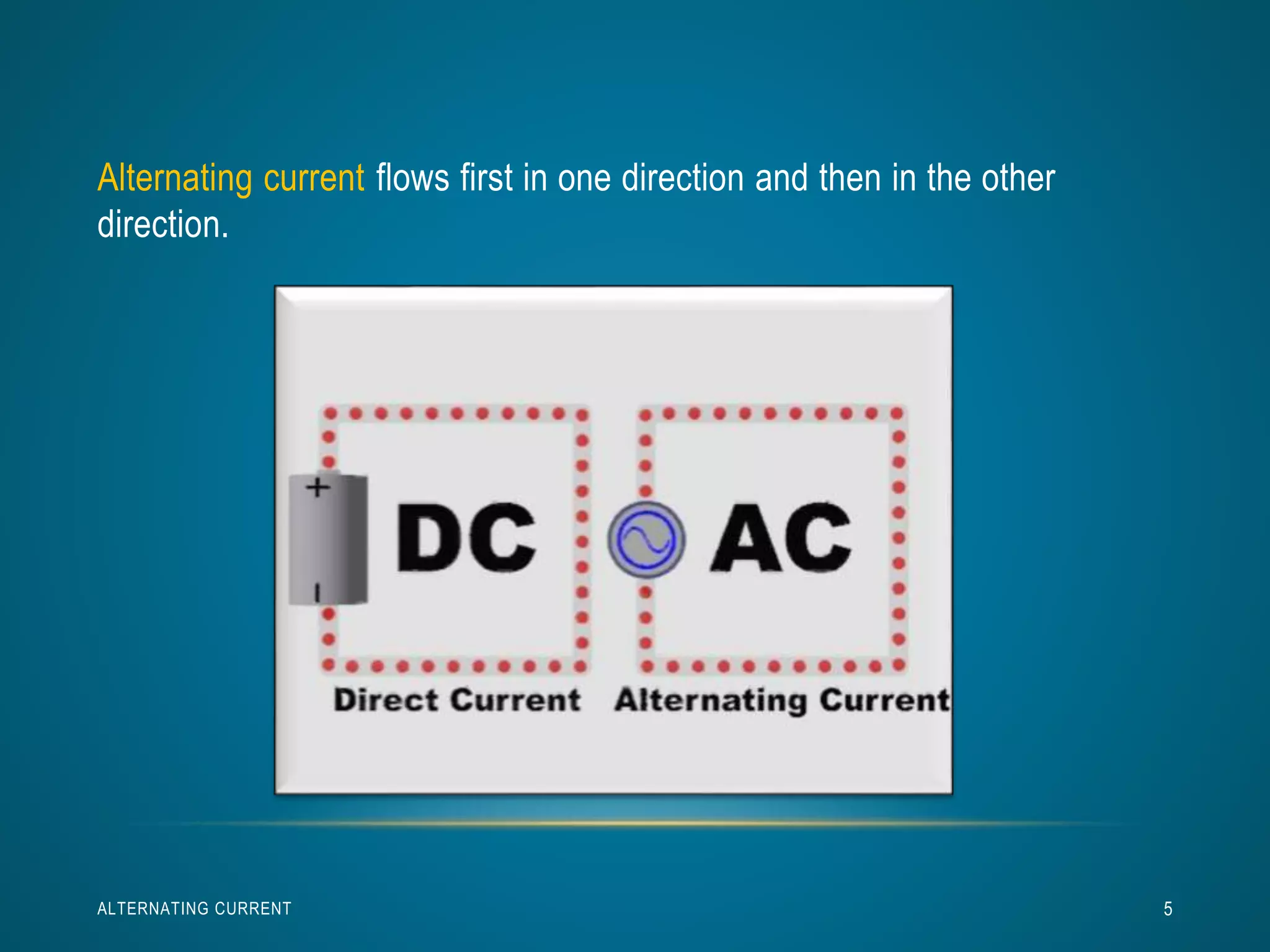
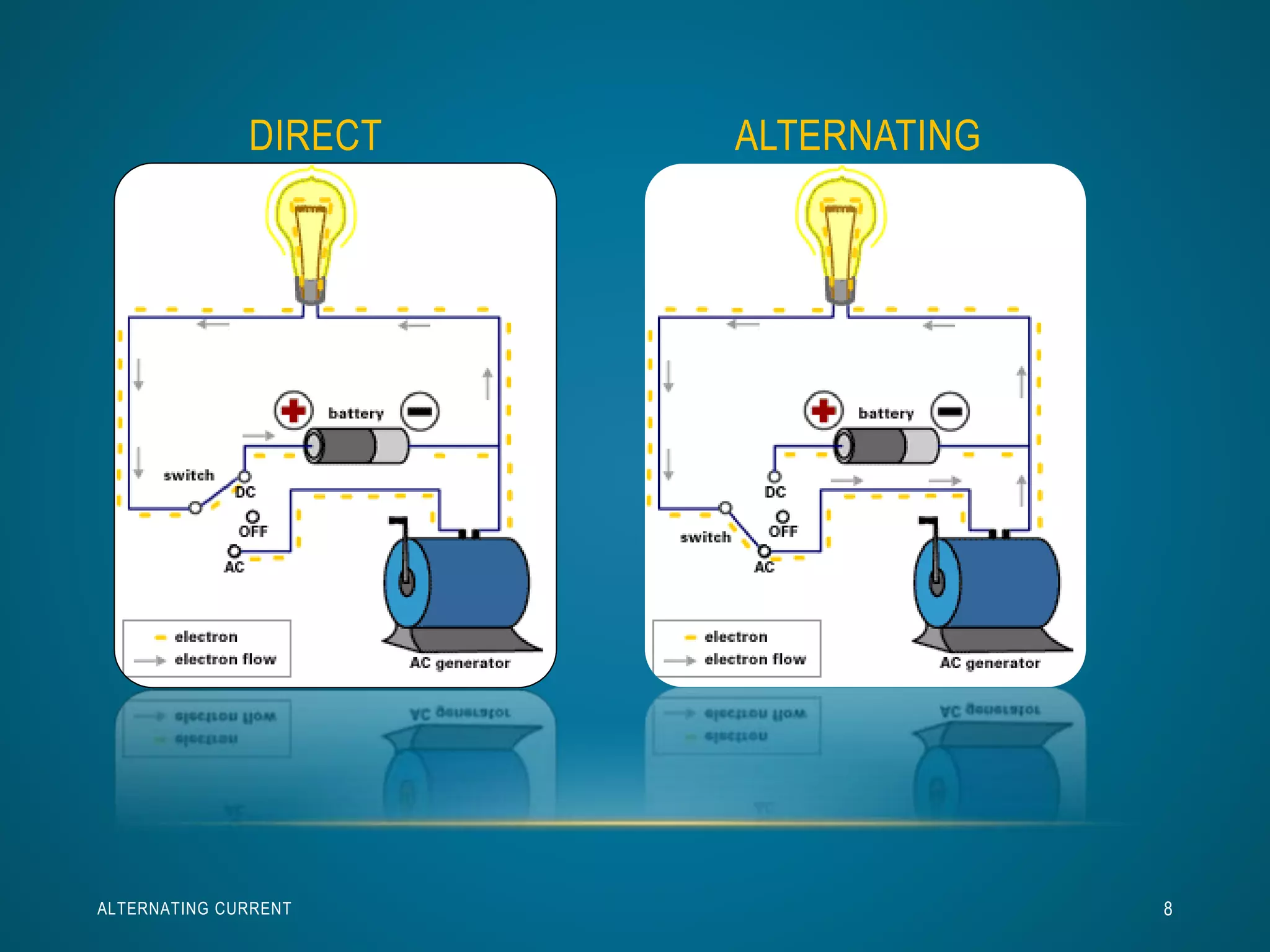
Alternating current flows first in one direction and then in the other 
direction. 
ALTERNATING CURRENT 5
ADVANTAGES 
 The single greatest advantage of alternating current is that AC current 
can be transformed and DC current cannot be transformed. 
 It can be controlled by a wide range of components 
eg.resistors,capacitors and inductors. 
 This allows high-voltage electrical power to be distributed with smaller 
wires and lower amperage. 
ALTERNATING CURRENT 6
HOW TO GENERATED ? 
ALTERNATING CURRENT 7
DIRECT ALTERNATING 
ALTERNATING CURRENT 8
RMS VALUES 
 Since voltage and current are always changing we need some way of 
averaging out their effect. 
 We use r.m.s values (root-mean-square) 
 The r.m.s values are the DC values which give the same average 
power output 
ALTERNATING CURRENT 9
ALTERNATING CURRENT 10
AC IN CAPACITORS 
In an AC circuit, the current can continue to flow, as the plates 
become alternately charged positively and negatively 
For both AC and DC circuits, the voltage across the resistor is 
related to the current by V=I.R 
A similar relationship exists for a capacitor: 
ALTERNATING CURRENT 11
REACTANCE 
 Reactance is a measure of how a capacitor can limit alternating 
current. 
 It is similar to resistance but differs in that it is dependent on the 
frequency of the ac supply. 
 It also depends on the size of the capacitor. 
ALTERNATING CURRENT 12
IMPEDANCE 
ALTERNATING CURRENT 13
AC IN INDUCTORS 
.In an AC circuit, the current is always changing so the inductor is always producing an 
opposing voltage so is always limiting the amount of current that can flow 
For both AC and DC circuits, the voltage across the resistor is related to the current by V=IR 
A similar relationship exists for an inductor 
ALTERNATING CURRENT 14
REACTANCE 
 It measures how well an inductor can limit alternating current 
 It depends on the frequency of the ac supply. 
 It depends on the size of the inductor 
ALTERNATING CURRENT 15
IMPEDANCE 
ALTERNATING CURRENT 16
PHASE RELATIONSHIP 
The current in the circuit will always be in phase with VR 
ALTERNATING CURRENT 17
The voltage phasors are not necessarily the same size, but are always 
90°out of phase. 
ALTERNATING CURRENT 18
Again the voltages may be different sizes but will always be 90° out of 
phase 
ALTERNATING CURRENT 19
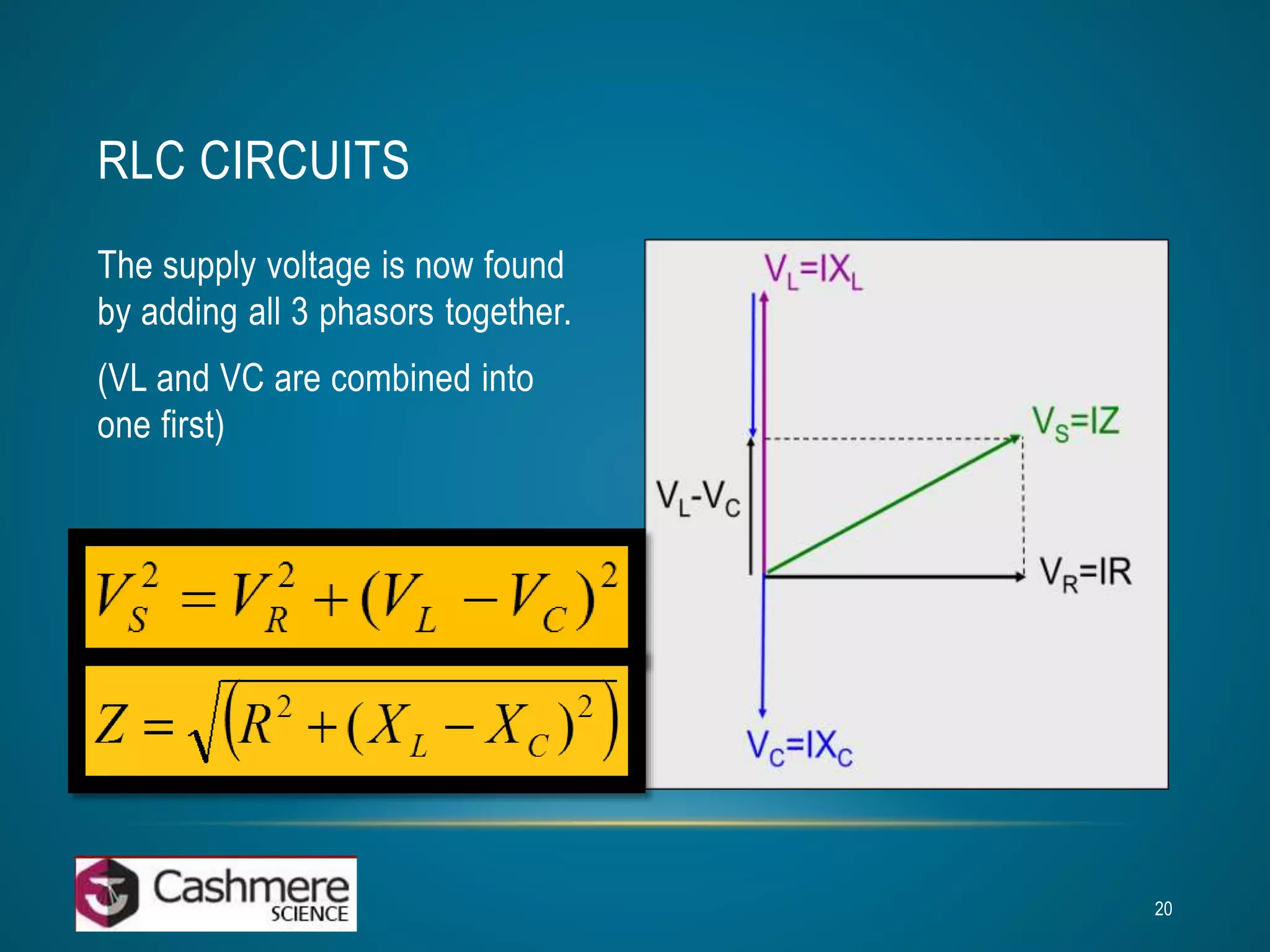
RLC CIRCUITS 
The supply voltage is now found 
by adding all 3 phasors together. 
(VL and VC are combined into 
one first) 
ALTERNATING CURRENT 20
RESONANCE 
At resonance, VL=VC and they cancel each 
other out. So VS=VR and if VR is at max then 
I is at max. 
ALTERNATING CURRENT 21
REFERENCES 
• http://www.teachersdomain.org 
• http://www.peetvs.co.za 
• http://www.sjsu.edu 
• http://www.youtube.com 
• http://www.wikipedia.com 
• http://www.upscale.utoronto.ca 
• NCEA A.S 3.6 Text Chapters 18-19 
• Yrd. Doç. Dr. Levent Çetin/ alternatif akım 
ALTERNATING CURRENT 22
THANKS FOR LISTENING... 
ALTERNATING CURRENT END

Alternating current

  • 1.
    Alper GÜNEREN -2010512022 Uğur KARAALİ - 2010512026 1
  • 2.
    OBJECTIVES SHORT HISTORY GENERATION CIRCUITS ALTERNATING CURRENT 2
  • 3.
    HISTORY OF ALTERNATINGCURRENT William Stanley, Jr. designed one of the first practical devices to transfer AC power efficiently between isolated circuits. The AC power system used today developed rapidly after 1886, and included contributions by Nikola Tesla and Carl Wilhelm Siemens. ALTERNATING CURRENT 3
  • 4.
    WHAT IS ALTERNATINGCURRENT ?  Alternating current electricity is the type of electricity commonly used in homes and businesses throughout the world.  AC electricity is created by an AC electric generator, which determines the frequency.  An AC waveform can be sinusoidal, square, or sawtooth-shaped. Some AC waveforms are irregular or complicated. ALTERNATING CURRENT 4
  • 5.
    Alternating current flowsfirst in one direction and then in the other direction. ALTERNATING CURRENT 5
  • 6.
    ADVANTAGES  Thesingle greatest advantage of alternating current is that AC current can be transformed and DC current cannot be transformed.  It can be controlled by a wide range of components eg.resistors,capacitors and inductors.  This allows high-voltage electrical power to be distributed with smaller wires and lower amperage. ALTERNATING CURRENT 6
  • 7.
    HOW TO GENERATED? ALTERNATING CURRENT 7
  • 8.
  • 9.
    RMS VALUES Since voltage and current are always changing we need some way of averaging out their effect.  We use r.m.s values (root-mean-square)  The r.m.s values are the DC values which give the same average power output ALTERNATING CURRENT 9
  • 10.
  • 11.
    AC IN CAPACITORS In an AC circuit, the current can continue to flow, as the plates become alternately charged positively and negatively For both AC and DC circuits, the voltage across the resistor is related to the current by V=I.R A similar relationship exists for a capacitor: ALTERNATING CURRENT 11
  • 12.
    REACTANCE  Reactanceis a measure of how a capacitor can limit alternating current.  It is similar to resistance but differs in that it is dependent on the frequency of the ac supply.  It also depends on the size of the capacitor. ALTERNATING CURRENT 12
  • 13.
  • 14.
    AC IN INDUCTORS .In an AC circuit, the current is always changing so the inductor is always producing an opposing voltage so is always limiting the amount of current that can flow For both AC and DC circuits, the voltage across the resistor is related to the current by V=IR A similar relationship exists for an inductor ALTERNATING CURRENT 14
  • 15.
    REACTANCE  Itmeasures how well an inductor can limit alternating current  It depends on the frequency of the ac supply.  It depends on the size of the inductor ALTERNATING CURRENT 15
  • 16.
  • 17.
    PHASE RELATIONSHIP Thecurrent in the circuit will always be in phase with VR ALTERNATING CURRENT 17
  • 18.
    The voltage phasorsare not necessarily the same size, but are always 90°out of phase. ALTERNATING CURRENT 18
  • 19.
    Again the voltagesmay be different sizes but will always be 90° out of phase ALTERNATING CURRENT 19
  • 20.
    RLC CIRCUITS Thesupply voltage is now found by adding all 3 phasors together. (VL and VC are combined into one first) ALTERNATING CURRENT 20
  • 21.
    RESONANCE At resonance,VL=VC and they cancel each other out. So VS=VR and if VR is at max then I is at max. ALTERNATING CURRENT 21
  • 22.
    REFERENCES • http://www.teachersdomain.org • http://www.peetvs.co.za • http://www.sjsu.edu • http://www.youtube.com • http://www.wikipedia.com • http://www.upscale.utoronto.ca • NCEA A.S 3.6 Text Chapters 18-19 • Yrd. Doç. Dr. Levent Çetin/ alternatif akım ALTERNATING CURRENT 22
  • 23.
    THANKS FOR LISTENING... ALTERNATING CURRENT END

Editor's Notes

  • #6 This shape show us the current is reversible ...
  • #7 The electrical power is then transformed to a lower voltage where it is needed It can be produced directly from generators
  • #14 Combination resistace and reactans called ımpedance