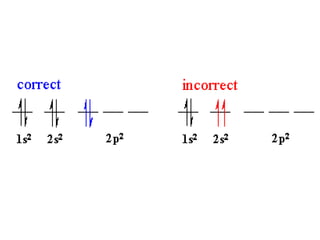
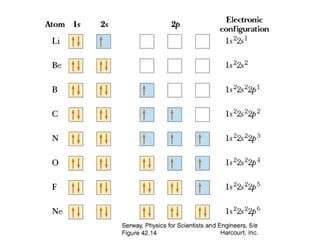
• An atomic orbital is defined as the region in
space around the nucleus in which the
probability of finding the electron is
maximum.
What is orbital?
• The number which expresses the size, shapes,
and direction of the orbital from the nucleus
and the spins of the electron of their own
axes, are called quantum number.
Quantum Number
• There are four types of quantum number:
1. principal quantum number(n)
2. Subsidiary quantum number(l)
3.Magnetic quantum number (m)
4.Spin quantum number (s)
Types of Quantum Number
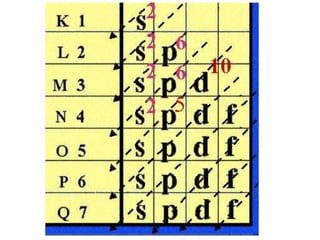
• Principal quantum number :
This express the orbits or principal energy level to
which the electron belongs and represents the
average distance of the electron from the
nucleus.It is denoted by n(n=1 2 3 etc).For the first
orbit n=1, for the second orbit n=2 and so on.The
energy levels are also called electron shells.
Innermost shell known as K shell and the
succeedings outer shells are denoted by the letter L
M N O P Q etc. Each shell has a definite value of
energy. the energy increase as the value of n
encrease.
Subsidiary quantum number
• This express sub-levels and the shapes of the
energy level.It is denoted by l. The vaule of l =o to
(n-1).When n=1 then l=o and so the 1st energy
level has 1 sub-shell.
n=1 then l=o
n=2 then l=0 1
n=3 then l=0 1 2
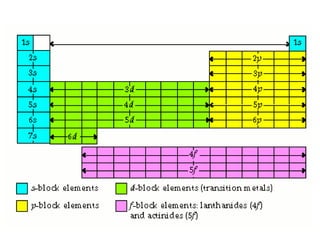
 The value of subsidiary quantum number 0 1 2 3 4
are represented s,p,d,f respectively.
Magnetic quantum number
This express the directions of the sub-levels of
the orbital from the nucleus in three –
dimentional spaces. This number is designated
as m.The permitted valus of m are depending on
l. the value for the magnetic quantum numbers
m, are given by +1 to -1 , including 0.
Spin Quantum Number
• The spin quantum number represents the
direction of the electron spin.This quantum
number is designed as “s”.This is due to the
spinning of the electron about its own
axis.One spin clockwise and other spin is anti-
clock wise.Their values are s=+12 and s=-12.
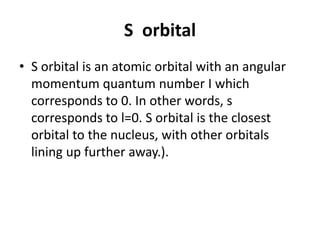
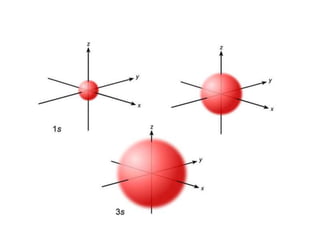
S orbital
• S orbital is an atomic orbital with an angular
momentum quantum number I which
corresponds to 0. In other words, s
corresponds to l=0. S orbital is the closest
orbital to the nucleus, with other orbitals
lining up further away.).
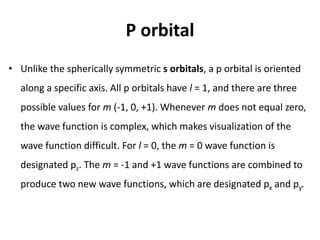
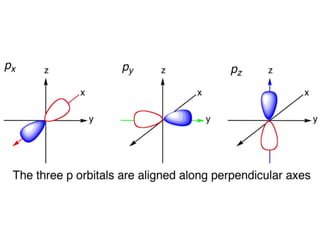
P orbital
• Unlike the spherically symmetric s orbitals, a p orbital is oriented
along a specific axis. All p orbitals have l = 1, and there are three
possible values for m (-1, 0, +1). Whenever m does not equal zero,
the wave function is complex, which makes visualization of the
wave function difficult. For l = 0, the m = 0 wave function is
designated pz. The m = -1 and +1 wave functions are combined to
produce two new wave functions, which are designated px and py.
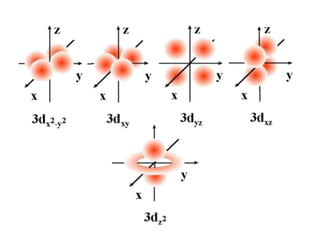
D orbital
• For d orbital l=2.Therefore the angular
momentum of an electron for d orbital is not
zero for l =2 the magnetic quantum number
(m) should have five different values m = -2 -1
0 +1 +2 .Accordingly there are five different
space orientations for d orbitals.
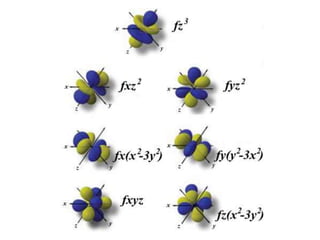
F orbital
• A subshell that corresponds to the angular
momentum quantum number l = 3, found in
the fourth and higher principal energy levels.
Each contains seven orbitals.
Orbitals
Orbitals
Orbitals
Orbitals
Orbitals
Orbitals
Orbitals

Orbitals

  • 2.
    • An atomicorbital is defined as the region in space around the nucleus in which the probability of finding the electron is maximum. What is orbital?
  • 3.
    • The numberwhich expresses the size, shapes, and direction of the orbital from the nucleus and the spins of the electron of their own axes, are called quantum number. Quantum Number
  • 4.
    • There arefour types of quantum number: 1. principal quantum number(n) 2. Subsidiary quantum number(l) 3.Magnetic quantum number (m) 4.Spin quantum number (s) Types of Quantum Number
  • 5.
    • Principal quantumnumber : This express the orbits or principal energy level to which the electron belongs and represents the average distance of the electron from the nucleus.It is denoted by n(n=1 2 3 etc).For the first orbit n=1, for the second orbit n=2 and so on.The energy levels are also called electron shells. Innermost shell known as K shell and the succeedings outer shells are denoted by the letter L M N O P Q etc. Each shell has a definite value of energy. the energy increase as the value of n encrease.
  • 6.
    Subsidiary quantum number •This express sub-levels and the shapes of the energy level.It is denoted by l. The vaule of l =o to (n-1).When n=1 then l=o and so the 1st energy level has 1 sub-shell. n=1 then l=o n=2 then l=0 1 n=3 then l=0 1 2  The value of subsidiary quantum number 0 1 2 3 4 are represented s,p,d,f respectively.
  • 7.
    Magnetic quantum number Thisexpress the directions of the sub-levels of the orbital from the nucleus in three – dimentional spaces. This number is designated as m.The permitted valus of m are depending on l. the value for the magnetic quantum numbers m, are given by +1 to -1 , including 0.
  • 8.
    Spin Quantum Number •The spin quantum number represents the direction of the electron spin.This quantum number is designed as “s”.This is due to the spinning of the electron about its own axis.One spin clockwise and other spin is anti- clock wise.Their values are s=+12 and s=-12.
  • 9.
    S orbital • Sorbital is an atomic orbital with an angular momentum quantum number I which corresponds to 0. In other words, s corresponds to l=0. S orbital is the closest orbital to the nucleus, with other orbitals lining up further away.).
  • 11.
    P orbital • Unlikethe spherically symmetric s orbitals, a p orbital is oriented along a specific axis. All p orbitals have l = 1, and there are three possible values for m (-1, 0, +1). Whenever m does not equal zero, the wave function is complex, which makes visualization of the wave function difficult. For l = 0, the m = 0 wave function is designated pz. The m = -1 and +1 wave functions are combined to produce two new wave functions, which are designated px and py.
  • 13.
    D orbital • Ford orbital l=2.Therefore the angular momentum of an electron for d orbital is not zero for l =2 the magnetic quantum number (m) should have five different values m = -2 -1 0 +1 +2 .Accordingly there are five different space orientations for d orbitals.
  • 15.
    F orbital • Asubshell that corresponds to the angular momentum quantum number l = 3, found in the fourth and higher principal energy levels. Each contains seven orbitals.