1.15
Bonding in Methane and
Orbital Hybridization
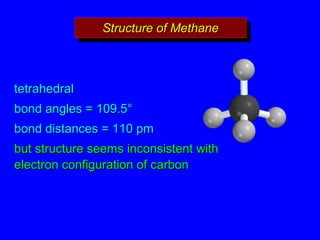
Structure of Methane

tetrahedral
bond angles = 109.5°
bond distances = 110 pm
but structure seems inconsistent with
electron configuration of carbon
Electron configuration of carbon
only two unpaired
electrons

2p

should form σ
bonds to only two
hydrogen atoms
2s

bonds should be
at right angles to
one another
sp33Orbital Hybridization
sp Orbital Hybridization

2p
Promote an electron from the 2s
to the 2p orbital

2s
sp33Orbital Hybridization
sp Orbital Hybridization

2p

2p

2s

2s
sp33Orbital Hybridization
sp Orbital Hybridization

2p
Mix together (hybridize) the 2s
orbital and the three 2p orbitals

2s
sp33Orbital Hybridization
sp Orbital Hybridization

2p
2 sp3
4 equivalent half-filled
orbitals are consistent
with four bonds and
tetrahedral geometry

2s
Shapes of orbitals
Shapes of orbitals

p

s
Nodal properties of orbitals

p

+

s

–

+
Shape of sp33hybrid orbitals
Shape of sp hybrid orbitals

p

+

–

take the s orbital and place it on
top of the p orbital
s

+
Shape of sp33hybrid orbitals
Shape of sp hybrid orbitals

s+p

+

+

–

reinforcement of electron wave in
regions where sign is the same
destructive interference in regions of
opposite sign
Shape of sp33hybrid orbitals
Shape of sp hybrid orbitals

sp hybrid

+

–

orbital shown is sp hybrid
analogous procedure using three s orbitals
and one p orbital gives sp3 hybrid
shape of sp3 hybrid is similar
Shape of sp33hybrid orbitals
Shape of sp hybrid orbitals

sp hybrid

+

–

hybrid orbital is not symmetrical
higher probability of finding an electron on
one side of the nucleus than the other
leads to stronger bonds
The C—H σ Bond in Methane
In-phase overlap of a half-filled 1s orbital of
hydrogen with a half-filled sp3 hybrid orbital of
carbon:
+
H

s

+

gives a σ bond.
+
H—C σ

H

C–

C–

sp3
Justification for Orbital Hybridization
consistent with structure of methane
allows for formation of 4 bonds rather than 2
bonds involving sp3 hybrid orbitals are stronger
than those involving s-s overlap or p-p overlap
1.16
sp3 Hybridization
and Bonding in Ethane
Structure of Ethane
Structure of Ethane

C2H6
CH3CH3

tetrahedral geometry at each carbon
C—H bond distance = 110 pm
C—C bond distance = 153 pm
The C—C σ Bond in Ethane

In-phase overlap of half-filled sp3 hybrid
orbital of one carbon with half-filled sp3
hybrid orbital of another.
Overlap is along internuclear axis to give a σ
bond.
The C—C σ Bond in Ethane

In-phase overlap of half-filled sp3 hybrid
orbital of one carbon with half-filled sp3
hybrid orbital of another.
Overlap is along internuclear axis to give a σ
bond.
1.17
sp2 Hybridization
and Bonding in Ethylene
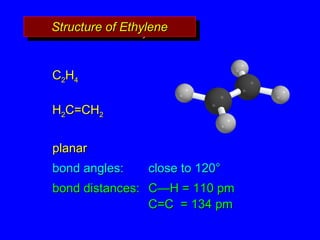
Structure of Ethylene
C2H4
H2C=CH2
planar
bond angles:

close to 120°

bond distances: C—H = 110 pm
C=C = 134 pm
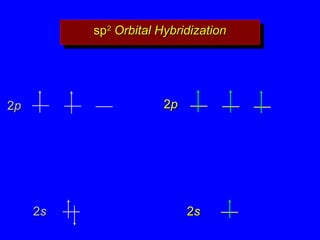
sp22Orbital Hybridization
sp Orbital Hybridization

2p
Promote an electron from the 2s
to the 2p orbital

2s
sp22Orbital Hybridization
sp Orbital Hybridization

2p

2p

2s

2s
sp22Orbital Hybridization
sp Orbital Hybridization

2p
Mix together (hybridize) the 2s
orbital and two of the three 2p
orbitals
2s
sp22Orbital Hybridization
sp Orbital Hybridization

2p
2 sp2
3 equivalent half-filled
sp2 hybrid orbitals plus
1 p orbital left
unhybridized

2s
sp22Orbital Hybridization
sp Orbital Hybridization

p
2 sp2

2 of the 3 sp2 orbitals
are involved in σ bonds
to hydrogens; the other
is involved in a σ bond
to carbon
sp22Orbital Hybridization
sp Orbital Hybridization

σ

p
2 sp2

σ

σ

σ

σ
π Bonding in Ethylene

p
2 sp2

the unhybridized p orbital of
carbon is involved in π bonding
to the other carbon
π Bonding in Ethylene

p
2 sp2

each carbon has an unhybridized 2p orbital
axis of orbital is perpendicular to the plane of the σ bonds
π Bonding in Ethylene

p
2 sp2
side-by-side overlap of half-filled
p orbitals gives a π bond
double bond in ethylene has a
σ component and a π component
1.18
sp Hybridization
and Bonding in Acetylene
Structure of Acetylene
C2H2
HC

CH

linear
bond angles:

180°

bond distances: C—H = 106 pm
CC = 120 pm
sp Orbital Hybridization

2p
Promote an electron from the 2s
to the 2p orbital

2s
sp Orbital Hybridization

2p

2p

2s

2s
sp Orbital Hybridization

2p
Mix together (hybridize) the 2s
orbital and one of the three 2p
orbitals
2s
sp Orbital Hybridization

2p

2p

2 sp2
2 equivalent half-filled
sp hybrid orbitals plus
2 p orbitals left
unhybridized

2s
sp Orbital Hybridization

2p

2 sp2

1 of the 2 sp orbitals
is involved in a σ bond
to hydrogen; the other
is involved in a σ bond
to carbon
sp Orbital Hybridization

σ

2p
σ
2 sp2

σ
π Bonding in Acetylene

2p

2 sp2

the unhybridized p orbitals of
carbon are involved in separate
π bonds to the other carbon
π Bonding in Acetylene

2p

2 sp2

one π bond involves one of the p orbitals on each carbon
there is a second π bond perpendicular to this one
π Bonding in Acetylene

2p

2 sp2
π Bonding in Acetylene

2p

2 sp2
1.19
Which Theory of
Chemical Bonding is Best?
Three Models
Three Models
Lewis
most familiar—easiest to apply
Valence-Bond (Orbital Hybridization)
provides more insight than Lewis model
ability to connect structure and reactivity
to hybridization develops with practice
Molecular Orbital
potentially the most powerful method
but is the most abstract
requires the most experience to use
effectively

Hybridization

  • 1.
    1.15 Bonding in Methaneand Orbital Hybridization
  • 2.
    Structure of Methane Structureof Methane tetrahedral bond angles = 109.5° bond distances = 110 pm but structure seems inconsistent with electron configuration of carbon
  • 3.
    Electron configuration ofcarbon Electron configuration of carbon only two unpaired electrons 2p should form σ bonds to only two hydrogen atoms 2s bonds should be at right angles to one another
  • 4.
    sp33Orbital Hybridization sp OrbitalHybridization 2p Promote an electron from the 2s to the 2p orbital 2s
  • 5.
    sp33Orbital Hybridization sp OrbitalHybridization 2p 2p 2s 2s
  • 6.
    sp33Orbital Hybridization sp OrbitalHybridization 2p Mix together (hybridize) the 2s orbital and the three 2p orbitals 2s
  • 7.
    sp33Orbital Hybridization sp OrbitalHybridization 2p 2 sp3 4 equivalent half-filled orbitals are consistent with four bonds and tetrahedral geometry 2s
  • 8.
  • 9.
    Nodal properties oforbitals Nodal properties of orbitals p + s – +
  • 10.
    Shape of sp33hybridorbitals Shape of sp hybrid orbitals p + – take the s orbital and place it on top of the p orbital s +
  • 11.
    Shape of sp33hybridorbitals Shape of sp hybrid orbitals s+p + + – reinforcement of electron wave in regions where sign is the same destructive interference in regions of opposite sign
  • 12.
    Shape of sp33hybridorbitals Shape of sp hybrid orbitals sp hybrid + – orbital shown is sp hybrid analogous procedure using three s orbitals and one p orbital gives sp3 hybrid shape of sp3 hybrid is similar
  • 13.
    Shape of sp33hybridorbitals Shape of sp hybrid orbitals sp hybrid + – hybrid orbital is not symmetrical higher probability of finding an electron on one side of the nucleus than the other leads to stronger bonds
  • 14.
    The C—H σBond in Methane The C—H σ Bond in Methane In-phase overlap of a half-filled 1s orbital of hydrogen with a half-filled sp3 hybrid orbital of carbon: + H s + gives a σ bond. + H—C σ H C– C– sp3
  • 15.
    Justification for OrbitalHybridization Justification for Orbital Hybridization consistent with structure of methane allows for formation of 4 bonds rather than 2 bonds involving sp3 hybrid orbitals are stronger than those involving s-s overlap or p-p overlap
  • 16.
  • 17.
    Structure of Ethane Structureof Ethane C2H6 CH3CH3 tetrahedral geometry at each carbon C—H bond distance = 110 pm C—C bond distance = 153 pm
  • 18.
    The C—C σBond in Ethane The C—C σ Bond in Ethane In-phase overlap of half-filled sp3 hybrid orbital of one carbon with half-filled sp3 hybrid orbital of another. Overlap is along internuclear axis to give a σ bond.
  • 19.
    The C—C σBond in Ethane The C—C σ Bond in Ethane In-phase overlap of half-filled sp3 hybrid orbital of one carbon with half-filled sp3 hybrid orbital of another. Overlap is along internuclear axis to give a σ bond.
  • 20.
  • 21.
    Structure of Ethylene Structureof Ethylene C2H4 H2C=CH2 planar bond angles: close to 120° bond distances: C—H = 110 pm C=C = 134 pm
  • 22.
    sp22Orbital Hybridization sp OrbitalHybridization 2p Promote an electron from the 2s to the 2p orbital 2s
  • 23.
    sp22Orbital Hybridization sp OrbitalHybridization 2p 2p 2s 2s
  • 24.
    sp22Orbital Hybridization sp OrbitalHybridization 2p Mix together (hybridize) the 2s orbital and two of the three 2p orbitals 2s
  • 25.
    sp22Orbital Hybridization sp OrbitalHybridization 2p 2 sp2 3 equivalent half-filled sp2 hybrid orbitals plus 1 p orbital left unhybridized 2s
  • 26.
    sp22Orbital Hybridization sp OrbitalHybridization p 2 sp2 2 of the 3 sp2 orbitals are involved in σ bonds to hydrogens; the other is involved in a σ bond to carbon
  • 27.
    sp22Orbital Hybridization sp OrbitalHybridization σ p 2 sp2 σ σ σ σ
  • 28.
    π Bonding inEthylene π Bonding in Ethylene p 2 sp2 the unhybridized p orbital of carbon is involved in π bonding to the other carbon
  • 29.
    π Bonding inEthylene π Bonding in Ethylene p 2 sp2 each carbon has an unhybridized 2p orbital axis of orbital is perpendicular to the plane of the σ bonds
  • 30.
    π Bonding inEthylene π Bonding in Ethylene p 2 sp2 side-by-side overlap of half-filled p orbitals gives a π bond double bond in ethylene has a σ component and a π component
  • 31.
  • 32.
    Structure of Acetylene Structureof Acetylene C2H2 HC CH linear bond angles: 180° bond distances: C—H = 106 pm CC = 120 pm
  • 33.
    sp Orbital Hybridization spOrbital Hybridization 2p Promote an electron from the 2s to the 2p orbital 2s
  • 34.
    sp Orbital Hybridization spOrbital Hybridization 2p 2p 2s 2s
  • 35.
    sp Orbital Hybridization spOrbital Hybridization 2p Mix together (hybridize) the 2s orbital and one of the three 2p orbitals 2s
  • 36.
    sp Orbital Hybridization spOrbital Hybridization 2p 2p 2 sp2 2 equivalent half-filled sp hybrid orbitals plus 2 p orbitals left unhybridized 2s
  • 37.
    sp Orbital Hybridization spOrbital Hybridization 2p 2 sp2 1 of the 2 sp orbitals is involved in a σ bond to hydrogen; the other is involved in a σ bond to carbon
  • 38.
    sp Orbital Hybridization spOrbital Hybridization σ 2p σ 2 sp2 σ
  • 39.
    π Bonding inAcetylene π Bonding in Acetylene 2p 2 sp2 the unhybridized p orbitals of carbon are involved in separate π bonds to the other carbon
  • 40.
    π Bonding inAcetylene π Bonding in Acetylene 2p 2 sp2 one π bond involves one of the p orbitals on each carbon there is a second π bond perpendicular to this one
  • 41.
    π Bonding inAcetylene π Bonding in Acetylene 2p 2 sp2
  • 42.
    π Bonding inAcetylene π Bonding in Acetylene 2p 2 sp2
  • 43.
  • 44.
    Three Models Three Models Lewis mostfamiliar—easiest to apply Valence-Bond (Orbital Hybridization) provides more insight than Lewis model ability to connect structure and reactivity to hybridization develops with practice Molecular Orbital potentially the most powerful method but is the most abstract requires the most experience to use effectively

Editor's Notes