Error Analysis - Statistics
• Accuracy and Precision
• Individual Measurement Uncertainty
– Distribution of Data
– Means, Variance and Standard Deviation
– Confidence Interval

• Uncertainty of Quantity calculated from several
Measurements
– Error Propagation

• Least Squares Fitting of Data

Slide 1
Accuracy and Precision
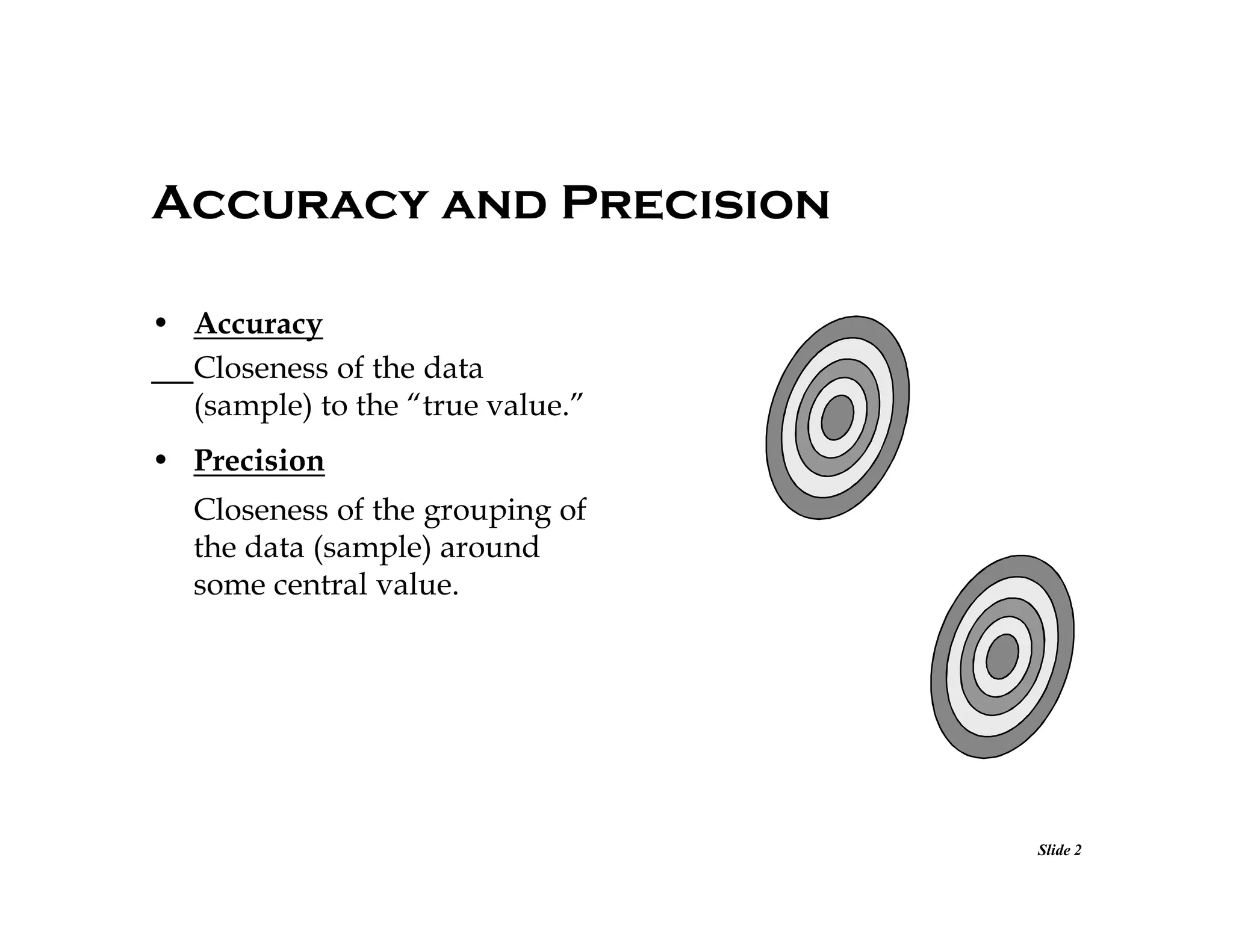
• Accuracy
Closeness of the data
(sample) to the “true value.”
• Precision
Closeness of the grouping of
the data (sample) around
some central value.

Slide 2
Accuracy and Precision
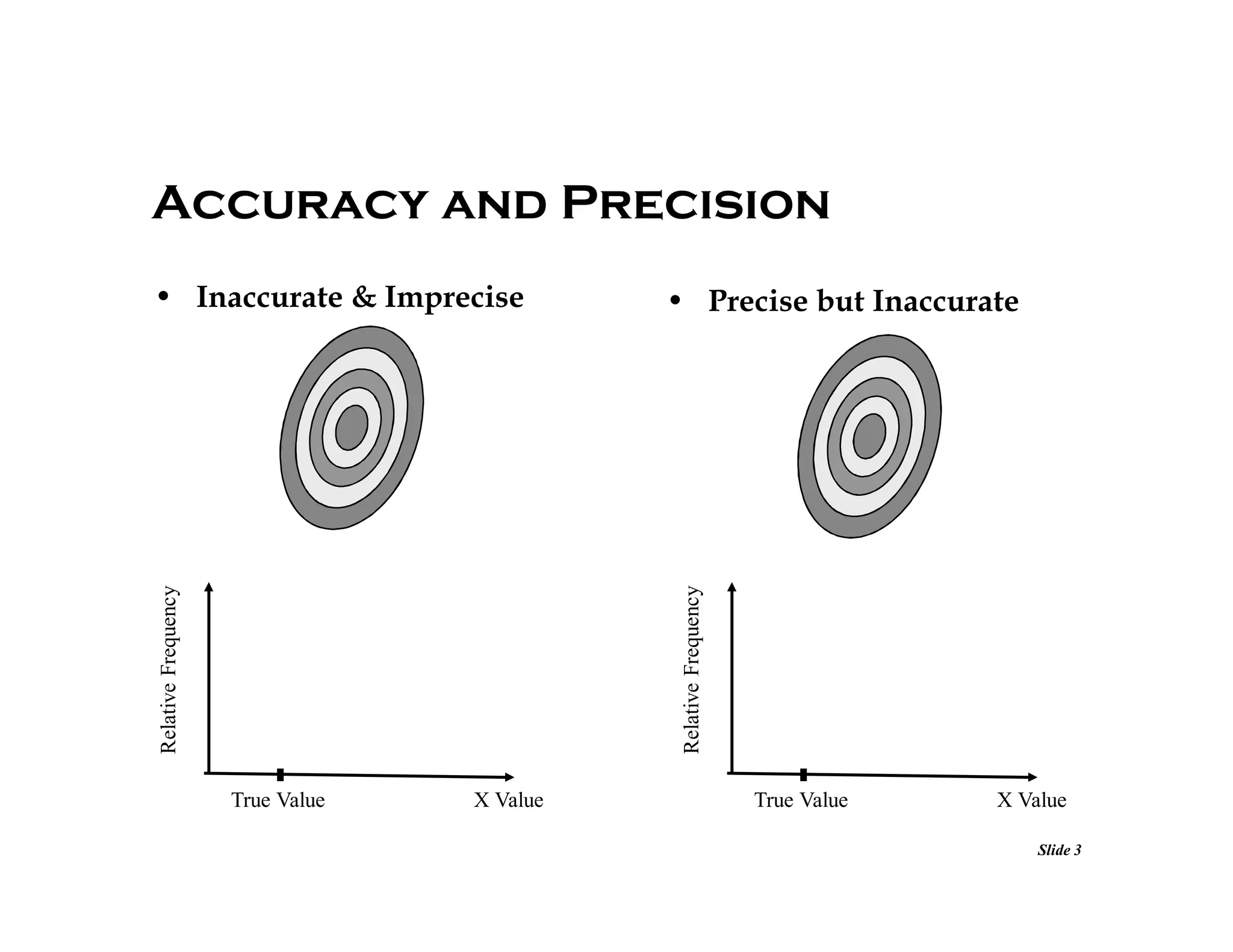
• Precise but Inaccurate

Relative Frequency

Relative Frequency

• Inaccurate & Imprecise

True Value

X Value

True Value

X Value
Slide 3
Accuracy and Precision
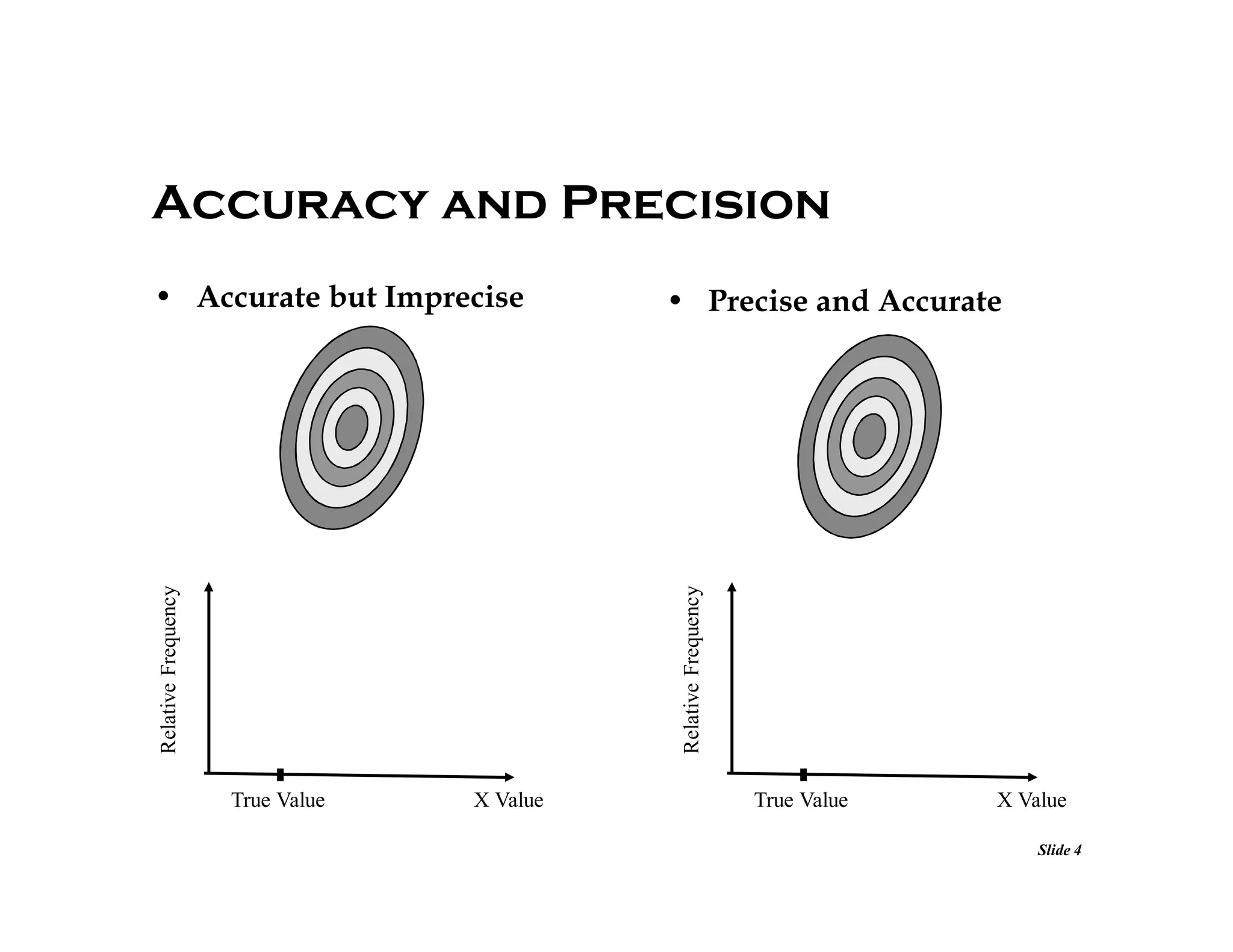
• Precise and Accurate

Relative Frequency

Relative Frequency

• Accurate but Imprecise

True Value

X Value

True Value

X Value
Slide 4
Accuracy and Precision
Q: How do we quantify the concept of accuracy and
precision? -- How do we characterize the error that
occurred in our measurement?

Slide 5
Individual Measurement
Statistics
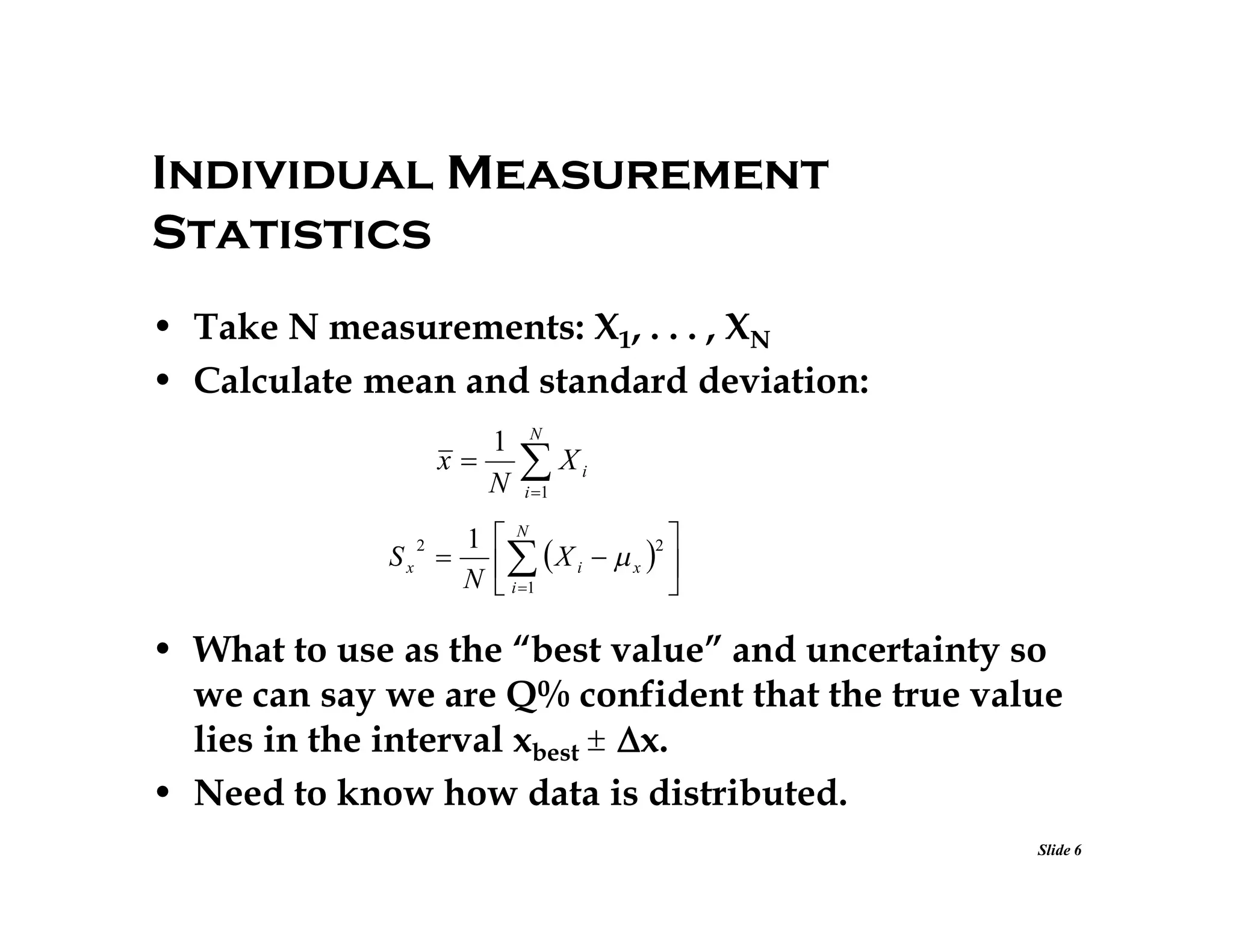
• Take N measurements: X1, . . . , XN
• Calculate mean and standard deviation:
1
x
N
Sx

2

N

X

i

i 1

1 N
2

 X i   x  
N  i 1



• What to use as the “best value” and uncertainty so
we can say we are Q% confident that the true value
lies in the interval xbest 
x.
• Need to know how data is distributed.
Slide 6
Population and Sample
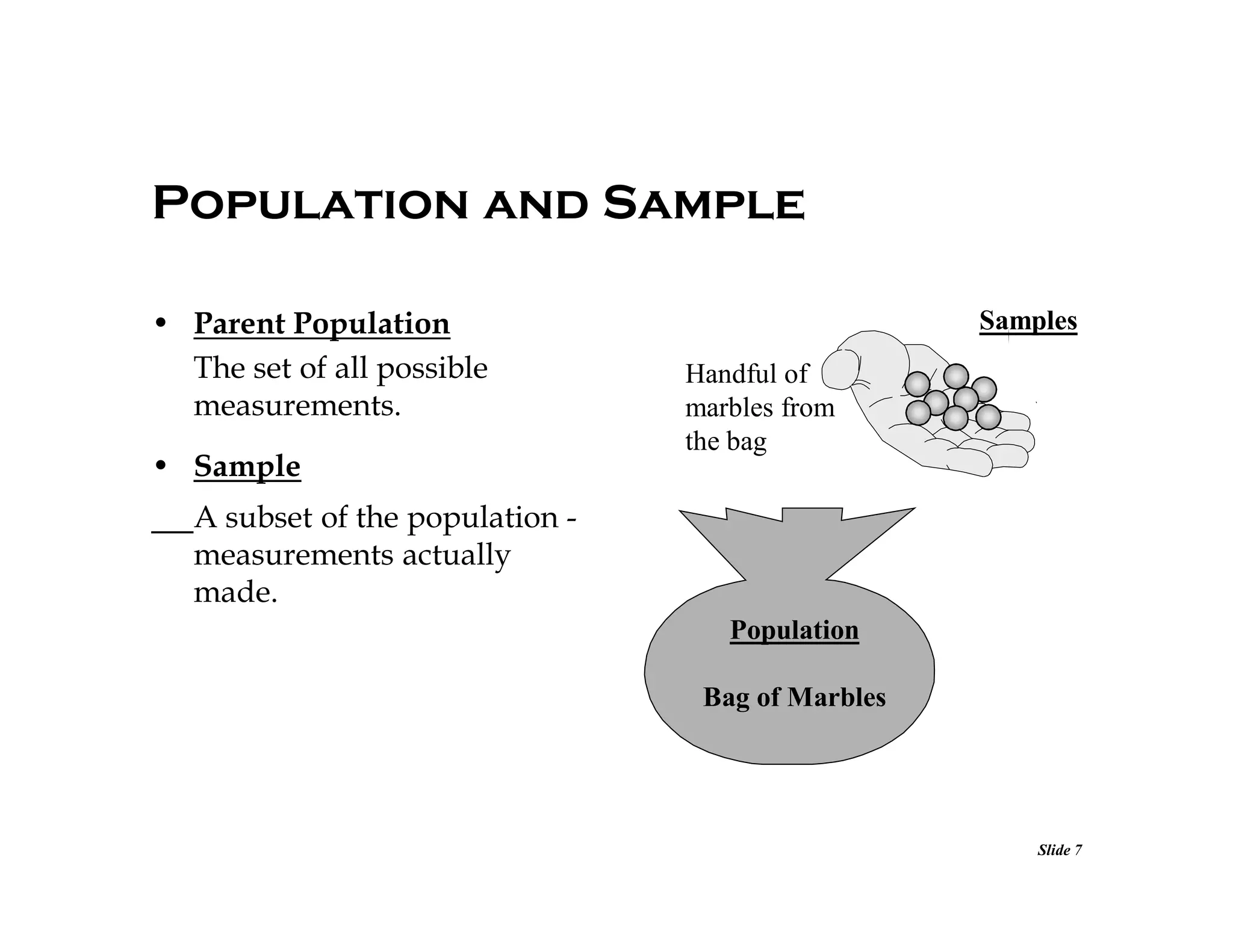
• Parent Population
The set of all possible
measurements.
• Sample

Samples
Handful of
marbles from
the bag

A subset of the population measurements actually
made.
Population
Bag of Marbles

Slide 7
Histogram (Sample Based)
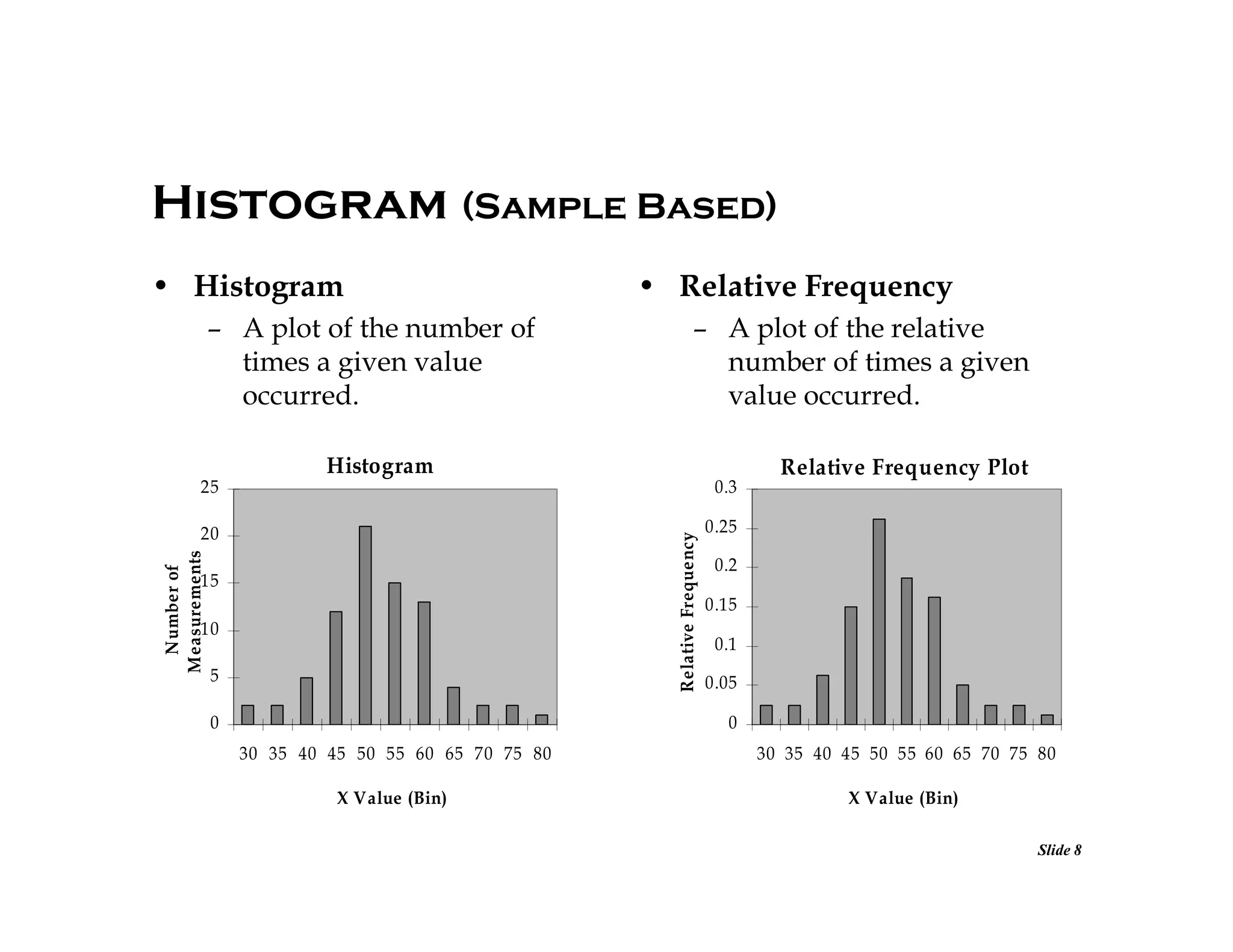
• Histogram
– A plot of the number of
times a given value
occurred.

• Relative Frequency
– A plot of the relative
number of times a given
value occurred.

Histogram
20

Relative Frequency Plot

0.25

Relative Frequency

0.3

Number of
Measurements

25

15
10
5
0

0.2
0.15
0.1
0.05
0

30 35 40 45 50 55 60 65 70 75 80

30 35 40 45 50 55 60 65 70 75 80

X Value (Bin)

X Value (Bin)
Slide 8
Probability Distribution (Population Based)
• Probability Density
Function (pdf) (p(x))
– Describes the probability
distribution of all possible
measures of x.
– Limiting case of the relative
frequency.
Probability Density Function
Probability per unit
change in x

0.3

• Probability Distribution
Function (P(x))
P x   P[ X  x]
X x

Probability that

– Probability Distribution
Function is the integral of
the pdf, i.e.
x

P  x    p  x  dx


0.25

Q: Plot the probability distribution function
vs x.
Q: What is the maximum value of P(x)?

0.2
0.15
0.1
0.05
0
30 35 40 45 50 55 60 65 70 75 80
x Value (Bin)

Slide 9
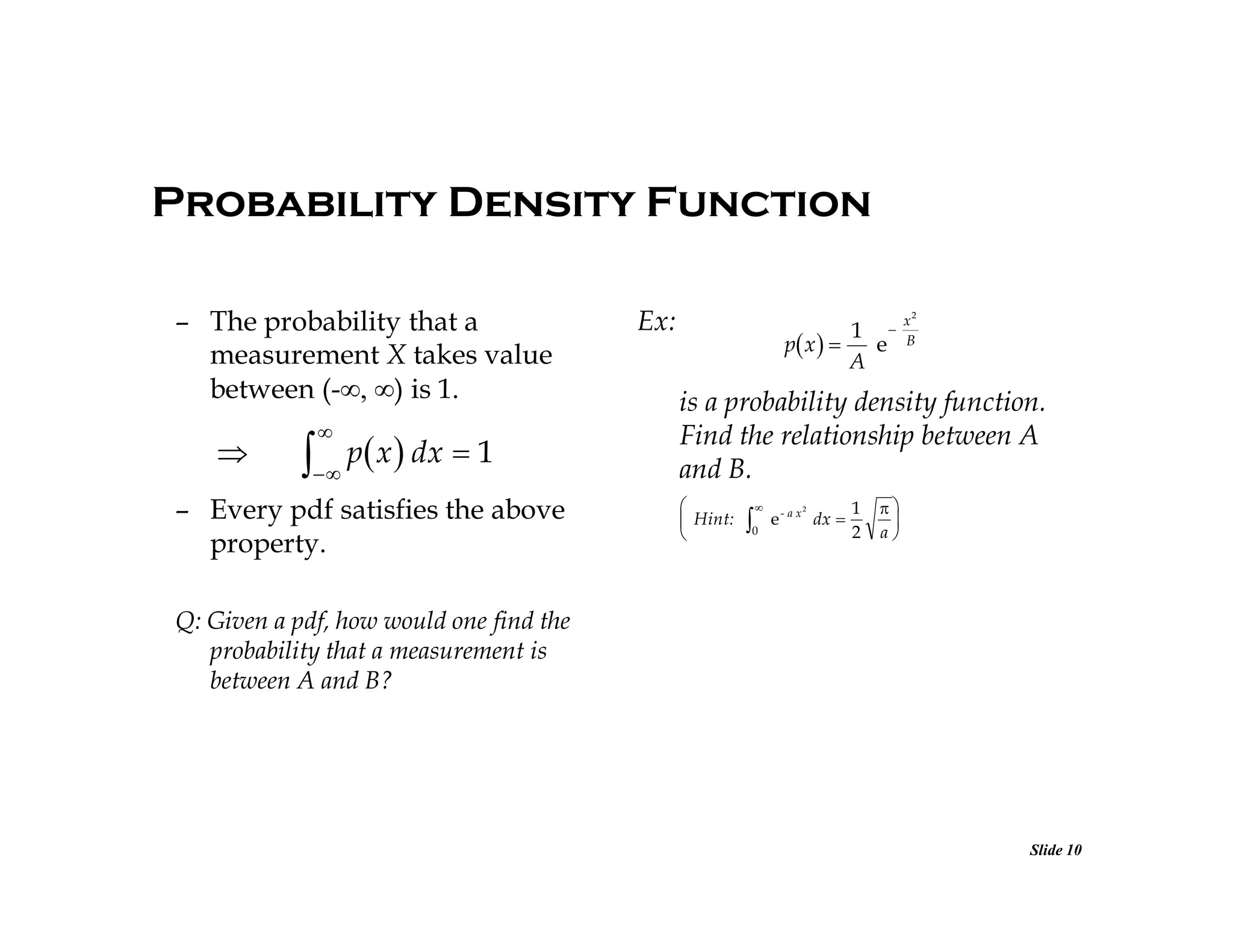
Probability Density Function
– The probability that a
measurement X takes value
between (-) is 1.





 p x  dx  1

– Every pdf satisfies the above
property.

Ex:

1 
p x  
e
A

x2
B

is a probability density function.
Find the relationship between A
and B.

 Hint:




0

2

e - a x dx 

1
2



a

Q: Given a pdf, how would one find the
probability that a measurement is
between A and B?

Slide 10
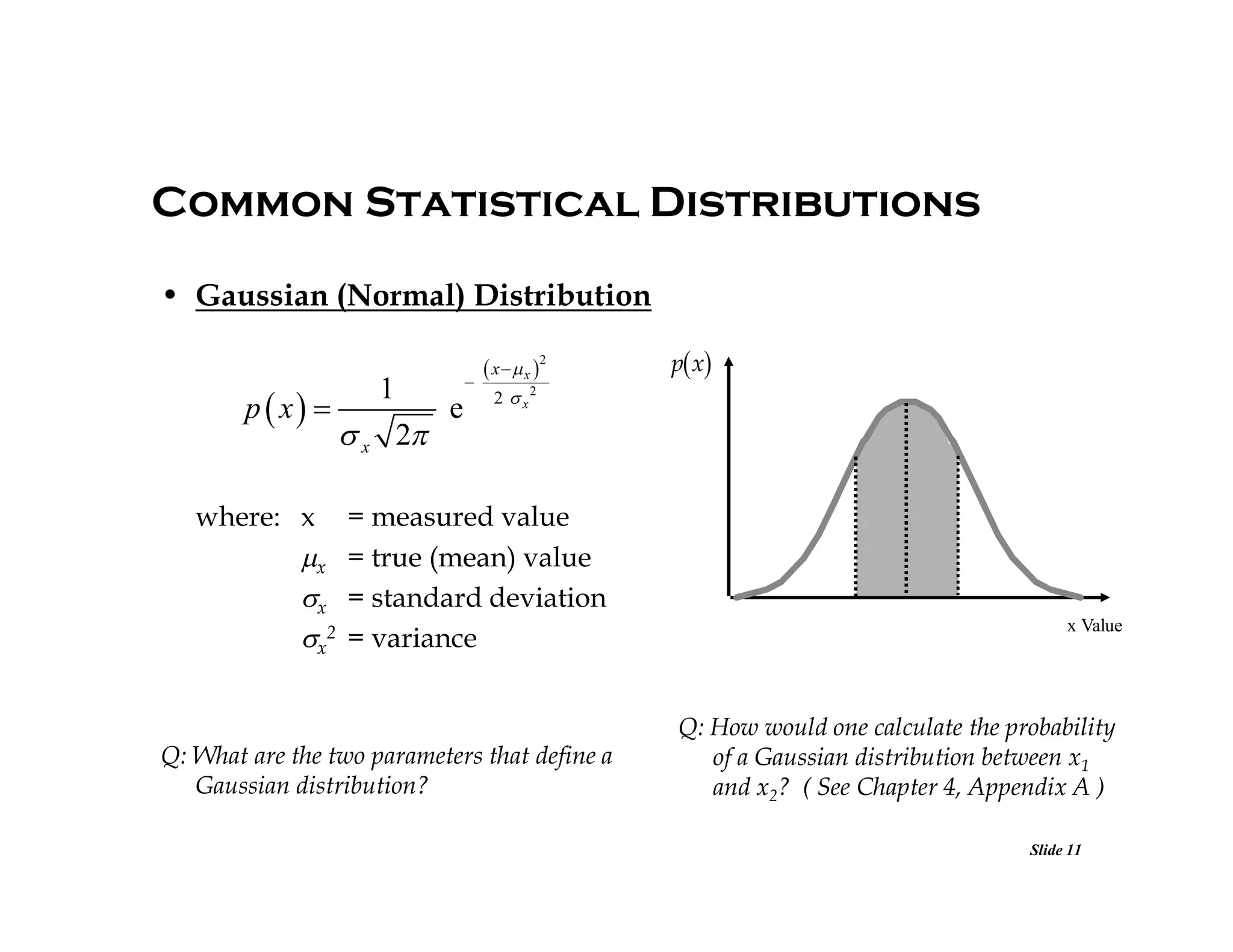
Common Statistical Distributions
• Gaussian (Normal) Distribution

p  x 
where: x
x
x
x2

1

 x 2



e

 x   x 2

p x

2  x2

= measured value
= true (mean) value
= standard deviation
= variance

Q: What are the two parameters that define a
Gaussian distribution?

x Value

Q: How would one calculate the probability
of a Gaussian distribution between x1
and x2? ( See Chapter 4, Appendix A )
Slide 11
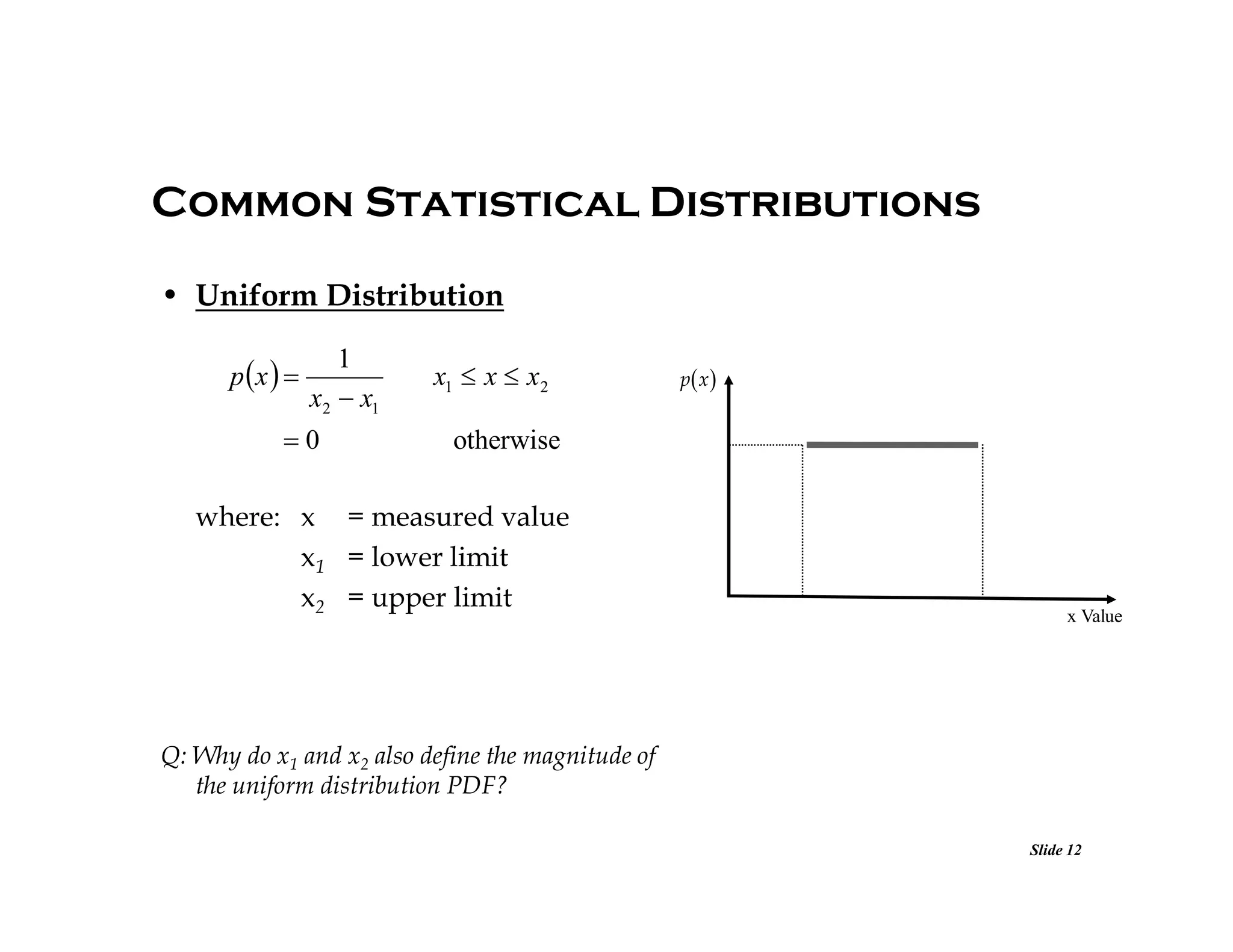
Common Statistical Distributions
• Uniform Distribution
p x  

1
x2  x1

0

x1  x  x2

p x 

otherwise

where: x = measured value
x1 = lower limit
x2 = upper limit

x Value

Q: Why do x1 and x2 also define the magnitude of
the uniform distribution PDF?
Slide 12
Common Statistical Distributions
Ex: A voltage measurement has a Gaussian
distribution with mean 3.4 [V] and a
standard deviation of 0.4 [V]. Using
Chapter 4, Appendix A, calculate the
probability that a measurement is
between:
(a) [2.98, 3.82] [V]

Ex: The quantization error of an ADC has
a uniform distribution in the
quantization interval Q. What is the
probability that the actual input voltage
is within Q/8 of the estimated input
voltage?

(b) [2.4, 4.02] [V]

Slide 13
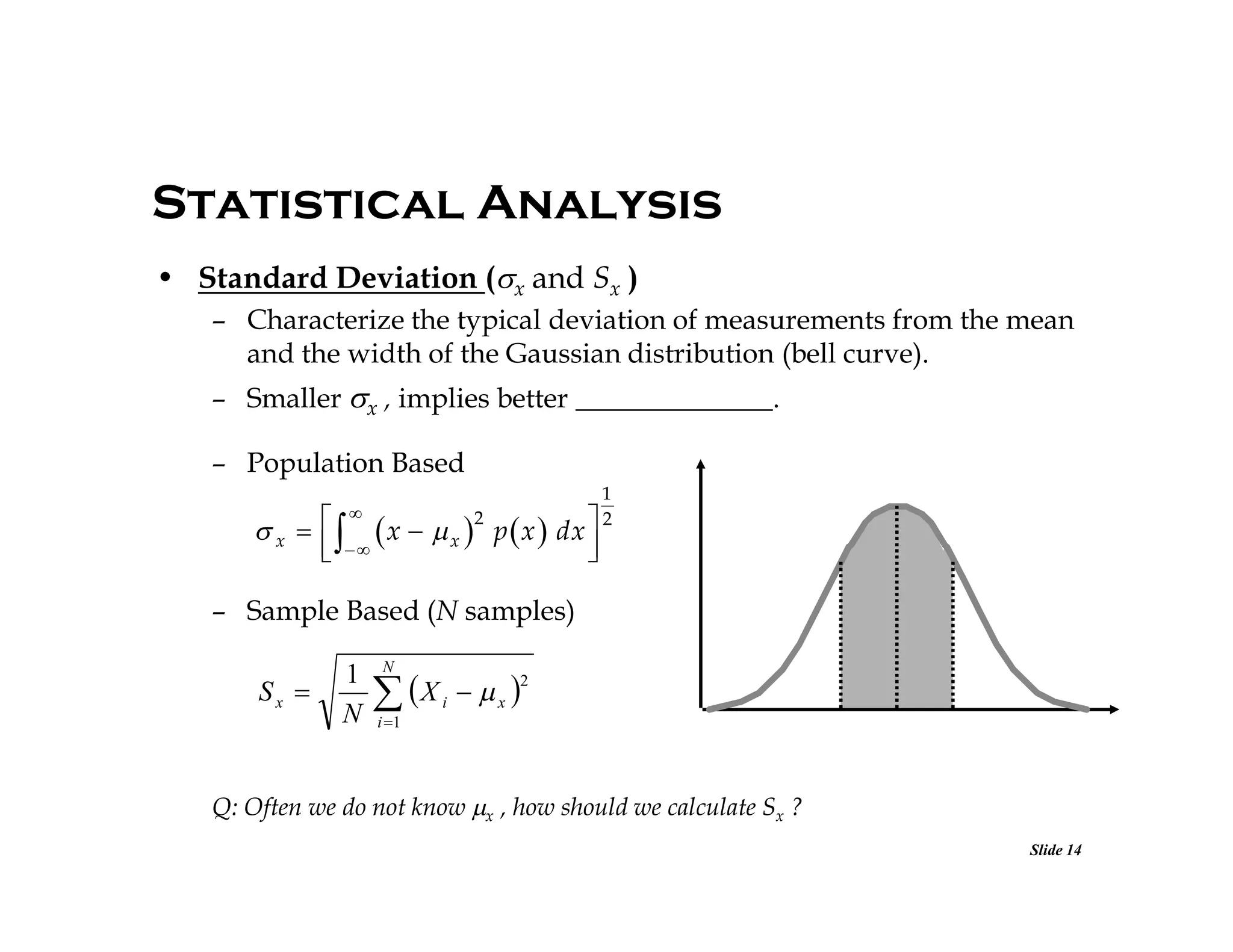
Statistical Analysis
• Standard Deviation (x and Sx )
– Characterize the typical deviation of measurements from the mean
and the width of the Gaussian distribution (bell curve).
– Smaller x , implies better ______________.
– Population Based
1
2



2
 x     x   x  p  x  dx
 




– Sample Based (N samples)

Sx 

1
N

N

 X

2

i

 x 

i 1

Q: Often we do not know x , how should we calculate Sx ?
Slide 14
Statistical Analysis
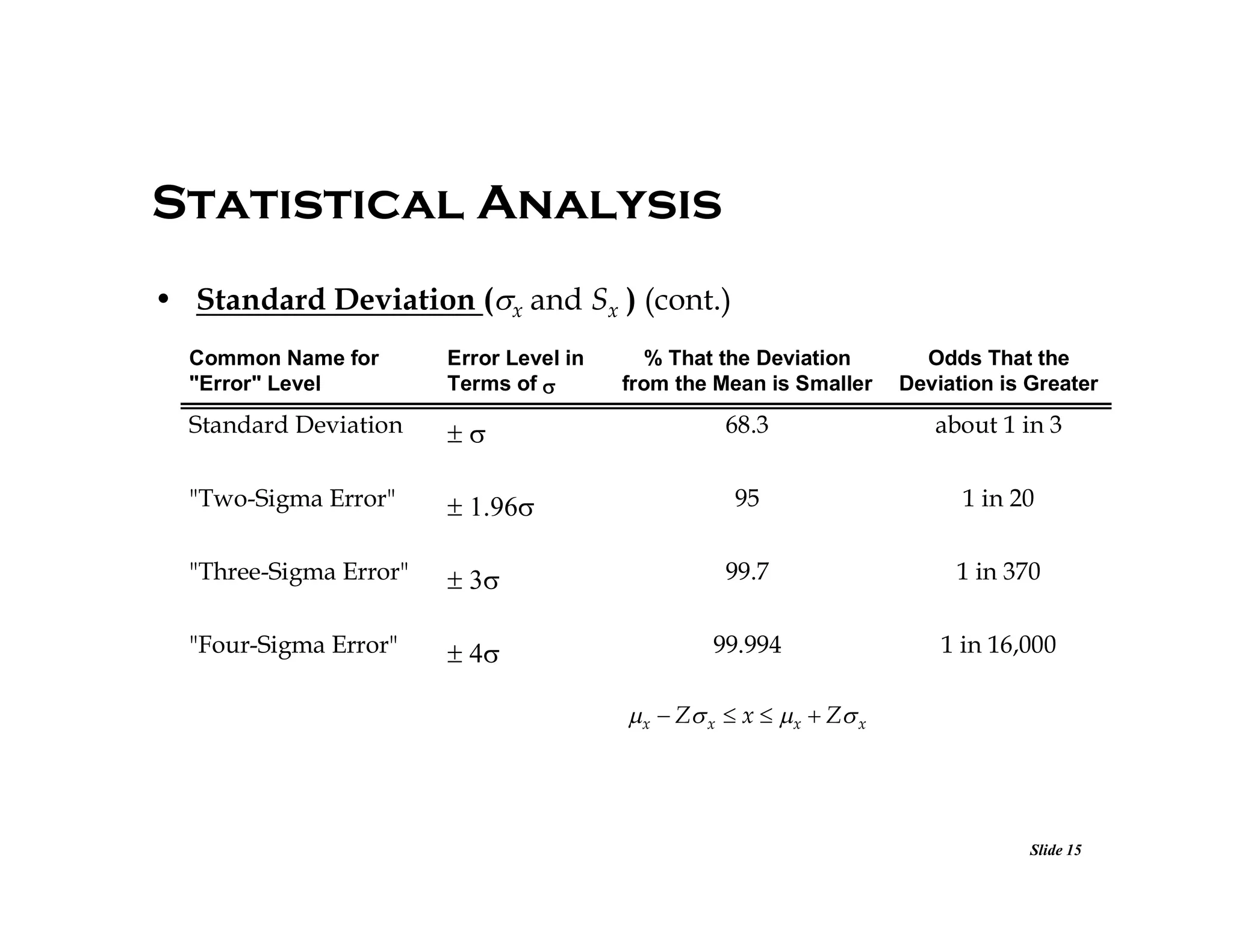
• Standard Deviation (x and Sx ) (cont.)
Common Name for
"Error" Level

Error Level in
Terms of 

% That the Deviation
from the Mean is Smaller

Odds That the
Deviation is Greater

Standard Deviation



68.3

about 1 in 3

"Two-Sigma Error"



95

1 in 20

"Three-Sigma Error"



99.7

1 in 370

"Four-Sigma Error"



99.994

1 in 16,000

 x  Z x  x   x  Z x

Slide 15
Statistical Analysis
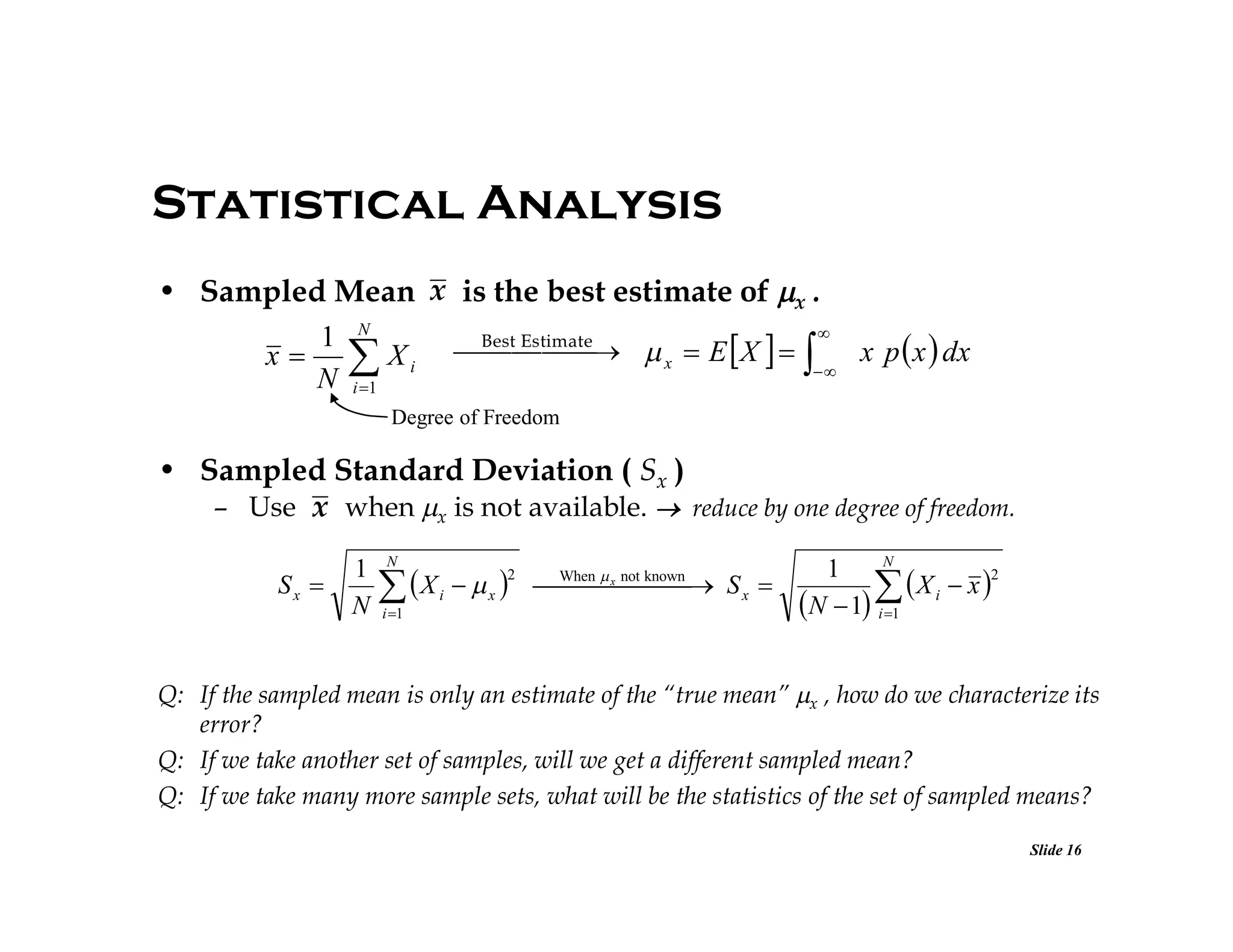
• Sampled Mean x is the best estimate of x .

1 N
Best   x  E  X   
 Estimate
x p  x  dx
x   Xi

N i 1
Degree of Freedom

• Sampled Standard Deviation ( Sx )
– Use x when x is not available.  reduce by one degree of freedom.
Sx 

1
N

N

 X
i 1

2

i

 x 

N
1
2
     S x 

 X i  x 
N  1 i 1
When  x not known

Q: If the sampled mean is only an estimate of the “true mean” x , how do we characterize its
error?
Q: If we take another set of samples, will we get a different sampled mean?
Q: If we take many more sample sets, what will be the statistics of the set of sampled means?
Slide 16
Statistical Analysis
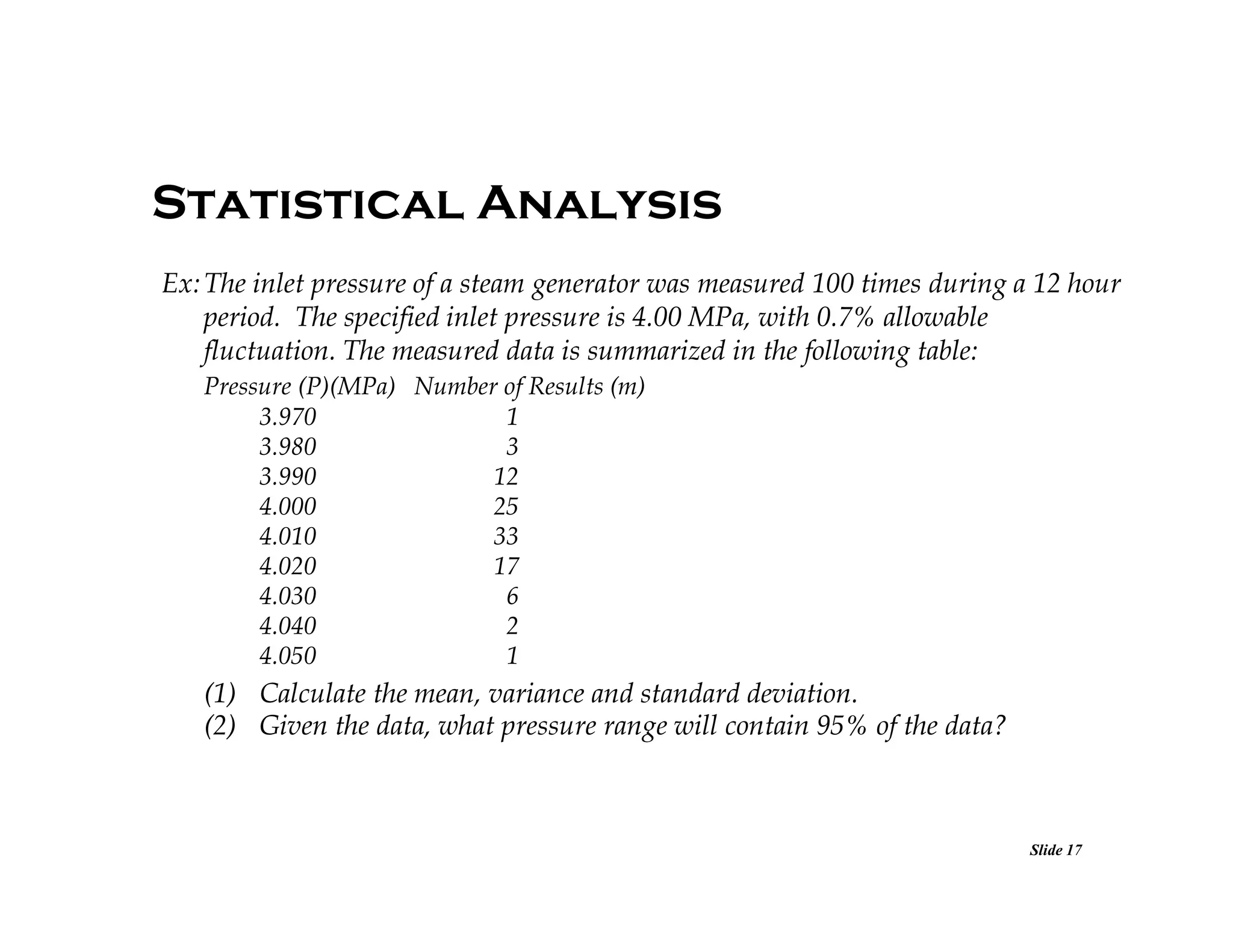
Ex: The inlet pressure of a steam generator was measured 100 times during a 12 hour
period. The specified inlet pressure is 4.00 MPa, with 0.7% allowable
fluctuation. The measured data is summarized in the following table:
Pressure (P)(MPa) Number of Results (m)
3.970
1
3.980
3
3.990
12
4.000
25
4.010
33
4.020
17
4.030
6
4.040
2
4.050
1

(1) Calculate the mean, variance and standard deviation.
(2) Given the data, what pressure range will contain 95% of the data?

Slide 17
Confidence Interval
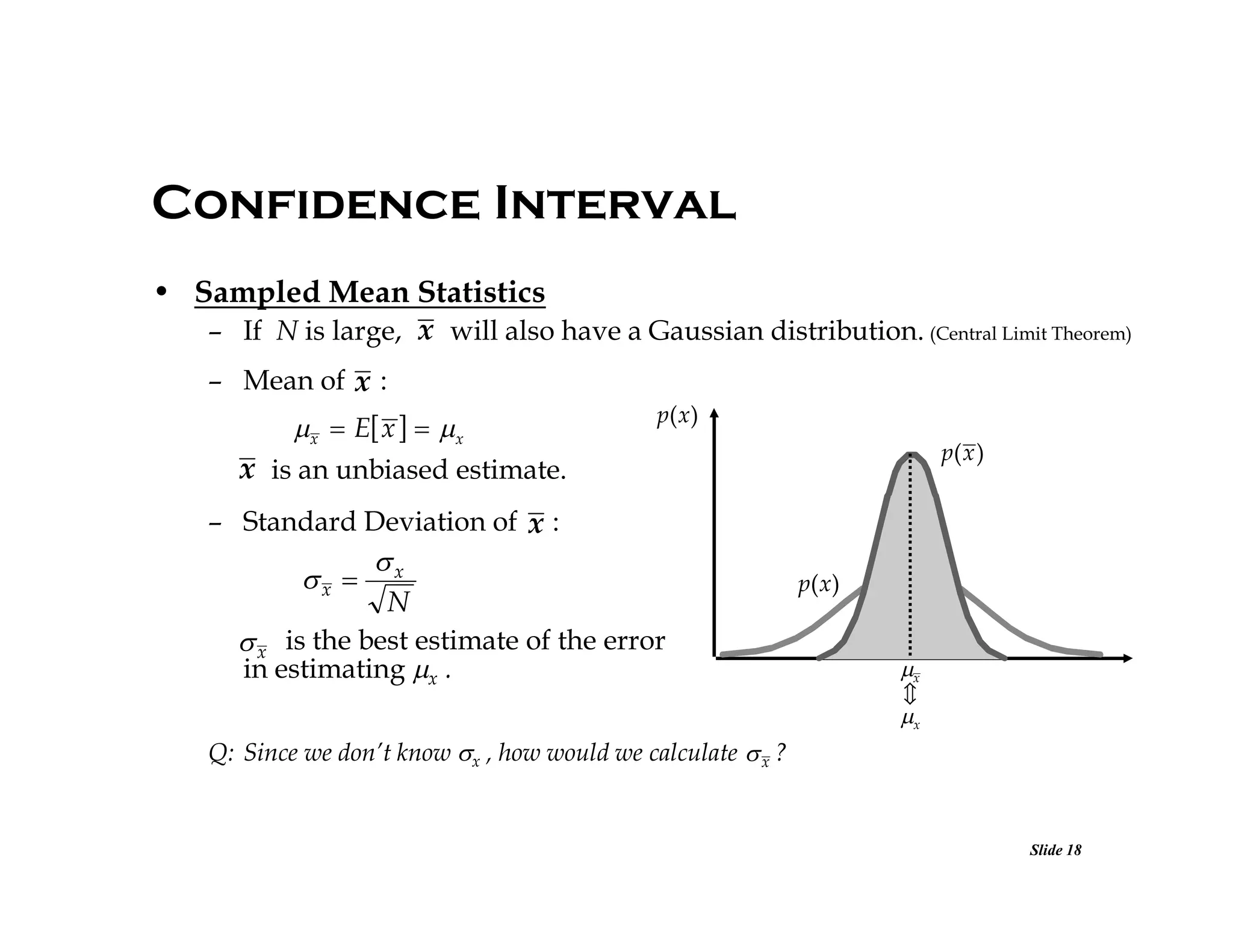
• Sampled Mean Statistics
– If N is large, x will also have a Gaussian distribution. (Central Limit Theorem)
– Mean of x :

x  E x   x
x is an unbiased estimate.

p( x )
p( x )

– Standard Deviation of x :

x 

x
N

 x is the best estimate of the error
in estimating x .

p( x )

x

x

Q: Since we don’t know x , how would we calculate  x ?

Slide 18
Confidence Interval
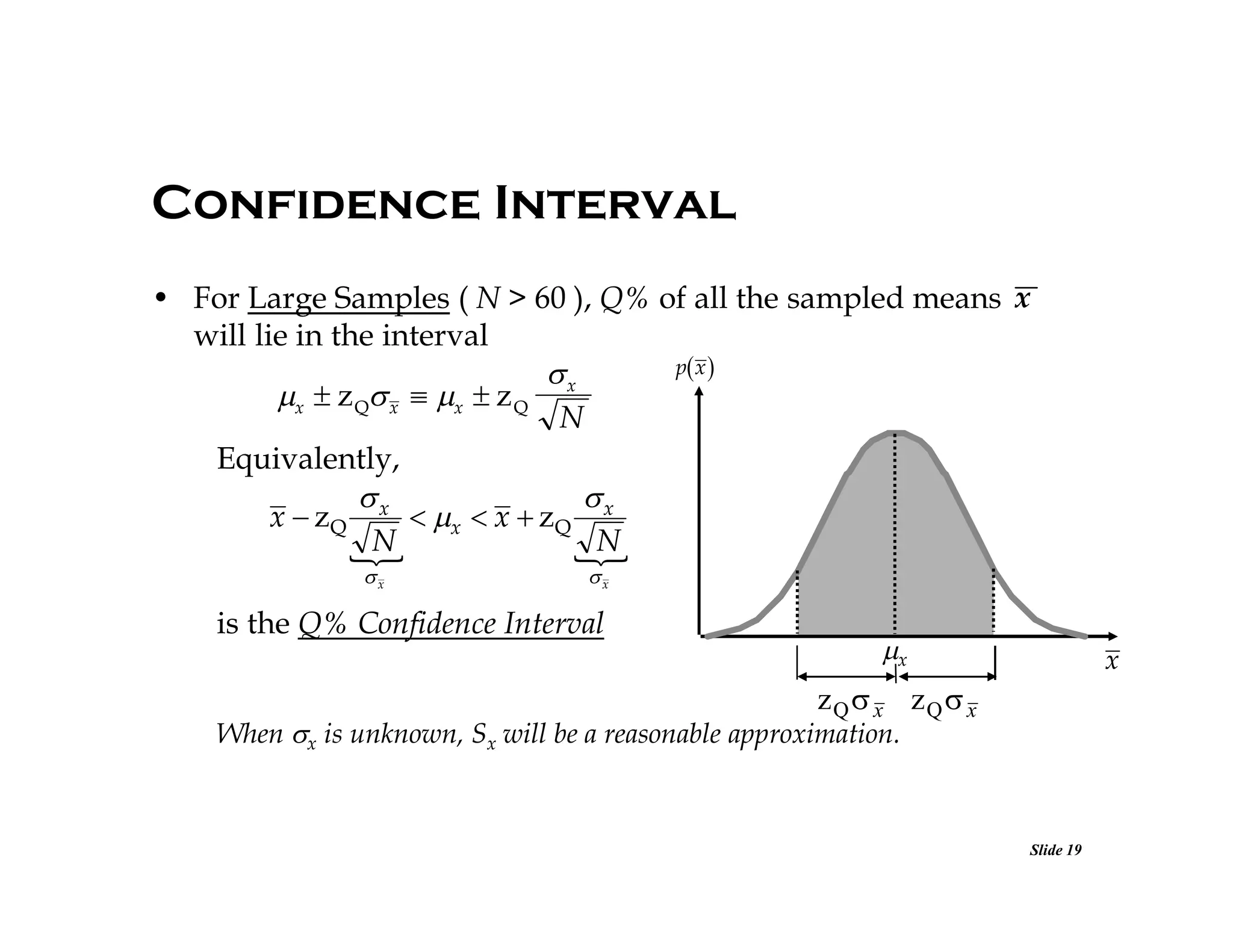
• For Large Samples ( N > 60 ), Q% of all the sampled means x
will lie in the interval
p x 
x
x  z Q x  x  z Q
N
Equivalently,


x  zQ x  x  x  zQ x
N
N


x

x

is the Q% Confidence Interval

x

x

zQ x zQ x
When x is unknown, Sx will be a reasonable approximation.

Slide 19
Confidence Interval
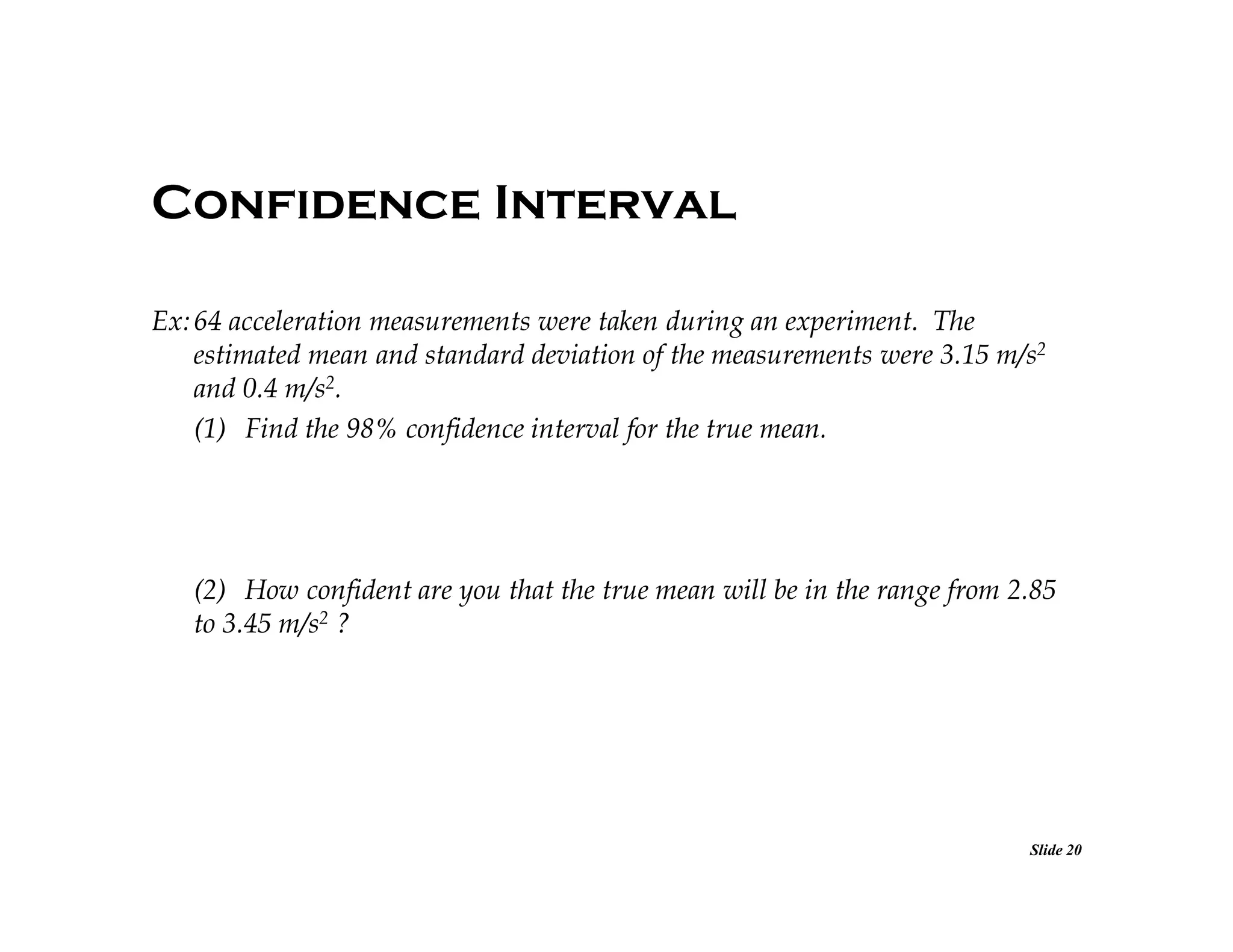
Ex: 64 acceleration measurements were taken during an experiment. The
estimated mean and standard deviation of the measurements were 3.15 m/s2
and 0.4 m/s2.
(1) Find the 98% confidence interval for the true mean.

(2) How confident are you that the true mean will be in the range from 2.85
to 3.45 m/s2 ?

Slide 20
Confidence Interval
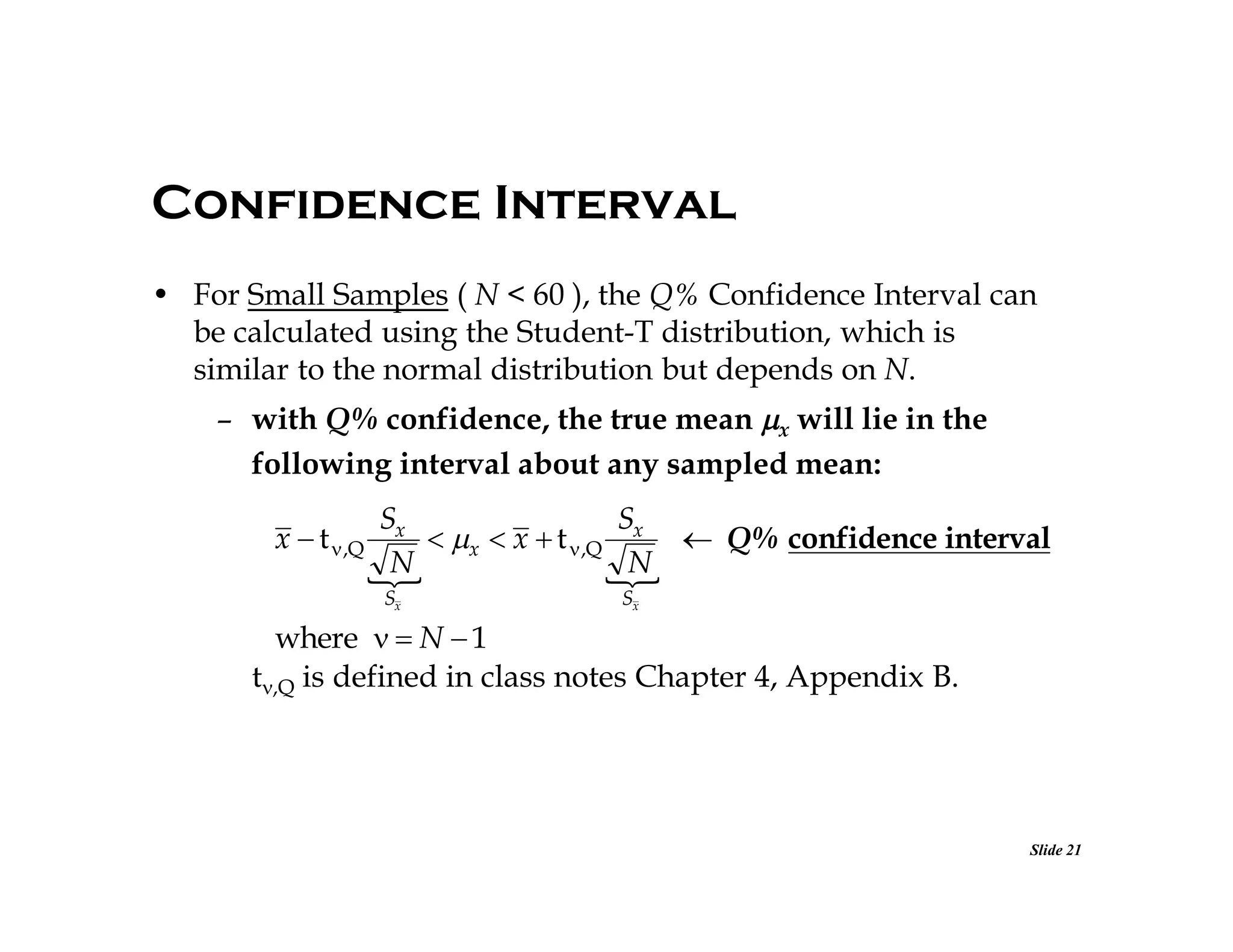
• For Small Samples ( N < 60 ), the Q% Confidence Interval can
be calculated using the Student-T distribution, which is
similar to the normal distribution but depends on N.
– with Q% confidence, the true mean x will lie in the
following interval about any sampled mean:
Sx
Sx
x  t  ,Q
 x  x  t  ,Q
 Q% confidence interval
N
N


Sx

Sx

where   N  1
t,Q is defined in class notes Chapter 4, Appendix B.

Slide 21
Confidence Interval
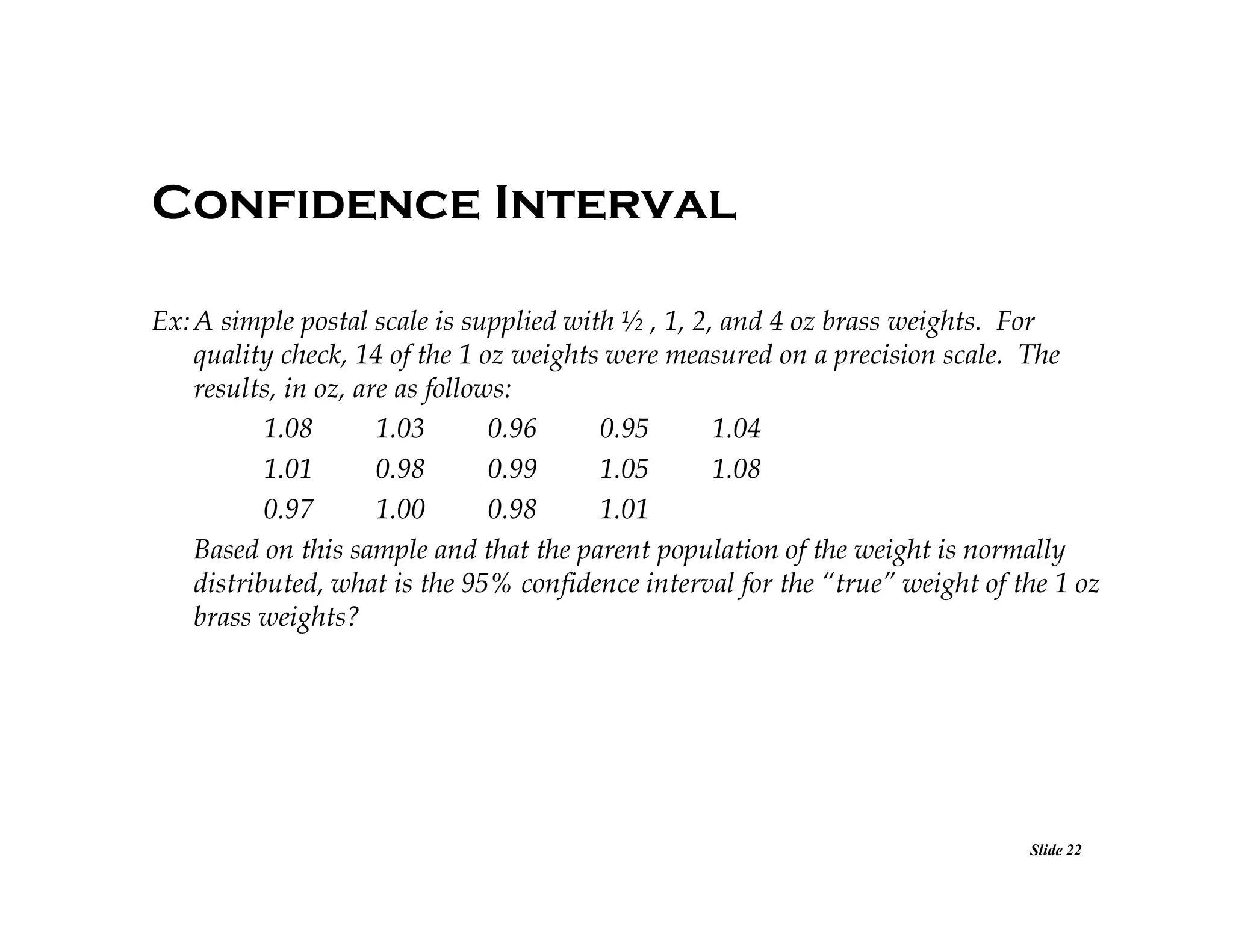
Ex: A simple postal scale is supplied with ½ , 1, 2, and 4 oz brass weights. For
quality check, 14 of the 1 oz weights were measured on a precision scale. The
results, in oz, are as follows:
1.08
1.03
0.96
0.95
1.04
1.01
0.98
0.99
1.05
1.08
0.97
1.00
0.98
1.01
Based on this sample and that the parent population of the weight is normally
distributed, what is the 95% confidence interval for the “true” weight of the 1 oz
brass weights?

Slide 22
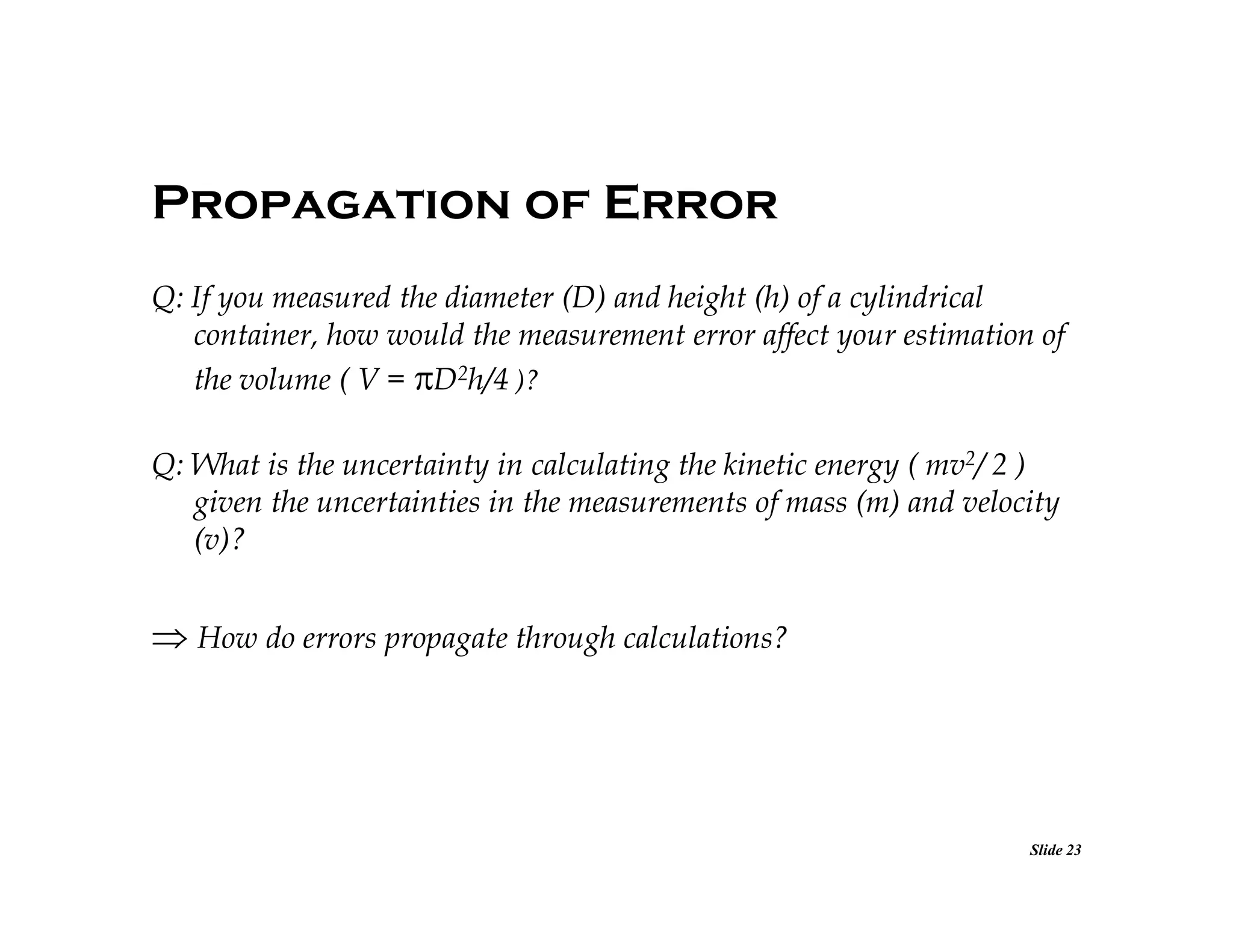
Propagation of Error
Q: If you measured the diameter (D) and height (h) of a cylindrical
container, how would the measurement error affect your estimation of
the volume ( V = D2h/4 )?
Q: What is the uncertainty in calculating the kinetic energy ( mv2/ 2 )
given the uncertainties in the measurements of mass (m) and velocity
(v)?

How do errors propagate through calculations?

Slide 23
Propagation of Error
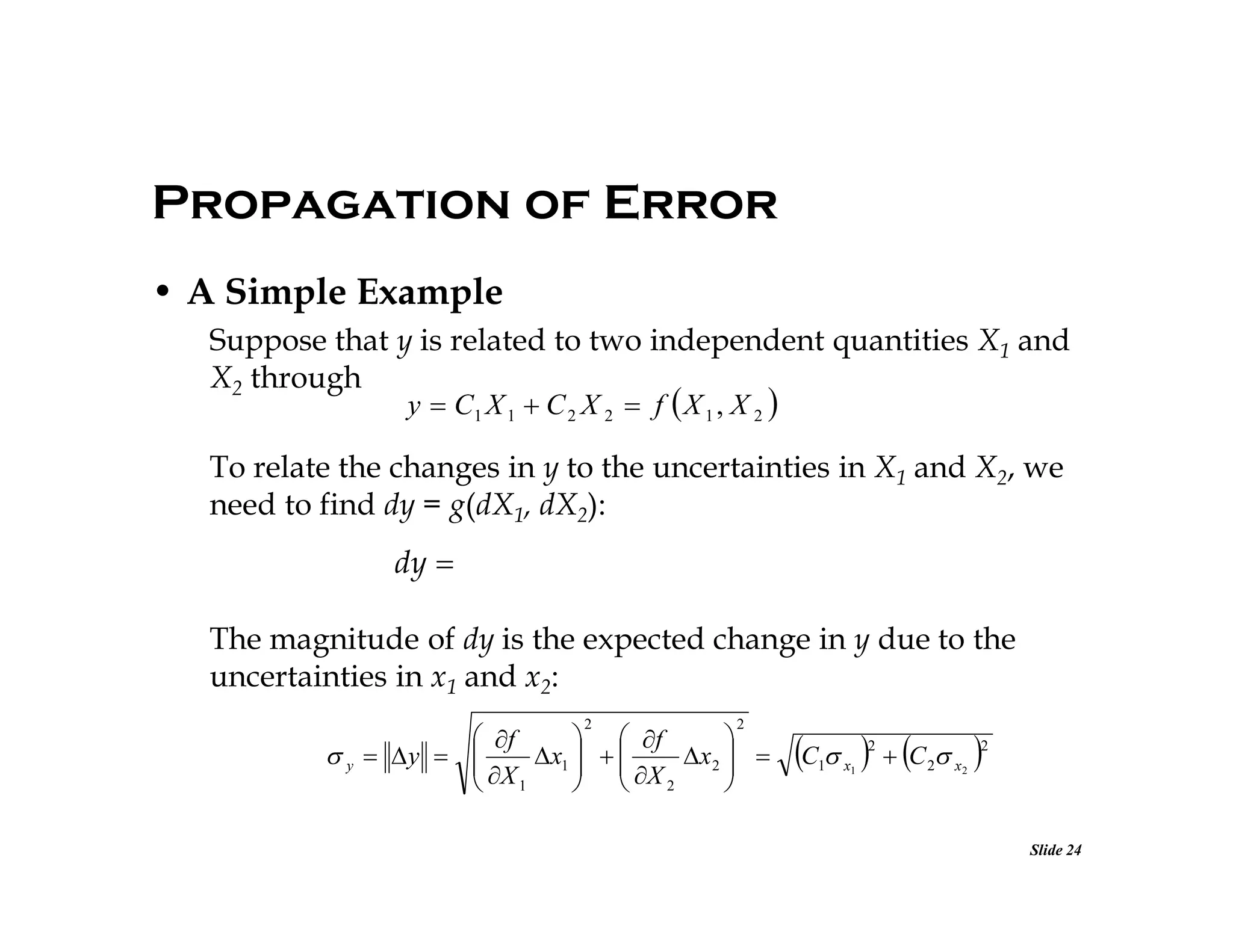
• A Simple Example
Suppose that y is related to two independent quantities X1 and
X2 through
y  C1 X 1  C 2 X 2  f  X 1 , X 2 

To relate the changes in y to the uncertainties in X1 and X2, we
need to find dy = g(dX1, dX2):

dy 
The magnitude of dy is the expected change in y due to the
uncertainties in x1 and x2:
2

2

 f
  f

 y  y  
x1   
x 2  
 X
  X

 1
  2


C    C  
2

1

x1

2

2

x2

Slide 24
Propagation of Error
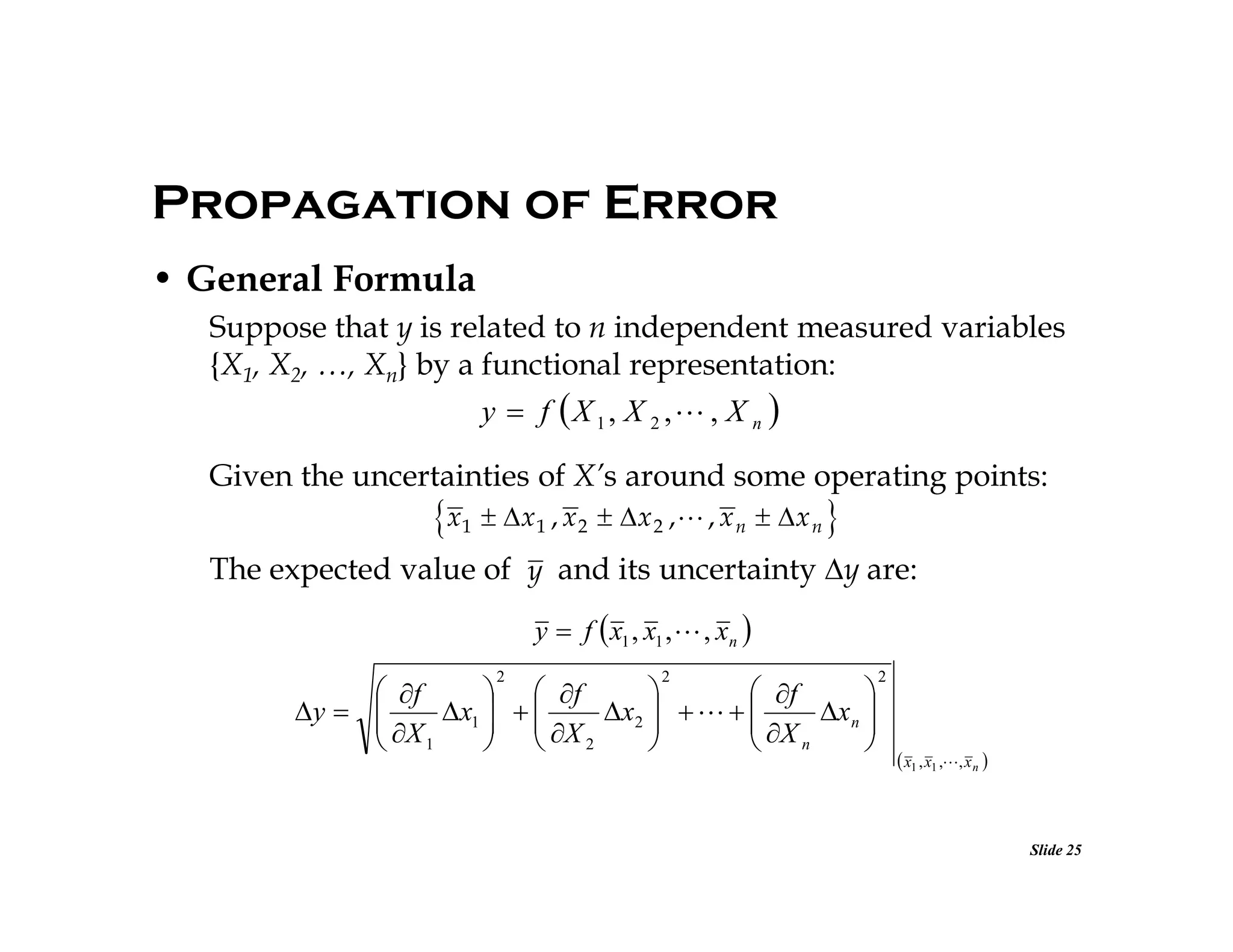
• General Formula
Suppose that y is related to n independent measured variables
{X1, X2, …, Xn} by a functional representation:

y  f X 1, X 2 , , X n 
Given the uncertainties of X’s around some operating points:

x1  x 1 , x 2  x 2 , , x n  x n 
The expected value of y and its uncertainty y are:
y  f  x1 , x1 ,  , xn 
2

2

 f
  f

 f

y  
x1   
x2     
x n 
 X
  X

 X

 1
  2

 n


2

 x1 , x1 ,, x n 

Slide 25
Propagation of Error
•Proof:
Assume that the variability in measurement y is caused
by k independent zero-mean error sources: e1, e2, . . . , ek.
Then, (y - ytrue)2 = (e1 + e2 + . . . + ek)2
= e12 + e22 + . . . + ek2 + 2e1e2 + 2e1e3 + . . .
E[(y - ytrue)2] = E[e12 + e22 + . . . + ek2 + 2e1e2 + 2e1e3 + . . .]
= E[e12 + e22 + . . . + ek2]
y 

   

 

E e1 2  E e2 2    E e k 2   1 2   2 2     k 2
Slide 26
Propagation of Error
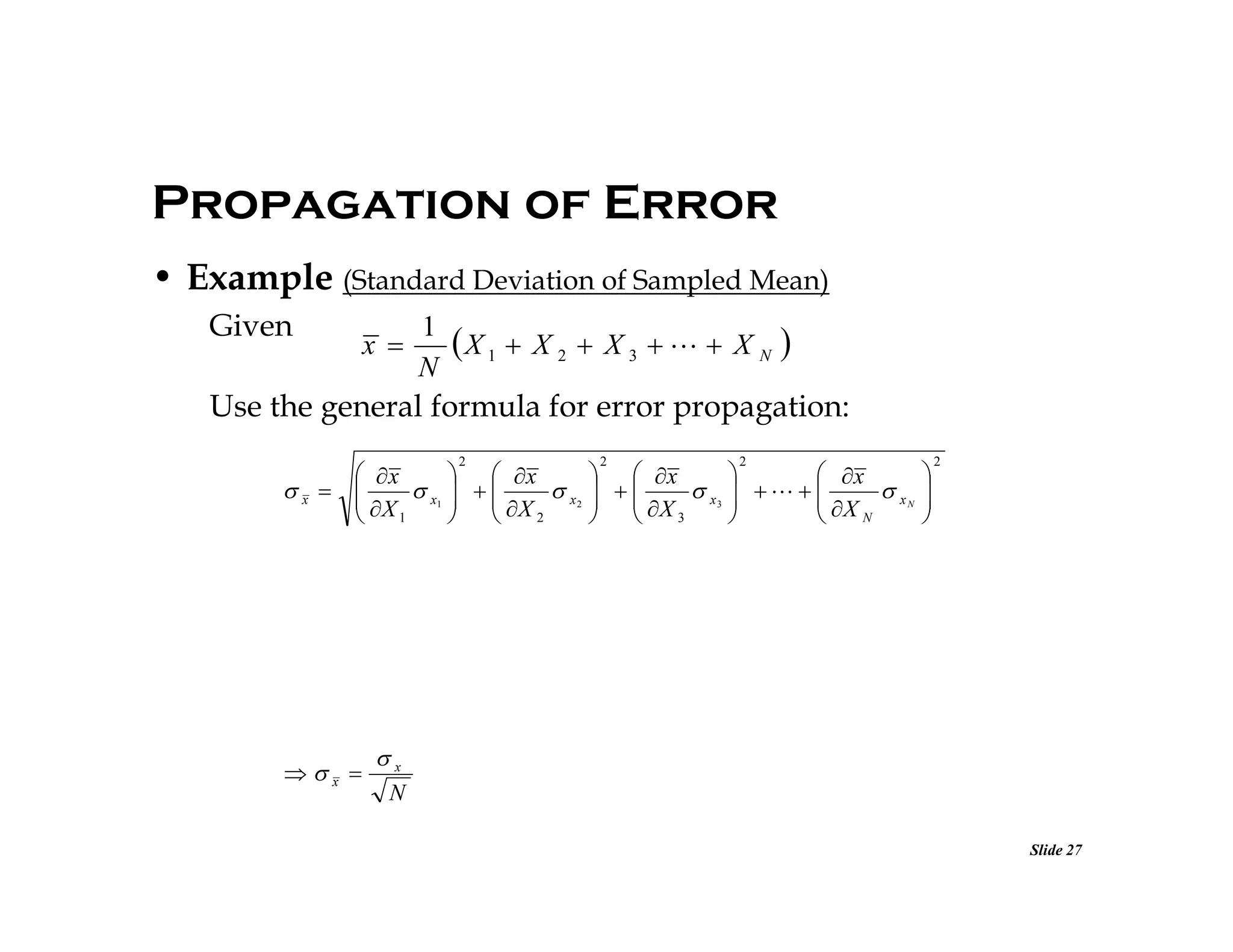
• Example (Standard Deviation of Sampled Mean)
Given

x 

1
X 1  X 2  X 3    X N
N



Use the general formula for error propagation:
2

x 

 x
  x

 x1   
 X
  X  x2
1
2

 

x 

2

2


 x
  x
 
 x3     
  X

 X  x N
3
N
 








2

x
N
Slide 27
Propagation of Error
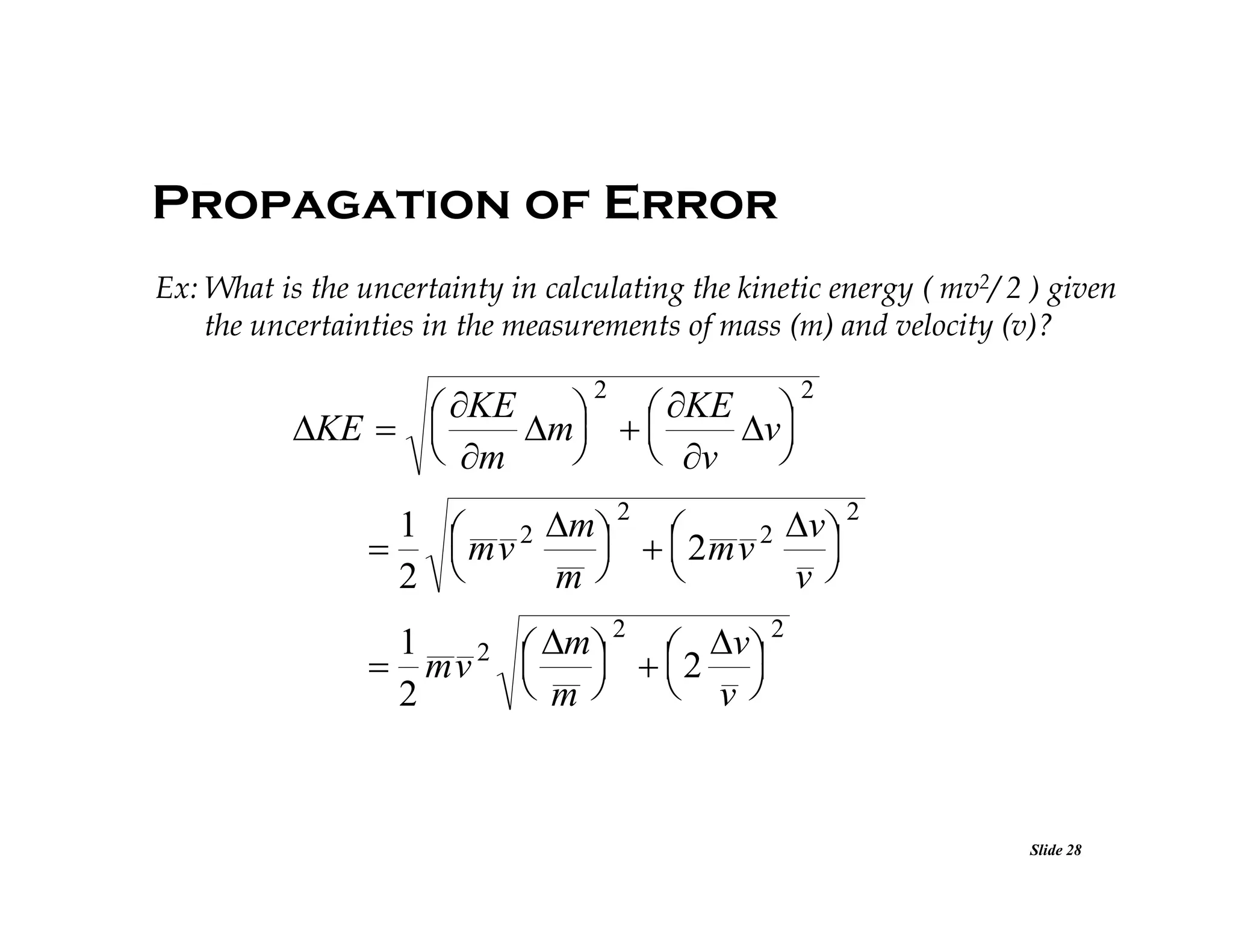
Ex: What is the uncertainty in calculating the kinetic energy ( mv2/ 2 ) given
the uncertainties in the measurements of mass (m) and velocity (v)?
2

KE
KE 
KE  
m  
v



 m

 v


2

1 
m  2 
v  2
 mv 2
   2 mv 2 


2 
m
v
1
m  2  v  2

  2 
 mv 2 
 m
 v
2

Slide 28
• Best Linear Fit
–How do we characterize “BEST”?
Fit a linear model (relation)

Output Y

Least Squares Fitting of Data
best linear
fit yest


yi  ao  a1 xi

to N pairs of [xi, yi] measurements.
Given xi, the error between the

estimated output y i and the measured
output yi is:


ni  yi  yi

measured
output yi

Input X

The “BEST” fit is the model that
 N 2
N
2

 min   ni   min   yi  yi  
minimizes the sum of the ___________
 i=1   
i=1


of the error
Least Square Error
Slide 29
Least Squares Fitting of Data
N
N
2
2
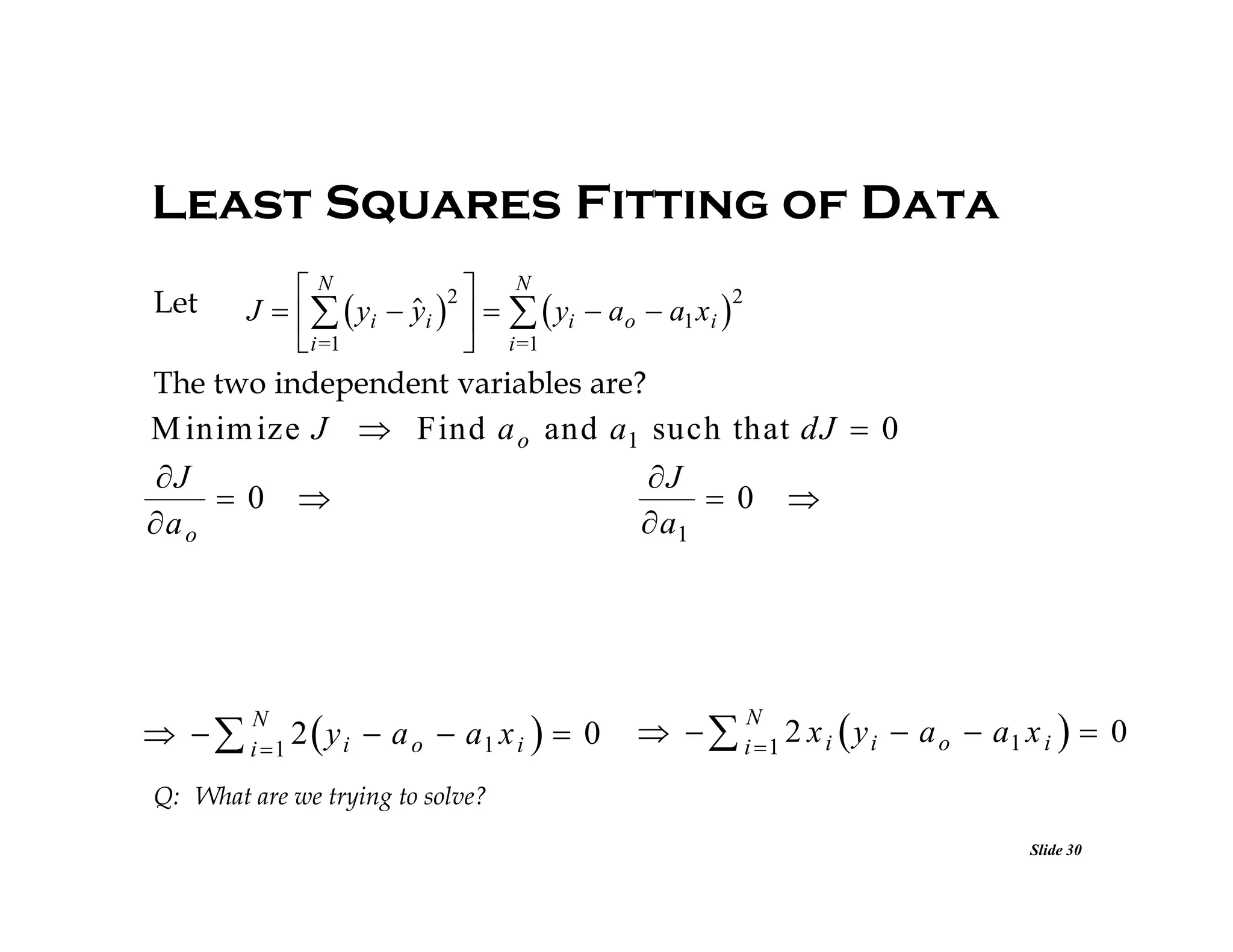
Let

J     yi  yi      yi  ao  a1 x i 
 i=1
 i=1
The two independent variables are?

M inim ize J  Find a o and a1 such that dJ  0
J
J
 0 
 0 
 a
a o

N

   i  1 2  y i  a o  a1 x i   0

N

   i  1 2 x i  y i  a o  a1 x i   0

Q: What are we trying to solve?
Slide 30
Least Squares Fitting of Data
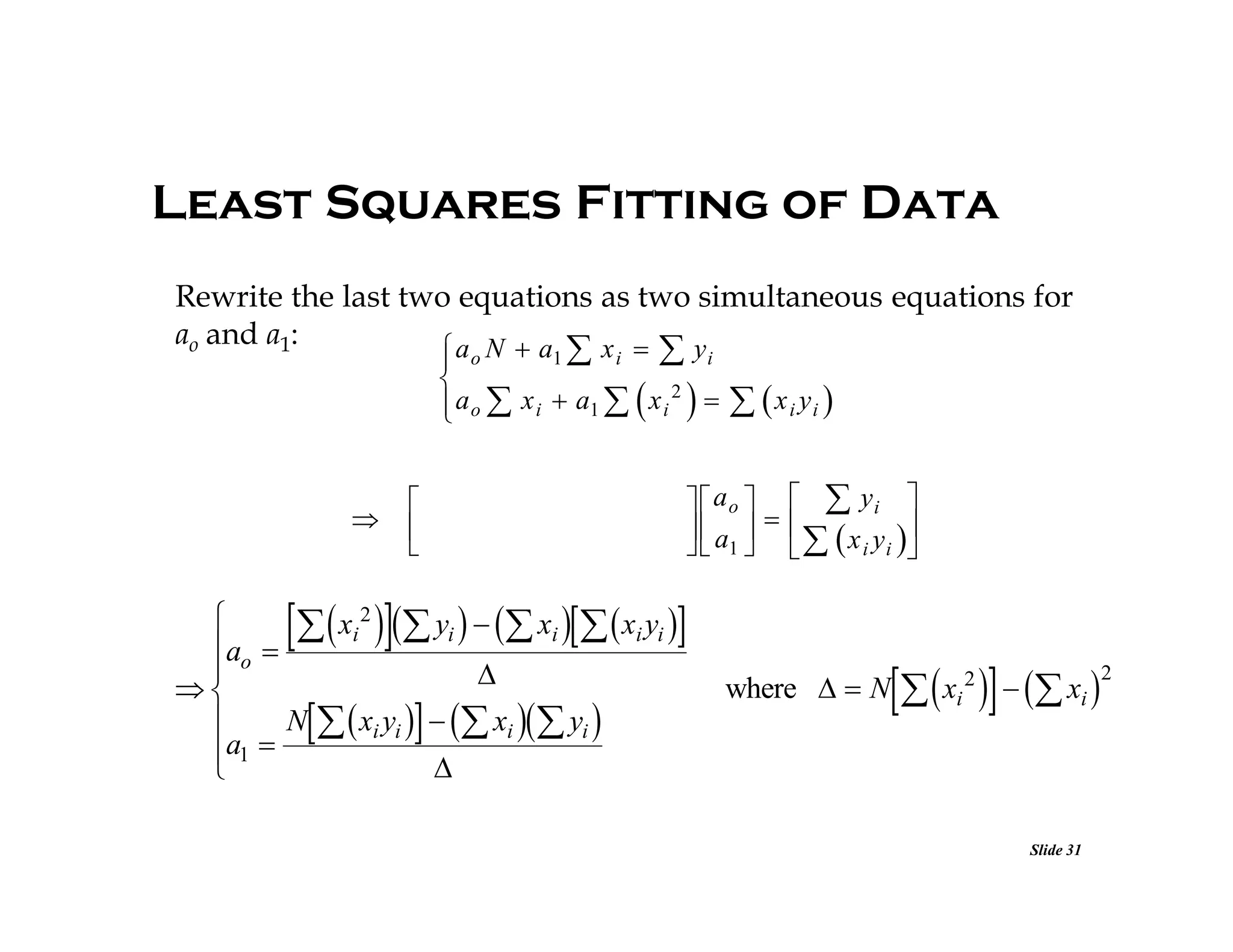
Rewrite the last two equations as two simultaneous equations for
ao and a1:
x 
y
a N  a

 i
1 i
 o

2
 a o  x i  a1  x i 


    x i yi 







  ao    yi 
  a     x y 
  1   i i 

  


 xi 2  yi    xi   xi yi 
ao 



N   xi yi    xi   yi 

a1 



  xi 2    xi 

where   N

Slide 31

2
Least Squares Fitting of Data
• Summary: Given N pairs of input/output measurements [xi, yi],
the best linear Least Squares model from input xi to output yi is:


yi  ao  a1 xi

  x  y    x   x y 

2

where
ao

a1 

i

i

i

i i



N   x i yi    x i  yi 

and   N

  

x i 2   xi 


• The process of minimizing squared error can be used for fitting
nonlinear models and many engineering applications.

• Same result can also be derived from a probability distribution
point of view (see Course Notes, Ch. 4 - Maximum Likelihood Estimation ).
Q: Given a theoretical model y = ao + a2 x2 , what are the Least Squares estimates for ao & a2?
Slide 32

2
Least Squares Fitting of Data
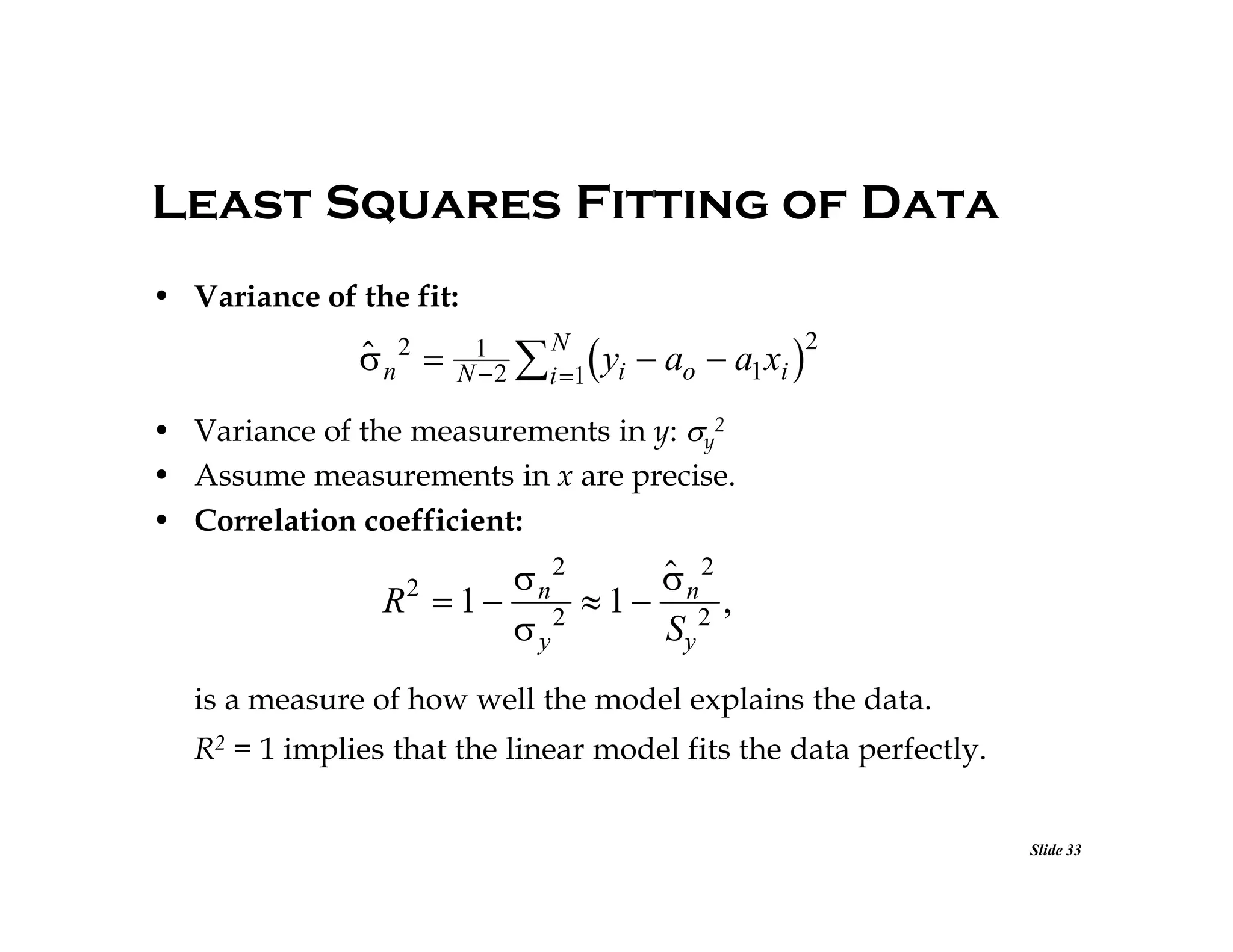
• Variance of the fit:


n2 

1
N 2

 yi  ao  a1xi 2

N
i 1

• Variance of the measurements in y: y2
• Assume measurements in x are precise.
• Correlation coefficient:


 n2
n2
R 1 2 1 2 ,
y
Sy
2

is a measure of how well the model explains the data.
R2 = 1 implies that the linear model fits the data perfectly.
Slide 33

Error analysis statistics

  • 1.
    Error Analysis -Statistics • Accuracy and Precision • Individual Measurement Uncertainty – Distribution of Data – Means, Variance and Standard Deviation – Confidence Interval • Uncertainty of Quantity calculated from several Measurements – Error Propagation • Least Squares Fitting of Data Slide 1
  • 2.
    Accuracy and Precision •Accuracy Closeness of the data (sample) to the “true value.” • Precision Closeness of the grouping of the data (sample) around some central value. Slide 2
  • 3.
    Accuracy and Precision •Precise but Inaccurate Relative Frequency Relative Frequency • Inaccurate & Imprecise True Value X Value True Value X Value Slide 3
  • 4.
    Accuracy and Precision •Precise and Accurate Relative Frequency Relative Frequency • Accurate but Imprecise True Value X Value True Value X Value Slide 4
  • 5.
    Accuracy and Precision Q:How do we quantify the concept of accuracy and precision? -- How do we characterize the error that occurred in our measurement? Slide 5
  • 6.
    Individual Measurement Statistics • TakeN measurements: X1, . . . , XN • Calculate mean and standard deviation: 1 x N Sx 2 N X i i 1 1 N 2   X i   x   N  i 1   • What to use as the “best value” and uncertainty so we can say we are Q% confident that the true value lies in the interval xbest  x. • Need to know how data is distributed. Slide 6
  • 7.
    Population and Sample •Parent Population The set of all possible measurements. • Sample Samples Handful of marbles from the bag A subset of the population measurements actually made. Population Bag of Marbles Slide 7
  • 8.
    Histogram (Sample Based) •Histogram – A plot of the number of times a given value occurred. • Relative Frequency – A plot of the relative number of times a given value occurred. Histogram 20 Relative Frequency Plot 0.25 Relative Frequency 0.3 Number of Measurements 25 15 10 5 0 0.2 0.15 0.1 0.05 0 30 35 40 45 50 55 60 65 70 75 80 30 35 40 45 50 55 60 65 70 75 80 X Value (Bin) X Value (Bin) Slide 8
  • 9.
    Probability Distribution (PopulationBased) • Probability Density Function (pdf) (p(x)) – Describes the probability distribution of all possible measures of x. – Limiting case of the relative frequency. Probability Density Function Probability per unit change in x 0.3 • Probability Distribution Function (P(x)) P x   P[ X  x] X x Probability that – Probability Distribution Function is the integral of the pdf, i.e. x P  x    p  x  dx  0.25 Q: Plot the probability distribution function vs x. Q: What is the maximum value of P(x)? 0.2 0.15 0.1 0.05 0 30 35 40 45 50 55 60 65 70 75 80 x Value (Bin) Slide 9
  • 10.
    Probability Density Function –The probability that a measurement X takes value between (-) is 1.    p x  dx  1 – Every pdf satisfies the above property. Ex: 1  p x   e A x2 B is a probability density function. Find the relationship between A and B.   Hint:   0 2 e - a x dx  1 2   a Q: Given a pdf, how would one find the probability that a measurement is between A and B? Slide 10
  • 11.
    Common Statistical Distributions •Gaussian (Normal) Distribution p  x  where: x x x x2 1  x 2  e  x   x 2 p x 2  x2 = measured value = true (mean) value = standard deviation = variance Q: What are the two parameters that define a Gaussian distribution? x Value Q: How would one calculate the probability of a Gaussian distribution between x1 and x2? ( See Chapter 4, Appendix A ) Slide 11
  • 12.
    Common Statistical Distributions •Uniform Distribution p x   1 x2  x1 0 x1  x  x2 p x  otherwise where: x = measured value x1 = lower limit x2 = upper limit x Value Q: Why do x1 and x2 also define the magnitude of the uniform distribution PDF? Slide 12
  • 13.
    Common Statistical Distributions Ex:A voltage measurement has a Gaussian distribution with mean 3.4 [V] and a standard deviation of 0.4 [V]. Using Chapter 4, Appendix A, calculate the probability that a measurement is between: (a) [2.98, 3.82] [V] Ex: The quantization error of an ADC has a uniform distribution in the quantization interval Q. What is the probability that the actual input voltage is within Q/8 of the estimated input voltage? (b) [2.4, 4.02] [V] Slide 13
  • 14.
    Statistical Analysis • StandardDeviation (x and Sx ) – Characterize the typical deviation of measurements from the mean and the width of the Gaussian distribution (bell curve). – Smaller x , implies better ______________. – Population Based 1 2  2  x     x   x  p  x  dx      – Sample Based (N samples) Sx  1 N N  X 2 i  x  i 1 Q: Often we do not know x , how should we calculate Sx ? Slide 14
  • 15.
    Statistical Analysis • StandardDeviation (x and Sx ) (cont.) Common Name for "Error" Level Error Level in Terms of  % That the Deviation from the Mean is Smaller Odds That the Deviation is Greater Standard Deviation  68.3 about 1 in 3 "Two-Sigma Error"  95 1 in 20 "Three-Sigma Error"  99.7 1 in 370 "Four-Sigma Error"  99.994 1 in 16,000  x  Z x  x   x  Z x Slide 15
  • 16.
    Statistical Analysis • SampledMean x is the best estimate of x .  1 N Best   x  E  X     Estimate x p  x  dx x   Xi  N i 1 Degree of Freedom • Sampled Standard Deviation ( Sx ) – Use x when x is not available.  reduce by one degree of freedom. Sx  1 N N  X i 1 2 i  x  N 1 2      S x    X i  x  N  1 i 1 When  x not known Q: If the sampled mean is only an estimate of the “true mean” x , how do we characterize its error? Q: If we take another set of samples, will we get a different sampled mean? Q: If we take many more sample sets, what will be the statistics of the set of sampled means? Slide 16
  • 17.
    Statistical Analysis Ex: Theinlet pressure of a steam generator was measured 100 times during a 12 hour period. The specified inlet pressure is 4.00 MPa, with 0.7% allowable fluctuation. The measured data is summarized in the following table: Pressure (P)(MPa) Number of Results (m) 3.970 1 3.980 3 3.990 12 4.000 25 4.010 33 4.020 17 4.030 6 4.040 2 4.050 1 (1) Calculate the mean, variance and standard deviation. (2) Given the data, what pressure range will contain 95% of the data? Slide 17
  • 18.
    Confidence Interval • SampledMean Statistics – If N is large, x will also have a Gaussian distribution. (Central Limit Theorem) – Mean of x : x  E x   x x is an unbiased estimate. p( x ) p( x ) – Standard Deviation of x : x  x N  x is the best estimate of the error in estimating x . p( x ) x  x Q: Since we don’t know x , how would we calculate  x ? Slide 18
  • 19.
    Confidence Interval • ForLarge Samples ( N > 60 ), Q% of all the sampled means x will lie in the interval p x  x x  z Q x  x  z Q N Equivalently,   x  zQ x  x  x  zQ x N N   x x is the Q% Confidence Interval x x zQ x zQ x When x is unknown, Sx will be a reasonable approximation. Slide 19
  • 20.
    Confidence Interval Ex: 64acceleration measurements were taken during an experiment. The estimated mean and standard deviation of the measurements were 3.15 m/s2 and 0.4 m/s2. (1) Find the 98% confidence interval for the true mean. (2) How confident are you that the true mean will be in the range from 2.85 to 3.45 m/s2 ? Slide 20
  • 21.
    Confidence Interval • ForSmall Samples ( N < 60 ), the Q% Confidence Interval can be calculated using the Student-T distribution, which is similar to the normal distribution but depends on N. – with Q% confidence, the true mean x will lie in the following interval about any sampled mean: Sx Sx x  t  ,Q  x  x  t  ,Q  Q% confidence interval N N   Sx Sx where   N  1 t,Q is defined in class notes Chapter 4, Appendix B. Slide 21
  • 22.
    Confidence Interval Ex: Asimple postal scale is supplied with ½ , 1, 2, and 4 oz brass weights. For quality check, 14 of the 1 oz weights were measured on a precision scale. The results, in oz, are as follows: 1.08 1.03 0.96 0.95 1.04 1.01 0.98 0.99 1.05 1.08 0.97 1.00 0.98 1.01 Based on this sample and that the parent population of the weight is normally distributed, what is the 95% confidence interval for the “true” weight of the 1 oz brass weights? Slide 22
  • 23.
    Propagation of Error Q:If you measured the diameter (D) and height (h) of a cylindrical container, how would the measurement error affect your estimation of the volume ( V = D2h/4 )? Q: What is the uncertainty in calculating the kinetic energy ( mv2/ 2 ) given the uncertainties in the measurements of mass (m) and velocity (v)? How do errors propagate through calculations? Slide 23
  • 24.
    Propagation of Error •A Simple Example Suppose that y is related to two independent quantities X1 and X2 through y  C1 X 1  C 2 X 2  f  X 1 , X 2  To relate the changes in y to the uncertainties in X1 and X2, we need to find dy = g(dX1, dX2): dy  The magnitude of dy is the expected change in y due to the uncertainties in x1 and x2: 2 2  f   f   y  y   x1    x 2    X   X   1   2  C    C   2 1 x1 2 2 x2 Slide 24
  • 25.
    Propagation of Error •General Formula Suppose that y is related to n independent measured variables {X1, X2, …, Xn} by a functional representation: y  f X 1, X 2 , , X n  Given the uncertainties of X’s around some operating points: x1  x 1 , x 2  x 2 , , x n  x n  The expected value of y and its uncertainty y are: y  f  x1 , x1 ,  , xn  2 2  f   f   f  y   x1    x2      x n   X   X   X   1   2   n  2  x1 , x1 ,, x n  Slide 25
  • 26.
    Propagation of Error •Proof: Assumethat the variability in measurement y is caused by k independent zero-mean error sources: e1, e2, . . . , ek. Then, (y - ytrue)2 = (e1 + e2 + . . . + ek)2 = e12 + e22 + . . . + ek2 + 2e1e2 + 2e1e3 + . . . E[(y - ytrue)2] = E[e12 + e22 + . . . + ek2 + 2e1e2 + 2e1e3 + . . .] = E[e12 + e22 + . . . + ek2] y        E e1 2  E e2 2    E e k 2   1 2   2 2     k 2 Slide 26
  • 27.
    Propagation of Error •Example (Standard Deviation of Sampled Mean) Given x  1 X 1  X 2  X 3    X N N  Use the general formula for error propagation: 2 x   x   x   x1     X   X  x2 1 2    x  2 2   x   x    x3        X   X  x N 3 N         2 x N Slide 27
  • 28.
    Propagation of Error Ex:What is the uncertainty in calculating the kinetic energy ( mv2/ 2 ) given the uncertainties in the measurements of mass (m) and velocity (v)? 2 KE KE  KE   m   v     m   v  2 1  m  2  v  2  mv 2    2 mv 2    2  m v 1 m  2  v  2    2   mv 2   m  v 2 Slide 28
  • 29.
    • Best LinearFit –How do we characterize “BEST”? Fit a linear model (relation) Output Y Least Squares Fitting of Data best linear fit yest  yi  ao  a1 xi to N pairs of [xi, yi] measurements. Given xi, the error between the  estimated output y i and the measured output yi is:  ni  yi  yi measured output yi Input X The “BEST” fit is the model that  N 2 N 2   min   ni   min   yi  yi   minimizes the sum of the ___________  i=1    i=1   of the error Least Square Error Slide 29
  • 30.
    Least Squares Fittingof Data N N 2 2 Let  J     yi  yi      yi  ao  a1 x i   i=1  i=1 The two independent variables are? M inim ize J  Find a o and a1 such that dJ  0 J J  0   0   a a o N    i  1 2  y i  a o  a1 x i   0 N    i  1 2 x i  y i  a o  a1 x i   0 Q: What are we trying to solve? Slide 30
  • 31.
    Least Squares Fittingof Data Rewrite the last two equations as two simultaneous equations for ao and a1: x  y a N  a  i 1 i  o  2  a o  x i  a1  x i       x i yi        ao    yi    a     x y    1   i i       xi 2  yi    xi   xi yi  ao     N   xi yi    xi   yi   a1      xi 2    xi  where   N Slide 31 2
  • 32.
    Least Squares Fittingof Data • Summary: Given N pairs of input/output measurements [xi, yi], the best linear Least Squares model from input xi to output yi is:  yi  ao  a1 xi   x  y    x   x y   2 where ao a1  i i i i i  N   x i yi    x i  yi  and   N    x i 2   xi   • The process of minimizing squared error can be used for fitting nonlinear models and many engineering applications. • Same result can also be derived from a probability distribution point of view (see Course Notes, Ch. 4 - Maximum Likelihood Estimation ). Q: Given a theoretical model y = ao + a2 x2 , what are the Least Squares estimates for ao & a2? Slide 32 2
  • 33.
    Least Squares Fittingof Data • Variance of the fit:  n2  1 N 2  yi  ao  a1xi 2  N i 1 • Variance of the measurements in y: y2 • Assume measurements in x are precise. • Correlation coefficient:   n2 n2 R 1 2 1 2 , y Sy 2 is a measure of how well the model explains the data. R2 = 1 implies that the linear model fits the data perfectly. Slide 33